
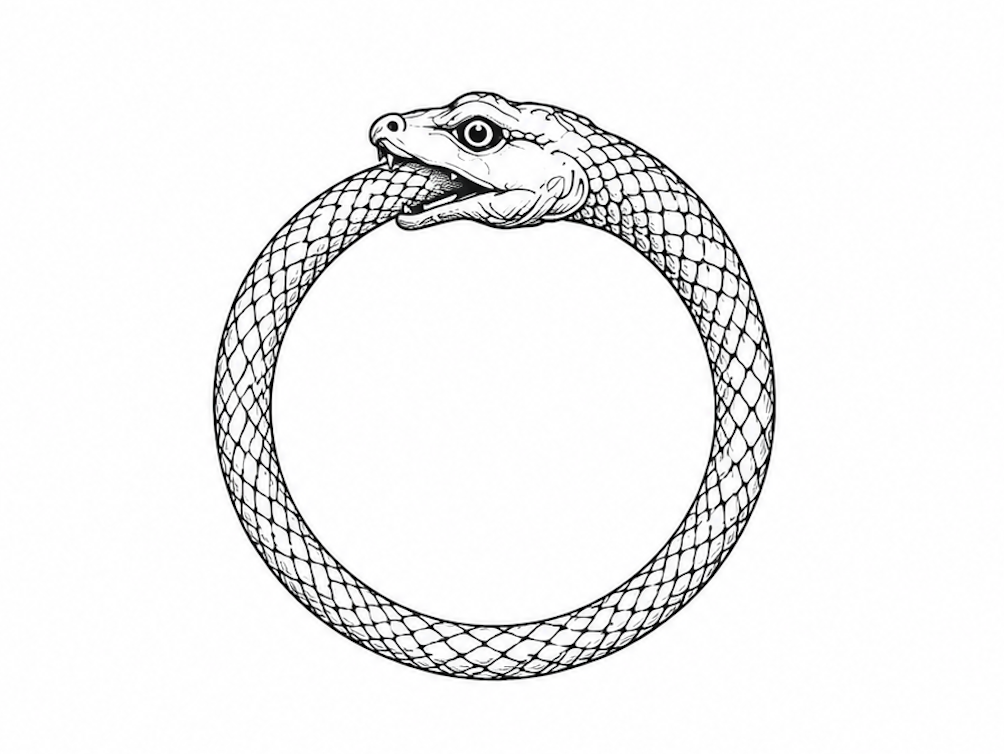
The following is a glossary of some of the key terms I use repeatedly in my writing, organized alphabetically. Many of you will already be familiar with them. The intent is to offer the glossary so new and unfamiliar readers may become acquainted with the otherwise obscure terminology used.
This glossary will be included on the header and may be updated from time to time.
Abraxas
The Jungian term for God as totality, the ultimate unity of all opposites (light and darkness, good and evil, creation and destruction, matter and spirituality, hot and cold, greed vs. asceticism, etc.) – God as quaternity, not trinity, comprising the Father, the Son, the Holy Spirit, and Satan. Jung originally articulated Abraxas in his Liber Novus, which wasn’t published fully until decades after his death, while the Seven Sermons to the Dead sub-portion was released during his life. He retreated from this horrifying conception of totality in his work, afraid that it would destabilize his patients and hurt his reputation, eventually offering a bridging myth in Answer to Job with the idea of an evolving but unconscious God. Abraxas is unconscious because consciousness arises from subject/object differentiation, and such distinctions are otherwise united within totality – life exists in order to add consciousness to totality via the lived crucifixion of opposites. Abraxas is not to be worshipped or identified with but to be recognized as the limit-condition of existence and individuated away from. See also: Crucifixion of Opposites, God-image.
Coherence (as a primary stabilizer)
The psychic configuration in which reality must not appear contradictory as a precondition for psychological stabilization. Contradictions on one level of existence (politics, culture, psychology, spirituality) are felt as intense and growing psychosomatic pressure which may only be resolved once the contradictions being faced are resolved, at least provisionally. When reality makes sense, the coherence-regulated psyche is relatively stable even if bleak; when reality does not make sense, it destabilizes even if life is comfortable. This work is intended primarily for this regulatory type, but not entirely, as anyone may cross the threshold under sufficient duress. See also: Stabilizers, Threshold.
Consciousness
A state of being which allows one to perceive, understand, and reflect on the external and internal world. It arises as a natural consequence of subject/object differentiation and while bearing and navigating the crucifixion of opposites. Consciousness born from limitation is the one thing that Abraxas lacks, as the opposites are otherwise united within it. See also: Abraxas, Crucifixion of Opposites.
Crucifixion of Opposites
The permanent condition and unbearable tension of inhabiting a reality constituted by irreconcilable poles (good and evil, matter and spirit, love and hatred, greed and asceticism, short term versus long term, light and darkness, persona vs shadow, masculine vs feminine, rational/scientific vs irrational/spiritual, action vs. reflection, justice vs. mercy, order vs. chaos, hope vs. lucidity) – see the term Opposites for how it is specifically used here. It is the condition of consciousness and a base condition of reality. The crucifixion must be borne somewhere by individuals – either offloaded to institutions, collapsed into antinomianism, or held internally via individuation. See also: Consciousness, Enantiodromia, Good and Evil, Individuation, Offloading, Opposites.
Egregore
A collective regulatory architecture which forms when sufficient individuals direct attention toward a shared symbolic object – a god, a nation, a team, an ideology – and that shared attention generates a field that in turn shapes what those individuals attend to next. This is a second-order cybernetic process in the von Foerster sense, and the egregore exerts back-pressure on individual God-images into compliance and conformity with the collective form, which is why they are often perceived to have taken on a semi-autonomous form. They follow predictable feedback-loop dynamics with growth, saturation and rupture. See also: God-Image, Noetic Commons, Regulatory Architecture.
Enantiodromia
An ancient concept from the Greeks and Taoism where a system, energy, or polarity, when pushed to its extreme, inverts into its opposite. Popularized in the modern era by Carl Jung, who used it to explain why the spiritual, anti-materialist energies at the start of the Christian era have been morphing into its opposite, seen in the symbol of the twin fish.
God-Image
The highest-order psychophysiological regulatory architecture which organizes perception, affect, interpretation, motivation, contradiction tolerance, and bodily coherence. As metabolic beings the God-image affects every nested belief beneath it, screening reality, filtering out competing perspectives, and maintaining psychic equilibrium, resulting in unstated hinge propositions. It is structurally analogous to the deep priors of predictive processing (Andy Clark): humans carry a model of the world, and sensory perception is used to identify errors in that model and update it instead of generating a model from scratch. Unlike the computational account, high-level prediction errors here are felt as bodily pressure, and when they cannot be resolved lower in the hierarchy they may force reorganization rather than revision. See also: Abraxas, Hinge Proposition, Metabolic, Prediction Error, Privatio Boni, Regulatory Architecture, Threshold.
Good and Evil
These are not ontological categories under this framework’s God-image, unlike the privatio boni, because Abraxas contains both within itself and therefore there is no cosmic backing, no ledger, no afterlife enforcement. Instead, they relate to the consequences of offloading the crucifixion of opposites onto others. “Good” means actions which sustain differentiated consciousness by not offloading into predation, projection, or scapegoating, while “evil” means collapsing another’s differentiated consciousness into an object serving one’s psychic economy. This is a claim about an act’s psychic consequences, not personal preferences, and is therefore not a claim of moral subjectivism even though it lacks the metaphysical enforcement privatio boni supplies. See also: Abraxas, Crucifixion of Opposites, Offloading, Privatio Boni.
Heleq
The term used in Ecclesiastes (2:10, 3:22, 5:18, 9:9) meaning “portion” or “lot” in Hebrew to describe what remains after every attempt to find a container for the crucifixion of opposites (wisdom, wealth, legacy, pleasure, etc.) has been tested and found insufficient. Insufficient does not mean empty but hebel, a term used dozens of times in the text and which translates as “breath” or “vapor”, something ungraspable. Heleq involves embracing finite experience and limiting the scope of one’s focus to what one can accomplish in one’s life, accepting responsibility for what one can affect while disclaiming responsibility for what one cannot change (see also the opening portion of the Serenity prayer) without collapsing into either despair or illusion. In the framework of this work, heleq is the path of individuation and differentiation under an Abraxian God-image, without any metaphysical promises that it accumulates into redemption.
Hermes of the Threshold
The adopted pseudonym of the author. Hermes describes a threshold function and not an identity here; it is the mediator and psychopomp which metabolically circulates meaning between incompatible energetic registers of his psyche (Saturn vs. Dionysus, or conscious order and chaos), articulating the impulses of each register and synthesizing them via writing output. The intent is primarily to increase psychosomatic regulation and coherence toward wholeness (an increase in one’s ability to live without splitting, projecting, or falsifying reality, even if it is painful), and is not intended to resolve into either rigid doctrine or escape.
Hinge Proposition
A Wittgenstein term involving propositions so fundamental that they are not believed but acted on, and that make all other beliefs possible. The redemptive person’s hinges include suffering is temporary, justice will be done, and that meaning exists. These are the conditions that make arguing possible, not things that people argue for. The Abraxian perspective hinges include suffering is permanent, justice is a human projection, and meaning is maintained, not given. When a redemptive person encounters Abraxas they do not encounter a disagreement, they encounter a different set of hinges – a different bedrock – and no amount of argument can reach across that gap because arguments presuppose hinges, and the hinges are different. Operating from a different perceptual apparatus creates loneliness, but that loneliness is hinge-structural, not social. See also: God-image.
Individuation
The internal response to the crucifixion of opposites. The ego holds the opposites consciously without ego-choosing one pole over the other, which can be quite mentally and emotionally painful, and over time a provisional answer arises from within or without called the transcendent function, a “third thing” received and felt as intuition. The intuition should still be balanced against one’s intellect and emotions, but intuition receives a higher standing than it has otherwise carried in the modern era. Individuation increases one’s consciousness toward wholeness but it offers no metaphysical guarantee, no redemption, and no final destination. It is difficult, uncomfortable, and lonely, and it is like balancing on a tight-wire over an abyss with the danger of collapse ever-present. It is constitutionally unavailable to most psychic configurations under ordinary conditions, but it may be thrust upon oneself if existing containers prove insufficient at bearing the crucifixion of opposites. See also: Crucifixion of Opposites, Threshold, Transcendent Function.
Metabolic (viability, coherence)
How well a God-image allows a person’s psyche and body to regulate, absorb, and sustain the tension between belief and experience over time. Distinct from ontological truth, which concerns whether the God-image describes what God or reality actually is. See also: Somatic Incoherence.
Noetic Commons
The shared, collective background assumptions, values, perceptual filters, and moral categories which a society uses to establish societal norms, guidelines, and meaning, affected strongly by the highest order egregore of shared belief. It is the aggregate expression of the collective demand by most people to offload the crucifixion of opposites to institutional authority. Elite networks shape and funnel this collective demand, but they do not generate it – they are providing most people what they want, which is to not think about finitude, death, or the uncertainty of existence. See also: Egregore, Offloading.
Offloading
The psychological process of displacing the crucifixion of opposites onto external institutions, authority figures, or cosmic narratives, so that one does not feel psychosomatic distress at the extreme uncertainties of life and an unknown afterlife. This is overwhelmingly the most common response to the crucifixion of opposites (compared to antinomianism or individuation). It is efficient and psychologically stabilizing most of the time and it is also a rational thing for most people to do under most circumstances, because it frees up psychic energy to devote to life – to friendships, work, hobbies, etc, but it trades consciousness for stability. Ego inflation occurs if one sees oneself as superior to those who offload, because feeling superior misses the issue of energy economics and efficiencies. See also: Crucifixion of Opposites, Noetic Commons, Resilience.
Opposites
Not intended as antonyms in the ordinary sense. Rather, two conditions count as opposites when they are actualized and foreclosed branches of a single selection event: differentiation process by selection at every scale (cell, embryo, species, ecosystems), and to select is necessarily to select against something else, which does not cease to exist as a possibility, only as an actuality for a finite standpoint. The selected and the foreclosed are bound together by the single act that produced both outcomes and are unintelligible apart from each other. Pushed across the full range of what could be selected for or against at any juncture, this relational structure produces something closer to a spectrum than a binary. See also: Crucifixion of Opposites, Enantiodromia.
Prediction error
Borrowed from predictive processing and used here by analogy: the mismatch between what a person’s expectations predict and what they perceive. Small errors are absorbed lower in the belief hierarchy. Those that cannot be are felt as somatic incoherence and, if they persist, may push a person toward the threshold. See also: Somatic Incoherence, God-Image, Threshold.
Privatio Boni
Literally “absence of good” in Latin. The theological doctrine formalized by Augustine, inherited from Neoplatonism that God is all good and emanates his goodness into the nether, where evil is merely a lack or privation of the good. It encourages people to identify with good and avoid evil so that they can go to Heaven and avoid Hell when they die. But because the foundation of this reality is the crucifixion of opposites, suppression of evil into the unconscious accumulates pressure and is eventually projected outwards onto designated enemies or otherwise leaks out in uncontrollable ways. The privatio boni is the metaphysical expression of the psychological demand to offload the crucifixion of opposites onto a cosmic authority that promises final resolution, where offloading is the most efficient and rational way for most people to relate to reality under most conditions. See also: God-Image, Offloading.
Regulatory Architecture
A structure at individual or collective scale that maintains equilibrium by governing how energy, attention, and contradiction are metabolized, in a cybernetic loop. God-images are individual regulatory architectures while egregores are collective ones, and they influence each other. This framework argues that these architectures are not merely beliefs but psychophysiological systems with measurable effects on perception, embodiment, and social coordination. See also: Egregore, God-Image, Stabilizers.
Regulatory Arbitrage
The practice of operating outside of a collective regulatory architecture’s constraints while still benefiting from the social stability provided by the architecture itself. In this work, the upper elites are described as deploying regulatory arbitrage by publicly enforcing the privatio boni while privately operating under a non-redemptive, antinomian framework that exempts them from its moral constraints. See also: Egregore, Noetic Commons, Regulatory Architecture.
Resilience
The capacity of a psychic structure (whether internal or external) to contain and metabolize the crucifixion of opposites without collapse. Individuation gradually develops internal structures capable of holding the crucifixion (via differentiated energies, gods, archetypes), while offloading the crucifixion onto institutions to hold it does not develop those internal structures. The question is not whether to bear the crucifixion, but where and by whom. See also: Crucifixion of Opposites, Offloading.
Somatic Incoherence
The persistent and intensifying psychophysiological friction produced when phenomenological data arising from lived experience systematically contradicts one’s conscious highest-order God-image. In predictive-processing terms, it is the felt form of high-level prediction error that cannot be resolved at lower levels of the belief hierarchy. Somatic incoherence is the primary driver of God-image threshold-crossing: when it exceeds a certain intensity the existing regulatory architecture can no longer hold, and reorganization becomes necessary rather than optional. Somatic coherence or incoherence depends on the individual and depends on upbringing, disposition, and life experiences. See also: Coherence, God-Image, Prediction Error, Threshold.
Stabilizers (Psychic)
The primary regulatory needs around which a psyche organizes to avoid the unbearable tension of the crucifixion of opposites. The five identified in this work are: (1) attachment and belonging, (2) esteem and status, (3) meaning and narrative, (4) control and agency, and (5) coherence and intelligibility. Most people have several, but one dominates. The dominant stabilizer determines how lived experience is interpreted and whether it serves to reinforce or undermine psychosomatic coherence, and they have different failure modes. The intellect is generally used in furtherance of one’s primary stabilizer, not the other way around. See also: Coherence, Regulatory Architecture.
Threshold
The point at which the psychosomatic cost of remaining inside one’s existing God-image exceeds the cost and uncertainty of adapting a new God-image. Threshold-crossing is a forced recognition produced by intense and unrelenting somatic incoherence, not a choice, and there is a near-universal process by which such reorganization occurs. Threshold-crossing is typically conducted from one redemptive God-image to another, and adopting a non-redemptive, tragic God-image typically only occurs if or after redemption as a category has been exhausted. The framework’s intended audience are those who have already crossed or are actively approaching crossing this threshold. See also: God-image, Individuation, Somatic Incoherence.
Transcendent Function
The intuition which arises mysteriously from outside the ego as a provisional answer when the opposites have been held in suspense long enough without collapse. It should not be listened to blindly but balanced against intellect and emotions, although it receives greater weight than modernity ascribes to it. The transcendent function guides the individuation process and provides a local orientation toward wholeness without ever achieving finality or involving any metaphysical guarantees of final redemption. See also: Crucifixion of Opposites, Individuation.
Note: You can sign up to receive email notifications of new posts here.