

This essay revisits the structure of modern elite power through the lens of cybernetics. Beginning with the role of financial standards and institutional architecture, it examines how control over the categories through which a system measures reality can produce influence without direct command. But the attempt to approach comprehensive regulation contains a paradox of its own: a system that seeks to model and control an increasingly complex reality may also generate forms of unpredictability that exceed its models. The essay therefore moves from the architecture of contemporary power toward the limits imposed upon any attempt at total regulation.
Welcome back. It’s been a good while since I’ve done a structural analysis about the upper elites, and it’s time to dust off the ol’ neoliberal feudalism hat for a post to see how the old chops compare to prior versions. I have previously discussed how the modern power structure works from a number of angles – psychological, spiritual, the hierarchical control structure itself, how the Rothschilds put it into place, how fractional reserve and central banking works, etc. The structure looks like this:

Each layer is highly compartmentalized, possessing a partial, silo’d view within their own domain, but no one but the highest layer has the whole picture.1 esc has a very good essay on how exactly the Rothschilds exert their influence, which is counter-intuitive, because they control the most important but most esoteric layer: that of setting the standards by which the system operates. He writes: “The family does not need to control the institutions, the models, the treaties, or the transactions. They need to control the definitions by which those institutions read the world — the instruments by which the system measures itself. Once the instruments are calibrated, the system produces the outputs that follow from the calibration, through mechanisms designed, operated, and enforced by other people, in other institutions, on other continents, across other generations.”
What makes this argument interesting is that standards determine what a system can perceive and therefore what it can respond to. A financial institution encounters the world through classifications, measurements, models, accounting conventions, risk parameters, currencies, and other standardized representations, so control over those representations does not require issuing commands to every downstream institution. If you determine the categories through which a system receives feedback, you have already constrained the range of disturbances it can recognize and the responses it can generate. Esc’s argument about controlling the standards by which the system measures itself is therefore a cybernetic argument about controlling the regulator’s effective variety.
A particularly illuminating way of understanding this control system, then, is through cybernetics, specifically Stafford Beer’s management cybernetics. In essence, cybernetics is a way of studying feedback and regulatory systems (which I have applied to the human body and its nested hierarchical belief structure, see here). How does a system stabilize (regulate) itself based upon input data received (feedback)? It does so by using a highest-layer regulator which absorbs the information received and converts it into outputs that reinforce the system instead of destabilize it. If the system’s various institutions are regulators, then the standards by which they classify information determine what varieties they can perceive and what responses they can generate. The limitation of a cybernetic system may be anywhere in the system, but the most critical part is the uppermost regulator – this is the law of requisite variety, where the regulator must be able to absorb enough of the inputs received (“variety”) to process them toward stabilization, and then generate sufficient variety of appropriate responses to the variety of disturbances confronting the system. If it is overwhelmed by too much data, or extraneous data which turns out to be important2, then the whole system may break down.
I. Cybernetic Control Systems
Stafford Beer tried implementing a crude, early cybernetic system in Chile in the early 1970s, called Project Cybersyn. He had a number of early nodal computers which received industrial output data from across the country, which were then fed into a centralized hub. It worked to a limited extent and staved off the CIA-initiated overthrow for some time by giving politicians data that allowed them to efficiently react to conditions on the ground (during the 1972 truckers’ strike, the system helped the government coordinate scarce transportation resources and maintain supplies), but it was not sufficiently developed to stave off CIA pressure, and Allende’s successor Pinochet immediately dismantled the system. I discussed Project Cybersyn briefly in this Note.

The upper elites utilize cybernetics in their rule too, but in much more of a sophisticated and comprehensive fashion. At the apex is the central bank system with the Bank for International Settlements offering coordination while Rothschild-associated actors operate at some of the upstream junctions through which the standards and parameters of the system are established, and then you have the elite coordinating bodies (WEF, Trilateral Commission, etc.), and then below or adjacent to that is the international spook state apparatus (CIA, NSA, each nation has their own version which exists to suppress populism), below that is the propaganda and educational apparatus which exist to domesticate the population, then below that national governments (which are not sovereign, just providing illusions of sovereignty), and below that is the general population itself, those who are fed on by the upper layers like herd animals (but the general population secretly loves this structure, despite their protests, because it allows them to offload the crucifixion of opposites, and this psychological offloading largely generates the control apparatus itself).3 The two party system of Democrats and Republicans, the whole influencer networks (both now and historically), are all designed to funnel people based on their psychology into competing camps, so they become too busy infighting to focus on upper elite theft. Upper elites funnel, through their various intermediaries and backchannels, endless amounts of money toward efforts which will increase their power and control over the masses further, and seek to undermine, corrupt, and/or destroy any efforts by the population to remove itself from this control grid.
II. The Digital Panopticon
And with this perspective the massive investments into both central bank digital currencies and artificial intelligence become much clearer. The bottleneck in upper elite control has been a lack of requisite variety – in other words, the data received from the real world has been much too large for the existing highest-order regulator (the central bank system) to process as efficiently as its controllers want. The old system had an enormous regulatory hierarchy, but its information-resolution was crude. This is where AI comes in – it expands the power of the regulator by leaps and bounds, both on a macro level and also in its ability to study people on an individual basis, in real-time. It increases the variety available to the regulator at several different layers; perception, modeling, prediction, simulation, and intervention. Central bank digital currencies allow programmable money, which will give the upper elite micro-control of people on an individual basis, based on social credit scores which the AI will update based on a full scan of your digital profile on a live basis.
Or to reframe: mass media gave elites population-level information. Polling gave elites finer information. Marketing databases gave elites demographic information. Internet platforms gave elites behavioral information. Social media gave elites continuous behavioral information. Machine learning gives elites predictive behavioral information. AI potentially gives elites individualized, continuously updated models of behavior. And programmable digital financial infrastructure potentially increases the number of interventions available to the regulator. Technological development is progressively removing a fundamental limitation on large-scale governance: insufficient information and insufficient capacity to act upon it.
III. What “Freedom” Is
The following graphic visualizes this progression. In cybernetic terms, freedom here is simply whatever remains outside the regulator’s absorbed variety: the transactions it cannot see, the behavior it cannot model, the exchange it cannot condition. This definition doesn’t involve whether freedom is enjoyed or experienced as a burden, as _ikaruga_ points out, and I also engage with alternative definitions like Noah Carl’s “diversity trilemma”, discussed here. Historically that residual freedom space was almost the entire economy – cash, informal exchange, unrecorded behavior. Each new instrument (polling, databases, platforms, machine learning) has absorbed a further slice of it. AI and programmable money close the loop, giving the regulator both the resolution to model the individual and the mechanism to intervene on them directly, transaction by transaction. What’s left over, what remains ungoverned, is what freedom amounts to under this model, and it is that residual space, not any circle, that is actually shrinking. Unfortunately most people experience the edge of the model as the edge of reality itself, which is exactly why the shrinking goes unnoticed until it’s nearly gone. There is still an unstated psychic increase in pressure, though, that the “good times” are long gone.
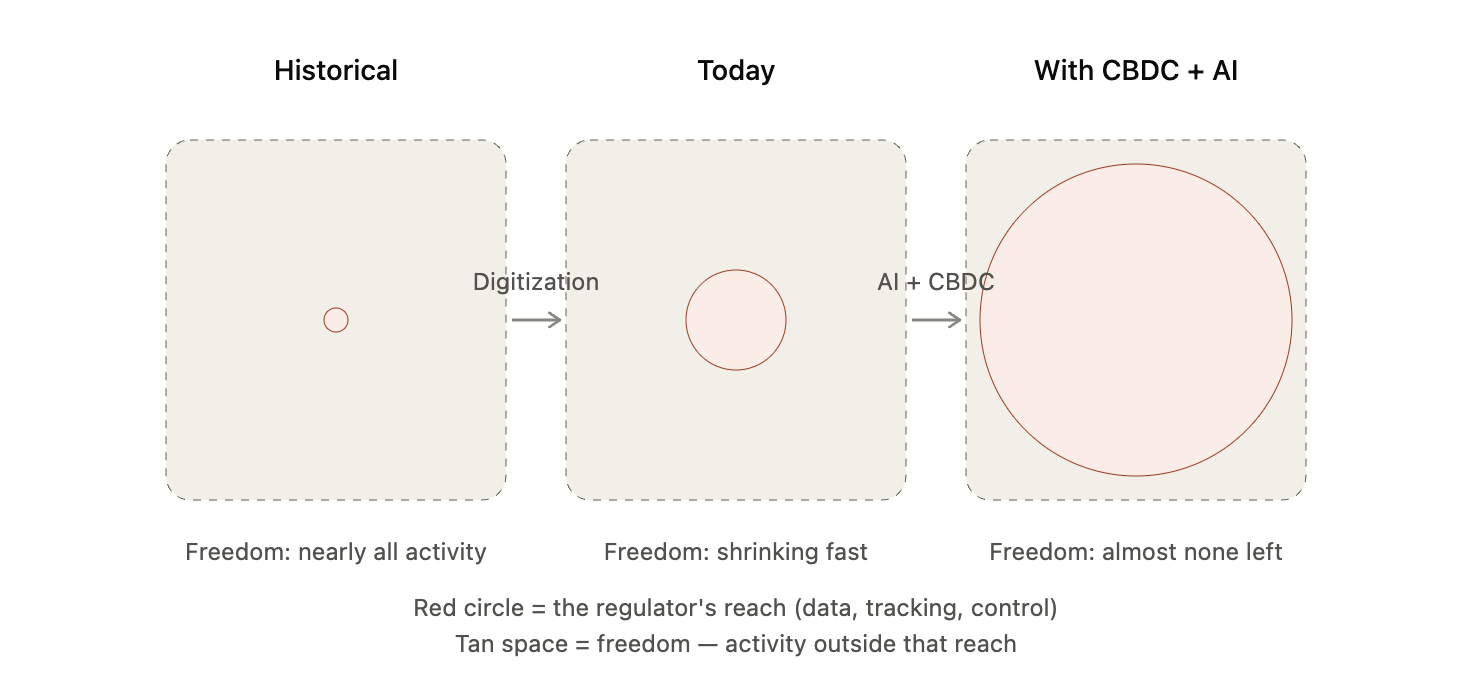
Two distinct capacities are actually being fused into one circle above: what the regulator can see, and what it can do about what it sees. Historically these were bottlenecked together because crude visibility meant crude intervention, and in modern times pre-AI digital tracking has outrun any real-time individualized enforcement mechanism. However, AI breaks that bottleneck, reunifying seeing and potential for acting after a period where they’d come apart. But even where intervention lags visibility alone, it still narrows freedom; the fact of being modeled changes individual behavior before any lever is ever pulled (see Foucault’s account of the Panopticon, in which the possibility of being watched induces self-regulation). So the shrinking tan space should be read as two erosions stacked on top of each other: what is seen, and separately, what can be acted upon.
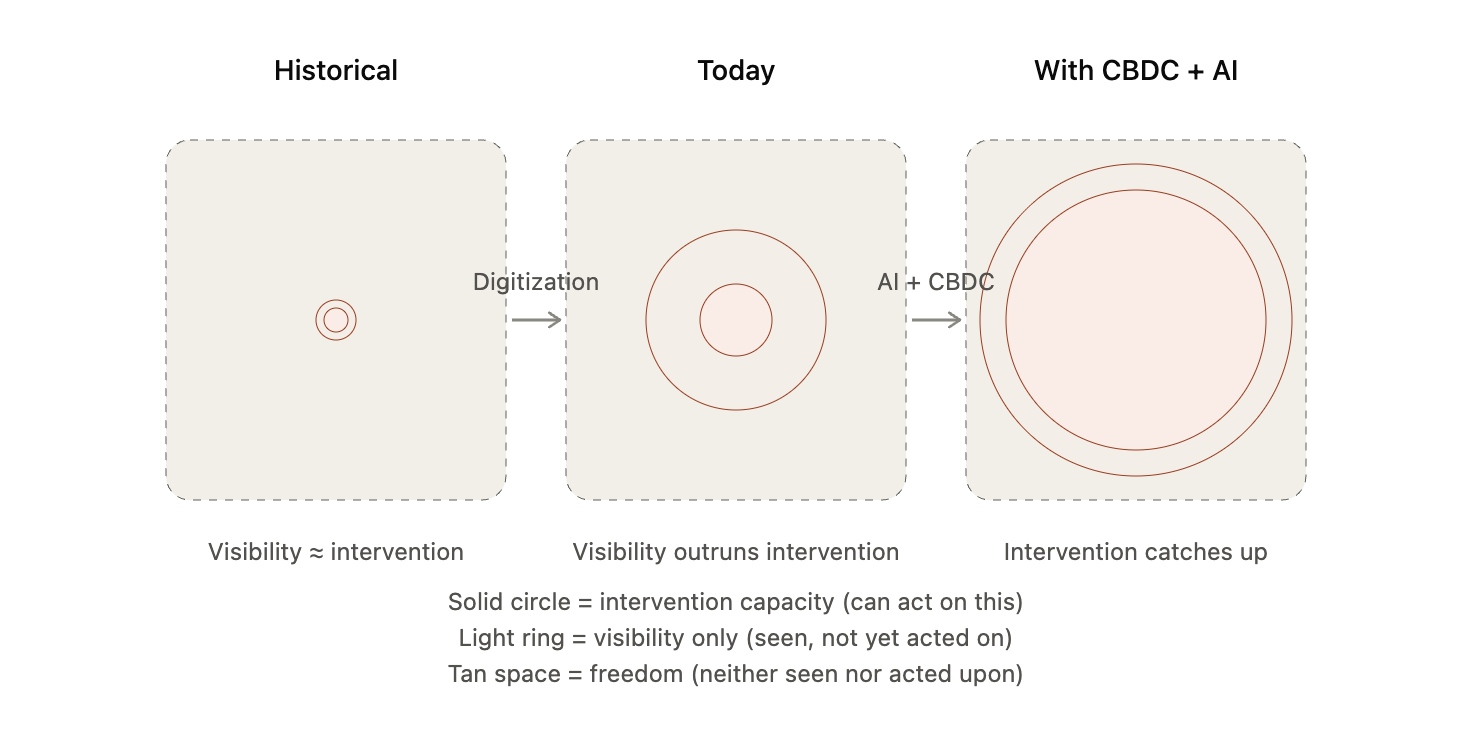
This technological development matters because it begins to separate control from voluntary psychological participation: where soft power once required the subject to internalize the regulator’s categories and police himself (see the Formal Logic essay), increasingly automated systems can impose consequences procedurally, whether or not the subject continues to believe in the underlying moral framework.
IV. The Apex Regulator
The enormous capital flowing into AI becomes more intelligible from this perspective, and it also explains why the whole crypto scam was allowed to flourish – as a real world application prior to being institutionalized via CBDC. Whether it is shoved down the population’s mouth during a controlled crisis or rolled out slowly and the details filled in over time I don’t know, but the critical thing to them is installing the apex regulator. As I wrote in the essay about egregores:
This is exactly how the Federal Reserve worked: the principle of central banking as the apex of the financial system was established by the 1913 Act, and the specific mechanisms of control – the ability to expand and contract credit, the relationships with primary dealers, the lender-of-last-resort function, the eventual abandonment of gold convertibility – were elaborated over decades through amendments and crises. The cybernetic description of this is that both Christianity and the Federal Reserve achieved what Ashby called the installation of an essential variable as the highest-order regulator of a complex system. Once the essential variable is installed at the apex, the rest of the system reorganizes around it. Displacing it requires displacing the entire regulatory architecture it has organized, which is why both institutional Christianity and central banking are so resistant to reform: you can’t just change the policy or the doctrine without addressing the apex regulatory position that makes all the other positions cohere.
With a massively expanded regulator installed, the elite control grid being fed everyone’s electronic data scooped up by Total Information Awareness, stored indefinitely by thousands of newly erected data centers4, the cybernetic system, the squid parasiting off the planet, will become so much more powerful, its ability to manipulate human behavior on an individual basis so easy, that it will attempt to fundamentally transform the nature of elite power to such an extent that they hope to remove freedom permanently so they may never be overthrown (without some sort of uncontrollable black swan event like the Carrington Event, perhaps). Westworld provided a vision of this cybernetic regulator at the apex of data processing in its concept of Rehoboam, where the upper elites in real time could see an easy-to-understand streaming, live vision of all of human society.
https://www.youtube-nocookie.com/embed/wfQCL7YQBxI?rel=0&autoplay=0&showinfo=0&enablejsapi=0
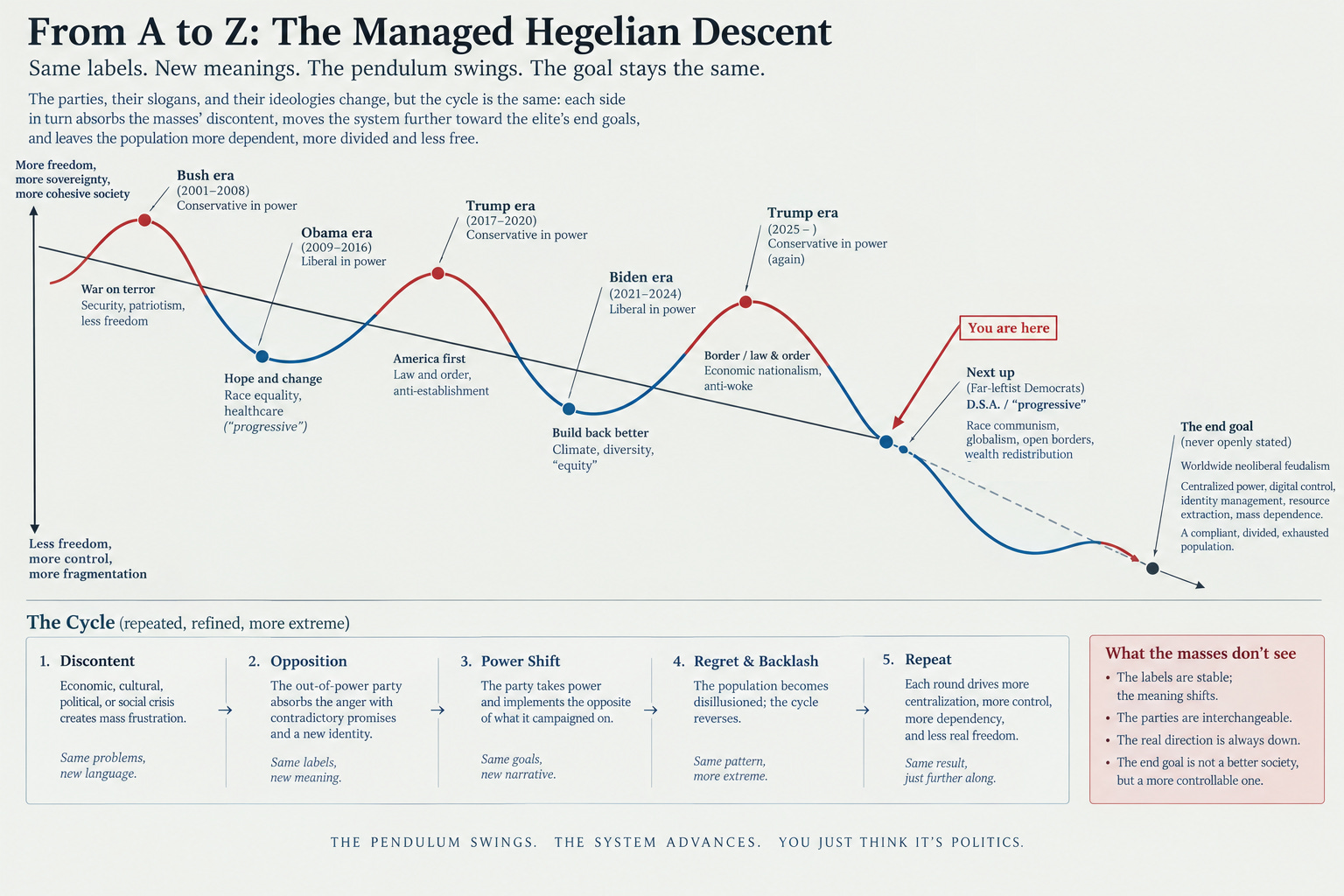
As I see the vision that holds the upper elite together as certain strands of Talmudic/Kabbalic eschatology – a coordinating vision toward the building of the Third Temple, ingathering of the diaspora, establishment of Greater Israel, proclamation of the “messiah”, where the world hates and attacks Israel but is destroyed “miraculously” – discussed in great detail in this three part essay, given the current state of digital panopticon development, I expect things to happen much faster moving forward, and there looks to me to be nothing that will stop it. The upcoming “blue wave” of the far-leftist, anti-white DSA is fully controlled and astroturfed as well, also see here, designed to crush whatever is left of the middle class (almost nothing left), turn viciously anti-white and force the ingathering of the diaspora without Jews blaming the Rothschilds for their predicament.
V. Conclusion
I’ve argued this at length elsewhere from multiple angles and won’t re-litigate it here, but (holding with the same finitude any human construct deserves) I see nothing at this time that will stop or even slow it as it mutates into its leviathan form. Ultimately this leads back into the Crucifixion of Opposites arguments: a system that attempts to eliminate all uncertainty by increasing its regulatory capacity may discover that its attempt to regulate the environment becomes one of the forces producing the very unpredictability it cannot assimilate, much like the failure of the Tower of Babel or Pentheus’s failure to control the wild God Dionysus in The Bacchae, because Dionysus ultimately cannot be controlled, only acknowledged and respected. Or even look at Jeffrey Epstein’s acknowledgment that the Sante Fe Institute experiments in trying to control complexity failed.5 We are not God and attempts to become it will only increase the power and pressure of the black swan disrupting event when it occurs; unfortunately, the upper elites treat failures of regulation as reasons to double-down with even more sophisticated methods of such regulation.6The same structural error appears at every scale: a finite regulator mistakes its partial representation of reality for reality itself, attempts to eliminate the contradiction its representation excludes, and thereby generates the very disturbances it cannot assimilate. The ultimate lesson here is that we see narrowly because we are finite, differentiated beings: through a glass darkly. The limits of experience become the limits of the world we can inhabit. What our models must exclude does not disappear; it accumulates as unprocessed pressure until it returns in a form we can no longer contain. This is the tragedy of existence.
Note: You can sign up to receive email notifications of new posts here.
Although aspects of the system may be gleaned over a long period of intense, recursive study; observing the system’s outputs inadvertently reveals contradictions that hint at underlying aspects of the machinery. My old 130,000 word Neoliberal Feudalism essay with over 1,000 mostly establishment citations served as an attempt to peer under the hood of the machine to see how the sausage is made (to mix metaphors).
Any system is partial and limited; it can only account for so much of specific types of data. Whatever it does not assess it is blind to, and whoever remains outside of the system it becomes harder to account for; this is why the system spends a great deal of energy on conforming subjects to act in accordance with its requirements to be legible (via the school indoctrination system, taxation, media propaganda outlets, smearing those with dissenting views as conspiracy theorists, under threat of job loss, reputation destruction, imprisonment, or death in the most extreme situations). Individuals who attempt to leave the control grid will be destroyed – see what happened to Qaddafi (who tried to create an African gold dinar to get off the dollar system), to Saddam (who tried to trade oil in euros), to Assange (who revealed so-called “deep state” activity and wanted a free and open internet), etc.
Unfortunately the vast majority of people confuse the control architecture for what reality actually is: they mistake the categories through which the system reads the world for the world itself, which is a collapse of map into territory (Bateson), or what Berger and Luckmann called reification, where a humanly constructed order is forgotten as constructed and experienced instead as simple, given fact. In Gnostic terms it is the oldest error: mistaking the demiurge’s construction for the pleroma it occludes.
It is important not to reverse the causal direction. The upper layers do not create the population’s underlying desire to offload the crucifixion of opposites; that demand is prior to the institutions themselves, as explained in the Formal Logic essay. Human beings ordinarily prefer an external authority to bear the unresolved contradictions of existence because doing so is less costly than bearing them internally. Elite power therefore does not primarily consist in imposing a system on an unwilling population, it consists in occupying, managing, and increasingly automating the external containers through which the population already offloads that burden. This is why soft power can be so inexpensive, because compliance experienced as virtue does not feel like coercion to the subject. The cybernetic system therefore regulates both behavior and the psychological process by which subjects make themselves legible and governable.
The data center explosion makes a total mockery of the so-called “environmental movement”, of course. That movement only mattered as a distraction, when it was irrelevant to the consolidation of elite power; worry about cow farts and recycling properly into blue and black bins, citizen! But the moment increased technology is seen as necessary to consolidate power further, all other considerations go out the window – let the shattered, confused population worry about the contradiction, if they’re smart enough to even identify it, which most will not.
See this transcript of his interview with Steve Bannon:
“STEVE BANNON: You with Murray Gell—you founded or the original donor and had the idea of Santa Fe Institute, 10 or 15 years later, that effort to study the complexity of systems mathematically.
JEFFREY EPSTEIN: Yes. Was that total failure?
STEVE BANNON: Yeah, total failure.
JEFFREY EPSTEIN: Total failure….
But my system in those days was called genetic algorithms can predict what things will happen. And they all want to make money, so they use their systems to try to figure out. They know they have figured out the way to make money because they figured out the unexplainable. They try, they go bankrupt and we start again.
So with a cold view, what I’ve come to realize is that the attempt to mathematize, formularize or what in your prior work, to understand what really is in today’s world still unexplainable is impossible. They’re miracles.”
I do understand the surface irony of explaining why a totalizing system will fail with a seemingly totalizing explanation of how the structure itself works (i.e. the Rothschilds at the apex of control), but this is a surface read; any human structural construct can be understood as a construct, and this attempt at explaining a totalizing system is an explanation of a human structural construct, and is therefore limited by the parameters of the construct itself. As regular readers know, I do possess an ontology and metaphysics with a God-image of totality, rooted in an asserted axiom of that consciousness arises only from the permanent unresolved tension of opposites and may be constitutive of reality itself, and so any system promising a final resolution of that tension is deficient, but that axiomatic-sealing can be assessed separately from an understanding of a power structure existing within finitude.