

Greek tragedy offers a strikingly non-redemptive vision of existence, in which suffering does not necessarily lead to salvation, progress, or ultimate restoration. Across the surviving plays of Aeschylus, Sophocles, and Euripides, human beings gradually discover the limits of their agency within a world governed by fate, divine powers, inherited guilt, and chance. Set against the modern redemptive expectation that suffering should ultimately be resolved or given a higher purpose, these tragedies instead explore what it means to recognize and endure a world whose deeper order may be intelligible without being benevolent.
In this post I will be providing a review of the extant works of the most famous Greek tragedians, Aeschylus (525-456 BC), Sophocles (497-406 BC), and Euripides (480-406 BC). This was a tremendously prolific period for Greek tragedy, which Aristotle later defined1 as possessing the following characteristics:
Tragedy, according to Aristotle, is the imitation (mimesis) of a serious (spoudaios) action, which is complete in itself…since tragedy imitates action, the most important element of a tragedy is plot (mythos), and character is secondary, a by-product of the action. The character in tragedy should be someone famous or prosperous, and must experience a change or reversal (peripeteia) in status from prosperity to misfortune. This will be accompanied by a recognition (anagnorisis), a change from ignorance to knowledge, and it will result in suffering (pathos). This turn of events will evoke feelings of pity or fear in the audience and effect a catharsis of those emotions – whether we understand that word to mean emotional purgation, purification, or intellectual clarification. To that end, the tragic character must be neither completely good nor completely wicked (since the suffering of such persons would not be fearful or pitiful). Rather, the individual will be someone like ourselves and will fall because of an error (hamartia) that he makes. This error will derive from some aspect of character, such as the sort of violent pride (hybris) that denies the distinction between gods and humans….What is missing from Aristotle’s analysis, however, is any sense of what lies beyond the suffering, any sense of its meaning or larger significance.
The golden age of Greek tragedy ended with the Spartan victory over Athens in the decades-long Peloponnesian War (431-404 BC) when Sparta installed the Thirty Tyrants as rulers in the city. It took some time to go through their corpus but less than one might have imagined, because only six or seven of Aeschylus’s 70-90 plays are extant, seven of Sophocles’s tragedies out of over 100 plays survive, and eighteen or nineteen of Euripides’ plays out of over 90 remain; what was preserved vs. what was lost is mostly due to the vicissitudes of history.2
My approach here is similar to my review of the television show Two and a Half Men, where my analytic deep-dive impulses were used so that my intense, excavating and investigative mind wouldn’t spin on itself; although the material here is heavier, higher status and more academic than a sitcom revolving around a Job figure paired with his hedonistic brother. These plays were performed in Athens’ Dionysian theatre in a yearly competition in front of up to 15,000 people, comprised of the chorus and a few all-male cast members in masks (Aeschylus introduced a second actor, Sophocles a third) and they often used historical events to allude to important political themes which Athens – as a belligerent expansionist power with a highly involved and unstable democratic citizenry3 – was undergoing.
The evolution of the tragedians reflected the evolution within wider society, mirroring the gradual transition toward secular rhetoric and rationalism via the sophists compared to the older form of mystery beneath the Gods, per classicist professor E.R. Dodds. Offloading the crucifixion of opposites remained a common denominator of the masses, both then and now.4 This transition was critiqued by Nietzsche in his uneven Birth of Tragedy, and the trends eventually culminated in the worldview of Socrates and Plato.
I. On Nietzsche
Nietzsche in his early work provides an aesthetic critique of Greek tragedy, finding what he believed to be Euripides’ rationalist perspective to be deficient, a decline compared to the order vs. chaos balance (Apollonian vs. Dionysian) of the older tragedians. At the time he was trying to justify Wagner’s works as a rebirth of the old art form, but he later abandoned this approach after experiencing disillusionment with Wagner. He then partially wrote off the work as amateurish, in line with attacks by critics.5 However, The Birth of Tragedy continues to be popular because the Apollonian vs. Dionysian dichotomy is an interesting and rich interpretive lens. What I would have loved to have seen Nietzsche do, though, instead of creating a broad narrative around the tragedians, was to go through each of the works one by one, or at least the major works, in order to establish his core point; he doesn’t do this, which means he is telling instead of showing. His points would have been much more effective if he showed the evolution of Greek tragedy toward rationalism by covering in detail the themes of the extant works and how they fit together. I will do something similar here by offering a brief review of each work chronologically.
Why do this? Because of my ongoing interest and fascination with non-redemptive worldviews, especially non-redemptive worldviews which offers cosmic legibility (even if amoral) instead of nihilism. Interesting questions arise: what did the ancient Greek worldview involve? What were the psychological, cultural, and political effects of such a perspective? How does it align with and differ from the privatio boni and the Abraxian perspectives? These issues have deep relevance to the so-called ongoing “meaning crisis”, rooted in failure of the Christian (and secular progressive) redemptive egregore which we are all experiencing today.
II. The Tragic vs. Redemptive Perspectives
As Stephen Esposito wrote in Euripides: Medea, Hippolytus, Heracles, Bacchae, the Greek perspective is very alien to us today, because the Abrahamic religions are essentially redemption-focused. Therefore, they must fundamentally deny the nature of tragic existence, even if there are slight counter-examples one could point to (Ecclesiastes, Job, etc.), but it was entirely possible to remain psychologically stabilized under such a tragic perspective:
Unlike the Israelites and Christians, the Greeks had no Bible or sacred book with a fixed truth (and so no religious fundamentalism, no “holy wars”), no Covenant with any deity, no Savior, no divine Revelation, no Prophets, no Decalogue, no dogma, no creed, and not much in the way of organized religion. In short, the Greeks did not have the “safety-net” – if that is the right expression – of the possibility of deliverance / redemption by the grace of an eternal, all-powerful, all-knowing, holy, just, merciful God of steadfast love…By their very constitutions the ancient theologies of the Hebrews and Christians might be said to preclude the possibility of a tragic world-view. Indeed, “one might even go so far as to say that for the Hebrews a ‘tragic’ world-view would itself be a sin: a denial of God.”…[for the Greeks] higher powers stalked the world, powers who ferociously protected their own turf, powers often beyond good and evil, powers unlike God, who Himself created good and evil (Isaiah 45.7). In such a world, human responsibility is radicalized; no safety-net exists except courage and friendship….
The monotheistic traditions of the Israelites and the Christians have not produced a genre of tragedy…For the Greeks, from Homer onwards, “man” is precariously poised between beast and god…the mutability of the human estate – perhaps the most persistent theme of Athenian tragedy – makes mortals susceptible to free-fall at a moment’s notice….ephemeral, insubstantial, fleeting, finite, and always yearning – that is how the Greeks viewed man’s lot in the world….for the Greeks there was no Redeemer, no Messiah, no Promised Land, no Second Coming, nor much in the way of an afterlife. Once the curtain fell, the show was over.
George Steiner echoes this point in The Death of Tragedy, where he writes: “Tragedy is alien to the Judaic sense of the world…Christianity is an anti-tragic vision of the world. [It] offers to man an assurance of final certitude and repose in God. This leads the soul toward justice and resurrection…Real tragedy can occur only where the tormented soul believes that there is no time left for God’s forgiveness.”
Furthermore, Esposito argues that an understanding and appreciation of a non-redemptive worldview may, paradoxically, allow one to better cope with misfortune on this plane because of the narrowing gulf between redemptive expectation and reality, and to teach certain virtues.6
III. Rating Criteria
According to Matthew S. Santirocco, Aeschylus holds out hope that the will of the gods will be ultimately revealed to us, Euripides “problematizes” the gods (pushed back on to an extent by Greek tragedian translator Paul Roche7), while Sophocles keeps the role of the Gods enigmatic.8 I don’t think these generalizations quite hold up, as we will see in the following reviews. They will be graded on the basis of the following factors:
- Dramatic structure: Does the play work as a story? Is it easy to read, engaging, and make sense on its own terms (this is affected too by the translation used – Fagles was excellent, for example, although his Serpent and the Eagle introduction in his Oresteia trilogy was overwrought);
- Anthropology: What does the play imply about human nature and human agency? I prefer plays where the behavior highlights universal as opposed to particularist themes;
- Cosmology: What kind of reality do the gods, fate, necessity, chance, pollution, etc. imply? I prefer plays where the cosmology contains a legible moral system, even if it is amoral. A world governed by fate, pollution, divine necessity, inherited curses, divine jealousy, erotic compulsion, etc. can be cosmically meaningful without being morally comforting (this is why Shakespeare’s works do not resonate with me, even though I’ve tried to read him many times9);
- Epistemology: How much can human beings actually understand about that reality? I prefer plays which do not assume that ultimate reality can be understood via rationalism and secular rhetoric – like Nietzsche, I think the stronger works are those where human experience is always partial, finite, and groping largely in the dark under mysterious forces that are beyond the scope of understanding; and
- Novelty: The deus ex machinas, the human sacrifices, the conflicts over burial of the dead, the same stories told from different angles get boring after awhile; they are strongly reminiscent of modern day superhero movies (“capeshit”) telling variations of the same origin stories.10 Now, the below plays were not read in chronological order (I read Aeschylus last instead of first, even though he was the earliest tragedian), and there was some degree of rating benefit from being read earlier and some degree of penalization for being read later; I tried to account for this dynamic once I became aware of it. Furthermore, most of the plays read had historical and cultural contextualization by the translator in physical book form, but a number of the lesser plays which were harder to acquire I read online and did not, and this may have detracted to an extent from my understanding. This isn’t fully specified below but it does impact some of the reviews.
With that said, let’s briefly review the plays of Aeschylus, Sophocles, and Euripides based on the above factors. Chronology is based on production date, not composition date.
IV. Rating Aeschylus
- The Persians (472 BC). Aeschylus’s oldest surviving work and the second part of an otherwise lost trilogy, it details the aftermath of the defeat of the Persians at the decisive Battle of Salamis. Over half of the dialogue is by the chorus, and much of the rest is either by the mother of king Xerxes, her husband Darius’s ghost, and a bit by Xerxes wailing about his loss. It wasn’t clear to me whether the play meant to mock the Persians or empathize with them; the ambiguity is a mark of strength. But the play is short and it is very one-dimensional; the Persians lose, attribute the loss to the anger of the Gods, and they wail about it. Rating: 3/10.
- Seven Against Thebes (467 BC). This is the earliest Greek tragedian account of Oedipus’s sons Polynices and Eteocles, who kill each other in one to one combat, fulfilling a curse by their father, and is the third part of a trilogy, the other parts of which are not extant. The original myth dates back at least to Homer’s The Odyssey if not further, and the overall myth later inspires Sophocles (Antigone, Oedipus at Colonus), and Euripides (Hypsipyle, The Phoenician Women, and The Suppliants). I don’t really like the chorus explaining so much of the plot; I do understand that Aeschylus expanded the number of actors on stage and invented Greek tragedy as we know it, but I prefer the chorus to take a more background role and for there to be a more dramatic, show-not-tell larger cast. I found this one to be boring. Rating: 3/10.
- The Suppliants (463 BC). The first part of a tetralogy, the other parts having been lost. Same problem with the prior plays; too much chorus, and the chorus here is the protagonist (a group of women fleeing arranged marriage). The plot features a king torn between protecting them (and risking war with those pursuing them) or turning them away (risking Zeus’s rage). Rating: 3/10.
- Agamemnon (458 BC), part one of the Oresteia trilogy. This is a powerful play, dealing with rich themes – the wife of Agamemnon who waits ten years to avenge her daughter (murdered by her husband as a sacrifice necessary to allow the Greek ships to set sail for Troy), Cassandra the prophetess destined not to be believed, knowing she was heading to her and Agamemnon’s doom; the role of blood guilt, how it haunts Agamemnon’s family generationally (his father fed his nephews and nieces to his unknowing brother as part of a power struggle; did the infamous South Park episode take its inspiration from it?). The dialogue is a bit flowery for me, but the plot does move well, and there is something archetypal to the story and aspects of this story were later repeated by the other tragedians from various angles. The Gods are alive and heavily influential, and everyone has some justification for their actions; as Nietzsche stated regarding Aeschylean tragedy: “all that exists is just and unjust and equally justified in both” – this is an excellent line. However, it is not to me as strong as Oedipus the King or The Bacchae, because those deal more directly with mankind’s smallness and ignorance in relation to fate and the Gods. Rating: 8/10.
- The Libation Bearers (458 BC). Orestes, the son of Agamemnon, kills his mother and her lover to avenge his father’s death. Part of this is to fulfill prophecy, but part of it is free will – knowing the prophecy, he decides to fulfill it. This is much less interesting as a hook than Oedipus struggling against his destiny, or even Cassandra knowing her upcoming destiny, lamenting it, but heading toward it anyway. Also, I didn’t like that Orestes didn’t acknowledge his mother’s motivation for murdering Agamemnon – his own sacrifice of his daughter and Orestes’ sister as a way to seek favor from the Gods for the Trojan war effort. The character is unbalanced, and hanging over both him and his family is the multi-generational blood guilt. I would typically give a play like this, which was pretty two dimensional, a 4/10, but seeing how much power it had over the subsequent tragedians where they kept remixing this from various angles, I will give it a Rating: 6/10. Even though I read this out of order (late in the process), I am consciously awarding points for being first chronologically here.
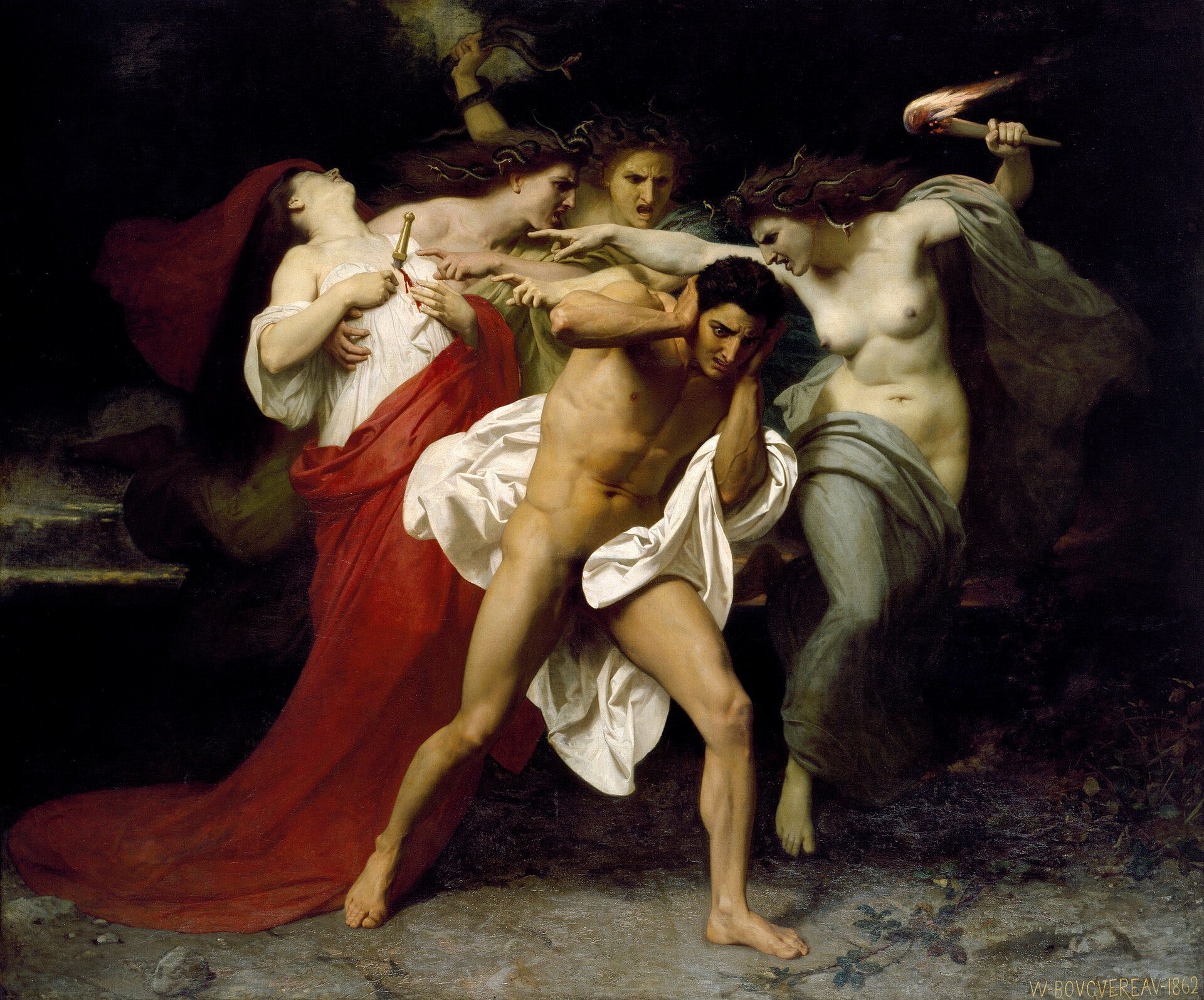
- The Eumenides (458 BC). Orestes is put on trial for the murder of his mother; the Furies want him convicted, while Apollo (who egged him on) and ultimately Athena want him to be declared not guilty. The vote is a tie, which means not guilty. The Furies, furious, are placated by an increase in power and respect so long as they let go of their anger, which they agree to do. This play isn’t a tragedy, because no murders happen here and it has a redemptive ending – further, the underlying message is that institutional, governmental justice is required for events with intractable problems for societal stability. I was conflicted on this one; it articulates the necessity of government to ascend beyond blood-for-blood violence (and also inherited blood guilt11), but it also seems to me to be a secular solution – although Apollo and Athena both feature heavily in this play, neither of them are omnipotent, they clash with the Furies (who Athena didn’t even recognize initially), and so this one lacked the metaphysical focus which so interests me. I would give this a 5/10 – it is slightly better than The Libation Bearers because it highlights issues beyond blood vengeance, but will elevate it to Rating: 6/10 based on novelty and the effect it had on future tragedians. This is a strange note for the earliest of the three tragedians to end on – one might have expected Aeschylus, writing first, to have the most fate-heavy, most metaphysically total plays in the corpus, with the shift toward secular/rationalist resolution belonging to Euripides per Nietzsche’s original decline narrative. Instead the earliest surviving trilogy ends by explicitly retiring the old vengeance-cosmology in favor of a human court, which is an important data point against the clean Aeschylus-mystery → Sophocles-opacity → Euripides-rationalism decline story that Nietzsche promoted.
- Prometheus Bound (uncertain, authorship and date disputed). This one is excellent, quite mythic. Prometheus is bound hard to a rock to suffer torture at the orders of Zeus, because Prometheus gave mankind the gift of fire. Prometheus had been told by his mother a prophecy of what would happen, that Zeus would be overthrown, and that Prometheus could not die; he laughs in the face of the Gods and their torture. He is willing to deal with Zeus to change the prophecy, but only on equal terms; he hides his prophecy in the meantime and mocks them. Io, hounded by Zeus and Hera, seeks his guidance, which he offers, but it terrifies her and she runs out. Hermes comes to try to talk sense into Prometheus, but the latter shoos Hermes off, and Zeus strikes Prometheus into a much more agonizing fate at the end. The plot is excellent, riveting; the themes are timeless – fate vs. free will, punishment for doing the right thing, how pain changes perception. Excellent. It ends on a cliffhanger, so this was likely part of a longer work, no longer extant, called Prometheus Unbound. Rating: 9/10.
V. Rating Sophocles
- Ajax (450–440 BC). The Trojan War hero Ajax kills himself after he’s embarrassed in front of the Greeks for being bewitched into killing the Greeks’ own captured livestock. Athena is directly involved in this play influencing outcomes but human will is a major factor; the tragedy is weakened by the arrogance and hubris of Ajax’s personality. This play echoes situations arising in both Antigone (a clash over burial rites) and Euripides’ Heracles, and the second half is much stronger than the first. Rating: 5/10. Longer review here.
- Antigone (442 BC). The plot on this one is narrow-scope and it highlights the importance of moderation over clinging dogmatically to any particular polarity, however, it didn’t quite hold my attention. One moment – when Antigone argues a brother can’t be replaced with both parents dead, while a husband or child can – is noted as being a historically strange plot device, not justified by the motivation of the character within the story itself, and especially strange because the brother at issue is dead, not alive. Rating: 4/10. Longer review here.
- Women of Trachis (440–430 BC). I really enjoyed this one, and it surprisingly had echoes of Oedipus the King to me. The heroic Heracles is returning home after being gone for more than a year, bringing back war booty in the form of female sex slaves. His wife Deianeira is sympathetic with the women who have lost their homes and families, but accepts that her husband cheats on her rampantly; she uses what she thinks is a magic cloak to try to keep his love, but the cloak turns out to be poison and it kills him instead; horrified, she then kills herself. Heracles reveals on his deathbed that the poison used – from a long-dead centaur – fulfills a prophecy he was told about how he would die, and he was also told his labors would end at this time, it just wasn’t clear whether it was from victory or death. So it appears that, like in Oedipus, humans act with what they think is free will, but it turns out to be part of a larger plan – and one may note that Heracles had vigorously done the will of the Gods, and death was the repayment (although they elevated him to Godhood after death). I liked this one because it shows the limits of human reason and willpower; it wasn’t quite as good as Oedipus, though, because Oedipus actively tried to escape his fate, whereas here the characters acted without broader knowledge of what would transpire. Rating: 8/10.
- Oedipus the King (430 BC). This reworking of a much older tale, for which Homer offers an earlier version, earns its reputation as the greatest play of Greek tragedy, although I would argue that The Bacchae is close behind. Oedipus is told his fate, does everything he can to avoid it, but in trying to avoid it causes it to happen. It highlights the nature of free will vs. fate, and suggests that fate dominates – except that free will exists in whether to embrace one’s destiny or resist it. Plotting and dialogue is top notch, and Oedipus’s inquisitive, strong character adds to the ultimate tragedy. This one hits hard, especially the end. Rating: 10/10. Longer review here.
- Electra (420–410 BC). This features a simple revenge plot: Agamemnon is killed by his wife Clytemnestra because he sacrificed their oldest daughter to the Gods in order to be allowed to sail to Troy; now Clytemnestra’s children Electra, Orestes, and Chrysothemis want revenge. Orestes concocts a scheme and carries it out, killing his mother and her paramour Aegisthus. There is very little conflict in terms of ideas other than whether Agamemnon was correct in his actions – he was very reluctant and only sacrificed his daughter because he faced mutiny and paralysis for his fleet if he didn’t accede, but Clytemnestra didn’t think he had any right to kill her. The Gods don’t feature in this play, but it’s also not psychological. It’s a flat, inert, 2-dimensional thing. Rating: 2/10.
- Philoctetes (409 BC). Philoctetes is given the bow of Heracles but he is stranded on an island alone with a wounded foot that won’t heal. Neoptolemus, a young man, and Odysseus come to retrieve him after receiving prophecy that Troy won’t fall without both Philoctetes and his bow. They trick him into giving up his bow, but Neoptolemus feels guilty at his treachery and returns it and promises to take him home – but in a deus ex machina, Heracles appears and tells Philoctetes to obey and he agrees. This play was OK, but I didn’t really like the subject matter – tricking an injured man out of the tool he uses to stay alive – and while I understand the competing forces at play (individual vs. collective need, honor vs. pragmatism, desire for revenge vs. giving in to necessity, etc.), the pacing dragged and I just wasn’t pulled into the drama very much. Using deus ex machina bothers me when the play around it is already dragging and thin, and doesn’t bother me as much when the surrounding material is doing real cosmological work (see Ion). Not a bad play, but it doesn’t possess the deeper issues that entice me. Rating: 5/10.12
- Oedipus at Colonus (401 BC – posthumous production; written earlier). The plot is weak and it was a struggle to get through, although it does hit on interesting themes about accepting one’s fate (and one’s responsibility for it vs. lack thereof), Oedipus’s relationship to family/friends/nation, and the strange forms such redemption may take. Rating: 4/10. Longer review here. I will note that the sort-of “trilogy” of Antigone → Oedipus the King → Oedipus at Colonus, where Antigone stubbornly insists on her polarity and is destroyed, Oedipus has a large ego and thinks he can rationalize himself out of destiny and fails, then Oedipus more humbly accepts his portion in life, mirrors the Jungian conception of the individuation process (which typically occurs in the second half of life after the ego fails, previously discussed here) and also the Ecclesiastian conception of embracing one’s portion, discussed here and less directly here.
VI. Rating Euripides
- Alcestis (438 BC). The oldest of Euripides’ surviving works – although he had been producing plays for seventeen years already – this is a strange play, occupying the pro-satyric fourth slot (leaning toward comedy) with a redemptive conclusion. The tone is wildly uneven and the topic is ridiculous; a wife offers to sacrifice herself so that the husband may live longer, until Heracles bests death and brings her back to life. I really don’t know what to make of this one, the plot is unlike anything else I’ve seen; so for the novelty factor and for the ease-of-read I’ll give it a Rating: 5/10, even though its ambiguity gives it a dilettantish, whimsical feel.
- Medea (431 BC). This one is really disturbing about a mother who kills her children in revenge against her ex-husband, and it has a very rationalist bent where Medea chooses to commit horrors after weighing the pros-and-cons; the Gods in this one are blamed for human psychology, and there doesn’t seem to be much of a legible cosmic order. It ends with a disturbing amoral deus ex machina. I’ll give it a Rating: 5/10 because the horror, despite the weak metaphysics, leaves a lasting impression. Longer review here.
- Children of Heracles (430 BC). Eurystheus, the king known for giving Heracles his labors, tracks down Heracles’ children in order to murder them so that they do not grow up and seek revenge against him. The King of Athens wants to protect them, but he consults multiple oracles and all tell him that a virgin of noble birth must be sacrificed for the protection to be effective; one of Heracles’ daughters volunteers herself. This play is flat and two-dimensional, but it was interesting to see how human sacrifice could be used as an extraordinary means of trying to secure favor of the Gods. Rating: 3/10.
- Hippolytus (428 BC). Hippolytus turns down the advance of his stepmother Phaidra, who kills herself but blames him. There is a lot of Sophistic debate in this one and the plot falls apart because it doesn’t make sense why Hippolytus would keep his stepmother’s rejected advance a secret after her underhanded tactics; the oath he swore would not have been made under a condition that the stepmother could then bludgeon him with it. Rating: 3/10. Longer review here. (Note: this is a remake of an earlier lost play called Hippolytus Veiled; in the earlier version Phaidra is portrayed as a bold sexual predator and the audience hated it and it failed, which surprised Euripides; he discusses his disappointment at its failure in the excellent but short recollection in Why I Wrote Two Plays About Phaidra, translated in Grief Lessons: Four Plays by Euripides by Anne Carson, although this might have been an imaginative reconstruction).
- Andromache (425 BC). This was seen as an unpopular play when it was performed, and I didn’t like it much; Andromache, the wife of Hector until he was killed, becomes a slave wife of Achilles’ son Neoptolemus, who then also marries a princess from Sparta named Hermione. A fallen prince Orestes arrives and carries off Hermione after arranging for Neoptolemus’s death. Andromache comes across as sympathetic, subject to a series of very negative life twists, living a life at the whims of others, and everyone has some claim to their positions, but the play is boring and it isn’t plotted very well. The agon or debates between the characters are strong. It ends with a deus ex machina. Rating: 3.5.
- Hecuba (424–423 BC). This one is similar to The Trojan Women below in the sense it deals with what happens to the losing women of war – slavery, rape, death, suffering, mourning, and gets the same Rating: 6.5/10. Hecuba, the queen of Troy, loses all of her children to the war, and she seeks revenge against a Trojan ally that had betrayed her and killed her last son. This one is heavy and tragic, and there are no Gods present; Hecuba’s daughter’s nobility while being sacrificed to honor Achilles was a high point, and even though the play wasn’t overtly psychological, Hecuba’s descent into a revenge-oriented mindset was an interesting one to watch.
- The Suppliants (423 BC). I was bored by this one and ended up skimming it; retrieving the bodies of the dead against opposition is a theme that has been done to death (ha) in Antigone and Ajax, among others. The speeches are way too long, the themes are flat and boring, the drama is stilted; this was just highly uninspiring. Rating: 2/10.
- Electra (c. 420 BC). This tells the tale of Electra and her brother Orestes murdering their mother because she killed their father. This story had already been covered by both Aeschylus and Sophocles; this telling mocks Aeschylus’s version to an extent by poking holes in the earlier version’s plot. The story is well written, I enjoyed the part about inspecting sacrificed entrails as a divination tool, and the question here is not really fate vs. free will, but the nature of a self-fulfilling prophecy – Orestes does not want to kill his mother, but feels compelled to because of a prophecy made by Apollo. Still, I don’t think it works that the mother and lover are killed at different times, Electra is a fairly unpleasant character, and the story ends with her trading-up husbands to a much higher class husband. Rating: 6/10.
- Heracles (416 BC). Heracles saves his family from the local ruler, but then is possessed by the Gods (as revenge for a slight) and murders his own family. The plot and pacing on this one are strong, but the outright body possession takes out the moral agency of the main character and dampens the tragedy, and the ending is kind of bizarre. This one does not have too much of a rationalist leaning. Rating: 6.5/10. Longer review here.
- The Trojan Women (415 BC). This depicts the aftermath of Greece’s victory over Troy and how the women and children, filled with grief, were divvied up among the victors as slaves or to be killed. This play is not tragedy in the usual sense – the tragedy has already happened when the curtain rises. It premiered shortly after Athens’s ruthless and infamous massacre of the men of Melos and enslavement of its women, making the play’s depiction of cruelty deeply relevant and critical of Athenian foreign policy. It also discusses the whimsy and the erraticism of the Gods, for whom favor is always temporary and subject to reversal. Poseidon and Athena go from enemies to co-conspirators purely out of pride. One leaves this play with a feeling of Demiurgic heaviness; we suffer either from the gods’ absence or their arrival. Rating: 6.5/10.
- Iphigenia in Tauris (414–412 BC). I actually couldn’t read this one, the only one of the tragedies I felt unable to read, because I disagreed with the premise. It was like the underwhelming play Helen (see #13 below), but worse, because the core plot forces an underlying historical tragedy to be rendered near meaningless. As background, Agamemnon sacrificed his daughter at the behest of an oracle in order to derive good tidings for the war against Troy, a horrible and tragic act; but in this play the results of the tragedy are rendered moot, toothless, because Iphigenia, the sacrificed victim, is swept away into a new land to begin a new life. This just doesn’t work. Tragedy does not exist to be merely swept under the carpet; the important thing is dealing with its implications. Rating: 0/10.
- Ion (414–412 BC). Ion is lovely because the play is set-up as a tragedy but which provides for hope and grace at the end, quite unexpectedly – here the deus ex machina worked for me. This is contrasted with The Bacchae where intense doom manifests for all involved, even the arguably undeserving. The Gods conspire and have a very strong impact on human action, but human agency is still partially retained, and the Gods plans often go awry. Rating: 8/10. The trap of political sovereignty is discussed briefly in this Note.
- Helen (412 BC). Helen of Troy never went with Paris to Troy; instead, the Gods sent a clone of her and she spent the war in Egypt in chastity. Menelaus, her husband, tries to rescue his real wife (after the clone disappears) from the Egyptian king who wants to marry her. Was this intended as a send-up lampooning justifications used for war, that the pretexts aren’t real and the bloodshed was for naught? The meaning of the war was casually wiped away using the pretext of a clone – it put a mockery to everyone involved, including the capricious Gods – and perhaps this was an early evisceration of propaganda used to generate war, that many died for no reason at all. But the plot doesn’t work and is silly. Rating: 2/10.
- The Phoenician Women (411–409 BC). This one was terrible; it had the same characters and themes associated with Sophocles’ Antigone (442 BC) and Oedipus the King (430 BC), but from the angle of Oedipus’s two sons who fight and kill each other. The theme of oracle predictions and human sacrifice to appease the Gods was interesting, but everything else had already been done and better in those two prior plays. Apparently there is debate about whether this is even an Euripides’ play. The plotting drags and the dialogue isn’t anything special. Rating: 2/10.
- Orestes (408 BC). This is a wild one – per Theodore Buckley in The Tragedies of Euripides, “the play is among the most celebrated on the stage, but infamous in its morals; for, with the exception of Pylades, all the characters are bad persons.” Orestes and his sister Electra are condemned to death for the murder of their mother (who in turn had killed their father Agamemnon); their uncle Menelaus refuses to step in to save them (because his standing among the Greeks for causing the Trojan war is so low), so Orestes moves to kill Menelaus’s wife Helen – but she is saved by Apollo – and to kidnap and potentially murder his daughter Hermione, but Apollo steps in at the end with a deus ex machina and puts everyone into their rightful place. This play features plotting, action, and chaotic anarchism; it is disturbing, and perhaps reflects Euripides’ feelings toward the failing Peloponnesian War that peace is a high virtue. But it doesn’t touch on the metaphysical/ontological issues I care about, and so ultimately had trouble holding my attention. Rating: 4.5/10.
- The Bacchae (405/406 BC, posthumous production). In this one, considered to be the strongest of Euripides’ plays, Dionysus manifests in human form, causes chaos in King Pentheus’s lands, and then results in the murder of Pentheus by his own possessed mother. The theme of this one is how limited rationalism is in the face of an irrational God, which stands starkly in contrast against Nietzsche’s argument about Euripides-as-rationalist-endpoint-of-tragedy. This is a truly excellent play, Rating: 10/10, and I will cover it separately in its own post.
- Iphigenia in Aulis (405/406 BC – posthumous production). Agamemnon is told by an oracle that he must sacrifice his daughter to the Gods or the war on Troy will go disastrously.13 He complies, but only after hesitation and attempting to backtrack, and other events conspire that the tragedy is carried out. This is a good psychological play and tragic, but the ending (where the daughter disappears and a deer is sacrificed) is widely considered an interpolation by someone after Euripides had died (he died before the play was finished) and undermines the whole tragic nature of the story. While I understood Agamemnon’s crucifixion between desire for victory against the Trojans, the responsibility of command, and his love of his daughter, that he even considered sacrificing his daughter (which has rhythms of Abraham’s sacrifice of Isaac) speaks very poorly of his character, although child sacrifice was treated in a different context in ancient Greece than today. I would give it a Rating: 8/10 up until the interpolated ending, which undermines it to a Rating: 6/10.
- Cyclops (uncertain date), the only surviving Satyr play. A retelling of Odysseus blinding the Cyclops, it has some funny one liners and a lot of rhetorical sparring. The Cyclops is blinded in part because of his arrogance and dismissal of the Gods. Pretty entertaining, but not very serious stuff. Rating: 6/10.
- Rhesus (uncertain date and authorship; it may be a very early satyr-esque play with underdeveloped author voice). This is a retelling of the Rhesus episode from The Iliad, where Odysseus sneaks into the Trojan camp and assassinates the Trojan ally stealthily. The Goddess Athena appears and talks out of both sides of her mouth, predicting the future. This one was pretty good; I didn’t really appreciate Odysseus’s underhanded tactics, even though they were brave – they were not honorable, but effective and understandable tactics. One of the themes is how much trust one should extend; Hector is (incorrectly) suspicious of Rhesus arriving to the war late; the guards (incorrectly) accept Odysseus’s code word when briefly caught; Rhesus’s soldier doesn’t know who to believe about who killed his king. But the metaphysics are underdeveloped in favor of action, the plotting drags and the characters are mostly two-dimensional. Rating: 6/10.
VII. Analysis
Looking at the scores:
Aeschylus averages 5.42 based on only seven plays, with the highest being Prometheus Bound at 9/10 and the lowest being The Persians, Seven Against Thebes, and The Suppliants at 3/10 each.
Sophocles averages 5.42 (exact same score) also based on only seven plays, with the highest being Oedipus the King at 10/10 and the lowest being Electra at 2/10.
Euripides averages 4.82 based on nineteen surviving plays, with the highest being The Bacchae at 10/10 and the lowest being Iphigenia in Tauris at 0/10.
Looking at these scores, certain commonalities stand out. As mentioned before the reviews, I prefer plays where the cosmos is intelligible even if it is horrifying, and human agency is real but bounded, often proving insufficient to the task at hand. Ion qualifies because the Gods’ plans often go awry and human agency stays partially real, even though things turn out well here. The ones I really loved were recognition plays; in Oedipus the King Oedipus recognizes what he is too late to matter, in Bacchae Pentheus fails to recognize it at all, Agave recognizes as catastrophe arrives, Teiresias recognizes in time and exits untouched – anagnorisis as the dawning of the understanding of one’s actual relationship to reality (which is necessary but not sufficient for a high score). Plays that taught epistemic humility – that we are finite beings acting half-blind under a totality far bigger than our understanding – is an important emphasis. Wisdom in this reading isn’t flourishing, integration, happiness, moral progress, liberation, mastery, or transcendence, it is knowing what kind of world you are in, knowing what you can and cannot do within it, and not confusing recognition with control. If a play’s underlying cosmology is unintelligible I did not like it as much, or if the characters do not act in accordance with their underlying personalities, or if divine intervention is arbitrary. I think that my approach is strongly related to my early experiences facing childhood double binds where no decision made was good enough, and also related to my coherence primary stabilizer.14
I will note that in prior posts I recommended a rebirth of the Gods within the psyche as a way of living as finite beings under a God-image of totality, but the City Dionysia served as a kind of institutional-scale version of this, and it still drove itself off the cliff at Melos. The individuated path is very hard to keep balanced, especially on an institutional level, where institutional incentives heavily lean toward offloading onto the Other for destruction.
With respect to Nietzsche’s argument, his story requires Euripides to be a rationalist flattening of the older mystery-tragedy, but we can already see that happening under Aeschylus in The Eumenides. The trajectory isn’t a decline from mystery through Sophocles’ opacity down into Euripides’ rationalism (although the role of the chorus does lessen and the plays do become more psychological), it’s more that each playwright had a few plays where mythic/divine material achieved full weight and a large number that were of uneven quality and scattershot in message. The problem with Nietzsche is that his paradigm focused on aesthetics rather than transformation. In a subsequent post, perhaps the next one, I may discuss in greater detail how his scheme falls apart in Euripides’ last play The Bacchae, which is by far the least rationalist, most irrational-divine-overwhelm work in the entire corpus of Greek tragedy and which, to me, makes it among the very best.Subscribed
Note: You can sign up to receive email notifications of new posts here.
Per Sophocles: The Complete Plays, translated by Paul Roche, in the afterword by Matthew S. Santirocco, p. 394.
From here: “The vast majority of works of ancient Greek literature that have survived to the present day have survived because they were copied throughout the Middle Ages by scribes living in the Byzantine Roman Empire who were literate in Greek. As a result of this, the works of ancient Greek drama that have survived are mainly ones that appealed to the Byzantine Romans’ literary tastes.”
See Costica Bradatan, In Praise of Failure, p. 77 about how unstable democracy as a form is, using modernity as an example: “Large-scale access to higher education over the last half century hasn’t resulted in a more enlightened citizenry in the West so much as a significant decrease in the intellectual quality of the education itself. The more people who get a college education, the less demanding it becomes, and the shallower the outcomes. The system produces enough decently trained professionals (doctors, engineers, teachers), but it doesn’t affect the inner lives of these people in such a way as to cause a major change in society. The profound humility that genuine democracy presupposes – the notion that you are no better than the next person and that, for all your education, you may be wrong and the other right; the acute awareness of your libido dominandi and the internalized need to keep it in check – is not something to be expected upon graduation from the modern university….Derek Bok, a former president of Harvard University, observed casually that, at American universities, the arts and sciences faculties “display scant interest in preparing undergraduates to be democratic citizens, a task once regarded as the principal purpose of a liberal education.” It appears that we have to learn to live with a conundrum: democracy remains only a dream without an education capable of transforming human nature, yet such a transformation does not seem possible on a large scale.”
Dodds in The Greeks and the Irrational, p. 74:
“In a guilt-culture, the need for supernatural assurance, for an authority transcending man’s, appears to be overwhelmingly strong. But Greece had neither a Bible nor a Church; that is why Apollo, vicar on earth of the heavenly Father, came to fill the gap. Without Delphi, Greek society could scarcely have endured the tensions to which it was subject in the Archaic Age. The crushing sense of human ignorance and human insecurity…the accumulated burden of these things would have been unendurable without the assurance which such an omniscient divine counsellor could give, the assurance that behind the seeming chaos there was knowledge and purpose….Out of his divine knowledge, Apollo would tell you what to do when you felt anxious or frightened; he knew the rules of the complicated game that the gods play with humanity; he was the “Averter of Evil”. The Greeks believed in their Oracle, not because they were superstitious fools, but because they could not do without believing in it. And when the importance of Delphi declined, as it did in Hellenistic times, the main reason was not, I suspect, that men had grown (as Cicero thought) more skeptical, but rather that other forms of religious reassurance were now possible.”
See, for example, E.R. Dodds, The Greeks and the Irrational, p. 50: “In his thought, though not in his literary technique, Sophocles (save perhaps in his latest plays) still belongs entirely to the older world…Aeschylus, on the other hand, struggling as he does to interpret and rationalize the legacy of the Archaic Age, is in many ways prophetic of the new time” – even though Aeschylus came before Sophocles and Euripides. And p. 187: “To judge from extant pieces, what chiefly preoccupied Euripides in his later work was not so much the importance of reason in man as the wider doubt whether any rational purpose could be seen in the ordering of human life and the governance of the world. That trend culminates in the Bacchae, whose religious content is, as a recent critic has said, the recognition of a “Beyond” which is outside our moral categories and inaccessible to our reason. I do not maintain that a consistent philosophy of life can be extracted from the plays (nor should we demand this of a dramatist writing in an age of doubt). But if we must attach a label, I still think that the world “irrationalist,” which I once suggested, fits Euripides better than any other.”
“Using Aristotle as a springboard, I suggest that tragedy made the Athenians better citizens by teaching the following: that the ground of the human condition is one of constant change, conflict, and fragility in which man is not the measure of all things (i.e. not self-sufficient), in which reason and intellect, man’s distinguishing trait, is often morally impotent against the forces of evil and darkness that are inherent in human nature and in which there is a frequent eruption of irrational, mysterious, and other-worldly forces (e.g. erotic passion, madness, chance, ancestral curses, oracles, Furies, gods). Despite the constraining yoke of these necessities tragedy teaches that men and women are still deeply responsible for their destinies (i.e. “man” makes morality)…the plot of an Athenian tragedy arouses in the spectator particular emotions (pity, fear) and this is healthy because these emotions have tremendous cognitive value, because working through such emotions enhances our understanding of life’s complexity. Such understanding is essential to the moral, spiritual, and political education of good citizens. Or expressed somewhat differently, character (ethos, one’s settled moral disposition) determines destiny (daimon), but that destiny (or the daemonic power controlling that destiny) simultaneously determines character. Thus, there is an unrelenting but productive tension between the two.”
See Euripides: Ten Plays, p. ix: “Women, war, and God were his perennial themes. And, of course, the human condition….When it comes to God, there are those who see a problem and accuse Euripides of being an atheist. This premature and unjust assumption is, I believe, based on his apparent dismissal of the gods and his distrust of Apollo. The truth is that a sense of divine presence and omnipotence is taken for granted in all his plays. His “dismissal” of the gods was a plea to look further and deeper than a wine-bibbing Bacchus, an inept Apollo, or a rollicking Heracles….In all of these quasi-deus-ex-machina escapes from reality it is as though Euripides were saying: “You want a happy ending, but can’t you see that the ending would not have been happy? Very well, I’ll give you an ending that you can’t believe in.”
Sophocles: The Complete Plays, p. 395,
For Aeschylus the meaning of suffering is to be found in the divine design, since he at least holds out the hope that the will of the gods, which is often painful for human beings to endure, has some larger purpose, which will be ultimately revealed to us. Euripides, on the other hand, problematizes the gods: in some plays they are reduced to an artificial plot device, the so-called deus ex machina; but his last play, the Bacchae, is obsessed with divinity…Sophocles falls somewhere between these two positions. In his plays the will of the gods is always enigmatic, which may explain the important role that oracles play in his works, especially oracles that are misleading, misinterpreted, or ignored. The world of Sophoclean tragedy is one in which neither one’s intellect nor morality can avail against the inscrutable will of the gods.
He has works of tragedy, yes, but they operate under an illegible cosmic moral system, focused on the motivations of particular characters and the human themes that arise from this – but that is not my layer of interest, I am interested in what the human experience states about the structural realities of this realm and the God image that it reflects. So I don’t particularly care that Othello is jealous, Hamlet is indecisive, Macbeth is ambitious, etc., except insofar as those things illuminate something about the structure of reality.
Athenian tragedy worked from a shared mythic canon (the house of Atreus, house of Labdacus/Oedipus, the Trojan War cycle) the way modern franchise cinema works from a shared universe of pre-established characters – Greek audiences already knew Electra would kill her mother the way a modern audience knows Bruce Wayne’s parents die in an alley. My novelty fatigue with the third or fourth burial-dispute or revenge-matricide play is like watching another billionaire-orphan origin story, except the Greeks had a century and three generations of playwrights working the same handful of houses rather than a single studio churning yearly installments. I would argue that certain psychic structures within a society or civilization are told and retold across much of a culture’s storytelling output, so this is not unique to either Greek or modern American civilization.
Dodds, The Greeks and the Irrational, p. 33: “[Familial, generational blood guilt] is the teaching of Hesiod, of Solon and Theognis, of Aeschylus and Herodotus. That it involved the suffering of the morally innocent was not overlooked: Solon speaks of the hereditary victims of nemesis as “not responsible”; Theognis complains of the unfairness of a system by which “the criminal gets away with it, while someone else takes the punishment later”; Aeschylus, if I understand him rightly, would mitigate the unfairness by recognising that an inherited curse may be broken. That these men nevertheless accepted the idea of inherited guilt and deferred punishment is due to that belief in family solidarity which Archaic Greece shared with other early societies and with many other primitive cultures to-day. Unfair it might be, but to them it appeared as a law of nature, which must be accepted: for the family was a moral unit, the son’s life was a prolongation of his father’s, and he inherited his father’s moral debts exactly as he inherited his commercial ones….As Glotz showed…the liberation of the individual from the bonds of clan and family is one of the major achievements of Greek rationalism, and one for which the credit must go to Athenian democracy.”
I also read Edmund Wilson’s famous Philoctetes: The Wound and the Bow essay within the same-named book, with the core point being that Philoctetes’ wound (the thing that isolates and repels others) and his bow (his extraordinary gift, the thing the collective needs) are inseparable, the same fact viewed from two angles: greatness and affliction as one bound-together condition; but its psychological/biographical register did not grip me like a metaphysical/structural one might have.
Fatalism/determinism under the Gods gave way to an offloading of responsibility for one’s behavior, which was also reflected simultaneously in one’s relationship to astrology (where the planets were the visual embodiment of the Gods), and it is one of the main reasons why Augustine claimed to reject astrological determinism. See his Confessions, Henry Chadwick translation, p. 54: “On the same ground I did not cease openly to consult those imposters called astrologers, because they offered, so to speak, no sacrifices, and no prayers were addressed to any spirit for the purpose of divining the future. Yet a true Christian piety consistently rejects and condemns this art….Astrologers try to destroy this entire saving doctrine when they say: ‘The reason for your sinning is determined by the heaven’, and ‘Venus or Saturn or Mars was responsible for this act’. They make a man not in the least responsible for his faults, but mere flesh and blood and putrid pride, so that the blame lies with the Creator and orderer of the heavens and stars.”
Whatever decision I made, criticism and undermining followed regardless, which left my “unconscious and psychic wiring” treating decisions as provisional and never complete, and worldviews as inherently partial rather than whole. That’s similar to the structure that I find most resonant in Greek tragedy: effort and intelligence applied in good faith, met by an outcome that was never actually contingent on the effort in the first place. Oedipus doesn’t lose because he was foolish or lazy, his intelligence and vigilance are the mechanism of his downfall. A double-bind childhood also teaches that a legible structure exists (the criticism is real, patterned, predictable in its arrival) even though the structure itself offers no way to satisfy it. That’s functionally identical to a cosmos that is legible, even amoral, even crushing, as long as it makes sense. Oedipus’s world is comprehensible, consistent, rule-governed, and utterly indifferent to the protagonist’s merit or effort. A story like that would be almost unbearable to someone whose stabilizer is meaning or attachment, because it offers no comfort and no relational repair. For someone whose stabilizer is coherence, it’s close to ideal, because the legibility itself is the payoff, independent of whether the outcome is good.