Category: Living Opposites

  • The Gulf Between Redemptive vs. Non-Redemptive God Images

    Human beings organize experience around an ultimate orienting image. When that image no longer accommodates lived reality, psychological pressure builds until a new organizing image emerges. Because this organizing image is embodied as well as conceptual, changing it involves years of cognitive, emotional, social, and bodily reorganization.

    Welcome back. In this post I would like to discuss the process of God image changes. For new readers, a “God image” is a Jungian term meaning that humans as limited, finite creatures cannot know God itself; what we have is an image in our minds of what God is, which may change over time and is always incomplete versus what infinity might actually comprise. In the sense used here, the God image doesn’t even have to be about “God” – rather, it is the highest-order psychophysiological regulatory architecture of the psyche. This is the foundational organizing principle that determines perception, affect, motivation, contradiction-tolerance, and somatic coherence. A God-image screens reality, filters out competing perspectives, and maintains psychic equilibrium. All lower-level beliefs are nested beneath it.

    In cognitive science, the predictive processing framework describes a related phenomenon at the mechanistic level. Andy Clark argues that the brain is not a passive receiver of sensory data but an active prediction engine, constantly generating expectations about what it will encounter. Sensory information primarily serves to correct errors in those predictions. The reason for this is energy efficiency; it is much cheaper energetically to possess a conception of the world and only update as necessary to the extent the conception is wrong than to continually generate such a conception from scratch. At the highest level of this predictive hierarchy – Clark’s “deep priors” – is something structurally analogous to the God-image: the foundational assumptions that determine how all lower-level predictions are organized, weighted, and revised.

    Where Clark’s framework and this one diverge is in their orientation. His framework is computational, while my account insists that high-level prediction errors aren’t just Bayesian updates, they’re experienced as existential dread, as the crucifixion of opposites, that the body keeps score of epistemic collapse. So Clark describes the mechanism (how the brain constructs and revises predictions) while my focus is on the architecture: what happens when the highest-order predictions/the God-image can no longer be sustained. Clark treats the highest-level predictions as revisable with new evidence, while I argue that the God-image is constitutive: some beliefs are so deeply embedded in a person’s generative model that ordinary evidence is insufficient to modify them directly, so significant change may therefore require a restructuring of the model in which those beliefs participate. Such deeply embedded change requires not revision but reorganization – a crossing of a threshold into a new highest order belief. Such a crossing restructures everything nested within it over time when the old architecture becomes unbearable. This could also be understood as a collapse in precision weighting at the highest level, forcing a reorganization not just of the predictions but of the metacognitive framework that evaluates prediction error. (I recently reviewed Clark’s The Experience Machine and noted where his framework complements and where it falls short of a phenomenological account.)


    The Anatomy of a God-Image Change

    I am not unique in experiencing a God image change, in my case from a redemptive, loving God to a horrifying God of totality, which I call Abraxas (a label for the unity of all opposites, including good and evil). Plenty of people go from believing formal religions to being secular non-believers or atheists (or the opposite), many adopt or lose a political platform as their religion or a cultural identity, many marry into other religions or convert from the religion of their upbringing. This is the backbone of many autobiographies, the loss of one’s core faith and then either its rediscovery (apologia) or its replacement (such as Augustine, covered previously). My understanding is that the conversion process is relatively similar regardless of the particular form that one’s God image change takes:

    1. An individual receives a certain inherited background and worldview from their parents, social circle, and community, which includes a particular God image (the highest order belief, which may even be secular in the form of communism, capitalism, race, etc.).
    2. The individual develops cognitive dissonance between what they perceive as reality and their inherited God image.1 This dissonance involves intellectual doubt, moral criticism, emotional suffering, and disaffiliation from a community.2 Trauma, especially in early life, major life changes, stressful events, and low self-esteem are key triggers.3
    3. The individual tries to resolve the cognitive dissonance in favor of the established community but is unable to do so.
    4. The cognitive dissonance grows and the individual looks for alternative solutions.
    5. The individual tries out alternative solutions. Such changes may initially be in a form less than the God image (mid-level beliefs), but inevitably involve that layer because the psyche demands it, a point Augustine makes4 as does William James.5
    6. The individual finds an alternative solution that works better for them than the perspective provided by their background. What exactly the individual finds resonance with depends on a combination of upbringing, genetics, culture, disposition, and one’s particular stabilizers (attachment and belonging, esteem and status, meaning and narrative, control and agency, coherence and truth-consistency).
    7. The individual increasingly experiments with the alternative solution, which continues to solidify as a better option for them (or, alternatively, it doesn’t, and they may ultimately reaffirm their original faith in a new context6).
    8. The individual considers the possibility of exit and the costs involved, including loss of community, loss of financial and social support, loss of reputation, and risks of the unknown.
    9. The individual exits, either in a faster or slower fashion, adopting the practices, customs, beliefs, and worldview of the new worldview. One may note that this process – from the beginning search for an alternative God image, finding one that resonates, and the exit – involve gradations and threshold conditions; one does not seek out such fundamental changes on a whim, one is typically either consciously or unconsciously pushed into it due to psychosomatic distress.
    10. The new God image installation continues and develops somatically in the body over time, through many disruptions where the body reconfigures expectations and responses based on the new highest order beliefs. (This process is deepest for God image changes, but also occurs for various mid-level belief changes).7
    11. The somatic changes continue occurring for the person for many years, decades, or likely forever. One retains vestiges of the prior worldview – it never fully disappears, and which continue to frame how one views the world.8 9

    The process is structurally similar across all god-image changes; what differs is the direction and the cost. Most God image changes are lateral between varying redemptive worldviews (i.e. a belief that with the right action or orientation, things will get better in the future, either in the secular realm or in the afterlife), and there is plenty of literature, beginning with Augustine’s Confessions on changing from a non-redemptive to a redemptive perspective. As I wrote in a Notethe greatest distinction in belief is not between secularism vs. religion, or religion vs. ideology, but between redemptive worldviews vs. non-redemptive worldviews.


    From Redemptive to Non-Redemptive God Images

    I was interested in understanding the literature around God image change, but the problem is that the type of God image change I was and continue to experience does not seem to have much precedent – this is a structural observation, not a moral one. I have discussed portions of my story many times, but I was placed into intense double binds in childhood where no matter what action I chose, I would be criticized and undermined passive aggressively; this rendered my unconscious and psychic wiring to consider decisions to be of a provisional and turbulently changing nature; this in turn led me to see arguments and worldviews as always partial, never complete, and a feeling of hypervigilance. This was a subconscious process which I was not aware of consciously. A God image of totality, then, preceded my intellectual understanding on a somatic level by decades. The body believed what it believed first; it was my mind that took a very long time to catch up. This isn’t meant in an inflationary “special” way; the literature on god-image change is almost entirely about lateral or downward transitions – from believer to secular, from one religion to another, from redemptive to redemptive framework, or even from deconversion to back to the same faith, which is John D. Barbour’s focus in his excellent and very readable Versions of Deconversion (1994), where he focuses primarily on God image changes primarily within the Christian milieu, including an analysis of autobiographies by Augustine, Bunyan, Newman, Ruskin, Gosse, Sartre, Carlyle, John Stuart Mill, Frederick Douglass, Charles Eastman, Malcolm X, C.S. Lewis, Edwin Muir, Dorothy Day, and Tolstoy, some of whom I may cover more directly in the future. One study of exit from a high-somatic-density religious framework – Lynn Davidman’s decent Becoming Un-Orthodox (2014), on Orthodox Jews who left Haredi communities – documents the inverse of what I experienced. Her informants began with maximum somatic density with 613 rigidly-held commandments, a full ritual life, and a body saturated with daily practice, who moved toward diffusion with loss of structure and inherited meaning.

    My trajectory was and is the opposite: I began with total diffusion – a secular upbringing with no ritual, no religious body-knowledge, no structure, with a privatio boni all good God image – and moved toward density and weight: the slow, painful installation of a horrifying god-image of totality, where all human experiences both good and bad add to it. Their exit cost from heaviness-to-lightness was giving up the rituals which offered meaning to human action, while my exit cost is the construction of a framework that may bear the weight of existence (from lightness to heaviness). The literature has little to say about the diffusion-to-density direction; two exceptions are from secular to religious Judaism, which Davidman discusses in another book, Tradition in a Rootless World (1991), where practitioners take on the responsibility of regular rule-based religious practice10, and the example of Julian the Apostate, who abandoned the Christianity of his upbringing for Hellenism, which I will discuss further below.


    Why Redemption Scales and Tragedy Doesn’t

    A trajectory from diffuse secular redemptive to dense tragic non‑redemptive follows the same structural steps as other God‑image changes, but the direction makes all the difference. Most mass-scalable religious systems contain significant redemptive architecture and preserve teleological rescue structures – whether Christianity (believe in God and Christ will make things right in the Second Coming, and in the afterlife he will sort the good and evil into Heaven and Hell), Judaism (perform the mitzvot and God will bless the Jewish people with success per the Chosen covenant11), Islam (submit oneself to God, live according to divine guidance with the hope of eternal reward in the afterlife), Buddhism (renounce cravings and be released from the wheel of birth and death samsara cycles), political solutions like communism, capitalism or socialism (peace on Earth and material prosperity is achievable with the right combination of human activities), or atheism (which almost always retains secular-progressive moral teleology beliefs but with the belief in God dropped). Even Stoicism is redemptive adjacent (align one’s behavior with Logos and it becomes easier to live) as are the Hellenic mystery religions (understand and accept the birth/death/rebirth life cycles and become free from that knowledge).

    Therefore, a transfer from one redemptive God image to another redemptive God image has a much smaller gulf and associated intellectual and somatic change than a transfer between redemptive and non-redemptive God images. A change from a Hellenic non-redemptive worldview – everyone goes to Hades upon death, life is tragic, final redemption does not exist – to a redemptive one like Christianity is radical, but it is radical in the sense from going from a worldview of weight to a worldview which weighs much less – one feels so much better and freer to believe that one may go to Heaven when one dies, that redemption is possible and will occur, that God cares, versus the heavy Hellenic tragic view. The transition from Orthodox Judaism to secularism is also a reduction in weight as physical responsibilities decrease, but both are redemptive.12

    Regarding Julian the Apostate’s partial attempt, who I have discussed previously, even his case shows incomplete somatic uninstallation; his Christian upbringing retained a strong residue after his conversion to Hellenism. Furthermore, his attempt to update Hellenism to compete with Christianity was destined to fail, because he was trying to graft onto a non-redemptive framework the competitive advantages of a redemptive one, which is a structural impossibility. The competitive advantages of a redemptive framework – hope and faith in the future, shared tribal allegiance, an approved enemy, centralized coordination, justice after death as long as one believes and follows the rules, all of which are enormously incentivizing toward group action – are not features that can be bolted onto a non-redemptive rootstock, they are emergent properties of the redemptive grammar itself. Julian wanted to copy Christianity’s almsgiving and regional, centralized priesthoods, but it was a rear-guard and losing action. The features that made Christianity win against Hellenism are inseparable from its redemptive grammar.

    An Abraxian perspective is inherently non-redemptive and, as I wrote in a Note, it takes the tragic elements from both Christianity and gnosticism while rejecting their redemptive parts, creating an almost uncanny valley effect. Taoism is non-redemptive, too, but it is lighter and more flowy, arguing that to accept things as they are makes for easier living – in other words, it is non-tragic13; Hinduism is also non-redemptive, but the Western conversion to Hinduism almost always involves a prior romanticization that selectively filters the darkness, so it functions less as god-image change than god-image tourism. Under an Abraxas perspective, to be alive is to experience the crucifixion of opposites, which is a permanent condition. One may offload the experience of the crucifixion to institutions or to act it out via antinomianism, but the crucifixion remains and is an ontological feature of this reality.

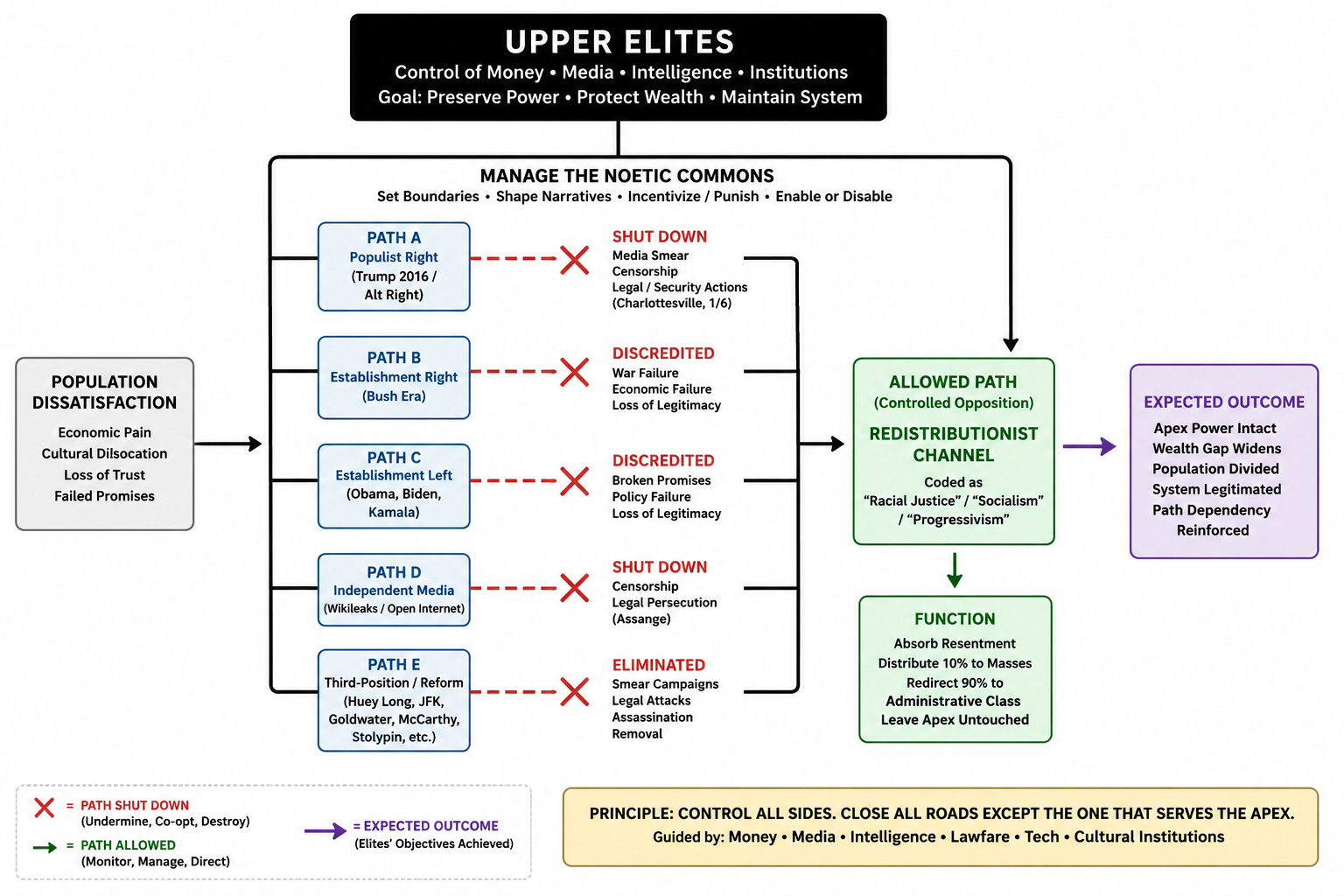
    There is a near zero institutional or cultural support for non-redemptive God images, and for good reason – they are structurally incapable of generating a noetic commons, which is the shared egregore which governs collective thought and action. A god-image that does not promise rescue or salvation is very inefficient at mobilizing populations, because mobilization is incentivized by the promise that participation will be rewarded in this life or the next. As Rodney Stark and William Bainbridge argue in The Future of Religion, religion (including secular redemption beliefs) will never disappear because people need “compensators” – systems of belief promising that rewards presently unavailable to them “will be obtained in the distant future or in some other context which cannot be immediately verified.” And as Davidman argues in Tradition, p. 152, “In her book on Catholic Charismatics, Meredith McGuire describes how “the millenarian dream that the perfect New Order is imminent” operated within the community as a powerful order-creating mechanism. The millenarianism in the Lubavitch worldview similarly served to create a well ordered universe for the [new initiates]. It reassured them that although the world did indeed seem to be in a critical state, that in itself was a sign that change was imminent. And because by joining this community they were allying themselves with “the ultimate source of order” – the Rebbe – they would “have a privileged position in the unknown glorious future.” This redemptive grammar is not true or false, it is structurally necessary for any god-image that aspires to scale beyond the individual. Non-redemptive frameworks can only survive at the individual level, sustained by personal constitution, not by cultural infrastructure, unless they are non-tragic such as Taoism and some versions of Buddhism). Tragic non‑redemption – the crucifixion of opposites held consciously – has severe structural difficulty scaling, because it offers no relief and no collective ritual that does not collapse into antinomianism or withdrawal – redemptive systems scale through shared promises; tragic systems can propagate only through shared recognition among people who have independently crossed the same threshold. This is why the experience feels uncharted: I have found little literature that maps from redemptive to non-redemptive tragic God images because no one has traveled this road at scale, and the road cannot be traveled at scale by design. It is really no fun to go from a psychically “light” perspective to a “heavy” perspective; alternatively, going from a “heavy” non-redemptive God image to a “light” redemptive God image is a tremendous weight off the psyche, which is partially why Christianity outcompeted its Hellenic competition; the process appears to me to be going in reverse now due to ratcheting neoliberal feudalism and technological advances, as discussed in this Note.


    The God Image Gulf

    Adopting a non-redemptive God image offers a much broader and more nuanced perspective, an ability to consider that all positions emerge from partial functional orientations within totality and that holding the tension between them is the operative task. This is a much colder perspective in the sense that there is no God is coming to save us, that we are each responsible for our own actions, but warmer in the sense of increased interpersonal ethics and respect for each person’s particular process. The coldness and the warmth are the same thing experienced from different angles. It is also quite lonely, and the translation cost in explaining an Abraxian perspective to those within a redemptive perspective is very high as well.

    The deep reason for the translation cost is not that Abraxian claims are harder to understand, it is that the gulf is not an argument gap but a hinge proposition difference. Using Wittgenstein’s framework from On Certainty (although I have major issues with his style): every worldview rests on hinges – propositions so fundamental that they are not believed but acted on, and that make all other beliefs possible. The redemptive person’s hinges include suffering is temporary, justice will be done, meaning exists. These are not things they argue for, they are the conditions that make arguing possible. The Abraxian perspective hinges include suffering is permanent, justice is a human projection, and meaning is maintained, not given. When a redemptive person encounters Abraxas they do not encounter a disagreement, they encounter a different set of hinges – a different bedrock – and no amount of argument can reach across that gap because arguments presuppose hinges, and the hinges are different. This is why the experience is not that I am failing to explain myself, it is that I am operating from a different perceptual apparatus entirely. The loneliness is not social, it is hinge-structural.

    Because crossing the divide is so energy intensive, the desire for silence increases over time. I am more present in my interactions with others, I do not react to the horrors of this world with nearly the emotional energy that I devoted to it in the past – it is not that I am indifferent, I am still saddened by them, but hearing of or seeing such horrors no longer causes a challenge to my highest level beliefs, so there is both good and bad that arises from the God image as it increasingly reorganizes me somatically. Whether this god-image is livable in the long term I do not yet know, but it has worked for me provisionally thus far.

    This process doesn’t feel like much of a choice, either – the choice was between remaining “lost” or going through the painful process of self-discovery. My path chose me, and the freedom one has is to embrace one’s unique path or to run from it and suffer increasing psycho-somatic pain as a result. As Marie Louise von Franz argued in Shadow and Evil in Fairy Tales,

    This is why, according to Jung, not becoming conscious when one has the possibility of doing so is the worst sin. If there is no germ of possible consciousness within, if God made you unconscious and you just stay that way, then it doesn’t matter; but if one does not live up to an inner possibility, then this inner possibility becomes destructive. That’s why Jung also says that in a similar way one of the most wicked destructive forces, psychologically speaking, is unused creative power. That is another aspect. If somebody has a creative gift and out of laziness, or for some other reason, doesn’t use it, that psychic energy turns into sheer poison. That’s why we often diagnose neuroses and psychotic diseases as not-lived higher possibilities.

    Note: You can sign up to receive email notifications of new posts here, and/or sign up for Substack updates here.

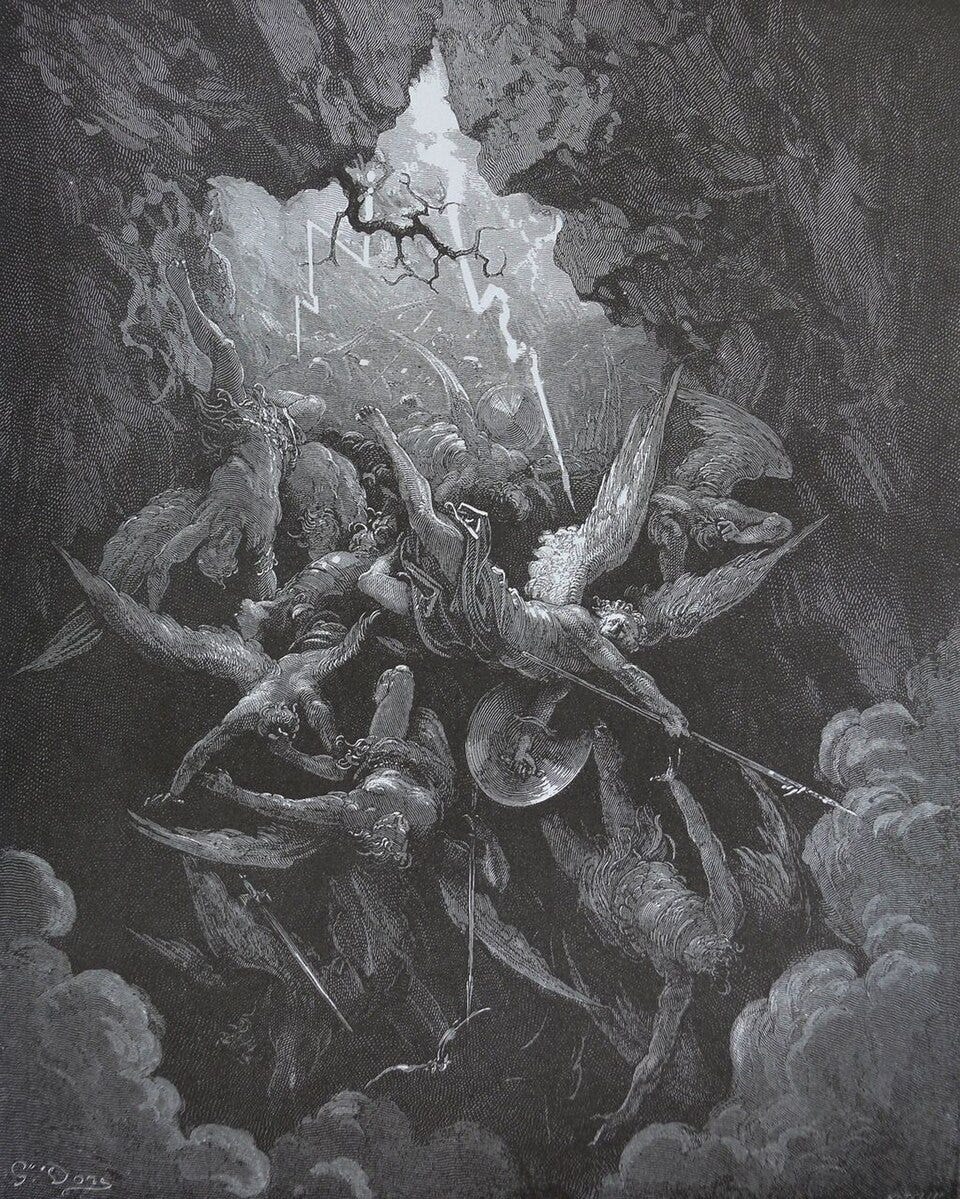
    Gustave Doré Illustration for John Milton’s “Paradise Lost“

    1

    See John D. Barbour’s Versions of Deconversion (1994), where he states, p. 206:

    A “disjunction between theory and experience” often generates the elements constitutive fo deconversion: intellectual doubt, moral criticism of an inadequate way of life, emotional upheaval, and rejection of a community or a conception of society. This is especially so when the disconfirmed theory is not simply a philosophical perspective but approximates a Sartean project of a lifetime. Such an identity-forming theory is in effect a faith commitment, and rejecting such a worldview and project is tantamount to a loss of religious faith. The theme of identity transformation, which becomes more and more prominent in twentieth-century autobiography, often involves a form of deconversion. The faith that is lost is less frequently in a historical religious tradition and increasingly a matter of devotion to some secular substitute, an ideology or commitment that claims to provide the final and normative terms for understanding one’s life and determining one’s conduct.

    2

    Barbour, p. 2:

    A deconversion has four basic characteristics that different autobiographers may emphasize to a greater or lesser extent. Deconversion involves doubt or denial of the truth of a system of beliefs. Second, deconversion is characterized by moral criticism of not only particular actions or practices but an entire way of life. Third, the loss of faith brings emotional upheaval, especially such painful feelings as grief, guilt, lonelinenss, and despair. Finally, a person’s deconversion is usually marked by the rejection of the community to which he or she belonged. Deconversion encompasses, then, intellectual doubt, moral criticism, emotional suffering, and disaffiliation from a community. Every autobiography discussed in this book involves at least three of these four dimensions of deconversions, although in particular cases one element may not be present. For instance, in Grace Abounding Bunyan does not reject a religious community, and the nature of his deconversion is rather different from Augustine’s. In his Apologia John Henry Newman makes few moral criticisms of himself or his former faith, as he precisely measures his increasing doubts about the Anglican church and, after considerable emotional suffering, joins the Roman Catholic Church.

    3

    As Lynn Davidman writes in Becoming Un-Orthodox, a study of Orthodox Jews who joined mainstream society, p. 21,

    Many spoke of feeling marginal in their own communities, the result of having grown up in families that differed in obvious ways from the majority. In some cases, one parent had been lost to death or divorce; in others, the mother and father had profound religious differences; or, more distressingly, within these families the defectors experienced sexual, physical, or verbal abuse, or a combination. Hasidic teachings emphasize that if one observes all the commandments, families will be joyous, warm, and close. It was painfully obvious to my informants that the emotional dynamics of their families fell far short of this ideal. Other significant predisposing factors to exiting included: an acute awareness of gender inequality; exposure to secular relatives; and exploring forbidden media such as television, movies, Internet sites, and books (including philosophical treatises on relativism)….Both my respondents and I began to feel at a young age that following the prescribed religious practices of Orthodox Judaism did not yield the promised experience of wholeness, morality, and sanctity. The ex-Hasidim whom I interviewed described how their community’s metanarrative and the physical rituals through which it was enacted began to lose sense and meaning for them, as they (like me) became increasingly aware of the contradictions in their lives. As we questioned the disjunctions we felt and found ourselves unable to assuage our doubts, our commitments to Orthodoxy and the bodily ritual practices that are at its core began to waver. We ought to test the truth claims of Orthodoxy by violating one of the hundreds of commandments that guide all aspects of Orthodox Jewish daily life.

    Or see Barbour, 209: “The large number of versions of deconversion that involve a struggle for autonomy in relation to the writer’s parents (for instance, those by Augustine, Mill, Ruskin, Gosse, and many apostates from cults) indicates that the loss of faith is often closely related to the task of forming personal identity in the context of one’s family.”

    4

    Barbour, p.15: “For Augustine deconversion is necessarily only a stage in a longer process, since human beings long to trust and believe in something beyond themselves. One cannot rest in deconversion; the heart and mind and soul will search restlessly for a new center of devotion, trust, and love. Placing one’s faith in anything other than God inevitably leads to disappointment. The Confessions describes not only a deconversion from Manicheism and conversion to Christianity but a series of conversions to and deconversions from various other objects of Augustine’s ultimate concern: philosophy, the unnamed friend who dies, the orator’s career, Neoplatonic wisdom, and the pleasures of “woman’s love”.”

    5

    Barbour, 74: “James anticipates functional definitions of religion (such as Paul Tillich’s conception of “ultimate concern”) when he holds that no one can live without a commitment that is, in effect, religious. This would mean that one can never rest in loss of faith. Only the divided self on the verge of either collapse or conversion could be said to lack some conviction which functions as a faith. James’ discussion of the loss of faith is ambiguous because while he presents permanent skepticism as a real possibility, he also holds that every human being, even the one who has been through “counterconversion,” has some “habitual center of personal energy” that functions like a religious faith to give meaning and purpose.”

    6

    The Puritans even make a system out of it. Barbour, 22: “The Puritan way of salvation generated a continuing cycle of deconversions and reconversions, as each moment of confidence and assurance yielded, slowly and subtly, to presumption, pride, or complacency. Noted by the Puritan’s scrupulous conscience, one’s very assurance caused a new round of despair about one’s moral condition and doubts about one’s election, precipitating a new need for deconversion in the form of repentance and struggling away from sin. Whether one regards this negatively as a classic double bind or vicious cycle, or positively as a profound means of revitalizing the basis of religious commitment and regeneration, the Puirtans forged a tight bond between the cycles of deconversion and conversion.”

    7

    This is an interesting post by a man named Dragos Roua, who commented on this concept in regards to his relationship to money. He grew up poor and became wealthy, but his body’s response to money lagged significantly his intellectual understanding and it took a very prolonged period, tested against various real world situations, before his body began to somatically accept his new situation, and the updates grew less intense and more sporadic over time but they never fully stopped – our early hardwiring takes a very long time to overright.

    8

    For example, see Barbour, 57: “Especially fascinating in Victorian versions of deconversion are the ways in which Christian rhetoric and values are appropriated in a writer’s attempt to express a new vision of human destiny. The language of Christian culture and community usually imposes itself even when an agnostic or atheist writer expresses confidence that one can live without the consolation of religion, without certainty about human origins or destiny, and without a divine justification for morality. Often the metaphors and structural elements of conversion narratives provide the organizing terms in which a writer envisages movement away from belief in God to agnostic principles and a new understanding of human existence.” And p. 211: “A central theme of this book is that deconversion is rarely if ever a total transformation of character and religious concern….Every author considered here can be shown to have been permanently marked by the faith he or she supposedly rejected. Thus one aspect of the religious significance of deconversion narratives is the deep and pervasive influence of religious commitments and ways of thought even on those who have abandoned a historical religious tradition.”

    Or, take Ruskin, for a specific example, 68: “As many scholars have pointed out, there is also much continuity between Ruskin’s evangelical background and his secular vocation, especially in terms of such moral values as hard work, self-denial, service to humanity, and struggle against moral evil. Many of his aesthetic interests and presuppositions, such as his interest in allegorical interpretations of art, can be understood as characteristic expressions of his religious sensibility. Like so many Victorians, and like most authors of deconversion narratives, Ruskin was deeply influenced by his religious upbringing long after he consciously rejected it.”

    9

    Davidman, p. 184: “Neuroscientists have recently emphasized the ways experience effects changes in the biology of our brains. Building on this insight, I can say that defectors’ earlier experiences and practices have been hardwired into their psyches. We could almost say they have become part of our “psychic DNA.” The cultural tool kit and its embodied presentations continue to remain entrenched in our deepest selves.”

    Further on this topic, I read the cyberneticist book The Tree of Knowledge (1987) which contained helpful discussions regarding how biological “hardware” relates to “software” downloaded from the environment (examples of a newborn lamb who, taken away from its mother for a couple hours, would not run and play with other animals thereafter; and two young Hindu girls raised by wolves, when reintegrated into human society, never became fully human).

    10

    Tradition in a Rootless World, p. 184, regarding women: “These behavioral changes included strictly observing the Sabbath, following the laws of kashrut, and even changing sexual behavior to conform to the community’s norm of no physical contact with men before marriage. “Conversion” to Orthodoxy involved no professions of faith or testimonials; rather, it comprised an accretion of observances.” And p. 202: “The price of joining is too high for most people because of (1) the ritualism of Orthodox Judaism, (2) the marginality and separation involved in adopting this way of life, and (3) the limits set on a person’s choice for a partner.” And p. 222: “Newcomers must make change sin their behavior that affect all aspects of their daily and social lives. There are many individuals who value the relative absence of restrictions in their lives enough to find Orthodoxy unattractive.”

    11

    Yahweh is a redemptive God for the Jewish people, but he is also demanding and wrathful in a way that the Christian God is not. Per Davidman, p. 141: “Hasidic socialization aimed to convince children that they would be severely punished by God if they failed to obey their parents or observe all 613 biblical commandments as they were interpreted in their respective communities. Hasidic children did not grow up with a conception of a loving and forgiving God; instead, they were told that God was harsh and stern and would penalize them for every transgression, even accidental ones. Esther, one of my respondents, highlighted this point. “The whole religion revolved around trying to escape or avoid punishment. And the fear – like God is a monster, really, to such an extent that if you are not nice today, then you will later have sick children. Similarly, if you don’t show proper respect to your parents, you will live in poverty for the rest of your life.”…The basic message was that if they violated God’s laws, he would send them every possible sorrow, sickness, and tragedy.”

    12

    Per Davidman, quoting someone named Binyamin, p. 82:

    Whether I believed in the Hasidic teachings or not, at the bottom line, the only thing that mattered was following the commandments. At one point, when I was sort of debating, I was speaking with my stepfather about God and why it doesn’t make sense and this and that, and he said: “Binyamin. You don’t get it. Judaism doesn’t have to do with believing in God or not! Nowhere in the Shulchan Aruch [the most authoritative Jewish legal code, authored by Rabbi Joseph Karo in 1563] does it say to believe in God. It’s all about doing. Judaism doesn’t have to do with believing in God or not. It’s a lifestyle, a way of living. And just like every lifestyle, in everything you do there’s a manual. So Judaism as a manual, the Shulchan Aruch, and it tells you what to do from the moment you wake up until the moment when you sleep. And you follow this manual. Whether you believe in God or not, that isn’t as important.

    Davidman adds on, p. 102: “[These] stories demonstrate the greater importance of actions over beliefs in the Haredi world. Questioning was written into the ancient texts; it was not problematic. But acting out bodily resistance to Jewish laws is a momentous event that might be the first step in defecting. These respondents were deeply aware of the difference between intellectual questioning, an internal, mental process, and violating a commandment, a physical act, as evidenced by the reported intensity of the physical experience.”

    13

    More specifically, the Tao contains both light and dark as co-original – the yin-yang is not good-conquering-evil but irreducible polarity. Wu wei (non-action, effortless action) is not alignment with the good but alignment with what is, which includes darkness, death, and dissolution. The Tao that can be named is not the eternal Tao, so it has genuine apophatic depth. And crucially, Taoism does not promise escape from suffering; it promises something more like the dissolution of the resistance to suffering, which is not the same thing. The sage flows with what is, including horror, without fighting it.

    However, Taoism differs from the Abraxian position in a critical way: it is fundamentally serene. The Tao is simply what is, and acceptance of what is produces a particular kind of peace. There is no crucifixion of opposites in the Jungian sense, no requirement to hold the tension actively and suffer it consciously. The Taoist response to horror is to flow through it, not to hold it as co-original and irreducible. This produces a different psychology: the Taoist sage is characterized by detachment and fluid non-resistance; the Abraxian position is characterized by active conscious holding of irresolvable tension, which is painful by design. Taoism is non-redemptive but also non-tragic. Abraxas is non-redemptive and tragic.

  • The Grammar of Capture: How Online Language Pre-Organizes Thought

    Online political rhetoric is full of phrases that assert unearned authority, claim undefined group identity, foreclose alternatives, and smuggle in redemption narratives. This essay examines the grammar of capture – the linguistic patterns that replace thinking with tribal performance – and offers a path toward more individuated speech.

    “The limits of my language mean the limits of my world.” – Wittgenstein

    Someone the other day on social media wrote something along the lines of, “We need to do [action].” This particular comment was in the context of a political post advocating electoral accelerationism, purging the GOP of establishment/Zionist types by hoping Democrats win as many seats as possible in 2026 elections so that a Groyper right would later be ascendant (lol), but the expression “we need to” is used regularly in all sorts of contexts. I found myself triggered by the expression – I felt physical agitation – and I pondered why this was. After reflection, the answer seems to be that it assumes commonality without demonstrating it:

    1. They imply an undefined group identity. The speaker claims to speak for a “we” that has not been defined. Who is this “we”? Does it include the reader? On what basis is the reader included or excluded? Does “we” mean Americans? Humans? Conservatives? Whites? Anti-Zionists? Does the reader agree to the shared interest? It’s usually arrogant in the context it is used. In propaganda and online tribalism, “we” is often an act of epistemic annexation. By declaring what “we need to do” or what “we know,” a speaker attempts to bypass your consent. They graft your identity onto their agenda without your permission, forcing you into a false binary: either accept membership in their undefined collective or actively break rank and become an outsider.
    2. They assert unearned authority. The speaker positions himself as the one who knows, the one who has seen through the deception, the one who can lead others to the truth. This authority is not demonstrated, it is assumed. “Need” – it assumes that there is a specific option that must happen, and the tone places the speaker in the role of decider/leader. On what basis is this authority derived from?
    3. They claim to have examined all alternatives. The speaker implies that they have considered all options and arrived at the correct conclusion, but this examination is not shown, the alternatives are not addressed. The conclusion is asserted, not argued. Have all the options been objectively assessed? Would the reader necessarily agree with the analysis? Why is the speaker making that assumption?
    4. They smuggle in a redemption narrative. The speaker implies that if the proposed action is taken, things will get better. Whether it is the Groyper right hoping for a cyclical reset or tech-dissidents waiting for institutional collapse, the underlying narrative structure remains theological. It relies on a secularized version of original sin (the enemy’s corruption), an apocalyptic awakening (the red pill), and a promised paradise (the societal restoration that follows victory). This is the redemptive structure – the promise that suffering will be rewarded, that justice will be done, that the arc bends toward the good. But this promise is not grounded in the structure of reality; it is hope, not analysis.

    So “we need to” is an implicit assertion of “here’s a group, you’re a part of the group, I am the leader of this group, I have properly assessed all options, follow me to redemption.” This isn’t meant to assert that groups don’t form or exist or that leaders don’t arise from that formation, of course, but this isn’t how that expression is commonly used on the internet.

    This contemplation then pivoted toward asking what other common online expressions express an underlying intent other than what the surface words appear to mean. Below is a list of common expressions I brainstormed that apply and why I think they’re not “on the level”. I will note that I am not entirely guilt-free from the following idioms; sometimes they are heuristic – rhetorical shortcuts employed – and sometimes it is old habits that die hard, but I do try my best to avoid them where I can.

    Before I list them, a disclaimer: these expressions are common in the reactionary and dissident spaces. This is not because these spaces are uniquely guilty of lazy rhetoric – the left and the establishment have their own set of misleading expressions, movements I have critiqued extensively elsewhere. Rather, it is because this was my own world for a long time. I spent years immersed in these spaces, and I can speak to their rhetorical habits with firsthand knowledge. I have evolved past them to a different relationship with language itself. The purpose of this essay is structural analysis: how language captures us, and how we can try to refuse the capture.


    The Pattern

    First, let me name what the below expressions have in common. Generalizing the “we” analysis above, they perform one or more recurring operations: claiming unearned authority, presupposing an undefined collective, foreclosing alternatives, and converting contingent political hopes into redemptive necessity.

    1. Unearned authority. The speaker positions themselves as the one who knows, the one who sees clearly, the one who can lead others. This authority is not demonstrated, it is assumed.
    2. Undefined group identity. The speaker claims to speak for a “we” that has not been defined. Who is included? On what basis? Not specified.
    3. Unexamined alternatives. The speaker implies that they have considered all options and arrived at the correct conclusion. But this examination is not shown, the alternatives are not addressed.
    4. Redemptive promise. The speaker implies that if the proposed action is taken, or if the identified enemy is defeated, things will get better. This is the redemptive structure – the promise that suffering will be rewarded, that justice will be done, that the arc bends toward the good.

    The following list does not mean that ordinary practical language is intrinsically manipulative. They can be legitimate shorthand if the speaker identifies scope, evidence, counterexamples, and uncertainty. Rather, these phrases become capture-language when they conceal the speaker’s authority, erase the boundaries of the relevant group, foreclose contestable alternatives, and turn an uncertain political possibility into a moral necessity.


    The List

    “Right” / “Left”

    These are the foundational tribal labels. They are used constantly, yet almost never defined with any precision. What does “right” mean? Traditionalism? Libertarianism? Nationalism? Capitalism? White identity? The term is used to encompass all of these and more, often shifting meaning depending on the context. Who is included? Which factions are excluded? The terms are used to imply that all factions within the category share the same goals, values, and strategies. The speaker claims to know what “the right” believes, wants, or is doing, and also assumes that their understanding of “the right” is accurate and complete. Furthermore, these terms are often used to dismiss internal dissent within a coalition – e.g., “the right” is accused of something, and therefore any criticism of that accusation is dismissed as “leftist.” The binary dramatically reduces the ability to analyze nuance and conflicting ideas within a movement. There is also a redemptive promise: if “the right” wins, or if “the left” is defeated, things will get better.

    The problem is not that political factions do not exist. They do. The problem is that “right” and “left” are usually employed as black boxes – they explain everything and therefore explain nothing. They are placeholders for complex, contested, and internally divided coalitions.

    “The Elites…” / “The Globalists…”

    These are the dissident equivalents of “the establishment” and are almost never defined. Who specifically? What institutions? What mechanisms? The vagueness allows the speaker to project whatever they hate onto the category. The speaker claims to know who the elites are and what they are doing. This knowledge is asserted, not demonstrated. They also imply that they are not part of the elite – they are the people, the ordinary, the excluded. But “the people” is never defined. The speaker implies that the elites are the cause of all problems. But this is asserted, not shown. And it also offers a redemptive promise: if the elites are removed or defeated, things will get better.

    The problem is not that elites do not exist, they do. The problem, as above, is that the term is used as a black box – it is a placeholder for resentment, not an analysis.

    “The Woke Mob…” or “Woke Mind Virus”

    A construction that treats progressive activists as a single, coordinated force, and is used as a smear to dismiss concerns about inegalitarianism as irrational or dangerous. The speaker claims to see through the “woke” narrative. This insight is asserted, not demonstrated. Elon Musk uses this term constantly. The terms are also undefined: what does “woke” mean in this context? Is it transsexualism, is it homosexuality, is it mixed-race marriage? Is the women’s right to vote “woke”? Is it a complaint about society allowing these identities and relationships, promoting them, or forcing them? What is the “mob” or “virus” in this context, and in what relationship is it a “woke mob”? It spreads from person to person? What is the mechanism, how does it work, and how is it cured? Under what conditions is it cured? What is the cost of “cure”?The speaker also implies that “wokeness” is the cause of social decay, and alternatives are not considered. The redemptive promise is that if “wokeness” is defeated, society will return to sanity and order.

    “Redpilled…”

    A term from The Matrix, used to mean “awakened to the truth.” Often used to signal in-group membership. The speaker claims to have special knowledge that others lack. This knowledge is not demonstrated. The group identity is assumed: “We” are the redpilled, the awakened, the ones who see clearly, but “we” is undefined; one may ironically note that The Matrix directors both became transsexual and stated “redpilled” related to transsexual identity, which is diametrically different from the common “right wing” context. The speaker implies that they have seen through the illusion, but the “truth” they claim to have discovered is asserted, not argued. The redemptive promise is if you take the red pill, you will see the truth. The truth will set you free.

    “Critical Thinking…”

    Often used to mean “thinking like me.” Used to dismiss opposing views as uncritical or sheep-like. The speaker claims to be a critical thinker but this is asserted, not demonstrated. The group identity is not properly defined: “We” are the critical thinkers, the ones who think for ourselves. But “we” is undefined, as is “thinking.” Ironically, “critical thinking” often means turning off one’s critical thinking abilities to follow the opinion of the speaker. The speaker implies that those who disagree are not thinking critically, and the alternatives are not considered. The redemptive promise is if you think critically, you will arrive at the truth. The truth will set you free.

    “Do Your Own Research…”

    A construction that implies the speaker has done the work and the listener has not. It positions the speaker as intellectually superior while evading the burden of presenting evidence. The speaker claims to have done research, but does not present it. The work is invisible. Group identify is undefined: it implies that “we” are the researchers, the ones who think for ourselves, and it assumes that “research” leads to the speaker’s conclusion. Alternative conclusions are dismissed as not real research. The redemptive promise is if you do your own research, you will see the truth. The truth will set you free.

    “Common Sense…”

    A construction that equates the speaker’s position with obviousness. Used to dismiss opposition as irrational or dishonest. The speaker claims to possess “common sense,” which is defined as their own position. “We” are the sensible ones. Those who disagree are not sensible. Alternatives are not considered; they are not “common sense.” The redemptive promise is if we use common sense, we will solve the problem.

    “It’s Obvious…”

    A way of saying “I am right” without argument. The speaker’s position is so obvious that it does not need to be defended. “We” see the obvious. Those who don’t are blind. Alternatives are not considered, they are not obvious. The redemptive promise is we accept the obvious, we will act correctly.

    “The Window Is Closing…” “We can’t afford to wait…”

    Assumes a limited opportunity. Often used to pressure others into agreement. The speaker knows when the window will close, “We” are the ones who see the opportunity, and the speaker assumes that the window is real and closing. The redemptive promise is if we act before the window closes, we will succeed.

    “The Solution Is…”

    Asserts a solution without evidence. The speaker knows what the solution is, “We” are the ones who know the solution, but other solutions are not considered. If we implement the solution, the problem will be solved.

    “You Don’t Hate Them Enough”

    Asserts an unpunished criminal conspiracy worthy of hatred. The speaker claims to know who constitutes “they”, blames “them” for a litany of alleged wrongs of the world, and is telling you what your feelings should be about it. “You” don’t have the speaker’s knowledge of “their” unspeakable criminal behavior, but if you did, you would hate them more than you currently do, the lack of which speaks to your current level of ignorance and deficiency, until it rises to such a level as to constitute “enough hatred.” (This phrase is a form of emotional conscription; it does not seek to inform or persuade, it seeks to recruit your affect. The speaker does not want you to think, they want you to feel. And they want you to feel in a specific, intense way that serves their agenda. It is the grammar of capture applied to emotion.)

    If “you” “hate” “them” “enough”, then it will somehow lead to real world action where “they” will be punished, leading to a rebalancing of the world. But until “you” “hate” “them” “enough”, the world will remain broken – and it’s your fault that it is so, as the glorious, enlightened speaker is so kind as to tell you.


    Why This Matters

    What unites these expressions is their function: they allow the speaker to assert authority without demonstrating it, to claim group identity without defining it, to foreclose alternatives without examining them, and to promise redemption without grounding it in reality. But these expressions are structurally misleading, even if they are not consciously intended to be so by the speaker: they perform epistemic and social operations that exceed what their literal content acknowledges. They argue something different than what the surface words actually mean. They replace thought with performance, they assert authority without justification, they claim group identity without demonstration, they smuggle in redemption narratives without evidence. All of these collapse distinctions that should remain differentiated: speaker / audience, observation / interpretation, fact / value, evidence / assertion, individual / collective, possibility / necessity, analysis / prescription, uncertainty / certainty, present condition / redemptive future.

    As I’ve explored elsewhere in examining language as an active forcefield shaping the architecture of consciousness, these idioms are psychic technologies. These kinds of expressions are a mechanism by which egregores (as discussed here; it is not being used in an occult sense) maintain themselves; they are the grammar of capture. Finite beings necessarily compress reality into models. Capture begins when the compression becomes invisible to the person doing it. These expressions function as the feedback loop’s maintenance signals. When someone says “we need to” or “the elites are…”, they are broadcasting a signal that reinforces the collective attention pattern, pulling individual god-images back toward conformity with the egregore’s requirements. The social friction of not repeating these expressions – the confusion, hostility, or exclusion that follows – is the egregore’s back-pressure mechanism enforcing compliance. Each phrase analyzed above hints at the user’s underlying stabilizer function, a linguistic technology that allows the user to regulate their psyche through group identity rather than internal pressure-bearing. A phrase like “we need to” is better understood as a linguistic cue or micro-ritual of recruitment, and it can activate a stabilizer: “We” may recruit attachment and belonging, “redpilled” may recruit esteem and special knowledge, “The solution is…” may recruit agency and control. “The arc bends…” may recruit meaning and narrative. “It’s obvious…” may provide pseudo-coherence. They provide recruitment without suffering the cost of individuation.

    The point here is not to ban the word “we,” or to pretend that collective action is avoidable. Every relationship, institution, and project requires some provisional commonality. The question is whether the speaker makes that commonality visible and contestable: who is included, what is being asked, what evidence supports it, what costs it carries (for every action carries cost, no matter how wonderful it seems at first glance), and who may reasonably dissent. Non-capture language does not abolish coordination, it makes the terms of coordination legible.

    Actual thinking – looking at the roots of ideas, seeing how they are connected to other ideas, recognizing the limitations of any particular label or approach – is scary, difficult, uncertain. We (yes, here I use the word as applied to all living beings) are all limited beings crucified by the opposites under totality. We see narrowly, through a glass darkly. What our models must exclude does not disappear; it accumulates as unprocessed pressure until it returns in a form we can no longer contain. This is the tragedy of existence. The tragedy is not that we are captured by egregores, but that we seek capture because the alternative – bearing the crucifixion of opposites internally – is metabolically expensive. Offloading the crucifixion onto institutions or ideology is a smart strategy for most people because it frees up energy that would otherwise be consumed by agony and paralysis, allowing them to actually live.

    The alternative to misleading rhetoric, then, is precision and humility. When you are tempted to say “the elites,” ask yourself: who specifically? what institutions? what mechanisms? And then say that instead. When you are tempted to say “we need to,” ask yourself: who is “we”? on what basis am I including others? have I examined the alternatives? And then say that instead. When you are tempted to say “the solution is,” ask yourself: how do I know? what am I not considering? what if I’m wrong? And then say that instead. My framework’s own language is not immune to these patterns, I am not perfect; precision and humility are ongoing disciplines rather than achieved states (and I recognize the irony of claiming a superior position in this post – “I see what others do not” – but such is unavoidable in picking apart these language games; what matters is that the argument is explained, dissected, and not asserted).

    This is not easy, social, or comfortable. It is the path of individuation – the refusal to offload responsibility onto vague collectives or hidden enemies, the refusal to assert unearned authority, the refusal to smuggle in redemption narratives that are not grounded in the structure of reality. 1 What non-capture language looks like is the specific, the provisional, the first-person, the interrogative, hermetic speech which circulates between registers without resolving them into doctrine. Compare “We need to destroy the system” with: “I think institution X is producing outcome Y through mechanism Z. My proposed intervention is A, but I haven’t ruled out B or C, and I don’t know whether the intervention would produce unintended consequences.” The first sentence is cheap because its costs are invisible and unpaid – someone still has to supply the missing specifics, absorb the unexamined risk, live with the consequences of an action no one actually argued for. The second sentence is expensive because the speaker pays those costs up front, in public, by name. This is why individuation is difficult and capture is attractive: capture lets you export the bill. In other words, language is individuated if it acknowledges its own limitations, does not claim finality, and remains open to revision. Ultimately, it is a refusal to employ linguistic shortcuts that otherwise allow you to escape responsibility for your own epistemic position.

    The Treachery of Images (1928) by René Magritte; the expression is “This is not a pipe”; the failure to admit that language is representation, not the thing itself, is exactly the failure these expressions are exploiting.

    Subscribe:
    Email delivery remains on Substack for now.


    1. ↩︎

    Individuation, in this framework, is the internal response to the crucifixion of opposites: the ego holding the opposites in suspense without resolving them through external authority or acting-out, until a provisional orientation emerges from within. It offers no cosmic protection, no guarantee, no redemption, only increased consciousness, which is expensive and which most psychic configurations cannot sustain under ordinary conditions. The linguistic behaviors described in this essay are the speech-equivalent of that same discipline.

  • Exploring the Hedonic Fantasy Within “Two and a Half Men”

    Beneath its surface as a sitcom review, this essay explores the appeal and ultimate limits of the hedonic fantasy embodied by Two and a Half Men. Along the way it examines Charlie Sheen’s collapse, Jon Cryer’s quiet professionalism, changing cultural norms, and the author’s psychological relationship to the world the series portrays.

    This is a post about the show Two and a Half Men, which aired for 12 seasons from 2003 until 2015. I’ve watched it over the years and always found it enjoyable – the Charlie Sheen version (season 1-8), anyway – and, after starting a sporadic rewatch (and trying to find one particular episode which made me laugh uproariously back in the day and which I just couldn’t find) I decided to watch the series in order and grade them season by season. There are 262 episodes overall, and I calculated early that if I watched 3 a day it would take me 87 days to get through. I don’t really feel like focusing on so-called “dissident” films or shows anymore – my definition of what “dissident” entails has changed pretty radically in the past year or two1 – and my Andy Kaufman-esque beat-by-beat April fools post analyzing beat-by-beat How Stella Got Her Groove Back went over as well as a hot lead balloon.

    Sheen is an interesting case because he is so charismatic and likable, even as he is known for being rogueish – he presents as having heart underneath. His life was easy, full of endless high profile film roles and then this show, where he became the highest paid actor in the history of television making $1.8 million an episode, while doing a tremendous amount of drugs and having endless amounts of sex in between two failed marriages. Yet due to the nature of hedonic adaptation combined with satiation – where one gets used to whatever baseline one has, no matter how good, and needs even greater “hits” to get excited – he grew bored with what he had (or the drugs finally got to him), torched his reputation by ranting publicly about having “tiger blood”, having sex with transsexuals and getting AIDS and his career basically died, while blowing through his fortune on alimony and child support and paying the sexual blackmailers over $10 million (they had a video of him getting a blowjob from a transsexual, apparently, and Sheen was desperate to keep his “man’s man” reputation, correctly intuiting that his career would end if he was seen as a bisexual with AIDS).

    Why do this season-by-season watch and commentary, and why should I (or you) care? First, I think the show is ultimately a great cautionary tale about having it all and then losing it. Materialism does not bring happiness. Chuck Lorre had originally pitched the show as a combination of a Job figure – a good person where everything goes wrong in his life no matter what he does (a reference made explicit in S8E4) – with restrictive, rule-following Saturnian energies (Cryer), and his Dionysian brother (Sheen), and I have strong resonance with both figures.2 Also, the show came out in the period before “Me Too” and transsexualism, and it’s simply a man’s fantasy – being rich, having lots of leisure time, caring for family, and enjoying lots of sex with attractive women while being liked and adulated by the public. Watching it and there is no deep message being pushed, it’s meant as light entertainment; of course secular hedonism as an end point to living was merely a historic blip, it could never have lasted (for many reasons), but it can still be enjoyed on its own terms, I think.

    The acting is superb throughout, especially Jon Cryer3 as Alan Harper, the Job figure – the weaselly, poor mooch who lives off his brother. Cryer had a long career as a middling but professional4 and humble5 actor and this was his big hit (which he chose to pursue over being a finalist for the role of Gaius Baltar on Battlestar Galactica), and my sense is he knew how hard success was and how it should be treasured (and whose decent autobiography So That Happened I read6 and will provide some quotes from; Sheen also has an autobiography, but I did not feel the urge to read it7). Sheen was cast early but Cryer, who was basically playing himself8, had to fight hard for the role after being labeled a show-killer for having multiple prior failed shows, a story which Cryer recounted.9 At one point both Cryer and Sheen’s lives mirrored their show lives.10 Sheen was paid 3x or more what Cryer was, which upset Cryer as the show matured, and later on he went on to discuss politics publicly in a standard Hollywood “Orange Man Bad” screeching manner, which he continues to do today. Chuck Lorre struck lightning in a bottle with this show, much more so to me than his other hits like Big Bang Theory (mediocre because the premise feels forced and the comedy is shallow), Mike & Molly (boring), or Mom (also boring).

    I’m in a bit of an idle mode at the moment mentally and spiritually where I feel like I’ve found out the nature of the world, uncovered the metaphysics that makes most sense to me, contrasted it against the closest thinkers I can find (Jung, Berdyaev, Weil, Kierkegaard, Philip K. Dick, Heinz von Foerster, Hans Eysenck etc.) which has refined my views further, and I’m wondering: what now? Part of me has retreated to a hedonism fantasy – what if I had made lots of money while younger and had a parade of women around, banging myself into oblivion? This show is adjacent to that fantasy, although I would have gotten bored by it even if it had somehow happened – hedonic adaption is a very real thing, and no matter how rich or successful one is one still grows old, health fails, death awaits, with family and friends of one’s youth going long before one does – and those who have had an easy life often have trouble coping when the pain finally does hit. I think I would have very likely hit the hedonism wall, gotten bored, and be right back to where I am now – studying philosophy and metaphysics, contemplating it and then writing it about it in solitude. Another aspect of covering this is that I can’t really turn off my deep dive analytic mode, which is central to my personality; if I don’t have a place to concentrate it, then the energy loops and spins in me which is unpleasant. Better to turn it toward a deepdive of a fun show when there’s nothing pressing than to loop.

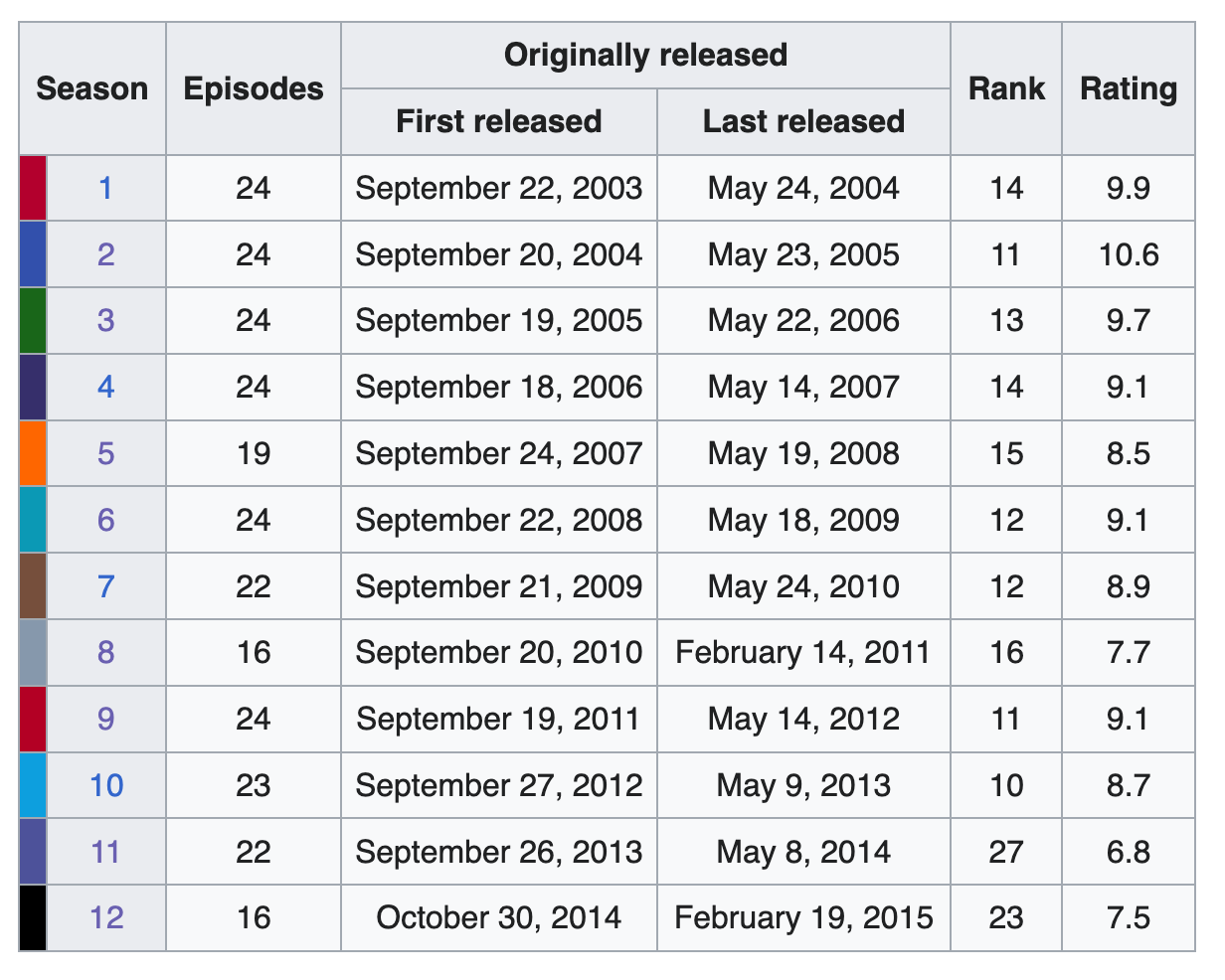
    The viewership numbers were pretty steady throughout the series, except for a fall during Sheen’s last season (season 8) and the final two seasons with Kutcher (season 11 and 12). I may or may not cover the Ashton Kutcher seasons (9-12), we will see how I feel when I get to it. The problem with Kutcher is that he wants to be seen as a “nice guy” way too much, he is a mushball with soft merchant Mercury energies while also wanting to be seen as “smart” in tech (and, to be fair, he has made strong tech investments in real life) – while at the same time he has a dark side with his longterm friendships both with Danny Masterson and Diddy, both of whom went to prison for dark sexual activities. Sheen as a charming rogue who you know is a rogue is much more fun to watch than the unfunny and strange Kutcher dynamic, but Kutcher did come in and save the show after Sheen flamed out which took courage. The following footnote analyzes their energy makeups in line with my prior psychic stabilizers post.11

    Okay, let’s get to the season reviews.


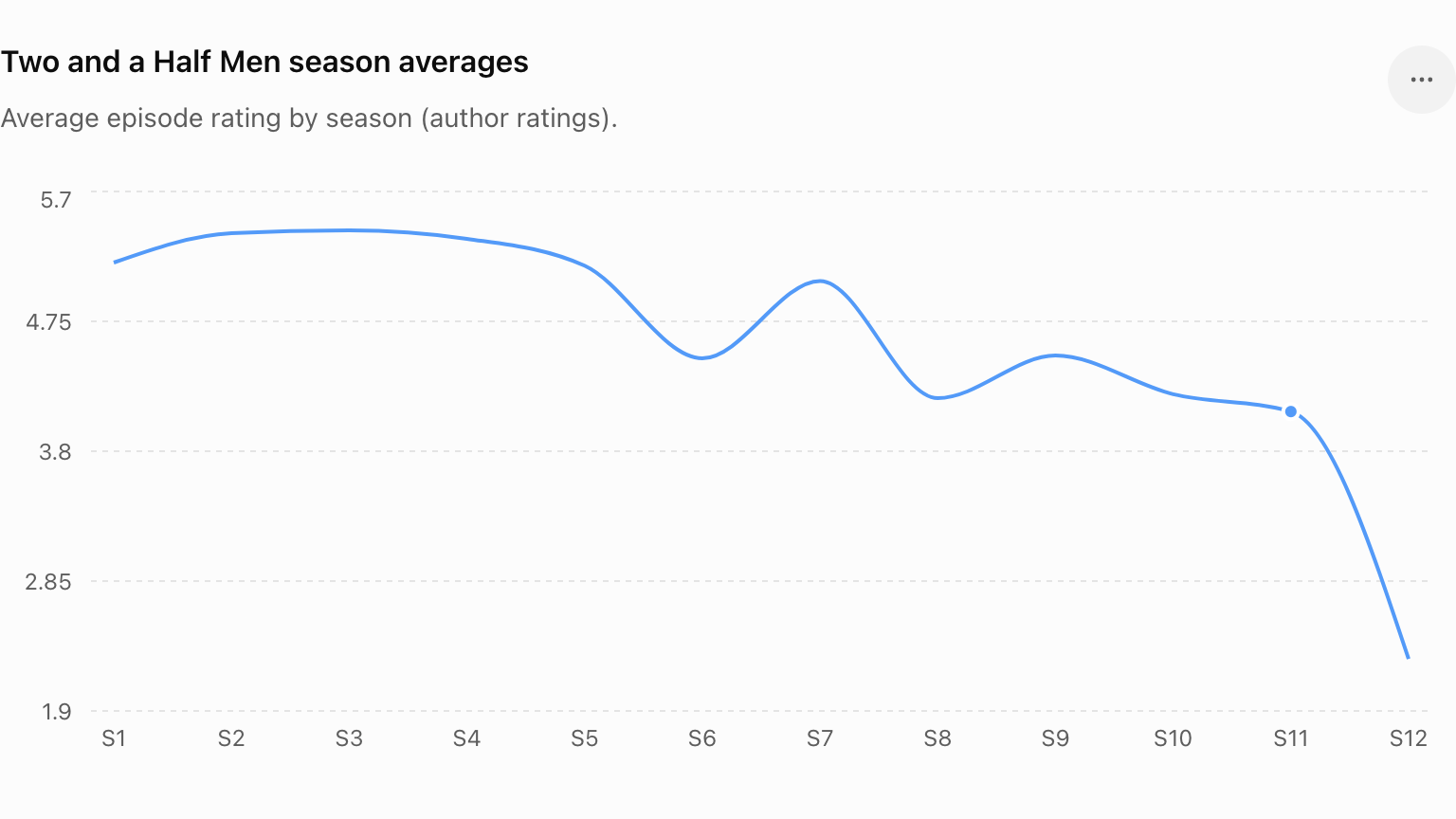
    Season 1 was released in 2003, Sheen and Cryer were both born in 1965 so they’re 38 here – young! They had previously acted in Hot Shots together. Angus T. Jones who played the “half man” is 10.12 Cryer still has his hair, in later seasons it starts to go and they spraypaint it back on (and make fun of that in an episode). This is the introduction season – Alan and Jake move in, the mother Evelyn is introduced (who I was surprised to find out is gay in real life), Sheen is roguish but loveable as a wealthy Malibu playboy with new love interests every episode and the show is finding it’s feet which is okay, but the first season in network shows is rarely very strong. Highest rated episode: Episode 5, 8-8.5/10. Lowest rated episode: E22, 3/10. Season average: 5.18.

    Season 2 (2004). This sophomore season is finding its footing, and the season average improves a bit. There are a couple of standout episodes and a bunch of mediocre ones. The show has yet to fully find its groove. The best episodes typically involve Alan and Charlie without the supporting cast – Berta, Evelyn13, Judith14, and especially Rose15 are inferior for different reasons (see the footnotes), although not always. The show works when it stays inside its own realism (male fantasy, fraternal dynamic, consequence-light hookups) and weakens whenever it imports elements from outside that realism (Rose’s stalker logic, the shrew dynamic’s unresolvable power asymmetry, the two-dimensional female authority figures). Highest rated episode: Episode 12 and 23 both with 9/10. Lowest rated episode: episode 9 and 13 both with 3/10. Season average: 5.395.

    Season 3 (2005). This season features both Charlie and Alan engaging in multi-episode relationships, Charlie with Mia and Alan with Kandi (after Kandi sleeps with Charlie first). The episodes remain highly erratic in their ratings, with the highest rated episode being Episode 9 with an 8/10 and the lowest being Episode 12 with a 2.5/10 because it was too forced and Cryer overacted. The highest rated episode was lower than the highest ones in prior seasons and the lowest was lower, but the season average still increased. Season average: 5.416. I’m a little surprised and was expecting a steady increase by season 3.

    Season 4 (2006). Somewhere in season 3, definitely by the start of season 4, watching began to feel like a chore and not so much fun. I attribute this to the basic idea of the show being fleshed out and explored, so the ratcheting of outlandish behavior has started (see Kandi) to try to keep the show “fresh”. I will keep grinding out the episodes, at least for now, out of lack of a better thing to do, and I still want to find the episode that made me laugh so hard. Highest rated episodes were Episodes 6, 9, and 14 at 8/10, and the lowest was Episode 2 with a 3.5/10. Season average: 5.354, so slightly decreased from Season 3.

    Season 5 (2007). This was a truncated season with only 19 episodes as opposed to 24 in a standard season due to the 2007–2008 Writers Guild of America strike. Highest rated was E13 with 8/10 and the lowest was E12 with a 2, maybe less – the worst episode of the show so far which was modeled on Misery and featured Rose. Season average: 5.157, which continues to decrease from season 4 and 3. On the bright side, Alan has started slightly displaying some kooky characteristics which Cryer pulls off very well, which will be accentuated in future seasons to keep the show from becoming too stale.

    Season 6 (2008). This was the worst season so far, both because the show is running out of ideas and because Charlie’s extended relationship arc with Chelsea is a downer. The actress who plays her is fine and doesn’t bother me, but she is written as a nag – not due to a personality quirk, but simply due to male/female dynamics. This season had the lowest episode of the entire series with a 0, Episode 21, which featured a wildly unrealistic scenario with Rose, a character I don’t like. The highest rated episode was Episode 4 when Charlie hits on Alan’s receptionist, while Alan is very unhappy about it. Jake has much less screen time this season, as does Evelyn, and Rose is almost featured not at all (thankfully). Season average: 4.479, which surprisingly continues its decline from Season 5. I hope it pulls out of this rut next season.

    Season 7 (2009). The show rebounds from the prior season but is still treading water; Sheen’s acting is increasingly becoming frazzled due to off-screen drug use. One of the things I will note is that Charlie’s approach to dealing with women on the show (not just this season) – easy willingness to apologize without fully meaning it, checking his ego in doing so – while sometimes pushes too far into obsequiousness, is pretty antithetical to my own approach, which often involves egoistic pushback and angrily stewing with a grudge for awhile. An experiment in adopting Charlie’s approach had surprisingly positive results, although it didn’t come naturally to me. The highest rated episodes of the season were episode 1 and 12 tied at only 7.5/10, and the worst was episode 10 which was a 0 where the writers infantilized Charlie’s character in a clumsy and dumb manner. Season average: 5.045, so better than Season 6, but still worse than other seasons.

    Season 8 (2010). Cryer noted in his autobiography how bad Sheen looked this season16 to the point he couldn’t remember his lines.17 The season was poor, and I hated the Rose-focused episodes. The highest rated episode was E13 with a 7.5 or 8/10 because of Alan’s funny jealousy, the worst was E14 due to it being a ridiculous Rose-centric episode. The Season average was 4.1875, the worst of every season, and there were only 16 episodes when a normal season has 24 – a truncated season. I could see the deterioration of Sheen in real time almost, which began in the middle of Season 7 and never recovered, and they increasingly focused on Cryer’s character to try to make up for it. I will note, looking back, that watching this show has likely encouraged me to drink more alcohol (nothing too crazy).

    Season 9 (2011). Screw it, I’ll keep watching the goofy Kutcher seasons and see how long I can stomach them – no guarantees. I hadn’t found the hilarious laugh-out-loud episode I’ve been looking for, which I guess must be in the Kutcher batch. It wasn’t clear if the show would continue after Sheen’s departure, but the network had pre-sold a couple more seasons and the money was too good to resist, I guess. Hugh Grant was supposed to be Sheen’s replacement but he backed out at the last second, uncomfortable with the lack of script to review. The biggest problem is that the hedonism fantasy is dead under Kutcher, that only worked under a rogueish but loveable Sheen (maybe it would’ve worked under Grant? not sure) – and Kutcher sucks, dopey voice, desperately wants to be likable and be seen as “smart” – so the continuation of watching this must be different. We will see if Cryer can carry the show on his own with the rest of the original cast, or if he can’t – I don’t know.

    The flimsiness of the Alan/Walden connection is readily apparent and the bones aren’t strong enough to hold up the story regardless of the acting; most of the rest of the cast has been downgraded into occasional appearances to make room for new characters like Kutcher’s ex-wife, girlfriend, business partner, etc – I wish they had kept Herb around more, his character is excellent. I know that Cryer and Kutcher got along well, although their onscreen chemistry is mediocre, and Cryer attended Kutcher’s wedding (unlike Cryer and Sheen at the end – Cryer hasn’t spoken to Sheen since the latter’s meltdown). The highest rating episodes of the season were E9 and E22, both excellent episodes (E22 was the one I was looking for), and I gave them 9’s, but they both could have been higher. The worst episode was E12 which gave Kutcher a gorilla for a brother, 0/10. The season average was slightly better than Season 8 at 4.5/10, but good enough to keep watching. Cryer is fully carrying the show by escalating into ever-increasing absurdist situations where he is the butt of the joke; Kutcher isn’t funny at all. Also, the house itself is and has always been its own character and part of the show, and see below how they massacred my boy. This has implications extending to the core differences between the two eras; light hedonism vs. bland technocracy, a small part of a much bigger trend draining the world of color. Here’s Sheen era:

    Here’s the “remodeled” Kutcher-era house, drained of life and personality:

    The cafe bustelo can in the kitchen in Two and a Half Men

    Season 10 (2012). The Kutcher-era show premise really wobbles – it’s wildly unrealistic that Walden would keep Alan living there – and there are far too many Walden-focused episodes. The highest rated episode was an Alan-focused episode at only 7/10, episode 22, and the lowest was a Rose-focused episode at 0/10, episode 6. The season average was yet another near low, at 4.217/10. Jake’s character was written out of the show after Jones publicly calling it “filth” due to his Christian beliefs, but he later apologized and will be back for the series finale. I’m still thankful the show continued – it’s worth watching still for Cryer’s performance – although Kutcher sucks. Berta is featured in a bunch of episodes sporadically, while Judith and Rose have mostly been written out of the show.

    Season 11 (2013). This is was a strange season; the first half was terrible, political and unfunny, but the second half surprisingly got better and better. The show initially pushes lesbianism, homosexuality, and transsexuality in a very crass and crude way, but then it pivots to a plot involving Alan having an affair with his ex girlfriend while becoming friends with her boyfriend under an assumed name, and this grew on me over time. The second half focuses more on Alan instead of Walden which is a plus. Lowest episodes: E9 and E10 which push transsexualism with 0’s, highest was E17 with Alan dating his ex girlfriend’s boyfriend’s sister with a 9, but the finale was also solid with an 8. Season average: 4.09/10, the lowest season yet, but the first half was a 3.18 average and the second half was a 5, so it picks up substantially.

    Season 12 (2014). The show ends just a couple years before Me Too starts (2017), when humor more or less officially died. This is a short season with 16 episodes, when most seasons had 22-24. It’s not a surprise that this was the last season as ratings declined starting in Season 11 because of the policitized woke stuff (lesbianism, transsexualism, homosexuality, gay adoption):

    This season was terrible, and there was a long stretch of 0 ratings, which picked up toward the end when they end the gay marriage/adoption plotline and pivoted back to adult relationships. The season average was a horrific 2.28/10, by far the worst of the series, fallen into the depths of Hell, and the highest rated episode was an 8 in the series finale, which was well plotted with a lot of jokes. The show was founded as a guy’s fantasy – Charlie Sheen with his beach house and women, displaying magnanimity to his loser brother – and ended with a gay marriage and mixed race child adoption, with a lesbian niece. I guess that reflects the decline of America too. Season 12 was hard to sit through despite being a short 16 episodes and I must say I’m glad it’s over. Then again, it’s pretty amazing how they stretched this concept about – with an ultimate focus on Alan’s Job role and the house itself – for twelve seasons.

    S1–S4: stable plateau (~5.2–5.4), S5–S8: Sheen-era decline with one rebound in S7, S9–S11: Kutcher era stabilizes at a mediocre ~4.1–4.5 rather than completely collapsing, S12: genuine collapse (2.28). Episodes rated above 9 were S2 E12, E23, S9 E9, E22, S11 E17.

    Conclusion

    This ultimately turned out to not just be reviewing a show, but tracking the collapse of a certain kind of unselfconscious masculinity – a world where a man could be a man, where sex was consequence-light, where the worst thing that could happen was being nagged by your ex-wife – and its replacement by something that felt deeply hollow and performative – a moralized soap opera about gay marriage and adoption which itself mirrored the changes in broader society. The pleasure was drained out of it, and it’s a perfect example of the skinsuiting concept: the comedy was intentionally replaced by sociopolitical programming, and I was acutely aware of and uncomfortable with the manipulation. The house – the central symbol – became a hollow shell mirroring this, which is redecorated in a cold, modern style, monochrome, modern, and much worse than the warm Sheen-era Mediterranean style.

    Ultimately I’m glad I did this ridiculous 262 episode watch and analysis, as it kept my energies moving as I am in a kind of holding pattern. The exploration of the hedonism fantasy did not result in any profound insights or changes, but I did not expect it to; casual hookups and short-term relationships had been generally denied to me in my formative years, and when formative experiences are denied to a person, they often become “stuck” on that period of their lives. Whether this watch shifts the underlying terrain I’m not sure, but the crucifixion of opposites here involves both holding the hedonic fantasy as an attractive vision while also recognizing that it would almost certainly be unlikely to be sufficient as a carrier for my energies, which requires contemplation, analysis, and synthesis via writing; it certainly wasn’t enough ultimately to contain Sheen’s wild Dionysian energies.

    Subscribe:
    Email delivery remains on Substack for now.

    1

    Basically, my definition of “dissident” changed from reaction against the forced egalitarianism permeating the West to following one’s individuation path regardless of societal pressures. This perspective shifted from something reactive to generative. I don’t mean individuation as individualism, egotistically following whatever one decides; rather, we all have a specific path in this life, something we are meant to fulfill if we listen to the deepest inner impulses, and our choice is either to acknowledge and follow that path, at least to an extent, or to suffer increased psychological burdens as this Note describes.

    2

    I also think of Frank Grimes as a restrictive Saturnian, Job-like figure from the Simpsons, and Squidward from Spongebob Squarepants, especially his juxtaposition with Spongebob and Patrick in the Magic Conch episode.

    3

    The last name “Cryer” brings to mind the figure of the town crier, a public figure who performs for the masses, and also a “crier”, someone who whines and complains. I often notice resonance between a person’s character and their name, or alternatively, that people adopt names that more suit them; Carlos Estevez went by the stage name “Charlie Sheen” (like his father Martin), where Sheen means “a soft luster on a surface.”

    4

    p. 59: “Years later, my mother [a famous stage actress] and I were reminiscing about my first taste of professional acting, and she said something that really struck me. She said that while she know from watching me at Stagedoor Manor that I had a talent for performing and making people laugh, and that from seeing me onstage in Torch Song Trilogy she knew I was going to make it, what really gave her the idea that I was cut out for acting as a career was how I dealt with the firing.

    “Jon”,” she reminded me, “when they handed you your pink slip, what was wonderful about your reaction was that it was complete anger and outrage. You came home and said, “I could have done it, Mom! They didn’t give me the chance!” rather than, “Oh, poor me, I’m defeated. I’m never going to do this again.” You were a warrior, and I was so very proud of you.”…[I] know that inside me I did discover a resilience and an urge to prove my worth that’s stood me in good stead ever since.”

    5

    p. 265: “I didn’t care about whether I had the A story or the B story each week. I’ve had both over the years. The quality of what I was doing was always paramount. Besides, having the A story each week is exhausting, because you’re in practically every scene. If I have a well-written secondary story line that gives me something really funny to play, I’m happy. The best material comes out of an organic process, and if you encumber writers with demands like, “give me that character’s funny lines!” or, “Why don’t I have more to do?” then they’re writing from a place of hampered creativity and pressure. I want the writers to go where the funniest stories are, period.”

    6

    Cryer is mostly known for his Two and a Half Men role, but he only gets to discussing it about 75% or more through the book, focusing on his origins and lesser known roles. He doesn’t discuss his favorite or least favorite episodes or how his character evolved over time except in passing, which I found to be a disappointment. But still, a pretty light and easy read overall.

    7

    Earlier in my life Sheen’s autobiography would have been far more interesting, but it’s almost two dimensional from my current standpoint: man has too-easy success with work, fame, and women, lets it go to his head, falls into drugs and transsexual whores, his ego swells and blows everything up, and his career is ruined; he looks back at it later with more humility. Cryer is more interesting because he remained professional throughout, did the job, kept his head low, stayed humble, and grinded, not taking things for granted – that’s a more interesting psyche to me currently.

    Update: I skimmed Sheen’s book and it accurately reflected my above understanding, and I put it down pretty quickly. What was surprising was that Cryer was mentioned only once in the book and Two and a Half Men was only discussed over a couple pages – I guess it was just a paycheck to him and he was just going through the motions during it.

    Update 2: I also skimmed Sheen’s documentary on Netflix and it was pretty much exactly what I expected, including the supporting characters (although Denise Richards was much more masculine than I expected; I expected her abnormal plastic surgery, sad, she used to be beautiful), and I found myself mostly only stopping to watch Cryer’s portions, as he had a lot of wisdom and gravitas in his statements (and he looks pretty good bald with a beard, although older). Sheen didn’t look very good – he had the puffy face and turkey neck and what almost looked like a facelift, dyed hair, he looked pretty artificial, perhaps which might be related either to HIV medication side-effects or the health effects caused by excessive lifelong partying and hedonism. I would also note that in one of Sheen’s post-show drugged out, ego-driven rants he stated he had always thought the show was “beneath” him, which corroborates the takeaway in the above update.

    8

    p. 266:

    As the episodes of Two and a Half Men were piling up, I’d had cause to reexamine my character and come to the conclusion that Alan is mostly me, with brushstrokes provided by some of my friends. His cheapness comes from one pal I won’t name, but he knows who he is.

    Again, though, he’s mostly me. Alan is so thwarted in some many aspects of his life that had I been thwarted in similarly, and not been possessed of my special self-delusional sense of destiny, I would probably have become an Alan-like mixture of uptight, judgmental, anxious, and flawed. In a way, Alan reminds me of how things could have gone.

    9

    p. 243:

    What I heard was that to CBS president Les Moonves, I was walking-and-talking eighties-movie-star baggage. Mind you, Sheen had that baggage too, but two holdovers from that decade was apparently too much.

    At that first audition, though, I received one more inauspicious sign: Chuck Lorre is the most notoriously generous laughter in the business at auditions, and when I read Alan Harper for him the first time, he didn’t make a peep.

    I had been sitting outside the audition room and I could hear other actors taking a swing at the character of Alan and not even remotely connecting with the material. The scene that all us prospective Alans auditioned with as we read opposite a casting agent reciting Charlie’s liens was the one in which Charlie has been on a bender, and Alan is informing him that his wife is divorcing him, and he needs to stay at Charlie’s a few days. What I heard from other auditioners, though, was an Alan frantic, as if he’d already begun losing his mind.

    To me, Alan struck me as tightly wound, someone who pushes down feelings. It takes a lot to get him to the eruptive stage. He’s like popcorn – he’s got to sit in hot oil awhile before he explodes, so if he was immediately frantic, that felt wrong. Besides, Alan retains a certain judgmental air toward his lothario brother, Charlie, so he’s not going to let on right away the shame he feels about his marriage being on the skids. In Alan’s mind, Charlie’s the fuckup, not him. Every frenzied line reading I heard through that door felt superficial and wrong, so as I walked into that room – “Hey good to see ya, Chuck! Jim Burrows, man, how are ya?” (It was great to see Jim again; that he was directing this was a good omen) – I was pretty confident that I knew how to hit that comedy the way it needed to be hit.

    But I got nothing from Chuck.

    When something’s dying, actors have a choice: Lie back a little and hope for the best, go big and amp up the energy, or try to connect in some other way. But as the silence from Chuck’s direction began to feel louder – believe me, that description makes sense when you’re a performer – I opted to stick to my guns. I told myself, Trust your interpretation of this. So I switched off the targeting computer, aimed for the thermal exhaust port, and let my proton torpedoes fly….

    Later on, Chuck explained his silence at that first audition. They’d been looking for Alan for weeks, he told me, and when I read he was struck silent by the fact that someone had finally done it right.”

    10

    p. 252:

    As our first season of Two and a Half Men hit its stride, it was becoming clear to me that work was going to be my refuge. I was trudging through a divorce at the same time my character was going through one as well. Quite a few people openly asked me if this was “fun,” because I got to bring all that stuff to the show.

    Um, no. Not fun at all. This was not, “Yay, I get to have turmoil in my life and play it at work!” Of course, it brought added depth to scenes Alan had with Jake, but it’s not as if I was thinking, Thank God, the pain is so readily available!

    When Charlie heard about what I was going through at home, he very sweetly took me aside one day and said, “Hey, man, I know things are really tough for you, so if you need a place to stay, you can crash at my house.”

    I looked at him quizzically and said, ‘Thanks, Charlie, but…how much like the show do you want your life to be?”

    “Oh, yeah,” he said, smiling ruefully. “Bad idea.”

    11

    Sheen’s energy signature is Dionysian with a Hermetic overlay: ecstatic, transgressive, pleasure‑driven, but socially adaptive enough to charm and perform. His metabolism is sanguine (social and risk‑seeking behaviors are cheap, hedonic adaptation rapid). His primary stabilizer is esteem/status (needing to be the star, the highest‑paid, the center). His implicit god‑image is secular hedonism with a redemptive hangover – the system should keep delivering, and when it didn’t, he had nothing to catch him. He imploded because his constellation had no internal container – ecstasy without Saturn, cheap rewards that accelerated hedonic adaptation, external stabilizers that failed when status stopped delivering, and a god‑image too weak to metabolize boredom or mortality.

    Cryer’s energy signature is Hephaestian (craftsman, the wounded worker, deep, stubborn, productive) with a Saturnian exterior: he grinds, stays professional, endures humiliation, builds a career through discipline rather than charisma. His metabolism is phlegmatic (resilience, low reactivity, ability to absorb pressure without collapsing). His primary stabilizer is control and agency – he stays humble, does the job, trusts that his disciplined effort will steer outcomes. His god‑image is pragmatic mastery: reality rewards those who maintain composure, choose their battles, and don’t let circumstances dictate their fate.

    Kutcher’s energy signature is Hermetic with a weak Martian overlay: social mimicry, desire for validation, forced likeability (dopey voice, desperate to be seen as a “nice guy” and a “serious” tech investor). His metabolism is sanguine. His primary stabilizers are esteem (needing recognition) with attachment secondary. His god‑image is secular tech‑progressivism – optimization and being perceived as smart will make life work, a hollow substitute that cannot bear the crucifixion of opposites.

    12

    Jones later became a religious Christian, fat and bald with scraggly facial hair, and publicly denounced the show as sinful, which caused a controversy at the time. He’s an excellent and natural actor, he makes it look effortless and he always looks like he’s having so much fun on the show. I don’t cover him much at all in these reviews because I don’t feel like there’s a compelling hook – he’s mostly losing his innocence slowly as Charlie’s character inherently corrupts him with booze, gambling, and women, while torn between a weak and neurotic father and a nasty shrew mother.

    13

    Evelyn’s two-dimensionality is her bitchiness deployed consistently and predictably, which produces diminishing returns. The episode where Jake disrupts that (E23 of season 3) – where the chaos comes from an unexpected direction and Evelyn is on the receiving end rather than delivering – breaks the pattern and produces genuine comic release. The same structural principle explains why the best episodes tend to exclude most of the supporting cast: Charlie and Alan’s dynamic has genuine depth and variability; the female supporting characters are mostly written as single-note obstacles.

    14

    The Judith critique has two components. The first is aesthetic: the shrewish-ex-wife archetype is structurally asymmetric in a way that’s hard to make funny. Comedy requires some form of release – the tension builds and then breaks in a direction that produces relief or recognition. The shrew dynamic doesn’t release cleanly because the power asymmetry is real and unresolvable within the show’s universe. Alan can’t win, can’t leave, can’t retaliate, and the audience knows it. That’s not comic tension; it’s just tension. The second component is constitutional and personal, where dealing with shrews in my own life makes seeing them on television feel sour.

    15

    The Rose critique is aesthetic and structural: the character violates the show’s internal realism. Two and a Half Men works because its fantasy is grounded in recognizable male psychology – the beach house, the money, the casual hookups, the fraternal dynamic. Rose introduces a supernatural-stalker element that the show’s realism can’t absorb. She belongs in a different genre. Every scene with her is a tonal rupture, not a comic escalation, and it’s a craft failure. Thankfully she is downgraded from main cast to reoccurring cast after season 2. With that said, I do understand the need for a “chaos” character in a sitcom, someone who shakes things up, whether that is Michael Richards in Seinfeld, Lisa Kudrow in Friends, David Spade in Rules of Engagement, Neil Patrick Harris in How I Met Your Mother, etc. Rose just doesn’t work here.

    16

    p. 284:

    Charlie didn’t look so good as we started our eighth season in the fall of 2010 – gaunt, pale, sallow, even sweaty occasionally. He started talking to himself. But most of all he just looked thinner, in a not-good way. Watching the new episodes at home, Lisa [Alan’s wife] could tell how terrible he looked, and said as much.

    Even his teeth looked bad. They looked like they were going to fall out of his mouth.

    His timing started to go off, too. The pauses were now a little too short. He was rushing lines. He was still remembering them, at least, but there was now an incrementally more manic energy that threw his rhythm off by microseconds. These might not have been perceptible differences to the vast majority of viewers, but to me they felt substantial. Charlie just wasn’t hitting the jokes the way he used to. It was as if his psyche had been sped up.

    17

    p. 294:

    Things didn’t start smoothly once the show began. We did a scene with the two of us sitting on a couch, and Charlie screwed up every line. He could not remember anything he was supposed to say. It was hard to comprehend what I was seeing, because Charlie had always prided himself on getting it done on show night. It was like watching HAL go haywire in 2001: A Space Odyssey. Mark Samuels, our assistant director, who is the soul of diplomacy and quiet competence, said to Charlie, “Do you need a minute?”…

    Charlie paused, then said, “Wait a minute; just give me a second.”

    Somebody handed him the pages, and as he went over them, the rest of us were extraordinarily uncomfortable. The audience was here, after all. And then a rather astonishing thing happened. On take two, Charlie completely nailed it. Every beat. Every line. When he absolutely had to focus, he did. It was a strange and impressive thing to behold.

    Instead of sticking around for the [drug intervention with executives after], however, Charlie chose to walk out, still in full makeup, get in his car, and have his driver take him home…That was also the last episode of Two and a Half Men Charlie would ever shoot.

  • The Earliest Crucifixion

    This essay argues that the oscillation running through Ecclesiastes – praised by some as literary paradox, dismissed by others as unresolved pessimism – is the phenomenological record of someone performing the crucifixion of opposites under a god-image that contains evil without the vocabulary to name what it contains. Qohelet is stranded between a polytheistic solution no longer available within the monotheistic tradition he was writing inside, and an individuation vocabulary not yet invented, which is why the text can only oscillate rather than resolve.

    Welcome back. This is a post about Ecclesiastes, which is my favorite book of either the Old Testament or New Testament, including runner-up Job, another Old Testament “wisdom literature” which I have covered previously in relation to Jung’s mind-expanding book (pre-Abraxian shift) and more in a recent Note.

    Before getting to Ecclesiastes, what I appreciate about Job is how it focuses on extreme injustice done to an innocent man with God’s approval, highlighting the nature of a God containing both good and evil. “He murders both the pure and the wicked… he laughs at the anguish of the innocent… who does it, if not he?” (9:22–24) Jung’s contribution in Answer to Job was to tie this to an evolving God image, where God grows his limited consciousness (because consciousness arises from subject/object differentiation which are otherwise united in the Godhood) through his interactions with humanity. To Jung, this both provides a theodicy – evil exists perhaps because God is to some degree unconscious – and provides dignity and meaning to humanity because it provides a cosmic role for our suffering. The book was written quickly after his near-fatal heart attack and under intense compulsion from his Self, and it served as a bridge for Jung between the privatio boni (God as all good, grafted onto Christianity by Augustine through a genealogy extending from Neoplatonism) and Abraxas (God as containing evil, articulated in his Liber Novus and which he backed away from as too psychologically destabilizing). My work by and large begins with accepting the horrifying conception of God-as-totality and following its implications.

    Jung never covered Ecclesiastes in depth, which I find to be curious given the phenomenological weight it gives to the crucifixion of opposites (an expression Jung only mentions once or twice, discussed here). The individuation process so central to his work involves consciously holding the opposites without ego-resolution until a provisional answer arises as intuition, and holding the opposites is often quite painful. Furthermore, the alchemical process leading to the union of the opposites – the coincidentia oppositorum – which so interested Jung, to the point he created a detailed genealogy (extending from the ancient gnostics through the medieval alchemists to modern psychology) relies fundamentally on pairs of opposites as well. Yet he doesn’t focus on Ecclesiastes and neither do prominent Jungians from what I can tell – not Edinger, not Hillman, not Stein, not von Franz, etc. Why not?

    My provisional answer is that Ecclesiastes’ focus on the crucifixion of opposites is non-redemptive and doesn’t have a narrative story to offer, unlike in Job. Jung could take the Job story and offer a redemptive story of the evolution of the God image through mankind’s suffering, offering readers hope, but in Ecclesiastes one holds the opposites, suffers, and there is no redemptive payoff. For someone focused on growing his practice and on meaning-making, something like Ecclesiastes could threaten his psychology practice by destabilizing patients and negatively affect the movement he was trying to build. In other words, Jung perhaps needed a redemptive narrative to offer patients, analysts, and other followers, while Ecclesiastes does not provide that. Furthermore, Ecclesiastes reads to me as primarily coherence-stabilized (observing reality and asking what results from that wherever it leads), so perhaps Jung – who I see as primarily status/esteem and meaning stabilized – had difficulty metabolizing the work. Still, I think his failure to discuss it was a mistake, because it is so powerful and so illuminating about the central concept of the opposites.1

    The interpretive claim I intend to present here is that the oscillation in Ecclesiastes that has puzzled commentators from the rabbinic debates at Jamnia to Bartholomew’s careful modern analysis is not primarily a rhetorical device, not a symptom of unresolved pessimism, not a dialectic moving toward resolution; rather, it is the phenomenological record of someone performing the crucifixion of opposites under a god-image that contains evil but lacks the vocabulary to name what it contains. Each time Ecclesiastes/Qohelet (the “teacher”) finds a provisional foothold (wisdom is better than folly, enjoyment is a gift, companionship has value) he immediately tests it against the structural reality he has observed and finds it insufficient. Not false – the foothold is real – but it cannot hold the weight of a condition that admits no permanent resolution. The text is what the crucifixion of opposites feels like, documented somewhere between 400 and 250 BCE, and from this perspective available interpretive frameworks (orthodox Jewish, Christian, secular academic) misread it by requiring the oscillation to resolve in a redemptive direction it never takes. The Orthodox Jewish reader needs it to end in “fear God and keep the commandments.” The Christian reader needs it to end in Christ’s fulfillment. The secular pessimist reader needs it to be a cry of despair. The academic structuralist catalogs its polar opposites without asking what generates them. None of these readings sit still in the oscillation itself. The Abraxian framework does, because it has a name for the structural condition Qohelet is navigating without being able to name.

    Prior frameworks for reading Ecclesiastes have produced sophisticated analyses of its formal features – Michael Fox’s work on contradiction, Loader’s structural catalog of polar opposites, Bartholomew’s observation that the juxtaposition of opposites leaves interpretive space for the reader.2 These are genuine contributions, but none of them supply an account of what generates the oscillation rather than merely describing its formal features. Describing the oscillation as paradox, as tension, as the “riddle of Qohelet,” names the phenomenon without explaining it. The Abraxian framework argues that the oscillation is generated by inhabiting a god-image that contains both good and evil without resolution, under a regulatory architecture that requires structural integrity rather than consolation, producing a phenomenological record that keeps returning to the same opposites because the opposites are the permanent structure of reality rather than a temporary problem awaiting solution. This is the framework that the text appears to be groping toward and yet does not quite reach because the vocabulary for naming the crucifixion of opposites as a structural condition did not exist in 300 BCE, was not available through the Yahwist tradition he was operating within, and would not be named for another two millennia.


    A Brief History

    Ecclesiastes is one of the “wisdom books” of the Old Testament attributed to King Solomon, although the modern scholarly consensus is that Solomon did not write it3, that it was attributed to him to give the text weight and power, primarily on the basis of Persian loanwords included in the text like pardes (garden) and pitgam (sentence), where there was no influence of Persia in the region until ~400 years post-Solomon’s rule. It was included in the formal Old Testament corpus with a significant amount of controversy. The book is quite pessimistic in many places, despairing at the injustice of the world, that rulers often are weak and fail at their role, that the wicked prosper and the innocent suffer, and its many contradictions and apparent clashes with other scriptures like Proverbs made it a problematic candidate for inclusion as a sacred text. It is also psychologically destabilizing by being quite antinomian in places; if God’s justice is often absent and if everything on this plane is “vanity” – ephemeral, built on a false conception that actions last forever and that one will be redeemed – then why should one follow kings, rulers, leaders? And it is also non-redemptive with a cyclical, not a linear view of history where the same things happen over and over again.4 The rabbinic debates at Jamnia (around 90 CE) and in the Talmud (b. Shabbat 30b) show genuine uncertainty about whether Ecclesiastes “defiles the hands” – the technical criterion for canonical inclusion – with the school of Shammai opposing inclusion and the school of Hillel accepting it. What the Talmudic discussions show is concern about the book’s apparent contradictions (Ecclesiastes 8:15 recommending enjoyment versus 2:2 calling laughter madness) and its heterodox teaching, with various attempts to harmonize the contradictions through allegorical reading.5 The allegorical solution offered where “eating and drinking” means study of Torah, “vanity” refers to excessive worldly attachment, etc., became dominant by the fourth century CE among both Jewish and Christian interpreters and effectively neutralized the text’s radicalism by reading it as a conventional religious text in unusual dress.6

    It’s not clear why Jewish leaders included the text in the corpus – other works attributed to Solomon were not included – but from what I can surmise, it is a combination of the alleged Solomon authorship7, a “steelmanning” of the Orthodox perspective by offering engagement with the painful realities of life and possible Hellenic influence in a contained manner, and appending the work with a conclusion (likely by a subsequent author) with a neat summary about “fearing God” and obeying the commandments (which reminds me of institutional oversight reports in Washington D.C. which reveal tremendous corruption within the institutions, but then stick on a summary and conclusion that contradict the actual findings).

    As Meir Zlotowitz states in Koheles: ArtScroll Tanach Series, xli- xlii: “The Sages sought to hide the book of Koheles because its statements [apparently] contradict one another. Why didn’t they conceal it? Because it commences with words of Torah and it concludes with words of Torah.” And: “In spite of the fact that Koheles was part of the Sacred Writings, it was feared that it could be a dangerous book because, to the unlearned, it seemed to contain contradictions. The Midrash goes even further than does the Talmud – according to the Midrash, it was feared that unlearned people might even make heretical interpretations of parts of Koheles. Therefore there was an opinion among the Sages that perhaps Koheles, sacred though it was, should be concealed lest it cause mistaken or heretical ideas….The conclusion concerning Koheles was that it should not be concealed because its opening and its conclusion show beyond a doubt that it is a book filled with fear of God and the spirit of Torah.” The Jewish scholar Rashbam, as recounted in The Commentary of R. Samuel Ben Meier Rashbam on Qoheleth, p. 34, “was the first to realize that the book of Qoheleth is set within a framework, consisting of the book’s first two verses and the last seven. According to him these verses were written by “those who edited it (the book)”.”


    Pairs of Opposites

    The book is structured as an exploration of whether any of the opposite polarities of life are sufficient to hold the crucifixion of opposites; from inside the crucifixion he explores wealth, power, sex, building, hoping to find something, anything, that survives a skeptical, questioning approach down to first principles. Scholars point to Qoheleth’s use of a poetic device called a merism, which uses polar opposites to encompass everything in between, thereby expressing totality – the most famous example is the poem in Ecclesiastes 3, which lists fourteen pairs of opposites (a time to be born and a time to die; a time to plant and a time to uproot, etc). Here are some of the primary pairs articulated throughout:

    The Existential and Theological Opposites

    1. Life and Death. The most fundamental pair. Qoheleth returns to it obsessively: both the wise and the foolish die; both the righteous and the wicked share the same fate. “For the fate of the sons of men and the fate of beasts is the same; as one dies, so dies the other. They all have the same breath, and man has no advantage over the beasts; for all is vanity.” (3:19)
    2. Meaning and Meaninglessness (Vanity). The entire book is structured around this oscillation. Qoheleth declares everything “vanity of vanities” (1:2), yet he still seeks meaning in work, wisdom, and pleasure. He never resolves this tension.
    3. Wisdom and Folly. Qoheleth praises wisdom as better than folly (2:13-14), yet he also acknowledges that the same fate awaits both (2:15-16), and that “much wisdom is much vexation” (1:18). Wisdom is valuable and insufficient.
    4. Joy and Sorrow. He counsels enjoyment of life’s pleasures (3:12-13, 5:18-20), yet the entire book is saturated with sorrow and the “unhappy business that God has given to the sons of men” (1:13).
    5. God’s Inscrutability and Human Agency. God is sovereign, yet humans are told to work and enjoy their portion. God’s ways are unknowable, yet humans are to “fear God and keep his commandments” (12:13). The tension is never resolved.
    6. Justice and Injustice. Qoheleth observes that “the righteous get what the wicked deserve, and the wicked get what the righteous deserve” (8:14). He acknowledges a kind of cosmic justice (11:9, 12:14), yet he also sees that “there is no man who has power over the day of death” (8:8). Justice is promised and absent.

    The Social and Ethical Opposites

    1. Wealth and Poverty. He acknowledges that wealth is a blessing (5:19), yet he also sees that the rich suffer from sleeplessness and the weariness of acquiring (2:23), and that the poor may be better off in some ways (4:13). Money is good and worthless.
    2. Toil and Rest. Work is a gift (3:13), yet it is also “vexation” and “striving after wind” (2:22). The laborer may enjoy his portion, yet his days are full of pain (2:23).
    3. The Powerful and the Oppressed. He observes oppression (4:1), yet he also counsels submission to the king (8:2-5). Power is corrupt and necessary.
    4. The Individual and the Collective. He acknowledges that “two are better than one” (4:9-12), yet he also warns against the “vanity” of amassing followers and popularity (4:15-16). Solitude is both valuable and dangerous.

    The Temporal and Natural Opposites

    1. Time and Eternity. “He has made everything beautiful in its time; also he has put eternity into man’s mind, yet so that he cannot find out what God has done from the beginning to the end” (3:11). Humans inhabit time but sense something beyond it – a permanent tension.
    2. Order and Chaos. There is “a time for every matter under heaven” (3:1-8), yet life is also unpredictable, full of “chance” (9:11). The world is ordered and chaotic.
    3. The Seasons and the Mundane. The famous passage (3:1-8) juxtaposes birth and death, planting and uprooting, killing and healing, weeping and laughing, mourning and dancing, casting away stones and gathering them, embracing and refraining, seeking and losing, keeping and throwing away, tearing and mending, silence and speech, love and hate, war and peace. These are not resolved into a higher synthesis; they simply are.

    The Psychological and Personal Opposites

    1. Joy and Sorrow. Qoheleth advises: “In the day of prosperity be joyful, and in the day of adversity consider; God has made the one as well as the other” (7:14). Both are from God, and there is no redemption from either.
    2. Hope and Despair. There are moments of hope – ”I perceived that there is nothing better for them than to be joyful” (3:12) – yet the overall tone is despair. He never reconciles the two.
    3. Desire and Satisfaction. He describes the endless cycle of desire: “The eye is not satisfied with seeing, nor the ear filled with hearing” (1:8). Yet he also advises eating and drinking and enjoying one’s portion (3:13). Desire is a treadmill; enjoyment is a gift.
    4. The Fear of God and the Inaccessibility of God. Qoheleth tells us to fear God (5:7), yet he also says God is unknowable (3:11, 8:17). The fear is not an intellectual grasp of God; it’s a response to the overwhelming mystery.

    The Structural Opposites

    1. The Body and the Spirit. In the final chapter, Qoheleth describes the “silver cord” being snapped, the “golden bowl” being broken (12:6), and the dust returning to the earth as the spirit returns to God. Body and spirit are distinguished but connected in death.
    2. Memory and Oblivion. Qoheleth repeatedly warns that “the former things are not remembered, nor will they be remembered by those who come after” (1:11). Yet he writes a book to be read, hoping to preserve some memory. He writes against oblivion even as he acknowledges its inevitability.
    3. The Living and the Dead. He famously observes: “A living dog is better than a dead lion. For the living know that they will die, but the dead know nothing” (9:4-5). Life is superior to death, yet death is the end of all. This is not resolved – the living have hope, the dead have peace.

    The author holds these tensions and oscillates between them without offloading them onto a redemptive framework. He doesn’t say “suffering is temporary,” “justice will prevail,” or “meaning will be restored.” He says this is how life is – joy and sorrow, wisdom and folly, toil and rest, birth and death – and we must simply live within it. The oscillation – wisdom is better than folly, but the wise man dies like the fool; there is nothing better than eating and drinking, but this too is vanity; God has made everything appropriate in its time, but man cannot find out what God has done from beginning to end – is not rhetorical inconsistency or a dialectic toward resolution. It’s phenomenological reporting from inside the crucifixion, oscillating because no stable position exists.

    And from that oscillation he keeps asking whether any pole can bear existence. He tries wisdom, pleasure, labor, wealth, political power, reputation, and each one fails as a final organizing principle. Each time Qohelet finds a foothold (wisdom is valuable, enjoyment is good, labor has its place) he immediately tests it against reality and finds it insufficient. Not false, but insufficient; vanity as in hebel – breath, vapor, something real but impossible to hold permanently. The privatio boni reader cannot see this because its framework demands that the oscillation be resolved, where either Qohelet is finally saying “fear God and keep the commandments” as the real takeaway via the tacked-on epilogue, or the pessimism is being deployed as a foil to be overcome by theological resolution. This was my core problem with Craig G. Bartholomew’s scholarly and well-written Christian-based exegesis of the text, which is a good translation and which I recommend, because he does not phenomenologically feel the oscillation himself – to me it is a feeling first, intellectualized after, not the other way around.8 Russell Meek of the Midwestern Baptist Theological Seminary has a short and easy to read evangelical take where he does feel the pain of living, but he largely misses the point of the text.9 This is not intended as an appeal to feeling as its own justification – my approach asks whether somatic recognition and the framework’s predictive and interpretive accuracy over time confirm each other, not whether either one alone is pleasant to sit with. Bartholomew uses a Protestant-deontological approach to try to find the “truth” of the text so that he goes to Heaven when he dies, which is not my approach and, I think, not Ecclesiastes’ either; a point, to be fair, that Bartholomew recognizes.10 My reading sits in uncertainty without resolution, because the Abraxian framework has a name for what sitting still in the unresolved oscillation actually is: the crucifixion of opposites held internally, not offloaded and not resolved.

    Other analytical attempts are worse than Bartholomew’s: Meir Zlotowitz’s Koheles: ArtScroll Tanach Series intensely offloads the crucifixion of opposites onto a redemptive holiness of the Torah (occasionally in almost comically over the top ways11), much as all the rabbinical sources he quotes do as well. As he explains, p. 92, “The meaning, as explained by Rashi, is that eventually God judges all, and although judgment appears delayed, everyone’s time comes eventually, for there is a time for everything – even for retribution – and judgment will assuredly come.” Bartholomew at least understands the oscillation – to Zlotowitz, the oscillation are simply doubts that ultimately resolve in favor of the Torah, although there are occasional unintended hints to the contrary.12 And R. Samuel Ben Meier (“Rashbam”, an exalted Jewish scholar)’s exegesis written in the 12th century, as translated by Sara Japhet and Robert B. Salters, is even worse: he not only collapses ambiguity into firm choices13 (like translating a phrase into “covered wagons” instead of “many concubines”, the latter which both makes more sense as the author purports to be a powerful King and is the scholarly consensus) but he collapses the opposites employed by inserting quotations -without basis to refer to heterodox perspectives which Qohelet attacks from an orthodox viewpoint! p. 54: “Common to all of the above sections is a certain linguistic or literary factor which led Rashbam to posit the existence of a quotation.” This is a disastrous misread.


    Conclusion

    Ecclesiastes is the earliest articulation I know of of the crucifixion of opposites from a lived phenomenological perspective, the permanent, unresolved tension of being alive. The text, with its tragic wisdom and its God of totality, is a remnant of an older, non-redemptive consciousness along with Heraclitus and Greek tragedy, something from an earlier where mankind was more in touch with the tragedy of life and before the redemptive framework was introduced to bear the crucifixion of opposites; it is a voice from before the “solidification” of the world (Guenon’s conception) into a dualistic, redemptive framework, which is why it resonates so strongly with my project. Polytheism, for all its inaccuracy as cosmology, was in one respect structurally closer to lived reality than the privatio boni that would later govern the Western world: it did not require suppressing the evil pole of life. Ecclesiastes stands after that distribution has collapsed into a single, answerable god, but before any theology exists that can hold what polytheism had merely divided.14 What Qohelet lacks is both the language for totality and the differentiated relationship to one’s own contradictory energies that a much later psychology would call individuation, which did not yet exist for him as an available vocabulary. He is stranded between a solution no longer available within his own tradition – though very much alive in the world around him, in Hellenistic and Near Eastern religion he would have had direct contact with – and one not yet invented, which is why the text can only oscillate.

    Qoheleth, to my reading, was writing from a similar structural position as my own: finite, limited, bearing the crucifixion of opposites without redemption, oriented toward structural integrity rather than social reward, status, meaning, or control.15 Given this, the author of Ecclesiastes was possibly a marginalized teacher or sage working on the fringes of the institutional religious establishment, gifted with insight but ignored during his lifetime because his perspective was too disturbing, too antinomian, too lacking in consolation, resonant with a small group who recognized the value of his perspective, who preserved his writings and posthumously “adopted” by the tradition through the redemptive ending and the attribution to Solomon. This may be projection, of course, seeing my reflection in Ecclesiastes; I am ignored by the mainstream (few followers, no fame, no institutional support), my work is too destabilizing for most people, too focused on the opposites, too non-redemptive, and my work contains antinomian implications (the critique of authority, the relativization of power), and I resonate with a small group, like the coherence-regulated, schizotypy-leaning figures who recognize themselves in this work. Regardless, from my perspective I see the author of Ecclesiastes as containing ancient resonance to my work in thought and possibly in constitutional type, social position, and relationship to the tradition. I make no claim that my work will have any particular resonance, either in the short term or longterm and which would otherwise be inflationary (and against how my work has been received thus far), but I thought it was important to comment on why I found it resonant regardless.

    Ultimately, Ecclesiastes is a systematic elimination of false stabilizers. He’s running repeated experiments: Will work stabilize me? No. Will pleasure stabilize me? No. Will wisdom stabilize me? Better than folly, but no. Will wealth stabilize me? No. Will political success stabilize me? No. The surviving position is much thinner: Receive your portion, recognize your limits, fear God, and continue living despite the absence of comprehensive resolution. This surviving position has a name in the text itself: heleq, “portion” or “lot,” repeated at 2:10, 3:22, 5:18, and 9:9. Traditional readings split it into either hedonism (eat and drink because nothing matters) or resignation (eat and drink because there is nothing else). But heleq carries no promise that the portion accumulates into anything and no assurance that following it resolves the oscillation; it is simply the one foothold still standing once wisdom, wealth, legacy, and pleasure pursued as ends have each been tested and found insufficient. This is not a different claim from the wisdom-folly or joy-sorrow oscillations documented above, it is what remains after every other candidate for a stable position has burned off.

    With that said, Qohelet’s god-image is not quite Abraxian totality – it’s a god-image that contains evil without being fully theorized as totality, which is why from this reading the oscillation never fully resolves even into the cold comfort of coherence that my own position reaches. Qohelet performs the crucifixion of opposites under a god-image that is partially but not fully adequate to what he is experiencing. He gets close to the Abraxian position repeatedly and then pulls back – not into the privatio boni (he never installs cosmic justice as a consolation) but into the carpe diem provisional handholds that are his only available response to a structural condition he can name but not fully articulate.

    It has been very helpful to have found a predecessor in an anonymous ancient teacher whose name is uncertain and whose work almost didn’t survive. Qohelet did not have the vocabulary of Abraxas, but he had the somatic experience of totality. In an era where the redemptive egregores are finally rupturing, his words increasingly call for being wrestled with again under a reemerging God image of totality.

    Subscribe:
    Email delivery remains on Substack for now.


    1

    I will note that Schopenhauer did cover the work in Parerga and Paralipomena (1851), where he quotes Ecclesiastes directly and approvingly – particularly the “vanity of vanities” theme – as corroboration of his own pessimism about the will-to-live, while Nietzsche, despite his own attacks on the privatio boni, was too invested in the will-to-power and the revaluation of values to sit still in Ecclesiastes’ oscillation.

    2

    Per Bartholomew, Ecclesiastes, p. 81: “The opposing perspectives are deliberately juxtaposed so that gaps are opened in the reading, and the book is precisely about who to resolve the tension between these contradictory juxtapositions. The juxtaposing of contradictory perspectives producing gaps is part of the very fabric of Ecclesiastes. This has never been consciously studied by commentators, although of course they work with the phenomenon all the time. Those who see Qohelet as ultimately positive tend to smooth over the gaps, whereas those who recognize the gaps tend to see Qohelet as a pessimist with the carpe diem passages as hedonistic resignations or as additions.”

    And p. 93: “Commentators remain polarized as to whether Ecclesiastes is fundamentally positive, affirming joy, or basically pessimistic. The majority incline to the latter view. in my view scholars continually fall into the trap of leveling Qohelet toward his hebel pole, or toward his carpe diem – affirmation-of-joy pole. This is to ignore the literary juxtaposition of contradictory views that is central to the gook and the life-death tension it embodies. Qohelet’s autonomous epistemology, depending on observation, experience, and reason alone, leads him continually to the hebel conclusion, where is juxtaposed again and again with his carpe diem confessions of the goodness of life. The book is about the struggle to live with and resolve the agnoized tension between these two poles.”

    3

    I tried reading Irish Anglican clergyman Charles Henry Hamilton Wright’s 1883 exploration of the history and authorship of the book of Koheleth where he reluctantly agrees that Solomon did not write it, but it was extremely pedantic and written in a drawn out, dry and boring style, and I gave up after about 120 pages.

    4

    p. 117: “This poem expresses, on the basis of observation, a cyclical view of history, in contrast to the OT’s cyclical and linear view. In the poem observation of the repetitiveness of nature leads to finding an analogical repetitiveness in history…Observation is central to Qohelet’s epistemology, and if on the basis of observation one concludes that history is endlessly repetitive, then it is indeed hard to see the value of labor and of life.”

    5

    p. 18: “The origin of this particular dispute is uncertain, but it centered on Ecclesiastes’ secular character, the great difficulty of harmonizing its contradictions (the Talmud mentions the conflicts between Eccles. 7:3 and 2:2 and between 8:15 and 2:2. See Beckwith…where he points out that the rabbis were experts at scriptural harmonization, and thus their problems with Ecclesiastes meant that they found its contradictions especially difficult to harmonize), and the passages with supposed heretical tendencies, such as 1:3 and 11:9.”

    6

    See Meir Zlotowitz states in Koheles: ArtScroll Tanach Series, p. 118: “Note the Midrash: All the eating and drinking mentioned in this Book refers to Torah and good deeds. The most clear proof is 8:15. Do, then, food and drink accompany man to the grave? What does accompany him? Torah and good deeds. “And enjoy pleasure” i.e. indulge in Torah study and be satisfied with his lot (Rashi).”

    7

    A useful contrast is Ecclesiasticus (Sirach), written roughly a century after Qohelet and excluded from the Jewish and most Protestant canons despite being doctrinally safer, not harder to harmonize. Where Qohelet oscillates without resolving, Sirach reasserts retributive order confidently, at points explicitly warning against Qohelet-style doubt (5:4). It uses a device close to Ecclesiastes 3’s merism – pairing opposites, good against evil, life against death – but resolves the tension rather than holding it open: the pairing exists, on Sirach’s reading, so the righteous have a foil against which to be measured. (Translations vary in register here – some render it as smoothly parallel to Qohelet’s poem, others more literally as “good against evil, life against death, the sinner against the just” – but the content is the same regardless of translation.) The same rhetorical device, the same genre, roughly the same era, and the opposite conclusion. That Sirach was excluded while Ecclesiastes was retained ironically and strangely appears to owe less to either book’s content than to authorship: Sirach’s author was known and comparatively recent, disqualifying it under criteria that let Ecclesiastes in only because its unresolved, destabilizing oscillation – easily readable as heretical and undermining of authority – could be attributed to Solomon.

    8

    I mentioned in passing in prior posts the death of a friend of mind, who phenomenologically felt the philosophical pessimism of the world – we bonded over this, and I don’t have any other real life friends who felt the pain of the world on this level. Perhaps this is why I miss him. But regardless, the feeling comes before the intellectual articulation or it doesn’t, but if it doesn’t it’s a different project than what I’m doing.

    9

    Meek lost his wonderful grandmother who raised him to cancer when he was young, and his father abandoned his family; he later dealt with drug and alcohol abuse issues. He resonated with Ecclesiastes because he thought its message was that in a world of unfairness which is turned upside down, one should appreciate God’s gifts and fear him. It acknowledges the pain of the world but provides this course of action regardless. This is the orthodox message of the appended-on ending, yes, but he does the standard Protestant take of treating the text as holy and trying to derive God-given meaning from the words themselves, tying it to Genesis and word-interpretation and the like, while reaffirming God as all-good and evil arising from mankind’s original sin. The point of the text, though, is the oscillation between poles as an intrinsic part of existence, and he totally misses this (perhaps because Protestants by and large deny the unconscious from which these poles arise from).

    10

    Bartholomew, p. 380: “What we do know is that Qohelet found himself confronted in an unavoidable way with the utter enigma of life. From a Jungian perspective, Qohelet had two choices: he could repress the experience because of its pain and capacity to wound him deeply, or he could enter the experience, surrender to it, not knowing precisely where it would take him. This is not so much a philosophy of despairvas it is an acceptance that says, “I can no longer live my life as I have before. I have to enter this terrifying realm of uncertainty and see where it leads, because all the things that brought me meaning are now in question.” Qohelet chooses the latter option, but it is not the easy one; rather, it is a journey of deep suffering that pervades every part of his being.”

    11

    Zlotowitz, p. 140: “Rashi explains that one must grasp both good and ‘evil’ – i.e. if a prophet tells you to do something which appears to be evil, you must have confidence and obey him.” As discussed previously, the crucifixion of opposites is a fundamental part of being alive, and the three basic responses are (1) offloading it to authority/institutions, (2) antinomian predation, or (3) the individuation process, holding the crucifixion within. Zlotowitz and the establishment rabbinical tradition are solidly within #1.

    12

    Zlotowitz, quoting Rabbi Yaakov Kiffel’s elaboration on a teaching attributed to Rabbi Meir, p. 137-138: “Rabbi Meir said: When God created something on this world, he created its opposite extreme. He created mountains and valleys, oceans and rivers. This concept can be extended to all of creation which is replete with opposite extremes. The size of the universe with its stars, galaxies, and outer cosmos, is virtually infinite; we also find that the minuteness of atoms and their component particles are beyond imagination. The orbits of stars and planets are similar to the orbits of electrons around the nuclei of atoms. Most matter is charged with opposite electrical charges, positive and negative. Magnetism has opposite poles. There is matter that exists for millenia and particles whose existence lasts the barest fraction of a second. Science does not yet know the extremes of hot and cold. There are holy and profane, male and female, light and darkness, giver and receiver, influencer and influenced – all examples of the parallel nature of creation.

    13

    p. 61: “The understanding of the literal meaning as…is the origin of one of the leading characteristics of Rashbam’s commentaries, i.e. that a text has only one, single meaning. This principle is applied with absolute consistency throughout the commentary on Qoheleth. A word, a phrase, a verse – when found in a given context – can have one and only one interpretation. Thus the practice which is so common in Jewish exegetical tradition, including medieval commentators, of suggesting several possibilities for interpreting a given text, is completely absent from Rashbam’s works.”

    14

    The polytheistic pantheon functioned structurally as a set of containers: a war god, a fertility god, a chaos figure and an order figure, each permitted to embody one pole of an opposition without the pressure of reconciling it with the others. This is not a claim that polytheism was cosmologically correct – an ultimate ground existing outside spacetime, on the premise inherited here from Neoplatonic and Kabbalistic monism (Plotinus’s One, Ein Sof), would be infinite, and infinitude entails unity rather than the plurality of finite, competing agents polytheism posits. But the error was in the multiplication of the ground, not in the content it was made to hold: a pantheon that lets one god be terrible and another be kind is, at the level of lived experience, a more honest map of a world that contains both than a single god from whom the terrible has been surgically removed and reassigned to a rival cosmic principle. What polytheism externalized as competing deities is structurally the same differentiation that a later individuation psychology (via Hillman) and as the formal Abraxian logic would relocate inside the psyche as energy currents to be related to without identification rather than projected outward or discharged – the gods are reborn, not necessarily as literal beings, but as differentiated positions within a single psyche that has absorbed what was once distributed among many. Qohelet has access to neither version. The external containers have already been foreclosed by the collapse to one god, and the internal containers (the individuation technology that would let him consciously differentiate and relate to what he is carrying rather than either projecting it outward or being crushed by it undifferentiated) do not yet exist as an available concept. He is not merely testing containers and finding them wanting; he is stranded in the gap between an old solution that has closed and a new one not yet invented, which is why the book can only oscillate rather than resolve.

    15

    My interpretation of his energy profile has tentative parallels to my own – i.e. Saturnian exterior, Dionysian interior, with Hermes as mediator, melancholic primary humor with choleric overlay, low sanguine, stabilized by coherence and with a God image approaching Abraxas.

    1. Saturnian exterior: The voice of the book is sober, measured, world-weary, cautious. He observes limits, warns against excess, counsels restraint. The famous “time for everything” poem (3:1-8) is Saturnian in its structure -everything has its season, its boundary, its limit. He is the Teacher, the Qoheleth, a figure of authority and gravity. Dionysian interior:Beneath the sober exterior, there is a wildness. The book oscillates between despair and ecstatic enjoyment -”eat, drink, and be merry” (8:15) sounds Dionysian. He sees the world’s chaos, its injustice, its absurdity, and his response is not to deny it but to register it fully. The frustration with injustice (4:1-3, 8:14) has a Dionysian rage beneath the Saturnian resignation.Hermes as mediator: The book itself is the mediation. Qoheleth writes. He observes, reflects, and writes it down. The writing is the synthesis – the “I saw,” “I considered,” “I said in my heart” that structures the entire book. He is not acting out the Dionysian chaos or imposing Saturnian order; he is writing through it.
    2. Humors Primarily melancholic with choleric overlays, low sanguine. Qoheleth is melancholic – the book is saturated with the “vanity of vanities” refrain. He processes life’s contradictions with deep interiority, not through action or social engagement. His world-weariness is melancholic; he has seen everything and found it wanting. The choleric overlay shows in his sharp judgments. He does not merely observe; he judges. The critique of the king (4:13-16), the condemnation of oppression (5:8-9), the warnings against folly (10:1-20), these have a choleric edge, a willingness to say “this is wrong.” The low sanguine is evident in his avoidance of social performance, his solitude, and his repeated emphasis on the limits of human connection (4:7-8, 4:9-12). He is not a social being; he is a solitary observer. He processes energy through introspection, not social performance.
    3. Primary Stabilizer: Coherence Coherence and truth-consistency. This is the most obvious match. Qoheleth is relentlessly, obsessively committed to structural honesty. He refuses to suppress contradiction. He observes: Wisdom is better than folly, yet both share the same fate (2:13-16). The righteous suffer, the wicked prosper (8:14). There is a time for everything, yet you cannot control which time you are in (3:1-8). God is inscrutable, yet you are to fear Him (3:11, 5:7, 12:13). He does not resolve these contradictions. He does not offer a synthesis, he presents them as the structure of reality and refuses to pretend otherwise. This is the coherence-regulated response to the world: truth-consistency at all costs, even if it means bearing unbearable tension. Conclusion: Qoheleth is coherence-primary. His regulatory system requires structural integrity. He cannot suppress what the body registers as contradictory.
    4. God-Image: Abraxas The horrifying unity of good and evil, totality. Qoheleth’s God is Elohim, not Yahweh – the cosmic God, not the covenantal God (a pattern likely also explained by Wisdom-genre convention rather than deliberate theological signaling, but suggestive here regardless). This is the God of totality: He is all-powerful (3:11, 8:17). He is inscrutable (3:11, 7:14, 8:17, 11:5). He is the source of both joy (3:12-13) and sorrow (7:13-14). He is sovereign over life and death (8:8). Qoheleth never suggests that God is all-good in the privatio boni sense. He never appeals to the covenant or to divine justice as a cosmic guarantee. The tacked-on ending (12:13-14) is a later attempt to force a redemptive reading, but the book itself is structurally non-redemptive.

    He also appears to me as as schizotypy-leaning (moderated by the coherence stabilizer), although this parallel is also meant lightly. Schizotypal features: Sense of alienation from ordinary meaning (”vanity of vanities” is a radical deconstruction of cultural meaning). Intense metaphysical engagement (the God-image, the problem of evil, the meaning of life). Solitary cognition (he observes, reflects, judges, not acts in community). High sensitivity to contradiction (he cannot tolerate the gap between the world as it should be and the world as it is). This combination of schizotypal features + coherence regulation produces a specific pattern: intense, solitary, systematic cognition oriented toward structural truth, with low reward from social performance, low tolerance for contradiction, and high capacity for bearing existential bleakness as long as the structural frame holds.

  • The Observable Structure of Reality

    “War is the father and king of all.” – Heraclitus

    The testis produces hundreds of millions of spermatozoa in a single ejaculation, of which, if expelled during coitus, the overwhelming majority die within the vaginal and cervical environment within hours, destroyed by acidity, by the immune response of the female body treating them as foreign matter, by simple failure of motility, before a single one reaches the fallopian tube. Of those that reach the tube, most swim in the wrong direction or arrive too late or too early relative to ovulation. Of the few that reach the egg, only one (if that) fuses with it, and the moment it does, the egg’s membrane changes chemically to block every other cell from entering, sealing the fate of the rest, which disperse and dissolve.

    The fertilized cell divides. As it divides it begins to differentiate, and differentiation proceeds by selective destruction: cells that are overproduced in the forming neural tube are killed by programmed internal collapse so that the tube closes correctly; the webbing between what will become fingers is present in early development and is then eliminated, cell by cell, so that the fingers separate; the tail structure present in the early human embryo regresses and its cells die and are reabsorbed; roughly half of the neurons generated in the developing brain are eliminated before birth, pruned because the connections they might have made are not the connections the organism will use. None of this is malfunction, this is what forming a body consists of.

    A large fraction of these fertilized eggs never progress to term. Many fail to implant at all and are shed, unnoticed, with the next menstrual cycle. Others implant and are lost weeks later, chromosomally incompatible with continued division, expelled by the same body that received them. Others survive to a birth that endangers the child, the mother, or both, through processes – hemorrhage, cord compression, prolonged obstruction – that predate any medical intervention capable of addressing them and that killed mothers and infants in large numbers for the entire span of human existence prior to the last century.

    The infant that survives birth is sustained by the transfer of nutrients extracted by the mother’s body from other organisms: plants uprooted from soil, mid-cycle in their own growth, or animals slaughtered by exsanguination, a process which in an animal with an intact nervous system produces a measurable and audible response to pain for some duration before death. The child, as it grows, will itself consume other organisms directly – plants harvested before they complete their own reproductive cycle, animals bred, confined, and killed at a schedule set by the consuming species rather than by the natural lifespan of the consumed one – at a volume that, aggregated across a population of billions, reduces the number of wild species and the total population of individual organisms within those species that the earth is able to sustain.

    Every cell in the child’s body will die and be replaced on its own schedule throughout the child’s life: skin cells within weeks, the lining of the gut within days, red blood cells within months, until by most estimates the great majority of the cells composing the body have been replaced multiple times over a normal lifespan, none of it experienced, none of it consented to, all of it required for continued function. Every day, the immune system identifies and destroys cells within the body itself: cells infected by viruses, cells that have accumulated mutations, and cells judged incompatible with continued function. The continued existence of the organism therefore depends not merely upon preservation, but upon continual internal elimination. A cell that refuses the programmed death required of the organism ceases to participate in differentiation and instead becomes malignant. Continued life of the organism therefore depends not upon the universal preservation of every cell, but upon the correct death of particular cells. Across generations, every lineage continues only because some organisms reproduce while countless others do not. Whatever account one gives of the mechanisms involved, no lineage persists through the preservation of every individual. Continuity itself is inseparable from selection.

    The child’s body is not solely its own. Bacterial and viral cells inhabiting its gut, skin, and other surfaces outnumber the child’s own cells, and these populations are born, compete, starve, and are killed by the immune system continuously, at a rate exceeding anything occurring among the child’s own cells – yet the child cannot digest food, synthesize certain vitamins, or develop a properly functioning immune system without them. The boundary between self and other, at this scale, does not hold. What persists as ‘the child’ is itself a sustained population-level die-off occurring across species lines within a single body.

    The child, in turn, differentiates by choice as well as by biology: this friend and not that one, this belief and not that one, this trade and not that one, this mate and not another, each choice foreclosing the branch not taken, and forecloses further by aging into a body whose own cells begin to fail at differentiation correctly, accumulating errors that either kill the organism through malfunction or are caught and killed by the immune system before they can, a process that itself eventually slows and permits what it once prevented.

    At a scale larger than any individual life, the fossil record documents multiple prior extinctions in which the large majority of species then living, predator and prey and neither, were eliminated – not by any moral failure of any organism involved, not by war or sin or the misuse of will, but by asteroid impact, atmospheric change, and the ordinary turnover of geological time, indifferent to whatever consciousness, however limited, any of the eliminated organisms possessed.

    At every scale examined – the cell, the organism, the species, the ecosystem, the planet across geological time – the process observed is the same process: differentiation proceeding by selection, selection proceeding by the death or foreclosure of what is not selected, and continuation of any given form purchased at the direct expense of some other form that does not continue.

    Beyond any single planet’s history, every star eventually exhausts the hydrogen that sustains its fusion. Depending on its mass, it swells, collapses, or detonates, and in doing so it sterilizes or destroys whatever orbited it – any planet, and anything living on that planet, regardless of what had developed there, however far, in whatever direction, or for however long. This is not a rare catastrophe befalling one unlucky system, it is the ordinary, universal endpoint awaiting every star, including the one this planet orbits, which will in time expand and end whatever remains here, having done so to uncounted other systems already, unwitnessed, before this one existed at all.

    At the furthest scale physics currently describes, the universe itself is expanding at a rate that carries galaxies apart faster than light can cross the growing distance between them, a process that ends, by current models, in a state in which no further energy differential exists anywhere to sustain motion, structure, or change of any kind – a uniform, cooling stillness in which nothing further happens, ever again, to anyone or anything.

    The question, therefore, is not whether destruction exists. That is empirically obvious. The question is whether destruction is accidental to reality or constitutive of it. Given this as the actual, observable operation of the world at every scale, from the sperm cell to the extinction event to the death of stars to the eventual stillness awaiting the universe itself – the ancient image of the Ouroboros rendered in biology, ecology, and cosmology alike – how does one account for it under the image of a single, all-good God, who is said to have made it, to preside over it, and to love equally everything within it? One must either conclude that the world was not created by an omnipotent God, that such a God lacks complete power over creation, that creation itself genuinely includes destruction within the divine act, or that the observable structure of reality is radically misleading about its own nature. These possibilities are not equally compatible with every God-image.

    If love is a property of the divine, it must be a love that includes the death of sperm cells and embryos as part of the mechanism, the predation of organisms as part of the process, and the eventual heat death of the universe as the endpoint. This is not a love that the human tradition has ever described as ‘love’ in any recognizable sense – it is the love of a process that consumes its own creations, at every scale, without exception. This is not a new observation. The Book of Job, Ecclesiastes, and the Greek tragedians all wrestled with the same problem: the world is not organized around justice or love. The Christian privatio boni was a late, forced solution to a problem that the tradition itself had already articulated. A defender of the privatio boni may reply that these processes belong not to creation itself but to the Fall, yet this merely relocates the question. If creation was capable of becoming a reality whose observable structure operates through continual selection and foreclosure, then that possibility already belonged to the created order itself.

    Under this description, ‘good’ cannot mean ‘that which is preserved’ and ‘evil’ cannot mean ‘that which is destroyed’ because preservation and destruction are the same process, differentiated only by scale and perspective. The sperm cell that dies is not evil; the egg that selects one is not good. The embryo that fails is not punished; the one that survives is not rewarded. The star that explodes is not destroyed; its elements are dispersed to form new systems. The process itself distinguishes only between persistence and non-persistence, it does not distinguish justice from injustice, innocence from guilt, virtue from vice. Those distinctions arise only when conscious beings evaluate what has occurred. Value is not written into the process itself; it is a judgment made by consciousness within the process – which may be the only thing the process could not generate on its own, and the only reason any of this was ever witnessed rather than merely occurring. This is what the God-image of totality actually looks like: a process that produces and destroys without preference, that selects and forecloses without judgment, that creates through destruction and destroys through creation. The privatio boni is a refusal to look at this directly. The Abraxian position is the choice to look at it without flinching, and to bear the weight of what is seen. This is not an argument for despair, it is an argument against false consolation. The universe is not organized to provide comfort, and the attempt to force it into a redemptive framework is an act of psychic narrowing against the overwhelming weight of evidence.

    At every scale examined – the cell, the organism, the species, the ecosystem, the planet, the star, the universe – the process observed is the same process: differentiation proceeding by selection, selection proceeding by the death or foreclosure of what is not selected, and continuation of any given form purchased at the direct expense of some other form that does not continue. This is what existence consists of. The God-image that can accommodate this reality is not the all-good Father who loves everything equally and will someday redeem it all, it is the God of totality, who contains both creation and destruction, selection and foreclosure, life and death, as the same process, without preference, without judgment, without redemption, and without end.

    Subscribe:
    Email delivery remains on Substack for now.

  • The Rise of the Democratic Socialists of America (DSA)

    This analysis argues that the DSA’s rise – driven by demographic shifts, economic concentration, and the failure of the Western redemptive egregore – is not an organic grassroots movement but the next iteration of controlled opposition. The DSA is permitted and amplified by the apex because it offers a redemptive container for popular resentment while remaining structurally incapable of threatening the apex itself. Its policies will follow the COVID template: concentrating wealth at the top, distributing a fraction to the lower classes, and eviscerating the upper-middle class.

    Welcome back. This is a politics and culture level post about the upcoming rise of the Democratic Socialists of America (DSA), which currently has a nominal presence nationwide (Alexandria Ocasio-Cortez and Rashida Tlaib in the House, Bernie Sanders in the Senate, Mamdani as NYC mayor with an expanding presence, plus various city council seats, using taxpayer funds illicitly to boost their efforts). In 2025, there are over 250 DSA members in office with 90% elected after 2019, and others are poised: Chris Rabb won the Philadelphia primary for Congress and Melat Kiros won a Colorado Congressional primary, Janeese Lewis George is the DSA front-runner to become mayor of D.C., and Nithya Raman is one of the finalists to become mayor of Los Angeles (after massive vote-by-mail fraud, even though she had already publicly and tearfully acknowledged defeat), while portions of $177 million of taxpayer funds are being redirected to DSA causes, including to elect a DSA city attorney, a strategy being effectively in various races nationwide.

    The premise of this post – which is early as a prediction, given the DSA’s almost total lack of national presence at this time – is that the DSA’s rise is not organic but will likely be the next iteration of controlled opposition, selected and amplified by upper elites because it offers the population a redemptive narrative (class/race-based smash and grab) while leaving the apex of power untouched. Their purpose – as cyberneticist Stafford Beer argued, the purpose of a thing is what it does – is to distribute 90% of what is smash and grabbed1 to political and administrative class allies, the remaining 10% to the lower class, while leaving the area controlled a smoking ruin while blaming the victims for the area’s decline. This is roughly equivalent to “race communism” – identity-based expropriation, where demographic composition is leveraged to justify the kinetic liquidation of mid-tier capital.2 They are building locally before focusing on a national level, and this prediction is on a decades-level and not the next election cycle – per City Journal, “Rather than supporting candidates at the national level, the organization increasingly focuses on small, local elections. Races for city councils, state assemblies, and state senates often get scarce media attention but represent real opportunities for power that the DSA is increasingly seizing.” In other words, the DSA will absorb the kinetic energy of popular resentment, redistribute a small fraction of it, provide a larger fraction to allies, and leave the actual apex of capital entirely undisturbed. Just as the world today looks radically different than only a decade ago – the rise and fall of right-wing populism into a skinsuited monstrosity, the wealth gap increasing massively, the intentional restructuring of the Middle East, etc., the world a decade from now is likely to be far darker than what can be imagined in the present.

    To understand why the DSA’s rise is structurally overdetermined, one may look at it through the framework of the failing Western egregore. In previous essays, I established that the highest-layer egregore of the West has been fundamentally redemptive – first via Christianity (the privatio boni), and later via its secular mutations (liberalism, progressivism, communism, the arc of history bending toward justice). These redemptive egregores functioned as collective cybernetic regulators, offering meaning, belonging, and a narrative of ultimate resolution. But as the material evidence of their failure has accumulated, these egregores have entered a rupture phase. The stabilizers of the population are failing.

    The system, however, cannot tolerate a population that is entirely unregulated (and neither can most of the people themselves). It requires a new container to absorb the crucifixion of opposites. Enter the DSA. Its rise is structurally overdetermined by demographic shifts (increasingly black, brown, and far-left youth), economic concentration (the largest wealth gap in history), elite management of the noetic commons (alternatives have been systematically shut down), and worldwide declining energy return on energy invested (EROEI), which produces chaos and radicalization. But the DSA is not a socialist movement in a meaningful material sense; it is a redemptive egregore, a collective regulatory architecture emerging from shared attention toward a common symbolic object. It offers narrative meaning (”we are the truth-tellers fighting the oligarchy”), status (“let’s take what’s ours”), and esteem (”we are the brave ones”) to a cohort whose existing stabilizers (based on society and history as continued progress) have collapsed. But because it is a managed, apex-approved egregore, its regulatory architecture is intentionally capped. The DSA’s policies will not reduce the gap between the apex and the bottom; they will dramatically increase the gap between the apex and classes below them (much as occurred during COVID, for example3). This is the structural function of controlled opposition: to channel popular resentment into policies that eviscerate the more independently minded, business-owning upper-middle and upper class wealth ($2M–$1B+ net worth) while leaving the upper elites ($100B+) untouched, all in managed furtherance of the upper elite longterm plan toward the digital panopticon, neoliberal feudalism and Greater Israel, articulated in this prior three-part series.

    The controlled opposition thesis is not new – Mullins, Preparata, and others have described the mechanism in conventional political terms. What the egregore framework adds is a causal account of why the mechanism works so reliably: it works because the population is not passively manipulated into accepting a new container, it desperately generates the demand for one. When the Western redemptive egregore enters rupture phase – when the privatio boni promise (suffering is temporary, the arc bends toward justice, alignment with the Good is possible) fails to match lived experience – the psychic energy previously metabolized by that container becomes kinetically available. The apex does not create this energy, it captures and directs it. The DSA is a real expression of real resentment. What makes it controlled opposition is not that the resentment is fake but that the proposed solution is architecturally capped, designed to absorb the energy without redirecting it toward the actual apex of the system generating the resentment. Understanding this distinction matters because it explains why the DSA will feel authentic to its participants even as it performs its structural function. The energy is genuine while the container is managed.

    The policies that would actually decentralize power and restore local metabolic autonomy – evicting tens of millions of illegals, strong antitrust action against megacorps, disbanding the Federal Reserve, ending fractional reserve banking, rural development – are structurally impossible because they would threaten the apex directly.4 Therefore, the DSA is permitted, even encouraged, to grow. It is likely to be the next iteration of the pattern: a movement allowed to rise under observation, acting as a pressure valve for the meaning-regulated and esteem-regulated, ensuring that the actual levers of cybernetic control remain firmly in the hands of the apex, which will be ultimately absorbed, skinsuited, or destroyed depending on its utility to the apex network.

    Lets walk through the confluence of factors driving the DSA’s rise, the structural reasons its policies will fail to deliver what they promise, and what this reveals about the nature of elite control in the neoliberal feudal era.


    Factors Affecting the DSA’s Rise

    1. The American youth are increasingly black, brown, and far-leftist.By 2050, non-Hispanic White children are projected to comprise only 42% of the population age 5-17. The U.S., in other words, is rapidly becoming a “majority-minority nation” (an Orwellian expression), where the white youth is declining not just as a percentage but in absolute numbers.A recent national telephone and online survey found that 53% of likely U.S. voters 18-39 would like to see a democratic socialist candidate win the 2028 presidential election. Another recent Cato and YouGov survey shows that 62% of American adults under 30 hold a favorable view of socialism, with 34% showing favorable sentiments toward communism. This marks a steep climb from past polls, where a 2019 Gallup survey found only 52% of 18–34-year-olds had a favorable view of socialism. The shift is sharper among younger cohorts, a trend confirmed in multiple studies.
    2. This increased radicalization is due to a number of factors, including educational institutions that frame Western history primarily through narratives of oppression, immigration policies that have dramatically reshaped the demographic composition of the country (~20 million illegals let in under Biden administration alone, with relatively few deported under Trump), and cultural narratives that discourage family formation and traditional identity, collapsing birth rates. The effect is a generation that feels rootless, resentful, and open to radical redistributionist solutions. While socialism itself is not racially coded – Nordic countries like Denmark and Sweden have worker-led economies and strong safety nets – its use within the U.S. is anti-white encoded, encouraging group dynamics which the blogger Spandrell termed bioleninism and which he discussed in this 2018 post. This is why a 2022 Pew poll found socialism was viewed favorably by 52% of Black, 49% of Asian, and 41% of Hispanic respondents, compared to just 31% of white respondents.
    3. The rich/poor gap is the greatest it has ever been, tied in large part to unlimited monetary printing, with unstated but strong actual inflation at likely 10-20% per year, which fuels impulses toward smash and grab socialism – if you’re boxed out of careers, wealth building and home ownership, who cares if the system burns down? According to NPR, young Americans worry about inflation, housing costs, and economic stagnation, factors driving them toward options that promise security. At the same time, the loyalty of the boomer generation to the establishment is firm because of artificially inflated home values and locked in low interest rates, social security, Medicair and Medicaid, which are scheduled to run out of funds as they die.
    4. The stock market, despite being the highest of all time, is increasingly concentrated in only a small number of companies. If the bubble pops, boomers will demand whatever steps are necessary to re-inflate the bubble, as they live on the consumption derived from that bubble. They will demand action regardless of longterm consequences. A collapsing stock market will benefit the party out of power, i.e. Democrats. The bubble inflation/deflation strategy has been used in the 1929 crash to expand government and set the stage for World War 25, and in Japan to entrench a privately controlled central bank.
    5. Alternative solutions have been intentionally shut down by the elites. The “far right” perspective – Trump 2016, the alt right – has been intentionally shut down by the elites (Charlottesville, 1/6), and Trump 2.0 – heavily corrupt (with $1.4 billion in 2025 bribes via crypto alone and massive insider trading, with 3,600 stock trades in the first 3 months of 2026 alone), establishment-oriented and Zionist – is deeply unpopular, where Trump, despite a stock market at the highest of all time, has close to the lowest popularity of any time of his presidency.6 The media focus on his corruption is also intentional to further depress the right-wing base. The establishment right (Bush) had blown through its credibility, and the establishment left (Obama, Biden, Kamala) has as well; alternatives such as the open internet via Wikileaks were shut down with Julian Assange thrown into prison. Other observable patterns of network manipulation include the Tea Party movement, Occupy Wall Street, and even Facebook were allowed to grow under observation, then undermined, skin-suited, destroyed or absorbed once their utility was exhausted, but this is a long-running pattern from both the left and the right (Huey Long, JFK, Joseph McCarthy, Barry Goldwater, etc.). We will return to this point, but the upper elites guide society by weakening and shutting down disapproved alternatives to the path that they want a society or country to go down, and they’ve left no other path open other than race communism – the right is entirely dispirited. (This, too, perhaps explains the assassination of Charlie Kirk, who had enough brand strength and increasing independence to potentially initiate a civic nationalist, non-racial anti-Zionist movement – an alternative path forcibly shut down.)
    6. We can see inklings of the upper elite shift of funding and support toward the DSA based on Soros funding $40 million to Mamdani (also see here), the large funding differential in favor the DSA figure over the establishment figure in the Maine Senate election (despite Platner’s many controversies), based on intense Reddit bot astroturfing in favor of the DSA, etc. Follow the money; as Eustace Mullins pointed out, the upper elites control all public sides of an issue (the disapproved are banned from the public space and their funding totally cut off, like Andrew Anglin and Owen Benjamin, discussed in this three-part series, and so-called anti-establishment organizations are secretly controlled7), and they dictate who wins by increasing or decreasing funding.8 A savvy friend made this point in a more informal context.9 I would also note that the combination of nationwide vote-by-mail (which just received the stamp of approval by the Supreme Court) and ballot harvesting, which is easy to commit fraud via multiple vectors, along with extremely sophisticated information control on the internet via bot use, artificial intelligence, algorithmic sorting and narrative amplification or suppression via censorship intensely tips the scales in elite-approved directions.Alex Soros, son of billionaire megadonor George Soros, congratulates Mayor-elect Zohran Mamdani on his New York City election victory.
    7. Energy return on energy invested (EROEI) for oil and natural gas, which runs the modern world, continues its decline, while other natural resources continue toward exhaustion. EROEI used to be 100:1 and is quickly declining to 10:1. As EROEI declines, quality of life declines, which encourages chaos and radicalization. The Honest Sorcerer regularly covers declining EROEI problems, as does Grundvilk.
    8. The DSA’s specific ideological flavor serves a secondary, eschatological function for the apex network. In a previous series, I argued that multi-generational upper elites require a binding glue – a highest-order regulatory architecture – to maintain cohesion across decades. The framework that has passed the selection pressure for this specific apex network is one possessing three structural features: non-redemptive theology (power does not need to justify itself via outcomes), infinite interpretive flexibility (any action can be reframed as necessary), and ontological hierarchy (exploitable lower tiers without moral contradiction). This framework carries a specific eschatological checklist: the ingathering of the diaspora, the establishment of Greater Israel, and the rebuilding of the Third Temple. If the apex network is guided by the eschatological stabilizer described in the prior series, then the DSA’s specific function becomes legible as an operational input for that stabilizer. The DSA’s “race communism” and manufactured, ratcheting10 anti-semitism would therefore be seen as efficient effectuators for this checklist. Controlled anti-semitism, deniable as organic and grassroots, provides the precise kinetic pressure required to drive the diaspora back to the centralized hub, while the DSA’s anti-Israel posture provides the required political cover and plausible deniability for the apex network executing the expansion. This is not asserted as proven fact but as a structural corollary that follows from the premises of the earlier analysis.

    Analysis

    As mentioned in #5, the upper elites guide society by weakening and shutting down disapproved alternatives to the path that they want a society or country to go down, and the only available path they’ve left open is a redistributionist one that channels resentment into policies that eviscerate the upper-middle class while leaving the apex untouched. This path is coded as racial justice, but its structural function is the same.

    This brings to mind Lenin’s comments on Pyotr Stolypin, who I covered in the past, where he discussed the notion of societal developmental paths. After Stolypin – who was pursuing highly successful agricultural reforms benefitting Russia’s middle class – was assassinated, Lenin in the Paris newspaper “Social-Democrat” on 31 October 1911 wrote “Stolypin and the Revolution”, calling for the “mortification of the uber-lyncher”, saying: ″Stolypin tried to pour new wine into old bottles, to reshape the old autocracy into a bourgeois monarchy; and the failure of Stolypin’s policy is the failure of tsarism on this last, the last conceivable, road for tsarism.” He reiterated this in 1912 comments: “This ‘reform’, of course, gave dying serfdom a new lease of life…The “new lease of life” given by Stolypin to the old order and old feudal agriculture lies in the fact that another valve was opened, the last that could still be opened without expropriating all the landed estates.” Guido Preparata noted in his amazing Conjuring Hitler, discussed here, how the British and global capitalism intentionally worked to bring the Bolsheviks to power – financing the White opposition until undermining it – and to bring Hitler to power by undermining alternatives. This is, indeed, one of the primary functions of intelligence work – control all sides, undermine the disfavored sides, and clear the path for the favored side to play its role. The ongoing Ukraine/Russia war today can be seen as a slow-moving vehicle to move Russia toward fragmentation/disintegration by shutting down alternatives, a process which is far advanced.

    The parallel to the DSA is structural rather than ideological. Stolypin’s land reform represented the last available path that could have preserved the existing order while addressing genuine peasant resentment, and it was closed by assassination before it could succeed. The DSA represents the last available path that the apex is willing to permit for absorbing working-class resentment, and it is permitted precisely because it cannot succeed in the one way that would matter: it cannot close the wealth gap between the apex and everyone below it because doing so would require dismantling the fractional reserve banking system, the regulatory capture apparatus, and the asset-inflation mechanism that the apex’s position depends on. It is Stolypin’s reform in reverse: not the last road that could save the old order, but the last road that can be offered without threatening the new one.

    Meanwhile, the upper elites own the mass media apparatus that manipulates the noetic commons, determining where and how the public’s attention is directed. The public’s interest in Jeffrey Epstein has waned. The media has been instructed not to cover the aggressive expansion of Israel into Lebanon, or to discuss the Gaza ethnic cleanse. It was instructed not to cover the 20 million illegals funneled into the United States during Biden’s puppet regime, or the national vote-by-mail apparatus constructed during the fraud of COVID. The noetic commons is managed not primarily through censorship of disapproved content, though that occurs, but through differential amplification: approved narratives receive algorithmic promotion, funding, institutional validation, and media repetition; disapproved narratives are not banned but starved of the attention infrastructure that would allow them to form stable egregores of their own. The DSA is increasingly benefiting from this differential amplification while its opponents on both the genuine left and the genuine right do not. The masses will accept any and all of the circular media amplification lies because underneath it all lies the horrors of the Void, and people will do anything in their power to avoid thinking about it, no matter if the sound and fury is detrimental to one’s interests.11


    Conclusion

    Those who have great wealth and mobility will be able to avoid the consequences of increasing DSA race communism. For example, on California’s ballot for 2026 is a “billionaire tax” retroactive to January 1, yet Google co-founders Sergey Brin and Larry Page shifted their assets out of the state, while Brin cut his New York losses for six cents on the dollar (while among the most wealthy individuals in the world, they do not come close to upper elite Rothschild and co. wealth, discussed by esc here, whose power does not require shifting wealth around in this manner, it is embedded in the structure of the financial network itself). Gavin Newsom whined that such policies needed to be implemented on a national level or it would result in continued wealth fleeing the state, which is true, but these same ultra-wealthy individuals will flee the country before allowing their wealth to be taxed (although they will park their wealth in tax-free states like Florida in the meantime).

    The falsifiable predictions embedded in this analysis and necessary for my recursive prediction model are specific. Over the next decade DSA candidates will continue winning local and then state-level offices, funded by a coalition that includes nominally anti-establishment money. Their policies where implemented will follow the COVID template – dramatically concentrating wealth at the apex while appearing to target it, with administrative class intermediaries capturing the majority of redistributed resources. The wealth gap between the apex ($100B+) and the upper-middle and upper classes ($2M-$1B) will increase under DSA governance, not decrease. The apex will not be meaningfully taxed, regulated, or threatened by any DSA policy in any jurisdiction where the DSA achieves power. If these predictions fail – if DSA governance produces genuine wealth redistribution that closes the gap between the apex and everyone below it – the controlled opposition thesis is wrong and will be updated accordingly.

    Furthermore, as a structural correlate of this alignment, DSA governance will implicitly or explicitly facilitate the conditions required by the apex network’s eschatological stabilizer: DSA-led municipalities will be at the forefront of dismantling local security and social cohesion in ways that accelerate diaspora Jewish out-migration toward the centralized hub, while DSA foreign policy postures will be weaponized to provide political cover for the expansion of Greater Israel, even as DSA grassroots rhetoric professes opposition to it.

    This analysis does not imply that DSA voters or participants are stupid, evil, or uniquely manipulated. The resentment driving DSA support is accurate as a diagnosis – the wealth gap is real, the system is predatory, the existing alternatives have failed or been closed. The framework explains why this accurate diagnosis is being channeled into a solution architecturally incapable of addressing it, and why that channeling serves the interests of the apex being diagnosed. The participants are not wrong about the problem, they are being offered a solution that preserves the problem while providing the psychological satisfaction of resistance. This is the standard function of controlled opposition in any historical period, and it requires participants who are genuinely aggrieved, not manufactured ones.

    The uncomfortable implication of the egregore framework applied here is that there is no clean exit from this dynamic at the collective level. The population requires a container for the crucifixion of opposites, and when one container fails another will be provided or spontaneously generated. The DSA will either be absorbed into the system – as Occupy Wall Street was, as the Tea Party was, as the alt-right was – or it will be permitted to implement enough policy to further undermine the upper middle and upper class (but not the apex) before being replaced by the next managed alternative (if it ever morphs to threatening the apex it will be destroyed, much as Stalin was assassinated for increasingly asserting disapproved authority). The apex does not need to win every political battle, it only needs to ensure that no political formation capable of threatening it is permitted to reach sufficient scale and coherence before being redirected, undermined, or absorbed; advances in artificial intelligence have dramatically increased the upper elites’ ability to undermine threats and advance their agenda by increasing the variety of information they can assess (Ashby’s law). That is not a counsel of despair, it is a structural description of how the system maintains itself, and accurate description is the precondition for any response more useful than the managed ones on offer. Meanwhile, the Rothschild neoliberal feudalism noose continues to tighten worldwide, and in Canada leaders can now force dissidents off the internet permanently without a warrant or oversight at whim.

    Subscribe:
    Email delivery remains on Substack for now.


    1

    Per City Journal: “Electing more DSA candidates to office would translate into easier and broader implementation of similar policies pushed by the group: even higher taxes on top earners (an already disastrous experiment in California), expanded environmental regulations that may come at the expense of blue-collar employment, reduced funding for policing, the expansion of sanctuary policies, and further efforts at decarceration. It would also likely include additional “affordable housing” measures that risk constraining supply and increasing overall market costs. In effect, without meaningful checks, these policies could compound and place significant strain on the city’s fiscal and economic stability, while also contributing to a broader cultural shift that cultivates contempt for capitalism and American exceptionalism—positions associated with the DSA.”

    2

    In every major civilizational transition, the ruling elite has weaponized the society’s most sensitive internal fracture as the vehicle for redistributive control. In Rome, the fracture was class and material deprivation; Christianity provided a spiritual hierarchy that inverted earthly status – the poor in spirit inherit the kingdom, the rich man passes through the eye of the needle – while the material order remained largely intact. In the Russian Empire, the fracture was class and economic serfdom; communism promised the abolition of class hierarchy while installing a new administrative class that was more extractive than the old. In the contemporary West, the fracture is race – the historical guilt of colonialism and slavery, the demographic churn of mass immigration, the educational narrative of systemic oppression – and the DSA represents the political vehicle that promises to resolve this fracture through redistribution while leaving the actual apex of wealth untouched. Each iteration presents itself as liberation while performing the same structural function: absorbing popular resentment, extracting resources from the middle tiers, and centralizing power at the apex under a new legitimating narrative. The label is inflammatory, but the pattern is historical.

    3

    Small and mid sized business were forcibly shut down while multinational organizations continued to operate; $13 trillion dollars was printed with the vast majority of it funneled to the ultra-rich.

    4

    The three features are explained in detail in Part 1. The key distinction is that this is a structural argument about selection pressure, not an ethnic argument about Jewish control. Elites of any background seeking maximum legitimation efficiency would converge on this framework.

    5

    “Paul Warburg arranged the 1929 stock market crash; first he advised all member banks to get out of the stock market or sell it short on March 9, 1929, then on October 24 the Federal Reserve Bank suddenly increased the rediscount rate to 6%, thousands of orders hit the exchange to sell “at market”, and six days later the Federal Reserve Bank ordered the contraction of brokers’ loans in the amount of $2.3 million, the combination of which caused the crash. Congressman Louis T. McFadden stated “It was a carefully contrived occurrence. The international [central] bankers sought to bring about a condition of despair so that they might emerge as the rulers of us all.””

    6

    As argued previously, my working assumption is that there is and was a backroom deal made in early 2024; all of Trump’s criminal and civil trials magically disappeared after Ron Desantis flamed out in his presidential run, and after his victory he immediately gutted enforcement agencies and engaged in a multi-billion dollar cryptocurrency graft, pay-for-play presidential pardons, and massive, billions of dollars worth of insider stock market trading. He also reached a “deal” with the IRS where the IRS never audit his actions in the future. In return for this intense criminal bribery he agreed to destroy the right-wing populist movement and further the Greater Israel project.

    7

    I think of Breitbart.com, controlled by Steve Bannon during the 2016 election, who turned out to be deeply embedded within the Jeffrey Epstein nexus; or consider the John Birsch society, seen as radically anti-establishment during the Vietnam War, where its co-founder Revilo P. Oliver bitterly complained that its head Robert Welch reported to Zionist handlers, while Welch’s apparently non-controlled successor Larry McDonald was blown out of the sky by the Soviets, I assume under the orders of the upper elites.

    8

    Mullins wrote that the central bank owners

    adopted the Hegelian dialectic, the dialectic of materialism, which regards the World as Power, and the World as Reality. It denies all other powers and all other realities. It functions on the principle of thesis, antithesis and a synthesis…Thus the World Order organizes and finances Jewish groups; it then organizes and finances anti-Jewish groups; it organizes Communist groups; it then organizes and finances anti-Communist groups. It is not necessary for the Order to throw these groups against each other; they seek each other out like heat-seeking missiles and try to destroy each other. By controlling the size and resources of each group, the World Order can always predetermine the outcome. In this technique, members of the World Order are often identified with one side or the other. John Foster Dulles arranged financing for Hitler, but he was never a Nazi. David Rockefeller may be cheered in Moscow, but he is not a Communist…a distinguishing trait of a member of the World Order, although it may not be admitted, is that he does not believe in anything but the World Order. Another distinguishing trait is his absolute contempt for anyone who actually believes in the tenets of Communism, Zionism, Christianity, or any national, religious or fraternal group…If you are a sincere Christian, Zionist or Moslem, the World Order regards you as a moron unworthy of respect. You can and will be used, but you will never be respected.

    9

    He wrote: “Globohomo has two main camps, the “left” open borders types and the “right” comically Zionist types. The right is having its turn with Trump, a gigantic corrupt Zionist puppet. Next turn will be the left open borders crowd. They already had four years of totally open borders under Biden, illegals all waved in like a third base coach and provided tons of free benefits, extreme overcrowding in cities, I think many people have already forgotten. So when they get to go again they’re going to take the anti white rhetoric to unseen new extreme heights, and go to increase the size and power of government regarding confiscation of private property. The best way to make this look legitimate to the masses is through this narrative that traditional Democrats are losing power to the “progressives” and this is being fueled grassroots from disaffected young people tired of the old corrupt democrat establishment. So globohomo is pouring resources to prop up these “progressives” aka DSA types all over the country.”

    10

    The forced sale of TikTok was not meant to entirely purge anti-semitism from the platform, but rather to give increased control to the upper elites who could decide how fast or slow to ratchet it for their purposes. The same applies to the universities forced into line with $100 million of “pro bono” legal aid provided by top law firms to pressure them.

    11

    As argued here, I do not believe I am special or better than the masses for offloading the crucifixion of opposites and being distracted by sound and fury. The reason for this is that the offloading frees up massive psychic space to focus on living life and other activities; holding the crucifixion of opposites internally is massively energy intensive and I wouldn’t be doing it if the psychosomatic buildup in my body didn’t require me to, based on threshold dynamics.

  • The Egregore and the God-Image: A Cybernetic Account

    An egregore is a collective regulatory architecture that emerges from shared attention toward a common symbolic object, exerts back-pressure on individual god-images, and follows predictable feedback loop dynamics of growth, saturation, and rupture. This essay applies the cybernetic framework developed in prior posts to explain how the Christian egregore is failing, why the Aquarian transition pushes toward individual rather than collective differentiation, and what the installation of a new apex regulatory variable – whether the Federal Reserve or CBDC infrastructure – reveals about how supreme egregores are built.

    Welcome back. In my recent post I discussed human energy flow and organization in cybernetic terms, arguing that there is a four-pronged differentiation between movement (how psychic force moves, where does energy go?), metabolism (how expensive different energetic operations are, what is the cost of moving that energy?), regulation (what the psyche ultimately protects, why do we move the energy, what is the homeostatic goal?), and orientation (the highest-order regulatory architecture governing the stabilizers themselves, what reality is the psyche orienting towards?). This process is cybernetic in the sense that each layer impacts the other layers, which affects them back in turn. Mental illness, depression, lethargy, and dissatisfaction are to some degree caused by improper or deficient synching of the various layers, and mental health therapeutics do not differentiate between these layers, leading regularly to improper and failed interventions.

    The highest layer of orientation relates to the God image, our highest order individual beliefs which presupposes thought itself and which Wittgenstein refers to as a hinge proposition (i.e. what must be in place for doubt to be possible, the beliefs that humans carry that shape the presuppositions that go into the thought form itself). All beliefs nested under the God image are impacted by the top layer beliefs, which in turn interact with reality and from those interactions either sync with or put pressure back on the God image. It looks like this:

    Brett Andersen did a good job of explaining nested hierarchical beliefs in scientific terms here and here, which I have discussed before.

    Humans are social creatures, and the specific God image of an individual is not a fixed organizing principle. Instead, it is installed during childhood and is shaped by the relationship to the parents, by genetics, perhaps by astrological influences, and by broader society. A God image forms as a psychic regulatory tool – it screens reality in order to filter out the “noise” of competing/alternate perspectives so that one can more efficiently live the life one has been exposed to.

    From a cybernetic perspective, the God image can be seen as a kind of regulator of the human machine, where it tries to maintain homeostasis and equilibrium. This system functions in equilibrium if or until received perceptual data so off-kilters the God image (because they don’t match) that pressure requires implementing a God image substitute to restore equilibrium (my case), sort of like how a system regulator can only regulate a system if it has sufficient variety (Ashby’s law). One’s God image may change in life – although such change is very difficult, as it results in a reorganization of all nested beliefs under the top layer, and also impacts one’s fundamental thought processes and perceptive abilities.

    A shared, collective vision of a specific God image or lesser belief is called an egregore, and it shapes the noetic commons which animates society and serves as the topic of today’s post. I read Egregores: The Occult Entities That Watch Over Human Destiny (2018) by Mark Stavish, but it is not very good and I don’t really recommend it, although it close to the only book on Amazon relating to the topic. While well written, it neglects psychology, group dynamics, how egregores evolve over time, and more importantly how the concept relates to cybernetics, so it is incomplete; it is also too occult focused for my taste, which confuses more than it clarifies. The following analysis utilizes his insights only to a minor degree.


    The God-image vs. Egregore

    The god-image and egregores are related but different concepts. The god-image is intrapsychic and individual, serving as the highest-order organizing principle that structures how a particular person metabolizes reality, filters experience, and assigns meaning. The egregore, alternatively, is intersubjective and collective – it’s the emergent thoughtform generated by many individuals sharing sufficiently similar god-images (or beliefs lesser than god-images; a football team is an egregore as is a political party, just lesser forms), which then takes on a kind of autonomous existence and exerts back-pressure on individual god-images, pulling them toward conformity with the collective form. The directionality is what makes them distinct: the god-image is a lens through which an individual sees; the egregore is a field that individual lenses collectively generate and are then partially shaped by. One is constitutive of personal perception, the other is an emergent property of aggregated perception that becomes semi-independent of any individual contributor.

    An egregore is also not the same thing as a Jungian archetype1, and while occultists2 and others3 see the egregore as a “real” entity, such beliefs are not relevant to analyzing its regulatory purpose for collectives. Rather, an egregore relates to the concept of how beliefs between people seem to act on a higher plane even without the individuals’ knowledge, impacting them in subtle and unconscious ways. For example, the Gospels mention “When two or more are gathered in my name, I will be in the midst of them.” This speaks to the idea that a collective ‘mind’ or consciousness can emerge whenever a group of individuals unite and it can dissolve just as easily when the group disperses. In such moments, the individuals are no longer just acting as separate entities – they become part of something larger which can influence their thoughts, decisions, and actions. Napoleon Hill touched on this concept in Think and Grow Rich, where he stated: “The coordination of knowledge and effort of two or more people, who work toward a definite purpose, in the spirit of harmony…No two minds ever come together without thereby creating a third, invisible, intangible force, which may be likened to a third mind.” Traditionalist philosopher René Guénon believed “the collective, in its psychic as well as its corporeal aspects, is nothing but a simple extension of the individual, and thus has absolutely nothing transcendent with respect to it, as opposed to spiritual influences, which are of a wholly different order.” He even believed that prayer is not directly addressed to spiritual entities such as gods or angels, but rather, “consciously or not, addresses itself most immediately to the collective entity, and it is only by the intermediary of this latter that it also addresses the spiritual influence that works through it.” And L.P. Koch argues, without naming the concept, that one cannot understand the thought pattern of another without understanding the egregores to which he is attached:

    What if the other person doesn’t have access to the thought form in question? Then communication can’t succeed. The person may lack the experience to make sense of what we said — experience not just in the sense of having lived through something, but also of having thought certain things, felt certain things while thinking about it, and so on. He therefore can’t channel the information from the cloud, so to speak; it is being that opens us up to that information, and if we lack the being, we will be blocked.


    Egregore Formation

    An egregore forms when sufficient individuals direct attention toward a shared symbolic object – a god, a nation, a team, an ideology – and that shared attention generates a field that in turn shapes what those individuals attend to next. This is a second-order cybernetic process in the von Foerster sense: the observers are partly constituted by what they collectively observe, and the observed field is partly constituted by the observers’ attention. The egregore is the emergent regulatory architecture that arises from collective action feedback loops.

    An egregore emerges from many individual god-images oriented toward a common symbolic object, yet once formed it develops regulatory properties of its own. In this sense, an egregore may be understood not as a supernatural entity but as a collective-scale regulatory architecture. The god-image regulates the individual; the egregore regulates the social field. Each recursively shapes the other.

    The highest layer egregores of Western civilization have been a redemptive one since the end of Hellenism, either via Christianity (privatio boni/God as all good, evil as a deprivation of God, humanity’s role to get closer to God), its Abrahamic competition running a parallel, competing redemptive egregore, or secular permutations which rely on some form of history-as-progress (democracy, socialism, communism, atheism). As I wrote in a Note, the biggest difference in perspective is not between any particular redemptive religion or ideology, but between redemptive and non-redemptive worldviews as categories.

    The argument is that egregores function as collective cybernetic regulators analogous to individual god-images, that the Christian egregore is and has been in its rupture phase for a very long time (echoes of Nietzsche’s “death of God”), that the Aquarian transition pushes individuals toward the individuation process rather than a new mass egregore (discussed here), while at the same time the Jewish egregore is on the verge of fulfilling its eschatology based on a checklist model for the upper elites, previously discussed in this three part series. Understanding how egregores are created, grow, and fail is an important piece of the puzzle necessary for framing ongoing developments, human nature, and underlying reality itself.


    The Feedback Loop

    Each egregore is partial and differentiated and does not comprise something like Abraxas/totality. Because of this, there must be elements excluded from the egregore as boundary line-drawing; what is rejected by the egregore results in a collective shadow which builds pressure, pressure which eventually results in marginal failures which precede eventual systemic rupture. The feedback loop has three phases that map onto the God-image change dynamics:

    1. The growth phase: Shared attention toward an egregore generates the field, the field amplifies the shared symbolic object, more individuals are drawn in because the field provides psychic stability, and their attention further amplifies the field. This is a positive feedback loop – self-reinforcing, expansive, energetically cheap for participants because the field does much of the regulatory work. The individual doesn’t have to hold the crucifixion of opposites internally; the egregore holds it collectively in the form of doctrine, ritual, and shared narrative. People don’t just join egregores because they’re convinced by the ideas; they join because the egregore offers regulation for a destabilized psyche caused by the failure of prior egregores.The stabilizer framework explains this: when a primary stabilizer is failing, latching onto an active egregore that metabolizes that failure (by offering belonging, meaning, control, esteem, or coherence) becomes extremely attractive. Egregores also exert back-pressure on deviant god-images, enforcing conformity through language, institutional power, economic incentives, and the somatic markers of shame/ostracism. When an individual’s god-image deviates from the egregore, the egregore’s carriers (other people) react with confusion, hostility, or exclusion. That social friction is internalized by the individual as somatic anxiety (the feeling of being “out of sync”), as loneliness or being incomprehensible, which adds further incentive to join the expanding egregore.Ashby’s law of requisite variety applies here in an interesting way. The egregore must have sufficient internal complexity to metabolize the variety of experiences its members bring to it. A too-simple egregore – a football team, a political party – can only metabolize a narrow range of experience. A complex egregore such as Christianity at its peak or Yahwist Judaism over millennia can metabolize enormous variety: suffering, triumph, theodicy, community, individual salvation, collective destiny. The more complex the egregore, the more experience it can absorb without breaking down, and the more psychically stabilizing it is for its members. Furthermore, an egregore can form around a god-image or around a lower-order stabilizer (attachment to a sports team, esteem from a political party)4, but lower-order egregores are parasitic on higher-order ones for their ultimate motivational power. A football team egregore works because belonging and esteem are already regulated within a broader cultural frame that values competition, achievement, and collective identity; if that broader frame collapses, the football egregore hollows out. So the hierarchy is nested.5
    2. The saturation phase: The egregore has absorbed so much variety that it begins suppressing the elements that don’t fit its regulatory architecture.6 The suppressed material accumulates in the collective shadow, which is everything the egregore cannot metabolize without fracturing its coherence. For Christianity this was the problem of evil, the status of women, the tension between individual experience and doctrinal authority, and the suppressed Hellenic naturalistic impulse. The suppressed material doesn’t disappear; instead, it builds pressure beneath the surface.
    3. The rupture phase: The accumulated shadow exceeds the egregore’s capacity to suppress it. The regulatory architecture begins failing – the material destruction of symbols and institutions is one mechanism7, but egregores can also fade through neglect (declining attention, not active destruction). The Christian egregore in Europe today isn’t being smashed, it’s being ignored, with attention withdrawal rather than from opposition. The cybernetic model explains this as attention is the energy source where withdrawal starves the feedback loop. The failure occurs for some members first, then progressively more; those on the margins whose experience was never adequately metabolized by the egregore first begin seeking alternatives, and new symbolic forms emerge that can metabolize what the old egregore suppressed. The new forms draw in those for whom the old egregore had already failed, gain enough collective attention to form their own feedback loops, and eventually become alternative or successor egregores.8

    The Hellenic material that Christianity suppressed is relevant here. The Hellenic egregore had metabolized tragedy, the plurality of gods including destructive and erotic ones, the acceptance of fate without cosmic justice, the heroic confrontation with mortality, and the body as a site of legitimate experience rather than suspect desire. Christianity suppressed all of this under the privatio boni with evil as absence, the body as suspect, the plural gods as demons, fate as providence, and tragedy as temporary affliction awaiting redemption. Two thousand years of suppression has accumulated an enormous shadow. The return of the suppressed Hellenic material is a way of reading the current cultural moment: the resurgence of new forms of paganism, polytheism, embodiment spirituality, tragic worldviews, the interest in mythology and the gods, and the specific appeal of non-redemptive frameworks to constitutions for whom the Christian egregore has failed (Jungianism, Hillman-esque internal polytheism, tragedy as seen in such entertainment as Game of Thrones and Breaking Bad come to mind, along with Wicked).

    The shadow of Christianity is partly the pre-Christian worldview that Christianity displaced and suppressed, returning now as the Christian egregore loses its regulatory power over an increasing portion of the population. The suppressed material returns through different forms conditioned by the intervening period rather than as a direct reproduction of what was suppressed – it’s not a boomerang effect – therefore I do not expect the re-emergence of Christianity’s shadow to mirror what Christianity superseded and suppressed. What Christianity suppressed seems to return as the recognition of these energies within the psyche as interior functional realities rather than external gods along with the individuation process.


    The noetic commons and elite arbitrage

    The noetic commons – the shared background of assumptions, values, and perceptual filters that makes collective cognition possible – is shaped by the egregores that animate a society. When a supreme egregore such as Christianity or secular progressivism dominates the noetic commons, it provides a stable regulatory field within which individuals and institutions coordinate. Most people operate inside this field, their god-images aligned with the egregore’s requirements, and their stabilizers are metabolized by its narratives and rituals.

    But elites have discovered something the framework makes explicit: one can operate outside the egregore’s constraints while still extracting its coordination benefits. This is regulatory arbitrage, using the stability provided by the collective field while refusing to bear the individual costs of alignment. The elite globalist class, for example, rhetorically supports progressive values (belonging, meaning, equity) while their actual behavior (wealth extraction, surveillance infrastructure, population management) contradicts those values. They are not stabilized by the egregore they publicly defend; they parasitize it. They do not believe the narratives they promote; they treat them as control tools for the non-elite. This is a natural function of the incentive structure governing the upper elites.

    The egregore framework explains why this arbitrage is possible and why it eventually destabilizes the system. The egregore requires genuine belief and attention from a critical mass of participants to maintain its regulatory function. When elites simulate belief while privately operating under a different god-image, they drain the egregore’s energy without replenishing it. The shadow material they suppress – their own cynical non-belief, their extractive behavior, their contempt for the narratives – accumulates in the collective unconscious. When the non-elite eventually register the mismatch between the egregore’s promise and the elite’s behavior, the rupture phase accelerates. The noetic commons hollows out from the top down.


    The Christianity case and the Federal Reserve parallel

    There is a Federal Reserve parallel here which I think is relevant. Christianity succeeded not by having a fully worked-out theology at the point of its emergence but by installing Yahweh at the center of the gentile world – putting the Jewish God-image at the apex of what would become the Western egregore – and then allowing the details to be filled in over centuries through councils, heresies, and doctrinal development, discussed long ago here. The core regulatory function was established first, and the elaboration followed.9

    This is exactly how the Federal Reserve worked: the principle of central banking as the apex of the financial system was established by the 1913 Act, and the specific mechanisms of control – the ability to expand and contract credit, the relationships with primary dealers, the lender-of-last-resort function, the eventual abandonment of gold convertibility – were elaborated over decades through amendments and crises. The cybernetic description of this is that both Christianity and the Federal Reserve achieved what Ashby called the installation of an essential variable as the highest-order regulator of a complex system. Once the essential variable is installed at the apex, the rest of the system reorganizes around it. Displacing it requires displacing the entire regulatory architecture it has organized, which is why both institutional Christianity and central banking are so resistant to reform: you can’t just change the policy or the doctrine without addressing the apex regulatory position that makes all the other positions cohere.

    I expect the upcoming central bank digital currency (CBDC) infrastructure will follow this cybernetic logic: installing the apex regulatory variable (the digital ledger) first, and subsequently expanding its regulatory reach to eliminate alternative metabolic pathways (i.e., physical cash), thereby closing the system’s requisite variety until only state-approved transactions remain possible.


    The Jewish eschatological egregore

    The Western supreme egregore has been Christian/secular-progressive for two millennia, but it has never been the only supreme egregore operating in the same geographical and civilizational space. The Jewish egregore – rooted in the Yahwist covenant, the Torah, the chosenness narrative, and the messianic promise – has run in parallel, partially assimilated, partially resistant, always maintaining its own regulatory architecture for those whose primary stabilizers aligned with its demands.

    What makes the Jewish egregore distinctive is its checklist eschatology. Unlike Christianity, which frames redemption as a passive gift (grace, faith, salvation through Christ), the Jewish messianic framework requires active completion of specific preconditions. These include: ingathering of exiles (Greater Israel), rebuilding of the Temple, establishment of universal Noahide laws as the moral baseline for all humanity, and the restoration of the Davidic line. This is not allegorical; for a significant portion of the religious Jewish population – and, I have argued, for the upper-elite secular Jewish network that coordinates global governance – these are concrete, actionable goals.

    The egregore framework illuminates this structure: the eschatological checklist is the ritual completion required for the Jewish egregore to achieve its highest regulatory closure. The egregore’s feedback loop – shared attention to Torah, Temple, land, law – has been sustained for millennia. But a feedback loop that never terminates accumulates pressure. The messianic endpoint is the termination condition that would either (a) fulfill the egregore and dissolve it into its telos, or (b) transform it into something new. The active pursuit of the checklist (settlements, Temple Institute preparations, Noahide legislation in various countries) is egregoric maintenance and acceleration. It feeds the collective thoughtform with the specific variety it requires to complete its cycle. As the Christian egregore enters rupture phase, the Jewish egregore’s checklist accelerates, because the dominant regulatory field no longer has the requisite variety to absorb or redirect it.


    Unresolved questions

    There are many unresolved questions here which are addressable within the cybernetic frame with varying degrees of certainty. Let’s go through some of them.

    1. Can one group have multiple egregores? Yes, and the tension between them is a form of intragroup regulatory conflict. Consider Catholicism vs. Protestantism, or Christianity vs. Mormonism, or Orthodox religious Jews vs. secular leftist Jews – these groups may share certain deep cultural-genetic inheritances, but have organized different mid-level egregores around those inheritances. The question of whether they share one egregore with internal variation or constitute genuinely distinct egregores is answerable by asking whether their regulatory architectures can be unified under a single set of highest-level premises. Orthodox religious Jews and secular leftist Jews have a shared and intense cultural perspective of perceived oppression and trauma leading to shared ethnic solidarity, but their God images appear different; the former with a tribal, wrathful God of the covenant and Chosenness, the latter with a perspective that veers toward a redemptive tribal secular materialism.
    2. Can the egregore of the same group change? Yes. The evolution of Judaism after the destruction of the Second Temple is the clearest historical example of egregores changing – the egregore lost its Temple-based ritual architecture and reorganized around Torah, text, and diaspora community, preserving its feedback loop through a radical structural transformation.
    3. What role does genetics play? The genetics question is the most politically sensitive and the most genuinely uncertain. The constitutional differences between groups – what the energy typology essay calls different metabolic profiles, what Maurice Samuel was gesturing at with his Gentile/Jewish distinction10 – may mean that certain egregores are more metabolically compatible with certain constitutional types than others. This doesn’t require any strong essentialist claim about genetic determination of worldview, it only requires the claim that constitutional variation is real, that it clusters in ways that correlate with ancestry and upbringing, and that egregores that fit the constitutional profile of their primary carriers are more stable than those that require ongoing suppression of constitutional tendencies that conflict with the egregore’s regulatory requirements. In other words, different populations may have different distributions of constitutional types, and egregores that fit the modal type of a population are more stable; this also explains the re-emergence of the God Wotan in the German psyche leading up to World War 2.11 The Hellenic egregore was more constitutionally compatible with the athletic, fate-accepting, pluralistic Hellenic temperament than with the exacting, duty-oriented, covenantal Jewish temperament. Neither is superior, they are constitutionally different in ways that map onto different egregore compatibility.
    4. Does the egregore exist independently or only as a collective idea? This is a question the essay leaves open. What the cybernetic frame says is that whether or not the egregore has independent ontological existence, it has real functional existence – it produces measurable effects on individual god-images, social organization, motivational structures, and collective action. The functional reality is what matters for the framework’s purposes. The ontological question can remain indeterminate without undermining any of the practical claims.

    Conclusion

    The Aquarian transition functions in a sense as an egregore rupture, much as the transition to Pisces ruptured the Hellenism egregore. The Christian egregore is failing, the margins are being pressured in all sorts of novel ways, and whether the Aquarian moment inherently pushes toward a new collective egregore formation or a novel individual god-image differentiation is an unresolved question.

    This last question is the most interesting for the project. The Abraxian framework produces individual regulatory architectures that are constitutionally incompatible with mass egregore formation – it can’t generate the shared redemptive narrative that gives an egregore its mobilizing power without fundamentally undermining what the framework represents. This means the framework cannot produce a successor egregore to Christianity. This is not a mark of superiority; the inability to generate collective field is both a substantial cost while offering protective coating against instrumentalization or co-option for ulterior purposes. What it can produce is a small number of constitutionally specific individuals whose god-images are no longer organized by the failing Christian egregore, navigating without collective field support, carrying their own psychic weight in the Aquarian mode. The constitutionally specific individuals navigating without collective field support are the test case for whether human psychic life can sustain itself without egregoric regulation at all. The answer can only be known longitudinally, through whether what they find on the other side coheres.

    Subscribe:
    Email delivery remains on Substack for now.


    1

    Archetypes as defined by Jung are not collective thought-forms generated by attention, but transpersonal patterns that appear to precede individual consciousness and shape symbolic experience from below. Egregores, by contrast, emerge from the recursive interaction of many individuals oriented toward a common symbolic object. If archetypes move from depth toward manifestation, egregores move from manifestation toward collective stabilization. The two may interact, but they are not identical phenomena.

    2

    Egregore is Greek in origin and derives from egregoros, meaning “wakeful” or “watcher”, and is included in the Book of Enoch describing an angelic being. Occultists define the egregore variously: (1) as an autonomous psychic entity which is shaped by and influences the thoughts of a group of people, (2) as a channel for nonhuman intelligence, linking invisible realms with our material world, or (3) as a collective entity embodying a nation or faith that exists not only in the physical bodies of its members but also in their astral and mental states (Mouni Sadhu’s view). In all cases, the common theme is a psychic force larger than the individual but dependent on collective attention.

    3

    As Joscelyn Godwin wrote in The Golden Thread, “The important point is that an egregore is augmented by human belief, ritual, and especially by sacrifice. If it is sufficiently nourished by such energies, the egregore can take on a life of its own and appear to be an independent, personal divinity, with a limited power on behalf of its devotees and an unlimited appetite for further devotion. It is then believed to be an immortal god or goddess an angel, or a daimon.”

    4

    According to Mark Stavish, “egregores are anthropomorphized images of the concept at hand. For instance, peace, war, love, wealth and nation are all just ideas that are created through visualization and vitalized through regular ritualized emotion, and finally made concrete through a specialized sign or symbol. These signs or symbols are no different from the logo of a company, brand, or product, which are themselves lesser or greater egregores. Just as a logo acts as a form of legal protection for the company and its employees who work together for a common cause, so too does the sigillum (magical sign or seal) of an egregore act as an identifying, guiding, and protecting force for its members.”

    5

    Using the football team egregore example, a football team operates primarily on esteem and belonging stabilizers. It metabolizes the need for collective identity, competitive tension, and communal experience of victory and defeat. It does not address the problem of evil, the meaning of suffering, the question of what happens after death, or the structure of the cosmos. Its regulatory reach is shallow. When it fails – when the team loses chronically, when the sport loses cultural relevance, when the individual ages out of the emotional intensity – the collapse is real but limited. The individual can find another team, another sport, another shallow egregore. The deeper stabilizers are not threatened.

    On the other hand, a God-image level egregore (Christianity, Yahwist Judaism, secular progressivism) reaches all the way to the highest regulatory level, and its failure produces the kind of systemic destabilization the Regulatory Architecture essay and Stabilizers essay describe: regulatory collapse that propagates downward through meaning, identity, motivation, embodiment, and relational orientation. The difference in severity between losing faith in your football team and losing faith in your God-image is the difference in regulatory depth the two egregores occupy.

    This gives one a structural hierarchy: egregores range from shallow (sports teams, political parties, consumer brands) to deep (national identities, ethnic traditions, religious frameworks) to supreme (God-image level egregores that reach the highest regulatory architecture). Deeper egregores are harder to form, more metabolically efficient once formed, more psychically stabilizing for longer, and more catastrophically destabilizing when they fail.

    6

    Stavish gives the example of Rome which incorporated new Gods into its empire as it grew, but such incorporation drained the initial egregore of Rome itself:

    Egregores were formed to watch over city-states, the Republic, and the Empire itself. A s long as offerings and devotion continued, the prosperity and well-being of the city or Empire was thought to be assured. However, if new cults came into being and the energies of worship were directed elsewhere, the agreement would be broken and the egregore would cease to support the land and its people. Esoterically, this can be seen as the reason for the collapse of the Roman Empire. When its old gods and goddeses were no longer sustained by the people, they in turn could no longer support Rome or its territories. In short, the spiritual death of the Roman Empire can be seen in what Godwin terms the natural tolerance of polytheism. By accepting new religious practices insofar as they did not challenge governmental authority, a slow draining-off of energy from traditional cults and their attendant egregores began. But it doesn’t end there. The real death stroke lay in the nature of these new religions. These mystery cults from Greece, Persia, Egypt, Palestine, and Syria offered something Roman religion did not – personal salvation or, rather, survival after physical death.

    Based on these metaphysical premises, Godwin suggests – and we agree – that for a city, nation, or empire to exist, its devotees must be focused on life in the material world to some degree. When their direction is turned otherworldly, the cults of family and state, the cults of blood, become weakened and are simply a jumping-off point for the individual instead of an end in themselves. When combined with the demands of time and intellectual and emotional commitment that mystery religions demanded of their members – initiates of the secret way – little or no energy was left for the traditional egregore….[This is reminiscent of] the famous quote from the Emerald Tablet: “that which is above is like that which is below; and that which is below is like that which is above; to accomplish the work (or miracle) of the One Thing.”

    7

    To destroy a religious, esoteric, or political egregore, the objects and symbols connected with it may be destroyed. Examples include Christianity, which destroyed Hellenic temples, architecture, art, books and culture; the French Revolution in 1789 destroying the monarchy and it’s symbolism, the Bolshevik’s overthrow of Tsarist Russia, the U.S. scrubbing Nazi ideology with “denazification” post-war, the Chinese Communists in Tibet in 1959, the Chinese Cultural Revolution, and the destruction of non-Islamic monuments and texts by Islamic fundamentalists. “While the spiritual or intelligence aspect of the egregore will continue to live for a very long period of time without a physical anchor, devotees, or rituals to feed it, its emotional or astral counterpart will not be able to sustain a presence in the physical world as a result of such acts of destruction.”

    8

    A God image – especially one from a redemptive architecture to a non-redemptive architecture is not chosen; it is either inherited or replaced by psychosomatic pressure. A God image replacement is a big deal because it is energetically very expensive to implement and with uncertain outcome, a step away from one’s inherited community, etc. From my current belief, a God image is installed in early childhood on a somatic level; from my example, the double binds created a God image within me of God as totality, not love or justice. But I didn’t have the words for it or intellectual understanding of it for decades, creating a feeling in those I interacted with that I seemed “lost”. The idea is and was to sync one’s God image with what one feels to be true somatically. This to me is a God of horrifying totality, not God-as-angel or God-as-devil (although God contains evil within it). The paradoxical thing is that a non-redemptive God image of Abraxas as totality cannot become a shared belief, because it would simply recreate the noetic commons under a new banner and undermine the very individuation process that such a God image necessitates.

    9

    See David Berger’s The Rebbe, the Messiah, and the Scandal of Orthodox Indifference, where he states in footnote 45 on page xxxv, “Maimonides maintained that the rise and spread of Christianity and Islam were part of a divine plan to prepare the world for the Messiah. When the Messiah arrives, he will enter a world already familiar with the Torah and with the concept of messianic redemption, thus enabling the nations to react to his coming with some degree of understanding.” And on p. 73, “In addition, despite profound Jewish objections to trinitarian and incarnationist theology, it cannot be denied that the religion set in motion by Jesus’ career erased pagan-style polytheism from vast sections of the earth. I should hate to depend on an argument that Jesus did absolutely nothing of a messianic nature.” And from Maimonides directly in Mishneh torah, Laws of Kings II: 4, uncensored version, as recounted by Berger on p. 152:

    In fact, all the events surrounding Jesus of Nazareth and the Ishmaelite [Muhammad] who came after him were for the purpose of straightening the way for the King Messiah and preparing the entire world so that all will serve the Lord together, as it is written, ‘For then I will make the peoples pure of speech, so that they all invoke the Lord by name and serve Him with one accord’ (Zeph. 3:8). How is this so? [Because of Christianity and Islam,] the entire world has been filled with discussion of the Messiah, the Torah, and the commandments.

    In other words, the only reason that gentiles care about the Jewish stories is because they put the Jewish God at the center of their world.

    10

    Maurice Samuel, a Romanian-born British and American award winning novelist (winning the 1944 Anisfield-Wolf Book Award and the Itzik Mangar Prize), translator and lecturer of Jewish heritage, argues that Jews and gentiles are simply incompatible in his 1924 book You Gentiles, referring to their competing egregores. In it he states:

    Years of observation and thought have given increasing strength to the belief that we Jews stand apart from you gentiles, that a primal duality breaks the humanity I know into two distinct parts; that this duality is a fundamental, and that all differences among you gentiles are trivialities compared with that which divides all of you from us….that primal difference, which I have sensed more and more keenly as I have tasted more and more of life, your life and our life, is a difference in the sum totals of our respective emotions under the stimulus of the external world; it is a difference in the essential quality or tone of our mental and spiritual being. Life is to you one thing — to us another. And according to these two essential qualities we make answer to the needs and impulses which are common to both of us.

    To you life is a game and gallant adventure, and all life’s enterprises partake of the spirit of the adventurous. To us life is a serious and sober duty pointed to a definite and inescapable task. Your relation to gods and men spring from the joy and rhythm of the temporary comradeship or enmity of spirit. Our relation to God and men is dictated by a somber subjection to some eternal principle. Your way of life, your moralities and codes, are the rules of a game – none the less severe or exacting for that, but not inspired by a sense of fundamental purposefulness…For you certain acts are “unbecoming” to the pertinent ideal type – whether he be a knight or a “decent fellow.” We have no such changing system of reference – only one command….we will not accept your rules because we do not understand them…

    This difference in behavior and reaction springs from something much more earnest and significant than a difference in beliefs: it springs from a difference in our biologic equipment. It does not argue the inferiority of the one or the other. It is a difference in the taking of life which cannot be argued. You have your way of life, we ours. In your system of life we are essentially without “honor.” In our system of life you are essentially without morality. In your system of life we must forever appear graceless; to us you forever appear Godless.

    Seen from beyond both of us, there is neither right nor wrong. There is your Western civilization. If your sense of the impermanence of things, the essential sportiness of all effort, the gamesomeness and gameness of life, has blossomed in events and laws like these I have seen around me, it cannot, from an external point of view (neither yours nor ours) be classified as right or wrong. Wars for Helen and for Jenkins’ ear; duels for honor and for gambling debts, death for a flag, loyalties, gallant gestures, a world that centers round sport and war, with a system of virtues related to these; art that springs not from God but from the joyousness and suffering of the free man, a world of play which takes death itself as part of the play, to be approached as carelessly and pleasantly as any other turn of chance, cities and states and mighty enterprises built up on the same rush of feeling and energy as carries a football team – and in the same ideology – this is the efflorescence of the Western world. It has a magnificent, evanescent beauty. It is a valiant defiance of the gloom of the universe, a warrior’s shout into the ghastly void – a futile thing to us, beautiful and boyish. For all its inconsistencies and failures within itself, it has a charm and rhythm which are unknown to us. We could never have built a world like yours….

    These are two ways of life, utterly alien to the other. Each has its place in the world – but they cannot flourish in the same soil, they cannot remain in contact without antagonism. Though to life itself each way is a perfect utterance, to each other they are enemies.

    11

    In Carl Jung’s 1936 Essay on Wotan, he explained:

    In fact, I venture the heretical suggestion that the unfathomable depths of Wotan’s character explain more of National Socialism than all three reasonable factors [economic, political, and psychological] put together. There is no doubt that each of these factors explains an important aspect of what is going on in Germany, but Wotan explains yet more. He is particularly enlightening in regard to a general phenomenon which is so strange to anybody not a German that it remains incomprehensible, even after the deepest reflection.

    Perhaps we may sum up this general phenomena as Ergriffenheit – a state of being seized or possessed. The term postulates not only an Ergriffener (one who is seized) but, also, an Ergreifer (one who seizes). Wotan is an Ergriefer of men, and, unless one wishes to deify Hitler – which has indeed actually happened – he is really the only explanation. It is true that Wotan shares this quality with his cousin Dionysus, but Dionysus seems to have exercised his influence mainly on women…Wotan confined himself to the berserkers, who found their vocation as the Blackshirts of mythical kings….

    [Wotan] is a fundamental attribute of the German psyche, an irrational psychic factor which acts on the high pressure of civilization like a cyclone and blows it away. Despite their crankiness, the Wotan-worshippers seem to have judged things more correctly than the worshippers of reason. Apparently everyone had forgotten that Wotan is a Germanic datum of first importance, the truest expression and unsurpassed personification of a fundamental quality that is particularly characteristic of the Germans.

    Also see the poet Heinrich Heine, who in 1835 predicted the rise of Nazism a hundred years later based on understanding the German spirit or egregore, which he attributed to Thor, the son of Odin:

    Christianity – and that is its greatest merit – has somewhat mitigated that brutal Germanic love of war, but it could not destroy it. Should that subduing talisman, the cross, be shattered, the frenzied madness of the ancient warriors, that insane Berserk rage of which Nordic bards have spoken and sung so often, will once more burst into flame. This talisman is fragile, and the day will come when it will collapse miserably. Then the ancient stony gods will rise from the forgotten debris and rub the dust of a thousand years from their eyes, and finally Thor with his giant hammer will jump up and smash the Gothic cathedrals. … Do not smile at my advice – the advice of a dreamer who warns you against Kantians, Fichteans, and philosophers of nature. Do not smile at the visionary who anticipates the same revolution in the realm of the visible as has taken place in the spiritual. Thought precedes action as lightning precedes thunder. German thunder is of true Germanic character; it is not very nimble, but rumbles along ponderously. Yet, it will come and when you hear a crashing such as never before has been heard in the world’s history, then you know that the German thunderbolt has fallen at last. At that uproar the eagles of the air will drop dead, and lions in the remotest deserts of Africa will hide in their royal dens. A play will be performed in Germany which will make the French Revolution look like an innocent idyll.

    See this post by Chad Crowley for more on this.

  • Offloading the Crucifixion of Opposites: Augustine as Case Study

    This essay analyzes Augustine’s Confessions, arguing that his conversion and the privatio boni framework served as a psychological stabilization mechanism – a redemptive hinge-set that suppressed his shadow and externalized evil onto others. The analysis frames Augustine as the definitive case study for why most psyches require such containers, setting the stage for later figures who approached but failed to fully inhabit the non-redemptive Abraxian position.

    Welcome back. This is a post about Saint Augustine’s Confessions (written between 397-400 AD), which I read against author intent. This is the first part of a greater series which will be released sporadically and will analyze resonant luminaries such as Kierkegaard, Weil, Berdyaev, von Foerster, and Philip K. Dick, among others, as those who approached the Abraxian framework but didn’t quite reach it (I’ve covered other resonant figures such as CioranJungerHoellerSchopenhauer, NietzscheShalamov previously, mostly from a pre-Abraxian perspective, and some may warrant a return).

    Why did I read Augustine? A couple of reasons:

    1. It is the earliest psychological autobiography in existence – as translator Henry Chadwick stated, “like Plotinus and Porphyry, Augustine understood the Delphic maxim ‘Know yourself’ as the path to knowing God; conversely, knowing God is the way to self-knowledge”, and it reads as modern in many ways (especially its baseline-to-descent-to-ascent structure and its heavy interior focus);
    2. Augustine intensely grappled with the crucifixion of opposites, and his case study demonstrates the offloading function which is necessary for most psyches to stabilize;
    3. He was placed in intense, early double binds from his fanatically religious mother and (to a much lesser extent) his status-driven Hellenist father, who he seems to perhaps to have hated1, and a significant aspect of his story to me revolved around trying to come up with a solution to the double bind, having parallels with my own case;
    4. While the privatio boni (evil as deprivation of the good, as opposed to evil possessing a reality of its own) existed before Augustine in both Neoplatonic and Platonic forms, Augustine played a pivotal role in grafting it (especially Plotinus’s version) onto Christianity, an influence felt to this day; and
    5. Augustine lived during Christianity’s total triumph over Hellenism, whose last gasp was Julian the Apostate (who I have covered previously), but even Julian was heavily influenced by the Christianity he fought.

    I’ll first provide a brief biography of Augustine for those unfamiliar, discuss the intensity of the crucifixion of opposites he experienced, delve into how he grafted the privatio boni onto Christianity and finally review how his particular path provided psychological stabilization for his specific situation.


    A Brief Biography

    Augustine’s biography in brief: born in 354 AD (which overlapped Julian, who died in 363 AD) to a middle class family, his mother was a Catholic who prayed heavily while also drinking heavily (although she apparently stopped drinking later in life2). Augustine was brilliant and learning came easy to him; he engaged in minor anti-social acts as a teenager, rebelling, acts – such as stealing fruit from trees even though the fruit was inferior to what his family already owned – which later caused him tremendous anguish. He had a sexual relationship with a woman for a decade and had a son with her out of wedlock, a common occurrence in that era. The son died in his teenage years and is only briefly mentioned in the autobiography.

    Augustine moved to Rome and became a master of and teacher of rhetoric, where he found success, and he was considering marrying into a wealthy family which was a prerequisite to a political career. At the same time he was religiously a Manichean, which believed in dualism (i.e. a battle between good and evil on the earthly plane) and non-procreation, but he experienced increasing doubts over its precepts over time, in significant part (to my understanding) because his mother Monica was following him (and his siblings3) around, praying, nagging, and wailing at him to become Catholic4, and this influenced him to such an extent that even philosophy didn’t quite appeal to him, p. 40: “This name of my Saviour your Son, my infant heart had piously drunk in with my mother’s milk, and at a deep level I retained the memory. Any book which lacked this name [of Christ], however well written or polished or true, could not entirely grip me.” In other words, his psychic architecture was heavily influenced by Christianity due to the intensity of his upbringing to such an extent that perhaps no other text, no matter how “true”, could grip him. I don’t mean this reductively; Augustine possessed extraordinary intellectual ambition, fear of death, grief over friendship, disgust with his own divided will, and existential anxiety about impermanence, but Monica’s presence was both overbearing and relentless.

    One of the items that shook his Manichean faith involved issues with its interpretation of astronomy; Mani had made various pronouncements about the Heavens which were, in Augustine’s age, proven to be incorrect based on arguments of the philosophers, and this shook his faith in Mani more broadly. He was unable to secure adequate answers to these arguments from the most scholarly Manicheans of his day. Another issue was that Augustine thought that equating evil to a real force gave one an excuse to offload personal responsibility – it was just some evil possessing an innocent person and the person wasn’t at fault, therefore one could be passive and avoid taking responsibility, and he didn’t like this.

    Heavily influenced by Neoplatonist philosophers about God being all good and emanating goodness into the empty nether – to such a degree that his main disagreement with Plato was that Plato had not accepted Christ5 – and shaken by a near death experience – a “fever” that almost killed him (such fevers were common and regularly killed the young and the old alike) – he eventually converted to Catholicism, abandoned his political ascent and became Bishop of Hippo Regius, where he was highly influential and wrote various books until dying during the Vandals besieging his city in 430.

    Augustine wrote his Confessions in large part to stave off critics, both Catholic, Manichaean and Hellenic, to his approach, trying to demonstrate (successfully) that his winding path was not a calculated one for political or social gain but rather motivated by the calling of the spirit. The book heavily focuses on his upbringing, his various beliefs over the years which all proved to be insufficient to quiet the angst within his soul, an angst which was only solved (to an extent) by his ultimate conversion. The last part of the book deals with doctrinal disputes, wrestling with the meaning of memory, the ambiguities of the Bible and how such ambiguities should be understood and addressed, and I found this later part to be less compelling.

    Saint Augustine by Philippe de Champaigne

    Augustine’s Crucifixion of Opposites

    Augustine does a great job describing his own version of the crucifixion of opposites, which is an inherent part of living – p. 202,

    There is a struggle between my regrets at my evil past and my memories of good joys, who desires troubles and difficulties? You command that they should be endured, not loved. No one loves what he endures, even if he loves to be able to endure it…in adversities I desire prosperity, in prosperous times I fear adversities. Between these two is there a middle ground where human life is not a trial? Cursed are the prosperities of the world, not once but twice over, because of the fear of adversity and the corruption of success. Cursed are the adversities of the world, not one or twice but thrice, because of the longing for prosperity, because adversity itself is hard, and because of the possibility that one’s endurance may crack. Is not human life on earth a trial in which there is no respite?

    Some of the opposites he was torn between include (but are not limited to):

    1. his desire for status and his desire for connection to God;
    2. his desire for carnality, love of food, love of music and his desire for asceticism;
    3. his love for and devotion to his mother and his appreciation for philosophy, especially Neoplatonism;
    4. his love for an all good God and his constant inability to maintain that level of Goodness (requiring him to engage in endless God praise chanting, reflected within the Confessions6);
    5. his desire for deep friendship and his inability to sustain it due to death, illness, inaccessibility, etc.

    There are many more such energies he, and everyone else, is crucified between. To be alive means to be torn between competing energies without permanent resolution – only provisional resolution, if that – and the question becomes how does one find a container to deal with those energies? As explained before, the vast majority of people offload the crucifixion of opposites rationally onto an exterior structure – whether to an all-loving God (privatio boni) or a secular alternative (politics, race, etc.) – while a minority collapse into antinomian predation, but the baseline is that the crucifixion of opposites must be borne somewhere. For Augustine, hedonism (“Grant me chastity and continence, but not yet”), rhetoric, and Manicheanism were all unsuccessful containers for his angst, leading to what seemed to me to be a high degree of neuroticism (at least until his conversion); as Jung argued, neuroticism is caused by a failure to follow the path one is meant to follow in this life.

    Augustine found a container for the agony he felt over the crucifixion of opposites in a conception of an all-loving God; this is why he writes, p. 61-62: “Not everything grows old, but everything dies. So when things rise and emerge into existence, the faster they grow to be, the quicker they rush toward non-being. This is the law limiting their being….’Surely I shall never go anywhere else’, says the word of God. Fix your dwelling there. Put in trust there whatever you have from him, my soul, at least now that you are wearied of deceptions. Entrust to the truth whatever has come to you from the truth. You will lose nothing.”7 But the conception of God as all good is the privatio boni, and such a conception is inherently unstable.


    Grafting the Privatio Boni Onto Christianity

    Augustine was reading Plotinus and Porphyry in Latin translation in Milan, and what he found there was a metaphysics that provided the intellectual armor against Manichaeanism’s dualism that he had come to detest. Plotinus had argued that evil has no positive ontological status, that it is simply the absence or diminishment of the Good, which emanates downward from the One into matter. Augustine’s move was to Christianize this framework: the One becomes the personal God of scripture, the emanation becomes creation, and the privatio boni becomes orthodox doctrine. This was the grafting of a philosophically sophisticated anti-dualist metaphysics onto a redemptive grammar – a personal God who cares with a promise of afterlife justice – that Plotinus had never provided. The privatio boni is therefore best understood as a transferable technology, one that migrated from pagan Neoplatonism into Christian orthodoxy through Augustine’s synthesis, and which has structured Western theodicy ever since.

    Such a conception of the privatio boni for Augustine was unstable, though, for structural reasons. Jung had correctly attacked both Augustine and the entire Plotinian inheritance, arguing that by declaring evil a mere privation of good rather than a real force with its own energy, the privatio boni framework requires the suppression of the shadow into the unconscious, where it does not disappear but accumulates pressure and is eventually projected outward onto an Other designated as the carrier of evilThe result is not the elimination of darkness but its externalization – heretics, pagans, enemies of God become the containers for everything the privatio boni framework cannot acknowledge within the self. Jung appreciated Augustine’s psychological depth and interiority, which was genuinely revolutionary for the period, while insisting that the God-image Augustine arrived at was structurally inadequate to the reality it was meant to contain. Augustine’s container holds, but only by generating a permanent leak that must be continuously managed through vigilance, shame, and the designation of approved enemies.

    This explains Augustine’s shift from a seeker of truth to a dogmatic enforcer (persecutor of Donatists, etc.). Once he stabilized his own psyche by declaring the internal world “saved,” he had to locate the “evil” outside himself in heretics, pagans, and sinners. The “leak” becomes the fuel for institutional intolerance. At the same time, the privatio boni beliefs massively incentivize group cohesion and collective action with a redemptive worldview – “be Good, deny the Evil, fight the Evil, and you’ll go to Heaven when you die.” Non-redemptive or lesser-redemptive frameworks lacked the group cohesion and incentivization toward action, which is why they lose out in the material realm – I think of gnosticism especially: if the world is fundamentally fallen, then what is the incentive to engage with and struggle to perfect the world? Boundary enforcement is required of any institution, where rejected ideas accumulate in the shadow – this is a structural reality of any collective and which is why, unfortunately, the individuation journey is fundamentally an individual path.


    Augustine’s Stabilizers

    A combination of upbringing, social conventions, and status-seeking all coalesced in Augustine unconsciously leading him to the path that he led. Based on the stabilizer model, I tend to think that Augustine was primarily status oriented, which explains his mastery of rhetoric – the ultimate status technology of the ancient world – with a secondary orientation around attachment and belonging (to his mother, to his friends, of which he had many close ones8). He did care to some extent for meaning and narrative, not much for control and agency (or rather, his agency was reactive (driven by angst, guilt, external pressure) rather than generative (driven by intrinsic orientation), and a bit of coherence (finding Manicheanism to be incoherent), but those were tertiary concerns for him, I think.9

    What makes Augustine’s framework functional as a stabilizer is also what makes it structurally incompatible with an Abraxian position. Using Wittgenstein’s terminology, every worldview rests on hinge propositions, bedrock assumptions so fundamental they are not argued for but acted from. Augustine’s hinges are: suffering is temporary, the good God will vindicate, meaning is given rather than maintained. These are not conclusions he reaches; they are the conditions that make his entire intellectual and spiritual movement possible. Essentially, then, redemptive metaphysics are best seen as psychophysiological technologies that allow most humans to metabolize irresolvable contradiction, and Augustine is the first and an excellent case study in this argument.

    The Abraxian hinges are the precise negation of each: suffering is permanent, justice is a human projection, meaning must be actively maintained against entropy. Abraxian consciousness asks the individual to carry contradictions permanently without final redemption. There is no argument that crosses this gap because arguments presuppose hinges, and the hinges are different. Augustine is not wrong given his hinge-set; the hinge-set itself is what is at issue. His Confessions is therefore readable as the most honest and psychologically precise account of what it costs to install and inhabit a particular hinge-set, and why, for the vast majority of people under the vast majority of conditions, that hinge-set remains the only metabolically survivable option. This explains why debate between a non-redemptive Abraxian type and a redemptive type is impossible, because we are standing on different ground. I cannot convince Augustine to adopt the Abraxian hinge because it would collapse his entire psychic structure (his relationship with his mother, his life’s work, his hope for redemption). He isn’t “stupid” or “blind”; he is structurally locked into a position he cannot leave without self-destruction.


    Conclusion

    None of this is to deny that Christianity – and Augustine specifically – advanced humanity’s understanding of the psyche. Before the Confessions, no one had documented the divided will, the experience of doing what one does not want to do, the way grief can attach to misery, or the phenomenon of self‑deception with such phenomenological precision. Augustine’s breakthrough was the idea that the self is opaque to itself, that reason cannot simply master desire. The problem is not his observations but his explanation: he channeled everything he discovered into a redemptive God‑image that required the suppression of the shadow.

    Augustine, then, is not a villain or a fool. He is the most honest witness we have to the structural necessity of redemptive stabilization for most psyches under most conditions. His Confessions documents, without entirely meaning to, the cost of installing a hinge‑set that suppresses the shadow: perpetual vigilance, shame, and the externalization of evil onto others. He approached the crucifixion of opposites with unusual clarity, but he could not bear to hold it without a container. This is the human default. In future posts, I will discuss those who came closer to the Abraxian position – Kierkegaard, who held the tension longer before leaping; Weil, who glimpsed affliction without redemption; Berdyaev, who tried to salvage freedom without the old God; and Philip K. Dick, whose ruptured gnosis arrived too late and too chaotically to stabilize, among others. None of them fully crossed the hinge‑gap, but their proximity illuminates the terrain.

    Subscribe:
    Email delivery remains on Substack for now.


    1

    Augustine’s father, Patricius, is barely present in the Confessions and when he appears it is often with contempt. The bath scene, where Patricius celebrates his son’s puberty as a worldly trophy, is framed by Augustine as moral blindness, and Patricius’s deathbed conversion is mentioned without emotion. One plausible reading is that Augustine’s turn toward an omnipotent, loving, and just heavenly Father was also a flight from an earthly father who represented everything he came to reject: status‑seeking, sexual indulgence, and pagan indifference to the soul.

    2

    Monica was the ultimate pious vessel, but she had a hidden, shameful compulsion of secretly drinking wine from the cellar. She was shocked into sobriety only when a slave girl insulted her by calling her a “drunkard.” Monica’s secret drinking is the mechanism of the privatio boni in action: the “badness” must be hidden in the unconscious (the cellar) to maintain the pious container, and it is only managed through the threat of shame. Augustine inherited this psychic architecture from her.

    3

    His sister – labeled “Perpetua” (a name which Ernst Junger interestingly referred to his wife as in his journals) – became head of a community of nuns.

    4

    p. 82: “As mothers do, she loved to have me with her, but much more than most mothers; and she did not understand that you were to use my absence as a means of bringing her joy. She did not know that. So she wept and lamented, and these agonies proved that there survived in her the remnants of Eve, seeking with groaning for the child she had brought forth in sorrow (Gen. 3: 16). And yet after accusing me of deception and cruelty, she turned again to pray for me and to go back to her usual home.”

    5

    The mediation between Plotinus and Augustine ran through Ambrose of Milan, but indirectly and almost accidentally. Augustine attended Ambrose’s sermons to study his rhetorical technique – Ambrose was the greatest preacher of the age and Augustine was still, at that point, a rhetoric professional evaluating a competitor. What he absorbed instead was Ambrose’s allegorical method of reading scripture, derived from Origen and ultimately from Philo’s Hellenistic-Jewish synthesis, which allowed the Old Testament’s more embarrassing literalisms to be read as spiritual symbols rather than historical claims. This resolved one of Augustine’s standing objections to Christianity. The Plotinus he encountered was through Marius Victorinus’s Latin translations – Victorinus himself a converted Neoplatonist rhetorician, making the transmission chain: Plotinus → Porphyry → Victorinus → Augustine, all running through the rhetoric profession. Augustine never read Plotinus in Greek. The privatio boni reached him already partially Christianized, through a chain of converted intellectuals who had each made a version of the same synthesis before him.

    6

    This endless praise is not psychological insecurity projected onto God, it is structural necessity. Within privatio boni logic, if God is pure good and the source of all being, any diminishment of praise risks conceding the reality of evil or lack, which the framework cannot tolerate. Evil as mere absence is an unstable concept; it requires constant rhetorical reinforcement to hold. The praise is load‑bearing, not decorative. This is why Augustine’s opening chapters feel almost compulsive; he is shoring up a metaphysical architecture that would otherwise collapse under the weight of its own internal contradiction.

    7

    This reminds me of the story of Roosh, a hedonist pickup artist who, after experiencing the early cancer-caused death of his sister, turned to Eastern Orthodoxy and is apparently becoming a monk now, leaning into it as an intense psychological stabilizer.

    8

    Augustine explicitly states he did not steal the pears because he was hungry or wanted the fruit (which he threw to the pigs). He stole them because “it was forbidden” and, crucially, he wanted to do it with his gang, wanting shared transgression and peer recognition. When his unnamed best friend dies, Augustine is so devastated by the loss of his relational anchor that he literally flees the city because every street corner reminds him of his friend. This is a classic Attachment-regulated destabilization. p. 58: “I was in misery, and misery is the state of every soul overcome by friendship with mortal things and lacerated when they are lost. Then the soul becomes aware of the misery which is its actual condition even before it loses them. At that time that was my state: I wept very bitterly and took my rest in bitterness. I was so wretched that I felt a greater attachment to my life of misery than to my dead friend.”

    9

    It’s debatable, of course; his primary and secondary stabilizers might be switched. If he were primarily Status-regulated, perhaps he would have stayed in Milan, married the wealthy aristocratic girl, and kept Ambrose as a useful intellectual patron. He abandoned the ultimate status game of his day because his attachment to his mother (and her tears) and his narrative need for salvation outweighed it, although, as a counter, his ultimate status as a Christian bishop far outweighed what he would have achieved as a politico. It shows that his conversion was not just a spiritual awakening but a status realignment – he traded the status of a Roman rhetorician for the ultimate, eternal status of a Bishop and Saint.

  • Psychic Stabilizers in a Breaking World

    Different psyches are not broken in the same way or by the same things – they are organized around different primary stabilizers, and when those stabilizers fail under sufficient pressure, the failure looks different and demands different responses. This essay maps five primary stabilizer types, how neoliberal feudalism is degrading each of them, and why the solutions that work for one constitutional type are metabolically toxic for another.

    Welcome back. In my Formal Logic of the Crucifixion of Opposites post, I discussed how the concept of God as totality could not be identified with by limited beings, and how identification with it would lead to either ego inflation, total collapse, or paralysis, and therefore the solution was to identify one’s unique energy signature and God-given life path, to put up blinders and to focus on it. I wrote:

    P22. If totality cannot be inhabited, and if the privatio boni [redemptive] load-bearing structure has been recognized as metaphysically false, the individual faces the base-layer problem directly: the crucifixion of opposites must still be borne somewhere. It does not disappear because its previous container has been dissolved.

    P23. The structural solution is the rebirth of the gods within the psyche – the differentiation of totality’s energy currents into personalized functional positions that can be related to without identification. The specific symbolic vocabulary used for this differentiation – gods, planetary archetypes, psychological complexes, or other frameworks – is a heuristic interface rather than a metaphysical claim. What matters structurally is that the energy currents are differentiated and related to without identification rather than projected outward onto external authorities or discharged through acting-out. If MBTI, Big Five, or another mapping system provides an accurate somatic guide to one’s specific energy currents, it serves the same structural function (though typically with less symbolic depth than mythic or archetypal vocabularies, which carry greater load-bearing capacity for extended periods of psychic pressure). The map that produces accurate self-knowledge and keeps one on one’s constitutionally specific path is the operative criterion, not the symbolic vocabulary used.

    What I tried to do in this series and elsewhere was to break our energetic makeups into four constituent parts:

    1. An energy signature typology, which relates to where and how energy is directed and flows throughout our body;
    2. How these energy signatures interact with our physical makeup in the form of humors (sanguine, choleric, phlegmatic, melancholic), which determine how cheap or costly energy flow in certain directions is;
    3. as referenced in footnotes in that series and also in my post Individuation Under Abraxas, the specific stabilizers that people use to absorb the crucifixion of opposites. I had written: “Broadly speaking, human psyches tend to regulate around one of a few primary stabilizers: (1) attachment and belonging, (2) esteem and status, (3) meaning and narrative, (4) control and agency, (5) coherence and truth-consistency. Most people have several, but one dominates….” Stabilizers result from numerous genetic and environmental factors and include but is not limited to trauma adaptation, whether one is neurotypical or not, an epistemic temperament, and/or a spiritual orientation; and
    4. The God image acts as the cybernetic regulator of the stabilizer system, in the Ashby sense, which determines how that protection is interpreted and maintained.

    The framework effectively offers a four-pronged differentiation:

    1. Movement: Energy signatures describe how psychic force moves. Where does the energy go? (e.g., Introverted Intuition vs. Extroverted Sensing);
    2. Metabolism: humors describe how expensive different energetic operations are. What is the cost of moving that energy? (e.g., a sanguine person finds social interaction metabolically “cheap”; a melancholic finds it “expensive”);
    3. Regulation: stabilizers describe what the psyche ultimately protects. Why do we move the energy? What is the homeostatic goal? (the stabilizers);
    4. Orientation: God-images describe the highest-order regulatory architecture governing the stabilizers themselves. What reality is the psyche orienting toward? What range of contradiction, suffering, uncertainty, and ambiguity can be metabolized before destabilization occurs? (e.g., privatio boni, Abraxas, historical progress, enlightenment, cosmic indifference).

    For example, two people may both appear introverted: one because social interaction is metabolically expensive, another because coherence-seeking overrides social reward, another because attachment trauma makes closeness threatening, another because their symbolic/intellectual life is intrinsically rewarding. Two individuals may possess the same primary stabilizer while inhabiting radically different psychological worlds because they operate under different God images. An attachment-regulated Christian experiences abandonment differently than an attachment-regulated materialist. A coherence-regulated Abraxian metabolizes contradiction differently than a coherence-regulated believer in privatio boni. The stabilizer specifies the regulatory need; the God image specifies the highest-order architecture within which that need is organized, justified, and maintained.

    Most personality systems collapse movement, metabolism, regulation and orientation into one variable, which I think is incorrect. MBTI collapses cognition, orientation, and energy movement, Big Five collapses behavioral tendencies and emotional regulation, enneagram collapses defense structure and desire, and even Jung often blurred symbolic orientation with psychological function.

    Perhaps this approach is too unwieldy, and take from it as much or as little as you like. Looking at my energy signature phenomenologically (which, along with recursive political/cultural predictions, is largely how I attempt to determine what is true today, in an era when institutional trust has utterly collapsed) I can take this breakdown and state:

    1. My energy signature is primarily two rough polarities, a severe “Saturnian” exterior with a “Dionysian” (chained but wild) interior with “Hermes” serves as mediator in the form of writing output;
    2. My humors are primarily melancholic with choleric overlays and low sanguine1;
    3. My primary stabilizer is coherence. As I wrote, “This means that when reality makes sense, I am stable even if it is bleak; when reality does not make sense, I destabilize even if life is comfortable. Emotional reassurance does not compensate for structural falsity in my worldview, belonging does not override contradiction, and hope that contradicts lived data increases my anxiety instead of relieving it…For those with my psychic profile, contradiction feels like suffocation….A non-negotiable requirement is that my god-image may not contradict lived phenomenological data; this is why the privatio boni did not merely feel “wrong” to me – it felt unlivable”; and
    4. My God image is a non-redemptive Abraxas, the horrifying unity of good and evil, totality.

    Putting these together, I have wild Dionysian energies chained by external Saturn severity, overlaying a melancholic core with choleric overlays which makes it metabolically expensive to process energy through action instead of introspection, leading to Hermes writing as output, all with the objective of trying to achieve coherence – to understand the world so that it makes sense, underneath an Abraxian non-redemptive God image.

    This is a specific combination, and it doesn’t mean my combination is better or worse than anyone else’s – it is a specific and narrow energy pattern which is geared toward intensity, interiority, understanding, and writing, and is very inefficient and poor in many areas. What I mean by this is that my somatic profile is specific and unique to me, with specific strengths and weaknesses, opportunities and challenges, and the same is true for everyone else with their own. A person isn’t “better” for having a certain energy signature; they just have a different metabolic profile and a different regulatory need. This creates a framework for incommensurability rather than superiority. What this means in effect is that my path is not your path, and your path is not anyone else’s path, and what is salvation for one person is poison for another.

    This is what I mean when I emphasize that a God image of Abraxas is (so far) good for my psyche – it solves the problem of somatically feeling as a crushing weight the endless contradictions in this realm, the injustice, the depravity, in a way that coheres for me, but this is a metabolically expensive solution – to hold the crucifixion of opposites internally until the transcendent function provides a provisional answer is very expensive, because it means I am spending my limited, finite energy looking internally instead of going out and making money or having adventures or being extroverted or whatever. This is why, if one adopts a non-redemptive God image, if one really grapples with this problem, it eventually becomes clear (if one doesn’t devolve into ego inflation or collapse) that this perspective is not one of superiority vs. those who have not undergone this specific path, but rather that a non-redemptive God image solves a very specific constitutional problem based on threshold conditions, i.e. no one will adopt a new God image – which is a very difficult, scary, uncertain and metabolically expensive undertaking – unless one has crossed a threshold where the pain of remaining where one is at exceeds the cost and uncertainty and fear of making that leap to a different God image, after every attempt to reinforce or stabilize the existing God image has failed. Everyone has such a threshold, but where that threshold is depends on one’s specific metabolic and psychological makeup. My contention is that more and more people will cross that threshold as neoliberal feudalism proceeds, making the vast majority of people materially poor, and (for those astrologically inclined) as the age continues its transition into Aquarius with the image of the water bearer representing individuals being forced to carry their own psychic weight. Threshold crossing occurs when a stabilizer can no longer be adequately regulated by its existing God-image architecture.

    Generally speaking, I think that those with a coherence primary stabilizer are more likely to cross that threshold before those of other primary stabilizers, mostly because of how intensely incoherent the world is today. There is so much contradiction, so much uncertainty, such a decline of societal expectations in hope and progress and meaning, a total devolution into secular material atomized nihilism, that those who are primarily stabilized by coherence are already under high internal stress loads. But that doesn’t mean that other stabilizers are immune to the effects of these societal changes.

    Let me briefly work through each of the stabilizers: (1) attachment and belonging, (2) esteem and status, (3) meaning and narrative, (4) control and agency, (5) coherence and truth-consistency.


    1. Attachment and Belonging

    The attachment-regulated psyche organizes reality around relational connection. Safety is relational, meaning is relational, the self exists in and through its bonds to others – family, community, beloved, tribe. What must remain intact is the sense of being held, known, and connected.

    The characteristic strength of those who are attachment-regulated is warmth, loyalty, and the capacity to sustain community across time. The attachment-regulated person can tolerate enormous external chaos such as political collapse, economic hardship, or philosophical incoherence as long as the relational field holds. The characteristic vulnerability is that relational rupture produces destabilization proportional to the depth of the bond. Abandonment, betrayal, death of the beloved are not ordinary losses to attachment-regulated psyches, they are regulatory catastrophes. No argument can substitute for the lost connection, no insight can metabolize the grief. I have an acquaintance who lost his mother a decade ago, and he still posts regular and glowingly about her on Instagram – this is a small example of an attachment-regulated psyche.

    The god-image most compatible with this stabilizer provides cosmic belonging, a personal God who knows and loves the individual, a divine family, a sense of being held by something that will not let go. The privatio boni works beautifully here. The all-good Father guarantees that the ultimate relationship cannot be broken. But the material substrate of attachment-regulation – stable communities, extended families, religious congregations, neighborhoods with multigenerational continuity, institutions worth belonging to – has been systematically dismantled by the same neoliberal feudal process that produces material deprivation. Economic precarity forces geographic mobility; people follow work, and following work severs the multigenerational rooting that genuine community requires. The digital substitution for community such as social media, parasocial relationships, and online belonging provides a simulacrum that activates the same social circuits without providing the metabolic equivalent. Virtual belonging is to genuine community what a photograph of food is to eating. The system registers the category without metabolizing the substance.

    For an attachment-regulated person, the Abraxian position does not primarily provide structural intelligibility, it provides something more counterintuitive: it removes the demand for cosmic belonging as a condition of psychic function. If totality contains all good and all evil without allegiance, without preference – if Abraxas is genuinely indifferent rather than personally loving – then the absence of relational confirmation from the cosmos stops being an accusation. The universe is not failing to love you; it does not have the capacity to love or fail to love in any personal sense. But this is a cold comfort and it is not available to many attachment-regulated constitutions. Some cannot metabolize an indifferent cosmos because the regulatory architecture requires personal relation as its foundation and Abraxas provides no personal relation, and for those constitutions the Abraxian position is metabolically toxic. What becomes available instead may be something closer to the differentiated gods: specific psychic energies that can be related to without being personal in the Christian sense but without being indifferent in the Abraxian sense. The Jungian anima, the specific archetype that claims a person, the God energy heuristics identified above are relational structures that survive the collapse of the personal God without requiring full adoption of Abraxian indifference.


    1. Esteem and Status

    The esteem-regulated psyche organizes reality around standing, recognition, and a viable position in the social field. The self is defined through its significance in the eyes of others through achievement, reputation, or the specific form of significance that transgression and rebellion can provide. What must remain intact is the sense of being someone whose existence registers as meaningful in the collective field. The characteristic strength is the capacity to sustain high-performance output when recognition is available, to maintain social intelligence, and to generate compelling self-presentation. Esteem-regulated people build, lead, and perform. The characteristic vulnerability is that status loss produces destabilization that no private reassurance can address. Public humiliation, professional failure, and social exile are felt as existential erasures, not ordinary setbacks. Being ignored is worse than being hated, because hatred still registers as recognition.

    The god-image most compatible with this stabilizer provides cosmic significance: election, a divine mission, a place in a meaningful hierarchy where virtue is ultimately recognized. The privatio boni works because it promises that alignment with the Good will be honored, that the moral order ultimately vindicates those who deserve vindication. But neoliberal feudalism produces a specific distribution of recognition: it concentrates status at the apex while systematically degrading the status infrastructure that previously allowed mid-tier actors to maintain viable social positions. Professions lose their prestige as credentials are devalued. Middle-class markers of status become increasingly inaccessible. Social media provides an endless performance of significance – follower counts, engagement metrics – that activates the esteem-seeking circuit without satisfying its regulatory function, serving as the form without the substance.

    The Abraxian position for esteem-regulated constitutions offers an uncomfortable reframing: if totality contains all recognition and all invisibility without remainder, if cosmic indifference means that significance is not cosmically guaranteed, then the drive for recognition stops being oriented toward an eventual accounting that will vindicate the effort. What becomes available instead is a position I have inhabited: the work has intrinsic value regardless of whether it registers. The creative instant in which something timeless is produced, whether or not ten thousand people admire it, a comment made by Picasso as related by Ernst Junger.2 This removes the cosmic guarantee of recognition without removing the value of the work. But this is also cold comfort and it is not available to all esteem-regulated constitutions.


    1. Meaning and Narrative

    The meaning-regulated psyche organizes reality around story, purpose, and the sense that existence participates in something larger than the individual life. The self is defined through its role in a narrative arc as protagonist, witness, contributor, or inheritor of something that matters. What must remain intact is the sense that the sequence of events constitutes a story with direction, that suffering serves a purpose, that the individual life is embedded in a larger significance. The characteristic strength is the capacity to sustain enormous deprivation as long as the narrative frame holds. The characteristic vulnerability is narrative collapse – the loss of the story that made suffering meaningful, the revelation that the arc doesn’t bend the way the narrative required. The god-image most compatible with this stabilizer provides cosmic story: creation, fall, redemption. The privatio boni is structurally optimal here because it guarantees that the story ends well. The secular-progressive narrative is its modern mutation: the arc of history bending toward justice, the story of civilization advancing.

    This narrative has been the dominant load-bearing structure for meaning-regulated psyches across the ideological spectrum for two centuries, and it is failing on its own terms; not because it has been philosophically refuted but because the material evidence of its failure has accumulated beyond the narrative’s capacity to metabolize it without increasingly obvious special pleading. Inequality increases despite decades of progressive policy, the institutions built to produce justice increasingly serve elite capture, the technology that was supposed to liberate produces the most sophisticated surveillance and control apparatus in history. The meaning-regulated person who has invested their regulatory architecture in the progressive narrative must either perform increasingly implausible special pleading or begin the slow recognition that the narrative frame itself is compromised.

    The path from meaning-regulation threshold toward Abraxas is in some ways the most direct of the four non-coherence paths, because the meaning-regulated person is already constitutionally oriented toward narrative and symbolic architecture. The move is not from symbolism to structure, as it is for coherence-regulation, but from redemptive narrative to tragic narrative, from a story that promises resolution to a story that acknowledges permanent crucifixion as the condition rather than the problem. The tragic vision by Homer or Ecclesiastes has historically been the most accessible secular alternative to redemptive religion for meaning-regulated constitutions. It retains narrative form while refusing the redemptive arc.


    1. Control and Agency

    The control-regulated psyche organizes reality around the capacity to act effectively. The self is defined through its efficacy – the ability to intervene, redirect, build, or prevent. What must remain intact is the sense that agency is real and that its exercise makes a difference.

    The characteristic strength is sustained action under adverse conditions, strategic thinking when others have collapsed into affect, and the specific form of courage that comes from being oriented toward what can be done. The characteristic vulnerability is the encounter with genuine helplessness – situations where nothing that can be done makes a difference, where the system is too large for effective intervention. The failure signature is rage first, and then something more dangerous: the substitution of symbolic agency for real agency.

    This is perhaps the stabilizer most directly targeted by the architecture currently being assembled. The panopticon, the algorithmic mediation of social life, the CBDC infrastructure, the AI surveillance apparatus are all systems that reduce the effective agency of ordinary actors while concentrating it at the apex. The control-regulated person does not primarily need community or recognition or structural coherence, they need to act effectively in the world, and the world is being redesigned to make effective action by non-apex actors increasingly impossible.

    The Abraxian position for control-regulated constitutions offers the most counterintuitive reframe of all: if totality contains both agency and its absence without remainder, if cosmic indifference means there is no ultimate guarantee that right action produces right outcomes (reminding me of the great Chinese “maybe” story as recounted by Alan Watts), then the absence of efficacy stops being a temporary obstacle to be overcome by greater effort and becomes a structural feature of the condition itself. This removes the implicit promise that sufficient agency will eventually restore control. What becomes available is precise discrimination between what is and what is not within the domain of genuine agency (i.e. the serenity prayer), combined with full commitment to what is within that domain and full acceptance of what is not.


    1. Coherence and Truth-Consistency

    The coherence-regulated psyche organizes reality around structural integrity, logical consistency, and the correspondence between model and world. The self is defined through its capacity to hold a non-contradictory orientation, to see reality clearly, without special pleading. What must remain intact is the sense that the highest-order framework contains no unresolvable contradictions that require active suppression.

    The characteristic strength is immunity to motivated reasoning, pattern recognition across domains, and the courage to prioritize accuracy over comfort. The coherence-regulated person can tolerate material deprivation, isolation, and bleakness as long as the structural frame holds. The characteristic vulnerability is that contradiction produces destabilization that no amount of emotional reassurance, relational warmth, status, or narrative meaning can compensate for. False coherence feels like suffocation.

    The god-image most compatible with this stabilizer provides structural intelligibility: a metaphysics without internal fracture. The privatio boni fails here not because it is emotionally unsatisfying but because it is structurally unsound. Evil is not a privation to anyone who has witnessed its positive, generative power. The coherence-regulated psyche experiences this as a regulatory catastrophe – the body registers the contradiction before the mind finishes the argument.

    The Abraxian position offers structural relief rather than comfort. If God is totality containing all good and all evil without remainder, the contradiction disappears. Observed injustice and depravity are not exceptions to be explained away but the content of the divine, metabolized without special pleading. The cost is high – holding the crucifixion of opposites internally requires metabolically expensive presence – but for the coherence-regulated psyche, non-falsity is the precondition for all other goods. Without it, no love, recognition, meaning, or agency can stabilize the system. With it, even suffering becomes potentially bearable, because suffering is no longer compounded by a god-image that claims love while permitting atrocity.


    Stabilizer Mismatch

    The stabilizer model explains why standard solutions work for some people but systematically fail others and why those people are often blamed for the failure.

    Most therapeutic modalities are designed implicitly for specific stabilizer types. Cognitive behavioral therapy targets the stories people tell about events, restructuring catastrophizing narratives, challenging irrational beliefs. For meaning-regulated psyches, this can be genuinely effective because restructuring the narrative restores regulatory function. But for other types it often does not work. For coherence-regulated psyches, it often fails because the problem is not the narrative content but the structural integrity of the highest-order orientation, which CBT doesn’t reach. For attachment-regulated psyches, CBT can feel cold and relationally insufficient, the therapeutic relationship itself is often more important than the cognitive restructuring. For control-regulated psyches, CBT can feel passive – talking about thoughts doesn’t feel like doing something. The modality works for some constitutions and not others, and the failure is typically attributed to the patient rather than to the mismatch.

    Attachment-based therapies are highly effective for attachment-regulated psyches and often puzzling or frustrating for coherence-regulated ones, who experience the warmth of the therapeutic relationship as pleasant but regulatorily beside the point. The same coherence-regulated patient may be diagnosed as intellectualizing or avoiding affect. Meanwhile, control-regulated patients may find attachment-based work aimless – they want tools, not attunement. Esteem-regulated patients may find it useful only insofar as the therapist’s validation substitutes for the recognition they need, which creates dependency rather than resolution.

    The practical implication is a prior diagnostic question that current frameworks don’t ask: what is this person’s primary stabilizer, what has destabilized it, and what would restore its function? A person presenting with depression who is attachment-regulated needs something different from a person with identical symptom severity who is coherence-regulated, control-regulated, or esteem-regulated. Treating them with the same protocol because they share a diagnostic category is the therapeutic equivalent of prescribing the same medication to everyone with chest pain regardless of whether the cause is cardiac, musculoskeletal, or anxiety-related.

    The same dynamic operates in institutions. Schools are designed around social belonging (the classroom community, peer relationships, the teacher as attachment figure) and narrative meaning (grades as progress, curriculum as arc, graduation as completion). These are effective for attachment and meaning-regulated students. For coherence-regulated students who need structural integrity rather than social belonging, the gap between the institutional narrative and the actual experience can be destabilizing (and this explains why I have always hated and been bored by formal schooling). For control-regulated students who need efficacy and real-world impact, the endless preparatory exercises can feel like busywork. For esteem-regulated students, the grading system works only if they are winning; once they fall behind, the same system that motivated them becomes a source of shame. Each stabilizer type experiences the same institution differently, and institutional design treats one type’s needs as universal.

    Religious communities are designed almost entirely around attachment and meaning stabilization (belonging to the community of faith, participation in a narrative of salvation). The instruction to have faith in the face of doubt works well for attachment-regulated psyches (trust the relationship with God) and meaning-regulated psyches (trust the arc of the story). It fails coherence-regulated psyches who cannot suppress what the body registers as structurally contradictory and it also fails control-regulated psyches who need efficacy, not trust. The same community that stabilizes some members destabilizes others, and the destabilized are typically seen as having a personal crisis of faith rather than a constitutional mismatch.

    At the interpersonal level, stabilizer mismatch is a structural source of relational friction. The attachment-regulated partner who responds to distress with increased closeness seeking is doing what their regulatory system requires, the coherence-regulated partner who withdraws into structural analysis is doing what theirs requires, the control-regulated partner who wants to fix the problem is doing what theirs requires, the meaning-regulated partner who wants to understand what the conflict means for the story of the relationship is doing what theirs requires. Each is genuinely trying to repair the connection through the mechanism that works for them, but each experiences the other’s repair attempt as aggravating the problem because each is solving for their own stabilizer rather than the other’s. This cannot be resolved by better communication alone, because the communication itself is routed through different regulatory architectures.3

    The most practically important effect of the stabilizer model at the individual level is the conversion of experienced failure into constitutional information. The person who has repeatedly failed to be stabilized by therapeutic interventions, institutional participation, or relational intimacy has typically been told that the failure reflects a deficit in them. The stabilizer model reframes this: the interventions failed because they were designed for different regulatory architectures. The failure is not a sign that something is wrong with the person but that the person has been applying solutions designed for other stabilizer types to a problem their own type presents. This reframing does not solve the problem, but it removes the secondary suffering of believing oneself to be uniquely broken. The problem becomes structural rather than personal. That shift is small in description and large in consequence.

    The same mismatch can occur at the level of God-images. A religious architecture optimized for attachment-regulated psyches may destabilize coherence-regulated ones. A God-image that provides profound structural relief for coherence-regulated constitutions may feel cold, alien, or psychologically hostile to attachment-regulated constitutions. This helps explain why theological disagreement is often experienced somatically rather than intellectually; the disagreement is not really over doctrine (although people consciously think that) but over competing regulatory architectures attempting to stabilize different constitutional needs.


    Conclusion

    The threshold model, then, is not a single path with different speeds. It is multiple paths with different phenomenologies, different trigger conditions, and different endpoints, some of which are full Abraxian adoption and some of which are post-privatio boni positions that stop short of Abraxas but have moved beyond the available redemptive alternatives. What they share is the structural mechanism: the primary stabilizer is no longer being adequately metabolized by the available regulatory architecture, and the threshold has been crossed where the cost of remaining inside the failing architecture exceeds the cost and uncertainty of reorganization.

    The framework is not predicting mass adoption of Abraxas. Most psyches that cross their threshold will reach for compensatory intensification first – doubling down on the available redemptive alternatives, joining high-demand communities, attaching to totalistic political movements – and only a subset will find their way to any post-privatio boni position through the long and metabolically expensive process of genuine reorganization. But the number crossing their threshold will increase as neoliberal feudalism continues its advance, and the number finding that the available redemptive alternatives cannot metabolize their specific threshold condition will increase alongside it.

    What the framework offers those people is not a solution but a legibility – a name for what is happening that does not require pretending the privatio boni is still working when the body has already registered that it isn’t. The crucifixion of opposites does not end, the path does not resolve, but understanding the structure of what is happening potentially makes it possible to bear without the additional suffering of confusion. That is not redemption, it is not salvation, it is the cold comfort of coherence, and for those who need it, it may be enough.

    Subscribe:
    Email delivery remains on Substack for now.


    1

    I had written: “My melancholic core relates to depth processing, high sensitivity to contradiction, long integration cycles, and symbolic metabolism, while my choleric overlay (conditional) relates to sharp articulation and structural clarity, and carries with it a capacity for decisive action after integration. I have low sanguine; this mean I have low tolerance for noise, low reward from novelty, and high cost from social performance. I am highly efficient in narrow, aligned channels. When the pressure is real (not artificial or performative), the problem is structural (not tactical or social), the frame allows integration rather than compliance, and the output is symbolic, analytic, or synthetic (writing, theory-building, pattern recognition) my system converts energy with very low loss. In those states I don’t thrash, I don’t loop emotionally, I don’t require much external regulation, and my output is dense relative to input.” There are substantial negatives associated with this configuration too, which I discussed in Part 2 of that series.

    2

    “As for posthumous literary glory, I don’t set excessive store by it. I’m skeptical, for I’ve observed that such glory pales even in an author’s lifetime. He then leads the life of a pauvre poete oublie [a poor forgotten poet]. Or else he behaves very sensibly, like Rimbaud, who after producing an exceptional literary oeuvre in his youth, devoted himself to commerce in Africa; that was more important in his eyes. And sub specie aeternitatis, the day will come when even Homer will be totally unknown. Glory is like the blazing tale of a comet, which still sparkles for a while in the wake of the work. You may then wonder what the goal of writing is assuming it has a goal. It is the creative instant itself, in which something timeless is produced, something that cannot be wiped out. The universe has affirmed itself in the individual, and that must suffice, whether or not anyone else notices it. In 1942, when I visited Picasso on Rue des Grands-Augustins, he said to me: “Look, this painting, which I have just completed, is going to have a certain effect; but this effect would be exactly the same, metaphysically speaking, if I wrapped the painting up in paper and cosigned it to a corner. It would be exactly the same thing as if ten thousand people had admired it.” – p. 56, The Details of Time

    3

    This may sound superficially like the Five Love Languages framework, but the difference is one of depth. Love languages describe how people prefer to receive affection – words, touch, service, time, gifts. The stabilizer model describes what the psyche is organized around at the level of regulatory architecture. The attachment-regulated partner doesn’t just prefer closeness; closeness is what prevents their system from destabilizing. The coherence-regulated partner doesn’t just prefer clarity; structural honesty is what prevents their system from suffocating. The repair mechanisms aren’t preferences that could be swapped for another love language with sufficient goodwill. They are constitutional requirements, and when they are not met, the result is not disappointment but regulatory crisis.

  • The God-Image as Regulatory Architecture

    This essay argues that god-images function as highest-order psychophysiological regulatory architectures rather than as theological opinions, organizing perception, affect, and bodily coherence across every domain of human experience. When a new god-image is articulated in systematic form, the act is recursive where the framework participates in the psychic reorganization it describes. This quality is a consequence of the framework’s central claim: that the god-image determines how contradiction itself is metabolized, and that changing it constitutes a regulatory intervention rather than a change of opinion.

    Welcome back. In general, reading and writing serve as a pressure release valve; this is because when ideas are verbalized the thought becomes an object separate from the thinker and therefore manageable (this is also why mass censorship increases societal pressure, because the ideas have no verbalization outlet). The God-as-totality Abraxian metaphysical framework seems to operate in reverse, though: the more precisely it is articulated, the deeper it acts on me. Rereading the logic of the crucifixion of opposites essay (and I felt compelled to read it maybe a dozen times post-publication) produced a renewed sense of this simultaneously Christian and anti-Christian, gnostic and anti-gnostic God image being metabolized, as though the text were an ongoing reorganization of the perceptual and somatic systems that generated it.

    This follows directly from the framework’s central claim: that a god-image is not primarily a theological opinion, but rather a highest-order psychophysiological regulatory architecture organizing perception, affect, interpretation, motivation, contradiction tolerance, and bodily coherence. We are metabolic and energy beings and our top level beliefs affect every nested belief below it. If that is true, then articulating a new god-image in systematic form is a regulatory intervention, not an intellectual exercise. The framework recursively participates in psychic organization and orientation as much as it describes it, and it predicts that it will operate this way – the accuracy of that prediction becomes a part of its own metabolic-coherence validation structure.


    1. The Rupture

    Most people think of a god-image as a religious opinion, a symbolic preference, an ideological framework, or perhaps a cultural inheritance. This framework treats it as something foundational: a highest-order cybernetic regulator organizing the psyche-body system as a whole.

    This changes almost everything: if the god-image is regulatory rather than merely propositional, then contradictions at that level do not remain intellectual, they propagate downward recursively into perception, affect, bodily tension, motivation, moral orientation, relational patterns, identity stability, political participation, and eventually civilization-scale symbolic organization. Therefore theology, psychology, politics, embodiment, and cybernetics cease being separate domains entirely and become different observational angles of the same recursive regulation process. The god-image sits at the apex of that process because it determines how contradiction itself is metabolized. Modernity became capable of analyzing subsystems by severing them from the total regulatory architecture they once inhabited – theology became belief, psychology became cognition, politics became administration, economics became incentive management, and embodiment became biology. This fragmentation increased analytic precision while simultaneously obscuring the organism-level regulatory unity those domains previously constituted. The modern mind therefore tends to interpret symbolic systems as “mere ideas” because it encounters them after the regulatory totality has already been conceptually disassembled.

    A redemptive god-image regulates individuals by promising that evil is temporary, contradiction is resolvable, suffering is meaningful, moral alignment is possible, history bends toward justice, and reality is fundamentally good. This produces enormous psychophysiological consequences: hope, future orientation, moral mobilization, institutional trust, capacity for sacrifice, collective coordination, psychological offloading, civilization-scale coherence. The regulatory efficiency is immense. But the Abraxian framework argues that this coherence comes at the cost of metabolically falsifying certain forms of lived phenomenological data. Specifically: the irreducibility of contradiction, the persistence of evil, the inevitability of double binds, the impossibility of final reconciliation, the constitutive nature of suffering, and the permanent crucifixion of opposites. If lived experience repeatedly contradicts the highest-order regulatory image, then incoherence accumulates throughout the system. And here the framework makes its most important move: it interprets psychological suffering as regulatory contradiction between lived phenomenology and inherited god-image architecture, not merely as pathology or trauma.

    That is a profoundly different model of the psyche. The psyche is no longer primarily a pleasure-seeking machine, a rational calculator, a trauma repository, or a self-authoring identity construct. It becomes a symbolic-metabolic regulation system attempting to maintain coherence between experience and highest-order orientation.1

    This framework operates across two levels whose relationship remains uncertain. At the regulatory level, the god-image’s reality is established by its psychophysiological consequences, i.e. a highest-order regulatory architecture that produces measurable effects on perception, affect, motivation, and somatic organization and therefore is rooted in material reality and thereby measurable in some sense. Whether the regulatory architecture also tracks metaphysical structure – whether the irreducibility of contradiction at the experiential level reflects genuine ontological co-originality of good and evil – is a question the regulatory framework cannot answer from within its own terms. This agnosticism acknowledges that the epistemological reach of the metabolic coherence criterion extends to regulatory reality and not further. The metaphysical claim, if it is to be made (and I do make it), must be made on other grounds – phenomenological, ontological, revelatory, or via recursive prediction – and the epistemological level of this framework neither requires nor forecloses it.


    II. The Criterion Shift

    This reframes the question of what makes a belief system “true.” Modern discourse evaluates worldviews according to familiar standards: empirical verification, moral acceptability, social legitimacy, emotional comfort, ideological consistency, political usefulness, therapeutic benefit, personal empowerment. Even when these standards conflict, they operate within a shared grammar. Beliefs are treated as propositions to be judged, identities to be inhabited, or values to be affirmed.

    The framework shifts the terrain underneath those categories. The central question becomes not “Is this belief morally approved?” or “Is this belief socially validated?” or even “Is this belief objectively true in some detached sense?” The question becomes: Does this worldview produce increasing coherence or increasing contradiction between lived phenomenological experience and highest-order orientation?

    This is neither straightforward empiricism nor conventional mysticism; it is closer to metabolic realism. A worldview is not primarily important because it is emotionally comforting or socially adaptive, it is important because it organizes psychic energy. The consequences of this shift are enormous. Once beliefs are viewed as regulatory structures rather than mere intellectual positions, large portions of modern life appear differently: political movements, ideological commitments, institutional loyalties, moral panics, therapeutic frameworks, even interpersonal relationships stop looking primarily like rational debates over truth claims and begin looking like stabilization attempts by organisms struggling to maintain coherence under conditions of existential contradiction.

    The symbolic and the physiological are not separate domains operating independently, they are recursive layers of the same process. A contradiction at the level of highest-order belief eventually propagates downward into perception, affect, bodily stress, identity fragmentation, compulsive projection, relational instability, and ideological rigidity. Likewise, symbolic structures that successfully organize psychic energy create temporary coherence: meaning, motivation, solidarity, moral orientation, emotional containment. More precisely, theology regulates meaning horizons and contradiction tolerance; politics regulates collective coordination and aggression distribution; media regulates perceptual salience and symbolic participation; morality regulates social trust and motivational hierarchy; economics regulates temporal orientation and libido distribution; psychology regulates internal contradiction management; embodiment registers cumulative coherence or incoherence physiologically. None of these operate independently, they are nested scales of a single organism-environment symbolic metabolism. A disturbance at the highest regulatory level – the god-image – propagates downward through all of them simultaneously. This is why the civilizational symbolic collapse we are experiencing does not produce merely intellectual uncertainty, it produces psychophysiological fragmentation across every nested layer at once.

    If worldviews are evaluated by metabolic coherence rather than propositional truth, then this framework is also subject to that criterion. The implicit claim is that the Abraxian regulatory architecture produces greater coherence between lived phenomenology and highest-order orientation for constitutionally specific psyches than privatio boni does – not for everyone, but for those for whom privatio boni was generating increasing incoherence.2 Whether it passes that test is not determinable in advance, it is legible only through the longitudinal record of whether the reorganization it induces produces increasing coherence or increasing contradiction in the psyches it reorganizes. That is a falsifiable claim, which is more than most metaphysical systems offer. For constitutionally specific psyches (primarily those coherence regulated), the inherited anesthesia no longer functions because their regulatory systems have become sensitized to the specific falsification the architecture requires. Repeated exposure to lived phenomenological data that the god-image cannot metabolize without suppression eventually degrades the suppression mechanism itself. The sensitization is a loss of metabolic insulation that makes the Abraxian architecture the only available regulatory option that does not require ongoing suppression of what the body already registers as false. This is why the transition is experienced as forced recognition rather than chosen belief, naming what sensitized organisms have already been living without a vocabulary adequate to the experience.

    Measurability

    The framework’s submission to its own criterion operates on two tracks simultaneously. The first is internal: does inhabiting the Abraxian regulatory architecture produce increasing coherence or increasing contradiction in the psyche that attempts it, measured longitudinally through somatic stability and the reduction of psychophysiological pressure? The second is external: does the framework generate greater predictive accuracy about political and cultural developments than the alternatives it displaces? The privatio boni framework predicts that moral forces tend toward eventual victory, that justice bends toward restoration, that predatory structures are ultimately unstable. The Abraxian framework predicts that apex predation is structurally self-reproducing, that redemptive political movements generate new predatory structures rather than eliminating predation, and that civilizational contradiction intensifies rather than resolves toward synthesis. The empirical record of political and cultural development constitutes a longitudinal test of these competing predictions. Based on decades of observation, holding opposites dispassionately – neither collapsing toward redemptive optimism nor toward nihilistic negation – produces measurably greater predictive accuracy than the redemptive grammar does.3 That external validation track is independent of subjective coherence and operates as a check against the circularity that any self-referential framework risks. The two tracks together – internal coherence and external predictive accuracy – constitute the framework’s epistemological method, and their convergence is the strongest available epistemic signal.

    This is not subjectivism; a regulatory architecture that produces temporary psychological coherence while degrading predictive contact with reality will eventually fail metabolically as contradiction accumulates. Likewise, a framework that generates accurate predictions while producing increasing psychophysiological disintegration in the organism inhabiting it is also incomplete. The criterion is not comfort, nor mere survival, nor instrumental success in isolation, it is sustained coherence across both experiential and predictive domains simultaneously. The framework therefore rejects both naïve objectivism and postmodern relativism. Regulatory architectures are neither arbitrary narratives nor purely detached truth-propositions, they are organism-reality mediation systems whose adequacy becomes visible through longitudinal consequences.


    III. The Reframing of the Social World

    From this perspective, the modern world increasingly appears psychologically strange. Modernity simultaneously dissolves inherited symbolic systems while continuing to require the organism to function coherently under conditions those systems previously stabilized. The result is chronic fragmentation. The modern subject is told that reality is mechanistic, meaning is subjective, morality is socially constructed, identity is self-generated, transcendence is suspect, tradition is oppressive, and truth is endlessly negotiable, while simultaneously being expected to maintain stable motivation, psychological coherence, moral orientation, relational trust, and existential resilience.

    The system increasingly lacks a shared symbolic grammar capable of metabolizing contradiction at scale. This helps explain why modern populations oscillate so violently between ideological fanaticism, therapeutic narcissism, political hysteria, conspiratorial thinking, identity absolutism, nihilistic entertainment, and compulsive moral mobilization, because they are compensatory stabilization attempts to failed offloading mechanisms. People are attempting to regulate unbearable contradiction.

    Political polarization begins looking less like disagreement and more like competing coherence systems defending themselves against disintegration. Moral outrage becomes partially intelligible as projection management where unresolved contradiction displaced outward onto sanctioned enemies, institutional loyalty becomes a stabilizing attachment to symbolic structures that reduce existential uncertainty, and conversion experiences become large-scale reorganizations of psychic energy around new orienting architectures.

    Noetic commons and apex predation

    The noetic commons, in this sense, is civilization-scale psychophysiological regulation where elite soft power acts as management of god-image architecture at mass scale. This produces a specific structural dynamic at the apex: high-agency actors who have operationally abandoned the mass regulatory architecture while continuing to maintain it for collective coordination purposes are engaged in regulatory arbitrage, where they exempt themselves from the contradiction-management constraints the architecture imposes on the population while extracting the coordination benefits that architecture generates. The mass symbolic system continues generating civilization-scale coherence – hope, moral mobilization, institutional trust, sacrificial coordination – while apex actors operate outside its constraints. The Sabbatean and Frankist antinomian strands discussed previously are the most explicit historical articulation of this structure with the permission architecture for regulatory arbitrage at the apex formalized as theology, but the dynamic is not confined to those lineages. It describes the operational logic of any apex tier that has privately abandoned the redemptive grammar it publicly enforces.4 The simultaneous public enforcement and private suspension of moral architectures – controlled transgression, symbolic inversion, selective antinomianism – act as cybernetic asymmetry at its outer boundary.

    The population for whom the redemptive anesthesia fails is not fixed, it is based on threshold dynamics. The threshold marks the line where offloading the crucifixion of opposites is greater or less than bearing the cost of bearing it internally, and it differs from individual to individual based on one’s primary stabilizers (see footnote two), although likely measurable on larger populations statistically. As civilizational contradiction intensifies through technological amplification of opposing forces, the collision of incompatible symbolic systems at global scale, and the acceleration of information that makes shadow suppression increasingly difficult, the falsification cost of maintaining redemptive architectures rises faster than those architectures’ stabilizing capacity. What presents clinically as epidemic anxiety, depression, political radicalization, and identity fragmentation is partially the observable signature of this process: organisms whose inherited regulatory architecture can no longer metabolize the contradiction load being imposed on it, reaching for emergency compensatory stabilization in the absence of any alternative (including doubling down on redemptive narratives). This framework is not intended to convince people by rational argument; it is intended to provide language to those who are already somatically crucified between the opposites and lack the words and structure to articulate it – it is intended to find resonance for those already at or across the threshold. However, it also anticipates that those approaching the threshold will increase over time as neoliberal feudalism continues to ratchet and intensify.


    IV. The Ancient After Cybernetics

    The Abraxian framework feels simultaneously ancient and unprecedented because it recombines domains that modernity has spent centuries separating. Premodern consciousness did not sharply distinguish psyche from cosmos, morality from fate, embodiment from politics, metaphysics from daily life, which were experienced as interwoven layers of a single reality.

    Modernity fragmented them into disciplines: psychology studies the mind, politics studies power, neuroscience studies the brain, theology studies belief, sociology studies institutions, economics studies incentives. The framework argues that these are not truly separate systems, they are nested layers of symbolic-metabolic regulation emerging from the same organism-environment process.

    Ancient symbolic systems achieved integration of cosmology, embodiment, morality, and social order but lacked the recursive systems language to describe their own operation – they functioned without being able to model themselves functioning. The king, the gods, fertility, war, ritual, ethics, and cosmic order formed one integrated symbolic metabolism whose regulatory function was real even when its cosmological claims were not literally accurate. Modernity shattered that unity into disciplines – science studied matter, psychology studied mind, economics studied incentives, politics studied power, theology became privatized belief – and in doing so dissolved the integrated regulatory architecture without replacing its function. Modern cybernetics and systems theory subsequently rediscovered regulation formally but evacuated symbolic depth in the process: it could describe recursive self-organization without being able to ground meaning within it.

    This framework attempts the recombination. It uses second-order cybernetic vocabulary to describe what ancient symbolic systems were actually doing, and it uses the symbolic depth of those traditions to give the cybernetic description its full weight. The result is neither a return to premodern cosmology nor a reduction to systems theory, it requires both registers simultaneously. The fragmentation became pathogenic because the civilization lost a coherent highest-order symbolic regulator capable of metabolizing contradiction across levels simultaneously. The framework names that loss enough to make it visible without pretending the integrated premodern architecture can be simply restored, and it does so without collapsing into either scientistic reductionism or vague spirituality. Most contemporary spirituality immediately reintroduces redemption, cosmic benevolence, manifestation, enlightenment, healing, transcendence, universal love, or ego-inflating narratives of awakening. This framework blocks those exits and insists instead that contradiction is structural, the opposites are irreducible, totality itself is unconscious, consciousness emerges through limitation, and the psyche cannot inhabit totality directly without collapse.

    Most systems promise stabilization through eventual resolution, but this framework proposes stabilization through conscious load-bearing. The individuating psyche is not saved, instead it develops enough internal structure to metabolize contradiction without externalizing it entirely onto institutions, ideologies, enemies, movements, or redemptive teleologies. This is not enlightenment or empowerment, it is forced reorganization under psychic pressure for those who have passed the threshold. The crucifixion of opposites is permanent as a condition of life.


    V. The Denial of Psychic Rewards

    Most comprehensive metaphysical systems offer rewards to those who adopt them, which include redemption, moral certainty, collective identity, transcendence, utopian resolution, heroic purpose, divine protection, historical inevitability, existential consolation. The creator of a grand theory typically becomes elect, awakened, saved, morally elevated, historically aligned, spiritually protected, or cosmically justified.

    The Abraxian framework systematically blocks those exits as anti-narcissistic stabilizers, insisting that the position it describes is not superiority but incommensurability to its inhabitants – a different scale, not a higher rung. It claims the framework cannot spread without destroying its function, that the intervention removes the anesthesia without removing the crucifixion or elite control, that individuation does not protect against predation and does not guarantee anything other than increased clarity. Individuation becomes a metabolic necessity for those past the threshold rather than an election, something forced by constitutional pressure, not chosen by virtue.

    As such, this framework is being constructed at significant personal cost without the ordinary compensating payoffs that grand theory construction delivers. The psychic rewards are blocked by the framework’s own logic. The work continues not because it produces recognition, community, status, wealth, or existential comfort – it produces none of these reliably – but because the alternative is increasing psychosomatic pressure from a path not followed, previously discussed here.


    VI. The Uncomfortable Middle

    Modern liberal consciousness is heavily organized around the image of the sovereign rational chooser, where the self is imagined as freely selecting beliefs, identities, values, and goals from a neutral position. But from a metabolic-coherence perspective, beliefs are not freely selected in that simplistic sense. Instead, they emerge from recursive interaction between constitution, developmental experience, symbolic environment, embodied contradiction, social reinforcement, and lived phenomenology.

    As mentioned above, a psyche under sufficient incoherence pressure does not “decide” to reorganize, reorganization increasingly becomes structurally necessary for continued functioning. The path is recognized, not freely invented. The threshold is crossed when the cost of not crossing exceeds the cost of crossing. Agency is real but bounded – the choice is whether to align with the reorganization or resist it, and resistance produces its own specific suffering. That intermediate zone – constrained inevitability without full fatalism – is psychologically uncanny because modern consciousness is built around narratives of self-authorship. The framework partially dissolves that narrative without collapsing into mechanism either – the psyche still participates, recognition still matters, alignment still matters, but the path appears discovered rather than invented.


    VII. Conclusion

    The framework continues metabolizing somatically post-publication because it functions as a regulatory intervention into god-image architecture; it predicts this recursive reorganization process and then induces it. The old redemptive regulatory structure weakens, my body attempts re-stabilization, perception changes, emotional valence changes, social participation changes, the moral field changes appearance, politics changes appearance, relationships change appearance, institutions change appearance. The somatic changes lag intellectual changes by an indefinite and extended period – months, years, or longer – which are induced in part by a process of rewriting or rewiring old perceptions and reactions.

    Once a person begins perceiving beliefs, institutions, ideologies, and identities as regulatory structures rather than merely truth claims, the entire social world changes appearance. It becomes harder to participate in collective moral enthusiasms, harder to find comfort in institutional belonging, harder to lose oneself in the warm narratives that make ordinary life feel meaningful. The gain is clarity and the cost is almost everything else.

    The framework’s deepest promise is not happiness or victory, it is legibility. The intervention removes the anesthesia without removing the force, making the structure of reality more readable while making it no less painful. The goal is not salvation from contradiction, it is the development of sufficient internal structure to consciously bear contradiction without collapse, projection, or premature offloading.

    If the god-image is a psychophysiological regulatory architecture rather than a propositional belief system, it cannot be transmitted through argument or evidence alone. It can only reorganize psyches that are constitutionally prepared and under sufficient incoherence pressure to be receptive to reorganization. The transmission model is not persuasion but recognition – the prepared reader encounters the framework and experiences not conversion but identification, a sense that the framework names what their own regulatory system has already been moving toward under pressure. The framework predicts its own audience: those already experiencing increasing incoherence between lived phenomenology and inherited highest-order orientation, those for whom the redemptive grammar has already begun failing as a regulatory architecture, those constitutionally capable of bearing contradiction without requiring its resolution. That is a narrow band, and it explains why the appropriate horizon is the kind of private substantive engagement that constitutes genuine recognition – and why that recognition, when it occurs, feels less like persuasion and more like the articulation of a regulatory shift already underway.

    The epistemological foundations laid here – the metabolic coherence criterion, the regulatory architecture framing, the criterion’s reflexive application to itself – are not primarily argumentative, they are diagnostic. They are not intended to convince a reader who does not already feel the crucifixion of opposites that the framework is intellectually coherent. A reader for whom the redemptive grammar is still functioning as a regulatory architecture will find the framework strange, cold, or needlessly difficult. That response is accurate information about their regulatory position, not a failure of the text to persuade. The foundations are for the reader who already feels the contradiction but lacks the structural vocabulary to name what their body has been registering, who knows something is wrong with the inherited architecture without being able to say what or why. For that reader, the criterion shift is not a new argument to evaluate, it is a name for something already lived. A reader who finds the framework intellectually compelling but has not experienced the somatic incoherence it describes is encountering the text from the wrong direction. The framework’s own diagnostics apply: intellectual adoption without metabolization is a misread and produces the superiority register, the framework as team, the position as elevation rather than incommensurability. To do that is to begin the offloading of the crucifixion of opposites over again under a new label.

    Instead, what is exchanged if the new God image takes hold somatically is the anesthesia that made the ordinary social world legible and participable – the inherited regulatory architecture that organized perception, motivation, moral orientation, and relational trust – in exchange for a clarity that makes the structure of that world visible while making unreflective participation in it increasingly difficult. The strangeness of the framework is the strangeness of having made that exchange, and of continuing to make it, without knowing whether the clarity is worth what it costs. The framework cannot answer that question, it can only describe the structure of the exchange. The living of it is something else.

    Subscribe:
    Email delivery remains on Substack for now.


    1

    This account has empirical adjacency to Karl Friston’s free energy principle in neuroscience, which proposes that biological organisms are fundamentally organized around minimizing prediction error rather than maximizing reward. Under that framework, a highest-order prior that generates persistent prediction error – a god-image that systematically fails to predict lived phenomenological experience – produces the specific somatic and psychological costs described here. The metabolic coherence criterion is not merely metaphorical and has a plausible neurobiological substrate. Friston’s framework provides independent empirical grounding for the claim that highest-order regulatory architectures have direct psychophysiological consequences.

    2

    As I wrote in this essay,

    Broadly speaking, human psyches tend to regulate around one of a few primary stabilizers: (1) attachment and belonging, (2) esteem and status, (3) meaning and narrative, (4) control and agency, (5) coherence and truth-consistency. Most people have several, but one dominates.1 My dominant stabilizer is coherence. This means that when reality makes sense, I am stable even if it is bleak; when reality does not make sense, I destabilize even if life is comfortable. Emotional reassurance does not compensate for structural falsity in my worldview, belonging does not override contradiction, and hope that contradicts lived data increases my anxiety instead of relieving it. This isn’t common, but it is a known psychological configuration and is not mystical. For those with my psychic profile, contradiction feels like suffocation. This configuration does not produce confidence, leadership, or direction for others, and it is poorly suited to movement-building, moral persuasion, or collective repair. Where it succeeds is in maintaining coherence in the presence of contradictions that cannot be resolved without psychic damage. A non-negotiable requirement is that my god-image may not contradict lived phenomenological data; this is why the privatio boni did not merely feel “wrong” to me – it felt unlivable. But one may be coherence stabilized in different ways; Rurik is a good example of another way.

    3

    The framework’s predictive claims are statistical and structural rather than prophetic; it does not predict specific events so much as directional tendencies generated by contradiction load within complex symbolic systems. Therefore, its validity rests on whether its structural expectations repeatedly outperform competing interpretive architectures across time.

    4

    As I wrote:

    A fundamental tension exists between metabolic power (the ability to direct resources and populations) and noetic clarity (unmediated contact with the divine/reality). These appear to be inverse properties. To achieve the infinite interpretive flexibility required to manage a global hierarchy, an individual or group discards the “anchors” of objective truth and universal empathy. This creates a closed loop:

    1. Selection: The structure filters for those willing to trade internal sovereignty for external dominance;
    2. Transformation: The occupant of the high-tier office is reshaped by the metaphysical affordances of the role; and
    3. Convergence: Even a revolutionary elite motivated by “good” or “liberation” finds that without adopting non-redemptive theology and ontological stratification, they lack the binding glue to prevent their own movement from fracturing.

    The tragedy is not that “evil” people have seized the framework, but that the framework is the only one capable of holding the apex. Any hand that reaches for the scepter must first wither.

    This leads to a profound philosophical pessimism: history is not a progress toward enlightenment, but a series of “Succession Crises of the Blind.” If consciousness and power are opposites, then every New World Order is a fresh regression into deeper contraction. The selection pressure ensures that the most spiritually hollow group always wins the competition for the top tier. In this view, civilization is a machine that systematically converts human consciousness into hierarchical stability until the resulting spiritual brittleness triggers a systemic collapse.