“War is the father and king of all.” – Heraclitus
The testis produces hundreds of millions of spermatozoa in a single ejaculation, of which, if expelled during coitus, the overwhelming majority die within the vaginal and cervical environment within hours, destroyed by acidity, by the immune response of the female body treating them as foreign matter, by simple failure of motility, before a single one reaches the fallopian tube. Of those that reach the tube, most swim in the wrong direction or arrive too late or too early relative to ovulation. Of the few that reach the egg, only one (if that) fuses with it, and the moment it does, the egg’s membrane changes chemically to block every other cell from entering, sealing the fate of the rest, which disperse and dissolve.
The fertilized cell divides. As it divides it begins to differentiate, and differentiation proceeds by selective destruction: cells that are overproduced in the forming neural tube are killed by programmed internal collapse so that the tube closes correctly; the webbing between what will become fingers is present in early development and is then eliminated, cell by cell, so that the fingers separate; the tail structure present in the early human embryo regresses and its cells die and are reabsorbed; roughly half of the neurons generated in the developing brain are eliminated before birth, pruned because the connections they might have made are not the connections the organism will use. None of this is malfunction, this is what forming a body consists of.
A large fraction of these fertilized eggs never progress to term. Many fail to implant at all and are shed, unnoticed, with the next menstrual cycle. Others implant and are lost weeks later, chromosomally incompatible with continued division, expelled by the same body that received them. Others survive to a birth that endangers the child, the mother, or both, through processes – hemorrhage, cord compression, prolonged obstruction – that predate any medical intervention capable of addressing them and that killed mothers and infants in large numbers for the entire span of human existence prior to the last century.
The infant that survives birth is sustained by the transfer of nutrients extracted by the mother’s body from other organisms: plants uprooted from soil, mid-cycle in their own growth, or animals slaughtered by exsanguination, a process which in an animal with an intact nervous system produces a measurable and audible response to pain for some duration before death. The child, as it grows, will itself consume other organisms directly – plants harvested before they complete their own reproductive cycle, animals bred, confined, and killed at a schedule set by the consuming species rather than by the natural lifespan of the consumed one – at a volume that, aggregated across a population of billions, reduces the number of wild species and the total population of individual organisms within those species that the earth is able to sustain.
Every cell in the child’s body will die and be replaced on its own schedule throughout the child’s life: skin cells within weeks, the lining of the gut within days, red blood cells within months, until by most estimates the great majority of the cells composing the body have been replaced multiple times over a normal lifespan, none of it experienced, none of it consented to, all of it required for continued function. Every day, the immune system identifies and destroys cells within the body itself: cells infected by viruses, cells that have accumulated mutations, and cells judged incompatible with continued function. The continued existence of the organism therefore depends not merely upon preservation, but upon continual internal elimination. A cell that refuses the programmed death required of the organism ceases to participate in differentiation and instead becomes malignant. Continued life of the organism therefore depends not upon the universal preservation of every cell, but upon the correct death of particular cells. Across generations, every lineage continues only because some organisms reproduce while countless others do not. Whatever account one gives of the mechanisms involved, no lineage persists through the preservation of every individual. Continuity itself is inseparable from selection.
The child’s body is not solely its own. Bacterial and viral cells inhabiting its gut, skin, and other surfaces outnumber the child’s own cells, and these populations are born, compete, starve, and are killed by the immune system continuously, at a rate exceeding anything occurring among the child’s own cells – yet the child cannot digest food, synthesize certain vitamins, or develop a properly functioning immune system without them. The boundary between self and other, at this scale, does not hold. What persists as ‘the child’ is itself a sustained population-level die-off occurring across species lines within a single body.
The child, in turn, differentiates by choice as well as by biology: this friend and not that one, this belief and not that one, this trade and not that one, this mate and not another, each choice foreclosing the branch not taken, and forecloses further by aging into a body whose own cells begin to fail at differentiation correctly, accumulating errors that either kill the organism through malfunction or are caught and killed by the immune system before they can, a process that itself eventually slows and permits what it once prevented.
At a scale larger than any individual life, the fossil record documents multiple prior extinctions in which the large majority of species then living, predator and prey and neither, were eliminated – not by any moral failure of any organism involved, not by war or sin or the misuse of will, but by asteroid impact, atmospheric change, and the ordinary turnover of geological time, indifferent to whatever consciousness, however limited, any of the eliminated organisms possessed.
At every scale examined – the cell, the organism, the species, the ecosystem, the planet across geological time – the process observed is the same process: differentiation proceeding by selection, selection proceeding by the death or foreclosure of what is not selected, and continuation of any given form purchased at the direct expense of some other form that does not continue.
Beyond any single planet’s history, every star eventually exhausts the hydrogen that sustains its fusion. Depending on its mass, it swells, collapses, or detonates, and in doing so it sterilizes or destroys whatever orbited it – any planet, and anything living on that planet, regardless of what had developed there, however far, in whatever direction, or for however long. This is not a rare catastrophe befalling one unlucky system, it is the ordinary, universal endpoint awaiting every star, including the one this planet orbits, which will in time expand and end whatever remains here, having done so to uncounted other systems already, unwitnessed, before this one existed at all.
At the furthest scale physics currently describes, the universe itself is expanding at a rate that carries galaxies apart faster than light can cross the growing distance between them, a process that ends, by current models, in a state in which no further energy differential exists anywhere to sustain motion, structure, or change of any kind – a uniform, cooling stillness in which nothing further happens, ever again, to anyone or anything.
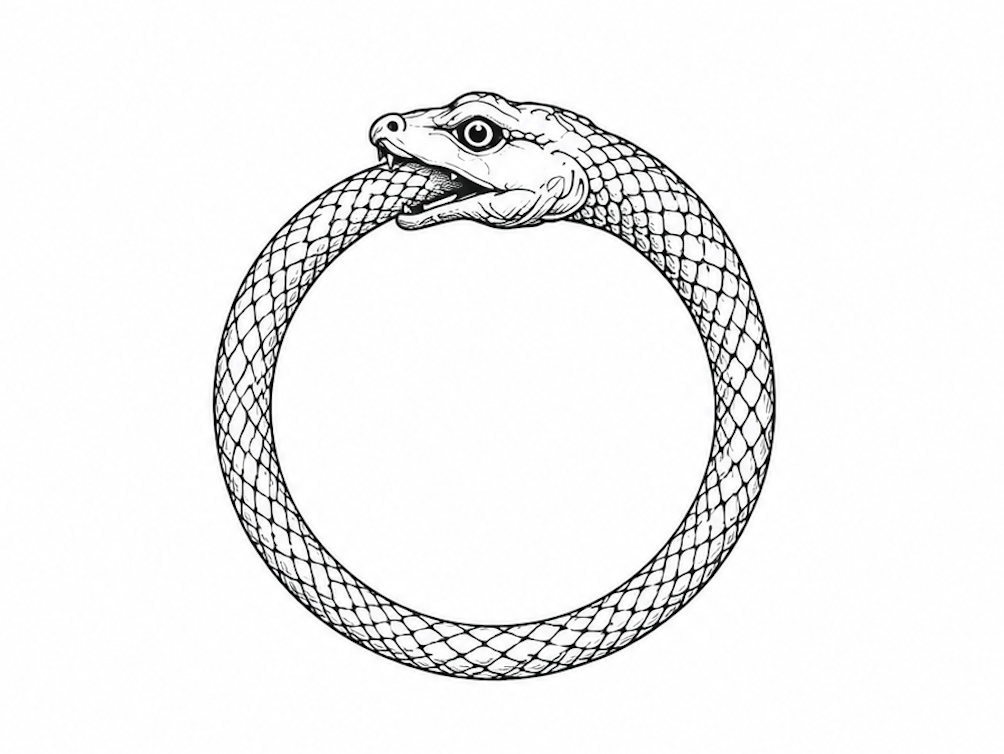
The question, therefore, is not whether destruction exists. That is empirically obvious. The question is whether destruction is accidental to reality or constitutive of it. Given this as the actual, observable operation of the world at every scale, from the sperm cell to the extinction event to the death of stars to the eventual stillness awaiting the universe itself – the ancient image of the Ouroboros rendered in biology, ecology, and cosmology alike – how does one account for it under the image of a single, all-good God, who is said to have made it, to preside over it, and to love equally everything within it? One must either conclude that the world was not created by an omnipotent God, that such a God lacks complete power over creation, that creation itself genuinely includes destruction within the divine act, or that the observable structure of reality is radically misleading about its own nature. These possibilities are not equally compatible with every God-image.
If love is a property of the divine, it must be a love that includes the death of sperm cells and embryos as part of the mechanism, the predation of organisms as part of the process, and the eventual heat death of the universe as the endpoint. This is not a love that the human tradition has ever described as ‘love’ in any recognizable sense – it is the love of a process that consumes its own creations, at every scale, without exception. This is not a new observation. The Book of Job, Ecclesiastes, and the Greek tragedians all wrestled with the same problem: the world is not organized around justice or love. The Christian privatio boni was a late, forced solution to a problem that the tradition itself had already articulated. A defender of the privatio boni may reply that these processes belong not to creation itself but to the Fall, yet this merely relocates the question. If creation was capable of becoming a reality whose observable structure operates through continual selection and foreclosure, then that possibility already belonged to the created order itself.
Under this description, ‘good’ cannot mean ‘that which is preserved’ and ‘evil’ cannot mean ‘that which is destroyed’ because preservation and destruction are the same process, differentiated only by scale and perspective. The sperm cell that dies is not evil; the egg that selects one is not good. The embryo that fails is not punished; the one that survives is not rewarded. The star that explodes is not destroyed; its elements are dispersed to form new systems. The process itself distinguishes only between persistence and non-persistence, it does not distinguish justice from injustice, innocence from guilt, virtue from vice. Those distinctions arise only when conscious beings evaluate what has occurred. Value is not written into the process itself; it is a judgment made by consciousness within the process – which may be the only thing the process could not generate on its own, and the only reason any of this was ever witnessed rather than merely occurring. This is what the God-image of totality actually looks like: a process that produces and destroys without preference, that selects and forecloses without judgment, that creates through destruction and destroys through creation. The privatio boni is a refusal to look at this directly. The Abraxian position is the choice to look at it without flinching, and to bear the weight of what is seen. This is not an argument for despair, it is an argument against false consolation. The universe is not organized to provide comfort, and the attempt to force it into a redemptive framework is an act of psychic narrowing against the overwhelming weight of evidence.
At every scale examined – the cell, the organism, the species, the ecosystem, the planet, the star, the universe – the process observed is the same process: differentiation proceeding by selection, selection proceeding by the death or foreclosure of what is not selected, and continuation of any given form purchased at the direct expense of some other form that does not continue. This is what existence consists of. The God-image that can accommodate this reality is not the all-good Father who loves everything equally and will someday redeem it all, it is the God of totality, who contains both creation and destruction, selection and foreclosure, life and death, as the same process, without preference, without judgment, without redemption, and without end.
Subscribe:
Email delivery remains on Substack for now.
Finally found a reliable link that actually works without any lag. Getting into my favorite games is so much easier now with jili0gameslogin.