
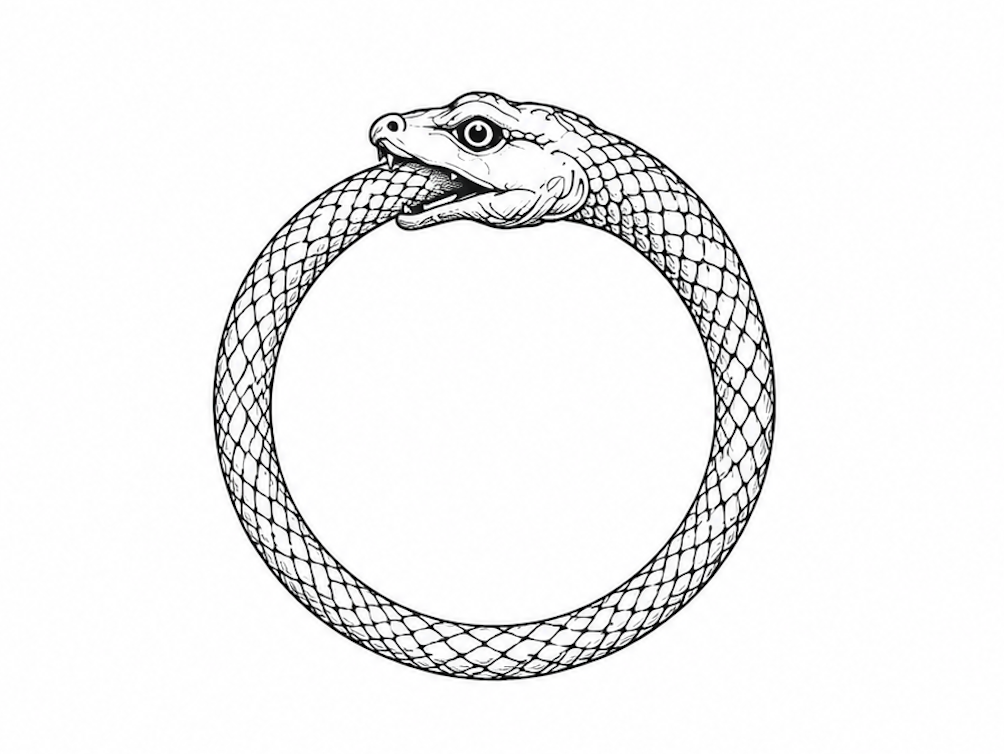
Ernest Becker correctly identifies death anxiety as a major force shaping human psychology and culture, but mistakes one manifestation of a more fundamental existential condition for its organizing principle. This essay argues instead that the human predicament is rooted in the permanent crucifixion of irreconcilable opposites, and that the task is not to resolve these tensions through religious or secular redemption but to learn to bear them through individuation and acceptance of one’s portion in existence.
In this post I will be discussing Ernest Becker’s The Denial of Death (1974) which served as the inspiration for Terror Management Theory (“TMT”). TMT argues that the awareness of mortality is the organizing principle behind much of human psychological and cultural activity. This in turn inspired a huge amount of scholarship and was later articulated in Greenberg, Pyszczynski, and Solomon’s The Worm at the Core: on the Role of Death in Life (2015), which I read and did not like.1 The theory peaked in popularity between 2004-2008, and more recently suffered multiple failures to replicate its claims in various studies, as discussed by PhD in psychology Sam Moreton here.
First, why should one care? Well, a perceptive reader may note some commonalities between my ideas and Terror Management Theory. As I wrote in The Fork in the Architecture of the Soul,
the vast majority of people do not want to experience the crucifixion of opposites, because to stare into the void is horrifying and would break most people’s minds. Most people want religious leaders (or secular leaders, or so-called “experts”) to tell them what to do. From this vantage-point the offloading of the crucifixion onto such experts of whatever religion or secular institution is not a horror or an injustice but a mercy, which was the inquisitor’s position in the Grand Inquisitor.
In other words, the horrors of the void underline the basics of philosophical pessimism and reality in general; to live is the brief blip of time between birth and death, nothing one builds last, life is pain and suffering, and reality constitutes a giant Ouroboros of differentiation, selection, and destruction of what is not selected, at every level of existence. To think about this is to invite psychic destabilization and possibly insanity; Schopenhauer retreated to an ascetic withdrawal, while Nietzsche doubled down on his ego in the form of the Ubermensch before collapsing. To sit with this pain, to stare into the void, is a very dangerous thing to do.
This is Becker’s point in his book2, which I hoped would be easy to read but which I struggled through. Becker points to Freud and sees him as brilliant but reductionist; everything is about sex to him. He points to Adler and his power principle (where everything boils down to the pursuit of power) and sees him correctly as a reductionist as well. But Becker’s response is to reduce everything to death itself. He is explicit about this, p. 96:
Man’s body was “a curse of fate,” and culture was built upon repression – not because man was a seeker only of sexuality, of pleasure, of life and expansiveness, as Freud thought, but because man was also primarily an avoider of death. Consciousness of death is the primary repression, not sexuality. As Rank unfolded in book after book, and as [Norman O.] Brown has recently again argued, the new perspective on psychoanalysis is that its crucial concept is the repression of death. This is what is creaturely about man, this is the repression on which culture is built, a repression unique to the self-conscious animal. Freud saw the curse and dedicated his life to revealing it with all the power at his command. But he ironically missed the precise scientific reason for the curse….A basic cause for his own lifelong twisting was that he would never cleanly leave the sexual dogma, never clearly see or admit that the terror of death was the basic repression.
Becker is correct that the fear of death makes up a significant part of the fears underlying the human psyche. He believes mankind is fundamentally caught in a mind/body split, where man’s animal body is forever at odds with its soaring God-inspired mind; it is this tearing, to him, that is at the core of the problem of mankind3, and neurosis and mental illness results if one tries to lean into one of the polarities too much (mind or body) at the expense of the other.
But the fear of death is not the primary issue of mankind from what I see. There’s a famous expression that the first third of life one worries about women/sex, the second third one worries about money, and the last third one worries about health/death, and that seems to be both my own experience and the experience of those I know. Many of the old people I know spend an inordinate amount of time talking about their health pains, their medicines, their doctor visits, etc. I don’t think young people are motivated by fear of death much at all, either consciously or unconsciously (unless affected by difficult early life circumstances, perhaps), unlike Becker’s take which leans very heavily on early life sexual Freudianisms and unconscious fears. Rather, I see the fear of death as primarily striking people in midlife during the aptly named “midlife crisis”, previously discussed here, where dying older generations combined with a slowing of one’s body forces one to confront mortality directly in a way one generally didn’t have to confront in youth. But even if mortality salience (i.e. the awareness of one’s own inevitable death, which can influence thoughts, emotions, and behaviors) produces a fear of death, it still wouldn’t explain why mortality has explanatory primacy over the broader structure of oppositional tension inherent in reality itself.
I think the fundamental problem of life may be reduced, but the reduction itself is paradoxical, Ouroboric: that the fundamental problem of life is the crucifixion of opposites, that to be alive, to be conscious, is to be forever torn between competing desires, motivations, beliefs – freedom/belonging, desire/satisfaction, love/independence, knowledge/uncertainty, individuality/society, creation/destruction, continuation/cessation, meaning/meaninglessness.4 The opposites are mutually implicating conditions of existence, such that the realization of one frequently reproduces or intensifies the other via the concept of enantiodromia. It is through the clash of opposites that consciousness emerges and sustains itself. And this perception forms the axiom at the heart of my project: that the opposites are irreconcilable, that they are the core feature of reality as it exists, and no one polarity will ever win out over the other. This axiom was necessary for me given the Münchhausen trilemma – where any argument, drilled down far enough, ultimately results in circularity, regression in which each proof requires another proof forever, or dogmatism resulting from belief axioms. The crucifixion of opposites as the base condition of reality chosen as my own axiomatic belief solved for me my endless circulation around the problems of evil, the meaning of life, the nature of God, etc., allowing me to re-engage life on a lived, provisional, horizontal basis, without my life interactions constantly cascading up the belief hierarchy to interact with the God-image itself, something which was exhausting and demoralizing. Of course, this doesn’t mean its psychosomatic/metabolic benefits equate to ontological truth, discussed here, but it isn’t possible to live in this realm without a highest order belief, all of which come with benefits and drawbacks; at best one may hope to find a livable orientation.
So it feels ironic that Becker criticizes Freud, Adler, Jung, and many others for their reductionism, while proposing a solution that also, from my perspective, seems quite reductionist as well – not false, but partial in a way that overclaims what the state of the evidence allows. To a man with only a hammer everything looks like a nail. He even quotes Jung on this point in relation to Freud, but doesn’t draw the broader lesson in respect to his own reductionism, p. 123:
Freud never asked himself why he was compelled to talk continually of sex, why this idea had taken such possession of him. He remained unaware that his “monotony of interpretation” expressed a flight from himself, or from that other side of him which might perhaps be called mystical. So long as he refused to acknowledge that side, he could never be reconciled with himself….There was nothing to be done about this one-sidedness of Freud’s. Perhaps some inner experience of his own might have opened his eyes….He remained the victim of the one aspect he could recognize, and for that reason I see him as a tragic figure; for he was a great man, and what is more, a man in the grip of his daimon.
Becker quotes this about Freud, but he never asks whether it applies to himself. Alternatively, an axiom involving the crucifixion of opposites as a base condition of reality incorporates all of these others, and that is why I think I found Becker’s take to ultimately be disappointing and kind of boring. Of course, my perspective is just as reductionist and axiomatic as the others, even if much broader in application. Perhaps Becker would argue that death is what makes the crucifixion of opposites meaningful, that without it the opposites would lack the time element and finitude that makes choice itself important, and there would be something to that; but I still see death as the cessation of the purpose of life as opposed to the purpose itself.
But perhaps someone will come along and claim another axiom that incorporates my beliefs just as it does all the others who came before. As Becker writes, p. 256 “But maybe [Jung’s] understanding was actually a reflection of Jung’s own demonic drivenness into alchemy, of the almost shamanistic quality of his inner life. No less a student of man than Erich Fromm has written the bitterest lines on Jung, denouncing him as an enemy of science. Pity the layman scurrying under the feet of all these giants dropping their weighty pronunciamentos on one another.” A finite being necessarily occupies partial positions within a totality it cannot fully inhabit. Death is particularly terrifying because it crystallizes one of those oppositions – continuation and cessation – but the same structure appears in sex, power, love, morality, knowledge, freedom, belonging, and meaning.
I will note that Becker doesn’t know what to do with his insight. Even if everyone is primarily motivated by the fear of death, okay, great, what does one do with it? Becker doesn’t know. He flails around with a lot of words before arguing that man should lean into “heroics” and perform a Kierkegaardian “leap of faith” into believing in God’s transcendence again. It feels very slap-dashed and taped together; it reminds me a bit of Richard Tarnas’s The Passion of the Western Mind which also dealt with the problems of nihilism in the modern world but which also had no idea what to do about it, despite his own hand-waving. My approach is in adopting a non-redemptive worldview, that the crucifixion of opposites is a permanent condition, and to accept one’s heleq, one’s portion in the Ecclesiastian sense; to narrow the scope of one’s focus to what one can impact and affect in one’s life and to try to ignore, at least to an extent, what is outside of one’s control, and to listen to one’s intuition more than society allows (but still balanced against one’s intellect and emotions).
It is also amusing to me that The Denial of Death won the Pulitzer Prize, and that it received praise from The New York Times, Publishers Weekly, Washington Post, Chicago Sun-Times, etc. I have a suspicion of intellectual prestige of this sort because institutions are remarkably good at either recognizing and rewarding arguments that reinforce institutional prestige, or at least converting destabilizing ideas into respectable cultural objects. And that’s the sense that I walked away from Terror Management Theory – to domesticate the idea of death and feed that anxiety, either covertly or implicitly, into reinforcing institutional power. Alternatively, the idea of the crucifixion of opposites dramatically weakens institutional power and expert prestige, because if everyone and everything is partial under totality, then no one and nothing can honestly claim to speak for the whole.5
The point is therefore not to replace one authoritative metaphysics with another, but to recognize the partiality of every finite position, including this one. Ultimately, Becker correctly identifies death anxiety as an enormous component of human symbolic life, but he commits the same explanatory error he identifies in Freud: he mistakes a powerful manifestation of a more fundamental condition for the condition itself.
Note: You can sign up to receive email notifications of new posts here.

It was clearly written and inoffensive, but the problems I had with the book were multi-faceted: (1) it was written in a simple, didactic style for mainstream public consumption, flattening nuance; (2) it relied on summarizing endless numbers of empirical studies, converting an existential claim into a series of propositions that can be experimentally demonstrated (and reducing terror to a variable). This reminded me of Freakonomics and it felt fake, a feeling apparently in line with TMT’s replicability issues in recent years; (3) related to #2, it felt surface-oriented, whereas I am much more interested in those who are phenomenologically crucified between the opposites, those who have lived the pain of existence, and I felt none of that from these authors; (4) it doesn’t risk anything; its views are quite conventional, even if they focus on the so-called “grittiness” of death. I could quote quite a few examples – the milquetoast, quasi-nauseating take on Ted Kennedy comes quickly to mind – but it’s not really worth the digression. Furthermore, (5) it suffered from the same problems as Becker’s did – i.e. it was reductive in that it reduced many competing phenomena to the fear of death – and I don’t agree with that as a foundational axiom, even if it happens to be an important element among many, like sex and power, that also influences behavior and motivation.
Essentially, TMT takes Becker’s existential psychology and turns it into behavioral science. In the process, the existential object becomes increasingly manageable, but I am interested in the opposite direction: going underneath the explanatory mechanism toward the actual structure of experience that makes such mechanisms necessary. As such, out of boredom I gave up on The Worm at the Core about 1/3 of the way through.
As Sam Keen states in the foreword:
“Becker’s philosophy…is a braid woven from four strands.
The first strand. The world is terrifying…Mother Nature is a brutal bitch, red in tooth and claw, who destroys what she creates. We live, he says in a creation in which the routine activity for organisms is “tearing others apart with teeth of all types – biting, grinding flesh, plant stalks, bones between molars, pushing the pulp greedily down the gullet with delight, incorporating its essence into one’s own organization, and then excreting with foul stench and gasses the residue.
The second strand. The basic motivation for human behavior is our biological need to control our basic anxiety, to deny the terror of death.
The third strand. Since the terror of death is so overwhelming we conspire to keep it unconscious…So long as we stay obediently within the defense mechanisms of our personality…we feel safe and are able to pretend that the world is manageable….Society provides the second line of defense against our natural impotence by creating a hero system that allows us to believe that we transcend death by participating in something of lasting worth….
The fourth strand. Our heroic projects that are aimed at destroying evil have the paradoxical effect of bringing more evil into the world….The root of humanly caused evil is not man’s animal nature, not territorial aggression, or innate selfishness, but our need to gain self-esteem, deny our mortality, and achieve a heroic self image.”
p. 26: “We might call this existential paradox the condition of individuality within finitude. Man has a symbolic identity that brings him sharply out of nature. He is a symbolic self, a creature with a name, a life history. He is a creator with a mind that soars out to speculate about atoms and infinity, who can place himself imaginatively at a point in space and contemplate bemusedly his own planet. The immense expansion, this dexterity, this ethereality, this self-consciousness gives to man literally the status of a small god in nature, as the Renaissance thinkers knew.
Yet, at the same time, as the Eastern sages also knew, man is a worm and food for worms. This is the paradox: he is out of nature and hopelessly in it; he is dual, up in the stars and yet housed in a heart-pumping, breath-gasping body that once belonged to a fish and still carries the gill-marks to prove it. His body is a material fleshy casing that is alien to him in many ways – the strangest and most repugnant way being that it aches and bleeds and will decay and die. Man is literally split in two: he has an awareness of his own splendid uniqueness in that he sticks out of nature with a towering majesty, and yet he goes back into the ground a few feet in order blindly and dumbly to rot and disappear forever. It is a terrifying dilemma to be in and to have to live with.”
As I define it here, “The permanent condition and unbearable tension of inhabiting a reality constituted by irreconcilable poles (good and evil, matter and spirit, love and hatred, greed and asceticism, short term versus long term, light and darkness, persona vs shadow, masculine vs feminine, rational/scientific vs irrational/spiritual, action vs. reflection, justice vs. mercy, order vs. chaos, hope vs. lucidity) – see the term Opposites for how the term is specifically used here. It is the condition of consciousness and a base condition of reality. The crucifixion must be borne somewhere by individuals – either offloaded to institutions, collapsed into antinomianism, or held internally via individuation.”
See here, where I wrote: “The Abraxas framing does something far more dangerous. It says: Good and evil are not monopolized by the God-image, they are structural opposites within reality itself. That has several consequences religious elites will grasp: God is no longer the guarantor of moral repair, suffering is not promised retroactive justification, evil is not guaranteed to be “accounted for.” This removes the Church’s role as the broker of cosmic reassurance. Moral authority can no longer be externalized upward; if God contains both poles, then moral clarity cannot be outsourced. The believer cannot say, “God wills this, therefore it is good.” Under Abraxas judgment collapses back into lived responsibility and sin loses its clean bookkeeping function. Under privatio boni evil = deviation, repentance = erasure, grace = ledger correction, but under Abraxas nothing is cosmically “balanced”, and this annihilates sacramental control. Heaven and hell stop functioning as leverage; if Heaven is not guaranteed compensation and Hell is not guaranteed punishment, then fear and hope can no longer be administered institutionally. God becomes unownable. This is the core threat to moral authorities. A God who is all-good can be represented, but a God who contains evil cannot be spoken for safely. No priest, no theologian, no hierarchy can say, “We stand closer to God than you.” Because proximity to Abraxas is not sanctity, it is exposure. That is why this position would feel worse than heresy to them; heresy still plays on the same board, it argues about what God is like. This move changes what God is for. It strips God of his role as moral insurer, cosmic accountant, narrative redeemer, institutional anchor. What remains is a God-image that cannot be used to govern souls. Religious elites do not fear disbelief – they fear a God who cannot be made safe, as it makes their mediating role structurally obsolete.”