
A months-long fixation on Way Down Hadestown has led me to explore the song’s many performances, its creator’s iterative process, and the mythological world it evokes. What keeps drawing me back is a vision of the underworld whose attractions and horrors are inseparable, and whose unresolved contradictions may illuminate something about my own psychic development.
In this post I will discuss the Broadway show Hadestown, with a focus on its keynote song Way Down Hadestown. I’ll also draw on Working on a Song: The Lyrics of Hadestown by the show’s creator which documented her process creating the musical.
First, why? Well, I have been playing the song obsessively across its dozens of versions online for a couple of months now. There is something about the song that relates to my current state of psychic development, and it’s like my psyche needs to repeatedly replay it until it metabolizes whatever underlying, mysterious element my unconscious has picked up as resonant. In prior stages, I was obsessed with different ABBA songs, discussed here in 2024 – Voulez Vous (during a period I heavily identified with Dionysus), the little-known Elaine (active and upbeat tune with downcast lyrics, signifying the opposites), and the as-little-known The Piper (where I identified with the archetype of The Magician), among other songs like Love Without End, Amen (especially Aaron Barker’s version), which is my favorite song of all time, Amarillo by Morning, Life’s a Dance, Much Too Young (To Feel This Damn Old), and Calling Baton Rouge. These songs are still bangers, but they have lost their psychic hold on me; I have absorbed from them whatever I subconsciously needed from them.
I. Background
I initially saw Hadestown after a relative recommended it on a whim – the Broadway show was playing in theaters, and did I want to see it? I walked in knowing nothing about it, and it took me about twenty minutes to get into it; I was thrown off because it was supposed to be about Greek myth, but it featured a predominately black cast in a New Orleans type setting (yes, I’m sure this was a political decision; there’s no avoiding it in 2020s America, especially on rigidly dogmatic Broadway; it is what it is, and I’m open to assessing material on its own terms; the politics isn’t thrown in one’s face). Hermes – after my namesake, but in a somewhat different function1 – is featured in one of the central roles, with a lot of lines and singing and dancing, and in the film version he is played (pretty amazingly and with dignity) by eighty year old André De Shields; imagine being a headliner in a Broadway show at that age, wild…
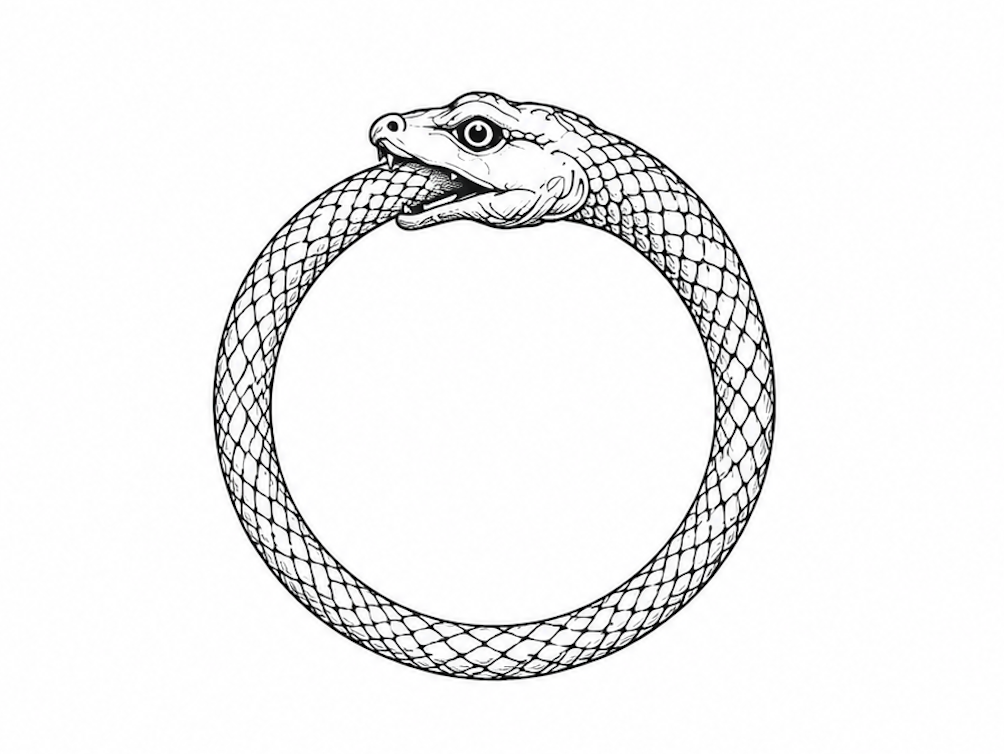
The plot is the dual Greek myths of Persephone/Hades and Orpheus/Eurydice2; the latter doesn’t work and I found to be boring, but the former was riveting in its portrayal, especially discussion of the complications of power3, as was Hermes’ role as narrator and psychopomp, and a number of the songs were quite good. The story is deliberately non-redemptive with a needle-threaded downbeat but hopeful ending (which is announced right at the start; the non-redemptive4 and Ouroboric ending5 was important to me), it features a Greek chorus called the Fates, and has plenty of upbeat beats throughout. It’s a pretty unusual production from what I’ve seen of Broadway shows in its content and history, and it does a great job of resurrecting in a modern format ancient Greek myth. Perhaps this (and other morally ambivalent musicals like Wicked) says something, too, about the changing cultural values as the aeon transitions from Pisces to Aquarius; the great wheel of the Zodiac turns, bringing to the forefront long-forgotten ancient values and de-emphasizing the last aeon’s values (the God of goodness via the Piscean fish).
II. The History
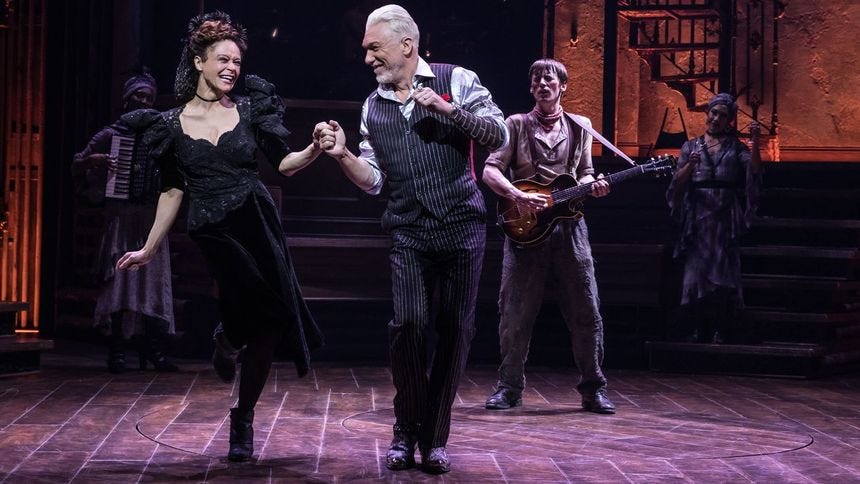
Equally impressive was the history of the play; a young woman named Anais Mitchell began it as a DIY community theatre project in Vermont in 2006-7 in her early 20s, where she wrote and recorded the original concept album, then shopped it around until it was featured in a workshop (2016 NYTW version), after which it eventually made it to Broadway more than a decade since inception. As Steve Earle wrote in the introduction to Working on a Song, “Her odyssey began on the folk circuit, a world of coffeehouses and house concerts peopled with fiercely free spirits who aren’t waiting around to be discovered. They simply bypass the gatekeepers in LA, Nashville, and New York and make music, recording and releasing it themselves if necessary. Then they go out on the road, and after proving the worth of their wares before a live audience, they sell CDs and vinyl directly to the people, sometimes right off the stage. It was in that DIY, fly-by-the-seat-of-your-pants environment that Hadestown was born.” What perseverance, what fortitude!
Even though the play didn’t start out with the idea in mind, it gradually came to resemble classical formulas. “I remember..realizing that our weird little show – born in the wild woods of Vermont and developed with a lot of downtown artists who disdained commercial formulas – was actually coming to resemble a classic Broadway musical structure….None of this was intentional! We were feeling our way in the dark, and when something worked, we kept it. But it gave me a certain reverence for those classical formulas, which aren’t merely “commercial,” but tap deep into a human storytelling culture older than any of us can remember.” The Broadway-show-turned movie outperformed Hamilton, becoming the highest grossing Broadway performance on film in history; the audience is smaller than Hamilton’s, but much more enthusiastic.
III. Way Down Hadestown
Onto the music itself. Honestly, I don’t care for most of it (especially all the Orpheus/Eurydice stuff, which to me was two dimensional and “floofy”), which is ironic given I’m doing a post about the musical; there are still a couple of pretty good songs (When the Chips Are Down, Why We Build the Wall, Chant), and Way Down Hadestown is, to me, extremely memorable and set apart from the rest. The song is about a train that arises from Hadestown and carries souls, along with Hades’ wife Persephone, back to the underworld, where people will work as slaves – “the pay is nothing and the work is hard.” Eurydice expresses interest in descending to Hades, because she is otherwise starving to death, and Hermes narrates the song. I’ll discuss aspects of it further, but first, I’ll link to different versions in different settings below; when I feel resonance with something, as some of you know, I feel compelled to deep dive into it to assess it from as many angles as I can. The same symbolic structure changes when the material is inhabited by a different psyche/body/voice/personality, and these subtle changes are fascinating.
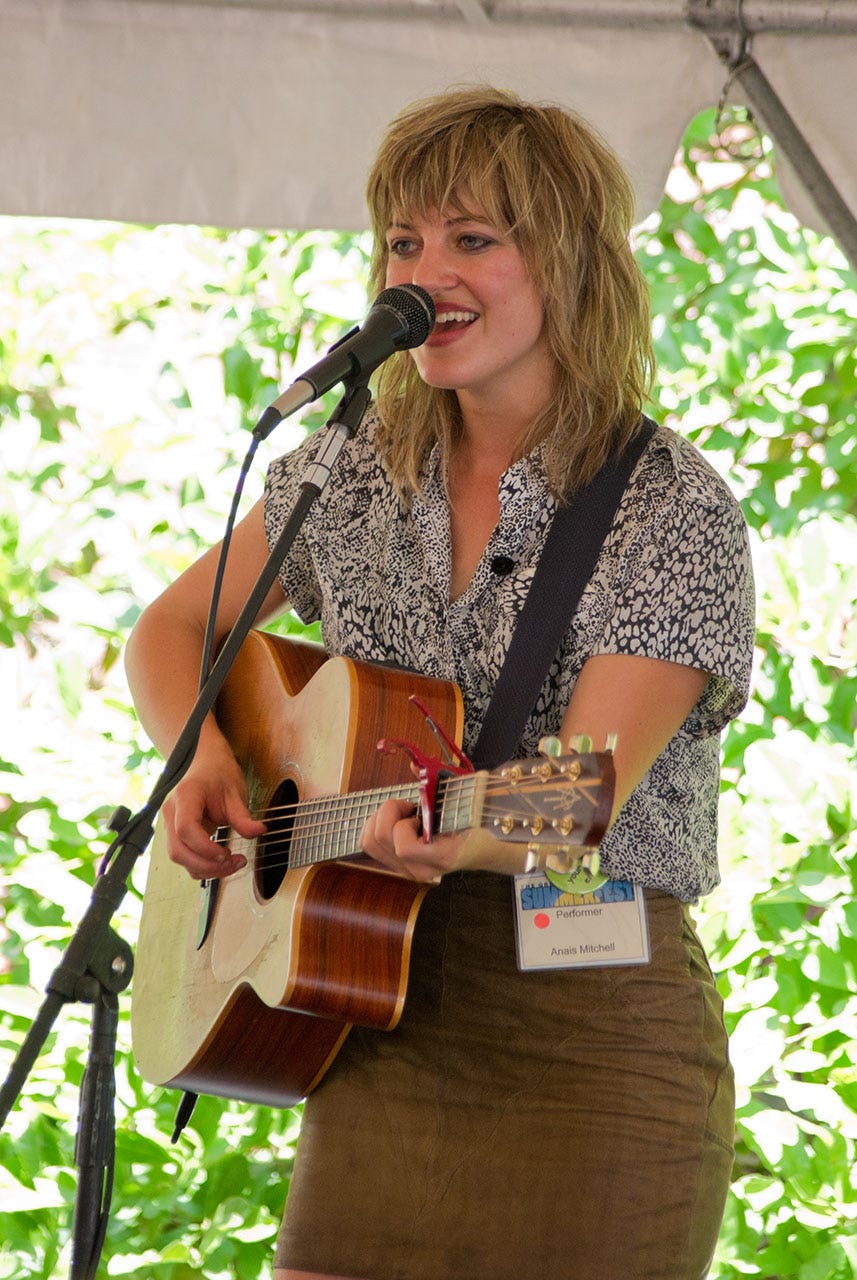
Here’s one of the earliest audio versions from 2007 sung by Anais Mitchell which is slow and shorn of instrumentals; it is haunting, poetic and beautiful to me.
This song has not changed much in the past almost 20 years, despite making it faster and giving different parts to different singers (although one part of the lyrics at the end is different). The following is an upbeat version sung by Mitchell in 2010 as she toured and performed to raise interest in her work.
The following is also from 2010, but now it has a become a multi-instrument song with multiple singers, a form which remains thereafter. Persephone sounds upbeat in it and the lyrics are crisp:
Here’s a clip from the film version with André De Shields playing Hermes, Amber Gray playing Persephone makes the character drunk and jaded which wasn’t a direction I loved (she played this role for quite a few years as part of the original cast):
Below is a version with Jewell Blackman as Persephone – she absolutely kills it. She was apparently in the play for awhile as one of the ensemble chorus (the “Fates”), and was eventually transitioned to a principal role. I love her wild haired possessed dance starting around 1:20, and how she pops up to begin her lyrics – amazing (it’s a wig, also funny how it doesn’t fly off). Super positive vibe in her role here, she seems really grateful to have gotten upgraded and is savoring every moment.
You can see Jewell Blackman in her role as one of the Fates in this clip:
The below cover is a fantastic one, just a group who loves the song assembled in some apartment somewhere. Three guys sing the Hades role, the one at 2:48 kills it, Persephone has a sexy vibe:
Sometimes adjusting the speed of playback makes an interesting difference; in this solo cover, for example, the song is better at 1.25x speed, and decidedly more cheerful.
There are even lots of high school performances. The Hermes in the below version steals the show, riveting, and could easily have a career in professional show business, and it demonstrates that the song’s symbolic structure survives being stripped of professional production value and inhabited by entirely different people:
There’s a pretty solid 2024 London West End version online which leans heavily into what sounds like a Hermes Jamaican accent, and even a Korean version, with the Hermes actor Choi Jae-rim giving an awesome delivery at 1:11:
IV. The Appeal of The Song
While it is very hard to pinpoint why the song has such resonance with me currently, I can still speculate about its themes. First, to state the obvious: the sound, repetition, the stomping, hypnotic, train-like groove, the call-and-response, the pull of a descent one can hear, the trance, ritual, mood regulation are relevant; it’s sexy and very catchy, it stays in the memory very easily. But there are many catchy tunes, so I tend to discount that explanation for why it currently calls to me.
Rather, it is about the content of the song itself: it is about entering a world that contains mutually contradictory descriptions of itself from multiple different perspectives (Hermes, Persephone, Eurydice, Orpheus, and the Fates), and they don’t align with each other and aren’t resolved. Hadestown represents the crucifixion of opposites: hell and refuge, prison and protection, death and survival, order and oppression, wealth and impoverishment, security and enslavement, the underworld and an industrial workplace, something terrifying and something deeply attractive. Eurydice doesn’t go there because she’s stupid or because evil seduces her, she is cold and hungry and Hadestown actually offers something she needs. So it’s not that Hadestown is “Hell”, there is a deep appeal to the place, and the song and the play don’t handwave that unpleasant issue away. And then the different arrangements, voices, emphases, and dramatic contexts add additional layers of meaning and ambiguity.
The attractive feature to me isn’t the number of oppositions, it’s that the positive and negative descriptions are causally connected. Hadestown offers security partly by eliminating freedom; its order is inseparable from its coercion, its provision of material necessities comes with exploitation, and the world above, for all its freedom, has left Eurydice exposed to hunger and cold. This is more interesting than a good world is corrupted by evil, or an evil world disguises itself as good. Hadestown has something real to offer, and that is why Eurydice’s choice is tragic.
Furthermore, there is an entire mythology organized around threshold-crossing and incompatible worlds: you have Persephone moving between worlds, Hermes narrating between worlds, Orpheus trying to cross between worlds, Eurydice choosing to descend, and the Fates embodying the psychological pressure surrounding the choice. It is a drama of liminality, and the show’s creators explicitly developed the climate/world-building around this imbalance. Additional pairs of opposites include above / below, life / death, summer / winter, freedom / order, love / possession, music / industry, and the world of becoming / the world of permanence, and Hadestown doesn’t resolve these into a clean moral polarity.
V. Conclusion
This was a strange topic for a post, but other than the ABBA post, I think it fits neatly into other cultural commentary posts such as my post on Two and a Half Men, which featured the opposites of Dionysus and Job in a comedy role (that is literally how the show creator saw it).
I hope you enjoyed it. If you did, you can see the film version of the Broadway show streaming on various platforms, or also catch the Hadestown national tour if it is of interest.
Note: You can sign up to receive email notifications of new posts here.
My use of Hermes is to describe the bridging of incompatible energies – Hermes serves as the messenger of the Gods in between them; in the musical Hermes has a bridging role between Hades and Orpheus and between the cast and the audience, but he is also significantly serving as a psychopomp between the living and the dead.
Briefly, Persephone spends six months out of the year in Hades, and six months in the upper world, mimicking the agricultural birth/death cycle associated with the changing seasons. Orpheus is a famous bard who travels down into Hadestown to try to rescue his wife Eurydice from a bad deal; a compromise is reached, where they can leave Hadestown if Orpheus does not look back at Eurydice following him. He looks back at the very last second, dooming her to an eternity remaining in Hades. Both of these myths are well known so long as one has a basic understanding of Greek myth, and Hadestown announces the tragedy which will occur right at the start – no hiding the ball here.
See the song How Long?, which includes the lyrics:
Hades: “How long? Just as long as Hades is king
Nothing comes of wishing on stars
And nothing comes of the songs people sing
However sorry they are
Give them a piece and they’ll take it all
Show them the crack and they’ll tear down the wall
Lend them an ear and the kingdom will fall
The kingdom will fall for a song.”
p. 250: “What was required was a delicate emotional transition between Orpheus’s turn and what I hoped would be an uplifting ending in spite of it all. It was important to dwell in the tragedy without wallowing in it; to move on, but not too quickly. A major middle-of-the-night breakthrough was the Hermes stanza: Cos here’s the thing / To know how it ends / And still begin / To sing it again / As if it might turn out this time / I learned that from a friend of mine. That stanza, miraculously, seemed to write itself….more significant was the way that invoked a Groundhog Day-style return to the beginning of the story….It was breathtakingly right. There was a joyful defiance in the act of “beginning agian” that seemed to sum up the spirit of our story.” And p. 255: “we raise our cups to Orpheus not because h succeeds, but because he tries. We understand implicitly that there’s value in his trying and even in his failure. The act of writing, for me, has most often been a process of failing repeatedly. It’s the only way I know how to write!…What is seen and heard onstage is the blooming flower, but most of the plant is underground. Every line, verse, or chorus – every idea any of us who worked on it ever had, even the ones that never saw the light of day – they’re down there. They’re the roots of the plant, and the flower wouldn’t exist without them. The ones who bloom in the bitter snow bloom because they are supported from below by a thousand tries and failures.”
This was actually stated deliberately in a song which was ultimately cut, p. 256: “
Persephone: Come, my son, we try and we fail / Every tale has an end
But the pale dawn breaks / And the snake eats its tale /And the tale begins again…”
https://webtoolreviews.blogspot.com/2026/10/how-to-download-videos-gifs-photos.html