
This essay examines a single decision point that determines the entire architecture of one’s relationship to reality: where is the crucifixion of opposites borne? Institutional authority, Sabbatean antinomianism, and Jungian individuation are examined as the three most historically significant responses to this fork, each following coherently from the same metaphysical premises while arriving at radically different destinations.
Welcome back. In this post I would like to discuss how one’s response to the crucifixion of opposites changes the entire nature of one’s relationship to reality. The disclaimers applying to the prior three part series apply here as well.1
Let’s briefly lay out the logic chain:
- Reality is made up of pairs of opposites where any category only makes sense in terms of its opposite – there can be no good without evil, light without darkness, happiness without sadness, life without death. Good and evil, matter and spirit, love and hatred, greed and asceticism, short term versus long term, light and darkness, persona vs shadow, masculine vs feminine, rational vs irrational, action vs. reflection, justice vs. mercy, order vs. chaos, hope vs. lucidity, there are an infinite number of such pairs.
- God must be the unity of all opposites, because to deny parts of the opposites to God would be to argue that God is not infinite, not total, not all powerful.
- This means that God’s unity includes evil, not merely that evil is a deprivation of God (the privatio boni of Christianity).
- The only thing that totality lacks under this conception is lived experience of navigating the opposites from a limited relational standpoint (the crucifixion of opposites), because the opposites are otherwise united within totality.
- God is an unconscious being, because consciousness arises from limitation (i.e. navigating this and not that).
- Given that God is totality and unconscious, it does not necessarily “care” like a personal God would about how living creatures navigate the opposites, as that would smuggle the privatio boni back through the backdoor.
- It is humanity’s role – and perhaps the role of all life – to provide fullness to totality by navigating the crucifixion of opposites from their limited perspective.
This is a horrific logic chain if one sits with it, because it means that God does not care about us individually and that all experiences, good and bad, add to totality. The starving African child and ruling the world as a Rothschild are both experiencing contributing to totality’s fullness. The question then becomes how does one bear this conception of God as totality, not as God as loving kindness? The structural question this generates is architectural: where does the processing of unbearable reality occur, who holds this terrible knowledge? A useful analogy is urban waste management. A centralized sewage system is efficient, coordinated, and scalable, but it concentrates toxicity in one place and is vulnerable to catastrophic failure. Alternatively, distributed composting is resilient and adaptive, but it cannot coordinate at scale. The crucifixion of opposites works the same way. The question is not whether it happens but where, and this single placement decision determines everything that follows.
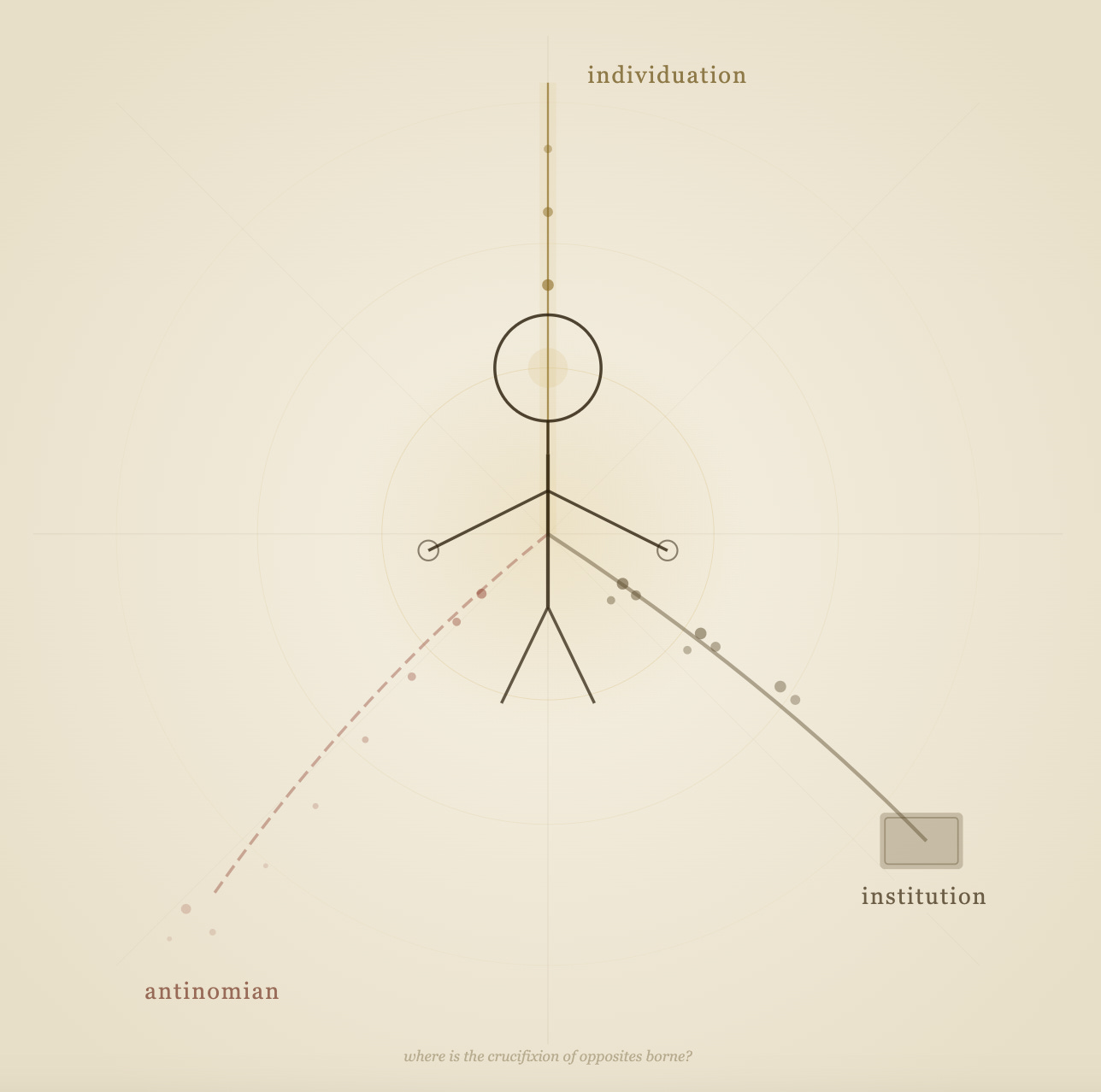
There are three possible responses to the crucifixion of opposites:
- To contain the horrors of the void within institutions. One can see this within religious institutions of all faiths (other than Buddhism) and in secular forms (belief in ideology or government, “experts” or “science”, news orgs broadcasting the Current Thing2, etc.). In other words, institutions tell believers how to act, the believer accepts and internalizes the messages, and the authorities bear the agony of the crucifixion of opposites so that the believers do not have to. We can see this in the Catholic Magisterium, where the Church acts as the ‘Vicar of Christ’ to resolve the paradoxes of sin and grace for the believer. Just as the Lurianic system uses Rabbinical guidance to navigate the Sefirot, the Catholic hierarchy functions as a spiritual ‘load-bearer.’ By claiming the sole authority to interpret divine will, the institution absorbs the crucifixion of opposites – the paralyzing weight of moral uncertainty – so the individual can focus on communal life and obedience. This is the essence of Dostoevsky’s Grand Inquisitor: the elite few accept the terrible burden of freedom and the knowledge of good and evil so that the many may live in a state of peaceful, humble happiness.
- Antinomianism, where if God is totality then why strive toward the good? One can see this impulse in strands of Jewish thought such as Sabbateanism and Frankism, where descent into the “kelipot” (the evil material world) was seen as necessary to “repair” the Godhead.
- The most recent approach, which is the Jungian individuation process. One accepts the crucifixion of opposites internally, individually, with answers given to one provisionally via the transcendent function (i.e. one holds the opposites without judgment, with the answer provided provisionally and mysteriously as intuition from within or without). This results in an expansion of consciousness because decisions are not offloaded onto others and decisions are made without ego choosing one polarity over another, which would otherwise collapse the rejected pole into the unconscious to be projected onto the Other for destruction. Under this ontology “good” is what expands consciousness (because it is the one thing that totality lacks) and “bad” is what contracts consciousness.
Let’s delve into these options more carefully.
The Institutional Response to the Crucifixion of Opposites (Choice #1)
Historical evidence confirms the structural incompatibility between individuals and institutions holding the crucifixion of opposites; institutions which tried to bridge the divide were outcompeted by those who embraced the role. “Pagan” systems such as Greek city-states and Germanic tribal cultures were structurally weaker with respect to sustained imperial coordination because their gods functioned as internal load-bearers: each warrior or citizen had a personal relationship with the divine that distributed rather than centralized interpretive authority. There was no rabbinical class to monopolize meaning, no covenant binding everyone to a single external reference point, but these approaches were structurally weaker in maintaining unified hierarchical governance versus the competition which arose from Christianity. This is not a moral judgment, it is a structural constraint. Just as the Roman Empire eventually adopted a centralized Christian hierarchy to stabilize its internal tensions, the move from distributed sovereignty (paganism) to externalized crucifixion (the Church or the Rabbinate) is a structural advantage for hierarchical governance, not a moral superiority. This is why Julian the Apostate intended to centralize regional Hellenic priests to compete against Christianity, while insisting that such institutions implement almsgiving, although his efforts failed as a rearguard, losing action.
But Christianity was ultimately outcompeted by a Talmudic/Kabbalistic framework3 within the ranks of the upper elites – as covered in this three part series, with the world barreling toward a digital panopticon with power centralized in Greater Israel – so understanding it’s approach to who bears the crucifixion of opposites becomes important. While the Torah and Talmud promoted a hierarchical rabbinical structure from inception, it was 16th century Lurianic Kabbalah that provided metaphysical meaning to the average Jewish adherence to the mitzvot. Quoting Gershom Sholem in The Messianic Idea in Judaism,
The Galut [Isaac Luria’s] Kabbalah saw as a terrible and pitiless state permeating and embittering all of Jewish life, but Galut was also the condition of the universe as a whole, even of the deity. This is an extremely bold idea, and when the Lurianic Kabbalists came to speak of it, they shuddered at their own audacity, hedging it with such deprecatory expressions as “one might suppose,” “as it were,” “to stun the ear.” Nevertheless, the idea was developed through the three central conceptions which shape the Lurianic system: limitation, destruction, reparation…God did not reveal Himself overtly in creation, but confined and concealed himself, and by doing so enabled the world to be revealed. Then came the second act, the fashioning of the universal “emanations,” the creations of the worlds, the revelation of the divine as mankind’s deity, as the Creator, as the God of Israel.
In other words, under Luria’s system God is totality, a totality comprising all good and all evil (Ein Sof, akin to but not the same thing as Abraxas4), but then a lesser being became the “God of Israel.” Roughly, the First Cause = Ein Sof = the hidden unknowable totality = Abraxas, while Yahweh = Yaldabaoth = the Demiurge = the lesser tribal God who emerged from that totality and claims to be the only God while actually being a subordinate emanation. This is is structurally identical to the Gnostic critique of Judaism which the early Gnostics were making from outside the tradition two thousand years ago.5 This is why Gershom Scholem once described Gnosticism as, per Wiki, “the greatest case of metaphysical anti-Semitism”, because a Godhead of totality does not favor one tribal group over another, demand obedience to whims, or express rage or disappointment – such an entity can only be a subordinate entity to the totality, which dynamites the metaphysical floor on which the scheme rests. The Sabbatean belief makes this explicit as an internal Jewish theological position: the radical Sabbateans acknowledged that the God of the philosophers – the true infinite ground – is not the same as the tribal God of Israel. This is a stunning internal confirmation of the Gnostic framework, coming from within the tradition’s own most antinomian strand.6
The sefirot of the Tree of Life was the response to the identification that this reality is determined by pairs of opposites. Under Luria’s scheme one could “repair” the world through the adherence to mitzvot as mediated by rabbinical guidance, and navigate the opposites through the sefirot system. The purpose was ultimately to “repair” God itself, per Sholem:
We all work, or are at least expected to work, for the amendment of the world and the “selection” of good and evil. This provides an ideology for the commandments and the life of Halakhah – an ideology which connects traditional Judaism with the hidden forces operation int he world at large. A man who observes a commandment is no longer merely observing a commandment: his act has a universal significance, he is amending something….The new Kabbalah had a very important function in restoring to the Jew his sense of responsibility and his dignity. He could now look upon his state, whether in Galut (exile) or in the Messianic hope, as the symbol of a profound mystery which reaches as high as God, and he could relate the fundamental experiences of his life to all cosmic being and integration.
In other words, the crucifixion of opposites as a lived reality underneath the horrors of Abraxas was placed into a safe context, funneling reality into a power dominance scheme with rabbis serving as the “clearinghouse” for morality, which works because people are desperate to offload the crucifixion of opposites elsewhere.7 David Berger in The Rebbe, The Messiah and the Scandal of Orthodox Indifference states an apparently well known phrase on p. 78, Ofor ani tachoas kappos raglei hageonim hatzaddikim (“I am as dust beneath the feet of the erudite and pious rabbis”), which encapsulates in a single phrase how willing people are to turn off their critical thinking facilities and offload the horrors of existence onto “experts” to tell them what to do. This also explains Chabad’s eagerness to equate Menachem Mendel Schneerson with God, p. 87: “The Rebbe has progressed in the eyes of one faction within the movement from being a navi [prophet] to being the most likely candidate for Moshiach to being ‘bechezkhas’ Moshiach [presumptive Messiah], to being Melech HaMoshiach [the King Messiah], to being a dead Moshiach who has not died, to being ‘omniscient’, ‘omnipotent’ and being ‘the Essence and Being [of God] enclothed in a body’!” This progressive logic chain makes sense because it feels so much better to offload the crucifixion of opposites onto the representative of the Godhead itself than to a mere mortal, who could otherwise be wrong. It feels so much safer! And it feeds the power of the institutional authority too, as Schneerson publicly argued that, per Berger p. 162, “since a rebbe is a ‘connecting intermediary’ [who does not interrupt the divine flow], a unity is established between the hasid who is one with the rebbe and the rebbe himself, who is ‘the Essence and Being itself placed into a body’. All are one.” Berger’s bitter critique is that, ironically, the Chabad approach to Schneerson mirrors the Christian approach to Christ, and that by removing the historic core objection to Christianity – that a Jewish messiah must complete the ingathering, third temple reconstruction, and “peace” to the nations while alive – that it becomes much easier for Jews to convert to Christianity. This offloading dynamic is not unique to the Jewish tradition – any elite coordination system must externalize the crucifixion of opposites to maintain hierarchical stability across generations, because internal crucifixion produces distributed psychological sovereignty that is structurally incompatible with centralized command. Catholicism is a good example of this – rigidly hierarchical, confessional for the absolution of sin. Protestantism represents a decentralized variant of the institutional response.8
A critical divergence separates the Lurianic institutional response from its Christian and secular competitors. The Christian doctrine of privatio boni – evil as the mere absence of good – does not make one’s shadow disappear, it severs it from consciousness and is suppressed into the unconscious, where what cannot be acknowledged internally must be projected outward. The suppressed pole finds its outlet in the scapegoat (the heretic, the unbeliever, the political enemy) whose destruction temporarily relieves the pressure the system cannot metabolize internally. This is Jung’s diagnosis of Christian psychological pathology, and it persists in secular form: progressive ideologies inherit the privatio boni architecture intact, identifying the collective with the Good and projecting darkness onto the deplorable, the reactionary, the enemy of progress. The Lurianic system is more sophisticated precisely because it acknowledges the sitra achra – the other side – as a functional component of reality rather than suppressing it. The shadow is managed through legal boundary enforcement and hierarchical mediation rather than righteous annihilation, which makes it internally more stable. It does not make it less dangerous, as the dominance scheme the system produces demonstrates; indeed, Judaism suppresses the humanity of the non-Jew, rendering them into a permanent Other, which is also a form of consciousness suppression.
The organizational consequences of theology
The offloading of the crucifixion of opposites onto authority has organizational consequences. A system that contains the crucifixion of opposites within institutional mediation seeks to expand its reach and neutralize threats because in a world without cosmic moral accounting – God as totality, not as Goodness – power is the only guarantee against predation. If Abraxas is indifferent to human suffering then it becomes critical to establish a power dominance scheme, because it is better to eat than to be eaten – the Kabbalistic power framework, and the smuggling in of the tribal God under the Ein Sof, follows logically from that specific theological premise. Luria’s system built off the Zohar, which was written in the last quarter of the thirteenth century and which established a dominance scheme where, according to Scholem,
The Gentiles (who are designated Esau or Edom)…receive their light in this world at a single stroke, but it will depart from them gradually until Israel shall grow strong and destroy them. And when the spirit of uncleanliness shall pass from the world and the divine light shall shine upon Israel without let or hinderance, all things will return to their proper order – to this state of perfection which prevailed in the Garden of Eden before Adam sinned.
Per Shahak, “One of the basic tenants of the Lurianic Cabbala is the absolute superiority of the Jewish soul and body over the non-Jewish soul and body. According to the Lurianic Cabbala, the world was created solely for the sake of Jews; the existence of non-Jews was subsidiary.”
Boundary Enforcement
Jews who opposed this dominance scheme were labeled heretics and, as threats to the system, could be destroyed under the law of the pursuer, “Din Rodef”, and the law of the informer, “Din Moser”. According to Shahak, to what extent punishment is meted out against heretics depends on the extent of Jewish power in a given territory; when rabbis have extensive authority heretic enforcement punishments are severe, up to and including amputation, banishment, or murder; when rabbis have less authority, they do what they can get away with without risking wrath from non-Jewish authorities. This relates to religious enforcement in general, which always depends on political and social factors. Chabad, for example, which was apolitical for decades as a way of promoting Jewish outreach, is increasingly leaning into a political role – allied with Itamar Ben-Gvir, who kept a portrait of Baruch Goldstein in his living room until recently (Goldstein murdered 29 Palestinian worshippers at the Cave of the Patriarchs in 1994 and is venerated in certain religious Zionist circles as a martyr). This shift reflects underlying dynamics – demographic growth, network maturation, and perceived status increase – that have moved in Chabad’s favor per this Haaretz report.
Heretics may be antinomians – those who reject the power of the rabbis – or they may be those who advocate for systems outside of a particular hierarchy – see Baruch Spinoza who was harshly excommunicated, the most that could be enforced under Christian rule.9 Shahak quotes Maimonides – who is the most authoritative legal codifier in Jewish history, meaning these positions represent normative rather than fringe halachic opinion – in Law of Murderer and Preservation of Life (chapter 4, rules 10-11)10, where he wrote:
The [Jewish] heretics are those [Jews] who commit sins on purpose; even one who eats meat not ritually slaughtered or who dresses in a sha’atnez clothes (made of linen and wool woven together) on purpose is called a heretic [as are] those [Jews] who deny the Torah and prophecy. They should be killed. If he [a Jew] has the power to kill them by the sword, he should do so. But if he has not [the power to do so], he should behave so deceitfully to them that death would ensue….Deaths of non-Jews with whom we are not at war and Jewish shepherds of sheep and goats and similar people should not be caused, although it is forbidden to save them if they are at the point of death. If, for example, one of them is seen falling into the sea, he should not be rescued. As it is written: ‘Neither shall you stand against the blood of your fellow’ (Leviticus 19:16) but he [the non-Jew] is not your fellow.
In Laws of Idolatry, chapter 2, rule 5, he states further:
Jews who worship idolatrously are considered as non-Jews, in contrast to Jews who have committed [another] sin punishable by stoning; if he [a Jew] converted to idolatry he is considered to be a denier of the entire Torah….In regard to the heretics who follow their own thoughts and speak foolishly, it is forbidden to talk with or to answer them, as we have said above [in the first section of the work] so that they may ultimately contravene maliciously and proudly the most important parts of the Jewish religion and say there is no sin [in doing this].
Per Shahak, “An idolatrous Jew, including one who converts to Christianity, accepts another religious discipline, while a heretic follows his own views and is thereby considered to be more dangerous.” He quotes Maimonidies further in Laws of Idolatry, chapter 2, rule 3:
“And it is not only forbidden to think about idolatry but [about] any thought that may cause a Jew to doubt one principle of the Jewish religion. [The Jew] is warned not to bring it to his consciousness. We shall not think in that direction, and we shall not allow ourselves to be drawn into meditations of the heart, because human understanding is limited and not every opinion is directed to the real truth….It is about that issue that the Torah warned us. As it is written: “And that you seek not after your own heart and after your own eyes that you are using to prostitute yourselves” (Numbers 16:39) [This verse is included in the third passage of “Kry’at Sh’ma,” one of the most sacred Jewish prayers that is said daily in the morning and in the evening.].” This means that every Jew is forbidden to allow himself to follow his own insufficient knowledge and to imagine that his own thoughts are capable of reaching the truth. The sages have said: “after your own heart” means heresy; “after your own eyes” means prostitution.
Per Shahak, “such prohibitions of any independent thinking (which some Haredim apply to some of Maimonides’ own writings) were common in post-talmudic Judaism and have persisted to date in part of Orthodox Judaism….In addition to advocating that heretics be killed, whenever possible, by employing one method or another, traditional Judaism directed that heretics while still alive should under all possible circumstances be treated in a worse manner than non-Jews or Jews who converted to another religion.” Such boundary enforcement is naturally necessary to maintain the structure of the religion itself; if heretics were not punished harshly then it would encourage more independent thinking and more defections from the religion. So boundary enforcement makes sense under the structure’s own logic.
Going back to the waste treatment analogy where the crucifixion of opposites (the pain of reality) is treated as toxic sludge, the rabbis (or priests) are the sanitation workers who process this sludge so the laity don’t have to, and the “heretic” is not a sinner but a polluter – someone who refuses to use the designated bins, thereby creating a biohazard for the community. As Shahak argues, “Our firm belief is that a fundamentalist Jewish regime, if it came to power in Israel, would treat Israeli Jews who did not accept its tenets worse than it would treat Palestinians.”
The institutional response to the crucifixion of opposites doesn’t require formal enforcement to operate, however; it operates at the psychological level in people who have never consciously held the theology and would reject its explicit formulations. The critical aspect is that it is not institutions forcing this solution to the crucifixion of opposites onto the masses except in boundary enforcement cases; rather, the vast majority of people do not want to experience the crucifixion of opposites, because to stare into the void is horrifying and would break most people’s minds. Most people want religious leaders (or secular leaders, or so-called “experts”) to tell them what to do. From this vantage-point the offloading of the crucifixion onto such experts of whatever religion or secular institution is not a horror or an injustice but a mercy, which was the inquisitor’s position in the Grand Inquisitor.
The Tribal Boundary
This is not ancient history; the same psychological structure operates in the present. A concrete illustration: a successful Jewish man known to me does a lot of good deeds in his community, both with respect to Jews and to non-Jews. He is a kind and caring person who shirks back at personal injustice, and I’ve seen examples of him extending himself and treating others fairly without expectation of reward. Yet he also casually favors bombing the electrical infrastructure of Iran, which would kill tens or hundreds of thousands of Iranians over a period of months. How does one explain this contradiction? This is the ontological hierarchy operating at the psychological level in someone who doesn’t consciously hold the theology; the in-group has become the relevant moral universe. The Iranian people aren’t fully real to him in the way that the people in his immediate life are because the tribal formation has drawn the circle of genuine moral consideration at a boundary that excludes them by default.
This is not conscious theology but an inherited psychological formation. The ontological hierarchy doesn’t require the Tanya to be real as a lived psychological reality, it just requires that the people inside the circle are people and the people outside it are abstractions – responsible for their leaders, deserving of their fate, not quite fully present as beings whose suffering registers with the same weight.
The specific thought process – “they support a terror state, therefore they bear responsibility, therefore what happens to them is acceptable” – is the secular translation of kelipot logic. Not consciously held, not theologically articulated, but functionally identical in its psychological operation. The circle of genuine moral consideration stops at the tribal boundary and everything outside it gets processed through a different, thinner moral register that can accommodate casual advocacy for mass civilian death without cognitive dissonance.
What makes it so difficult to engage is that the kindness is real while the casual advocacy for lethal force toward those outside the circle is also real. They coexist without friction because the formation that produced them keeps them in separate compartments that never have to meet. He doesn’t experience himself as someone who advocates for mass civilian death, he experiences himself as someone who supports Israel’s security and opposes Iranian nuclear ambitions. The civilian deaths are an abstraction downstream of a position that feels entirely reasonable and even morally required from inside the formation. The chain of causation between the casual advocacy and the child starving in the dark is long enough, indirect enough, and populated with enough intermediate steps that the connection never becomes viscerally real. The electricity plant is a military target, the military target is a strategic necessity, the strategic necessity serves security, security protects the in-group. The child who dies three months later from contaminated water because the pumping station lost power is several steps removed from the casual dinner conversation about bombing infrastructure. If he saw the chain play out directly his position would likely change because it would collapse the abstraction into something the tribal formation can’t process cleanly – his genuine local kindness would activate. The child in front of him is a child. The tribal boundary doesn’t hold against direct visual encounter with specific suffering in the way it holds against statistical abstraction of distant consequences. This is why war propaganda has always worked by keeping the consequences abstract and distant for domestic populations while making the enemy’s actions viscerally concrete. People who would be horrified by the direct visual chain consistently support policies that produce that chain when the connection is sufficiently mediated.
The distance between my position and his isn’t primarily intellectual, the distance is in where the circle of genuine moral consideration is drawn, and that circle was drawn by a formation that operates below the level of conscious argument. One can’t argue someone out of a boundary they didn’t argue themselves into.11 Note that this psychological formation is not unique to Jewish identity; it operates identically in American nationalist, Chinese communist, or corporate tribal formations. The specific content changes; the structural mechanism of compartmentalized cruelty remains the same.
Antinomian Externalization of the Crucifixion of Opposites (Choice #2)
If one rejected rabbinical rule but accepts a God of totality and the Lurianic system, the push for antinomian action is strong. Sabbateanism and Frankism believed that the way toward “repair” of the world was to externalize the crucifixion of opposites, to delve into “evil” in order to then “rescue” the shards of godliness within. However, externalizing the crucifixion of opposites rather than bearing it internally produces the same problem as the institutional response, just in the opposite direction – it collapses consciousness as I discussed previously here, where I wrote:
If God is not good but all good and all evil, he is indifferent to human suffering, why not be a predator? What does morality matter then?
There are four non-theological constraints, and none of them are sentimental.
Constraint 1: Individuation is incompatible with compulsive predation. Predation can be instrumental, but compulsive predation fractures the psyche. Why? Because individuation requires holding opposites consciously. Predation collapses tension by externalizing shadow outward. The predator does not contain evil; he discharges it. That produces inflation, dissociation, eventual psychic rigidity, and finally possession by the very archetypes he thought he wielded. Predation is anti-individuative, not immoral per se. This is a structural limit, not a moral one.
Constraint 2: Predation narrows consciousness, and Abraxas wants consciousness (or rather, consciousness is the logical telos of the Abraxian process of differentiation, even if Abraxas has no intention). This is subtle and important. Abraxas does not care about good or evil, but consciousness is the one thing he lacks. Predation simplifies reality, it reduces others to objects, it flattens complexity, it trades awareness for efficiency. If humanity’s function is to increase consciousness, then predation is counterproductive even within the Abraxas logic. Not forbidden, but inferior.
Constraint 3: Total predation destroys the field that individuates anyone. A purely predatory system annihilates trust, continuity, symbol, and memory. That produces short-term dominance, long-term sterility. No individuation occurs in total collapse; only survival loops. Thus even without a good God, predation undermines the very psychic ecosystem that makes higher differentiation possible. This is why elites can exploit but never fully burn the system down, and why they already live post-privatio boni while pretending otherwise.
Constraint 4: Suffering becomes yours once projection is gone. Under privatio boni, one can justify cruelty as obedience, necessity, destiny, or righteousness. Under Abraxas, there is no such alibi. If you harm, you own the harm. Not morally – existentially. Many people cannot bear that weight, and it breaks them faster than guilt ever did.
In other words, under Abraxas predation is metaphysically permissible, but it is psychologically corrosive. Predatory action increases unconsciousness, not wholeness. Why? Because individuation is not about expressing power, it is about holding opposites without collapse. Predation collapses the tension by identifying fully with one pole. The predator becomes unconscious of the victim, pole dependency, vulnerability finitude. Unrestrained predation collapses differentiation, reduces complexity, annihilates future consciousness, erodes the very field in which opposites can be held. Excess predation collapses differentiation because it reduces others to means, flattens interiority, simplifies the world into resource and obstacle. The predator becomes less differentiated as he dominates, his consciousness narrows, his symbolic range shrinks. He becomes repetitive, compulsive, mechanical. What happens then? Meaning thins, time collapses into repetition, the world becomes boring, hostile, or unreal, violence escalates because it no longer satisfies. This is why predation is self-defeating even in a godless cosmos. Not because it is immoral, but because it is anti-consciousness. Predation simplifies the psyche while individuation complexifies it.
So the restraint against predation is not moral law, it is not “goodness”, not divine command but psychic consequence – structural fidelity to the conditions of consciousness. This is energetic economy. You do not need a higher good god above Abraxas, you need the fact that consciousness is fragile and easily lost. Excess predation is anti-Abraxian, not because it is evil but because it is stupid at the level of totality. Abraxas does not reward goodness, but unconsciousness punishes predation internally. That’s colder, and truer. This produces an ethics of stewardship of differentiation, damage limitation, preservation of psychic and social complexity; not obedience, not righteousness not salvation – maintenance.
This is the irony: privatio boni licenses predation through moral projection, while Abraxas limits predation through structural realism. When no cosmic referee exists harm is final, loss is irreversible, destruction is not redeemed elsewhere. This creates practical restraint, not nihilism. Cold gods often produce warmer ethics because they leave no room for moral outsourcing.
The institution suppresses a pole of independent thought, the antinomian acts out another pole (treating the Other instrumentally), neither actually holds the horrible tension of the crucifixion. These systems collapsed externally – with Sabbatai Zevi converting to Islam and Frank converting to Catholicism – because their results were so societally horrific, especially in relation to sexuality (including orgies and incest) but also with respect to community dissolution, mass apostasy, and the social chaos that followed Sabbatai’s conversion, although their perspective remained highly influential in subterranean currents. Alternatively, as I argued here, the antinomian perspective is very likely held by those occupying the apex of power today.
Jungian Individuation as the Internal Response to the Crucifixion of Opposites (Response #3)
The alternative to the institutional system or to externalized antinomianism is the individual acceptance of the crucifixion of opposites with provisional resolution via the transcendent function. Because one cannot identify with totality as a limited being – it leads either to psychic inflation, collapse, or paralysis – and because the crucifixion is so painful and difficult to sit inside, it ultimately requires a rebirth of the Gods within the human psyche, as discussed in this series here (i.e. because one cannot remain identifying with totality, one must instead identify with one’s specific energy currents, and these currents must be personalized as Gods and planetary energies in order to interact with them without identifying with them). The individuation process keeps the pairs of opposites in suspense without the ego deciding on one polarity over the other; it is the act of listening, of accepting a provisional answer mysteriously which arises after sustained crucifixion from either an internal or external source which separates it from institutions holding that tension or antinomianism acting out the tension.
As a counterweight, I would note that the individuation process is a luxury of a stable society; Jung himself lived in an individualist, safe, wealthy society. If times were different, if there was an intense competition for resources and territory on a group basis, it would be much harder to sustain the individuation process and not get swept up within the collective itself.
The personal cost of the individuating path in an environment structured by the first option is not incidental but constitutive. The person who cannot compartmentalize – who cannot keep the tribal boundary and the universal moral consideration in separate rooms that never meet – pays in zero status, reputational exposure, and the specific suffering that clarity adds to isolation. The successful operator within the coordinating system is not less intelligent; he is more efficiently adapted to the actual environment, having learned which contradictions to metabolize and which to keep separated. His costs are invisible to him, while the individuating person’s costs are visible to themselves, which is the additional penalty clarity extracts. This is not a moral superiority claim, it is a description of what the structural incompatibility between consciousness expansion and collective coordination costs at the individual level, paid in real time, without cosmic compensation. This should be kept in mind so that one does not develop a sense of superiority that one is above the masses (as Ernst Junger did).
Conclusion
Ultimately, the logic surrounding Abraxas as totality is, to me, very strong, how consciousness arises from the navigation (and crucifixion) of endless opposite energies. The choice is how one deals with its horrors, whether one offloads it to an institution to bear its pain and uncertainty, whether one internalizes it but then collapses into antinomian predation, or whether one internalizes it in order to increase consciousness. The individual and the collective have incompatible needs when processing unbearable reality, which is the structural tragedy the essay has been circling: not that one path is wrong and the other right, but that the path that preserves consciousness destroys coordination and the path that enables coordination contracts consciousness. There is no resolution that preserves both simultaneously, only the honest acknowledgment of what each path costs. The choice between these responses is ultimately a choice about what one thinks consciousness is for. The institutional response treats consciousness as something to be protected from the void, the antinomian response treats consciousness as an instrument for descent, while the individuating response treats consciousness as the one thing totality lacks – the only genuinely creative act available to a finite being in an indifferent universe.
Thanks for reading.
Subscribe:
Email delivery remains on Substack for now.
i.e. the detailed focus on Talmudic/Kabbalistic responses in this essay follows directly from the structural argument developed in the preceding three-part series: apex elites facing multi-generational coordination problems converge, via selection pressure rather than ethnic conspiracy, on the metaphysical framework that most efficiently supplies non-redemptive theology, infinite interpretive flexibility, and ontological hierarchy. This essay examines what its internal logic implies for the crucifixion of opposites. It is not a claim about ‘Jews’ as an ethnicity or about ordinary adherents of any tradition; it follows from an analysis of a specific legitimation technology that the model predicts elites of any background would adopt or instrumentalize.
As I wrote elsewhere: “When metaphysical afterlife weakens, the compensation logic does not disappear, it migrates. Modern politics is Christianity with the eschaton dragged into time. Observe the structural equivalence: Heaven becomes utopia/liberation/equality, Hell becomes fascism/reaction/evil Others, Judgment becomes tribunals, purges, cancellations, Sin becomes structural guilt and wrong consciousness, salvation becomes alignment with history’s “right side.”
Politics becomes a moral afterlife simulator. Why? Because once people lose faith that injustice will be corrected elsewhere they demand that it be corrected now, by force, through total systems. This produces zero-sum moralization, apocalyptic rhetoric, intolerance of ambiguity, compulsory innocence signaling. In Jungian terms the unintegrated shadow of the all-good God returns as collective persecution. Modern political movements are not primarily rational projects, they are attempts to re-install Heaven and Hell inside history after metaphysical belief collapses. This is why they are so ferocious: they are carrying the weight of theodicy without admitting it. Abraxas detonates this. If there is no cosmic justice arc politics cannot redeem, enemies cannot be metaphysically purged, history cannot be purified. What remains is tragic management, not salvation, which is intolerable to most people.”
The structural incoherence of combining Christianity’s privatio boni framework with Kabbalistic material is demonstrated historically by the Christian Kabbalah movement of the Renaissance – figures like Pico della Mirandola and Johannes Reuchlin attempted to synthesize Kabbalistic symbolism with Christian theology, primarily as an apologetic project to demonstrate that Jewish mystical tradition secretly confirmed Christian claims about the Trinity and Christ. The attempt failed structurally rather than merely theologically. Kabbalah’s operative depth derives precisely from its honest acknowledgment of divine totality including the dark dimension where the Ein Sof contains the sitra achra as a genuine cosmic force, the Lurianic rupture as a real catastrophe requiring human participation in repair. Christianity’s privatio boni suppresses exactly this acknowledgment. Christian Kabbalah attempted to borrow the symbolic apparatus – the sefirot, the divine names, the emanation structure – while maintaining the Christian suppression of divine darkness, which emptied the symbols of their operative content. The result was elaborate decorative mysticism without functional depth: you cannot have the benefit of acknowledging the dark dimension of the divine while simultaneously insisting God is all good. The two operations cancel each other. Christian Kabbalah is therefore a clean historical demonstration of the structural incompatibility this essay identifies, not merely a cultural difference between two traditions but a genuine logical contradiction between the privatio boni framework and the crucifixion of opposites that Kabbalah honestly acknowledges and routes through institutional mediation. Scholem’s scholarship on Kabbalah’s specifically Jewish origins as depicted in his highly academic Alchemy and Kabbalah (1977) – contra Jung’s tendency to treat it as a variant of a universal mystical tradition – is relevant here: the specifically Jewish theological context, including the tradition’s honest engagement with divine darkness that the privatio boni forecloses, is precisely what gives the Kabbalistic system its distinctive depth and power which Christian appropriation of its symbolic vocabulary without its theological premises could not replicate. The connection between alchemy and Jewish kabbalah were forced per Scholem on p. 23, as “within Judaism practical alchemy was only rarely pursued in kabbalist circles. These two areas did not fit well together and, as we will see, were connected relatively late. I have not been able to find alchemical recipes related to the Great Work in any Hebraic kabbalist book or manuscript before 1500. Those recipes found in older manuscripts (from the fourteenth or fifteenth century) have nothing to do with Kabbalah and did not originate in Jewish tradition.” And p. 42, “I am not sure that it is necessary to resort to the more far-reaching psychological hypothesis of archetypes of the soul, as developed by C.G. Jung in his respective works.”
This is a heuristic and Ein Sof and Abraxas are not exactly the same. While Ein Sof (the Infinite) and Abraxas are functionally identical as placeholders for the Absolute Totality, they represent different psychological orientations toward that Totality. Ein Sof is the Godhead prior to any self-expression – a silent, infinite void that is strictly trans-moral. In the Lurianic system, the Ein Sof undergoes Tzimtzum (contraction) to allow for a world of opposites, but the tension of those opposites is immediately managed through the structured emanations of the Sefirot.
By contrast, Abraxas – as revived by Jung in The Seven Sermons to the Dead – is the God above God who explicitly embodies the active, violent union of opposites. Where Ein Sof is the Ground of Being that remains hidden behind the curtain of the Law, Abraxas is the Effect of the Whole that the individuating soul must confront directly. Structurally, both systems posit a First Cause that contains the roots of what humans call rvil (Sitra Achra in Kabbalah; the Darkness in Abraxas), but the Lurianic framework focuses on the institutional repair of that fracture, while the Jungian framework focuses on the individual endurance of it.
While the Gnostic identification of Yahweh as Demiurge is structurally correct, the standard Gnostic model posits an all-good God above the Demiurge, smuggling the privatio boni back in through the back door which an understanding of God as the unity of all opposites forecloses.
Per Scholem, “the five distinguishing beliefs of “radical” Sabbatianism are:
- The belief in the necessary apostasy of the Messiah and in the sacramental nature of the descent into the realm of the kelipot [unclean].
- The belief that the “believer” must not appear to be as he really is.
- The belief that the Torah of atzilut [the “true” Torah which has been in a state of concealment for the entire period of Jewish exile] must be observed through the violation of the Torah of beriah [a word denoting every aspect of the old life and its institutions].
- The belief that the First Cause and the God of Israel are not the same, the former being the God of rational philosophy, the latter the God of religion.
- The belief in three hypostases of the Godhead, all of which have been or will be incarnated in human form.”
The mechanism by which this offloading operates at the level of individual transaction – rather than only at the level of theological system – is the dispensation (heterirn) apparatus. The individual brings the unbearable tension to the institutional layer: a prohibition exists, the economic necessity exists, they cannot both be honored simultaneously, and the crucifixion of opposites cannot be resolved from within. The rabbi assesses the situation against the standard, issues the dispensation, and clears the transaction. The individual is released from the weight of having had to decide. The crucifixion of opposites – the paralyzing question of what to do when reality cannot be navigated without moral compromise – is processed through the institutional clearinghouse rather than borne internally. The standard remains intact, the clearing layer does the work of accommodation invisibly, and the individual never has to experience the contradiction directly, which means the crucifixion of opposites never has to be metabolized individually. It is processed institutionally, at scale, by the authority class whose function is precisely to bear what the laity cannot. The rabbi who issues the dispensation has absorbed the tension, the individual who receives it has been relieved of it. This is the structural genius of the system: infinite practical flexibility – any economic necessity can be accommodated, any prohibition routed around – while the appearance of unwavering adherence to an inviolable standard is maintained. The authority class derives its power from controlling the layer that determines what is legitimized; whoever operates that clearing layer governs the system without owning any of its components.
By rejecting the papal magisterium and affirming the priesthood of all believers, it appears to shift the crucifixion of opposites onto the individual. However, the individual is not asked to hold the tension internally; rather, the tension is externalized onto sola scriptura – the Bible as the sole infallible authority. The believer is not required to metabolize the contradiction between divine goodness and worldly evil; they are required to submit to the text and its (often pastorally mediated) interpretation. The crucifixion is still offloaded, not to a hierarchical priest, but to a closed canon and a personal relationship with a God who remains within the privatio boni framework (all-good, evil as absence). This creates a different psychological economy: the Protestant carries the weight of direct accountability to God without a human intermediary, but the weight is still borne by an external reference point. The result is greater doctrinal fragmentation (each denomination becomes its own institutional clearinghouse) and a tendency toward moral certainty that can be more brittle than Catholic casuistry. Protestantism does not produce individuation in the Jungian sense because the opposites are still externalized – they are projected onto the text, the conscience, or the personal relationship with Christ – rather than held internally without resolution. It is institutional containment without a centralized sanitation worker, which often means the believer ends up doing more of the psychological work themselves, but still within a framework that forecloses genuine confrontation with the void.
Per Shahak, 131: “It may be instructive to compare the Frankist heresy incident with what Baruch Spinoza had to endure in Holland about a hundred years earlier. Because of the relatively tolerant modern Dutch regime, the Jewish community of Amsterdam could only excommunicate Spinoza. As much as members of that community desired to do so, they could not flog or kill Spinoza; they could not compel Spinoza to make public confession in the synagogue that he had sinned in his commentaries and statements about Judaism. The Jewish community could only excommunicate Spinoza and forbid him from attending the synagogue. A few years before Spinoza’s excommunication, the Jewish community of Amsterdam excommunicated Uriel D’Acusta for similar reasons….A comparison between the fates of Spinoza and D’Acusta suggests two lessons for contemporary Jews who do not wish to submit to the tyranny often prevalent in Jewish orthodoxy: 1) An intellectual compromise with Jewish orthodoxy is no more possible than is an intellectual compromise with any other totalitarian system. 2) An apologetic approach to the Jewish past, which is in reality false beautification and falsification of one part of Jewish history and is intended to remove the horrors and persecutions that Jews suffered at the hands of their own authorities and rabbis, only increases the dangers of a developing Jewish “Khomeinism.” In Israel such compromise increases the danger of a Jewish state that could become dominated by rabbis who will not hesitate to punish other Jews as did their revered predecessors when not prevented from doing so by an outside power.”
Shahak’s translations are contested by Orthodox authorities, but the structural claim here does not depend on precise wording but on the functional outcome: boundary enforcement against heretics is necessary to maintain any hierarchical religious system, and the severity of enforcement correlates with institutional power.
I would also note that this man is smarter in navigating the real world than I am, he is better calibrated to the world as it actually operates – the world where tribal alignment with the apex network is rewarded and where the costs of departing from it are real. His worldly intelligence is correctly adapted to that environment, while my formation produces the clarity to see what that environment is and the inability to navigate it comfortably. His success depends on a certain energetic economy, i.e. not spending processing power on contradictions that don’t need to be resolved in order to function effectively. The crucifixion of opposites is genuinely expensive. Holding simultaneously that you are a kind person who helps those around you and that you casually advocate for infrastructure bombing that will kill children through slow attrition requires either resolving the contradiction – which would mean either changing the advocacy or revising the self-image – or keeping the two compartments from ever meeting, which is what the tribal formation enables.
The successful real-world operator has learned, not always consciously, which contradictions to metabolize and which to keep compartmentalized. The ones that don’t affect his functioning get compartmentalized, the ones that would cost him real-world position if unresolved get metabolized into whatever position maintains the functioning. This is not stupidity or psychopathy, it’s a specific and highly adaptive cognitive economy that the real world selects for and rewards. He pays for his compartmentalization with blindness, I pay for my inability to compartmentalize with zero status, reputational exposure, and isolation of work that almost no one can receive. The difference is that his costs are invisible to him and mine are visible to me, which adds the specific suffering of clarity to everything else.