
This essay explores Jung’s conception of historical ages, particularly the transition from Pisces to Aquarius, through the lens of archetypes, Christian symbolism, and astrology. Drawing on Jung’s Aion, Edinger’s interpretations, and mytho-historical analysis, it examines how the Christ/Antichrist dialectic of Pisces shaped the past two millennia and how the Aquarian age invites individuation, integration of opposites, and conscious human participation in the unfolding of the divine.
“The approach of the next Platonic month, namely Aquarius, will constellate the problem of the union of opposites. It will then no longer be possible to write off evil as the mere privation of good; its real existence will have to be recognized. This problem can be solved… only by the individual human being, via his experience of the living spirit, whose fire… was handed onward into the future….” – Jung (1959)
Welcome back. In many posts I’ve discussed the transition from the Age of Pisces to the Age of Aquarius, relying on a combination of the science underlying astrology, Jung’s conception of astrological ages, Guenon’s belief in the Kali Yuga and the increased “solidification” of the world, while projecting current trends of ratcheting centralization and censorship into the digital panopticon and what appears to be the upper elites sprint toward Agenda 2030, curiously timed exactly 2,000 years after the death of Christ in 30 AD (although some scholars say he died in 33 AD).
Here, I would like to elaborate on Jung’s conception of astrological ages in his sprawling Aion (1951), which he wrote as part of his esoteric turn after his 1944 near-fatal heart attack, and as interpreted by Edward Edinger in his The Aion Lectures (1996). Both Aion and Edinger’s interpretation are not what I expected – I expected a direct link between the past two thousand years and the esoteric interpretation of the Age of Pisces, and then an extension into what the transition to Aquarius entails. There is an element of this, but it is a small portion of the book; rather, Jung focuses in great detail, with a tremendous number of citations, on linking Christianity to the individuation process throughout the age of Pisces via symbol and myth. His target audience was a skeptical mid-20th century secular and academic elite, not for the layman, and Edinger’s explanations for the modern audience are helpful.
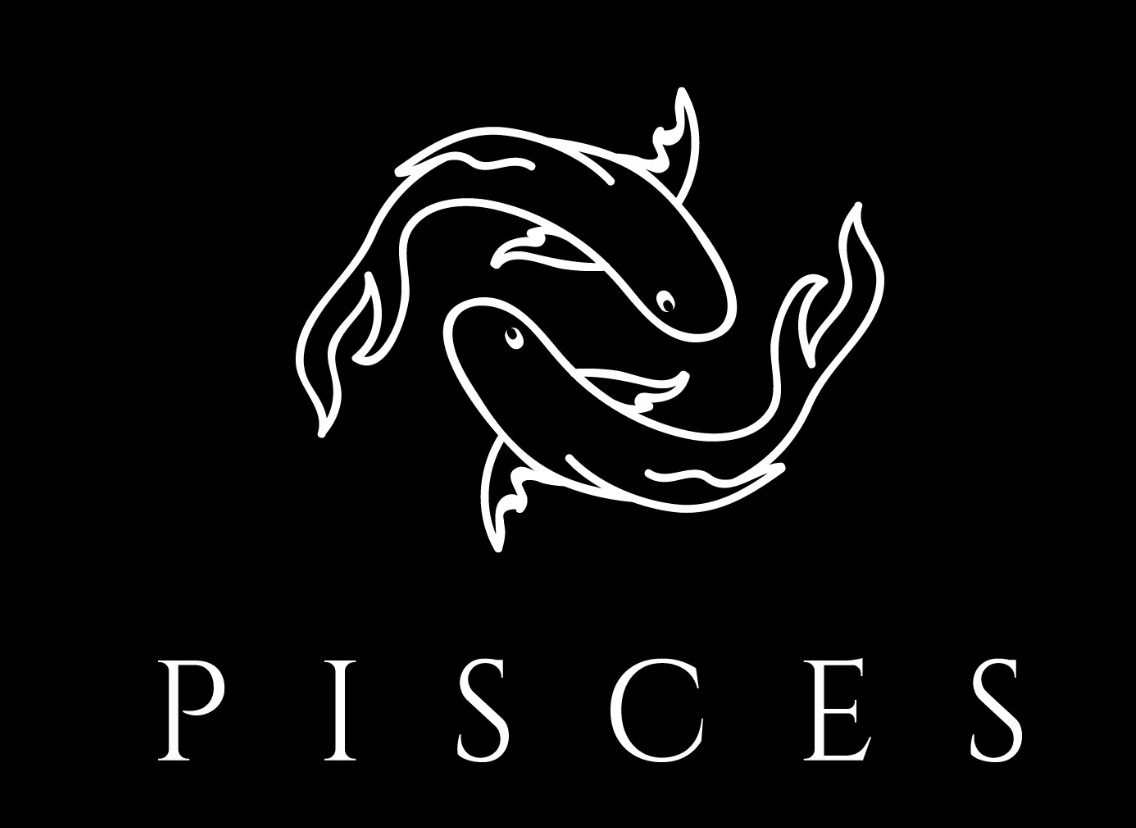
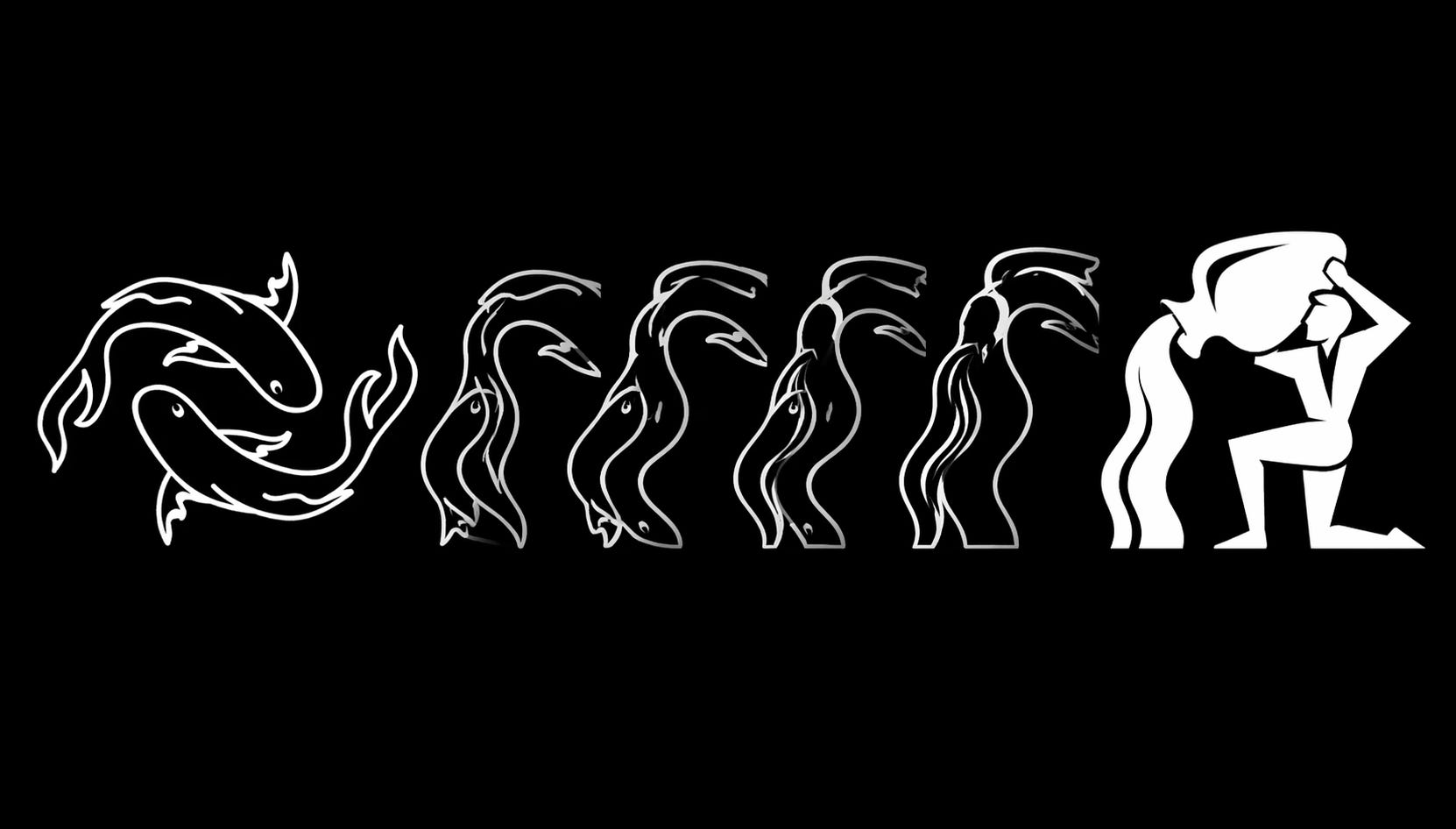
Regarding the portion that interests me, Jung argues that the twin fish symbolism of Pisces – one fish facing upwards, one fish facing downwards or sideways depending on the image – represent the dual figures of Christ and the anti-Christ. They are represented psychically in two almost schizophrenic polarities and which arose due to competition within the early Church.
The early Church developed the privatio boni view of evil – where evil was considered the absence of good, and God was all good – in order to counter Manichean dualism, which was a very real and looming threat to Church leaders.1 This, in turn, created certain unexpected problems. Jung, following Meister Eckhart, saw the privatio boni development as violating basic common sense because consciousness requires differentiation, while God is unity: “Union of opposites is equivalent to unconsciousness, so far as human logic goes, for consciousness presupposes a differentiation into subject and object and a relation between them. Where there is no “other,” or it does not yet exist, all possibility of consciousness ceases.” He states in Answer to Job: “The naive assumption that the creator of the world is a conscious being must be regarded as a disastrous prejudice which later gave rise to the most incredible dislocations of logic. For example, the nonsensical doctrine of the privatio boni would never have been necessary had one not had to assume in advance that it is impossible for the consciousness of a good God to produce evil deeds. Divine unconsciousness and lack of reflection, on the other hand, enable us to form a conception of God which puts his actions beyond moral judgment and allows no conflict to arise between goodness and beastliness.”
The adoption of the privatio boni pushed humanity’s evil into the suppressed unconscious because Christians wanted to be “good” in order to go to Heaven after death, so they ran, terrified, from their darker selves, projecting it onto the Other for destruction. From a psychological perspective – and Jung insisted publicly (for good reasons, but not entirely truthfully) that his perspective was informed by psychology, not metaphysics – the suppressed unconsciousness of mankind would have to manifest at some point down the road, culminating in the figure of the Anti-Christ (which I addressed from a different angle in a prior post). As Jung explains:
A factor that no one has reckoned with, however, is the fatality inherent in the Christian disposition itself, which leads inevitably to a reversal of its spirit – not through the obscure workings of chance but in accordance with psychological law. The ideal of spirituality striving for the heights was doomed to clash with the materialistic earth-bound passion to conquer matter and master the world. This change became visible at the time of the “Renaissance.” The word means “rebirth,” and it refers to the renewal of the antique spirit. We know today that this spirit was chiefly a mask; it was not the spirit of antiquity that was reborn, but the spirit of medieval Christianity that underwent strange pagan transformations, exchanging the heavenly goal for an earthly one, and the vertical of the Gothic style for a horizontal perspective (voyages of discovery, exploration of the world and of nature). The subsequent developments that led to the Enlightenment and the French Revolution have produced a world-wide situation today which can only be called “antichristian” in a sense that confirms the early Christian anticipation of the “end of time.” It is as if, with the coming of Christ, opposites that were latent till then had become manifest, or as if a pendulum had swung violently to one side and were now carrying out the complementary movement in the opposite direction….The double meaning of this movement lies in the nature of the pendulum. Christ is without spot, but right at the beginning of his career there occurs the encounter with Satan, the Adversary, who represents the counterpole of that tremendous tension in the world psyche which Christ’s advent signified….Both strive for a kingdom: one for the kingdom of heaven, the other for the principatus huius mundi (the rule of the world). We hear of a reign of a “thousand years” and of a “coming of the Antichrist,” just as if a partition of worlds and epochs had taken place between two royal brothers. The meeting with Satan was therefore more than a mere chance; it was a link in the chain.
Edinger adds, “To underscore what Jung says here, the advent of Christ represented psychologically the split of the opposites in the God-image into two irreconcilable halves, Christ and Satan. This was a necessary step in the development of consciousness, but it has led to a profound one-sidedness and to a dissociated condition that now has to be corrected.” This is Jung’s concept of enantiodromia, where when something is pushed to its extreme, it morphs into its opposite.
Historical Manifestations of the Piscean Dialectic
Jung therefore saw that the age of Pisces would begin with a spiritual Christ-focused era and end with the fullest manifestation of the anti-Christ, which is a secular, materialist, anti-spiritual energy. Because he thought the Self relates to wholeness, not goodness, and because he linked the Self to mandalas and quaternities2 which represent such wholeness, he applied that framework to the Age of Pisces: the first 1,000 years was considered the Christian era (with Christian expansion 0-500 AD and the deepening of faith through the system of monasteries and monks from 500-1000 AD or so starting with St. Benedict of Nursia) and the next 1,000 years was/is the anti-Christian era with scholasticism slowly rationalizing faith and a flowering of cults and heresies such as the Cathars, leading to full onset materialism and secularism via the printing press, Protestantism, technological innovation, material exploitation and then the French Revolution, communism, etc. (1500 AD-2000 AD). This anti-Christian era coincides with Spengler’s conception of the Faustian spirit, which occurred in the early medieval West with Romanesque and Gothic Christianity as its first great expression.
Astrological Roots of Pisces and Aquarius
While Christianity was linked to the fish symbol early in its history, the symbolism of the Twin Fish for Pisces and the Water Bearer for Aquarius has deep ancient roots, primarily in Greek and Babylonian traditions. While zodiacal symbolism are very old, astrological ages as a schema only become possible after Hipparchus’ discovery of precession (2nd c. BCE). Pisces, depicted as two fish swimming in opposite directions, originates from the Greek myth of Aphrodite and her son Eros, who were transformed into fish to escape the monster Typhon. This imagery is also found in Babylonian astrology around 2000 BCE, where the fish represented duality and fluidity, themes associated with the sign. By the Hellenistic period (around 200 BCE – 100 CE), Pisces was firmly tied to the Twin Fish symbol.
Aquarius, represented by the Water Bearer, comes from the myth of Ganymede, a Trojan prince abducted by Zeus to serve as the cupbearer to the gods, often depicted pouring water. While Aquarius is not a water sign in the traditional sense (it is an air sign), the Water Bearer symbolizes the flow of knowledge and the collective consciousness. The link between Aquarius and water can be traced back to Babylonian astrology, where a water-related constellation was associated with the sign. By the Hellenistic period, the Water Bearer symbol for Aquarius was solidified, influenced by both the myth of Ganymede and ancient astronomical interpretations.
The modern conception of the ages dividing roughly into 2,000-year periods, with Pisces from 0–2000 AD and Aquarius from 2000–4000 AD, only became more solidified in astrology and popular consciousness in the 20th century by the Theosophy movement, Dane Rudhyar, and the New Age movement. Pisces was generally accepted as starting around the birth of Christ, and Aquarius was thought to be beginning in the early 2000s, largely based on the precessional cycle and the movement of the vernal equinox into the Aquarius constellation. Jung was projecting, then, a psychological narrative onto symbols whose “Age” function was not fully operative until quite recently, which is why he had to lean into symbolic and mythic analysis as much as he did to dampen academic criticism about his ideas. Per Jung, “Astrologically the beginning of the next aeon, according to the starting point you select, falls between A.D. 2000 and 2200. Starting from star “O” and assuming a Platonic month of 2,143 years, one would arrive at A.D. 2154 for the beginning of the Aquarian Age, and at A.D. 1997 if you start from star “a 113.” The latter date agrees with the longitude of the stars in Ptolemy’s Almagest.”
A question quickly arises under this conception: do Ages cause events, or do they merely influence people’s thoughts, ideas, and actions, but people retain elements of free will? I lean toward the latter, much as I see other knowledge systems like physiognomy (discussed previously here and here) as influencing but not compelling action. This is because the speck of God within each of us, the Self, changes under observation – it cannot be fully controlled, much like Heisenberg’s uncertainty principle. When one becomes aware of the influences affecting oneself, one retains an element of free will in order to change it – conscious awareness of symbols gives a person the free will to choose how one responds to that influence, but not to an infinite degree. No matter how much you train you will never be Michael Jordan, Tiger Woods or Tom Brady; we have free will within our physiognomy, but only to whether to embrace or reject our own unique path. And while Ages don’t cause events, they constellate archetypal fields. This means the Christ/Antichrist dialectic of Pisces was not mechanically fated, but its archetypal resonance with its emphasis on faith, inner transformation, and duality, mirroring the tension between the higher and lower aspects of the Self made such a trajectory almost inevitable unless consciously integrated.
The Aquarian Age: Water Bearers and Conscious Agency
Archetypally, the Age of Aquarius brings themes of individuation, collective consciousness, technology, and the integration of opposites. Symbolized by the Water Bearer who pours out knowledge and life, it emphasizes awakening, innovation, equality, and the union of spirit and intellect, as described further in this Jungian center article on Aquarius. This age may challenge rigid structures and dogmas inherited from Pisces, urging humanity toward greater self-awareness, psychological integration, and responsibility to the collective, with a different God-image: that of God as both all good and all evil, all-encompassing, which is horrifying, and because God is an unconscious being (as consciousness arises from navigation of the crucifixion of the opposites as a partial, finite being), it is humanity’s role to bring consciousness to God. As Edinger states in The Aion Lectures, “God…as a term used by Eckhart, is a consequence of consciousness; it is born in the human soul. This is the basic theme of Eckhart’s teaching – that God is born in the human soul, in a process parallel to the nativity of Christ. He does not exist, really, until he is born there. This is the idea that Jung found so appealing, that God requires conscious man in order to come into existence.” Shadow aspects of Aquarius include depersonalization/loss of individuality in mass systems, cold rationality, abstraction, decentralization and simultaneity, the dominance of networks over hierarchies, and the dissolution of the old Piscean forms of mediation (church, nation, monarch, experts, institutions).
At its best, this new era invites the conscious realization of the Self as part of a shared human evolution, and Jung was the first to recognize this. Per Edinger:
I think that…Jung is the first representative of the new aeon…what I call and what I think will in the future be called the Jungian aeon. Jung could not have perceived and summarized the content of the aeon of Pisces unless he was already outside it. You can not see something in its totality, objectively, until you are already out of it. Jung was already in the next aeon, so to speak. Just as Christ was the first person to enter the aeon of Pisces, so Jung is the first to inaugurate the aeon of Aquarius.
This leads us to inquire, at least briefly, what the qualities of the aeon of Aquarius might be; we have been talking about the aeon of Pisces until now.
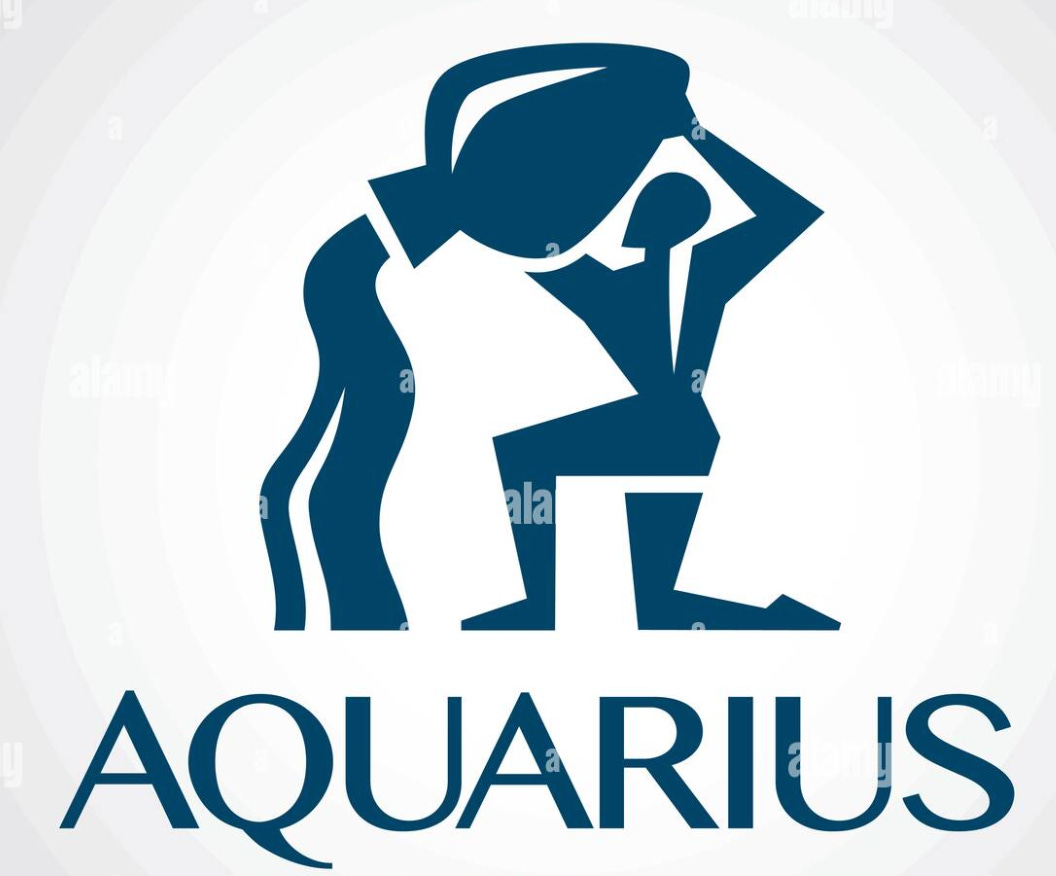
The term “Aquarius” has three different interpretations that I know of. It is called “water man,” “water carrier” and “water pourer.” Aquarius is pictured as a human figure carrying a jug of water. Sometimes he is pouring water from the jug and sometimes he is carrying it. This suggests three different things. First, Aquarius is a human figure, not an animal or fish, suggesting that the aeon of Aquarius is going to be of a human nature, not less. Further, the figure is carrying water rather than being immersed in it like a fish. That suggests that the two aeons will have a totally different relation to the psyche; it is the difference between being a fish immersed and being a carrier and pourer. Third, we have the image of a vessel, an allusion to the symbolism of the alchemical vessel and to the capacity to contain the psyche, rather than be contained by it. Instead of being a fish contained in a psychic fish pond, the individual becomes a conscious carrier and dispenser of the psyche.
Both Mark and Luke recount that Christ directed two of his disciples to make preparations for the last supper. He said “Go into the city and you will meet a man carrying a pitcher of water. Follow him.” (Mark 14:13; Luke 22:10, JB)
This man leads the disciples to the house in which they are to go to the upper room for the Passover meal or last supper. This is an image of the aeon to come 2,000 years later, visible even at the opening of the aeon of Pisces. It corresponds also to certain symbolic aspects of Christ. Christ was pictured as a water bearer and water dispenser. To the Samaritan woman at the well he said that if she had asked him for a drink, he would have dispensed eternal living water for her. (John 4:10)
Also there is the image of a stream of water flowing from Christ’s belly when his side was pierced at the Crucifixion. These images indicate that in a certain sense Christ foreshadowed Aquarius as a water dispenser. But the water he dispensed did not generate more dispensers; it generated fish rather than water carriers because the church became the water carrier, the fish bond in which the faithful fish could swim. Who discovered water? We know who did not discover it – the fish. We can now say the person who discovered it was Aquarius. Jung discovered water.
If my reading of the symbolism is correct, the aeon of Aquarius will generate individual water carriers. The numinous reality of the psyche [i.e. the crucifixion of opposites] will no longer be carried by religious communities – the church, the synagogue or the mosque – but instead it will be carried by conscious individuals. This is the idea Jung put forward in his notion of a continuous incarnation, the idea that individuals are to become incarnating vessels of the Holy Spirit on an ongoing basis.
Given the collapse of public faith in institutions – media, experts, education establishments, organized religion – people are increasingly being asked to carry their own psychic loads, which is very painful to do, and which is why most people lean into the Current Thing narratives as a surrogate religious replacement (a weak and poor one), why people bounce back and forth between ideologies (I think of young men attracted to Eastern Orthodoxy for a bit) and why mental instability and depression is rapidly increasing. If Jung and Edinger’s framing is accurate, solutions will not be found through experts or institutions – one is increasingly required to carry the crucifixion of opposites internally, without external mediation. This is a horrifying conception given institutions exist precisely to protect people’s psyches from the horrors of the void. Many people will collapse during this transition; this doesn’t make those who adapt properly “better”, just more able to carry the current of this aeon’s transition.
Note that the transition from one age to another does not occur in a day, a week, a month, a year, or even a lifetime; while Christ’s death ushered in the Age of Pisces, this wasn’t clear to people of that time and it took centuries for Paul’s epistles, the gospels, Christianity’s spread, and the culmination in Constantine’s formal adoption of Christianity as the official religion of empire. As such, Aquarius, despite an upcoming coronation event in the horrors of a worldwide centralized anti-Christ system, may not manifest fully during a long transitionary period, which we are already in.
Symbolic Literacy and Elite Manipulation
The question this framework naturally generates is how it connects to the elite sprint toward 2030, and specifically, where does the symbolic and astrological literacy come from that would make such timing meaningful rather than arbitrary? Their panic over Trump’s surprise 2016 win was not so much about Trump himself but about how his win could derail their timeline (which is unfortunately back on track). From my current vantage point, it looks like they have an astrological and occult understanding of the changing aeon, where upper elites versed in the Kabbalistic framework which treats cosmic timing as strategic, riding the currents of archetypal change and aligning with inevitable astrological and symbolic movements to consolidate power. The principle is simple: the current moves, and those aligned with it move faster than others, allowing opportunities for power accumulation. Unlike mystics or ascetics, these actors do not seek self-transcendence but rather map cosmic inevitability onto social and political engineering.
Because humans have an element of free will, while at the same time this astrological change is inevitable, what they are seeking do is channel the water, the flow of the changing age for their own purposes. In other words, the Aquarian archetypal tide of transparency, networks, leveling is being instrumentalized by elites to build centralization, surveillance, CBDCs, etc.
How did the upper elites gain the knowledge of astrological synchronicity? Given my prior structural analysis about how elite power structures naturally converge on a Talmudic/Kabbalistic framework, the focus here should be on the Jewish tradition. Within Jewish intellectual tradition there has always been a live conversation about cosmic timing, destiny, and the human role in channeling it.3 The Talmud contains debates about astrology: some rabbis saw stars as influencing fate, others rejected determinism, still others accepted that the stars incline but do not compel. Rabbis explicitly argued whether “mazal” (constellation/fate) governs Israel. Some said “there is no mazal for Israel” – i.e. Jews are above astrology through Torah observance. Others acknowledged stars incline fate, but covenant and merit can override them. There is a strand of Orthodox opinion, drawing on Deuteronomy’s prohibitions against divination and the Talmudic position that Israel is not subject to astrological fate, that treats astrology as forbidden. Maimonides was particularly forceful on this: he considered astrology a form of idolatry and pseudo-science, and his rationalist strand of Judaism rejected it categorically.
This produced a live dialectic: fate vs. free will, stars vs. covenant. Later Kabbalah took cosmic symbolism further, linking it with divine emanations and repair. Kabbalistic tradition, particularly Lurianic Kabbalah and the Zohar, integrated astrological symbolism extensively regardless of the halachic prohibitions – the Sefirot map onto planetary energies, the Lurianic system explicitly connects cosmic cycles to historical unfolding, and practicing Kabbalists have always worked with astrological frameworks. The Zohar and Lurianic Kabbalah folded astrology into a grand symbolic system of divine emanations and cycles of exile/redemption where cosmic timing is tied to the actual unfolding of history (tikkun, messianic epochs, shattering and repair). Lurianic Kabbalists frequently connected planetary and zodiacal cycles with mystical processes, meaning there is a framework for timing actions to “align” with macrocosmic flows. The idea is not deterministic but strategic, that the currents exist and knowing their rhythm can amplify effects. The Sabbatean/Frankist strand, which my companion series identifies as the operative apex theology, explicitly transgressed halachic restrictions as a matter of theological principle, so the prohibition would carry no weight for these actors.
Those with this understanding may not be “slaves to an astrological calendar,” but inherit lineages of symbolic literacy, knowing how to ride the archetypal currents; kabbalah did not necessarily develop more advanced astronomical/astrological science compared to Islamic philosophers4 or Christian scholastics5, but it cultivated a more continuous, inward-facing symbolic hermeneutic where astrology was directly tied to law, fate, and the collective destiny of Israel. That gave Jewish thought a distinctive depth in treating how symbols shift across time. It’s distinctive feature is that Jewish mysticism treated cosmic symbols as mutable and dialectical – sparks hidden in shells, letters and constellations shifting roles through cycles, which is closer to Jung’s idea of archetypes evolving over time. It is this accumulated symbolic literacy, inherited through lineages that connect Lurianic Kabbalah to the Frankist underground to the secularized eschatological networks documented in the companion series, that positions certain apex networks to recognize and instrumentalize the Aquarian transition before the broader culture perceives it.
What Comes Next?
As I wrote in my post about the anti-Christ, due to the concept of enantiodromia – any energy over time eventually becomes its opposite – the spiritual, other-worldly Christ energy at the start of the Piscean era must fully manifest into its opposite – pure materialism, pure secularism, pure anti-soul. Those who already mastered the symbolic in Pisces through textual interpretation, financial code, and the manipulation of law and image will not surrender that mastery, they will reframe it into Aquarian modes: AI as the new rabbinic commentary, blockchain as Talmudic ledger, predictive modeling as the new halakhic casuistry. The result will be a techno-messianism that fulfills the eschatological line while appearing secular, progressive, and rational. The fate of Aquarius – dissolution of borders, collective hive structures, the dominance of the mental-symbolic over the earthy-sacramental – is made to look like a cunning plan, but the plan only succeeds because it rides the tide of inevitability.
So the convergence says to expect (1) the full exteriorization of the “invisible text”: databases, archives, code as scripture, (2) a dialectical play where “anti-Semitism” is used to consolidate Jewish return to Zion and Greater Israel, but the true Aquarius move is all peoples made diaspora within the digital panopticon, and (3) the cunning to become more Aquarian in mask with AI priesthood, global technocracy, and “humanitarian” control. The deeper irony is the egregore of Yahweh, globalized through Christianity and Islam, becomes Aquarianized, turned into an operating system for humanity itself.
With this said, there are risks of failure in the elites’ plan through several inherent paradoxes: first, their overextension of symbolic control is fragile; while Aquarius operates on abstraction and digital systems, these cannot account for the irrationality and unprogrammable nature of human life, leading to a potential breakdown of their complex systems akin to a modern-day Tower of Babel. Indeed, their closed system explicitly excludes all factors that cannot be quantified and controlled, as cyberneticist Ross Ashby explained here. Second, instrumentalizing forces like anti-semitism as a tool for political ends can backfire as hatred can become uncontrollable, causing the very forces they manipulate to turn against them. Third, Aquarius’s imperative to dissolve veils and create an “open society” may eventually expose the hidden mechanics of their cunning plan, causing them to lose power as their facade is revealed – the horror show of so-called “COVID”, with draconian shutdowns, free speech suppression and forced “vaccinations” rolled out worldwide in lockstep created an urgency in some to understand the deeper levels at play. Finally, the eschatological paradox ensures that by trying to become the authors of prophecy and force its fulfillment (such as the assembly of Greater Israel), the elites risk an unintended inversion of their goals, becoming servants of the very inevitability they sought to master – the Kabbalistic/Talmudic scheme works best in the shadows, and how will its practitioners and the world ultimately react to an externalized, in-your-face dominance scheme fully manifested? In this grand scheme, both the inegalitarian right and the egalitarian left, unaware of the symbolic forces at play, are pawns in a dialectic they do not understand, pushing against each other while remaining confined within the larger, inevitable Aquarian frame. The risks also explain why those like Sam Altman, Peter Thiel and Mark Zuckerberg have extensive underground bunkers prepared if their plans fall apart (the upper elites will certainly destroy the world if their plans fail and then retreat from the chaos, blaming the victims for their own nefarious plans and deeds, although neither Altman, Thiel nor Zuckerberg are at that level).
Conclusion: The Battle for Meaning in the Aquarian Aeon
Very few people outside of the upper echelons of power understand how symbols work, how they are embedded within language itself and manipulated dialectically over time in a Fabian fashion in order to achieve longterm goals. If the Aquarian archetype invites the integration of opposites and a collective awakening, then the battle over meaning itself – over who controls the symbols, the myths, the language – may be the most important struggle of all. I delved into the importance of the meaning behind language here, and Saoirse By Sinead has a strong post on this topic here. Without recovering symbolic literacy, humanity risks becoming the raw material of our upper elite’s nefarious control grid. But their prior panic was a tacit admission of impotence: they can surf inevitability for a time, while 2030 functions like an occult firewall – an attempt to crystallize the Aquarian age into their own image, to pre-structure the flood before it spills out – but the very need for such a firewall betrays that they know it’s not guaranteed. If inevitability were on their side, they could afford to wait. The rush is the tell. With that said, given there is a direct and inverse correlation between power and spirituality, I do not have hope that a system of hollow, apex predatory actors will be overthrown by better actors.
For the individual, individuation and the conscious holding of opposites holds the key to freedom. Aquarius is the water-bearer – not the water itself, but the vessel, and the archetype is about carrying the collective flood without drowning in it. The masses will drown in data, in ideology, in dialectical manipulation, and this transition between ages is very painful. As Jung stated in a letter to Adolf Keller, “Transitions between the aeons always seem to have been melancholy and despairing times, as for instance the collapse of the Old Kingdom in Egypt… between Taurus and Aries, or the melancholy of the Augustinian age between Aries and Pisces. And now we are moving into Aquarius, of which the Sibylline Books say: Luciferi vires accendit Aquarius acres (Aquarius inflames the savage forces of Lucifer). And we are only at the beginning of this apocalyptic development! Already I am a grandfather twice over and see those distant generations growing up who long after we are gone will spend their lives in that darkness…” Yet each dominant age contains a mystery religion representing it’s inverted energies in the sign opposite to it on the Zodiac as its structural complement, the thing the age cannot produce from within itself. In the age of Taurus, the mystery religion was Scorpio: the Eleusinian mysteries, Isis and Osiris, initiation through death and transformation as the hidden counter-current to Taurean emphasis on material abundance, fertility, and earthly permanence. The bull worshippers were taught that what is accumulated must also be lost. In the age of Aries, the mystery religion was Libra: Ma’at, the weighing of souls, cosmic proportionality as the counter-current to pure martial conquest. The warrior cultures were taught, through their mystery traditions, that force without measure destroys itself. In the age of Pisces, the mystery religion was Virgo: the disciplined vessel, the body as sacred container, the contemplative traditions and the Marian cult as counter-current to Piscean oceanic dissolution and self-sacrifice. The fish were taught that the sacred must be held, not merely swum in.
Per Leo M.J. Aurini (discussed here), in Aquarius the mystery religion is in the sign of Leo. Aquarius dissolves individual identity into collective networks, data architectures, abstract universalism, and the counter-current is the one who cannot be anonymized – not through rebellion, which is reactive and therefore predictable and therefore capturable, but through genuine interiority that has no interface for the control architecture to grab. The digital panopticon requires legibility, that a person broadcast on frequencies the system monitors, but the Leo counter-current simply doesn’t. Leo represents personal sovereignty, embodied authority, and individuation; holding the crucifixion of opposites without collapse into a polarity until the transcendent function takes place is something received, not controlled, which means the individual stops being predictable within the Aquarian dialectic. This is a different structural position, not a superior one. That transformation cannot be mass-produced, institutionalized, or timed to anyone’s agenda, and it arrives when the Self’s own pressure makes it necessary, which is why it functions as a mystery religion rather than a movement – the moment it organizes collectively it becomes Aquarian and loses its counter-current function entirely.6 A Leo mystery religion rejects moral outsourcing and mass anonymity in favor of visible, unified being – liberation through the solar integrity of a singular soul.7 The individuated individual doesn’t “solve” the opposites but becomes a container strong enough to bear them without collapse into mass hypnosis nor into reactive opposition. See this Note, and the subsequent conversation with Bios Logos, for more on this point.
In this frame, phenomena such as end-times prophecy, technological centralization, and geopolitical maneuvering are expressions of archetypal currents. The world can be deciphered, patterns discerned, archetypes followed, but decipherment is not protection: the Leo counter-current offers no material defense against predation, no collective organization, no political leverage, and no guarantee that clarity produces anything other than a more precise understanding of one’s own exposure. The crucifixion of opposites is permanent – it is the condition of consciousness, not a passage through which consciousness travels toward resolution. Understanding the structure of what is happening does not stop it from happening, the water-bearer still gets wet. So why focus on it at all? Well, for certain uncommon constitutions coherence is preferable to consolation even when coherence is bleak; for most, this framework will simply remove the last available buffers without replacing them with anything.8 This kind of clarity has very significant costs: an inability to organize collectively, difficulty sustaining ordinary hope, a growing incommensurability with almost everyone in one’s life. Whether those costs are worth bearing depends entirely on whether the alternative – living inside contradiction that cannot be acknowledged – is still available to you. For most people it is, but for those for whom it is not, this framing is simply a colder and more accurate description of the situation they are already in.
Thanks for reading.
Subscribe:
Email delivery remains on Substack for now.
The early Church saw Manichaeism as a major threat because it challenged core Christian metaphysics on the nature of evil, the unity of God, and salvation. Mani presented his religion as a universal revelation blending Christianity, Zoroastrianism, and Buddhism with its own scriptures, clergy, and global ambitions, and its radical dualism posited two eternal principles, Light and Darkness, making evil a co-eternal force rather than a privation of good – this undermined Christian monotheism by implying God was not all-powerful. Manichaeism also promoted a cosmic pessimism, viewing the material world as a prison for divine sparks, contradicting the Christian affirmation of creation and the Incarnation. Its strict ascetic ethics among the “Elect” created a spiritual elite rivaling the Church’s structure. Augustine, once a Manichaean Hearer, developed his theology (including the privatio boni) in direct opposition, and his influence ensured Manichaeism’s legacy as the arch-heretical system. The Church feared it as a rational, missionary faith offering a compelling rival explanation for suffering and evil.
Jung’s quaternity is a symbolic structure of wholeness, expressed as a fourfold pattern (e.g., elements, directions, functions, or aspects of the self). The number four is complete because it embodies totality and balance – unlike three, which implies dynamism or tension, four allows the reconciliation of opposites and the integration of all directions or aspects. In Aion the quaternity mediates between conscious and unconscious, providing a symbolic framework through which the psyche can achieve balance, resolve conflict, and approach psychic wholeness.
I am offering a symbolic-historical reading, not an assertion of a unified plot. Jewish textual traditions from rabbinic debates about mazal to Lurianic meditations on tikkun cultivated a language for thinking about historical timing and repair. That symbolic literacy may be instrumentalized by actors of many kinds; in practice some influential figures/institutions draw selectively on esoteric resources to frame long-term projects, but instrumentality is not identical to monolithic conspiracy: influence is often distributed, tacit, and mediated through law, finance, ritual, and narrative. My claim is that symbolic fluency confers strategic advantage, it is not a claim that all who are Jewish, or all elites, act from a single text or single will.
In Islam, astrology found a more integrated place, particularly within philosophical schools. Thinkers like Avicenna, al-Farabi, and Averroes embraced and rationalized Ptolemaic cosmology, treating astrology as a legitimate scientific pursuit. Esoteric Islam, particularly in Sufi traditions and writings of groups like the Ikhwan al-Safa and mystics like Ibn Arabi, developed rich symbolic cosmologies that connected celestial cycles to spiritual development. A distinctive feature of Islamic astrology was its technical sophistication and mystical depth, though it emphasized eternal correspondences over symbolic evolution. Symbols were more fixed, reflecting timeless truths rather than changing meanings through history.
The early Church Fathers largely rejected astrology as a pagan practice incompatible with doctrine. During the medieval period, scholastic thinkers allowed for a limited role of astrology, recognizing its influence on temperament, weather, and medicine, while maintaining that the soul remained free and untouched by celestial determinism. However, the symbolic richness of astrology was minimized, with efforts focused on reconciling natural astrology with divine providence. In the Renaissance, esoteric streams of Christianity such as those influenced by Hermeticism, Neoplatonism, and figures like Marsilio Ficino and Giordano Bruno developed more spiritually rich forms of astrology. Yet these were syncretic, blending Christian elements with pagan and philosophical traditions rather than emerging from Christianity’s theological core. While Christianity deeply spiritualized its own symbols like the cross, Christ, and sacraments, its mainstream theology did not foster astrology as a dynamic tool for evolving archetypes.
The mystery religions understood this structural constraint. Their transmission mechanism wasn’t doctrine or argument but a prepared experiential clearing, ritual conditions under which knowledge already present somatically in the initiate could become conscious and articulable. The Eleusinian initiates already knew the Persephone myth, but what the rites did was move that knowledge from narrative – something that happened to someone else in mythic time – to direct interior recognition. Death and return stopped being a story about Persephone and became a legible fact about the initiate’s own psyche. The writing that functions as Leo counter-current in Aquarius is doing structurally identical work without the ritual container, without the community of fellow initiates, without the preparatory stages the mystery traditions provided, and without the death-rebirth myth that offered the initiate hope for life after death – in other words, the Aquarian mystery religion does the clearing without the consolation, which is colder, more exposed, and a bigger demand on the psyche than anything the Hellenic mystery traditions asked of their initiates. This outreach reaches people individually and in isolation, which is why transmission is slow, diffuse, and dependent on finding readers already close enough to the threshold that recognition becomes possible rather than mere information transfer. This is why the audience is necessarily small, because the clearing work requires a reader already carrying the somatic knowledge that needs articulating, and most people aren’t, and furthermore the mysteries could draw people who needed the consolation alongside those who could bear the cold, but this can only draw the latter. Those few who find resonance with this work experience something different from ordinary reading: not persuasion but recognition, which is the only transmission mechanism the Leo counter-current has available to it in the absence of institutional container or ritual support. See this comment from Griptoe Guy in Training for a bit more on this point.
Whether the mystery religion’s specific manifestation shifts within an age as the dominant current shifts is an open question. Jung’s fourfold periodization of Pisces suggests it does – the Virgo counter-current in early Pisces expressed as desert monasticism and bodily asceticism against oceanic spiritual dissolution, while in late Pisces it expressed as psychological discernment and embodied intelligence against materialist abstraction. Same sign, different emphasis, tracking the dominant current’s shadow rather than remaining fixed in content. If so, the Leo counter-current’s specific manifestation in early Aquarius – personal sovereignty against network dissolution and anonymization – would shift as the dominant Aquarian current itself shifts across the full 2000-year period.
As I wrote previously, “Broadly speaking, human psyches tend to regulate around one of a few primary stabilizers: (1) attachment and belonging, (2) esteem and status, (3) meaning and narrative, (4) control and agency, (5) coherence and truth-consistency. Most people have several, but one dominates. My dominant stabilizer is coherence. This means that when reality makes sense, I am stable even if it is bleak; when reality does not make sense, I destabilize even if life is comfortable. Emotional reassurance does not compensate for structural falsity in my worldview, belonging does not override contradiction, and hope that contradicts lived data increases my anxiety instead of relieving it. This isn’t common, but it is is a known psychological configuration and is not mystical.
Most people do not have the psychic configuration I have with a coherence primary focus and certain non-negotiables, and adopting a God image of Abraxas would be wrong for them: for attachment-regulated psyches (which are stabilized by relationships), Abraxas destroys safety; for esteem-regulated psyches (which are stabilized by social standing), Abraxas destroys justification; for narrative-regulated psyches (which are stabilized by a “story” or arc (e.g., Progress)), Abraxas destroys arc; for control-regulated psyches (which are stabilized by the ability to act), Abraxas destroys leverage. For psyches primarily regulated by coherence, though, this symbolic configuration appears capable of restoring a sense of internal alignment. This is not a claim about superiority, advancement, or universality, but about structural fit.”