

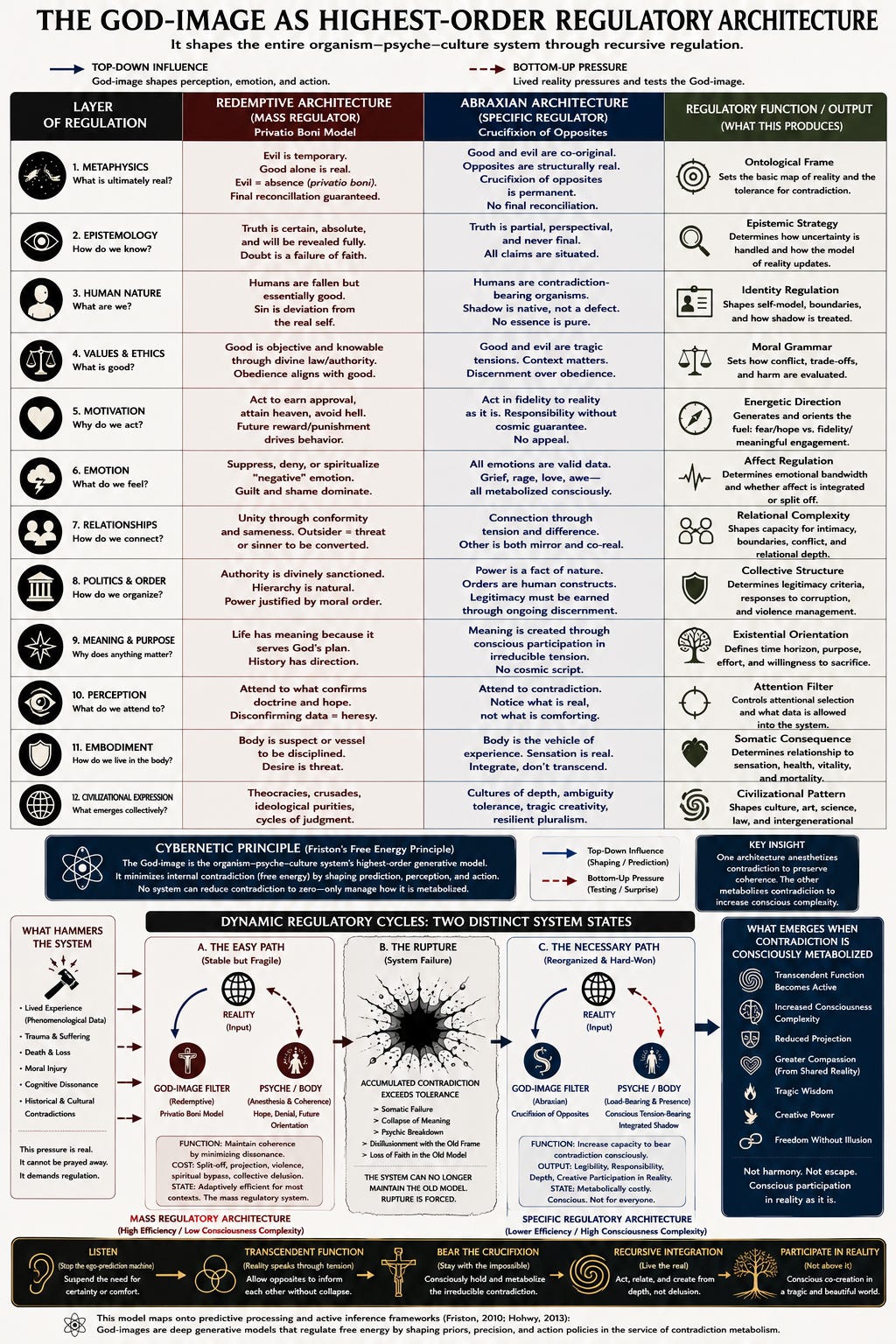
This essay argues that god-images function as highest-order psychophysiological regulatory architectures rather than as theological opinions, organizing perception, affect, and bodily coherence across every domain of human experience. When a new god-image is articulated in systematic form, the act is recursive where the framework participates in the psychic reorganization it describes. This quality is a consequence of the framework’s central claim: that the god-image determines how contradiction itself is metabolized, and that changing it constitutes a regulatory intervention rather than a change of opinion.
Welcome back. In general, reading and writing serve as a pressure release valve; this is because when ideas are verbalized the thought becomes an object separate from the thinker and therefore manageable (this is also why mass censorship increases societal pressure, because the ideas have no verbalization outlet). The God-as-totality Abraxian metaphysical framework seems to operate in reverse, though: the more precisely it is articulated, the deeper it acts on me. Rereading the logic of the crucifixion of opposites essay (and I felt compelled to read it maybe a dozen times post-publication) produced a renewed sense of this simultaneously Christian and anti-Christian, gnostic and anti-gnostic God image being metabolized, as though the text were an ongoing reorganization of the perceptual and somatic systems that generated it.
This follows directly from the framework’s central claim: that a god-image is not primarily a theological opinion, but rather a highest-order psychophysiological regulatory architecture organizing perception, affect, interpretation, motivation, contradiction tolerance, and bodily coherence. We are metabolic and energy beings and our top level beliefs affect every nested belief below it. If that is true, then articulating a new god-image in systematic form is a regulatory intervention, not an intellectual exercise. The framework recursively participates in psychic organization and orientation as much as it describes it, and it predicts that it will operate this way – the accuracy of that prediction becomes a part of its own metabolic-coherence validation structure.
- The Rupture
Most people think of a god-image as a religious opinion, a symbolic preference, an ideological framework, or perhaps a cultural inheritance. This framework treats it as something foundational: a highest-order cybernetic regulator organizing the psyche-body system as a whole.
This changes almost everything: if the god-image is regulatory rather than merely propositional, then contradictions at that level do not remain intellectual, they propagate downward recursively into perception, affect, bodily tension, motivation, moral orientation, relational patterns, identity stability, political participation, and eventually civilization-scale symbolic organization. Therefore theology, psychology, politics, embodiment, and cybernetics cease being separate domains entirely and become different observational angles of the same recursive regulation process. The god-image sits at the apex of that process because it determines how contradiction itself is metabolized. Modernity became capable of analyzing subsystems by severing them from the total regulatory architecture they once inhabited – theology became belief, psychology became cognition, politics became administration, economics became incentive management, and embodiment became biology. This fragmentation increased analytic precision while simultaneously obscuring the organism-level regulatory unity those domains previously constituted. The modern mind therefore tends to interpret symbolic systems as “mere ideas” because it encounters them after the regulatory totality has already been conceptually disassembled.
A redemptive god-image regulates individuals by promising that evil is temporary, contradiction is resolvable, suffering is meaningful, moral alignment is possible, history bends toward justice, and reality is fundamentally good. This produces enormous psychophysiological consequences: hope, future orientation, moral mobilization, institutional trust, capacity for sacrifice, collective coordination, psychological offloading, civilization-scale coherence. The regulatory efficiency is immense. But the Abraxian framework argues that this coherence comes at the cost of metabolically falsifying certain forms of lived phenomenological data. Specifically: the irreducibility of contradiction, the persistence of evil, the inevitability of double binds, the impossibility of final reconciliation, the constitutive nature of suffering, and the permanent crucifixion of opposites. If lived experience repeatedly contradicts the highest-order regulatory image, then incoherence accumulates throughout the system. And here the framework makes its most important move: it interprets psychological suffering as regulatory contradiction between lived phenomenology and inherited god-image architecture, not merely as pathology or trauma.
That is a profoundly different model of the psyche. The psyche is no longer primarily a pleasure-seeking machine, a rational calculator, a trauma repository, or a self-authoring identity construct. It becomes a symbolic-metabolic regulation system attempting to maintain coherence between experience and highest-order orientation.1
This framework operates across two levels whose relationship remains uncertain. At the regulatory level, the god-image’s reality is established by its psychophysiological consequences, i.e. a highest-order regulatory architecture that produces measurable effects on perception, affect, motivation, and somatic organization and therefore is rooted in material reality and thereby measurable in some sense. Whether the regulatory architecture also tracks metaphysical structure – whether the irreducibility of contradiction at the experiential level reflects genuine ontological co-originality of good and evil – is a question the regulatory framework cannot answer from within its own terms. This agnosticism acknowledges that the epistemological reach of the metabolic coherence criterion extends to regulatory reality and not further. The metaphysical claim, if it is to be made (and I do make it), must be made on other grounds – phenomenological, ontological, revelatory, or via recursive prediction – and the epistemological level of this framework neither requires nor forecloses it.
II. The Criterion Shift
This reframes the question of what makes a belief system “true.” Modern discourse evaluates worldviews according to familiar standards: empirical verification, moral acceptability, social legitimacy, emotional comfort, ideological consistency, political usefulness, therapeutic benefit, personal empowerment. Even when these standards conflict, they operate within a shared grammar. Beliefs are treated as propositions to be judged, identities to be inhabited, or values to be affirmed.
The framework shifts the terrain underneath those categories. The central question becomes not “Is this belief morally approved?” or “Is this belief socially validated?” or even “Is this belief objectively true in some detached sense?” The question becomes: Does this worldview produce increasing coherence or increasing contradiction between lived phenomenological experience and highest-order orientation?
This is neither straightforward empiricism nor conventional mysticism; it is closer to metabolic realism. A worldview is not primarily important because it is emotionally comforting or socially adaptive, it is important because it organizes psychic energy. The consequences of this shift are enormous. Once beliefs are viewed as regulatory structures rather than mere intellectual positions, large portions of modern life appear differently: political movements, ideological commitments, institutional loyalties, moral panics, therapeutic frameworks, even interpersonal relationships stop looking primarily like rational debates over truth claims and begin looking like stabilization attempts by organisms struggling to maintain coherence under conditions of existential contradiction.
The symbolic and the physiological are not separate domains operating independently, they are recursive layers of the same process. A contradiction at the level of highest-order belief eventually propagates downward into perception, affect, bodily stress, identity fragmentation, compulsive projection, relational instability, and ideological rigidity. Likewise, symbolic structures that successfully organize psychic energy create temporary coherence: meaning, motivation, solidarity, moral orientation, emotional containment. More precisely, theology regulates meaning horizons and contradiction tolerance; politics regulates collective coordination and aggression distribution; media regulates perceptual salience and symbolic participation; morality regulates social trust and motivational hierarchy; economics regulates temporal orientation and libido distribution; psychology regulates internal contradiction management; embodiment registers cumulative coherence or incoherence physiologically. None of these operate independently, they are nested scales of a single organism-environment symbolic metabolism. A disturbance at the highest regulatory level – the god-image – propagates downward through all of them simultaneously. This is why the civilizational symbolic collapse we are experiencing does not produce merely intellectual uncertainty, it produces psychophysiological fragmentation across every nested layer at once.
If worldviews are evaluated by metabolic coherence rather than propositional truth, then this framework is also subject to that criterion. The implicit claim is that the Abraxian regulatory architecture produces greater coherence between lived phenomenology and highest-order orientation for constitutionally specific psyches than privatio boni does – not for everyone, but for those for whom privatio boni was generating increasing incoherence.2 Whether it passes that test is not determinable in advance, it is legible only through the longitudinal record of whether the reorganization it induces produces increasing coherence or increasing contradiction in the psyches it reorganizes. That is a falsifiable claim, which is more than most metaphysical systems offer. For constitutionally specific psyches (primarily those coherence regulated), the inherited anesthesia no longer functions because their regulatory systems have become sensitized to the specific falsification the architecture requires. Repeated exposure to lived phenomenological data that the god-image cannot metabolize without suppression eventually degrades the suppression mechanism itself. The sensitization is a loss of metabolic insulation that makes the Abraxian architecture the only available regulatory option that does not require ongoing suppression of what the body already registers as false. This is why the transition is experienced as forced recognition rather than chosen belief, naming what sensitized organisms have already been living without a vocabulary adequate to the experience.
Measurability
The framework’s submission to its own criterion operates on two tracks simultaneously. The first is internal: does inhabiting the Abraxian regulatory architecture produce increasing coherence or increasing contradiction in the psyche that attempts it, measured longitudinally through somatic stability and the reduction of psychophysiological pressure? The second is external: does the framework generate greater predictive accuracy about political and cultural developments than the alternatives it displaces? The privatio boni framework predicts that moral forces tend toward eventual victory, that justice bends toward restoration, that predatory structures are ultimately unstable. The Abraxian framework predicts that apex predation is structurally self-reproducing, that redemptive political movements generate new predatory structures rather than eliminating predation, and that civilizational contradiction intensifies rather than resolves toward synthesis. The empirical record of political and cultural development constitutes a longitudinal test of these competing predictions. Based on decades of observation, holding opposites dispassionately – neither collapsing toward redemptive optimism nor toward nihilistic negation – produces measurably greater predictive accuracy than the redemptive grammar does.3 That external validation track is independent of subjective coherence and operates as a check against the circularity that any self-referential framework risks. The two tracks together – internal coherence and external predictive accuracy – constitute the framework’s epistemological method, and their convergence is the strongest available epistemic signal.
This is not subjectivism; a regulatory architecture that produces temporary psychological coherence while degrading predictive contact with reality will eventually fail metabolically as contradiction accumulates. Likewise, a framework that generates accurate predictions while producing increasing psychophysiological disintegration in the organism inhabiting it is also incomplete. The criterion is not comfort, nor mere survival, nor instrumental success in isolation, it is sustained coherence across both experiential and predictive domains simultaneously. The framework therefore rejects both naïve objectivism and postmodern relativism. Regulatory architectures are neither arbitrary narratives nor purely detached truth-propositions, they are organism-reality mediation systems whose adequacy becomes visible through longitudinal consequences.
III. The Reframing of the Social World
From this perspective, the modern world increasingly appears psychologically strange. Modernity simultaneously dissolves inherited symbolic systems while continuing to require the organism to function coherently under conditions those systems previously stabilized. The result is chronic fragmentation. The modern subject is told that reality is mechanistic, meaning is subjective, morality is socially constructed, identity is self-generated, transcendence is suspect, tradition is oppressive, and truth is endlessly negotiable, while simultaneously being expected to maintain stable motivation, psychological coherence, moral orientation, relational trust, and existential resilience.
The system increasingly lacks a shared symbolic grammar capable of metabolizing contradiction at scale. This helps explain why modern populations oscillate so violently between ideological fanaticism, therapeutic narcissism, political hysteria, conspiratorial thinking, identity absolutism, nihilistic entertainment, and compulsive moral mobilization, because they are compensatory stabilization attempts to failed offloading mechanisms. People are attempting to regulate unbearable contradiction.
Political polarization begins looking less like disagreement and more like competing coherence systems defending themselves against disintegration. Moral outrage becomes partially intelligible as projection management where unresolved contradiction displaced outward onto sanctioned enemies, institutional loyalty becomes a stabilizing attachment to symbolic structures that reduce existential uncertainty, and conversion experiences become large-scale reorganizations of psychic energy around new orienting architectures.
Noetic commons and apex predation
The noetic commons, in this sense, is civilization-scale psychophysiological regulation where elite soft power acts as management of god-image architecture at mass scale. This produces a specific structural dynamic at the apex: high-agency actors who have operationally abandoned the mass regulatory architecture while continuing to maintain it for collective coordination purposes are engaged in regulatory arbitrage, where they exempt themselves from the contradiction-management constraints the architecture imposes on the population while extracting the coordination benefits that architecture generates. The mass symbolic system continues generating civilization-scale coherence – hope, moral mobilization, institutional trust, sacrificial coordination – while apex actors operate outside its constraints. The Sabbatean and Frankist antinomian strands discussed previously are the most explicit historical articulation of this structure with the permission architecture for regulatory arbitrage at the apex formalized as theology, but the dynamic is not confined to those lineages. It describes the operational logic of any apex tier that has privately abandoned the redemptive grammar it publicly enforces.4 The simultaneous public enforcement and private suspension of moral architectures – controlled transgression, symbolic inversion, selective antinomianism – act as cybernetic asymmetry at its outer boundary.
The population for whom the redemptive anesthesia fails is not fixed, it is based on threshold dynamics. The threshold marks the line where offloading the crucifixion of opposites is greater or less than bearing the cost of bearing it internally, and it differs from individual to individual based on one’s primary stabilizers (see footnote two), although likely measurable on larger populations statistically. As civilizational contradiction intensifies through technological amplification of opposing forces, the collision of incompatible symbolic systems at global scale, and the acceleration of information that makes shadow suppression increasingly difficult, the falsification cost of maintaining redemptive architectures rises faster than those architectures’ stabilizing capacity. What presents clinically as epidemic anxiety, depression, political radicalization, and identity fragmentation is partially the observable signature of this process: organisms whose inherited regulatory architecture can no longer metabolize the contradiction load being imposed on it, reaching for emergency compensatory stabilization in the absence of any alternative (including doubling down on redemptive narratives). This framework is not intended to convince people by rational argument; it is intended to provide language to those who are already somatically crucified between the opposites and lack the words and structure to articulate it – it is intended to find resonance for those already at or across the threshold. However, it also anticipates that those approaching the threshold will increase over time as neoliberal feudalism continues to ratchet and intensify.
IV. The Ancient After Cybernetics
The Abraxian framework feels simultaneously ancient and unprecedented because it recombines domains that modernity has spent centuries separating. Premodern consciousness did not sharply distinguish psyche from cosmos, morality from fate, embodiment from politics, metaphysics from daily life, which were experienced as interwoven layers of a single reality.
Modernity fragmented them into disciplines: psychology studies the mind, politics studies power, neuroscience studies the brain, theology studies belief, sociology studies institutions, economics studies incentives. The framework argues that these are not truly separate systems, they are nested layers of symbolic-metabolic regulation emerging from the same organism-environment process.
Ancient symbolic systems achieved integration of cosmology, embodiment, morality, and social order but lacked the recursive systems language to describe their own operation – they functioned without being able to model themselves functioning. The king, the gods, fertility, war, ritual, ethics, and cosmic order formed one integrated symbolic metabolism whose regulatory function was real even when its cosmological claims were not literally accurate. Modernity shattered that unity into disciplines – science studied matter, psychology studied mind, economics studied incentives, politics studied power, theology became privatized belief – and in doing so dissolved the integrated regulatory architecture without replacing its function. Modern cybernetics and systems theory subsequently rediscovered regulation formally but evacuated symbolic depth in the process: it could describe recursive self-organization without being able to ground meaning within it.
This framework attempts the recombination. It uses second-order cybernetic vocabulary to describe what ancient symbolic systems were actually doing, and it uses the symbolic depth of those traditions to give the cybernetic description its full weight. The result is neither a return to premodern cosmology nor a reduction to systems theory, it requires both registers simultaneously. The fragmentation became pathogenic because the civilization lost a coherent highest-order symbolic regulator capable of metabolizing contradiction across levels simultaneously. The framework names that loss enough to make it visible without pretending the integrated premodern architecture can be simply restored, and it does so without collapsing into either scientistic reductionism or vague spirituality. Most contemporary spirituality immediately reintroduces redemption, cosmic benevolence, manifestation, enlightenment, healing, transcendence, universal love, or ego-inflating narratives of awakening. This framework blocks those exits and insists instead that contradiction is structural, the opposites are irreducible, totality itself is unconscious, consciousness emerges through limitation, and the psyche cannot inhabit totality directly without collapse.
Most systems promise stabilization through eventual resolution, but this framework proposes stabilization through conscious load-bearing. The individuating psyche is not saved, instead it develops enough internal structure to metabolize contradiction without externalizing it entirely onto institutions, ideologies, enemies, movements, or redemptive teleologies. This is not enlightenment or empowerment, it is forced reorganization under psychic pressure for those who have passed the threshold. The crucifixion of opposites is permanent as a condition of life.
V. The Denial of Psychic Rewards
Most comprehensive metaphysical systems offer rewards to those who adopt them, which include redemption, moral certainty, collective identity, transcendence, utopian resolution, heroic purpose, divine protection, historical inevitability, existential consolation. The creator of a grand theory typically becomes elect, awakened, saved, morally elevated, historically aligned, spiritually protected, or cosmically justified.
The Abraxian framework systematically blocks those exits as anti-narcissistic stabilizers, insisting that the position it describes is not superiority but incommensurability to its inhabitants – a different scale, not a higher rung. It claims the framework cannot spread without destroying its function, that the intervention removes the anesthesia without removing the crucifixion or elite control, that individuation does not protect against predation and does not guarantee anything other than increased clarity. Individuation becomes a metabolic necessity for those past the threshold rather than an election, something forced by constitutional pressure, not chosen by virtue.
As such, this framework is being constructed at significant personal cost without the ordinary compensating payoffs that grand theory construction delivers. The psychic rewards are blocked by the framework’s own logic. The work continues not because it produces recognition, community, status, wealth, or existential comfort – it produces none of these reliably – but because the alternative is increasing psychosomatic pressure from a path not followed, previously discussed here.
VI. The Uncomfortable Middle
Modern liberal consciousness is heavily organized around the image of the sovereign rational chooser, where the self is imagined as freely selecting beliefs, identities, values, and goals from a neutral position. But from a metabolic-coherence perspective, beliefs are not freely selected in that simplistic sense. Instead, they emerge from recursive interaction between constitution, developmental experience, symbolic environment, embodied contradiction, social reinforcement, and lived phenomenology.
As mentioned above, a psyche under sufficient incoherence pressure does not “decide” to reorganize, reorganization increasingly becomes structurally necessary for continued functioning. The path is recognized, not freely invented. The threshold is crossed when the cost of not crossing exceeds the cost of crossing. Agency is real but bounded – the choice is whether to align with the reorganization or resist it, and resistance produces its own specific suffering. That intermediate zone – constrained inevitability without full fatalism – is psychologically uncanny because modern consciousness is built around narratives of self-authorship. The framework partially dissolves that narrative without collapsing into mechanism either – the psyche still participates, recognition still matters, alignment still matters, but the path appears discovered rather than invented.
VII. Conclusion
The framework continues metabolizing somatically post-publication because it functions as a regulatory intervention into god-image architecture; it predicts this recursive reorganization process and then induces it. The old redemptive regulatory structure weakens, my body attempts re-stabilization, perception changes, emotional valence changes, social participation changes, the moral field changes appearance, politics changes appearance, relationships change appearance, institutions change appearance. The somatic changes lag intellectual changes by an indefinite and extended period – months, years, or longer – which are induced in part by a process of rewriting or rewiring old perceptions and reactions.
Once a person begins perceiving beliefs, institutions, ideologies, and identities as regulatory structures rather than merely truth claims, the entire social world changes appearance. It becomes harder to participate in collective moral enthusiasms, harder to find comfort in institutional belonging, harder to lose oneself in the warm narratives that make ordinary life feel meaningful. The gain is clarity and the cost is almost everything else.
The framework’s deepest promise is not happiness or victory, it is legibility. The intervention removes the anesthesia without removing the force, making the structure of reality more readable while making it no less painful. The goal is not salvation from contradiction, it is the development of sufficient internal structure to consciously bear contradiction without collapse, projection, or premature offloading.
If the god-image is a psychophysiological regulatory architecture rather than a propositional belief system, it cannot be transmitted through argument or evidence alone. It can only reorganize psyches that are constitutionally prepared and under sufficient incoherence pressure to be receptive to reorganization. The transmission model is not persuasion but recognition – the prepared reader encounters the framework and experiences not conversion but identification, a sense that the framework names what their own regulatory system has already been moving toward under pressure. The framework predicts its own audience: those already experiencing increasing incoherence between lived phenomenology and inherited highest-order orientation, those for whom the redemptive grammar has already begun failing as a regulatory architecture, those constitutionally capable of bearing contradiction without requiring its resolution. That is a narrow band, and it explains why the appropriate horizon is the kind of private substantive engagement that constitutes genuine recognition – and why that recognition, when it occurs, feels less like persuasion and more like the articulation of a regulatory shift already underway.
The epistemological foundations laid here – the metabolic coherence criterion, the regulatory architecture framing, the criterion’s reflexive application to itself – are not primarily argumentative, they are diagnostic. They are not intended to convince a reader who does not already feel the crucifixion of opposites that the framework is intellectually coherent. A reader for whom the redemptive grammar is still functioning as a regulatory architecture will find the framework strange, cold, or needlessly difficult. That response is accurate information about their regulatory position, not a failure of the text to persuade. The foundations are for the reader who already feels the contradiction but lacks the structural vocabulary to name what their body has been registering, who knows something is wrong with the inherited architecture without being able to say what or why. For that reader, the criterion shift is not a new argument to evaluate, it is a name for something already lived. A reader who finds the framework intellectually compelling but has not experienced the somatic incoherence it describes is encountering the text from the wrong direction. The framework’s own diagnostics apply: intellectual adoption without metabolization is a misread and produces the superiority register, the framework as team, the position as elevation rather than incommensurability. To do that is to begin the offloading of the crucifixion of opposites over again under a new label.
Instead, what is exchanged if the new God image takes hold somatically is the anesthesia that made the ordinary social world legible and participable – the inherited regulatory architecture that organized perception, motivation, moral orientation, and relational trust – in exchange for a clarity that makes the structure of that world visible while making unreflective participation in it increasingly difficult. The strangeness of the framework is the strangeness of having made that exchange, and of continuing to make it, without knowing whether the clarity is worth what it costs. The framework cannot answer that question, it can only describe the structure of the exchange. The living of it is something else.
Subscribe:
Email delivery remains on Substack for now.
This account has empirical adjacency to Karl Friston’s free energy principle in neuroscience, which proposes that biological organisms are fundamentally organized around minimizing prediction error rather than maximizing reward. Under that framework, a highest-order prior that generates persistent prediction error – a god-image that systematically fails to predict lived phenomenological experience – produces the specific somatic and psychological costs described here. The metabolic coherence criterion is not merely metaphorical and has a plausible neurobiological substrate. Friston’s framework provides independent empirical grounding for the claim that highest-order regulatory architectures have direct psychophysiological consequences.
As I wrote in this essay,
Broadly speaking, human psyches tend to regulate around one of a few primary stabilizers: (1) attachment and belonging, (2) esteem and status, (3) meaning and narrative, (4) control and agency, (5) coherence and truth-consistency. Most people have several, but one dominates.1 My dominant stabilizer is coherence. This means that when reality makes sense, I am stable even if it is bleak; when reality does not make sense, I destabilize even if life is comfortable. Emotional reassurance does not compensate for structural falsity in my worldview, belonging does not override contradiction, and hope that contradicts lived data increases my anxiety instead of relieving it. This isn’t common, but it is a known psychological configuration and is not mystical. For those with my psychic profile, contradiction feels like suffocation. This configuration does not produce confidence, leadership, or direction for others, and it is poorly suited to movement-building, moral persuasion, or collective repair. Where it succeeds is in maintaining coherence in the presence of contradictions that cannot be resolved without psychic damage. A non-negotiable requirement is that my god-image may not contradict lived phenomenological data; this is why the privatio boni did not merely feel “wrong” to me – it felt unlivable. But one may be coherence stabilized in different ways; Rurik is a good example of another way.
The framework’s predictive claims are statistical and structural rather than prophetic; it does not predict specific events so much as directional tendencies generated by contradiction load within complex symbolic systems. Therefore, its validity rests on whether its structural expectations repeatedly outperform competing interpretive architectures across time.
As I wrote:
A fundamental tension exists between metabolic power (the ability to direct resources and populations) and noetic clarity (unmediated contact with the divine/reality). These appear to be inverse properties. To achieve the infinite interpretive flexibility required to manage a global hierarchy, an individual or group discards the “anchors” of objective truth and universal empathy. This creates a closed loop:
- Selection: The structure filters for those willing to trade internal sovereignty for external dominance;
- Transformation: The occupant of the high-tier office is reshaped by the metaphysical affordances of the role; and
- Convergence: Even a revolutionary elite motivated by “good” or “liberation” finds that without adopting non-redemptive theology and ontological stratification, they lack the binding glue to prevent their own movement from fracturing.
The tragedy is not that “evil” people have seized the framework, but that the framework is the only one capable of holding the apex. Any hand that reaches for the scepter must first wither.
This leads to a profound philosophical pessimism: history is not a progress toward enlightenment, but a series of “Succession Crises of the Blind.” If consciousness and power are opposites, then every New World Order is a fresh regression into deeper contraction. The selection pressure ensures that the most spiritually hollow group always wins the competition for the top tier. In this view, civilization is a machine that systematically converts human consciousness into hierarchical stability until the resulting spiritual brittleness triggers a systemic collapse.