This post argues that philosophical pessimism has been widely misunderstood, especially in the west and in the modern era, and that properly understood it provides a counter-balance to the false perspective of history-as-progress which results in continuous disappointment. If you are an optimist by nature, remember Aristotle: “It is the mark of an educated mind to be able to entertain a thought without accepting it”.
“There is only one inborn error, and that is the notion that we exist in order to be happy….So long as we persist in this inborn error, and indeed even become confirmed in it through optimistic dogmas, the world seems to us full of contradictions.” – Arthur Schopenhauer
“The future is the only transcendental value for men without God.” – Albert Camus, The Rebel
In a comment to my post “The era of empty, secular mass consumption is over”, Grant Smith left a comment stating “I think this is a little too pessimistic. Perhaps likely, but better outcomes can’t be entirely discounted unless we give up on pursuing them.” I responded, “My disposition is toward pessimism generally because I hate being surprised to the downside. I like to focus on the negative and be pleasantly surprised by the upside if it happens….But we all need hope, life is struggle, and I agree with you that it’s better to fight for a better world than simply withdraw.”
This response leads to various questions about the nature of pessimism, and this post explores these thoughts. In the modern west, pessimism is seen as an emotional disposition, a derogatory term of abuse against a perspective perceived as repellant, passive, weak, and held by weird, low-status losers. It is seen as an attempt to justify doing nothing, a haven for empty complainers, too scared to go out into the world to try to accomplish something. Contrast this with optimistic perspectives that are seen as rational and productive, who see history-as-progress (“Whig history”), which is ubiquitously accepted in the modern west and which is a secularized version of immanentizing the eschaton. Optimism is the perspective of winners and do-ers, right? But there is a sinister side to optimism, too, which we will discuss. Anyway, pessimism has a less negative connotation in Europe, and a much different and more accepted connotation in earlier eras.
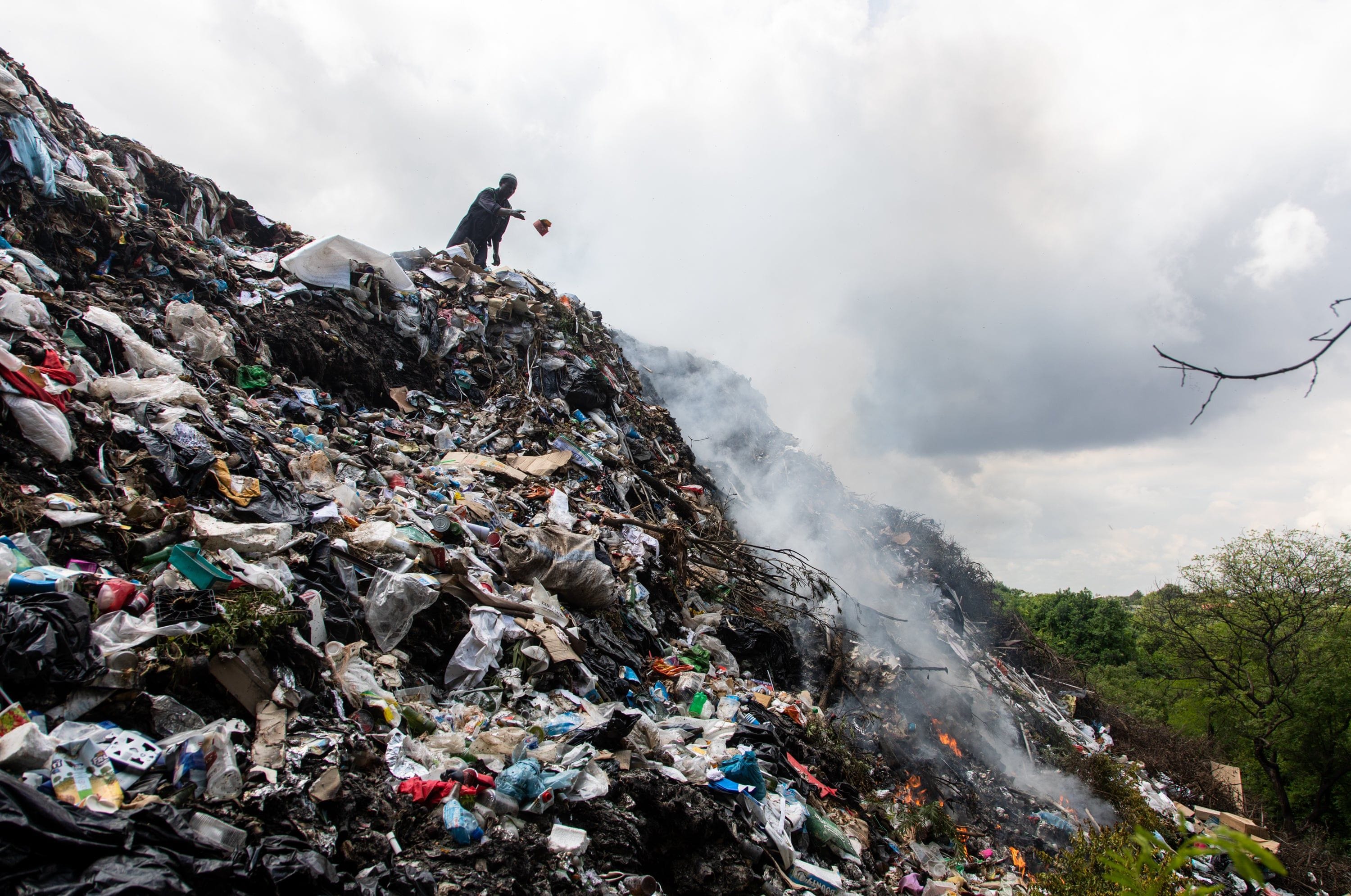
The Neoliberal Feudalism framework sees history pessimistically: not that things will get worse, per se, but rather that human psychology and incentive structures are perennial issues that will not get better, that everything has a trade-off with it and people are inclined to take short-term easy solutions which cause more problems later. History is seen as a series of cons with elites fooling the gullible masses with endless propaganda, no accountability, and with no lessons learned – for all eternity.1 The egalitarian ratchet effect gradually crushes everything that is noble, strong, honorable, robust, involving self-determination and personal excellence (not that being a non-elite in master morality Rome was any better), while humanity reaches its Malthusian limits as it unsustainably consumes the world’s natural resources leaving a trash-heap of rubble and extinction behind. Meanwhile a kind of blind, unthinking centralization process occurs which increasingly removes from humanity its self-sufficiency, privacy and even basic dignity. From this perspective history is seen not as a continuous progress from darkness to light but rather in a much more sinister light. And given that the nature of reality is one of predation – living things can only survive by consuming other living things – the incentive structures look created by a malicious creator-deity, the Demiurge.
As I have mentioned elsewhere, adopting a pessimistic attitude toward the possibility of positive political change has made my political predictive abilities, by and large, much stronger than they were before this shift.
To be clear, this perspective is not meant to cause paralysis or passivity, but rather to set baseline expectations about how we should view the world, to approach events and situations without expectations that they will magically work out for the best. Rather, the range of possibilities is much wider and more flexible than a rigid history-as-progress model suggests. Embraced in this manner, pessimism can lead to increased freedom, unshackled from the Whig model with its expectations of constant progress, leading to vast disappointment when such progress does not materialize.
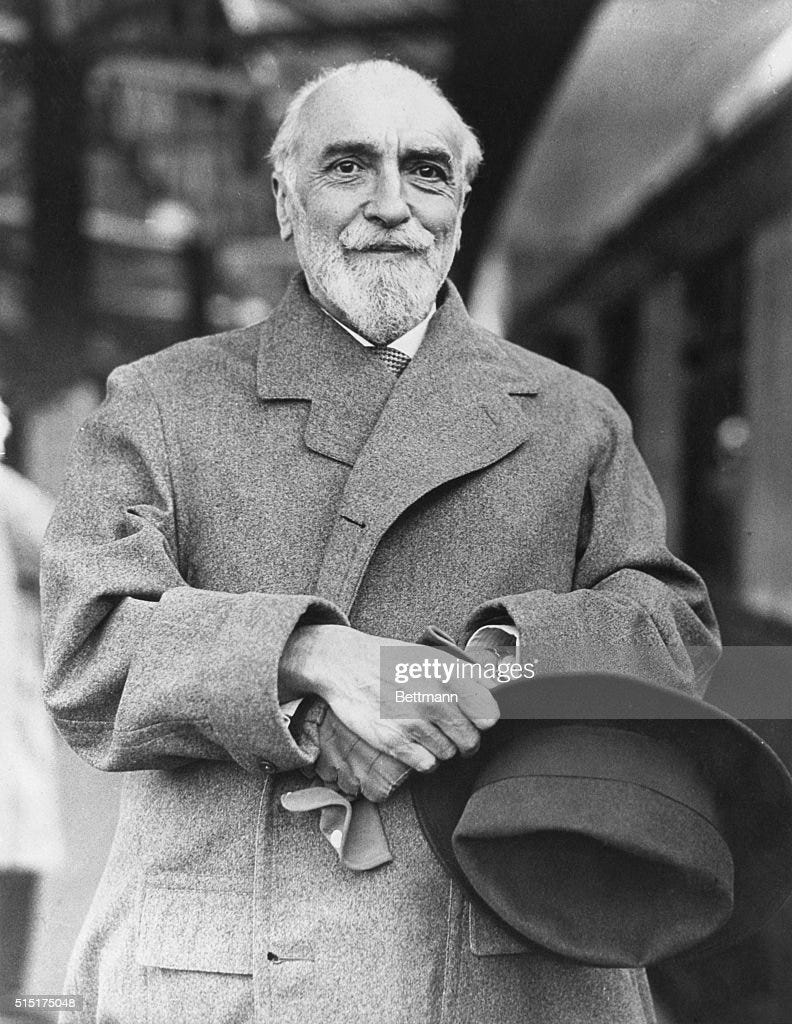
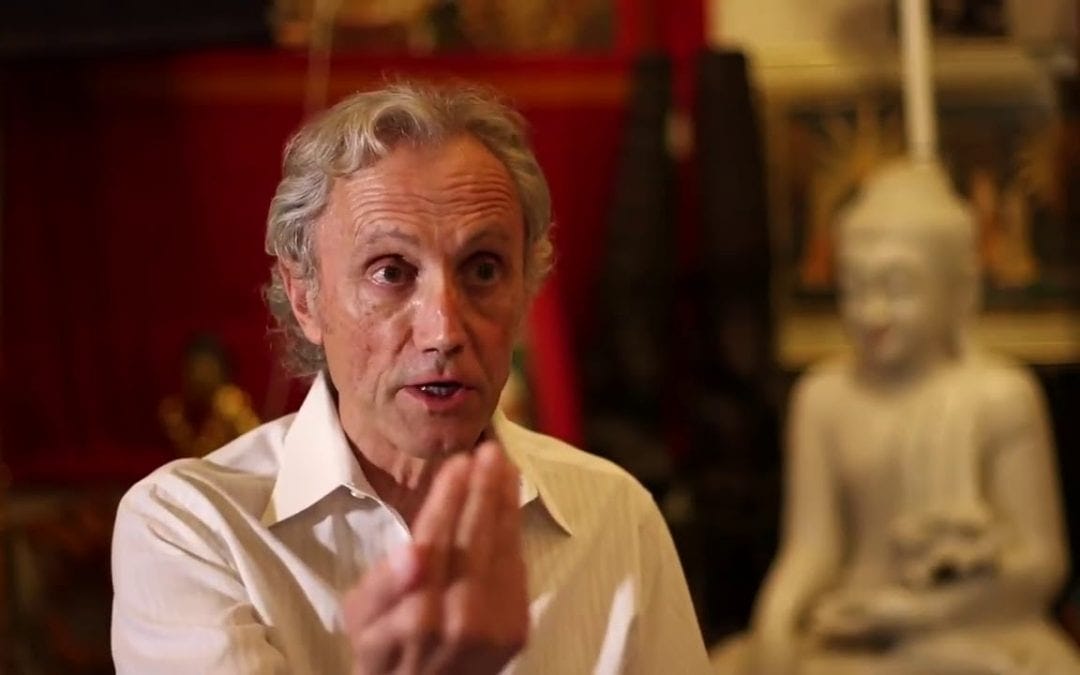
To flesh out my understanding of the intellectual tradition of pessimism, I picked up Joshua Foa Dienstag’s difficult book “Pessimism”. According to Dienstag pessimism has a rich philosophical history, drawing from such figures as Rousseau, Leopardi, Schopenhauer, Nietzsche, Weber, Unamuno, Ortega y Gasset, Freud, Camus, Adorno, Foucault, and Cioran. A bit ironically, I put off reading it because I didn’t want to get sucked into negativity (ha), but was pleasantly surprised by the power and insight of its articulated core points.
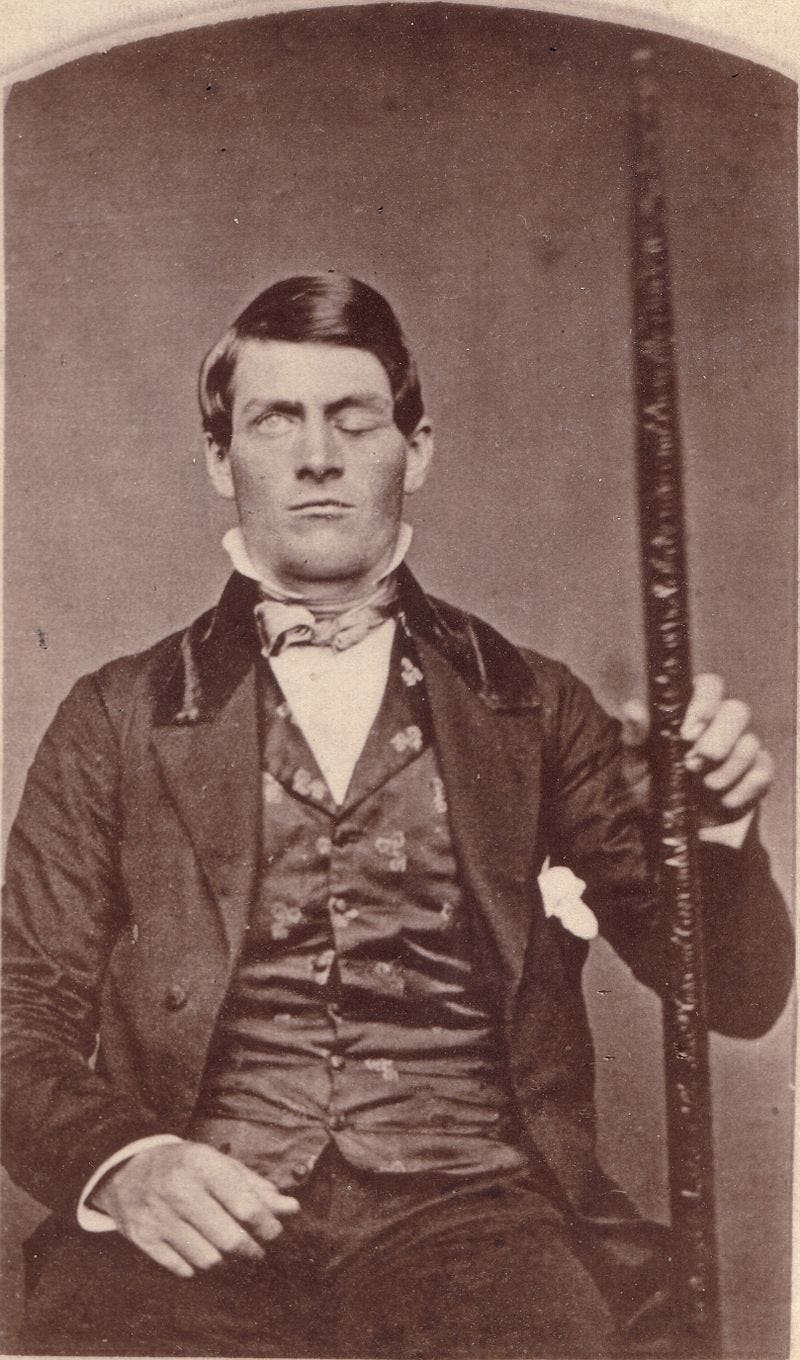
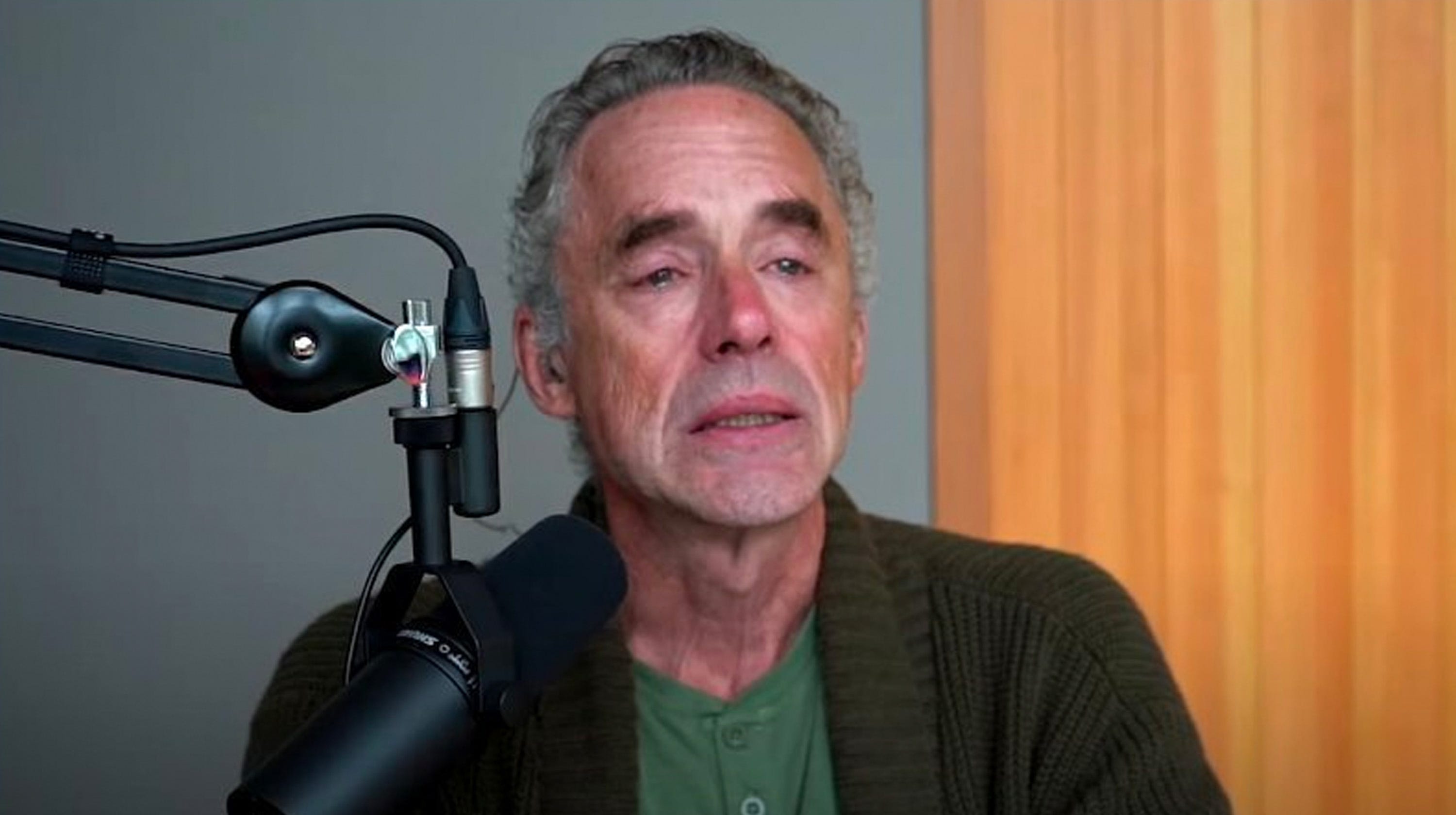
Physiognomy check. Dienstag’s eyes and expression look pessimistic and/or depressive. On a Youtube search he comes across as somewhat effeminate and very academic.
With that said, let’s begin with defining philosophical pessimism.
What is philosophical pessimism?
Pessimists “generally do not set out a scheme of ideal government structure or principles of justice. Theirs is (for the most part) a philosophy of personal conduct, rather than public order. Since such schemes or principles are, to some, the very essence of a political philosophy, this fact, by itself, has been enough to disqualify the pessimists from serious consideration in some quarters.”
The central claims to which all pessimists share to greater or lesser degrees are a series of propositions which, per Dienstag, are as follows:
Time is a burden;
The course of history is in some sense ironic; and
Human existence is absurd.
The reaction to belief in these propositions takes one of two approaches, to various extremes: either (1) ascetic resignation, like Schopenhauer, or (2) those who reject resignation in favor of a more life-affirming ethic of individualism and spontaneity in spite of the horrors of reality, like Nietzsche.
Let’s explore these propositions and then the reactions to pessimism by its adherents.
#1: Time is a burden
Humans are separated from animals by their sense of time-consciousness. Animals live exclusively in the present, while humans have a linear sense of time. According to Nietzsche, animals live “unhistorically” in the sense that they can form no concept of past or future. They “respond to stimuli in the present in a routine and automatic way as their nature dictates but are unable, on the one hand, to form plans or hopes about the future, and on the other, to have regrets or satisfactions about the past….The timelessness of animal existence, whether seen as an Eden or as an infancy, is something we have left behind and can never recover, except perhaps in occasional moments of reverie or transcendence.” Having time-consciousness is a burden because, per Rousseau, consciousness of time means consciousness of death, and he calls this knowledge one of the many “terrors” of consciousness. Freud says “the aim of all life is death.” Per Dienstag,
This sentiment – of the constant presence of death in our lives – is both central to the pessimistic tradition and also central to misunderstandings of it. Critics have often used this sort of material to accuse the pessimist of teaching resignation or nihilism. But this is usually (though not always) a mistake. It is not the pessimists, but their opponents, who draw the conclusion that the acknowledgment of death must lead to inactivity or helplessness. This is hardly ever the conclusion of the pessimists themselves. To say that our lives are always on the way to death is not at all to say that they are pointless, but simply to set out the parameters of possibility for our existence. Pessimism may warn us to acknowledge our limitations – but it does not urge us to collapse in the face of them. Death is merely the ultimate reminder that we do not control the conditions of our existence and are not ever likely to.
Schopenhauer laments “time and that perishability of all things existing in time that time itself brings about…Time is that by virtue of which everything becomes nothingness in our hands and loses all real value”, referring to this phenomenon as the “vanity of existence.” This is emblematic of what Leopardi referred to as the nature of temporal, non-progressive existence: constant change to no particular effect. Koheleth, the presumed author of the Biblical book Ecclesiastes, describes life as “futility” akin to “the pursuit of wind” and “Vanity of vanities! All is futile!”
The perishability of all things results in a sense of unreality to life. For Schopenhauer, the implication is that all striving is in some sense futile; whatever goal one achieves will disappear the moment it arrives. We suffer most from the lack of permanence in the people and things we most care about. The more we care, the more we suffer.2 Animals lose whatever it is they possess too, but “only humans feel the pain of that loss since only human consciousness retains a sense of these things as past. Nor is our capacity for hope or anticipation of the future a compensation for this condition. Indeed, it compounds our situation, since most of our hopes are bound to be disappointed, and those that are fulfilled are disfulfilled in the next moment as the objects of our hopes slip into the past.” Time-consciousness, then, results in unhappiness, even though we receive the compensation of consciousness itself – the intellectual ability for higher thought.
#2:The course of history is in some sense ironic
Pessimists do not deny the existence of progress in certain areas, such as technology and science. Instead, “they ask whether these improvements are inseparably related to a greater set of costs that often go unperceived. Or they ask whether these changes have really resulted in a fundamental melioration of the human condition. This often results…in a conception of history as following an ironic path, one that appears, on the surface, to be getting better when in fact it is getting worse (or, on the whole, no better.” Leopardi explains that “if humans were happier as animals than as conscious beings, then as primitive, ignorant conscious beings they remain happier than as more developed and civilized ones. Since the reality of temporal existence is transience, decay and death (point #1), happiness is found in illusion. The piercing of illusion may be counted as a philosophical, and even a moral, advance. But if we knew of the consequences beforehand and cared about our happiness, such insight would not be pursued. The growth of reason, however, once initiated cannot be frozen at any point. Knowledge cannot draw a limit to itself since the knowing mind finds it nearly impossible to value ignorance.” Therefore, “what appears from one perspective to be an advance is, from another, in equal measure, a diminishment. Every step away from our animal condition is a step closer to misery; the path toward enlightenment and the path to hell are one and the same. Nor is this trajectory reversible. Reason, once engaged, has its own logic, and we can no more ignore its conclusions than we can consciously decide to become unconscious.” Rousseau argued that “our souls have become corrupted in proportion as our Sciences and our Arts have advanced toward perfection.” The decline of morality derives directly from mental growth; thus while human reason is “perfected”, the species is “deteriorating.” Or per Ecclesiastes, “And I gave my heart to know wisdom, and to know madness and folly: I perceived that this also is vexation of spirit. For in much wisdom is much grief: and he that increaseth knowledge increaseth sorrow.”
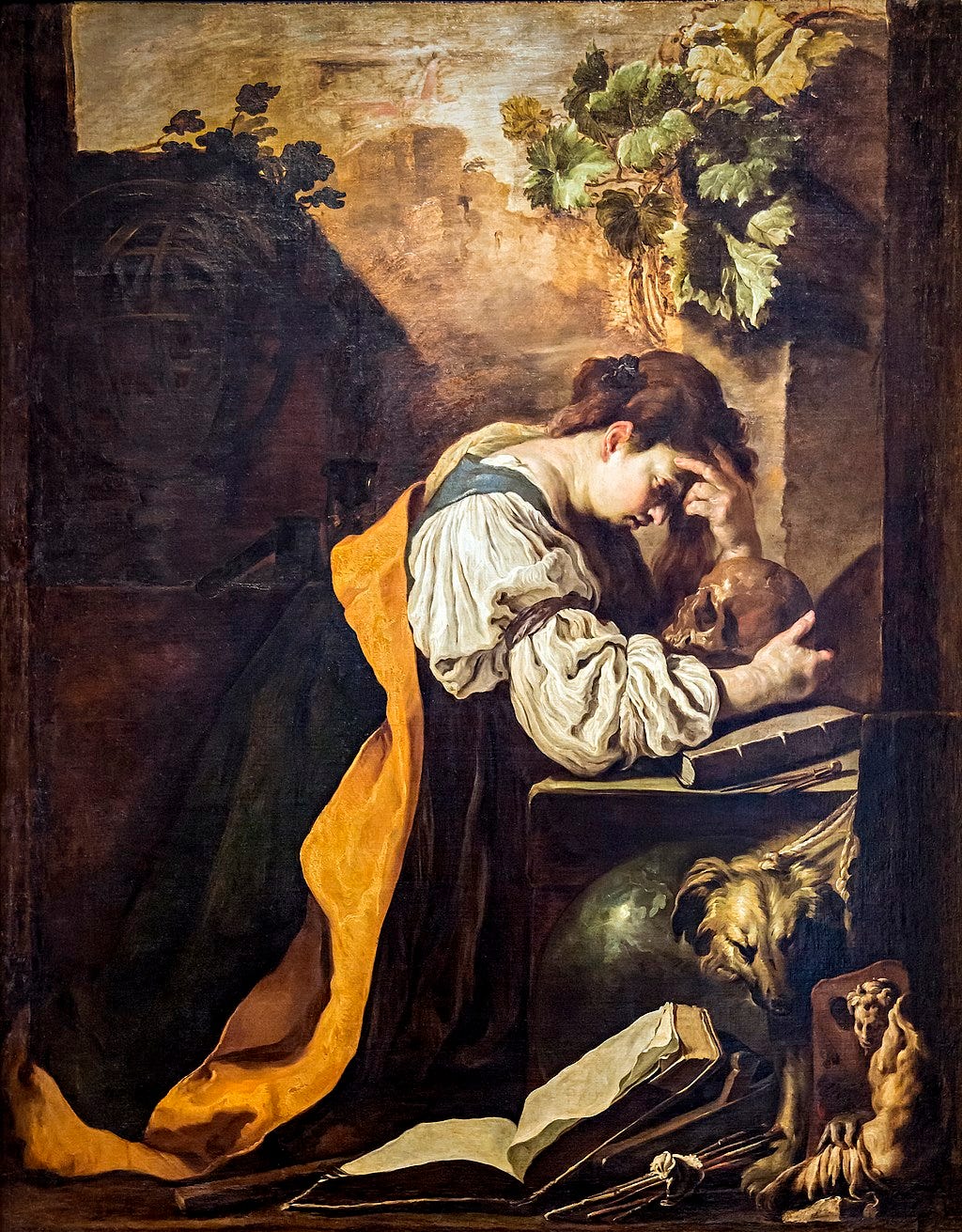
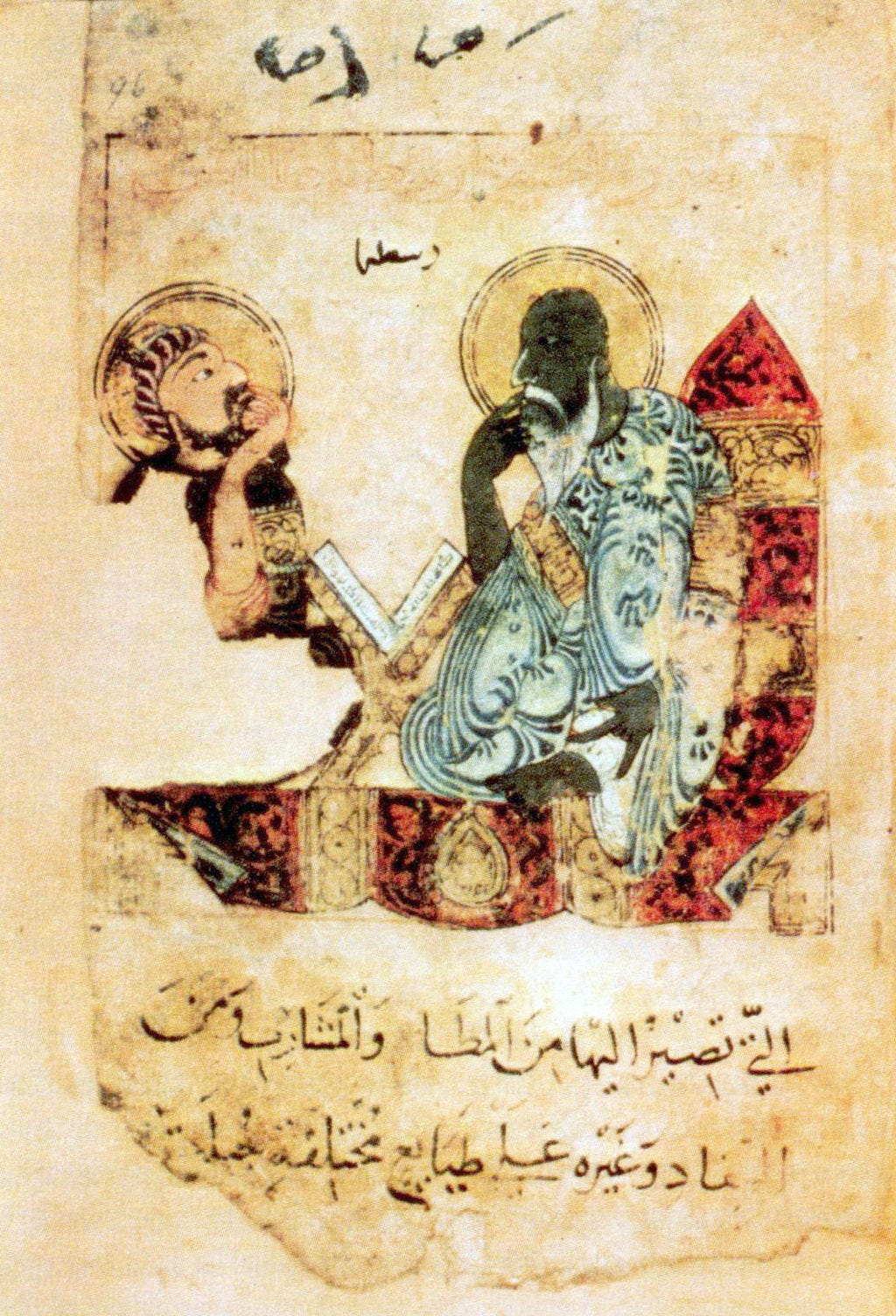
Melancholy by Domenico Fetti (1612). Death, suffering and meaninglessness are the main themes of philosophical pessimism.
There is another aspect of this too: boredom. If history neither repeats nor improves, most pessimists see life as a kind of earthly purgatory where nothing changes but nothing lasts forever. “Human beings often manage to distract themselves from this underlying reality, but when they do not, or their distractions fail, boredom is the inevitable result….Since boredom springs from this fundamental attribute of self-consciousness, it is effectively the baseline mental condition from which we can only be distracted, either by pain or by relentless activity. The latter does not bring happiness, exactly, but at least it is neither pain nor tedium, the two most common conditions.” This is reminiscent of Kaczynski’s notion of surrogate activities which are used to keep boredom at bay. Schopenhauer connects the prevalence of boredom to the absence of true pleasure in life. Pleasure is only the temporary satisfaction of desire, an absence of pain, and the ease of encountering one form of pain or another – coupled with the human mind’s ability to be pained by inconsequential things it desires, and our awareness of impending death – means we get more pain than pleasure:
We are, he argues, compelled by needs which are hard to satisfy. But even when do satisfy them, “their satisfaction achieves nothing but a painless condition in which [man] is only given over to boredom…and that boredom is direct proof that existence is in itself valueless, fore boredom is nothing other than the sensation of the emptiness of existence. For if life…possessed in itself a positive value and real content, there would be no such thing as boredom: mere existence would fulfill and satisfy us. As things are, we take no pleasure in existence except when we are striving after something.”
It is the optimist philosophies who claim that the increase in human mental and technological abilities will inevitably produce a society of happier individuals, but whether this assertion is made in a Platonic form or in an Enlightenment form, it is a false promise, and a promise that creates expectations that lead to disappointment and unhappiness. This is also why Lennon’s pleasant-sounding “Imagine” is the theme of the most bloodthirsty tyrants in history, as it promises a utopian future at the expense of the present with no possibility of fulfillment.
#3: Existence is absurd
Existence is absurd because freedom and happiness are incompatible. We are taught by the false optimism that pervades society to believe that our goals and dreams are achievable, but we are constantly disappointed by their failures:
To the pessimists, human existence is not a riddle waiting to be solved by philosophy; human existence merely is. Freedom and happiness do not exist as the solution to a problem. Rather, starting with Rousseau’s contention that reasoning is against Nature, pessimists have asserted, contra the optimistic Socrates and his descendants, that freedom and happiness are in a fundamental tension with one another as a result of the ontological “divorce” between the time-conscious being full of desires, goals, and memories and the time-bound universe that constantly destroys the objects of its inhabitants’ desires….Socrates had it exactly backwards; it is only release from the burdens of consciousness, which ultimately means time-consciousness, that could purchase our happiness.
The absurdity of existence to the pessimist is contained in the idea that freedom and happiness oppose one another. Schopenhauer writes, “There is only one inborn error, and that is the notion that we exist in order to be happy…everything in life is certainly calculated to bring us back from that original error, and to convince us that the purpose of our existence is not to be happy.” Or as Dienstag argues,
Put another way, we can say that there is a kind of pragmatism buried so deeply in Western philosophy that it is almost impossible to root out. This is the notion that there must be an answer to our fundamental questions, even if we have not found it yet, and that this answer will deliver us from suffering. That is, there must be a way for human beings to live free and happy….It is this widely shared model of a universe predisposed to being subdued by the proper dialectic that pessimism objects to via the language of the “absurd.” Pessimism differs from other modern philosophies, then, not because of a recommendation of lassitude but because of a diagnosis of the human condition that finds no basis for the faith in progressive reason that these varieties of optimism share.
The response to pessimism
There are two general responses to pessimism by its adherents, represented on two poles: advocation of a retreat from life like Rousseau and Schopenhauer, i.e. to live a life of ascetic withdrawal, or alternatively to affirm and embrace life despite living in an absurd world full of pain, without expectation of time-as-progress, which is the approach of writers like Camus, Nietzsche, Unamuno and Leopardi.
Schopenhauer v. Nietzsche: two poles of response to pessimism
For Schopenhauer, the pains of time-consciousness are a just punishment for our evil natures, where he writes:
As a reliable compass for orienting yourself in life nothing is more useful than to accustom yourself to regarding this world as a place of atonement, a sort of penal colony. When you have done this you will order your expectations of life according to the nature of things and no longer regard the calamities, sufferings, torments, and miseries of life as something irregular and not to be expected but will find them entirely in order, well knowing that each of us is here being punished for his existence and each in his own particular way.
With an attitude like this, why didn’t he kill himself? While Schopenhauer and Leopardi have sympathy for those who find the burdens of existence too much, none of the pessimist philosophers recommend suicide and, for the most part, their aim is to find reasons to oppose it. Schopenhauer viewed the world as an illusory representation, that only our will is real and that will is not affected by death, so suicide changes nothing, “it affords no escape.” In fact, Schopenhauer arguably led a life at odds to an extent with his philosophy. Anyway, Schopenhauer’s essays on pessimism are delightful and available online here, and I highly recommend them.
In contrast, Nietzsche, who saw the world just as Schopenhauer did as a place of continuous suffering, took the opposite approach: “You ought to learn the art of this-worldly comfort first; you ought to learn to laugh, my young friends, if you are hell-bent on remaining pessimists. Then perhaps, as laughers, you may someday dispatch all metaphysical comforts to the devil – metaphysics in front”. Nietzsche believed that Schopenhauer’s retreat into asceticism was born from weakness, shirking from accepting life as it is on its own terms. By embracing life as change, the natural result of a temporal existence, per Dienstag, “a pessimist can recognize and delight in the fact that we live in a world of surprises – surprises that can only strike the optimist as accidents and mishaps, disturbing as they do a preordered image of the world’s continuous improvement. This openness to the music of chance lends to the pessimist an equanimity that might strike an outsider as callous. The optimist, on the other hand, must suffer through a life of disappointment, where a chaotic world constantly disturbs the upward path he feels entitled to tread.”
Here is a great article by Dienstag if you want to read more about Schopenhauer and Nietzsche’s alternative responses to pessimism.
Conclusion
The question is ultimately this: what type of relationship do we want to have to the present and future, one of freedom or enslavement? According to Dienstag, “optimism subordinates the present to what is to come and thereby devalues it. Pessimism embodies a free relation to the future. In refraining from hope and prediction we make possible a concern that is not self-abasing and self-pitying. By not holding every moment hostage to its future import, we also make possible a genuinely friendly responsibility to ourselves and to others.”
Personally, I embrace this pessimistic spirit, even though I am myself torn between Schopenhauer and Nietzsche’s position – why strive, when striving will inevitably result in loss and failure? Nietzsche went insane, after all. But then why live if one is not striving for goals and living — a life as an ascetic doesn’t sound very appealing either. And it’s debatable how much Schopenhauer lived his own philosophy! I’ve more or less taken a middle road, trying to survive in the world and build a life while nurturing an increasing understanding that everything is fleeting and there is no expectation that tomorrow will be better, allowing me to set proper expectations for myself that do not result in being regularly surprised.
I hope you found this primer on pessimism helpful, and hopefully this post has a small effect on removing the terrible reputation it has from your mind.
Thanks for reading.
Subscribe: Email delivery remains on Substack for now.
1 It is much easier to avoid this perspective during times of economic prosperity, and time is indeed cyclical ala Spengler. But we are at the start of a period featuring a massively declining quality of life, so it is a good time to embrace a more pessimistic philosophy. I also generally prefer not to focus on the cyclical nature of civilization because of concern that it could make one too passive (i.e. society is turning to Hell so why bother focusing on it, it’s only natural) while I would rather rage against the dying of the light.
2 There are a lot of commonalities between Schopenhauer’s thoughts and Buddhism, which he called the “best of all possible religions”. I used to practice Vipassana meditation and kind of miss it; there was no dogma involved which was very refreshing. I even attended one of the ten day retreats. The technique is simple: you spend the first two days focusing your attention only on your breath (in a guided meditation hall for ten hours a day), inward and outward. You come to see how wild and uncontrolled one’s thoughts are; you try to focus on your breath but the mind keeps wandering, like a wild stallion. After two days the mind finally calms down. The rest of the ten days are focused on scanning your body top to bottom, over and over, feeling whatever sensation comes up, good or bad, without reacting to it. Whenever the mind wanders you calmly bring the attention back to the scanning. This results in a deepening sense of calmness of body and soul. I walked out of the retreat with an unsurpassed sense of calmness and well-being (for me), but one is supposed to meditate for a minimum of two hours a day to keep the accrued benefits, and I was not able to do so. Maybe I’ll revisit down the line. The Art of Living by William Hart is a great primer on it.
This is a politics post. Because politics is downstream of culture and culture is downstream of society’s beliefs, this post feels like a bit of a regression. However, it is useful to review certain common misconceptions about the makeup of the Supreme Court, its ability and willingness to check the power of the legislative and executive branches, and how it may address lawfare manifested in the upcoming Trump trials and 2024 election issues (such as efforts to remove Trump from multiple state ballots).
A number of months ago I analyzed the composition of the U.S. Senate, concluding that, even though the Senate was roughly evenly split, there were really only seven Republican Senators that consistently voted in a pro-American manner, or maybe fifteen if one was being generous. In other words, representation for right-wing populists was dismal, 15% of the Senate at most, and therefore they served merely as fig leaves, cover for the myth of popular representation as globohomo-backed politicians of the uni-party establishment dictate actual policy.
This leads to questions about populism’s support in other governmental institutions. How supportive of America First populism or dissident policies is the Supreme Court, especially by its Republican Supreme Court justices?
The Supreme Court is generally perceived as being one of the last bastions of Republican control in the United States. Pro-globohomo, viciously anti-white liberals control the university system, the schooling system, the media, the entertainment complex, the Senate, effectively the House and the governorships (both are roughly tied with slight Republican majorities, but many “Republicans” are RINOs while the Democrats vote monolithically), the top brass of the military, the neutered police forces, the CIA, DOJ, FBI, NSA, EPA, IRS, Homeland Security, etc. Republicans do control a solid majority of State legislatures and the rank-and-file of the military and police do lean heavily Republican, but that’s it.
The Supreme Court is presently 6-3, with six appointed Republican Supreme Court justices: John Roberts, Clarence Thomas, Samuel Alito, Brett Kavanaugh, Amy Cohen Barrett and Neil Gorsuch, and three appointed Democrat justices: Sonia Sotomayor, Elena Kagan and Ketanji Brown Jackson.
The Court in 2023
How much of a check does this Court have on legislature and executive overreach? What do the “Republican” and “Democrat” labels mean in practice? And how do we make that determination?
As background, there are about 60 cases that the Supreme Court decides in any given year. You can see the specific case breakdown hyperlinked for 2022-2023, 2021-2022, 2020-2021, 2019-2020, 2018-2019, and 2017-2018. Many of these cases deal with complex procedural technicalities, many with criminal law, many with administrative law and various other apolitical topics. Very few cases are high-profile and political.
Chief Justice John Roberts is very sensitive to public opinion and the court’s perceived legitimacy. He does not want to be seen as crafting law from the bench, as the court faces court-packing threats like the court faced in 1937 with the “switch in time saved nine”. As such, Roberts really doesn’t like to take on high profile cases — to take on a version 2 of Bush v. Gore would probably give him a heart attack, and the Court rejected all 2020 election challenges (although Thomas and Alito hinted at their willingness to consider them) — and Roberts generally does all he can to reach consensus with as many justices as possible, even if that means narrowing the scope of the ruling to be so attenuated as to be near meaningless, if the Court agrees to hear the case at all.
As Obama said when he decided not to pursue a career track toward becoming a Supreme Court justice, “If you’re going to make change, you’re not going to do it as a Supreme Court clerk.” The cases before the court take years to get there in a winding, circuitous process; the Court was and is too slow, too cumbersome, far too reactive to be able to proactively remake society the way Obama wanted. The court is essentially a stopgap measure to radical change, but easily swayed by media and political pressures.
Methodology
How should one analyze the 360 or so cases from 2017 until the present? For purposes of this post the cleanest approach is as follows: compare the voting records of the Republican justices to the record of the most conservative member of the court, the wonderful Clarance Thomas.1 Thomas is constantly smeared in the media with one-sided, biased media allegations about financial impropriety2, and he was barely confirmed to the seat because of the politicized allegations of Anita Hill. He received and continues to receive rougher treatment from globohomo – despite being a proud black man – than any of the white justices, including crybaby Brett Kavanaugh who had similar tactics used against him, simply because Thomas is at least dissident-adjacent and dissidents receive no preference at all in society, no matter their race, gender or sexual orientation. People only receive preferment and protection within their checkmark box victim category if they are liberal or pro-globohomo.
To compare Republican justice voting records to Thomas’s, we will narrow the scope further with the following parameters:
We will limit the analysis of the voting record to a period designated from Trump’s 2017 inauguration when everything became much more politicized and hysterical until today;
We will limit the analysis to cases where Thomas dissented from the majority opinion, because if Thomas is in the majority then it either involves liberals joining the decision (which they wouldn’t do in a politicized case) or from a unanimous or near-unanimous Republican vote, which isn’t helpful to parse differing beliefs of the justices (although I must give them credit for rejecting the OSHA COVID-19 mandate for private sector employees with 100+ employees, to which the liberal justices dissented); and
We will limit the analysis of cases to those that are politicized, which generally means cases involving voter access, redistricting, state rights, Trump cases, immigration cases, gun rights cases and gay/transgender rights cases.
By parsing the cases in this manner, we are able to decrease the applicable cases from 360+ down to a mere 8, which are reviewed below.
Note: this isn’t meant to be a comprehensive analysis, merely a useful heuristic, as the analysis does not look into important politicized cases that the Court simply declined to take up for consideration.
The cases
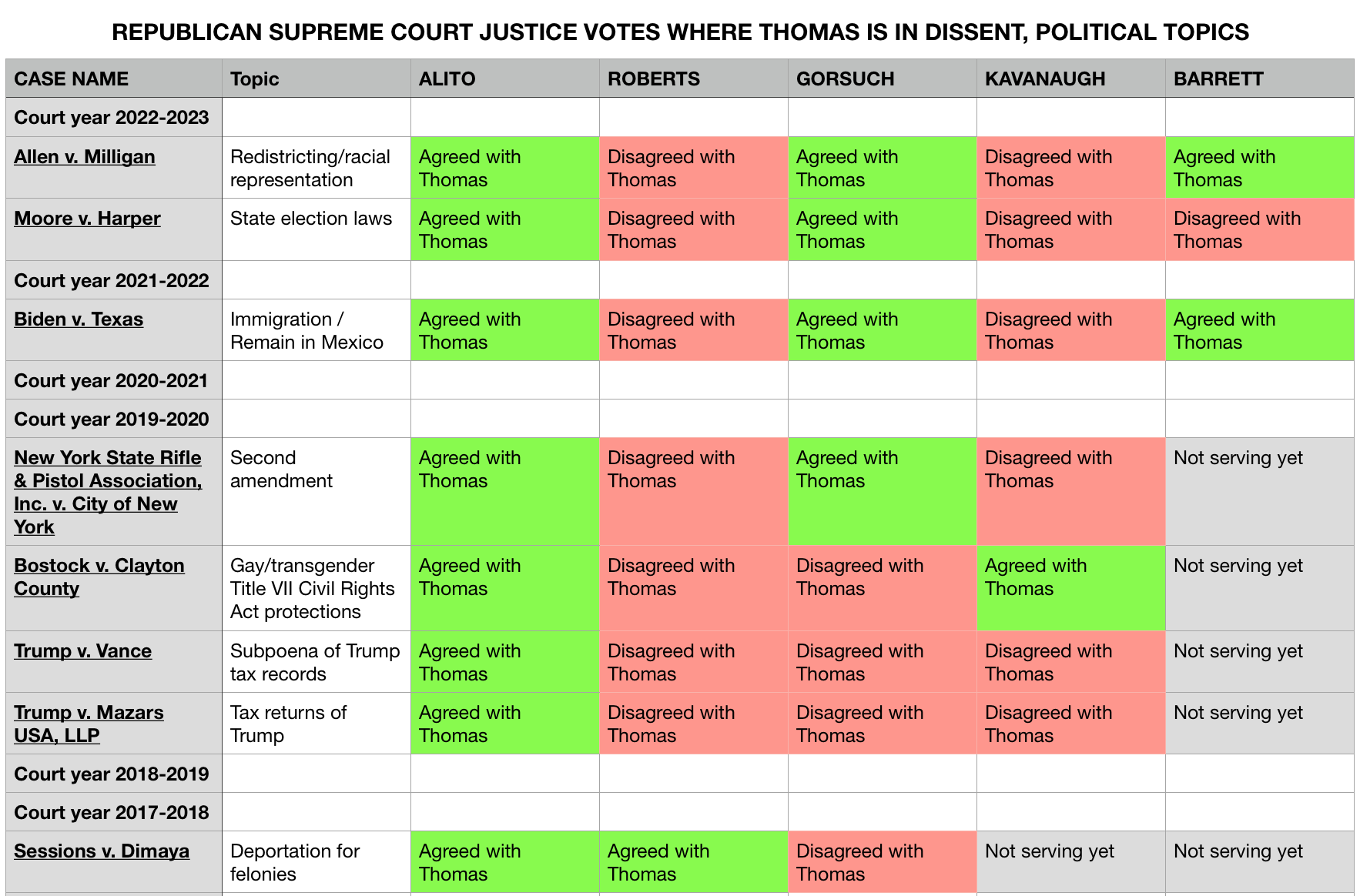
The following are the eight cases that Thomas dissented from, the topics of those cases, and whether the other Republican justices joined Thomas in dissent (in green) or joined the majority (in red):
Allen v. Milligan: This was a case regarding whether Alabama’s congressional redistricting discriminated against black voters. The Court decided 5-4 to maintain an injunction that required Alabama to create an additional majority-minority district. Roberts and Kavanaugh joined the Democrat justices. This case alone will likely net the Democrats multiple House seats (4-5+?) in 2024.
Moore v. Harper: The Court ruled in a 6–3 decision that the Elections Clause does not give state legislatures sole power over elections, rejecting independent state legislature theory. The case arose from the redistricting of North Carolina’s districts by its legislature after the 2020 United States census, which the state courts found to be too artificial and partisan, and an extreme case of gerrymandering in favor of the Republican Party. This is important given Republicans control state legislatures by a wide margin, 28-19-3 in 2023, so this case dramatically curtailed their authority. Roberts, Kavanaugh and Barrett sided with the Democrat justices.
Biden v. Texas: The Court reversed the Fifth Circuit by a 5–4 vote and held that the federal government has the authority to revoke the Migrant Protection Protocols, the revocation of which ended Trump’s “Remain in Mexico” immigration policy. This has and will continue to have a major impact on encouraging massive levels of illegal immigration. Roberts and Kavanaugh sided with the liberals.
New York State Rifle & Pistol Association Inc. v. City of New York: This was a case addressing whether the gun ownership laws of New York City, which restrict the transport of a licensed firearm out of one’s home, violated the Second Amendment to the United States Constitution. After the Supreme Court agreed to hear the case, New York City and New York state cynically amended its laws to allay the challenged provision. In a per curiam decision in April 2020, the Supreme Court determined that the case was moot, vacating and remanding the case to lower courts. Alito, Thomas and Gorsuch wanted to hear the case; eventually the case was re-heard in 2022 and had a proper 6-3 decision in favor of gun rights. Why such tentative, slow support for gun rights in the first place?
Bostock v. Clayton County: The Court held that Title VII of the Civil Rights Act of 1964 protects employees against discrimination if they are gay or transgender. Gorsuch and Roberts joined the liberal justices in this decision.
Trump v. Vance: This case arose from a subpoena issued in August 2019 by Manhattan District Attorney Cyrus Vance Jr. against Mazars, then-President Donald Trump’s accounting firm, for Trump’s tax records and related documents, as part of his ongoing investigation into the Stormy Daniels scandal. Trump commenced legal proceedings to prevent their release. The Court agreed that Trump was obligated to provided the records and documents; only Alito and Thomas dissented.
Trump v. Mazars USA, LLP: This case involved subpoenas issued by committees of the US House of Representatives to obtain the tax returns of President Donald Trump. The Court agreed that Trump was obligated to provide his tax returns; only Alito and Thomas dissented.
Sessions v. Dimaya: In this case the Court held that 18 U.S.C. § 16(b)[1] a statute defining certain “aggravated felonies” for immigration purposes, is unconstitutionally vague. The Immigration and Nationality Act (INA) classifies some categories of crimes as “aggravated felonies”, and immigrants convicted of those crimes, including those legally present in the United States, are almost certain to be deported. Those categories include “crimes of violence”, which are defined by the “elements clause” and the “residual clause”. The Court struck down the “residual clause”, which classified every felony that, “by its nature, involves a substantial risk” of “physical force against the person or property” as an aggravated felony. Essentially, the Court held that illegal aliens committing certain felonies would not result in almost certain deportation. Gorsuch agreed with the liberal justices.
Analysis
There is a very limited sample of politicized cases, which are but a very small percentage of the cases that the Court has heard over the past six years. From this sample, though, we can see a kind of trend emerge: Alito is almost as conservative as Thomas is, agreeing with him on all of these controversial decisions; Roberts and Kavanaugh almost always disagree with Thomas and Alito on these decisions, and Barrett and Gorsuch are wishy-washy.
Much more importantly than these cases though is that, as stated above, the Supreme Court wouldn’t consider 2020 election cases except as briefly hinted at otherwise by Thomas and Alito in their dissent to Texas v. Pennsylvania.
We can therefore say with a reasonable measure of confidence that the Supreme Court will not step in to resolve contentious 2024 election cases (at least if it involves challenging globohomo’s dictates) and it is questionable to what extent, if any, they will be willing to uphold challenges to Trump or his allies’ legal cases, regardless of their merits.
This isn’t to say that a Republican dominated Supreme Court has no value; they likely slow down to an extent the egalitarian ratchet effect which, if the Court were majority Democrat (and possibly had insane, deranged bloodthirsty Merrick Garland on it), we would still be under oppressive OSHA COVID vaccine mandates and who knows what other sort of additional horrendous anti-white, anti-civilizational dictates. A world of decisions led by anti-white dim racists Sotomayor, Kagan and Ketanji Brown Jackson is a world of even more rapid civilizational collapse and destruction. I guess the right-wing under this setup also gets occasional fig leaf “victories” such as:
These three so-called victories are at best Pyrrhic victories, meaningless to the big picture as the country rapidly careens toward implementing what happened in California but on a national level: a permanent one party state based on wide-open borders and tens of millions of new non-integrating immigrants, with the Supreme Court utterly powerless to do anything about it…
Why does this matter?
There are four reasons:
This post continues my general theme of encouraging people to put less faith in the political process or the system as a whole, to set realistic expectations for oneself. I increasingly believe this world is controlled by the Demiurge, and that we are put here as kind of a prison (if there’s any purpose at all). Schopenhauer comments on this point: “As a reliable compass for orienting yourself in life nothing is more useful than to accustom yourself to regarding this world as a place of atonement, a sort of penal colony. When you have done this you will order your expectations of life according to the nature of things and no longer regard the calamities, sufferings, torments, and miseries of life as something irregular and not to be expected but will find them entirely in order, well knowing that each of us is here being punished for his existence and each in his own particular way”;
As i have written elsewhere (see Takeaway #1), the best way to judge a system for modeling the world is by its predictive accuracy. The black-pilled take has been much more accurate than any other take I’ve seen so far. This post highlights this perspective by arguing that the Supreme Court is highly unlikely to support Trump during 2024’s upcoming election theft;
This post is one piece of a multi-post assemblage that will be used in the future to argue that the odds of a “redneck rebellion” succeeding are exceedingly unlikely; and
My broader perspective of philosophical pessimism is deepening and entrenching, perhaps not in a healthy way. This will be discussed more in a future post.
Conclusion
As unsatisfactory as the current ideological composition of the Court is – to the point there should be no significant hope or expectation that the Court will stop any of globohomo’s devious plans – it could be much worse. Globohomo likely murdered Thomas-tier conservative Antonin Scalia in 2016 (he was found with a pillow over his head in a hotel room as a public statement) and it wouldn’t be surprising for them to do the same to Thomas. Thomas is 75 years old, though, and rumored to not be in such fantastic health, while Alito is 73 years old, which should be worrying for conservatives in the medium-term even without conspiracy concerns. If liberals appoint a couple of justices and swing the majority their way, one can expect the speed of globohomo stripping you of your vestigial rights to intensify significantly.
Subscribe: Email delivery remains on Substack for now.
1 Thomas’s conservatism approaches dissident thought (defined previously here) in many ways, although he is an originalist which is, like standard conservatism, always losing.
2 These media-created allegations have no downside for globohomo. They could potentially get Thomas to resign and/or recuse himself from criminal 2020 election cases; they want to apply pressure on conservative justices to cave on important cases; and they want to set the foundation for packing the court or impeaching the justices if Democrats receive a large enough congressional majority. There is also a rumor that Ginni Thomas is a listed co-conspirator in one of the Trump cases, which would be a brilliant (and incredibly evil and devious) move by globohomo to force Thomas’s recusal from these cases. If I were a globohomo strategist this is exactly the type of move I would devise.
“We are unchanged; we are still the same as we were in the eighth century….Oh that you could only consent to be again what you were once, when we were both united in faith and communion!” – Aleksey Khomyakov
Ignatius of Maidstone had some interesting criticism regarding my post about the egalitarian ratchet effect. That post presents the argument that the egalitarianism at the heart of Christianity doubles down on itself and intensifies over time in a ratchet-like manner, reaching the point where we are today dealing with transsexualism and child sex reassignment surgery and with more horrors to come, and that the process will continue unabated unless society’s core values are transvalued, if ever.
The push for egalitarianism is codified in numerous biblical passages, such as “the first shall be last and the last shall be first” (Matthew 20:16), “There is neither Jew nor Greek; there is neither slave nor free; there is neither male nor female; for you are all one in Christ Jesus” (Galatians 3:28 NKJV), “Whosoever will be great among you, let him be your minister; And whosoever will be chief among you, let him be your servant” (Matthew 20:26-28), and “Brothers and sisters, think of what you were when you were called. Not many of you were wise by human standards; not many were influential; not many were of noble birth. But God chose the foolish things of the world to shame the wise; God chose the weak things of the world to shame the strong. God chose the lowly things of this world and the despised things — and the things that are not — to nullify the things that are, so that no one may boast before him” (1st Corinthians 1:27).
The problem with this is that in this reality nothing is equal and nothing will ever be equal, which creates an endless amount of tension. Oh, equality isn’t here? Then that means racism, sexism, and all the other -isms are holding us back! We must double down and flatten and destroy those holding back utopia on earth, brothers!
One can see how this might present problems.
Now, Ignatius’s criticism is that the ratchet effect doesn’t apply to Eastern Orthodoxy, the second largest Christian communion worldwide with 260 million members. He wrote in the comments to that post:
The problem started in 1054, when the Western Church split from the Eastern Church [i.e. the East-West Schism or the Great Schism], believing that the West could function under an authoritarian pope, who himself owned land and property. Thus, the [Catholic] Church pivoted from concerns about Heaven and Eternity, and towards materialist endeavours. Their pontiff was no longer subject to obedience at a council of bishops.
Essentially, the Roman Catholics wanted to create a heaven on Earth. [Modern day liberalism] is the fruit of that.
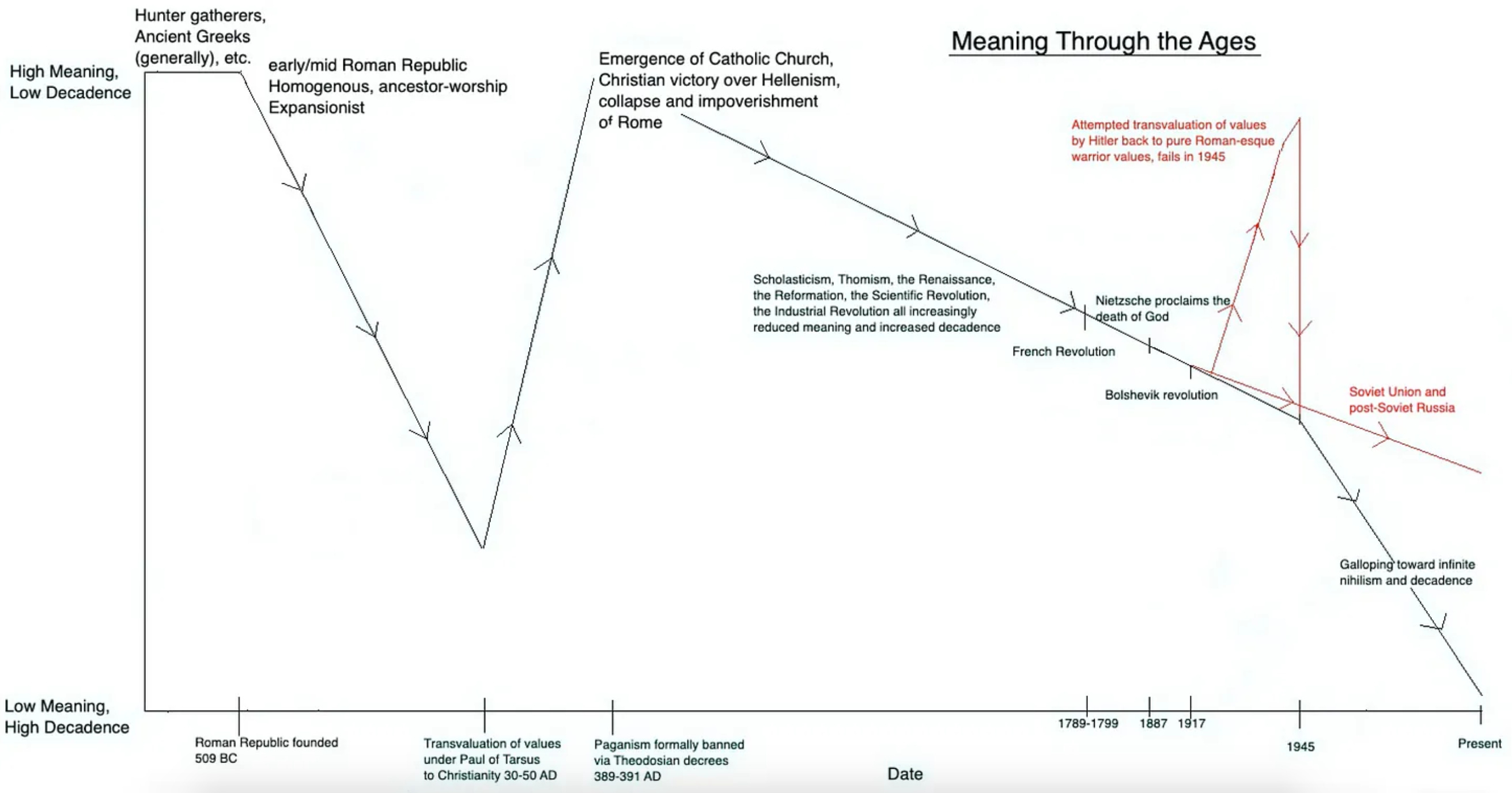
Ignatius is right about this: Eastern Orthodoxy does not suffer from the egalitarian ratchet effect. Eastern Orthodoxy has not ratcheted much past the original transvaluation of values under Paul (which, as argued previously, was enormously radical and led to the destruction of Rome, but also offered reinvigorated meaning to its believers in a world that had descended into decadence).
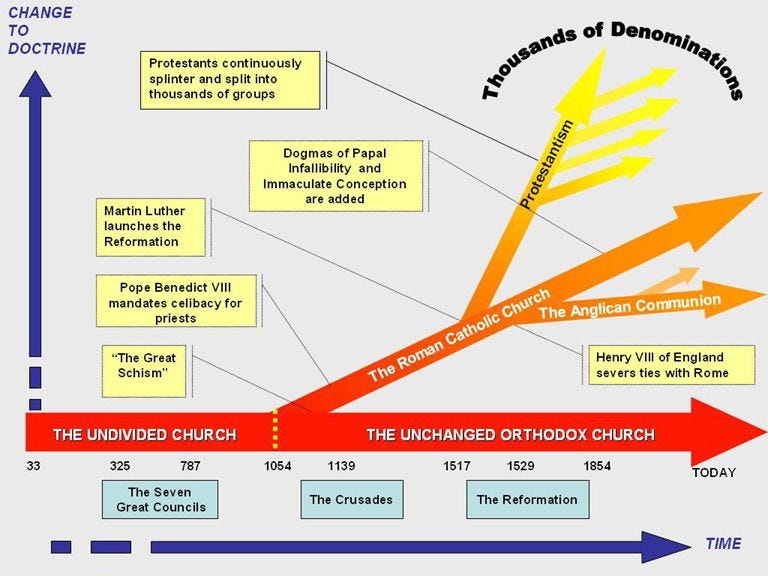
Below is a chart visualizing the societal progression under egalitarianism in the West across time. More change to doctrine = more egalitarian.
Orthodoxy prides itself on offering a doctrine which is everlasting and unchanging. This can’t really be said for Catholicism, whose Scholastics adopted Aristotlean logic which led inexorably to Protestantism which then led in turn, via Unitarianism, to modern secular egalitarianism. Catholics also introduced substantial doctrinal changes since the Great Schism such as mandatory celibacy, papal infallibility and immaculate conception. Radical ecumenical and social justice-oriented changes were seen as recently as Vatican II, and the current Pope comes across as very liberal in both belief and action, with near-daily headlines like “Pope Francis Softens Vatican’s Ban on Blessing Gay Couples” and documents released like this. This has led to a collapse in faith among the laity.
That isn’t to say that everyone in the Catholic Church leadership is liberal, though. According to the wonderful Archbishop Vigano, the Catholic Church has been infiltrated by a “Deep Church” pushing “heresy, sodomy and corruption.” He states,
“There is a very strict relationship between the doctrinal crisis of the Church and the immorality of the clergy, that scandalously reaches up to the highest levels of the hierarchy. But it is also apparent that this crisis is being used by the ultra-progressive wing not only to impose a false morality together with a false doctrine, but also to irremediably discredit the Holy Church and the Papacy before the faithful and the world, through the action of its own leaders.” Viganò added that a “gay lobby” has “infiltrated into the Church and that is literally terrified that good pastors will shed light on the influence that it exercises in the Secretariat of State, in the Congregations of the Roman Curia, in the Dioceses, and over the entire Church…[Pope] Bergoglio has surrounded himself with compromised and blackmailed personalities, whom he has no qualms about getting rid of as soon as they risk compromising him in his media image.” Viganò said that “these three elements – heresy, sodomy, and corruption – are so recurrent that they are almost a trademark of the deep state and of the deep church.”
Not exactly a ringing endorsement for the state of the Catholic Church.
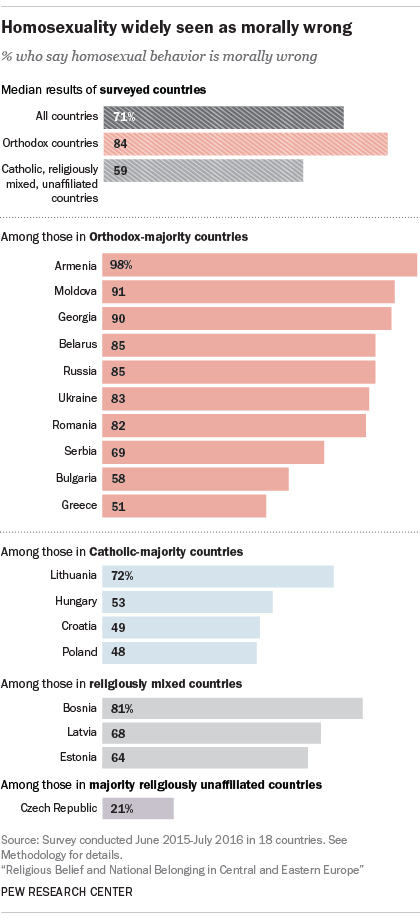
Now, the Bible is unambiguous in condemning homosexuality. Comparing the extent to which a population within countries dominated by Orthodoxy or Catholicism believes homosexuality is “morally wrong” in accordance with the Bible, then, should be a decent proxy for assessing the laity’s susceptibility to doctrinal changes and liberalism. Here are the results:
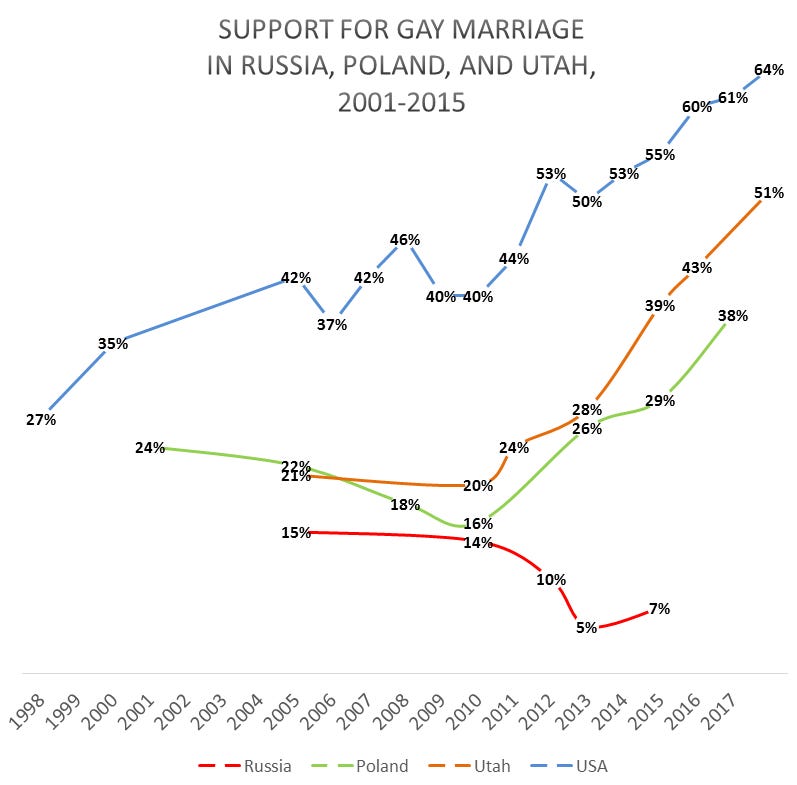
As part of this trend Poland just elected a pro-globohomo government.
The Orthodox Church doesn’t really have the liberalism-slippage issues that plague Catholicism. It has other issues which we will discuss, but not these. It offers a religious stability of dogma that, in this world of incessant, radical change, is admirable and commendable. Among other reasons, this has made the religion more attractive to those on the American right who are looking for a religious solution to the degeneracy of the West and who see Catholicism and Protestantism as unworkable.1 I believe that this line of logic was at least part of the reason that led Roosh on his religious journey after the sad cancer death of his sister to Orthodoxy (first to Armenian Orthodoxy and then to Russian Orthodoxy), although he has since adopted rigid ideological guardrails enforced at rooshvforum.com where he is the final arbiter on what is Orthodox approved and what is Orthodox forbidden. Uh, thanks I guess, Roosh, for banning all unapproved discussion from your followers. The narrowing of the scope of ideas he is willing to contend with is sad to see and speaks to a rigid mind living in great fear [update: he’s now shutting down his forum].
Anyway, I wanted to do a more in-depth examination of Orthodoxy and give a fuller response to Ignatius, and had some ideas to what I viewed as its strengths and weaknesses, so I turned to the book The Orthodox Church (1963) by Timothy/Kallistos Ware which offered a clear and concise history, its benefits, the reasons from their perspective for the Great Schism, and his understanding of the ongoing challenges that the Church faces. It offers a strong summary of the Church and I recommend it, and some of the ideas it presents are discussed below.
Pre-Schism Background
The Eastern Orthodox and Roman Catholic Churches were united as one until the Great Schism. They both continue to accept the first seven ecumenical councils as legitimate. These counsels generally related to controversies surrounding the nature of Jesus in relation to God (most importantly the condemnation of Arianism), the structure of the Church, the relation of the various regional apostolic sees to each other (Rome was first among equals until the Schism; then Constantinople became first among equals), and whether the worship of icons were acceptable or heretical idol worship.
The Theotokos of Vladimir, one of the most venerated of Orthodox Christian icons of the Virgin Mary
It is hard to understand for those of us raised in the secular, liberal, nihilistic west devoid of meaning, but the Church at the time provided an all-encompassing world perspective that grounded its followers and gave him a reasoning for his suffering:
Not without reason has Byzantium been called ‘the icon of the heavenly Jerusalem’. Religion entered into every aspect of Byzantine life. The Byzantine’s holidays were religious festivals; the races which he attended in the Circus began with the singing of hymns; his trade contracts invoked the Trinity and were marked with the sign of the Cross. Today, in an untheological age, it is all but impossible to realize how burning an interest was felt in religious questions by every part of society, by laity as well as clergy, by the poor and uneducated as well as the Court and the scholars. Gregory of Nyssa describes the unending theological arguments in Constantinople at the time of the second General Council: ‘The whole city is full of it, the squares, the market places, the cross-roads, the alleyways; old-clothes men, money changers, food sellers: they are all busy arguing. If you ask someone to give you change, he philosophizes about the Begotten and the Unbegotten; if you inquire about the price of a loaf, you are told by way of reply that the Father is greater and the Son inferior; if you ask ‘Is my bath ready?’ the attendant answers that the Son was made from nothing.’
There were certain ongoing issues between the Rome and Constantinople, and these came to a head in 1054 with the Great Schism, which put each out of communion with the other and which continues to this day.
The Great Schism
The two primary causes of the Great Schism of 1054 were (1) Rome’s ecclesiastical doctrine of Papal supremacy, where Catholics believed the Pope can issue dictates to the other episcopal sees, versus the Eastern Orthodox view that Rome was merely the first among equals (“primus inter pares”) like a well respected older brother; and (2) the Filioque, which was a singular word that the Catholics added to the Nicene Creed. For some the addition of the word implies a serious underestimation of the Father’s role in the Trinity; for others, its denial implies a serious underestimation of the role of the Son.
Ware states that there were other issues too. There were language differences, both written and spoken (Greek vs. Latin), political differences (recognition of the Holy Roman Empire), structural differences (the Pope supplied order in the West after barbarian invasions weakened secular rule, while the secular Byzantine Emperor maintained law and order in the East), and the degree of division between clergy and laity, among others.
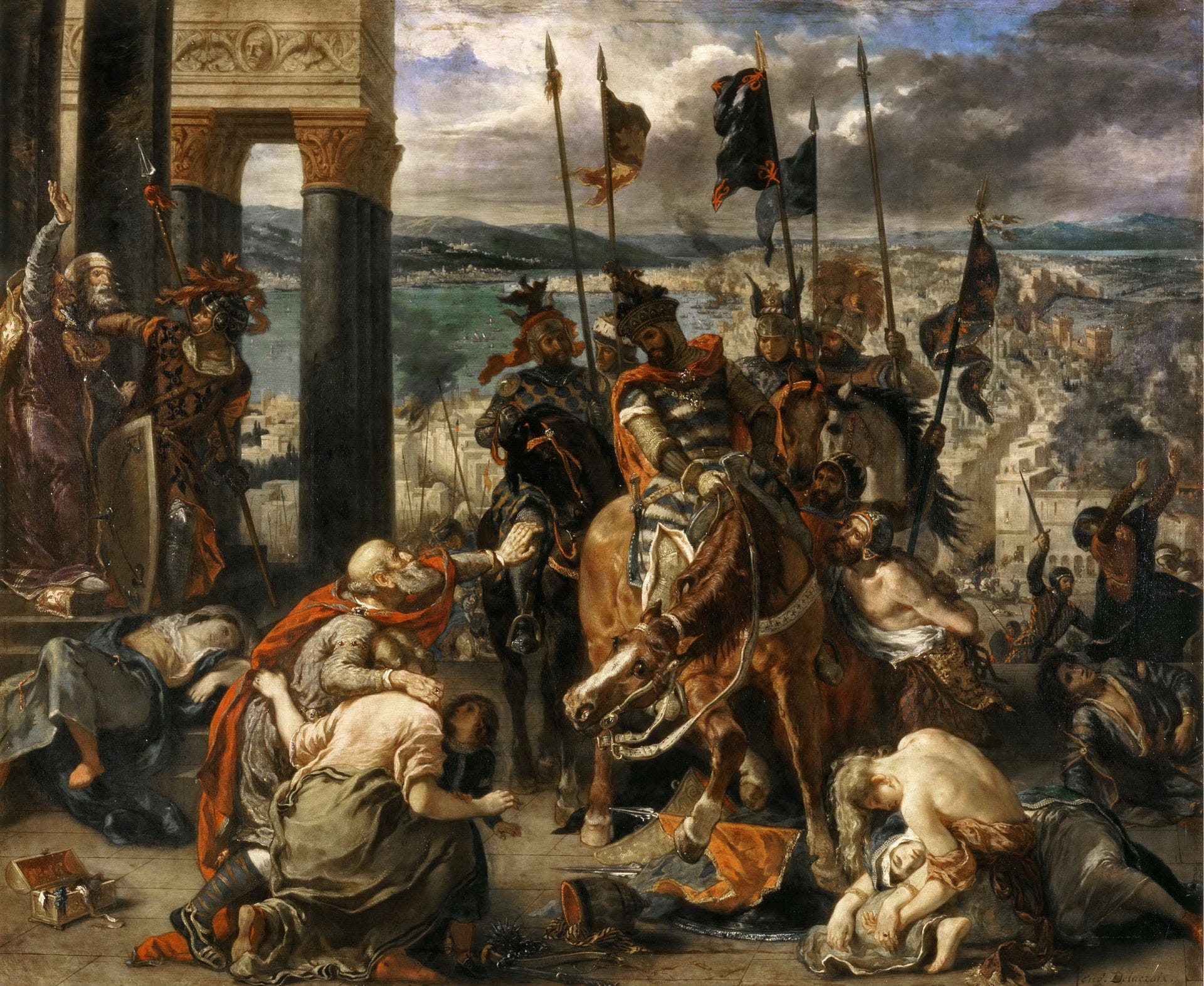
These issues culminated in the representative of the Pope’s excommunication of the Constantinople Patriarch, followed by counter-excommunication, which caused the Schism. But relations really soured after the massacre of the Latins in Constantinople (1182) followed by the Fourth Crusade (1202-1204), where the Crusaders took and sacked Constantinople, killing an estimated 2,000 Orthodox civilians.2
The Entry of the Crusaders into Constantinople (Eugène Delacroix, 1840).
The theology of the Churches drifted apart as the Catholics replaced their faith-based tradition with that of rationalist Scholasticism, which tried to reconcile Christian beliefs and traditions with that of Aristotle, whose works had been reintroduced into Christian lands by the Muslims (the Christians had previously burned or lost almost all of Aristotle’s works). Their acceptance of Aristotle’s philosophy eventually led to the Renaissance, then to Protestantism and then to secular liberalism, as previously described here.
New Catholic disciplines and doctrines were gradually introduced after the Schism, including mandatory clerical celibacy (not required by the Eastern Orthodox if already married before being ordained), papal infallibility and immaculate conception. Meanwhile, the Eastern Orthodox leaned into mysticism via Hesychasm. Eastern Orthodox theologians charged that, in contrast to Eastern Orthodox theology, western theology was based on philosophical discourse which reduces humanity and nature to cold mechanical concepts. To the Orthodox the nature of God and reality was outside the ability of man to formulate into reason.3
Nonetheless, there were two failed attempts at reconciliation between the Churches, one in the 13th century and one in the 15th. Constantinople eventually fell to the Muslims in 1453 and the population gradually converted to Islam due to the onerous nature of Dhimmitude (or were massacred in the Armenian Genocide). The heart of Eastern Orthodoxy shifted to the Russian Orthodox Church where it remains today, surviving the horrors of communism despite relentless persecution4 and the political cravenness of top leadership.
The structure, politics and demographics of the Church today
Each country with an Orthodox Church is national in character, modified to fit the local customs of the region. Its liturgy is conducted in the local languages and the religious texts are translated into those languages. In other words, they are ethnic Churches.
These ethnic Churches are self-governing to a degree. This Lutheran Witness article provides a decent background on the Orthodox structure and the current schismatic issues affecting the Church, despite an otherwise liberal, pro-western slant:
Autocephalous churches each elect their own leader and have full authority to operate as independent church bodies in all matters. Autonomous churches have some authority regarding internal self-governance but rely on a mother church (one of the autocephalous churches) in many matters, including the appointment of a leader….
Currently, there are 13 — or maybe 14, 15 or 16, or maybe more — autocephalous churches within Eastern Orthodoxy. There are 14 about which everyone agreed until quite recently: Constantinople, Alexandria, Antioch, Jerusalem, Russia, Serbia, Romania, Bulgaria, Georgia, Cyprus, Greece, Poland, Albania and the Czech Lands/Slovakia.
In 2019, amid mounting tensions between Russia and Ukraine, the Ecumenical Patriarch of Constantinople granted autocephaly to the Orthodox Church of Ukraine, which had formerly been a daughter church of the Russian Orthodox Church. In retaliation, the Patriarch of Moscow declared the separation of the Russian Orthodox Church from Constantinople — a significant schism in Eastern Orthodoxy since nearly half of its adherents fall under the umbrella of the Russian Orthodox Church (110 million in Russia and its subsidiary churches). A schism of this magnitude has arguably not occurred since the Eastern Church splintered from the Western Church in A.D. 1054. If this declaration leads to a lasting divide, then the Russian Orthodox Church can no longer be considered an autocephalous church of Eastern Orthodoxy but will have the same standing as the Oriental Orthodox Church, which broke from the established church in A.D. 451 (long before the Great Schism).
This seems like a big deal, especially considering the issue is taking place in the heart of Orthodoxy itself:
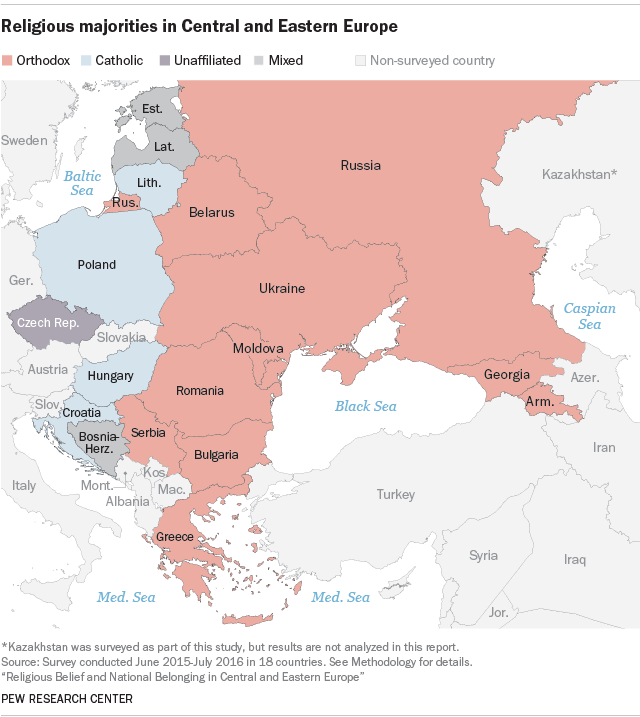
The Orthodox dominate Eastern Europe
Ukraine, after all, has 35 million Orthodox believers, which is the third most numerous Orthodox country in the world, making up 13.4% of the global Orthodox total. Roosh views the creation of the Orthodox Church of Ukraine by globohomo in 2018 as as an attempt to sow division and weaken the Church with the intent of undermining and destroying it. Actions like Zelensky signed a law on July 28, 2023 changing the date of the Christmas public holiday in Ukraine from Jan. 7 to Dec. 25 as part of the efforts to “renounce Russian heritage” give credence to his perspective.
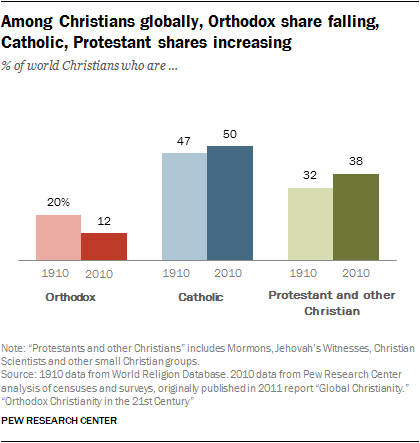
In terms of Orthodoxy’s reach, despite growing in absolute numbers to 260 million adherents today, its percentage of Christianity’s total has fallen significantly since 1910 and continues to fall:
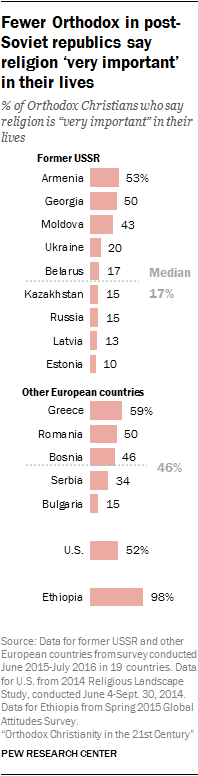
Today, just 12% of Christians around the world are Orthodox, compared with an estimated 20% a century ago. And 4% of the total global population is Orthodox, compared with an estimated 7% in 1910. Fewer Orthodox in post-Soviet republics consider religion to be ‘very important’ in their lives.
The strengths and weaknesses of Orthodoxy
This section will review Orthodoxy in light of the neoliberal feudalism framework. Jesus said to judge a tree by the fruit that it bears, so I think it is fair to look at the real world results of Orthodoxy based upon its successes and struggles and not from a deontological perspective. This isn’t meant to be a comprehensive or final analysis.
Positives
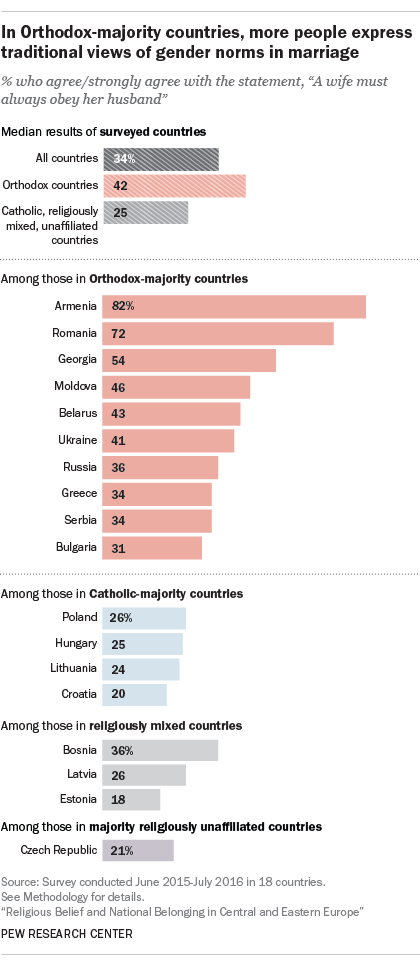
Orthodoxy as a “real” religion. A serious monotheistic religion is going to be exclusionary to other belief systems and hold its own perspective as the “true” religion. Those that do not have an exclusionary worldview, that are open to secular humanism and relativism and ecumenism, are inevitably going to have a demoralized, non-reproducing laity who will shed followers to globohomo as the religion, skin-suited and hollowed out, suffers a quiet, drawn out death. Every Protestant denomination suffers from this and Catholicism and Anglicanism increasingly do as well. The more a religion changes its doctrines over time (such as Mormonism acting under outside pressure), the more it can be molded to conform to societal whims. Orthodoxy has had the same doctrines and practices as it has had since the Schism, although it still has internal conflicts such as with the Old Believers, and it should be applauded for its stability.As part of its resistance to globohomo, most Orthodox believers support traditional views of gender norms in marriage. Compare Orthodox countries’ views on this to Catholics:
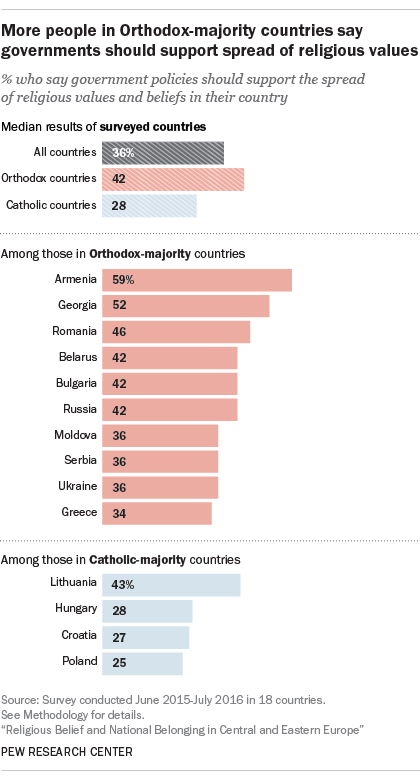
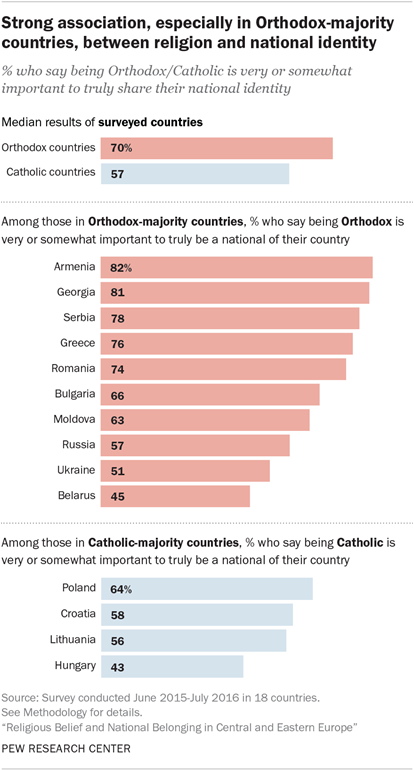
Orthodoxy’shealthy outlook. This is a corollary to the above; a healthy religion will see itself positively and wish to spread its beliefs to others, both on a personal and an institutional level. While the Church supports a separation of Church and State by encouraging a secular ruler to decide on secular matters (Famuli vestrae pietatis, also “Render unto Caesar what it’s Caesar’s”), unlike in the West they believe such a secular ruler should promote the Orthodox religion. In other words, the Orthodox do not suffer from the demoralization that plagues the West. Again, compare the Orthodox to Catholic countries:
Orthodoxy is correct that the changing doctrines of non-Orthodox Christianity has corrupted and destroyed western civilization under the guise of rationalism. Orthodox theologian David Bentley Hart has a great article addressing head-on Nietzsche’s criticisms of Christianity here. He agrees with Nietzsche and Heidegger’s interpretations to an extent but he believes that modern nihilism is not the final form of Christianity but merely the result of it’s receding, that Christianity was so great, and so fully conquered the Hellenistic Gods that came before that there is simply no room to go back to them, and that all there is to be done is re-embrace Christ and Orthodoxy. He writes:The word “nihilism” has a complex history in modern philosophy, but I use it in a sense largely determined by Nietzsche and Heidegger, both of whom not only diagnosed modernity as nihilism, but saw Christianity as complicit in its genesis; both it seems to me were penetratingly correct in some respects, if disastrously wrong in most, and both raised questions that we Christians ignore at our peril….Christianity, however, was a slave revolt in morality: the cunning of the weak triumphed over the nobility of the strong, the resentment of the many converted the pride of the few into self-torturing guilt, the higher man’s distinction between the good and the bad was replaced by the lesser man’s spiteful distinction between good and “evil,” and the tragic wisdom of the Greeks sank beneath the flood of Christianity’s pity and pusillanimity. This revolt, joined to an ascetic and sterile devotion to positive fact, would ultimately slay even God. And, as a result, we have now entered the age of the Last Men, whom Nietzsche depicts in terms too close for comfort to the banality, conformity, and self-indulgence of modern mass culture.Heidegger’s tale is not as catastrophist, and so emphasizes less Christianity’s novelty than its continuity with a nihilism implicit in all Western thought, from at least the time of Plato…Nihilism, says Heidegger, is born in a forgetfulness of the mystery of being, and in the attempt to capture and master being in artifacts of reason…Scandalously to oversimplify his argument, it is, says Heidegger, the history of this nihilistic impulse to reduce being to an object of the intellect, subject to the will, that has brought us at last to the age of technology, for which reality is just so many quanta of power, the world a representation of consciousness, and the earth a mere reserve awaiting exploitation; technological mastery has become our highest ideal, and our only real model of truth….I should admit that I, for one, feel considerable sympathy for Nietzsche’s plaint, “Nearly two-thousand years and no new god”—and for Heidegger intoning his mournful oracle: “Only a god can save us.” But of course none will come. The Christian God has taken up everything into Himself; all the treasures of ancient wisdom, all the splendor of creation, every good thing has been assumed into the story of the incarnate God, and every stirring towards transcendence is soon recognized by the modern mind—weary of God—as leading back towards faith. Antique pieties cannot be restored, for we moderns know that the hungers they excite can be sated only by the gospel of Christ and him crucified. To be a Stoic today, for instance, is simply to be a soul in via to the Church; a Platonist, most of us understand, is only a Christian manqué; and a polytheist is merely a truant from the one God he hates and loves….
Orthodoxy allows already-married men to become ordained: This seems like a reasonable position to take and would likely dramatically lower priest molestation rates, to the extent those scandals have not been overblown by globohomo.
Decentralization: The trends of humanity on a historic timeline are toward ever-increasing centralization and control, so to have a decentralized religious structure able to absorb pressures imposed on any particular country or region (such as the atheist Soviet Union’s control over Eastern Europe, or Islam’s control over Constantinople) is a benefit.
A balance of energies: Society and individuals are best served by an energy that mixes egalitarian and inegalitarian energies. Orthodoxy offers a degree of such balancing with its rigid adherence to tradition, whether or not one agrees that the specific balance it achieved is the correct one.
The potential for revolutionary change: Perhaps I am not understanding his perspectively clearly, but it seems like Rolo Slavsky, who is a lapsed Orthodox, thinks that Orthodoxy has the potential to undergo a mystical Ghost Dance rebellion as a way to check the power of globohomo.
The focus on suffering and mysticism: Russians have always focused more than other nations on the nature of suffering, and that focus in conjunction with Orthodoxy seems to be an interesting focus for such a fallen world. One loses family, friends, health, mental and physical abilities as one ages; war, plague, starvation, all sorts of calamities happen. The nature of reality is suffering and beyond human understanding. Life is about letting go of attachments and control and diminishing the ego, which is the attraction for the ascetic ideal. That being said, this is also a negative, as the Orthodox tendency to over-emphasize suffering is the quintessential component of life-denying slave morality.“ See Ivan the Terrible and His Son Ivan on 16 November 1581”, painting by Russian realist artist Ilya Repin made between 1883 and 1885. It has been called one of Russia’s most famous and controversial paintings, and reflects the typical Russian approach toward suffering.
The ability to deal peacefully with the Jewish population. Eustace Mullins, in his book “New History of the Jews”, argues that Jews and Christians can coexist peacefully in society based on the example of the Byzantine Empire without expulsions or pogroms: The history of the Jews demonstrates two things; first, that there has never been a reconciliation between them and their hosts; second, that no nation has ever succeeded in barring them permanently…in every case where the Jews were expelled from a nation, often under conditions of great suffering, within a few years, the Jews have returned! Again, one can find no parallel in the historical record of other groups, this strange compulsion, this incredible persistence in putting their heads into the lion’s mouth again and again….In all of recorded history, there was only one civilization which the Jews could not destroy. Because of this, they have given it the silent treatment. Few American college graduates with a Ph.D. degree could tell you what the Byzantine Empire was. It was the Empire of East Rome, set up by Roman leaders after the Jews had destroyed Rome. This empire functioned in Constantinople for 1,200 years, the longest duration of any empire in the history of the world. Throughout the history of Byzantium, as it was known, by imperial edict, no Jew was allowed to hold any post in the Empire, nor was he allowed to educate the young. The Byzantine Empire finally fell to the Turks after twelve centuries of prosperity, and the Jews have attempted to wipe out all traces of its history. Yet its edicts against the Jews were not cruel; in fact, the Jews lived unmolested and prosperously in the empire throughout its history, but here alone the vicious cycle of host and parasite did not take place. It was a Christian civilization, and the Jews were not able to exercise any influence…It was Ezra Pound who launched upon a study of Byzantine civilization, and who reminded the world of this happily non-Jewish land. From the Byzantines, Pound derived his non-violent formula formula for controlling the Jews. “The answer to the Jewish problem is simple,” he said. “Keep them out of banking, out of education, out of government.” And this is how simple it is. (Out of media too would be a critical addition).
Negatives
Orthodoxy seems to always be losing. Its center of religious belief and administration, Constantinople, was overrun by Muslims in 1453, and Orthodox believers living there gradually converted to Islam or were massacred in the Armenian genocide. The Soviets imprisoned, terrorized and murdered countless Orthodox and suppressed the religion. Now globohomo has cleaved off Ukrainian Orthodoxy and skin-suited it for their own ends, while Azerbaijan repeatedly seizes the territory and murders those living in ultra-weak Armenia (which may escalate to genocide). The decentralized centers of power, while a positive for reasons discussed above, is also a negative because it makes them politically weaker than if the Church was centralized. Furthermore, its acceptance of a secular “Caesar” ruler governing secular affairs puts them always, to an extent, at the mercy of secular governments. Perhaps the nature of suffering is a good thing; perhaps God wants to keep His followers in pain and downtrodden so they pray with devotion. As Ware writes about the Soviet calamity:What effect did communist propaganda and persecution have upon the Church? In many places there was an amazing quickening of the spiritual life. Cleansed of worldly elements, freed from the burden of insincere members who had merely conformed outwardly for social reasons, purified as by fire, the true Orthodox believers gathered themselves together and resisted with heroism and humility. ‘In every place where the faith has been put to the test,’ a Russian of the emigration writes, ‘there have been abundant outpourings of grace, the most astonishing miracles – icons renewing themselves before the eyes of astonished spectators; the cupolas of churches shining with a light not of this world.’ ‘Nevertheless,’ the same author rightly adds, ‘all this was scarcely noticed. The glorious aspect of what had taken place in Russia remained almost without interest for the generality of mankind….The crucified and buried Christ will always be judged thus by those who are blind to the light of his resurrection.’ It is not surprising that enormous numbers should have deserted the Church in the hour of persecution, for this has always happened, and will doubtless happen again. Far more surprising is the fact that so many remained faithful.Still, for non-religious outsiders perpetual losing isn’t really a point of sale to becoming a believer.
The ethnic nature of the religious communities makes it difficult to join. The countries with the most adherents are Russia, Ukraine and Greece, and their liturgy and writings are conducted in their national languages. This can make conversion very difficult for non-ethnic outsiders.
Orthodoxy’s rejection of Aristotelian logic makes it weak technologically. A religion that is static and unchanging seems like it will always lag behind in the times, which may be a good thing (as it resists the egalitarian ratchet effect) but it also makes it susceptible to falling behind technologically, which requires a belief in the power of transformative and rapid change to advance. As Kaczynski wrote, “The conservatives are fools: They whine about the decay of traditional values, yet enthusiastically support technological progress and economic growth. Apparently it never occurs to them that you can’t make rapid, drastic changes in the technology and the economy of a society without causing rapid changes in all other aspects of the society as well, and that such rapid changes inevitably break down traditional values.” Orthodoxy avoids this criticism by not enthusiastically supporting technological progress or economic growth, at the price of remaining on the losing side of conflicts.
The static nature of Orthodoxy may inhibit personal growth. The same criticism can be made to personal growth and our ability to understand the world. Brett Andersen has posited a life-affirming philosophy buttressed by the latest scientific advances, rooted in human psychology and human nature, reflecting Nietzsche and Heraclitus that everything is change except for change itself, and that values and perspectives must themselves evolve over time. If Andersen is correct, a static, dualist perspective only holds people back from the process of complexification which lies at the heart of the universe and our relation to it.
The nature of belief. Orthodoxy presupposes belief in its suppositions that can be difficult for those with evidence-based minds to accept on faith. The resolutions of disputes such as the Arian conflict, Nestorius’s dispute with Cyril, and the debates surrounding the use of icons are perplexing. One is expected to take on faith that they resolved in the form and manner in which God wanted, as opposed to resolving by chance or from majority rule/power politics.The Orthodox deontological way of thinking is not one that comes naturally to those pursuing cause-and-effect analysis, nor does it exactly match up with my own observations which sees reality as metaphysically infused with malevolence. The basic nature of reality is that living things can only survive by eating other living things, which is a nightmare, and reality is therefore likely controlled by the Demiurge. Despite some commonality between classical gnosticism and Orthodoxy, my observations are at odds with the view of a loving, omnipotent God in control of both material and spiritual reality, or that the God of the Old Testament is the same God as the God of the New Testament. Additionally, most of what we know about the life and philosophy of Jesus himself comes from Paul of Tarsus, who likely crafted his narratives as part of a non-violent revenge strategy against Rome.
There is no way from within the religion to disprove it. This criticism applies to all religions, but as Rolo Slavsky has pointed out, any time the Orthodox lose or suffer a calamity they always default to one of two explanations: (1) it’s all part of God’s plan, just have faith; or (2) God is punishing His believers for lacking sufficient faith. I personally have a lot of beliefs, some very strongly held, but I could name plenty of conditions under which my faith would be shaken. For the Orthodox, what are the conditions, if any, under which they could lose faith? As I explained to Ignatius of Maidstone, if Orthodoxy was entirely wiped out, would that mean to him that the religion was false? I can look back on polytheistic ancient Hellenism and conclude that the wiping out of all the old Gods either means that those old Gods never existed or otherwise that they have receded from the world. What are the conditions under which his faith could or would be shaken?
The doctrinal disputes seem silly and inconsequential. The perspective that differences in small minutia in doctrine, such as using two versus three fingers for making the sign of the Cross in their dispute with the Old Believers, or the addition of the one word Filioque to the Nicene Creed, are seen as having enormous theological and spiritual consequences, but as an outsider they seem quite silly.
Some of the trends in Orthodox countries are concerning. For example, look at the changes in acceptance of legal gay marriage among younger adults in Greece and other Orthodox countries. How resistant will it be long-term to globohomo?Uh oh.Or look at Russia: “Russians are much less religious, at least in terms of active practice, and the ROC is less influential than the Catholic Church. Abortion is legal, while it is not in Poland.”
Conclusions
Orthodox Christianity offers an attractive, unchanging stability to its followers and a comprehensive, non-nihilistic worldview. Orthodoxy in both its Christian and other Abrahamic forms presents an exclusionary monotheistic framework that will survive into the future as everything non-Orthodox gets subsumed by globohomo secular materialism. But given its drawbacks, I am not convinced that Orthodox Christianity is likely to succeed in the material realm against globohomo now or in the future. Whether that matters is up to you.
Thanks for reading.
Subscribe: Email delivery remains on Substack for now.
1 Orthodoxy in any belief system is likely to exhibit similar resistance to globohomo secular egalitarianism, which is easy to see based on a group’s fertility rates. Orthodox Judaism and conservative strains of Islam have much higher fertility rates than mainstream society, as do the Amish. Mormons traditionally had much higher birthrates than normal Christians but their birthrates are plummeting.
2 As a side note, it is interesting how Catholics and the Orthodox handled heresy and power struggles differently. Catholics were quick to burn heretics at the stake, such as the Cathars and the Knights Templar, while the Orthodox, who rarely did the same (such as with the Old Believers and their leader in Russia), were quick to mutilate their political opponents in Byzantium.
3 Also see the positions of Aleksey Khomyakov, who co-founded the Slavophile movement and became one of its most distinguished lay theoreticians. The Russian religious philosopher Nikolai Berdyaev located Khomyakov’s significance in his attempt to free Christianity from rationalism. As he wrote in his 1912 book, Aleksei Stepanovich Khomiakov:
Khomiakov will be eternally remembered, first and foremost, for his statement of the problem of the Church and his attempt to reveal the essence of the Church. Khomiakov approached the essence of the Church from within, not from outside. First of all he did not believe that it is possible to formulate a concept of the Church. The essence of the Church is inexpressible; like all living organisms, she cannot be encompassed by any formula, is not subject to any formal definitions. The Church is, first of all, a living organism, a unity of love, ineffable freedom, the truth of the faith not subject to rationalization. From the outside the Church is not knowable or definable; she is known only by those who are within her, by those who are her living members. The sin of scholastic theology was that it attempted to formulate rationalistically the essence of the Church; that is, it attempted to transform the Church from a mystery known only to believers into something subject to the knowledge of objective reason.
When the Bolsheviks seized power in October 1917, the Church of Russia found itself in a position for which there was no exact precedent in Orthodox history. The Roman Empire, although it persecuted Christians, was not an atheist state, opposed to all religion as such. The Turks, while non-Christians, were still worshippers of One God and, as we have seen, allowed the Church a large measure of toleration. But communism is committed by its fundamental principles to an aggressive and militant atheism. A communist government cannot rest satisfied merely with a separation of Church and State, but it seeks either by direct or indirect means to overthrow all organized Church life and to extirpate all religious belief. ‘The Party cannot be neutral towards religion,’ wrote Stalin. ‘It conducts an anti-religious struggle against all and any religious prejudices.’…
All seminaries and theological academies were ordered to be closed down…All Church buildings, lands, and moneys were declared to be national property…From 1918 until 1938, churches were methodically desecrated, closed, and destroyed, often against the wishes of the overwhelming majority of the population and at times in the face of their active opposition…
In the years between the two World Wars the Christians of Russia underwent sufferings which in extent and in cruelty equalled anything endured by the early Christians…At one time as many as 150 bishops were in prison at the same moment (before 1917 the total number of diocesan and assistant bishops in the Russian Empire was less than 130). In 1918 and 1919 alone, about 28 bishops were killed; between 1923 and 1926 some 50 more were murdered by the Bolsheviks. Parish clergy and monks also suffered severely: by 1926, according to information supplied by a bishop living in Russia at the time, some 2,700 priests, 2,000 monks, and 3,400 nuns and other ordained persons had been killed, while emigre writers today calculate that since 1917, among priests alone, at least 12,0000, and possibly far more, have been executed or have died through ill treatment..It will never be known how many laity suffered impoverishment, prison sentences, or death because of their faith. In the words of the Archpriest Avvakum: ‘Satan has obtained our radiant Russia from Good, that she may become red with the blood of martyrs.’
This is a summary of recent Neofeudal Review posts. While other Substacks focus on the news cycle or current politics, the intent for each article here is to touch on certain perennial truths which, hopefully, will make them retain their relevance long after their posting date.
A number of months ago I wrote a compendium post called “A dissident framework reaches dramatically different conclusions from the mainstream right.” That post compared the views expressed in my first seventeen posts with those of the conventional right, and it encouraged right-leaning individuals to expand the scope of their thinking beyond the narrow confines of media and educational propaganda, Pavlovian conditioning, and their fear of stepping outside the Overton window.
Now, the title of that post wasn’t entirely accurate. I sloppily commingled the Neoliberal Feudalism framework with that of political dissidence as a whole. The right consists of three layers:
The broad right, which John Carter points out includes a wide variety of thought and belief1 and who share objections to certain facets of globohomo, although they generally accept the egalitarianism at the heart of society deriving from Paul of Tarsus2;
A subsidiary of the broad right known as dissidents, who share a fundamental opposition to globohomo and not simply certain facets of it; and
Subsidiaries of dissidence with unique frameworks for why they fundamentally oppose globohomo, one of which is the Neoliberal Feudalism framework which is laid out in this Substack.3
This could have been better stated in the first post so it’s good to clarify now.
Anyway, it’s been another eighteen posts since the seventeen reviewed in that compendium (why seventeen or eighteen? No reason) so it’s time for another. I think I conveyed to my satisfaction the point I was trying to make there, so this will have a different focus: “The neoliberal feudalism framework emphasizes dramatically different issues from the mainstream right.” In other words, it’s not just the conclusions on issues that are different, but the issues which are emphasized or not. Additionally, the scope is different: for example, issues within the current news cycle or politics (mainstream right) vs. touching on higher-level points, especially spiritual ones, that impact people across time and space (neoliberal feudalism framework).
Ernst Junger stated that when he wrote The Marble Cliffs that he wasn’t operating in a political framework but rather a higher-level spiritual one, and I would like to think the presented approach at least attempts to do the same. Like Junger, I write for and appreciate those loners who pursue truth for its own sake, not the gray NPC herds who dutifully listen to authority or for those so-called “elites” who pursue wealth or power unconditionally, and one of these loners is worth “ten thousand raised to a power” of the NPC herds on this plane. Here’s Junger on this point:
Q: Do you think it is still possible to preserve style, this delicate and aristocratic gesture, in a world that tends towards depersonalisation and manipulation of the individual?
Junger: I would define ours as a society of massified individuals, which therefore needs very restricted elites, destined to perform a very important function. On this point, I would adhere to the Heraclitean sentence that says: “ To me, one is ten thousand”. This number should be raised to a power today.
Q: We are used to thinking of elites in more sociological than spiritual terms. What definition would you give of them?
Junger: The sociological definition of elite is already an indication of the corruption of the concept. A warning, for me, to no longer trust even the elites, but now only the great loners.
I love that last line. “A warning, for me, to no longer trust even the elites, but now only the great loners.”
With that said, let’s begin.
Environmentalism and sustainability
Mainstream right emphasis: To ignore environmentalism and sustainability, dismissing it as a left-wing issue.
Neoliberal feudalism emphasis: In “The sad skinsuiting of the environmental movement: turning a blind eye to the effects of unchecked world population growth due to obsession with egalitarianism” (Part 1 and Part 2), the environmental destruction caused by unchecked worldwide population growth is examined. The post concludes that our overlords are myopically focused on power concentration, paying lip service to second-order effects in the media with buzz-words but otherwise ignoring them, which is going to have disastrous effects down the road. Environmentalism and sustainability are important issues and should be emphasized, as we should all want to leave the planet in a better condition for the next generation.
This doesn’t look sustainable
Natural selection
Mainstream right emphasis: Eugenics and dysgenics are consciously ignored as “racist” and linked to Hitler.
Neoliberal feudalism emphasis: “The 10,000 year explosion: Rapid selection pressures in a radically changing environment” examines Cochran and Harpending’s thesis that natural selection pressures on humanity are both ongoing and occurring 100x faster than the historical baseline because of changes brought forth by the neolithic agricultural revolution 10,000 years ago. It asks to what extent humanity should try to guide selection and on what basis it should be pursued.
The neolithic agricultural revolution
2020 serving as a pivot toward an entirely new, darker and oppressive era
Mainstream right emphasis: The mainstream right ignore the broader implications of the Schmittian lawbreaking “exceptions” used by our overlords to destroy Trump and try to continue with business as usual.
Neoliberal feudalism emphasis: “Trump on trial: an examination of globohomo’s sword-and-shield strategy” examines globohomo’s legal and extra-legal attacks on Trump, concluding that they view him as a Schelling point/symbol for white Christian Middle America and they plan to smash him just as the Bolsheviks murdered the entire Romanov family before liquidating millions of kulaks. One should view the takedown of Trump as the prelude to much darker plans that will be hoisted onto a large portion of this country.
Trump heading to court for one of his innumerable globohomo show-trials
The Israel/Hamas war and the possibility of World War 3
Mainstream right emphasis: A blind, 2001-ish neocon energy has overtaken the narrative discourse, blind to the larger forces at play and based on the assumption that America remains undisputed top dog militarily worldwide.
Neoliberal feudalism emphasis: This war may open the second front (after Russia/Ukraine) of World War 3, and based on how the central bank owners operate, these plans have been prepared for decades with predetermined outcomes in mind, especially the implementation of CBDCs and the removal of free speech as an end goal. World War 2 was conducted in much the same manner; Hitler was an unknowing puppet in a larger game. Great caution and skepticism should be applied to whatever narrative globohomo pushes here.Central bank owners maintaining a balance of powers until determining which party was to be punished
The science of physiognomy
Mainstream right emphasis: Physiognomy doesn’t exist and don’t trust your instincts, trust the experts, same as the leftist position.
Neoliberal feudalism emphasis: In “The science of physiognomy”, the argument is presented that our instincts have evolved for millions of years to detect personality traits in others based on the way they look, dress, and carry themselves, and we do a great disservice to ourselves not to acknowledge our instincts and integrate them along with our thoughts. There should be a much greater weight put on our own thoughts and judgments and much less put on the perspectives of corrupted “science”.
The liberal mentality
Mainstream right emphasis: The mainstream right focus on holding liberals to the standards that liberals set for conservatives, i.e. focusing on liberal hypocrisy. No lessons are ever learned despite this strategy failing throughout modern history.
Neoliberal feudalism emphasis: “The strange relationship of liberals to power: their psychology as the forever underdog” examines the strange herd-like mentality of the liberal mind, where they always have to see themselves as the oppressed no matter how much stronger they themselves are over their perceived enemy. By framing power struggles in this manner, they are always able to justify to themselves the brutal use of power against their enemies. Given the gulf between liberal and dissident thought processes, there can be no rapprochement and there should be no political discussion with them. This point is driven home in “Navigating Schmitt’s friend-enemy distinction in an uncertain environment”, which argues that dissidents should only spend their energy having discussions with other dissidents. And in “Did the last three years of COVID happen, or was it a bad dream?”, the argument is made that political and social reality does not exist in the minds of the masses except to the extent pushed by propaganda and authority figures. Scary stuff.
Mainstream right emphasis: The standard Christian take, decisions made via free will lead to judgment and Heaven/Hell in the afterlife.
Neoliberal feudalism emphasis: “Ruminations on the nature of the soul” examines the personality aspects that we attribute to the soul and concludes that they do not stand up to scrutiny. Nonetheless it feels like we possess a soul, in whatever unclear form it takes, and there are positive benefits that derive from such belief.
Phineas Gage’s personality completely changed after a metal rod was slammed with great force into his skull during a work accident, disproving to an extent the link between personality and soul
Profiles in courage
Mainstream right emphasis: Who does the mainstream right admire these days – Trump, I guess? There seems to be a quiet void here as Ron “Meatball” DeSantis slinks off into the nether.
Neoliberal feudalism emphasis: The most admirable people are those who advanced the dissident cause and stood up for it despite unrelenting pressure. The first two examples include Ian Smith, who kept his business open during the worst of the COVID lockdowns and provided inspiration to millions, and Julian Assange, who fought to hold globohomo accountable to their own stated principles despite massive governmental attacks on him.
Ian SmithJulian Assange
The meaning crisis
Mainstream right emphasis: Maybe society has suffered a degree of nihilism, but that’s just because the country is too secular and liberal. The mainstream right de-emphasizes and doesn’t understand this issue.
Neoliberal feudalism emphasis: As covered in “The meaning crisis: Meaning and decadence through the history of western civilization”, society is in the full embrace of an unrelenting secular nihilistic materialism which is smothering all the joy out of life. This derives at least from the 10th century when Christianity achieved total dominion over its enemies and decadence began to creep in. We currently live in an age of pure nihilism and no meaning, regardless of the extent of one’s religiousness. There must be some sort of transvaluation of values to get out of this.
The state of the times
Mainstream right emphasis: The economy is still trying to recover from a deadly multi-year COVID shutdown while battling high inflation. Things are in the doldrums a bit even though the stock market is quite high and official unemployment is low! Very surface level analysis.
Neoliberal feudalism emphasis: As emphasized in “The era of empty, secular mass consumption is over”, there was a 40-year period of artificial prosperity caused by a declining interest rate environment, which hid the effects of the huge losses to manufacturing and to the social fabric at large. That artificial prosperity is over now with much higher interest rates, and things are going to get much worse. Therefore it’s important to live below one’s means and prepare with a long-term view for hardship.
The use of the U.S. military
Mainstream right emphasis: Downplays why we stayed in Afghanistan for 20 years but highlights the shamefulness of the messy withdrawal; encourages unlimited funding for Ukraine and Israel.
Neoliberal feudalism emphasis: As described in “A typology of globohomo-initiated wars: Assessing success or failure by the objectives sought”, the U.S. military engages in three specific types of wars, each with their own unstated objectives which are quite different from the propaganda fed to the masses. Given that the U.S. military and the U.S. itself are merely vassal states of the central bank owners, success and failure should be viewed in the context of the central bank owner objectives. When viewed from this perspective, the central bank owners appear to be close to invincible despite occasional bumps in the road. In “Half measures vs. full measures”, the post argues that if a country or entity is going to challenge globohomo they must be prepared to go all the way, because any weakness or hesitation will result in being annihilated. This is because globohomo is a totalitarian force bent on power acquisition and centralization at any and all cost.
Listening to weirdos
Mainstream right emphasis: Completely de-emphasized; listen to those who present well publicly and slickly offer dopamine hits from battling the current news cycle’s cultural war.
Neoliberal feudalism emphasis: One can learn something from anyone, no matter how strange or odd, and in fact the stranger the better because “strange” in this context means they are not a rubber-stamped NPC ready for popular consumption, so they will have something unique and different to offer. “A review of Brett Andersen’s evolutionary psychology Youtube series” examines Brett Andersen’s work with a considered eye, even though he subsequently descended into Orange Man Bad ramblings and severe schizophrenia. There’s lots to learn on the state of evolutionary science within his work, conducted as a PhD candidate at the University of New Mexico before he dropped out in the full throes of madness.
Thanks for reading and engaging on what has been an interesting Substack experience so far.
Subscribe: Email delivery remains on Substack for now.
1 Per here, “Religiously, the right embraces an incredible variety of creeds. Tradcaths, Orthobros, prots of every description from high church Lutheran to low church Baptist, Odinists, Neo-Hellenists, Buddhists, Hindus, Muslims, Nietzschean vitalists, gnostics, New Agers, druids, and atheists are all found in varying degrees of abundance. Ideologically, you have neoreactionaries, traditionalists, foundationalists, Nietzschean vitalists, civic nationalists, ethno-nationalists, MAGA America Firsters, populists, fascists, national socialists, 4th Political Theory Duginists, paleo-conservatives, classical liberals, post-liberals, libertarians, anarcho-capitalists, Catholic integralists, monarchists, masculinists, and (what I think is) the most recent addition, Landian effective accelerationists.”
2 The mainstream right do not understand or accept that their core egalitarian views, whether secular or religious, tie back to Paul of Tarsus’s original transvaluation of values, where the egalitarainism at the heart of Christianity is reinforced over time as a ratchet effect. There needs to be a revaluation of values away from that to, I hope, a balance between inegalitarianism and egalitarianism. Hence almost all of the right is “mainstream” in this perspective.
3 The framework is two simple points: (1) the world is owned and controlled by a small number of families who own and control the central banks of the world, and they use divide and conquer tactics to divide people along race, sex, sexual orientation, religious grounds to keep everyone too busy infighting to focus on their theft, and (2) that this system was put into place due to egalitarianism deriving from Paul of Tarsus.
This is a post about the careful, long-term planning of the central bank owners behind World War 2 who manipulated events to bring about certain desired results. The hope is to provide perspective on how such events are unfolding today, which are developing in a similar manner, likely to result in war, panic, and finally a central bank digital currency dialectical solution. To be forewarned, this is long, detailed and technical, so bring your big boy thinking cap.
Additionally, while previously covering parts of World War 2 here and here, this elaboration is necessary for an upcoming post about the odds of success for a potential middle class rebellion against globohomo, which is an energy increasingly lurking in the background for some on the far-right. This war goes to the heart of the question: on a historical basis, has the international financial system ever been seriously challenged since it arose in the 17th century?
The commonly accepted story of World War 2 is that a hypnotically persuasive politician, drunk on aggression and power, a gambler of lives and of nations, seeing the early and continued appeasement of his foolish and weak enemies, plunged the whole world into a disastrous war.
This post will present a theory contrary to the mainstream understanding of history. It’s not that Hitler wasn’t these things – he was, although his underlying rationale is not commonly understood, dating back to a 2,000 year old conflict – nor is it meant to downplay Nazi mass murders committed in Eastern Europe, but rather to argue that the world’s central bank owners set in motion the events of World War 2, and they did so deliberately and consciously with the intention of furthering their worldwide power and control. They nurtured and brought forth the Nazi movement with a clear eye toward its – and Germany’s – future destruction. Through such destruction they planned to remove Germany’s abilities to threaten globalist rule forever, as well as dirty the cause of self-determination and nationalism throughout the West.
However, through a combination of Hitler’s strategic abilities, innovative German military tactics and technological innovations, and the clear superiority of the average German soldier compared to their enemies1, the war ended up being closer than the central bank owners had planned for. Not close enough, though.
The core of the argument is presented in the 2005 book “Conjuring Hitler: How Britain and America Made the Third Reich” by Guido Giacomo Preparata. I had originally touched on it in a footnote about the motivations of the central bank owners. The text is detailed and well-researched, and its publication unfortunately ended the author’sacademic career, whose liberal censorious views allow no dissent to their monolithic ideology. It’s an incredible book and I highly recommend it.
The book’s thesis, supported by a wealth of corroborating evidence, is that the financial powers in Britain /America deliberately built up Hitler and the Nazis in Germany, along with sponsoring the Bolsheviks in the Soviet Union from its inception, so that they would tear each other apart and leave Britain/America as the undisputed controllers of the European continent. They perused a similar successful strategy in World War 1.
The Bolsheviks were viciously anti-German, viewing the Germans as “capitalists” who had to be conquered on behalf of worldwide communism, even as they came to temporary agreements with them. The Nazis, meanwhile, considered Slavs in Eastern Europe to be sub-human untermenschen who should be exterminated in order to open up lebensraum, free space for Germans to expand eastward, and were deliberately incubated due to the particular provisions of Versailles treaty, the Dawes Plan and other measures. These ideologies were fundamentally opposed to each other, and this situation did not come about randomly — it was planned, with great foresight and intention by the financial powers who controlled Britain and America.
The animating idea: Mackinder’s Heartland Theory
The British and American approach were informed by Halford Mackinder’s 1904 Heartland Theory, which posited that control of Europe would belong either to a land power (Germany allied with Russia) or a sea power (England plus America). Under this theory one or the other would ultimately win in a zero sum game. Mackinder provided a warning to England that continent-sized powers with a strong industrial base, large populations, and national resources could dominate world politics if the sea powers were not careful. Such a power would be immune to blockades by sea, rendering British and American control of the waterways irrelevant.
This theory was hugely influential among the British elite and they adopted it wholeheartedly in their strategies. These elite thought in Empire terms, not in national or civilizational terms, as Britain had ruled the empire on which the sun never sets from the 16th century. Any concern about the mass suffering of humanity from these strategies – of millions of women, of children, of the elderly who would suffer under the expected starvation, hyperinflation or bombings – was seen as weakness, a detriment to the ruling class’s continued power and control, and those that focused on this were deliberately excluded from positions of authority.
The British empire pre-World War 1
One can see such tension historically in Rome (land power) vs. Carthage (sea power), which only ended after the Third Punic War when Rome destroyed Carthage. Cato the Elder ended every speech with “Carthāgō dēlenda est”, which meant “Carthage must be destroyed”, prior to that final war.
Mackinder’s theory served as a contrast to Alfred Thayer Mahan’s influential 1890 argument in “The Influence of Sea Power Upon History” that island states such as England or the United States could prevail in the world through sea power.
To England the worst nightmare would have been a German/Russian alliance to control the European continent, which would have relegated England to a secondary power. As such, they would do anything it took to ensure that such an alliance would never materialize, even at the cost of 70 million lives between the two World Wars and the passing of the baton of empire to America.2They viewed this as a matter of survival, an absolutely critical natural security priority, and they have retained that philosophy to this day. This perspective explains why England (and the U.S.) have worked so hard to dynamite deepening German/Russian ties in the 21st century by blowing up the Nordstream 2 pipeline (confirmed by Seymour Hersh) during the controlled Russia/Ukraine war. Have you seen Mackinder’s Heartland theory tied to the Nordstream 2 pipeline explosion before this moment? If not, why not? The same principles and theories are at play here, same as they were more than a century ago.
With that said, the point of this post is not to rehash the past for its own sake (although it may be helpful to clear the cobwebs of decades-old propaganda from a reader’s eyes), but rather to shine light on our ruling globohomo overlords, how they operate, how their planning extends for decades, and how ruthlessly and deviously they are prepared to act in relation to their plans for the world.
To understand the origins for World War 2 we must first begin with the origins for World War 1.
Let’s begin…
The late 19th century and the start of World War 1
Germany was not on the British Empire’s radar as a potential threat until it formed the Second Reich in the 1870s. It had been a fragmented backwater before then, and Britain was focused on its rivalry with France and fighting against Czarist Russia in Central Asia.
The Second Reich quickly became an imperial upstart. As the new man on the world stage they wanted attention, competition for its own sake, and sought to expand their foreign colonies. They were beginners at the game of Empire, though, and naive; its rulers were confused and unsure regarding the country’s strategic imperatives despite their nervous rhetorical bombast. Chancellor Bernhard von Bulow would decry in his memoirs that the German people had no political ability whatsoever. Even with that drawback, though, the Germans were impeccable administrators, possessed unsurpassed arts and sciences, and established an enviable network of commercial stations and railway. As the German navy grew to challenge the waterways the British grew to see them as a threat.
As their rivalry with England increased, Germany’s relations with France remained in the gutter from the Franco-Prussian war of 1870. Germany intuitively knew that it would be no good to be potentially caught in a multi-front war with France, England and potentially Russia. While Bismark tried not to antagonize Russia, Austria, its closest ally which was decidedly anti-Russia, stood in its way.
Under Mackinder’s theory the British came to believe the German/Russian alliance had to be prevented at all costs. In choosing its victim, Germany was decided to be an easier target because (1) the Reich was the dynamic half of the Russo-German threat and (2) it could be surrounded and blockaded with greater ease compared to Russia. Britain drew in France as an ally with the Entente Cordiale. Because France had allied itself with Russia by advancing them loans in 1887, and with time-honored and intense military cooperation, France was able to draw in Russia. Kaiser Wilhelm tried for rapprochement with Russia in 1905 but it was too late by then, and Tsar Nicholas was severely dressed down by his ministers for considering it. Britain drew Russia closer with the Entente Cordiale part 2, creating the Triple Entente. Germany was encircled. And worse, France had knowledge of Germany’s war plans, the Schlieffen Plan, thanks to a traitor.
The spark of World War 1, the assassination of Archduke Ferdinand, was instigated by Russia’s military attache, Colonel Victor Artamanov, who had told the chiefs of Serb intelligence to go ahead with it. Britain lied to Germany that Russia was unprepared to intervene and that Britain had no biding obligations to Russia or France; then lied to Russia that the Germans were rapidly conveying divisions to the East and that the situation looked upon the Reich with disfavor. Then Britain lied to the public by pretending to offer a mediation in the name of peace. “Britain had always been careful to spin the international tangle so as to drive the opponent in the position of the assailant, and reserve for herself the role of the peace-loving defender. This was a psychological artifice tailed for mass seduction, and the Germans had no knowledge or understanding of such tricks.” Austria issued the ultimatum to Serbia, Serbia turned it down on the orders of her patrons, and the British Treasury began printing money for war. “The war against Serbia into which Austria was deliberately incited by the ruinous intrigues of Serbia at the instigation of Russia was a trap into which Austria fell, not knowing it was fomented by Russia to create a pretext of general mobilization and war to make Austria and Germany appear to the world as the willful originators of the great conflict.” Upon hearing the news of Russia’s massing of troops, Wilhelm said:
“In this way the stupidity and clumsiness of our ally is turned into a noose. So the celebrated encirclement of Germany has finally become an accomplished fact…The net has suddenly been closed over our heads, and the purely anti-German policy which England has been scornfully pursuing all over the world has won the most spectacular victory which we have proved powerless to prevent while they, having got us despite our struggles all alone into the net through our loyalty to Austria, proceed to throttle our political and economic existence. A magnificent achievement which even those for whom it means disaster are bound to admire.”
As Germany prepared to unleash the onslaught onto the Western Front, Britain issued one last cunning call for peace provided Germany did not attack France, making Germany look again like the aggressor instead of the fool caught in the trap that it was. Abel Fery, the French Under-Secretary of State, wrote in his notebook: “The web was spun and Germany entered it like a great buzzing fly.”
Five years after WW1, a U.S. Senator, Robert Owen, undertook a deep, dispassionate study of the war’s origins and presented his findings in 1923, concluding that in 1914 Germany had no reason for war, knowing that it would have would too risky and disruptive to its burgeoning trading and commerce. When in 1916 Wilhelm brooded over the butchery at the front, he whimpered that he never wanted this war, by which he meant a massacre of global magnitude. “This is exactly right,” rejoined the British Prime Minister Lloyd George in a public response, “The emperor Wilhelm did not want this war. He wanted another war, one that would have allowed him to dispatch France and Russia in two months. We were the ones that wanted this war, as it is being fought, and we shall conduct it to victory.”
The fall of the Tsar and rise of the Bolsheviks
The scale of butchery of the war was historically unprecedented. Russia quickly got cold feet, especially with Hindenberg’s successes against them in the east. What did Russia have to gain from the war? Britain wanted to maintain its empire, France its pride, Germany its life. Russia had little to gain from this adventure. But Britain had leverage over Russia: Russia owed them a huge amount of money, a sum roughly a third of her annual income; Britain had knowledge of Rasputin’s upcoming murder a week before it happened, demonstrating a deep subversive network within Russia, and Britain threatened Tsar Nicholas with revolution: “The British ambassador in Russia himself was a the center of the scheme to overthrow the czar if he should ever lose his stomach for war…[To that end, he] had gathered a coterie of wealthy bankers, liberal capitalists, conservative politicians, and disgruntled aristocrats.” Britain was dead set at any cost to prevent a German/Russian rapprochement.
A British double-agent nicknamed Parvus set up the scheme to overthrow the Tsar with German gold, who naively thought they were putting pressure on the Tsar to withdraw from the war. The Germans, as noted above, were naive and gullible and had no understanding of the depths of political intrigues. They made excellent soldiers but, as prodders, they were easy to manipulate and control by the experienced British, who had centuries of knowledge of the subtle, nuanced levers of power. Truly, the British embodied their nickname the “Perfidious Albion”.
The Germans foolishly allowed Lenin passage back to Russia in April 1917. The subsequent ascension of the Bolsheviks (to which Jacob Schiff in the United States contributed more than $20 million of his own funds, an astronomical figure today, and the U.S. provided extraordinary support3) did knock Russia out of the war, but at a much steeper cost than they bargained for: the installation of a permanently hostile anti-capitalist Bolshevik government, owned by the Rothschild central bank owners, who would settle the war today cheaply in return for a much bigger, nastier war down the line. If Germany had understood the nature of the game being played — if they had truly understood Britain’s goals to keep Germany and Russia asunder at any and all costs — they would have worked with the Tsar and tried whatever the cost to both keep him in power and to conclude a peace treaty.
It didn’t matter that the Bolsheviks withdrew from the war, anyway, as America joined the war when the Russian front appeared to be creaking. Remember that the Rothschild central bankers owned America just like they owned Britain.4 They had completed their coup d’etet in 1913 where they set up the 16th Amendment authorizing personal income taxes, the IRS, the Federal Reserve and the Anti-Defamation League (ADL) all in the same year.
America’s entry into the war proved too much for Germany which led to their surrender and the harsh, but very cleverly tailored, Treaty of Versailles.
Germany had not been defeated on its own territory. It had lost the war, but it was not destroyed. This necessitated the next long-term phase of the geopolitical game for power, with a clear objective in mind: to let Germany rebuild and rearm so that it could be, once and for all, fully and completely annihilated.
The second act of the siege
Per Preparata, the overarching story of the second act of the German siege is as follows:
After 1918 began the second act of the siege: that is, an astounding political maneuver willingly performed by the Allies to resurrect in Germany a reactionary regime from the ranks of her vanquished militarists. Britain orchestrated this incubation with a view to conjuring a belligerent political entity which she encouraged to go to war against Russia: the premeditated purpose was to ensnare the new, reactionary German regime in a two-front war, and profit from the occasion to annihilate Germany once and for all.
To carry out these deep and painstaking directives for world control, two conditions were necessary: (1) an imposing and anti-German [regime] secretly aligned with Britain had to be set up in Russia, and (2) the seeds of chaos had to be planted in Germany to predispose the institutional terrain for the growth of this reactionary movement of ‘national liberation’. The first objective was realized by backstabbing the Czar in Russia in 1917 and installing the Bolsheviks into power; the second by drafting the clauses of the Peace Treaty so as to leave the dynastic clans of Germany unscathed: indeed, it was from their fold that Britain expected the advent of this revanchist movement.
What unraveled in Germany after the Great War was the life of the Weimar Republic, the puppet regime of the West, which incubated Nazism in three stages: a period of chaos ending with the hyperinflation and the appearance of Hitler (1918-23); a period of artificial prosperity during which the Nazis were quiet and the future war machine of Germany was in the process of being assembled with American loans (1924-29); and a period of disintegration (1930-32) paced by the financial mastermind of the twentieth century: Montagu Norman, the Governor of the Bank of England.
After the incubation was completed and the Hitlerites obtained with the aid of Anglo-American financial capital the chancellorship of the Reich (January 1933), the formidable recovery of Germany began under the Nazi wing, British loans, and the financial artistry of Germany’s central banker: Hjalmar Schacht, Montagu Norman’s protege. There followed the unbelievable ‘dance’ of Britain and Nazi Germany (1933-43), led by the former to push the latter to go to war against Russia. And Russia, too, acting in sync with London, appeased the Nazis in order to lure them into the trap of the Eastern Front….Britain calculatingly prevented the Americans from opening a western front for three years so as to allow the Nazis to penetrate and devastate Russia undisturbed…In the end, after this spectacular feat of dissimulation, Britain dropped the mask and closed in on the duped Nazis, who would be crushed on two fronts by the colluded Soviet and Anglo-American forces.
We will briefly delve into each of these phases.
Phase 1, 1918-1923: A period of chaos ending with the hyperinflation and the appearance of Hitler
The Treaty of Versailles was not what it appeared to be. While on its face the Treaty was ruinous for Germany, demanding a level of reparations that could not be paid back (especially after losing 13% of her territory which included 75% of her iron ore reserves, 26% of her coal production, as well as 44% and 38% of her pig iron and steel production respectively), the Allies did not expropriate the wealth of the German landed class, which it could have done as a first step by sequestering the certificates of the German war loan from their wealthy subscribers, who held the bulk of such securities. In other words, it let German’s right-wing aristocracy, steeped in deep military and hierarchical tradition, remain intact. By structuring Versailles in this manner, it would be the common man who would be forced to bear the brunt of inflation and excess taxation, which would in turn help radicalize them: “So the Treaty was in essence an articulate trap by which the German upper class – the custodians of Reaction – were to be left untouched, and thus uncured of the feudal disease, while the grief and resentment of the underclass – the proximate victims of the reparations’ bloodletting – was counted on to provide as much fodder for ‘radicalism’ as the sheltered Junkers required to re-establish a reactionary, anti-Bolshevik regime.”
The Versailles debt bubble was twice the size of Germany’s income, so the British financiers would have known that short term disastrous hyperinflation awaited. It would have been expected that engineering such a result would result in annihilation of the country’s currency resulting in societal destabilization, which could then be “solved” via massive foreign investments thereafter in order to buy everything in Germany for cents on the dollar.
The engineered destruction of the German mark
Furthermore, France occupied the Ruhr in January 1923, which produced 80% of Germany’s remaining coal, iron, and steel. And the Soviets unleashed a Red Terror within Germany that was not designed to seize power (it couldn’t; it didn’t have any solid base of support there), but rather to help the British game to bring forth the rise of the Nazis in order to later destroy Germany: “Everything seemed to conspire in favor of the Hitlerites: they could count on London for the political and financial strangulation of the German people, and they could thank Moscow for causing all this Communist inferno, which made them stand tall as the Fatherland’s defenders.”
Speaking of the Nazis, Hitler professed a passionate admiration for Britain, whose folklore and tradition he revered and whose partnership he desired above all else. General Karl Haushofer and conservative ideologue Moeller van den Bruck at various points made clear to Hitler the testament of Mackinder and the importance of an embrace with the East, but Hitler ignored them. “This fellow never comprehends” van den Bruck confided to a friend. Hanfstaengl chalked up Hitler’s anti-Slav fixation to the influence of Alfred Rosenberg. Mein Kamph made clear he wanted lebensraum in the East:
In the concluding section of the book, the geopolitical agenda of the Third Reich was clearly exposed: ‘The aim of the German foreign policy,’ announced Hitler, ‘must be the preparation for the reconquest of freedom for tomorrow.’ Britain, indeed, was bent upon ‘world domination’,’ but she had no further interest, he added, ‘in the complete effacement of Germany’, which would bring about ‘French hegemony on the continent.’ Therefore, he concluded…Germany’s priority was an alliance with Britain. The foregoing argument…was a reiteration of the fallacious hope that Britain could be lured with such a shoddy bait as the hostility toward France,when in fact the fate of the British empire had always been staked on the prevention of the Eurasian embrace. No amount of coaxing could induce Britain to conceive her dominion otherwise.”
To be fair, though, as mentioned above, the rise of the Soviets meant that an Eurasian embrace was impossible, so Germany’s options were very limited. Additionally Hitler would later argue that a world war with Germany would bankrupt Britain and result in the end of its empire, which was also true and did happen thereafter. But Britain was more than ready to hand the baton to America, which it shared a common culture and language (and the same central bank owners) instead of letting Germany prosper.
Meanwhile, Russia had descended into civil war after the overthrow of the Tsar. The British and Americans wanted the anti-capitalist Bolshevik Reds to win against the pro-west, aristocratic, pro-Tsarist Whites, because if the Whites won then they would make natural allies for an alliance with a right-wing German resurgence (and again, everything revolved around preventing such an alliance, per Mackinder). However, the British and Americans could not look as if they were supporting the communists because it would have laid bare the scam of the whole affair, and then the Whites might turn to the Germans decisively for aid. So they publicly pretended to support the Whites and promised tremendous support while in actuality offering very little material aid, stringing along the Whites with promises of future aid and sabotaging them at every opportunity until they were finally wiped out and Bolshevism reigned supreme. Per Preparata:
“What Britain would do, with the help of America and the most heinous complicity of France and Japan, who should have had no part in this anti-European plot, was to engage in a mock fight on the side of the Whites versus the Reds, committing very limited resources and men. Thus what was in fact an operation of sabotage by neglect – a pretense to fight – was masked as a pro-White intervention, whose surreptitious objective was to instigate the Whites to combat under unfavorable conditions, deceitfully hamper their advances, prepare the terrain for their rout, and finally evacuate the Allied contingent by blaming the defeat on the putative inefficiency of the Whites.”
Meanwhile, they embedded a Jewish double agent, Ignaz Trebitsch-Lincoln, high up within the nationalist right wing in Germany to undermine and ruin the autocratic 1920 Kapp Putsch against the weak German government, which if it had succeeded their alliance with the Russian Whites would have been an immediate priority.5
The figures involved put the whole farce to light: “When it came to killing the Germans, America had been ready to see 2 million of its soldiers die. But when the time had arrived to fight the 3-5 million ‘evil Communists,’ London and Washington committed together approximately 1% of the American contingent in France….Siding ‘officially’ with the Whites, 500 Anglo-American soldiers were killed by the Reds in the polar north, which was part of an extraordinary double-cross of the White generals staged by the Anglo-American clubs for the benefit of the Reds themselves: such was the twisted beauty of imperial scheming.”
Phase 2, 1924-1929: A period of artificial prosperity during which the Nazis were quiet and the future war machine of Germany as in process of being assembled with American loans
The Governor of the Bank of England, Montagu Norman, was an incredible man, brilliant and devious, and a name who very few know. He was Governor of the Bank for an extraordinary duration of 24 years (1920-44) during this most unusual period of world history. He came from an important banking family on both sides of his lineage, and he was a secretive but mentally unstable genius, possessing a prodigious memory. His motto was “never explain, never apologize.” His personality was likened to that of a spider, as he had a special ability to get people to do what he wanted without it seeming like he was doing so. Norman, more than any other figure other than maybe Max and Paul Warburg and Jacob Schiff, were responsible for crafting the strategy for permanently crushing Germany. Other important parties were J.P. Morgan & Co., the Federal Reserve Bank of New York (Benjamin Strong), John Foster Dulles, others in Kuhn, Loeb and Company, and Norman’s lackey at the head of the German central bank, Hjalmar Schacht.
Montagu Norman. Unstable and eccentric, but genius physiognomy
The means by which Germany would be resurrected was with the Dawes bailout. Schacht’s plan was adopted by the financier overlords, which was to give funds for rebuilding not to the profilgate ministers of Weimar, but rather to a cluster of giant conglomerates specifically created for this purpose. John Foster Dulles recommended Schacht (an unknown minor figure) to Morgan & Co., Morgan to Norman, and Norman to Weimar’s incumbent figureheads.
As I had written elsewhere: “Lloyd George told the N.Y. Journal American, June 24, 1924, how the international bankers were the decision makers and not the heads of state of the participating countries in the settlement to the war: ‘The international bankers dictated the Dawes reparations settlement. The Protocol which was signed between the Allies and Associated Powers and Germany is the triumph of the international financier. Agreement would never have been reached without the brusque and brutal intervention of the international bankers. They swept statesmen, politicians and journalists to one side, and issued their orders with the imperiousness of absolute monarchs, who knew that there was no appeal from their ruthless decrees…the orders of German financiers to their political representatives were just as peremptory as those of allied bankers to their political representatives.’”
The Dawes bailout bestowed upon Germany five years of ‘synthetic prosperity’, her so-called ‘Golden Years’ (1924-1929). The Dawes plan was a J.P. Morgan production, directed by Norman. The key was the new agreement on reparations payments which lightened Germany’s payments, with the critical provision a new ‘transfer clause’ whereby reparations payments could be suspended if the strain against the mark should become too strong. This opened up the floodgate of international borrowing; up until 1930, some $28 billion flowed into Germany, 50% as short-term credits, like fattening a pig up for slaughter:
“This initiated Weimar’s absurd cycle of the ‘golden years’: the gold that Germany had paid as tribute after the war, sold, pawned and lost during the inflation to the United States, was sent in the form of Dawes loans back to Germany, who then remitted it to France and Britain, who shipped it as payment for the war debts to the United States, who channeled it once again, burdened with an additional layer of interest, to Germany, and so on….It did not take much to realize that the arrangement was a house of cards: the moment Wall Street decided to recall its loans, Germany would plunge into complete, irredeemable bankruptcy. What next? Nobody wished to give the prospect a careful thought. Only the fall was certain. It was just a matter of time.”
The I.G. Farben concern, one of the giant conglomerates, entered into an alliance with Standard Oil and had on its board numerous American captains of industry and business, including Paul Warburg, first member and creator of the Federal Reserve Board and Chairman of Manhattan Bank. During World War 2, Farben would supply Germany with the following essentials: 100% of Germany’s synthetic rubber, 100% of their dyestuffs 100%, 95% of their poison gas, 90% of their plastics, 84% of their explosives, 70% of their gunpowder, 46% of their aviation gasoline, 36% of their synthetic gasoline.
Paul Warburg: the originator of the Federal Reserve slavery system in America and one of the crafters of both World War 1 and 2
Britain and America raised up Germany in order to facilitate its future destruction. “Since 1924, the Anglo-Americans equipped what would become Hitler’s war machine through well over 150 foreign long-term loans contracted in less than seven years: the more thorough and elaborate the fitting, the more devastating the German army, the bloodier the war, the more resounding the foregone victory of the Allies (and the defeat of Germans, who were being set up), and the more sweeping and permanent the Anglo-American conquest. There was neither greed nor treason behind the Dawes bailout, but solely the long-term objective of fitting a prospective enemy with a view to bringing him down in a fiery confrontation – a confrontation to be orchestrated at a later stage.”
Phase 3, 1930-1932: A period of disintegration
The great 1929 Wall Street Crash was initiated by Paul Warburg as previously discussed here, in coordination with Montagu Norman. The American policy of cheap money had been to sustain the continuous flotation of German securities in New York in order to fuel Germany’s rise. With the crash Americans wanted their money back. They immediately stopped buying German securities:
As soon as the ‘stream’ of foreign money was drained out of Germany, all the trappings of the Allied bailout snapped closed upon her….As in 1923, the German Grid was literally colonized by the Allied investors: more than 50% of all German bank deposits belonged to foreigners in 1930: this was money that would vaporize at the first sign of distress. And, finally, the unshakable burden of the reparations impeded any freedom of financial initiative on the part of the Reich. The ‘Dawes machine’ had nailed Germany to the cross, right and proper.
Official unemployment in Germany rose to 5 million and major important banks failed. Tight exchange controls were initiated, but there was no return to normal. The combination of the retention of the German landed aristocratic class post-World War 1, the hyperinflation of the early 1920s followed by the Dawes loans and then economic collapse, along with the regular irritant and threat of the communists, juiced the rise of the anti-Soviet Nazis who went from 4% of the vote in 1928 elections to 37.3% in the 1932 elections. 9 million Germans were jobless out of a labor force of 20 million — two out of every five Germans employed in 1929 were without work in the winter of 1932-33.
The Nazis themselves were funded to a significant part with foreign funds:
“Who had been funding them from the beginning? According to one hideously humorous folk tale eagerly circulated, the Nazis financed themselves by way of rallies and contributions, in addition to the storm troopers’ late endorsements of razor blades called ‘Sturmer’ (‘Stormer’) and a brand of margarine called ‘Kampf’ (‘Battle’). Ten years of political activity all over the nation, and three technologically innovative, mass-publicized elections in a country half-bankrupt, funded by means of tickets, piddling donations, and margarine?….In 1934 the foreign correspondent of the Manchester Guardian confirmed the widely diffused rumor that the bulk of Nazi funding was foreign in origin.”
Hitler demanded Hindenburg’s mandate to become Chancellor, but Hindenburg hated Hitler. Hindenburg appointed brilliant Kurt von Schleicher as Chancellor of the Reich instead and he initiated a public program of large-scale work-creating endeavors. But Maxim Litvinov, who covertly ruled the Soviet Union on behalf of the central bank owners, had already told Ivan Maisky, the newly appointed Soviet Ambassador to London, that the Nazis would soon come to power. The international bankers suddenly gave the Nazis unlimited credit and president of the Reichbank and Montagu Norman puppet Schacht confided that the Nazis would be in power within three weeks. This came to pass.
Phase 4, 1933-43: The ‘dance’ of Britain and Nazi Germany
Once the Nazis were in power Britain, the USSR and the U.S. provided them with resources, military know-how, patents, money and weapons in very large quantities. Explains Preparata:
Throughout the 1930s, the United States acted as a mere supplier to the Nazis in the shadow of Britain, who produced the entire show. This show had to end with Britain’s participation in a worldwide conflict as the leader of the coalition of Allied forces against Nazi Germany. But the Hitlerites had to be duped into going to war against Russia with the guarantee that Britain, and thus America, would remain neutral: Hitler would not want to repeat the errors of World War 1. Therefore Britain had too ‘double’ herself, so to speak, into a pro-Nazi and anti-Nazi faction – both of which, of course, were components of one and the same fakery. The complex and rather grotesque whole of Britain’s foreign policy in the 1930s was indeed the result of these ghastly theatrical diversions with which the Hiterlites were made to believe that at any time the colorful Nazi-phile camp would overthrow the hawks of the War Party, led by Winston Churchill, and sign a separate peace with the Third Reach. The secret goal of this unbelievable mummery was to drive Hitler away from the Mediterranean in 1941 and into the Soviet marshes, which the British would in fact allow him to ‘cleanse’ for three years, until the time would arrive to hem the Nazis in and finally crush them.”
Preparata believed the best chance Germany had to stop this process was under von Schleicher, the ‘Red General’, or secondly if Hitler had pursued a Mediterranean policy in the war and not get sucked into the Russian morass, although I have my doubts about this given the Russians were about ready to invade Germany when Barbarossa was launched.
Anyway, in the 1930s the international financiers turned back on the tap of loans to Germany. Hitler understood and hated the game with these financiers, but he knew he had to abide by their dictates in order to accomplish his goal in the East. The Reich borrowed from the Reichbank (at interest, which is the core component of our sick central bank system as explained here), which in turn received funds from the international financiers. These funds were then used for infrastructure projects and for re-armament. Schacht reduced interest rates from over 8% in 1933 to 2.81% by 1935, enabling a tremendous amount of borrowing and furthering the German economic “miracle”: it looked as though the whole endeavor was pervaded with the lightness of a zero-interest loan.
It is not time yet!
The British had a number of opportunities to crush the Germans early, but they did not want to: the time was not ripe yet. They had spent multiple decades to get to this moment, and they did not want the opportunity to go to waste. Germany had to be allowed to grow and become a major threat to the world before they would be allowed to be destroyed; otherwise the resultant victory would not be large enough for the international financier’s purposes. When Mussolini was about to go to war against Germany over Austrian Nazis botching a coup in Vienna, Britain said ‘no’. London had further chances when Germany invaded the Rhineland with a mere three battalions, then with the Austrian annexation, then with Czechoslovakia. A group of generals led by the Chief of the General Staff, General Ludwig Beck, plotted to assassinate Hitler in 1938 if Britain gave the okay — Britain refused. Britain had detailed plans of Germany’s planned invasion of Russia with Barbarossa via Captain Winterbotham, the British spy. There was nothing that England did not know.
Then a conspiracy led by Pope Pius XII plotted to assassinate Hitler in early 1939. The message from the British: no, do not move forward. “These plots to assassinate Hitler were always a nuisance and a source of embarrassment to Britain: she did not want the fruit of her conjuration dead just yet; certainly not at this early stage. And so the stewards sabotaged this plot as well.”
Conclusion
We all know what happened thereafter:
Preparata’s thesis cleanly solves many puzzles leading up to World War 2, puzzles that are not answerable under the traditional narrative:
If it is true that the British stewards intrigued at Versailles to conjure a reactionary movement that would feed on radicalism and be prone to seek war in the East; if it is true that the Anglo-Americans traded heavily with and offered financial support to the Nazis, continuously and deliberately from the Dawes loans of 1924 to the conspicuous credits via the Bank of International Settlements in Basle of late 1944; if it is true that the encounter in Cologne in von Schröder’s manse was the decisive factor behind Hitler’s appointment as Chancellor; if it true that such financial support was accorded to make Nazism an enemy target so strong as to elicit in war a devastating response – retribution that would make the Allied victory clear-cut and definitive; if it is true that appeasement was a travesty since 1931; if it is true that Churchill refused deceitfully to open a western front for three years, during which the expectation was that the Germans would find themselves so hopelessly mired in the Russian bog as to make the British closing onslaught from the West as painless as possible; and if it is true that Hess brought with him to Britain plans for evacuating the Jews to the island of Madagascar, for such was the last policy pursued by the Germans before adopting the Final Solution – a plan that clearly was given no sequitor; if all the foregoing is true, then it is just to lay direct responsibility for incubating Nazism and planning World War II, and indirect responsibility for the Holocaust of the Jews, at the door of the Anglo-American establishment.
The result of the war was that there was no more Germany to speak of: all there remains is a benumbed population subject to permanent U.S. control and endless, soul-destroying propaganda. Innumerable horrors have been done to it, some of which are described by The Underdog here. The country remains militarily occupied to this day, occupied by one hundred and nineteen U.S. military bases:
Re-reading Conjuring Hitler in preparation for this post surprisingly left a feeling a lingering sadness on this go-around: perhaps possessing a greater understanding and weight of the horrors unleashed, tens of millions of lives lost in both wars because of the games conducted by the great powers for power and control, financed and set up by the Rothschild central bank owners for their dreams of world domination, and with the great masses of western civilization serving as mindless cannon fodder, easily susceptible to media propaganda to act against their own interests, chewed up and sacrificed on the altar of the Demiurge.
Now, the book didn’t really cover the important central bank ownership angle, an angle that was explored in depth by South African central banker Stephen Mitford Goodson and which I reviewed here. Also, Preparata portrays the international financier’s machinations as more or less brilliant and unstoppably devious and everyone else as essentially low IQ retards, easy to fool. Maybe that perspective is true, maybe it isn’t, but it’s certainly depressing. Also, it’s easy to construe the book as “look how bad the Allied powers were for giving rise to Hitler” but, without discounting the huge numbers of deaths caused by Germany, I took the lesson more as: look how much of a head-start the central bank owners and the Anglo-Saxons had on understanding the nature of power; look how brutally and unflinchingly they played the game no matter the death and destruction wrought; look at how they planned with layers of contingencies built into each plan; and look how deceptive they were, always trying (successfully) to get their enemies to be goaded into the first military move, a strategy they regularly use including in the 2022 Russian/Ukraine war.
And all for what? So the globohomo elites can control most of the world’s wealth, engage in murders and perverted sex addictions to their heart’s content, and then torture and genocide the peasants for fun and to get a rush of power and control, to feel like God? How empty that all is, how fundamentally unsatisfying. It brings to mind two things. The first is the emperor Diocletian, the first Roman emperor who ever retired. There was a large amount of political instability after he abdicated, and the citizens begged him to return in order to restore order. Diocletian responded: “If you could show the cabbage that I planted with my own hands to your emperor, he definitely wouldn’t dare suggest that I replace the peace and happiness of this place with the storms of a never-satisfied greed.”
The other story is a tribute that Kurt Vonnegut wrote for his friend Joseph Heller, originally published in the New Yorker in 2005:
“True story, Word of Honor: Joseph Heller, an important and funny writer now dead, and I were at a party given by a billionaire on Shelter Island. I said, “Joe, how does it make you feel to know that our host only yesterday may have made more money than your novel ‘Catch-22’ has earned in its entire history?” And Joe said, “I’ve got something he can never have.” And I said, “What on earth could that be, Joe?” And Joe said, “The knowledge that I’ve got enough.” Not bad! Rest in peace!”
Amen to that.
Subscribe: Email delivery remains on Substack for now.
1 Trevor N. Dupuy, a noted American military analyst, US Army Colonel, and author of numerous books and articles, studied the comparative performance of the soldiers of World War II. On average, he concluded, 100 German soldiers were the equivalent of 120 American, British or French soldiers, or 200 Soviet soldiers. “On a man for man basis,” Dupuy wrote, “German ground soldiers consistently inflicted casualties at about a 50 percent higher rate than they incurred from the opposing British and American troops under all circumstances [emphasis in original]. This was true when they were attacking and when they were defending, when they had a local numerical superiority and when, as was usually the case, they were outnumbered, when they had air superiority and when they did not, when they won and when they lost.” Many other noted historians agreed with this assessment
2 Preparata, Preface xix: “The leitmotiv of this book is the conscious nature of the effort expended by the British clubs to preserve the empire, it being understood that such an effort was worthwhile even if it meant surrendering leadership to the American brethren, whom the London clubs cultivated as their spiritual heirs. The message conveyed here is that Britain’s imperial way was possibly the most atrocious manifestation of machiavellism in modern history for she stopped at nothing to defend her dominant position; she knew of no means that could not justify the end. To achieve world hegemony, Britain did not retract from planning in Germany an interminable season of pain and chaos to incubate an eerie, native force, which she thought of manipulating in a second world conflict – that too a British idea. All of this was, from the beginning in 1919 till the end in 1945, a cool-headed, calculated plot. Needless to say, I am well aware that such a thesis might too easily lend itself to being booed by the patriotic ‘experts’ of Western academia as yet another grotesque conspiracy theory; but in fact this thesis provides no more than a thread with which one may finally string together a collection of clues and solid evidence, which have been available for years, and have formed ever since a platform for dissenters, that is, for those students of history and economics that have had the candor to acknowledge that the central tenet of international relations was, then as now, secrecy….all great historical developments, good or ill, are unfailingly animated, fought and countered by the initiates of the several antagonistic ‘societies’; and the herds, despite themselves, always follow. In the twentieth and early twenty-first centuries, it is the Anglo-American clubs that have carried the day, and their tenure has little to do with human rights, free markets and democracy, regardless of what they may shamelessly profess. What follows is the story of the most important battle they victoriously fought so far: the horrifying campaign against Germany.”
3 Per Preparata, p. 72: “The magnitude of Western assistance to the Bolsheviks is not known, though in early 1918, for instance, it was a matter of some notoriety that the United States was conveying funds to Bolshevik Russia for purchases of weaponry and munitions via Wall Street operator Raymond Robins, for whom Trotsky was ‘the greatest Jew since Jesus.’ The significant number of contracts, concessions, and licenses subsequently released by Lenin’s empire to American firms during the Civil War, and in its immediate aftermath, formed something of a smoking gun of Bolshevism’s early Allied sponsorship: $25 million of Soviet commissions for US manufactures between July 1919 and January 1920, not to mention Lenin’s concession for the extraction of asbestos to Armand Hammer in 1921, and the 60-year lease granted in 1920 to Frank Vanderlip’s US consortium formed to exploit the coal, petroleum and fisheries of a North Siberian region covering 600,000 square kilometers.”
4 Per Preparata, p. xvi footnote 3: “So-called ‘democracy’ is a sham, the ballot a travesty. In modern bureaucratized systems, whose birth dates from the mid-nineteenth century, the feudal organization has been carried to the next level, so to speak. A chief objective of what Thucydides referred to in his epoch as synomosiai (literally ‘exchanges of oaths’), that is, the out-of-sight fraternities acting behind the ruling clans, has been to make the process of the exaction of rents from the population (a ‘free income’ in the form of rents, financial charges and like thefts) as unfathomable and impenetrable as possible. The tremendous sophistication, and the propagandistic wall of artfully divulged misconceptions surrounding the banking system, which is the chief instrument wherewith the hierarchs expropriate and control the wealth of their surrounding community, is the limpid testimony of this essential transformation undergone by the feudal/oligarchic organization in the modern era. The West has moved from a low-tech agrarian establishment built upon the backs of disenfranchised serfs to a highly mechanized post-industrial hive that feeds off the strength of no less disenfranchised blue- and white-collar slaves, whose lives are mortgaged to buy into the vogue of modern consumption. The latter-day lords of the manor are no longer seen demanding tribute since they have relied on the mechanics of banking accounts for the purpose, whereas the sycophants of the median class, as academics and publicists, have consistently remained loyal to the synomosiai. The other concrete difference between yesterday and today is the immensely increased throughput of industrial production (whose potential level, however, has always been significantly higher than the actual one, to keep prices high). As for the ‘democratic participation’ of the ordinary citizens, these know in their hearts that they never decide anything of weight, and that politics consists in the art of swaying the mobs in one direction or another according to the wishes and anticipations of the few having the keys to information, intelligence and finance. These few may at a point in time be more or less divided into warring factions; the deeper the division, the bloodier the social strife. The electoral record of the West in the past century is a shining monument to the utter inconsequence of ‘democracy’: in spite of two cataclysmic wars and a late system of proportional representation that yielded a plethora of parties, Western Europe has seen no significant shift in her socio-economic constitution, whereas America has become, as time progressed, even more identical to her late oligarchic self, having reduced the democratic pageant to a contest between two rival wings of an ideologically compact monopartite structure, which is in fact ‘lobbied’ by more or less hidden ‘clubs’: the degree of public participation in this flagrant mockery is, as known, understandably lowest: a third of the franchise at best.”
5 Preparata, 111: “Had the coup succeeded, the Versailles Treaty might have all been for naught. True, Kolchak was already finished when the Kappists invaded Berlin: thus a White, full-fledged Russo-German alliance could hardly have come into being at the time of the putsch, but a revived dynastic Reich, propped by a few satellites in Central Europe, would have certainly conspired, and successfully so, to loosen completely the unsteady grip of Bolshevism over Eurasia in the medium term by bolstering the armies of the other Russian Whites – Denikin, Yudenitch, and the survivors of the Siberian debacle.”
This post offers a preliminary analysis of the Israel/Gaza conflict from the perspective of globohomo’s broader goals and objectives.
I generally try to design my posts around social, geopolitical, and spiritual factors above the fray of day-to-day politics, because a focus on day-to-day politics generally misses the forest for the trees. But occasionally there will be event that happens that reflects on larger trends, and I’ll feel compelled to break away from the scheduled release order of posts and address the topic directly.
These events are felt as an emotional gut-punch which lingers, usually signifying the event is something that is likely to have much wider and longer-lasting repercussions than the day-to-day politics, and which I have to sit back and intellectualize the complex underlying feelings. Two of these events covered in this manner were the Russian oligarchy’s recent assassination of Prigozhin and Donald Trump being hit with a slew of frivolous globohomo criminal lawsuits. I had similar emotional gut-punches when globohomo ramped up the COVID narrative scam in March 2020, when they rigged and stole the election from Blormf in a very obvious manner at the end of 2020 and at the start of the Russian/Ukraine “Not War”.
When one of these impactful events happens, it can be hard to separate the deluge of competing propaganda “facts” and false narratives as well as their implications. For example, when the Russia/Ukraine war started pretty much everything argued on both sides was wrong. The Z-bloggers thought Kiev would fall in a matter of days, while the Ukraine bloggers thought their later counter-offensives would have spectacular results. Only when time passed and the smoke cleared did it become apparent that the “Not War” was America’s next forever war after Afghanistan, that it was designed to rape the American taxpayer and to churn dead white Christian bodies on both sides. But to this day this position is almost entirely unknown except for Rurik Skywalker and maybe a couple others.
Therefore, when assessing an event like Hamas’s attack on Israel, it is best to sit back and ponder it, to be tentative about reaching conclusions that will only be really understood down the line.
A couple things seem obvious, though:
It seems hard to believe that Israel did not have advance knowledge of a major military buildup on its border (a sentiment echoed by a popular Israeli Substack blogger),
Iran was behind the planning, funding, and supplies for the attack, the proximate cause of which is to scuttle Israel-Saudi normalization talks (which I think will be scuttled),
Iran has war-gamed the response to the broadcasted atrocities (rape, torture, and mass-murder of civilians, including announced ISIS-style publicly broadcast executions of captives) and will have lots of nasty surprises in store during a Gaza ground invasion, and urban combat will negate to a large extent Israel’s tech advantages and result in lots of IDF casualties, and
Hezbollah may enter the war at any moment, and from there it’s possible that Syria, Iran, and Israel’s Muslim population join in.
But why is this attack important? After all, Josiah Lippincott is correct that Israel is not America and that America have no business being in the region at all, given that it has enormous domestic issues to deal with and is out of money. The middle east has always been home to tribal blood feuds, and that’s not ending anytime soon. I love the little chart he led with:
“Israel is Not America”
I would much prefer to withdraw all U.S. forces from abroad and to end all foreign aid and let the world fend for itself. But that’s not the reality we live in. We currently live in Pax Americana (which is itself controlled by the central bank owners1) and Israel is an American protectorate shoved into the heart of the Arab region. It’s mere existence stirs conflict and controversy, although the Muslim world is not sympathetic either, mired in tribal backwardness, corruption, and brutality, although it’s avoided the worst of globohomo degeneracy for now.
Here is a quote from Guido Giacomo Preparata in his excellent “Conjuring Hitler” on how our central bank owning overlords operate:
“To isolate each conflict, the targeted territorial portion had to be severed from its adjacent district, and bled white by prolonged strife waged in the name of political, religious, or ethnic diversity. Thus the Anglo-Americans have always acted: in Europe by spinning everybody against Germany (1904-45); in the Near East, by jamming Israel in the heart of the Arab world (1917-present); in the Far East, by planting thorns in the side of China: Korea, Vietnam, and Taiwan (1950-present); in Central Asia by destabilizing the entire region intro tribal warfare with the help of Pakistan to prevent the Caspian seaboard from gravitating into the Russian sphere of influence.
Most importantly, in such trying games of conquest, results might never be expected to take shape quickly, but might take a matter of weeks, months or even decades. Imperial strategems are protracted affairs. The captains of world aggression measure their achievements, or failures, on a timescale whose unit is the generation.”
Think about those fault lines: (1) Germany (which is a conquered, humiliated and brainwashed American protectorate now) has shifted to Ukraine with Russia, but other than that we have (2) China/Taiwan, (3) India/Pakistan, and (4) Israel/Muslim world (with a sub-irritant of Palestinians as a thorn in the side of Israel2).
Our globohomo overlords installed each of these conflicts as a means of leverage to keep nations compliant, keeping a relative balance of power which they have done since time immemorial. As I wrote when discussing the motivations of our overlords:
The money-lenders attempted to finance both sides of European conflicts, hoping for long, drawn out wars to increase the debts owed to them and thus their leverage against the debtor kings. These lenders sought to obtain a balance of power among European countries so that if any king tried to cancel their debt arrangements they could finance other nearby countries to overthrow them. In this way they could ensure kings would pay their debts and not abrogate them by decree….
According to Professor Stuart Crane as told by Gary Allen, “If you will look back at every war in Europe during the Nineteenth Century, you will see that they always ended with the establishment of a ‘balance of power’. With each reshuffling there was a balance of power in a new grouping around the House of Rothschild in England, France or Austria. They grouped nations so that if any king got out of line a war would break out and the war would be decided by which way the financing went. Researching the debt positions of the warring nations will usually indicate who was to be punished.”
And I think that’s the cause of the emotional reaction: it may be the start of the opening of a second front (Israel/Middle East3) after Ukraine/Russia, which, if so, one can then reasonably conclude that it could lead to a third and fourth front. This is also geopolitically rational, right? Because if the U.S. gets sucked into the Middle East somehow (given U.S. Jews are in control of the government4, see also here), and given it’s military inventories are already getting low in the Ukraine war, then it would be the proper time for China to invade Taiwan, if it decides to do so, because the U.S. would not be able to competently respond.
And from there, one could imagine a U.S. draft being called. Kulak believes calling a draft would result in imperial suicide, but keep in mind that the U.S. population was ~90% against entry into both World War 1 and World War 2 before authorities managed affairs to change their minds. The U.S. population is obese, lazy, and entitled now, with very little patriotism and some degree of greater resistance to globohomo propaganda, along with trends toward increased anti-semitism5, but I don’t think it would be too hard to gear the population up for war with a false flag on domestic soil (Cyber Polygon?) or endless propaganda or otherwise (perhaps an end to free speech or an internet shutdown?). As Goering famously said:
“…after all, it’s the leaders of the country who determine the policy, and it’s always a simple matter to drag the people along whether it’s a democracy, a fascist dictatorship, or a parliament, or a communist dictatorship. Voice or no voice, the people can always be brought to the bidding of the leaders. That is easy. All you have to do is tell them they are being attacked, and denounce the pacifists for lack of patriotism, and exposing the country to greater danger.”
People are idiots and will always follow leadership during times of perceived danger, the perception of which the media controls.
The end of Pax Americana
After all, Pax America is on its last legs. The following graph visualizes Pax Americana; note especially how many bases there are in Germany.
Pax Americana wasn’t all bad, as it resulted in unprecedented global peace since the fall of the Soviet Union, per Noah Smith, who argues that we aren’t going to like what comes next:
Pax Americana resulted in global peace for 35 years
The signs are all there for Pax American to wind down: the U.S. government has too much debt, its population is set against each other, it’s military is increasingly gay, trans, non-white and woke, greatly eroding combat capabilities, U.S. manufacturing was maliciously sent abroad to China in the 1990s so that globohomo elite could profit off it and the military-industrial complex has enormous problems competently delivering weapons.
And it’s about time to end based on historical metrics, judged by the average length of time a country retained world reserve currency status:
World reserve currency
Losing reserve currency status would result in a dramatic and shocking higher cost of borrowing and inflation domestically, given the U.S. government has historically exported inflation abroad as part of the benefits it receives from the petrodollar system as described by Tree of Woe here (and part 2, 3, 4).
As Pax Americana ends – regardless of whether we have World War 3 or not – the transition to a multi-polar world will continue, and such a world is likely to result in massively higher costs of living as well as hugely spiking deaths from ethnic, religious and state conflicts moving forward.
To be clear, a transition from a unipolar to a multi-polar world does not impact the top layer of control by the central bank owners who own the BRICS central banks. I’ve touched on this point many times (see the second part of this post or this analysis of the Russia/Ukraine war); also see this post by Edward Slavsquat to get a feel for it. Alex Soros bragged about it ten years ago on Instagram, when he asked “The question is, which of these flags will fall first?” and included a photo of the U.S. flag.
The WEF itself has publicly bragged about an upcoming multi-polar world in this deleted but archived post, where it predicted:
US dominance is over. We have a handful of global powers. Nation states will have staged a comeback, writes Robert Muggah, Research Director at the Igarapé Institute. Instead of a single force, a handful of countries – the U.S., Russia, China, Germany, India and Japan chief among them – show semi-imperial tendencies. However, at the same time, the role of the state is threatened by trends including the rise of cities and the spread of online identities.
If globohomo is bragging and predicting a multi-polar world, you can be sure they aren’t losing control in it.
CBDCs and the Great Reset
As argued previously, central bank digital currencies (CBDCs) are primed up and ready for roll-out. CBDCs will be used to micro-manage human behavior to an extent never seen before in human history, with the greatest loss of human freedom of all time, enforced by an ultra-woke AI. If you don’t comply your funds will be stolen and you will be locked out of life. They need a major triggering event to bring this system into effect, with a shocked and terrified population calling out for a solution, any solution (which will be hand-ready to deliver); COVID was a test-run and designed to get Trump out of office (among other objectives6), as they did not plan for him to win in 2016.
This triggering event could easily be World War 3 by inciting conflict in these four primed fault line areas, and the concern is that Israel/Hamas will expand to be the second triggered fault line. World War 3 would also serve as a fantastic excuse for globohomo to shift blame for their destruction of Western economies, currencies, and populations away from themselves and onto something else, as globohomo will do anything within its power to avoid accepting public blame for their crimes.
Hopefully the Israel/Gaza conflict stays localized and does not spread further, and I will look back on this post like I look back on all the immediate post-Ukraine invasion commentary by all the squawking heads online, with bemusement and a head shake for a concern that did not materialize.
Thanks for reading.
Subscribe: Email delivery remains on Substack for now.
1 The 16th Amendment authorizing personal income taxes, the IRS, the Federal Reserve and the Anti-Defamation League (ADL) all came into existence in 1913.
2 Gaza’s population is 3 million on a 140 square mile strip of land. It survives entirely on foreign aid, but at the same time no Arab state is willing to grant them passports to move (WSJ: “Arab countries won’t grant them citizenship. My life attests that doing so would be a boon for all involved” and see here). As such, it’s implicit purpose is to serve as an irritant for Israel, just as Israel’s existence is to serve as an irritant on the larger Arab world.
3 As one of the smartest men in the world Chris Langan has argued here and here, the central bank owners, while mostly Jewish, are more than willing to sacrifice their genetic brethren if it advances their overarching goals.
4 Per the Jerusalem Post, Jewish Journal, and Jewish Telegraphic Agency, Jews serving within the Biden administration include Antony Blinken, Secretary of State; David Cohen, Deputy CIA Director; Janet Yellen, Secretary of the Treasury; Merrick Garland, Attorney-General; Avril Haines, Director of National Intelligence; Ron Klain, Chief of Staff; Eric Lander, Director, Office of Science & Technology Policy; Rachel Levine, Deputy Secretary, Health and Human Services; Alejandro Mayorkas, Secretary of Homeland Security; Anne Neuberger, Director of Cybersecurity, National Security Agency; Wendy Sherman, Deputy Secretary of State; Jeff Zients, COVID-19 Coordinator; Rochelle Walensky, Director, Center for Disease Control; Jared Bernstein, member, Council of Economic Advisors; Douglas Emhoff, second gentleman, husband of US Vice President Kamala Harris.
It’s not just limited to Democrats, of course. Among the Trump administration, also per the above Jerusalem Post link, there were also a huge number of Jews. Among them included Jared Kushner, son-in-law and senior advisor; Elliot Abrams Special representative for Venezuela, then Iran; David Friedman, Ambassador to Israel; Jason Greenblatt, Special Representative for International Negotiations, the Israeli-Palestinian Conflict; Steve Mnuchin, Secretary of the Treasury; Stephen Miller, Senior Advisor, Policy; Gary Cohn, Director, White House National Economic Council; Reed Cordish, Assistant to the President, Intragovernmental and Technology Initiatives; Avrahm Berkowitz, Deputy Advisor to the President; Rod Rosenstein, Deputy Attorney General; Elan Carr, Special Envoy to monitor and combat antisemitism; Ellie Cohanim, Deputy Special Envoy to monitor and combat antisemitism; Jeffrey Rosen, Attorney General; Morgan Ortagus, Spokesperson, State Department; David Shulkin, Secretary of Veterans Affairs; Lawrence Kudlow, Director National Economic Council; Ivanka Trump, daughter, Advisor to the President; John Eisenberg, National Security Council Legal; Ezra Cohen-Watnick, Acting Under-Secretary of Defense for Intelligence; Len Khodorkovsky, Deputy Secretary of State and Senior Advisor to the US Special Representative for Iran.
5 There has been a massive amount of anti-Jewish Islamic immigration into America as a result of predominantly Jewish-pushed open borders (see perplexed comments like this one that completely miss this point, thinking eternal blood-feuds can be negotiated with), along with white America’s increasing embitterment at the Jewish position of “closed borders for me but not for thee” given Israel has a border wall and closed immigration.
6 Other objectives furthered include: (1) it instituted permanent vote by mail in key states so that future elections would be much easier for globohomo to rig; (2) it was a test to see how weak/complaint the populations worldwide are to tyrannical dictates, and those populations failed miserably; (3) it was an opportunity to print $11 trillion dollars+ and funnel most of it to themselves, their friends and allies; (4) it was an opportunity to crush small and medium sized businesses in favor of big businesses; (5) it was an opportunity to test experimental and dangerous mRNA technologies on a wide scale. Probably some others, but those off the top of my head. It was a masterful operation. Now, they didn’t get away with permanent vaccine passports this time around, likely because the uptake on the COVID booster was terrible (~20%). But hey, they pushed the envelope and made a lot happen with it.
This post links the last 40 years of American so-called prosperity to a declining interest rate environment and massively inflating debt levels, which have raised asset prices and peppered over a deteriorating quality of life, making it easier for people to ignore. But the days of declining interest rates are over and therefore so is the party, and much harder times are ahead.
Western society is in a very unusual situation.
When the Bolsheviks seized power in Russia in 1917 on the basis of economic equality, they inherited a country that was extremely backwards and poor. Sure, they crushed the small but burgeoning kulak class (which existed thanks to the efforts of Pyotr Stolypin) and murdered millions of middle class, small, independent farmers in what is the current Ukraine, but generally speaking the quality of life of the peasants overall did not get that much worse. Furthermore, the peasants were generally very religious and remained so in spite of the Bolshevik’s militant atheism.
America, on the other hand, is rich. Really rich. Richer than any nation in history as it gallops to a permanent Bioleninistone party state. But average wages peaked in 1971 and have been slowly crushed under the central bank’s unbacked fiat system, unlimited immigration and the forced exportation of manufacturing jobs abroad, a process of neoliberal feudalism which is intensifying. You can see a whole bunch of charts here to see the shocking changes.
America was able to hide these problems with a 40-year declining interest rate environment, from the early 1980s until 2022, which raised asset prices (for homes, education, business equipment, the stock market, etc.) and made borrowing easier for the length of this “golden” period, with some blips along the way.
There is a simple formula for this: lowering interest rates = more borrowing power = higher asset prices, and the opposite is also true (higher interest rates = decreased borrowing power = decreasing asset prices).
Here is the result in the stock market:
Globohomo bailed out the big banks in 2008, then dropped rates to 0% for many years in order to create the biggest asset and debt bubble of all time.
But the party is over: The Fed Funds rate suddenly spiked in 2022-2023 and is now over 5%, signaling the end of the 40 year falling rate/rising asset prices dynamic. Jamie Dimon recently warned that rates may likely rise further to 7% (or higher).
As the 40 declining rate period occurred, people were forced to take out more and more debt to afford ever-appreciating assets. I discussed previously how the money lending process worked to steal the assets of the general population, where I wrote:
Any industry that received expansion of credit…resulted in major price appreciation, so individuals were forced to take out debt at whatever rate was demanded or get priced out of their industries. For example, money lenders first arrived in England in 1066 in the wake of William I’s defeat of King Harold II at Hastings. They had financed the war and, in return for their support, William I richly awarded the money lenders by allowing them to practice usury under royal protection. By charging rates of interest of 33% per annum on lands mortgaged by nobles and 300% per annum on tools of trade or chattels pledged by workmen, within two generations 1/4 of all English lands were in the hands of usurers. At his death in 1186, the English financier Aaron of Lincoln’s wealth exceeded that of King Henry II. The famous economist Dr. William Cunningham compares “the activity of the money-lenders in England from the eleventh century onward to a sponge, which sucks up all the wealth of the land and thereby hinders all economic development.”
This process has played out in America now as well. People took out more and more debt in order to survive as interest rates dropped in this unusual environment. Per Wikipedia, “In 1978, the financial sector comprised 3.5% of the American economy (that is, it made up 3.5% of U.S. GDP), but by 2007 it had reached 5.9%.Profits in the American financial sector in 2009 were six times higher on average than in 1980, compared with non-financial sector profits, which on average were just over twice what they were in 1980. Financial sector profits grew by 800%, adjusted for inflation, from 1980 to 2005. In comparison with the rest of the economy, U.S. nonfinancial sector profits grew by 250% during the same period. For context, financial sector profits from the 1930s until 1980 grew at the same rate as the rest of the American economy.” The financialization of the American economy is significantly worse now compared to 2009; in 2020 the financial sector comprised 8% of the American economy; finance now makes up 25% of corporate profits while it employs only 4% of the work force. This trend is only intensifying.
Look at consumer and government/welfare debt since 1980:
Here is another visualization showing the issue is endemic and well above the level of whichever party controls the presidency:
Due to the $11 trillion+ printed during “COVID” the above charts would look much worse today.
Because the total amount of debt is so massive, increases in rates will have a much greater and negative impact than in prior periods. Raising rates further will crash the real economy because of extremely high valuations and unprecedented debt levels — simply put, if the interest expense of running one’s business doubles or triples from lower rate environments, then the profits drops and hence the value of the business declines. This process is playing out slowly over a multi-year process, not weekly or monthly; it’s a slow grind and bleed-out. One can assume globohomo will then gobble up the shrinking middle class’s assets for pennies on the dollar to help bring about the Great Reset. They have used this yo-yo high/low interest rate strategy many times historically.
Let’s look at housing as an example. People are already either priced out of home ownership or otherwise locked into their existing homes, unable to sell and buy another because their mortgage expense (acquired when rates were low, for many – but not all – on a 30 year fixed term) would triple. If you can’t move because of your living situation, how are you different from a serf?1
Housing affordability in the US is near all-time-lows, per Goldman Sachs
Compounding this issue, the resilience of the average American via their skillsets and health has collapsed. Here is a chart showing the changes in American jobs per sector over time, gutting us from a productive manufacturing to a useless service based economy, from Grundvilk:
Agriculture and manufacturing, traditionally understood “real” jobs that led to self-sufficiency and a middle class lifestyle, have been replaced with “education”, “health care”, and “trade (retail and wholesale)”, which are useless paper shuffling, indoctrination and “service economy” slave jobs. That’s if there are any jobs to be had – John Carter explains in his latest post that whites, and especially white men, are basically banned from corporate jobs today. Wonderful.
So let’s sum this up. The 40 years of secular materialist “good times” are over, brought to an end by the beginning of a rising interest rate environment after the accumulation of unprecedented amounts of personal and governmental debt. The “good times” were declining for a long time before that but were peppered over with increasing debt which made it easy to ignore. Now it will be declining faster and more intensely. This isn’t a prediction that will play out over a day or a week or a month or a year or multiple years, but more long-term. And it has nothing to do with stock market performance, which globohomo can keep inflated by printing infinite Federal Reserve loldollars and shoving it into the market at their discretion (or crash it by withholding future funds). This is a magic trick, by the way, as people will look at a stock market chart going constantly up which short-circuits their brains into somehow believing the collapse isn’t already here – but it is here, now, and it’s to your quality of life.
This prescient 4chan post from 2013 accurately sums up the state of affairs, previously discussed here:
America has no social capital remaining to weather the intensifying storm
All that America has anymore is consumerism. Worship at the idol of eating, Tinder, drinking, travel-shrewing, fancy cars and big houses. Due to the death of God as foretold by Nietzsche, we live in a world that is unsustainably materialist and nihilist, regardless of one’s religious beliefs. We exist to consume on a giant ball in space in a hostile, unforgiving universe and with a God that, if he exists, does not interfere in human affairs, and therefore we need to be managed by caring technocratic experts (this isn’t my argument, this is just a description of the baseline understanding for current Western society).
Because of this process social capital — community trust, community vitality and spirit — has been obliterated. Everyone is atomized both on a friend, family and dating level, gatherings of like minded people are forbidden by government, there is mass censorship, a stifling political correctness, zero ability to petition government for redress, feminization and digitization of society and there is a rapidly declining quality of life. See here for the grim details.
Suicides in America are at an all-time high, per 2nd Smartest Guy in the World here:
Additionally, it’s not just raising interest rates and the end of social capital that mean the party is over. Here are twenty common functions of American life the government wants to regulate or ban. The below is globohomo’s gameplan for the upcoming restrictions on basic living as explained by UKFires, which has a lot of establishment credibility, even attracting a full debate in the House of Lords in February 2020:
The Net Zero zealots have forced the closure of [Britain’s] last remaining fertiliser plant and they also want to close the available routes to import ammonia. Not only that, but no shipping and no aviation will also impede our ability to import food.
The “experts” on the Climate Change Committee want to “release” 11% of our agricultural land by 2035 and up to a quarter by 2050. By “release” they mean turn over to tree-planting or energy crops. One has to ask, without fertiliser or imported food and much less agricultural land, how are we going to feed ourselves?
It is plain to see that we are heading towards economic disaster, social catastrophe and potentially famine.
Grim stuff.
Work toward self sufficiency, decreased spending and find God or suffer
Regardless of what globohomo has planned for us down the road, because of the prevalence of nihilism, without a spiritual foundation to provide meaning to man’s actions in this world the environment already currently feels choking, oppressive, stifling; like the whole country has become an open air prison.
It feels like a pressure cooker, and I’m seeing people become more frayed, more stressed, acting out in strange and unusual ways, turning to drugs and other reckless behaviors or worse. And this trend is markedly increasing. As I argue here, those who are going to best be able to manage the shift are going to have to consciously choose a path away from materialism and back toward idealism/God because materialism and spirituality have a direct inverse correlation. In an environment where one’s materialist consumption is going to become more and more limited, one is going to have to rediscover a firm belief in God in order to manage their stresses and outlooks properly. Those that fail to make this difficult transition will see their stressors continue to increase until they suffer breakdown.
American Psycho, both the movie and the book, were very rare classics of the modern era, because they demonstrated the principal that materialism and spirituality are direct opposites
The Orthodox Russians under the Soviets managed to bear their hardship well – even though they faced massive discrimination and brutalization – in no small part because they lived in poverty to begin with. I suspect the western transition to dramatically lower standards of living and quality of life is going to be much harder, much more chaotic and much worse overall, because the consumption patterns, mental outlooks, personal health and most importantly the baseline expectations are so much worse. Americans expect to consume a tremendous amount, and not being able to do so anymore — oh boy, it’s going to be a very rocky road…
For those secular materialists (and this to an extent is all of us) who make the transition to an element of belief, because this involves changes to our core views, it is likely to have an extremely jarring ripple effect on every area of our lives. As Brett Andersen explained before his recent schizophrenic breakdown, our beliefs are structured in a hierarchical pyramid structure with core beliefs at the top (comprising the Big Questions; religious/metaphysical beliefs, beliefs about the self, self-narratives, etc.), mid-level goals/beliefs (e.g. career goals, political beliefs), low level goals/beliefs (e.g. the goal of passing a test, belief in a scientific hypothesis), and sub-routines (e.g. solving an equation, brushing your teeth). It is easy to change lower-level beliefs which do not impact higher layers, but changes to the higher layers have a rippling effect on the layers below, so such fundamental changes will likely be very painful and disruptive.
The above images are clickable to the relevant Youtube moment.
The mind is arranged in this kind of hierarchy of abstraction and the worldview questions are at the top. And so all of our subsidiary goals and beliefs are nested inside of our answers to the big questions. Now for most people the answers to the big questions are not really explicit, right? For most people, most people are not philosophers, right? And that’s totally fine. Most people don’t have an elaborated philosophy of epistemology. They have implicit assumptions about how they know what is true and they don’t have an elaborated ontology. They have implicit assumptions about what is real and unreal. But nevertheless, those implicit assumptions are still of vital importance because your assumptions about what is real and unreal constrains what you can possibly believe in because something that presents itself to your sensory experience that you have a priori deemed as being impossible, it’s very likely that you’ll deny that or find some explanation for it that deems it unreal in some important sense.So disruptions to our answers to the big questions, if we allow those to be disrupted, that will generate a lot more psychological entropy than other kinds of disruptions because everything that was nested inside of them also becomes disrupted.
As an aside, Andersen believes (as does Ma Mu) that it becomes more easier to disrupt one’s highest order beliefs with psychedelic therapies. These therapies have been demonstrated in clinical trials to have strong and prolonged impacts on those with PTSD and other difficult-to-cure disorders.
Anyway, lower your debt levels, lower your consumption patterns to live well below your means, try to develop an element of self-sufficiency, and try to find a relationship with God. Upcoming years and decades will be a “batten down the hatches” situation – I suspect we will not see such easy, “good times” again for the rest of our lives, and probably not for a long time thereafter. There are simply too few natural resources left and the world population is too large, and there is way too much debt and decadence, necessitating some future extreme population die-off on a globohomo pretext because our overlords were too evil or stupid to set population levels at or below a neo-Malthusian sustainable level generations ago.
Hopefully this post provides some perspective to navigate the trials and tribulations ahead.
Subscribe: Email delivery remains on Substack for now.
1 Additionally, I expect air travel to be curtailed for the peasants down the road. The perks that belonged to the masses in prior generations will be increasingly phased out but be retained by the globalist class. People will be increasingly landlocked, chained in place. Massive cost of living increases will eat away what meager savings proles have and the travel-shrew phenomenon will no longer be necessary to help suppress birthrates.
Furthermore, the societal decline of IQ and the rise of generalized incompetence makes air travel tenuous longterm on its own. We have incompetents (labeled as “clowns” in internal emails) designing new planes that can’t fly, and white men engineers who keep the whole thing together with regular maintenance are generally reaching retirement age. Remember just a generation ago we had supersonic commercial aircraft. What will happen to air travel when planes start crashing on a regular basis?
This is a post about the trends toward meaning or decadence throughout the history of western civilization.
In this context, meaning means western civilization offering a worldview to the people within it that provides a satisfactory explanation for man’s place in the world, a reason for his suffering (man can bear almost any suffering so long as it is perceived as meaningful) and a guide for living a fulfilling life.
Decadence means that society has lost discipline to achieve its values or has lost interest in the values themselves. Laws are not enforced, standards are lowered, difficult things are not attempted. There is a perceived decay in standards, morals, dignity, religious faith, honor, discipline, or skill at governing among the members of the elite of a very large social structure. More importantly, decadence relates to the inability of a society to maintain a worldview which provides meaning which people need to function cohesively in the world. Decadence signifies a loss of faith in the existing paradigm. The most serious form of societal decadence is nihilism, where decay reaches a point that society believes that nothing has any inherent importance and that life lacks purpose. Decadence goes hand in hand with material success; the richer and more powerful a culture is, the more decadence follows.
I recently read Richard Tarnas’s 1991 book “The Passion of the Western Mind” which investigated these trends. Passion became a bestseller, increased Tarnas’s stature and, according to Christopher Bache, it is “[w]idely regarded as one of the most discerning overviews of Western philosophy from the ancient Greeks to postmodern thought.” Joseph Campbell called it “the most lucid and concise presentation of Western thought. The writing is elegant and carries the reader with the momentum of a novel… A noble performance.”
Tarnas looks quite a bit like Jordan Peterson, unfortunately
This post will look at the fluctuations between meaning and decadence historically using Tarnas’s book as a guide.
Tarnas traces the development of philosophy from ancient Greece through the modern era, summarizing how man’s ideas about the world evolved over time. Philosophers built on the work of those who came before them in an ongoing dialectical process, whereby competing ideas and internal contradictions within an era ultimately resulted in the production of a synthesis, a Kuhnianparadigm shift and a new perspective, which in turn resulted in new contradictions or “anomalies” of its own. Knowingly or unknowingly, directly or circuitously, the impact of philosophers was to either reinforce the existing meaning paradigm, to weaken it leading to increased decadence, or, in rare situations, to push for new sources of meaning.
Since the complete victory of Catholicism by the 10th century AD, there has been an ever-increasing trend toward shedding its faith-based worldview in favor of reason — first with Scholasticism, then via the reintroduction of Aristotlean reason, followed by the increasing dominance of that reason over faith, then from attacks on the hierarchical structure of Catholicism via the Protestant Reformation, then from the supreme ascendancy of reason crystallized in the Scientific and Industrial Revolutions, followed by philosophical attacks on the reliability and objectivity of our senses and our reasoning abilities (most notably by Kant) and to what extent we can even know anything real about the world. All of this has led to a ubiquitous nihilism after the “death of God” as prophesied by Nietzsche. There is only one thing we have held onto throughout these changes, gripped white knuckled for dear life: our belief in the egalitarian core values that permeate every aspect of society which intensify over time via the egalitarian ratchet effect. This is the final hurdle, the last thing that must be overcome, before society can be reborn…if it can be at such a late stage as civilization hurtles into the abyss.
With that said, let’s begin.
Meaning at the beginning
Religion originally arose among hunter gatherers as a form of ancestor worship. Gods were a part of everyday life and they were just like humans, only more powerful, with their own personalities and whims. These religions were shamanistic in character in that they involved intense ceremonies led by charismatic, right-brain-dominant, chaotic practitioners who attempted to unite small groups of people in focused, high-energy, altered consciousness rites.
Hunter gatherer mythological narratives involved stories where everything has meaning, which served as a forum for action for how everyone should act in their own lives. Humans were generally well integrated between their thoughts and their instincts because they had naturally selected for this nomadic lifestyle for millions of years. Life was meaningful, and there was not an excess of food production that arose during the neolithic agricultural revolution which created the opportunity for inegalitarianism, the rise of non-productive elites who ruled with an iron fist, and ultimately decadence.
Peasant farmers in a neolithic grain field
In Greece in the eighth century BC spectacular myths arose:
The values expressed in the Homeric epics, composed around the eighth century B.C., continued to inspire successive generations of Greeks throughout antiquity, and the many figures of the Olympian pantheon, systematically delineated somewhat later in Hesiod’s Theogony, informed and pervaded the Greek cultural vision. In the various divinities and their powers lay a sense of the universe as an ordered whole, a cosmos rather than a chaos. The natural world and the human world were not distinguishable domains in the archaic Greek universe, for a single fundamental order structured both nature and society, and embodied the divine justice that empowered Zeus, the ruler of the gods. Although the universal order was especially represented in Zeus, even he was ultimately bound by an impersonal fate (moira) that governed all and that maintained a certain equilibrium of forces. The gods were indeed often capricious in their actions, with human destinies in the balance. Yet the whole cohered, and the forces of order prevailed over those of chaos—just as the Olympians led by Zeus had defeated the Giants in the primeval struggle for rulership of the world, and just as Odysseus after his long and perilous wanderings at last triumphantly achieved home….
For both archaic poet and classical tragedian, the world of myth endowed human experience with an ennobling clarity of vision, a higher order that redeemed the wayward pathos of life. The universal gave comprehensibility to the concrete. If, in the tragic vision, character determined fate, yet both were mythically perceived. Compared with the Homeric epics, Athenian tragedy reflected a more conscious sense of the gods’ metaphorical significance and a more poignant appreciation of human self-awareness and suffering. Yet through profound suffering came profound learning, and the history and drama of human existence, for all its harsh conflict and wrenching contradiction, still held overarching purpose and meaning. The myths were the living body of that meaning, constituting a language that both reflected and illuminated the essential processes of life.1
What followed these ancient myths included Socrates, Plato, Aristotle, Heraclitus, Pythagoras and other Greek philosophers who deepened the Hellenic understanding of the world. Plato came up with the idea of idealistic dualism which later so heavily influenced Christianity, while Aristotle’s dealt more with a scientific, materialistic understanding of the world which would later inform the scientific method. But both still saw the world in a classical framework.
The School of Athens with Plato and Aristotle represented in the center, by Raphael
When Rome conquered Greece it absorbed its culture. However, it could be argued that Greece actually conquered Rome because the Romans continued to operate within the Greek intellectual framework. The Romans copied the Greek masterpieces and brought them into the Latin language with Cicero, Virgil, Horace, and Livy, and the Greeks remained the leaders in philosophy, literature, science, art, and education. But Roman military expansion came at a cost to society:
Although nobility of character often evidenced itself in the turmoil of political life, the Roman ethos gradually lost its vitality. The very success of the empire’s inordinate military and commercial activity, divorced from deeper motivations, was weakening the fiber of the Roman citizenry. Most scientific activity, let alone genius, radically diminished in the empire soon after Galen and Ptolemy in the second century, and the excellence of Latin literature began to wane in the same period. Faith in human progress, so broadly visible in the cultural florescence of fifth-century B.C. Greece, and sporadically expressed, usually by scientists and technologists, in the Hellenistic age, virtually disappeared in the final centuries of the Roman Empire. Classical civilization’s finest hours were by then all in the past, and the various factors that brought on Rome’s fall—oppressive and rapacious government, overambitious generals, constant barbarian incursions, an aristocracy grown decadent and effete, religious crosscurrents undermining the imperial authority and military ethos, drastic sustained inflation, pestilential diseases, a dwindling population without resilience or focus—all contributed further to the apparent death of the Greek-inspired world.2
In other words, Roman success – its wealth and the pacifying luxury it afforded – led to decadence (especially for the upper class) and loss of meaning, reminiscent of the G. Michael Hopf quote, “Hard times create strong men, strong men create good times, good times create weak men, and weak men create hard times.” Decline began in the first and second centuries BC, was interrupted by the short-lived ‘Restoration’ under the emperor Augustus (reign 27 BC – AD 14), then it resumed. In the process of decline, the Roman religion embraced emperor worship, the ‘oriental cults’ and Christianity as symptoms of that decline.
The famed historian Edward Gibbon argued, “…The decline of Rome was the natural and inevitable effect of immoderate greatness. Prosperity ripened the principle of decay; the causes of destruction multiplied with the extent of conquest; and as soon as time or accident had removed the artificial supports, the stupendous fabric yielded to the pressure of its own weight.” Gibbon thought that, in its quest for world dominion, Rome had created a situation that intensified despotism, loss of public freedom, and allowed the universal dominion of their Pax Romana to cause the deterioration of virtue.The Roman Empire included many different nations and cultures, and Rome assimilated them recklessly. The citizens of the world-empire “received the name without adopting the spirit of Romans”. This led to what Gibbon saw as an obliteration of what it meant to be Roman.”
The success of Christianity, regardless of the questionable motivations of Paul of Tarsus, transformed society on a fundamental level. Instead of polytheistic Hellenic Gods who provided templates for how people could act in the world, themselves subject to a more unknowable Unmoved Mover, Christians inverted the Roman warrior values into priestly values valuing the ascetic ideal, an all-knowing God spying and judging your every move, turning believers against their baser instincts, providing incentives of Heaven/Hell, and demonstrating extreme intolerance of all other religions (as well as other Christian sects) except to an extent for Judaism.
Even though Gibbon believes that Christianity weakened and had a major role in destroying Rome by sapping its fighting spirit and esprit de corps, there is no doubt that the ascetic ideal prepared believers for hard living during the decline of Rome. It offered a comprehensive worldview which placed man at the center of the universe and gave him a reason for his suffering, removing the decadence felt from the height of Roman materialist success.
Tarnas explains Christianity’s turn inwards toward the ascetic ideal:
With the rise of Christianity, the already decadent state of science in the late Roman era received little encouragement for new developments….The world as a whole was understood simply and preeminently as God’s creation, and thus efforts at scientifically penetrating nature’s inherent logic no longer seemed necessary or appropriate. Its true logic was known to God, and what man could know of that logic was revealed in the Bible.…
The scriptural testaments were thus the final and unchanging repository of universal truth, and no subsequent human efforts were going to enhance or modify, let alone revolutionize, that absolute statement….Truth was therefore approached primarily not through self- determined intellectual inquiry, but through Scripture and prayer, and faith in the teachings of the Church, and only the hope of recovering that lost spiritual light motivated the Christian soul while detained in this body and this world. Only when man awakened from the present life would he attain true happiness. Death, as a spiritual liberation, was more highly valued than mundane existence. At best the concrete natural world was an imperfect reflection of and preparation for the higher spiritual kingdom to come. But more likely the mundane world, with its deceptive attractions, its spurious pleasures and debasing arousal of the passions, would pervert the soul and deprive it of its celestial reward. Hence all human intellectual and moral effort was properly directed toward the spiritual and the afterlife, away from the physical and this life. In all these ways, Platonism gave an emphatic philosophical justification to the potential spirit-matter dualism in Christianity.
Monks living the ascetic ideal
Christianity went from strength to strength against its Hellenic opposition and competing heresies such as the Arians and the various gnostic sects: from surviving the various Roman crackdowns, to growing the religion’s following, to the conversion of Constantine, to the Edict of Milan, the Council of Nicaea, the establishment of Constantinople, the conversion of Augustine and his Confessions and City of God, through the Frankish conversion under Clovis to Christianity, through the outlawing of Hellenism and the gradual disappearance of “pagans” until they were forgotten (along with their philosophy, engineering, architecture and and science), toward the end of the 1st millennium Catholicism stood alone, more or less unopposed throughout Europe. It’s paradigm was the paradigm of the West, and the prior Hellenist, polytheistic, tolerant warrior beliefs were nothing but a memory.
Visualization of the spread of Christianity.
Christianity provided meaning to man’s life regardless of its actual metaphysical validity:
Viewing now in retrospect the Roman Catholic Church at the height of its glory in the high Middle Ages—with virtually all of Europe Catholic, with the entire calendar of human history now numerically centered on the birth of Christ, with the Roman pontiff regnant over the spiritual and often the temporal as well, with the masses of the faithful permeated with Christian piety, with the magnificent Gothic cathedrals, the monasteries and abbeys, the scribes and scholars, the thousands of priests, monks, and nuns, the widespread care for the sick and poor, the sacramental rituals, the great feast days with their processions and festivals, the glorious religious art and Gregorian chant, the morality and miracle plays, the universality of the Latin language in liturgy and scholarship, the omnipresence of the Church and Christian religiosity in every sphere of human activity—all this can hardly fail to elicit a certain admiration for the magnitude of the Church’s success in establishing a universal Christian cultural matrix and fulfilling its earthly mission. And whatever Christianity’s actual metaphysical validity, the living continuity of Western civilized culture itself owed its existence to the vitality and pervasiveness of the Christian Church throughout medieval Europe.3
St. Peter’s Basilica, Vatican City
Just like other religions and ideologies throughout history, having opposition to fear (the Arians, the Hellenists, the gnostics) had kept Christianity energized and invigorated, just like the omnipresent specter of white nationalism (no matter how silly the perceived threat) keeps liberals vigorous in stamping out heresy in the modern era. Threats and heresies that could undermine the nascent order might be anywhere. But by the end of the 1st millennium there was no opposition to be seen: Catholicism had conquered everything and there were no credible threats (other than the Muslims) to stand against them. Without such threats Christianity descended into complacency. And it is that complacency which led, in turn, starting with the Scholastics and then with the fortuitous reintroduction of Aristotle’s works by the Muslims (given the Christians had burned or lost almost all of it over the centuries) which began the assault on the Christian worldview.
The slow-moving assault on the Christian belief system
The rediscovery of Aristotle was probably the most impactful find in post-Roman Western history. It massively influenced the Church’s approach toward reason which had already begun shifting under the Scholastics:
In this unprecedented context of Church-sponsored learning, and under the impact of the larger forces invigorating the cultural emergence of the West, the stage was set for a radical shift in the philosophical underpinnings of the Christian outlook: Within the womb of the medieval Church, the world-denying Christian philosophy forged by Augustine and based on Plato began giving way to a fundamentally different approach to existence, as the Scholastics in effect recapitulated the movement from Plato to Aristotle in their own intellectual evolution.
That shift was sparked in the twelfth and thirteenth centuries with the West’s rediscovery of a large corpus of Aristotle’s writings, preserved by the Moslems and Byzantines and now translated into Latin. With these texts, which included the Metaphysics, the Physics, and De Anima (On the Soul), came not only learned Arabic commentaries, but also other works of Greek science, notably those of Ptolemy. Medieval Europe’s sudden encounter with a sophisticated scientific cosmology, encyclopedic in breadth and intricately coherent, was dazzling to a culture that had been largely ignorant of these writings and ideas for centuries. Yet Aristotle had such extraordinary impact precisely because that culture was so well prepared to recognize the quality of his achievement. His masterly summation of scientific knowledge, his codification of the rules for logical discourse, and his confidence in the power of the human intelligence were all exactly concordant with the new tendencies of rationalism and naturalism growing in the medieval West….
Islamic portrayal of Aristotle, c. 1220
The use of reason to examine and defend articles of faith, already exploited in the eleventh century by Anselm, archbishop of Canterbury, and the discipline of logic in particular, championed by the fiery twelfth-century dialectician Abelard, now rapidly ascended in both educational popularity and theological importance…medieval thinkers became increasingly preoccupied with the possible plurality of truth, with debate between competing arguments, and with the growing power of human reason for discerning correct doctrine. It is not that Christian truths were called into question; rather, they were now subject to analysis. As Anselm stated, “It seems to me a case of negligence if, after becoming firm in our faith, we do not strive to understand what we believe.”4
Thomas Aquinas furthered the influence of Aristotlean reason on Catholic thinking:
The extraordinary impact Aquinas had on Western thought lay especially in his conviction that the judicious exercise of man’s empirical and rational intelligence, which had been developed and empowered by the Greeks, could now marvelously serve the Christian cause….Faith transcended reason, but was not opposed by it; indeed, they enriched each other.Rather than view the workings of secular reason as a threatening antithesis to the truths of religious faith, Aquinas was convinced that ultimately the two could not be in conflict and that their plurality would therefore serve a deeper unity. Aquinas thereby fulfilled the challenge of dialectic posed by the earlier Scholastic Abelard, and in so doing opened himself to the influx of the Hellenic intellect.5
But was this a good thing? Secularism and materialism arising within the Catholic church led to increasing decadence and disillusionment:
In the high Middle Ages, the Christian world view was still beyond question. The status of the institutional Church, however, had become considerably more controversial. Having consolidated its authority in Europe after the tenth century, the Roman papacy had gradually assumed a role of immense political influence in the affairs of Christian nations. By the thirteenth century, the Church’s powers were extraordinary, with the papacy actively intervening in matters of state throughout Europe, and with enormous revenues being reaped from the faithful to support the growing magnificence of the papal court and its huge bureaucracy. By the early fourteenth century the results of such worldy success were both clear and unsettling. Christianity had become powerful but compromised.
The Church hierarchy was visibly prone to financial and political motivation. The pope’s temporal sovereignty over the Papal States in Italy involved it in political and military maneuverings that repeatedly complicated the Church’s spiritual self-understanding. Moreover, the Church’s extravagant financial needs were placing constantly augmented demands on the masses of devout Christians. Perhaps worst of all, the secularism and evident corruption of the papacy were causing it to lose, in the eyes of the faithful, its spiritual integrity…The very success of the Church’s striving for cultural hegemony, at first spiritually motivated, was now undermining its religious foundations.6
Pandora’s box had been opened:
On the one hand, the Church was supporting the whole academic enterprise in the universities, where Christian doctrine was explicated with unprecedentedly rigorous logical method and increasingly greater scope. On the other hand, it attempted to keep that enterprise under control, either by condemnation and suppression, or by giving doctrinal status to certain innovations such as those of Aquinas—as if to say, “This far and no further.” But within this ambivalent atmosphere, the Scholastic inquiry went on, with increasingly weighty implications.
The Church had largely accepted Aristotle. But the culture’s new interest in Aristotle did not stop with the study of his writings, for that interest signified a broader, and ever-broadening, interest in the natural world and a growing confidence in the power of human reason….This new focus on direct experience and reasoning was beginning to undermine the Church’s exclusive investment in the authoritativeness of the ancient texts—now Aristotelian as well as biblical and patristic. Aristotle was being questioned on his own terms, in specifics if not in overall authority. Some of his principles were compared with experience and found lacking, logical fallacies in his proofs were pinpointed, and the corpus of his works was subjected to minute examination.7
Technological innovation during the Renaissance undermined role of Catholic church further:
As with the medieval cultural revolution several centuries earlier, technical inventions played a pivotal role in the making of the new era. Four in particular (all with Oriental precursors) had been brought into widespread use in the West by this time, with immense cultural ramifications: the magnetic compass, which permitted the navigational feats that opened the globe to European exploration; gunpowder, which contributed to the demise of the old feudal order and the ascent of nationalism; the mechanical clock, which brought about a decisive change in the human relationship to time, nature, and work, separating and freeing the structure of human activities from the dominance of nature’s rhythms; and the printing press, which produced a tremendous increase in learning, made available both ancient classics and modern works to an ever-broadening public, and eroded the monopoly on learning long held by the clergy.
All of these inventions were powerfully modernizing and ultimately secularizing in their effects. The artillery-supported rise of separate but internally cohesive nation-states signified not only the overthrow of the medieval feudal structures but also the empowerment of secular forces against the Catholic Church. With parallel effect in the realm of thought, the printing press allowed the rapid dissemination of new and often revolutionary ideas throughout Europe. Without it, the Reformation would have been limited to a relatively minor theological dispute in a remote German province, and the Scientific Revolution, with its dependence on international communication among many scientists, would have been altogether impossible. Moreover, the spread of the printed word and growing literacy contributed to a new cultural ethos marked by increasingly individual and private, noncommunal forms of communication and experience, thereby encouraging the growth of individualism. Silent reading and solitary reflection helped free the individual from traditional ways of thinking, and from collective control of thinking, with individual readers now having private access to a multiplicity of other perspectives and forms of experience.8
The widespread sale of indulgences was one of the causes of the Reformation
The Protestant Reformation led to more secularism, even though it was a reaction against the decadence of the Catholic Church:
Here we encounter the other extraordinary paradox of the Reformation. For while its essential character was so intensely and unambiguously religious, its ultimate effects on Western culture were profoundly secularizing, and in multiple, mutually reinforcing ways. By overthrowing the theological authority of the Catholic Church, the internationally recognized supreme court of religious dogma, the Reformation opened the way in the West for religious pluralism, then religious skepticism, and finally a complete breakdown in the until then relatively homogeneous Christian world view….The immediate consequence of the liberation from the old matrix was a manifest liberation of fervent Christian religiosity, permeating the lives of the new Protestant congregations with fresh spiritual meaning and charismatic power. Yet as time passed, the average Protestant, no longer enclosed by the Catholic womb of grand ceremony, historical tradition, and sacramental authority, was left somewhat less protected against the vagaries of private doubt and secular thinking. From Luther on, each believer’s belief was increasingly self-supported; and the Western intellect’s critical faculties were becoming ever more acute….
By disenchanting the world of immanent divinity, completing the process initiated by Christianity’s destruction of pagan animism, the Reformation better allowed for its radical revision by modern science. The way was then clear for an increasingly naturalistic view of the cosmos, moving first to the remote rationalist Creator of Deism, and finally to secular agnosticism’s elimination of any supernatural reality.9
Even as the West became secular, though, its ethics and metaphysics remained thoroughly Christian:
The West had “lost its faith”—and found a new one, in science and in man. But paradoxically, much of the Christian world view found continued life, albeit in often unrecognized forms, in the West’s new secular outlook. Just as the evolving Christian understanding did not fully divorce itself from its Hellenic predecessor but, on the contrary, employed and integrated many of the latter’s essential elements, so too did the modern secular world view— often less consciously—retain essential elements from Christianity. The Christian ethical values and the Scholastic-developed faith in human reason and in the intelligibility of the empirical universe were conspicuous among these, but even as fundamentalist a Judaeo-Christian doctrine as the command in Genesis that man exercise dominion over nature found modern affirmation, often explicit as in Bacon and Descartes, in the advances of science and technology. So too did the Judaeo-Christian high regard for the individual soul, endowed with “sacred” inalienable rights and intrinsic dignity, continue in the secular humanist ideals of modern liberalism—as did other themes such as the moral self-responsibility of the individual, the tension between the ethical and the political, the imperative to care for the helpless and less fortunate, and the ultimate unity of mankind. The West’s belief in itself as the most historically significant and favored culture echoed the Judaeo-Christian theme of the Chosen People. The global expansion of Western culture as the best and most appropriate for all mankind represented a secular continuation of the Roman Catholic Church’s self-concept as the one universal Church for all humanity. Modern civilization now replaced Christianity as the cultural norm and ideal with which all other societies were to be compared, and to which they were to be converted. Just as Christianity had, in the process of overcoming and succeeding the Roman Empire, become Roman itself in the centralized, hierarchical, and politically motivated Roman Catholic Church, so too did the modern secular West, in the process of overcoming and succeeding Christianity and the Catholic Church, incorporate and unconsciously continue many of the latter’s characteristic approaches to the world.
But perhaps the most pervasive and specifically Judaeo-Christian component tacitly retained in the modern world view was the belief in man’s linear historical progress toward ultimate fulfillment. Modern man’s self-understanding was emphatically teleological, with humanity seen as moving in a historical development out of a darker past characterized by ignorance, primitiveness, poverty, suffering, and oppression, and toward a brighter ideal future characterized by intelligence, sophistication, prosperity, happiness, and freedom. The faith in that movement was based largely on an underlying trust in the salvational effect of expanding human knowledge: Humanity’s future fulfillment would be achieved in a world reconstructed by science. The original Judaeo-Christian eschatological expectation had here been transformed into a secular faith. The religious faith in God’s eventual salvation of mankind—whether Israel’s arrival in the Promised Land, the Church’s arrival at the millennium, the Holy Spirit’s progressive perfecting of humanity, or the Second Coming of Christ—now became an evolutionary confidence, or revolutionary belief, in an eventual this-worldly utopia whose realization would be expedited by the expert application of human reason to nature and society.10
That secular western society retained the underlying values of Christianity even as it discarded the religion itself is exactly the point that Tom Holland made in Dominion, where he argues that no philosopher until Nietzsche understood the assumptions that went into choosing society’s core values, and that the French Revolution, the communist revolution, secular liberalism, and atheism are all mere continuations and amplifications of the underlying Christian principles. Only the Nazis tried, but failed, to transvalue the West’s core priestly egalitarianism back into inegalitarian warrior values.
Tom Holland explaining that all the major secular revolutions within the west prior to Nazism were merely extensions of underlying Christians values and metaphysics.
The descent into nihilism
In the modern era idealist metaphysics no longer commanded widespread acceptance because its ideas were not empirically testable, and therefore society focused on materialism. This intense focus on materialism has led to widespread environmental destruction and an unsustainable quality of life:
But compounding these humanistic critiques were more disturbingly concrete signs of science’s untoward consequences. The critical contamination of the planet’s water, air, and soil, the manifold harmful effects on animal and plant life, the extinction of innumerable species, the deforestation of the globe, the erosion of topsoil, the depletion of groundwater, the vast accumulation of toxic wastes, the apparent exacerbation of the greenhouse effect, the breakdown of the ozone layer in the atmosphere, the radical disruption of the entire planetary ecosystem— all these emerged as direly serious problems with increasing force and complexity. From even a short-term human perspective, the accelerating depletion of irreplaceable natural resources had become an alarming phenomenon. Dependence on foreign supplies of vital resources brought a new precariousness into global political and economic life. New banes and stresses to the social fabric continued to appear, directly or indirectly tied to the advance of a scientific civilization—urban overdevelopment and overcrowding, cultural and social rootlessness, numbingly mechanical labor, increasingly disastrous industrial accidents, automobile and air travel fatalities, cancer and heart disease, alcoholism and drug addiction, mind- dulling and culture-impoverishing television, growing levels of crime, violence, and psychopathology. Even science’s most cherished successes paradoxically entailed new and pressing problems, as when the medical relief of human illness and lowering of mortality rates, combined with technological strides in food production and transportation, in turn exacerbated the threat of global overpopulation. In other cases, the advance of science presented new Faustian dilemmas, as in those surrounding the unforeseeable future uses of genetic engineering. More generally, the scientifically unfathomed complexity of all relevant variables—whether in global or local environments, in social systems, or in the human body— made the consequences of technological manipulation of those variables unpredictable and often pernicious.11
An increasing world of trash and junk, leaving the world a ruin for future generations
So what we have seen is the faith of the Christian worldview slowly giving way to a scientific materialism that accelerated into both decadence and nihilism. Tarnas comments on the rise of the impersonal technocratic society:
As the twentieth century advanced, modern consciousness found itself caught up in an intensely contradictory process of simultaneous expansion and contraction. Extraordinary intellectual and psychological sophistication was accompanied by a debilitating sense of anomie and malaise. An unprecedented broadening of horizons and exposure to the experience of others coincided with a private alienation of no less extreme proportions. A stupendous quantity of information had become available about all aspects of life – the contemporary world, the historical past, other cultures, other forms of life, the subatomic world, the macrocosm, the human mind and psyche – yet there was also less ordering vision, less coherence and comprehension, less certainty. The great overriding impulse defining Western man since the Renaissance – the quest for independence, self-determination, and individualism – had indeed brought those ideals to reality in many lives; yet it had also been eventuated in a world where individual spontaneity and freedom were increasingly smothered, not just in theory by a reductionist scientism, but in practice by the ubiquitous collectivity and conformism of mass societies. The great revolutionary political projects of the modern era, heralding personal and social liberation, had gradually led to conditions in which the modern individual’s fate was ever more dominated by bureaucratic commercial and political superstructures. Just as man had become a meaningless speck in the modern universe, so had individual persons become insignificant ciphers in modern states, to be manipulated or coerced by the millions.
The quality of modern life seemed ever equivocal. Spectacular empowerment was countered by a widespread sense of anxious helplessness. Profound moral and aesthetic sensitivity confronted horrific cruelty and waste. The price of technology’s accelerating advance grew ever higher. And in the background of every pleasure and every achievement loomed humanity’s unprecedented vulnerability. Under the West’s direction and impetus, modern man had burst forward and outward, with tremendous centrifugal force, complexity, variety, and speed. And yet it appeared he had driven himself into a terrestrial nightmare and a spiritual wasteland, a fierce constriction, a seemingly irresolvable predicament…
The anguish and alienation of twentieth-century life were brought to full articulation as the existentialist addressed the most fundamental, naked concerns of human existence—suffering and death, loneliness and dread, guilt, conflict, spiritual emptiness and ontological insecurity, the void of absolute values or universal contexts, the sense of cosmic absurdity, the frailty of human reason, the tragic impasse of the human condition. Man was condemned to be free. He faced the necessity of choice and thus knew the continual burden of error. He lived in constant ignorance of his future, thrown into a finite existence bounded at each end by nothingness. The infinity of human aspiration was defeated before the finitude of human possibility. Man possessed no determining essence: only his existence was given, an existence engulfed by mortality, risk, fear, ennui, contradiction, uncertainty. No transcendent Absolute guaranteed the fulfillment of human life or history. There was no eternal design or providential purpose. Things existed simply because they existed, and not for some “higher” or “deeper” reason. God was dead, and the universe was blind to human concerns, devoid of meaning or purpose. Man was abandoned, on his own. All was contingent. To be authentic one had to admit, and choose freely to encounter, the stark reality of life’s meaninglessness. Struggle alone gave meaning.12
The comparison of the human impulse to live a life of meaning with modern society’s explanation of the universe as a cold, impersonal force devoid of meaning, ultimately creates spiritual conditions akin to schizophrenia in the modern man:
We have the post-Copernican dilemma of being a peripheral and insignificant inhabitant of a vast cosmos, and the post-Cartesian dilemma of being a conscious, purposeful, and personal subject confronting an unconscious, purposeless, and impersonal universe, with these compounded by the post-Kantian dilemma of there being no possible means by which the human subject can know the universe in its essence. We are evolved from, embedded in, and defined by a reality that is radically alien to our own, and moreover cannot ever be directly contacted in cognition.
This double bind of modern consciousness has been recognized in one form or another since at least Pascal: “I am terrified by the eternal silence of these infinite spaces.” Our psychological and spiritual predispositions are absurdly at variance with the world revealed by our scientific method. We seem to receive two messages from our existential situation: on the one hand, strive, give oneself to the quest for meaning and spiritual fulfillment; but on the other hand, know that the universe, of whose substance we are derived, is entirely indifferent to that quest, soulless in character, and nullifying in its effects. We are at once aroused and crushed. For inexplicably, absurdly, the cosmos is inhuman, yet we are not. The situation is profoundly unintelligible.13
Concluding thoughts
We currently live in an era of ubiquitous nihilism; no meaning at all, an all-encompassing decadence everywhere one looks. Meanwhile, via the egalitarian ratchet effect, the parabolic rush toward enforcing total equality of outcome via white erasure continues apace. Natural resources are being vigorously consumed as the worldwide population gallops toward an unsustainable 10+ billion population, while the world also drowns in Rothschild created central bank debt slavery. Oligarchy rules everything, populist leaders have elections stolen from them and then thrown into prison on nonsensical charges, there is no freedom of speech and no freedom of association, spying on everyone is ubiquitous, mainstream media lies are unrelenting and nonstop, and everything careens down to the lowest common denominator. According to 2nd Smartest Guy in the World American suicides are at an all-time high. The lack of meaning provided by this era is Hell, despite its unprecedented levels of material prosperity.
One can argue that that the doctrine of materialism is using idealism itself as fuel for its continued propagation, turning humanity into unthinking automatons without any dignity, independence, creativity or uniqueness to benefit the Machine. But this materialist philosophy undermines itself as it consumes and destroys the world’s limited natural resources; how can materialism continue long-term without the cheap propagation of goods? After all the joy and spontaneity is sucked out of life, perhaps the whole enterprise just collapses, either from the central banker’s depopulation agenda, from a natural resource crisis, or otherwise. Perhaps humanity goes extinct. Or perhaps, like Rome when it was subsumed by decadence and lack of meaning before the rise a new Christian paradigm, there is an opportunity for a new paradigm shift toward a transvaluation of values away from egalitarianism into something different…
Here’s a crude chart, “Meaning Through the Ages”, documenting the story told in this post:
Any worldview that successfully combats nihilism will likely have a very different expression with very different values from the ubiquitous secular egalitarianism we all experience, in whatever form it ultimately manifests.
Let us hope that we can develop the wisdom, experience, and luck to discover and birth a worldview which brings forth a perspective full of meaning and hope for mankind, of life-enhancement and soul complexity, and leave this nihilist, materialist, soul-deadening world of short-sighted death, trash and blind, one-track money-chasing behind.
Subscribe: Email delivery remains on Substack for now.
1 Richard Tarnas, The Passion of the Western Mind, 17.
This post offers a typology of globohomo-initiated wars. An understanding of how the central bank owners own and control Western civilization is helpful background knowledge to appreciate the arguments advanced within.
Is globohomo invincible?
What a loaded question. It’s an emotionally charged question, too: a dissident with an optimistic, hopeful streak will likely instinctively react “Hell no!” and “This question is inherently demoralizing and shouldn’t even be considered – of course they’re beatable! Focus on the bright side of things, God is on our side!”
Okay, great. I am comforted, thanks for that. But it wouldn’t hurt to consider the question and then reject it after some analysis, right? Let’s give it a try.
First let’s define “globohomo” and “invincible” in the context of the question presented. We can avoid defining what “is” means, sorry Bill Clinton.
Globohomo is a portmanteau of “globalization” plus either “homogenization” or “homosexuality”. Globalism really kicked into gear with the founding of the United Nations in 1945 (after the League of Nations failed), but movement toward it has been ongoing since either:
The privately owned Bank of England was established in 1694, allowing the printing of fiat out of thin air with such funds lent to the British government at interest for the Bank owner’s benefit, or
From a wider perspective, since the neolithic agricultural revolution 10,000 years ago where history has been trending, with some hiccups, toward ever-increasing power centralization into larger and larger blocs controlled by fewer and fewer people with ever-increasing micro-managed control of governments over their populations.
The homosexual component of globohomo is a fairly recent phenomenon, gaining steam since the 1980s along with a corresponding war on masculinity.
The hyper masculinity of the 1980s is missed. Ah-nuld and Carl Weathers in Predator. Ah-nuld later became a globohomo shill and said “Screw your freedoms” during COVID.
For purposes of framing this argument, globohomo means the historical, worldwide centralization trends that the central bank owners have piggybacked off of (not created) and supercharged via their methods of control.
The question of invincibility depends on setting the framing, which requires an investigation into the goals and motivations of the central bank owners. From their world-spanning perspective, nation states are mere provinces that can be used to fight each other to achieve overarching goals. This is why Alex Soros, who is taking over Daddy’s empire, casually brags about hoping America is destroyed:
If Alex Soros thought America’s success was somehow important to the overarching goals, he wouldn’t be publicly bragging about hoping it fails.
To the ruling class, having a mere nation-state province fail can be either a good or a bad thing, depending on the context of whether it increases or decreases their control over the worldwide masses. For the purposes of defining the question, invincibility means whether globohomo, despite occasional hiccups, can be stopped from its continued power centralization along with increased control over the population over which it rules. The framing of this post does not speak to a spiritual perspective involving God’s judgment in the afterlife or whether it is all part of His plan ending in the Second Coming, Judgment Day, the Rapture, etc; it is about control on the material plane in the here and now.
The types of globohomo control
Globohomo ensures compliance through a combination of soft and hard power.
Use of power always has a cost associated with it. Soft power is less costly to use than hard power in terms of money, the impact on perceived legitimacy, the ability for the puppeteers’ to stay in the shadows, and the ability to control outcomes. Soft power includes economic pressure (sanctions, tariffs, utilizing World Bank loans enforcing the Washington Consensus), media and corporate influence, NGO support, control over interest rates and lending through the “independent” central banks, CIA sponsored activities such as color revolutions, overthrow attempts, spying, bribery, etc. The best soft power, though, was the image of America as a bastion of “freedom” and “democracy” worldwide, an image that is rapidly fading, or has already faded. Anyway, western control has metastasized worldwide — its economic system, its push for secularization and increased degeneracy, its media narratives, its fast food and big box stores, its “democracy” (aka oligarchy) are now ubiquitous. It consumes everything in its wake and leaves a gray financialized blob in its wake.1
There is very little competition for the west’s empty materialist mass consumption at this time. China’s belt and road initiative is a purely economic offering and they have no cultural soft power. The alternative media is quick to hype that Brazil, Russia, India and China are forming a currency to counteract U.S. dollar hegemony. But this is merely an illusion: the central bank owners control all of these country’s central banks. Here are just a few examples: The pro-West head of the Russian central bank, Elvira Nabiullina, was renominated to her position by Putin after sending $400 billion of Russian funds to get seized by the West at the start of the Not-War. One of the first things the president of Brazil, “Lula”, did after globohomo rigged the election in his favor was call for de-dollarization. Why would Lula do this unless it’s what they wanted? China has been controlled by the central bankers since at least World War 2, or likely after the Opium Wars. Alex Soros, as noted above, is perfectly happy with the U.S. collapsing. Edward Slavsquat regularly covers the details of the BRICS scam, which you can read about here and here. It’s not a pretty picture.
What about hard power? Globohomo as represented by America has lost numerous wars in the recent past, right? If some Afghan goat herders can beat them, can’t others as well?
This line of reasoning is the cause of much confusion, because people look at the victory conditions of wars as merely being military victory by the aggressor country, ignoring all sorts of alternative victory conditions or what motivations might inspire them. These unconventional victory conditions are not publicly broadcast because such conditions would be wildly unpopular.
There are three types of wars that globohomo engages in. Each type has its own particular objectives (which are always different than what is announced to the public) and therefore victory or failure must be assessed in terms of those unstated objectives. The strategies employed are different, the propaganda they use in support of the war at home and internationally is different, their rules of engagement are different, and the intensity of the effort as well as the length of time involved in each war is different.
The three types of wars are as follows:
Forever-wars, which are long, drawn out affairs, with no desire for outright military victory, designed both to enrich the military industrial complex as well as to bleed right-wing patriotism/enthusiasm to soften them up for the next phase of the globalist agenda. Examples of this type include Vietnam, Afghanistan, and the ongoing Russia/Ukraine war (previously covered here);
Wars to maintain the dollar’s hegemony as the world currency worldwide, as seen in wars in Libya, both Iraq wars, and ongoing tension with Iran; and
Wars against white Christian countries or communities as part of the overarching white and Christian erasure in the West. Examples include Clinton’s war on Serbia, the Syrian war against Alewite/Christian Assad, the so-called “Arab Spring”, World War 1, World War 2, the Boer Wars, ongoing racial conflicts in South Africa and Zimbabwe, and Russia/Ukraine.
Sometimes a war is a hybrid of two objectives. For example, the Russia/Ukraine war is a blend of a forever-war and a war against white Christian Russia, while the second Iraq war was conducted primarily to maintain the dollar’s hegemony, but it had the added benefit for globohomo of destroying an ancient Christianity community whose Christian population is down 90% from pre-war numbers.
There are usually other strategic considerations involved in all three types of war, such as America’s access to the victim nation’s natural resources (especially oil and gas, but also rare earth minerals, gold and silver and others), oil pipeline routes, location for future American military bases, etc., but those are usually secondary considerations.
The Rothschilds control the Federal Reserve (among other central banks); the Federal Reserve controls America; America has conquered the world
In addition to these three types of war there are also other minor types of conflicts, such as the CIA and military’s support for regular coups in Latin America, or the 1980s “War on Crime”, and other CIA-sponsored shenanigans which they conduct to increase their budgets (i.e. creating more problems to “solve” provides justification for increased spending to Congress) but those interventions are usually short, cheap (comparatively) both in money and lives killed or lost, and quickly forgotten.
Let’s go through the three types of wars.
Forever wars
Forever-wars are long, drawn out affairs, with no desire for outright military victory. They are designed both to enrich the military industrial complex on a perpetual basis as well as to bleed right-wing patriotism/enthusiasm to soften them up for the next phase of the globalist agenda. Let’s go through a couple examples.
Vietnam war
Establishment narrative: The United States fought against the North Vietnamese, who were in turn backed by the Soviet Union, to prevent communism from spreading worldwide based on domino theory. The U.S.’s total engagement lasted roughly 20 years (1955-1973), but it’s direct, heavy involvement started after the false flag Gulf of Tonkin incident in 1965 and lasted 8 years. Due to the unfavorable, difficult jungle fighting, the intransigence of the North Vietnamese, and a burgeoning anti-war movement at home, despite military and technological superiority the United States eventually lost the war.
The reality: The Vietnam war, chosen as far away as physically possible from America (halfway around the world) and utilizing extraordinarily restrictive rules of engagement (seriously, read this link if you want to understand how this war was fought), along with controlling both sides of the debate (including the hard-right nationalist John Birch society, according to co-founder Revilo P. Oliver, despite their above complaints about the war) was a major victory for globohomo, achieving the following objectives: (1) America’s loss put a major dent in the right-wing, hotblooded American populist anti-communist movement, both ideologically and in costing 58,000 lower and middle class lives, paving the way for further global integration; and (2) it cost a trillion dollars (adjusted for inflation), increasing the deficit and therefore interest that would be paid to the Federal Reserve owners.
The Afghanistan war
Establishment narrative: Due to 9/11 the Taliban were sympathetic to the attackers and sheltered Osama Bin Laden, therefore the Taliban had to be overthrown. However, given the Taliban retreated into the mountains bordering Pakistan which was a radical wild-card country full of extremists, it was impossible to fully root them out, and that is why America had to stay there for 20 years, only withdrawing in 2021, six months before the start of the next forever-war, the Russia/Ukraine war. Ultimately, the cavemen goat-herders won out against the strongest country in the world (well, twice).https://www.youtube-nocookie.com/embed/F0necNQSj-8?rel=0&autoplay=0&showinfo=0&enablejsapi=0The Taliban fighters riding bumper cars in Kabul after taking the city. They also tried working out in the Presidential Palace. Wheee!
The reality: The central bank owner goals were to massively drive up U.S. debt and bleed right wing populism again, same goals as in Vietnam. It was a massively successful operation for them, costing $2 trillion and thousands of American lives. The military industrial complex carried out these orders because they got to participate in the graft of the U.S. taxpayer; they wanted a forever war as Julian Assange, who is a hero, eloquently explained in this 30 second clip:https://www.youtube-nocookie.com/embed/_IGU_7alJ80?rel=0&autoplay=0&showinfo=0&enablejsapi=0Additionally, globohomo’s control over Pakistan is and was much greater than commonly perceived. It forced out popular Imran Khan from office and then imprisoned him because he was insufficiently pro-Ukraine war (confirmed by leaked diplomatic cables). They just didn’t want to use Pakistan to rein in the Taliban.
Ukraine war
Establishment perspective: NATO is defending poor Ukrainian democracy against the ultra-aggressive Russian behemoth dictatorship led by Putin, who is almost akin to a Nazi war criminal. Alternatively, to many on the religious right Putin is standing up for white Christian values against expansionist U.S./UK/NATO forces.
The reality: The war is controlled on both sides by globohomo. The war is being conducted for many reasons, but especially as a tool for continued white genocide and trillion dollar/year funding laundered back to the military/industrial complex and paid for via the taxpayer and from U.S. debt servitude. Win/win/win. Here is a deep-dive on the topic.
On the basis of globohomo’s objectives for these forever wars, they were resounding successes even if the military outcomes of one of their subjugated national provinces “lost” or was “stalemated” in the war against another one of their subjugated national provinces. These wars resoundingly successes for globohomo’s long-term plans for worldwide centralization, consolidation, and control.
Wars to maintain the dollar’s hegemony as the world currency worldwide
Essentially, the U.S. agreed to provide a security guarantee to Saudi and other middle east nations in return for them accepting only dollars for their oil, and then the U.S. would accept those middle eastern dollars back into the U.S. as foreign investments. As part of this arrangement, other nations that threatened Saudi would have to be dealt with, militarily if necessarily (Saudi got scared by Saddam’s invasion of Kuwait in the Gulf War). Additionally, any oil-producing nation that tried to get off the petrodollar system was a threat to the U.S. dollar as world reserve currency and therefore had to be brutally crushed. Any leader that attempts to get off the petrodollar system must be overthrown and brutally murdered or executed as a warning to other leaders not to try the same thing. The objective is not the pacification of a nation’s people per se but regime overthrow plus leadership execution, and globohomo pursues it with a singular focus. With this in mind:
The Second Iraq war
Establishment perspective: Saddam’s weapons of mass destruction, Sunnis oppressing the Shiites, Saddam’s a dictator, some nonsense around those lines.
The reality: The war was primarily about destroying Saddam for threatening to get off the U.S. petrodollar system. In November 2000 Saddam Hussein decreed that all oil payments would be made in euros, as he did not wish to deal “in the currency of the enemy”, which is what cost him his life. Secondarily, the war continued globohomo’s goal of destroying Christianity worldwide; Iraq’s Christian population has declined 90% from 2003. The U.S. also continues to steal Iraqi oil, stealing $150 billion worth since the U.S.-led invasion.
Libya war
Establishment perspective: Something about Qaddafi terrorizing his population and a “civil war” breaking out during the so-called (fake, CIA backed) “Arab Spring”.
The reality: Libya had the only central bank in the world run on genuine state banking lines which exhibited the classic symptoms of full employment, zero inflation and excellent worker’s rights, and in 2010 Qaddafi announced the creation of the gold dinar as a replacement for the settlement of all foreign transactions in a proposed region of over 200 million people; this is why he was murdered.
Ongoing tensions with Iran
Establishment perspective: Iran is a rogue nation sponsoring radical Islamic extremism in the region, developing nuclear weapons and threatening Israel.
The reality: Iran ended oil transactions in U.S. dollars in 2008 and therefore provides a weakening element toward the petrodollar system; as such, it is a major factor in globohomo’s continued aggression against it, and it explains why the CIA regularly sponsors protests in Iran to try to overthrow the political system.
The establishment has done an excellent job maintaining the petrodollar system, even though Iran has successfully gotten off of it, which is a point against globohomo invincibility. That being said, Iran continues to pursue CBDCs along with the rest of the world, they fully went along with the COVID and COVID vaccine narrative, and their banking system, which supposedly is run along Islamic lines, charges interest like every other bank on earth. Therefore it is unclear how independent they actually are from the central bank owners, even though they hate two of globohomo’s national provinces (U.S. and Israel).
Wars against white Christian countries or communities, as part of the overarching white erasure in the West
These are wars that globohomo fights as part of its long-term goal of white erasure. You can see the 3-part post on the goals and motivations of the central bank owners here, but basically they believe that whites and, to an extent, Christians2 are too resistant to the horrendous, Beast-tier technological neoliberal feudalism system they are bringing into place which is based in the most abject, horrible materialism one can imagine with no freedoms, the most oppressive system in human history, and because of this globohomo wants to wipe them out.
Unlike forever wars which are deliberately fought to stalemate, and unlike wars to maintain U.S. dollar hegemony to overthrow and execute recalcitrant leaders, the wars against whites and Christians are fought on the basis of group erasure, and so they are fundamentally a different class than the other types of wars. It doesn’t mean that any particular war against whites ramps up to total genocide; it doesn’t, but these wars are fought with a very long-term view with this objective in mind, and the wars always further those ends. In such a conflict globohomo fights no holds-barred; they unleash the highest degree of propaganda, they fight the most ruthlessly and underhandedly, with a clever, creative, extreme bloodlust, more heartlessly than normal people could ever imagine – “Imperium super omnia” – “control above all” – whatever it takes for them to win, regardless of the ethical red-lines crossed or the zero rules of engagement, and regardless of the exceptions to society’s rules they need to distort (per Schmitt). This type of war cannot be compared to U.S. forever-wars or wars to punish a country’s leadership, and those that try are conducting an analysis that wildly misses the mark.
The Second Boer War
Let’s explore the Second Boer War as a prime example of the way in which globohomo fights these types of wars. The Boers had won the First Boer War in 1880-1881, which was a disaster for globohomo which had not lost a war since the American revolution a hundred years earlier, and South Africa gained its independence. But globohomo doesn’t take losses on the chin (see how it subverted America with the first two national banks before finally achieving victory with the Federal Reserve), and it came back with a vengeance in the Second Boer War of 1899-1902, which was supercharged because of vast amounts of gold found in the Transvaal. The Rothschilds initiated the war under flimsy pretexts (much like the Opium Wars) as they wanted total control over the newly found gold reserves.
But they found the Boers to be a surprisingly difficult enemy. Even though the British forces wildly outnumbered and out-equipped the Boers, the Boers conducted guerilla warfare and gradually wore down the British numbers. In response, the British burned down all the Boer houses, farms, and animals in a scorched earth policy, stuck the Boer women and children in concentration camps and deliberately starved them to death until the Boers gave up, which they eventually did, giving the British control over the region and it’s natural resources. Imperium super omnia.
If you want to read a good and brief summary of the Rothschild tactics in this war (which were led by their puppet Alfred Milner) check out this 26 page book “Genocide of the Boers” (it’s free online, click the link) by Stephen Mitford Goodson, a well credentialed South African central banker who turned on his masters.
155,000 women and children were imprisoned in the concentration camps, which was almost 2/3 of the entire Boer population. They were kept on starvation rations, and as a result about 34,000 or 22% of the inmates of the concentration camps died, of whom 27,540 or 81% were under the age of 16. According to Goodson, “The bankers achieved their principal aim of obtaining full control of the gold and other mineral resources of South Africa. They had financed the war in the amount of 222 million British pounds and thereby added a further 132 million to Britain’s national debt. For the Rothschilds the Second Anglo-Boer War was a consummate victory.”
Does anyone today know about what the British did here? Have they ever had to account for it in the modern era? No one knows about it, no one talks about it, no one justifies it, it’s as if it never happened. The media simply dictates what is reality for most people. But it’s an easy parallel to draw this to the hypocrisy of globohomo’s singular, loud focus on the Holocaust when they perpetrated actions like this.
Conclusions
“Imperium super omnia” – “control above all” – is the unstated motto of the world’s central bank owners. Their strategies and objectives are pursued across a multi-decade or longer horizon, and their goals are to create a worldwide population that they control to a level never seen before in human history. They occasionally suffer real setbacks that delay their plans for years – Trump’s 2016 win was not something they planned for, their defeat in the First Boer War, Hitler dramatically outperformed globohomo’s expectations for Germany during World War 2 which scared them, Andrew Jackson dismantled the Rothschild second National Bank – but they have bounced back from each of these setbacks stronger than ever because of their long-term planning and perspective, their ruthlessness and their patience.
If one looks at their actions since taking over the Bank of England if not much earlier, they have gone from victory to victory, with ever increasing power centralization, and appear, especially now when right-wing populism has been smashed and whites are 6.5% of the worldwide population, with an ultra-woke AI and freedom-denying CBDCs about to be (or already being) unleashed onto the public, that things are grimmer than ever. From this perspective they do appear to be close to invincible, at least in the material realm, unless God decides to come down and change the fundamental situation somehow. Perhaps this is a Tower of Babel scenario where humanity’s integration and consolidation happens inexorably — until it is struck down and humanity cast to the winds, shattered and confused. And who knows what such an event would look like?3
Illustration of the Tower of Babel
I will be doing a post analyzing the possibilities of a “redneck rebellion” in a future post, but for those looking at history, the three types of globohomo wars absolutely need to be taken into consideration. “Oh, the U.S. failed against a bunch of goat herders in Afghanistan, therefore a heavily armed white Christian population would have no trouble wiping the floor with a decadent, homosexual/transsexual, corrupt ruling oligarchy” is absolutely the wrong analysis and those that push this line of thinking (and there are many of them) are completely and utterly wrong. A victory or defeat can only be ascertained in the context of the pursued reasons for the war by globohomo, and Afghanistan as a “forever war” was an unmitigated success for them. In a redneck rebellion scenario those very naive men on the right would be shocked at globohomo’s extreme aggression with no rules of engagement, extreme and unrelenting propaganda and an unrelenting bloodthirstiness that would make their heads spin.
Hopefully this post provides a better context for analyzing wars in the context of globohomo’s goals, motivations and abilities.
Subscribe: Email delivery remains on Substack for now.
1 From Profiles in courage #2: Julian Assange, “America learned over a long trial-and-error process that direct military occupation and colonialism of nations around the world was not a very efficient process. It was expensive, unwieldily, had a negative impact on world opinion, led to charges of imperialism and racism and other things. Rather, indirect control was a much cheaper and sophisticated process without many of the other drawbacks that came with the former process. Indirect control came from the Washington consensus, where a country could be controlled via foreign loans, which would put pressure on the nation for deregulation, foreign investment, decreased minimum wage, i.e. strip-mining the country to benefit globohomo overlords. If a country was deemed too immature to advance the Washington consensus via democracy, it would support a strong-man in power to achieve these goals. Once the country was deemed mature enough, they would seek to cast aside the strong-man in order to institute “fake” democracy, which was seen as easier to control than the strong-man past a certain point of development. Populist movements which sought actual nationalism and self-sufficiency, i.e. to nationalize industries and plants owned by foreign powers, to default on its foreign debt obligations, were deemed anathema to foreign investment and therefore had to be rigorously stamped out using as much brutality as necessary.”
2 Despite secular egalitarianism being directly traceable to Christianity via Unitarianism and mainline Protestantism, true-believing Christians still believe in God and the imperfectability of this world, that people possess souls and are due inherent dignity. This makes them more resistant to this stage of globohomo reducing everyone to a mere widget and digits on screens. Therefore they, to an extent, serve as both an impediment and a facilitator of the globohomo vision.
This is part 2 of a reoccurring series highlighting specific individuals who have displayed true, unquestionable courage standing up to the globohomo1 behemoth against unrelenting pressures, serving as a bit of a counter to the typical grim perspective pushed on this Substack. These individuals pay a price, often a big price, for their courage, and for standing up anyway they deserve to be applauded. Part 1 covers Ian Smith, who stood up to global hysteria around the COVID narrative at its peak.
“Who am I? I fought for liberty and was deprived of all liberty. I fought for freedom of speech and was denied all speech. I fought for the truth and became the subject of a thousand lies.” – tweet by Julian Assange, April 10, 2019, the day before he was hauled out of the Ecuadorian embassy
Julian Assange is a controversial and complicated character. The globalist establishment has a special hatred for the man, which in turn makes him interesting. Given how blackly evil globohomo is, what about the man makes him dangerous to their agenda?
An interesting and idealistic but somewhat unsettling physiognomy, reflecting certain philosophical issues I have with him which will be discussed herein
I had vaguely heard about Assange as he became famous in the 2010s, and the broad strokes of his story are known by many. Originally an Australian hacker, he founded Wikileaks in order to serve as a repository for government and corporate leaks provided by whistleblowers, and then to publish them online as a journalist in the vein of Daniel Ellsberg with the Pentagon Papers. Assange and his team would verify each leak — not the contents of the material, just whether they were official documents, a hard enough task — before releasing them to the public, with limited temporary redactions to protect life where necessary. Assange was always proud that his verification rate was 100% accurate and he never published fake documents in all the years that he published leaks, despite some sophisticated fakes being offered along the way. He offered leakers the very best in privacy protection, both via state of the art cryptography as well as rigid source protection protocols within Wikileaks, and he also promised to take whatever steps he could to maximize the impact of the leaks to balance the risk involved. Such impact maximization strategies required a careful understanding of the countermeasures that governments and corporations would use, and a considered approach toward pre-empting those countermeasures.
Assange’s approach was effective and he released a tremendous amount of material to the public, organized and systematized in a way that made searching it easy. The publications include revelations about drone strikes in Yemen, corruption across the Arab world,extrajudicial executions by Kenyan police,2008 Tibetan unrest in China,and the “Petrogate” oil scandal in Peru. Assange’s profile rose further when Wikileaks published Bradley/Chelsea Manning leak’s, which included the Collateral murder video (April 2010), the Iraqi war logs (October 2010), and a quarter of a million diplomatic U.S. cables in what was known as Cablegate (November 2010). Later leaks included the Guantanamo Bay files leak,the Syria Files, the Kissinger cables, and the Saudi cables. By mid 2015 Assange had published more than ten million files and corresponding analysis.
As a result of his early Wikileaks activities, globohomo targeted him with false rape allegations in Sweden in 2010 in order to tie him up in legal defense, drain his limited funds, curtail his activities, and serve as a dampener on both his reputation and his work. He eventually sought refuge in the Ecuadorian embassy in 2012 to avoid extradition on the false rape charges.
An interesting 3-hour meeting between Assange and Google head Eric Schmidt in 2011 became the subject of an Assange book called “When Google Met Wikileaks”, which includes a transcript of their meeting. It was published in 2014, and Assange by that time had come to believe that Schmidt did not visit him as a friendly tech compatriot as research for Schmidt’s upcoming book, but rather to spy on Assange and Wikileaks on behalf of the State department and other government organizations. It’s an interesting read to see what two titans in their respective specialties discussed. One interesting point is that Assange recommended Bitcoin in this 2011 interview, because globohomo had cut Assange off from all traditional banking and financial services, creating an Schmittian exception to the rule of law2 (Assange was the canary in the coal mine for this treatment that would later spread and be applied to many more dissidents; recently Nigel Farage and Joseph Mercola experienced the same treatment, and other more controversial figures like Alex Jones and Andrew Anglin have experienced it as well). After Schmidt released his book, Assange, who had since woken up to his ulterior motivations, savaged it in a New York Times review. He also later wrote, “But in a wider sense, I think it is misguided to be looking to Google to help get us out of this mess. In large part, Google has us in this mess. The company’s business model is based on sucking private data out of parts of human community that have never before been subject to monitoring, and turning that into a profit. I do not think it is wise to try to “reform” something which, from first premises, is beyond reform.”
Eric Schmidt: lizard-like, squinting, heartless nerd physiognomy. Google retained a crushing monopoly for more than two decades before being subject to a current anti-trust action over its search monopoly. Assange: “Eric Schmidt is personably likeable in the sense that most billionaires are. You can’t get there without making friends. Obama’s also likable, but runs an extrajudicial kill list each Tuesday and has prosecuted more whistleblowers than all previous presidents combined. The problem with Google, as in the US administration is not the personalities. It is the structure, the business model and social and ideological matrix in which its decision makers are embedded.”
In July 2016 Wikileaks published leaks from the Democratic National Committee (likely from Seth Rich, who was quickly murdered by globohomo for it) and in October emails from Hillary Clinton’s campaign chair John Podesta, which were bizarre and sinister. Wikileaks released these utilizing a smart, sophisticated publishing strategy to maximize impact.
These leaks had a big role in Trump’s extremely surprising election win. To be fair, Assange did state he would release leaks on any candidate, but he received no leaks on Trump.
Then in 2017 Wikileaks published the Vault 7 leaks which detailed the CIA’s capabilities and activities with respect to cyber warfare. The CIA then considered kidnapping or assassinating Assange in response. Hillary Clinton famously inquired about whether they could “drone strike” him. Instead, they kept up the legal pressure as Assange remained in the Ecuadorian embassy with a constant police presence outside, ready to nab him if he ever stepped out. His internet was cut off and he was subject to all sorts of mental and physical pressures.
Finally in 2019 a superseding indictment was filed by the United States with charges of Conspiracy to Receive National Defense Information, Obtaining National Defense Information, Disclosure of National Defense Information, and Conspiracy to Commit Computer Intrusion and the British government dragged him out in 2019 (after globohomo overthrew the rule of his benefactor in Ecuador), where he has been held in a British prison awaiting his various appeals to the United States’s extradition efforts since. The process is the punishment, though, and Assange’s conditions in prison are quite poor and akin to torture.34
Assange dragged out of the embassy. Note the smug, arrogant smile of the secret police agent who occupies central frame. What a disgusting globohomo cretin.
Trump considered pardoning Assange on his way out of office, but he ultimately did not pardon him or Snowden due to political pressure: Tucker Carlson claimed that he had heard Assange’s pardon was being blocked by Senate Majority Leader Mitch McConnell, who sent word to the White House informing Trump that if he pardoned Assange Republicans will be “much more likely to convict you in an impeachment trial.” Snowden correctly reacted to the development by tweeting that he was “not at all disappointed to go unpardoned by a man who has never known a love he had not paid for. But what supporters of his remain must never forgive that this simpering creature failed to pardon truth-tellers in far more desperate circumstances.” While Trump serves as a Schelling point for the frustrations of white Middle America, I agree with Snowden’s criticisms here and believe that he should have pardoned Assange.5 Although it’s likely globohomo would then have just killed Assange.
Anyway, there have not been very notable Wikileaks releases since Assange’s arrest. While the organization had a lot of grassroot support worldwide and many people who helped review and verify the leaks, Assange was the head of the organization and it didn’t run very effectively without him.
Assange’s beliefs
Assange acted as an idealist whose goal was and is to seek radical transparency from government and corporations worldwide, who he believed generally sought to entrench themselves in positions of power and corruption at the expense of the masses.6 In December 2006, the same month WikiLeaks posted its first leak, he outlined the organization’s strategy: use leaks to force organizations to reduce levels of abuse and dishonesty, or pay a ‘secrecy tax’ to be secret but inefficient. As he explained,
“The more secretive or unjust an organization is, the more leaks induce fear and paranoia in its leadership and planning coterie. This must result in minimization of efficient internal communications mechanisms (an increase in cognitive ‘secrecy tax’) and consequent system-wide cognitive decline resulting in decreased ability to hold onto power as the environment demands adaptation.”
A spokesperson for WikiLeaks says Assange’s essay was a “thought experiment” that the organization still believes to be true. “Organizations have two choices (1) reduce their levels of abuse or dishonesty or (2) pay a heavy ‘secrecy tax’ in order to engage in inefficient but secretive processes,” the spokesperson writes. “As organizations are usually in some form of competitive equilibrium this means that, in the face of WikiLeaks, organizations that are honest will, on average, grow, while those that are dishonest and unjust will decline.”
This was a meta-philosophy that Assange had above the level of politics: transparency was good for its own sake, regardless of its ramifications and regardless of whether it applied to a democracy or a dictatorship, whether it was pro-West or anti-West. He states:
Confidential government documents we have published disclose evidence of war crimes, criminal back-room dealings and sundry abuses. That alone legitimates our publications, and that principally motivates our work. Secrecy was never intended to enable criminality in the highest offices of state. Secrecy is, yes, sometimes necessary, but healthy democracies understand that secrecy is the exception, not the rule. “National security” pretexts for secrecy are routinely used by powerful officials, but seldom justified. If we accept these terms of propaganda, strong national security journalism becomes impossible. Our publications have never jeopardized the “national security” of any nation. When secrecy is a cover-all for endemic official criminality, I suggest to you, it bespeaks a strange set of priorities to ask journalists to justify their own existence.
Why was Assange interested in reducing these abuses? As he explains to Google head Eric Schmidt:
Let me first frame this. I looked at something that I had seen going on with the world, which is that I thought there were too many unjust acts. And I wanted there to be more just acts, and fewer unjust acts. And one can ask, “What are your philosophical axioms for this?” And I say, “I do not need to consider them. This is simply my temperament. And it is an axiom because it is that way.” That avoids getting into further unhelpful philosophical discussion about why I want to do something. It is enough that I do.
In considering how unjust acts are caused, and what tends to promote them, and what promotes just acts, I saw that human beings are basically invariant. That is, their inclinations and biological temperament haven’t changed much over thousands of years. Therefore the only playing field left is: what do they have and what do they know? What they have—that is, what resources they have at their disposal, how much energy they can harness, what food supplies they have and so on—is something that is fairly hard to influence. But what they know can be affected in a nonlinear way because when one person conveys information to another they can convey it on to another, and another, in a way that is nonlinear. So you can affect a lot of people with a small amount of information. Therefore, you can change the behavior of many people with a small amount of information. The question then arises as to what kinds of information will produce behavior which is just and disincentivize behavior which is unjust?
In an interview with Spiegal International, he made a similar statement regarding his motivations: “We all only live once. So we are obligated to make good use of the time that we have and to do something that is meaningful and satisfying. This is something that I find meaningful and satisfying. That is my temperament. I enjoy creating systems on a grand scale, and I enjoy helping people who are vulnerable. And I enjoy crushing bastards. So it is enjoyable work.”
According to Assange, we aren’t able to sit out of this fight. Either we are a participant of history or a victim of it: “I think first it’s necessary to have an understanding that one is either a participant in history or a victim of it, and that there is no other option. It is actually not possible to remove oneself from history, because of the nature of economic…and intellectual interaction. Hence, it is not possible to break oneself off….Because no one wants to be a victim, one must therefore be a participant, and in being a participant, the most important thing to understand is that your behavior affects other people’s behavior, and your courage will inspire actions. On the other hand, a lack of courage will suppress them.” And: “Every time we witness an injustice and do not act, we train our character to be passive in its presence and thereby eventually lose all ability to defend ourselves and those we love. In a modern economy it is impossible to seal oneself off from injustice. If we have brains or courage, then we are blessed and called on not to frit these qualities away, standing agape at the ideas of others, winning pissing contests, improving the efficiencies of the neocorporate state, or immersing ourselves in obscuranta, but rather to prove the vigor of our talents against the strongest opponents of love we can find.”
The first thing they can do is place a moratorium on mass surveillance. The mass surveillance of significant portions of the world’s population is an ongoing violation of rights on a mass scale. Putting an end to it – pending a full investigation into who was responsible, and who gave the orders – would be a good first step. Official channels for releasing documents exist: FOI laws, for instance, and declassification laws. I would support making these stronger and more transparent, of course. But they cannot supplant the function that a free press plays: the safety valve of secret institutions.
The key actors in society who influence its political process: publishers, journalists, dissidents, MPs, civil society foundations, if they can’t operate then you have an increasingly authoritarian and conformist society. Do not think that this will not affect you. Even if you think that you are of absolutely no interest, the result this attitude is that you have to suffer the consequences of the society your apathetic conformism helps to produce.
You’re not an island. When you don’t protect your own communications, it’s not just about you. You’re not communicating with yourself, you’re communicating with other people. You’re exposing all of those other people. If you assess that they’re not at risk, are you sure your assessment is correct? Are you sure they’re not at risk going into the future? Perhaps the biggest problem with mass surveillance is that the knowledge of mass surveillance. Fear about it produces intense conformity, so people start censoring their own conversations and eventually they start censoring their own thoughts.
It’s not enough to create fears about mass surveillance. At the same time, one has to create an understanding of how to avoid mass surveillance or an understanding that at the moment, most of the mass surveillance authorities, like the NSA and the organs it feeds are pretty incompetent. But that will change as artificial intelligence merges with mass surveillance, when the data streams from the NSA and PRISM program are fed into artificial intelligence.
He further added ominously: “Mass surveillance is a mass structural change. When society goes goes bad, its going to take you with it, even if you are the blandest person on earth.” This was nine years ago, and his prediction was powerfully correct. And it’s only getting worse…
Assange in relation to neoliberal feudalism
Reading “The Wikileaks Files: The World According to U.S. Empire”, which provides an overview of the hundreds of thousands of State department cable leaks around the world, Assange and the various contributors to the book note a general pattern. Essentially, America learned over a long trial-and-error process that direct military occupation and colonialism of nations around the world was not a very efficient process. It was expensive, unwieldily, had a negative impact on world opinion, led to charges of imperialism and racism and other things. Rather, indirect control was a much cheaper and sophisticated process without many of the other drawbacks that came with the former process. Indirect control came from the Washington consensus, where a country could be controlled via foreign loans, which would put pressure on the nation for deregulation, foreign investment, decreased minimum wage, i.e. strip-mining the country to benefit globohomo overlords. If a country was deemed too immature to advance the Washington consensus via democracy, it would support a strong-man in power to achieve these goals. Once the country was deemed mature enough, they would seek to cast aside the strong-man in order to institute fake “democracy”, which was seen as easier to control than the strong-man past a certain point of development. Populist movements which sought actual nationalism and self-sufficiency, i.e. to nationalize industries and plants owned by foreign powers, to default on its foreign debt obligations, were deemed anathema to foreign investment and therefore had to be rigorously stamped out using as much brutality as necessary.
One of the reoccurring, ongoing tensions within the Western political establishment are the various factions arguing how far along the process a particular country is – is the country underdeveloped enough where it still needs a strongman to implement neoliberal policies? Or has it progressed enough to the point where they can transition to an easier to control fake democracy type? Generally speaking the Pentagon prefers the former type and the State Department prefers the latter type, but that is just a general rule of thumb.
One of the last things that Assange tweeted out before he was taken offline was the following, which shows the structure for how the higher layers of globohomo coordinate worldwide:
In addition, Assange had a very clear understanding of the financial incentives behind many of these wars. He succinctly explained the rationale behind the 20 year Afghanistan war in this 30 second clip, which I have posted a number of times:
Now, Assange is and was a brilliant man. His insights across a whole range of issues are incredible, and he reached these conclusions long before they became apparent to more of the world when the deep state revealed itself in its opposition to Orange Man. He was an early programmer with a brilliant systems-oriented mind. My issues with his approach to the neoliberal feudalism framework are three-fold:
Either he didn’t understand or for strategic reasons he didn’t speak publicly about the level of ownership above the CFR/Trilateral Commission/WEF, which is the small number of families that own the central banks of the world, which is a critically important point in order to understand their overarching plans and motivations — how could he fight back against enemies at a top level he possibly knew nothing about?,
I think Assange generally agrees with worldwide integration and intervention where necessary, so long as globalists abide by their own stated standards of egalitarianism without hypocrisy, while my impulses are much more isolationist and toward autarky, seeking an end to private ownership of the central banks of the world; and
I have a sense of ambivalence regarding his meta-strategy of transparency at all cost.
An artist protesting the Federal Reserve by painting it on fire
With respect to #3, perhaps transparency at all costs will lead to a better future for all down the road, but a non-productive elite using guile and military might to secure the excess production of farmers has existed universally since the neolithic agricultural revolution. It is simply human nature. There isn’t going to be a kumbaya moment where the masses are smart and dedicated enough to prevent this kind of elite grifting from occurring; rather, the important thing to me seems to be supporting an elite that have noblesse oblige to the masses instead of noblesse malice, that promotes values of greatness, honor, nobility, and strength of purpose instead of pandering to the lowest common denominator, and ties responsibility to power, which is only possible with a king or dictator versus an oligarchy. An oligarchy will stick figureheads in power while they operate behind the scenes to crush the population in order to suck it dry; but a king or dictator knows that ultimately they will be held responsible to the public, and therefore they will try to deliver better results to the masses than an oligarchy. By Assange pushing for transparency at all costs, I think he may have gone up against too fundamental of a drive of human nature. His naive libertarian beliefs contributed to the ruination of Libya by promoting the overthrow of Qaddafi and led to the rise of the Muslim Brotherhood in Egypt which would have, over time, destroyed the Coptic Christian community. What good is radical transparency if those are the kind of expected results?7 Instead of transparency at all costs as a Schelling point for the world, I think demanding public ownership of the world central banks along with strictly enforced audits would be popular with all but the small number of central banking owning families and their vassals.
Conclusions
Regardless of these criticisms, it’s undeniable that Assange possesses great courage to stand against the endless and horrific onslaught of globohomo. Assange said, “People often say, ‘You are tremendously courageous in doing what you are doing.’ And I say, ‘No, you misunderstand what courage is. Courage is not the absence of fear. Only fools have no fear. Rather, courage is the intellectual mastery of fear by understanding the true risks and opportunities of the situation and keeping those things in balance.”8
Edward Snowden argued, “[Wikileaks is] absolutely fearless in putting principles above politics…Their mere existence has stiffened the spines of institutions in many countries, because editors know if they shy away from an important but controversial story, they could be scooped by the global alternative to the national press. Our politics may be different, but their efforts to build a transnational culture of transparency and source protection are extraordinary – they run towards the risks everyone else runs away from – and in a time when government control of information can be ruthless, I think that represents a vital example of how to preserve old freedoms in a new age”.
Assange was careful about not trying to hype globohomo’s power levels to Olympian heights, because he thought that would give them more power than they deserved: “All the talk of mass surveillance is very dangerous if it doesn’t come with some hope of a solution because it grants more perceptual power to a system that already has a radical, extreme and destabalising amount of it. All that is necessary to control others is the projected perception of power. That’s why we have worked hard to break that perception, for example in the race to spirit Edward Snowden to asylum vs. Washington DC’s race to arrest him, we won, demonstrating that with a few good ideas and some determination it is possible to beat this power cluster in a well defined head on contest. Solutions are going to come form the demand that organisations, governments and individuals have for protection. Don’t be dispirited; a lot of people are now working rapidly on tools and standards to counter the mass surveillance attack. There’s a great flowering in that field.”
When asked on Reddit nine years ago (2014) if Wikileaks was likely to succeed against globohomo, though, he answered, “These are cascading effects with geometric amplifiers in both directions. It’s hard to say, but at least we can say we fought and gave people a choice to know themselves and their civilization.”
And Assange has fought. Substack writers are doing what they can to make an impression, too, but Assange even back then was pessimistic about that approach: “Public commentators are obsessed with influencing the public, but the reality is the US public isn’t going to solve this. A powerful, invisible, intangible, complex, global system, with a scale only the deeply numerate can appreciate has been erected. Until we see the bulk release of individual’s emails or SMS messages, the average person isn’t going to believe its real. Until then, the pushback is going to come from technical organisations and other state’s counter intelligence units.”
We see what has happened since then. Censorship has exploded through the roof in every direction, show trials of political enemies are happening every day, NSA spying has been standardized and is used by 10,000 federal contractors to spy on white Middle Americans (which is only growing)9, Assange has been silenced and Wikileaks rendered into irrelevance. The censoring of Assange and Wikileaks closes a small but important ability to speak truth to power, and it is greatly missed as globohomo solidifies its hold on power and sticks its tyrannical boot in everyone’s face.
What’s the pessimistic scenario? Per Assange: “The negative trajectory [is] a transnational surveillance state, drone-riddled, the networked neo-feudalism of the transnational elite…How can a normal person be free within that system? They simply cannot, it’s impossible. Not that anyone can ever be completely free, within any system, but the freedoms that we have biologically evolved for, and the freedoms that we have become culturally accustomed to, will be almost entirely eliminated. So I think the only people who will be able to keep the freedom that we had, say twenty years ago – because the surveillance state has already eliminated quite a lot of that, we just don’t realize it yet. -are those who are highly educated in the internals of this system. So it will only be a high-tech rebel elite that is free.”
But perhaps there is a silver lining to this. According to Assange, “[Censorship] is always an opportunity, because it reveals a fear of reform. And if an organization is expressing a fear or reform, it is also expressing the fact that it can be reformed.” And “When organizations or governments of various kinds attempt to contain knowledge and suppress it, they are giving you the most important information you need to know: that there is something worth looking at to see if it should be exposed and the censorship expresses weakness, not strength.”
Regardless, Assange’s actions transcend the traditional right/left dynamic and in his attempt to hold truth to power and to fight back against mass surveillance and the corruption of Western elites, he deserves to be applauded. Assange’s rejection of America’s empire resonates with me, as it is founded and propagated on death, destruction, and the skulls of millions, all out of an insatiable greed. More money, more power, more control, more domination, more death and destruction and Mcdonalds on every corner and iPhones and propaganda pumped into everyone’s heads, and for what ultimate purpose? So the ultra rich in D.C. can live in giant McMansions, have vacation homes, yachts and planes, have sex with underage sex slaves, feel like lords and masters of the world and consume consume consume to their heart’s content, with no longterm planning for sustainability or a better world for the future, all while larping about racial, gender, and sexual orientation inequalities so the masses are too busy infighting to focus on their theft? What kind of garbage vision is this? It is gross and decadent and awful, some macabre nightmare from the fires of Hell.
For Assange’s attempts to make the world a better place, even with his faults, he deserves to be highlighted as a Profile in Courage.
Subscribe: Email delivery remains on Substack for now.
1 For new readers, globohomo is a portmanteau of either “globalization plus homosexuality” or “globalization plus homogenization”. It is the latter interpretation that makes the term superior to “global American empire” (“GAE”), because it references a technical, technological process that is turning the world into a kind of gray, androgynous, secular nihilistic sludge, reducing the world’s populations to hollowed-out, atomized digits with no group culture and a McDonalds and Starbucks on every corner. It is a process larger than empire.
2 “In Conversation with Julian Assange, Part II”, Hans Ulrich Obrist, Journal #26, e-flux, June 2011: “I think the attacks on us by Visa, PayPal, Mastercard, Bank of America, PostFinance, Moneybookers, and other U.S. companies – predominantly banks and financial intermediaries – is the most interesting revelation that has come out of what we’ve been doing. Like the Pentagon Papers case, the reaction and overreaction of the state and other groups involved in it will be seen to be one of the most important outcomes of the revelation itself. What we see is that the United States, in its reaction to us, behaved no differently than the Soviet Union in the 1960s toward Solzhenitsyn, and in the 1970s toward Sakharov, just in. amore modern way. Previous censorship actions in the West have been more subtle, more nuanced, and harder to see, but here we have a case of absolutely naked, flagrant, extrajudicial state censorship working through the private sector.”
3 Julian Assange in His Own Words, footnote 4, p. 8-9: “In a letter published in the British medical journal the Lancet on June 26, 2020, 200 eminent doctors around the world, representing 216 colleagues from 33 countries, decried yet again the ongoing mistreatment of Julian that they first wrote about on February 17, when they condemned the “torture and medical neglect” that since then, with the coronavirus pandemic, had exacerbated the seriousness of his situation….When United Nations Special Rapporteur on Torture Nils Melzer, along with two medical doctors, visited Julian in prison in May of 2019, they recognized clear signs of psychological torture and they called for an immediate end to such treatment. “The evidence is overwhelming and clear,” Melzer said. “Mr. Assange has been deliberately exposed for a period of several years, to progressively severe forms of cruel, inhuman or degrading treatment or punishment, the cumulative effects of which can only be described as psychological torture….In 20 years of work with victims of war, violence and political persecution I have never seen a group of democratic States ganging up to deliberately isolate, demonise and abuse a single individual for such a long time and with so little regard for human dignity and the rule of law….The collective persecution of Julian Assange must end here and now!”
4 Julian Assange in his Own Words, 102: “The Obama administration, supported by varying degrees by its Western allies, in the last eight years has prosecuted and investigated more publishers and journalists under the Espionage Act than all previous presidencies combined…What a number of these cases have in common is not simply that they are recent, or that they are conducted sometimes without any charge, or that there are abuses in the formal process, it is that a technique has been developed in the West where the process was clearly the punishment.”
5 Vivek Ramaswamy, a character I am ambivalent about due to the fraudulent way he made his high net-worth and for multiple other reasons, although I think he is smarter than the non-Trump Republican candidates especially including Ron “Meatball” DeSantis, has said that he would pardon Snowden, Assange and Ross Ulbricht if he is elected.
6 As Caitlin Johnstone explains, “Whoever controls the narrative controls the world. Understand this key point and you’ll understand why plutocrat-controlled media outlets are constantly smearing Julian Assange, why they never fail to fall in line to support a US-led military agenda, why they pay massive amounts of attention to some political candidates while completely ignoring others, and why they put so much energy into keeping everyone arguing over the details of how the status quo should be maintained instead of debating whether it should exist at all. The unelected power establishment uses its control over politics and media to determine what the public believes about what’s going on in their world in order to keep them from rebelling against a status quo which does not serve them; without the ability to effectively propagandise the masses in this way, they cannot rule.”
7 Julian Assange in His Own Words, p. 115: “I do have a political temperament, which is a combination of libertarianism and the importance of understanding. And what emerges from this temperament is holding power to account through action driven by understanding. So, if you have a libertarian temperament, then you’re temperamentally opposed to authoritarian power. And if you have a temperament that is inclined to understanding, then you want to know what power is about. These two things combined drive forth a position, an intellectual and political position, that is about understanding power to such a degree that power is not able to express its more abusive aspects.”
9 A declassified FISA report stated that the FBI ran 3.1 million illegal FISA searches on American citizens in 2017 alone, compared to 7,500 combined searches by the NSA and CIA in the same year. It later came out that the law firm Perkins Coie had its own NSA search terminal set up in its D.C. offices to spy on domestic opposition; it was placed there to provide the perpetrators protection. In 2023 the DOJ Inspector General revealed that more than 10,000 federal employees have access to the NSA database for surveillance inquiries (which show everything you have ever typed electronically on your computer or used on your phone), more than 3.4 million search queries were ran between 12/1/2020 and 11/30/2021, and approximately 30% were outside the rules and regulations that govern warrantless search, showing the pattern of illegal governmental behavior is extreme and only expanding. See here, here and here.