
Category: Neofeudal Review

  • The lack of representation for right wing populists in American democracy: An examination

    I often link to an argument European blogger Kynosarges made in 2019 regarding the deficiencies of right-wing populism. One of those deficiencies he discussed, which you can read here, is that “Right-wing populists do not command parliamentary majorities or sole governments – neither in the past nor in the present, nor likely in the future. They are always in opposition or dependent on coalition partners who are not right-wing populists.”

    Now, Trump had won the presidency in 2016 with roughly 63 million votes, which was 46.1% of the vote with a 60.1% turnout. He ran as a protest candidate with positions of hard-right immigration-restrictionism and trade protectionism, along with an attitude of humor, irreverence and anti-political correctness. So these positions certainly resonate strongly with about half of the American public, and especially with Republican voters. But how well are those positions represented within Congress?

    I thought it would be interesting to test Knosarges’s argument by analyzing the beliefs of the current Republicans in the Senate via their recent voting histories. There are currently 49 Republican Senators, 48 Democrat Senators, and 3 Independents who caucus with the Democrats. Except for one standout, which I will discuss later, the Democrats are uninteresting and monolithic — all viciously anti-white, pro-unlimited monetary printing, pro-wide open borders and pro-intelligence agency control. By comparison, the Republicans are ideologically diverse. But ideologically diverse on what basis?


    The unifying beliefs that animate American society

    “Ideologically diverse” is a relative, not an absolute term. The blogger Kruptos explains political theorist Carl Schmitt’s argument that all societies possess core beliefs which unites them, and if they didn’t then there would be civil war:

    For Schmitt, morality is not a private thing and cannot be a private thing. All laws are an expression of morality, an expression of norms. You cannot have two competing sets of norms in society, because that would create two competing sets of laws, two legal realities. This would create the conditions for civil war. The idea of the separation of religion and politics, church and state, is a fiction. If you have laws in a society, you have an operative morality. And if you have an operative morality, there is a set of beliefs, almost always some form of religious belief, for which those norms are an expression.

    What he is laying out in these early portions is the foundation for a critique of the “marketplace of ideas.” Schmitt argues that this is a fiction. It simply is not the case that there are numerous ideas out there in society competing equally and fairly for attention. We are told that when ideas emerge from that competition they will be true or the best. Any functioning state must by definition be unitary, working from one set of norms over and above all others. Its system of laws will give expression to that set of norms. There is always a dominant set of beliefs that “ground” a legal system and the state. If you have two genuine competing set of beliefs, you have the conditions for either civil war or for the oppression of the minority, or minorities. Ideas do not compete on a level playing field, and the best ideas do not emerge out of that competition. The very fact that a society has a legal system says that one idea has already won that battle.

    In the case of America and western countries, the operative morality underlying society is egalitarianism rooted in Christianity, regardless of whether people consciously identify as secular, religious or atheist (such as self-described “atheist” Richard Dawkins). Every Senator regardless of party affiliation operates under this framework. Differences in the operative morality are of degree, not of kind. Political debates revolve around the question: should we have fast societal-leveling egalitarianism (Democrats) or slow societal-leveling egalitarianism (Republicans)?

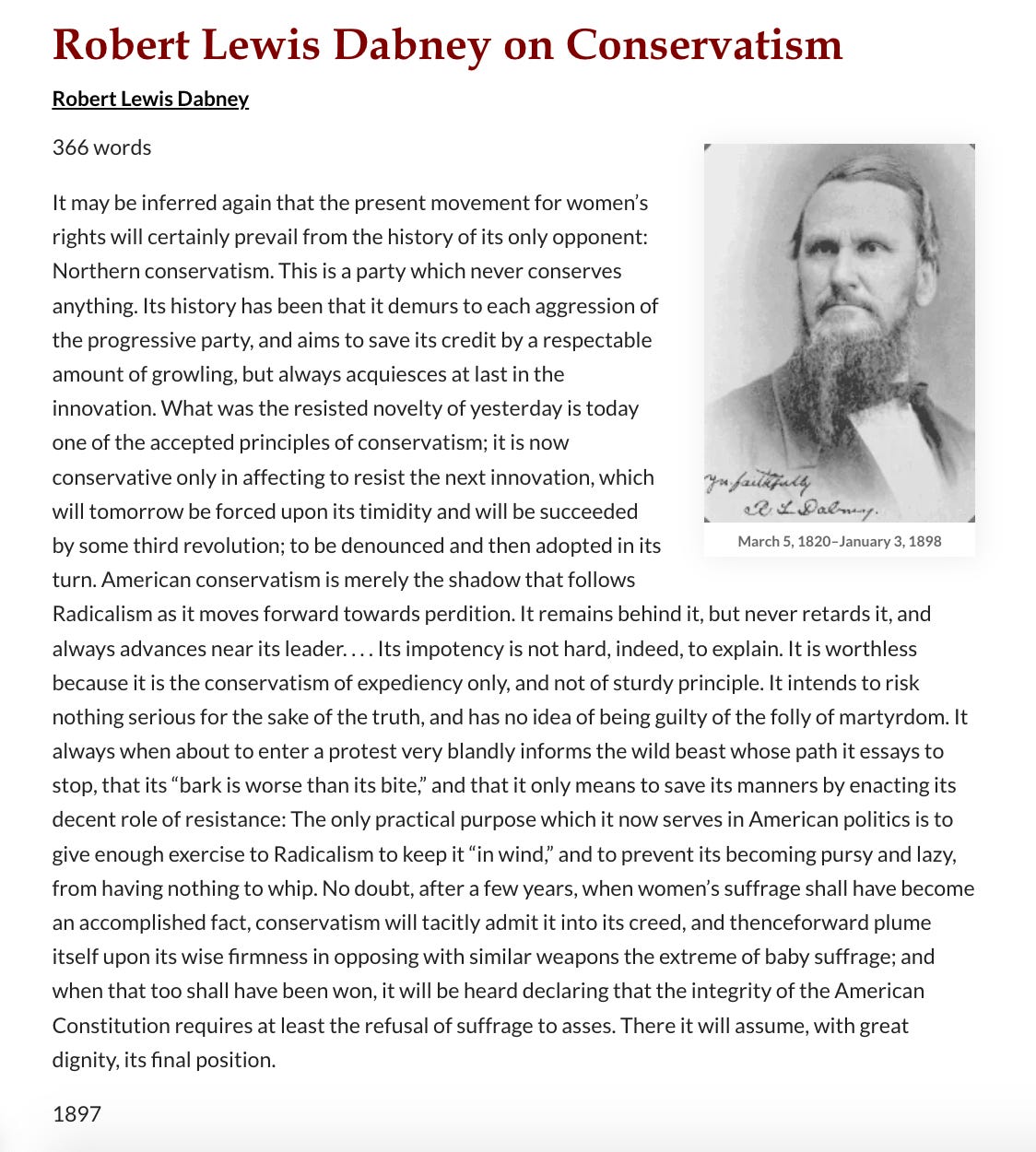
    Robert Lewis Dabney, the Chief of Staff to Stonewall Jackson, bitterly complained about this fast/slow egalitarian belief system in an 1897 screed, which is as relevant now as it was then:

    Powerful words.

    Because politics is downstream of belief, a societal transvaluation of values must occur before any true change of representation is possible within Congress. Still, from a dissident perspective there are gradations; some are better than others.


    Which Senate votes will be tabulated, and on what basis?

    Much of politics is kayfabe; Senate leadership can whip its members to comply with their demands with bribes or threats (such as providing or withholding campaign funding, or offering committee seats) or let them vote their conscience, depending on political necessity. For example, 2021’s Inflation Reduction Act (an Orwellian name given it vastly increased spending and led to much higher inflation) passed on a party-line 51-50 vote with Kamala serving as tiebreaker. Republican leadership thought it would look better to their voters to oppose it in a uniform fashion, but would some have broken rank and helped pass it if their votes were actually needed (like John McCain did to scuttle the Obamacare repeal)? To what extent was their opposition performative to fool voters?

    Regardless of leadership’s tactics, over a significant amount of time one can get a sense for each Senator’s philosophy based on their voting record, and we can grade them on that basis. For purposes of this analysis we will take the votes cast at face value. Let’s look at the major bills passed since 2020, provide a description of each bill, the final vote tally, explain the dissident position (from my perspective, which you are free to disagree with), and then review the votes cast per each Senator.

    As a caveat, we will not be reviewing the Senate’s extremely fast confirmation of many radical leftist judges chosen on the basis of race and gender (except for covering Ketanji Brown in the Supreme Court). According to Lauren Witzske, “A study reveals how Biden has appointed 97 Federal Judges. [Only] 5 of the 97 judges were white men, 2 of those white male judges were gay. They are completely rebuilding the US judiciary with people that hate us.”1 Many Republicans have voted in favor of Biden’s bioleninist, anti-western civilization judicial nominees.

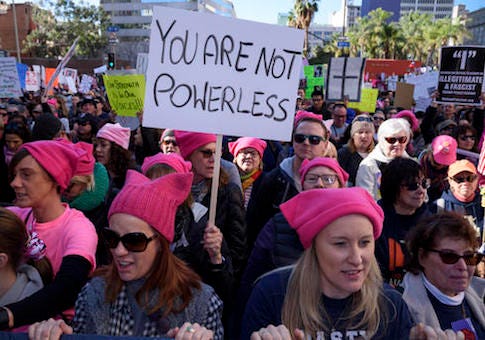
    Biden’s judges have been picked with female gender being a determinative factor. The pussyhat cancer exported to the judiciary.

    The Senate votes and analysis

    The relevant Senate votes from 2020-present are as follows: (1) the USA Freedom Reauthorization Act of 2020, (2) the Wyden-Daines amendment to that Act, (3) the Alejandro Mayorkas Vote for Homeland Security, (4) the Infrastructure Investment and Jobs Act, (5) the confirmation of Ketanji Brown to the Supreme Court, (6) the $40 billion Ukraine aid package, (7) the Bipartisan Safer Communities Act, (8) the Respect for (Gay) Marriage Act, and (9) the Fiscal Responsibility Act of 2023. Let’s go through each of these briefly.

    1. USA Freedom Reauthorization Act of 2020This bill reauthorized the FISA spying provisions of the NSA, despite well-known and extensive abuse of the NSA search databases by illegally spying on the Trump campaign and against non-establishment figures. A 2018 declassified FISA report stated that the FBI ran 3.1 million illegal FISA searches on American citizens in 2017 alone, compared to 7,500 combined searches by the NSA and CIA in the same year. Regardless, the bill passed the Senate on a 80-16-4 vote and the Trump administration incompetently supported it, satisfying itself with minimal surface-level reforms.
      1. Dissident position: According to Noah Carl in what he calls the “The Diversity Trilemma”, “You can pick two out of the following three: social stability, civil liberties, non-selective immigration. If you want social stability and civil liberties, you have to be picky with immigration. If you want civil liberties and non-selective immigration, you won’t get social stability. And if you want non-selective immigration and social stability, you’ll have to infringe civil liberties.” The establishment chooses social stability and non-selective immigration and eschews civil liberties. The dissident position is that unchecked immigration is wrong and emphasizes social stability and civil liberties. Therefore a dissident would have voted no on FISA spying reauthorization and pushed instead to tighten and enforce immigration laws.
      2. Additional commentary: After this Act was reauthorized the FISA abuse continued and got much worse. In 2023 the DOJ Inspector General revealed that more than 10,000 federal employees have access to the NSA database for surveillance inquiries, more than 3.4 million search queries were ran between 12/1/2020 and 11/30/2021, and approximately 30% were outside the rules and regulations that govern warrantless search, showing the pattern of illegal governmental behavior had only expanded with no repercussions for its offenders. A general rule is that when bad behavior is unchecked it metastasizes (bad behavior only stops when, with a South Park example, it is properly addressed and punished), so expect it to be abused even worse in the future. Great move on the FISA reauthorization, Orange Man.
    2. The Wyden-Daines amendment to the USA Freedom Reauthorization Act of 2020. The vote was for an amendment to the above Act, which would have expressly forbidden the government from collecting internet browsing and history without a warrant provided to the FISA court. It failed the Senate vote by a single vote59-37-4 (it needed 60 votes to pass).
      1. Dissident position: A dissident would have voted yes on the amendment if the Act itself was unfortunately passed, for the same reasons described above.
      2. Additional commentary: This is a good example demonstrating why Senate votes are performative. The establishment will ensure they receive the votes they need to pass their dictates, and anything beyond that depends on the politics surrounding the issue. Here globohomo wanted to be able to spy on citizens without a warrant, and that’s what they got, but they didn’t feel the need to “punish” Senators by forcing their no vote more than required for passage because the optics of voting no looked so bad.
    3. Alejandro Mayorkas Vote for Homeland SecurityNovember 2020. Mayorkas was known as a radical leftist who would open the southern border. He was confirmed on a 56–43 vote.
      1. Dissident position: Easy self-explanatory no.
      2. Additional commentary: Mayorkas has performed as expected and the southern border is now more open than at any time in modern American history. The man should be criminally prosecuted for dereliction of duty, but he is carrying out orders from above to apply the tactics they employed in California on a national basis to bring forth a permanent one party state.
    4. Infrastructure Investment and Jobs Act,August 2021. The amended bill included approximately $1.2 trillion in spending, with $550 billion being newly authorized spending on top of what Congress was initially planning to authorize. The amended bill was passed 69–30 by the Senate.
      1. Dissident position: Easy no. It should have been obvious that the bill would be a gross giveaway of graft and corruption to the worst elements in Congress; one Republican senator, Kevin Cramer, bragged on television that only about 1/3 of the spending would go toward infrastructure.
      2. Additional commentary: Following the bill’s passage by Congress, Trump criticized it as containing “only 11% for real Infrastructure”, calling it “the Elect Democrats in 2022/24 Act”, and attacked Republicans who had supported it, saying in particular that McConnell had lent “lifelines to those who are destroying” the country.
    5. Confirmation of Ketanji Brown to Supreme Court, April 2022. She was confirmed on a 53–47 vote.
      1. Dissident position: Another easy no. She had a reputation as a radical anti-white racist globohomo apparatchik and she was nominated on the basis of her race and gender.
    6. $40 billion Ukraine aid package, May 2022. The legislation theoretically “provided money for military and humanitarian aid, including funding to assist Ukrainian military and national security forces, help replenish stores of US equipment sent to Ukraine, and provide public health and medical support for Ukrainian refugees.” It passed on an 86-11 vote.
      1. Dissident position: The Rusia/Ukraine war is designed to be the next forever-war after Afghanistan. Here’s Assange on the purpose of these forever wars. The vast majority of aid supplied gets funneled back into the military industrial complex and as bribes to U.S. politicians after Zelensky and co. take their cut. According to a CBS documentary, which was forcibly censored by globohomo, only 30% of U.S. supplied arms/munitions reached its final destination. Even if the war was legitimately being fought, only 16% of Americans can point out Ukraine, which means “Borderland” in Russia, on a map: is that really worth risking global nuclear war over? This is an easy no vote and there should have been a push for a negotiated settlement.
      2. Additional commentary: Rand Paul tried to insert a special inspector general to oversee the funds but failed for the reasons stated above, and there have been tens of billions of additional funds sent to Ukraine to be washed-back subsequently.
    7. The Bipartisan Safer Communities Act, June 2022. Per Wiki, “It implemented several changes to the mental health system, school safety programs, and gun safety laws. Gun safety laws in the bill include extended background checks for gun purchasers under 21, clarification of Federal Firearms License requirements, funding for state red flag laws and other crisis intervention programs, further criminalization of arms trafficking and straw purchases, and partial closure of the boyfriend loophole.” The bill was passed by the Senate 65–33.
      1. Dissident position: There’s nothing wrong in theory with limitations on the Second Amendment – for example, Americans can’t own functional tanks or F-16s. The problem is that liberals publicly claim to only want “reasonable and incremental gun control measures”, but they havn’t been and won’t be satisfied with any specific gun restriction.  They weren’t satisfied with red flag laws and they weren’t satisfied with background checks or banning assault rifles; if they only wanted reasonable restrictions, they would eventually be content with the ones passed instead of turning around and demanding more.  What they really want, but won’t say publicly, is a total prohibition on gun ownership.2  It is the same in other western countries: Trudeau announced a Canadian gun ban in 2022, Australia banned guns in 1996 and New Zealand banned guns in 2019.  These only affect law abiding citizens, though: felons and jackbooted enforces of the regime are allowed to keep their weapons and avoid punishment for their crimes, which serves a useful purpose in terrorizing and distracting the middle class (i.e. anarcho-tyranny). Therefore the only logical response to such an underhanded, devious strategy is to oppose it entirely. No new gun control laws, period, which is the NRA’s morally and strategically correct stance and which has been quite successful overall in protecting American’s constitutional right to bear arms. Compare this to the long-term failure of every other “conservative” issue.
      2. Additional commentary: One should note that gun laws weren’t needed in earlier decades when America was homogenous and gun ownership was ubiquitous, giving further credence to Noah Carl’s argument above.
    8. The Respect for (Gay) Marriage Act, Nov 2022. This Act repeals the Defense of Marriage Act (DOMA), requires the U.S. federal government and all U.S. states and territories to recognize the validity of same-sex marriages in the United States. The Senate passed it by a 61–36 vote.
      1. Dissident position: The two main problems with gay marriage, aside from the religious argument, are (1) it weakens and cheapens the institution as a whole, whose primary, perhaps sole purpose is to create a secure environment for the raising of children (and homosexuals raising children are far more likely to sexually abuse those children); and (2) the slippery slope argument, so often derided by liberals during the lead-up to gay marriage, has been conclusively proven to be true. “Don’t ask don’t tell” led to civil unions which led to gay marriage which led to transsexual rights which led to child sex grooming in schools, and which will sooner or later lead to pro-pedophelia legalization. The country has lurched so far left so rapidly that Republicans who are considered “further right” like Ted Cruz now viciously attack other countries for opposing gay marriage. Because of these issues, a dissident position on gay marriage would be “no”.
      2. Additional commentary: Globohomo doesn’t actually care their minority grievance groups, whether gays or blacks or transsexuals. What they care about is having loyal shock troops who will do their bidding. This is why if an individual from one of these favored minority groups goes “off the reservation” and becomes a dissident, their special privileges are revoked without pity or remorse and they are attacked as viciously as white males. See how globohomo treats Kanye WestKyrie IrvingNick Cannon or Clarence Thomas as examples of this.
    9. Fiscal Responsibility Act of 2023, June 2023. This would suspend the United States debt ceiling for two years as well as rubber stamp much of the Democrat’s previously passed legislation including on the expansion of the IRS (87,000 new IRS employees to shake down the middle class). This bill is passing 63-36-1.
      1. Dissident perspective: This one is a bit tricky. America’s spending is completely out of control — non-military discretionary spending is only at most 15% of the total budget — and a default on debt could have very difficult consequences, like forcing a heroin addict to go cold turkey. Additionally, the globohomo controlled media would smear Republicans for their objections if they didn’t pass the increase, creating strong pressure on them to fold, and these debt increase negotiations occur every couple of years with the outcome known far in advance. That being said, dissidents could pick a stand and then stick to it, tying the debt ceiling increase to a closing of the southern border and then not budging from it, as Sundance argues, or tying it to a full rollback of the liberal’s previously passed items pertaining to the IRS and other graft.
      2. Additional commentary: With all this said, this bill is passing without meaningful concessions because the Senate Republican leadership is compromised.

    The Senate vote tallies

    The chart is below. A vote with a green background is the dissident position; a vote with a red background is the establishment position.

    Based on the votes, Rand Paul has the best dissident voting record since 2020, correct on every issue; he was the only Senator to oppose the FISA reauthorization in 2020. Tommy Tuberville, Roger Marshall, Mike Lee, Mike Braun, Bill Hagerty and Josh Hawley are behind him, correct on every issue except for FISA reauthorization.

    Rand Paul and family. What a nice and clean-cut, if a bit autistic and odd-looking, family.

    That’s only 7 Republicans out of 49. If you open it further to include those with two wrong votes, there are an additional eight, still only 30% of Republican Senators.

    Other “standouts” from these votes are Mitt Romney (it’s hard to believe “binders full of women” Romney was almost president) and Susan Collins, who are Democrats in all but name, having voted the wrong way on every issue. Lisa Murkowski and Shelley Moore Capito are one-vote behind them. Senate leader Mitch McConnell should be highlighted for voting on the wrong side of every issue except gay marriage, the confirmation of Ketanji Brown and Mayorkas (and he intentionally undermines and tries to destroy truly populist candidates like Blake Masters). Also, lol at Lindsay Graham for voting no on gay marriage. Who does he think he’s fooling?

    Mitt Romney, who was a virulent Never-Trumper, dining with Trump after his surprise 2016 win where he begged (and failed) for a cabinet position.

    Analysis of the senate vote tallies

    This vote tally should explain in part the extreme difficulties Trump had as president dealing with Congress. The Republicans controlled the House, Senate and Presidency in 2017 with razor thin margins, but all that got passed were tax cuts for the ultra rich. How can one expect meaningful legislation favoring dissidents when Trump had, maybe, 7 out of 100 Senators on his side? Or the Senate to confirm decent cabinet picks? Compare this to Ron DeSantis in Florida where the Florida House and Senate are overwhelmingly Republican, so he has much greater margins to pass quasi-meaningful legislation.

    Rand Paul being the biggest dissident in the Senate shouldn’t be much of a surprise given his father is “Audit the Fed” and “End the Fed” hero Ron Paul. But curiously note that Rand was viciously attacked by a “politically motivated” neighbor in 2017 and almost killed, and his aide was “brutally attacked” and stabbed in broad daylight in 2023. Being a high-profile enemy of globohomo carries with it a lot of risks.


    The Outliers

    Perhaps even better than the seven semi-dissident senators is one Democrat Senator, along with one Republican congressman.

    Newly elected Democrat Senator John Fetterman, who thankfully3 beat early pro-transsexualism, pro-China COVID shutdowns Republican candidate Mehmet Oz, exposes the joke of Congress for what it is by having a stroke and being consistently rambling, incoherent and unintelligible. This is a good thing.

    Congress’s approval rating has averaged just 18% from 2010-2020; Senators say whatever platitudes they need to in order to get elected, then immediately turn around and do whatever their donors demand for the next six years. As Montagu Norman, Governor of the Bank of England, argued while addressing the U.S. Bankers’ Association, New York, Idaho Leader, 26 August 1924:

    “Capital must protect itself in every possible way, both by combination and legislation. Debts must be collected, mortgages foreclosed as rapidly as possible. When, through process of law, the common people lose their homes, they will become more docile and more easily governed through the strong arm of the government applied by a central power of wealth under leading financiers. These truths are well known among our principal men, who are now engaged in forming an imperialism to govern the world. By dividing the voters through the political party system, we can get them to expend their energies in fighting for questions of no importance. It is thus, by discrete action, we can ensure for ourselves that which has been so well planned and so successfully accomplished.”

    Democracy equals rule by oligarchy; i.e. in a democracy (1) those who shape public opinion have the power, (2) mass media shapes public opinion, and (3) mass media is owned by the central bank owners. Senators and congressmen serve as play-actors, allowing oligarchs to pillage the masses who have no voice and no say.

    Therefore Congress is unworthy of the respect one would otherwise accord such an institution, filled with smooth-talking men and women who lie to their constituents as they do the opposite of what they verbally espouse. I prefer my politicians to match up with the reality as much as possible, and Fetterman’s presence in Congress, along with George Santos’s, expose the whole thing as a farce (confirmed by others: “Afghanistan veteran challenging George Santos blasts embattled congressman’s ‘mockery of our political system”). They discredit the establishment in the eyes of normal people as well as to foreigners and foreign governments.

    It’s too bad they’re taking down poor Georgie, who unlike Fetterman does not have a krisha providing protection; he played as fast and loose as the establishment does with truth, but the establishment is a mafia and doesn’t allow others to act like they do. Like Icarus, Santos flew too close to the sun.

    George Santos. I’m not sure what he’s doing with his hands here. “Look how they masssacred my boy.”
    Fetterman: the hero we need? Or the hero we deserve?

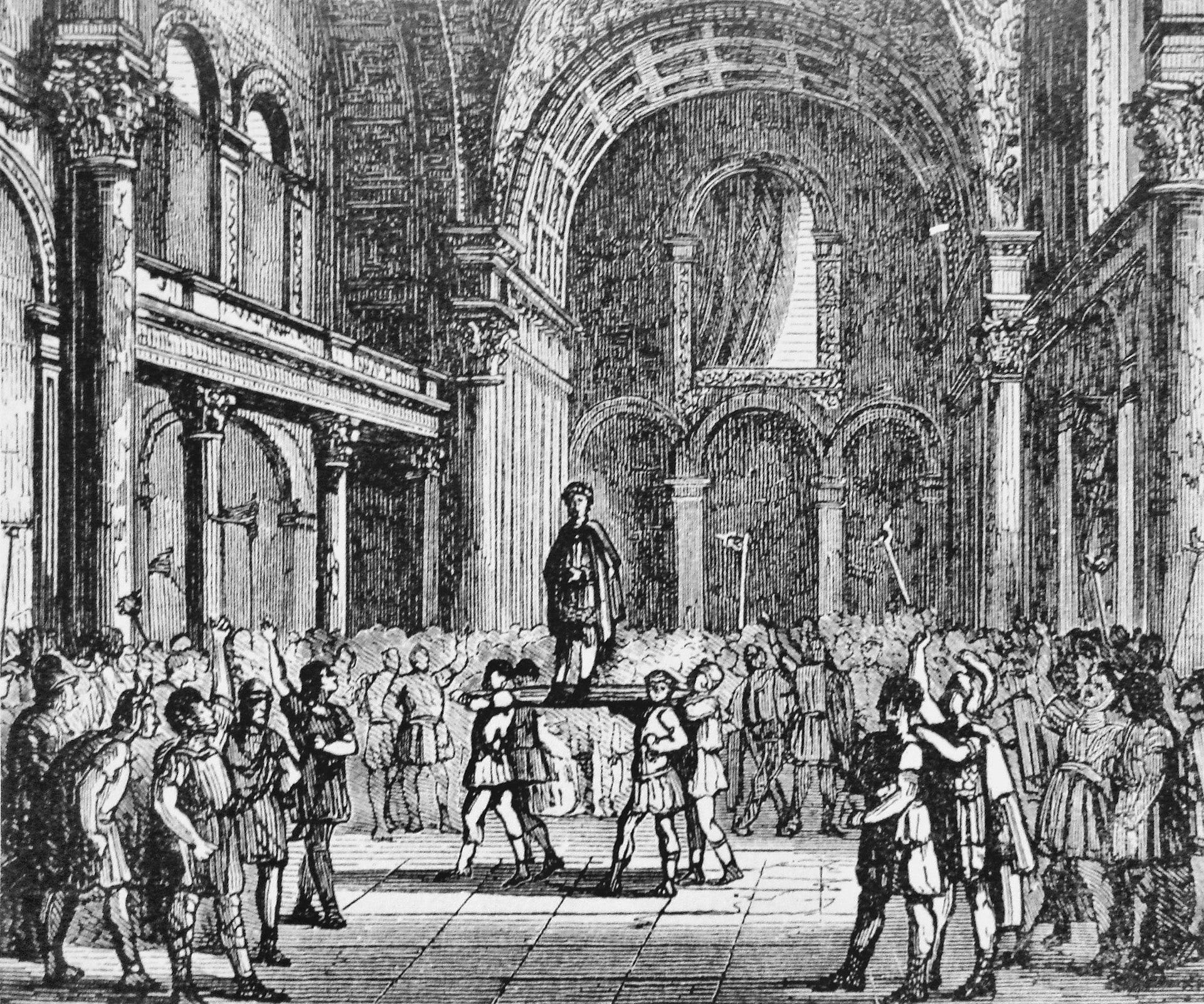
    It’s very reminiscent of Caligula appointing his favorite horse, Incitatus, to the Senate in Rome; he, too, would likely have been my favorite Senator in an environment like this.

    Caligula and Incitatus. Here’s to you, Real Horses of Genius.

    Subscribe:
    Email delivery remains on Substack for now.


    1 Interestingly, Biden-nominated and confirmed straight white male district judge Stephen H. Locher represented convicted felon Sholom Rubashkin, who was pardoned by Trump; a return of favors regardless of the change of administration?

    2 As Ted Kaczynski argues in Industrial Society and Its Future, paragraph 219-221,

    “The leftist seeks to satisfy his need for power through identification with a social movement and he tries to go through the power process by helping to pursue and attain the goals of the movement. But no matter how far the movement has gone in attaining its goals the leftist is never satisfied, because his activism is a surrogate activity. That is, the leftist’s real motive is not to attain the ostensible goals of leftism; in reality he is motivated by the sense of power he gets from struggling for and then reaching a social goal. Consequently the leftist is never satisfied with the goals he has already attained; his need for the power process leads him always to pursue some new goal….Suppose you asked leftists to make a list of ALL the things that were wrong with society, and then suppose you instituted EVERY social change that they demanded. It is safe to say that within a couple of years the majority of leftists would find something new to complain about, some new social “evil” to correct; because, once again, the leftist is motivated less by distress at society’s ills than by the need to satisfy his drive for power by imposing his solutions on society. Because of the restrictions placed on their thoughts and behavior by their high level of socialization, many leftists of the over-socialized type cannot pursue power in the ways that other people do. For them the drive for power has only one morally acceptable outlet, and that is in the struggle to impose their morality on everyone.”

    3 While some may argue it would be better to have Oz in place instead of Fetterman solely to prevent Biden’s judicial confirmations, the current Senate breakdown is 51-49 so even if it was 50-50 Kamala would still be breaking the tie and advancing confirmations.

  • Lee Kuan Yew and Singapore: A knife-edge path along a broken ridge

    Imagine, if you will, the expected prognosis for a small, poor-city state with the following issues:

    • a complete lack of natural resources;
    • a looming communist threat backed by major regional and world powers;
    • a demographically, linguistically, and culturally diverse population lunging at each other’s throats in a tense atmosphere, a powder-keg for race riots ready to explode at any moment;
    • influential newspapers controlled by foreign powers deliberately stirring up unrest at every turn;
    • both of your much larger neighbors cutting off trade, and the closer neighbor (who you are quasi-militarily occupied by) threatening to cut off your critically important supply of water; and
    • the superpower who set up your city-state and guaranteed security is leaving.

    Imagine further that your citizens are uneducated and backward immigrants who settled the land for the purposes of cheap manual labor, and they are deeply set in their ways with strong loyalties and attachments to their various homelands. And all of this in hot (87-91°F average highs year-round), humid (over 80% year round), swamp-like conditions that strongly discourages even tourism to the city-state.

    Now imagine that same city-state today where all of those issues have been resolved (other than the weather) fifty years later and it is a shining success story (materially, at least) with the third highest GDP per capita in the world at $91,000 in 2017 (5th highest today), the world’s highest percentage of millionaires, with one out of every six households having at least one million US dollars in disposable wealth (excluding property, businesses, and luxury goods, which if included would increase the number of millionaires), and crowned the world’s most expensive city multiple years in a row.

    Well, such is the case with Singapore:

    The Jewel Waterfall at Changi Airport
    The Marina Bay Sands hotel, completed in 2010

    And Singapore owes its success primarily to one man: Lee Kuan Yew, who served as the first prime minister of Singapore between 1959 and 1990.

    Lee Kuan Yew. A strong physiognomy.

    How did he pull it off? What was it about the man’s philosophy, consummated with an unrelenting and vigorous drive, that arguably single-handedly produced such a miraculous economic transformation? To what extent does it further the argument that only a dictator who strengthens the middle class can counter leftism, made in this Substack article about Pyotr Stolypin? And is there a downside, perhaps a massive downside, to this economic success? This is what this article will explore.

    Much of the information contained herein is based on one of Lee’s autobiographies, “From Third World to First, The Singapore Story: 1965-2000”, although some is from other sources where identified. The book’s format is unusual in that it was not written chronologically but rather by subject: “Building An Army from Scratch”, “Britain Pulls Out”, “Creating a Financial Center”, “Winning Over the Unions”, “Nurturing and Attracting Talent”, “Managing the Media”, “Up and Downs with Malaysia” are a sample of the topics covered in this dense 700 page book.

    Let’s begin with some historical background about Singapore itself.


    Historical Background

    The British governor Stamford Raffles arrived in Singapore on 28 January 1819 and soon recognized the island as a natural choice for a new port. Below is a modern-day map; one can see how critical the Strait of Malacca is for trade, which is the shortest sea-born route from India to the South China Sea; further south is the Sunda Strait next to Jakarta but its narrowness, shallowness, and lack of accurate charting make it unsuitable for many modern, large ships.

    A map of the region; note Singapore’s key location through the Strait of Malacca.
    Singapore as an island nation off the coast of Malaysia: the main island and 63 satellite islands and islets, and one outlying islet.

    In 1824, a treaty with the owner of the island, the Sultan of Johor, led to the entire island becoming a British possession. Prior to Raffles’ arrival, there were only about a thousand people living on the island, mostly indigenous Malays along with a handful of Chinese. By 1860 the population had swelled to over 80,000, more than half being Chinese, mostly laborers. The growth of the Singapore population is reflected below:

    The Chinese have comprised more than 70% of the Singapore population, and Muslim Malayas about 15% of the population since 1900:

    After World War I, the British built the large Singapore Naval Base as part of their anti-Japanese Singapore strategy. Costing $60 million and not fully completed in 1938, it was nonetheless the largest dry dock in the world, the third-largest floating dock, and had enough fuel tanks to support the entire British navy for six months. However, the British Home Fleet was stationed in Europe and the British could not afford to build a second fleet to protect their interests in Asia, leaving it open to Japanese invasion, who took over the island in 1942 and then massacred 25,000-50,000 of its Chinese residents in what was called “Sook Ching”.


    Lee Kuan Yew’s Background

    Lee was born in 1923 in Singapore to English-educated third-generation Straits Chinese. Lee’s first language was English and he also learned Malay; he had a Buddhist background although he also described himself as agnostic, and he would later state Singapore was a Confucian society. He performed well in school, and was almost rounded up and executed during “Sook Ching” but managed to barely avoid it. He ended up working for the Japanese occupation force as an English specialist in their propaganda department. Per Wikipedia:

    The rapid Japanese victory in the Malaya-Singapore campaign had a major impact on Lee: “In 70 days of surprises, upsets and stupidities, British colonial society was shattered, and with it all the assumptions of the Englishman’s superiority.” In a radio broadcast made in 1961, Lee said he “emerged [from the war] determined that no one—neither Japanese nor British—had the right to push and kick us around… (and) that we could govern ourselves.” It also influenced his perceptions of raw power and the effectiveness of harsh punishment in deterring crime.

    After the war he got married, pursued higher education in Great Britain where he excelled, became an attorney and then returned to Singapore in 1950. There he made a name for himself representing nearly fifty trade unions and associations against the British authorities on a pro bono basis, and successfully defended the left-wing University Socialist Club against charges of sedition. He co-founded the leftist People’s Action Party (PAP) in 1954 with the goal of securing self-governance from Britain, which contained a significant communist element until he purged them from the party after they attempted an internal coup in 1957.

    The PAP eventually won the 1959 Singapore general electionsplit permanently from and expelled the far-leftist element within the party, and secured self-rule from Britain in 1963. As part of securing self-rule, Singapore merged with Malaysia. The reasons for the merger was it served to reduce Britain’s footprint in Singapore; the PAP also hoped it would reduce Singapore unemployment, which was very high, with the introduction of a common market; and the Malays could hopefully reduce the communist threat, which was large due to the Chinese population’s ethnic affinity for communist China.

    However, the merger was not successful. There were constant tensions between Singapore and Malaysia, primarily because Malaysia was comprised of roughly 70% Muslim Malaysians and 23% Chinese (like today), while Singapore was comprised of roughly the opposite: 75% Chinese and 15% Malaysian (like today). Malaysia wanted to stick to its “Malay Malaysia” policies explicitly favoring Malays over Chinese, whereas the PAP wanted a “Malaysian Malaysia” and to remove or weaken those affirmative action programs. Tensions culminated in anti-Chinese race riots in the Kuala Lumpur 13 May incident and in the 1969 race riots in Singapore. However, there were other issues, especially over taxes, use of the Singapore port and transportation of goods and hostility surrounding increased competition.

    Lee’s personal qualities added to the tension: he was such an eloquent, popular public figure, able to cross religious and ethnic boundaries, fluent in English, Malay and he was learning Mandarin, that it was increasingly looking like he could become Prime Minister of Malaysia which alarmed the Malay politicians in power. Due to these issues Malaysia’s Prime Minister Tunku Abdul Rahman considered arresting Lee and applying martial law against Singapore, but was dissuaded by British Prime Minister Harold Wilson, who still had leverage over Malaysia as he was defending them against attempts by Indonesia to annex the country.

    Lee’s sad public speech where he acknowledged Singapore would be kicked out of Malaysia.

    Singapore was expelled from Malaysia, and then had to turn its focus to dealing with its myriad problems on its own: issues pertaining to security/defense, high unemployment and poverty, a lack of natural resources, racial issues, communist subversion, recalcitrant unions, a hostile media, balancing capitalism and socialism, and juggling foreign affairs, including securing recognition, funding, diplomatic support, and trade. Let’s briefly delve into each of these, but before doing that, let’s discuss Lee’s philosophy and outlook.


    Lee Kuan Yew’s Philosophy

    In my previous post on Pyotr Stolypin, which dealt with his attempt to save Tsarism in Russia, I quoted Alexander Solyznhenitsyn, who wrote:

    Stolypin saw in his mind the only path, the natural path, though in earthquake conditions it looked improbable: a knife-edge path along a broken ridge. In the past reform had for some reason always signified a weakening and possibly the collapse of the regime, while stern measures to restore order were taken to indicate a renunciation of reform. He saw clearly that the two things must be combined!

    Stolypin’s story illustrated the point that only a combination of a strong monarchy plus an expanding, healthy middle class could serve as a bulwark against leftist radicalism.Lee Kuan Yew had a very similar philosophy as he established Singapore; he vigorously promoted the economic middle class, instituted a strong monarchy-in-all-but-name for over 40 years, and with an iron fist crushed the communist element.

    A strong monarchy plus a focus on the middle class leads to widespread wealth and social stability, so long as the monarch is strong (Stolypin failed because Nicholas II’s personality was too weak), while an oligarchy with a compliant media seeks to poison society in every conceivable way, but primarily via divide et impera tactics in order to keep populism weak in order to continue their parasitism. This is a government structure argument, not a transvaluation of values argument; any society regardless of its core values has to wrestle with these issues.

    However, there were two key difference between Stolypin and Lee: (1) the difference in their backgrounds and (2) their quite different strategies for pursuing their similar objectives:

    1. Background differences: Stolypin was born into the Russian aristocracy; he was a supporter of the Tsar from an early age and ultimately subordinated his decisions to that of the (weak) Tsar, even as he battled the Bolsheviks and tried to uplift the peasantry. On the other hand, Lee came from a poor background, was self-made, rose to power as an anti-colonial leftist who was allied with the communists before experiencing a falling out with them, and he relied on regular elections for his support as he uplifted the peasantry from a position as implied dictator. In other words, both figures shared the same goals – the uplifting of the peasantry via an increase in their material wealth using the same institution – dictatorship – but arrived at from opposite directions.
    2. Strategy differences: Stolypin’s goal was inward-focused autarky. Russia had all the natural resources needed to succeed on its own, it had a large population that only needed to be freed from the shackles of serfdom and communal living; private ownership would incentivize a great increase in domestic production which would in turn create a middle class and lead to social stability. Stolypin was not interested in foreign affairs or external warfare because (to him) all of Russia’s problems could be solved by looking inwards. On the other hand, Lee’s goal was the opposite: Singapore had nothing going for it except a world-class natural port located at a strategic location, and because of Singapore’s extreme racial issues and a host of other problems, he had to be outward/globalist focused – there was no other options other than to remain a poor, divided backwater, subject to the whims of its larger neighbors – and therefore his goal was to make Singapore a critical component of globalist goals.

    Lee Kuan Yew’s approach

    From Third World to First, The Singapore Story: 1965-2000 is too long and dense to provide detailed analysis issue-by-issue in this post or it will turn into its own book. Instead highlights will be discussed based on the values Lee employed to achieve his desired objectives. While some of the below values are oft-repeated buzzwords that politicians worldwide throw out in speeches to woo voters, almost all of the time they are empty and meaningless words with no follow through. Here, they are tabulated and analyzed because it is how Lee actually governed Singapore.

    • Lee believed in an open-minded technocracy. In other words, Singapore should learn the latest processes, procedures, and technologies necessary to remain at a cutting-edge competitive level on the world stage. He would travel the world, constantly see what others were doing, and then use the ideas he learned to make upgrades within Singapore itself. Lee even learned to use a computer, emails and the internet himself when he was in his 80s – it’s pretty unusual for an “old dog” to learn new tricks like that; usually neuroplasticity atrophies as one ages and people just get stuck in their ways.
    • Lee believed that society should be governed by well respected, well educated experts, and that those experts were expected to deliver results on the ground in an efficient manner, both in time and in cost (the tying of expertise to results separates Singapore from so-called “experts” in the west). In return these experts would be properly compensated, with salaries in the public sector commensurate to the private sector so the best are willing to serve and to do it without accepting bribery. As a result, public sector salaries in Singapore are among the highest in the world. He also regularly consulted with experts, especially technocratic experts, across the world in various fields, such as Dutch economist Albert Winsemius.
    • Lee believed in having a free-market economy with very strong dirigisme characteristics. Essentially, every aspect of a citizen’s life would be controlled, molded and shaped to maximize productivity and competitiveness on the world stage, using a combination of incentives and governmental commands, while also forcing a high level of savings so that citizens would not become a burden either on the government in old age or on future generations by spending more than the government received from tax receipts.
    • In that vein, Lee strongly believed in the value of formal education, especially technically oriented higher education, and especially learned abroad at the best universities in the world. His three children exemplified this belief and all went on to high achieving careers (his oldest son is the current Singapore Prime Minister; allegations of nepotism have dogged his career as well as that of the other children).
    • Lee believed strongly in the values of pragmatism, adapting to changing circumstances and dealing with them in the moment in the most level-headed, realistic way possible with a view toward advancing his long-term goals. In line with pragmatism were values of self-confidence and a full defense of his positions using whatever tactics were required. While Lee was not a Christian and Christians were not really represented among his constituencies, he understood that he had to work within a Christian (or post-Christian) framework because the countries he relied on for trade as part of his leap-frog strategy (discussed below) were all Christian. Therefore he was very sensitive to their sensibilities and what was acceptable and what was not, and made pains to mostly stay within those boundaries.
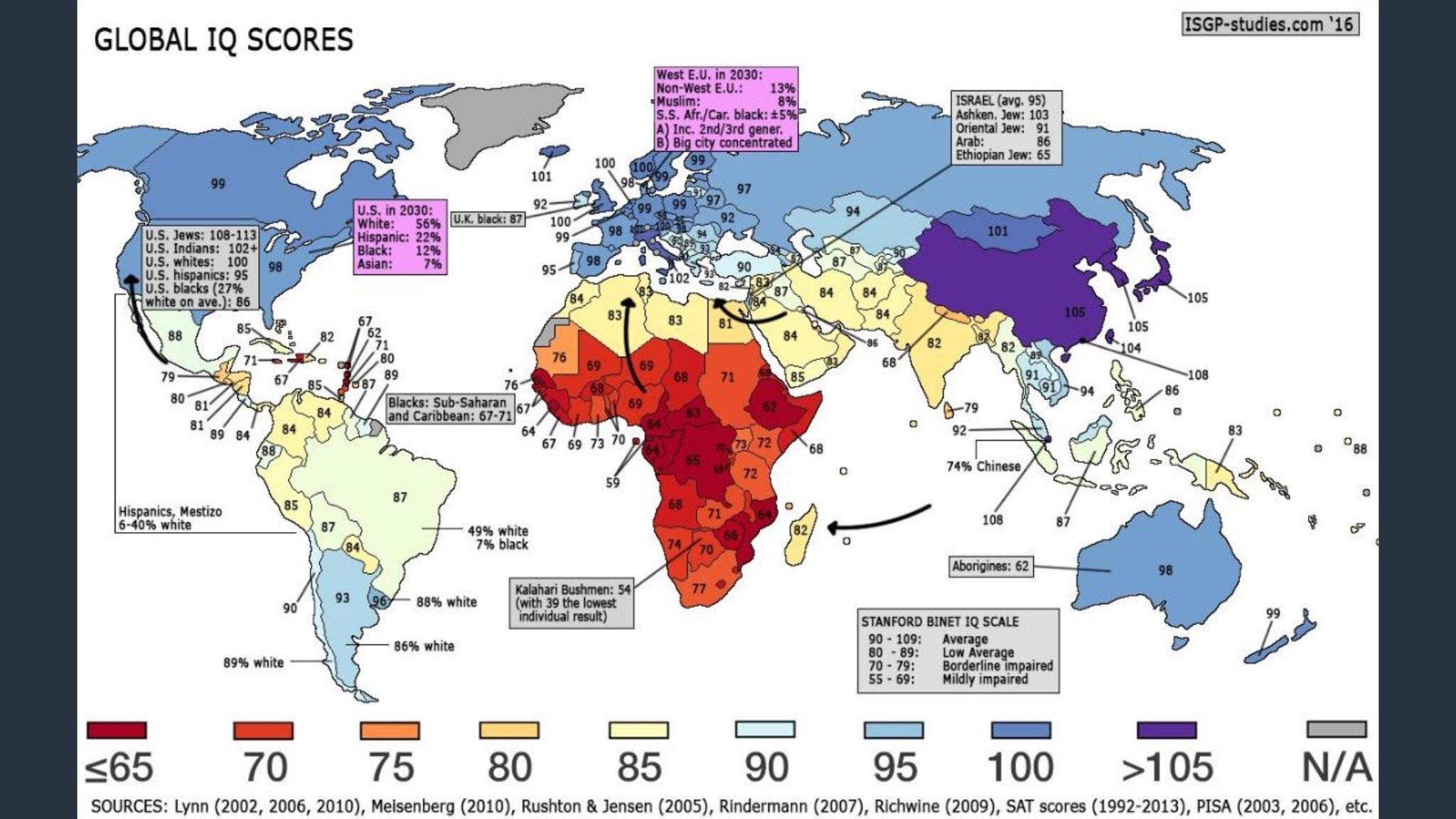
    • Lee was extremely cognizant of the racial sensitivity of political decisions, but from a pragmatic, not a liberal perspective. Here are a large number of controversial quotes by Lee where he acknowledged differences between races in their abilities and their temperaments. Lee had to take racial issues into his calculations to ensure social stability (see the race riots in Singapore in 1964 and in Kuala Lumpur in 1969), but he was very aware of and commented on the differences in average IQs among races. Lee commented negatively on American’s denial of human biodiversity, especially at Harvard:“I found many other fresh ideas and picked the brains of other highly intelligent people who were not always right. They were too politically correct. Harvard was determinedly liberal. No scholar was prepared to say or admit that there were any inherent differences between races or cultures or religions. They held that human beings were equal and a society only needed correct economic policies and institutions of government to succeed. They were so bright I found it difficult to believe that they sincerely held these views they felt compelled to espouse.”These views came, of course, from the western hyper-focus on equality as derived from Christianity, which Lee did not share. He did try to narrow the results gap between groups through education and other initiatives for social stability reasons and to placate the west, but with the specific stated understanding that the gap was not due to societal racism.
    • Lee strongly believed in the values of meritocracy, seeking to transparently create processes and incentives that would promote the very best of society. In this way Lee was able to offer an alternative to racial and religion identity via a promise of wealth, essentially arguing, “Stop focusing on your differences and focus on making money instead, and in return we will make everyone rich.” And he expressed extreme disagreement with world leaders that turned inward with racial and religious focuses instead of opening up and pursuing wealth via free-market economies (examples he gives include Pakistan, India, Rhodesia, Burma and Sri Lanka).
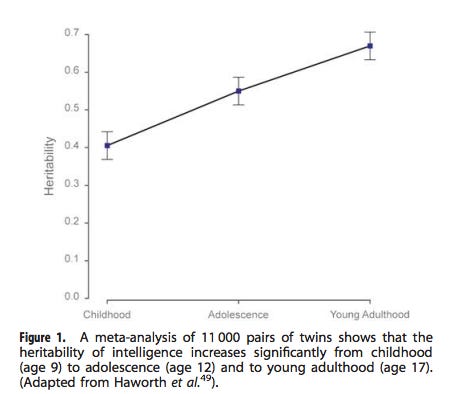
    • Lee was sensitive to the rapidly declining birth rates in Singapore (which are among the very lowest in the world). Because women naturally want to “marry up” in social status, they are reluctant to marry someone of lesser educational attainment than their own; but men of equal education generally want to marry younger, with the amount of a woman’s education either being irrelevant or a negative. Lee argued in “The Great Marriage Debate” that highly educated women need to prioritize having children, and that highly educated men should focus more on marrying highly educated women, because Singapore needs smart people for its future and data shows that children of highly educated individuals are much more likely to be highly intelligent themselves. The government of Singapore instituted many policies to try to revert the way-below-replacement birthrates, such as monetary incentives for having children and preferred placement for those children in the best schools, but it has completely failed: Channel NewsAsia reported in January 2011 that the fertility rate of Singaporeans in 2010 were an abysmal 1.02 for Chinese, 1.13 for Indians and 1.65 for Malays. Major cities worldwide, and especially Singapore, are “IQ shredders” where high IQ people move to and fail to procreate. Due to its aging population and not having enough children, Singapore has to constantly import itself new workers. Per Wiki: “By the middle of the 2010s, nearly 40% of the population were estimated to be of foreign origin; although many have become permanent residents, most of them were non-citizens made up of foreign students and workers including dependents.Between 1970 and 1980, the size of the non-resident population in Singapore doubled. The numbers began to increase greatly from 1980 to 2010. Foreigners constituted 28.1% of Singapore’s total labour force in 2000, to 34.7% in 2010,which is the highest proportion of foreign workers in Asia. Singapore’s non-resident workforce increased 170% from 248,000 in 1990 to 670,000 in 2006.”
    • Lee believed in law and order and transparency, and that investigations into impropriety should be provided no matter how high ranking the target may be. Lee and his son and wife were investigated, for example, for buying real estate at discounted prices, but they were cleared of any impropriety. Lee then appeared before parliament to explain his actions, and donated the difference in price to charity.
    • Lee believed in a Confucian society, which he saw as a balancing act so that society doesn’t devolve into an extreme version of American-style winner-take-all individualistic capitalism, which hurts society and breeds distrust, greed and fear, while also structuring society so that the best really do enjoy most of the fruits of their labor because otherwise they would not be driven to succeed.
    • Lee thought that, because of Singapore’s post-independence difficulty in trading with Malaysia and also with Indonesia (given Indonesia was practicing Confrontation at the time), Singapore should leapfrog over its neighbors in order to engage in free trade worldwide and to provide a suitable investing environment, especially with western nations, by providing a law-and-order, stable investing environment where multinational corporations would feel comfortable investing and operating without fear of social unrest. With this approach and by working in a constructive way with the British when they decided to withdraw in 1967 (with the last troops leaving in 1976), which was alarming to Singapore from both a security perspective and because 20% of the population was employed directly or indirectly working for the British, Singapore was able to weather the crisis and emerge from it intact. Lee created an investor and business-friendly, stable oasis (with no union strikes or racial strife) for multinational corporations to operate freely, and it is why he is held in such high esteem by globohomo apparatchiksaccording to Mother Jones: “[Lee] was a member of J.P. Morgan Chase’s “International Council.” In 2009, Barack Obama called him “one of the legendary figures of Asia.” Henry Kissinger later delivered an introduction as LKY accepted a lifetime achievement award from the US-ASEAN Business Council. Margaret Thatcher said he was “never wrong.” Tony Blair noted that LKY was “the smartest leader I think I ever met.” Joseph Stiglitz, the Nobel Prize–winning economist, wrote an encomium touting “Singapore’s Lessons for an Unequal America.””
    • Given Lee’s background in pro-union legal work, Lee knew how to deal with the unions. He ultimately broke them and remolded them into entities that would not impede Singapore’s economic progress or allow them to become a point of hesitation for multinational corporations to invest there. Per Wiki: “Lee also forged a symbiotic and mutually dependent relationship between the People’s Action Party with the National Trades Union Congress, whereby the governing political party received certain input from the labour grassroots, whilst the national trade union centre is led by prominent PAP party politicians who usually have ministerial portfolios within the Government. The Government’s tight control over trade union activities and industrial relations, ensured near-total industrial peace, that was assessed to be a prerequisite for rapid economic development.
    • Given the problems with the neighbors and Malaysia constantly threatening to cut off Singapore’s access to its critical water supplies, Lee believed in possessing a high tech, highly motivated military to defend Singapore interests. Singapore was early to receive a lot of second generation, but state of the art for the region, military hardware from Israel and other countries, even though its population at the time was only a couple of million while Malaysia’s was tens of millions.
    • Lee believed in applying technical innovation to society, but conservatively; in other words he wanted new, potentially disruptive technology to be tested elsewhere first so that the problems could be ironed out before being implemented in Singapore, especially in the financial sector.
    • Lee believed in maintaining a balanced budget. Singapore does not have a central bank and therefore cannot print their way out of problems; this was a deliberate, consciously chosen decision. Instead the Singapore dollar is pegged to a basket of currencies of its major trading partners. Compare this to Malaysia’s currency; they originally had a fixed 1:1 exchange rate, which got de-pegged in 1971. Now $1 Singapore dollar (SGD) is worth $3.36 Malaysian ringgit (MYR). Such is the result of utilizing central bank printing to try to push problems down the road… Lee had the same warning to America, where he stated in a 2013 interview:“[The U.S.] has been unable to tackle its exploding debt, he asserts, because presidents do not get “reelected if they give a hard dose of medicine to their people.” In a social-media-fueled era of 24/7 news, furthermore, those who prevail in elections are not necessarily those who are most capable in governing, but those who can present themselves and their ideas “in a polished way”…Instead, he laments conditions in which “to win votes you have to give more and more. And to beat your opponent in the next election, you have to promise to give more away.” That being said, given the Rothschilds and their allies own the central banks of the world and Singapore uses a basket of those currencies, it is basically like having a second-order central bank, just without the ability to independently print.
    • Lee also thought Singapore citizens should have a significant percent of their income impounded into savings account for down-payments on housing, for retirement and health care, and that people would otherwise not save enough to carry them into old age. His focus on most people owning their own home was an extremely important issue for him and he spent an inordinate amount of time on it (he wrote, “My primary preoccupation was to give every citizen a stake in the country and its future. I wanted a home-owning society”). Lee thought that Singapore’s soldiers would not be as willing to defend the country if their parents did not own their own home, and that otherwise they would think they were defending wealthy fat cats and not their people. Home ownership was critical for societal stability, for people to have a vested interest in the outcome of society: “I had seen how voters in capital cities always tended to vote against the government of the day and was determined that our householders should become homeowners, otherwise we would not have political stability.” Singapore has one of the highest (the highest?) homeownership rates in the world at 87.9%, a remarkable achievement.
    • Lee believed in a media being subject to significant government rules and regulations, and he was very sensitive to the ultra-wealthy individuals and foreign governments funding the anti-PAP media within Singapore, and he was strong-handed in breaking them up and limiting their reach.
    • Lee believed in sustainable environmentalism; cleaning up the extremely polluted rivers and water-ways, increasing the percentage of the water that Singapore produced (via rain capture and desalinization, among other methods), tremendously increasing the amount of greenery throughout the city by sending botanical experts abroad to study other countries and what they did and bring samples of the best back for planting.
    • Lee believed in an efficient, transparent, fast-working judiciary that would promote foreign investor confidence in Singapore.
    • He believed in the will of the people, and regularly called for elections to justify the actions he was taking and the direction he and the PAP were leading Singapore, but from an authoritarian perspective with his one party state. Lee stated in an interview: “Why should I be against democracy? The British came here, never gave me democracy, except when they were about to leave. But I cannot run my system based on their rules. I have to amend it to fit my people’s position. In multiracial societies, you don’t vote in accordance with your economic interests and social interests, you vote in accordance with race and religion. Supposing I’d run their system here, Malays would vote for Muslims, Indians would vote for Indians, Chinese would vote for Chinese. I would have a constant clash in my Parliament which cannot be resolved because the Chinese majority would always overrule them. So I found a formula that changes that…
    • Lee stated over and over again that the communists were his most dogged, most difficult to defeat opponents, and he worked very hard to never underestimate them. He used all tactics at his disposal to crush the communists and crush them mercilessly; whether they were hiding in unions, or behind newspapers as writers or financiers, he would imprison them (often without trial for years; in Operation Coldstore, for example, the police rounded up about 100 supposed communists and communist sympathizers and detained them without trial for up to 10 years), he would sue them for libel in the courts, he would spy on them, he would limit their newspaper’s circulation or close their offices, whatever it took to maintain law and order. The PAP kept a British law that, among other things, suspended civil liberties and allowed for indefinite detention without trial which is still an active law today. When challenged by the United States on this in 1978, Lee wrote, “Singapore was a Confucianist society which placed the interests of the community above those of the individual. My primary responsibility was the well-being of the people. I had to deal with communist subversives, against whom it was not possible to get witnesses to testify in open court. If I followed [the U.S.’s] prescription, Singapore would come to grief.” Even with the economic prosperity that his policies were bringing to Singapore, Lee said that 30% of the population were hardcore communist sympathizers and it took many years, perhaps decades, to sway them from their beliefs, if they were swayable at all.
    • In that vein, Lee believed in extreme punishments for criminals. Importing into Singapore small amounts of marijuana earns the death penalty. The caning of U.S. citizen Michael Fay in 1999 for vandalism caused an international incident with America. Bringing in chewing gum can get you a year in prison; feeding pigeons a $500 SGD fine, and also eating or drinking on the metro will cost you $500 SGD. But the benefit is an impeccably clean and both crime and drug-free city….According to Noah Carl in what he calls the “The Diversity Trilemma”, “Basically, you can pick two out of the following three: social stability, civil liberties, non-selective immigration. If you want social stability and civil liberties, you have to be picky with immigration. If you want civil liberties and non-selective immigration, you won’t get social stability. And if you want non-selective immigration and social stability, you’ll have to infringe civil liberties.” Lee wanted selective immigration – but lots of it, and selective based on intelligence and not ethnic or religious background – and social stability, so as a result he operated a very aggressive law-and-order society.
    • Lee’s foreign policy with respect to war and economic boycotts was based firmly in Singaporean national interests. He was a strong proponent of U.S. war in Vietnam and against U.S. withdrawal because he was fearful of an ascendant communism in Singapore and surrounding countries; then he semi-supported the Khmer Rouge in Cambodia even after their genocide of 1.5-2 million of their own people (out of a population of 7.8 million) was known throughout the world because he pragmatically believed they were needed to counter Vietnam’s occupation of the country (but Vietnam had stopped the Cambodian genocide; I suppose Lee was so fearful of an expansionist communism that he believed in “better dead than red”); he was against Rhodesia’s existence with (white) minority rule because he wanted (black) majority rule there, which would bolster Lee’s own position (as Singapore was majority Chinese, like Lee), although he did not want to frame the Rhodesia conflict in immigrant vs. indigenous terms:“Like the peoples in Canada, Australia and New Zealand, I was a settler. If all immigrants were racists, then the world was in for a difficult time. We had two alternative solutions to problems created by migrations that had taken place all around the world: either to accept that all men had equal rights, or to return to the rule of the strong over the weak. For colored peoples of the world to demand retribution for past wrongs was not the answer to survival.”This was either a naive or a duplicitous answer and Lee was quite wrong on this, given the complete economic collapse, the mass starvation and the low-key white genocide that has taken place in Zimbabwe subsequently. But it served his purposes to add to the legitimacy of his own rule. He applied the same policies to South Africa, where there were no diplomatic relations until 1993 after apartheid ended, but there too today is an ongoing low-key white genocide and total economic collapse.
    • In choosing how to develop some of the islands off of the Singapore main island, Lee chose to focus on tourism instead of other possible uses such as oil refining. The focus on tourism is why the Singapore airport is so beautiful and why the Marina Bay Sands is such an unusual, attractive design.
    Panoramic view of the Singapore Central Business District

    The Downsides

    Everything in life has a trade-off, though, and Singapore’s is typical for those myopically focused on wealth creation and secular attempts to immanentize the eschaton: the highs of material success leads to spiritual death, atomization and torn-asunder family formation. The downside of Lee’s pro-globalist approach includes:

    • A population total fertility rate which is one of the lowest in the world (#232 out of #237 countries);
    • A soulless flattened culture where Singapore feels like a giant shopping mall;
    • The total control Singapore has on its citizens, micro-managed down to the tiniest detail and which feels like a precursor to globohomo’s “15 minute cities”, degrades the basic humanity where Singaporeans are treated as human widgets;
    • Despite being a supposedly conservative society, Singapore decriminalized homosexual marriage in 2022 and left the door open for outright legalization with a simple majority vote;
    • Singapore has the most unhappy people in the world, coming in dead last. One Gallup poll of 148 countries found Singaporeans were the least likely to report “feeling positive emotions”:One may curiously note that next-door Malaysia, which has struggled compared to Singapore economically with a 2015 nominal GDP per capita of only $12,000, has one of the highest rates of happiness in the world.1 Indeed, the top 10 happiest countries on that list are all quite poor. GDP and wealth figures don’t take into account happiness, communal bonds, or the amount and quality of free time; perhaps, just perhaps, the most important things in life are intangible and unquantifiable.
    George Town, Penang, Malaysia

    Indeed, when Stolypin attempted to save Tsarist Russia via farmland privatization and enriching a new middle class, Solzhenitsyn wondered what the drawbacks would be, worrying a decline of communal farms would destroy community ties.2 But Stolypin believed it was the only way to protect the Tsar and avoid a tremendous amount of human suffering, which occurred anyways after the Bolsheviks took power. Perhaps Russia’s progress would have taken different turns if it had succeeded, possibly with greater citizen happiness than Singapore; perhaps autarky and self-sufficiency could have allowed Russia to thrive in a different, more relaxed manner versus the extreme micro-managed control which Singapore is subject to.


    Lessons of Singapore for other countries

    Lee strongly advised other leaders to open up their countries to free trade and foreign investments; to Lee, that was a prerequisite for a country becoming economically successful. He looked down on any country that turned inward and remained a closed society. As Singapore surpassed its competition and became economically successful, other leaders around the world sat up and took note, and many tried to copy his tactics. But Lee’s advice was somewhat myopic. Acceptance of foreign investment supercharges economic growth in a country but it also makes that country a prisoner to global capitalism’s whims, per Council Estate Media ; in other words, lenders and investors can collapse the economy at any moment by withdrawing their capital if they don’t get what they want. And what these investors wanted was to own value-generating assets, i.e. a country’s natural resources and its infrastructure, its banks and its major corporations; to control these without friction meant also purchasing the country’s mass media and educational system and then indoctrinating its citizens into becoming compliant, pliable workers. Singapore had no natural resources, it was at such a strategic location, and Lee was so good at what he was doing, that he never really got on globohomo’s bad side. But many countries did run afoul and their punishment was harsh: economies thrown into chaos, leaders overthrown, revolutions and murder; their rulers should have thought twice before taking in such investment for short-term growth.

    In China’s case, they learned a tremendous amount from Lee’s experience in Singapore and initiated open market reforms while retaining security control to semi-copy his model. The main difference was that that China has a vast majority Han Chinese population and therefore much less racial conflict (notwithstanding the issues with Tibet or the Uyghurs, which are a very small percent of China’s population). And China, like Singapore, remains under globohomo control.

    N.S. Lyons argues that Saudi Arabia is increasingly using Lee’s approach as well.


    Conclusion

    Oswald Spengler believed that in the period of Civilizational Winter, which he says we are in now, weak ties and complex bureaucracies (fueled by “money”) will be eventually severed in favor of strong ties and absolutism (fueled by “blood”). Perhaps Singaporeans would have been happier killing each other in race-based riots and living in poverty than be dead-last in world happiness ratings while materially well off.

    What is more appealing, living in California now with its advanced tech industries and high GDP and unlimited non-selective immigration, or in the 1950s with a smaller and poorer homogenous culture with freedom?

    Regardless, Lee knew that the only alternative to endless racial-infighting for a country in Singapore’s situation was the path he chose, regardless of its drawbacks.

    Lee brought unprecedented economic success to Singapore using the model that a strong dictator who focuses on uplifting the country’s middle class, in conjunction with strong-armed tactics against leftist political enemies, would translate into long-term political stability and wealth. The downside of a myopic focus on materialism is a dying spirituality and massive unhappiness, along with a completely collapsed birthrate which requires constant infusion of immigrants to keep afloat. Each nation should have the ability to decide for itself how and to what extent it wants to choose materialism vs. spirituality on this spectrum, either extreme or moderate in either direction, but there is no independence for the nations of the world today, just complete debt slavery to the Rothschilds and their allies as owners of the world central banks, and getting rid of their shackles of central bank debt slavery is a proper Shelling point that all of the world should aspire to.

    Subscribe:
    Email delivery remains on Substack for now.


    1 “Feeling positive emotions” is a difficult thing to quantify and measure. Its entirely possible this Gallup study is flawed, but given the similar demographics, language, history and culture of Malaysia and Singapore, and their extreme differences in results, probably indicates that there is some disparity between happiness levels between the countries.

    2 August 1914, p. 705, Solzhenitsyn wrote philosophically: “Perhaps, though, in this self-denial [the communal land system], this harmonization of the will of the individual with that of the commune, this mutual aid and curbing of wild willfulness, there lay something more valuable than harvests and material well-being? Perhaps the people could look forward to something better than the development of private property? Perhaps the commune was not just a system of paternalistic constraints, cramping the freedom of the individual, perhaps it reflected the people’s philosophy of life, its faith? Perhaps there was a paradox here which went beyond the commune, indeed beyond Russia itself: freedom of action and prosperity are necessary if man is to stand up to his full height on this earth, but spiritual greatness dwells in eternal subordination, in awareness of oneself as an insignificant particle.

    Thinking this way makes action impossible. Stolypin was always a realist. With him, thought and action were one. No one can ask the people to behave like angels. We have to live with property as we live with all the temptations of this life. And in any case, the commune created a good deal of discord among the peasants.”

  • Trump vs. Desantis: The Tale of the Tape

    Tale of the tape: This idiom is used when comparing things, especially in sports; it comes from boxing where the fighters would be measured with a tape measure before a fight. Or maybe their clash is more like Mortal Kombat’s theme song.

    Surprising no one, Ron DeSantis has announced that he is running for president (to an inauspicious start). Compromised WEF ally Elon Musk served as hype-man to try to pump him up. Meanwhile, the establishment has scheduled their show trial of Trump based on a “novel legal theory” to interfere with the Republican presidential primaries, with a trial date of March 25, 2024.

    Many on the right have chosen their team, “Team Orange Man” or “Team Meatball”, but while “our side” vs “their side” is good for a football match, there is no Savior figure coming to save you and what matters is whether a politician advances a pro-middle class, anti-establishment agenda or not; whether their agenda lines up with yours and to what extent, and the more that can be analyzed and quantified the better. Additionally, beware the snake in the grass; a politician who espouses platitudes of friendship and then knifes you in the back (exemplified by Mitch McConnell and his crew of 15 “Decepticon” RINO Senators, according to Sundance, who vote in lockstep with his establishment orders) is a much bigger problem than identified liberal opponents, because the backstabbers muddy the waters surrounding ideology, alliances and friendships, and often pounce at the most inopportune moments (Jeff Sessions, I’m looking at you). Fighting an enemy you don’t see is much harder than fighting one you do, and that’s why holding the right’s feet to the fire and criticizing them for weakness, opportunism, and short-sightedness is entirely appropriate. Anyway, liberals are pretty boring, stamped with the mark of NPC or sociopathic liberals, both types anti-white and pro-establishment, and have very little interesting personal qualities to them. Focusing on ignoring right-wing allies’ flaws in order to “own the libs” is not a strategy that is, has or will work due to an extremely muddled ideology and vision of the current right.

    I thought it would make for a decent post to judge Trump and DeSantis based on certain specific criteria from a 1 to 10 scale, with a 10 being excellent for dissidents and a 1 being the worst. These criteria include:

    1. Independence from large donors,
    2. The degree of policy effectualization (i.e. how effective are they at getting policies passed through the legislative branch),
    3. The quality of their personnel choices,
    4. The quality of their political allies,
    5. The emphasis they place on loyalty, both from and to others,
    6. The level of establishment opposition/expectation of vote rigging against each candidate,
    7. Each candidate’s physiognomy,
    8. Each candidate’s vision and
    9. Each candidate’s symbolism.

    Actions matter much more than words, so I will, where possible, highlight those, but may make use of words in areas where action is lacking.

    For transparency, I supported Trump in the 2015 primaries and voted for him both in 2016 and (reluctantly) in 2020; I do not defend or concentrate on Biden at all in this analysis; he wears an earpiece which tells him what to say and basically wanders around drugged up with dementia otherwise, directed by his “I’m really a Doctor” wife/nurse. He’s barely alive and a total puppet. And even though I am vigorously hard on both Trump and DeSantis below, I still think Trump is the first quasi-populist (as opposed to full globalist1) in our lifetimes, and that alone makes him better than every president (which is a very, very low bar) since possibly Andrew Jackson (who was not a perfect man by any stretch, but his abolition of the Rothschild sponsored Second Bank of the United States was a God-tier move), and DeSantis is doing a solid job as governor of Florida. I don’t intend to take away from either of their accomplishments.

    That being said, the energy spent on the 2024 nominee, regardless of whether one or both are great or terrible candidates, is almost certainly an exercise in futility because of (1) the upcoming bogus criminal trial(s) against Trump to try to knock him out of the race, (2) the establishment’s certain rigging of the 2024 elections just like 2020, and (3) the grim financial (and otherwise) situation of America:

    Is it even possible for any president to fix this?

    America’s financial situation is metastatic, and it seems impossible to imagine a politician figuring out a way out of this problem without divine intervention.

    Okay, let’s jump into the analysis.


    #1: Independence from Large Donors

    Independence from large donors matters because large donors are universally pro-globohomo due to the financial and reputational shackles that come with great wealth; if they consciously buck the system they will be targeted and stripped of their fortune (which is why Trump’s net-worth has been cut in half and why Elon Musk and Peter Thiel, despite some possible populist sympathies, won’t cross red lines).

    Trump has a net-worth of $2.5 billion in 2023 according to Forbes, down from $4.5 billion in 2016. His wealth allowed him to self-fund most of his 2016 election, and he took in a large amount from small donors, although he apparently didn’t spend a penny toward his 2020 re-election bid, taking $75 million from Sheldon Adelson alone. Analysts were correct that Trump wasn’t rich enough to truly self-finance, unlike unpopular pro-establishment elitists like Michael Bloomberg who has a net-worth of $94 billion. However, big money donors are apparently staying away from Trump thus far for his 2024 run, and he’s been busy conducting highly embarrassing shakedowns of his hardcore followers:

    Therefore it seems like Trump wasn’t dependent on large donors in 2016, became highly dependent on them in 2020, and it’s up in the air the extent of his dependence in 2024.

    DeSantis has a net-worth of $320,000 at the end of 2021, which means he is by default beholden to large donors (unless he receives a groundswell of small donor support, which hasn’t happened so far). Seven figure checks are rolling in and they all have strings attached. One mega-donor, the head of Citadel Investments Ken Griffin, bragged about how he purchased DeSantis in order to crush populism. This explains why, for example, DeSantis originally took a populist position and called the Russia/Ukraine war a territorial dispute that perhaps America should stay out of, then reversed himself a week later and branded Putin a “war criminal” who should be “held accountable”. Uh, thanks for the encouragement for global nuclear war, Ron.

    Trump earns a 4 on independence from large donors and DeSantis is a 0. Advantage: Trump.


    #2: Policy effectualization

    When Trump became president in 2017, Republicans controlled the House and the Senate (with very small margins). Having written “The Art of the Deal”, he should have understood that the greatest leverage a president has is right at the start of his presidency when he has the greatest momentum where he sets the ground rules for the rest of his term. Instead of pushing for controversial items upfront like funding for the Wall or an immediate DACA repeal, he gave in to Mitch McConnell and Paul Ryan’s demands — both of whom hated Trump with a white-hot passion — and gave in to support tax cuts for the ultra-rich and then a weak attempt at Obamacare repeal which failed. After McConnell and Ryan got the tax cuts they wanted, they refused to play ball to cooperate on border funding, on allowing Trump to appoint judges via recess appointments, or anything else. Detained migrants on the border even stayed at the same level they were at under Obama:

    Trump got played.

    Furthermore, Trump’s executive orders were overturned by judges — a district court judge in Hawaii issuing a nationwide injunction on Trump’s “Muslim Ban”, and other courts stepping in to prevent Trump from overturning Obama’s DACA executive order with his own executive order (!!), which weren’t his fault. But Trump got completely outplayed on the COVID shutdowns, which ultimately ushered in permanent fraudulent vote by mail (also see here and here) overseen by a new Democrat pro-fraud postal service tsar, while increasing the deficit to over $3 trillion in 2020. Ouch.

    Now, Trump did withdraw from the awful Trans-Pacific Partnership, and did get a weak, watered down NAFTA reform passed, but it failed in its purpose of shrinking trade deficits and the trade deficit with China and overall actually increased. Trump also managed to keep us out of new wars which is very appreciated (although he symbolically bombed Syria over an establishment false-flag fake chemical attack), and he set the stage for the Afghanistan withdrawal.

    DeSantis’s policy effecutalizations, on the other hand, are significantly better than Trump’s – at least on the surface. First, it’s a question of how effective DeSantis himself is versus riding the coattails of the Florida Senate, which in 2022 is lopsidedly Republican – 28 Republican seats vs. 12 Democrat seats – and the Florida House, which in 2022 is also lopsidedly Republican – 84 vs. 35 seats. DeSantis also benefitted strongly from Rick Scott firing the ultra-corrupt, pro-fraud Broward county elections supervisor Brenda Snipes, who had done her best to swing elections toward Democrats. Would Trump have been more effective if he had such a lopsided Republican legislature behind him? Would DeSantis have had much worse results pushing policies if he somehow becomes president with razor thin legislature majorities like Trump?

    Second, let’s look at the publicly championed accomplishments of DeSantis in Florida: (1) the ban on childhood homosexual/transsexual grooming in public schools, (2) the ban on COVID vaccine mandates even during the days of COVID hysteria, (3) the battle with Disney over their special district, and (4) his attempts to turn Florida into a bastion of “freedom”.

    1. The “Don’t Say Gay” bill (HB 1557) passed the Florida legislature and was signed into law by DeSantis. It prevented childhood grooming into homosexuality and transsexualism via in-class sex-ed discussions, and it received a tremendous amount of media attention — but the prohibition was only up through third grade; as soon as a child hit fourth grade it was legal to groom them. That really limited the benefits of the purported law. However, my criticism is minimal now that they just passed in May 2023 HB 1069 which extends those protections up to grade 5 and somewhat through 6-12.
    2. Regarding the ban on COVID vaccine mandates in Florida, this was only with respect to public sector workers; private sector workers could still be subject to corporate vaccine mandates, although they had access to personal and religious exemptions (which corporations could be very tight about granting).
    3. The Florida legislature reorganized Disney’s Reedy Creek special status (which is going to be litigated) in the wake of Disney demanding that child sex grooming remain legal in Florida.2 This issue remains ongoing and outcome is uncertain.
    4. Florida passed a law that made it illegal for social media companies to ban right-wing candidates, but it has been blocked by a federal appeals court. DeSantis also supported a law to ban CBDCs in Florida (which I don’t think will have much if any legal effect), and mandates e-verify for employers. On the other hand, Florida passed a law that criminalizes free speech with respect to “hate speech”, surely on behalf of DeSantis’s Jewish megadonors (a consistent theme, as he has publicly punished anti-Israel companies in the past), which is a very fast slippery slope to the complete evisceration of the First Amendment. Banning “hate speech” is banning free speech – period. As Thomas Sowell said, “Freedom is unlikely to be lost all at once or openly, it is far more likely eroded away bit-by-bit amid glittering promises and expressions of noble ideals. Thus hard-earned freedoms for which many have fought and died have now been bought and sold for words or money, or both.”  And as Michael Malice said, “The claim ‘hate speech is not free speech’ implies ‘free’ is a type of speech, as opposed to how speech is treated in a free society.”

    Overall DeSantis has been much more effective than Trump in passing legislation, but it’s debatable how much of that is due to the difference in majorities between the Florida legislatures and the federal legislatures. DeSantis’s laws have been mixed in terms of their reach and intent, and it’s unclear how much of it is a cynical attempt to bolster DeSantis’s “populist” accomplishments to pry away Trump voters before turning the screw on them if he wins (which is Zman’s perspective).

    Regardless, Trump earns a 2 on policy effectualization (it would be 0 except for his anti-war actions and withdrawal from TPP) and DeSantis earns a 6.5. Advantage: DeSantis.


    #3: Personnel choices

    Trump came from a business background and had a supreme power of positive thinking; he believed that he can convince anyone to be his friend and ally, to work together, which had been his experience previously in dealing with New York real estate politics, but it didn’t translate well to national politics and he ended up hiring a lot of “never Trumpers” who tried to undermine him at every turn. He did have beginner’s luck: His 2015-2016 campaign manager choices were sublime; he had rough-and-tumble Corey Lewandowski early on to shepherd him through the primary, then pivoted to dirty-tricks Paul Manafort to help him during the Republican Convention, whose establishment members wanted to screw him over at the 11th hour and replace him with either Lyin’ Ted or a Mike Pence/Paul Ryan combo (deep-statist Pence was ultimately forced on Trump as his vice president by Ryan, who otherwise threatened to change the convention rules to prevent him from winning3; the Cleveland deal may also have involved Ryan’s ability to choose Trump’s cabinet members) and then pivoted to Steve Bannon to go full populist during the general election. Each one of those played to the needs of the moment, and the switches occurred exactly when they were most needed. Masterful.

    However, Trump’s personnel choices as soon as he won were, with respect to the policy positions he ran on, quite poor. He essentially let Jared Kushner and Goldman Sachs (via Gary Cohn, who illegally stole documents from Trump’s desk, and Steve Mnuchin) run much of his presidency; Steve Bannon who was the soul of Trump’s general election campaign was fired very quickly; Jeff Sessions turned out to be a traitor, William Barr was an extreme deep-statist and close personal friends with Robert Mueller (Barr also vigorously defended the sniper that killed Vicki Weaver, defenseless and holding a baby, at Ruby Ridge, and his father gave Jeffrey Epstein his first job); he had John Kelly in Homeland Security, who hated Trump and tried to undermine him; he hired never-Trumper Nikki Haley to be U.N. representative; he even hired insane arch-neocon John Bolton to be National Security Advisor for awhile. To be fair, cabinet-level positions required Senate approval and so it would have been difficult or impossible to appoint really great people given deep-state McConnell’s control of the Senate, but still, at the very least the National Security Advisor did not require Senate approval when he hired Bolton and he didn’t have to let Kushner edge out Bannon.

    Trump’s poor personnel choices are easily seen in the day-to-day of the first couple months of his presidency, with the beat-by-beat are recorded as follows:

    Regarding DeSantis, due to his lack of financial independence it seems unlikely that he would be surrounded by anyone other than warmed over Jeb-tier neoconservative figures with a window-dressing of fake populism.

    Trump earns a 3 for personnel choices and DeSantis a pessimistic unknown. Advantage: Neither.


    #4: Quality of political allies

    Trump had very little political allies within congress or government, perhaps just the Tea Party contingent and the Freedom Caucus (which has a lot of overlap); to be a permanent part of the D.C. apparatus requires a globalist outlook, and Trump was elected on a populist anti-government protest vote. During elections he wavered between endorsing and supporting establishment candidates to have better chances of being perceived as having a “winning brand”, or endorsing and supporting more populist candidates who due to funding and media deficiencies and lack of other support had lower (perceived) chances of winning. It was a hard position to be in and reflected his internal split between wanting a return to the Reagan past and his instincts that such a return wasn’t possible (to be discussed in #8).

    On the other hand, DeSantis is a kind of Jeb Bush/Ted Cruz hybrid and his allies are establishment allies. Endorsers include Rupert and Lachlan Murdoch, Meghan McCain and Ben Shapiro. National Review speaks glowingly of him.

    Trump earns a 3 for his ability to build meaningful populist alliances and DeSantis scores a 3 for having a greater ability to build alliances than Trump but which are of questionable quality. Score: tie.


    #5: The emphasis placed on loyalty

    This is just a dig a Trump, who selectively demands loyalty from his followers, insisting that support for him is a cult of personality and not tied to specific policy goals, while ignoring regular betrayal from figures such as Jared Kushner, Gary Cohn, John Kelly, and others. He didn’t stand by General Flynn who was set up and fired by globohomo deep snake Mike Pence and the FBI. His own campaign staff were blocked from positions in the administration in 2017 after never-Trumper Johnny de Stefano was put in charge of hiring. He failed to pardon Julian Assange, whose leaks about the deep state secured Trump the presidency in 2016. He also failed to pardon his 1/6 supporters or Charlottesville supporters who were being set up and politically persecuted. While he had run on a get-tough-on-crime political platform, he turned around and let out a tremendous number of criminals in a failed bid to pander for the black vote (uh, good one Jared!). He apparently sold pardons for $2 million a pop through Kushner and pardoned undeserving criminals.

    Trump even issued commendations to Anthony Fauci and Deborah Birx for their “contributions” to Operation Warp Speed on his final day in office, despite Fauci completely butchering and making a mockery of science in the name of ultra-liberal, pro-establishment politics.

    Politics is all about rewarding one’s friends and punishing one’s enemies; but Trump basically has an inverted version of the famous Sulla quote, which was “No friend ever served me, and no enemy ever wronged me, whom I have not repaid in full.” For Trump it was more “No friend ever served me, and no enemy ever wronged me, who I have repaid.”

    DeSantis’s stance on loyalty to allies in unknown.

    Trump earns a 0 and DeSantis an unknown. Advantage: DeSantis.


    #6: The level of establishment opposition and expectation of vote rigging

    Well, this is an easy one. The establishment hates Trump and has set up nonsensical criminal prosecutions of him; they in-your-face rigged the 2020 election with the 3am vote stoppages for 4 hours while they stuffed ballots and then bragged about how they “fortified” the election. Trump’s unpredictability, his penchant for off-the-cusp truth-telling and the lack of FBI/Mossad legitimate blackmail on him makes him a loose cannon who discredits the entire system, regardless of his toothlessness in carrying out much or any of his agenda. The level of establishment opposition to Trump is a 10 and expectations of vote rigging against him are also a 10. DeSantis is much more acceptable to the establishment, although it’s not really clear how much they would rig the election against him (rigging the election against a candidate is positive in this context as it demonstrates deep state fear of someone representing non-approved, alternative values).

    Trump earns a 10 and DeSantis, say, a 3 or a 4. Advantage: Strong Trump.


    #7: Each candidate’s physiognomy

    This is also an easy one. Trump is 6’3” and is polished in television, an excellent and entertaining impromptu speaker and looks the part; and DeSantis is 5’8”-5’10” (he wears heels) and looks like a squinting meatball.

    Trump is a binary 1 and DeSantis a binary 0. Advantage: Strong Trump.


    #8: Each candidate’s vision

    Trump’s “Make America Great Again” campaign directly ripped off Reagan’s:

    Trump basically just wanted to return to a Reagan-era American (back from when Trump was on top of the world, rich and famous and a “master dealmaker”, and thought of the time period glowingly); he had no greater vision, no philosophy and very little understanding of history. To say nothing for his COVID shutdown or heart attack jab response (Trump called the COVID vaccines “one of the greatest achievements of mankind”), which was quite bad. And now he and Don Jr. (as Trump’s proxy) are publicly embracing trannies and calling for the end of the Bud Light boycott.

    DeSantis also seems like an empty suit with neocon financiers behind him, and he also got the COVID vaccine.

    Even if either or both candidates were populists instead of globalists, populism itself is a losing position because it lacks a greater vision. The European blogger Kynosarges castigated the short-sightedness of right wing populism in a 2019 blog post, which he believes has six major deficiencies:

    1. Right-wing populists have no awareness of the depth of the [societal] problem and the necessity of a massive social transformation. 
    2. Right-wing populists consider metapolitics irrelevant. They view our plight as strictly a matter of state policy, therefore solvable by the legislative and executive branches (which is understandable given point 1). 
    3. Right-wing populists do not command parliamentary majorities or sole governments – neither in the past nor in the present, nor likely in the future. They are always in opposition or dependent on coalition partners who are not right-wing populists. 
    4. The institutional corset of late liberalism narrows the factual scope for political action to such a degree that profound changes are impossible. 
    5. Right-wing populists offer no grand designs for solutions because they lack a positive alternative framework beyond “liberalism without foreigners” (which is closely linked to points 1 and 2). 
    6. Right-wing populists are objectively too slow even where they bring about changes. A critical comparison between the development of right-wing populism and demographics during recent decades clearly shows that this approach is impossible solely due to lack of time (ignoring points 1–5)…

    Because of these issues, according to Kynosarges, 

    [Right wing populists] have no concept of how to actively solve the problems of late modernity or liberalism. They offer no counter-culture that goes beyond reactionary ideas. They become almost apolitical when they merely retreat into their nation-state bunkers (typical for Poland or Slovakia). They lack a dynamic counter-ideal, and they are not at all equipped to propagate such an ideal to the furthest corners of the West (and beyond), as the chief enemy is (still) capable of doing.

    The equation of our identity with the liberal state (e.g. the Federal Republic of Germany as the land of the Germans) inevitably leads to disappointments and at best to the realization that this state neither defends nor recognizes our identity, sometimes even destroys it. No Western constitution has a decidedly identitarian foundation, nor is there any trend in that direction. Anyway such a foundation would be incompatible with the self-concept of liberalism (universalism, egalitarianism, individualism) – the left is correct on that point! But right-wing populists believe that liberalism would only need a “right-wing” orientation to solve the problem, thanks to insufficient analysis….

    Modernity can only be overcome with the experiences of modernity, not by an utterly impossible return to an earlier or pre-modern era. The profound change that is now necessary is not genuinely political but belongs to the cultural, metapolitical sphere. Such a counter-enlightenment or counter-culture requires – in contrast to the liberalist eclecticism of right-wing populists – a spiritual preparation for a new European myth that binds us to our oldest past and reconciles us with our future. Nothing less than such an attempt at European rebirth is our task and the most promising exit from political modernity.

    Ultimately, Trump scores a 3 and DeSantis an unknown but likely something comparable. Advantage: Neither.


    #9: Each candidate’s symbolism

    Trump will always be a symbol for white middle America given they elected him as a protest candidate; he was never supposed to win, and eeked out a win on the tiniest of margins: 107,000 votes across three states when Hillary failed to campaign because she was so far ahead in the polling and FBI head James Comey didn’t bother to rig it for the same reason. No matter what Trump does thereafter, including his extremely embarrassing shilling of the heart attack jabs, the establishment will always hate him for his un-approved win. DeSantis has no such symbolism; his symbolism is minor as the establishment-backed leader of a competently run Republican state.

    Trump 10, Desantis maybe a 3. Advantage: clear Trump.


    The Tally

    To tally up the tale of the tape, we have:

    1. Independence from large donors: Trump
    2. The degre of policy effectualization: DeSantis
    3. The quality of personnel choices: Tie
    4. The quality of political allies: Tie
    5. The emphasis placed on loyalty, both from and to others: DeSantis
    6. The level of establishment opposition/expectation of vote rigging: Trump
    7. The candidate’s physiognomy: Trump
    8. The candidate’s vision: Tie
    9. The candidate’s symbolism: Trump

    So it is 4 Trump, 2 DeSantis, 3 tie. Trump is the preferred candidate of choice, although both are very flawed candidates.

    I think I would vote for either of them over Biden, Kamala, Michelle “Big Mike” Obama or Newsom instead of sit out, with bottom-tier expectations, but regardless, just like 2020 and 2022, I believe the 2024 elections will be rigged to favor a establishment outcome. I think we will have rigged elections for the rest of our lives. (This isn’t to encourage apathy, just have the proper expectations; the roots of a problem can only be addressed with a level-headed, clear-eyed analysis).

    Subscribe:
    Email delivery remains on Substack for now.


    1 Such as “Hope and Change” Obama turning around and letting Citigroup appoint his entire 2009 cabinet.

    2 As a side note, there are only two, really one, potential explanations that makes sense for why Disney would self-immolate against its core audience like this: (1) their top shareholders Vanguard and Blackrock forced them to (they retain the voting rights in the shares they place for investors, which is incredibly nasty) or (2) Blackrock, which is deeply entangled with the Federal Reserve, made various promises regarding financial and political support to Disney that they found too enticing to turn down regardless of the public fallout.

    3 This is a very common establishment move whenever there is a populist presidential candidate. By forcing a deep-statist in as vice president they can use that as leverage against the president for either impeachment or via assassination. This is why Kennedy’s vice president was pro-globohomo LBJ and why Reagan’s was former CIA head George H.W. Bush.

  • The different conceptions of marriage in patriarchal vs. matriarchal societies

    The last post was a historical, considered post on an almost unknown figure to the west, but still relevant and important, tying themes of politics, psychology, history and philosophy together; a difficult subject matter, and it pushed my writing abilities. This one we’re going to go lighter and trashy, at least comparatively, but relevant to those affected by, or considering, the institution of marriage in a western country.

    The two proximate causes for this post are Gisele Bludchen’s cheating on and divorce from Tom Brady, the greatest football player of all time, and Blake Lively possibly cheating on her husband Ryan Reynolds, one of the most successful actors in the world. This post will touch briefly on this low quality, salacious tabloid-tier gossip and then use it as a springboard to discuss the state of marriage in western society.


    Background

    Gisele finalized a quick divorce from Tom in October 2022, ostensibly because he wouldn’t do what she demanded and retire from football in order to “reverse roles” and let her focus on her career, after she spent years bossing him around, then a month later in November she was seen strolling with her long-time jiu jitsu instructor in Costa Rica:

    She furiously tried to deny that they were having an affair, but it didn’t look good. She quickly moved on to her next man.

    What about Blake Lively and Ryan Reynolds? They have four kids together and no rumors of a pending divorce. Well, here she is in a series of recently released photos with her hands all over her tall, muscular, good looking personal trainer, splashed across popular gossip rags for the world to see:

    So she’s on camera holding him in multiple photos across different time periods and in different locations, then its released with gusto across the front pages of the internet. The pregnancy photo is especially, uh, classy. Note the trainer’s wearing a wedding ring; maybe they’re just friends, or maybe he’s gay, or maybe she’s just a “flirty, touchy person”, but at the very least it’s quite disrespectful to Ryan for the world to see her physically hanging on this guy. What gives?


    Who cares?

    Those are two examples, one from the sports world and one from the entertainment world. If we look at the richest men in the world, we see that Bill Gates is divorced (Melinda left him allegedly in part due to his friendship with Jeffrey Epstein) and Jeff Bezos is divorced (but he didn’t learn his lesson and is about to do it again after putting his aged, haggard, botox’d fiance’s image on the front of his $500 million mega-yacht). The wife of wealthy and masculine Mel Gibson, who is an ultra-religious Christian, left him after having seven kids with him.

    Of the 10 richest men in the world:

    1. Bernard Arnaut – divorced (and remarried)
    2. Elon Musk – divorced (twice)
    3. Jeff Bezos – divorced
    4. Larry Ellison – divorced (4x)
    5. Warren Buffett – separated but remained legally married until wife’s death
    6. Bill Gates – divorced
    7. Michael Bloomberg – divorced
    8. Carlos Slim – stayed married (congrats Carlos!) until her death, no plans to remarry
    9. Mukesh Ambani – married (congrats Mukesh!)
    10. Steve Ballmer – married (congrats Steve!)

    So of the ten richest men in the world, seven are or have been divorced or separated, and both Carlos Slim (Mexico) and Mukesh Ambani (Indian) live in more traditional cultures.

    Therefore the highest value, most successful men in western society, the creme de la creme, are highly liked to get divorced. And if these men have problems staying married, what does that say about the western institution of marriage generally, as well as your odds of staying together if you do get married?


    The institution of marriage as seen in the extreme polarities

    There are two polarities of the institution of marriage, one representing a highly patriarchal society and one representing a highly matriarchal society. The following is meant to highlight the extreme versions of each type; many societies exist moderately somewhere in-between these poles. There are usually gradations and each society contains certain features that others don’t possess.

    Extreme version of patriarchal society – Typically seen today in traditional Islamic societies. In a patriarchal society the man is the head of the household. In an extreme version, a woman cannot leave the house without a male escort, they wear very conservative clothing (such as the hijab or niqab within Islam), and the father decides who the daughter will marry1 – the woman is treated like quasi-chattel. Education for the female is limited. There are limited or no spousal physical abuse protections or marital rape laws. The woman has a limited right to work and sometimes even to drive, and her expected role is as a mother and tender of house. The woman has a limited right of inheritance and the expectation is her husband will control the finances. The expectation is that she will be quiet and demure. Fertility rates are higher than in matriarchal societies and the women get married (see below) and start having children earlier. Only the man has the right of unilateral divorce while women require the consent of the spouse or approval by a court for a divorce (see below). Divorce has a significant social stigma to it as does female cheating (men in Islamic societies can have up to four wives, and male cheating seems to be downplayed), and therefore divorce rates are much lower (see below).

    Average age of first marriage per country; patriarchal countries get married younger.

    Total fertility rate per country; patriarchal countries generally have higher TFR, although Africa’s is an extreme outlier greater than, by far, anywhere else in the world. Given how Africa is not self-sufficient in many areas, especially food production, this is very ominous for the future.

    Divorce laws by country; patriarchal countries have stricter divorce laws.

    Divorce rates by country. Patriarchal countries with stricter divorce laws have lower divorce rates.

    Cat Stevens/Yusaf Islam and family – an example of a patriarchal family structure (which is not to argue they have an extreme version of it). They have nine grandchildren as of 2017.

    Extreme of matriarchal society – Typically seen in all western countries today (which are not just matriarchal but increasingly matriarchal gynecocracies). In a matriarchal society the woman is the head of the household. The woman works as much or as little as she wants and expects the man both to make more money than her, to have higher status than her (increasingly hard to find due to female workplace advancement and greater-than-male college education attainment), and for the man to put in at least 50% of the housework and child-care. The expectation is that she will be loud and bossy, leaning-in, which she often tries to hide during the courtship phase. The woman generally dresses however she wants. There are strong anti-domestic violence laws and marital rape laws.

    Marriage only happens in the first place for many women after chasing Chad under the rules of female hypergamy until she hits The Wall and then bitterly settles for a beta male provider shortly before her eggs expire, settling in for a usually short-lived, unhappy marriage that lasts just long enough to pump out 1-2 kids and secure alimony and child support.

    Just as people experience hedonic adaptation, they also experience status adaptation; in other words, women become accustomed to the social status of whatever man they are with, no matter how high status or rich, and eventually looks down on him and wonders about her options, how she can somehow secure even higher status. The woman knows that divorce laws favor her to an extreme extent2 (she must be kept “in the lifestyle she has become accustomed to” by the courts), and combined with media programming telling her to have-her-cake-and-eat-it-too (“girl, you can have it all!”) she is highly incentivized to seek divorce and jump back on the cock carousel in the never-ending quest for Chad. Fertility rates are very low and childbirth is usually delayed until the 30s.

    Divorce rates are high, hovering around 50% since the 1970s.3 Divorce is typically no-fault and a man is responsible for alimony (often for life) and child support post-divorce, and often even if the child is conclusively proven not to be his. The woman almost always gets primary custody and often full custody of the children and gets to decide on how they will be educated, to what extent they will be vaccinated and who they get to hang out with, because the judges almost always side with the woman. In extreme but becoming more common cases, the woman also gets to unilaterally decide whether to push their children to horrific life-changing transgender drugs and surgery. Divorce has little or no social stigma including involving female cheating.

    Matriarchal countries have strict domestic violence laws.

    Generally speaking, the richer a country is the lower the fertility rate (dubbed the demographic-economic paradox) and the more matriarchal a society it is.

    Will and Jada Smith; an example of a matriarchal relationship (notice Will fails the green line test by leaning in). She had an affair with one of her son’s friends and flaunted it, she quasi-asked Will to defend her honor and slap Chris Rock using her body language, their daughter is openly polyamorous and their son prances around in a dress. After the slap incident she publicly stated she felt pressured to marry Will. [Side note: Why is this useless information in my brain? Please extract it.] It’s not even close to the most extreme example though as they’ve managed to stay together and their children aren’t post-op transgender.


    How did western societies shift from patriarchal to matriarchal?

    One could look at a lot of factors, especially in relation to technological advancement, governmental expansion and life becoming “easy”, but here’s an additional element: it was deliberately planned. Aaron Russo, the producer of the classic comedy “Trading Places”, gave an interview as he was dying of cancer where he claimed to be friends with a very wealthy, prominent Rockefeller, who had bragged to Aaron that he and the other elites created women’s liberation as a way of (1) destroying the nuclear family to make people easier to control, as children of divorce have universally worse life outcomes, as well as (2) expand the taxpayer base by doubling the work-force. Here’s a 3 minute video of Russo making this argument:

    You can watch the full interview here which is quite interesting.


    What should one do with this information?

    For western women, nothing – the laws and societal factors all massively favor you and give you a weird, artificial leg-up in both the relationship and divorce. Congrats! Queue Beyonce’s “Single Ladies (Put a Ring on It).” But the downside of this setup is it goes against your natural programming, and it will inevitably make you unsettled and unhappy; a woman generally wants a man to lead and feels a pit of disgust deep in her stomach if he doesn’t fulfill that role, even if she doesn’t consciously acknowledge it – it will bleed out into the relationship one way or the other.

    For western men, if the hope is to have a successful marriage with multiple children, the options are: (1) don’t get married and either (a) don’t have children or (b) have children out of wedlock; (2) go live permanently in a more traditional country to have marriage and children; (3) lower expectations and expect unhappiness and divorce; or (4) join a fundamentalist religion which is resistant to these noxious anti-family globohomo trends:

    On a political level, just as there needs to be a transvaluation of values away from a focus on extreme equality back toward a Nietzschian warrior/priestly balance, there needs to be a societal shift away from extreme matriarchal values toward a balance between the polarities of patriarchy and matriarchy (the specific balance I will leave you to decide, although I think no-fault divorce should be abolished). The only thing that will happen from society pushing the extreme matriarchal values we have now is a continued collapse in marriage rates, a continued collapse in fertility rates, a continued highly elevated divorce rate (compared to patriarchal societies today and to historical norms), children growing up under extreme dysfunction – all of which globohomo of course actively desires and conspires to worsen, but that doesn’t mean you should be brainwashed to want it. Long-term, if these trends continue, one can expect society to eventually trend toward the demographics of those religious groups who are resistant to globohomo messaging and maintain traditional marriage and higher fertility rates.


    1 According to a 2018 study slightly more than half of marriages worldwide are arranged marriages.

    2 This is why women initiate nearly 70 percent of all divorces, yet there was no significant difference between the percentage of breakups initiated by women and men in non-marriage relationships. They are simply responding to societal incentives that enormously favor them.

    3 This rate seems too low and could be, perhaps, artificially suppressed.

  • Solzhenitsyn on the importance of Pyotr Stolypin

    This is a post on Pyotr Stolypin, who according to a 2008 Russian television poll is the second greatest Russian in history after Alexander Nevsky and ahead of Joseph Stalin, yet very few in the modern west have heard of him (there are essentially no English language biographies of him). It is worth introducing him to new eyes and ears and possibly reframe the understanding of him for those who have heard of him before, as his ideals continue to have important relevance.

    Stolypin. Intelligent, serious, caring but firm eyes, mission driven; an excellent physiognomy.

    I had vaguely heard of Stolypin’s zemstvo land reforms under the last Tsar Nicholas II, and came across his name again when reading the Gulag Archipelago in relation to the railway cars named “Stolypin cars”, which were used by the Soviets to shuttle gulag prisoners (called zeks), cramped, overcrowded and barely fed, across the icy, barren tundra leading to and separating the gulag prisons from the rest of society. There was also “Stolypin neckties”, named for the hangman’s noose used to execute anti-Tsarist revolutionaries under the martial law that Stolypin had introduced; somewhere between 3,000-5,500 radicals were convicted and executed by these special courts between 1906 and 1909 (it’s interesting how easy it was to smear the Tsar and his supporters for “right wing suppression” and “Stolypin neckties” when the Cheka under the Soviets was responsible for the murder of at least 20 million Soviet citizens, per journalist Sever Plocker in Ynet news, a 3,636x or greater increase – winners write the history no matter how extreme the lie, I suppose).

    What really caught my eye, though, were a couple of quotes that Lenin had made about Stolypin. After Stolypin was assassinated by a Jewish communist, Lenin in the Paris newspaper “Social-Democrat” on 31 October 1911 wrote “Stolypin and the Revolution”, calling for the “mortification of the uber-lyncher”, saying: ″Stolypin tried to pour new wine into old bottles, to reshape the old autocracy into a bourgeois monarchy; and the failure of Stolypin’s policy is the failure of tsarism on this last, the last conceivable, road for tsarism.” He reiterated this in 1912 comments: “This ‘reform’, of course, gave dying serfdom a new lease of life…The “new lease of life” given by Stolypin to the old order and old feudal agriculture lies in the fact that another valve was opened, the last that could still be opened without expropriating all the landed estates.

    Now what did Lenin mean by this? What was Stolypin offering that Lenin recognized as an avenue that could have prevented the Bolshevik revolution? And why is it relevant to us today? I will offer Stolypin’s solution here, and then follow up with it with quotes from Solzhenitsyn in his novel August 1914, which is a strange novel. In the novel, published in 1971, Solzhenitsyn writes about the start of World War 1 and the disastrous (for Russia) Battle of Tannenberg, but then he went back and added well over 100 pages to the novel in a much expanded 1984 edition – which had been suppressed in the prior edition, seen (correctly) as too anti-Soviet – and which provides much color and commentary on Stolypin.


    The Idea

    What Stolypin believed is only a combination of a strong monarchy plus an expanding, healthy middle class could serve as a bulwark against leftist radicalism. Bolshevism, in essence, involves the creation of an oligarchical class via riling up the lowest classes to overthrow the existing order, leading to an extreme decline in quality of life for all but the oligarchy, and to Stolypin that result needed to be prevented at all cost. Lee Kuan Yew had a very similar philosophy as he successfully established Singapore, where he vigorously promoted the economic middle class, instituted a strong monarchy-in-all-but-name for over 40 years, and utilized strong-handed suppression of the left-wing, communist element. A strong monarchy plus a focus on the middle class leads to wealth, truth and justice, so long as the monarch is strong (succession rules sooner or later result in a weak monarch, which weakens the institution and allow oligarchy to grow), while an oligarchy with a compliant media seeks to poison society in every conceivable way, but primarily by pushing an endless stream of lies in order to keep populism weak so they can continue to parasite off society. This is a government structure argument, not a transvaluation of values argument; any society regardless of its core values will have to wrestle with these issues.

    Essentially, Stolypin was trying to thread a fine needle, or walk a tight tightrope, whichever analogy you prefer. The far-right at the time wanted to simply crush the leftist elements in support of the Tsar, but Stolypin correctly saw that would only strengthen the leftist element due to the poverty of the population. The far-left at the time wanted to seize all the lands of the rich and weaken and then overthrow the Tsar, but that would only result in chaos, death and destruction. Stolypin’s solution was to walk a middle ground: to legalize peasant’s private ownership of land (which was a radical concept) in order to let them enjoy the fruits of their own labor1 (which he saw as part two of the agrarian reform of 1861), as well as institute additional agrarian reforms that would dramatically increase agricultural output2, while at the same time use an iron fist to crack-down on the terrorist leftist element. As Solzhenitsyn stated:

    Stolypin saw in his mind the only path, the natural path, though in earthquake conditions it looked improbable: a knife-edge path along a broken ridge. In the past reform had for some reason always signified a weakening and possibly the collapse of the regime, while stern measures to restore order were taken to indicate a renunciation of reform. He saw clearly that the two things must be combined! And, characteristically, what he saw and knew he felt able to carry through courageously. He had no time for public political wrangles, and none for empty show: his preference was for purposeful action. He saw the path forward, and set out on it.3

    Stolypin came from a prominent Russian aristocratic family and became involved in government in his early 20s. He was a visionary and saw what Russia needed from a young age, and he was also fearless and bold – he would place himself in danger at a moment’s notice, such as to personally confront antagonistic leftist crowds and calm them down without bodyguards4, and at one point he challenged a leftist politician who insulted him to a duel (despite Stolypin having six young kids, which seems irresponsible). His early successes in public service led to extremely rapid promotions which were highly unusual for the time, culminating in his appointment as interior minister under prime minister Ivan Goremykin in April 1906. In July, Goremykin resigned and was succeeded as prime minister by Stolypin; he was only 44 years old.


    The problem

    Stolypin had a heavy task in front of him. After Bloody Sunday and Russia’s catastrophic defeat in the Russio-Japanese war, the Tsar panic-agreed to leftist concessions when the revolution started gaining steam, and he published the very poorly drafted October Manifesto. The results of the Manifesto created, among many other problems, a shrieking, hysterical leftist press, which addressed the Tsar and government officials in a harsh, critical tone previously unheard of. Zhirkov calls this time “the flowering of Russian journalism”. This so-called freedom of speech (really, free speech for the left-wing oligarchical owners of the press, ultimately financed by the Rothschilds, Schiffs and their allies) also opened the floodgates for meetings and organized anti-monarch political parties.5 The revolutionaries “grew more brazen everywhere; they brought arms in from abroad in quantities which endangered the country. They coerced people to take part in riots or strikes. Where they could not provoke a strike they damaged bridges or railway beds, or tore up telegraph poles, hoping to disrupt the country totally even without a strike wave….the agitators took advantage of every weak spot, every oversight – slowness in releasing time-expired conscripts, delay in replacing uniforms, slow rations, withholding of travel warrants.”6 Local authorities were caught off balance, and they, including the police, were too terrified to respond.

    Stolypin stepped up to the plate: he responded by dissolving the first Duma, which was very left-wing and openly supported the revolutionaries, and instituted martial law:

    The court machinery worked too slowly to make any impression on the masses or to reassure anybody. Field court-martial were the only thing for it. The situation was one of civil war – so the laws of wartime must apply. Swift measures would elicit popular support, and that was the surest way to stop the revolutionaries. Stolypin argued, “The resolve of right-thinking people to be seen defending order will in itself produce an impression calculated to daunt the “militants,” whose insane daring thrives on the pusillanimity of those who prefer a quiet life.”7

    The Tsar shirked from such proposed action, though, but his hand was forced when revolutionaries blew up Stolypin’s out-of-town residence on Aptekarsky Island, killing 27 and seriously injuring 32, including two of his children.

    Aftermath of the bomb attack; leftists were not messing around. This was just another attack in a long string of assassinations, bombings and general terrorism against Tsarist figures.

    The press responded with further threats to Stolypin and his family, but Stolypin, to his credit, doubled down: “Where bombs are used as arguments the natural answer is merciless punishment. To our grief and shame only the execution of a few can prevent the spilling of seas of blood.” As Solzhenitsyn explains8:

    That was the beginning of the notorious Stolypin terror – a phrase so persistently foisted on the Russian language and the Russian mind (abroad it was worse still!) that even now the image of a black era of cruel excesses is seared onto our eyeballs. Yet all the terror amounted to was the introduction of field courts-martial (which operated for eight months) to deal with especially serious (not all) cases of looting, murder, and attacks on the police, on the civil authorities, and on peaceful citizens, so as to bring trial and sentence closer to the time and place of the time. (Urged to hold terrorists already under arrest hostage for the actions of others not yet captured, Stolypin of course rejected the idea.) Dissemination of subversive ideas in the army (previously practically unimpeded) was made a criminal offense. So was praise of terrorism (in which Duma deputies, the press, and indeed the general public had hitherto indulged unhindered). Bomb throwers were now subject to the death penalty, but those caught making bombs were not treated as actual murderers. Meetings organized by political parties and societies, provided they were not in public places and there were no outsiders present, or only outsiders belonging to the educated classes, did not require administrative supervision.

    These draconian measures aroused the unanimous wrath of educated Russian society. There was a spate of newspaper articles, speeches, and letters (one from Lev Tolstoy) arguing that no one should ever dare to execute anyone, not even the most brutal of murderers, that field courts-martial could do nothing toward the moral rejuvenation of society (as though that was what terror was doing) but could only further brutalize it (something which terror did still more effectively)….Anyone who did not loudly approve of revolutionary terror was regarded by Russian society as a hangman himself.

    Yet, whether Stolypin was brutalizing Russia or not, terrorism decline from the moment the field courts-martial was introduced.

    To reiterate, somewhere between 3,000-5,500 leftist revolutionaries were executed under Tsarist martial law, whereas the Cheka under the Soviet Union murdered at least 20 million Soviet citizens. It’s hard to get over how crazy this disparity is and how people worldwide were fooled by an evil, disgusting, agenda-ridden media — the media literally set the terms of reality for most people.

    Stolypin undertook these measures while having to seek the approval of a weak, shilly-shallying Tsar, who he supported despite his flaws because Stolypin accepted the importance of the monarchy as institutionally necessary for Russia to survive9:

    Even though the sovereign’s actions showed not strength of purpose but a mixture of timidity and obstinacy, obstinacy even in error, even though the sovereign’s highest motivation was to avoid disquiet, he must nonetheless carefully seek out the dim spark of the sovereign’s will…because for the foreseeable future Russia could not advance, or indeed survive, if its monarchic structure and character was demolished. He must not give in to an ordinary human judgment of the limp and somewhat sluggish man facing him across the desk and smoking, with a soft, unassuming smile between his unassuming mustache and beard…the greatest of ministers was no substitute even for a weak hereditary monarch: Stolypin could never have chosen for himself the path of Bismarck who had ruthlessly violated the will of the monarch in the interests in the interests of the monarchy.

    There was no doubt that the Emperor was perplexed, unsure of himself, afraid to take decisive steps lest they aggravate the disorders…he undoubtedly needed a strong man to do everything for him…All this together stirred in Stolypin pain and pity, first for Russia, but then for his sovereign too, that weak but virtuous man, weaker than any former Romanov, who through no wish of his own had found himself wearing the crown of Monomakh in those most difficult years. He could not leave this Tsar in distress, he must instill in him his own resolve; not only because they would not otherwise be able to accomplish their work for Russia but because he pitied the man’s fatal dilatoriness and indecision. (Although it needed no great foresight to see how easily this Tsar might recoil from his minister and betray him.)

    The leftist revolutionaries kept trying to kill him, and Stolypin woke up as if each day would be his last. Speaking of those months, Stolypin would tell his intimates, “I offer up a prayer each morning and think of the day ahead as my last. In the evening I thank God for granting me one more day of life. I realize that death is often the penalty to be paid for one’s beliefs. And I feel strongly at times that the day will come when some murder’s plan will succeed. Still, you only die once.” As he put it, “There is no limit to the assistance I am ready to give and the concessions I am willing to make to put the peasantry on the path of cultural development. If we fail to carry out this reform we should all be swept onto the rubbish heap.”10 To the (still far-left wing) Second Duma, he argued:

    We cannot set aside the urgent requests of the peasants, who are being drained of their substance and increasingly impoverished by our clumsy system of land tenure; we must not be slow to prevent the total ruin of the most numerous part of Russia’s population, which has become economically weak and no longer capable of ensuring for itself a decent existence by tilling the soil in the time-honored way.

    Portions of the Second Duma were still collaborating with terrorists, but the Second Duma rejected their expulsion and therefore Stolypin dissolved the Duma and passed the agricultural reform law that he wanted.

    During this period Stolypin also spent considerable efforts drafting and promoting a law granting equal rights to the Jews, which he hoped to use to tear numbers of Jews away from revolution.11 This is ironic given Stolypin was ultimately assassinated by a far-leftist Jewish revolutionary. However, the Tsar rejected the proposal, after much hesitation, with unusual decisiveness. Solzhenitsyn doesn’t go into it in this novel, but he later argues in “200 Years Together”, which has never had a full translation into English, that Jews were dramatically over-represented among left-wing revolutionaries, which was born out by other research.12


    The results

    Stolypin’s carrot-and-stick methods worked; the situation calmed down and the revolutionary energy in the air petered out. “Another ten to fifteen years,” Stolypin would tell his close collaborators, “and the revolutionaries won’t have a chance.”

    Stolypin’s agricultural reforms were also starting to bear fruit. According to the Moscow Times, “Pyotr Stolypin’s reforms produced astounding results within a few years. Between 1906 and 1915, thanks to the efforts of Stolypin’s farmers, the productivity of crops nationwide grew by 14 percent, in Siberia by 25 percent. In 1912, Russia’s grain exports exceeded by 30 percent those of Argentina, the United States and Canada combined.” And that was only with the partial reforms that Stolypin had been able to institute against resistance from the left and right, and also the very slow rate of change in the Russian peasantry, who were scared of leaving the communal “obschinas” and accepting privately owned land because of pressure from the far left (which later turned out to be accurate; these peasants that took the government up on the offer were viciously targeted later by the Bolsheviks as “kulaks”) but still, a couple million Russian peasants did take the government up on the offer, and 2.8 million peasants moved to Siberia between 1908-1913 in part to take advantage of those reforms. Tax receipts showed that it was working because the peasants who owned the private land were producing much more and paying much more in taxes as a result.

    Per South African central banker Stephen Mitford Goodson, “After the passing of the Stolypin Act in 1906, peasants could obtain individual title with hereditary rights… By 1913 two million families had availed themselves of this opportunity to acquire what became known as “Stolypin farms.”   The Peasants’ State Bank, which was described at that time as the “greatest and most socially beneficent institution of land credit in the world” granted loans at a very low rate of interest.  Agricultural production soared as a result – its production of cereals exceeded the combined production of Argentina, Canada and the United States by 25% in 1913.  In that year Russia had 37.5 million horses, more than half of all those in the world.  Russia produced 80% of the world’s flax and provided more than 50% of the world’s egg imports.  Mining and industrial output expanded by huge margins.  Between 1885 and 1913 coal production increased from 259.6 million woods to 2,159.8 million poods, cast iron production rose form 25 million poods in 1890 to 1,378 million poods in 1913 and petroleum production rose from 491.2 million poods in 1906 to 602.1 million poods in 1916.  From 1870 to 1914 industrial output grew by 1% per annum in Great Britain, 2.75% per annum in the United States and 3.5% per annum in Russia.  During the period from 1890 to 1913 industrial production quadrupled; the increase in GDP averaged 10% per annum between 1895-1914.”13

    Distribution of newly formed farms in Grodno Governorate (1909)

    The downfall

    Stolypin had greater confidence in the Third Duma, which, due to changes in its representation which, in part, decreased the representation of the far-leftist 5th column Polish contingent, were much more conservative than the first two Dumas. However, the far right still didn’t like or trust Stolypin for his agricultural reforms; they saw him as left leaning, just as the left saw him as perpetuating the Tsarist regime. Combined with the Tsar souring on Stolypin (too many were whispering in his ear that the crisis had passed and Stolypin was power hungry; the Tsar was too wishy-washy, and he both didn’t give Stolypin enough credit for calming the troubles and he discounted how easily the troubles could return), the Third Duma turned against Stolypin on a minor matter regarding further agricultural reform that humiliated him. Only the nationalists, about 1/3 of the Duma, fully supported him — the rest that had supported him previously were fair-weather friends, motivated by self-interest, greed, weakness and poor values, and readily abandoned him despite his brilliance and prior successes.

    It became increasingly likely that Stolypin would be dismissed from his position as prime minister by the Tsar. The Duma tried to offer him a way out, to accept some demoted post in the Far East where he could focus on expanding farm production output, but he turned it down. Stolypin traveled to Kiev despite police warnings of an assassination plot, as there had already been 10 attempts to kill him; however, he was offered no police protection. During a performance of Rimsky-Korsakov’s The Tale of Tsar Saltan at the Kiev Opera in the presence of the Tsar and his eldest daughters, Stolypin was assassinated by Dmitry Bogrov, a far-leftist double-agent that was knowingly allowed to attend by the Tsarist secret police (Bogrov stated that he didn’t target the Tsar himself only because he was worried about retaliation in the form of anti-Jewish pogroms). Stolypin lay wounded for four days and the Tsar ungratefully never visited him; later the Tsar would bemoan that he didn’t have Stolypin to help as a strong-man front-man to avoid World War 1. An investigation into the four officers that allowed Bogrov to attend the Opera was later quashed by the Tsar, leading to speculation that the Tsar or the secret police knew about and/or planned the assassination of Stolypin.

    After the assassination, the left-wing press went buckwild and falsely accused Stolypin of having knowledge of and even approving of Bogrov being at the Kiev Opera and smeared his character every which way, which were atrocious lies.

    The death of Stolypin resulting in the stalling-out of the agriculture reforms and this, along with later strategic mistakes surrounding World War 1, gave the Bolsheviks the room they need to later make their move and conquer the country.


    Conclusion

    Perhaps if Russia had had a stronger monarch – which goes beyond Stolypin and includes later World War 1 decisions like the Tsar and his advisor’s decisions to garrison unstable and unreliable units of armed forces in Petrograd, and his decision to rush off to Petrograd basically on his own when the news of the 1917 February Revolution reached him instead of seeking an armistice with Germany and pushing back on Petrograd and Moscow with his reliable front-line troops – then the fate of Russia would have been different; one should give credit to the Tsar, though, for recognizing Stolypin’s talent early on and promoting him to Prime Minister in the first place and giving him such a degree of power so quickly.

    Ultimately, it is only a combination of a strong middle class plus a strong head of government that can combat the combination of oligarchy, a controlled press and the lower classes. The former results in prosperity for society; the latter results in death, destruction, and poverty for all but the richest. This is why, in effect, globohomo is so myopically focused on destroying the American and western middle class; by weakening the middle class and turning the presidency into a toothless puppet, they strengthen oligarchy. They need the middle class to be hollowed out and destroyed (a process already in a very advanced state, but they can always squeeze more) so that they can usher in maximum oligarchy and death and destruction.

    This is the lesson of Stolypin, and it is why people in the west should be familiar with him.

    Subscribe:
    Email delivery remains on Substack for now.


    1 Solzhenitsyn, August 1914, p. 728: Stolypin argued, “The obligation for all to conform to a single pattern of farming can be tolerated no longer. It is intolerable for a peasant with initiative to invest his talents and efforts in land which is only temporarily his. Continual redistribution begets carelessness and indifference in the cultivator. Equal shares in the land mean equal shares in ruin. Egalitarian land use lowers agricultural standards and the general cultural level of the country at large.”

    Also, p. 705, Solzhenitsyn opined philosophically: “Perhaps, though, in this self-denial [the communal land system], this harmonization of the will of the individual with that of the commune, this mutual aid and curbing of wild willfulness, there lay something more valuable than harvests and material well-being? Perhaps the people could look forward to something better than the development of private property? Perhaps the commune was not just a system of paternalistic constraints, cramping the freedom of the individual, perhaps it reflected the people’s philosophy of life, its faith? Perhaps there was a paradox here which went beyond the commune, indeed beyond Russia itself: freedom of action and prosperity are necessary if man is to stand up to his full height on this earth, but spiritual greatness dwells in eternal subordination, in awareness of oneself as an insignificant particle.

    Thinking this way makes action impossible. Stolypin was always a realist. With him, thought and action were one. No one can ask the people to behave like angels. We have to live with property as we live with all the temptations of this life. And in any case, the commune created a good deal of discord among the peasants.”

    2 Ibid, 712: “Stolypin insisted in the Duma that no repartition could make Russia as a whole richer, it would only lead to the ruin of the best farms and a reduction of the harvest. He quoted agrarian statistics quite unknown to the uninstructed peasant (none of whose rulers had ever felt inspired to leave his snug estate and explain such things to the common people), but also so unpalatable to the Kadets that they refused to accept and digest them. The country, said Stolypin, had 140 million desyatins of state land, but most of that was tundra or desert, and the rest was already allotted to peasants. The peasants had, altogether, 160 million desyatins, the gentry a third of that, 53 million, much of it forest, so that if the last scrap was redistributed it would not make the peasants rich. So then, handing out land left and right, seeking to pacify rebellious peasants by almsgiving, ws useless. Instead of trying to grab more land from others everyone should ill his own holding differently, learn to get eighty or a hundred puds from a desyatin, as the most efficient farmers did, instead of thirty-five.”

    3 Ibid, 725.

    4 Ibid, 707: “He was erect and well built, his movements were assured, his manner masterful – he was obviously not one of those who lay sleepless and trembling at night in their gubernatorial palaces. He could ride out without escort to face a furious mob on the city square, toss his greatcoat – “Hold that!” – to a hefty fellow advancing on him with a cudgel, and with a confident speech delivered in a ringing voice persuade the crowd to disperse. Conversely, when another crowd, moved by patriotic outrage, besieged a building at Balashov, Stolypin intervened personally, pushed through the crowd to save the intellectuals inside who were discussing political revolution, and suffered further damage to his congenitally weak right arm form a cobblestone flung by.a murderous hooligan.”

    Also: “The third time [a leftist tried to assassinate him], the assassin leveled his revolver point-blank at his intended victim, once again in the presence of a crowd, but dropped his weapon when Stolypin undid his overcoat and called out, “Go ahead – shoot!”

    5 Ibid, 717: “The press was free, and did not ask the government to authorize its outpourings; inevitably persons hostile to the government made use of it to corrupt the people (which meant the army too!). To mention only the least of these abuses, the legitimate press “reproduced without comment” revolutionary appeals however wild and nonsensical, and the resolutions of illegal conferences whatever their character. Intellectuals harbored the whole Soviet of Workers’ Deputies in private apartments and printed its destructive exhortations. The educated public was disposed to believe any lie or libel, so long as it was directed against the government, and newspapers had a predilection for printing such things and then not retracting them. The press had usurped a power greater than that of the government.”

    Stocks of revolutionary publications and weapons, “laboratories” producing bombs, illegal presses, and the headquarters of revolutionary organizations were concealed in educational institutions. But every time the police tried to lay a hand on them “the public” and the press raised a howl about their illegal interference in matters which did not concern them, while the educators, who could not quiet the rebellious young, sucked up to them and call them into question the results of searches. At teachers’ meetings caps and handbags were passed around labeled “For propaganda among the workers,” “For arms,” “In aid of the Socialist Revolutionary Committee.”

    6 Ibid.

    7 Ibid, 723.

    8 Ibid, 724.

    9 Ibid, 726.

    10 Ibid, 728.

    11 Ibid, 732.

    12 In Russia at this time Jews made up 2% of the USSR’s population.  When Theodor Herzl visited the Russian Empire in 1903, he met Count Witte, the Minister of Finance. According to Leonard Schapiro, who authored The Role of the Jews in the Russian Revolutionary Movement in 1961, Herzl found that “50% of the membership of the revolutionary parties was Jewish.”  Alexander Guchkov, the Russian minister of war in the Russian Provision Government after Tsar Nicholas II abdicated in March 1917, told the British military attache General Alfred Knox that “the extreme element consists of Jews and imbeciles.”  Lenin’s return to Russia had included 19 members of his Bolshevik party, several of his allies among the Mensheviks and six Jewish members of the Jewish Labor Bund.  Almost half the passengers on the train were Jewish.  

    Winston Churchill claimed the Jewish role in the Russian Revolution “probably outweighs [the role] of all others.  With the notable exception of Lenin, the majority of the leading figures are Jews.”  He named names:  Maxim Litvinoff, Trotsky, Grigory Zinoview, Radek, Leonid Krassin.  He accused Jews of playing “the prominent, if not indeed the principal part in the system of terrorism” that had then become known as the “red terror” or the suppression of those in the Soviet Union who deviated from the communist line. In the Sixth Congress of the Bolshevik Russian Social Democratic Labor Party and its Central Committee elected in August 1917, we find that five of the committee’s 21 members were Jewish. This included Trotsky, Zinoviev, Moisei Uritsky, Sverdlov and Grigori Sokolnikov. Except for Sverdlov, they were all from Ukraine. The next year they were joined by Kamenev and Radek. Jews made up 20% of the central committees until 1921. Half of the top contenders in the Central Committee of the Communist Party to take power after Lenin’s health declined in 1922 – Lev Kamenev, Trotsky and Zinoviev – were Jewish. Yakov Sverdlov, the chairman of the All-Russian Central Executive Committee from November 1917 to his death in 1919, was Jewish.  Of those in power that weren’t Jewish, according to Molotov, many had Jewish wives: “There is an explanation. Oppositionist and revolutionary elements formed a higher percentage among Jews than among Russians. Insulted, injured and oppressed, they were more versatile. They penetrated everywhere, so to speak.” He claimed that Jews were more “active” than average Russians.”  The Bolsheviks made anti-semitism a capital offense after seizing power.

    Within a short period of time, the Cheka became the largest and cruelest state security organization. Its organizational structure was changed every few years, as were its names: From Cheka to GPU, later to NKVD, and later to KGB. We cannot know with certainty the number of deaths Cheka was responsible for in its various manifestations, but the number is surely at least 20 million, including victims of the forced collectivization, the hunger, large purges, expulsions, banishments, executions, and mass death at Gulags.  The GPU’s deputy commander and founder/commander of the NKVD was a Jewish mass murderer named Genrikh Yagoda.  Yagoda implemented Stalin’s collectivization orders and is responsible for the deaths of at least 10 million people. In 1934, according to published statistics, 38.5% of those holding the senior posts in the Soviet security apparatuses were of Jewish origin. They too, of course, were gradually eliminated in the next purges.

    13 Stephen Mitford Goodson, “The History of Central Banking and the Enslavement of Mankind”, 76-82.

  • The intentional implosion of California is the (almost? already?) completed blueprint for national destruction

    This post looks at how California was transformed from a solid Republican state to a supermajority Democrat state solely through mass illegal immigration, and how the establishment is using the same strategy now on a national level.

    The Durham report has been released. Despite it attacking globohomo for the Spygate fraud, it itself served as a limited hangout.1 It’s nice that this time they didn’t swap out a fake executive summary to contradict the internal text of the report2, which they do as standard practice knowing that almost no one will read more than the executive summary, and which gives the media cover to report on that basis; that’s what they did on the previously released Horowitz report, which I had wasted my time reading.

    There’s been a bit of embarrassing toothless mea culpa’s and apologies by some of the uncharged-criminal-actors (including by the FBI, which recently stated they would not comply with Congressional demands for document production), but mostly silence from the establishment and a collective shrug. It was classy how CNN put on-air fired and disgraced (but with reinstated pension) Spygate Deputy Director of the FBI Andrew McCabe to opine on the criminality he himself substantially contributed to within the report (Honk!). Meanwhile the southern border is completely open and the media is ignoring it, also with a collective shrug. Chomsky and Leon Botstein received hundreds of thousands of dollars from Epstein and they barely defend themselves, using excuses that are nonsensical on their face (“I didn’t know how to send a bank wire so he helped me send one!”). The White House openly mocks the majority population by highlighting photos such as this despite Jews making up 2.4% of the population. Globohomo just released an asinine, smug fake-poll showing Biden would beat Trump by an even wider margin if the election was held today despite, per CNN, Biden holding the second lowest approval rating of any president in the past 70 years. I could rattle off another easy dozen examples.

    What we are seeing, essentially, is an establishment that no longer has any fear of the general population. It no longer feels the need to hold out false-hope of promised justice to the masses or even for their messaging to make sense. It feels confident that it has crushed the Trump movement, neutered Trump himself with nonsensical criminal charges pending in New York that even liberals won’t defend (calling it a “novel legal theory”)3, and destroyed populism in general — and it has no fear of other government institutions either. All institutional power has been corrupted and co-opted from the military4, to the FBI, CIA, NSA and DOJ, to federal prosecutors, to local prosecutors, to the police (which acts as an establishment enforcement arm against whites and populism at this point), to the media, to universities and schooling, to all social media companies including Musk-owned Twitter, to the medical establishment, to the election process itself, to the judiciary and Congress, and there are no holdouts remaining at this time. China and Russia are both globohomo protectorates with Rothschild owned central banks; the over-arching agenda is back on track after Orange Man’s surprising 2016 win, and it’s back to business as normal. So who cares if there are some media or governmental reports detailing the extent of it’s fraud? Nothing will come of it.

    What we are watching play out on the federal level now was conducted previously in a test case with California. The establishment likes to run test cases to iron out any problems before rolling out an otherwise risky strategy on a large scale; that’s why they gave the green-light for the cryptocurrency experiment, for example, in order to test CBDCs before rolling them out worldwide (coming very soon).

    So let’s discuss California, which used to be a solid Republican state, and is now a supermajority Democrat state. How did this happen, what tactics did globohomo use to achieve this, and how are they applying this nationally?


    Background

    California was a solid Republican state until the 1990s: from 1952 until 1992 its electoral votes went every election to the Republican candidate (except in 1964 with LBJ vs. Goldwater, which was a blowout election), including 3 times for Nixon and twice for Reagan. Since 1992 its electoral votes have gone to Democrats in every election, with the lopsidedness of the vote increasing in every election. 1992’s Bill Clinton received 46% of the vote, while Biden received 63%:

    California’s senators were mixed for decades, with a mix of Republican and Democrat senators, usually one and one, until the early 1990s when it too went permanent Democrat.

    California’s house seats always favored Democrats, electing more Democrats than Republicans since the 1960s, but the mix was fairly close. For example, in 1960 California elected 16D 14R; in 1974 23D 20R, in 1980 28D 15R, in 1994 30D 22R. Since the 2000s though the house seats have grown increasingly lopsided toward Democrats: 33D 20R (2004), 34D 19R (2008), 38D 15R (2016), 39D 14R (2018), 46D 7R (2020), 42D 11R (2022).

    Even today the coastal districts containing high-population urban areas are all liberal whereas the less-populated in-land districts are almost all conservative, reflecting a worldwide urban/liberal vs rural/conservative divide:

    For a different format for some of this data, see here.

    The Governor’s office has been held by Democrats since 1999, with an Arnold Schwarzengger (2004-2010) blip.

    The state legislature has been controlled by Democrats since the 1960s, but it too has grown more lopsided, providing the Democrats a supermajority in both state houses since 2012, allowing them, among many other things, to redistrict the state to destroy the minority Republican seats. One specific target of recent redistricting was Devin Nunes because of his public support for Donald Trump; seeing the writing on the wall despite serving since 2002, he did not run for re-election in order to go work with Trump (although his replacement managed to hold the district, barely, with a 51.5%-48.5% win).

    Also of note is the fact that California has now permanent vote by mail (see the Stalin quote from Boris Bazhanov’s book, “I consider it completely unimportant who in the party will vote, or how; but what is extraordinarily important is this — who will count the votes, and how”). In the 2018 legislative elections and 2016 presidential election liberals strenuously fought against any signature matching, and the California signature rejection rate was 1.4% and 1.0%, respectively, but they flipped and demanded the opposite in the 2022 Recall Los Angeles District Attorney George Gascon effort, which failed because of rigid signature matching where 30% of signatures were thrown out. They will say anything, do anything, it doesn’t matter how hypocritical, whatever gets them more power.

    We can conclude then, with confidence, that California has a one party state government, with supermajority control from Democrats, and the trend is only toward even-further control.


    How did this happen?

    Well, this part is easy. The answer is simply due to one factor and one factor only: changing demographics.

    Here’s the census data 1960-2010:

    The white percentage of the population decreased from 66.6% of the population in 1980 to 40.1% of the population in 2010. Here’s the 2020 census data, which drops the non-hispanic white population further to 35.2%. It is likely far lower than that due to illegal immigrants who do not fill out census data; according to a study by scholars at MIT and Yale, there are over 10 million illegal immigrants in California.

    Per NPR, “The majority of white voters have voted for Republicans in presidential elections going back to the 1960s.”

    Alternatively, hispanics as a class are pretty liberal. They vote at minimum vote 58% Democrat in national elections; the highest Hispanic vote for a Republican was to George W. Bush in 2004 when he got 40-42% of their vote (by promising free housing with no credit checks that later caused the 2008 financial crisis, pushing for amnesty, and by playing up his fake-Texan cowboy shtick and “compassionate conservatism”):

    Therefore, it’s a simple math problem: by dramatically increasing the number of non-whites in an area one can ensure a supermajority one party state that will last, theoretically, forever.

    Now, many Californians did see the problem coming and tried to put a stop to it by decreasing the attractiveness of the state to illegal immigrants, despite actions like Reagan’s betrayal of his base with his 1986 illegal immigration amnesty which greatly incentivized further illegal immigration (Reagan’s status as a hero of the right, including to Trump, just shows how ideologically confused the right is5). Californians passed 1994’s Proposition 187 by a wide majority (58% to 42%) which would have prevented illegals from using non-emergency public services, but it was struck down by globohomo-controlled courts. The judge who issued the permanent injunction overruling the will of the population had one of the usual “early life” wikipedia entries (under education and career).


    What have Democrats done with their supermajority?

    Let’s check off some of the Democrat accomplishments in the state of California with their supermajority.

    I could go on, but hopefully you get the point. California is completely ruined despite its natural beauty, its ports for worldwide transportation and serving as a technology and military industrial complex hub. It puts Sodom and Gomorrah to shame. And keep this in mind: California’s insanity is still kept in check, to a degree, by the comparative sanity of the federal government and other states. If the federal government successfully copies the California model, as argued below, there will be nothing to keep its sanity in check and it will go off the rails at a far quicker pace, and to a much worse degree, than California has.


    How is this California-tested strategy playing out on a national level?

    The federal government has been copying the California model for many years now, and we are seeing the fruits of their efforts at this time. By opening up the southern border intentionally and swarming the country with tens of millions of Democrat-leaning voters, they plan to install a permanent Democrat majority to usher in a one party state that will last indefinitely, or at least for an extremely long time. Republican politicians go along with the agenda and serve as barking do-nothing dogs that merely attempt to slow the Democrats down, never stop them.6 Mitch McConnell7 and Kevin McCarthy know about and intentionally further this process.

    It is already impossible for a Republican to win the popular vote in America (the last time was George W. Bush in 2004 due to 9/11 and war; before that 1988); soon enough (or already now due to Democrat vote fraud tactics nationally and specifically in Arizona and Georgia) it will be impossible for Republicans to win the electoral college vote too. At the very least, when Texas turns blue (which could happen at any time) it’s all over.

    This is the fundamental reason why globohomo doesn’t really care how silly what they say in the press is or what you believe anymore – they feel completely in control again (although their extreme censorship efforts will continue; this pejorative Salon article explains that any free speech forum will always become right wing over time, which globohomo doesn’t want to allow).

    Now, the central bank owning rulers behind globohomo may decide to keep the fake two party system going8 as it serves certain purposes; for example, if things get out of control too quickly then the boiling frog may jump out of the pot. But I would not be surprised for the two party system to collapse once the boomers die off and for the country to then rapidly lurch toward the leftist singularity and white genocide, making California’s actions thus far look mild by comparison, where America and western civilization will experience horrors beyond comprehension.

    Subscribe:
    Email delivery remains on Substack for now.


    1 With Durham’s direct supervisor being the wife of Biden’s current National Security Advisor, Jake Sullivan, who was involved in Spygate criminality; and with Durham himself chosen to protect the fraudulent Mueller investigation, per Sundance.

    2 Per Sundance: “First a positive note about the report.  Unlike all other reports of similar internal investigation, I will give the Durham team credit for not using the ‘executive summary’ of the report to cloud, positively shape or disguise the corruption outlined within the body of the report.  This is the first such report where the executive summary actually summarizes the scale of the corruption within the details.

    Perhaps the parting message was considered, “If you are going to whitewash this s**t [ie entire govt operation], at least be intellectually honest with the American people, and not whitewash the investigation in the ‘executive summary’ of it.”  I’m pretty sure that was the exact parting phrase.  It was after that conversation [Aug 2020] when CTH then said, do not anticipate anything from Durham.  Bill Barr was the bondo, John Durham is the spray paint.”

    3 Along with a $5 million civil defense verdict for being “Orange Man Bad” and more criminal charges upcoming (the Georgia grand jury forewoman is in the mold of a pussyhat wearing extremist.

    A theory is that globohomo is pre-screening juries on political issues for extreme liberalism and not just relying on voir dire by using the NSA search databases to search through potential jury member beliefs beforehand. In 2023 the DOJ Inspector General revealed that more than 10,000 federal employees have access to the NSA database for surveillance inquiries (which show everything you have ever typed electronically on your computer or used on your phone), more than 3.4 million search queries were ran between 12/1/2020 and 11/30/2021, and approximately 30% were outside the rules and regulations that govern warrantless search, showing the pattern of illegal governmental behavior is extreme and only expanding. This is another tool for globohomo to, among other things, ensure the results from juries that they want.

    4 The military still has decently high approval from the public, but it is declining quickly. See the Joint Chief of Staff sponsoring Alexander Vindman, appearing in full military uniform, for the impeachment of Trump for investigating globohomo corruption in Ukraine; see Mark Milley stating he would warn China if Trump was going to attack them; see the top-down degeneracy in the military (see new advertisements for the military) and see General Milley’s statement comparing “white rage” to Mao Zedong, Lenin and Marx. Also note dissidents who refused to get the COVID vaccine were purged.

    5 Per James Perloff, The Shadows of Power, 145, 147-148 and 170, 172: Campaigning in 1980, Reagan said he intended to balance the budget by 1983.  However, the federal deficit actually increased from $40.2-$78.9 billion under Carter to $127.9 billion in 1982 and $208.9 billion in 1983.  He chalked up more government debt that all the Presidents before him combined.  While Congress bears some culpability for this, Reagan’s own budget proposals estimated deficits from $100-200 billion dollars.  The civilian work force in the executive branch grew by nearly 100,000 between 1981 and 1986.   He appointed more than 80 individuals to his administration who were members of the Council on Foreign Relations, the Trilateral Commission or both.  When communist Poland defaulted on its interest payments to American banks, Reagan didn’t pressure Warsaw — he bailed out the banks by having the U.S. taxpayers pick up the tab.  And who could forget Reagan’s support for the 1986 illegal immigration amnesty which radically sped up the racial transformation of America?

    6 In 1897 Robert Lewis Dabney, the Chief of Staff to and biographer of Stonewall Jackson, bitterly wrote about these “moderate” types and his description of their psychology applies just as much now as it did then:

    It may be inferred again that the present movement for women’s rights will certainly prevail from the history of its only opponent: Northern conservatism. This is a party which never conserves anything. Its history has been that it demurs to each aggression of the progressive party, and aims to save its credit by a respectable amount of growling, but always acquiesces at last in the innovation. What was the resisted novelty of yesterday is today one of the accepted principles of conservatism; it is now conservative only in affecting to resist the next innovation, which will tomorrow be forced upon its timidity and will be succeeded by some third revolution; to be denounced and then adopted in its turn. American conservatism is merely the shadow that follows Radicalism as it moves forward towards perdition. It remains behind it, but never retards it, and always advances near its leader. . . . Its impotency is not hard, indeed, to explain. It is worthless because it is the conservatism of expediency only, and not of sturdy principle. It intends to risk nothing serious for the sake of the truth, and has no idea of being guilty of the folly of martyrdom. It always when about to enter a protest very blandly informs the wild beast whose path it essays to stop, that its bark is worse than its bite, and that it only means to save its manners by enacting its decent role of resistance: The only practical purpose which it now serves in American politics is to give enough exercise to Radicalism to keep it in wind, and to prevent its becoming pursy and lazy, from having nothing to whip. No doubt, after a few years, when women’s suffrage shall have become an accomplished fact, conservatism will tacitly admit it into its creed, and thenceforward plume itself upon its wise firmness in opposing with similar weapons the extreme of baby suffrage; and when that too shall have been won, it will be heard declaring that the integrity of the American Constitution requires at least the refusal of suffrage to asses. There it will assume, with great dignity, its final position.

    7 Just a couple of examples about McConnell: he refused to allow Trump to appoint any recess cabinet members; he crushed the tea party movement through machiavellian backroom strategies; his wife abuses her office to help her family firm with China business. He’s high up in the globohomo chain of command and he knows exactly what he’s doing; he’s worse than liberals because his standard approach is to knife his putative allies, the populists, in the back.

    8 “Capital must protect itself in every possible way, both by combination and legislation.  Debts must be collected, mortgages foreclosed as rapidly as possible.  When, through process of law, the common people lose their homes, they will become more docile and more easily governed through the strong arm of the government applied by a central power of wealth under leading financiers.  These truths are well known among our principal men, who are now engaged in forming an imperialism to govern the world.  By dividing the voters through the political party system, we can get them to expend their energies in fighting for questions of no importance.  It is thus, by discrete action, we can ensure for ourselves that which has been so well planned and so successfully accomplished.” – Montagu Norman, Governor of the Bank of England, addressing the U.S. Bankers’ Association, New York, Idaho Leader, 26 August 1924.

  • The final letters of a prisoner about to be executed at the end of World War 2

    Back when I was much younger I stumbled across an old, dusty book called, “Dying We Live”, edited by Helmut Gollwitzer and published originally in 1956, which published the final letters of imprisoned leftists in Nazi Germany who were about to be executed by the state. I wasn’t very political at the time, but I was interested in the question: what would a person say in their last words to their close family members?

    There was one series of letters from a 22 year old seaman in particular that have stuck with me in the years since, especially his final letter to his girlfriend, and I thought it was worth republishing here. The seaman, Kim, and I have very different political beliefs, but one can still be impressed by unusual eloquence and writing talent, especially from someone so young. Life is gray and everyone has good and bad in them1, and it is the mark of a mature personality that can see and applaud such talent even if one disagrees in other areas.

    Here are Kim’s final letters which he had sent to his mother and girlfriend; some short commentary will be provided at the end.


    The press bureau of the chief of the SS and the police force in Denmark on Sunday, April 8, 1945, issued the following announcement:

    Condemned to death: Seaman Kim Malthe-Brunn, born July 8, 1923 in Saskatchewan, Canada, resident in Copenhagen, because, as a member of an illegal organization, he possessed himself of a revenue service boat and took it to Sweden. In addition he procured arms for his organization and took part in transporting arms. The death sentence was carried out by a firing squad.

    Two days after his Arrest

    December 21, 1944

    Dear Mother: Conditions here are excellent, and my new life is far better than expected. These are undeniably completely new surroundings and impressions, but undoubtedly contributive to my development…I set in my cell with five others, and discussion runs high about everything under the sun….You must all be perfectly calm now. It probably won’t be too long before I’m home with you again.

    A very merry Christmas and a Happy New Year. Be of good cheer and don’t let the thought of me cloud your joy. I assure you that the hardest thing for me is the thought of you.

    Your Kim

    (Censored)

    January 13, 1945

    The Gestapo is made up of very primitive men who have gained considerable skill in outwitting and intimidating feeble spirits; if you observe them a little more closely during one of their interrogations, you will see them displaying a look of violent dissatisfaction, as if they were obliged to muster all their self-control and as if it were an act of mercy on their part not to shoot you down on the spot for not telling them more. But if you look into their eyes, you see that they are enormously satisfied with anything they have succeeded in squeezing out of their victim. The victim himself realizes only much later that he has allowed himself to be led by the nose.

    Now listen, in case you should find yourself some day in the hands of traitors or of the Gestapo, look them – and yourself – straight in the eye. The only change that has actually taken place consists of the fact that they are now physically your masters. Otherwise they are still the same dregs of humanity they were before you were captured. Look at them, realize how far beneath you they are, and it will dawn upon you that the utmost that these creatures can achieve is to give you a few bruises and some aching muscles….

    You come into a room or a corridor and you have to turn your face to the wall. Don’t stand there trembling at the thought that perhaps now you must due. If you are afraid of death, then you are not old enough to take part in the fight for freedom, certainly not mature enough. If this obsession has power to frighten you, then you are the ideal subject for an interrogation. Suddenly and without cause they slap you. If you are soft enough, then just the humiliation of such a slap is such a shock that the Gestapo wins the upper hand and puts such terror into you that they can have their own way with you.

    Confront them calmly, showing neither hatred nor contempt, because both of these goad their overly sensitive vanity far too much. Regard them as human beings and use their vanity against them. [This letter was smuggled out]

    Western Prison [No Date]

    Nothing is happening to me. I sit here within four walls, behind a locked door, and nothing happens. I keep saying that I live for the day, and I do, but in the same way as the winter seed does. It lies very quiet under its blanket of warm earth; it lies and waits, perhaps it dreams. For the grain, the rich harvest, will not be reaped until after the warm summer.

    It is a strange feeling of security that has descended upon me, while I set inside these four infinitely strong walls. For here nothing can happen, everyone knows that, at least nothing surprising, and this induces a certain numbness and lethargy – a state, I imagine, much like that of the winter seed as it lies resting in preparation for coming struggles and deeds.

    January 22, 1945

    During the last few days I’ve been thinking a good bit about the present-day Pharisees and how much the Bible has been misused, and how well I understand this. Suppose that I am reading in the Bible – I am speaking now of the New Testament – and suddenly, behind a couple of lines, I see Jesus clearly and sharply; then he disappears again behind the flooding wordage of the evangelists. Slowly their ponderous words pile up on top of me. Slaves that we all are, we are numbed by this flattening weight, and we trot along, submitting to it, with the result that it becomes part of us.

    Today I was standing on my bunk and looking out of the window, and suddenly it seemed as if all the thoughts that I had recently expressed were returning to me, just like the landscape before me. When I saw it last it was gray and monotonous; there was nothing special that would catch the eye. But today the whole scene lies so radiant in its snow-white covering, with a blue sky sparkling in the cold above it. Suddenly, just as in raising one’s eyes, I saw my old thought in a completely new light. I understood it thus (remember that every season has its garb): the teaching of Jesus should not be something that we follow just because we have been taught to do so and permit ourselves to be influenced on this. We should live not by the letter of his precepts, but rather in conformity with them, complying with a deeply felt inspiration that should come not as an influence from without, but from the heart, from the innermost depths of the soul, as in the case with every inspiration. At this moment there comes to me, as one of the profoundest truths I have learned from Jesus, the perception that one should live solely according to the dictates of one’s soul.

    On March 2, after being tortured, Kim was carried back unconscious to his cell. The next day he wrote:

    Since then I have been thinking about the strange thing that actually has happened to me. Immediately afterward I experienced an indescribable feeling of relief, an exultant intoxication of victory, a joy so irrational that I was as though paralyzed. It was as if the soul had liberated itself completely from the body, as if soul and body were gambolling like two detached beings, the one in a completely unfettered supernatural ecstasy, the other, severely earthbound, writing in a passionless convulsion. Suddenly I realized how incredibly strong I am. When the soul returned once more to the body, it was as if the jubilation of the whole world had been gathered together here. But the matter ended as it does in the case of so many other opiates: when the intoxication was over, a reaction set in. I became aware that my hands were trembling, that there was a tension within me. It was as if a cell in the depths of my heart had short-circuited and were now very swiftly being discharged. I was like an addict consumed by his addiction. Yet I was calm and spiritually far stronger than ever before.

    However, though I am unafraid, though I do not yield ground, my heart beats faster every time someone stops before my door. This must be something purely physical, even though it is indisputably a sense perception that evokes it.

    Immediately afterward it dawned upon me that I have now a new understanding of the figure of Jesus. The time of waiting, that is the ordeal. I will warrant that the suffering endured in having a few nails driven through one’s hands, in being crucified, is something purely mechanical that lifts the soul into an ecstasy comparable with nothing else. But the waiting in the garden – that hour drips red with blood.

    One other strange thing. I felt absolutely no hatred. Something happened to my body; it was only the body of a boy, and it reacted as such. But my soul was occupied with something completely different. Of course it noticed the little creatures who were there with my body, but it was so filled with itself that it could not closely concern itself with them.

    March 27, 1945

    Since then I have often thought of Jesus. I can well understand the measureless love he felt for all men, and especially for those who took part in driving nails into his hands. From the moment when he left Gethsemane, he stood high above all passion….

    Jesus felt how his whole life was burning itself out of its own fiery force in a last concentration of everything that was strongest in him. Fear is something that comes from within. And if someone tries to instill fear in too great a degree into a man, he may easily succeed in driving out all fear, in projecting his victim into a state in which he stands out of reach of everything and untouchable to anything.

    A Letter of Farewell to his Sweetheart, Western Prison, German Section, Cell 411, April 4, 1945

    My own little sweetheart: Today I was put on trial and condemned to death. What terrible news for a little girl only twenty years old! I obtained permission to write this farewell letter. And what shall I write now? How shall this, my swan song, sound? The time is short, and there are so many thoughts. What is the final and most precious gift that I can make to you? What do I possess that I can give you in farewell, in order that you may live on, grow, and become an adult, in sorrow and yet with a happy smile?

    We sailed upon the wild sea, we met each other in the trustful way of playing children, and we loved each other. We still love each other and we shall continue to do so. But one day a storm tore us asunder; I struck a reef and went down, but you were washed up on another shore, and you will live on in a new world. You are not to forget me, I do not ask that: why should you forget something that is so beautiful? But you must not cling to it. You must live on as gay as ever and doubly happy, for life has given you on your path the most beautiful of all beautiful things. Tear yourself free; let this joy of joys be all for you, let it radiate as the strongest and clearest force in the world, but let it be only one of your golden remembrances; don’t let it blind you and so prevent you from seeing all the glorious things that still lie before you. Don’t give yourself up to melancholy. You must become mature and rich, do you hear, my own dear sweetheart?

    You will live on and meet with other marvelous adventures. But promise me one thing – you owe this to me because of everything for which I have lived – promise me that the thought of me will never stand between you and life. Remember that I am in you a reason for being; and if I leave you, that means merely that this reason lives on by itself. It should be a healthy and natural thing, it should not take up too much room, and after a while, when a larger and more important things take its place, it should fade into the background and become nothing more than a small element in a soil full of potential for development and happiness.

    You feel a stab at the heart; that is what people call sorrow. But you see, Hanne, we all have to die, and if I have to go a bit sooner or a bit later, neither you nor I can say whether that is good or bad.

    I think of Socrates. Read about him – you will find Plato telling about what I am now experiencing. I love you boundlessly, but not more now than I have always loved you. The stab I feel in my heart is nothing. That is simply the way things are, and you must understand this. Something lives and burns within me – love, inspiration, call it what you will, but it is something for which I have not yet found a name. Now I am to die, and I do not know whether I have kindled a little flame in another heart, a flame that will outlive me; nonetheless I am calm, for I have seen and I know that nature is so rich that no one takes note when a few isolated little spouts are crushed underfoot and die. Why then should I despair, when I see all the wealth that lives on?

    Lift up your head, you my heart’s most precious core, lift up your head and look about you. The sea is still blue – the sea that I have loved so much, the sea that has enveloped both of us. Live on now for the two of us. I am gone and far away, and what remains is not a memory that should turn you into a woman like N.N., but a memory that should make you into a woman who is alive and warmhearted, mature and happy. You must not bury yourself in sorrow, for you would become arrested, sunk in a worship of me and yourself, and you would lose what I have loved most in your, your womanliness. Remember, and I swear to you that it is true, that every sorrow turns into happiness – but very few people will in retrospect admit this to themselves. They wrap themselves in their sorrow, and habit leads them to believe that it continues to be sorrow, and they go on wrapping themselves up in it. The truth is that after sorrow comes a maturation, and after maturation comes fruit.

    One of these days, Hanne, you will meet a man who will become your husband. Will the thought of me disturb you then? Will you perhaps then have a faint feeling that you are being disloyal to me or to what is pure and holy to you? Lift up your head, Hanne, lift up your head once again and look into my laughing blue eyes, and you will understand that the only way in which you can be disloyal to me would be in not completely following your natural instinct. You will see this man and you will let your heart go out to him – not to numb the pain, but because you love him with all your heart. You will become very, very happy because you will have found a soil in which feelings still unknown to you will come to rich growth.

    You must greet Nitte for me. I have had it much in mind to write to her, but don’t know whether I’ll still have time. I seem to feel that I can do more for you, and you are after all the essence of all living life for me. I should like to breathe into you all the life that is in me, so that thereby it could perpetuate itself and as little as possible of it be lost. That is willy-nilly what my nature demands.

    Yours, but not forever,

    Kim

    Farewell Letter to his Mother, Western Prison, German Section, Cell 411, April 4, 1945

    Dear Mother: Today, together with Jorgen, Nils, and Ludwig, I was arraigned before a military tribunal. We were condemned to death. I know that you are a courageous woman, and that you will bear this, but, hear me, it is not enough to bear it, you must also understand it. I am an insignificant thing, and my person will soon be forgotten, but the thought, the life, the inspiration that filled me will live on. You will meet them everywhere – in the trees at springtime, in people who cross your path, in a loving little smile. You will encounter that something which perhaps had value in me, you will cherish it, and you will not forget me. And so I shall have a chance to grow, to become large and mature. I shall be living with all of you whose hearts I once filled. And you will all live on, knowing that I have preceded you, and not, as perhaps you thought at first, dropped out behind you. You know what my dearest wish has always been, and what I hoped to become. Follow me, my dear mother, on my path, and do not stop before the end, but linger with some of the matters belonging to the last space of time allotted to me, and you will find something that may be of value both to my sweetheart and to you, my mother.

    I travelled a road that I have never regretted. I have never evaded the dictate of my heart, and now things seem to fall into place. I am not old, I should not be dying, yet it seems so natural to me, so simple. It is only the abrupt manner of it that frightens us at first. The time is short, I cannot properly explain it, but my soul is perfectly at rest….

    When I come right down to it, how strange it is to be sitting here and writing this testament. Every word must stand, it can never be amended, erased, or changed. I have so many thoughts. Jorgen is sitting here before me writing his two-year-old daughter a letter for her confirmation. A document for life. He and I have lived together, and now we die together, two comrades….

    I see the course that things are taking in our country, and I know that grandfather will prove to have been right, but remember – and all of you must remember this – that your dream must not be to return to the time before the war, but that all of you, young and old, should create conditions that are not arbitrary but that will bring to realization a genuinely human ideal, something that every person will see and feel to be an ideal for all of us. That is the great gift for which our country thirsts – something for which every humble peasant boy can yearn, and which he can joyously feel himself to have a part in and be working for.

    Finally, there is the girl whom I call mine. Make her realize that the stars still shine and that I have been only a milestone on her road. Help her on: she can still become very happy.

    In haste – your eldest child and only son,

    Kim


    A couple of points to note:

    • These letters were written toward the very end of World War 2 when the Germans were losing badly; they were being carpet-bombed an extreme amount and breakdowns were occurring everywhere. For Nazi guards to take the letters of this man while bombs were falling overhead and Allied troops were approaching from all sides and mail it and make sure it got to the addressee speaks to the incredible efficiency of the German system.
    • This seaman was executed on April 4, 1945, while the war ended on April 8 or 9 — quite bad luck for Kim to have made it almost right to the end.
    • Why is it that people with hyphenated last names are always very liberal? I have not come across a single exception to this generalization.
    • I wonder what effects seeing the modern world with the extreme degeneracy and horrors that have occurred to the natural world, the complete implosion of western civilization would have had on this man, who was a religious Christian [and correctly fighting, from that standpoint, for Christian values; he had not transvalued them] if he were here to see it.
    • The letters were written by a simple seaman; reading it one is struck by an acute feeling how massively average IQs have fallen in the western world in just a couple of generations — based on this letter it feels like 30 points or more.
    • Lastly and strangely, while conducting research for this post it looks like this simple seaman has his own wikipedia page, which is unnerving. Does this speak to the relative rarity of Nazi executions that they received such individualized, special attention by our globohomo overlords? Also see here. The Soviets executed countless people in the gulags, millions over the years; this one peasant who grew up as a farmhand is executed and gets a state funeral and a movie about him, as well as a wikipedia page? It’s quite odd.


    1 As Solzhenitsyn stated in The Gulag Archipelago, “If only there were evil people somewhere insidiously committing evil deeds, and it were necessary only to separate them from the rest of us and destroy them. But the line dividing good and evil cuts through the heart of every human being. And who is willing to destroy a piece of his own heart? During the life of any heart this line keeps changing place; sometimes it is squeezed one way by exuberant evil and sometimes it shifts to allow enough space for good to flourish. One and the same human being is, at various ages, under various circumstances, a totally different human being. At times he is close to being a devil, at times to sainthood. But his name doesn’t change, and to that name we ascribe the whole lot, good and evil.”

  • Prominent pickup artists: Where are they now?

    I’ve been writing about some heavier stuff in the past couple of posts – meditations on the problem of evil, the tether scam, the controlled nature of the Russia/Ukraine war, the preplanned decline in the quality of life for almost everyone, and the untrustworthiness of Elon Musk and Tucker Carlson.

    So I thought I would lighten it up a little bit (well, as much as can be lightened up with my posting style, which is matter-of-fact, dry and serious) with a life update on some of the famous pickup artists (PUAs) from the early 2000s, and a couple more thrown in from more recently.

    Why are the PUAs interesting? Because they emerged as one of the first cracks by Millennials against the United States sole-superpower international “rules based” order total-informational-narrative-dominance after the fall of the Soviet Union (get a sense of Fukuyama’s End of History for the feeling that America would always be on top thereafter). Other major routes to “taking the red pill” such as Alex Jones with InfoWars started around the same time, and Mencius Moldbug with his political takes arrived a bit later in 2007. There was also the Patriot movement around this time, but it was mostly an older generation…

    The history and motivation

    The pickup community emerged sometime during the early 2000s because of cognitive dissonance that young men were experiencing because of their difficulty in finding mates. It had its roots in earlier eras – in 1970, with the publication of How to Pick Up Girls! by Eric Weber and in the 1990s with Ross Jeffries with his “neuro-linguistic programming” – but this is when it became widespread and mainstream. As discussed previously, cognitive dissonance occurs whenever narratives pushed by the establishment do not fulfill needs of low-status groups, and lower-status young men were increasingly being deprived of mates due to unleashed female hypergamy1 which was itself caused by multiple factors (decline in religion and associated decreased stigma of hook-up culture, increased atomization, increased takeover of women in the workplace, government welfare obviating the need for women to secure beta male providers, a deliberate and nasty strategy employed by the central bank owners, etc). These low status men, suffering cognitive dissonance and psychological pain, had to devise alternative approaches because the establishment messaging and incentives were the cause of their pain in the first place.

    These young men looked around and tried to reverse-engineer the ease of success of that high-status men (who they eventually called “Chad”) had with women. Was it Chad’s confidence? His looks? His height? His humor? The fact that he could be unavailable and a bit of a dick? It definitely wasn’t his money; Chad was often poor, even destitute, yet basically had to swat away women who swarmed him for attention. Think of some bartender living in a filthy tenement apartment, rats and trash everywhere, regularly hooking up with 9s and 10s, who felt honored to experience his attention, while “nice” low status men with stable jobs and looking to get married were completely ignored. In response, some low-status men got together on internet forums and in small groups in the real world (to go sarging and critique each other) and tried to devise techniques to attract women; which pick-up lines worked, what attitude to use, how dressing differently affected results, which locations were best, even which countries were better than others. They treated it with all the rigor of autistically trying to beat a video game; i.e. they viewed women mostly as inanimate objects where if the right combination of emotional hind-brain buttons were pressed they would “win” the interaction and be rewarded with sex (a point Neil Strauss would later make as a critique).

    Later on the community split. The ones that had success moved on to other chapters of their lives, and some of the better PUA tactics and terms were absorbed into mainstream dating culture2, while the low-status males who couldn’t or wouldn’t adapt became mostly incels and shut-off in their own online communities. The most memorable incel was Elliot Roger, the “Supreme Gentleman”, who went crazy after failing in his lotto-ticket get-rich-scheme due to his inability to attract a woman and went on a killing spree.

    The PUA leaders

    A number of the PUA community’s most prominent leaders included Roosh ValizadehRoissy/HeartisteNeil StraussMystery, and Rollo Tomassi3. Also of note is Tucker Max (via PUA’s cousin “fratire” which celebrated fraternity hookup-culture, but without the loser autism of the PUAs).

    There is a maxim that once someone becomes red-pilled in one area of life and sees establishment lies in that area, it makes it easier to then transition to becoming red-pilled in many other areas of life (this is different than the Gel-Mann amnesia affect which refers to becoming red-pilled in one’s compartmentalized work specialty).

    The meme is: first comes the blue pill (just believe what the establishment tells you), then the red pill (belief that the establishment teaches the masses lies for their own gain), then the black pill (despair and a sense of hopelessness at the world’s situation), then the white pill (finding solace in God). How has this trope manifested in these prominent PUA figures in the years since, if it has?


    Roosh Valizadeh

    Roosh was known as a pickup artist who traveled the world to have casual sex with women. He released a series of books: Bang: The Pickup Bible That Helps You Get More Lays (2007), and then with sex-themed travel guides on the countries he had visited such as Bang Iceland, Don’t Bang DenmarkBang EstoniaDon’t Bang Latvia, and Bang Lithuania. These books provided him a steady stream of passive income from his followers. He had a well-read blog and a well-read forum, and his concurrent controversial takes on women and politics via the “manosphere” resulted in feminist boycotts of his in-person meetups with the protests in Canada receiving widespread media coverage.

    Eventually, a combination of Roosh experiencing hedonic adaptation (much like drug users, a person with an addition, including a sex addiction, needs more extreme experiences in order to receive the same level of dopamine hits to feel pleasure), combined with aging resulting in declining testosterone levels, led to Roosh’s general disillusionment with the pickup artist and casual sex lifestyle.

    Roosh experienced a triggering event, though, when his younger sister died of cancer. That shook him to his core and he ultimately became devoutly religious as a result, first in the Armenian Apostolic Church in 2019 and then in the Russian Orthodox Church Outside of Russia (ROCOR) in 2021.

    I believe the conversion was fully heart-felt and legitimate given he unpublished all of his PUA books, which were his primary source of income, and closed his PUA website. He then released a book about his journey to God called American Pilgrim.

    Roosh continues to maintain his blog which is generally very well written, his Gab account, and his Forum, which is very censored and controlled to specifically promote ROCOR views. He maintains his unusually intense interest in women, but he tries to filter it through his religious perspective. I believe he continues to live at home and is unmarried presently.

    Roosh, then, went from the red pill to the black pill and then to the white (God) pill.


    Roissy/Heartiste

    Roissy in DC, also known as Heartiste, had a very popular blog for many years starting in 2007 which deconstructed female behavior in the context of the pickup artist scene. It remains online currently but experienced a lengthy shutdown by WordPress in 2019 for unspecified violations of their terms of service, and Heartiste gave up posting on it as a result. He continues to regularly post as King of All Nads on Gab, almost exclusively about politics these days from a far-right perspective.

    It seems Heartiste has somewhat taken the black pill, perhaps straddling the line between red and black.


    Neil Strauss

    Neil Strauss popularized the pickup artist community to the world when he published the 2005 book The Game: Penetrating the Secret Society of Pickup Artists. Strauss was a prominent author who rolled in high society as a contributing editor at Rolling Stone and also wrote regularly for The New York Times, so his book was prominently displayed and talked about by the public.

    Neil Strauss bald and in the tan clothes to the right of Mystery in the center.

    Strauss was short, bald, and nothing special physically, and he was unsuccessful with women so he turned to this lifestyle in order to improve it. He eventually got married, had a child, then got divorced, while in 2015 wrote a book walking back much of the PUA lifestyle. He continues to be a very successful writer, and in 2021 wrote a book about the wonders of Ethereum and is working on a book about NFTs.

    It appears Strauss stayed in the red pill zone, which was necessary for him to continue a respectable writing career, or semi-reverted to the blue pill.


    Mystery

    Mystery came to fame in Neil Strauss’s book, where he had at least one major mental breakdown. He later had a short-lived television show called “The Pickup Artist”. His approach was to peacock, i.e. to dress outlandishly with weird hats, shoelifts, makeup, and garish clothing, to do magic tricks, to be constantly in the “dancing monkey” frame to keep attention-scattered nightlife-tier women entertained.

    Mystery in the center in the black faux fur hat (it looks like a shtreimel) in an apparent promotional image for his television show.

    It looks like he continues to host pickup seminars in 2023, so it looks like he remains redpilled.


    Tucker Max

    Tucker Max came to fame as a result of his quite popular fratire series of books documenting his numerous hook-up escapades, especially I Hope They Serve Beer in Hell, which he later turned into a self-produced movie which was not successful. He had a number of controversies, and also had a forum which he shut down at some point. Tucker was a gifted writer and then parlayed his gift for writing into a successful business helping people write and publish books called Scribe Media, and he ghostwrote Tiffany Haddish’s memoir.

    Tucker moved to a rural area of Texas, got married, and has four kids, and he documents his attempt to become a rancher on his Twitter account, which is a very interesting read. He encourages his followers to become self-sufficient in food production and champions a rural lifestyle, which is a positive message, although the financial resources to do so are outside the reach of many (although there are steps that anyone can take in this regard, no matter how limited). Tucker’s own lifestyle requires a level of capital that most people who are not already rich cannot afford, where he lives on a self-owned large cattle ranch with a nice house and the ability to raise many kids.

    His religious views are not clear, and he seems disillusioned with the current American form of government, but his public-facing persona focuses on his work and his lifestyle.


    I wanted to mention two others involved in this scene, even though they are much more recent additions: Looks Maximus and Gonzalo Lira.

    Looks Maximus

    Looks Maximus came out of nowhere a year or two ago, posting videos on Youtube where he eschewed dating altogether and instead advocated for a lifestyle of steroids and prostitution, and tied his viewpoints into an endless number of stories regarding ancient Greece and Rome, which he was very well versed in. He was a Canadian living in Poland where his family was from, and he spoke Polish fluently. He viewed dating any women to be “simping”, where the woman was the man’s “massa” (i.e. she controlled him and told him what to do because this “gynocentric society” gave them that power), and he looked down greatly on “jestermaxxing”, where one had to act as a jester to women to get sex. He was an advocate for androcentrism.

    His Youtube channel was eventually banned as he was rapidly growing his following, and he shifted to Odysee and Bitchute, hosting multi-hour Symposiums where he interacted with his followers. However, Looks was mentally unstable — he live-blogged himself harassing women on the streets of Poland, and he filmed himself sniffing used women’s panties (multiple times; these videos were re-uploaded by “Gimpina”, one of Looks’s stalkers and chief-haters)— and the steroids apparently gave him cancer. He got a girlfriend, had a mental breakdown, disclaimed everything he had said before and then disappeared from the internet (for now), after having deleted almost all of his videos, which were, to be fair, quite entertaining.

    After digging a lot of Bitchute and Odysee, I was able to find some of his older videos:

    Here’s one asking who would you be cast as in a movie or television show? (an attack on people with weak bodies)

    Here’s one where he attacks Nietzsche for being a simp for women.

    Here’s a short one on Achilles and Leonidas.

    Here’s one where he recommends remaining unmarried and childless.

    Here’s a long one attacking the manosphere and Richard “Belle” Cooper.

    Here are a bunch of others, the older ones are better than the newer ones.

    If you watch these (which are interesting and entertaining), keep in mind he later had a total nervous breakdown and disclaimed all of this.

    So he went from redpilled to either blue-pilled or insane-pilled.

    Gonzalo Lira

    I don’t know too much about Gonzalo other than he went by the moniker “Coach Red Pill”, giving advice to men on dating (despite looking quite slovenly himself), before shifting entirely to focus on the Russia/Ukraine war, where he bizarrely was extremely pro-Russia, pushing a 5D chess narrative, despite living in Ukraine-controlled Kharkov. He was arrested in 2022 by the Ukrainian authorities for his views and re-arrested recently in 2023. Gonzalo, if they let you out and you see this, please clean your toilet (it was shown in the arrest video) — it looks completely disgusting.

    He appears to be standard red-pilled.

    ****

    So that’s the gamut of prominent PUAs and what happened to them. There isn’t a particular lesson to be drawn from any of this; these guy’s journeys are just interesting in light of their significant exposure to perspectives that put them at odds with establishment messaging, at least with respect to women, and they should be commended for having unique personalities that aren’t standardized and rubber-stamped like most “I support the Current Thing” NPCs are today via educational and media propaganda. Uniqueness and going against the herd should be respected and appreciated; there isn’t enough of it, and when one comes across someone being unapologetically themselves (and not in an aggressive, brainwashed “lean in” way) it’s a breath of fresh air.

    Subscribe:
    Email delivery remains on Substack for now.


    1 As mentioned elsewhere, hypergamy is as toxic for women as it is for men.  Women end up having sex with very high-status men far beyond their ability to lock that man down for marriage and children, because men are fine “hooking up” down/far down from their status level,  leading women to become angry and bitter when they are unable to successfully pair bond.  The more men that a woman has sex with, the harder it is for her to pair bond and the weaker her pair bond will be.  This also applies to men but to a much lesser extent.  This results in a phenomenon where women “settle” in their 30s before their eggs expire, but they are generally very unhappy with their sub-par mate.  These Red Pill comics demonstrate the phenomenon described here, but please note that they are sexual and very crude in nature.  Also see here.

    2 Andrew Tate’s lifestyle grifting for insecure men looking for a father figure, which incorporates dating tips, can be seen as a successor to this stuff.

    3 Rollo I am less familiar with, although he seems quite unimpressive in 2023, encouraging men not to procreate and to focus on pure hedonism; his definition of “high value male” by “avoiding family creation” will likely leave one alone, sad, and giving off creepy-pervert vibes in older age, which is not a proper long-term definition of high value. His Twitter profile photo is of an old man pretending to be a young man while giving off Satanic imagery.

  • Misconceptions regarding cryptocurrencies as an alternative to fiat

    I think the idea of cryptocurrencies, especially bitcoin, is a beautiful thing. The concept of a decentralized, ledgerized blockchain currency, with limited and capped circulation (for Bitcoin; others like Ethereum are not), really is a novel and revolutionary idea that elegantly solves multiple problems plaguing fiat currencies: high inflation and declining purchasing power caused by infinite monetary printing, the risk of asset seizure by government, the ease of counterfeiting, cumbersome and time-delayed transmissibility, and the risk of the USD eventually losing reserve currency status.

    The decline of the dollar’s purchasing power: this happens to every fiat currency in history due to endless monetary printing.

    It also solves a number of problems that plague gold and silver, which have been the historical alternative to fiat1: safety issues in storage and transportation (risk of theft and loss due to fire or otherwise), their inefficiency as a medium of currency, difficulty with divisibility, and the ever-present dangers of counterfeiting.

    Despite these benefits, the argument presented herein is that the entire cryptocurrency space has been corrupted, including Bitcoin. While it is arguably controlled via governmental regulation over fiat on-and-offramps like Coinbase and by shutting down crypto-focused Signature Bank, the establishment has devised a brilliant workaround to the decentralized nature of the space and taken full control over it by creating what is essentially an unregulated central bank:

    Tether.

    Tether (USDT) is a cryptocurrency stablecoin putatively backed 1:1 with real U.S. dollars; it claims that each tether it prints is tied dollar-for-dollar to real currencies in its bank account or otherwise.

    Tether was launched by the company Tether Limited Inc. in 2014. Tether Limited is owned by Hong Kong-based company iFinex Inc., which also owns the Bitfinex exchange. It was created as a workaround to laws governing the use of dollars in international transactions and is both unregulated and has never passed an audit.2

    Tether has a current market cap of $83 billion, and has consistently had more daily trading volume than the rest of the top 10 cryptocurrencies combined. Tether, a 13 man company based in the Virgin Isles, claims to have the #5 cash balance in world:

    1. Apple $202B (audited)
    2. Google $169B (audited)
    3. Microsoft $132B (audited)
    4. Amazon $86B (audited)
    5. Tether $83B (not audited)
    6. General Electric $67B (audited)

    In May 2021, Tether published a still-unaudited report showing that 2.9% of Tether was backed by fiat USD, with over 49.6% backed by commercial paper, and the remaining amount backed by other assets. The commercial paper market is a small market, though, and commercial paper traders had not heard of Tether’s commercial paper holdings despite Tether purportedly holding tens of billions of dollars of it. Tether itself refused to disclose whose commercial paper it was holding. Later Tether claimed to have reduced their commercial paper holdings. Previously, Tether Limited as of 2017 stated that owners of tethers have no contractual right, other legal claims, or guarantee that tethers can be redeemed or exchanged for dollars.

    So what is the argument?

    The contention herein is that most Tethers are unbacked, i.e. they have been printed out of thin air and then used to pump up or contract the cryptocurrency market cap at will; that the owners of Tether have done this for many years; and that the reason they have not been shut down or arrested by the authorities in the years since (despite a small, very lame 2019 New York Attorney General case; and despite multiple Tether affiliates going bankrupt and being criminally charged like the head of Crypto Capital Corp., the CFO of Celsius and Sam Bankman-Fried) is because they were either created or are fully sponsored by the CIA and NSA (and possibly the FBI). They possess what Rolo Slavsky calls a “krisha”, which is institutional protection. There is no other explanation that makes sense why Tether is still operational today.

    These federal organizations likely use cryptocurrency for personal enrichment and for money laundering for their black operations. The core reason, however, and why they likely have had broad establishment support for this operation, must be because of this: to publicly stress-test blockchain technologies before central bank digital currencies (CBDCs) are unleashed by governments, which will result in the greatest centralization and loss of individual freedom in human history.

    For a deep-dive into Tether, see this 2019 deep dive by Patrick McKenzie, a software entrepreneur who worked for Stripe, who argues “Tether is the internal accounting system for the largest fraud since Madoff.” He followed up and doubled down in a November 2022 update. These articles are well researched and well argued, and very convincing. Revolver News also has an excellent analysis of Tether, calling it “FTX on Steroids”, as does Seeking Alpha. For daily updates on Tether, Bitfinexed on Twitter is a good resource.

    See also this 2020 academic study by John M. Griffin and Amin Shams, who concluded:

    By mapping the blockchains of Bitcoin and Tether, we are able to establish that one large player on Bitfinex uses Tether to purchase large amounts of Bitcoin when prices are falling and following the printing of Tether. Such price supporting activities are successful as Bitcoin prices rise following the periods of intervention. Indeed, even 1% of the times with extreme exchange of Tether for Bitcoin have substantial aggregate price effects. The buying of Bitcoin with Tether also occurs more aggressively right below salient round-number price thresholds where the price support might be most effective. Negative EOM price pressure on Bitcoin in months with large Tether issuance points to a month-end need for dollar reserves for Tether, consistent with partial reserve backing. Our results are most consistent with the supply-driven hypothesis.

    Overall, our findings provide support for the view that price manipulation can have substantial distortive effects in cryptocurrencies. Prices in this market reflect much more than standard supply/demand and fundamental news. These distortive effects, when unwound, could have a considerable negative impact on cryptocurrency prices. More broadly, these findings also suggest that innovative technologies designed to bypass traditional banking systems have not eliminated the need for external surveillance, monitoring, and a regulatory framework as many in the cryptocurrency space had believed. Our findings support the historical view that dubious activities are associated with bubbles and can contribute to further price distortions.

    These findings, to be fair, have been challenged by others, who have unknown financial incentives for their work.

    Many sophisticated parties in the cryptocurrency space likely know and knew what Tether is and what it represents, but they have stayed quiet about it because they don’t want to ruin the primary driver of the industry’s price appreciation. And the masses don’t care; per Gustave Le Bon, “The masses have never thirsted after truth.  Whoever can supply them with illusions is easily their master; whoever attempts to destroy their illusions is always their victim.” The masses want and desire new, shiny, exciting narratives to fulfill the emptiness in their lives, and how dare the naysayers say otherwise! “Isn’t the feeling amazing when you have an adrenaline pump from investing in shitcoins with your online friends and watching prices double, triple, 10x in rapid succession! Wow, amazing! Let’s laugh at the ‘nocoiners’! What’s the next novelty – NFTs? So cool!”

    The Sam Bankman-Fried FTX blowup, which excited the internet and talking heads for months, is minuscule compared to the size and scope of the Tether fraud.

    If this contention is accurate, what the establishment’s control over the cryptocurrency space via Tether means is that they can pump or crash the entire crypto space at will. Although the total cryptocurrency market cap is currently over $1.1 trillion, the trading platforms are so illiquid that small amounts of purchases or sales can move the market and cause dramatic, oversized changes in market cap. They can pump prices 100x from here it crash it to near 0; but the decision is entirely theirs, artificially and not subject to market forces.

    Globohomo now has the information they need for their CBDCs, which will be rolled out very soon. The CIA, NSA (and maybe the FBI) likely want to continue funding their black ops with crypto and continue their personal enrichment, but really, it’s impossible to know what their plans are for the space from the outside. So far it looks like they’ve been content with slowly deflating their massive fraud-bubble to minimize media scrutiny (BTC is currently at $27,000 when the peak was $65,000); one can imagine the story the Tether creators could tell if the whole thing collapsed and they risked imprisonment, and perhaps globohomo doesn’t want to just kill them off (or the Tether owners are smart enough to use dead-man switches).

    Investment in cryptocurrency, then, is basically a risky bet surrounding globohomo’s plans without the insider knowledge necessary to turn the bet into a sure thing. It’s a sad thing, because the decentralized, transparent idea behind Bitcoin itself really is beautiful. But like everything else beautiful in this fallen world, incredible things one way or another seem to always get dragged down into the mud.


    Gold and silver

    That’s not to say that gold and silver are a panacea either. The establishment has suppressed their prices for decades via COMEX (and also via investment vehicles such as SLV) so the public does not view it as a real alternative to fiat; banks acting on their behalf have been regularly fined for price manipulation/suppression (examples here and here; interesting surrounding information on a dismissed antitrust lawsuit here).

    But the silver and gold COMEX vaults have been quietly drained over the past couple of years, down over 32% and 41%, respectively, since January 2021:

    It will be interesting to see how prices change as the COMEX vaults continue to drain. Ditch the Deep State on Reddit is an excellent resource to follow for daily updates.

    There’s also an interesting argument that, compared to ancient times, silver is dramatically undervalued, comparing an interesting metric: the price of prostitution in silver from that period to the cost of it today.

    On the other hand, the establishment could always make gold and silver ownership illegal like they did in the 1930s with Executive Order 6102, or try to crash the (silver) market like they did in 1980 with the Hunt Brothers, but attempts to crash the market would likely be met by other nations (both central banks and citizens) dramatically increasing their bullion holdings.

    Ultimately, there’s no panacea with this stuff. Alternatives to fiat carry their own opportunities and risks, and one should do their own due diligence and do a gut check to arrive at a level of investment comfort that comports to their own worldview. But the story on cryptocurrency and Tether hasn’t been properly understood, and hopefully this post is helpful when making your investment decisions.

    Subscribe:
    Email delivery remains on Substack for now.


    1 “Gold Is Money, Everything Else Is Credit” is attributed to JP Morgan while testifying in front of Congress back in 1912 shortly before his death. Also see what resulted from de-coupling fiat from gold since 1971.

    2 In its enforcement action, per Fortune Magazine, the CFTC said Tether failed to disclose that it held unsecured receivables and non-fiat assets as part of its reserves, and falsely told investors it would undergo routine, professional audits to demonstrate that it maintained “100% reserves at all times.” In fact, Tether reserves weren’t audited, the agency said.

  • Meditations on the problem of evil

    I frequently make reference to the Demiurge, so I thought I would elaborate on what I mean by this.

    At the core the question being explored is: how can the problem of evil be explained?1

    The problem of evil is easy for most people to ignore when times are good; no one likes a pessimistic naysayer during easy times of plenty, according to Carl Schmitt.2 But times are bad and going to get much worse, so wrestling with this question is important. Religion and material prosperity have a strong inverse correlation; think about and do a gut check on what you believe now so you are better prepared before the harshness of a rapidly declining material reality surprises you and drives you to depression or despair.

    There are a couple of basic approaches to address the problem of evil:

    1. Evil is the absence of and distance from God, a necessary choice given to humans with free will (the standard Jewish, Christian and Muslim approach);
    2. There is no God and we are here merely as a result of the Big Bang and evolution, and evil just kind of occurs just as good does (the atheist approach);
    3. There is no evil, there is just nature’s laws which a distant, aloof non-interventionist God created and it is up to us as human’s to either abide by nature’s laws and live in harmony with them which will provide peace of soul, or stray from them which causes chaos and destruction (the pantheist approach); or
    4. The unrelenting evil in the world is tied to a matter/spiritual duality, where an evil being is in charge of material reality and the good God is in charge of spiritual reality (the GnosticBogomilMarcionite, and Cathar approach).

    There’s also a polytheist approach practiced by the Romans and Greeks, for example, where humans were just unlucky to fall prey to the whims of various Gods. But this hasn’t been in vogue in a couple thousand years (sorry, Julian the Apostate). Same with Zoroastrianism, which posited an ongoing war between Good and Evil with the battle represented on the earthly plane.

    Let’s go through the four enumerated approaches briefly. I’m not a theologian and I don’t pretend this to be a conclusive overview — it’s just my understanding, and I’m open to growing and learning if you have something to add to it.

    1. Some of the problems with the standard religious approach include (1) the evil that happens to children or invalids who do not have the opportunity to decide whether to get closer to the light or not. If people aren’t provided the opportunity to choose good or evil, how can this approach be correct? (One possible solution for this is to allow for reincarnation, but these religions generally frown upon it. Or they’re stuck in purgatory until the End of Times, which seems unsatisfactory). (2) Another problem with this approach is the nature of free will conflicts with the notion of God as omnipotent and omniscient – he would already know what people will choose, so how can that free will be anything but illusory? And how can Heaven and Hell exist without free choice? Nor does (3) it properly address the role of animal suffering in this formulation.
    2. The problem with the atheist approach is: where did all the matter in the universe come from? If you took all the matter in the universe and stuck it in a giant ball, something outside of that ball (and the corresponding space/time) would have had to have created it. We would call such a creator God. To claim the Big Bang started creation is to beg the question of well, what created the Big Bang? The human mind balks at envisioning a forever static universe, or a universe with infinite Big Bangs; the mind demands cause and effect resting with a first cause. It’s also something engrained in humanity — there are no atheists in foxholes, most people intrinsically feel they have some sort of soul, and God exists among all the peoples of the world.
    3. The problem with the pantheist perspective is it has a poor track record. Hitler was a pantheist and lost everything (if focusing on abiding by nature’s laws was bound for victory, shouldn’t he have won?), the philosopher Baruch Spinoza was a pantheist and he died young, likely from inhaling microscopic particles of glass as part of his job. Nietzsche was an admirer of Spinoza and of Heraclitus, and he realized that his world-affirmation came close to pantheism, and he went insane and spent the last 10 years of his life bedridden.It doesn’t disprove it, but pantheism is a lonely, cold universe with an absent God, and it doesn’t seem to work out so well for its believers, and it provides no comfort for the losers in a Darwinian struggle for survival.
    4. Regarding the matter/spiritual duality approach, material reality does seem to be infused with evil. After all, the only way one can survive is by eating other living things — even plants want to grow, to expand, to become bigger and healthier and live longer (and they have natural defenses to help them do so). This is the core, base reality, it’s extremely Darwinian as much as we (or at least those with Christian ethics) hate to think about it. The universal commandment: Consume other things in order to live. And if we look at the scope of human history, it’s full of endless suffering, ever-increasing centralization and gradual loss of individual autonomy and privacy; the bad prosper while the good suffer. It is hard to believe that a loving, caring God would allow such a situation; a matter/spiritual duality, a split where the Demiurge is the malevolent creator and maintainer of material reality, and the God of goodness is in charge of spiritual reality does a better job of explaining this scenario than the standard approach.There are two types of matter/spiritual duality believers: in moderate dualism the Demiurge is ultimately subordinate to the spiritual God; in radical dualism God and the Demiurge just have their own realms and they are equal in power to each other.Under this matter/spiritual dualist approach, a soul reincarnates until it transcends the material desires that bind it to this realm; there is no Heaven vs. Hell (Hell is here on earth). Once it transcends these material desires, the soul ascends to rejoin the spiritual God and reincarnation is no longer necessary. It’s very Buddhist-like in this sense.

    The matter/spiritual duality approach in history

    The concept of the Demiurge has reappeared repeatedly throughout history, only to be ruthlessly suppressed by centralized authorities, because to deny the importance of material reality is inherently decentralizing: why strive for power, material possessions and control if material reality is hopelessly fallen and evil and if the goal of life is to return to the non-material spiritual God of goodness?3 This is why centralized authorities MUST crush this belief, because it threatens to undermine their power. Throughout history the Gnostics, the Bogomils and the Marcionites, followed by the Cathars have believed in the concept, and it offers a better explanation for the problem of evil compared to the traditional approach, which is why it always re-emerges in another form after being brutally suppressed.

    The decentralized Cathars were brutally crushed by the centralized Catholic during the Albigensian Crusade, where 200,000-1,000,000 were murdered, many of them burnt to death, and then they were wiped out during the subsequent Inquisition. But does this not just prove the Cathar point about material reality being controlled by the Demiurge?

    Each of these groups, to the extent they can be categorized (the Gnostics, for example, were not unified and had lots of different sects with different beliefs), believed that the God of the Old Testament represented material reality and the God of the New Testament represented spiritual reality. The Cathars did not even believe Jesus was a physical being; they thought he only had existed on the spiritual plane, and they denied the validity of the OT and much of the NT as well.

    It is highly unlikely that we will receive a definitive answer to the problem of evil in this life. The most we can do is use our reason as best we can and then arrive at what we think is the most likely explanation for the world around us. For me, the older I get the more I see the matter/spiritual duality as properly reflecting what I see in the world, with evil infused in material reality and terrible incentive structures guiding human behavior (a ruthless Darwinian process to out-manipulate others or become prey; a tragedy of the commons with huge destruction of nature and extinction of species which is only speeding up; and if one closely studies our elites, its hard to conclude they’re not animated by some sort of active, creative and manifesting demonic influence, etc). A pure spiritual God who does not and will not interfere in the Demiurge’s control of this world unfortunately lines up with observable facts. Perhaps my views will evolve further in a different direction, but the regular drumbeat of terrible news, declining quality of life, and the horrors of reality itself have reinforced this to me so far.

    Subscribe:
    Email delivery remains on Substack for now.


    1 While “good” and “evil” are generally defined in slave-morality Christian terms, per Nietzsche, versus a “good” vs “bad” master morality perspective of the Romans, I believe there are some aspects of life that transcend such distinctions. For example, consider something like this: I think anyone would be hard-pressed not to consider such a vision to be a nightmare of horror regardless of perspective. The photographer apparently killed himself over it.

    2 “Without wanting to decide the question of the nature of man one may say in general that as long as man is well off or willing to put up with things, he prefers the illusion of an undisturbed calm and does not endure pessimists. The political adversaries of a clear political theory will, therefore, easily refute political phenomena and truths in the name of some autonomous discipline as amoral, uneconomical, unscientific and above all else declare this- a devilry worthy of being combated.” ― Carl Schmitt, The Concept of the Political 

    3 It’s the same reason why Buddhism is inherently decentralized; it’s focus on human suffering in the material world and the desire to reject and transcend it has much in common with this approach. Catharism has been compared to a western form of Buddhism.