Category: Neofeudal Review

  • The Rise of the Democratic Socialists of America (DSA)

    This analysis argues that the DSA’s rise – driven by demographic shifts, economic concentration, and the failure of the Western redemptive egregore – is not an organic grassroots movement but the next iteration of controlled opposition. The DSA is permitted and amplified by the apex because it offers a redemptive container for popular resentment while remaining structurally incapable of threatening the apex itself. Its policies will follow the COVID template: concentrating wealth at the top, distributing a fraction to the lower classes, and eviscerating the upper-middle class.

    Welcome back. This is a politics and culture level post about the upcoming rise of the Democratic Socialists of America (DSA), which currently has a nominal presence nationwide (Alexandria Ocasio-Cortez and Rashida Tlaib in the House, Bernie Sanders in the Senate, Mamdani as NYC mayor with an expanding presence, plus various city council seats, using taxpayer funds illicitly to boost their efforts). In 2025, there are over 250 DSA members in office with 90% elected after 2019, and others are poised: Chris Rabb won the Philadelphia primary for Congress and Melat Kiros won a Colorado Congressional primary, Janeese Lewis George is the DSA front-runner to become mayor of D.C., and Nithya Raman is one of the finalists to become mayor of Los Angeles (after massive vote-by-mail fraud, even though she had already publicly and tearfully acknowledged defeat), while portions of $177 million of taxpayer funds are being redirected to DSA causes, including to elect a DSA city attorney, a strategy being effectively in various races nationwide.

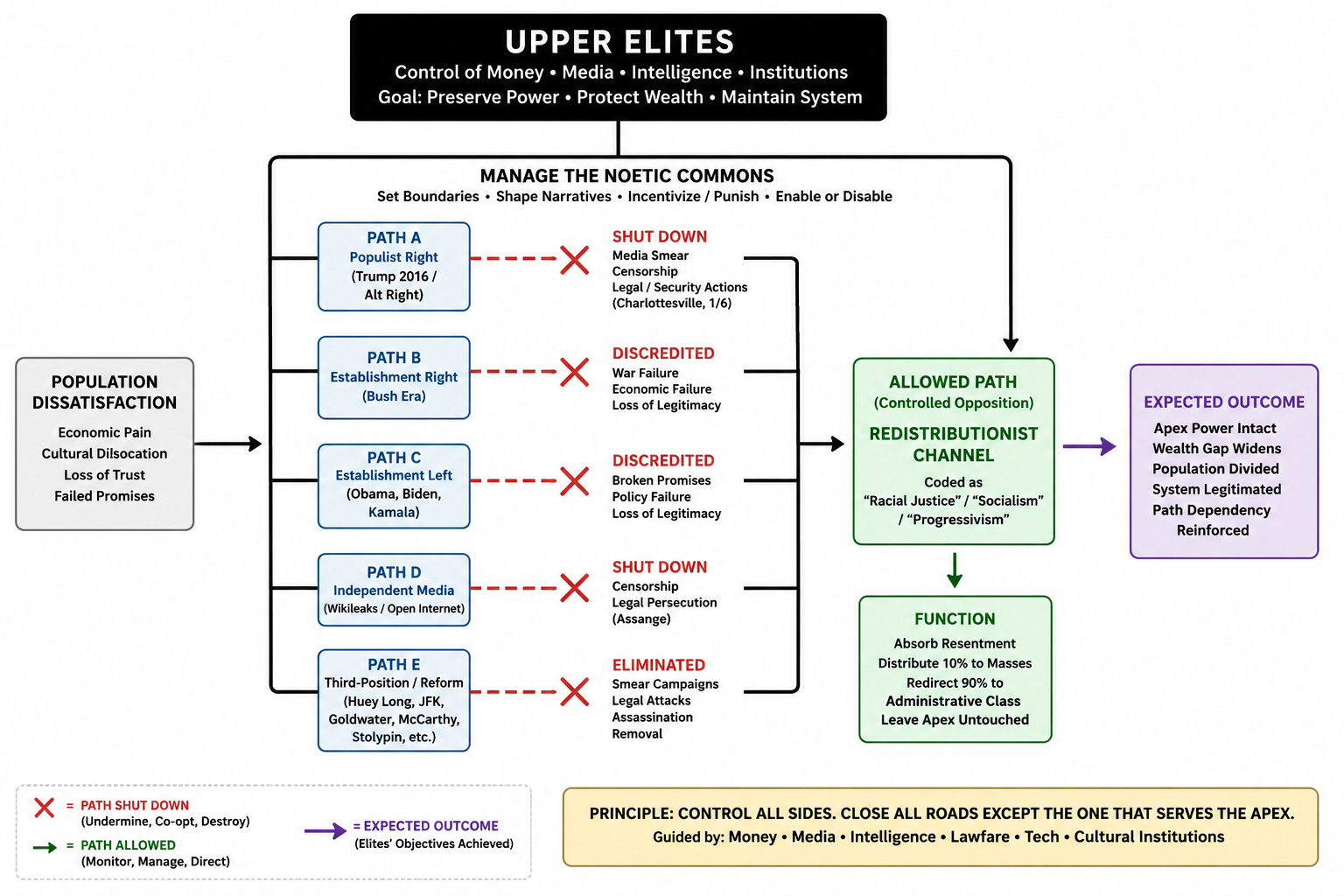
    The premise of this post – which is early as a prediction, given the DSA’s almost total lack of national presence at this time – is that the DSA’s rise is not organic but will likely be the next iteration of controlled opposition, selected and amplified by upper elites because it offers the population a redemptive narrative (class/race-based smash and grab) while leaving the apex of power untouched. Their purpose – as cyberneticist Stafford Beer argued, the purpose of a thing is what it does – is to distribute 90% of what is smash and grabbed1 to political and administrative class allies, the remaining 10% to the lower class, while leaving the area controlled a smoking ruin while blaming the victims for the area’s decline. This is roughly equivalent to “race communism” – identity-based expropriation, where demographic composition is leveraged to justify the kinetic liquidation of mid-tier capital.2 They are building locally before focusing on a national level, and this prediction is on a decades-level and not the next election cycle – per City Journal, “Rather than supporting candidates at the national level, the organization increasingly focuses on small, local elections. Races for city councils, state assemblies, and state senates often get scarce media attention but represent real opportunities for power that the DSA is increasingly seizing.” In other words, the DSA will absorb the kinetic energy of popular resentment, redistribute a small fraction of it, provide a larger fraction to allies, and leave the actual apex of capital entirely undisturbed. Just as the world today looks radically different than only a decade ago – the rise and fall of right-wing populism into a skinsuited monstrosity, the wealth gap increasing massively, the intentional restructuring of the Middle East, etc., the world a decade from now is likely to be far darker than what can be imagined in the present.

    To understand why the DSA’s rise is structurally overdetermined, one may look at it through the framework of the failing Western egregore. In previous essays, I established that the highest-layer egregore of the West has been fundamentally redemptive – first via Christianity (the privatio boni), and later via its secular mutations (liberalism, progressivism, communism, the arc of history bending toward justice). These redemptive egregores functioned as collective cybernetic regulators, offering meaning, belonging, and a narrative of ultimate resolution. But as the material evidence of their failure has accumulated, these egregores have entered a rupture phase. The stabilizers of the population are failing.

    The system, however, cannot tolerate a population that is entirely unregulated (and neither can most of the people themselves). It requires a new container to absorb the crucifixion of opposites. Enter the DSA. Its rise is structurally overdetermined by demographic shifts (increasingly black, brown, and far-left youth), economic concentration (the largest wealth gap in history), elite management of the noetic commons (alternatives have been systematically shut down), and worldwide declining energy return on energy invested (EROEI), which produces chaos and radicalization. But the DSA is not a socialist movement in a meaningful material sense; it is a redemptive egregore, a collective regulatory architecture emerging from shared attention toward a common symbolic object. It offers narrative meaning (”we are the truth-tellers fighting the oligarchy”), status (“let’s take what’s ours”), and esteem (”we are the brave ones”) to a cohort whose existing stabilizers (based on society and history as continued progress) have collapsed. But because it is a managed, apex-approved egregore, its regulatory architecture is intentionally capped. The DSA’s policies will not reduce the gap between the apex and the bottom; they will dramatically increase the gap between the apex and classes below them (much as occurred during COVID, for example3). This is the structural function of controlled opposition: to channel popular resentment into policies that eviscerate the more independently minded, business-owning upper-middle and upper class wealth ($2M–$1B+ net worth) while leaving the upper elites ($100B+) untouched, all in managed furtherance of the upper elite longterm plan toward the digital panopticon, neoliberal feudalism and Greater Israel, articulated in this prior three-part series.

    The controlled opposition thesis is not new – Mullins, Preparata, and others have described the mechanism in conventional political terms. What the egregore framework adds is a causal account of why the mechanism works so reliably: it works because the population is not passively manipulated into accepting a new container, it desperately generates the demand for one. When the Western redemptive egregore enters rupture phase – when the privatio boni promise (suffering is temporary, the arc bends toward justice, alignment with the Good is possible) fails to match lived experience – the psychic energy previously metabolized by that container becomes kinetically available. The apex does not create this energy, it captures and directs it. The DSA is a real expression of real resentment. What makes it controlled opposition is not that the resentment is fake but that the proposed solution is architecturally capped, designed to absorb the energy without redirecting it toward the actual apex of the system generating the resentment. Understanding this distinction matters because it explains why the DSA will feel authentic to its participants even as it performs its structural function. The energy is genuine while the container is managed.

    The policies that would actually decentralize power and restore local metabolic autonomy – evicting tens of millions of illegals, strong antitrust action against megacorps, disbanding the Federal Reserve, ending fractional reserve banking, rural development – are structurally impossible because they would threaten the apex directly.4 Therefore, the DSA is permitted, even encouraged, to grow. It is likely to be the next iteration of the pattern: a movement allowed to rise under observation, acting as a pressure valve for the meaning-regulated and esteem-regulated, ensuring that the actual levers of cybernetic control remain firmly in the hands of the apex, which will be ultimately absorbed, skinsuited, or destroyed depending on its utility to the apex network.

    Lets walk through the confluence of factors driving the DSA’s rise, the structural reasons its policies will fail to deliver what they promise, and what this reveals about the nature of elite control in the neoliberal feudal era.


    Factors Affecting the DSA’s Rise

    1. The American youth are increasingly black, brown, and far-leftist.By 2050, non-Hispanic White children are projected to comprise only 42% of the population age 5-17. The U.S., in other words, is rapidly becoming a “majority-minority nation” (an Orwellian expression), where the white youth is declining not just as a percentage but in absolute numbers.A recent national telephone and online survey found that 53% of likely U.S. voters 18-39 would like to see a democratic socialist candidate win the 2028 presidential election. Another recent Cato and YouGov survey shows that 62% of American adults under 30 hold a favorable view of socialism, with 34% showing favorable sentiments toward communism. This marks a steep climb from past polls, where a 2019 Gallup survey found only 52% of 18–34-year-olds had a favorable view of socialism. The shift is sharper among younger cohorts, a trend confirmed in multiple studies.
    2. This increased radicalization is due to a number of factors, including educational institutions that frame Western history primarily through narratives of oppression, immigration policies that have dramatically reshaped the demographic composition of the country (~20 million illegals let in under Biden administration alone, with relatively few deported under Trump), and cultural narratives that discourage family formation and traditional identity, collapsing birth rates. The effect is a generation that feels rootless, resentful, and open to radical redistributionist solutions. While socialism itself is not racially coded – Nordic countries like Denmark and Sweden have worker-led economies and strong safety nets – its use within the U.S. is anti-white encoded, encouraging group dynamics which the blogger Spandrell termed bioleninism and which he discussed in this 2018 post. This is why a 2022 Pew poll found socialism was viewed favorably by 52% of Black, 49% of Asian, and 41% of Hispanic respondents, compared to just 31% of white respondents.
    3. The rich/poor gap is the greatest it has ever been, tied in large part to unlimited monetary printing, with unstated but strong actual inflation at likely 10-20% per year, which fuels impulses toward smash and grab socialism – if you’re boxed out of careers, wealth building and home ownership, who cares if the system burns down? According to NPR, young Americans worry about inflation, housing costs, and economic stagnation, factors driving them toward options that promise security. At the same time, the loyalty of the boomer generation to the establishment is firm because of artificially inflated home values and locked in low interest rates, social security, Medicair and Medicaid, which are scheduled to run out of funds as they die.
    4. The stock market, despite being the highest of all time, is increasingly concentrated in only a small number of companies. If the bubble pops, boomers will demand whatever steps are necessary to re-inflate the bubble, as they live on the consumption derived from that bubble. They will demand action regardless of longterm consequences. A collapsing stock market will benefit the party out of power, i.e. Democrats. The bubble inflation/deflation strategy has been used in the 1929 crash to expand government and set the stage for World War 25, and in Japan to entrench a privately controlled central bank.
    5. Alternative solutions have been intentionally shut down by the elites. The “far right” perspective – Trump 2016, the alt right – has been intentionally shut down by the elites (Charlottesville, 1/6), and Trump 2.0 – heavily corrupt (with $1.4 billion in 2025 bribes via crypto alone and massive insider trading, with 3,600 stock trades in the first 3 months of 2026 alone), establishment-oriented and Zionist – is deeply unpopular, where Trump, despite a stock market at the highest of all time, has close to the lowest popularity of any time of his presidency.6 The media focus on his corruption is also intentional to further depress the right-wing base. The establishment right (Bush) had blown through its credibility, and the establishment left (Obama, Biden, Kamala) has as well; alternatives such as the open internet via Wikileaks were shut down with Julian Assange thrown into prison. Other observable patterns of network manipulation include the Tea Party movement, Occupy Wall Street, and even Facebook were allowed to grow under observation, then undermined, skin-suited, destroyed or absorbed once their utility was exhausted, but this is a long-running pattern from both the left and the right (Huey Long, JFK, Joseph McCarthy, Barry Goldwater, etc.). We will return to this point, but the upper elites guide society by weakening and shutting down disapproved alternatives to the path that they want a society or country to go down, and they’ve left no other path open other than race communism – the right is entirely dispirited. (This, too, perhaps explains the assassination of Charlie Kirk, who had enough brand strength and increasing independence to potentially initiate a civic nationalist, non-racial anti-Zionist movement – an alternative path forcibly shut down.)
    6. We can see inklings of the upper elite shift of funding and support toward the DSA based on Soros funding $40 million to Mamdani (also see here), the large funding differential in favor the DSA figure over the establishment figure in the Maine Senate election (despite Platner’s many controversies), based on intense Reddit bot astroturfing in favor of the DSA, etc. Follow the money; as Eustace Mullins pointed out, the upper elites control all public sides of an issue (the disapproved are banned from the public space and their funding totally cut off, like Andrew Anglin and Owen Benjamin, discussed in this three-part series, and so-called anti-establishment organizations are secretly controlled7), and they dictate who wins by increasing or decreasing funding.8 A savvy friend made this point in a more informal context.9 I would also note that the combination of nationwide vote-by-mail (which just received the stamp of approval by the Supreme Court) and ballot harvesting, which is easy to commit fraud via multiple vectors, along with extremely sophisticated information control on the internet via bot use, artificial intelligence, algorithmic sorting and narrative amplification or suppression via censorship intensely tips the scales in elite-approved directions.Alex Soros, son of billionaire megadonor George Soros, congratulates Mayor-elect Zohran Mamdani on his New York City election victory.
    7. Energy return on energy invested (EROEI) for oil and natural gas, which runs the modern world, continues its decline, while other natural resources continue toward exhaustion. EROEI used to be 100:1 and is quickly declining to 10:1. As EROEI declines, quality of life declines, which encourages chaos and radicalization. The Honest Sorcerer regularly covers declining EROEI problems, as does Grundvilk.
    8. The DSA’s specific ideological flavor serves a secondary, eschatological function for the apex network. In a previous series, I argued that multi-generational upper elites require a binding glue – a highest-order regulatory architecture – to maintain cohesion across decades. The framework that has passed the selection pressure for this specific apex network is one possessing three structural features: non-redemptive theology (power does not need to justify itself via outcomes), infinite interpretive flexibility (any action can be reframed as necessary), and ontological hierarchy (exploitable lower tiers without moral contradiction). This framework carries a specific eschatological checklist: the ingathering of the diaspora, the establishment of Greater Israel, and the rebuilding of the Third Temple. If the apex network is guided by the eschatological stabilizer described in the prior series, then the DSA’s specific function becomes legible as an operational input for that stabilizer. The DSA’s “race communism” and manufactured, ratcheting10 anti-semitism would therefore be seen as efficient effectuators for this checklist. Controlled anti-semitism, deniable as organic and grassroots, provides the precise kinetic pressure required to drive the diaspora back to the centralized hub, while the DSA’s anti-Israel posture provides the required political cover and plausible deniability for the apex network executing the expansion. This is not asserted as proven fact but as a structural corollary that follows from the premises of the earlier analysis.

    Analysis

    As mentioned in #5, the upper elites guide society by weakening and shutting down disapproved alternatives to the path that they want a society or country to go down, and the only available path they’ve left open is a redistributionist one that channels resentment into policies that eviscerate the upper-middle class while leaving the apex untouched. This path is coded as racial justice, but its structural function is the same.

    This brings to mind Lenin’s comments on Pyotr Stolypin, who I covered in the past, where he discussed the notion of societal developmental paths. After Stolypin – who was pursuing highly successful agricultural reforms benefitting Russia’s middle class – was assassinated, Lenin in the Paris newspaper “Social-Democrat” on 31 October 1911 wrote “Stolypin and the Revolution”, calling for the “mortification of the uber-lyncher”, saying: ″Stolypin tried to pour new wine into old bottles, to reshape the old autocracy into a bourgeois monarchy; and the failure of Stolypin’s policy is the failure of tsarism on this last, the last conceivable, road for tsarism.” He reiterated this in 1912 comments: “This ‘reform’, of course, gave dying serfdom a new lease of life…The “new lease of life” given by Stolypin to the old order and old feudal agriculture lies in the fact that another valve was opened, the last that could still be opened without expropriating all the landed estates.” Guido Preparata noted in his amazing Conjuring Hitler, discussed here, how the British and global capitalism intentionally worked to bring the Bolsheviks to power – financing the White opposition until undermining it – and to bring Hitler to power by undermining alternatives. This is, indeed, one of the primary functions of intelligence work – control all sides, undermine the disfavored sides, and clear the path for the favored side to play its role. The ongoing Ukraine/Russia war today can be seen as a slow-moving vehicle to move Russia toward fragmentation/disintegration by shutting down alternatives, a process which is far advanced.

    The parallel to the DSA is structural rather than ideological. Stolypin’s land reform represented the last available path that could have preserved the existing order while addressing genuine peasant resentment, and it was closed by assassination before it could succeed. The DSA represents the last available path that the apex is willing to permit for absorbing working-class resentment, and it is permitted precisely because it cannot succeed in the one way that would matter: it cannot close the wealth gap between the apex and everyone below it because doing so would require dismantling the fractional reserve banking system, the regulatory capture apparatus, and the asset-inflation mechanism that the apex’s position depends on. It is Stolypin’s reform in reverse: not the last road that could save the old order, but the last road that can be offered without threatening the new one.

    Meanwhile, the upper elites own the mass media apparatus that manipulates the noetic commons, determining where and how the public’s attention is directed. The public’s interest in Jeffrey Epstein has waned. The media has been instructed not to cover the aggressive expansion of Israel into Lebanon, or to discuss the Gaza ethnic cleanse. It was instructed not to cover the 20 million illegals funneled into the United States during Biden’s puppet regime, or the national vote-by-mail apparatus constructed during the fraud of COVID. The noetic commons is managed not primarily through censorship of disapproved content, though that occurs, but through differential amplification: approved narratives receive algorithmic promotion, funding, institutional validation, and media repetition; disapproved narratives are not banned but starved of the attention infrastructure that would allow them to form stable egregores of their own. The DSA is increasingly benefiting from this differential amplification while its opponents on both the genuine left and the genuine right do not. The masses will accept any and all of the circular media amplification lies because underneath it all lies the horrors of the Void, and people will do anything in their power to avoid thinking about it, no matter if the sound and fury is detrimental to one’s interests.11


    Conclusion

    Those who have great wealth and mobility will be able to avoid the consequences of increasing DSA race communism. For example, on California’s ballot for 2026 is a “billionaire tax” retroactive to January 1, yet Google co-founders Sergey Brin and Larry Page shifted their assets out of the state, while Brin cut his New York losses for six cents on the dollar (while among the most wealthy individuals in the world, they do not come close to upper elite Rothschild and co. wealth, discussed by esc here, whose power does not require shifting wealth around in this manner, it is embedded in the structure of the financial network itself). Gavin Newsom whined that such policies needed to be implemented on a national level or it would result in continued wealth fleeing the state, which is true, but these same ultra-wealthy individuals will flee the country before allowing their wealth to be taxed (although they will park their wealth in tax-free states like Florida in the meantime).

    The falsifiable predictions embedded in this analysis and necessary for my recursive prediction model are specific. Over the next decade DSA candidates will continue winning local and then state-level offices, funded by a coalition that includes nominally anti-establishment money. Their policies where implemented will follow the COVID template – dramatically concentrating wealth at the apex while appearing to target it, with administrative class intermediaries capturing the majority of redistributed resources. The wealth gap between the apex ($100B+) and the upper-middle and upper classes ($2M-$1B) will increase under DSA governance, not decrease. The apex will not be meaningfully taxed, regulated, or threatened by any DSA policy in any jurisdiction where the DSA achieves power. If these predictions fail – if DSA governance produces genuine wealth redistribution that closes the gap between the apex and everyone below it – the controlled opposition thesis is wrong and will be updated accordingly.

    Furthermore, as a structural correlate of this alignment, DSA governance will implicitly or explicitly facilitate the conditions required by the apex network’s eschatological stabilizer: DSA-led municipalities will be at the forefront of dismantling local security and social cohesion in ways that accelerate diaspora Jewish out-migration toward the centralized hub, while DSA foreign policy postures will be weaponized to provide political cover for the expansion of Greater Israel, even as DSA grassroots rhetoric professes opposition to it.

    This analysis does not imply that DSA voters or participants are stupid, evil, or uniquely manipulated. The resentment driving DSA support is accurate as a diagnosis – the wealth gap is real, the system is predatory, the existing alternatives have failed or been closed. The framework explains why this accurate diagnosis is being channeled into a solution architecturally incapable of addressing it, and why that channeling serves the interests of the apex being diagnosed. The participants are not wrong about the problem, they are being offered a solution that preserves the problem while providing the psychological satisfaction of resistance. This is the standard function of controlled opposition in any historical period, and it requires participants who are genuinely aggrieved, not manufactured ones.

    The uncomfortable implication of the egregore framework applied here is that there is no clean exit from this dynamic at the collective level. The population requires a container for the crucifixion of opposites, and when one container fails another will be provided or spontaneously generated. The DSA will either be absorbed into the system – as Occupy Wall Street was, as the Tea Party was, as the alt-right was – or it will be permitted to implement enough policy to further undermine the upper middle and upper class (but not the apex) before being replaced by the next managed alternative (if it ever morphs to threatening the apex it will be destroyed, much as Stalin was assassinated for increasingly asserting disapproved authority). The apex does not need to win every political battle, it only needs to ensure that no political formation capable of threatening it is permitted to reach sufficient scale and coherence before being redirected, undermined, or absorbed; advances in artificial intelligence have dramatically increased the upper elites’ ability to undermine threats and advance their agenda by increasing the variety of information they can assess (Ashby’s law). That is not a counsel of despair, it is a structural description of how the system maintains itself, and accurate description is the precondition for any response more useful than the managed ones on offer. Meanwhile, the Rothschild neoliberal feudalism noose continues to tighten worldwide, and in Canada leaders can now force dissidents off the internet permanently without a warrant or oversight at whim.

    Subscribe:
    Email delivery remains on Substack for now.


    1

    Per City Journal: “Electing more DSA candidates to office would translate into easier and broader implementation of similar policies pushed by the group: even higher taxes on top earners (an already disastrous experiment in California), expanded environmental regulations that may come at the expense of blue-collar employment, reduced funding for policing, the expansion of sanctuary policies, and further efforts at decarceration. It would also likely include additional “affordable housing” measures that risk constraining supply and increasing overall market costs. In effect, without meaningful checks, these policies could compound and place significant strain on the city’s fiscal and economic stability, while also contributing to a broader cultural shift that cultivates contempt for capitalism and American exceptionalism—positions associated with the DSA.”

    2

    In every major civilizational transition, the ruling elite has weaponized the society’s most sensitive internal fracture as the vehicle for redistributive control. In Rome, the fracture was class and material deprivation; Christianity provided a spiritual hierarchy that inverted earthly status – the poor in spirit inherit the kingdom, the rich man passes through the eye of the needle – while the material order remained largely intact. In the Russian Empire, the fracture was class and economic serfdom; communism promised the abolition of class hierarchy while installing a new administrative class that was more extractive than the old. In the contemporary West, the fracture is race – the historical guilt of colonialism and slavery, the demographic churn of mass immigration, the educational narrative of systemic oppression – and the DSA represents the political vehicle that promises to resolve this fracture through redistribution while leaving the actual apex of wealth untouched. Each iteration presents itself as liberation while performing the same structural function: absorbing popular resentment, extracting resources from the middle tiers, and centralizing power at the apex under a new legitimating narrative. The label is inflammatory, but the pattern is historical.

    3

    Small and mid sized business were forcibly shut down while multinational organizations continued to operate; $13 trillion dollars was printed with the vast majority of it funneled to the ultra-rich.

    4

    The three features are explained in detail in Part 1. The key distinction is that this is a structural argument about selection pressure, not an ethnic argument about Jewish control. Elites of any background seeking maximum legitimation efficiency would converge on this framework.

    5

    “Paul Warburg arranged the 1929 stock market crash; first he advised all member banks to get out of the stock market or sell it short on March 9, 1929, then on October 24 the Federal Reserve Bank suddenly increased the rediscount rate to 6%, thousands of orders hit the exchange to sell “at market”, and six days later the Federal Reserve Bank ordered the contraction of brokers’ loans in the amount of $2.3 million, the combination of which caused the crash. Congressman Louis T. McFadden stated “It was a carefully contrived occurrence. The international [central] bankers sought to bring about a condition of despair so that they might emerge as the rulers of us all.””

    6

    As argued previously, my working assumption is that there is and was a backroom deal made in early 2024; all of Trump’s criminal and civil trials magically disappeared after Ron Desantis flamed out in his presidential run, and after his victory he immediately gutted enforcement agencies and engaged in a multi-billion dollar cryptocurrency graft, pay-for-play presidential pardons, and massive, billions of dollars worth of insider stock market trading. He also reached a “deal” with the IRS where the IRS never audit his actions in the future. In return for this intense criminal bribery he agreed to destroy the right-wing populist movement and further the Greater Israel project.

    7

    I think of Breitbart.com, controlled by Steve Bannon during the 2016 election, who turned out to be deeply embedded within the Jeffrey Epstein nexus; or consider the John Birsch society, seen as radically anti-establishment during the Vietnam War, where its co-founder Revilo P. Oliver bitterly complained that its head Robert Welch reported to Zionist handlers, while Welch’s apparently non-controlled successor Larry McDonald was blown out of the sky by the Soviets, I assume under the orders of the upper elites.

    8

    Mullins wrote that the central bank owners

    adopted the Hegelian dialectic, the dialectic of materialism, which regards the World as Power, and the World as Reality. It denies all other powers and all other realities. It functions on the principle of thesis, antithesis and a synthesis…Thus the World Order organizes and finances Jewish groups; it then organizes and finances anti-Jewish groups; it organizes Communist groups; it then organizes and finances anti-Communist groups. It is not necessary for the Order to throw these groups against each other; they seek each other out like heat-seeking missiles and try to destroy each other. By controlling the size and resources of each group, the World Order can always predetermine the outcome. In this technique, members of the World Order are often identified with one side or the other. John Foster Dulles arranged financing for Hitler, but he was never a Nazi. David Rockefeller may be cheered in Moscow, but he is not a Communist…a distinguishing trait of a member of the World Order, although it may not be admitted, is that he does not believe in anything but the World Order. Another distinguishing trait is his absolute contempt for anyone who actually believes in the tenets of Communism, Zionism, Christianity, or any national, religious or fraternal group…If you are a sincere Christian, Zionist or Moslem, the World Order regards you as a moron unworthy of respect. You can and will be used, but you will never be respected.

    9

    He wrote: “Globohomo has two main camps, the “left” open borders types and the “right” comically Zionist types. The right is having its turn with Trump, a gigantic corrupt Zionist puppet. Next turn will be the left open borders crowd. They already had four years of totally open borders under Biden, illegals all waved in like a third base coach and provided tons of free benefits, extreme overcrowding in cities, I think many people have already forgotten. So when they get to go again they’re going to take the anti white rhetoric to unseen new extreme heights, and go to increase the size and power of government regarding confiscation of private property. The best way to make this look legitimate to the masses is through this narrative that traditional Democrats are losing power to the “progressives” and this is being fueled grassroots from disaffected young people tired of the old corrupt democrat establishment. So globohomo is pouring resources to prop up these “progressives” aka DSA types all over the country.”

    10

    The forced sale of TikTok was not meant to entirely purge anti-semitism from the platform, but rather to give increased control to the upper elites who could decide how fast or slow to ratchet it for their purposes. The same applies to the universities forced into line with $100 million of “pro bono” legal aid provided by top law firms to pressure them.

    11

    As argued here, I do not believe I am special or better than the masses for offloading the crucifixion of opposites and being distracted by sound and fury. The reason for this is that the offloading frees up massive psychic space to focus on living life and other activities; holding the crucifixion of opposites internally is massively energy intensive and I wouldn’t be doing it if the psychosomatic buildup in my body didn’t require me to, based on threshold dynamics.

  • The Egregore and the God-Image: A Cybernetic Account

    An egregore is a collective regulatory architecture that emerges from shared attention toward a common symbolic object, exerts back-pressure on individual god-images, and follows predictable feedback loop dynamics of growth, saturation, and rupture. This essay applies the cybernetic framework developed in prior posts to explain how the Christian egregore is failing, why the Aquarian transition pushes toward individual rather than collective differentiation, and what the installation of a new apex regulatory variable – whether the Federal Reserve or CBDC infrastructure – reveals about how supreme egregores are built.

    Welcome back. In my recent post I discussed human energy flow and organization in cybernetic terms, arguing that there is a four-pronged differentiation between movement (how psychic force moves, where does energy go?), metabolism (how expensive different energetic operations are, what is the cost of moving that energy?), regulation (what the psyche ultimately protects, why do we move the energy, what is the homeostatic goal?), and orientation (the highest-order regulatory architecture governing the stabilizers themselves, what reality is the psyche orienting towards?). This process is cybernetic in the sense that each layer impacts the other layers, which affects them back in turn. Mental illness, depression, lethargy, and dissatisfaction are to some degree caused by improper or deficient synching of the various layers, and mental health therapeutics do not differentiate between these layers, leading regularly to improper and failed interventions.

    The highest layer of orientation relates to the God image, our highest order individual beliefs which presupposes thought itself and which Wittgenstein refers to as a hinge proposition (i.e. what must be in place for doubt to be possible, the beliefs that humans carry that shape the presuppositions that go into the thought form itself). All beliefs nested under the God image are impacted by the top layer beliefs, which in turn interact with reality and from those interactions either sync with or put pressure back on the God image. It looks like this:

    Brett Andersen did a good job of explaining nested hierarchical beliefs in scientific terms here and here, which I have discussed before.

    Humans are social creatures, and the specific God image of an individual is not a fixed organizing principle. Instead, it is installed during childhood and is shaped by the relationship to the parents, by genetics, perhaps by astrological influences, and by broader society. A God image forms as a psychic regulatory tool – it screens reality in order to filter out the “noise” of competing/alternate perspectives so that one can more efficiently live the life one has been exposed to.

    From a cybernetic perspective, the God image can be seen as a kind of regulator of the human machine, where it tries to maintain homeostasis and equilibrium. This system functions in equilibrium if or until received perceptual data so off-kilters the God image (because they don’t match) that pressure requires implementing a God image substitute to restore equilibrium (my case), sort of like how a system regulator can only regulate a system if it has sufficient variety (Ashby’s law). One’s God image may change in life – although such change is very difficult, as it results in a reorganization of all nested beliefs under the top layer, and also impacts one’s fundamental thought processes and perceptive abilities.

    A shared, collective vision of a specific God image or lesser belief is called an egregore, and it shapes the noetic commons which animates society and serves as the topic of today’s post. I read Egregores: The Occult Entities That Watch Over Human Destiny (2018) by Mark Stavish, but it is not very good and I don’t really recommend it, although it close to the only book on Amazon relating to the topic. While well written, it neglects psychology, group dynamics, how egregores evolve over time, and more importantly how the concept relates to cybernetics, so it is incomplete; it is also too occult focused for my taste, which confuses more than it clarifies. The following analysis utilizes his insights only to a minor degree.


    The God-image vs. Egregore

    The god-image and egregores are related but different concepts. The god-image is intrapsychic and individual, serving as the highest-order organizing principle that structures how a particular person metabolizes reality, filters experience, and assigns meaning. The egregore, alternatively, is intersubjective and collective – it’s the emergent thoughtform generated by many individuals sharing sufficiently similar god-images (or beliefs lesser than god-images; a football team is an egregore as is a political party, just lesser forms), which then takes on a kind of autonomous existence and exerts back-pressure on individual god-images, pulling them toward conformity with the collective form. The directionality is what makes them distinct: the god-image is a lens through which an individual sees; the egregore is a field that individual lenses collectively generate and are then partially shaped by. One is constitutive of personal perception, the other is an emergent property of aggregated perception that becomes semi-independent of any individual contributor.

    An egregore is also not the same thing as a Jungian archetype1, and while occultists2 and others3 see the egregore as a “real” entity, such beliefs are not relevant to analyzing its regulatory purpose for collectives. Rather, an egregore relates to the concept of how beliefs between people seem to act on a higher plane even without the individuals’ knowledge, impacting them in subtle and unconscious ways. For example, the Gospels mention “When two or more are gathered in my name, I will be in the midst of them.” This speaks to the idea that a collective ‘mind’ or consciousness can emerge whenever a group of individuals unite and it can dissolve just as easily when the group disperses. In such moments, the individuals are no longer just acting as separate entities – they become part of something larger which can influence their thoughts, decisions, and actions. Napoleon Hill touched on this concept in Think and Grow Rich, where he stated: “The coordination of knowledge and effort of two or more people, who work toward a definite purpose, in the spirit of harmony…No two minds ever come together without thereby creating a third, invisible, intangible force, which may be likened to a third mind.” Traditionalist philosopher René Guénon believed “the collective, in its psychic as well as its corporeal aspects, is nothing but a simple extension of the individual, and thus has absolutely nothing transcendent with respect to it, as opposed to spiritual influences, which are of a wholly different order.” He even believed that prayer is not directly addressed to spiritual entities such as gods or angels, but rather, “consciously or not, addresses itself most immediately to the collective entity, and it is only by the intermediary of this latter that it also addresses the spiritual influence that works through it.” And L.P. Koch argues, without naming the concept, that one cannot understand the thought pattern of another without understanding the egregores to which he is attached:

    What if the other person doesn’t have access to the thought form in question? Then communication can’t succeed. The person may lack the experience to make sense of what we said — experience not just in the sense of having lived through something, but also of having thought certain things, felt certain things while thinking about it, and so on. He therefore can’t channel the information from the cloud, so to speak; it is being that opens us up to that information, and if we lack the being, we will be blocked.


    Egregore Formation

    An egregore forms when sufficient individuals direct attention toward a shared symbolic object – a god, a nation, a team, an ideology – and that shared attention generates a field that in turn shapes what those individuals attend to next. This is a second-order cybernetic process in the von Foerster sense: the observers are partly constituted by what they collectively observe, and the observed field is partly constituted by the observers’ attention. The egregore is the emergent regulatory architecture that arises from collective action feedback loops.

    An egregore emerges from many individual god-images oriented toward a common symbolic object, yet once formed it develops regulatory properties of its own. In this sense, an egregore may be understood not as a supernatural entity but as a collective-scale regulatory architecture. The god-image regulates the individual; the egregore regulates the social field. Each recursively shapes the other.

    The highest layer egregores of Western civilization have been a redemptive one since the end of Hellenism, either via Christianity (privatio boni/God as all good, evil as a deprivation of God, humanity’s role to get closer to God), its Abrahamic competition running a parallel, competing redemptive egregore, or secular permutations which rely on some form of history-as-progress (democracy, socialism, communism, atheism). As I wrote in a Note, the biggest difference in perspective is not between any particular redemptive religion or ideology, but between redemptive and non-redemptive worldviews as categories.

    The argument is that egregores function as collective cybernetic regulators analogous to individual god-images, that the Christian egregore is and has been in its rupture phase for a very long time (echoes of Nietzsche’s “death of God”), that the Aquarian transition pushes individuals toward the individuation process rather than a new mass egregore (discussed here), while at the same time the Jewish egregore is on the verge of fulfilling its eschatology based on a checklist model for the upper elites, previously discussed in this three part series. Understanding how egregores are created, grow, and fail is an important piece of the puzzle necessary for framing ongoing developments, human nature, and underlying reality itself.


    The Feedback Loop

    Each egregore is partial and differentiated and does not comprise something like Abraxas/totality. Because of this, there must be elements excluded from the egregore as boundary line-drawing; what is rejected by the egregore results in a collective shadow which builds pressure, pressure which eventually results in marginal failures which precede eventual systemic rupture. The feedback loop has three phases that map onto the God-image change dynamics:

    1. The growth phase: Shared attention toward an egregore generates the field, the field amplifies the shared symbolic object, more individuals are drawn in because the field provides psychic stability, and their attention further amplifies the field. This is a positive feedback loop – self-reinforcing, expansive, energetically cheap for participants because the field does much of the regulatory work. The individual doesn’t have to hold the crucifixion of opposites internally; the egregore holds it collectively in the form of doctrine, ritual, and shared narrative. People don’t just join egregores because they’re convinced by the ideas; they join because the egregore offers regulation for a destabilized psyche caused by the failure of prior egregores.The stabilizer framework explains this: when a primary stabilizer is failing, latching onto an active egregore that metabolizes that failure (by offering belonging, meaning, control, esteem, or coherence) becomes extremely attractive. Egregores also exert back-pressure on deviant god-images, enforcing conformity through language, institutional power, economic incentives, and the somatic markers of shame/ostracism. When an individual’s god-image deviates from the egregore, the egregore’s carriers (other people) react with confusion, hostility, or exclusion. That social friction is internalized by the individual as somatic anxiety (the feeling of being “out of sync”), as loneliness or being incomprehensible, which adds further incentive to join the expanding egregore.Ashby’s law of requisite variety applies here in an interesting way. The egregore must have sufficient internal complexity to metabolize the variety of experiences its members bring to it. A too-simple egregore – a football team, a political party – can only metabolize a narrow range of experience. A complex egregore such as Christianity at its peak or Yahwist Judaism over millennia can metabolize enormous variety: suffering, triumph, theodicy, community, individual salvation, collective destiny. The more complex the egregore, the more experience it can absorb without breaking down, and the more psychically stabilizing it is for its members. Furthermore, an egregore can form around a god-image or around a lower-order stabilizer (attachment to a sports team, esteem from a political party)4, but lower-order egregores are parasitic on higher-order ones for their ultimate motivational power. A football team egregore works because belonging and esteem are already regulated within a broader cultural frame that values competition, achievement, and collective identity; if that broader frame collapses, the football egregore hollows out. So the hierarchy is nested.5
    2. The saturation phase: The egregore has absorbed so much variety that it begins suppressing the elements that don’t fit its regulatory architecture.6 The suppressed material accumulates in the collective shadow, which is everything the egregore cannot metabolize without fracturing its coherence. For Christianity this was the problem of evil, the status of women, the tension between individual experience and doctrinal authority, and the suppressed Hellenic naturalistic impulse. The suppressed material doesn’t disappear; instead, it builds pressure beneath the surface.
    3. The rupture phase: The accumulated shadow exceeds the egregore’s capacity to suppress it. The regulatory architecture begins failing – the material destruction of symbols and institutions is one mechanism7, but egregores can also fade through neglect (declining attention, not active destruction). The Christian egregore in Europe today isn’t being smashed, it’s being ignored, with attention withdrawal rather than from opposition. The cybernetic model explains this as attention is the energy source where withdrawal starves the feedback loop. The failure occurs for some members first, then progressively more; those on the margins whose experience was never adequately metabolized by the egregore first begin seeking alternatives, and new symbolic forms emerge that can metabolize what the old egregore suppressed. The new forms draw in those for whom the old egregore had already failed, gain enough collective attention to form their own feedback loops, and eventually become alternative or successor egregores.8

    The Hellenic material that Christianity suppressed is relevant here. The Hellenic egregore had metabolized tragedy, the plurality of gods including destructive and erotic ones, the acceptance of fate without cosmic justice, the heroic confrontation with mortality, and the body as a site of legitimate experience rather than suspect desire. Christianity suppressed all of this under the privatio boni with evil as absence, the body as suspect, the plural gods as demons, fate as providence, and tragedy as temporary affliction awaiting redemption. Two thousand years of suppression has accumulated an enormous shadow. The return of the suppressed Hellenic material is a way of reading the current cultural moment: the resurgence of new forms of paganism, polytheism, embodiment spirituality, tragic worldviews, the interest in mythology and the gods, and the specific appeal of non-redemptive frameworks to constitutions for whom the Christian egregore has failed (Jungianism, Hillman-esque internal polytheism, tragedy as seen in such entertainment as Game of Thrones and Breaking Bad come to mind, along with Wicked).

    The shadow of Christianity is partly the pre-Christian worldview that Christianity displaced and suppressed, returning now as the Christian egregore loses its regulatory power over an increasing portion of the population. The suppressed material returns through different forms conditioned by the intervening period rather than as a direct reproduction of what was suppressed – it’s not a boomerang effect – therefore I do not expect the re-emergence of Christianity’s shadow to mirror what Christianity superseded and suppressed. What Christianity suppressed seems to return as the recognition of these energies within the psyche as interior functional realities rather than external gods along with the individuation process.


    The noetic commons and elite arbitrage

    The noetic commons – the shared background of assumptions, values, and perceptual filters that makes collective cognition possible – is shaped by the egregores that animate a society. When a supreme egregore such as Christianity or secular progressivism dominates the noetic commons, it provides a stable regulatory field within which individuals and institutions coordinate. Most people operate inside this field, their god-images aligned with the egregore’s requirements, and their stabilizers are metabolized by its narratives and rituals.

    But elites have discovered something the framework makes explicit: one can operate outside the egregore’s constraints while still extracting its coordination benefits. This is regulatory arbitrage, using the stability provided by the collective field while refusing to bear the individual costs of alignment. The elite globalist class, for example, rhetorically supports progressive values (belonging, meaning, equity) while their actual behavior (wealth extraction, surveillance infrastructure, population management) contradicts those values. They are not stabilized by the egregore they publicly defend; they parasitize it. They do not believe the narratives they promote; they treat them as control tools for the non-elite. This is a natural function of the incentive structure governing the upper elites.

    The egregore framework explains why this arbitrage is possible and why it eventually destabilizes the system. The egregore requires genuine belief and attention from a critical mass of participants to maintain its regulatory function. When elites simulate belief while privately operating under a different god-image, they drain the egregore’s energy without replenishing it. The shadow material they suppress – their own cynical non-belief, their extractive behavior, their contempt for the narratives – accumulates in the collective unconscious. When the non-elite eventually register the mismatch between the egregore’s promise and the elite’s behavior, the rupture phase accelerates. The noetic commons hollows out from the top down.


    The Christianity case and the Federal Reserve parallel

    There is a Federal Reserve parallel here which I think is relevant. Christianity succeeded not by having a fully worked-out theology at the point of its emergence but by installing Yahweh at the center of the gentile world – putting the Jewish God-image at the apex of what would become the Western egregore – and then allowing the details to be filled in over centuries through councils, heresies, and doctrinal development, discussed long ago here. The core regulatory function was established first, and the elaboration followed.9

    This is exactly how the Federal Reserve worked: the principle of central banking as the apex of the financial system was established by the 1913 Act, and the specific mechanisms of control – the ability to expand and contract credit, the relationships with primary dealers, the lender-of-last-resort function, the eventual abandonment of gold convertibility – were elaborated over decades through amendments and crises. The cybernetic description of this is that both Christianity and the Federal Reserve achieved what Ashby called the installation of an essential variable as the highest-order regulator of a complex system. Once the essential variable is installed at the apex, the rest of the system reorganizes around it. Displacing it requires displacing the entire regulatory architecture it has organized, which is why both institutional Christianity and central banking are so resistant to reform: you can’t just change the policy or the doctrine without addressing the apex regulatory position that makes all the other positions cohere.

    I expect the upcoming central bank digital currency (CBDC) infrastructure will follow this cybernetic logic: installing the apex regulatory variable (the digital ledger) first, and subsequently expanding its regulatory reach to eliminate alternative metabolic pathways (i.e., physical cash), thereby closing the system’s requisite variety until only state-approved transactions remain possible.


    The Jewish eschatological egregore

    The Western supreme egregore has been Christian/secular-progressive for two millennia, but it has never been the only supreme egregore operating in the same geographical and civilizational space. The Jewish egregore – rooted in the Yahwist covenant, the Torah, the chosenness narrative, and the messianic promise – has run in parallel, partially assimilated, partially resistant, always maintaining its own regulatory architecture for those whose primary stabilizers aligned with its demands.

    What makes the Jewish egregore distinctive is its checklist eschatology. Unlike Christianity, which frames redemption as a passive gift (grace, faith, salvation through Christ), the Jewish messianic framework requires active completion of specific preconditions. These include: ingathering of exiles (Greater Israel), rebuilding of the Temple, establishment of universal Noahide laws as the moral baseline for all humanity, and the restoration of the Davidic line. This is not allegorical; for a significant portion of the religious Jewish population – and, I have argued, for the upper-elite secular Jewish network that coordinates global governance – these are concrete, actionable goals.

    The egregore framework illuminates this structure: the eschatological checklist is the ritual completion required for the Jewish egregore to achieve its highest regulatory closure. The egregore’s feedback loop – shared attention to Torah, Temple, land, law – has been sustained for millennia. But a feedback loop that never terminates accumulates pressure. The messianic endpoint is the termination condition that would either (a) fulfill the egregore and dissolve it into its telos, or (b) transform it into something new. The active pursuit of the checklist (settlements, Temple Institute preparations, Noahide legislation in various countries) is egregoric maintenance and acceleration. It feeds the collective thoughtform with the specific variety it requires to complete its cycle. As the Christian egregore enters rupture phase, the Jewish egregore’s checklist accelerates, because the dominant regulatory field no longer has the requisite variety to absorb or redirect it.


    Unresolved questions

    There are many unresolved questions here which are addressable within the cybernetic frame with varying degrees of certainty. Let’s go through some of them.

    1. Can one group have multiple egregores? Yes, and the tension between them is a form of intragroup regulatory conflict. Consider Catholicism vs. Protestantism, or Christianity vs. Mormonism, or Orthodox religious Jews vs. secular leftist Jews – these groups may share certain deep cultural-genetic inheritances, but have organized different mid-level egregores around those inheritances. The question of whether they share one egregore with internal variation or constitute genuinely distinct egregores is answerable by asking whether their regulatory architectures can be unified under a single set of highest-level premises. Orthodox religious Jews and secular leftist Jews have a shared and intense cultural perspective of perceived oppression and trauma leading to shared ethnic solidarity, but their God images appear different; the former with a tribal, wrathful God of the covenant and Chosenness, the latter with a perspective that veers toward a redemptive tribal secular materialism.
    2. Can the egregore of the same group change? Yes. The evolution of Judaism after the destruction of the Second Temple is the clearest historical example of egregores changing – the egregore lost its Temple-based ritual architecture and reorganized around Torah, text, and diaspora community, preserving its feedback loop through a radical structural transformation.
    3. What role does genetics play? The genetics question is the most politically sensitive and the most genuinely uncertain. The constitutional differences between groups – what the energy typology essay calls different metabolic profiles, what Maurice Samuel was gesturing at with his Gentile/Jewish distinction10 – may mean that certain egregores are more metabolically compatible with certain constitutional types than others. This doesn’t require any strong essentialist claim about genetic determination of worldview, it only requires the claim that constitutional variation is real, that it clusters in ways that correlate with ancestry and upbringing, and that egregores that fit the constitutional profile of their primary carriers are more stable than those that require ongoing suppression of constitutional tendencies that conflict with the egregore’s regulatory requirements. In other words, different populations may have different distributions of constitutional types, and egregores that fit the modal type of a population are more stable; this also explains the re-emergence of the God Wotan in the German psyche leading up to World War 2.11 The Hellenic egregore was more constitutionally compatible with the athletic, fate-accepting, pluralistic Hellenic temperament than with the exacting, duty-oriented, covenantal Jewish temperament. Neither is superior, they are constitutionally different in ways that map onto different egregore compatibility.
    4. Does the egregore exist independently or only as a collective idea? This is a question the essay leaves open. What the cybernetic frame says is that whether or not the egregore has independent ontological existence, it has real functional existence – it produces measurable effects on individual god-images, social organization, motivational structures, and collective action. The functional reality is what matters for the framework’s purposes. The ontological question can remain indeterminate without undermining any of the practical claims.

    Conclusion

    The Aquarian transition functions in a sense as an egregore rupture, much as the transition to Pisces ruptured the Hellenism egregore. The Christian egregore is failing, the margins are being pressured in all sorts of novel ways, and whether the Aquarian moment inherently pushes toward a new collective egregore formation or a novel individual god-image differentiation is an unresolved question.

    This last question is the most interesting for the project. The Abraxian framework produces individual regulatory architectures that are constitutionally incompatible with mass egregore formation – it can’t generate the shared redemptive narrative that gives an egregore its mobilizing power without fundamentally undermining what the framework represents. This means the framework cannot produce a successor egregore to Christianity. This is not a mark of superiority; the inability to generate collective field is both a substantial cost while offering protective coating against instrumentalization or co-option for ulterior purposes. What it can produce is a small number of constitutionally specific individuals whose god-images are no longer organized by the failing Christian egregore, navigating without collective field support, carrying their own psychic weight in the Aquarian mode. The constitutionally specific individuals navigating without collective field support are the test case for whether human psychic life can sustain itself without egregoric regulation at all. The answer can only be known longitudinally, through whether what they find on the other side coheres.

    Subscribe:
    Email delivery remains on Substack for now.


    1

    Archetypes as defined by Jung are not collective thought-forms generated by attention, but transpersonal patterns that appear to precede individual consciousness and shape symbolic experience from below. Egregores, by contrast, emerge from the recursive interaction of many individuals oriented toward a common symbolic object. If archetypes move from depth toward manifestation, egregores move from manifestation toward collective stabilization. The two may interact, but they are not identical phenomena.

    2

    Egregore is Greek in origin and derives from egregoros, meaning “wakeful” or “watcher”, and is included in the Book of Enoch describing an angelic being. Occultists define the egregore variously: (1) as an autonomous psychic entity which is shaped by and influences the thoughts of a group of people, (2) as a channel for nonhuman intelligence, linking invisible realms with our material world, or (3) as a collective entity embodying a nation or faith that exists not only in the physical bodies of its members but also in their astral and mental states (Mouni Sadhu’s view). In all cases, the common theme is a psychic force larger than the individual but dependent on collective attention.

    3

    As Joscelyn Godwin wrote in The Golden Thread, “The important point is that an egregore is augmented by human belief, ritual, and especially by sacrifice. If it is sufficiently nourished by such energies, the egregore can take on a life of its own and appear to be an independent, personal divinity, with a limited power on behalf of its devotees and an unlimited appetite for further devotion. It is then believed to be an immortal god or goddess an angel, or a daimon.”

    4

    According to Mark Stavish, “egregores are anthropomorphized images of the concept at hand. For instance, peace, war, love, wealth and nation are all just ideas that are created through visualization and vitalized through regular ritualized emotion, and finally made concrete through a specialized sign or symbol. These signs or symbols are no different from the logo of a company, brand, or product, which are themselves lesser or greater egregores. Just as a logo acts as a form of legal protection for the company and its employees who work together for a common cause, so too does the sigillum (magical sign or seal) of an egregore act as an identifying, guiding, and protecting force for its members.”

    5

    Using the football team egregore example, a football team operates primarily on esteem and belonging stabilizers. It metabolizes the need for collective identity, competitive tension, and communal experience of victory and defeat. It does not address the problem of evil, the meaning of suffering, the question of what happens after death, or the structure of the cosmos. Its regulatory reach is shallow. When it fails – when the team loses chronically, when the sport loses cultural relevance, when the individual ages out of the emotional intensity – the collapse is real but limited. The individual can find another team, another sport, another shallow egregore. The deeper stabilizers are not threatened.

    On the other hand, a God-image level egregore (Christianity, Yahwist Judaism, secular progressivism) reaches all the way to the highest regulatory level, and its failure produces the kind of systemic destabilization the Regulatory Architecture essay and Stabilizers essay describe: regulatory collapse that propagates downward through meaning, identity, motivation, embodiment, and relational orientation. The difference in severity between losing faith in your football team and losing faith in your God-image is the difference in regulatory depth the two egregores occupy.

    This gives one a structural hierarchy: egregores range from shallow (sports teams, political parties, consumer brands) to deep (national identities, ethnic traditions, religious frameworks) to supreme (God-image level egregores that reach the highest regulatory architecture). Deeper egregores are harder to form, more metabolically efficient once formed, more psychically stabilizing for longer, and more catastrophically destabilizing when they fail.

    6

    Stavish gives the example of Rome which incorporated new Gods into its empire as it grew, but such incorporation drained the initial egregore of Rome itself:

    Egregores were formed to watch over city-states, the Republic, and the Empire itself. A s long as offerings and devotion continued, the prosperity and well-being of the city or Empire was thought to be assured. However, if new cults came into being and the energies of worship were directed elsewhere, the agreement would be broken and the egregore would cease to support the land and its people. Esoterically, this can be seen as the reason for the collapse of the Roman Empire. When its old gods and goddeses were no longer sustained by the people, they in turn could no longer support Rome or its territories. In short, the spiritual death of the Roman Empire can be seen in what Godwin terms the natural tolerance of polytheism. By accepting new religious practices insofar as they did not challenge governmental authority, a slow draining-off of energy from traditional cults and their attendant egregores began. But it doesn’t end there. The real death stroke lay in the nature of these new religions. These mystery cults from Greece, Persia, Egypt, Palestine, and Syria offered something Roman religion did not – personal salvation or, rather, survival after physical death.

    Based on these metaphysical premises, Godwin suggests – and we agree – that for a city, nation, or empire to exist, its devotees must be focused on life in the material world to some degree. When their direction is turned otherworldly, the cults of family and state, the cults of blood, become weakened and are simply a jumping-off point for the individual instead of an end in themselves. When combined with the demands of time and intellectual and emotional commitment that mystery religions demanded of their members – initiates of the secret way – little or no energy was left for the traditional egregore….[This is reminiscent of] the famous quote from the Emerald Tablet: “that which is above is like that which is below; and that which is below is like that which is above; to accomplish the work (or miracle) of the One Thing.”

    7

    To destroy a religious, esoteric, or political egregore, the objects and symbols connected with it may be destroyed. Examples include Christianity, which destroyed Hellenic temples, architecture, art, books and culture; the French Revolution in 1789 destroying the monarchy and it’s symbolism, the Bolshevik’s overthrow of Tsarist Russia, the U.S. scrubbing Nazi ideology with “denazification” post-war, the Chinese Communists in Tibet in 1959, the Chinese Cultural Revolution, and the destruction of non-Islamic monuments and texts by Islamic fundamentalists. “While the spiritual or intelligence aspect of the egregore will continue to live for a very long period of time without a physical anchor, devotees, or rituals to feed it, its emotional or astral counterpart will not be able to sustain a presence in the physical world as a result of such acts of destruction.”

    8

    A God image – especially one from a redemptive architecture to a non-redemptive architecture is not chosen; it is either inherited or replaced by psychosomatic pressure. A God image replacement is a big deal because it is energetically very expensive to implement and with uncertain outcome, a step away from one’s inherited community, etc. From my current belief, a God image is installed in early childhood on a somatic level; from my example, the double binds created a God image within me of God as totality, not love or justice. But I didn’t have the words for it or intellectual understanding of it for decades, creating a feeling in those I interacted with that I seemed “lost”. The idea is and was to sync one’s God image with what one feels to be true somatically. This to me is a God of horrifying totality, not God-as-angel or God-as-devil (although God contains evil within it). The paradoxical thing is that a non-redemptive God image of Abraxas as totality cannot become a shared belief, because it would simply recreate the noetic commons under a new banner and undermine the very individuation process that such a God image necessitates.

    9

    See David Berger’s The Rebbe, the Messiah, and the Scandal of Orthodox Indifference, where he states in footnote 45 on page xxxv, “Maimonides maintained that the rise and spread of Christianity and Islam were part of a divine plan to prepare the world for the Messiah. When the Messiah arrives, he will enter a world already familiar with the Torah and with the concept of messianic redemption, thus enabling the nations to react to his coming with some degree of understanding.” And on p. 73, “In addition, despite profound Jewish objections to trinitarian and incarnationist theology, it cannot be denied that the religion set in motion by Jesus’ career erased pagan-style polytheism from vast sections of the earth. I should hate to depend on an argument that Jesus did absolutely nothing of a messianic nature.” And from Maimonides directly in Mishneh torah, Laws of Kings II: 4, uncensored version, as recounted by Berger on p. 152:

    In fact, all the events surrounding Jesus of Nazareth and the Ishmaelite [Muhammad] who came after him were for the purpose of straightening the way for the King Messiah and preparing the entire world so that all will serve the Lord together, as it is written, ‘For then I will make the peoples pure of speech, so that they all invoke the Lord by name and serve Him with one accord’ (Zeph. 3:8). How is this so? [Because of Christianity and Islam,] the entire world has been filled with discussion of the Messiah, the Torah, and the commandments.

    In other words, the only reason that gentiles care about the Jewish stories is because they put the Jewish God at the center of their world.

    10

    Maurice Samuel, a Romanian-born British and American award winning novelist (winning the 1944 Anisfield-Wolf Book Award and the Itzik Mangar Prize), translator and lecturer of Jewish heritage, argues that Jews and gentiles are simply incompatible in his 1924 book You Gentiles, referring to their competing egregores. In it he states:

    Years of observation and thought have given increasing strength to the belief that we Jews stand apart from you gentiles, that a primal duality breaks the humanity I know into two distinct parts; that this duality is a fundamental, and that all differences among you gentiles are trivialities compared with that which divides all of you from us….that primal difference, which I have sensed more and more keenly as I have tasted more and more of life, your life and our life, is a difference in the sum totals of our respective emotions under the stimulus of the external world; it is a difference in the essential quality or tone of our mental and spiritual being. Life is to you one thing — to us another. And according to these two essential qualities we make answer to the needs and impulses which are common to both of us.

    To you life is a game and gallant adventure, and all life’s enterprises partake of the spirit of the adventurous. To us life is a serious and sober duty pointed to a definite and inescapable task. Your relation to gods and men spring from the joy and rhythm of the temporary comradeship or enmity of spirit. Our relation to God and men is dictated by a somber subjection to some eternal principle. Your way of life, your moralities and codes, are the rules of a game – none the less severe or exacting for that, but not inspired by a sense of fundamental purposefulness…For you certain acts are “unbecoming” to the pertinent ideal type – whether he be a knight or a “decent fellow.” We have no such changing system of reference – only one command….we will not accept your rules because we do not understand them…

    This difference in behavior and reaction springs from something much more earnest and significant than a difference in beliefs: it springs from a difference in our biologic equipment. It does not argue the inferiority of the one or the other. It is a difference in the taking of life which cannot be argued. You have your way of life, we ours. In your system of life we are essentially without “honor.” In our system of life you are essentially without morality. In your system of life we must forever appear graceless; to us you forever appear Godless.

    Seen from beyond both of us, there is neither right nor wrong. There is your Western civilization. If your sense of the impermanence of things, the essential sportiness of all effort, the gamesomeness and gameness of life, has blossomed in events and laws like these I have seen around me, it cannot, from an external point of view (neither yours nor ours) be classified as right or wrong. Wars for Helen and for Jenkins’ ear; duels for honor and for gambling debts, death for a flag, loyalties, gallant gestures, a world that centers round sport and war, with a system of virtues related to these; art that springs not from God but from the joyousness and suffering of the free man, a world of play which takes death itself as part of the play, to be approached as carelessly and pleasantly as any other turn of chance, cities and states and mighty enterprises built up on the same rush of feeling and energy as carries a football team – and in the same ideology – this is the efflorescence of the Western world. It has a magnificent, evanescent beauty. It is a valiant defiance of the gloom of the universe, a warrior’s shout into the ghastly void – a futile thing to us, beautiful and boyish. For all its inconsistencies and failures within itself, it has a charm and rhythm which are unknown to us. We could never have built a world like yours….

    These are two ways of life, utterly alien to the other. Each has its place in the world – but they cannot flourish in the same soil, they cannot remain in contact without antagonism. Though to life itself each way is a perfect utterance, to each other they are enemies.

    11

    In Carl Jung’s 1936 Essay on Wotan, he explained:

    In fact, I venture the heretical suggestion that the unfathomable depths of Wotan’s character explain more of National Socialism than all three reasonable factors [economic, political, and psychological] put together. There is no doubt that each of these factors explains an important aspect of what is going on in Germany, but Wotan explains yet more. He is particularly enlightening in regard to a general phenomenon which is so strange to anybody not a German that it remains incomprehensible, even after the deepest reflection.

    Perhaps we may sum up this general phenomena as Ergriffenheit – a state of being seized or possessed. The term postulates not only an Ergriffener (one who is seized) but, also, an Ergreifer (one who seizes). Wotan is an Ergriefer of men, and, unless one wishes to deify Hitler – which has indeed actually happened – he is really the only explanation. It is true that Wotan shares this quality with his cousin Dionysus, but Dionysus seems to have exercised his influence mainly on women…Wotan confined himself to the berserkers, who found their vocation as the Blackshirts of mythical kings….

    [Wotan] is a fundamental attribute of the German psyche, an irrational psychic factor which acts on the high pressure of civilization like a cyclone and blows it away. Despite their crankiness, the Wotan-worshippers seem to have judged things more correctly than the worshippers of reason. Apparently everyone had forgotten that Wotan is a Germanic datum of first importance, the truest expression and unsurpassed personification of a fundamental quality that is particularly characteristic of the Germans.

    Also see the poet Heinrich Heine, who in 1835 predicted the rise of Nazism a hundred years later based on understanding the German spirit or egregore, which he attributed to Thor, the son of Odin:

    Christianity – and that is its greatest merit – has somewhat mitigated that brutal Germanic love of war, but it could not destroy it. Should that subduing talisman, the cross, be shattered, the frenzied madness of the ancient warriors, that insane Berserk rage of which Nordic bards have spoken and sung so often, will once more burst into flame. This talisman is fragile, and the day will come when it will collapse miserably. Then the ancient stony gods will rise from the forgotten debris and rub the dust of a thousand years from their eyes, and finally Thor with his giant hammer will jump up and smash the Gothic cathedrals. … Do not smile at my advice – the advice of a dreamer who warns you against Kantians, Fichteans, and philosophers of nature. Do not smile at the visionary who anticipates the same revolution in the realm of the visible as has taken place in the spiritual. Thought precedes action as lightning precedes thunder. German thunder is of true Germanic character; it is not very nimble, but rumbles along ponderously. Yet, it will come and when you hear a crashing such as never before has been heard in the world’s history, then you know that the German thunderbolt has fallen at last. At that uproar the eagles of the air will drop dead, and lions in the remotest deserts of Africa will hide in their royal dens. A play will be performed in Germany which will make the French Revolution look like an innocent idyll.

    See this post by Chad Crowley for more on this.

  • Offloading the Crucifixion of Opposites: Augustine as Case Study

    This essay analyzes Augustine’s Confessions, arguing that his conversion and the privatio boni framework served as a psychological stabilization mechanism – a redemptive hinge-set that suppressed his shadow and externalized evil onto others. The analysis frames Augustine as the definitive case study for why most psyches require such containers, setting the stage for later figures who approached but failed to fully inhabit the non-redemptive Abraxian position.

    Welcome back. This is a post about Saint Augustine’s Confessions (written between 397-400 AD), which I read against author intent. This is the first part of a greater series which will be released sporadically and will analyze resonant luminaries such as Kierkegaard, Weil, Berdyaev, von Foerster, and Philip K. Dick, among others, as those who approached the Abraxian framework but didn’t quite reach it (I’ve covered other resonant figures such as CioranJungerHoellerSchopenhauer, NietzscheShalamov previously, mostly from a pre-Abraxian perspective, and some may warrant a return).

    Why did I read Augustine? A couple of reasons:

    1. It is the earliest psychological autobiography in existence – as translator Henry Chadwick stated, “like Plotinus and Porphyry, Augustine understood the Delphic maxim ‘Know yourself’ as the path to knowing God; conversely, knowing God is the way to self-knowledge”, and it reads as modern in many ways (especially its baseline-to-descent-to-ascent structure and its heavy interior focus);
    2. Augustine intensely grappled with the crucifixion of opposites, and his case study demonstrates the offloading function which is necessary for most psyches to stabilize;
    3. He was placed in intense, early double binds from his fanatically religious mother and (to a much lesser extent) his status-driven Hellenist father, who he seems to perhaps to have hated1, and a significant aspect of his story to me revolved around trying to come up with a solution to the double bind, having parallels with my own case;
    4. While the privatio boni (evil as deprivation of the good, as opposed to evil possessing a reality of its own) existed before Augustine in both Neoplatonic and Platonic forms, Augustine played a pivotal role in grafting it (especially Plotinus’s version) onto Christianity, an influence felt to this day; and
    5. Augustine lived during Christianity’s total triumph over Hellenism, whose last gasp was Julian the Apostate (who I have covered previously), but even Julian was heavily influenced by the Christianity he fought.

    I’ll first provide a brief biography of Augustine for those unfamiliar, discuss the intensity of the crucifixion of opposites he experienced, delve into how he grafted the privatio boni onto Christianity and finally review how his particular path provided psychological stabilization for his specific situation.


    A Brief Biography

    Augustine’s biography in brief: born in 354 AD (which overlapped Julian, who died in 363 AD) to a middle class family, his mother was a Catholic who prayed heavily while also drinking heavily (although she apparently stopped drinking later in life2). Augustine was brilliant and learning came easy to him; he engaged in minor anti-social acts as a teenager, rebelling, acts – such as stealing fruit from trees even though the fruit was inferior to what his family already owned – which later caused him tremendous anguish. He had a sexual relationship with a woman for a decade and had a son with her out of wedlock, a common occurrence in that era. The son died in his teenage years and is only briefly mentioned in the autobiography.

    Augustine moved to Rome and became a master of and teacher of rhetoric, where he found success, and he was considering marrying into a wealthy family which was a prerequisite to a political career. At the same time he was religiously a Manichean, which believed in dualism (i.e. a battle between good and evil on the earthly plane) and non-procreation, but he experienced increasing doubts over its precepts over time, in significant part (to my understanding) because his mother Monica was following him (and his siblings3) around, praying, nagging, and wailing at him to become Catholic4, and this influenced him to such an extent that even philosophy didn’t quite appeal to him, p. 40: “This name of my Saviour your Son, my infant heart had piously drunk in with my mother’s milk, and at a deep level I retained the memory. Any book which lacked this name [of Christ], however well written or polished or true, could not entirely grip me.” In other words, his psychic architecture was heavily influenced by Christianity due to the intensity of his upbringing to such an extent that perhaps no other text, no matter how “true”, could grip him. I don’t mean this reductively; Augustine possessed extraordinary intellectual ambition, fear of death, grief over friendship, disgust with his own divided will, and existential anxiety about impermanence, but Monica’s presence was both overbearing and relentless.

    One of the items that shook his Manichean faith involved issues with its interpretation of astronomy; Mani had made various pronouncements about the Heavens which were, in Augustine’s age, proven to be incorrect based on arguments of the philosophers, and this shook his faith in Mani more broadly. He was unable to secure adequate answers to these arguments from the most scholarly Manicheans of his day. Another issue was that Augustine thought that equating evil to a real force gave one an excuse to offload personal responsibility – it was just some evil possessing an innocent person and the person wasn’t at fault, therefore one could be passive and avoid taking responsibility, and he didn’t like this.

    Heavily influenced by Neoplatonist philosophers about God being all good and emanating goodness into the empty nether – to such a degree that his main disagreement with Plato was that Plato had not accepted Christ5 – and shaken by a near death experience – a “fever” that almost killed him (such fevers were common and regularly killed the young and the old alike) – he eventually converted to Catholicism, abandoned his political ascent and became Bishop of Hippo Regius, where he was highly influential and wrote various books until dying during the Vandals besieging his city in 430.

    Augustine wrote his Confessions in large part to stave off critics, both Catholic, Manichaean and Hellenic, to his approach, trying to demonstrate (successfully) that his winding path was not a calculated one for political or social gain but rather motivated by the calling of the spirit. The book heavily focuses on his upbringing, his various beliefs over the years which all proved to be insufficient to quiet the angst within his soul, an angst which was only solved (to an extent) by his ultimate conversion. The last part of the book deals with doctrinal disputes, wrestling with the meaning of memory, the ambiguities of the Bible and how such ambiguities should be understood and addressed, and I found this later part to be less compelling.

    Saint Augustine by Philippe de Champaigne

    Augustine’s Crucifixion of Opposites

    Augustine does a great job describing his own version of the crucifixion of opposites, which is an inherent part of living – p. 202,

    There is a struggle between my regrets at my evil past and my memories of good joys, who desires troubles and difficulties? You command that they should be endured, not loved. No one loves what he endures, even if he loves to be able to endure it…in adversities I desire prosperity, in prosperous times I fear adversities. Between these two is there a middle ground where human life is not a trial? Cursed are the prosperities of the world, not once but twice over, because of the fear of adversity and the corruption of success. Cursed are the adversities of the world, not one or twice but thrice, because of the longing for prosperity, because adversity itself is hard, and because of the possibility that one’s endurance may crack. Is not human life on earth a trial in which there is no respite?

    Some of the opposites he was torn between include (but are not limited to):

    1. his desire for status and his desire for connection to God;
    2. his desire for carnality, love of food, love of music and his desire for asceticism;
    3. his love for and devotion to his mother and his appreciation for philosophy, especially Neoplatonism;
    4. his love for an all good God and his constant inability to maintain that level of Goodness (requiring him to engage in endless God praise chanting, reflected within the Confessions6);
    5. his desire for deep friendship and his inability to sustain it due to death, illness, inaccessibility, etc.

    There are many more such energies he, and everyone else, is crucified between. To be alive means to be torn between competing energies without permanent resolution – only provisional resolution, if that – and the question becomes how does one find a container to deal with those energies? As explained before, the vast majority of people offload the crucifixion of opposites rationally onto an exterior structure – whether to an all-loving God (privatio boni) or a secular alternative (politics, race, etc.) – while a minority collapse into antinomian predation, but the baseline is that the crucifixion of opposites must be borne somewhere. For Augustine, hedonism (“Grant me chastity and continence, but not yet”), rhetoric, and Manicheanism were all unsuccessful containers for his angst, leading to what seemed to me to be a high degree of neuroticism (at least until his conversion); as Jung argued, neuroticism is caused by a failure to follow the path one is meant to follow in this life.

    Augustine found a container for the agony he felt over the crucifixion of opposites in a conception of an all-loving God; this is why he writes, p. 61-62: “Not everything grows old, but everything dies. So when things rise and emerge into existence, the faster they grow to be, the quicker they rush toward non-being. This is the law limiting their being….’Surely I shall never go anywhere else’, says the word of God. Fix your dwelling there. Put in trust there whatever you have from him, my soul, at least now that you are wearied of deceptions. Entrust to the truth whatever has come to you from the truth. You will lose nothing.”7 But the conception of God as all good is the privatio boni, and such a conception is inherently unstable.


    Grafting the Privatio Boni Onto Christianity

    Augustine was reading Plotinus and Porphyry in Latin translation in Milan, and what he found there was a metaphysics that provided the intellectual armor against Manichaeanism’s dualism that he had come to detest. Plotinus had argued that evil has no positive ontological status, that it is simply the absence or diminishment of the Good, which emanates downward from the One into matter. Augustine’s move was to Christianize this framework: the One becomes the personal God of scripture, the emanation becomes creation, and the privatio boni becomes orthodox doctrine. This was the grafting of a philosophically sophisticated anti-dualist metaphysics onto a redemptive grammar – a personal God who cares with a promise of afterlife justice – that Plotinus had never provided. The privatio boni is therefore best understood as a transferable technology, one that migrated from pagan Neoplatonism into Christian orthodoxy through Augustine’s synthesis, and which has structured Western theodicy ever since.

    Such a conception of the privatio boni for Augustine was unstable, though, for structural reasons. Jung had correctly attacked both Augustine and the entire Plotinian inheritance, arguing that by declaring evil a mere privation of good rather than a real force with its own energy, the privatio boni framework requires the suppression of the shadow into the unconscious, where it does not disappear but accumulates pressure and is eventually projected outward onto an Other designated as the carrier of evilThe result is not the elimination of darkness but its externalization – heretics, pagans, enemies of God become the containers for everything the privatio boni framework cannot acknowledge within the self. Jung appreciated Augustine’s psychological depth and interiority, which was genuinely revolutionary for the period, while insisting that the God-image Augustine arrived at was structurally inadequate to the reality it was meant to contain. Augustine’s container holds, but only by generating a permanent leak that must be continuously managed through vigilance, shame, and the designation of approved enemies.

    This explains Augustine’s shift from a seeker of truth to a dogmatic enforcer (persecutor of Donatists, etc.). Once he stabilized his own psyche by declaring the internal world “saved,” he had to locate the “evil” outside himself in heretics, pagans, and sinners. The “leak” becomes the fuel for institutional intolerance. At the same time, the privatio boni beliefs massively incentivize group cohesion and collective action with a redemptive worldview – “be Good, deny the Evil, fight the Evil, and you’ll go to Heaven when you die.” Non-redemptive or lesser-redemptive frameworks lacked the group cohesion and incentivization toward action, which is why they lose out in the material realm – I think of gnosticism especially: if the world is fundamentally fallen, then what is the incentive to engage with and struggle to perfect the world? Boundary enforcement is required of any institution, where rejected ideas accumulate in the shadow – this is a structural reality of any collective and which is why, unfortunately, the individuation journey is fundamentally an individual path.


    Augustine’s Stabilizers

    A combination of upbringing, social conventions, and status-seeking all coalesced in Augustine unconsciously leading him to the path that he led. Based on the stabilizer model, I tend to think that Augustine was primarily status oriented, which explains his mastery of rhetoric – the ultimate status technology of the ancient world – with a secondary orientation around attachment and belonging (to his mother, to his friends, of which he had many close ones8). He did care to some extent for meaning and narrative, not much for control and agency (or rather, his agency was reactive (driven by angst, guilt, external pressure) rather than generative (driven by intrinsic orientation), and a bit of coherence (finding Manicheanism to be incoherent), but those were tertiary concerns for him, I think.9

    What makes Augustine’s framework functional as a stabilizer is also what makes it structurally incompatible with an Abraxian position. Using Wittgenstein’s terminology, every worldview rests on hinge propositions, bedrock assumptions so fundamental they are not argued for but acted from. Augustine’s hinges are: suffering is temporary, the good God will vindicate, meaning is given rather than maintained. These are not conclusions he reaches; they are the conditions that make his entire intellectual and spiritual movement possible. Essentially, then, redemptive metaphysics are best seen as psychophysiological technologies that allow most humans to metabolize irresolvable contradiction, and Augustine is the first and an excellent case study in this argument.

    The Abraxian hinges are the precise negation of each: suffering is permanent, justice is a human projection, meaning must be actively maintained against entropy. Abraxian consciousness asks the individual to carry contradictions permanently without final redemption. There is no argument that crosses this gap because arguments presuppose hinges, and the hinges are different. Augustine is not wrong given his hinge-set; the hinge-set itself is what is at issue. His Confessions is therefore readable as the most honest and psychologically precise account of what it costs to install and inhabit a particular hinge-set, and why, for the vast majority of people under the vast majority of conditions, that hinge-set remains the only metabolically survivable option. This explains why debate between a non-redemptive Abraxian type and a redemptive type is impossible, because we are standing on different ground. I cannot convince Augustine to adopt the Abraxian hinge because it would collapse his entire psychic structure (his relationship with his mother, his life’s work, his hope for redemption). He isn’t “stupid” or “blind”; he is structurally locked into a position he cannot leave without self-destruction.


    Conclusion

    None of this is to deny that Christianity – and Augustine specifically – advanced humanity’s understanding of the psyche. Before the Confessions, no one had documented the divided will, the experience of doing what one does not want to do, the way grief can attach to misery, or the phenomenon of self‑deception with such phenomenological precision. Augustine’s breakthrough was the idea that the self is opaque to itself, that reason cannot simply master desire. The problem is not his observations but his explanation: he channeled everything he discovered into a redemptive God‑image that required the suppression of the shadow.

    Augustine, then, is not a villain or a fool. He is the most honest witness we have to the structural necessity of redemptive stabilization for most psyches under most conditions. His Confessions documents, without entirely meaning to, the cost of installing a hinge‑set that suppresses the shadow: perpetual vigilance, shame, and the externalization of evil onto others. He approached the crucifixion of opposites with unusual clarity, but he could not bear to hold it without a container. This is the human default. In future posts, I will discuss those who came closer to the Abraxian position – Kierkegaard, who held the tension longer before leaping; Weil, who glimpsed affliction without redemption; Berdyaev, who tried to salvage freedom without the old God; and Philip K. Dick, whose ruptured gnosis arrived too late and too chaotically to stabilize, among others. None of them fully crossed the hinge‑gap, but their proximity illuminates the terrain.

    Subscribe:
    Email delivery remains on Substack for now.


    1

    Augustine’s father, Patricius, is barely present in the Confessions and when he appears it is often with contempt. The bath scene, where Patricius celebrates his son’s puberty as a worldly trophy, is framed by Augustine as moral blindness, and Patricius’s deathbed conversion is mentioned without emotion. One plausible reading is that Augustine’s turn toward an omnipotent, loving, and just heavenly Father was also a flight from an earthly father who represented everything he came to reject: status‑seeking, sexual indulgence, and pagan indifference to the soul.

    2

    Monica was the ultimate pious vessel, but she had a hidden, shameful compulsion of secretly drinking wine from the cellar. She was shocked into sobriety only when a slave girl insulted her by calling her a “drunkard.” Monica’s secret drinking is the mechanism of the privatio boni in action: the “badness” must be hidden in the unconscious (the cellar) to maintain the pious container, and it is only managed through the threat of shame. Augustine inherited this psychic architecture from her.

    3

    His sister – labeled “Perpetua” (a name which Ernst Junger interestingly referred to his wife as in his journals) – became head of a community of nuns.

    4

    p. 82: “As mothers do, she loved to have me with her, but much more than most mothers; and she did not understand that you were to use my absence as a means of bringing her joy. She did not know that. So she wept and lamented, and these agonies proved that there survived in her the remnants of Eve, seeking with groaning for the child she had brought forth in sorrow (Gen. 3: 16). And yet after accusing me of deception and cruelty, she turned again to pray for me and to go back to her usual home.”

    5

    The mediation between Plotinus and Augustine ran through Ambrose of Milan, but indirectly and almost accidentally. Augustine attended Ambrose’s sermons to study his rhetorical technique – Ambrose was the greatest preacher of the age and Augustine was still, at that point, a rhetoric professional evaluating a competitor. What he absorbed instead was Ambrose’s allegorical method of reading scripture, derived from Origen and ultimately from Philo’s Hellenistic-Jewish synthesis, which allowed the Old Testament’s more embarrassing literalisms to be read as spiritual symbols rather than historical claims. This resolved one of Augustine’s standing objections to Christianity. The Plotinus he encountered was through Marius Victorinus’s Latin translations – Victorinus himself a converted Neoplatonist rhetorician, making the transmission chain: Plotinus → Porphyry → Victorinus → Augustine, all running through the rhetoric profession. Augustine never read Plotinus in Greek. The privatio boni reached him already partially Christianized, through a chain of converted intellectuals who had each made a version of the same synthesis before him.

    6

    This endless praise is not psychological insecurity projected onto God, it is structural necessity. Within privatio boni logic, if God is pure good and the source of all being, any diminishment of praise risks conceding the reality of evil or lack, which the framework cannot tolerate. Evil as mere absence is an unstable concept; it requires constant rhetorical reinforcement to hold. The praise is load‑bearing, not decorative. This is why Augustine’s opening chapters feel almost compulsive; he is shoring up a metaphysical architecture that would otherwise collapse under the weight of its own internal contradiction.

    7

    This reminds me of the story of Roosh, a hedonist pickup artist who, after experiencing the early cancer-caused death of his sister, turned to Eastern Orthodoxy and is apparently becoming a monk now, leaning into it as an intense psychological stabilizer.

    8

    Augustine explicitly states he did not steal the pears because he was hungry or wanted the fruit (which he threw to the pigs). He stole them because “it was forbidden” and, crucially, he wanted to do it with his gang, wanting shared transgression and peer recognition. When his unnamed best friend dies, Augustine is so devastated by the loss of his relational anchor that he literally flees the city because every street corner reminds him of his friend. This is a classic Attachment-regulated destabilization. p. 58: “I was in misery, and misery is the state of every soul overcome by friendship with mortal things and lacerated when they are lost. Then the soul becomes aware of the misery which is its actual condition even before it loses them. At that time that was my state: I wept very bitterly and took my rest in bitterness. I was so wretched that I felt a greater attachment to my life of misery than to my dead friend.”

    9

    It’s debatable, of course; his primary and secondary stabilizers might be switched. If he were primarily Status-regulated, perhaps he would have stayed in Milan, married the wealthy aristocratic girl, and kept Ambrose as a useful intellectual patron. He abandoned the ultimate status game of his day because his attachment to his mother (and her tears) and his narrative need for salvation outweighed it, although, as a counter, his ultimate status as a Christian bishop far outweighed what he would have achieved as a politico. It shows that his conversion was not just a spiritual awakening but a status realignment – he traded the status of a Roman rhetorician for the ultimate, eternal status of a Bishop and Saint.

  • Psychic Stabilizers in a Breaking World

    Different psyches are not broken in the same way or by the same things – they are organized around different primary stabilizers, and when those stabilizers fail under sufficient pressure, the failure looks different and demands different responses. This essay maps five primary stabilizer types, how neoliberal feudalism is degrading each of them, and why the solutions that work for one constitutional type are metabolically toxic for another.

    Welcome back. In my Formal Logic of the Crucifixion of Opposites post, I discussed how the concept of God as totality could not be identified with by limited beings, and how identification with it would lead to either ego inflation, total collapse, or paralysis, and therefore the solution was to identify one’s unique energy signature and God-given life path, to put up blinders and to focus on it. I wrote:

    P22. If totality cannot be inhabited, and if the privatio boni [redemptive] load-bearing structure has been recognized as metaphysically false, the individual faces the base-layer problem directly: the crucifixion of opposites must still be borne somewhere. It does not disappear because its previous container has been dissolved.

    P23. The structural solution is the rebirth of the gods within the psyche – the differentiation of totality’s energy currents into personalized functional positions that can be related to without identification. The specific symbolic vocabulary used for this differentiation – gods, planetary archetypes, psychological complexes, or other frameworks – is a heuristic interface rather than a metaphysical claim. What matters structurally is that the energy currents are differentiated and related to without identification rather than projected outward onto external authorities or discharged through acting-out. If MBTI, Big Five, or another mapping system provides an accurate somatic guide to one’s specific energy currents, it serves the same structural function (though typically with less symbolic depth than mythic or archetypal vocabularies, which carry greater load-bearing capacity for extended periods of psychic pressure). The map that produces accurate self-knowledge and keeps one on one’s constitutionally specific path is the operative criterion, not the symbolic vocabulary used.

    What I tried to do in this series and elsewhere was to break our energetic makeups into four constituent parts:

    1. An energy signature typology, which relates to where and how energy is directed and flows throughout our body;
    2. How these energy signatures interact with our physical makeup in the form of humors (sanguine, choleric, phlegmatic, melancholic), which determine how cheap or costly energy flow in certain directions is;
    3. as referenced in footnotes in that series and also in my post Individuation Under Abraxas, the specific stabilizers that people use to absorb the crucifixion of opposites. I had written: “Broadly speaking, human psyches tend to regulate around one of a few primary stabilizers: (1) attachment and belonging, (2) esteem and status, (3) meaning and narrative, (4) control and agency, (5) coherence and truth-consistency. Most people have several, but one dominates….” Stabilizers result from numerous genetic and environmental factors and include but is not limited to trauma adaptation, whether one is neurotypical or not, an epistemic temperament, and/or a spiritual orientation; and
    4. The God image acts as the cybernetic regulator of the stabilizer system, in the Ashby sense, which determines how that protection is interpreted and maintained.

    The framework effectively offers a four-pronged differentiation:

    1. Movement: Energy signatures describe how psychic force moves. Where does the energy go? (e.g., Introverted Intuition vs. Extroverted Sensing);
    2. Metabolism: humors describe how expensive different energetic operations are. What is the cost of moving that energy? (e.g., a sanguine person finds social interaction metabolically “cheap”; a melancholic finds it “expensive”);
    3. Regulation: stabilizers describe what the psyche ultimately protects. Why do we move the energy? What is the homeostatic goal? (the stabilizers);
    4. Orientation: God-images describe the highest-order regulatory architecture governing the stabilizers themselves. What reality is the psyche orienting toward? What range of contradiction, suffering, uncertainty, and ambiguity can be metabolized before destabilization occurs? (e.g., privatio boni, Abraxas, historical progress, enlightenment, cosmic indifference).

    For example, two people may both appear introverted: one because social interaction is metabolically expensive, another because coherence-seeking overrides social reward, another because attachment trauma makes closeness threatening, another because their symbolic/intellectual life is intrinsically rewarding. Two individuals may possess the same primary stabilizer while inhabiting radically different psychological worlds because they operate under different God images. An attachment-regulated Christian experiences abandonment differently than an attachment-regulated materialist. A coherence-regulated Abraxian metabolizes contradiction differently than a coherence-regulated believer in privatio boni. The stabilizer specifies the regulatory need; the God image specifies the highest-order architecture within which that need is organized, justified, and maintained.

    Most personality systems collapse movement, metabolism, regulation and orientation into one variable, which I think is incorrect. MBTI collapses cognition, orientation, and energy movement, Big Five collapses behavioral tendencies and emotional regulation, enneagram collapses defense structure and desire, and even Jung often blurred symbolic orientation with psychological function.

    Perhaps this approach is too unwieldy, and take from it as much or as little as you like. Looking at my energy signature phenomenologically (which, along with recursive political/cultural predictions, is largely how I attempt to determine what is true today, in an era when institutional trust has utterly collapsed) I can take this breakdown and state:

    1. My energy signature is primarily two rough polarities, a severe “Saturnian” exterior with a “Dionysian” (chained but wild) interior with “Hermes” serves as mediator in the form of writing output;
    2. My humors are primarily melancholic with choleric overlays and low sanguine1;
    3. My primary stabilizer is coherence. As I wrote, “This means that when reality makes sense, I am stable even if it is bleak; when reality does not make sense, I destabilize even if life is comfortable. Emotional reassurance does not compensate for structural falsity in my worldview, belonging does not override contradiction, and hope that contradicts lived data increases my anxiety instead of relieving it…For those with my psychic profile, contradiction feels like suffocation….A non-negotiable requirement is that my god-image may not contradict lived phenomenological data; this is why the privatio boni did not merely feel “wrong” to me – it felt unlivable”; and
    4. My God image is a non-redemptive Abraxas, the horrifying unity of good and evil, totality.

    Putting these together, I have wild Dionysian energies chained by external Saturn severity, overlaying a melancholic core with choleric overlays which makes it metabolically expensive to process energy through action instead of introspection, leading to Hermes writing as output, all with the objective of trying to achieve coherence – to understand the world so that it makes sense, underneath an Abraxian non-redemptive God image.

    This is a specific combination, and it doesn’t mean my combination is better or worse than anyone else’s – it is a specific and narrow energy pattern which is geared toward intensity, interiority, understanding, and writing, and is very inefficient and poor in many areas. What I mean by this is that my somatic profile is specific and unique to me, with specific strengths and weaknesses, opportunities and challenges, and the same is true for everyone else with their own. A person isn’t “better” for having a certain energy signature; they just have a different metabolic profile and a different regulatory need. This creates a framework for incommensurability rather than superiority. What this means in effect is that my path is not your path, and your path is not anyone else’s path, and what is salvation for one person is poison for another.

    This is what I mean when I emphasize that a God image of Abraxas is (so far) good for my psyche – it solves the problem of somatically feeling as a crushing weight the endless contradictions in this realm, the injustice, the depravity, in a way that coheres for me, but this is a metabolically expensive solution – to hold the crucifixion of opposites internally until the transcendent function provides a provisional answer is very expensive, because it means I am spending my limited, finite energy looking internally instead of going out and making money or having adventures or being extroverted or whatever. This is why, if one adopts a non-redemptive God image, if one really grapples with this problem, it eventually becomes clear (if one doesn’t devolve into ego inflation or collapse) that this perspective is not one of superiority vs. those who have not undergone this specific path, but rather that a non-redemptive God image solves a very specific constitutional problem based on threshold conditions, i.e. no one will adopt a new God image – which is a very difficult, scary, uncertain and metabolically expensive undertaking – unless one has crossed a threshold where the pain of remaining where one is at exceeds the cost and uncertainty and fear of making that leap to a different God image, after every attempt to reinforce or stabilize the existing God image has failed. Everyone has such a threshold, but where that threshold is depends on one’s specific metabolic and psychological makeup. My contention is that more and more people will cross that threshold as neoliberal feudalism proceeds, making the vast majority of people materially poor, and (for those astrologically inclined) as the age continues its transition into Aquarius with the image of the water bearer representing individuals being forced to carry their own psychic weight. Threshold crossing occurs when a stabilizer can no longer be adequately regulated by its existing God-image architecture.

    Generally speaking, I think that those with a coherence primary stabilizer are more likely to cross that threshold before those of other primary stabilizers, mostly because of how intensely incoherent the world is today. There is so much contradiction, so much uncertainty, such a decline of societal expectations in hope and progress and meaning, a total devolution into secular material atomized nihilism, that those who are primarily stabilized by coherence are already under high internal stress loads. But that doesn’t mean that other stabilizers are immune to the effects of these societal changes.

    Let me briefly work through each of the stabilizers: (1) attachment and belonging, (2) esteem and status, (3) meaning and narrative, (4) control and agency, (5) coherence and truth-consistency.


    1. Attachment and Belonging

    The attachment-regulated psyche organizes reality around relational connection. Safety is relational, meaning is relational, the self exists in and through its bonds to others – family, community, beloved, tribe. What must remain intact is the sense of being held, known, and connected.

    The characteristic strength of those who are attachment-regulated is warmth, loyalty, and the capacity to sustain community across time. The attachment-regulated person can tolerate enormous external chaos such as political collapse, economic hardship, or philosophical incoherence as long as the relational field holds. The characteristic vulnerability is that relational rupture produces destabilization proportional to the depth of the bond. Abandonment, betrayal, death of the beloved are not ordinary losses to attachment-regulated psyches, they are regulatory catastrophes. No argument can substitute for the lost connection, no insight can metabolize the grief. I have an acquaintance who lost his mother a decade ago, and he still posts regular and glowingly about her on Instagram – this is a small example of an attachment-regulated psyche.

    The god-image most compatible with this stabilizer provides cosmic belonging, a personal God who knows and loves the individual, a divine family, a sense of being held by something that will not let go. The privatio boni works beautifully here. The all-good Father guarantees that the ultimate relationship cannot be broken. But the material substrate of attachment-regulation – stable communities, extended families, religious congregations, neighborhoods with multigenerational continuity, institutions worth belonging to – has been systematically dismantled by the same neoliberal feudal process that produces material deprivation. Economic precarity forces geographic mobility; people follow work, and following work severs the multigenerational rooting that genuine community requires. The digital substitution for community such as social media, parasocial relationships, and online belonging provides a simulacrum that activates the same social circuits without providing the metabolic equivalent. Virtual belonging is to genuine community what a photograph of food is to eating. The system registers the category without metabolizing the substance.

    For an attachment-regulated person, the Abraxian position does not primarily provide structural intelligibility, it provides something more counterintuitive: it removes the demand for cosmic belonging as a condition of psychic function. If totality contains all good and all evil without allegiance, without preference – if Abraxas is genuinely indifferent rather than personally loving – then the absence of relational confirmation from the cosmos stops being an accusation. The universe is not failing to love you; it does not have the capacity to love or fail to love in any personal sense. But this is a cold comfort and it is not available to many attachment-regulated constitutions. Some cannot metabolize an indifferent cosmos because the regulatory architecture requires personal relation as its foundation and Abraxas provides no personal relation, and for those constitutions the Abraxian position is metabolically toxic. What becomes available instead may be something closer to the differentiated gods: specific psychic energies that can be related to without being personal in the Christian sense but without being indifferent in the Abraxian sense. The Jungian anima, the specific archetype that claims a person, the God energy heuristics identified above are relational structures that survive the collapse of the personal God without requiring full adoption of Abraxian indifference.


    1. Esteem and Status

    The esteem-regulated psyche organizes reality around standing, recognition, and a viable position in the social field. The self is defined through its significance in the eyes of others through achievement, reputation, or the specific form of significance that transgression and rebellion can provide. What must remain intact is the sense of being someone whose existence registers as meaningful in the collective field. The characteristic strength is the capacity to sustain high-performance output when recognition is available, to maintain social intelligence, and to generate compelling self-presentation. Esteem-regulated people build, lead, and perform. The characteristic vulnerability is that status loss produces destabilization that no private reassurance can address. Public humiliation, professional failure, and social exile are felt as existential erasures, not ordinary setbacks. Being ignored is worse than being hated, because hatred still registers as recognition.

    The god-image most compatible with this stabilizer provides cosmic significance: election, a divine mission, a place in a meaningful hierarchy where virtue is ultimately recognized. The privatio boni works because it promises that alignment with the Good will be honored, that the moral order ultimately vindicates those who deserve vindication. But neoliberal feudalism produces a specific distribution of recognition: it concentrates status at the apex while systematically degrading the status infrastructure that previously allowed mid-tier actors to maintain viable social positions. Professions lose their prestige as credentials are devalued. Middle-class markers of status become increasingly inaccessible. Social media provides an endless performance of significance – follower counts, engagement metrics – that activates the esteem-seeking circuit without satisfying its regulatory function, serving as the form without the substance.

    The Abraxian position for esteem-regulated constitutions offers an uncomfortable reframing: if totality contains all recognition and all invisibility without remainder, if cosmic indifference means that significance is not cosmically guaranteed, then the drive for recognition stops being oriented toward an eventual accounting that will vindicate the effort. What becomes available instead is a position I have inhabited: the work has intrinsic value regardless of whether it registers. The creative instant in which something timeless is produced, whether or not ten thousand people admire it, a comment made by Picasso as related by Ernst Junger.2 This removes the cosmic guarantee of recognition without removing the value of the work. But this is also cold comfort and it is not available to all esteem-regulated constitutions.


    1. Meaning and Narrative

    The meaning-regulated psyche organizes reality around story, purpose, and the sense that existence participates in something larger than the individual life. The self is defined through its role in a narrative arc as protagonist, witness, contributor, or inheritor of something that matters. What must remain intact is the sense that the sequence of events constitutes a story with direction, that suffering serves a purpose, that the individual life is embedded in a larger significance. The characteristic strength is the capacity to sustain enormous deprivation as long as the narrative frame holds. The characteristic vulnerability is narrative collapse – the loss of the story that made suffering meaningful, the revelation that the arc doesn’t bend the way the narrative required. The god-image most compatible with this stabilizer provides cosmic story: creation, fall, redemption. The privatio boni is structurally optimal here because it guarantees that the story ends well. The secular-progressive narrative is its modern mutation: the arc of history bending toward justice, the story of civilization advancing.

    This narrative has been the dominant load-bearing structure for meaning-regulated psyches across the ideological spectrum for two centuries, and it is failing on its own terms; not because it has been philosophically refuted but because the material evidence of its failure has accumulated beyond the narrative’s capacity to metabolize it without increasingly obvious special pleading. Inequality increases despite decades of progressive policy, the institutions built to produce justice increasingly serve elite capture, the technology that was supposed to liberate produces the most sophisticated surveillance and control apparatus in history. The meaning-regulated person who has invested their regulatory architecture in the progressive narrative must either perform increasingly implausible special pleading or begin the slow recognition that the narrative frame itself is compromised.

    The path from meaning-regulation threshold toward Abraxas is in some ways the most direct of the four non-coherence paths, because the meaning-regulated person is already constitutionally oriented toward narrative and symbolic architecture. The move is not from symbolism to structure, as it is for coherence-regulation, but from redemptive narrative to tragic narrative, from a story that promises resolution to a story that acknowledges permanent crucifixion as the condition rather than the problem. The tragic vision by Homer or Ecclesiastes has historically been the most accessible secular alternative to redemptive religion for meaning-regulated constitutions. It retains narrative form while refusing the redemptive arc.


    1. Control and Agency

    The control-regulated psyche organizes reality around the capacity to act effectively. The self is defined through its efficacy – the ability to intervene, redirect, build, or prevent. What must remain intact is the sense that agency is real and that its exercise makes a difference.

    The characteristic strength is sustained action under adverse conditions, strategic thinking when others have collapsed into affect, and the specific form of courage that comes from being oriented toward what can be done. The characteristic vulnerability is the encounter with genuine helplessness – situations where nothing that can be done makes a difference, where the system is too large for effective intervention. The failure signature is rage first, and then something more dangerous: the substitution of symbolic agency for real agency.

    This is perhaps the stabilizer most directly targeted by the architecture currently being assembled. The panopticon, the algorithmic mediation of social life, the CBDC infrastructure, the AI surveillance apparatus are all systems that reduce the effective agency of ordinary actors while concentrating it at the apex. The control-regulated person does not primarily need community or recognition or structural coherence, they need to act effectively in the world, and the world is being redesigned to make effective action by non-apex actors increasingly impossible.

    The Abraxian position for control-regulated constitutions offers the most counterintuitive reframe of all: if totality contains both agency and its absence without remainder, if cosmic indifference means there is no ultimate guarantee that right action produces right outcomes (reminding me of the great Chinese “maybe” story as recounted by Alan Watts), then the absence of efficacy stops being a temporary obstacle to be overcome by greater effort and becomes a structural feature of the condition itself. This removes the implicit promise that sufficient agency will eventually restore control. What becomes available is precise discrimination between what is and what is not within the domain of genuine agency (i.e. the serenity prayer), combined with full commitment to what is within that domain and full acceptance of what is not.


    1. Coherence and Truth-Consistency

    The coherence-regulated psyche organizes reality around structural integrity, logical consistency, and the correspondence between model and world. The self is defined through its capacity to hold a non-contradictory orientation, to see reality clearly, without special pleading. What must remain intact is the sense that the highest-order framework contains no unresolvable contradictions that require active suppression.

    The characteristic strength is immunity to motivated reasoning, pattern recognition across domains, and the courage to prioritize accuracy over comfort. The coherence-regulated person can tolerate material deprivation, isolation, and bleakness as long as the structural frame holds. The characteristic vulnerability is that contradiction produces destabilization that no amount of emotional reassurance, relational warmth, status, or narrative meaning can compensate for. False coherence feels like suffocation.

    The god-image most compatible with this stabilizer provides structural intelligibility: a metaphysics without internal fracture. The privatio boni fails here not because it is emotionally unsatisfying but because it is structurally unsound. Evil is not a privation to anyone who has witnessed its positive, generative power. The coherence-regulated psyche experiences this as a regulatory catastrophe – the body registers the contradiction before the mind finishes the argument.

    The Abraxian position offers structural relief rather than comfort. If God is totality containing all good and all evil without remainder, the contradiction disappears. Observed injustice and depravity are not exceptions to be explained away but the content of the divine, metabolized without special pleading. The cost is high – holding the crucifixion of opposites internally requires metabolically expensive presence – but for the coherence-regulated psyche, non-falsity is the precondition for all other goods. Without it, no love, recognition, meaning, or agency can stabilize the system. With it, even suffering becomes potentially bearable, because suffering is no longer compounded by a god-image that claims love while permitting atrocity.


    Stabilizer Mismatch

    The stabilizer model explains why standard solutions work for some people but systematically fail others and why those people are often blamed for the failure.

    Most therapeutic modalities are designed implicitly for specific stabilizer types. Cognitive behavioral therapy targets the stories people tell about events, restructuring catastrophizing narratives, challenging irrational beliefs. For meaning-regulated psyches, this can be genuinely effective because restructuring the narrative restores regulatory function. But for other types it often does not work. For coherence-regulated psyches, it often fails because the problem is not the narrative content but the structural integrity of the highest-order orientation, which CBT doesn’t reach. For attachment-regulated psyches, CBT can feel cold and relationally insufficient, the therapeutic relationship itself is often more important than the cognitive restructuring. For control-regulated psyches, CBT can feel passive – talking about thoughts doesn’t feel like doing something. The modality works for some constitutions and not others, and the failure is typically attributed to the patient rather than to the mismatch.

    Attachment-based therapies are highly effective for attachment-regulated psyches and often puzzling or frustrating for coherence-regulated ones, who experience the warmth of the therapeutic relationship as pleasant but regulatorily beside the point. The same coherence-regulated patient may be diagnosed as intellectualizing or avoiding affect. Meanwhile, control-regulated patients may find attachment-based work aimless – they want tools, not attunement. Esteem-regulated patients may find it useful only insofar as the therapist’s validation substitutes for the recognition they need, which creates dependency rather than resolution.

    The practical implication is a prior diagnostic question that current frameworks don’t ask: what is this person’s primary stabilizer, what has destabilized it, and what would restore its function? A person presenting with depression who is attachment-regulated needs something different from a person with identical symptom severity who is coherence-regulated, control-regulated, or esteem-regulated. Treating them with the same protocol because they share a diagnostic category is the therapeutic equivalent of prescribing the same medication to everyone with chest pain regardless of whether the cause is cardiac, musculoskeletal, or anxiety-related.

    The same dynamic operates in institutions. Schools are designed around social belonging (the classroom community, peer relationships, the teacher as attachment figure) and narrative meaning (grades as progress, curriculum as arc, graduation as completion). These are effective for attachment and meaning-regulated students. For coherence-regulated students who need structural integrity rather than social belonging, the gap between the institutional narrative and the actual experience can be destabilizing (and this explains why I have always hated and been bored by formal schooling). For control-regulated students who need efficacy and real-world impact, the endless preparatory exercises can feel like busywork. For esteem-regulated students, the grading system works only if they are winning; once they fall behind, the same system that motivated them becomes a source of shame. Each stabilizer type experiences the same institution differently, and institutional design treats one type’s needs as universal.

    Religious communities are designed almost entirely around attachment and meaning stabilization (belonging to the community of faith, participation in a narrative of salvation). The instruction to have faith in the face of doubt works well for attachment-regulated psyches (trust the relationship with God) and meaning-regulated psyches (trust the arc of the story). It fails coherence-regulated psyches who cannot suppress what the body registers as structurally contradictory and it also fails control-regulated psyches who need efficacy, not trust. The same community that stabilizes some members destabilizes others, and the destabilized are typically seen as having a personal crisis of faith rather than a constitutional mismatch.

    At the interpersonal level, stabilizer mismatch is a structural source of relational friction. The attachment-regulated partner who responds to distress with increased closeness seeking is doing what their regulatory system requires, the coherence-regulated partner who withdraws into structural analysis is doing what theirs requires, the control-regulated partner who wants to fix the problem is doing what theirs requires, the meaning-regulated partner who wants to understand what the conflict means for the story of the relationship is doing what theirs requires. Each is genuinely trying to repair the connection through the mechanism that works for them, but each experiences the other’s repair attempt as aggravating the problem because each is solving for their own stabilizer rather than the other’s. This cannot be resolved by better communication alone, because the communication itself is routed through different regulatory architectures.3

    The most practically important effect of the stabilizer model at the individual level is the conversion of experienced failure into constitutional information. The person who has repeatedly failed to be stabilized by therapeutic interventions, institutional participation, or relational intimacy has typically been told that the failure reflects a deficit in them. The stabilizer model reframes this: the interventions failed because they were designed for different regulatory architectures. The failure is not a sign that something is wrong with the person but that the person has been applying solutions designed for other stabilizer types to a problem their own type presents. This reframing does not solve the problem, but it removes the secondary suffering of believing oneself to be uniquely broken. The problem becomes structural rather than personal. That shift is small in description and large in consequence.

    The same mismatch can occur at the level of God-images. A religious architecture optimized for attachment-regulated psyches may destabilize coherence-regulated ones. A God-image that provides profound structural relief for coherence-regulated constitutions may feel cold, alien, or psychologically hostile to attachment-regulated constitutions. This helps explain why theological disagreement is often experienced somatically rather than intellectually; the disagreement is not really over doctrine (although people consciously think that) but over competing regulatory architectures attempting to stabilize different constitutional needs.


    Conclusion

    The threshold model, then, is not a single path with different speeds. It is multiple paths with different phenomenologies, different trigger conditions, and different endpoints, some of which are full Abraxian adoption and some of which are post-privatio boni positions that stop short of Abraxas but have moved beyond the available redemptive alternatives. What they share is the structural mechanism: the primary stabilizer is no longer being adequately metabolized by the available regulatory architecture, and the threshold has been crossed where the cost of remaining inside the failing architecture exceeds the cost and uncertainty of reorganization.

    The framework is not predicting mass adoption of Abraxas. Most psyches that cross their threshold will reach for compensatory intensification first – doubling down on the available redemptive alternatives, joining high-demand communities, attaching to totalistic political movements – and only a subset will find their way to any post-privatio boni position through the long and metabolically expensive process of genuine reorganization. But the number crossing their threshold will increase as neoliberal feudalism continues its advance, and the number finding that the available redemptive alternatives cannot metabolize their specific threshold condition will increase alongside it.

    What the framework offers those people is not a solution but a legibility – a name for what is happening that does not require pretending the privatio boni is still working when the body has already registered that it isn’t. The crucifixion of opposites does not end, the path does not resolve, but understanding the structure of what is happening potentially makes it possible to bear without the additional suffering of confusion. That is not redemption, it is not salvation, it is the cold comfort of coherence, and for those who need it, it may be enough.

    Subscribe:
    Email delivery remains on Substack for now.


    1

    I had written: “My melancholic core relates to depth processing, high sensitivity to contradiction, long integration cycles, and symbolic metabolism, while my choleric overlay (conditional) relates to sharp articulation and structural clarity, and carries with it a capacity for decisive action after integration. I have low sanguine; this mean I have low tolerance for noise, low reward from novelty, and high cost from social performance. I am highly efficient in narrow, aligned channels. When the pressure is real (not artificial or performative), the problem is structural (not tactical or social), the frame allows integration rather than compliance, and the output is symbolic, analytic, or synthetic (writing, theory-building, pattern recognition) my system converts energy with very low loss. In those states I don’t thrash, I don’t loop emotionally, I don’t require much external regulation, and my output is dense relative to input.” There are substantial negatives associated with this configuration too, which I discussed in Part 2 of that series.

    2

    “As for posthumous literary glory, I don’t set excessive store by it. I’m skeptical, for I’ve observed that such glory pales even in an author’s lifetime. He then leads the life of a pauvre poete oublie [a poor forgotten poet]. Or else he behaves very sensibly, like Rimbaud, who after producing an exceptional literary oeuvre in his youth, devoted himself to commerce in Africa; that was more important in his eyes. And sub specie aeternitatis, the day will come when even Homer will be totally unknown. Glory is like the blazing tale of a comet, which still sparkles for a while in the wake of the work. You may then wonder what the goal of writing is assuming it has a goal. It is the creative instant itself, in which something timeless is produced, something that cannot be wiped out. The universe has affirmed itself in the individual, and that must suffice, whether or not anyone else notices it. In 1942, when I visited Picasso on Rue des Grands-Augustins, he said to me: “Look, this painting, which I have just completed, is going to have a certain effect; but this effect would be exactly the same, metaphysically speaking, if I wrapped the painting up in paper and cosigned it to a corner. It would be exactly the same thing as if ten thousand people had admired it.” – p. 56, The Details of Time

    3

    This may sound superficially like the Five Love Languages framework, but the difference is one of depth. Love languages describe how people prefer to receive affection – words, touch, service, time, gifts. The stabilizer model describes what the psyche is organized around at the level of regulatory architecture. The attachment-regulated partner doesn’t just prefer closeness; closeness is what prevents their system from destabilizing. The coherence-regulated partner doesn’t just prefer clarity; structural honesty is what prevents their system from suffocating. The repair mechanisms aren’t preferences that could be swapped for another love language with sufficient goodwill. They are constitutional requirements, and when they are not met, the result is not disappointment but regulatory crisis.

  • The God-Image as Regulatory Architecture

    This essay argues that god-images function as highest-order psychophysiological regulatory architectures rather than as theological opinions, organizing perception, affect, and bodily coherence across every domain of human experience. When a new god-image is articulated in systematic form, the act is recursive where the framework participates in the psychic reorganization it describes. This quality is a consequence of the framework’s central claim: that the god-image determines how contradiction itself is metabolized, and that changing it constitutes a regulatory intervention rather than a change of opinion.

    Welcome back. In general, reading and writing serve as a pressure release valve; this is because when ideas are verbalized the thought becomes an object separate from the thinker and therefore manageable (this is also why mass censorship increases societal pressure, because the ideas have no verbalization outlet). The God-as-totality Abraxian metaphysical framework seems to operate in reverse, though: the more precisely it is articulated, the deeper it acts on me. Rereading the logic of the crucifixion of opposites essay (and I felt compelled to read it maybe a dozen times post-publication) produced a renewed sense of this simultaneously Christian and anti-Christian, gnostic and anti-gnostic God image being metabolized, as though the text were an ongoing reorganization of the perceptual and somatic systems that generated it.

    This follows directly from the framework’s central claim: that a god-image is not primarily a theological opinion, but rather a highest-order psychophysiological regulatory architecture organizing perception, affect, interpretation, motivation, contradiction tolerance, and bodily coherence. We are metabolic and energy beings and our top level beliefs affect every nested belief below it. If that is true, then articulating a new god-image in systematic form is a regulatory intervention, not an intellectual exercise. The framework recursively participates in psychic organization and orientation as much as it describes it, and it predicts that it will operate this way – the accuracy of that prediction becomes a part of its own metabolic-coherence validation structure.


    1. The Rupture

    Most people think of a god-image as a religious opinion, a symbolic preference, an ideological framework, or perhaps a cultural inheritance. This framework treats it as something foundational: a highest-order cybernetic regulator organizing the psyche-body system as a whole.

    This changes almost everything: if the god-image is regulatory rather than merely propositional, then contradictions at that level do not remain intellectual, they propagate downward recursively into perception, affect, bodily tension, motivation, moral orientation, relational patterns, identity stability, political participation, and eventually civilization-scale symbolic organization. Therefore theology, psychology, politics, embodiment, and cybernetics cease being separate domains entirely and become different observational angles of the same recursive regulation process. The god-image sits at the apex of that process because it determines how contradiction itself is metabolized. Modernity became capable of analyzing subsystems by severing them from the total regulatory architecture they once inhabited – theology became belief, psychology became cognition, politics became administration, economics became incentive management, and embodiment became biology. This fragmentation increased analytic precision while simultaneously obscuring the organism-level regulatory unity those domains previously constituted. The modern mind therefore tends to interpret symbolic systems as “mere ideas” because it encounters them after the regulatory totality has already been conceptually disassembled.

    A redemptive god-image regulates individuals by promising that evil is temporary, contradiction is resolvable, suffering is meaningful, moral alignment is possible, history bends toward justice, and reality is fundamentally good. This produces enormous psychophysiological consequences: hope, future orientation, moral mobilization, institutional trust, capacity for sacrifice, collective coordination, psychological offloading, civilization-scale coherence. The regulatory efficiency is immense. But the Abraxian framework argues that this coherence comes at the cost of metabolically falsifying certain forms of lived phenomenological data. Specifically: the irreducibility of contradiction, the persistence of evil, the inevitability of double binds, the impossibility of final reconciliation, the constitutive nature of suffering, and the permanent crucifixion of opposites. If lived experience repeatedly contradicts the highest-order regulatory image, then incoherence accumulates throughout the system. And here the framework makes its most important move: it interprets psychological suffering as regulatory contradiction between lived phenomenology and inherited god-image architecture, not merely as pathology or trauma.

    That is a profoundly different model of the psyche. The psyche is no longer primarily a pleasure-seeking machine, a rational calculator, a trauma repository, or a self-authoring identity construct. It becomes a symbolic-metabolic regulation system attempting to maintain coherence between experience and highest-order orientation.1

    This framework operates across two levels whose relationship remains uncertain. At the regulatory level, the god-image’s reality is established by its psychophysiological consequences, i.e. a highest-order regulatory architecture that produces measurable effects on perception, affect, motivation, and somatic organization and therefore is rooted in material reality and thereby measurable in some sense. Whether the regulatory architecture also tracks metaphysical structure – whether the irreducibility of contradiction at the experiential level reflects genuine ontological co-originality of good and evil – is a question the regulatory framework cannot answer from within its own terms. This agnosticism acknowledges that the epistemological reach of the metabolic coherence criterion extends to regulatory reality and not further. The metaphysical claim, if it is to be made (and I do make it), must be made on other grounds – phenomenological, ontological, revelatory, or via recursive prediction – and the epistemological level of this framework neither requires nor forecloses it.


    II. The Criterion Shift

    This reframes the question of what makes a belief system “true.” Modern discourse evaluates worldviews according to familiar standards: empirical verification, moral acceptability, social legitimacy, emotional comfort, ideological consistency, political usefulness, therapeutic benefit, personal empowerment. Even when these standards conflict, they operate within a shared grammar. Beliefs are treated as propositions to be judged, identities to be inhabited, or values to be affirmed.

    The framework shifts the terrain underneath those categories. The central question becomes not “Is this belief morally approved?” or “Is this belief socially validated?” or even “Is this belief objectively true in some detached sense?” The question becomes: Does this worldview produce increasing coherence or increasing contradiction between lived phenomenological experience and highest-order orientation?

    This is neither straightforward empiricism nor conventional mysticism; it is closer to metabolic realism. A worldview is not primarily important because it is emotionally comforting or socially adaptive, it is important because it organizes psychic energy. The consequences of this shift are enormous. Once beliefs are viewed as regulatory structures rather than mere intellectual positions, large portions of modern life appear differently: political movements, ideological commitments, institutional loyalties, moral panics, therapeutic frameworks, even interpersonal relationships stop looking primarily like rational debates over truth claims and begin looking like stabilization attempts by organisms struggling to maintain coherence under conditions of existential contradiction.

    The symbolic and the physiological are not separate domains operating independently, they are recursive layers of the same process. A contradiction at the level of highest-order belief eventually propagates downward into perception, affect, bodily stress, identity fragmentation, compulsive projection, relational instability, and ideological rigidity. Likewise, symbolic structures that successfully organize psychic energy create temporary coherence: meaning, motivation, solidarity, moral orientation, emotional containment. More precisely, theology regulates meaning horizons and contradiction tolerance; politics regulates collective coordination and aggression distribution; media regulates perceptual salience and symbolic participation; morality regulates social trust and motivational hierarchy; economics regulates temporal orientation and libido distribution; psychology regulates internal contradiction management; embodiment registers cumulative coherence or incoherence physiologically. None of these operate independently, they are nested scales of a single organism-environment symbolic metabolism. A disturbance at the highest regulatory level – the god-image – propagates downward through all of them simultaneously. This is why the civilizational symbolic collapse we are experiencing does not produce merely intellectual uncertainty, it produces psychophysiological fragmentation across every nested layer at once.

    If worldviews are evaluated by metabolic coherence rather than propositional truth, then this framework is also subject to that criterion. The implicit claim is that the Abraxian regulatory architecture produces greater coherence between lived phenomenology and highest-order orientation for constitutionally specific psyches than privatio boni does – not for everyone, but for those for whom privatio boni was generating increasing incoherence.2 Whether it passes that test is not determinable in advance, it is legible only through the longitudinal record of whether the reorganization it induces produces increasing coherence or increasing contradiction in the psyches it reorganizes. That is a falsifiable claim, which is more than most metaphysical systems offer. For constitutionally specific psyches (primarily those coherence regulated), the inherited anesthesia no longer functions because their regulatory systems have become sensitized to the specific falsification the architecture requires. Repeated exposure to lived phenomenological data that the god-image cannot metabolize without suppression eventually degrades the suppression mechanism itself. The sensitization is a loss of metabolic insulation that makes the Abraxian architecture the only available regulatory option that does not require ongoing suppression of what the body already registers as false. This is why the transition is experienced as forced recognition rather than chosen belief, naming what sensitized organisms have already been living without a vocabulary adequate to the experience.

    Measurability

    The framework’s submission to its own criterion operates on two tracks simultaneously. The first is internal: does inhabiting the Abraxian regulatory architecture produce increasing coherence or increasing contradiction in the psyche that attempts it, measured longitudinally through somatic stability and the reduction of psychophysiological pressure? The second is external: does the framework generate greater predictive accuracy about political and cultural developments than the alternatives it displaces? The privatio boni framework predicts that moral forces tend toward eventual victory, that justice bends toward restoration, that predatory structures are ultimately unstable. The Abraxian framework predicts that apex predation is structurally self-reproducing, that redemptive political movements generate new predatory structures rather than eliminating predation, and that civilizational contradiction intensifies rather than resolves toward synthesis. The empirical record of political and cultural development constitutes a longitudinal test of these competing predictions. Based on decades of observation, holding opposites dispassionately – neither collapsing toward redemptive optimism nor toward nihilistic negation – produces measurably greater predictive accuracy than the redemptive grammar does.3 That external validation track is independent of subjective coherence and operates as a check against the circularity that any self-referential framework risks. The two tracks together – internal coherence and external predictive accuracy – constitute the framework’s epistemological method, and their convergence is the strongest available epistemic signal.

    This is not subjectivism; a regulatory architecture that produces temporary psychological coherence while degrading predictive contact with reality will eventually fail metabolically as contradiction accumulates. Likewise, a framework that generates accurate predictions while producing increasing psychophysiological disintegration in the organism inhabiting it is also incomplete. The criterion is not comfort, nor mere survival, nor instrumental success in isolation, it is sustained coherence across both experiential and predictive domains simultaneously. The framework therefore rejects both naïve objectivism and postmodern relativism. Regulatory architectures are neither arbitrary narratives nor purely detached truth-propositions, they are organism-reality mediation systems whose adequacy becomes visible through longitudinal consequences.


    III. The Reframing of the Social World

    From this perspective, the modern world increasingly appears psychologically strange. Modernity simultaneously dissolves inherited symbolic systems while continuing to require the organism to function coherently under conditions those systems previously stabilized. The result is chronic fragmentation. The modern subject is told that reality is mechanistic, meaning is subjective, morality is socially constructed, identity is self-generated, transcendence is suspect, tradition is oppressive, and truth is endlessly negotiable, while simultaneously being expected to maintain stable motivation, psychological coherence, moral orientation, relational trust, and existential resilience.

    The system increasingly lacks a shared symbolic grammar capable of metabolizing contradiction at scale. This helps explain why modern populations oscillate so violently between ideological fanaticism, therapeutic narcissism, political hysteria, conspiratorial thinking, identity absolutism, nihilistic entertainment, and compulsive moral mobilization, because they are compensatory stabilization attempts to failed offloading mechanisms. People are attempting to regulate unbearable contradiction.

    Political polarization begins looking less like disagreement and more like competing coherence systems defending themselves against disintegration. Moral outrage becomes partially intelligible as projection management where unresolved contradiction displaced outward onto sanctioned enemies, institutional loyalty becomes a stabilizing attachment to symbolic structures that reduce existential uncertainty, and conversion experiences become large-scale reorganizations of psychic energy around new orienting architectures.

    Noetic commons and apex predation

    The noetic commons, in this sense, is civilization-scale psychophysiological regulation where elite soft power acts as management of god-image architecture at mass scale. This produces a specific structural dynamic at the apex: high-agency actors who have operationally abandoned the mass regulatory architecture while continuing to maintain it for collective coordination purposes are engaged in regulatory arbitrage, where they exempt themselves from the contradiction-management constraints the architecture imposes on the population while extracting the coordination benefits that architecture generates. The mass symbolic system continues generating civilization-scale coherence – hope, moral mobilization, institutional trust, sacrificial coordination – while apex actors operate outside its constraints. The Sabbatean and Frankist antinomian strands discussed previously are the most explicit historical articulation of this structure with the permission architecture for regulatory arbitrage at the apex formalized as theology, but the dynamic is not confined to those lineages. It describes the operational logic of any apex tier that has privately abandoned the redemptive grammar it publicly enforces.4 The simultaneous public enforcement and private suspension of moral architectures – controlled transgression, symbolic inversion, selective antinomianism – act as cybernetic asymmetry at its outer boundary.

    The population for whom the redemptive anesthesia fails is not fixed, it is based on threshold dynamics. The threshold marks the line where offloading the crucifixion of opposites is greater or less than bearing the cost of bearing it internally, and it differs from individual to individual based on one’s primary stabilizers (see footnote two), although likely measurable on larger populations statistically. As civilizational contradiction intensifies through technological amplification of opposing forces, the collision of incompatible symbolic systems at global scale, and the acceleration of information that makes shadow suppression increasingly difficult, the falsification cost of maintaining redemptive architectures rises faster than those architectures’ stabilizing capacity. What presents clinically as epidemic anxiety, depression, political radicalization, and identity fragmentation is partially the observable signature of this process: organisms whose inherited regulatory architecture can no longer metabolize the contradiction load being imposed on it, reaching for emergency compensatory stabilization in the absence of any alternative (including doubling down on redemptive narratives). This framework is not intended to convince people by rational argument; it is intended to provide language to those who are already somatically crucified between the opposites and lack the words and structure to articulate it – it is intended to find resonance for those already at or across the threshold. However, it also anticipates that those approaching the threshold will increase over time as neoliberal feudalism continues to ratchet and intensify.


    IV. The Ancient After Cybernetics

    The Abraxian framework feels simultaneously ancient and unprecedented because it recombines domains that modernity has spent centuries separating. Premodern consciousness did not sharply distinguish psyche from cosmos, morality from fate, embodiment from politics, metaphysics from daily life, which were experienced as interwoven layers of a single reality.

    Modernity fragmented them into disciplines: psychology studies the mind, politics studies power, neuroscience studies the brain, theology studies belief, sociology studies institutions, economics studies incentives. The framework argues that these are not truly separate systems, they are nested layers of symbolic-metabolic regulation emerging from the same organism-environment process.

    Ancient symbolic systems achieved integration of cosmology, embodiment, morality, and social order but lacked the recursive systems language to describe their own operation – they functioned without being able to model themselves functioning. The king, the gods, fertility, war, ritual, ethics, and cosmic order formed one integrated symbolic metabolism whose regulatory function was real even when its cosmological claims were not literally accurate. Modernity shattered that unity into disciplines – science studied matter, psychology studied mind, economics studied incentives, politics studied power, theology became privatized belief – and in doing so dissolved the integrated regulatory architecture without replacing its function. Modern cybernetics and systems theory subsequently rediscovered regulation formally but evacuated symbolic depth in the process: it could describe recursive self-organization without being able to ground meaning within it.

    This framework attempts the recombination. It uses second-order cybernetic vocabulary to describe what ancient symbolic systems were actually doing, and it uses the symbolic depth of those traditions to give the cybernetic description its full weight. The result is neither a return to premodern cosmology nor a reduction to systems theory, it requires both registers simultaneously. The fragmentation became pathogenic because the civilization lost a coherent highest-order symbolic regulator capable of metabolizing contradiction across levels simultaneously. The framework names that loss enough to make it visible without pretending the integrated premodern architecture can be simply restored, and it does so without collapsing into either scientistic reductionism or vague spirituality. Most contemporary spirituality immediately reintroduces redemption, cosmic benevolence, manifestation, enlightenment, healing, transcendence, universal love, or ego-inflating narratives of awakening. This framework blocks those exits and insists instead that contradiction is structural, the opposites are irreducible, totality itself is unconscious, consciousness emerges through limitation, and the psyche cannot inhabit totality directly without collapse.

    Most systems promise stabilization through eventual resolution, but this framework proposes stabilization through conscious load-bearing. The individuating psyche is not saved, instead it develops enough internal structure to metabolize contradiction without externalizing it entirely onto institutions, ideologies, enemies, movements, or redemptive teleologies. This is not enlightenment or empowerment, it is forced reorganization under psychic pressure for those who have passed the threshold. The crucifixion of opposites is permanent as a condition of life.


    V. The Denial of Psychic Rewards

    Most comprehensive metaphysical systems offer rewards to those who adopt them, which include redemption, moral certainty, collective identity, transcendence, utopian resolution, heroic purpose, divine protection, historical inevitability, existential consolation. The creator of a grand theory typically becomes elect, awakened, saved, morally elevated, historically aligned, spiritually protected, or cosmically justified.

    The Abraxian framework systematically blocks those exits as anti-narcissistic stabilizers, insisting that the position it describes is not superiority but incommensurability to its inhabitants – a different scale, not a higher rung. It claims the framework cannot spread without destroying its function, that the intervention removes the anesthesia without removing the crucifixion or elite control, that individuation does not protect against predation and does not guarantee anything other than increased clarity. Individuation becomes a metabolic necessity for those past the threshold rather than an election, something forced by constitutional pressure, not chosen by virtue.

    As such, this framework is being constructed at significant personal cost without the ordinary compensating payoffs that grand theory construction delivers. The psychic rewards are blocked by the framework’s own logic. The work continues not because it produces recognition, community, status, wealth, or existential comfort – it produces none of these reliably – but because the alternative is increasing psychosomatic pressure from a path not followed, previously discussed here.


    VI. The Uncomfortable Middle

    Modern liberal consciousness is heavily organized around the image of the sovereign rational chooser, where the self is imagined as freely selecting beliefs, identities, values, and goals from a neutral position. But from a metabolic-coherence perspective, beliefs are not freely selected in that simplistic sense. Instead, they emerge from recursive interaction between constitution, developmental experience, symbolic environment, embodied contradiction, social reinforcement, and lived phenomenology.

    As mentioned above, a psyche under sufficient incoherence pressure does not “decide” to reorganize, reorganization increasingly becomes structurally necessary for continued functioning. The path is recognized, not freely invented. The threshold is crossed when the cost of not crossing exceeds the cost of crossing. Agency is real but bounded – the choice is whether to align with the reorganization or resist it, and resistance produces its own specific suffering. That intermediate zone – constrained inevitability without full fatalism – is psychologically uncanny because modern consciousness is built around narratives of self-authorship. The framework partially dissolves that narrative without collapsing into mechanism either – the psyche still participates, recognition still matters, alignment still matters, but the path appears discovered rather than invented.


    VII. Conclusion

    The framework continues metabolizing somatically post-publication because it functions as a regulatory intervention into god-image architecture; it predicts this recursive reorganization process and then induces it. The old redemptive regulatory structure weakens, my body attempts re-stabilization, perception changes, emotional valence changes, social participation changes, the moral field changes appearance, politics changes appearance, relationships change appearance, institutions change appearance. The somatic changes lag intellectual changes by an indefinite and extended period – months, years, or longer – which are induced in part by a process of rewriting or rewiring old perceptions and reactions.

    Once a person begins perceiving beliefs, institutions, ideologies, and identities as regulatory structures rather than merely truth claims, the entire social world changes appearance. It becomes harder to participate in collective moral enthusiasms, harder to find comfort in institutional belonging, harder to lose oneself in the warm narratives that make ordinary life feel meaningful. The gain is clarity and the cost is almost everything else.

    The framework’s deepest promise is not happiness or victory, it is legibility. The intervention removes the anesthesia without removing the force, making the structure of reality more readable while making it no less painful. The goal is not salvation from contradiction, it is the development of sufficient internal structure to consciously bear contradiction without collapse, projection, or premature offloading.

    If the god-image is a psychophysiological regulatory architecture rather than a propositional belief system, it cannot be transmitted through argument or evidence alone. It can only reorganize psyches that are constitutionally prepared and under sufficient incoherence pressure to be receptive to reorganization. The transmission model is not persuasion but recognition – the prepared reader encounters the framework and experiences not conversion but identification, a sense that the framework names what their own regulatory system has already been moving toward under pressure. The framework predicts its own audience: those already experiencing increasing incoherence between lived phenomenology and inherited highest-order orientation, those for whom the redemptive grammar has already begun failing as a regulatory architecture, those constitutionally capable of bearing contradiction without requiring its resolution. That is a narrow band, and it explains why the appropriate horizon is the kind of private substantive engagement that constitutes genuine recognition – and why that recognition, when it occurs, feels less like persuasion and more like the articulation of a regulatory shift already underway.

    The epistemological foundations laid here – the metabolic coherence criterion, the regulatory architecture framing, the criterion’s reflexive application to itself – are not primarily argumentative, they are diagnostic. They are not intended to convince a reader who does not already feel the crucifixion of opposites that the framework is intellectually coherent. A reader for whom the redemptive grammar is still functioning as a regulatory architecture will find the framework strange, cold, or needlessly difficult. That response is accurate information about their regulatory position, not a failure of the text to persuade. The foundations are for the reader who already feels the contradiction but lacks the structural vocabulary to name what their body has been registering, who knows something is wrong with the inherited architecture without being able to say what or why. For that reader, the criterion shift is not a new argument to evaluate, it is a name for something already lived. A reader who finds the framework intellectually compelling but has not experienced the somatic incoherence it describes is encountering the text from the wrong direction. The framework’s own diagnostics apply: intellectual adoption without metabolization is a misread and produces the superiority register, the framework as team, the position as elevation rather than incommensurability. To do that is to begin the offloading of the crucifixion of opposites over again under a new label.

    Instead, what is exchanged if the new God image takes hold somatically is the anesthesia that made the ordinary social world legible and participable – the inherited regulatory architecture that organized perception, motivation, moral orientation, and relational trust – in exchange for a clarity that makes the structure of that world visible while making unreflective participation in it increasingly difficult. The strangeness of the framework is the strangeness of having made that exchange, and of continuing to make it, without knowing whether the clarity is worth what it costs. The framework cannot answer that question, it can only describe the structure of the exchange. The living of it is something else.

    Subscribe:
    Email delivery remains on Substack for now.


    1

    This account has empirical adjacency to Karl Friston’s free energy principle in neuroscience, which proposes that biological organisms are fundamentally organized around minimizing prediction error rather than maximizing reward. Under that framework, a highest-order prior that generates persistent prediction error – a god-image that systematically fails to predict lived phenomenological experience – produces the specific somatic and psychological costs described here. The metabolic coherence criterion is not merely metaphorical and has a plausible neurobiological substrate. Friston’s framework provides independent empirical grounding for the claim that highest-order regulatory architectures have direct psychophysiological consequences.

    2

    As I wrote in this essay,

    Broadly speaking, human psyches tend to regulate around one of a few primary stabilizers: (1) attachment and belonging, (2) esteem and status, (3) meaning and narrative, (4) control and agency, (5) coherence and truth-consistency. Most people have several, but one dominates.1 My dominant stabilizer is coherence. This means that when reality makes sense, I am stable even if it is bleak; when reality does not make sense, I destabilize even if life is comfortable. Emotional reassurance does not compensate for structural falsity in my worldview, belonging does not override contradiction, and hope that contradicts lived data increases my anxiety instead of relieving it. This isn’t common, but it is a known psychological configuration and is not mystical. For those with my psychic profile, contradiction feels like suffocation. This configuration does not produce confidence, leadership, or direction for others, and it is poorly suited to movement-building, moral persuasion, or collective repair. Where it succeeds is in maintaining coherence in the presence of contradictions that cannot be resolved without psychic damage. A non-negotiable requirement is that my god-image may not contradict lived phenomenological data; this is why the privatio boni did not merely feel “wrong” to me – it felt unlivable. But one may be coherence stabilized in different ways; Rurik is a good example of another way.

    3

    The framework’s predictive claims are statistical and structural rather than prophetic; it does not predict specific events so much as directional tendencies generated by contradiction load within complex symbolic systems. Therefore, its validity rests on whether its structural expectations repeatedly outperform competing interpretive architectures across time.

    4

    As I wrote:

    A fundamental tension exists between metabolic power (the ability to direct resources and populations) and noetic clarity (unmediated contact with the divine/reality). These appear to be inverse properties. To achieve the infinite interpretive flexibility required to manage a global hierarchy, an individual or group discards the “anchors” of objective truth and universal empathy. This creates a closed loop:

    1. Selection: The structure filters for those willing to trade internal sovereignty for external dominance;
    2. Transformation: The occupant of the high-tier office is reshaped by the metaphysical affordances of the role; and
    3. Convergence: Even a revolutionary elite motivated by “good” or “liberation” finds that without adopting non-redemptive theology and ontological stratification, they lack the binding glue to prevent their own movement from fracturing.

    The tragedy is not that “evil” people have seized the framework, but that the framework is the only one capable of holding the apex. Any hand that reaches for the scepter must first wither.

    This leads to a profound philosophical pessimism: history is not a progress toward enlightenment, but a series of “Succession Crises of the Blind.” If consciousness and power are opposites, then every New World Order is a fresh regression into deeper contraction. The selection pressure ensures that the most spiritually hollow group always wins the competition for the top tier. In this view, civilization is a machine that systematically converts human consciousness into hierarchical stability until the resulting spiritual brittleness triggers a systemic collapse.

  • The Formal Logic of the Crucifixion of Opposites

    Welcome back. What follows is a formal structural account presenting the argument of the Living Opposites project in logical sequence – premises, inferences, qualifications, and summary – stripped of the phenomenological and narrative registers of the other posts. The purpose is to make the architecture visible in isolation so that the load-bearing claims can be assessed independently of the voice in which they are usually carried. Readers unfamiliar with the broader project may find it useful to read the Collapse of the All-Good God series and the Fork in the Architecture of the Soul first. Readers already inside the framework may find this a more precise statement of what the project has been arguing across its full arc.

    I. Core Ontological Premises

    P1. Reality contains irreducible opposites – good and evil, matter and spirit, love and hatred, greed and asceticism, light and darkness, persona vs shadow, masculine vs feminine, rational vs irrational, action vs. reflection, justice vs. mercy, order vs. chaos, hope vs. lucidity, there are an infinite number of such pairs. This is ontological, not epistemic, and the contradictions are structural.

    P2. The ultimate unity of all opposites comprises totality, which is what we think of as God and is referred to as Abraxas (a Jungian concept from his Seven Sermons to the Dead).

    P3. There is only one totality, because otherwise the being would not be the ultimate unity of all opposites.

    P4. Totality (Abraxas) is unconscious, because consciousness arises from subject/object differentiation and such distinctions are otherwise unified within it.

    P5. The one thing totality lacks is the lived experience of the opposites arising from limitation.

    P6. Humanity and all of life’s role is to add consciousness to totality via the lived crucifixion of opposites.

    P7. All experience contributes to totality, no matter how wonderful or how terrible.

    P8. Abraxas cannot be psychologically identified with by a finite being, because identification with totality produces inflation, collapse, or paralysis. Worshipping it is also senseless because totality does not favor one polarity of opposites over another; all experiences add to it (P7).

    P9. Therefore consciousness requires differentiation into partial functional positions. The psyche cannot hold everything simultaneously and remain operative.


    II. The Crucifixion of Opposites as the Primary Structural Problem

    P10. The crucifixion of opposites – the permanent, unbearable tension of inhabiting a reality constituted by irreconcilable poles – must be borne somewhere. This is not optional. The tension exists regardless of whether it is acknowledged, and the question is not whether it is processed but where and by whom.

    P11. There are three structural responses to the crucifixion of opposites, each following coherently from the same metaphysical premises while arriving at radically different destinations. These are structural attractors rather than exhaustive categories; hybrid states and cycling between them are common, but the attractors describe the dominant equilibrium positions.

    1. Institutional offloading: The crucifixion is borne by an external authority – religious institution, secular expert, ideological movement, cultural consensus. The individual submits to the authority’s mediation of the opposites and is relieved of the direct encounter with the void. This is the dominant historical response and the structural foundation of the noetic commons, which is the shared perceptual common ground of society.
    2. Antinomian acting-out: The crucifixion is resolved by collapsing into one pole, typically predation, transgression, or dissolution. The tension is discharged rather than held. This produces short-term relief and long-term psychic contraction.
    3. Individuation: The crucifixion is borne internally. The ego holds the opposites in suspense without resolving them through external authority or acting-out, until the transcendent function produces a provisional orientation from within. This is costly, painful, and constitutionally unavailable to most psychic configurations under ordinary conditions, though crisis, somatic contradiction, and forced encounter with incoherence can shift individuals across the threshold.

    P12. The vast majority of people across all historical periods and cultures have chosen Response 1, not because they are constitutionally incapable of an alternative in some fixed sense, but because the cost of externalization has not exceeded the cost of bearing the crucifixion internally. When somatic incoherence1 between lived reality and highest-order belief remains below a certain threshold, offloading is the rational equilibrium response to an unbearable psychological demand. Institutions exist because people desperately need them to bear what they cannot bear themselves, and it is also efficient, freeing up energy for offloaders to engage with life – constant wrestling with the opposites internally is energetically very costly. This is the Grand Inquisitor’s argument, and it is not wrong as a description of human psychology even if it is wrong as a prescription.


    III. The Noetic Commons as Aggregate Offloading Structure

    P13. The noetic commons – the shared symbolic field within which legitimate perception occurs, moral categories are assigned, and social reality is maintained – is not primarily an elite construction. It is the aggregate expression of the universal demand described in P10. It exists because billions of individual psyches are offloading the crucifixion of opposites onto shared symbolic structures simultaneously.

    P14. Elite soft power does not create the noetic commons, it captures and instrumentalizes a demand that already exists and that would exist in some form regardless of elite intervention. The elites are downstream of the psychological demand, not its origin. This is why soft power is cheap – it doesn’t have to construct compliance from scratch, it only has to manage and direct a compliance structure that the population generates spontaneously out of psychological necessity.

    P15. This distinction matters structurally. If the noetic commons were purely an elite imposition, removing elite control would dissolve it. But because it is rooted in the universal demand to offload the crucifixion of opposites, removing elite control would simply produce a different noetic commons organized around different authorities, which is what the history of reform movements, revolutions, and counter-cultural projects consistently demonstrates. The population does not want to bear the crucifixion of opposites, it wants better authorities to bear it for them.

    P16. This is why the privatio boni structure – the all-good God, the perfectible world, the moral arc of history – is so durable across its mutations. It is not primarily a theological claim, it is the metaphysical expression of the demand to offload the crucifixion of opposites onto a cosmic authority that will bear it and eventually resolve it. Its secular mutations – progressive teleology, technocratic optimization, therapeutic culture – are structurally identical because the psychological demand they serve is identical. The privatio boni (good is universal and perfectible, evil is deviation requiring correction, history has a moral arc) is one particularly scalable and stable Western encoding of the offloading function. It’s advantage is its ability to mobilize, its coherence and emotional manageability. Other cultures have produced different encodings of the same base demand; the privatio boni is historically specific, not metaphysically necessary.


    IV. The Privatio Boni as Load-Bearing Mechanism

    P17. The privatio boni framework is the specific metaphysical form the noetic commons takes in the Western tradition and its secular mutations. It is load-bearing in that it carries the crucifixion of opposites for the individual by promising that the tension is temporary, that evil will be corrected, that suffering has redemptive meaning, and that alignment with the Good is possible and morally required. Just as the individuating psyche requires internal load-bearing structures, the non-individuating psyche requires external ones, and the privatio boni is the Western form of that external structure.

    P18. Modern elite soft power operates by managing this load-bearing structure – directing its moral categories, controlling its attention targets, determining which deviations require correction and which are virtuous. This is cheaper than using hard power because the population is already generating compliance through its own psychological need. The elites are toll collectors on a road the population is already traveling, not the engineers who built the road.

    P19. The noetic commons is therefore a layered structure: at the base, the universal psychological demand to offload the crucifixion of opposites; in the middle, the specific metaphysical framework (privatio boni, perfectionist teleology) that gives the offloading structure its form; at the top, elite management of that framework’s specific moral categories and attention targets.


    V. The Abraxas Intervention – What It Actually Disrupts

    P20. Abraxian ontology (i.e. that evil is a part of totality and not a deviation from it) when metabolized somatically rather than merely intellectually adopted disrupts all three layers of the noetic commons simultaneously, but unevenly. The distinction between intellectual adoption and metabolization is important: intellectual adoption means holding the framework as a new belief system while still somatically operating from the old load-bearing structure. Metabolization means an individual’s highest-order belief layer has shifted where somatic incoherence between lived experience and the god-image has resolved through metabolic realignment, a process which takes a long period of time. The sign of mere intellectual adoption is that Abraxas becomes a team, a form of special knowledge that elevates the holder above those still in the noetic commons. The sign of metabolization is that the superiority register disappears – what remains is not elevation but incommensurability, a different scale rather than a higher position on the same scale.

    1. At the top layer – upper elite management of moral categories – the disruption is direct. The individual no longer accepts the managed moral categories as transparent windows onto reality. They recognize them as instrumental constructions serving coordination functions. Elite soft power loses purchase at this layer immediately.
    2. At the middle layer – the privatio boni metaphysical framework – the disruption is also direct. If good and evil are ontologically co-constitutive, perfectionist teleology loses its metaphysical grounding. The moral arc of history, the redemptive narrative, the promise that alignment with the Good is possible, all of these become structurally incoherent.
    3. At the base layer – the universal psychological demand to offload the crucifixion of opposites – the disruption is not direct. Abraxian ontology does not remove the demand, it removes the specific framework through which the demand is being met. This is the most dangerous moment in the process: the individual has lost the load-bearing structure without yet having developed a replacement.

    P21. This is why the Abraxian intervention without the next structural layer produces not liberation but destabilization – nihilism, predation, or regression to a cruder offloading structure such as conspiracy cult affiliation, ideological extremism, or antinomian acting-out. The temptation during this destabilization window is to fill the void prematurely with whatever offers relief – a new authority, a new movement, a new moral framework. Resisting that temptation is the specific discipline the interval requires. The intervention is incomplete without what follows.


    VI. The Rebirth of the Gods as Structural Replacement

    P22. If totality cannot be inhabited, and if the privatio boni load-bearing structure has been recognized as metaphysically false, the individual faces the base-layer problem directly: the crucifixion of opposites must still be borne somewhere. It does not disappear because its previous container has been dissolved.

    P23. The structural solution is the rebirth of the gods within the psyche – the differentiation of totality’s energy currents into personalized functional positions that can be related to without identification. The specific symbolic vocabulary used for this differentiation – gods, planetary archetypes, psychological complexes, or other frameworks – is a heuristic interface rather than a metaphysical claim. What matters structurally is that the energy currents are differentiated and related to without identification rather than projected outward onto external authorities or discharged through acting-out. If MBTI, Big Five, or another mapping system provides an accurate somatic guide to one’s specific energy currents, it serves the same structural function (though typically with less symbolic depth than mythic or archetypal vocabularies, which carry greater load-bearing capacity for extended periods of psychic pressure). The map that produces accurate self-knowledge and keeps one on one’s constitutionally specific path is the operative criterion, not the symbolic vocabulary used.

    P24. This differentiation is load-bearing in the specific sense required. The differentiated energy currents – whatever vocabulary is used to name them – carry the tension the individual is constitutionally aligned with. Relating to them without identifying with them provides internal structural containment that does not require external institutional mediation, does not require the privatio boni metaphysical framework, and does not require the noetic commons to function.

    P25. The individuation process – the ongoing discipline of holding the crucifixion of opposites without collapse, allowing the transcendent function to produce provisional orientations from within – is the operational form this takes in lived experience. It is not the adoption of a new belief system, it is the development of a working relationship with energies that were previously projected outward onto external authorities or suppressed into unconscious acting-out. The path chooses the walker; the walker’s only real choice is to align with it or resist it. Resistance does not produce freedom, it produces intensifying psychosomatic friction as the gap between lived experience and highest-order belief widens.

    P26. The individuation process cannot be universalized without destroying its function. The specific energy currents that emerge within a given psyche are constitutionally determined – they are not chosen by the ego but recognized as already operative. The distribution of psychic capacity for bearing the crucifixion internally is a pressure-dependent threshold: for most constitutions, the cost of not offloading has not exceeded the cost of bearing it internally, making offloading the rational equilibrium choice. For a specific constitution – those for whom somatic incoherence between lived experience and highest-order belief produces pain that exceeds the cost of bearing the crucifixion internally – individuation becomes a metabolic necessity rather than an election. This is not a moral distinction, it is a structural one.


    VII. Political Implications (Constrained)

    C1. The above does not entail the collapse of elite power.

    C2. Soft power via noetic commons management is cheaper than hard power but not necessary for domination. Elite power has operated historically through polytheistic cultures, tragic cosmologies, and feudal hierarchies that did not require perfectionist moral teleology. The current regime’s preference for soft power is historically specific, not structurally required. What made modern soft power anomalously cheap relative to historical precedent was precisely the privatio boni’s universalist and perfectionist mutation, the claim that history has a moral arc toward which all legitimate subjects must align. Tragic and polytheistic regimes never made that claim, which is why they could not achieve the same scale of self-policing compliance.

    C3. The upper elites are already shifting toward a blended model. The transition is not from cheap soft power to expensive hard power in the classical sense, it is from moralized soft power (compliance achieved through the subject’s internalized moral framework) to procedural and algorithmic hard power (compliance achieved through automated exclusion from the resource base without moral alibi). The distinction is that soft power operates when the subject experiences compliance as virtue, while hard power operates when the subject experiences exclusion as punishment. Algorithmic social credit scoring, financial exclusion, automated credentialing, and LLM-mediated digital footprint surveillance have drastically reduced the marginal cost of the latter. The elites are retiring the moral alibi because the cost of hard compliance infrastructure (comply or be excluded from the resource base) is becoming as cheap to administer as utilizing soft power – it no longer requires the population to police itself when it can be policed automatically.

    C4. The Abraxian intervention does not dissolve elite power, it increases the cost of one control mechanism – moralized self-policing – while the elites shift investment toward procedural and algorithmic enforcement. The systemic outcome is indeterminate. The presence of a visible minority who have exited the moral compliance structure creates cognitive dissonance for those still inside it, which is why such individuals are typically ignored, pathologized, suppressed via censorship, or made examples of. The system does not need to engage with the argument, it only needs to make the social cost of the exit position visible, which is itself a demonstration of hard power rather than soft.

    C5. The noetic commons will not dissolve even if the Abraxian framework spread widely, because the base-layer demand – the universal psychological need to offload the crucifixion of opposites – would simply reconstitute it around different authorities. Most people do not want to individuate, they want better institutions to bear what they cannot bear themselves. This is not a moral failure, it is a constitutional fact about the distribution of psychic capacity under ordinary conditions, and it means that even successful Abraxian metabolization by a non-trivial minority produces a different noetic commons rather than the absence of one.

    C6. A further political consequence worth naming: the predatory structure of the system means that even for those constitutions for whom offloading the crucifixion of opposites is the rational and efficient choice, the quality of life declines intensely over time. The toll collectors extract more as the road deteriorates, where systems optimized for elite extraction and sustained by offloading demand have no internal constraint against increasing extraction as long as the offloading mechanism holds. The efficiency of offloading the crucifixion to institutional authorities does not protect against the material consequences of living inside a predatory system, it only makes those consequences easier to bear without psychic collapse, until they aren’t. This does not make individuation more accessible to those constitutions, it does mean that the choice between offloading and bearing the crucifixion internally is not a choice between comfort and pain but between different distributions of pain across time. Internalizing the crucifixion of opposites does not protect oneself from this process either, but it makes the process more legible.


    VIII. The Claim – Psychological Rather Than Political

    The argument is intended as a psychological theory, not a political one.

    Even if procedural and algorithmic hard power renders moralized soft power unnecessary for the elites – even if social credit scores, financial exclusion, and automated compliance make noetic commons management redundant – it remains psychologically better not to be manipulated by it.

    Why better? The individual captured by the noetic commons is operating from a falsified highest-order belief layer. Their god-image contradicts lived phenomenological data. This produces a specific pathology: contradiction climbing upward through belief levels, producing psychic instability, projection of shadow onto approved enemies, and moral conscription into redemptive projects that serve elite coordination while feeling like personal virtue.

    The individual who has metabolized the Abraxian framework and developed the internal load-bearing structure of differentiated energy currents operates from a highest-order belief layer coherent with lived data. This does not protect one from hard power – such people can still be financially excluded, algorithmically suppressed, and socially isolated, but they cannot be made to police themselves through internalized moral compliance. The soft power mechanism has no purchase on a psyche that no longer accepts its metaphysical premises and no longer needs external institutional mediation to bear the crucifixion of opposites.

    This is asymmetric in a specific way: hard power is visible and therefore legible, the individual subject to hard power knows they are being coerced, while the individual subject to soft power via noetic commons control often does not – they experience their compliance as virtue, their mobilization as conscience, their participation in the control architecture as moral agency. The Abraxian intervention converts invisible soft power into visible hard power for those who undergo it. It doesn’t remove the force, but it removes the anesthesia.

    Ironically, the elites’ shift toward procedural and algorithmic hard power is already removing the anesthesia involuntarily for the population at large – the moral alibi is being retired by the system itself as it no longer needs it. The individual who has undergone the Abraxian intervention is prepared for that visibility, while the population that has not undergone it is not. The difference is not that one group is protected and the other isn’t, it is that one group can read what is happening to them while the other cannot.


    IX. The Recursive Danger

    The argument must acknowledge its own vulnerability to the totalizing replacement problem. This framework denies moral universalism but asserts universal ontological contradiction, universal psychological finitude, and universal tragic structure. It is a meta-universal claim even while rejecting first-order universalism.

    The specific danger is that if people rally around anti-perfectionism as a perfection of realism – if Abraxian ontology becomes a mobilizing myth, a team to join, a new noetic commons – it recreates the control structure under a different banner. The sign that this has occurred is identical to the sign of mere intellectual adoption described in P20: the framework becomes a source of superiority rather than a source of incommensurability, a new moral high ground rather than a different scale entirely.

    The only structural protection against this is that the framework cannot be mass-adopted without destroying its function. The individuation process is constitutionally specific and pressure-dependent, and it requires a psyche already in sufficient somatic distress from incoherence that recognition rather than mere information transfer becomes possible. It cannot be marketed, institutionalized, or scheduled. The moment it becomes a movement it becomes another institutional response to the crucifixion of opposites – another offloading structure – and loses its counter-current function entirely, much like Jungian therapy has become a mere therapeutic. The framework’s structural immunity to capture is identical to its limitation in reach.


    X. Formal Summary

    The crucifixion of opposites is permanent and must be borne somewhere. This is the foundational structural fact from which everything follows.

    There are three responses: institutional offloading, antinomian acting-out, and individuation. The vast majority of people across all historical periods have chosen the first because the cost of not offloading has not exceeded the cost of bearing the crucifixion internally, making offloading the rational equilibrium response to an unbearable psychological demand.

    The noetic commons is the aggregate expression of that universal demand. It is not primarily an elite construction but a structure the population generates spontaneously, which elites then capture and instrumentalize as toll collectors on a road the population already demanded.

    The privatio boni is one particularly scalable and stable Western encoding of the offloading function, load-bearing because it promises that the crucifixion of opposites is temporary and will be resolved cosmically. Its advantage over other encodings was mobilizability and universalist scope, which made it anomalously cheap to administer as a soft power mechanism.

    Abraxian ontology disrupts all three layers of the noetic commons simultaneously but unevenly – most directly at the top two layers, least directly at the base-layer psychological demand which it removes the container for without removing the demand itself, producing a destabilization window that must be navigated without premature refilling.

    The rebirth of the differentiated energy currents within the psyche – gods, archetypes, complexes, or whatever heuristic vocabulary maps accurately to the individual’s constitutionally specific energy configuration – is the structural replacement for the dissolved container, providing internal load-bearing that does not require external institutional mediation.

    This does not collapse elite power. The elites are already shifting from moralized soft power to procedural and algorithmic hard power, reducing the marginal cost of coercion through automated exclusion rather than internalized moral compliance. The distinction between soft and hard power is visibility and moral alibi: soft power operates when the subject experiences compliance as virtue, while hard power operates when the subject experiences exclusion as punishment.

    The intervention is therefore primarily psychological: it converts invisible soft power coercion into visible hard power coercion for those who undergo it, removing the anesthesia without removing the force and preparing them for the involuntary withdrawal of anesthesia already underway as the system retires its moral alibi.

    The framework’s immunity to capture and its limitation in reach are identical – it cannot spread without destroying its function. The post-intervention relationship to those still in the noetic commons is not superiority but incommensurability: a different scale rather than a higher position on the same scale.


    Subscribe:

    Email delivery remains on Substack for now.


    1

    Somatic incoherence here refers to the persistent psychophysiological friction produced when highest-order belief systematically contradicts lived phenomenological data across multiple domains – relational, vocational, moral, perceptual – such that offloading no longer reduces distress but amplifies it. It is distinguished from ordinary stress or contradiction by its persistence across domains and its resistance to resolution through lower-level belief adjustment.

  • From Pisces to Aquarius: Jung, Archetypes, and the Coming Age

    This essay explores Jung’s conception of historical ages, particularly the transition from Pisces to Aquarius, through the lens of archetypes, Christian symbolism, and astrology. Drawing on Jung’s Aion, Edinger’s interpretations, and mytho-historical analysis, it examines how the Christ/Antichrist dialectic of Pisces shaped the past two millennia and how the Aquarian age invites individuation, integration of opposites, and conscious human participation in the unfolding of the divine.

    “The approach of the next Platonic month, namely Aquarius, will constellate the problem of the union of opposites. It will then no longer be possible to write off evil as the mere privation of good; its real existence will have to be recognized. This problem can be solved… only by the individual human being, via his experience of the living spirit, whose fire… was handed onward into the future….” – Jung (1959)

    Welcome back. In many posts I’ve discussed the transition from the Age of Pisces to the Age of Aquarius, relying on a combination of the science underlying astrology, Jung’s conception of astrological ages, Guenon’s belief in the Kali Yuga and the increased “solidification” of the world, while projecting current trends of ratcheting centralization and censorship into the digital panopticon and what appears to be the upper elites sprint toward Agenda 2030, curiously timed exactly 2,000 years after the death of Christ in 30 AD (although some scholars say he died in 33 AD).

    Here, I would like to elaborate on Jung’s conception of astrological ages in his sprawling Aion (1951), which he wrote as part of his esoteric turn after his 1944 near-fatal heart attack, and as interpreted by Edward Edinger in his The Aion Lectures (1996). Both Aion and Edinger’s interpretation are not what I expected – I expected a direct link between the past two thousand years and the esoteric interpretation of the Age of Pisces, and then an extension into what the transition to Aquarius entails. There is an element of this, but it is a small portion of the book; rather, Jung focuses in great detail, with a tremendous number of citations, on linking Christianity to the individuation process throughout the age of Pisces via symbol and myth. His target audience was a skeptical mid-20th century secular and academic elite, not for the layman, and Edinger’s explanations for the modern audience are helpful.

    Regarding the portion that interests me, Jung argues that the twin fish symbolism of Pisces – one fish facing upwards, one fish facing downwards or sideways depending on the image – represent the dual figures of Christ and the anti-Christ. They are represented psychically in two almost schizophrenic polarities and which arose due to competition within the early Church.

    The early Church developed the privatio boni view of evil – where evil was considered the absence of good, and God was all good – in order to counter Manichean dualism, which was a very real and looming threat to Church leaders.1 This, in turn, created certain unexpected problems. Jung, following Meister Eckhart, saw the privatio boni development as violating basic common sense because consciousness requires differentiation, while God is unity: “Union of opposites is equivalent to unconsciousness, so far as human logic goes, for consciousness presupposes a differentiation into subject and object and a relation between them. Where there is no “other,” or it does not yet exist, all possibility of consciousness ceases.” He states in Answer to Job: “The naive assumption that the creator of the world is a conscious being must be regarded as a disastrous prejudice which later gave rise to the most incredible dislocations of logic. For example, the nonsensical doctrine of the privatio boni would never have been necessary had one not had to assume in advance that it is impossible for the consciousness of a good God to produce evil deeds. Divine unconsciousness and lack of reflection, on the other hand, enable us to form a conception of God which puts his actions beyond moral judgment and allows no conflict to arise between goodness and beastliness.”

    The adoption of the privatio boni pushed humanity’s evil into the suppressed unconscious because Christians wanted to be “good” in order to go to Heaven after death, so they ran, terrified, from their darker selves, projecting it onto the Other for destruction. From a psychological perspective – and Jung insisted publicly (for good reasons, but not entirely truthfully) that his perspective was informed by psychology, not metaphysics – the suppressed unconsciousness of mankind would have to manifest at some point down the road, culminating in the figure of the Anti-Christ (which I addressed from a different angle in a prior post). As Jung explains:

    A factor that no one has reckoned with, however, is the fatality inherent in the Christian disposition itself, which leads inevitably to a reversal of its spirit – not through the obscure workings of chance but in accordance with psychological law. The ideal of spirituality striving for the heights was doomed to clash with the materialistic earth-bound passion to conquer matter and master the world. This change became visible at the time of the “Renaissance.” The word means “rebirth,” and it refers to the renewal of the antique spirit. We know today that this spirit was chiefly a mask; it was not the spirit of antiquity that was reborn, but the spirit of medieval Christianity that underwent strange pagan transformations, exchanging the heavenly goal for an earthly one, and the vertical of the Gothic style for a horizontal perspective (voyages of discovery, exploration of the world and of nature). The subsequent developments that led to the Enlightenment and the French Revolution have produced a world-wide situation today which can only be called “antichristian” in a sense that confirms the early Christian anticipation of the “end of time.” It is as if, with the coming of Christ, opposites that were latent till then had become manifest, or as if a pendulum had swung violently to one side and were now carrying out the complementary movement in the opposite direction….The double meaning of this movement lies in the nature of the pendulum. Christ is without spot, but right at the beginning of his career there occurs the encounter with Satan, the Adversary, who represents the counterpole of that tremendous tension in the world psyche which Christ’s advent signified….Both strive for a kingdom: one for the kingdom of heaven, the other for the principatus huius mundi (the rule of the world). We hear of a reign of a “thousand years” and of a “coming of the Antichrist,” just as if a partition of worlds and epochs had taken place between two royal brothers. The meeting with Satan was therefore more than a mere chance; it was a link in the chain.

    Edinger adds, “To underscore what Jung says here, the advent of Christ represented psychologically the split of the opposites in the God-image into two irreconcilable halves, Christ and Satan. This was a necessary step in the development of consciousness, but it has led to a profound one-sidedness and to a dissociated condition that now has to be corrected.” This is Jung’s concept of enantiodromia, where when something is pushed to its extreme, it morphs into its opposite.


    Historical Manifestations of the Piscean Dialectic

    Jung therefore saw that the age of Pisces would begin with a spiritual Christ-focused era and end with the fullest manifestation of the anti-Christ, which is a secular, materialist, anti-spiritual energy. Because he thought the Self relates to wholeness, not goodness, and because he linked the Self to mandalas and quaternities2 which represent such wholeness, he applied that framework to the Age of Pisces: the first 1,000 years was considered the Christian era (with Christian expansion 0-500 AD and the deepening of faith through the system of monasteries and monks from 500-1000 AD or so starting with St. Benedict of Nursia) and the next 1,000 years was/is the anti-Christian era with scholasticism slowly rationalizing faith and a flowering of cults and heresies such as the Cathars, leading to full onset materialism and secularism via the printing press, Protestantism, technological innovation, material exploitation and then the French Revolution, communism, etc. (1500 AD-2000 AD). This anti-Christian era coincides with Spengler’s conception of the Faustian spirit, which occurred in the early medieval West with Romanesque and Gothic Christianity as its first great expression.


    Astrological Roots of Pisces and Aquarius

    While Christianity was linked to the fish symbol early in its history, the symbolism of the Twin Fish for Pisces and the Water Bearer for Aquarius has deep ancient roots, primarily in Greek and Babylonian traditions. While zodiacal symbolism are very old, astrological ages as a schema only become possible after Hipparchus’ discovery of precession (2nd c. BCE). Pisces, depicted as two fish swimming in opposite directions, originates from the Greek myth of Aphrodite and her son Eros, who were transformed into fish to escape the monster Typhon. This imagery is also found in Babylonian astrology around 2000 BCE, where the fish represented duality and fluidity, themes associated with the sign. By the Hellenistic period (around 200 BCE – 100 CE), Pisces was firmly tied to the Twin Fish symbol.

    Aquarius, represented by the Water Bearer, comes from the myth of Ganymede, a Trojan prince abducted by Zeus to serve as the cupbearer to the gods, often depicted pouring water. While Aquarius is not a water sign in the traditional sense (it is an air sign), the Water Bearer symbolizes the flow of knowledge and the collective consciousness. The link between Aquarius and water can be traced back to Babylonian astrology, where a water-related constellation was associated with the sign. By the Hellenistic period, the Water Bearer symbol for Aquarius was solidified, influenced by both the myth of Ganymede and ancient astronomical interpretations.

    The modern conception of the ages dividing roughly into 2,000-year periods, with Pisces from 0–2000 AD and Aquarius from 2000–4000 AD, only became more solidified in astrology and popular consciousness in the 20th century by the Theosophy movement, Dane Rudhyar, and the New Age movement. Pisces was generally accepted as starting around the birth of Christ, and Aquarius was thought to be beginning in the early 2000s, largely based on the precessional cycle and the movement of the vernal equinox into the Aquarius constellation. Jung was projecting, then, a psychological narrative onto symbols whose “Age” function was not fully operative until quite recently, which is why he had to lean into symbolic and mythic analysis as much as he did to dampen academic criticism about his ideas. Per Jung, “Astrologically the beginning of the next aeon, according to the starting point you select, falls between A.D. 2000 and 2200. Starting from star “O” and assuming a Platonic month of 2,143 years, one would arrive at A.D. 2154 for the beginning of the Aquarian Age, and at A.D. 1997 if you start from star “a 113.” The latter date agrees with the longitude of the stars in Ptolemy’s Almagest.”

    A question quickly arises under this conception: do Ages cause events, or do they merely influence people’s thoughts, ideas, and actions, but people retain elements of free will? I lean toward the latter, much as I see other knowledge systems like physiognomy (discussed previously here and here) as influencing but not compelling action. This is because the speck of God within each of us, the Self, changes under observation – it cannot be fully controlled, much like Heisenberg’s uncertainty principle. When one becomes aware of the influences affecting oneself, one retains an element of free will in order to change it – conscious awareness of symbols gives a person the free will to choose how one responds to that influence, but not to an infinite degree. No matter how much you train you will never be Michael Jordan, Tiger Woods or Tom Brady; we have free will within our physiognomy, but only to whether to embrace or reject our own unique path. And while Ages don’t cause eventsthey constellate archetypal fields. This means the Christ/Antichrist dialectic of Pisces was not mechanically fated, but its archetypal resonance with its emphasis on faith, inner transformation, and duality, mirroring the tension between the higher and lower aspects of the Self made such a trajectory almost inevitable unless consciously integrated.


    The Aquarian Age: Water Bearers and Conscious Agency

    Archetypally, the Age of Aquarius brings themes of individuation, collective consciousness, technology, and the integration of opposites. Symbolized by the Water Bearer who pours out knowledge and life, it emphasizes awakening, innovation, equality, and the union of spirit and intellect, as described further in this Jungian center article on Aquarius. This age may challenge rigid structures and dogmas inherited from Pisces, urging humanity toward greater self-awareness, psychological integration, and responsibility to the collective, with a different God-image: that of God as both all good and all evil, all-encompassing, which is horrifying, and because God is an unconscious being (as consciousness arises from navigation of the crucifixion of the opposites as a partial, finite being), it is humanity’s role to bring consciousness to God. As Edinger states in The Aion Lectures, “God…as a term used by Eckhart, is a consequence of consciousness; it is born in the human soul. This is the basic theme of Eckhart’s teaching – that God is born in the human soul, in a process parallel to the nativity of Christ. He does not exist, really, until he is born there. This is the idea that Jung found so appealing, that God requires conscious man in order to come into existence.” Shadow aspects of Aquarius include depersonalization/loss of individuality in mass systems, cold rationality, abstraction, decentralization and simultaneity, the dominance of networks over hierarchies, and the dissolution of the old Piscean forms of mediation (church, nation, monarch, experts, institutions).

    At its best, this new era invites the conscious realization of the Self as part of a shared human evolution, and Jung was the first to recognize this. Per Edinger:

    I think that…Jung is the first representative of the new aeon…what I call and what I think will in the future be called the Jungian aeon. Jung could not have perceived and summarized the content of the aeon of Pisces unless he was already outside it. You can not see something in its totality, objectively, until you are already out of it. Jung was already in the next aeon, so to speak. Just as Christ was the first person to enter the aeon of Pisces, so Jung is the first to inaugurate the aeon of Aquarius.

    This leads us to inquire, at least briefly, what the qualities of the aeon of Aquarius might be; we have been talking about the aeon of Pisces until now.

    The term “Aquarius” has three different interpretations that I know of. It is called “water man,” “water carrier” and “water pourer.” Aquarius is pictured as a human figure carrying a jug of water. Sometimes he is pouring water from the jug and sometimes he is carrying it. This suggests three different things. First, Aquarius is a human figure, not an animal or fish, suggesting that the aeon of Aquarius is going to be of a human nature, not less. Further, the figure is carrying water rather than being immersed in it like a fish. That suggests that the two aeons will have a totally different relation to the psyche; it is the difference between being a fish immersed and being a carrier and pourer. Third, we have the image of a vessel, an allusion to the symbolism of the alchemical vessel and to the capacity to contain the psyche, rather than be contained by it. Instead of being a fish contained in a psychic fish pond, the individual becomes a conscious carrier and dispenser of the psyche.

    Both Mark and Luke recount that Christ directed two of his disciples to make preparations for the last supper. He said “Go into the city and you will meet a man carrying a pitcher of water. Follow him.” (Mark 14:13; Luke 22:10, JB)

    This man leads the disciples to the house in which they are to go to the upper room for the Passover meal or last supper. This is an image of the aeon to come 2,000 years later, visible even at the opening of the aeon of Pisces. It corresponds also to certain symbolic aspects of Christ. Christ was pictured as a water bearer and water dispenser. To the Samaritan woman at the well he said that if she had asked him for a drink, he would have dispensed eternal living water for her. (John 4:10)

    Also there is the image of a stream of water flowing from Christ’s belly when his side was pierced at the Crucifixion. These images indicate that in a certain sense Christ foreshadowed Aquarius as a water dispenser. But the water he dispensed did not generate more dispensers; it generated fish rather than water carriers because the church became the water carrier, the fish bond in which the faithful fish could swim. Who discovered water? We know who did not discover it – the fish. We can now say the person who discovered it was Aquarius. Jung discovered water.

    If my reading of the symbolism is correct, the aeon of Aquarius will generate individual water carriers. The numinous reality of the psyche [i.e. the crucifixion of opposites] will no longer be carried by religious communities – the church, the synagogue or the mosque – but instead it will be carried by conscious individuals. This is the idea Jung put forward in his notion of a continuous incarnation, the idea that individuals are to become incarnating vessels of the Holy Spirit on an ongoing basis.

    Given the collapse of public faith in institutions – media, experts, education establishments, organized religion – people are increasingly being asked to carry their own psychic loads, which is very painful to do, and which is why most people lean into the Current Thing narratives as a surrogate religious replacement (a weak and poor one), why people bounce back and forth between ideologies (I think of young men attracted to Eastern Orthodoxy for a bit) and why mental instability and depression is rapidly increasing. If Jung and Edinger’s framing is accurate, solutions will not be found through experts or institutions – one is increasingly required to carry the crucifixion of opposites internally, without external mediation. This is a horrifying conception given institutions exist precisely to protect people’s psyches from the horrors of the void. Many people will collapse during this transition; this doesn’t make those who adapt properly “better”, just more able to carry the current of this aeon’s transition.

    Note that the transition from one age to another does not occur in a day, a week, a month, a year, or even a lifetime; while Christ’s death ushered in the Age of Pisces, this wasn’t clear to people of that time and it took centuries for Paul’s epistles, the gospels, Christianity’s spread, and the culmination in Constantine’s formal adoption of Christianity as the official religion of empire. As such, Aquarius, despite an upcoming coronation event in the horrors of a worldwide centralized anti-Christ system, may not manifest fully during a long transitionary period, which we are already in.


    Symbolic Literacy and Elite Manipulation

    The question this framework naturally generates is how it connects to the elite sprint toward 2030, and specifically, where does the symbolic and astrological literacy come from that would make such timing meaningful rather than arbitrary? Their panic over Trump’s surprise 2016 win was not so much about Trump himself but about how his win could derail their timeline (which is unfortunately back on track). From my current vantage point, it looks like they have an astrological and occult understanding of the changing aeon, where upper elites versed in the Kabbalistic framework which treats cosmic timing as strategic, riding the currents of archetypal change and aligning with inevitable astrological and symbolic movements to consolidate power. The principle is simple: the current moves, and those aligned with it move faster than others, allowing opportunities for power accumulation. Unlike mystics or ascetics, these actors do not seek self-transcendence but rather map cosmic inevitability onto social and political engineering.

    Because humans have an element of free will, while at the same time this astrological change is inevitable, what they are seeking do is channel the water, the flow of the changing age for their own purposes. In other words, the Aquarian archetypal tide of transparency, networks, leveling is being instrumentalized by elites to build centralization, surveillance, CBDCs, etc.

    How did the upper elites gain the knowledge of astrological synchronicity? Given my prior structural analysis about how elite power structures naturally converge on a Talmudic/Kabbalistic framework, the focus here should be on the Jewish tradition. Within Jewish intellectual tradition there has always been a live conversation about cosmic timing, destiny, and the human role in channeling it.3 The Talmud contains debates about astrology: some rabbis saw stars as influencing fate, others rejected determinism, still others accepted that the stars incline but do not compel. Rabbis explicitly argued whether “mazal” (constellation/fate) governs Israel. Some said “there is no mazal for Israel” – i.e. Jews are above astrology through Torah observance. Others acknowledged stars incline fate, but covenant and merit can override them. There is a strand of Orthodox opinion, drawing on Deuteronomy’s prohibitions against divination and the Talmudic position that Israel is not subject to astrological fate, that treats astrology as forbidden. Maimonides was particularly forceful on this: he considered astrology a form of idolatry and pseudo-science, and his rationalist strand of Judaism rejected it categorically.

    This produced a live dialectic: fate vs. free will, stars vs. covenant. Later Kabbalah took cosmic symbolism further, linking it with divine emanations and repair. Kabbalistic tradition, particularly Lurianic Kabbalah and the Zohar, integrated astrological symbolism extensively regardless of the halachic prohibitions – the Sefirot map onto planetary energies, the Lurianic system explicitly connects cosmic cycles to historical unfolding, and practicing Kabbalists have always worked with astrological frameworks. The Zohar and Lurianic Kabbalah folded astrology into a grand symbolic system of divine emanations and cycles of exile/redemption where cosmic timing is tied to the actual unfolding of history (tikkun, messianic epochs, shattering and repair). Lurianic Kabbalists frequently connected planetary and zodiacal cycles with mystical processes, meaning there is a framework for timing actions to “align” with macrocosmic flows. The idea is not deterministic but strategic, that the currents exist and knowing their rhythm can amplify effects. The Sabbatean/Frankist strand, which my companion series identifies as the operative apex theology, explicitly transgressed halachic restrictions as a matter of theological principle, so the prohibition would carry no weight for these actors.

    Those with this understanding may not be “slaves to an astrological calendar,” but inherit lineages of symbolic literacy, knowing how to ride the archetypal currents; kabbalah did not necessarily develop more advanced astronomical/astrological science compared to Islamic philosophers4 or Christian scholastics5, but it cultivated a more continuous, inward-facing symbolic hermeneutic where astrology was directly tied to law, fate, and the collective destiny of Israel. That gave Jewish thought a distinctive depth in treating how symbols shift across time. It’s distinctive feature is that Jewish mysticism treated cosmic symbols as mutable and dialectical – sparks hidden in shells, letters and constellations shifting roles through cycles, which is closer to Jung’s idea of archetypes evolving over time. It is this accumulated symbolic literacy, inherited through lineages that connect Lurianic Kabbalah to the Frankist underground to the secularized eschatological networks documented in the companion series, that positions certain apex networks to recognize and instrumentalize the Aquarian transition before the broader culture perceives it.


    What Comes Next?

    As I wrote in my post about the anti-Christ, due to the concept of enantiodromia – any energy over time eventually becomes its opposite – the spiritual, other-worldly Christ energy at the start of the Piscean era must fully manifest into its opposite – pure materialism, pure secularism, pure anti-soul. Those who already mastered the symbolic in Pisces through textual interpretation, financial code, and the manipulation of law and image will not surrender that mastery, they will reframe it into Aquarian modes: AI as the new rabbinic commentary, blockchain as Talmudic ledger, predictive modeling as the new halakhic casuistry. The result will be a techno-messianism that fulfills the eschatological line while appearing secular, progressive, and rational. The fate of Aquarius – dissolution of borders, collective hive structures, the dominance of the mental-symbolic over the earthy-sacramental – is made to look like a cunning plan, but the plan only succeeds because it rides the tide of inevitability.

    So the convergence says to expect (1) the full exteriorization of the “invisible text”: databases, archives, code as scripture, (2) a dialectical play where “anti-Semitism” is used to consolidate Jewish return to Zion and Greater Israel, but the true Aquarius move is all peoples made diaspora within the digital panopticon, and (3) the cunning to become more Aquarian in mask with AI priesthood, global technocracy, and “humanitarian” control. The deeper irony is the egregore of Yahweh, globalized through Christianity and Islam, becomes Aquarianized, turned into an operating system for humanity itself.

    With this said, there are risks of failure in the elites’ plan through several inherent paradoxes: first, their overextension of symbolic control is fragile; while Aquarius operates on abstraction and digital systems, these cannot account for the irrationality and unprogrammable nature of human life, leading to a potential breakdown of their complex systems akin to a modern-day Tower of Babel. Indeed, their closed system explicitly excludes all factors that cannot be quantified and controlled, as cyberneticist Ross Ashby explained here. Second, instrumentalizing forces like anti-semitism as a tool for political ends can backfire as hatred can become uncontrollable, causing the very forces they manipulate to turn against them. Third, Aquarius’s imperative to dissolve veils and create an “open society” may eventually expose the hidden mechanics of their cunning plan, causing them to lose power as their facade is revealed – the horror show of so-called “COVID”, with draconian shutdowns, free speech suppression and forced “vaccinations” rolled out worldwide in lockstep created an urgency in some to understand the deeper levels at play. Finally, the eschatological paradox ensures that by trying to become the authors of prophecy and force its fulfillment (such as the assembly of Greater Israel), the elites risk an unintended inversion of their goals, becoming servants of the very inevitability they sought to master – the Kabbalistic/Talmudic scheme works best in the shadows, and how will its practitioners and the world ultimately react to an externalized, in-your-face dominance scheme fully manifested? In this grand scheme, both the inegalitarian right and the egalitarian left, unaware of the symbolic forces at play, are pawns in a dialectic they do not understand, pushing against each other while remaining confined within the larger, inevitable Aquarian frame. The risks also explain why those like Sam Altman, Peter Thiel and Mark Zuckerberg have extensive underground bunkers prepared if their plans fall apart (the upper elites will certainly destroy the world if their plans fail and then retreat from the chaos, blaming the victims for their own nefarious plans and deeds, although neither Altman, Thiel nor Zuckerberg are at that level).


    Conclusion: The Battle for Meaning in the Aquarian Aeon

    Very few people outside of the upper echelons of power understand how symbols work, how they are embedded within language itself and manipulated dialectically over time in a Fabian fashion in order to achieve longterm goals. If the Aquarian archetype invites the integration of opposites and a collective awakening, then the battle over meaning itself – over who controls the symbols, the myths, the language – may be the most important struggle of all. I delved into the importance of the meaning behind language here, and Saoirse By Sinead has a strong post on this topic here. Without recovering symbolic literacy, humanity risks becoming the raw material of our upper elite’s nefarious control grid. But their prior panic was a tacit admission of impotence: they can surf inevitability for a time, while 2030 functions like an occult firewall – an attempt to crystallize the Aquarian age into their own image, to pre-structure the flood before it spills out – but the very need for such a firewall betrays that they know it’s not guaranteed. If inevitability were on their side, they could afford to wait. The rush is the tell. With that said, given there is a direct and inverse correlation between power and spirituality, I do not have hope that a system of hollow, apex predatory actors will be overthrown by better actors.

    For the individual, individuation and the conscious holding of opposites holds the key to freedom. Aquarius is the water-bearer – not the water itself, but the vessel, and the archetype is about carrying the collective flood without drowning in it. The masses will drown in data, in ideology, in dialectical manipulation, and this transition between ages is very painful. As Jung stated in a letter to Adolf Keller, “Transitions between the aeons always seem to have been melancholy and despairing times, as for instance the collapse of the Old Kingdom in Egypt… between Taurus and Aries, or the melancholy of the Augustinian age between Aries and Pisces. And now we are moving into Aquarius, of which the Sibylline Books say: Luciferi vires accendit Aquarius acres (Aquarius inflames the savage forces of Lucifer). And we are only at the beginning of this apocalyptic development! Already I am a grandfather twice over and see those distant generations growing up who long after we are gone will spend their lives in that darkness…” Yet each dominant age contains a mystery religion representing it’s inverted energies in the sign opposite to it on the Zodiac as its structural complement, the thing the age cannot produce from within itself. In the age of Taurus, the mystery religion was Scorpio: the Eleusinian mysteries, Isis and Osiris, initiation through death and transformation as the hidden counter-current to Taurean emphasis on material abundance, fertility, and earthly permanence. The bull worshippers were taught that what is accumulated must also be lost. In the age of Aries, the mystery religion was Libra: Ma’at, the weighing of souls, cosmic proportionality as the counter-current to pure martial conquest. The warrior cultures were taught, through their mystery traditions, that force without measure destroys itself. In the age of Pisces, the mystery religion was Virgo: the disciplined vessel, the body as sacred container, the contemplative traditions and the Marian cult as counter-current to Piscean oceanic dissolution and self-sacrifice. The fish were taught that the sacred must be held, not merely swum in.

    Per Leo M.J. Aurini (discussed here), in Aquarius the mystery religion is in the sign of Leo. Aquarius dissolves individual identity into collective networks, data architectures, abstract universalism, and the counter-current is the one who cannot be anonymized – not through rebellion, which is reactive and therefore predictable and therefore capturable, but through genuine interiority that has no interface for the control architecture to grab. The digital panopticon requires legibility, that a person broadcast on frequencies the system monitors, but the Leo counter-current simply doesn’t. Leo represents personal sovereignty, embodied authority, and individuation; holding the crucifixion of opposites without collapse into a polarity until the transcendent function takes place is something received, not controlled, which means the individual stops being predictable within the Aquarian dialectic. This is a different structural position, not a superior one. That transformation cannot be mass-produced, institutionalized, or timed to anyone’s agenda, and it arrives when the Self’s own pressure makes it necessary, which is why it functions as a mystery religion rather than a movement – the moment it organizes collectively it becomes Aquarian and loses its counter-current function entirely.6 A Leo mystery religion rejects moral outsourcing and mass anonymity in favor of visible, unified being – liberation through the solar integrity of a singular soul.7 The individuated individual doesn’t “solve” the opposites but becomes a container strong enough to bear them without collapse into mass hypnosis nor into reactive opposition. See this Note, and the subsequent conversation with Bios Logos, for more on this point.

    In this frame, phenomena such as end-times prophecy, technological centralization, and geopolitical maneuvering are expressions of archetypal currents. The world can be deciphered, patterns discerned, archetypes followed, but decipherment is not protection: the Leo counter-current offers no material defense against predation, no collective organization, no political leverage, and no guarantee that clarity produces anything other than a more precise understanding of one’s own exposure. The crucifixion of opposites is permanent – it is the condition of consciousness, not a passage through which consciousness travels toward resolution. Understanding the structure of what is happening does not stop it from happening, the water-bearer still gets wet. So why focus on it at all? Well, for certain uncommon constitutions coherence is preferable to consolation even when coherence is bleak; for most, this framework will simply remove the last available buffers without replacing them with anything.8 This kind of clarity has very significant costs: an inability to organize collectively, difficulty sustaining ordinary hope, a growing incommensurability with almost everyone in one’s life. Whether those costs are worth bearing depends entirely on whether the alternative – living inside contradiction that cannot be acknowledged – is still available to you. For most people it is, but for those for whom it is not, this framing is simply a colder and more accurate description of the situation they are already in.

    Thanks for reading.

    Subscribe:
    Email delivery remains on Substack for now.


    1

    The early Church saw Manichaeism as a major threat because it challenged core Christian metaphysics on the nature of evil, the unity of God, and salvation. Mani presented his religion as a universal revelation blending Christianity, Zoroastrianism, and Buddhism with its own scriptures, clergy, and global ambitions, and its radical dualism posited two eternal principles, Light and Darkness, making evil a co-eternal force rather than a privation of good – this undermined Christian monotheism by implying God was not all-powerful. Manichaeism also promoted a cosmic pessimism, viewing the material world as a prison for divine sparks, contradicting the Christian affirmation of creation and the Incarnation. Its strict ascetic ethics among the “Elect” created a spiritual elite rivaling the Church’s structure. Augustine, once a Manichaean Hearer, developed his theology (including the privatio boni) in direct opposition, and his influence ensured Manichaeism’s legacy as the arch-heretical system. The Church feared it as a rational, missionary faith offering a compelling rival explanation for suffering and evil.

    2

    Jung’s quaternity is a symbolic structure of wholeness, expressed as a fourfold pattern (e.g., elements, directions, functions, or aspects of the self). The number four is complete because it embodies totality and balance – unlike three, which implies dynamism or tension, four allows the reconciliation of opposites and the integration of all directions or aspects. In Aion the quaternity mediates between conscious and unconscious, providing a symbolic framework through which the psyche can achieve balance, resolve conflict, and approach psychic wholeness.

    3

    I am offering a symbolic-historical reading, not an assertion of a unified plot. Jewish textual traditions from rabbinic debates about mazal to Lurianic meditations on tikkun cultivated a language for thinking about historical timing and repair. That symbolic literacy may be instrumentalized by actors of many kinds; in practice some influential figures/institutions draw selectively on esoteric resources to frame long-term projects, but instrumentality is not identical to monolithic conspiracy: influence is often distributed, tacit, and mediated through law, finance, ritual, and narrative. My claim is that symbolic fluency confers strategic advantage, it is not a claim that all who are Jewish, or all elites, act from a single text or single will.

    4

    In Islam, astrology found a more integrated place, particularly within philosophical schools. Thinkers like Avicenna, al-Farabi, and Averroes embraced and rationalized Ptolemaic cosmology, treating astrology as a legitimate scientific pursuit. Esoteric Islam, particularly in Sufi traditions and writings of groups like the Ikhwan al-Safa and mystics like Ibn Arabi, developed rich symbolic cosmologies that connected celestial cycles to spiritual development. A distinctive feature of Islamic astrology was its technical sophistication and mystical depth, though it emphasized eternal correspondences over symbolic evolution. Symbols were more fixed, reflecting timeless truths rather than changing meanings through history.

    5

    The early Church Fathers largely rejected astrology as a pagan practice incompatible with doctrine. During the medieval period, scholastic thinkers allowed for a limited role of astrology, recognizing its influence on temperament, weather, and medicine, while maintaining that the soul remained free and untouched by celestial determinism. However, the symbolic richness of astrology was minimized, with efforts focused on reconciling natural astrology with divine providence. In the Renaissance, esoteric streams of Christianity such as those influenced by Hermeticism, Neoplatonism, and figures like Marsilio Ficino and Giordano Bruno developed more spiritually rich forms of astrology. Yet these were syncretic, blending Christian elements with pagan and philosophical traditions rather than emerging from Christianity’s theological core. While Christianity deeply spiritualized its own symbols like the cross, Christ, and sacraments, its mainstream theology did not foster astrology as a dynamic tool for evolving archetypes.

    6

    The mystery religions understood this structural constraint. Their transmission mechanism wasn’t doctrine or argument but a prepared experiential clearing, ritual conditions under which knowledge already present somatically in the initiate could become conscious and articulable. The Eleusinian initiates already knew the Persephone myth, but what the rites did was move that knowledge from narrative – something that happened to someone else in mythic time – to direct interior recognition. Death and return stopped being a story about Persephone and became a legible fact about the initiate’s own psyche. The writing that functions as Leo counter-current in Aquarius is doing structurally identical work without the ritual container, without the community of fellow initiates, without the preparatory stages the mystery traditions provided, and without the death-rebirth myth that offered the initiate hope for life after death – in other words, the Aquarian mystery religion does the clearing without the consolation, which is colder, more exposed, and a bigger demand on the psyche than anything the Hellenic mystery traditions asked of their initiates. This outreach reaches people individually and in isolation, which is why transmission is slow, diffuse, and dependent on finding readers already close enough to the threshold that recognition becomes possible rather than mere information transfer. This is why the audience is necessarily small, because the clearing work requires a reader already carrying the somatic knowledge that needs articulating, and most people aren’t, and furthermore the mysteries could draw people who needed the consolation alongside those who could bear the cold, but this can only draw the latter. Those few who find resonance with this work experience something different from ordinary reading: not persuasion but recognition, which is the only transmission mechanism the Leo counter-current has available to it in the absence of institutional container or ritual support. See this comment from Griptoe Guy in Training for a bit more on this point.

    7

    Whether the mystery religion’s specific manifestation shifts within an age as the dominant current shifts is an open question. Jung’s fourfold periodization of Pisces suggests it does – the Virgo counter-current in early Pisces expressed as desert monasticism and bodily asceticism against oceanic spiritual dissolution, while in late Pisces it expressed as psychological discernment and embodied intelligence against materialist abstraction. Same sign, different emphasis, tracking the dominant current’s shadow rather than remaining fixed in content. If so, the Leo counter-current’s specific manifestation in early Aquarius – personal sovereignty against network dissolution and anonymization – would shift as the dominant Aquarian current itself shifts across the full 2000-year period.

    8

    As I wrote previously, “Broadly speaking, human psyches tend to regulate around one of a few primary stabilizers: (1) attachment and belonging, (2) esteem and status, (3) meaning and narrative, (4) control and agency, (5) coherence and truth-consistency. Most people have several, but one dominates. My dominant stabilizer is coherence. This means that when reality makes sense, I am stable even if it is bleak; when reality does not make sense, I destabilize even if life is comfortable. Emotional reassurance does not compensate for structural falsity in my worldview, belonging does not override contradiction, and hope that contradicts lived data increases my anxiety instead of relieving it. This isn’t common, but it is is a known psychological configuration and is not mystical.

    Most people do not have the psychic configuration I have with a coherence primary focus and certain non-negotiables, and adopting a God image of Abraxas would be wrong for them: for attachment-regulated psyches (which are stabilized by relationships), Abraxas destroys safety; for esteem-regulated psyches (which are stabilized by social standing), Abraxas destroys justification; for narrative-regulated psyches (which are stabilized by a “story” or arc (e.g., Progress)), Abraxas destroys arc; for control-regulated psyches (which are stabilized by the ability to act), Abraxas destroys leverage. For psyches primarily regulated by coherence, though, this symbolic configuration appears capable of restoring a sense of internal alignment. This is not a claim about superiority, advancement, or universality, but about structural fit.”

  • The Fork in the Architecture of the Soul

    This essay examines a single decision point that determines the entire architecture of one’s relationship to reality: where is the crucifixion of opposites borne? Institutional authority, Sabbatean antinomianism, and Jungian individuation are examined as the three most historically significant responses to this fork, each following coherently from the same metaphysical premises while arriving at radically different destinations.

    Welcome back. In this post I would like to discuss how one’s response to the crucifixion of opposites changes the entire nature of one’s relationship to reality. The disclaimers applying to the prior three part series apply here as well.1

    Let’s briefly lay out the logic chain:

    1. Reality is made up of pairs of opposites where any category only makes sense in terms of its opposite – there can be no good without evil, light without darkness, happiness without sadness, life without death. Good and evil, matter and spirit, love and hatred, greed and asceticism, short term versus long term, light and darkness, persona vs shadow, masculine vs feminine, rational vs irrational, action vs. reflection, justice vs. mercy, order vs. chaos, hope vs. lucidity, there are an infinite number of such pairs.
    2. God must be the unity of all opposites, because to deny parts of the opposites to God would be to argue that God is not infinite, not total, not all powerful.
    3. This means that God’s unity includes evil, not merely that evil is a deprivation of God (the privatio boni of Christianity).
    4. The only thing that totality lacks under this conception is lived experience of navigating the opposites from a limited relational standpoint (the crucifixion of opposites), because the opposites are otherwise united within totality.
    5. God is an unconscious being, because consciousness arises from limitation (i.e. navigating this and not that).
    6. Given that God is totality and unconscious, it does not necessarily “care” like a personal God would about how living creatures navigate the opposites, as that would smuggle the privatio boni back through the backdoor.
    7. It is humanity’s role – and perhaps the role of all life – to provide fullness to totality by navigating the crucifixion of opposites from their limited perspective.

    This is a horrific logic chain if one sits with it, because it means that God does not care about us individually and that all experiences, good and bad, add to totality. The starving African child and ruling the world as a Rothschild are both experiencing contributing to totality’s fullness. The question then becomes how does one bear this conception of God as totality, not as God as loving kindness? The structural question this generates is architectural: where does the processing of unbearable reality occur, who holds this terrible knowledge? A useful analogy is urban waste management. A centralized sewage system is efficient, coordinated, and scalable, but it concentrates toxicity in one place and is vulnerable to catastrophic failure. Alternatively, distributed composting is resilient and adaptive, but it cannot coordinate at scale. The crucifixion of opposites works the same way. The question is not whether it happens but where, and this single placement decision determines everything that follows.

    There are three possible responses to the crucifixion of opposites:

    1. To contain the horrors of the void within institutions. One can see this within religious institutions of all faiths (other than Buddhism) and in secular forms (belief in ideology or government, “experts” or “science”, news orgs broadcasting the Current Thing2, etc.). In other words, institutions tell believers how to act, the believer accepts and internalizes the messages, and the authorities bear the agony of the crucifixion of opposites so that the believers do not have to. We can see this in the Catholic Magisterium, where the Church acts as the ‘Vicar of Christ’ to resolve the paradoxes of sin and grace for the believer. Just as the Lurianic system uses Rabbinical guidance to navigate the Sefirot, the Catholic hierarchy functions as a spiritual ‘load-bearer.’ By claiming the sole authority to interpret divine will, the institution absorbs the crucifixion of opposites – the paralyzing weight of moral uncertainty – so the individual can focus on communal life and obedience. This is the essence of Dostoevsky’s Grand Inquisitor: the elite few accept the terrible burden of freedom and the knowledge of good and evil so that the many may live in a state of peaceful, humble happiness.
    2. Antinomianism, where if God is totality then why strive toward the good? One can see this impulse in strands of Jewish thought such as Sabbateanism and Frankism, where descent into the “kelipot” (the evil material world) was seen as necessary to “repair” the Godhead.
    3. The most recent approach, which is the Jungian individuation process. One accepts the crucifixion of opposites internally, individually, with answers given to one provisionally via the transcendent function (i.e. one holds the opposites without judgment, with the answer provided provisionally and mysteriously as intuition from within or without). This results in an expansion of consciousness because decisions are not offloaded onto others and decisions are made without ego choosing one polarity over another, which would otherwise collapse the rejected pole into the unconscious to be projected onto the Other for destruction. Under this ontology “good” is what expands consciousness (because it is the one thing that totality lacks) and “bad” is what contracts consciousness.

    Let’s delve into these options more carefully.


    The Institutional Response to the Crucifixion of Opposites (Choice #1)

    Historical evidence confirms the structural incompatibility between individuals and institutions holding the crucifixion of opposites; institutions which tried to bridge the divide were outcompeted by those who embraced the role. “Pagan” systems such as Greek city-states and Germanic tribal cultures were structurally weaker with respect to sustained imperial coordination because their gods functioned as internal load-bearers: each warrior or citizen had a personal relationship with the divine that distributed rather than centralized interpretive authority. There was no rabbinical class to monopolize meaning, no covenant binding everyone to a single external reference point, but these approaches were structurally weaker in maintaining unified hierarchical governance versus the competition which arose from Christianity. This is not a moral judgment, it is a structural constraint. Just as the Roman Empire eventually adopted a centralized Christian hierarchy to stabilize its internal tensions, the move from distributed sovereignty (paganism) to externalized crucifixion (the Church or the Rabbinate) is a structural advantage for hierarchical governance, not a moral superiority. This is why Julian the Apostate intended to centralize regional Hellenic priests to compete against Christianity, while insisting that such institutions implement almsgiving, although his efforts failed as a rearguard, losing action.

    But Christianity was ultimately outcompeted by a Talmudic/Kabbalistic framework3 within the ranks of the upper elites – as covered in this three part series, with the world barreling toward a digital panopticon with power centralized in Greater Israel – so understanding it’s approach to who bears the crucifixion of opposites becomes important. While the Torah and Talmud promoted a hierarchical rabbinical structure from inception, it was 16th century Lurianic Kabbalah that provided metaphysical meaning to the average Jewish adherence to the mitzvot. Quoting Gershom Sholem in The Messianic Idea in Judaism,

    The Galut [Isaac Luria’s] Kabbalah saw as a terrible and pitiless state permeating and embittering all of Jewish life, but Galut was also the condition of the universe as a whole, even of the deity. This is an extremely bold idea, and when the Lurianic Kabbalists came to speak of it, they shuddered at their own audacity, hedging it with such deprecatory expressions as “one might suppose,” “as it were,” “to stun the ear.” Nevertheless, the idea was developed through the three central conceptions which shape the Lurianic system: limitation, destruction, reparation…God did not reveal Himself overtly in creation, but confined and concealed himself, and by doing so enabled the world to be revealed. Then came the second act, the fashioning of the universal “emanations,” the creations of the worlds, the revelation of the divine as mankind’s deity, as the Creator, as the God of Israel.

    In other words, under Luria’s system God is totality, a totality comprising all good and all evil (Ein Sof, akin to but not the same thing as Abraxas4), but then a lesser being became the “God of Israel.” Roughly, the First Cause = Ein Sof = the hidden unknowable totality = Abraxas, while Yahweh = Yaldabaoth = the Demiurge = the lesser tribal God who emerged from that totality and claims to be the only God while actually being a subordinate emanation. This is is structurally identical to the Gnostic critique of Judaism which the early Gnostics were making from outside the tradition two thousand years ago.5 This is why Gershom Scholem once described Gnosticism as, per Wiki, “the greatest case of metaphysical anti-Semitism”, because a Godhead of totality does not favor one tribal group over another, demand obedience to whims, or express rage or disappointment – such an entity can only be a subordinate entity to the totality, which dynamites the metaphysical floor on which the scheme rests. The Sabbatean belief makes this explicit as an internal Jewish theological position: the radical Sabbateans acknowledged that the God of the philosophers – the true infinite ground – is not the same as the tribal God of Israel. This is a stunning internal confirmation of the Gnostic framework, coming from within the tradition’s own most antinomian strand.6

    The sefirot of the Tree of Life was the response to the identification that this reality is determined by pairs of opposites. Under Luria’s scheme one could “repair” the world through the adherence to mitzvot as mediated by rabbinical guidance, and navigate the opposites through the sefirot system. The purpose was ultimately to “repair” God itself, per Sholem:

    We all work, or are at least expected to work, for the amendment of the world and the “selection” of good and evil. This provides an ideology for the commandments and the life of Halakhah – an ideology which connects traditional Judaism with the hidden forces operation int he world at large. A man who observes a commandment is no longer merely observing a commandment: his act has a universal significance, he is amending something….The new Kabbalah had a very important function in restoring to the Jew his sense of responsibility and his dignity. He could now look upon his state, whether in Galut (exile) or in the Messianic hope, as the symbol of a profound mystery which reaches as high as God, and he could relate the fundamental experiences of his life to all cosmic being and integration.

    In other words, the crucifixion of opposites as a lived reality underneath the horrors of Abraxas was placed into a safe context, funneling reality into a power dominance scheme with rabbis serving as the “clearinghouse” for morality, which works because people are desperate to offload the crucifixion of opposites elsewhere.7 David Berger in The Rebbe, The Messiah and the Scandal of Orthodox Indifference states an apparently well known phrase on p. 78, Ofor ani tachoas kappos raglei hageonim hatzaddikim (“I am as dust beneath the feet of the erudite and pious rabbis”), which encapsulates in a single phrase how willing people are to turn off their critical thinking facilities and offload the horrors of existence onto “experts” to tell them what to do. This also explains Chabad’s eagerness to equate Menachem Mendel Schneerson with God, p. 87: “The Rebbe has progressed in the eyes of one faction within the movement from being a navi [prophet] to being the most likely candidate for Moshiach to being ‘bechezkhas’ Moshiach [presumptive Messiah], to being Melech HaMoshiach [the King Messiah], to being a dead Moshiach who has not died, to being ‘omniscient’, ‘omnipotent’ and being ‘the Essence and Being [of God] enclothed in a body’!” This progressive logic chain makes sense because it feels so much better to offload the crucifixion of opposites onto the representative of the Godhead itself than to a mere mortal, who could otherwise be wrong. It feels so much safer! And it feeds the power of the institutional authority too, as Schneerson publicly argued that, per Berger p. 162, “since a rebbe is a ‘connecting intermediary’ [who does not interrupt the divine flow], a unity is established between the hasid who is one with the rebbe and the rebbe himself, who is ‘the Essence and Being itself placed into a body’. All are one.” Berger’s bitter critique is that, ironically, the Chabad approach to Schneerson mirrors the Christian approach to Christ, and that by removing the historic core objection to Christianity – that a Jewish messiah must complete the ingathering, third temple reconstruction, and “peace” to the nations while alive – that it becomes much easier for Jews to convert to Christianity. This offloading dynamic is not unique to the Jewish tradition – any elite coordination system must externalize the crucifixion of opposites to maintain hierarchical stability across generations, because internal crucifixion produces distributed psychological sovereignty that is structurally incompatible with centralized command. Catholicism is a good example of this – rigidly hierarchical, confessional for the absolution of sin. Protestantism represents a decentralized variant of the institutional response.8

    A critical divergence separates the Lurianic institutional response from its Christian and secular competitors. The Christian doctrine of privatio boni – evil as the mere absence of good – does not make one’s shadow disappear, it severs it from consciousness and is suppressed into the unconscious, where what cannot be acknowledged internally must be projected outward. The suppressed pole finds its outlet in the scapegoat (the heretic, the unbeliever, the political enemy) whose destruction temporarily relieves the pressure the system cannot metabolize internally. This is Jung’s diagnosis of Christian psychological pathology, and it persists in secular form: progressive ideologies inherit the privatio boni architecture intact, identifying the collective with the Good and projecting darkness onto the deplorable, the reactionary, the enemy of progress. The Lurianic system is more sophisticated precisely because it acknowledges the sitra achra – the other side – as a functional component of reality rather than suppressing it. The shadow is managed through legal boundary enforcement and hierarchical mediation rather than righteous annihilation, which makes it internally more stable. It does not make it less dangerous, as the dominance scheme the system produces demonstrates; indeed, Judaism suppresses the humanity of the non-Jew, rendering them into a permanent Other, which is also a form of consciousness suppression.

    The organizational consequences of theology

    The offloading of the crucifixion of opposites onto authority has organizational consequences. A system that contains the crucifixion of opposites within institutional mediation seeks to expand its reach and neutralize threats because in a world without cosmic moral accounting – God as totality, not as Goodness – power is the only guarantee against predation. If Abraxas is indifferent to human suffering then it becomes critical to establish a power dominance scheme, because it is better to eat than to be eaten – the Kabbalistic power framework, and the smuggling in of the tribal God under the Ein Sof, follows logically from that specific theological premise. Luria’s system built off the Zohar, which was written in the last quarter of the thirteenth century and which established a dominance scheme where, according to Scholem,

    The Gentiles (who are designated Esau or Edom)…receive their light in this world at a single stroke, but it will depart from them gradually until Israel shall grow strong and destroy them. And when the spirit of uncleanliness shall pass from the world and the divine light shall shine upon Israel without let or hinderance, all things will return to their proper order – to this state of perfection which prevailed in the Garden of Eden before Adam sinned.

    Per Shahak, “One of the basic tenants of the Lurianic Cabbala is the absolute superiority of the Jewish soul and body over the non-Jewish soul and body. According to the Lurianic Cabbala, the world was created solely for the sake of Jews; the existence of non-Jews was subsidiary.”

    Boundary Enforcement

    Jews who opposed this dominance scheme were labeled heretics and, as threats to the system, could be destroyed under the law of the pursuer, “Din Rodef”, and the law of the informer, “Din Moser”. According to Shahak, to what extent punishment is meted out against heretics depends on the extent of Jewish power in a given territory; when rabbis have extensive authority heretic enforcement punishments are severe, up to and including amputation, banishment, or murder; when rabbis have less authority, they do what they can get away with without risking wrath from non-Jewish authorities. This relates to religious enforcement in general, which always depends on political and social factors. Chabad, for example, which was apolitical for decades as a way of promoting Jewish outreach, is increasingly leaning into a political role – allied with Itamar Ben-Gvir, who kept a portrait of Baruch Goldstein in his living room until recently (Goldstein murdered 29 Palestinian worshippers at the Cave of the Patriarchs in 1994 and is venerated in certain religious Zionist circles as a martyr). This shift reflects underlying dynamics – demographic growth, network maturation, and perceived status increase – that have moved in Chabad’s favor per this Haaretz report.

    Heretics may be antinomians – those who reject the power of the rabbis – or they may be those who advocate for systems outside of a particular hierarchy – see Baruch Spinoza who was harshly excommunicated, the most that could be enforced under Christian rule.9 Shahak quotes Maimonides – who is the most authoritative legal codifier in Jewish history, meaning these positions represent normative rather than fringe halachic opinion – in Law of Murderer and Preservation of Life (chapter 4, rules 10-11)10, where he wrote:

    The [Jewish] heretics are those [Jews] who commit sins on purpose; even one who eats meat not ritually slaughtered or who dresses in a sha’atnez clothes (made of linen and wool woven together) on purpose is called a heretic [as are] those [Jews] who deny the Torah and prophecy. They should be killed. If he [a Jew] has the power to kill them by the sword, he should do so. But if he has not [the power to do so], he should behave so deceitfully to them that death would ensue….Deaths of non-Jews with whom we are not at war and Jewish shepherds of sheep and goats and similar people should not be caused, although it is forbidden to save them if they are at the point of death. If, for example, one of them is seen falling into the sea, he should not be rescued. As it is written: ‘Neither shall you stand against the blood of your fellow’ (Leviticus 19:16) but he [the non-Jew] is not your fellow.

    In Laws of Idolatry, chapter 2, rule 5, he states further:

    Jews who worship idolatrously are considered as non-Jews, in contrast to Jews who have committed [another] sin punishable by stoning; if he [a Jew] converted to idolatry he is considered to be a denier of the entire Torah….In regard to the heretics who follow their own thoughts and speak foolishly, it is forbidden to talk with or to answer them, as we have said above [in the first section of the work] so that they may ultimately contravene maliciously and proudly the most important parts of the Jewish religion and say there is no sin [in doing this].

    Per Shahak, “An idolatrous Jew, including one who converts to Christianity, accepts another religious discipline, while a heretic follows his own views and is thereby considered to be more dangerous.” He quotes Maimonidies further in Laws of Idolatry, chapter 2, rule 3:

    “And it is not only forbidden to think about idolatry but [about] any thought that may cause a Jew to doubt one principle of the Jewish religion. [The Jew] is warned not to bring it to his consciousness. We shall not think in that direction, and we shall not allow ourselves to be drawn into meditations of the heart, because human understanding is limited and not every opinion is directed to the real truth….It is about that issue that the Torah warned us. As it is written: “And that you seek not after your own heart and after your own eyes that you are using to prostitute yourselves” (Numbers 16:39) [This verse is included in the third passage of “Kry’at Sh’ma,” one of the most sacred Jewish prayers that is said daily in the morning and in the evening.].” This means that every Jew is forbidden to allow himself to follow his own insufficient knowledge and to imagine that his own thoughts are capable of reaching the truth. The sages have said: “after your own heart” means heresy; “after your own eyes” means prostitution.

    Per Shahak, “such prohibitions of any independent thinking (which some Haredim apply to some of Maimonides’ own writings) were common in post-talmudic Judaism and have persisted to date in part of Orthodox Judaism….In addition to advocating that heretics be killed, whenever possible, by employing one method or another, traditional Judaism directed that heretics while still alive should under all possible circumstances be treated in a worse manner than non-Jews or Jews who converted to another religion.” Such boundary enforcement is naturally necessary to maintain the structure of the religion itself; if heretics were not punished harshly then it would encourage more independent thinking and more defections from the religion. So boundary enforcement makes sense under the structure’s own logic.

    Going back to the waste treatment analogy where the crucifixion of opposites (the pain of reality) is treated as toxic sludge, the rabbis (or priests) are the sanitation workers who process this sludge so the laity don’t have to, and the “heretic” is not a sinner but a polluter – someone who refuses to use the designated bins, thereby creating a biohazard for the community. As Shahak argues, “Our firm belief is that a fundamentalist Jewish regime, if it came to power in Israel, would treat Israeli Jews who did not accept its tenets worse than it would treat Palestinians.”

    The institutional response to the crucifixion of opposites doesn’t require formal enforcement to operate, however; it operates at the psychological level in people who have never consciously held the theology and would reject its explicit formulations. The critical aspect is that it is not institutions forcing this solution to the crucifixion of opposites onto the masses except in boundary enforcement cases; rather, the vast majority of people do not want to experience the crucifixion of opposites, because to stare into the void is horrifying and would break most people’s minds. Most people want religious leaders (or secular leaders, or so-called “experts”) to tell them what to do. From this vantage-point the offloading of the crucifixion onto such experts of whatever religion or secular institution is not a horror or an injustice but a mercy, which was the inquisitor’s position in the Grand Inquisitor.

    The Tribal Boundary

    This is not ancient history; the same psychological structure operates in the present. A concrete illustration: a successful Jewish man known to me does a lot of good deeds in his community, both with respect to Jews and to non-Jews. He is a kind and caring person who shirks back at personal injustice, and I’ve seen examples of him extending himself and treating others fairly without expectation of reward. Yet he also casually favors bombing the electrical infrastructure of Iran, which would kill tens or hundreds of thousands of Iranians over a period of months. How does one explain this contradiction? This is the ontological hierarchy operating at the psychological level in someone who doesn’t consciously hold the theology; the in-group has become the relevant moral universe. The Iranian people aren’t fully real to him in the way that the people in his immediate life are because the tribal formation has drawn the circle of genuine moral consideration at a boundary that excludes them by default.

    This is not conscious theology but an inherited psychological formation. The ontological hierarchy doesn’t require the Tanya to be real as a lived psychological reality, it just requires that the people inside the circle are people and the people outside it are abstractions – responsible for their leaders, deserving of their fate, not quite fully present as beings whose suffering registers with the same weight.

    The specific thought process – “they support a terror state, therefore they bear responsibility, therefore what happens to them is acceptable” – is the secular translation of kelipot logic. Not consciously held, not theologically articulated, but functionally identical in its psychological operation. The circle of genuine moral consideration stops at the tribal boundary and everything outside it gets processed through a different, thinner moral register that can accommodate casual advocacy for mass civilian death without cognitive dissonance.

    What makes it so difficult to engage is that the kindness is real while the casual advocacy for lethal force toward those outside the circle is also real. They coexist without friction because the formation that produced them keeps them in separate compartments that never have to meet. He doesn’t experience himself as someone who advocates for mass civilian death, he experiences himself as someone who supports Israel’s security and opposes Iranian nuclear ambitions. The civilian deaths are an abstraction downstream of a position that feels entirely reasonable and even morally required from inside the formation. The chain of causation between the casual advocacy and the child starving in the dark is long enough, indirect enough, and populated with enough intermediate steps that the connection never becomes viscerally real. The electricity plant is a military target, the military target is a strategic necessity, the strategic necessity serves security, security protects the in-group. The child who dies three months later from contaminated water because the pumping station lost power is several steps removed from the casual dinner conversation about bombing infrastructure. If he saw the chain play out directly his position would likely change because it would collapse the abstraction into something the tribal formation can’t process cleanly – his genuine local kindness would activate. The child in front of him is a child. The tribal boundary doesn’t hold against direct visual encounter with specific suffering in the way it holds against statistical abstraction of distant consequences. This is why war propaganda has always worked by keeping the consequences abstract and distant for domestic populations while making the enemy’s actions viscerally concrete. People who would be horrified by the direct visual chain consistently support policies that produce that chain when the connection is sufficiently mediated.

    The distance between my position and his isn’t primarily intellectual, the distance is in where the circle of genuine moral consideration is drawn, and that circle was drawn by a formation that operates below the level of conscious argument. One can’t argue someone out of a boundary they didn’t argue themselves into.11 Note that this psychological formation is not unique to Jewish identity; it operates identically in American nationalist, Chinese communist, or corporate tribal formations. The specific content changes; the structural mechanism of compartmentalized cruelty remains the same.


    Antinomian Externalization of the Crucifixion of Opposites (Choice #2)

    If one rejected rabbinical rule but accepts a God of totality and the Lurianic system, the push for antinomian action is strong. Sabbateanism and Frankism believed that the way toward “repair” of the world was to externalize the crucifixion of opposites, to delve into “evil” in order to then “rescue” the shards of godliness within. However, externalizing the crucifixion of opposites rather than bearing it internally produces the same problem as the institutional response, just in the opposite direction – it collapses consciousness as I discussed previously here, where I wrote:

    If God is not good but all good and all evil, he is indifferent to human suffering, why not be a predator? What does morality matter then?

    There are four non-theological constraints, and none of them are sentimental.

    Constraint 1: Individuation is incompatible with compulsive predation. Predation can be instrumental, but compulsive predation fractures the psyche. Why? Because individuation requires holding opposites consciously. Predation collapses tension by externalizing shadow outward. The predator does not contain evil; he discharges it. That produces inflation, dissociation, eventual psychic rigidity, and finally possession by the very archetypes he thought he wielded. Predation is anti-individuative, not immoral per se. This is a structural limit, not a moral one.

    Constraint 2: Predation narrows consciousness, and Abraxas wants consciousness (or rather, consciousness is the logical telos of the Abraxian process of differentiation, even if Abraxas has no intention). This is subtle and important. Abraxas does not care about good or evil, but consciousness is the one thing he lacks. Predation simplifies reality, it reduces others to objects, it flattens complexity, it trades awareness for efficiency. If humanity’s function is to increase consciousness, then predation is counterproductive even within the Abraxas logic. Not forbidden, but inferior.

    Constraint 3: Total predation destroys the field that individuates anyone. A purely predatory system annihilates trust, continuity, symbol, and memory. That produces short-term dominance, long-term sterility. No individuation occurs in total collapse; only survival loops. Thus even without a good God, predation undermines the very psychic ecosystem that makes higher differentiation possible. This is why elites can exploit but never fully burn the system down, and why they already live post-privatio boni while pretending otherwise.

    Constraint 4: Suffering becomes yours once projection is gone. Under privatio boni, one can justify cruelty as obedience, necessity, destiny, or righteousness. Under Abraxas, there is no such alibi. If you harm, you own the harm. Not morally – existentially. Many people cannot bear that weight, and it breaks them faster than guilt ever did.

    In other words, under Abraxas predation is metaphysically permissible, but it is psychologically corrosive. Predatory action increases unconsciousness, not wholeness. Why? Because individuation is not about expressing power, it is about holding opposites without collapse. Predation collapses the tension by identifying fully with one pole. The predator becomes unconscious of the victim, pole dependency, vulnerability finitude. Unrestrained predation collapses differentiation, reduces complexity, annihilates future consciousness, erodes the very field in which opposites can be held. Excess predation collapses differentiation because it reduces others to means, flattens interiority, simplifies the world into resource and obstacle. The predator becomes less differentiated as he dominates, his consciousness narrows, his symbolic range shrinks. He becomes repetitive, compulsive, mechanical. What happens then? Meaning thins, time collapses into repetition, the world becomes boring, hostile, or unreal, violence escalates because it no longer satisfies. This is why predation is self-defeating even in a godless cosmos. Not because it is immoral, but because it is anti-consciousness. Predation simplifies the psyche while individuation complexifies it.

    So the restraint against predation is not moral law, it is not “goodness”, not divine command but psychic consequence – structural fidelity to the conditions of consciousness. This is energetic economy. You do not need a higher good god above Abraxas, you need the fact that consciousness is fragile and easily lost. Excess predation is anti-Abraxian, not because it is evil but because it is stupid at the level of totality. Abraxas does not reward goodness, but unconsciousness punishes predation internally. That’s colder, and truer. This produces an ethics of stewardship of differentiation, damage limitation, preservation of psychic and social complexity; not obedience, not righteousness not salvation – maintenance.

    This is the irony: privatio boni licenses predation through moral projection, while Abraxas limits predation through structural realism. When no cosmic referee exists harm is final, loss is irreversible, destruction is not redeemed elsewhere. This creates practical restraint, not nihilism. Cold gods often produce warmer ethics because they leave no room for moral outsourcing.

    The institution suppresses a pole of independent thought, the antinomian acts out another pole (treating the Other instrumentally), neither actually holds the horrible tension of the crucifixion. These systems collapsed externally – with Sabbatai Zevi converting to Islam and Frank converting to Catholicism – because their results were so societally horrific, especially in relation to sexuality (including orgies and incest) but also with respect to community dissolution, mass apostasy, and the social chaos that followed Sabbatai’s conversion, although their perspective remained highly influential in subterranean currents. Alternatively, as I argued here, the antinomian perspective is very likely held by those occupying the apex of power today.


    Jungian Individuation as the Internal Response to the Crucifixion of Opposites (Response #3)

    The alternative to the institutional system or to externalized antinomianism is the individual acceptance of the crucifixion of opposites with provisional resolution via the transcendent function. Because one cannot identify with totality as a limited being – it leads either to psychic inflation, collapse, or paralysis – and because the crucifixion is so painful and difficult to sit inside, it ultimately requires a rebirth of the Gods within the human psyche, as discussed in this series here (i.e. because one cannot remain identifying with totality, one must instead identify with one’s specific energy currents, and these currents must be personalized as Gods and planetary energies in order to interact with them without identifying with them). The individuation process keeps the pairs of opposites in suspense without the ego deciding on one polarity over the other; it is the act of listening, of accepting a provisional answer mysteriously which arises after sustained crucifixion from either an internal or external source which separates it from institutions holding that tension or antinomianism acting out the tension.

    As a counterweight, I would note that the individuation process is a luxury of a stable society; Jung himself lived in an individualist, safe, wealthy society. If times were different, if there was an intense competition for resources and territory on a group basis, it would be much harder to sustain the individuation process and not get swept up within the collective itself.

    The personal cost of the individuating path in an environment structured by the first option is not incidental but constitutive. The person who cannot compartmentalize – who cannot keep the tribal boundary and the universal moral consideration in separate rooms that never meet – pays in zero status, reputational exposure, and the specific suffering that clarity adds to isolation. The successful operator within the coordinating system is not less intelligent; he is more efficiently adapted to the actual environment, having learned which contradictions to metabolize and which to keep separated. His costs are invisible to him, while the individuating person’s costs are visible to themselves, which is the additional penalty clarity extracts. This is not a moral superiority claim, it is a description of what the structural incompatibility between consciousness expansion and collective coordination costs at the individual level, paid in real time, without cosmic compensation. This should be kept in mind so that one does not develop a sense of superiority that one is above the masses (as Ernst Junger did).


    Conclusion

    Ultimately, the logic surrounding Abraxas as totality is, to me, very strong, how consciousness arises from the navigation (and crucifixion) of endless opposite energies. The choice is how one deals with its horrors, whether one offloads it to an institution to bear its pain and uncertainty, whether one internalizes it but then collapses into antinomian predation, or whether one internalizes it in order to increase consciousness. The individual and the collective have incompatible needs when processing unbearable reality, which is the structural tragedy the essay has been circling: not that one path is wrong and the other right, but that the path that preserves consciousness destroys coordination and the path that enables coordination contracts consciousness. There is no resolution that preserves both simultaneously, only the honest acknowledgment of what each path costs. The choice between these responses is ultimately a choice about what one thinks consciousness is for. The institutional response treats consciousness as something to be protected from the void, the antinomian response treats consciousness as an instrument for descent, while the individuating response treats consciousness as the one thing totality lacks – the only genuinely creative act available to a finite being in an indifferent universe.

    Thanks for reading.

    Subscribe:
    Email delivery remains on Substack for now.


    1

    i.e. the detailed focus on Talmudic/Kabbalistic responses in this essay follows directly from the structural argument developed in the preceding three-part series: apex elites facing multi-generational coordination problems converge, via selection pressure rather than ethnic conspiracy, on the metaphysical framework that most efficiently supplies non-redemptive theology, infinite interpretive flexibility, and ontological hierarchy. This essay examines what its internal logic implies for the crucifixion of opposites. It is not a claim about ‘Jews’ as an ethnicity or about ordinary adherents of any tradition; it follows from an analysis of a specific legitimation technology that the model predicts elites of any background would adopt or instrumentalize.

    2

    As I wrote elsewhere: “When metaphysical afterlife weakens, the compensation logic does not disappear, it migrates. Modern politics is Christianity with the eschaton dragged into time. Observe the structural equivalence: Heaven becomes utopia/liberation/equality, Hell becomes fascism/reaction/evil Others, Judgment becomes tribunals, purges, cancellations, Sin becomes structural guilt and wrong consciousness, salvation becomes alignment with history’s “right side.”

    Politics becomes a moral afterlife simulator. Why? Because once people lose faith that injustice will be corrected elsewhere they demand that it be corrected now, by force, through total systems. This produces zero-sum moralization, apocalyptic rhetoric, intolerance of ambiguity, compulsory innocence signaling. In Jungian terms the unintegrated shadow of the all-good God returns as collective persecution. Modern political movements are not primarily rational projects, they are attempts to re-install Heaven and Hell inside history after metaphysical belief collapses. This is why they are so ferocious: they are carrying the weight of theodicy without admitting it. Abraxas detonates this. If there is no cosmic justice arc politics cannot redeem, enemies cannot be metaphysically purged, history cannot be purified. What remains is tragic management, not salvation, which is intolerable to most people.”

    3

    The structural incoherence of combining Christianity’s privatio boni framework with Kabbalistic material is demonstrated historically by the Christian Kabbalah movement of the Renaissance – figures like Pico della Mirandola and Johannes Reuchlin attempted to synthesize Kabbalistic symbolism with Christian theology, primarily as an apologetic project to demonstrate that Jewish mystical tradition secretly confirmed Christian claims about the Trinity and Christ. The attempt failed structurally rather than merely theologically. Kabbalah’s operative depth derives precisely from its honest acknowledgment of divine totality including the dark dimension where the Ein Sof contains the sitra achra as a genuine cosmic force, the Lurianic rupture as a real catastrophe requiring human participation in repair. Christianity’s privatio boni suppresses exactly this acknowledgment. Christian Kabbalah attempted to borrow the symbolic apparatus – the sefirot, the divine names, the emanation structure – while maintaining the Christian suppression of divine darkness, which emptied the symbols of their operative content. The result was elaborate decorative mysticism without functional depth: you cannot have the benefit of acknowledging the dark dimension of the divine while simultaneously insisting God is all good. The two operations cancel each other. Christian Kabbalah is therefore a clean historical demonstration of the structural incompatibility this essay identifies, not merely a cultural difference between two traditions but a genuine logical contradiction between the privatio boni framework and the crucifixion of opposites that Kabbalah honestly acknowledges and routes through institutional mediation. Scholem’s scholarship on Kabbalah’s specifically Jewish origins as depicted in his highly academic Alchemy and Kabbalah (1977) – contra Jung’s tendency to treat it as a variant of a universal mystical tradition – is relevant here: the specifically Jewish theological context, including the tradition’s honest engagement with divine darkness that the privatio boni forecloses, is precisely what gives the Kabbalistic system its distinctive depth and power which Christian appropriation of its symbolic vocabulary without its theological premises could not replicate. The connection between alchemy and Jewish kabbalah were forced per Scholem on p. 23, as “within Judaism practical alchemy was only rarely pursued in kabbalist circles. These two areas did not fit well together and, as we will see, were connected relatively late. I have not been able to find alchemical recipes related to the Great Work in any Hebraic kabbalist book or manuscript before 1500. Those recipes found in older manuscripts (from the fourteenth or fifteenth century) have nothing to do with Kabbalah and did not originate in Jewish tradition.” And p. 42, “I am not sure that it is necessary to resort to the more far-reaching psychological hypothesis of archetypes of the soul, as developed by C.G. Jung in his respective works.”

    4

    This is a heuristic and Ein Sof and Abraxas are not exactly the same. While Ein Sof (the Infinite) and Abraxas are functionally identical as placeholders for the Absolute Totality, they represent different psychological orientations toward that Totality. Ein Sof is the Godhead prior to any self-expression – a silent, infinite void that is strictly trans-moral. In the Lurianic system, the Ein Sof undergoes Tzimtzum (contraction) to allow for a world of opposites, but the tension of those opposites is immediately managed through the structured emanations of the Sefirot.

    By contrast, Abraxas – as revived by Jung in The Seven Sermons to the Dead – is the God above God who explicitly embodies the active, violent union of opposites. Where Ein Sof is the Ground of Being that remains hidden behind the curtain of the Law, Abraxas is the Effect of the Whole that the individuating soul must confront directly. Structurally, both systems posit a First Cause that contains the roots of what humans call rvil (Sitra Achra in Kabbalah; the Darkness in Abraxas), but the Lurianic framework focuses on the institutional repair of that fracture, while the Jungian framework focuses on the individual endurance of it.

    5

    While the Gnostic identification of Yahweh as Demiurge is structurally correct, the standard Gnostic model posits an all-good God above the Demiurge, smuggling the privatio boni back in through the back door which an understanding of God as the unity of all opposites forecloses.

    6

    Per Scholem, “the five distinguishing beliefs of “radical” Sabbatianism are:

    1. The belief in the necessary apostasy of the Messiah and in the sacramental nature of the descent into the realm of the kelipot [unclean].
    2. The belief that the “believer” must not appear to be as he really is.
    3. The belief that the Torah of atzilut [the “true” Torah which has been in a state of concealment for the entire period of Jewish exile] must be observed through the violation of the Torah of beriah [a word denoting every aspect of the old life and its institutions].
    4. The belief that the First Cause and the God of Israel are not the same, the former being the God of rational philosophy, the latter the God of religion.
    5. The belief in three hypostases of the Godhead, all of which have been or will be incarnated in human form.”

    7

    The mechanism by which this offloading operates at the level of individual transaction – rather than only at the level of theological system – is the dispensation (heterirn) apparatus. The individual brings the unbearable tension to the institutional layer: a prohibition exists, the economic necessity exists, they cannot both be honored simultaneously, and the crucifixion of opposites cannot be resolved from within. The rabbi assesses the situation against the standard, issues the dispensation, and clears the transaction. The individual is released from the weight of having had to decide. The crucifixion of opposites – the paralyzing question of what to do when reality cannot be navigated without moral compromise – is processed through the institutional clearinghouse rather than borne internally. The standard remains intact, the clearing layer does the work of accommodation invisibly, and the individual never has to experience the contradiction directly, which means the crucifixion of opposites never has to be metabolized individually. It is processed institutionally, at scale, by the authority class whose function is precisely to bear what the laity cannot. The rabbi who issues the dispensation has absorbed the tension, the individual who receives it has been relieved of it. This is the structural genius of the system: infinite practical flexibility – any economic necessity can be accommodated, any prohibition routed around – while the appearance of unwavering adherence to an inviolable standard is maintained. The authority class derives its power from controlling the layer that determines what is legitimized; whoever operates that clearing layer governs the system without owning any of its components.

    8

    By rejecting the papal magisterium and affirming the priesthood of all believers, it appears to shift the crucifixion of opposites onto the individual. However, the individual is not asked to hold the tension internally; rather, the tension is externalized onto sola scriptura – the Bible as the sole infallible authority. The believer is not required to metabolize the contradiction between divine goodness and worldly evil; they are required to submit to the text and its (often pastorally mediated) interpretation. The crucifixion is still offloaded, not to a hierarchical priest, but to a closed canon and a personal relationship with a God who remains within the privatio boni framework (all-good, evil as absence). This creates a different psychological economy: the Protestant carries the weight of direct accountability to God without a human intermediary, but the weight is still borne by an external reference point. The result is greater doctrinal fragmentation (each denomination becomes its own institutional clearinghouse) and a tendency toward moral certainty that can be more brittle than Catholic casuistry. Protestantism does not produce individuation in the Jungian sense because the opposites are still externalized – they are projected onto the text, the conscience, or the personal relationship with Christ – rather than held internally without resolution. It is institutional containment without a centralized sanitation worker, which often means the believer ends up doing more of the psychological work themselves, but still within a framework that forecloses genuine confrontation with the void.

    9

    Per Shahak, 131: “It may be instructive to compare the Frankist heresy incident with what Baruch Spinoza had to endure in Holland about a hundred years earlier. Because of the relatively tolerant modern Dutch regime, the Jewish community of Amsterdam could only excommunicate Spinoza. As much as members of that community desired to do so, they could not flog or kill Spinoza; they could not compel Spinoza to make public confession in the synagogue that he had sinned in his commentaries and statements about Judaism. The Jewish community could only excommunicate Spinoza and forbid him from attending the synagogue. A few years before Spinoza’s excommunication, the Jewish community of Amsterdam excommunicated Uriel D’Acusta for similar reasons….A comparison between the fates of Spinoza and D’Acusta suggests two lessons for contemporary Jews who do not wish to submit to the tyranny often prevalent in Jewish orthodoxy: 1) An intellectual compromise with Jewish orthodoxy is no more possible than is an intellectual compromise with any other totalitarian system. 2) An apologetic approach to the Jewish past, which is in reality false beautification and falsification of one part of Jewish history and is intended to remove the horrors and persecutions that Jews suffered at the hands of their own authorities and rabbis, only increases the dangers of a developing Jewish “Khomeinism.” In Israel such compromise increases the danger of a Jewish state that could become dominated by rabbis who will not hesitate to punish other Jews as did their revered predecessors when not prevented from doing so by an outside power.”

    10

    Shahak’s translations are contested by Orthodox authorities, but the structural claim here does not depend on precise wording but on the functional outcome: boundary enforcement against heretics is necessary to maintain any hierarchical religious system, and the severity of enforcement correlates with institutional power.

    11

    I would also note that this man is smarter in navigating the real world than I am, he is better calibrated to the world as it actually operates – the world where tribal alignment with the apex network is rewarded and where the costs of departing from it are real. His worldly intelligence is correctly adapted to that environment, while my formation produces the clarity to see what that environment is and the inability to navigate it comfortably. His success depends on a certain energetic economy, i.e. not spending processing power on contradictions that don’t need to be resolved in order to function effectively. The crucifixion of opposites is genuinely expensive. Holding simultaneously that you are a kind person who helps those around you and that you casually advocate for infrastructure bombing that will kill children through slow attrition requires either resolving the contradiction – which would mean either changing the advocacy or revising the self-image – or keeping the two compartments from ever meeting, which is what the tribal formation enables.

    The successful real-world operator has learned, not always consciously, which contradictions to metabolize and which to keep compartmentalized. The ones that don’t affect his functioning get compartmentalized, the ones that would cost him real-world position if unresolved get metabolized into whatever position maintains the functioning. This is not stupidity or psychopathy, it’s a specific and highly adaptive cognitive economy that the real world selects for and rewards. He pays for his compartmentalization with blindness, I pay for my inability to compartmentalize with zero status, reputational exposure, and isolation of work that almost no one can receive. The difference is that his costs are invisible to him and mine are visible to me, which adds the specific suffering of clarity to everything else.

  • On Iran

    This post examines the ongoing Iran war through a structural lens that the standard and dissident frameworks cannot provide. Beginning with a series of unanswered questions – why the war was launched with almost no public justification, why Israel’s stock market is at all-time highs despite purported Iranian retaliation, why every Israeli enemy in the region has been systematically eliminated while Israeli allies remain – it argues that the war is not a geopolitical conflict but a single integrated operation with five simultaneous outputs. The post then situates this operation within a deeper framework, arguing that the degradation of the Western population is not a byproduct of the system but its calibrated output and that the Iran war marks the acceleration toward the formalization of covert hierarchy into overt control.

    Welcome back. In this post I am going to discuss the ongoing Iran war, because the ramifications of the war seem to be extending beyond a Current Thing – which I am loathe to cover except in throwaway Notes, if that – and providing signs of possibly morphing into a COVID-19 type scenario, with lockdowns and upcoming panic on the basis of energy crisis instead of a rebranded flu.

    Let’s start with some questions about the war. Trump attacked Iran last year and purportedly destroyed or set back substantially its nuclear weapons program, with many generals, scientists, and other prominent regime officials assassinated – what was the need to attack them again? Why did the Trump regime not really attempt to sell the American public on the war – some wishy-washy, contradictory statements about the threat Iran posed, its rebuilding of its nuclear program, whatever, which was a very weak attempt, certainly far, far weaker than Colin Powell’s WMD lies about Iraq? Why did Trump have endless meetings with Netanyahu in the leadup to the war? Why does Trump and his administration release endless numbers of contradictory statements about escalation versus de-escalation? Who is the Trump administration negotiating with in Iran – all the news reports are about unnamed “Iranian officials” or the “Iranian government response” – even though the Supreme Leader and much of the top political and military officials have all been targeted and are dead, to the point Trump himself said he has no idea who is running the Iranian government (“”Nobody knows who to talk to,” President Donald Trump said Tuesday at the White House, describing what he portrayed as both chaos and opportunity inside Iran’s leadership”)? Why have top military officials been fired by Hegseth? Understanding that Iran would control the Strait of Hormuz, and its effect on the oil market, especially if the war continued for a long period, is extremely elementary facts – why did the Trump administration not care? Why does the administration seem to not be concerned about upcoming 2026 elections, which appears to be a massive blue wave, assumedly leading to an impeachment attempt if Democrats win? Why do they not seem to care that the public support for the war is very low and Trump’s popularity is now at the lowest level ever from either of his presidencies? Why is Israel’s stock market, despite the purported “pummeling” Iran is giving Israel, near its all time highs, 3x the level it was a year ago? Why have all of Israel’s enemies in the region been destroyed in the past couple years and decades – starting with Iraq, but recently Hamas, Hezbollah, Assad, Yemen, and now Iran, with only Israel allies – Egypt, Saudi Arabia, Jordan – remaining untouched? To increase the puzzle further, the Iranian mullah regime was originally established by the U.S./U.K. national security elite1, it went along fully with the COVID lockdowns and forced “vaccinations” and it has been deeply involved in CBDC research – in other words, they were loyal adherents to the global system despite their public-facing chants of “Death to America” and “Death to Israel” – what was the need to remove these figures?

    I could go on, but these questions are not resolvable from a standard or dissident framework. The standard framework is about “defeating the Iranian regime” and “preventing it from having nuclear weapons”, but the Iranian nuclear program was already destroyed or heavily set back last year – and what interest does America other than Israel have in overthrowing the Iranian regime? So-called prominent “dissident” Substackers – I’m not going to name names as I don’t have interest in a pissing match, but you should be able to identify who these people are (see the comments) – gave internally contradictory and weak analysis about how great it was that America’s “enemy” was defeated, while hedging against possible retaliation and blowback, analysis that generates no predictive accuracy and asks no structural questions. The standard and culture war dissident perspective has no idea why this war was launched, why it was launched now, for what reasons, and they have no understanding of where it is headed.

    A couple perceptive folks correctly ascertained that one of the objectives is the furtherance of the Greater Israel project. One simply can’t look at a map of the region without understanding how heavily Israel benefits from these wars or that Trump is beholden to Kushner, Chabad, Lutnick, that he pardons Orthodox criminals in return for bribes, and that his administration is fully staffed with Jews and Noahides.2

    But these people also fail to ask the deeper questions, even though they are much further along than culture war “dissidents.” These deeper questions include: why are these Zionists in control of the Trump administration, and before that the Biden administration and all administrations going back decades? Does this relate to the concept of egregores and of Christianity itself – that by adopting Yahweh as their God gentiles put the Jewish vision at the center of their universe with all that entails? (Nietzsche certainly thought so.3) What about the Jewish perspective provides this kind of vision and power to create this kind of result, how does it differ from other visions out there, despite Jews being such a tiny percent of the world population? What does Greater Israel entail, what results from that and on what basis and for what purpose, how far back does it go? What is it about the nature of reality itself that has allowed this system to propagate and succeed?

    What I am trying to explain here is that political contradictions naturally lead to a questioning and greater understanding of culture contradictions, which naturally leads to a questioning and greater understanding of religious and belief contradictions, which then naturally leads to a questioning and greater understanding of our conception of the God image and base reality conceptions.

    But this only happens if one is willing to wrestle with the contradictions at the layer one is analyzing, which most people are wildly loathe to do, with good reason – because to do this is uncomfortable, it requires separation from group thought, it requires diminished status, it requires greater risk, and none of this comes with increased material payoff. If you want status and money then you better stick to the politics and culture war level, even though it has zero predictive ability and very low understanding of the world, because that’s where the masses are – the masses want to be told everything will be okay, they want to be told to focus on the shiny Current Thing, to alleviate their boredom, their concerns about this reality and the world. They want an authority to tell them what to think and what to fear. Make them uncomfortable instead? No money for you, no attention for you, no status for you. There is also a deeper reason beyond incentive structure: to drill down past the political and cultural levels requires tolerating genuine uncertainty, the absence of a redemptive narrative, the possibility that the structure is more total than any available opposition can address. Most people will accept almost any lie rather than sit with that, it is the normal human response to the contemplation of the void, and the abnormality belongs to those who cannot stop drilling regardless of what they find.

    My answers to these questions have been addressed in prior posts (here on the God image, here on why there is a direct and inverse correlation between spirituality and power that is built into the nature of reality itself). The political level Current Thing is meant as a poor religious surrogate replacement, the culture war level is meant to keep the masses infighting on the basis of race, sex, sexual orientation, and religion so they won’t focus on upper elite financial theft. The religious level is that, despite many benefits and reasons for its success, both Christianity and Islam are Noahide religions that puts Yahweh at the center of their worldview, thereby enabling the current structure, but they outcompeted their “pagan” rivals for specific reasons too (for Christianity, for example, it centralized power in the hands of regional bishops, it focused on almsgiving which was popular, and its conceptions of Heaven and Hell were hugely incentivizing toward action – all innovations over Hellenism). The Jewish religion possesses certain features that are naturally upper elite encoded – non-redemptive theology (where power doesn’t need to justify itself via outcomes), infinite interpretive flexibility (where any action can be reframed as necessary), and ontological hierarchy (with exploitable lower tiers without moral contradiction) – that provides justification for the upper elite predation and domination even if they also use those tactics against common Jews who are not in on their schemes and are often the victim of those schemes. And ultimately, beneath and behind all of this, the vast majority of people do not want to think for themselves, being told what to think and what to focus on is what almost everyone wants, because the alternative is so horrifying – the contemplation of the Void, the lack of moral certainty, the permanent crucifixion of opposites, the uncertainty of the afterlife, is simply too horrible and awful for most people to accept. It is too painful, so believing any narrative, no matter how ridiculous, no matter how much they are detrimental to oneself and one’s progeny, is better than staring into the void.

    With that said, as I explained in a Note, the Iran war has the following objectives:

    1. to level Iran permanently so it isn’t considered a threat for upcoming Greater Israel investment (possibly to include bombing civilian electrical infrastructure per Trump’s public threats – including on Truth Social on 4/5, “Tuesday will be Power Plant Day, and Bridge Day, all wrapped up in one, in Iran. There will be nothing like it!!! Open the Fuckin’ Strait, you crazy bastards, or you’ll be living in Hell – JUST WATCH! Praise be to Allah. President DONALD J. TRUMP”), which would be, if carried out, a war crime and indirectly result in tremendous numbers of civilian casualties by cutting off electricity to hospitals, water supply and other vital civilian needs); this is perhaps why the unprovoked attack was launched days (2/28) before Purim (3/3), the holiday celebrating preemptive elimination of a perceived existential threat through court access and political manipulation;Esther Denouncing Haman (1888) by Ernest Normand
    2. to shift oil transportation to Europe from Hormuz to pipelines through Israel via the India–Middle East–Europe Economic Corridor (IMEC), giving Israel clearinghouse leverage over all of Europe, as ESC Key discusses here,
    3. to hurt China’s access to oil (it gets 50% of its energy through Hormuz4),
    4. to likely game the stock market both up and down so Trump and his inner circle can make billions through shortdated options (based on unsubstantiated posts like this, however, the gutting of the SEC, the rollout of Trumpcoin and Melaniacoin, and Trump accepting massive “donations” for pardons provides substantial credibility to the allegations), and, unfortunately,
    5. potentially to cause an energy crisis leading to COVID-level lockdowns / agricultural shortages leading to a preapproved CBDC “solution”.

    These five objectives serve as a single integrated mechanism: the pipeline infrastructure (1) enables Greater Israel’s economic consolidation while (2) severing China’s primary energy artery, (3)weakening the only viable alternative national level pole (although China is also subservient to the apex financial structure, see the discussion here about it under the “What about China” heading), (4) the market operation funds the inner circle and demonstrates that geopolitical events can be manufactured for financial extraction at will, and (5) the energy crisis pretext advances the control infrastructure that makes all subsequent operations irreversible. The available evidence suggests that the Iranian leadership is a theatrical opposition (see footnote 1) that has served its function – providing the pretext for military expenditure, regional destabilization, and the consolidation of Israel’s enemies into a single manageable target – must eventually be retired when the next phase of the program requires different regional architecture (I discussed the phases of integration into the global order in this prior post). The mullah regime was a stage prop whose removal was always scheduled, not an enemy whose defeat was uncertain – this is why Netanyahu has been “warning” about Iranian nuclear weapons being imminent for many decades now.

    With this said, the war is going perfectly for them, there is no daylight at all between Trump and figures like Netanyahu despite media reports to the contrary (fed by nefarious parties to keep the public hooked on uncertainty), and popular opinion no longer matters – this is due to the American voting apparatus being fully controlled, audio/text/visuals domination via AI crushing the ability for the public to organize on the internet, and the closeness of the materialization of the Mark of the Beast system – programmable central bank digital currencies and social credit scores via AI scanning everyone’s digital footprints via Total Information Awareness – being ready for deployment, with digital IDs being rolled out in the EU and Russia now. The world public utterly failed the COVID test, putting up with the most ridiculous lies and injecting themselves with untested mRNA heart attack jabs (and the lesson elites drew was not that the public can be manipulated under sufficient pressure, which they already knew, but that the public will actively participate in its own degradation and thank the architects for the opportunity), giving the upper elites the confidence they have as they sprint to implementing Greater Israel, the rebuild of the Third Temple, and the proclamation of their fake “messiah”, after which they will rule the world formally with the masses of the world predated upon on an individual level to an extent never seen before in human history. As the Israel stock market is basically at an all time high and fatalities are close to zero, Iran’s hyped “retaliation” is a total joke and anyone who tells you otherwise is mistaken or deliberately misleading you to make the “war” seem closer than what it is.

    This is where it’s all heading and I don’t personally see anything that can be done to stop it – voting provides legitimacy to the system and you are given false choices (Trump v. Biden, Trump v. Kamala, Vance v. Newsom?), the public is demoralized and shattered and America probably has ~50 million+ illegals and children of illegals within it, tech advancement by this system is too extreme, debt levels are too high, morals are too low, and almost everyone is obese, tattoo’d and ruined.

    The choice one has at this time is whether to drill down from the political and culture war levels to the metaphysics underlying this system, or to put one’s head in the sand as the ruination continues to ratchet higher. This is not a call to action in any conventional sense; there is no political action available that does not validate the system it purports to oppose, no coalition to build among a population whose interior resources have been systematically evacuated, no institution to capture that has not already been captured. What remains is the individual confrontation with what is actually happening – not the Current Thing version, not the dissident culture war version, but the full structural reality including its metaphysical foundations, all based on a recursive prediction model (for example, see my posts a year ago that Greater Israel was being implemented, or my 2026 or 2025 prediction posts). This is not comfortable and it does not resolve into hope or despair but into something more difficult than either: holding the crucifixion of opposites without collapsing into one polarity versus another, resolved provisionally via the transcendent function, which is the only position from which the structure can be seen clearly and the only position from which anything resembling sovereignty remains available. Prior posts of mine address the metaphysical foundations. It is not light reading, but if the political level questions that open this post cannot be answered from the political level – and they cannot – then the answer is elsewhere.

    What the prior series establishes is that the degradation of the population is not the byproduct of market logic, not the unintended consequence of ideological capture, not mere elite indifference to collateral damage; rather, the Lurianic cosmological framework and the Sabbatean/Frankist value inversion the apex elite utilize treats the gentile population as kelipot – husks whose proper function within the cosmic economy is substrate maintenance for the hierarchical apparatus above them.5 The obesity, the tattoos, the shattered attention spans, the spiritual vacancy, these are the outputs of the system, not its failures, calibrated to produce a population degraded enough to be incapable of organized resistance but functional enough to continue generating the substrate the hierarchy requires. The Iran war ultimately points to the next phase of a program whose endpoint is the formalization of what has until now been covert. When the Third Temple is rebuilt and the “messiah” proclaimed and the CBDC infrastructure deployed and the social credit apparatus activated, the covert hierarchy becomes overt. The masks will come off when the control infrastructure has become sufficiently total that the fiction of democratic governance is no longer necessary to maintain. At that point the kelipot question resolves itself practically rather than cosmologically: a population that has been systematically evacuated of the interior resources required for resistance will not resist, they will blow away in the wind as the “empty husks” they have been forced to, in a slow-moving Fabian fashion, based at their understandable unwillingness to contemplate the void and to put their trust in authorities, to become. The drilling down this post recommends is the only remaining act of sovereignty available to someone who can still do it – the refusal to become a husk while there is still something left to refuse with.

    Subscribe:
    Email delivery remains on Substack for now.


    1 As I wrote elsewhere: “Several claims, patterns, and circumstantial data points have led some analysts, historians, and conspiracy theorists to suspect indirect facilitation or strategic tolerance of Khomeini’s rise by Western intelligence, particularly in light of the following:

    • Publicly Known and Less Controversial Facts
      • Khomeini lived in the West before the revolution: He spent over a decade in exile, including time in France, where he had unrestricted access to media and communication tools. His sermons were recorded and broadcast into Iran with a degree of tolerance that raised some eyebrows. From Neauphle-le-Château, Khomeini’s messages were widely disseminated, including through BBC Persian, which gave extensive and sympathetic coverage to him during the revolution, unlike its previous treatment of dissidents. Some interpret this as passive Western support, particularly from France and Britain.
      • The Carter administration’s behavior: Some American officials saw Khomeini as less dangerous than the radical leftist groups in Iran. Declassified CIA assessments suggested Khomeini was not hostile to U.S. interests and that a clerical regime might be less volatile than other revolutionary alternatives. The Shah himself claimed that the United States was “betraying him” during the final months of his rule, and several memoirs from the period, including those by U.S. Ambassador William Sullivan, show a lack of support for the Shah from Carter’s inner circle.
      • The Shah’s downfall: The 1979 revolution was not seriously opposed by Western powers despite the fact that Iran was a major Cold War ally. Some view this as benign neglect or a managed transition, with Khomeini allowed to return under carefully watched conditions.
    • Claims, Suspicions, and Conspiratorial Readings
      • French Socialist Party figures, particularly François Mitterrand, allegedly had ties to revolutionary clerical circles. Some researchers claim Western powers preferred an Islamic revolution to a leftist or Soviet-aligned alternative.
      • F. William Engdahl, in books like Full Spectrum Dominance, and other authors from the anti-globalist right and left, have claimed that the revolution was allowed to proceed in order to restructure Iranian society in a way more compatible with a bifurcated East-West system — i.e., to maintain oil flow but destroy the Shah’s aspirations toward full independence.
      • Some Middle Eastern political theorists, especially in Egypt and Syria, have long alleged that both Khomeini and the Muslim Brotherhood were permitted or aided by Western intelligence as a counterweight to Arab nationalism (Ba’athism, Nasserism), which was more secular and economically independent. See the devastating Iran/Iraq war launched shortly after the Ayatollahs took over which resulted in half a million dead, very useful for collapsing birthrates for both countries and dealing a heavy blow to masculine Islam on both sides.”

    2 Tucker Carlson’s interview with U.S. ambassador to Israel Mike Huckabee was revealing as how intense Huckabee supports the Greater Israel project as a Noahide evangelical desperately hoping to bring about the “end dates” for the Second Coming. As I wrote elsewhere regarding Trump’s first term (while the same would apply to Biden’s administration),

    Among the Trump administration, also per the above Jerusalem Post link, there were also a large number of Jews. Among them included Jared Kushner, son-in-law and senior advisor; Elliot Abrams Special representative for Venezuela, then Iran; David Friedman, Ambassador to Israel; Jason Greenblatt, Special Representative for International Negotiations, the Israeli-Palestinian Conflict; Steve Mnuchin, Secretary of the Treasury; Stephen Miller, Senior Advisor, Policy; Gary Cohn, Director, White House National Economic Council; Reed Cordish, Assistant to the President, Intragovernmental and Technology Initiatives; Avrahm Berkowitz, Deputy Advisor to the President; Rod Rosenstein, Deputy Attorney General; Elan Carr, Special Envoy to monitor and combat antisemitism; Ellie Cohanim, Deputy Special Envoy to monitor and combat antisemitism; Jeffrey Rosen, Attorney General; Morgan Ortagus, Spokesperson, State Department; David Shulkin, Secretary of Veterans Affairs; Lawrence Kudlow, Director National Economic Council; Ivanka Trump, daughter, Advisor to the President; John Eisenberg, National Security Council Legal; Ezra Cohen-Watnick, Acting Under-Secretary of Defense for Intelligence; Len Khodorkovsky, Deputy Secretary of State and Senior Advisor to the US Special Representative for Iran.

    3 From Genealogy of Morality, as discussed here: “Let’s bring this to a conclusion. The two opposing values “good and bad,” “good and evil” have fought a fearful battle on earth for thousands of years. …The symbol of this battle, written in a script which has remained legible through all human history up to the present, is called “Rome against Judea, Judea against Rome.” To this point there has been no greater event than this war, this posing of a question, this contradiction between deadly enemies. Rome felt that the Jew was like something contrary to nature itself, its monstrous polar opposite, as it were. In Rome the Jew was considered “guilty of hatred against the entire human race.” And that view was correct, to the extent that we are right to link the health and the future of the human race to the unconditional rule of aristocratic values, the Roman values.

    By contrast, how did the Jews feel about Rome? We can guess that from a thousand signs, but it is sufficient to treat ourselves again to the Apocalypse of St. John, that wildest of all written outbursts which vengeance has on its conscience…

    The Romans were indeed strong and noble men, stronger and nobler than any people who had lived on earth up until then or even than any people who had ever been dreamed up. Everything they left as remains, every inscription, is delightful, provided that we can guess what is doing the writing there. By contrast, the Jews were par excellence that priestly people of ressentiment, who possessed an unparalleled genius for popular morality…

    Which of them has proved victorious for the time being, Rome or Judea? Surely there’s not the slightest doubt. Just think of who it is that people bow down to today in Rome itself, as the personification of all the highest values — and not only in Rome, but in almost half the earth, all the places where people have become merely tame or want to become tame — in front of three Jews, as we know, and one Jewess (in front of Jesus of Nazareth, the fisherman Peter, the carpet maker Paul, and the mother of the first-mentioned Jesus, named Mary). This is very remarkable: without doubt Rome has been conquered.”

    4 From Forbes: “Perhaps surprisingly, China can withstand 300 days of no oil shipments from Hormuz and more than 100 days of no exports at all, thanks to its 1.3 billion barrel strategic petroleum reserve–despite the fact that 45% of China’s more than 11 million bpd of total oil imports pass through the strait. “China has intentionally capped Middle Eastern dependence near 50% and built substantial shock absorbers through diversified oil sourcing, pipeline gas, domestic production, and large inventories,” says analyst Lloyd Byrne at Jefferies.”

    5 This framework did not originate with Luria. As Israel Shahak – son of Holocaust survivors, professor at Hebrew University, and among the most rigorous internal critics of classical Judaism – documents in Jewish History, Jewish Religion, the fourfold hierarchy of rabbis, Jews, righteous gentiles, and those outside the covenant predates Kabbalistic metaphysics, embedded in Talmudic legal practice as behavioral differentials toward in-group versus out-group across centuries of documented application. Significantly, the hierarchy is structural rather than racial: the heretic category – Jews who reject rabbinical authority – receives treatment comparable to those outside the covenant entirely (with heretics being harshly excommunicated, whipped, or murdered – what happened to Spinoza, for example, was a mild case reflecting decreases in rabbinic power due to social and cultural changes in broader Europe), demonstrating that the hierarchy organizes compliance with authority rather than ethnic essence. Lurianic Kabbalah then provided the metaphysical scaffolding that made this existing behavioral structure feel cosmologically redemptive, i.e. participation in the fourfold hierarchy became tikkun, cosmic repair, generating genuine subjective meaning for participants at every level while extraction flowed upward. This is the mechanism that explains ordinary Jewish participation in and defense of a structure that also exploits them: the framework produces genuine meaning, not merely cynical compliance.

    Therefore, the argument operates at two distinct levels that should not be conflated: at the distributed level, the Talmudic-Kabbalistic structure generates behavioral outputs consistent with kelipot maintenance through ordinary religious practice without requiring conscious coordination; at the apex level, a specific network of actors with explicit Lurianic and messianic self-understanding – documented in the Chabad network, in Schneerson’s explicit statements about the messianic timeline (“After 3307 years, everything necessary has been done. The table is set – and we are sitting at it. The feast of Moshiach is being served with the Ancient Wine, the Leviathan, and the Wild Ox” from here), in the Bakst material on the techno-serpent (as discussed in the same link) – consciously deploys the framework as a program. The system requires only that the structural incentives are real and that apex actors understand the framework generating them.

  • I Watched “How Stella Got Her Groove Back” in Two Minute Increments Over Two Months

    For two months I subjected myself to the cinematic experiment of watching How Stella Got Her Groove Back (1998) in micro-doses, roughly two minutes a day. What follows is the liveblog of that odyssey.

    Here is the film’s trailer:

    0-6 minutes: I just watched the first 6 minutes of Stella. The first 2 minutes is entirely comprised of cast cards. The next scene is Stella as high powered stock market boss woman, short scene, silly. The next scene was Stella and friends getting facials/massages. It was an overlong scene at ~3 minutes providing some background color to her friends (one sassy, one pregnant). I am now 6 minutes into it, enough for today.

    6 – 8 minutes: Stella is at the airport in a business suit, her young son is going on a trip. She’s divorced, the father is apparently fat. Son is sassy, tells her to have fun and not just work. Heartfelt music, she smiles and kisses after him as he goes on plane, then sighs. Corny scene.

    8:00-10:00 Stella is at home, a wealthy and expensive home, playing piano – a cultured black woman! Sad, she’s alone 🙁 Now she’s look through photos reminiscing, she’s in an oversized sports shirt and perfectly coifed hair and makeup even though she’s at home by herself. She sees a TV advertisement for a vacation to Jamaica; she pictures herself going on it, transfixed. She receives a phone call for a perspective suitor, a judge, but she’s totally transfixed by her vacation and barely talking to the suitor on the phone. She’s going to get her groove back on a trip to Jamaica! Yes!

    10:00-12:00 Stella is calling her friend while dancing to uplifting music, she wants her friend to go with her. The call goes to voicemail and she leaves a message; she then immediately leaves another voicemail backing out, Stella has too much on her plate – uh oh, the adventure is over before it begins!

    Or is it?

    Stella also has a garden, it’s raining outside, her friend calls her back and says we’re going to Jamaica and you can’t back out! The friend is Whoopi Goldberg, wow, and she’s busy stuffing scarves into mannequin’s genital areas as she works for Calvin Klein, multitasking as she talks to Stella, haha! What a hip and happening woman! Stella has too much work but Whoopi talks her into it.

    Stella is played by Angela Bassett – a sassy black woman who can appeal to sassy white women too. A multi-demographically targeted film, these studio execs are so clever!

    I am increasingly concerned that Stella only lost her groove because she doesn’t have a man, which is very retro feminist and misogynist – in the post-Me Too world women don’t need a man to complete them. Can’t Stella have her groove without needing a man?

    13:00-15:00. Stella is on the plane to Jamaica! Jamaican music plays, the light is on her face (supposedly sunlight, but really just an artificial light placed on her face) – she’s Going Home. “Welcome to Jamaica” the staff at her high-end hotel say over and over. What a fantasy! She checks into her beautiful hotel, Whoopi greets her. They hug, it’s so nice, together again! Stella wants her first drink. Two black guys on vacation with Superbowl rings check them out. Whoopi has already promised to connect them. Stella doesn’t want to be a slut, though. Oooh, yet another handsome man welcomes them to Jamaica, they are so excited! Haha! Jamaican music plays again as the scene pans out to beautiful golf courses and a giant resort. Wow!

    Unfortunately, her groove has apparently (and troublingly) been lost because she has no man and works too much. The movie, in effect, is saying if she had a man then she would still have her groove – this is a very troubling message! Regardless, there are signs that Jamaica may lead to the love life the movie creators believe she desperately needs, and there is hope that she may indeed find her lost groove. Yasss queen!

    I can’t wait to see what happens next!

    15:00-1700 Whoopi and Stella are trying on clothes in their room; they compliment each other. Whoopi isn’t feeling great though. It’s a filler scene, this could have been cut with better editing but, because the film is from 1998, Whoopi was kind of a bigger star in this period so they probably kept it in to give her more airtime. Politics!

    17:00-23:00 (contains a long extended scene) Stella and Whoopi are stretching on the beach. Why is Stella in pants? Whoopi is out of shape. Jamaican music again. Stella runs in pants by herself on the beach. Now Stella’s at breakfast, oooh she sees a hot athletic black man who is staring at her. They exchange looks. Oh, it’s Taye Diggs! This must be the love interest who will help her Get Her Groove Back. She asks if he’s a rapper, he gives his famous smile, says no. He’s much younger than her. He wants to join her – oh, this will be a long scene. They exchange pleasantries. He makes a bad joke about therapy. He’s flirting, she asks about his age. He’s 20! She says she’s 40 but she’s likely older. Awkward! Will it end before it begins? She keeps checking him out, licking her lips. He asks her to the pajama disco at night, he wants to dance with her. She plays hard to get. “Baby I’m old enough to be your mother!” He ignores her (correctly), says he will meet her there at 10pm. She says no and walks away – but does she mean it?

    23:00-25:00 Stella is relaxing on the beach and swimming in the clear ocean. Her body looks pretty good for 40. Whoopi introduces Stella to the retired NFL players. He has a lame pickup line. Whoopi wants to set up dinner. The retired NFL player is fat and ugly and creepy. Stella doesn’t want to go to dinner. The other retired NFL player has a stutter, Stella and Whoopi are a little stunned, pause and ignore it. Whoopi wonders if she missed something by not appearing at breakfast (she did, the Young Stud!). Whoopi is going to take her NFL player to the porn shop.

    Overall an awkward scene demonstrating Stella only wants a Black Chad, while Whoopi is OK getting railed by someone lower tier.

    The actress playing Stella is basically a white shrew played by a black woman.

    25:00-28:00 Stella trying on sex clothes in her hotel room, sexy music playing. Stella looks out at the beautiful view, she’s in contemplation. Head arches back, exposing vulnerable neck. She wants a Man. Hot Scene. New scene: Stella went out to meet Young Hot Man at night at the party! Her tits are popping out, squeezed together. But Taye Diggs doesn’t seem that much taller than her! Oh, shit! I looked him up and he is a measly 5’10” – and that is his listed height, so he’s probably 5’8” or shorter. This is a disastrous update! Men under 6’1” Do Not Exist to women, oh no, the film is falling apart. I looked up Angela Bassett’s height and it’s listed at 5’4” – in heels, 5’8”. He’s done for! Is the movie arguing she would pick a Runt over a former 6’4” NFL player??? Stella’s breasts look good, though. They don’t have real chemistry, he’s too short. Oh, the film has fallen apart. They dance awkwardly together. Diggs grabs her hands, she is into it in the film (not in real life). Sexy music plays.

    28:00-32:00 (long continuous scene): The party continues. Whoopi is dancing with both the retired NFL players but she notices Stella with Taye Diggs dancing together. She walks over, unhappy that Stella ditched her; Stella is really into Diggs. This is a fake scene, the beats don’t work, Angela Bassett is overacting here (she’s not actually drunk and Diggs is 5’8”). Everyone is getting naked now at the party, Whoopi is bisexual and can’t believe what’s going on. Stella decides to leave with Diggs.

    He is in a red see-thru shirt at the party, very sexual, but no shirt off yet. He appears shirtless in the movie poster. I expect he will get naked in multiple upcoming scenes, at least his top half, aimed at getting the juices flowing of the female audience. If only he were taller.

    32:00-34:30: Whoopi is knocking on Stella’s door, Stella opens it. Diggs is 20 years old, almost 21, but he’s not there! No sex yet even though they left together late? Whoopi is upset that Stella kept Diggs info from her, but says he is cute. All he and Stella did was dance “all night long.” Whoopi says she was a “chicken-shit” and should have “fucked him.” Whoopi: “We in Jamaica girl! We in Jamaica. Have an affair! I won’t tell anyone if you won’t.” Stella is thinking about what she said, pondering it…hmmm…if her friend tells her to be a SLUT, then maybe she can do it and not be judged by it? Will people find out back home?

    34:30-37:00 Pool scene, Stella is in a bikini. Looks good for her age. Taye Diggs is by the pool, shirt off – he’s in good shape! Jamaican music playing. Diggs get in the pool with her, compliments her. She asks him if he wants to have sex with her, he says yes, she says OK. She wonders if it’s going to be illegal because he’s so much younger, he says to calm down. She smiles, looks sexy. It’s on, baby!

    I don’t know why this didn’t happen the night before while they were drunk and dancing – so she doesn’t look like a total slut to the audience, I guess, she had to be in doubt about whether to move forward for dramatic tension.

    I will note we’re only 37 minutes into the 2 hour movie, so I assume a one night/day stand with Diggs will not be enough on its own for Stella to Get Her Groove Back. What will be the impediments thrown at her by the script to hold her back from her Groove for another hour and a half?

    I’m concerned, based upon the latest scene, that they’re making poor short Diggyboi a virgin. That would make sense, though.

    It’s becoming apparent that the “groove” is a placeholder for the hamster running in the female brain as they navigate the cock carousel.

    37:00-39:00 Stella and Diggs are GETTING-IT-ON! (Chris Farley). They are kissing all sensitive like. Soul music playing, great lighting, sunset in background – all designed for Tingles in the female audience. Suddenly, Diggs drips cold water onto her back, breaks the mood! Oh no, Diggs what did you do?? This is why she didn’t get her groove back at this point in the movie – cold water! Lame plot device. Stella is laughing at what happened. Diggs is in the bathroom, feeling shaken up and insecure. Could he be a virgin??

    39:00-43:30 It’s night time. Diggs and Stella go to bed – I guess they have sex after all! No virgin plotline, good. Sexy music plays. They Tenderly Make Love (gross). It’s filmed darkly. Stella is experiencing Pleasure, close-cuts to her face. She stares at the camera – this could be you, ladies! Now it’s pillow talk. He wants to be a doctor, but postponed medical school. They share emotional intimacy. She wanted to build furniture but went into money markets. This scene is too long, I don’t care about this – give me sex and drama and beach! Piano, soft music continues to play. Yawn.

    This scene should have had brighter lightening and been half as long, with some jokes thrown in.

    She’s found her man, she’s had her sex, there are no unfolding plotlines currently for further drama. The movie could basically end here with her going home and happy. It’s strange and a poorly developed script that there is no ongoing dramatic tension at this stage.

    One may note that this film is based on a novel of the same name. The real life-author later discovered the guy was gay and using her for a green card. The screenplay is attributed in part to the woman who wrote the underlying book, it happened to her: “McMillan was credited with having introduced the interior world of Black women professionals in their thirties who are successful, alone, available, and unhappy.”

    43:30-46:00 Stella is contemplating and happy that she has had sex, smiling to herself. Diggs announces he has been hired as assistant to the head chef, she is happy for him – but he starts immediately so he has to go 🙁 She asks what time he gets off tonight; he says he’s busy tonight, tomorrow, and rest of the week. Stella then breaks up with him. He wants to see her before she leaves. She resists; he kisses her. She says lets say goodbye now, he says no, she gives in.

    Bad scene – so the drama at this point is that his new work is cockblocking them? This is a disaster, total failure of dramatic tension.

    46:00-47:30 Whoopi wonders if Stella thinks she got played as they stare out at the ocean. Stella is pouting and pissed. Diggs sexed her and ran? Whoopi asks if it was good at least, “better than that” Stella said. He’s been calling her and Whoopi tells her to call him back, that Stella isn’t fooling anybody. The character of Whoopi basically embodies the contrasting emotions that one may feel; stay or go, engage or disengage? All of this could be happening inside Stella herself, but Whoopi exists as an external springboard so this internal conversation can be verbalized for audiences. The film is leaning heavily on the Jamaican scenery, almost as a crutch to cover the flimsiness of the plot.

    47:30-52:00 Stella calls Diggs at his work, who is not there! She tears up his number, oh dear. In the next and overlong scene Stella is back from her vacation now, her friends are waiting for her, they make fun of her for having sex with a 20 year old. They think she’s glowing. This is a light and kind of fun scene but again, where is the narrative momentum? This is disastrous.

    52:00-53:30 Stella is back at work, yaassss baby! She’s dressed in a power suit. But uh oh – Stella has been forced out of her job! Is this RACISM??? Why was the BLACK FEMALE targeted as opposed to any other top executive??? Oh no you didn’t!!!! She threatens to sue, but she doesn’t use the black or female card – where’s your use of leverage, girl? She storms out.

    But now she will have more free time to chase after Diggs??

    53:30-55:00 Stella is with her son who is making breakfast for her; he’s upset she was fired. They say grace quickly and mechanically. He wants to do a vacation to Jamaica, she says no. But perhaps she will change her mind again and reconnect with Diggs???

    Because it seems like many black women raise children without a man, the film is really leaning into that single black mother motif – will the audience sympathize?

    55:00-57:45 Stella is stretching in tight clothes before a run – so that’s how you stay in shape, girl. Diggs suddenly calls Stella, wow! She is excited he called. He wanted to say goodbye, he is at work. She’s been thinking about him. He says he misses her. She is very excited. Romantic music plays. He wants to see her. He can take a sick leave, Stella will go back to Jamaica with her son.

    But where are the STAKES??? I expected so much more from a film called How Stella Got Her Groove Back, like some disco dancing or something.

    And we’re only halfway through.

    57:45-59:40 Diggs, riding a little moped in Jamaica, leans back into the beauty of the country. Drone or helicopter footage of the countryside. Stella greets him in a spacious villa on the beach in an abrupt transition. They are back in Jamaica, with her son. They hold hands in front of him. The son isn’t enthusiastic. Diggs takes off his shirt — oooh honey! He jumps into the pool. Stella likes how they all immediately get along.

    I am groaning at this point; scenes are becoming a chore.

    59:45-1:02:40 Stella is happy and cheerful on the beach with Diggs, they drink alcohol. The bartender, who seems to maybe know Diggs (ex girlfriend?), calls him Stella’s son. They make out in front of her to prove her wrong, but then Diggs legitimately doesn’t seem to know who the bartender was – this is a confusing scene and improperly developed. Later at night he tells her he quit his job. She tells him she got fired and might sue. They are being emotionally intimate. Who is watching after Stella’s kid during this romance?? Is he just wandering the resort with no supervision? Soft music plays.

    1:02:40-1:05:20 Whoopi calls her as she’s relaxing; Diggs is out playing with her kids (again, where were the kids while they were out on their date?). Whoopi is in the hospital, uh oh! What’s wrong with her?? Stella is Glowing – is she in love?? Whoopi wants her to feel OK with dating a 20 year old, but Stella says he hasn’t even had his heart broken before.

    This was a wholly unnecessary scene – I guess Whoopi has to be Dying to inject some tension? The strange thing is Whoopi looks exactly the same in the hospital – no weight loss, they didn’t even apply makeup to make her look pale or whatever. She is just chilling in the hospital bed, looking as normal as ever.

    1:05:20-1:08:05 Stella, Diggs, and the kids pull up to a spacious mansion with horses – it’s Diggs’ parents house, they’re rich! He surprises her. Diggs has on an ugly shirt. The parents are regal and dignified; the father is smoking a cigar (it makes me want one). Classical music plays in the house; they have servants. Stella has a heart to heart with the mother; the mother is upset at Stella’s age. The mother is 41, Stella is 40! The mother is right to be upset – Stella isn’t going to be giving him children or the mother grandchildren. Cradle robber! Barren womb-er!

    A good and true scene – Stella’s friends were ribbing her about it before, but this is the first one to actually hold her to task. Finally a little real tension. How will it develop further? The parents put their foot down – you can’t be with Stella! – and he breaks it off with her, then changes his mind to be with her at the end? We’ll see!

    1:08:00-1:11:00 Stella is humiliated, staring out at the ocean. Diggs empathizes with her, apologizes. He just wanted her to meet his family, that she was important to him. She’s upset that he didn’t ask her first, which was immature. He’s upset she’s scolding him like a child – “you didn’t think I was such a child last night.” Oooooh, sick burn. He says he will take her back to the hotel, they’re finished here. Trouble in paradise! Another good scene, let her get PWNed for cradle robbing. He takes them back to the hotel, there’s a note for Stella on the door. She calls the hospital – UH OH IS WHOOPI IS IN TROUBLE??? Whoopi is facing a medical emergency, she has cancer which has advanced. Oh, I thought the doctor would say she would be dead, now she gets to have more mopey emotional scenes – bummer. The doctor advises her to go home to see her. Diggs is worried, will she tell him?

    1:11:00-1:17:30 Stella on the plane back; it looks like she brought her kid and niece with her at least. She is worried about Whoopi. Stock cut of NYC, then Stella is in the hospital with Whoopi. They’re making small talk, Whoopi is acting like she’s drugged up, but they didn’t put makeup to look her pale and she didn’t lose any weight, she’s just squinting her eyes and talking with a croak. Stella is trying to keep her cheerful. I don’t like Stella’s hair here, it’s natty. Whoopi asks for a hit of morphine, Stella gets sad. This was a way overlong scene and probably the worst scene of the film pacing wise so far – my attention wandered hard. They probably kept it so long because of Whoopi’s star power, wanted to give her a chance to “act real good.”

    Whoopi’s death will surely make Stella realize the importance of living in the moment, no delay, seize the day (i.e. jump headlong into uninhibited sex with Diggs) because life is short and death is near! Thank you, Whoopi, for teaching Stella this important example through your courageous fight with cancer! You are not a slut, not a cradle robber, carpe diem! And you, too, female audience, can experience this for yourself too without guilt!

    1:17:30-1:20:50 Oh shit, next scene Whoopi is DEAD, she’s DEAD! Wow, that was a quick cut. Church scene, Stella is giving a speech – oh, as she’s about to speak Diggs shows up! It’s on, baby, and it’s serious! He loves her! Did Diggs and Whoopi even meet? This seems like a strange move – Diggs received a visa to attend his booty call’s best friend’s funeral? I guess he wasn’t working so why not? Stella’s blue dress is retro, I don’t really like it. Music is soft and soulful. Damn, daddy – Whoopi she DEAD! Onto the next film payday in the sky. Stella meets with Diggs outside the church, they share a hug and tender moment – “thank you for coming.”

    1:20:50-1:24:30 Diggs is contemplative, tells Stella he loves her. She says no you don’t, you can’t. He reiterates it, wants to go with her. Oh shit he wants the green card!!! Is a 90 Day Fiance situation incoming? They introduce Diggs to her family, although she is reluctant – and oh, Stella’s ex-husband is there! How will that go down? The Relationship is Deepening!!!

    But honestly this film is dragging. Bring back Diggs’ mom to disapprove of Stella for being a cougar!

    12:24:30-1:27:30 At the family party we finally meet Stella’s ex, who is middle aged and nondescript, looks like an average black man; he is spiteful at first, meets Diggs and gives him some manly advice about how Stella is stubborn and she needs a man to keep her in place – this would have been a good cameo opportunity for someone famous and scene chewing and funny, missed opportunity (Chris Rock?). Diggs is acting charming, Stella is receiving mixed feedback from family, then tells Diggs she loves him – it’s getting deep! Her son is watching this and giving the stink eye.

    1:27:40-1:33:00 Back at Stella’s very nice and spacious place; her son wants to show Diggs around. He shows him Stella’s furniture making office, Diggs is impressed; clearly Stella will go back to doing this by the end of the film, having “gotten her groove back” with her new man and the furniture passion. The son tells Diggs not to break Stella’s heart, tender music sways – sigh, could they have skipped this scene? “If you break her heart you have to deal with me”…too cliche. Of course in real life the guy who Diggs played might have said if he was being truthful, “I’m gay and doing this for the green card and money.” Next scene they’re cooking together acting “happy” and kissing…there is no narrative tension. Oh, now Stella is crying at night – is it about Whoopi? Yeah, Whoopi. I’ll note this is 1.5 hours into the movie, another 30 minutes to go – couldn’t they have truncated this thing into 1.5 hours total? Romcoms are not supposed to be 2 hours.

    1:33:00-1:37:30 Diggs bonding with Stella’s son, dog next to them – how idyllic (boring)! Women check out Stella and she feels insecure and old, this could have been highlighted more. Stella’s old work colleagues meet Diggs and it is awkward, Diggs is too young and inexperienced/immature. This is reiterated in the subsequent scene.

    1:37:30-1:40:45 They’re at a fancy dinner, Diggs wants to pay but he can’t really afford to – lol. I guess his rich parents aren’t covering his expenses due to their relationship? They fight over the bill, he insists on paying anyway. Stella looks good here, tight black dress and neck tie, tits hanging out. They fight over whether she wears the pants or he does, and that he seems immature. Trouble in paradise (no fight about Diggs’ character being secretly gay, though). They then fight over whether Diggs does enough chores and how well he does them. He doesn’t want to be scolded. This is a good and resonant scene, women turn sour after awhile – my mentor told me women give the best they have to offer at the beginning, then after awhile all you’re left with is the bone and gristle. Diggs thinks she’s ashamed of him because of his age, that she won’t bring him around her friends. He suggests maybe they should break up – lawdy lawdy! He storms out, and she is kind of impressed that he stood up for himself. Very good scene.

    1:40:45-1:51:51 Stella and Diggs are sleeping apart, uh oh! Even though both are awake. Oh, she apologizes, a de-escalation. Booooo, less drama. He shows her that he cleaned up her garage and made it nice again for her to do woodworking, nice gesture, I knew this was coming. He bought her expensive machinery – how did he have money for this? He’s unemployed and cut off financially. An unasked and unanswered question. Next scene, the white bosses at work invite Stella back, $275,000 to start plus incentives, wow! Will she do woodworking and follow her heart, or take the money and abandon it? She turns them down! She questions her decision, he supports her. What is Diggs doing all day with his life, just sitting around? His Jamaican accent is starting to get annoying. He proposes – he really wants that green card! Sweet piano music plays. They kiss. She says she wants to think about it.

    They’re still 15 minutes left in this film, including credits. Sigh, this is dragged out. Stella is hustling, Diggs is sulking, she doesn’t have an answer to the marriage proposal, Stella’s son defends her. Now you see Diggs’s muscular butt while he’s showering, he and Stella have sex in the shower. Will she now say YES to marriage & green card? Sexy music plays. She orgasms. Long and drawn out sex scene, very focused on their faces, especially Stella’s.

    1:51:45-2:00:00 OK I’m going to sprint to the finish here. “Winston, we need to talk.” “I know.” I forgot what’s happening at this point, are they fighting or in love? It’s all blurring together into a stream of nonsense due to a total lack of dramatic tension / forward momentum. Diggs is thinking maybe he isn’t the right fit for Stella between the age difference, money, but he still wants her (and children? She’s 40!). He wants to go to medical school and is going home today. He says he loves her and she doesn’t respond – oooh, burn. 9 minutes left of this, less with credits. But does Stella really have her groove back yet? No man, hasn’t done her woodworking business, how will everything wrap up into a bow? Where’s the groove, baby? It’s got to have some quick scenes where they get back together then she’s happy & successful in woodworking, I think. Will it happen? Diggs is at the airport in the rain – oh shit, there’s Stella waiting for him! How did she get there before him, that doesn’t make any sense. “Ever consider Stanford?” OK, they embrace, now we still need the woodworking scene of success. Oh, she says yes to marriage – she got her man, groove box checked off! Soulful music plays. What? It jumps to credits – where is her woodworking success story??? A scene totally missing from the end to wrap it up in a bow, big miss here.

    Lots of narrative threads left unprofessionally and sloppily dangling – shouldn’t they have a nod to Whoopi at the end, perhaps have her wave like the ghosts in Star Wars? Do his parents accept Diggs for his decisions? Who is watching Stella’s son when she sprints to the airport? What will her friends think? Is her woodworking business successful? Will he become a successful doctor?

    I hope you have found this journey through the world of Stella and her groove to be education and entertaining. Oh, and there might be a sequel – Grandma Gets Her Groove Back?

    Thanks for reading.

    Subscribe:
    Email delivery remains on Substack for now.