
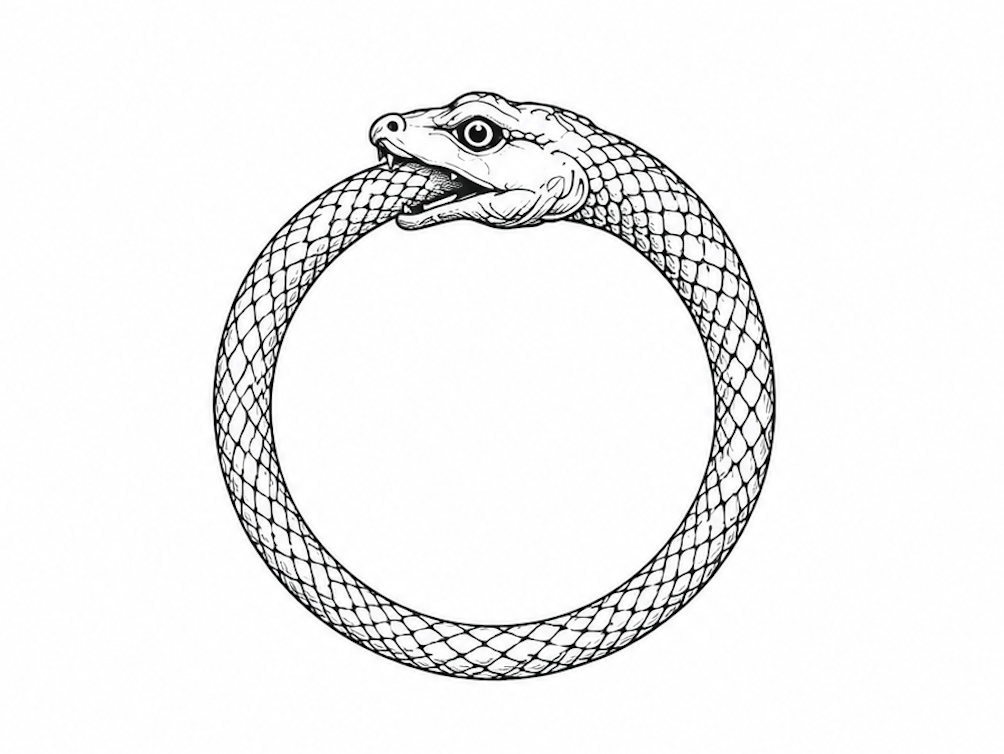
Human beings organize experience around an ultimate orienting image. When that image no longer accommodates lived reality, psychological pressure builds until a new organizing image emerges. Because this organizing image is embodied as well as conceptual, changing it involves years of cognitive, emotional, social, and bodily reorganization.
Welcome back. In this post I would like to discuss the process of God image changes. For new readers, a “God image” is a Jungian term meaning that humans as limited, finite creatures cannot know God itself; what we have is an image in our minds of what God is, which may change over time and is always incomplete versus what infinity might actually comprise. In the sense used here, the God image doesn’t even have to be about “God” – rather, it is the highest-order psychophysiological regulatory architecture of the psyche. This is the foundational organizing principle that determines perception, affect, motivation, contradiction-tolerance, and somatic coherence. A God-image screens reality, filters out competing perspectives, and maintains psychic equilibrium. All lower-level beliefs are nested beneath it.
In cognitive science, the predictive processing framework describes a related phenomenon at the mechanistic level. Andy Clark argues that the brain is not a passive receiver of sensory data but an active prediction engine, constantly generating expectations about what it will encounter. Sensory information primarily serves to correct errors in those predictions. The reason for this is energy efficiency; it is much cheaper energetically to possess a conception of the world and only update as necessary to the extent the conception is wrong than to continually generate such a conception from scratch. At the highest level of this predictive hierarchy – Clark’s “deep priors” – is something structurally analogous to the God-image: the foundational assumptions that determine how all lower-level predictions are organized, weighted, and revised.
Where Clark’s framework and this one diverge is in their orientation. His framework is computational, while my account insists that high-level prediction errors aren’t just Bayesian updates, they’re experienced as existential dread, as the crucifixion of opposites, that the body keeps score of epistemic collapse. So Clark describes the mechanism (how the brain constructs and revises predictions) while my focus is on the architecture: what happens when the highest-order predictions/the God-image can no longer be sustained. Clark treats the highest-level predictions as revisable with new evidence, while I argue that the God-image is constitutive: some beliefs are so deeply embedded in a person’s generative model that ordinary evidence is insufficient to modify them directly, so significant change may therefore require a restructuring of the model in which those beliefs participate. Such deeply embedded change requires not revision but reorganization – a crossing of a threshold into a new highest order belief. Such a crossing restructures everything nested within it over time when the old architecture becomes unbearable. This could also be understood as a collapse in precision weighting at the highest level, forcing a reorganization not just of the predictions but of the metacognitive framework that evaluates prediction error. (I recently reviewed Clark’s The Experience Machine and noted where his framework complements and where it falls short of a phenomenological account.)
The Anatomy of a God-Image Change
I am not unique in experiencing a God image change, in my case from a redemptive, loving God to a horrifying God of totality, which I call Abraxas (a label for the unity of all opposites, including good and evil). Plenty of people go from believing formal religions to being secular non-believers or atheists (or the opposite), many adopt or lose a political platform as their religion or a cultural identity, many marry into other religions or convert from the religion of their upbringing. This is the backbone of many autobiographies, the loss of one’s core faith and then either its rediscovery (apologia) or its replacement (such as Augustine, covered previously). My understanding is that the conversion process is relatively similar regardless of the particular form that one’s God image change takes:
- An individual receives a certain inherited background and worldview from their parents, social circle, and community, which includes a particular God image (the highest order belief, which may even be secular in the form of communism, capitalism, race, etc.).
- The individual develops cognitive dissonance between what they perceive as reality and their inherited God image.1 This dissonance involves intellectual doubt, moral criticism, emotional suffering, and disaffiliation from a community.2 Trauma, especially in early life, major life changes, stressful events, and low self-esteem are key triggers.3
- The individual tries to resolve the cognitive dissonance in favor of the established community but is unable to do so.
- The cognitive dissonance grows and the individual looks for alternative solutions.
- The individual tries out alternative solutions. Such changes may initially be in a form less than the God image (mid-level beliefs), but inevitably involve that layer because the psyche demands it, a point Augustine makes4 as does William James.5
- The individual finds an alternative solution that works better for them than the perspective provided by their background. What exactly the individual finds resonance with depends on a combination of upbringing, genetics, culture, disposition, and one’s particular stabilizers (attachment and belonging, esteem and status, meaning and narrative, control and agency, coherence and truth-consistency).
- The individual increasingly experiments with the alternative solution, which continues to solidify as a better option for them (or, alternatively, it doesn’t, and they may ultimately reaffirm their original faith in a new context6).
- The individual considers the possibility of exit and the costs involved, including loss of community, loss of financial and social support, loss of reputation, and risks of the unknown.
- The individual exits, either in a faster or slower fashion, adopting the practices, customs, beliefs, and worldview of the new worldview. One may note that this process – from the beginning search for an alternative God image, finding one that resonates, and the exit – involve gradations and threshold conditions; one does not seek out such fundamental changes on a whim, one is typically either consciously or unconsciously pushed into it due to psychosomatic distress.
- The new God image installation continues and develops somatically in the body over time, through many disruptions where the body reconfigures expectations and responses based on the new highest order beliefs. (This process is deepest for God image changes, but also occurs for various mid-level belief changes).7
- The somatic changes continue occurring for the person for many years, decades, or likely forever. One retains vestiges of the prior worldview – it never fully disappears, and which continue to frame how one views the world.8 9
The process is structurally similar across all god-image changes; what differs is the direction and the cost. Most God image changes are lateral between varying redemptive worldviews (i.e. a belief that with the right action or orientation, things will get better in the future, either in the secular realm or in the afterlife), and there is plenty of literature, beginning with Augustine’s Confessions on changing from a non-redemptive to a redemptive perspective. As I wrote in a Note, the greatest distinction in belief is not between secularism vs. religion, or religion vs. ideology, but between redemptive worldviews vs. non-redemptive worldviews.
From Redemptive to Non-Redemptive God Images
I was interested in understanding the literature around God image change, but the problem is that the type of God image change I was and continue to experience does not seem to have much precedent – this is a structural observation, not a moral one. I have discussed portions of my story many times, but I was placed into intense double binds in childhood where no matter what action I chose, I would be criticized and undermined passive aggressively; this rendered my unconscious and psychic wiring to consider decisions to be of a provisional and turbulently changing nature; this in turn led me to see arguments and worldviews as always partial, never complete, and a feeling of hypervigilance. This was a subconscious process which I was not aware of consciously. A God image of totality, then, preceded my intellectual understanding on a somatic level by decades. The body believed what it believed first; it was my mind that took a very long time to catch up. This isn’t meant in an inflationary “special” way; the literature on god-image change is almost entirely about lateral or downward transitions – from believer to secular, from one religion to another, from redemptive to redemptive framework, or even from deconversion to back to the same faith, which is John D. Barbour’s focus in his excellent and very readable Versions of Deconversion (1994), where he focuses primarily on God image changes primarily within the Christian milieu, including an analysis of autobiographies by Augustine, Bunyan, Newman, Ruskin, Gosse, Sartre, Carlyle, John Stuart Mill, Frederick Douglass, Charles Eastman, Malcolm X, C.S. Lewis, Edwin Muir, Dorothy Day, and Tolstoy, some of whom I may cover more directly in the future. One study of exit from a high-somatic-density religious framework – Lynn Davidman’s decent Becoming Un-Orthodox (2014), on Orthodox Jews who left Haredi communities – documents the inverse of what I experienced. Her informants began with maximum somatic density with 613 rigidly-held commandments, a full ritual life, and a body saturated with daily practice, who moved toward diffusion with loss of structure and inherited meaning.
My trajectory was and is the opposite: I began with total diffusion – a secular upbringing with no ritual, no religious body-knowledge, no structure, with a privatio boni all good God image – and moved toward density and weight: the slow, painful installation of a horrifying god-image of totality, where all human experiences both good and bad add to it. Their exit cost from heaviness-to-lightness was giving up the rituals which offered meaning to human action, while my exit cost is the construction of a framework that may bear the weight of existence (from lightness to heaviness). The literature has little to say about the diffusion-to-density direction; two exceptions are from secular to religious Judaism, which Davidman discusses in another book, Tradition in a Rootless World (1991), where practitioners take on the responsibility of regular rule-based religious practice10, and the example of Julian the Apostate, who abandoned the Christianity of his upbringing for Hellenism, which I will discuss further below.
Why Redemption Scales and Tragedy Doesn’t
A trajectory from diffuse secular redemptive to dense tragic non‑redemptive follows the same structural steps as other God‑image changes, but the direction makes all the difference. Most mass-scalable religious systems contain significant redemptive architecture and preserve teleological rescue structures – whether Christianity (believe in God and Christ will make things right in the Second Coming, and in the afterlife he will sort the good and evil into Heaven and Hell), Judaism (perform the mitzvot and God will bless the Jewish people with success per the Chosen covenant11), Islam (submit oneself to God, live according to divine guidance with the hope of eternal reward in the afterlife), Buddhism (renounce cravings and be released from the wheel of birth and death samsara cycles), political solutions like communism, capitalism or socialism (peace on Earth and material prosperity is achievable with the right combination of human activities), or atheism (which almost always retains secular-progressive moral teleology beliefs but with the belief in God dropped). Even Stoicism is redemptive adjacent (align one’s behavior with Logos and it becomes easier to live) as are the Hellenic mystery religions (understand and accept the birth/death/rebirth life cycles and become free from that knowledge).
Therefore, a transfer from one redemptive God image to another redemptive God image has a much smaller gulf and associated intellectual and somatic change than a transfer between redemptive and non-redemptive God images. A change from a Hellenic non-redemptive worldview – everyone goes to Hades upon death, life is tragic, final redemption does not exist – to a redemptive one like Christianity is radical, but it is radical in the sense from going from a worldview of weight to a worldview which weighs much less – one feels so much better and freer to believe that one may go to Heaven when one dies, that redemption is possible and will occur, that God cares, versus the heavy Hellenic tragic view. The transition from Orthodox Judaism to secularism is also a reduction in weight as physical responsibilities decrease, but both are redemptive.12
Regarding Julian the Apostate’s partial attempt, who I have discussed previously, even his case shows incomplete somatic uninstallation; his Christian upbringing retained a strong residue after his conversion to Hellenism. Furthermore, his attempt to update Hellenism to compete with Christianity was destined to fail, because he was trying to graft onto a non-redemptive framework the competitive advantages of a redemptive one, which is a structural impossibility. The competitive advantages of a redemptive framework – hope and faith in the future, shared tribal allegiance, an approved enemy, centralized coordination, justice after death as long as one believes and follows the rules, all of which are enormously incentivizing toward group action – are not features that can be bolted onto a non-redemptive rootstock, they are emergent properties of the redemptive grammar itself. Julian wanted to copy Christianity’s almsgiving and regional, centralized priesthoods, but it was a rear-guard and losing action. The features that made Christianity win against Hellenism are inseparable from its redemptive grammar.
An Abraxian perspective is inherently non-redemptive and, as I wrote in a Note, it takes the tragic elements from both Christianity and gnosticism while rejecting their redemptive parts, creating an almost uncanny valley effect. Taoism is non-redemptive, too, but it is lighter and more flowy, arguing that to accept things as they are makes for easier living – in other words, it is non-tragic13; Hinduism is also non-redemptive, but the Western conversion to Hinduism almost always involves a prior romanticization that selectively filters the darkness, so it functions less as god-image change than god-image tourism. Under an Abraxas perspective, to be alive is to experience the crucifixion of opposites, which is a permanent condition. One may offload the experience of the crucifixion to institutions or to act it out via antinomianism, but the crucifixion remains and is an ontological feature of this reality.
There is a near zero institutional or cultural support for non-redemptive God images, and for good reason – they are structurally incapable of generating a noetic commons, which is the shared egregore which governs collective thought and action. A god-image that does not promise rescue or salvation is very inefficient at mobilizing populations, because mobilization is incentivized by the promise that participation will be rewarded in this life or the next. As Rodney Stark and William Bainbridge argue in The Future of Religion, religion (including secular redemption beliefs) will never disappear because people need “compensators” – systems of belief promising that rewards presently unavailable to them “will be obtained in the distant future or in some other context which cannot be immediately verified.” And as Davidman argues in Tradition, p. 152, “In her book on Catholic Charismatics, Meredith McGuire describes how “the millenarian dream that the perfect New Order is imminent” operated within the community as a powerful order-creating mechanism. The millenarianism in the Lubavitch worldview similarly served to create a well ordered universe for the [new initiates]. It reassured them that although the world did indeed seem to be in a critical state, that in itself was a sign that change was imminent. And because by joining this community they were allying themselves with “the ultimate source of order” – the Rebbe – they would “have a privileged position in the unknown glorious future.” This redemptive grammar is not true or false, it is structurally necessary for any god-image that aspires to scale beyond the individual. Non-redemptive frameworks can only survive at the individual level, sustained by personal constitution, not by cultural infrastructure, unless they are non-tragic such as Taoism and some versions of Buddhism). Tragic non‑redemption – the crucifixion of opposites held consciously – has severe structural difficulty scaling, because it offers no relief and no collective ritual that does not collapse into antinomianism or withdrawal – redemptive systems scale through shared promises; tragic systems can propagate only through shared recognition among people who have independently crossed the same threshold. This is why the experience feels uncharted: I have found little literature that maps from redemptive to non-redemptive tragic God images because no one has traveled this road at scale, and the road cannot be traveled at scale by design. It is really no fun to go from a psychically “light” perspective to a “heavy” perspective; alternatively, going from a “heavy” non-redemptive God image to a “light” redemptive God image is a tremendous weight off the psyche, which is partially why Christianity outcompeted its Hellenic competition; the process appears to me to be going in reverse now due to ratcheting neoliberal feudalism and technological advances, as discussed in this Note.
The God Image Gulf
Adopting a non-redemptive God image offers a much broader and more nuanced perspective, an ability to consider that all positions emerge from partial functional orientations within totality and that holding the tension between them is the operative task. This is a much colder perspective in the sense that there is no God is coming to save us, that we are each responsible for our own actions, but warmer in the sense of increased interpersonal ethics and respect for each person’s particular process. The coldness and the warmth are the same thing experienced from different angles. It is also quite lonely, and the translation cost in explaining an Abraxian perspective to those within a redemptive perspective is very high as well.
The deep reason for the translation cost is not that Abraxian claims are harder to understand, it is that the gulf is not an argument gap but a hinge proposition difference. Using Wittgenstein’s framework from On Certainty (although I have major issues with his style): every worldview rests on hinges – propositions so fundamental that they are not believed but acted on, and that make all other beliefs possible. The redemptive person’s hinges include suffering is temporary, justice will be done, meaning exists. These are not things they argue for, they are the conditions that make arguing possible. The Abraxian perspective hinges include suffering is permanent, justice is a human projection, and meaning is maintained, not given. When a redemptive person encounters Abraxas they do not encounter a disagreement, they encounter a different set of hinges – a different bedrock – and no amount of argument can reach across that gap because arguments presuppose hinges, and the hinges are different. This is why the experience is not that I am failing to explain myself, it is that I am operating from a different perceptual apparatus entirely. The loneliness is not social, it is hinge-structural.
Because crossing the divide is so energy intensive, the desire for silence increases over time. I am more present in my interactions with others, I do not react to the horrors of this world with nearly the emotional energy that I devoted to it in the past – it is not that I am indifferent, I am still saddened by them, but hearing of or seeing such horrors no longer causes a challenge to my highest level beliefs, so there is both good and bad that arises from the God image as it increasingly reorganizes me somatically. Whether this god-image is livable in the long term I do not yet know, but it has worked for me provisionally thus far.
This process doesn’t feel like much of a choice, either – the choice was between remaining “lost” or going through the painful process of self-discovery. My path chose me, and the freedom one has is to embrace one’s unique path or to run from it and suffer increasing psycho-somatic pain as a result. As Marie Louise von Franz argued in Shadow and Evil in Fairy Tales,
This is why, according to Jung, not becoming conscious when one has the possibility of doing so is the worst sin. If there is no germ of possible consciousness within, if God made you unconscious and you just stay that way, then it doesn’t matter; but if one does not live up to an inner possibility, then this inner possibility becomes destructive. That’s why Jung also says that in a similar way one of the most wicked destructive forces, psychologically speaking, is unused creative power. That is another aspect. If somebody has a creative gift and out of laziness, or for some other reason, doesn’t use it, that psychic energy turns into sheer poison. That’s why we often diagnose neuroses and psychotic diseases as not-lived higher possibilities.
Note: You can sign up to receive email notifications of new posts here, and/or sign up for Substack updates here.
See John D. Barbour’s Versions of Deconversion (1994), where he states, p. 206:
A “disjunction between theory and experience” often generates the elements constitutive fo deconversion: intellectual doubt, moral criticism of an inadequate way of life, emotional upheaval, and rejection of a community or a conception of society. This is especially so when the disconfirmed theory is not simply a philosophical perspective but approximates a Sartean project of a lifetime. Such an identity-forming theory is in effect a faith commitment, and rejecting such a worldview and project is tantamount to a loss of religious faith. The theme of identity transformation, which becomes more and more prominent in twentieth-century autobiography, often involves a form of deconversion. The faith that is lost is less frequently in a historical religious tradition and increasingly a matter of devotion to some secular substitute, an ideology or commitment that claims to provide the final and normative terms for understanding one’s life and determining one’s conduct.
Barbour, p. 2:
A deconversion has four basic characteristics that different autobiographers may emphasize to a greater or lesser extent. Deconversion involves doubt or denial of the truth of a system of beliefs. Second, deconversion is characterized by moral criticism of not only particular actions or practices but an entire way of life. Third, the loss of faith brings emotional upheaval, especially such painful feelings as grief, guilt, lonelinenss, and despair. Finally, a person’s deconversion is usually marked by the rejection of the community to which he or she belonged. Deconversion encompasses, then, intellectual doubt, moral criticism, emotional suffering, and disaffiliation from a community. Every autobiography discussed in this book involves at least three of these four dimensions of deconversions, although in particular cases one element may not be present. For instance, in Grace Abounding Bunyan does not reject a religious community, and the nature of his deconversion is rather different from Augustine’s. In his Apologia John Henry Newman makes few moral criticisms of himself or his former faith, as he precisely measures his increasing doubts about the Anglican church and, after considerable emotional suffering, joins the Roman Catholic Church.
As Lynn Davidman writes in Becoming Un-Orthodox, a study of Orthodox Jews who joined mainstream society, p. 21,
Many spoke of feeling marginal in their own communities, the result of having grown up in families that differed in obvious ways from the majority. In some cases, one parent had been lost to death or divorce; in others, the mother and father had profound religious differences; or, more distressingly, within these families the defectors experienced sexual, physical, or verbal abuse, or a combination. Hasidic teachings emphasize that if one observes all the commandments, families will be joyous, warm, and close. It was painfully obvious to my informants that the emotional dynamics of their families fell far short of this ideal. Other significant predisposing factors to exiting included: an acute awareness of gender inequality; exposure to secular relatives; and exploring forbidden media such as television, movies, Internet sites, and books (including philosophical treatises on relativism)….Both my respondents and I began to feel at a young age that following the prescribed religious practices of Orthodox Judaism did not yield the promised experience of wholeness, morality, and sanctity. The ex-Hasidim whom I interviewed described how their community’s metanarrative and the physical rituals through which it was enacted began to lose sense and meaning for them, as they (like me) became increasingly aware of the contradictions in their lives. As we questioned the disjunctions we felt and found ourselves unable to assuage our doubts, our commitments to Orthodoxy and the bodily ritual practices that are at its core began to waver. We ought to test the truth claims of Orthodoxy by violating one of the hundreds of commandments that guide all aspects of Orthodox Jewish daily life.
Or see Barbour, 209: “The large number of versions of deconversion that involve a struggle for autonomy in relation to the writer’s parents (for instance, those by Augustine, Mill, Ruskin, Gosse, and many apostates from cults) indicates that the loss of faith is often closely related to the task of forming personal identity in the context of one’s family.”
Barbour, p.15: “For Augustine deconversion is necessarily only a stage in a longer process, since human beings long to trust and believe in something beyond themselves. One cannot rest in deconversion; the heart and mind and soul will search restlessly for a new center of devotion, trust, and love. Placing one’s faith in anything other than God inevitably leads to disappointment. The Confessions describes not only a deconversion from Manicheism and conversion to Christianity but a series of conversions to and deconversions from various other objects of Augustine’s ultimate concern: philosophy, the unnamed friend who dies, the orator’s career, Neoplatonic wisdom, and the pleasures of “woman’s love”.”
Barbour, 74: “James anticipates functional definitions of religion (such as Paul Tillich’s conception of “ultimate concern”) when he holds that no one can live without a commitment that is, in effect, religious. This would mean that one can never rest in loss of faith. Only the divided self on the verge of either collapse or conversion could be said to lack some conviction which functions as a faith. James’ discussion of the loss of faith is ambiguous because while he presents permanent skepticism as a real possibility, he also holds that every human being, even the one who has been through “counterconversion,” has some “habitual center of personal energy” that functions like a religious faith to give meaning and purpose.”
The Puritans even make a system out of it. Barbour, 22: “The Puritan way of salvation generated a continuing cycle of deconversions and reconversions, as each moment of confidence and assurance yielded, slowly and subtly, to presumption, pride, or complacency. Noted by the Puritan’s scrupulous conscience, one’s very assurance caused a new round of despair about one’s moral condition and doubts about one’s election, precipitating a new need for deconversion in the form of repentance and struggling away from sin. Whether one regards this negatively as a classic double bind or vicious cycle, or positively as a profound means of revitalizing the basis of religious commitment and regeneration, the Puirtans forged a tight bond between the cycles of deconversion and conversion.”
This is an interesting post by a man named Dragos Roua, who commented on this concept in regards to his relationship to money. He grew up poor and became wealthy, but his body’s response to money lagged significantly his intellectual understanding and it took a very prolonged period, tested against various real world situations, before his body began to somatically accept his new situation, and the updates grew less intense and more sporadic over time but they never fully stopped – our early hardwiring takes a very long time to overright.
For example, see Barbour, 57: “Especially fascinating in Victorian versions of deconversion are the ways in which Christian rhetoric and values are appropriated in a writer’s attempt to express a new vision of human destiny. The language of Christian culture and community usually imposes itself even when an agnostic or atheist writer expresses confidence that one can live without the consolation of religion, without certainty about human origins or destiny, and without a divine justification for morality. Often the metaphors and structural elements of conversion narratives provide the organizing terms in which a writer envisages movement away from belief in God to agnostic principles and a new understanding of human existence.” And p. 211: “A central theme of this book is that deconversion is rarely if ever a total transformation of character and religious concern….Every author considered here can be shown to have been permanently marked by the faith he or she supposedly rejected. Thus one aspect of the religious significance of deconversion narratives is the deep and pervasive influence of religious commitments and ways of thought even on those who have abandoned a historical religious tradition.”
Or, take Ruskin, for a specific example, 68: “As many scholars have pointed out, there is also much continuity between Ruskin’s evangelical background and his secular vocation, especially in terms of such moral values as hard work, self-denial, service to humanity, and struggle against moral evil. Many of his aesthetic interests and presuppositions, such as his interest in allegorical interpretations of art, can be understood as characteristic expressions of his religious sensibility. Like so many Victorians, and like most authors of deconversion narratives, Ruskin was deeply influenced by his religious upbringing long after he consciously rejected it.”
Davidman, p. 184: “Neuroscientists have recently emphasized the ways experience effects changes in the biology of our brains. Building on this insight, I can say that defectors’ earlier experiences and practices have been hardwired into their psyches. We could almost say they have become part of our “psychic DNA.” The cultural tool kit and its embodied presentations continue to remain entrenched in our deepest selves.”
Further on this topic, I read the cyberneticist book The Tree of Knowledge (1987) which contained helpful discussions regarding how biological “hardware” relates to “software” downloaded from the environment (examples of a newborn lamb who, taken away from its mother for a couple hours, would not run and play with other animals thereafter; and two young Hindu girls raised by wolves, when reintegrated into human society, never became fully human).
Tradition in a Rootless World, p. 184, regarding women: “These behavioral changes included strictly observing the Sabbath, following the laws of kashrut, and even changing sexual behavior to conform to the community’s norm of no physical contact with men before marriage. “Conversion” to Orthodoxy involved no professions of faith or testimonials; rather, it comprised an accretion of observances.” And p. 202: “The price of joining is too high for most people because of (1) the ritualism of Orthodox Judaism, (2) the marginality and separation involved in adopting this way of life, and (3) the limits set on a person’s choice for a partner.” And p. 222: “Newcomers must make change sin their behavior that affect all aspects of their daily and social lives. There are many individuals who value the relative absence of restrictions in their lives enough to find Orthodoxy unattractive.”
Yahweh is a redemptive God for the Jewish people, but he is also demanding and wrathful in a way that the Christian God is not. Per Davidman, p. 141: “Hasidic socialization aimed to convince children that they would be severely punished by God if they failed to obey their parents or observe all 613 biblical commandments as they were interpreted in their respective communities. Hasidic children did not grow up with a conception of a loving and forgiving God; instead, they were told that God was harsh and stern and would penalize them for every transgression, even accidental ones. Esther, one of my respondents, highlighted this point. “The whole religion revolved around trying to escape or avoid punishment. And the fear – like God is a monster, really, to such an extent that if you are not nice today, then you will later have sick children. Similarly, if you don’t show proper respect to your parents, you will live in poverty for the rest of your life.”…The basic message was that if they violated God’s laws, he would send them every possible sorrow, sickness, and tragedy.”
Per Davidman, quoting someone named Binyamin, p. 82:
Whether I believed in the Hasidic teachings or not, at the bottom line, the only thing that mattered was following the commandments. At one point, when I was sort of debating, I was speaking with my stepfather about God and why it doesn’t make sense and this and that, and he said: “Binyamin. You don’t get it. Judaism doesn’t have to do with believing in God or not! Nowhere in the Shulchan Aruch [the most authoritative Jewish legal code, authored by Rabbi Joseph Karo in 1563] does it say to believe in God. It’s all about doing. Judaism doesn’t have to do with believing in God or not. It’s a lifestyle, a way of living. And just like every lifestyle, in everything you do there’s a manual. So Judaism as a manual, the Shulchan Aruch, and it tells you what to do from the moment you wake up until the moment when you sleep. And you follow this manual. Whether you believe in God or not, that isn’t as important.
Davidman adds on, p. 102: “[These] stories demonstrate the greater importance of actions over beliefs in the Haredi world. Questioning was written into the ancient texts; it was not problematic. But acting out bodily resistance to Jewish laws is a momentous event that might be the first step in defecting. These respondents were deeply aware of the difference between intellectual questioning, an internal, mental process, and violating a commandment, a physical act, as evidenced by the reported intensity of the physical experience.”
More specifically, the Tao contains both light and dark as co-original – the yin-yang is not good-conquering-evil but irreducible polarity. Wu wei (non-action, effortless action) is not alignment with the good but alignment with what is, which includes darkness, death, and dissolution. The Tao that can be named is not the eternal Tao, so it has genuine apophatic depth. And crucially, Taoism does not promise escape from suffering; it promises something more like the dissolution of the resistance to suffering, which is not the same thing. The sage flows with what is, including horror, without fighting it.
However, Taoism differs from the Abraxian position in a critical way: it is fundamentally serene. The Tao is simply what is, and acceptance of what is produces a particular kind of peace. There is no crucifixion of opposites in the Jungian sense, no requirement to hold the tension actively and suffer it consciously. The Taoist response to horror is to flow through it, not to hold it as co-original and irreducible. This produces a different psychology: the Taoist sage is characterized by detachment and fluid non-resistance; the Abraxian position is characterized by active conscious holding of irresolvable tension, which is painful by design. Taoism is non-redemptive but also non-tragic. Abraxas is non-redemptive and tragic.
I have to say I do relate to some degree. I feel I drift slightly Taoist as I seem to be sitting with an internal witness. An awareness that seems capable of handling any amount of inputs. That said – the loneliness is real and it has to be handled, carried. The price of consciousness is being conscious as they say. It is so easy during the sleeping years of comfort and being opinionated and positional. It is now hard to hold the vastness of not really being ‘set’. Good work brother.