

Beneath its surface as a sitcom review, this essay explores the appeal and ultimate limits of the hedonic fantasy embodied by Two and a Half Men. Along the way it examines Charlie Sheen’s collapse, Jon Cryer’s quiet professionalism, changing cultural norms, and the author’s psychological relationship to the world the series portrays.
This is a post about the show Two and a Half Men, which aired for 12 seasons from 2003 until 2015. I’ve watched it over the years and always found it enjoyable – the Charlie Sheen version (season 1-8), anyway – and, after starting a sporadic rewatch (and trying to find one particular episode which made me laugh uproariously back in the day and which I just couldn’t find) I decided to watch the series in order and grade them season by season. There are 262 episodes overall, and I calculated early that if I watched 3 a day it would take me 87 days to get through. I don’t really feel like focusing on so-called “dissident” films or shows anymore – my definition of what “dissident” entails has changed pretty radically in the past year or two1 – and my Andy Kaufman-esque beat-by-beat April fools post analyzing beat-by-beat How Stella Got Her Groove Back went over as well as a hot lead balloon.
Sheen is an interesting case because he is so charismatic and likable, even as he is known for being rogueish – he presents as having heart underneath. His life was easy, full of endless high profile film roles and then this show, where he became the highest paid actor in the history of television making $1.8 million an episode, while doing a tremendous amount of drugs and having endless amounts of sex in between two failed marriages. Yet due to the nature of hedonic adaptation combined with satiation – where one gets used to whatever baseline one has, no matter how good, and needs even greater “hits” to get excited – he grew bored with what he had (or the drugs finally got to him), torched his reputation by ranting publicly about having “tiger blood”, having sex with transsexuals and getting AIDS and his career basically died, while blowing through his fortune on alimony and child support and paying the sexual blackmailers over $10 million (they had a video of him getting a blowjob from a transsexual, apparently, and Sheen was desperate to keep his “man’s man” reputation, correctly intuiting that his career would end if he was seen as a bisexual with AIDS).
Why do this season-by-season watch and commentary, and why should I (or you) care? First, I think the show is ultimately a great cautionary tale about having it all and then losing it. Materialism does not bring happiness. Chuck Lorre had originally pitched the show as a combination of a Job figure – a good person where everything goes wrong in his life no matter what he does (a reference made explicit in S8E4) – with restrictive, rule-following Saturnian energies (Cryer), and his Dionysian brother (Sheen), and I have strong resonance with both figures.2 Also, the show came out in the period before “Me Too” and transsexualism, and it’s simply a man’s fantasy – being rich, having lots of leisure time, caring for family, and enjoying lots of sex with attractive women while being liked and adulated by the public. Watching it and there is no deep message being pushed, it’s meant as light entertainment; of course secular hedonism as an end point to living was merely a historic blip, it could never have lasted (for many reasons), but it can still be enjoyed on its own terms, I think.
The acting is superb throughout, especially Jon Cryer3 as Alan Harper, the Job figure – the weaselly, poor mooch who lives off his brother. Cryer had a long career as a middling but professional4 and humble5 actor and this was his big hit (which he chose to pursue over being a finalist for the role of Gaius Baltar on Battlestar Galactica), and my sense is he knew how hard success was and how it should be treasured (and whose decent autobiography So That Happened I read6 and will provide some quotes from; Sheen also has an autobiography, but I did not feel the urge to read it7). Sheen was cast early but Cryer, who was basically playing himself8, had to fight hard for the role after being labeled a show-killer for having multiple prior failed shows, a story which Cryer recounted.9 At one point both Cryer and Sheen’s lives mirrored their show lives.10 Sheen was paid 3x or more what Cryer was, which upset Cryer as the show matured, and later on he went on to discuss politics publicly in a standard Hollywood “Orange Man Bad” screeching manner, which he continues to do today. Chuck Lorre struck lightning in a bottle with this show, much more so to me than his other hits like Big Bang Theory (mediocre because the premise feels forced and the comedy is shallow), Mike & Molly (boring), or Mom (also boring).
I’m in a bit of an idle mode at the moment mentally and spiritually where I feel like I’ve found out the nature of the world, uncovered the metaphysics that makes most sense to me, contrasted it against the closest thinkers I can find (Jung, Berdyaev, Weil, Kierkegaard, Philip K. Dick, Heinz von Foerster, Hans Eysenck etc.) which has refined my views further, and I’m wondering: what now? Part of me has retreated to a hedonism fantasy – what if I had made lots of money while younger and had a parade of women around, banging myself into oblivion? This show is adjacent to that fantasy, although I would have gotten bored by it even if it had somehow happened – hedonic adaption is a very real thing, and no matter how rich or successful one is one still grows old, health fails, death awaits, with family and friends of one’s youth going long before one does – and those who have had an easy life often have trouble coping when the pain finally does hit. I think I would have very likely hit the hedonism wall, gotten bored, and be right back to where I am now – studying philosophy and metaphysics, contemplating it and then writing it about it in solitude. Another aspect of covering this is that I can’t really turn off my deep dive analytic mode, which is central to my personality; if I don’t have a place to concentrate it, then the energy loops and spins in me which is unpleasant. Better to turn it toward a deepdive of a fun show when there’s nothing pressing than to loop.
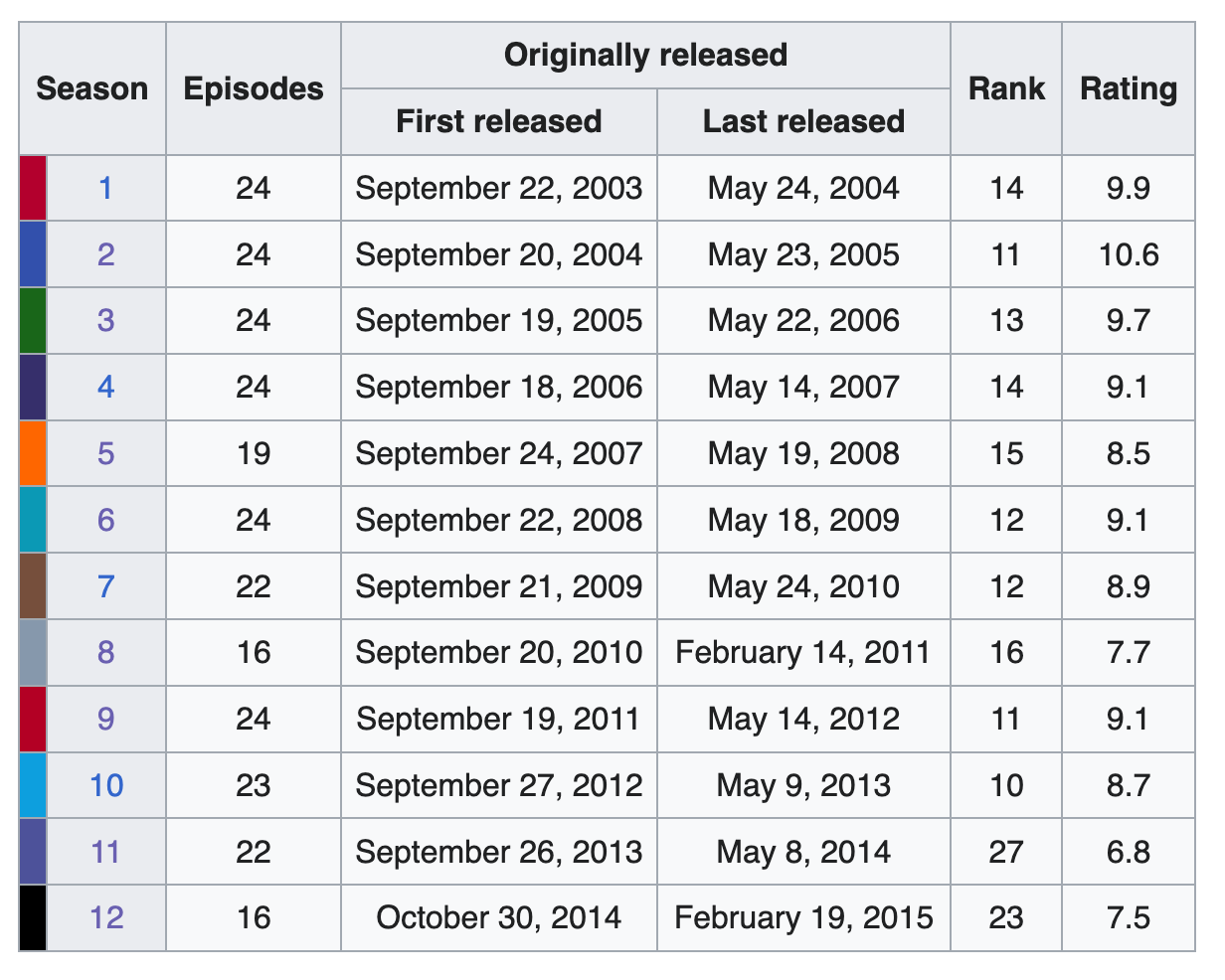
The viewership numbers were pretty steady throughout the series, except for a fall during Sheen’s last season (season 8) and the final two seasons with Kutcher (season 11 and 12). I may or may not cover the Ashton Kutcher seasons (9-12), we will see how I feel when I get to it. The problem with Kutcher is that he wants to be seen as a “nice guy” way too much, he is a mushball with soft merchant Mercury energies while also wanting to be seen as “smart” in tech (and, to be fair, he has made strong tech investments in real life) – while at the same time he has a dark side with his longterm friendships both with Danny Masterson and Diddy, both of whom went to prison for dark sexual activities. Sheen as a charming rogue who you know is a rogue is much more fun to watch than the unfunny and strange Kutcher dynamic, but Kutcher did come in and save the show after Sheen flamed out which took courage. The following footnote analyzes their energy makeups in line with my prior psychic stabilizers post.11
Okay, let’s get to the season reviews.
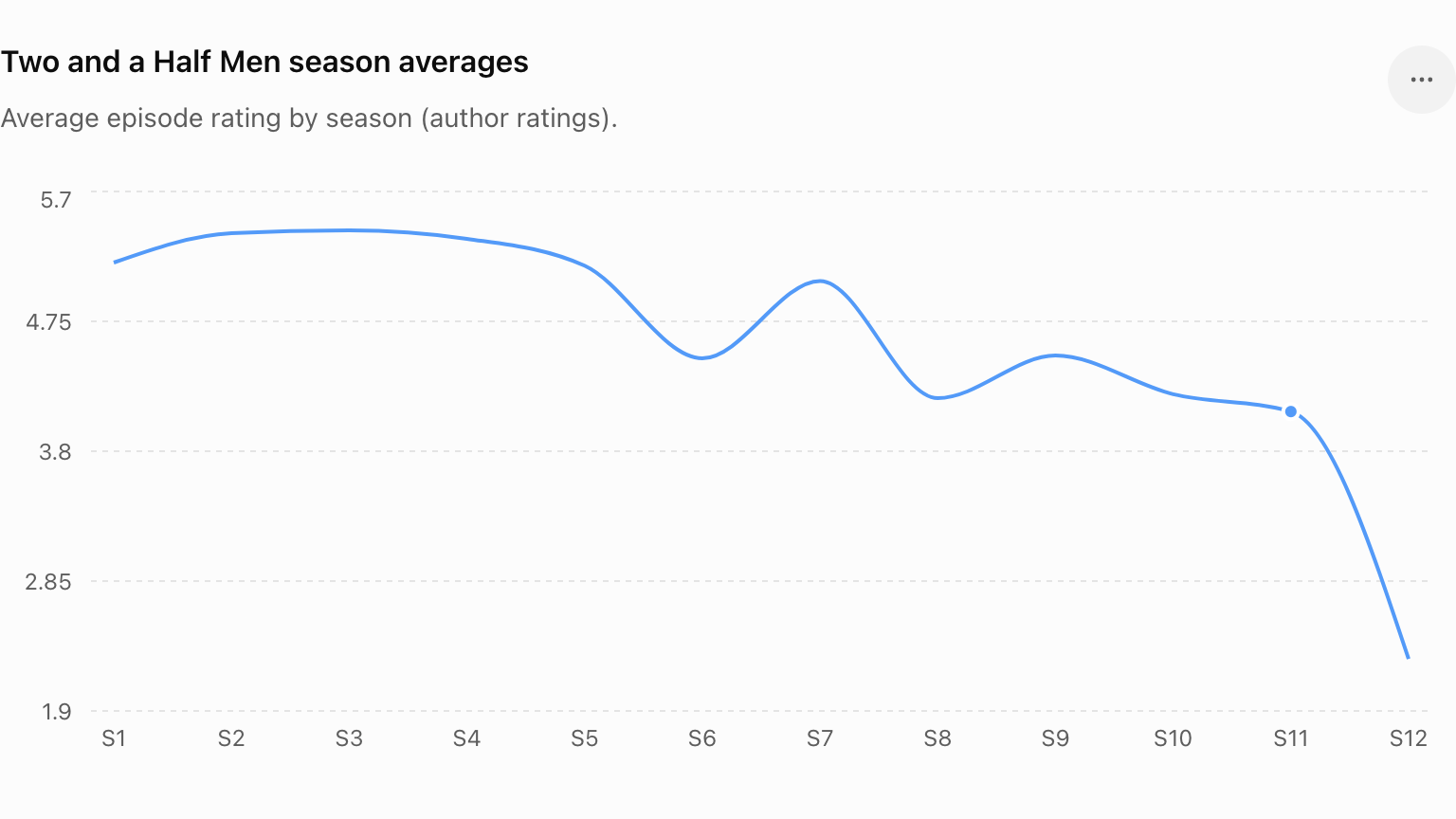
Season 1 was released in 2003, Sheen and Cryer were both born in 1965 so they’re 38 here – young! They had previously acted in Hot Shots together. Angus T. Jones who played the “half man” is 10.12 Cryer still has his hair, in later seasons it starts to go and they spraypaint it back on (and make fun of that in an episode). This is the introduction season – Alan and Jake move in, the mother Evelyn is introduced (who I was surprised to find out is gay in real life), Sheen is roguish but loveable as a wealthy Malibu playboy with new love interests every episode and the show is finding it’s feet which is okay, but the first season in network shows is rarely very strong. Highest rated episode: Episode 5, 8-8.5/10. Lowest rated episode: E22, 3/10. Season average: 5.18.
Season 2 (2004). This sophomore season is finding its footing, and the season average improves a bit. There are a couple of standout episodes and a bunch of mediocre ones. The show has yet to fully find its groove. The best episodes typically involve Alan and Charlie without the supporting cast – Berta, Evelyn13, Judith14, and especially Rose15 are inferior for different reasons (see the footnotes), although not always. The show works when it stays inside its own realism (male fantasy, fraternal dynamic, consequence-light hookups) and weakens whenever it imports elements from outside that realism (Rose’s stalker logic, the shrew dynamic’s unresolvable power asymmetry, the two-dimensional female authority figures). Highest rated episode: Episode 12 and 23 both with 9/10. Lowest rated episode: episode 9 and 13 both with 3/10. Season average: 5.395.
Season 3 (2005). This season features both Charlie and Alan engaging in multi-episode relationships, Charlie with Mia and Alan with Kandi (after Kandi sleeps with Charlie first). The episodes remain highly erratic in their ratings, with the highest rated episode being Episode 9 with an 8/10 and the lowest being Episode 12 with a 2.5/10 because it was too forced and Cryer overacted. The highest rated episode was lower than the highest ones in prior seasons and the lowest was lower, but the season average still increased. Season average: 5.416. I’m a little surprised and was expecting a steady increase by season 3.
Season 4 (2006). Somewhere in season 3, definitely by the start of season 4, watching began to feel like a chore and not so much fun. I attribute this to the basic idea of the show being fleshed out and explored, so the ratcheting of outlandish behavior has started (see Kandi) to try to keep the show “fresh”. I will keep grinding out the episodes, at least for now, out of lack of a better thing to do, and I still want to find the episode that made me laugh so hard. Highest rated episodes were Episodes 6, 9, and 14 at 8/10, and the lowest was Episode 2 with a 3.5/10. Season average: 5.354, so slightly decreased from Season 3.
Season 5 (2007). This was a truncated season with only 19 episodes as opposed to 24 in a standard season due to the 2007–2008 Writers Guild of America strike. Highest rated was E13 with 8/10 and the lowest was E12 with a 2, maybe less – the worst episode of the show so far which was modeled on Misery and featured Rose. Season average: 5.157, which continues to decrease from season 4 and 3. On the bright side, Alan has started slightly displaying some kooky characteristics which Cryer pulls off very well, which will be accentuated in future seasons to keep the show from becoming too stale.
Season 6 (2008). This was the worst season so far, both because the show is running out of ideas and because Charlie’s extended relationship arc with Chelsea is a downer. The actress who plays her is fine and doesn’t bother me, but she is written as a nag – not due to a personality quirk, but simply due to male/female dynamics. This season had the lowest episode of the entire series with a 0, Episode 21, which featured a wildly unrealistic scenario with Rose, a character I don’t like. The highest rated episode was Episode 4 when Charlie hits on Alan’s receptionist, while Alan is very unhappy about it. Jake has much less screen time this season, as does Evelyn, and Rose is almost featured not at all (thankfully). Season average: 4.479, which surprisingly continues its decline from Season 5. I hope it pulls out of this rut next season.
Season 7 (2009). The show rebounds from the prior season but is still treading water; Sheen’s acting is increasingly becoming frazzled due to off-screen drug use. One of the things I will note is that Charlie’s approach to dealing with women on the show (not just this season) – easy willingness to apologize without fully meaning it, checking his ego in doing so – while sometimes pushes too far into obsequiousness, is pretty antithetical to my own approach, which often involves egoistic pushback and angrily stewing with a grudge for awhile. An experiment in adopting Charlie’s approach had surprisingly positive results, although it didn’t come naturally to me. The highest rated episodes of the season were episode 1 and 12 tied at only 7.5/10, and the worst was episode 10 which was a 0 where the writers infantilized Charlie’s character in a clumsy and dumb manner. Season average: 5.045, so better than Season 6, but still worse than other seasons.
Season 8 (2010). Cryer noted in his autobiography how bad Sheen looked this season16 to the point he couldn’t remember his lines.17 The season was poor, and I hated the Rose-focused episodes. The highest rated episode was E13 with a 7.5 or 8/10 because of Alan’s funny jealousy, the worst was E14 due to it being a ridiculous Rose-centric episode. The Season average was 4.1875, the worst of every season, and there were only 16 episodes when a normal season has 24 – a truncated season. I could see the deterioration of Sheen in real time almost, which began in the middle of Season 7 and never recovered, and they increasingly focused on Cryer’s character to try to make up for it. I will note, looking back, that watching this show has likely encouraged me to drink more alcohol (nothing too crazy).
Season 9 (2011). Screw it, I’ll keep watching the goofy Kutcher seasons and see how long I can stomach them – no guarantees. I hadn’t found the hilarious laugh-out-loud episode I’ve been looking for, which I guess must be in the Kutcher batch. It wasn’t clear if the show would continue after Sheen’s departure, but the network had pre-sold a couple more seasons and the money was too good to resist, I guess. Hugh Grant was supposed to be Sheen’s replacement but he backed out at the last second, uncomfortable with the lack of script to review. The biggest problem is that the hedonism fantasy is dead under Kutcher, that only worked under a rogueish but loveable Sheen (maybe it would’ve worked under Grant? not sure) – and Kutcher sucks, dopey voice, desperately wants to be likable and be seen as “smart” – so the continuation of watching this must be different. We will see if Cryer can carry the show on his own with the rest of the original cast, or if he can’t – I don’t know.
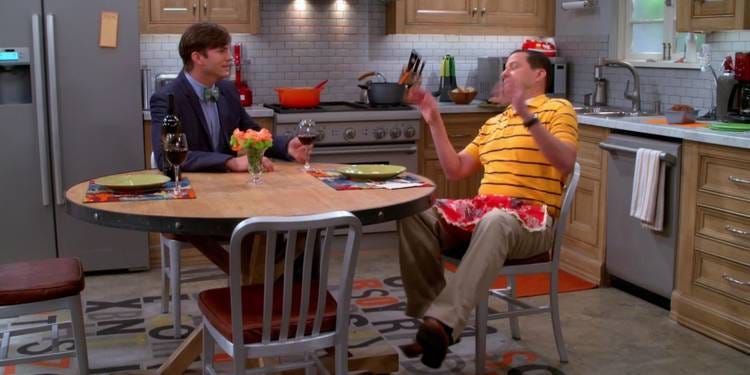
The flimsiness of the Alan/Walden connection is readily apparent and the bones aren’t strong enough to hold up the story regardless of the acting; most of the rest of the cast has been downgraded into occasional appearances to make room for new characters like Kutcher’s ex-wife, girlfriend, business partner, etc – I wish they had kept Herb around more, his character is excellent. I know that Cryer and Kutcher got along well, although their onscreen chemistry is mediocre, and Cryer attended Kutcher’s wedding (unlike Cryer and Sheen at the end – Cryer hasn’t spoken to Sheen since the latter’s meltdown). The highest rating episodes of the season were E9 and E22, both excellent episodes (E22 was the one I was looking for), and I gave them 9’s, but they both could have been higher. The worst episode was E12 which gave Kutcher a gorilla for a brother, 0/10. The season average was slightly better than Season 8 at 4.5/10, but good enough to keep watching. Cryer is fully carrying the show by escalating into ever-increasing absurdist situations where he is the butt of the joke; Kutcher isn’t funny at all. Also, the house itself is and has always been its own character and part of the show, and see below how they massacred my boy. This has implications extending to the core differences between the two eras; light hedonism vs. bland technocracy, a small part of a much bigger trend draining the world of color. Here’s Sheen era:

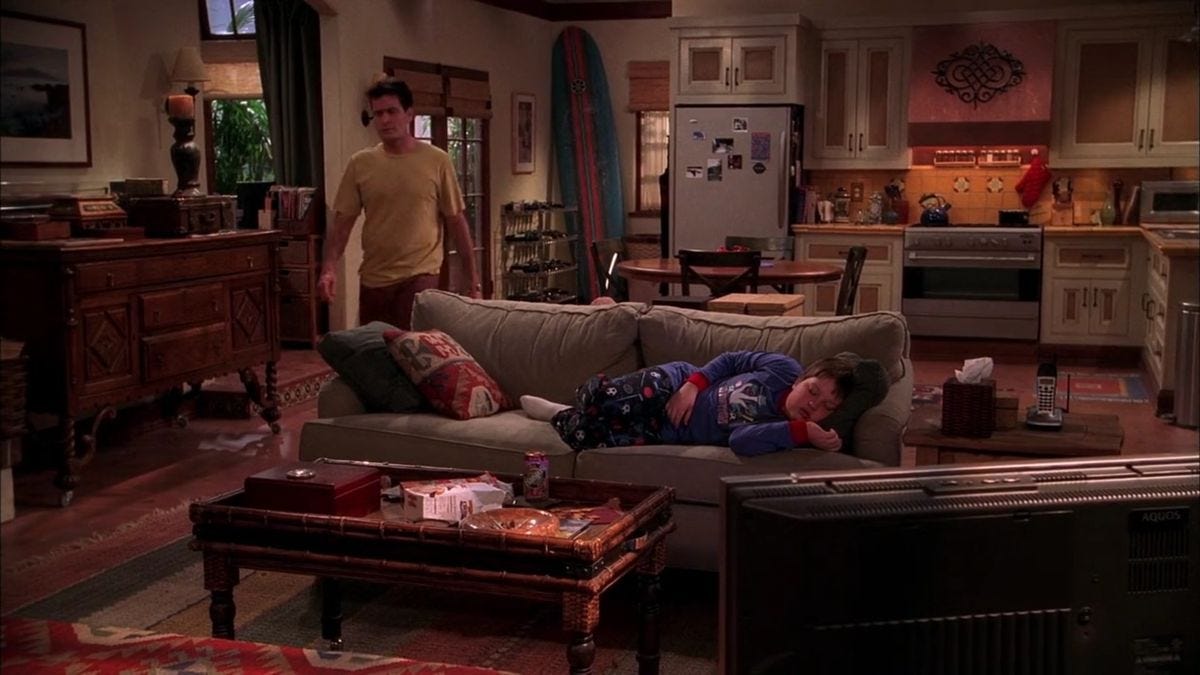
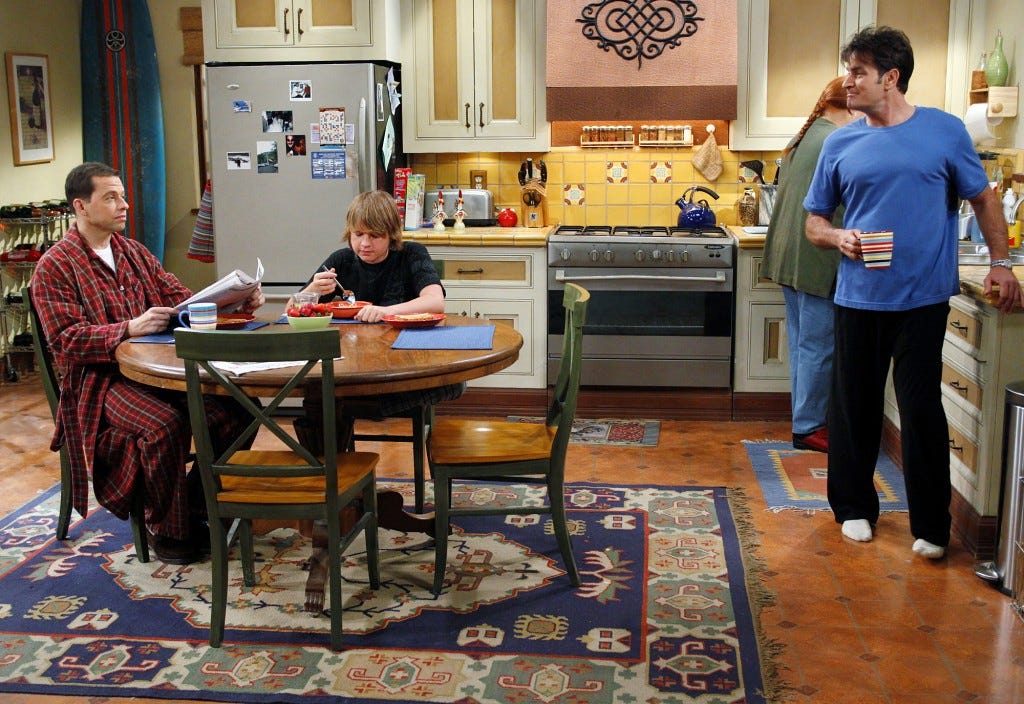
Here’s the “remodeled” Kutcher-era house, drained of life and personality:
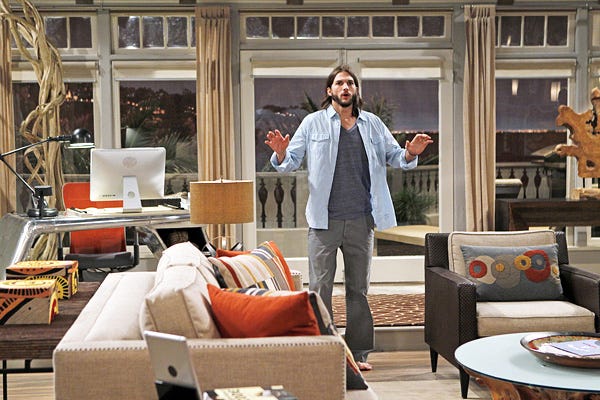
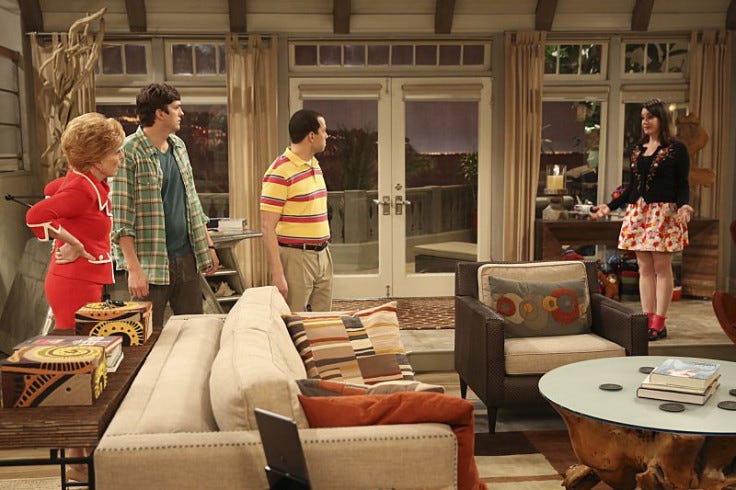
Season 10 (2012). The Kutcher-era show premise really wobbles – it’s wildly unrealistic that Walden would keep Alan living there – and there are far too many Walden-focused episodes. The highest rated episode was an Alan-focused episode at only 7/10, episode 22, and the lowest was a Rose-focused episode at 0/10, episode 6. The season average was yet another near low, at 4.217/10. Jake’s character was written out of the show after Jones publicly calling it “filth” due to his Christian beliefs, but he later apologized and will be back for the series finale. I’m still thankful the show continued – it’s worth watching still for Cryer’s performance – although Kutcher sucks. Berta is featured in a bunch of episodes sporadically, while Judith and Rose have mostly been written out of the show.
Season 11 (2013). This is was a strange season; the first half was terrible, political and unfunny, but the second half surprisingly got better and better. The show initially pushes lesbianism, homosexuality, and transsexuality in a very crass and crude way, but then it pivots to a plot involving Alan having an affair with his ex girlfriend while becoming friends with her boyfriend under an assumed name, and this grew on me over time. The second half focuses more on Alan instead of Walden which is a plus. Lowest episodes: E9 and E10 which push transsexualism with 0’s, highest was E17 with Alan dating his ex girlfriend’s boyfriend’s sister with a 9, but the finale was also solid with an 8. Season average: 4.09/10, the lowest season yet, but the first half was a 3.18 average and the second half was a 5, so it picks up substantially.
Season 12 (2014). The show ends just a couple years before Me Too starts (2017), when humor more or less officially died. This is a short season with 16 episodes, when most seasons had 22-24. It’s not a surprise that this was the last season as ratings declined starting in Season 11 because of the policitized woke stuff (lesbianism, transsexualism, homosexuality, gay adoption):
This season was terrible, and there was a long stretch of 0 ratings, which picked up toward the end when they end the gay marriage/adoption plotline and pivoted back to adult relationships. The season average was a horrific 2.28/10, by far the worst of the series, fallen into the depths of Hell, and the highest rated episode was an 8 in the series finale, which was well plotted with a lot of jokes. The show was founded as a guy’s fantasy – Charlie Sheen with his beach house and women, displaying magnanimity to his loser brother – and ended with a gay marriage and mixed race child adoption, with a lesbian niece. I guess that reflects the decline of America too. Season 12 was hard to sit through despite being a short 16 episodes and I must say I’m glad it’s over. Then again, it’s pretty amazing how they stretched this concept about – with an ultimate focus on Alan’s Job role and the house itself – for twelve seasons.
Conclusion
This ultimately turned out to not just be reviewing a show, but tracking the collapse of a certain kind of unselfconscious masculinity – a world where a man could be a man, where sex was consequence-light, where the worst thing that could happen was being nagged by your ex-wife – and its replacement by something that felt deeply hollow and performative – a moralized soap opera about gay marriage and adoption which itself mirrored the changes in broader society. The pleasure was drained out of it, and it’s a perfect example of the skinsuiting concept: the comedy was intentionally replaced by sociopolitical programming, and I was acutely aware of and uncomfortable with the manipulation. The house – the central symbol – became a hollow shell mirroring this, which is redecorated in a cold, modern style, monochrome, modern, and much worse than the warm Sheen-era Mediterranean style.
Ultimately I’m glad I did this ridiculous 262 episode watch and analysis, as it kept my energies moving as I am in a kind of holding pattern. The exploration of the hedonism fantasy did not result in any profound insights or changes, but I did not expect it to; casual hookups and short-term relationships had been generally denied to me in my formative years, and when formative experiences are denied to a person, they often become “stuck” on that period of their lives. Whether this watch shifts the underlying terrain I’m not sure, but the crucifixion of opposites here involves both holding the hedonic fantasy as an attractive vision while also recognizing that it would almost certainly be unlikely to be sufficient as a carrier for my energies, which requires contemplation, analysis, and synthesis via writing; it certainly wasn’t enough ultimately to contain Sheen’s wild Dionysian energies.
Subscribe:
Email delivery remains on Substack for now.
Basically, my definition of “dissident” changed from reaction against the forced egalitarianism permeating the West to following one’s individuation path regardless of societal pressures. This perspective shifted from something reactive to generative. I don’t mean individuation as individualism, egotistically following whatever one decides; rather, we all have a specific path in this life, something we are meant to fulfill if we listen to the deepest inner impulses, and our choice is either to acknowledge and follow that path, at least to an extent, or to suffer increased psychological burdens as this Note describes.
I also think of Frank Grimes as a restrictive Saturnian, Job-like figure from the Simpsons, and Squidward from Spongebob Squarepants, especially his juxtaposition with Spongebob and Patrick in the Magic Conch episode.
The last name “Cryer” brings to mind the figure of the town crier, a public figure who performs for the masses, and also a “crier”, someone who whines and complains. I often notice resonance between a person’s character and their name, or alternatively, that people adopt names that more suit them; Carlos Estevez went by the stage name “Charlie Sheen” (like his father Martin), where Sheen means “a soft luster on a surface.”
p. 59: “Years later, my mother [a famous stage actress] and I were reminiscing about my first taste of professional acting, and she said something that really struck me. She said that while she know from watching me at Stagedoor Manor that I had a talent for performing and making people laugh, and that from seeing me onstage in Torch Song Trilogy she knew I was going to make it, what really gave her the idea that I was cut out for acting as a career was how I dealt with the firing.
“Jon”,” she reminded me, “when they handed you your pink slip, what was wonderful about your reaction was that it was complete anger and outrage. You came home and said, “I could have done it, Mom! They didn’t give me the chance!” rather than, “Oh, poor me, I’m defeated. I’m never going to do this again.” You were a warrior, and I was so very proud of you.”…[I] know that inside me I did discover a resilience and an urge to prove my worth that’s stood me in good stead ever since.”
p. 265: “I didn’t care about whether I had the A story or the B story each week. I’ve had both over the years. The quality of what I was doing was always paramount. Besides, having the A story each week is exhausting, because you’re in practically every scene. If I have a well-written secondary story line that gives me something really funny to play, I’m happy. The best material comes out of an organic process, and if you encumber writers with demands like, “give me that character’s funny lines!” or, “Why don’t I have more to do?” then they’re writing from a place of hampered creativity and pressure. I want the writers to go where the funniest stories are, period.”
Cryer is mostly known for his Two and a Half Men role, but he only gets to discussing it about 75% or more through the book, focusing on his origins and lesser known roles. He doesn’t discuss his favorite or least favorite episodes or how his character evolved over time except in passing, which I found to be a disappointment. But still, a pretty light and easy read overall.
Earlier in my life Sheen’s autobiography would have been far more interesting, but it’s almost two dimensional from my current standpoint: man has too-easy success with work, fame, and women, lets it go to his head, falls into drugs and transsexual whores, his ego swells and blows everything up, and his career is ruined; he looks back at it later with more humility. Cryer is more interesting because he remained professional throughout, did the job, kept his head low, stayed humble, and grinded, not taking things for granted – that’s a more interesting psyche to me currently.
Update: I skimmed Sheen’s book and it accurately reflected my above understanding, and I put it down pretty quickly. What was surprising was that Cryer was mentioned only once in the book and Two and a Half Men was only discussed over a couple pages – I guess it was just a paycheck to him and he was just going through the motions during it.
Update 2: I also skimmed Sheen’s documentary on Netflix and it was pretty much exactly what I expected, including the supporting characters (although Denise Richards was much more masculine than I expected; I expected her abnormal plastic surgery, sad, she used to be beautiful), and I found myself mostly only stopping to watch Cryer’s portions, as he had a lot of wisdom and gravitas in his statements (and he looks pretty good bald with a beard, although older). Sheen didn’t look very good – he had the puffy face and turkey neck and what almost looked like a facelift, dyed hair, he looked pretty artificial, perhaps which might be related either to HIV medication side-effects or the health effects caused by excessive lifelong partying and hedonism. I would also note that in one of Sheen’s post-show drugged out, ego-driven rants he stated he had always thought the show was “beneath” him, which corroborates the takeaway in the above update.
p. 266:
As the episodes of Two and a Half Men were piling up, I’d had cause to reexamine my character and come to the conclusion that Alan is mostly me, with brushstrokes provided by some of my friends. His cheapness comes from one pal I won’t name, but he knows who he is.
Again, though, he’s mostly me. Alan is so thwarted in some many aspects of his life that had I been thwarted in similarly, and not been possessed of my special self-delusional sense of destiny, I would probably have become an Alan-like mixture of uptight, judgmental, anxious, and flawed. In a way, Alan reminds me of how things could have gone.
p. 243:
What I heard was that to CBS president Les Moonves, I was walking-and-talking eighties-movie-star baggage. Mind you, Sheen had that baggage too, but two holdovers from that decade was apparently too much.
At that first audition, though, I received one more inauspicious sign: Chuck Lorre is the most notoriously generous laughter in the business at auditions, and when I read Alan Harper for him the first time, he didn’t make a peep.
I had been sitting outside the audition room and I could hear other actors taking a swing at the character of Alan and not even remotely connecting with the material. The scene that all us prospective Alans auditioned with as we read opposite a casting agent reciting Charlie’s liens was the one in which Charlie has been on a bender, and Alan is informing him that his wife is divorcing him, and he needs to stay at Charlie’s a few days. What I heard from other auditioners, though, was an Alan frantic, as if he’d already begun losing his mind.
To me, Alan struck me as tightly wound, someone who pushes down feelings. It takes a lot to get him to the eruptive stage. He’s like popcorn – he’s got to sit in hot oil awhile before he explodes, so if he was immediately frantic, that felt wrong. Besides, Alan retains a certain judgmental air toward his lothario brother, Charlie, so he’s not going to let on right away the shame he feels about his marriage being on the skids. In Alan’s mind, Charlie’s the fuckup, not him. Every frenzied line reading I heard through that door felt superficial and wrong, so as I walked into that room – “Hey good to see ya, Chuck! Jim Burrows, man, how are ya?” (It was great to see Jim again; that he was directing this was a good omen) – I was pretty confident that I knew how to hit that comedy the way it needed to be hit.
But I got nothing from Chuck.
When something’s dying, actors have a choice: Lie back a little and hope for the best, go big and amp up the energy, or try to connect in some other way. But as the silence from Chuck’s direction began to feel louder – believe me, that description makes sense when you’re a performer – I opted to stick to my guns. I told myself, Trust your interpretation of this. So I switched off the targeting computer, aimed for the thermal exhaust port, and let my proton torpedoes fly….
Later on, Chuck explained his silence at that first audition. They’d been looking for Alan for weeks, he told me, and when I read he was struck silent by the fact that someone had finally done it right.”
p. 252:
As our first season of Two and a Half Men hit its stride, it was becoming clear to me that work was going to be my refuge. I was trudging through a divorce at the same time my character was going through one as well. Quite a few people openly asked me if this was “fun,” because I got to bring all that stuff to the show.
Um, no. Not fun at all. This was not, “Yay, I get to have turmoil in my life and play it at work!” Of course, it brought added depth to scenes Alan had with Jake, but it’s not as if I was thinking, Thank God, the pain is so readily available!
When Charlie heard about what I was going through at home, he very sweetly took me aside one day and said, “Hey, man, I know things are really tough for you, so if you need a place to stay, you can crash at my house.”
I looked at him quizzically and said, ‘Thanks, Charlie, but…how much like the show do you want your life to be?”
“Oh, yeah,” he said, smiling ruefully. “Bad idea.”
Sheen’s energy signature is Dionysian with a Hermetic overlay: ecstatic, transgressive, pleasure‑driven, but socially adaptive enough to charm and perform. His metabolism is sanguine (social and risk‑seeking behaviors are cheap, hedonic adaptation rapid). His primary stabilizer is esteem/status (needing to be the star, the highest‑paid, the center). His implicit god‑image is secular hedonism with a redemptive hangover – the system should keep delivering, and when it didn’t, he had nothing to catch him. He imploded because his constellation had no internal container – ecstasy without Saturn, cheap rewards that accelerated hedonic adaptation, external stabilizers that failed when status stopped delivering, and a god‑image too weak to metabolize boredom or mortality.
Cryer’s energy signature is Hephaestian (craftsman, the wounded worker, deep, stubborn, productive) with a Saturnian exterior: he grinds, stays professional, endures humiliation, builds a career through discipline rather than charisma. His metabolism is phlegmatic (resilience, low reactivity, ability to absorb pressure without collapsing). His primary stabilizer is control and agency – he stays humble, does the job, trusts that his disciplined effort will steer outcomes. His god‑image is pragmatic mastery: reality rewards those who maintain composure, choose their battles, and don’t let circumstances dictate their fate.
Kutcher’s energy signature is Hermetic with a weak Martian overlay: social mimicry, desire for validation, forced likeability (dopey voice, desperate to be seen as a “nice guy” and a “serious” tech investor). His metabolism is sanguine. His primary stabilizers are esteem (needing recognition) with attachment secondary. His god‑image is secular tech‑progressivism – optimization and being perceived as smart will make life work, a hollow substitute that cannot bear the crucifixion of opposites.
Jones later became a religious Christian, fat and bald with scraggly facial hair, and publicly denounced the show as sinful, which caused a controversy at the time. He’s an excellent and natural actor, he makes it look effortless and he always looks like he’s having so much fun on the show. I don’t cover him much at all in these reviews because I don’t feel like there’s a compelling hook – he’s mostly losing his innocence slowly as Charlie’s character inherently corrupts him with booze, gambling, and women, while torn between a weak and neurotic father and a nasty shrew mother.
Evelyn’s two-dimensionality is her bitchiness deployed consistently and predictably, which produces diminishing returns. The episode where Jake disrupts that (E23 of season 3) – where the chaos comes from an unexpected direction and Evelyn is on the receiving end rather than delivering – breaks the pattern and produces genuine comic release. The same structural principle explains why the best episodes tend to exclude most of the supporting cast: Charlie and Alan’s dynamic has genuine depth and variability; the female supporting characters are mostly written as single-note obstacles.
The Judith critique has two components. The first is aesthetic: the shrewish-ex-wife archetype is structurally asymmetric in a way that’s hard to make funny. Comedy requires some form of release – the tension builds and then breaks in a direction that produces relief or recognition. The shrew dynamic doesn’t release cleanly because the power asymmetry is real and unresolvable within the show’s universe. Alan can’t win, can’t leave, can’t retaliate, and the audience knows it. That’s not comic tension; it’s just tension. The second component is constitutional and personal, where dealing with shrews in my own life makes seeing them on television feel sour.
The Rose critique is aesthetic and structural: the character violates the show’s internal realism. Two and a Half Men works because its fantasy is grounded in recognizable male psychology – the beach house, the money, the casual hookups, the fraternal dynamic. Rose introduces a supernatural-stalker element that the show’s realism can’t absorb. She belongs in a different genre. Every scene with her is a tonal rupture, not a comic escalation, and it’s a craft failure. Thankfully she is downgraded from main cast to reoccurring cast after season 2. With that said, I do understand the need for a “chaos” character in a sitcom, someone who shakes things up, whether that is Michael Richards in Seinfeld, Lisa Kudrow in Friends, David Spade in Rules of Engagement, Neil Patrick Harris in How I Met Your Mother, etc. Rose just doesn’t work here.
p. 284:
Charlie didn’t look so good as we started our eighth season in the fall of 2010 – gaunt, pale, sallow, even sweaty occasionally. He started talking to himself. But most of all he just looked thinner, in a not-good way. Watching the new episodes at home, Lisa [Alan’s wife] could tell how terrible he looked, and said as much.
Even his teeth looked bad. They looked like they were going to fall out of his mouth.
His timing started to go off, too. The pauses were now a little too short. He was rushing lines. He was still remembering them, at least, but there was now an incrementally more manic energy that threw his rhythm off by microseconds. These might not have been perceptible differences to the vast majority of viewers, but to me they felt substantial. Charlie just wasn’t hitting the jokes the way he used to. It was as if his psyche had been sped up.
p. 294:
Things didn’t start smoothly once the show began. We did a scene with the two of us sitting on a couch, and Charlie screwed up every line. He could not remember anything he was supposed to say. It was hard to comprehend what I was seeing, because Charlie had always prided himself on getting it done on show night. It was like watching HAL go haywire in 2001: A Space Odyssey. Mark Samuels, our assistant director, who is the soul of diplomacy and quiet competence, said to Charlie, “Do you need a minute?”…
Charlie paused, then said, “Wait a minute; just give me a second.”
Somebody handed him the pages, and as he went over them, the rest of us were extraordinarily uncomfortable. The audience was here, after all. And then a rather astonishing thing happened. On take two, Charlie completely nailed it. Every beat. Every line. When he absolutely had to focus, he did. It was a strange and impressive thing to behold.
Instead of sticking around for the [drug intervention with executives after], however, Charlie chose to walk out, still in full makeup, get in his car, and have his driver take him home…That was also the last episode of Two and a Half Men Charlie would ever shoot.