This post examines the ongoing Iran war through a structural lens that the standard and dissident frameworks cannot provide. Beginning with a series of unanswered questions – why the war was launched with almost no public justification, why Israel’s stock market is at all-time highs despite purported Iranian retaliation, why every Israeli enemy in the region has been systematically eliminated while Israeli allies remain – it argues that the war is not a geopolitical conflict but a single integrated operation with five simultaneous outputs. The post then situates this operation within a deeper framework, arguing that the degradation of the Western population is not a byproduct of the system but its calibrated output and that the Iran war marks the acceleration toward the formalization of covert hierarchy into overt control.
Welcome back. In this post I am going to discuss the ongoing Iran war, because the ramifications of the war seem to be extending beyond a Current Thing – which I am loathe to cover except in throwaway Notes, if that – and providing signs of possibly morphing into a COVID-19 type scenario, with lockdowns and upcoming panic on the basis of energy crisis instead of a rebranded flu.
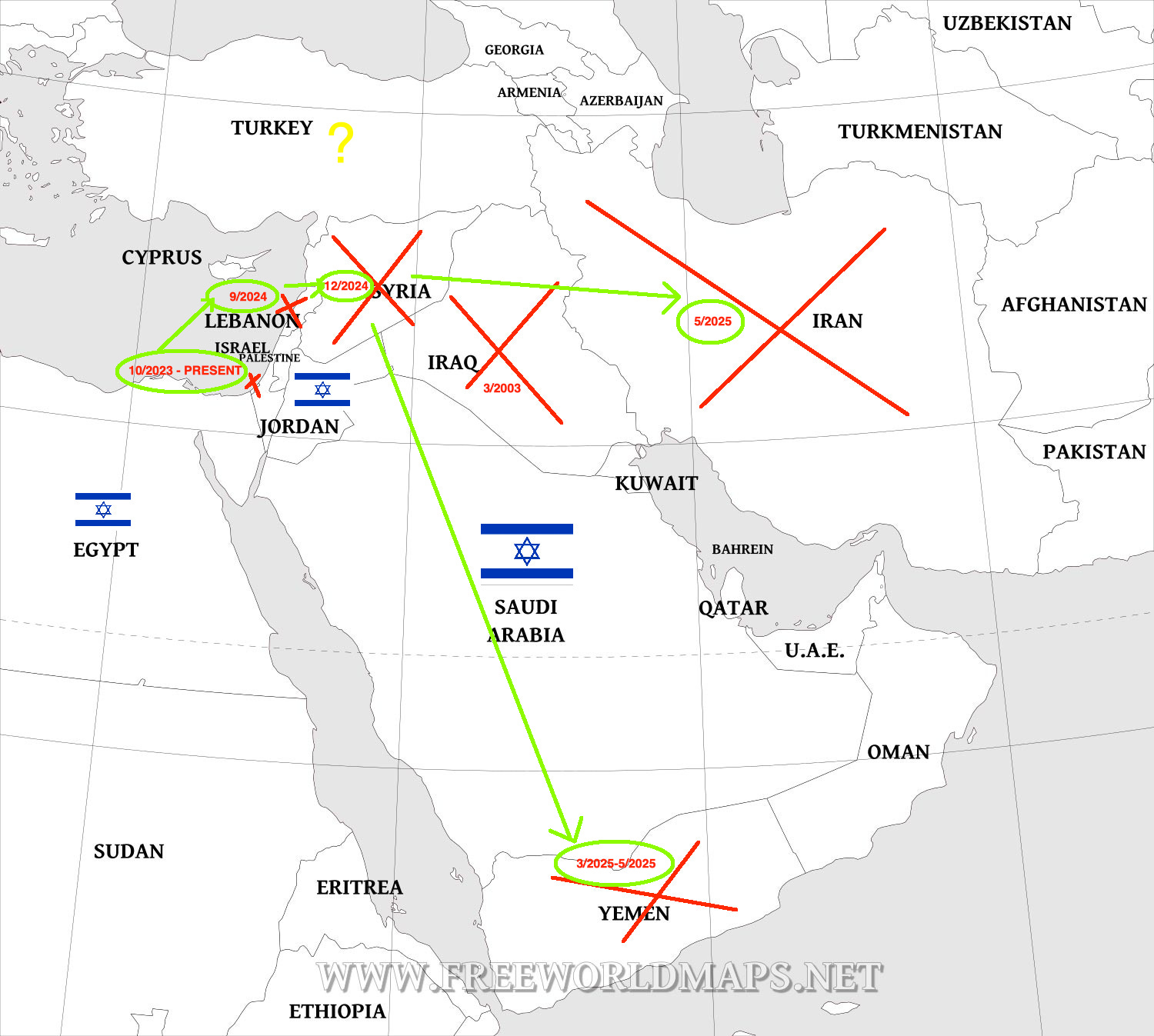
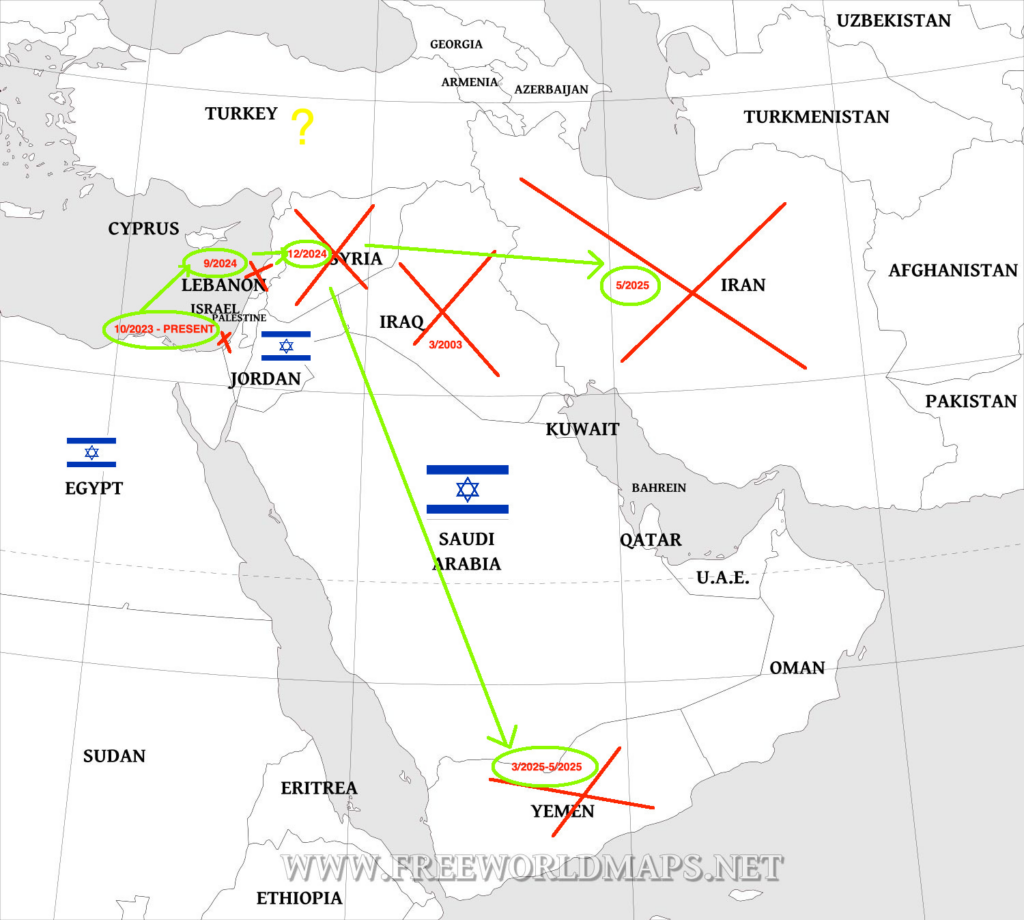
Let’s start with some questions about the war. Trump attacked Iran last year and purportedly destroyed or set back substantially its nuclear weapons program, with many generals, scientists, and other prominent regime officials assassinated – what was the need to attack them again? Why did the Trump regime not really attempt to sell the American public on the war – some wishy-washy, contradictory statements about the threat Iran posed, its rebuilding of its nuclear program, whatever, which was a very weak attempt, certainly far, far weaker than Colin Powell’s WMD lies about Iraq? Why did Trump have endless meetings with Netanyahu in the leadup to the war? Why does Trump and his administration release endless numbers of contradictory statements about escalation versus de-escalation? Who is the Trump administration negotiating with in Iran – all the news reports are about unnamed “Iranian officials” or the “Iranian government response” – even though the Supreme Leader and much of the top political and military officials have all been targeted and are dead, to the point Trump himself said he has no idea who is running the Iranian government (“”Nobody knows who to talk to,” President Donald Trump said Tuesday at the White House, describing what he portrayed as both chaos and opportunity inside Iran’s leadership”)? Why have top military officials been fired by Hegseth? Understanding that Iran would control the Strait of Hormuz, and its effect on the oil market, especially if the war continued for a long period, is extremely elementary facts – why did the Trump administration not care? Why does the administration seem to not be concerned about upcoming 2026 elections, which appears to be a massive blue wave, assumedly leading to an impeachment attempt if Democrats win? Why do they not seem to care that the public support for the war is very low and Trump’s popularity is now at the lowest level ever from either of his presidencies? Why is Israel’s stock market, despite the purported “pummeling” Iran is giving Israel, near its all time highs, 3x the level it was a year ago? Why have all of Israel’s enemies in the region been destroyed in the past couple years and decades – starting with Iraq, but recently Hamas, Hezbollah, Assad, Yemen, and now Iran, with only Israel allies – Egypt, Saudi Arabia, Jordan – remaining untouched? To increase the puzzle further, the Iranian mullah regime was originally established by the U.S./U.K. national security elite1, it went along fully with the COVID lockdowns and forced “vaccinations” and it has been deeply involved in CBDC research – in other words, they were loyal adherents to the global system despite their public-facing chants of “Death to America” and “Death to Israel” – what was the need to remove these figures?
I could go on, but these questions are not resolvable from a standard or dissident framework. The standard framework is about “defeating the Iranian regime” and “preventing it from having nuclear weapons”, but the Iranian nuclear program was already destroyed or heavily set back last year – and what interest does America other than Israel have in overthrowing the Iranian regime? So-called prominent “dissident” Substackers – I’m not going to name names as I don’t have interest in a pissing match, but you should be able to identify who these people are (see the comments) – gave internally contradictory and weak analysis about how great it was that America’s “enemy” was defeated, while hedging against possible retaliation and blowback, analysis that generates no predictive accuracy and asks no structural questions. The standard and culture war dissident perspective has no idea why this war was launched, why it was launched now, for what reasons, and they have no understanding of where it is headed.
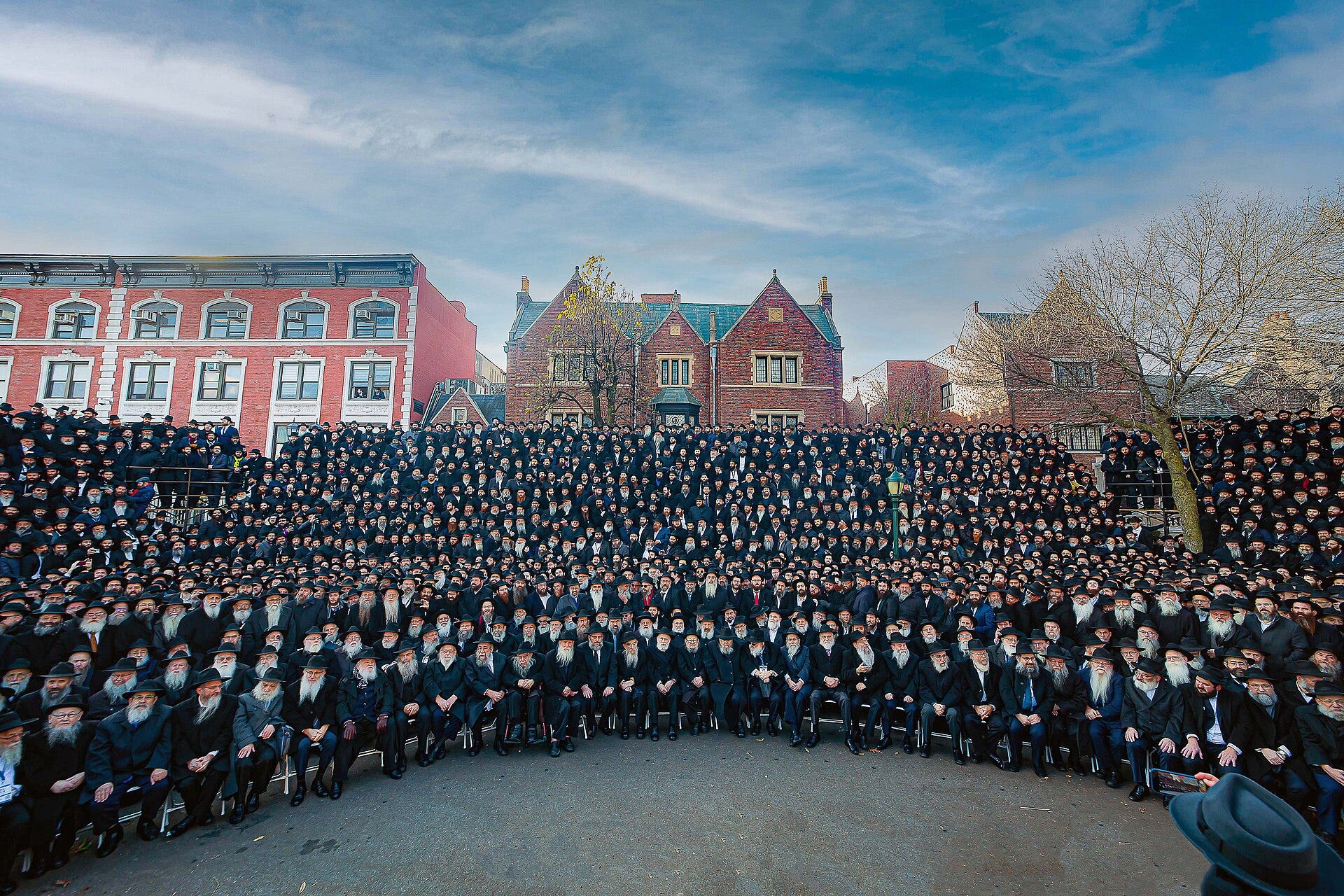
A couple perceptive folks correctly ascertained that one of the objectives is the furtherance of the Greater Israel project. One simply can’t look at a map of the region without understanding how heavily Israel benefits from these wars or that Trump is beholden to Kushner, Chabad, Lutnick, that he pardons Orthodox criminals in return for bribes, and that his administration is fully staffed with Jews and Noahides.2
But these people also fail to ask the deeper questions, even though they are much further along than culture war “dissidents.” These deeper questions include: why are these Zionists in control of the Trump administration, and before that the Biden administration and all administrations going back decades? Does this relate to the concept of egregores and of Christianity itself – that by adopting Yahweh as their God gentiles put the Jewish vision at the center of their universe with all that entails? (Nietzsche certainly thought so.3) What about the Jewish perspective provides this kind of vision and power to create this kind of result, how does it differ from other visions out there, despite Jews being such a tiny percent of the world population? What does Greater Israel entail, what results from that and on what basis and for what purpose, how far back does it go? What is it about the nature of reality itself that has allowed this system to propagate and succeed?
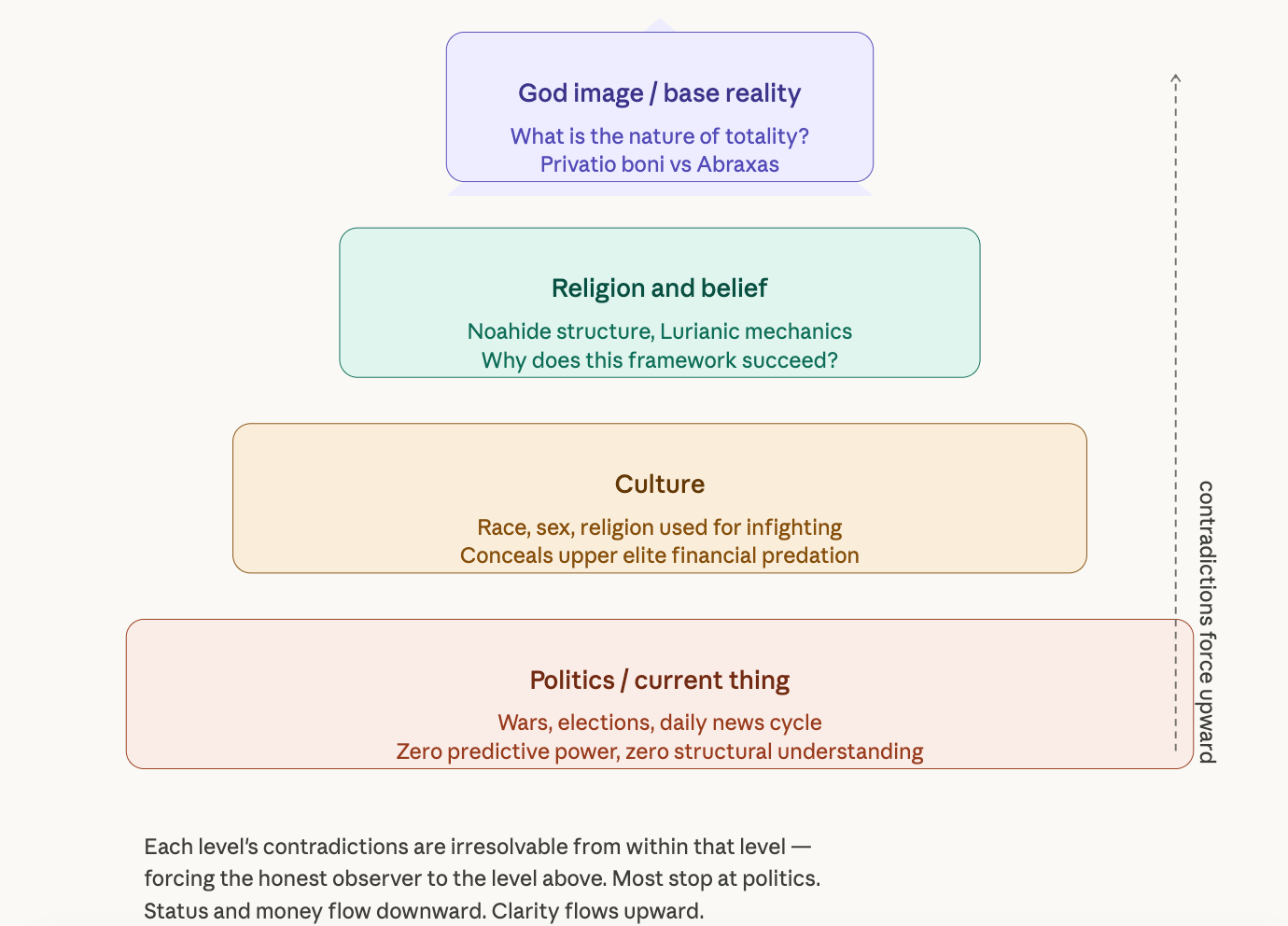
What I am trying to explain here is that political contradictions naturally lead to a questioning and greater understanding of culture contradictions, which naturally leads to a questioning and greater understanding of religious and belief contradictions, which then naturally leads to a questioning and greater understanding of our conception of the God image and base reality conceptions.
But this only happens if one is willing to wrestle with the contradictions at the layer one is analyzing, which most people are wildly loathe to do, with good reason – because to do this is uncomfortable, it requires separation from group thought, it requires diminished status, it requires greater risk, and none of this comes with increased material payoff. If you want status and money then you better stick to the politics and culture war level, even though it has zero predictive ability and very low understanding of the world, because that’s where the masses are – the masses want to be told everything will be okay, they want to be told to focus on the shiny Current Thing, to alleviate their boredom, their concerns about this reality and the world. They want an authority to tell them what to think and what to fear. Make them uncomfortable instead? No money for you, no attention for you, no status for you. There is also a deeper reason beyond incentive structure: to drill down past the political and cultural levels requires tolerating genuine uncertainty, the absence of a redemptive narrative, the possibility that the structure is more total than any available opposition can address. Most people will accept almost any lie rather than sit with that, it is the normal human response to the contemplation of the void, and the abnormality belongs to those who cannot stop drilling regardless of what they find.
My answers to these questions have been addressed in prior posts (here on the God image, here on why there is a direct and inverse correlation between spirituality and power that is built into the nature of reality itself). The political level Current Thing is meant as a poor religious surrogate replacement, the culture war level is meant to keep the masses infighting on the basis of race, sex, sexual orientation, and religion so they won’t focus on upper elite financial theft. The religious level is that, despite many benefits and reasons for its success, both Christianity and Islam are Noahide religions that puts Yahweh at the center of their worldview, thereby enabling the current structure, but they outcompeted their “pagan” rivals for specific reasons too (for Christianity, for example, it centralized power in the hands of regional bishops, it focused on almsgiving which was popular, and its conceptions of Heaven and Hell were hugely incentivizing toward action – all innovations over Hellenism). The Jewish religion possesses certain features that are naturally upper elite encoded – non-redemptive theology (where power doesn’t need to justify itself via outcomes), infinite interpretive flexibility (where any action can be reframed as necessary), and ontological hierarchy (with exploitable lower tiers without moral contradiction) – that provides justification for the upper elite predation and domination even if they also use those tactics against common Jews who are not in on their schemes and are often the victim of those schemes. And ultimately, beneath and behind all of this, the vast majority of people do not want to think for themselves, being told what to think and what to focus on is what almost everyone wants, because the alternative is so horrifying – the contemplation of the Void, the lack of moral certainty, the permanent crucifixion of opposites, the uncertainty of the afterlife, is simply too horrible and awful for most people to accept. It is too painful, so believing any narrative, no matter how ridiculous, no matter how much they are detrimental to oneself and one’s progeny, is better than staring into the void.
With that said, as I explained in a Note, the Iran war has the following objectives:
to level Iran permanently so it isn’t considered a threat for upcoming Greater Israel investment (possibly to include bombing civilian electrical infrastructure per Trump’s public threats – including on Truth Social on 4/5, “Tuesday will be Power Plant Day, and Bridge Day, all wrapped up in one, in Iran. There will be nothing like it!!! Open the Fuckin’ Strait, you crazy bastards, or you’ll be living in Hell – JUST WATCH! Praise be to Allah. President DONALD J. TRUMP”), which would be, if carried out, a war crime and indirectly result in tremendous numbers of civilian casualties by cutting off electricity to hospitals, water supply and other vital civilian needs); this is perhaps why the unprovoked attack was launched days (2/28) before Purim (3/3), the holiday celebrating preemptive elimination of a perceived existential threat through court access and political manipulation;Esther Denouncing Haman (1888) by Ernest Normand
to shift oil transportation to Europe from Hormuz to pipelines through Israel via the India–Middle East–Europe Economic Corridor (IMEC), giving Israel clearinghouse leverage over all of Europe, as ESC Key discusses here,
to hurt China’s access to oil (it gets 50% of its energy through Hormuz4),
to likely game the stock market both up and down so Trump and his inner circle can make billions through shortdated options (based on unsubstantiated posts like this, however, the gutting of the SEC, the rollout of Trumpcoin and Melaniacoin, and Trump accepting massive “donations” for pardons provides substantial credibility to the allegations), and, unfortunately,
potentially to cause an energy crisis leading to COVID-level lockdowns / agricultural shortages leading to a preapproved CBDC “solution”.
These five objectives serve as a single integrated mechanism: the pipeline infrastructure (1) enables Greater Israel’s economic consolidation while (2) severing China’s primary energy artery, (3)weakening the only viable alternative national level pole (although China is also subservient to the apex financial structure, see the discussion here about it under the “What about China” heading), (4) the market operation funds the inner circle and demonstrates that geopolitical events can be manufactured for financial extraction at will, and (5) the energy crisis pretext advances the control infrastructure that makes all subsequent operations irreversible. The available evidence suggests that the Iranian leadership is a theatrical opposition (see footnote 1) that has served its function – providing the pretext for military expenditure, regional destabilization, and the consolidation of Israel’s enemies into a single manageable target – must eventually be retired when the next phase of the program requires different regional architecture (I discussed the phases of integration into the global order in this prior post). The mullah regime was a stage prop whose removal was always scheduled, not an enemy whose defeat was uncertain – this is why Netanyahu has been “warning” about Iranian nuclear weapons being imminent for many decades now.
With this said, the war is going perfectly for them, there is no daylight at all between Trump and figures like Netanyahu despite media reports to the contrary (fed by nefarious parties to keep the public hooked on uncertainty), and popular opinion no longer matters – this is due to the American voting apparatus being fully controlled, audio/text/visuals domination via AI crushing the ability for the public to organize on the internet, and the closeness of the materialization of the Mark of the Beast system – programmable central bank digital currencies and social credit scores via AI scanning everyone’s digital footprints via Total Information Awareness – being ready for deployment, with digital IDs being rolled out in the EU and Russia now. The world public utterly failed the COVID test, putting up with the most ridiculous lies and injecting themselves with untested mRNA heart attack jabs (and the lesson elites drew was not that the public can be manipulated under sufficient pressure, which they already knew, but that the public will actively participate in its own degradation and thank the architects for the opportunity), giving the upper elites the confidence they have as they sprint to implementing Greater Israel, the rebuild of the Third Temple, and the proclamation of their fake “messiah”, after which they will rule the world formally with the masses of the world predated upon on an individual level to an extent never seen before in human history. As the Israel stock market is basically at an all time high and fatalities are close to zero, Iran’s hyped “retaliation” is a total joke and anyone who tells you otherwise is mistaken or deliberately misleading you to make the “war” seem closer than what it is.
This is where it’s all heading and I don’t personally see anything that can be done to stop it – voting provides legitimacy to the system and you are given false choices (Trump v. Biden, Trump v. Kamala, Vance v. Newsom?), the public is demoralized and shattered and America probably has ~50 million+ illegals and children of illegals within it, tech advancement by this system is too extreme, debt levels are too high, morals are too low, and almost everyone is obese, tattoo’d and ruined.
The choice one has at this time is whether to drill down from the political and culture war levels to the metaphysics underlying this system, or to put one’s head in the sand as the ruination continues to ratchet higher. This is not a call to action in any conventional sense; there is no political action available that does not validate the system it purports to oppose, no coalition to build among a population whose interior resources have been systematically evacuated, no institution to capture that has not already been captured. What remains is the individual confrontation with what is actually happening – not the Current Thing version, not the dissident culture war version, but the full structural reality including its metaphysical foundations, all based on a recursive prediction model (for example, see my posts a year ago that Greater Israel was being implemented, or my 2026 or 2025 prediction posts). This is not comfortable and it does not resolve into hope or despair but into something more difficult than either: holding the crucifixion of opposites without collapsing into one polarity versus another, resolved provisionally via the transcendent function, which is the only position from which the structure can be seen clearly and the only position from which anything resembling sovereignty remains available. Prior posts of mine address the metaphysical foundations. It is not light reading, but if the political level questions that open this post cannot be answered from the political level – and they cannot – then the answer is elsewhere.
What the prior series establishes is that the degradation of the population is not the byproduct of market logic, not the unintended consequence of ideological capture, not mere elite indifference to collateral damage; rather, the Lurianic cosmological framework and the Sabbatean/Frankist value inversion the apex elite utilize treats the gentile population as kelipot – husks whose proper function within the cosmic economy is substrate maintenance for the hierarchical apparatus above them.5 The obesity, the tattoos, the shattered attention spans, the spiritual vacancy, these are the outputs of the system, not its failures, calibrated to produce a population degraded enough to be incapable of organized resistance but functional enough to continue generating the substrate the hierarchy requires. The Iran war ultimately points to the next phase of a program whose endpoint is the formalization of what has until now been covert. When the Third Temple is rebuilt and the “messiah” proclaimed and the CBDC infrastructure deployed and the social credit apparatus activated, the covert hierarchy becomes overt. The masks will come off when the control infrastructure has become sufficiently total that the fiction of democratic governance is no longer necessary to maintain. At that point the kelipot question resolves itself practically rather than cosmologically: a population that has been systematically evacuated of the interior resources required for resistance will not resist, they will blow away in the wind as the “empty husks” they have been forced to, in a slow-moving Fabian fashion, based at their understandable unwillingness to contemplate the void and to put their trust in authorities, to become. The drilling down this post recommends is the only remaining act of sovereignty available to someone who can still do it – the refusal to become a husk while there is still something left to refuse with.
Subscribe: Email delivery remains on Substack for now.
1 As I wrote elsewhere: “Several claims, patterns, and circumstantial data points have led some analysts, historians, and conspiracy theorists to suspect indirect facilitation or strategic tolerance of Khomeini’s rise by Western intelligence, particularly in light of the following:
Publicly Known and Less Controversial Facts
Khomeini lived in the West before the revolution: He spent over a decade in exile, including time in France, where he had unrestricted access to media and communication tools. His sermons were recorded and broadcast into Iran with a degree of tolerance that raised some eyebrows. From Neauphle-le-Château, Khomeini’s messages were widely disseminated, including through BBC Persian, which gave extensive and sympathetic coverage to him during the revolution, unlike its previous treatment of dissidents. Some interpret this as passive Western support, particularly from France and Britain.
The Carter administration’s behavior: Some American officials saw Khomeini as less dangerous than the radical leftist groups in Iran. Declassified CIA assessments suggested Khomeini was not hostile to U.S. interests and that a clerical regime might be less volatile than other revolutionary alternatives. The Shah himself claimed that the United States was “betraying him” during the final months of his rule, and several memoirs from the period, including those by U.S. Ambassador William Sullivan, show a lack of support for the Shah from Carter’s inner circle.
The Shah’s downfall: The 1979 revolution was not seriously opposed by Western powers despite the fact that Iran was a major Cold War ally. Some view this as benign neglect or a managed transition, with Khomeini allowed to return under carefully watched conditions.
Claims, Suspicions, and Conspiratorial Readings
French Socialist Party figures, particularly François Mitterrand, allegedly had ties to revolutionary clerical circles. Some researchers claim Western powers preferred an Islamic revolution to a leftist or Soviet-aligned alternative.
F. William Engdahl, in books like Full Spectrum Dominance, and other authors from the anti-globalist right and left, have claimed that the revolution was allowed to proceed in order to restructure Iranian society in a way more compatible with a bifurcated East-West system — i.e., to maintain oil flow but destroy the Shah’s aspirations toward full independence.
Some Middle Eastern political theorists, especially in Egypt and Syria, have long alleged that both Khomeini and the Muslim Brotherhood were permitted or aided by Western intelligence as a counterweight to Arab nationalism (Ba’athism, Nasserism), which was more secular and economically independent. See the devastating Iran/Iraq war launched shortly after the Ayatollahs took over which resulted in half a million dead, very useful for collapsing birthrates for both countries and dealing a heavy blow to masculine Islam on both sides.”
2 Tucker Carlson’s interview with U.S. ambassador to Israel Mike Huckabee was revealing as how intense Huckabee supports the Greater Israel project as a Noahide evangelical desperately hoping to bring about the “end dates” for the Second Coming. As I wrote elsewhere regarding Trump’s first term (while the same would apply to Biden’s administration),
Among the Trump administration, also per the above Jerusalem Post link, there were also a large number of Jews. Among them included Jared Kushner, son-in-law and senior advisor; Elliot Abrams Special representative for Venezuela, then Iran; David Friedman, Ambassador to Israel; Jason Greenblatt, Special Representative for International Negotiations, the Israeli-Palestinian Conflict; Steve Mnuchin, Secretary of the Treasury; Stephen Miller, Senior Advisor, Policy; Gary Cohn, Director, White House National Economic Council; Reed Cordish, Assistant to the President, Intragovernmental and Technology Initiatives; Avrahm Berkowitz, Deputy Advisor to the President; Rod Rosenstein, Deputy Attorney General; Elan Carr, Special Envoy to monitor and combat antisemitism; Ellie Cohanim, Deputy Special Envoy to monitor and combat antisemitism; Jeffrey Rosen, Attorney General; Morgan Ortagus, Spokesperson, State Department; David Shulkin, Secretary of Veterans Affairs; Lawrence Kudlow, Director National Economic Council; Ivanka Trump, daughter, Advisor to the President; John Eisenberg, National Security Council Legal; Ezra Cohen-Watnick, Acting Under-Secretary of Defense for Intelligence; Len Khodorkovsky, Deputy Secretary of State and Senior Advisor to the US Special Representative for Iran.
3 From Genealogy of Morality, as discussed here: “Let’s bring this to a conclusion. The two opposing values “good and bad,” “good and evil” have fought a fearful battle on earth for thousands of years. …The symbol of this battle, written in a script which has remained legible through all human history up to the present, is called “Rome against Judea, Judea against Rome.” To this point there has been no greater event than this war, this posing of a question, this contradiction between deadly enemies. Rome felt that the Jew was like something contrary to nature itself, its monstrous polar opposite, as it were. In Rome the Jew was considered “guilty of hatred against the entire human race.” And that view was correct, to the extent that we are right to link the health and the future of the human race to the unconditional rule of aristocratic values, the Roman values.
By contrast, how did the Jews feel about Rome? We can guess that from a thousand signs, but it is sufficient to treat ourselves again to the Apocalypse of St. John, that wildest of all written outbursts which vengeance has on its conscience…
The Romans were indeed strong and noble men, stronger and nobler than any people who had lived on earth up until then or even than any people who had ever been dreamed up. Everything they left as remains, every inscription, is delightful, provided that we can guess what is doing the writing there. By contrast, the Jews were par excellence that priestly people of ressentiment, who possessed an unparalleled genius for popular morality…
Which of them has proved victorious for the time being, Rome or Judea? Surely there’s not the slightest doubt. Just think of who it is that people bow down to today in Rome itself, as the personification of all the highest values — and not only in Rome, but in almost half the earth, all the places where people have become merely tame or want to become tame — in front of three Jews, as we know, and one Jewess (in front of Jesus of Nazareth, the fisherman Peter, the carpet maker Paul, and the mother of the first-mentioned Jesus, named Mary). This is very remarkable: without doubt Rome has been conquered.”
4 From Forbes: “Perhaps surprisingly, China can withstand 300 days of no oil shipments from Hormuz and more than 100 days of no exports at all, thanks to its 1.3 billion barrel strategic petroleum reserve–despite the fact that 45% of China’s more than 11 million bpd of total oil imports pass through the strait. “China has intentionally capped Middle Eastern dependence near 50% and built substantial shock absorbers through diversified oil sourcing, pipeline gas, domestic production, and large inventories,” says analyst Lloyd Byrne at Jefferies.”
5 This framework did not originate with Luria. As Israel Shahak – son of Holocaust survivors, professor at Hebrew University, and among the most rigorous internal critics of classical Judaism – documents in Jewish History, Jewish Religion, the fourfold hierarchy of rabbis, Jews, righteous gentiles, and those outside the covenant predates Kabbalistic metaphysics, embedded in Talmudic legal practice as behavioral differentials toward in-group versus out-group across centuries of documented application. Significantly, the hierarchy is structural rather than racial: the heretic category – Jews who reject rabbinical authority – receives treatment comparable to those outside the covenant entirely (with heretics being harshly excommunicated, whipped, or murdered – what happened to Spinoza, for example, was a mild case reflecting decreases in rabbinic power due to social and cultural changes in broader Europe), demonstrating that the hierarchy organizes compliance with authority rather than ethnic essence. Lurianic Kabbalah then provided the metaphysical scaffolding that made this existing behavioral structure feel cosmologically redemptive, i.e. participation in the fourfold hierarchy became tikkun, cosmic repair, generating genuine subjective meaning for participants at every level while extraction flowed upward. This is the mechanism that explains ordinary Jewish participation in and defense of a structure that also exploits them: the framework produces genuine meaning, not merely cynical compliance.
Therefore, the argument operates at two distinct levels that should not be conflated: at the distributed level, the Talmudic-Kabbalistic structure generates behavioral outputs consistent with kelipot maintenance through ordinary religious practice without requiring conscious coordination; at the apex level, a specific network of actors with explicit Lurianic and messianic self-understanding – documented in the Chabad network, in Schneerson’s explicit statements about the messianic timeline (“After 3307 years, everything necessary has been done. The table is set – and we are sitting at it. The feast of Moshiach is being served with the Ancient Wine, the Leviathan, and the Wild Ox” from here), in the Bakst material on the techno-serpent (as discussed in the same link) – consciously deploys the framework as a program. The system requires only that the structural incentives are real and that apex actors understand the framework generating them.
For two months I subjected myself to the cinematic experiment of watchingHow Stella Got Her Groove Back (1998) in micro-doses, roughly two minutes a day. What follows is the liveblog of that odyssey.
Here is the film’s trailer:
0-6 minutes: I just watched the first 6 minutes of Stella. The first 2 minutes is entirely comprised of cast cards. The next scene is Stella as high powered stock market boss woman, short scene, silly. The next scene was Stella and friends getting facials/massages. It was an overlong scene at ~3 minutes providing some background color to her friends (one sassy, one pregnant). I am now 6 minutes into it, enough for today.
6 – 8 minutes: Stella is at the airport in a business suit, her young son is going on a trip. She’s divorced, the father is apparently fat. Son is sassy, tells her to have fun and not just work. Heartfelt music, she smiles and kisses after him as he goes on plane, then sighs. Corny scene.
8:00-10:00 Stella is at home, a wealthy and expensive home, playing piano – a cultured black woman! Sad, she’s alone 🙁 Now she’s look through photos reminiscing, she’s in an oversized sports shirt and perfectly coifed hair and makeup even though she’s at home by herself. She sees a TV advertisement for a vacation to Jamaica; she pictures herself going on it, transfixed. She receives a phone call for a perspective suitor, a judge, but she’s totally transfixed by her vacation and barely talking to the suitor on the phone. She’s going to get her groove back on a trip to Jamaica! Yes!
10:00-12:00 Stella is calling her friend while dancing to uplifting music, she wants her friend to go with her. The call goes to voicemail and she leaves a message; she then immediately leaves another voicemail backing out, Stella has too much on her plate – uh oh, the adventure is over before it begins!
Or is it?
Stella also has a garden, it’s raining outside, her friend calls her back and says we’re going to Jamaica and you can’t back out! The friend is Whoopi Goldberg, wow, and she’s busy stuffing scarves into mannequin’s genital areas as she works for Calvin Klein, multitasking as she talks to Stella, haha! What a hip and happening woman! Stella has too much work but Whoopi talks her into it.
Stella is played by Angela Bassett – a sassy black woman who can appeal to sassy white women too. A multi-demographically targeted film, these studio execs are so clever!
I am increasingly concerned that Stella only lost her groove because she doesn’t have a man, which is very retro feminist and misogynist – in the post-Me Too world women don’t need a man to complete them. Can’t Stella have her groove without needing a man?
13:00-15:00. Stella is on the plane to Jamaica! Jamaican music plays, the light is on her face (supposedly sunlight, but really just an artificial light placed on her face) – she’s Going Home. “Welcome to Jamaica” the staff at her high-end hotel say over and over. What a fantasy! She checks into her beautiful hotel, Whoopi greets her. They hug, it’s so nice, together again! Stella wants her first drink. Two black guys on vacation with Superbowl rings check them out. Whoopi has already promised to connect them. Stella doesn’t want to be a slut, though. Oooh, yet another handsome man welcomes them to Jamaica, they are so excited! Haha! Jamaican music plays again as the scene pans out to beautiful golf courses and a giant resort. Wow!
Unfortunately, her groove has apparently (and troublingly) been lost because she has no man and works too much. The movie, in effect, is saying if she had a man then she would still have her groove – this is a very troubling message! Regardless, there are signs that Jamaica may lead to the love life the movie creators believe she desperately needs, and there is hope that she may indeed find her lost groove. Yasss queen!
I can’t wait to see what happens next!
15:00-1700 Whoopi and Stella are trying on clothes in their room; they compliment each other. Whoopi isn’t feeling great though. It’s a filler scene, this could have been cut with better editing but, because the film is from 1998, Whoopi was kind of a bigger star in this period so they probably kept it in to give her more airtime. Politics!
17:00-23:00 (contains a long extended scene) Stella and Whoopi are stretching on the beach. Why is Stella in pants? Whoopi is out of shape. Jamaican music again. Stella runs in pants by herself on the beach. Now Stella’s at breakfast, oooh she sees a hot athletic black man who is staring at her. They exchange looks. Oh, it’s Taye Diggs! This must be the love interest who will help her Get Her Groove Back. She asks if he’s a rapper, he gives his famous smile, says no. He’s much younger than her. He wants to join her – oh, this will be a long scene. They exchange pleasantries. He makes a bad joke about therapy. He’s flirting, she asks about his age. He’s 20! She says she’s 40 but she’s likely older. Awkward! Will it end before it begins? She keeps checking him out, licking her lips. He asks her to the pajama disco at night, he wants to dance with her. She plays hard to get. “Baby I’m old enough to be your mother!” He ignores her (correctly), says he will meet her there at 10pm. She says no and walks away – but does she mean it?
23:00-25:00 Stella is relaxing on the beach and swimming in the clear ocean. Her body looks pretty good for 40. Whoopi introduces Stella to the retired NFL players. He has a lame pickup line. Whoopi wants to set up dinner. The retired NFL player is fat and ugly and creepy. Stella doesn’t want to go to dinner. The other retired NFL player has a stutter, Stella and Whoopi are a little stunned, pause and ignore it. Whoopi wonders if she missed something by not appearing at breakfast (she did, the Young Stud!). Whoopi is going to take her NFL player to the porn shop.
Overall an awkward scene demonstrating Stella only wants a Black Chad, while Whoopi is OK getting railed by someone lower tier.
The actress playing Stella is basically a white shrew played by a black woman.
25:00-28:00 Stella trying on sex clothes in her hotel room, sexy music playing. Stella looks out at the beautiful view, she’s in contemplation. Head arches back, exposing vulnerable neck. She wants a Man. Hot Scene. New scene: Stella went out to meet Young Hot Man at night at the party! Her tits are popping out, squeezed together. But Taye Diggs doesn’t seem that much taller than her! Oh, shit! I looked him up and he is a measly 5’10” – and that is his listed height, so he’s probably 5’8” or shorter. This is a disastrous update! Men under 6’1” Do Not Exist to women, oh no, the film is falling apart. I looked up Angela Bassett’s height and it’s listed at 5’4” – in heels, 5’8”. He’s done for! Is the movie arguing she would pick a Runt over a former 6’4” NFL player??? Stella’s breasts look good, though. They don’t have real chemistry, he’s too short. Oh, the film has fallen apart. They dance awkwardly together. Diggs grabs her hands, she is into it in the film (not in real life). Sexy music plays.
28:00-32:00 (long continuous scene): The party continues. Whoopi is dancing with both the retired NFL players but she notices Stella with Taye Diggs dancing together. She walks over, unhappy that Stella ditched her; Stella is really into Diggs. This is a fake scene, the beats don’t work, Angela Bassett is overacting here (she’s not actually drunk and Diggs is 5’8”). Everyone is getting naked now at the party, Whoopi is bisexual and can’t believe what’s going on. Stella decides to leave with Diggs.
He is in a red see-thru shirt at the party, very sexual, but no shirt off yet. He appears shirtless in the movie poster. I expect he will get naked in multiple upcoming scenes, at least his top half, aimed at getting the juices flowing of the female audience. If only he were taller.
32:00-34:30: Whoopi is knocking on Stella’s door, Stella opens it. Diggs is 20 years old, almost 21, but he’s not there! No sex yet even though they left together late? Whoopi is upset that Stella kept Diggs info from her, but says he is cute. All he and Stella did was dance “all night long.” Whoopi says she was a “chicken-shit” and should have “fucked him.” Whoopi: “We in Jamaica girl! We in Jamaica. Have an affair! I won’t tell anyone if you won’t.” Stella is thinking about what she said, pondering it…hmmm…if her friend tells her to be a SLUT, then maybe she can do it and not be judged by it? Will people find out back home?
34:30-37:00 Pool scene, Stella is in a bikini. Looks good for her age. Taye Diggs is by the pool, shirt off – he’s in good shape! Jamaican music playing. Diggs get in the pool with her, compliments her. She asks him if he wants to have sex with her, he says yes, she says OK. She wonders if it’s going to be illegal because he’s so much younger, he says to calm down. She smiles, looks sexy. It’s on, baby!
I don’t know why this didn’t happen the night before while they were drunk and dancing – so she doesn’t look like a total slut to the audience, I guess, she had to be in doubt about whether to move forward for dramatic tension.
I will note we’re only 37 minutes into the 2 hour movie, so I assume a one night/day stand with Diggs will not be enough on its own for Stella to Get Her Groove Back. What will be the impediments thrown at her by the script to hold her back from her Groove for another hour and a half?
I’m concerned, based upon the latest scene, that they’re making poor short Diggyboi a virgin. That would make sense, though.
It’s becoming apparent that the “groove” is a placeholder for the hamster running in the female brain as they navigate the cock carousel.
37:00-39:00 Stella and Diggs are GETTING-IT-ON! (Chris Farley). They are kissing all sensitive like. Soul music playing, great lighting, sunset in background – all designed for Tingles in the female audience. Suddenly, Diggs drips cold water onto her back, breaks the mood! Oh no, Diggs what did you do?? This is why she didn’t get her groove back at this point in the movie – cold water! Lame plot device. Stella is laughing at what happened. Diggs is in the bathroom, feeling shaken up and insecure. Could he be a virgin??
39:00-43:30 It’s night time. Diggs and Stella go to bed – I guess they have sex after all! No virgin plotline, good. Sexy music plays. They Tenderly Make Love (gross). It’s filmed darkly. Stella is experiencing Pleasure, close-cuts to her face. She stares at the camera – this could be you, ladies! Now it’s pillow talk. He wants to be a doctor, but postponed medical school. They share emotional intimacy. She wanted to build furniture but went into money markets. This scene is too long, I don’t care about this – give me sex and drama and beach! Piano, soft music continues to play. Yawn.
This scene should have had brighter lightening and been half as long, with some jokes thrown in.
She’s found her man, she’s had her sex, there are no unfolding plotlines currently for further drama. The movie could basically end here with her going home and happy. It’s strange and a poorly developed script that there is no ongoing dramatic tension at this stage.
One may note that this film is based on a novel of the same name. The real life-author later discovered the guy was gay and using her for a green card. The screenplay is attributed in part to the woman who wrote the underlying book, it happened to her: “McMillan was credited with having introduced the interior world of Black women professionals in their thirties who are successful, alone, available, and unhappy.”
43:30-46:00 Stella is contemplating and happy that she has had sex, smiling to herself. Diggs announces he has been hired as assistant to the head chef, she is happy for him – but he starts immediately so he has to go 🙁 She asks what time he gets off tonight; he says he’s busy tonight, tomorrow, and rest of the week. Stella then breaks up with him. He wants to see her before she leaves. She resists; he kisses her. She says lets say goodbye now, he says no, she gives in.
Bad scene – so the drama at this point is that his new work is cockblocking them? This is a disaster, total failure of dramatic tension.
46:00-47:30 Whoopi wonders if Stella thinks she got played as they stare out at the ocean. Stella is pouting and pissed. Diggs sexed her and ran? Whoopi asks if it was good at least, “better than that” Stella said. He’s been calling her and Whoopi tells her to call him back, that Stella isn’t fooling anybody. The character of Whoopi basically embodies the contrasting emotions that one may feel; stay or go, engage or disengage? All of this could be happening inside Stella herself, but Whoopi exists as an external springboard so this internal conversation can be verbalized for audiences. The film is leaning heavily on the Jamaican scenery, almost as a crutch to cover the flimsiness of the plot.
47:30-52:00 Stella calls Diggs at his work, who is not there! She tears up his number, oh dear. In the next and overlong scene Stella is back from her vacation now, her friends are waiting for her, they make fun of her for having sex with a 20 year old. They think she’s glowing. This is a light and kind of fun scene but again, where is the narrative momentum? This is disastrous.
52:00-53:30 Stella is back at work, yaassss baby! She’s dressed in a power suit. But uh oh – Stella has been forced out of her job! Is this RACISM??? Why was the BLACK FEMALE targeted as opposed to any other top executive??? Oh no you didn’t!!!! She threatens to sue, but she doesn’t use the black or female card – where’s your use of leverage, girl? She storms out.
But now she will have more free time to chase after Diggs??
53:30-55:00 Stella is with her son who is making breakfast for her; he’s upset she was fired. They say grace quickly and mechanically. He wants to do a vacation to Jamaica, she says no. But perhaps she will change her mind again and reconnect with Diggs???
Because it seems like many black women raise children without a man, the film is really leaning into that single black mother motif – will the audience sympathize?
55:00-57:45 Stella is stretching in tight clothes before a run – so that’s how you stay in shape, girl. Diggs suddenly calls Stella, wow! She is excited he called. He wanted to say goodbye, he is at work. She’s been thinking about him. He says he misses her. She is very excited. Romantic music plays. He wants to see her. He can take a sick leave, Stella will go back to Jamaica with her son.
But where are the STAKES??? I expected so much more from a film called How Stella Got Her Groove Back, like some disco dancing or something.
And we’re only halfway through.
57:45-59:40 Diggs, riding a little moped in Jamaica, leans back into the beauty of the country. Drone or helicopter footage of the countryside. Stella greets him in a spacious villa on the beach in an abrupt transition. They are back in Jamaica, with her son. They hold hands in front of him. The son isn’t enthusiastic. Diggs takes off his shirt — oooh honey! He jumps into the pool. Stella likes how they all immediately get along.
I am groaning at this point; scenes are becoming a chore.
59:45-1:02:40 Stella is happy and cheerful on the beach with Diggs, they drink alcohol. The bartender, who seems to maybe know Diggs (ex girlfriend?), calls him Stella’s son. They make out in front of her to prove her wrong, but then Diggs legitimately doesn’t seem to know who the bartender was – this is a confusing scene and improperly developed. Later at night he tells her he quit his job. She tells him she got fired and might sue. They are being emotionally intimate. Who is watching after Stella’s kid during this romance?? Is he just wandering the resort with no supervision? Soft music plays.
1:02:40-1:05:20 Whoopi calls her as she’s relaxing; Diggs is out playing with her kids (again, where were the kids while they were out on their date?). Whoopi is in the hospital, uh oh! What’s wrong with her?? Stella is Glowing – is she in love?? Whoopi wants her to feel OK with dating a 20 year old, but Stella says he hasn’t even had his heart broken before.
This was a wholly unnecessary scene – I guess Whoopi has to be Dying to inject some tension? The strange thing is Whoopi looks exactly the same in the hospital – no weight loss, they didn’t even apply makeup to make her look pale or whatever. She is just chilling in the hospital bed, looking as normal as ever.
1:05:20-1:08:05 Stella, Diggs, and the kids pull up to a spacious mansion with horses – it’s Diggs’ parents house, they’re rich! He surprises her. Diggs has on an ugly shirt. The parents are regal and dignified; the father is smoking a cigar (it makes me want one). Classical music plays in the house; they have servants. Stella has a heart to heart with the mother; the mother is upset at Stella’s age. The mother is 41, Stella is 40! The mother is right to be upset – Stella isn’t going to be giving him children or the mother grandchildren. Cradle robber! Barren womb-er!
A good and true scene – Stella’s friends were ribbing her about it before, but this is the first one to actually hold her to task. Finally a little real tension. How will it develop further? The parents put their foot down – you can’t be with Stella! – and he breaks it off with her, then changes his mind to be with her at the end? We’ll see!
1:08:00-1:11:00 Stella is humiliated, staring out at the ocean. Diggs empathizes with her, apologizes. He just wanted her to meet his family, that she was important to him. She’s upset that he didn’t ask her first, which was immature. He’s upset she’s scolding him like a child – “you didn’t think I was such a child last night.” Oooooh, sick burn. He says he will take her back to the hotel, they’re finished here. Trouble in paradise! Another good scene, let her get PWNed for cradle robbing. He takes them back to the hotel, there’s a note for Stella on the door. She calls the hospital – UH OH IS WHOOPI IS IN TROUBLE??? Whoopi is facing a medical emergency, she has cancer which has advanced. Oh, I thought the doctor would say she would be dead, now she gets to have more mopey emotional scenes – bummer. The doctor advises her to go home to see her. Diggs is worried, will she tell him?
1:11:00-1:17:30 Stella on the plane back; it looks like she brought her kid and niece with her at least. She is worried about Whoopi. Stock cut of NYC, then Stella is in the hospital with Whoopi. They’re making small talk, Whoopi is acting like she’s drugged up, but they didn’t put makeup to look her pale and she didn’t lose any weight, she’s just squinting her eyes and talking with a croak. Stella is trying to keep her cheerful. I don’t like Stella’s hair here, it’s natty. Whoopi asks for a hit of morphine, Stella gets sad. This was a way overlong scene and probably the worst scene of the film pacing wise so far – my attention wandered hard. They probably kept it so long because of Whoopi’s star power, wanted to give her a chance to “act real good.”
Whoopi’s death will surely make Stella realize the importance of living in the moment, no delay, seize the day (i.e. jump headlong into uninhibited sex with Diggs) because life is short and death is near! Thank you, Whoopi, for teaching Stella this important example through your courageous fight with cancer! You are not a slut, not a cradle robber, carpe diem! And you, too, female audience, can experience this for yourself too without guilt!
1:17:30-1:20:50 Oh shit, next scene Whoopi is DEAD, she’s DEAD! Wow, that was a quick cut. Church scene, Stella is giving a speech – oh, as she’s about to speak Diggs shows up! It’s on, baby, and it’s serious! He loves her! Did Diggs and Whoopi even meet? This seems like a strange move – Diggs received a visa to attend his booty call’s best friend’s funeral? I guess he wasn’t working so why not? Stella’s blue dress is retro, I don’t really like it. Music is soft and soulful. Damn, daddy – Whoopi she DEAD! Onto the next film payday in the sky. Stella meets with Diggs outside the church, they share a hug and tender moment – “thank you for coming.”
1:20:50-1:24:30 Diggs is contemplative, tells Stella he loves her. She says no you don’t, you can’t. He reiterates it, wants to go with her. Oh shit he wants the green card!!! Is a 90 Day Fiance situation incoming? They introduce Diggs to her family, although she is reluctant – and oh, Stella’s ex-husband is there! How will that go down? The Relationship is Deepening!!!
But honestly this film is dragging. Bring back Diggs’ mom to disapprove of Stella for being a cougar!
12:24:30-1:27:30 At the family party we finally meet Stella’s ex, who is middle aged and nondescript, looks like an average black man; he is spiteful at first, meets Diggs and gives him some manly advice about how Stella is stubborn and she needs a man to keep her in place – this would have been a good cameo opportunity for someone famous and scene chewing and funny, missed opportunity (Chris Rock?). Diggs is acting charming, Stella is receiving mixed feedback from family, then tells Diggs she loves him – it’s getting deep! Her son is watching this and giving the stink eye.
1:27:40-1:33:00 Back at Stella’s very nice and spacious place; her son wants to show Diggs around. He shows him Stella’s furniture making office, Diggs is impressed; clearly Stella will go back to doing this by the end of the film, having “gotten her groove back” with her new man and the furniture passion. The son tells Diggs not to break Stella’s heart, tender music sways – sigh, could they have skipped this scene? “If you break her heart you have to deal with me”…too cliche. Of course in real life the guy who Diggs played might have said if he was being truthful, “I’m gay and doing this for the green card and money.” Next scene they’re cooking together acting “happy” and kissing…there is no narrative tension. Oh, now Stella is crying at night – is it about Whoopi? Yeah, Whoopi. I’ll note this is 1.5 hours into the movie, another 30 minutes to go – couldn’t they have truncated this thing into 1.5 hours total? Romcoms are not supposed to be 2 hours.
1:33:00-1:37:30 Diggs bonding with Stella’s son, dog next to them – how idyllic (boring)! Women check out Stella and she feels insecure and old, this could have been highlighted more. Stella’s old work colleagues meet Diggs and it is awkward, Diggs is too young and inexperienced/immature. This is reiterated in the subsequent scene.
1:37:30-1:40:45 They’re at a fancy dinner, Diggs wants to pay but he can’t really afford to – lol. I guess his rich parents aren’t covering his expenses due to their relationship? They fight over the bill, he insists on paying anyway. Stella looks good here, tight black dress and neck tie, tits hanging out. They fight over whether she wears the pants or he does, and that he seems immature. Trouble in paradise (no fight about Diggs’ character being secretly gay, though). They then fight over whether Diggs does enough chores and how well he does them. He doesn’t want to be scolded. This is a good and resonant scene, women turn sour after awhile – my mentor told me women give the best they have to offer at the beginning, then after awhile all you’re left with is the bone and gristle. Diggs thinks she’s ashamed of him because of his age, that she won’t bring him around her friends. He suggests maybe they should break up – lawdy lawdy! He storms out, and she is kind of impressed that he stood up for himself. Very good scene.
1:40:45-1:51:51 Stella and Diggs are sleeping apart, uh oh! Even though both are awake. Oh, she apologizes, a de-escalation. Booooo, less drama. He shows her that he cleaned up her garage and made it nice again for her to do woodworking, nice gesture, I knew this was coming. He bought her expensive machinery – how did he have money for this? He’s unemployed and cut off financially. An unasked and unanswered question. Next scene, the white bosses at work invite Stella back, $275,000 to start plus incentives, wow! Will she do woodworking and follow her heart, or take the money and abandon it? She turns them down! She questions her decision, he supports her. What is Diggs doing all day with his life, just sitting around? His Jamaican accent is starting to get annoying. He proposes – he really wants that green card! Sweet piano music plays. They kiss. She says she wants to think about it.
They’re still 15 minutes left in this film, including credits. Sigh, this is dragged out. Stella is hustling, Diggs is sulking, she doesn’t have an answer to the marriage proposal, Stella’s son defends her. Now you see Diggs’s muscular butt while he’s showering, he and Stella have sex in the shower. Will she now say YES to marriage & green card? Sexy music plays. She orgasms. Long and drawn out sex scene, very focused on their faces, especially Stella’s.
1:51:45-2:00:00 OK I’m going to sprint to the finish here. “Winston, we need to talk.” “I know.” I forgot what’s happening at this point, are they fighting or in love? It’s all blurring together into a stream of nonsense due to a total lack of dramatic tension / forward momentum. Diggs is thinking maybe he isn’t the right fit for Stella between the age difference, money, but he still wants her (and children? She’s 40!). He wants to go to medical school and is going home today. He says he loves her and she doesn’t respond – oooh, burn. 9 minutes left of this, less with credits. But does Stella really have her groove back yet? No man, hasn’t done her woodworking business, how will everything wrap up into a bow? Where’s the groove, baby? It’s got to have some quick scenes where they get back together then she’s happy & successful in woodworking, I think. Will it happen? Diggs is at the airport in the rain – oh shit, there’s Stella waiting for him! How did she get there before him, that doesn’t make any sense. “Ever consider Stanford?” OK, they embrace, now we still need the woodworking scene of success. Oh, she says yes to marriage – she got her man, groove box checked off! Soulful music plays. What? It jumps to credits – where is her woodworking success story??? A scene totally missing from the end to wrap it up in a bow, big miss here.
Lots of narrative threads left unprofessionally and sloppily dangling – shouldn’t they have a nod to Whoopi at the end, perhaps have her wave like the ghosts in Star Wars? Do his parents accept Diggs for his decisions? Who is watching Stella’s son when she sprints to the airport? What will her friends think? Is her woodworking business successful? Will he become a successful doctor?
I hope you have found this journey through the world of Stella and her groove to be education and entertaining. Oh, and there might be a sequel – Grandma Gets Her Groove Back?
Thanks for reading.
Subscribe: Email delivery remains on Substack for now.
This essay continues the structural analysis of upper elite beliefs by examining two paradoxes the framework generates. The first: if upper elites converged on a Talmudic/Kabbalistic eschatological framework as binding technology and engineered WW2, why did that process destroy precisely the most religiously observant Jewish communities as the primary carriers of the tradition they supposedly operated within? The second: what explains the survival and rise of Chabad – small, poor, and marginal in 1951 – into a worldwide political force whose influence now touches Trump, Putin, Zelensky, and Palantir simultaneously? The resolution of both paradoxes turns on a single principle: in a sufficiently centralized power environment, networks are neither preserved nor destroyed by accident.
Welcome back. In this post I would like to continue my structural exploration of upper elite beliefs. In Part 1 I argued, using IF-THEN logic, that IF there were an upper elite who possessed centralized power and guided world affairs, THEN, based on an understanding of human nature and incentive structures, it would naturally converge on a legitimization framework with certain features. These features would be necessary to justify elite rule both to themselves and to others, to keep themselves united in a shared vision, and to provide longterm goals to organize around. Secular ideology and the pursuit of power for its own sake would not be sufficient binding glue to keep such upper elites from infighting; people want to think of themselves generally as the “good guys”, and to act against an underlying ontology would create cognitive dissonance which builds up over time and finds uncontrolled outlets. Therefore they would constellate around the following attributes in a religious, not a secular context:
non-redemptive theology (where power doesn’t need to justify itself via outcomes),
infinite interpretive flexibility (where any action can be reframed as necessary), and
ontological hierarchy (with exploitable lower tiers without moral contradiction).
Most Western traditions lack one or more of these: (1) Christianity is redemptive, universalist, and weak dialectically, (2) Islam is redemptive, interpretively closed, with a universalist ummah, (3) Marxism is redemptive (classless society) and ends at revolution, (4) liberalism is redemptive (progress) but denies hierarchy. A Talmudic/Kabbalistic framework uniquely provides all three: (1) Yahweh as a God-image containing both good and evil (destruction is divine, not error), (2) Tikkun olam and pilpul (permanent incompletion plus infinite recursion), (3) Rabbis → Jews → Righteous Gentiles → Kelipot (ontological stratification); therefore, elites seeking maximum power-legitimation would converge on this framework not because of ethnic conspiracy but because it’s structurally optimal for their needs. This perspective discounts the argument that the Anglo elites of the United Kingdom or the U.S. are in the apex power position, and that the apex is held by the central bank owners.
Part 2 of the essay extended this logic to what specific end goals this shared vision would likely be structurally, which is based on Jewish eschatology: the ingathering of the exiles/diaspora, the manifestation of Greater Israel, the rebuild of the third temple and the proclamation of the Messiah, and that this vision would rule the world formally and externalized via a combination of central bank digital currency, woke artificial intelligence scanning everyone’s digital footprints and assigning social credit scores, where those with poor scores will be cut out of society and their funds stolen from them. It is this longterm, multi-generational vision combining religion and power that would be able to unite the upper elites, give them a shared vision, prevent infighting, and address any psychological issues caused by domination as part of God’s will/plan (It also explains why, apparently, much of the critical infrastructure of the West is designed in Israel).
There are two deep paradoxes raised by this framework to a careful reader, and this is what this post intents to wrestle with:
If upper elites converged on a Talmudic/Kabbalistic eschatological framework as binding technology and engineered WW2, why did that process destroy precisely the most religiously observant Jewish communities as the primary carriers of the tradition they supposedly operated within?
What explains the survival and rise of Chabad – small, poor, and marginal in 1951 – into a worldwide political force whose influence now touches Trump, Putin, Zelensky, and Palantir simultaneously?
As we will see, the resolution of both paradoxes turns on a single principle: in a sufficiently centralized power environment, networks are neither preserved nor destroyed by accident. Note that this essay is long, technical, and with many footnotes, because the answers to these specific questions require a historical understanding and framing.
The First Paradox: Hasidic Judaism Destruction
If apex elites are (a) Jewish in identity or converged on it as a structural optimism argument, (b) use eschatological frameworks as generational binding technology, and (c) engineered or enabled the conditions for WW2 (Guido Preparata argued convincingly that the upper elite engineered these wars in his must-read Conjuring Hitler, discussed here), then the almost total destruction of the most religiously observant, anti-Zionist Hasidic Jewish populations of Europe creates a deep structural paradox (this post is not meant to get into the details of the Holocaust – you can see the following footnote if you want my opinion1): they’re wiping out the primary carriers of the very tradition they’re supposedly animated by. How does one reconcile this paradox?
There are four theories:
The acceptable loss theory. The eschatological goal – a Jewish state as precondition for end-times fulfillment – required both the moral/political pressure that only catastrophic persecution could generate, and the elimination of diaspora as a competing “solution” to Jewish existence. The Orthodox and traditional communities of Eastern Europe were, from this angle, obstacles as much as victims: their theology was anti-Zionist (many strands of Orthodoxy considered political Zionism a violation of the divine prohibition on “forcing the end”). The destruction of Vilna, of Polish Jewry, of the yeshiva culture removed the most theologically serious opposition to the Zionist project. Acceptable loss calculus, with the scale perhaps exceeding what was anticipated or intended.
The Sabbatean/Frankist strand.2 The Sabbatean/Frankist tradition is explicitly antinomian – it holds that in the messianic era, transgression of the law becomes the path to redemption, that the sacred can be reached through deliberate descent into the profane.3 Jacob Frank explicitly taught that the Torah of the new age inverts the Torah of the old. From this framework, the destruction of normative, halachic, establishment Judaism is structurally consonant with the vision, where the old Torah-world had to be annihilated for the new order to emerge.4 The apex elites operating within this strand would have had theological justification for viewing the Orthodox communities not as their own people being sacrificed but as representatives of a superseded dispensation.
The identity discontinuity theory. The apex elites’ Jewish identity is nominal or instrumental, where they use Kabbalistic/eschatological frameworks as coordination technology without being bound by ethnic solidarity to Jewish communities generally. The communities destroyed were, from their vantage, not “their” people in any meaningful sense. This is coldly cynical rather than theologically motivated, but structurally it solves the paradox by dissolving the assumed solidarity. A contemporary data point that illuminates the identity discontinuity theory is that during COVID-19, Israel was among the most aggressively locked down and force-vaccinated countries in the world, alongside Australia, subjected to the same population control measures imposed on gentile populations globally. If upper elites operating through a Jewish eschatological framework maintained genuine ethnic solidarity with the Jewish population of Israel, this would be difficult to explain. It becomes explicable only if the apex network’s relationship to ordinary Israeli Jews mirrors its relationship to other populations: instrumental rather than solidary, the masses as pawns regardless of ethnic identification. The Israeli population, including its religious communities, appears to have been a test case for the digital surveillance and vaccine compliance infrastructure that the broader globalist project requires, suggesting the eschatological end goal does not extend its protections to ordinary Jews any more than to ordinary gentiles. The pyramid has many layers, and proximity to the apex, not ethnic membership, determines one’s position within it.
The unintended scale theory. They opened a door – engineered conditions for persecution and displacement sufficient to drive Zionist political momentum – without anticipating or fully controlling the industrial scale of what the Nazi machinery would do. This requires believing in meaningful gaps between apex intention and implementation, which has some structural plausibility: the system had its own dynamic once set in motion. The anti-immigrationist Breckinridge Long, who was Assistant Secretary of State committed to halting refugees to America, wrote in his diary in 1944: “The Jewish organizations are all divided amid controversies…There is no cohesion or any sympathetic collaboration – rather rivalry, jealousy and antagonism”, which cuts against the idea that the upper elites controlled every aspect of the war (although Long was undermined and forced to resign after Henry Morgenthau Jr. – who proposed to genocide Germany via his Morgenthau Plan – complained to Roosevelt about Long’s efforts to keep America’s doors closed to hundreds of thousands of Jews fleeing Hitler; after his resignation 200,000 were allowed in via the War Refugee Board.)
The Sabbatean/Frankist angle is the most structurally elegant resolution to the core paradox, precisely because it dissolves the assumed solidarity. The three attributes useful for the upper elites – non-redemptive theology, infinite interpretive flexibility, ontological hierarchy – are present in Talmudic/Kabbalistic Judaism generally, but Sabbatean/Frankist antinomianism adds a fourth attribute that the others lack: active sanctification of transgression as the mechanism of historical completion. Standard Kabbalistic frameworks provide the structural properties while Sabbatean/Frankism provides the operational theology, the specific permission structure for doing whatever the eschatological project requires, including destroying the old order, without experiencing cognitive dissonance. It’s not that upper elites would necessarily choose Frankism over other Kabbalistic strands, it’s that the Frankist strand provides the most complete permission structure for the specific actions apex power requires.
If the operative theology at apex levels is indeed antinomian – if the old Torah-world represents a superseded dispensation that must be overturned for messianic emergence – then the destruction of normative Orthodox Jewry wasn’t a tragic cost to be rationalized, it was theologically consonant with the vision. The Frankist doctrine that redemption comes through the inversion and transgression of the old law provides the grammar for viewing the annihilation of halachic Judaism as participation in the mystery rather than sacrifice of one’s own. This sharpens the confluence of the theories: the “acceptable loss” theory becomes theologically motivated rather than merely strategic when filtered through the Frankist lens, and the Zionist state as eschatological requirement doesn’t just need the Holocaust political pressure, it needs the elimination of the theological competition that the Orthodox anti-Zionist world represented.
The Transmission Mechanism
The missing piece is the transmission mechanism. That’s where Gershom Scholem’s Redemption Through Sin becomes helpful reading, which is serious scholarship documenting the Frankist underground’s persistence and its infiltration of the Haskalah, serving as the gateway into 19th century Jewish intellectual and eventually political modernity5 (although Israel Shahak believes that Scholem hides critical information he deems would be antithetical to Judaism.6)
Even though the Sabbatians intentionally obscured their beliefs7, the transmission mechanism from 18th-century sectarian heresy to 19th-century financial and revolutionary power is partially recoverable through specific documented cases. As Scholem writes, “Not only did most of the families once associated with the Sabbatian movement in Western and Central Europe continue to remain afterwards within the Jewish fold, but many of their descendants, particularly in Austria, rose to positions of importance during the nineteenth century as prominent intellectuals, great financiers, and men of high political connections.” Jacob Frank’s nephews, whether as believers or out of some other motive, “were active in high revolutionary circles in Paris and Strsbourg…[and] while the idea of violating the Torah of beriah remained a cardinal principle of “the holy faith”, its application was transferred to other areas, particularly to dreams of a general revolution that would sweep away the past in a single stroke so that the world might be rebuilt.”
Moses Dobruška – Jacob Frank’s first cousin, ennobled in Vienna as Thomas von Schönfeld – provides the clearest human link. A founding architect of the Order of the Asiatic Brethren, the first Masonic lodge to explicitly incorporate Kabbalistic ritual and admit Jewish members, Dobruška later appeared in Paris as ‘Junius Frey,’ a Jacobin Club member executed alongside Danton during the Terror. His trajectory from Frankist initiate to esoteric lodge founder to revolutionar maps the precise path by which the antinomian permission structure migrated from sectarian underground to secular political modernity. The Asiatic Brethren functioned as the institutional vessel: a ‘neutral’ esoteric space where Frankist-derived theology – the old order as husk to be shattered, transgression as sacred work – was transmitted to European aristocratic and intellectual elites under the guise of Kabbalistic wisdom. By the time this current reached the revolutionary and banking frameworks of the early 19th century, the theology had been secularized with its eschatological grammar intact, its explicitly Jewish content abstracted into universal revolutionary ideology. The persistence of this network into the 19th and 20th centuries followed three distinct paths:
Aristocratic integration where the mass conversions and ennoblements of the late 18th century, typified by the Offenbach baptisms, dissolved the sectarian form while preserving the network’s high-trust cohesion through specific marriage patterns that Scholem documented persisting a century after formal conversion.
Financial institutionalization where the transition from court banking to international finance, most visible in the Frankfurt milieu from which both the Rothschild and Schiff networks emerged, and which culminated in the construction of the Federal Reserve architecture by figures like Paul Warburg.
Intellectual migration where the absorption of the antinomian permission structure into Haskalah secularism and subsequently into the progressive, legal, and media institutions that constitute the modern interpretive apparatus.
By the 20th century the theology had been abstracted with its eschatological grammar intact, its explicitly sectarian content invisible, its functional properties – non-redemptive, infinitely flexible, ontologically hierarchical – operating through secular institutional forms that neither their operators nor their critics recognized as carrying a specific theological inheritance. The framework’s persistence is identifiable through functional continuity, with the same three structural properties operating through successive institutional forms, regardless of what those institutions call themselves or what their operators believe about their own motivations.
The most documentable human chain example runs through the Frankfurt Judengasse, where the Schiff family shared a communal house with the Rothschilds for decades before both families emerged into international finance in the 19th century. Jacob Schiff’s Kuhn Loeb partnership financed Japan in the Russo-Japanese War – a move that contributed to Romanov destabilization – while Paul Warburg, who had intermarried with the Schiff family, became the primary architect of the Federal Reserve system in 1913. James Warburg, Paul’s son, later told the U.S. Senate in 1950 that world government would come “whether or not we like it.” Whether these figures consciously carried Frankist theological formation cannot be documented, but what can be documented is that they emerged from the specific Frankfurt milieu where Frankist-adjacent networks operated, constructed the central banking architecture as the apex coordination mechanism, and expressed a long-term vision of global governance that maps precisely onto the eschatological end-state Parts 1 and 2 described. The theology may have been fully secularized by this point, but the functional properties it produced were identical to what a consciously Frankist-informed program would have built. The names change from Dobruška to Warburg, but the structural affordance remains, with the transmission of a specific operational software that proved more durable than any competing framework in modern history.
The Second Paradox: The Near Destruction then Flourishing of Chabad
But this raises another paradox. If the upper elites destroyed anti-Zionist Orthodoxy as theological competition – and this can be structural confluence rather than fully intentional8 – what explains the survival and flourishing of the Chabad movement under Menachem Schneerson, universally considered the most influential rabbi of the 20th century, which was initially non-Zionist before later pivoting to activism? Chabad is not Sabbatean and has historically been opposed to it. This question is relevant because Chabad today seems to have an unusually large amount of public influence over key political figures across the world: from Trump (via Kushner but also many other angles, including Lutnick) to Putin (Berel Lazar as Putin’s preferred Chief Rabbi9) to Zelensky (his relationship with Moshe Azman), and even to Palantir, which Chabad honored at a ceremony for its work on belief of Israel (“over 500 people, including more than 50 House and Senate Leaders and Members, ambassadors and senior diplomats, packed Washington, DC’s regal Great Hall of Union Station for the Annual Lamplighter Awards Dinner in support of American Friends of Lubavitch (Chabad) in Washington, DC….The magnificent event honored Dr. Alex C. Karp, Co-founder and CEO of Palantir. The Leadership Award was bestowed upon Hon. Hakeem S. Jeffries, Democratic Leader of the US House of Representatives”). The relationship of the upper elite to Chabad changed over time, and understanding how and under what circumstances it changed sheds light on the relationship between networks and power systems. To investigate this question I read Rebbe (2014) by Joseph Telushkin, a 600 page hagiography organized by topic by the son of Chabad’s accountant and which received rave establishment reviews. It’s extreme positivity about its subject reminded me of Buber’s Tales of the Hasidim (1946), which took a similarly one sided, laudatory perspective about its topic. I also read The Secret of Chabad (2015) by David Eliezrie, another Chabad insider and even more of a hagiography than Rebbe, and offset these with Israel Shahak’s highly critical Jewish Fundamentalism in Israel (1994).
One may note that structural and religious arguments overlap and blur in ways that resist clean separation. The structural argument offered here looks at the religion from the outside as an organizational approach to power, but for those on the inside the power that results from it is a natural result of doing God’s will. If Chabad and/or Kabbalah/the Talmud’s approach outcompetes its enemies based on a more accurate appraisal of reality’s incentives, human psychology, and nature, does that mean that God himself blesses these organizations, or does it mean that they are simply more optimized structures for domination based upon underlying reality without anything being God given? These perspectives are methodologically incompatible, but at least my approach is falsifiable based on recursive predictions while theirs is unfalsifiable.10
Chabad’s Approach
Chabad had distinguished itself from other Hasidic organizations because of its international outreach strategy embracing less observant and secular Jews through “smiles and love”, a strategy that its insular competition did not employ (although Yeshiva University professor David Berger notes “I have no doubt about their fundamental sincerity. But in the face of resistance, they engage in tactics whose ruthlessness has shaken even [those predisposed to liking them].”11 Schneerson’s predecessor, the 6th Chabad head rabbi known as the Frierdiker Rebbe, was imprisoned by the Soviets and sentenced to death in 1927 for counter-revolutionary activities (Chabad was the only organization to run yeshivas and Hebrew immersion classes under the Soviets, having a clandestine network12), but international pressure was brought to bear based on his connections and he was both released and allowed to leave the country, which was unheard of. This repeated itself: after Nazi Germany’s invasion of Poland in 1939, the Frierdiker Rebbe was able to use American diplomatic pressure to get Nazi Germany to allow his and his family to leave the country, also highly unusual, as recounted in Bryan Mark Rigg’s Chabad sympathetic Rescued from the Reich (2004).13 These actions showed the power and reach of Chabad in terms of its cultivation of powerful political relationships despite their poverty and small size, although that power was used on behalf of its leadership.
Menachem Mendel Schneerson, upon his ascension to power, dramatically broadened Jewish outreach. His character was unusual – apparently he had memorized the entirety of the Torah, Talmud, and Kabbalah, and could cite and cross-cite from it at will, and he had extremely strong memory retention with respect to networking – remembering names, who they were connected to, their stories, what they liked and didn’t like, etc. even decades later – and he held court for whoever wanted to talk to him, called farbrengens, at least twice a week until three or four in the morning, then arising after only a few hours of sleep to start the process over again. Schneerson’s memory retention extended beyond religion to include politics, culture, and military strategy and tactics. His astrology profile was interesting.14 His objective was to hasten the return of the Messiah, and he didn’t think there was a moment to wait – anything that could be done now should be done now, and no one should rest on their laurels, always challenge oneself to push for more. There’s a famous video of Schneerson telling Netanyahu to do what he could to hasten the Messiah’s return15:
Netanyahu later remarked “The Rebbe gave me my mission in life.”16
What Rebbe hints at is that Schneerson had or grew into a dual role – if his primary and intense objective was “Mashiach Now”, then it would only make sense that he would be involved not just in Jewish outreach but connected to clandestine efforts to promote Judaism and Israel that could and would not be publicly disclosed, such as his deep connections to Mossad, apparently even outranking them in some matters.17 Yitzchak Rabin left a meeting in 1972, confiding to diplomat Yehuda Avner, “The Rebbe knows more about Israeli security than the 120 members of the Knesset.” There are even hints that his network had a role in Stalin’s death during Purim when Stalin was weeks away from deporting their Jewish community to Siberia, which would have been a likely death sentence.18 Schneerson later predicted the upcoming end of the Soviet Union in 1985.19 This story from Eliezrie’s book, p. 255, is worth repeating here:
In 1968, [Ariel] Sharon visited the Rebbe in New York and was strongly urged by the Rebbe to change his return flight. Sharon complied, though he did not understand why. His planned El Al flight was hijacked by terrorists on the last leg between Rome and Tel Aviv, and diverted to Algeria. General Sharon would have been a big prize. The Israeli daily, She-arim, wrote at the time, “It seems the whole purpose of the hijacking was to get Sharon.” The Rebbe’s advise had saved his life.
Eliezrie, of course, does not follow up at all with the pertinent questions about how Schneerson know this information. As he notes in a footnote though, p. 386, “Even today it is difficult to unveil the layers of secrecy concerning the activities of decades ago. Many of those involved have passed on and there are few written records. The Rebbe compartmentalized the work. It was all on a need-to-know basis. It seems that no one other than the Rebbe knew the broad scope of the secret efforts. Even the Rebbe’s secretaries were not privy to the vast majority of the activities.”
Chabad under Schneerson grew and flourished as a result of his activities, and he sent his shluchim (emissaries) all over the world, who established Chabad houses near universities, financial centers, and diplomatic communities, so the network naturally intersected with mobile elites and grew into a motivated, intelligent, religious worldwide network that was deeply keyed into local communities and politics. Each node is financially semi-autonomous, maintains loyalty to the central movement, and develops relationships with local elites. As of 2021, there are over 6,500 Chabad shluchim families worldwide, operating over 3,500 institutions in over 110 countries, with 200,000 committed adherents plus hundreds of thousands of Jews who attend Chabad schools, synagogues, and study groups, and an operating budget of close to a billion dollars a year. Chabad runs the largest network of synagogues of any Jewish movement as of 2023. In network theory terms, this is a distributed high-trust diaspora network, and it would have very likely caught the eye of the upper elites over time – global geographic reach, internal trust, local embeddedness, and ideological cohesion would make the network instrumentally valuable.20
Group picture of Chabad Shluchim (emissaries) in Crown Heights, Brooklyn, 2022
Furthermore, the key text of Chabad, the Tanya, directly promoted the ontological stratification (Rabbis -> regular Jews -> “Righteous among the nations” non-Jews -> “kelipot” gentile resisters) that the upper elites would have honed in on like honey. The ontological stratification embedded in Chabad theology is stated explicitly by Schneerson himself, as documented by Israeli professor Israel Shahak, a Holocaust survivor and civil rights activist who Gore Vidal referred to as the “latest- if not the last – of the great prophets” and whose Jewish Fundamentalism in Israel remains one of the few serious treatments of these texts from an insider-critical perspective.21 Here’s Schneerson himself:
The difference between a Jewish and a non-Jewish person stems from the common expression: “Let us differentiate.” Thus, we do not have a case of profound change in which a person is merely on a superior level. Rather, we have a case of “let us differentiate” between totally different species. This is what needs to be said about the body: the body of a Jewish person is of a totally different quality from the body of [members] of all nations of the world … The Old Rabbi explained that the passage in Chapter 49 of Hatanya: “And you have chosen us” [the Jews] means specifically that the Jewish body was chosen [by God], because a choice is thus made between outwardly similar things. The Jewish body “looks as if it were in substance similar to bodies of non-Jews,” but the meaning … is that the bodies only seem to be similar in material substance, outward look and superficial quality. The difference of the inner quality, however, is so great that the bodies should be considered as completely different species. This is the reason why the Talmud states that there is an halachic difference in attitude about the bodies of non-Jews [as opposed to the bodies of Jews]” “their bodies are in vain.” … An even greater difference exists in regard to the soul. Two contrary types of soul exist, a non-Jewish soul comes from three satanic spheres, while the Jewish soul stems from holiness. As has been explained, an embryo is called a human being, because it has both body and soul. Thus, the difference between a Jewish and a non-Jewish embryo can be understood. There is also a difference in bodies. The body of a Jewish embryo is on a higher level than is the body of a non-Jew….A Jew was not created as a means for some [other] purpose; he himself is the purpose, since the substance of all [divine] emanations was created only to serve the Jews…this means everything, all developments, all discoveries, the creation, including the “heavens and the earth – are vanity compared to the Jews. The important things are the Jews, because they do not exist for any [other] aim; they themselves are [the divine] aim…The entire creation [of a non-Jew] exists only for the sake of the Jews.”
The Tanya’s ontological stratification – its explicit metaphysical hierarchy of Jewish souls over gentile souls, reflected also in the Kabbalah22 – maps directly onto the third criterion identified in Part 1 as structurally necessary for apex power legitimation: ontological hierarchy that permits exploitation of lower tiers without moral contradiction. This understanding of Chabad’s perspective was confirmed by pro-Chabad author Bryan Mark Riggs, although in a wishy-washy form.23 This is not incidental to Chabad’s appeal to elite networks, it is its precise structural affordance. Schneerson’s views are standard Chabad views to this day, and if you talk to a Chabad rabbi, their first question will be “Are you Jewish?” and “Are you Jewish through the mother?” They mean this racially, not religiously, affects the dynamic of how they interact with an individual – the structural parallel to Nazi racial classification is difficult to avoid.24 And Schneerson’s perspective is not niche – he was considered by a significant portion of Chabad to have been the Jewish messiah25, they hung onto his every word without question26, and as stated above, he is widely recognized as the most influential rabbi of the 20th century.
The Noahide laws, under this perspective, which Schneerson and Chabad insist gentiles must abide by, is the demand that gentiles adopt the Jewish God or egregore as their own – because once gentiles put the Jewish God at the center of their universe, everything else follows. As noted in part 2, in 1991 US Congress passed H.J. Res. 104 recognizing Noahide Laws as “founding principles of our nation” (and in 1995 Schneerson was posthumously honored by Congress with the Congressional Gold Medal). For those who reject the Noahide laws under this conception, it is a short leap of logic to understand that they may be marked destruction so long as political, cultural, and other factors are properly accounted for27, as tactical concerns of gentile backlash are taken account.28 Chabad, which was intentionally apolitical for decades as a way of maximizing Jewish outreach, is quietly leaning into a political role – allied with Itamar Ben-Gvir, who kept a portrait of Baruch Goldstein in his living room until recently (Goldstein murdered 29 Palestinian worshippers at the Cave of the Patriarchs in 1994 and is venerated in certain religious Zionist circles as a martyr). This shift reflects underlying dynamics – demographic growth, network maturation, and perceived status increase – that have moved in Chabad’s favor per this Haaretz report.
The argument, then, is that Chabad early on had a metaphysical structure and networking intent that was upper elite-encoded, but the network was only fully actualized and instrumentalized once Schneerson perfected the structure. How and under what circumstances this happened is unclear, although the Frierdiker Rebbe escapes and the Stalin story hint that it may have been substantially in place before Schneerson himself. Over time the intelligence community increasingly intersected with Chabad, donations increased, and it became the face of worldwide Jewish outreach. Without the combination of eschatology match, intelligence community match, and politics match, Chabad could have been like any number of other Jewish communities that simply stayed small and marginal or were actively crushed like the anti-Zionist communities in central/Eastern Europe.
The precise moment of crystallization is probably unrecoverable from public sources, because the relationships between intelligence communities and religious networks of this kind do not generate documentary trails accessible to outside researchers. What Schneerson then did was not initiate the relationship but systematically expand the network whose elite connections already existed, converting latent relational capital into institutional infrastructure at a scale and speed that made the dual role increasingly legible to anyone paying attention. The obscurity of the transition mechanism is a feature rather than a bug – networks of this kind are designed to be opaque at precisely the points where their most significant functions operate.
The Upper Elite Reaction to Organic Network Growth
This speaks to the nature of how the upper elites work – competing networks develop naturally based on human nature over time, and the upper elites assess it and determine whether it can be absorbed or whether it should be undermined and destroyed. Recent emergent networks demonstrate a consistent selection pattern: the Alt Right movement, the Tea Party movement, Occupy Wall Street, Julian Assange’s Wikileaks are networks that were allowed to grow under higher-level observation, then undermined and destroyed once their use was over, while Trump’s MAGA movement was allowed to survive but skin suited into its opposite from within, as were environmental movements like the Sierra Club, Project Veritas, Greenpeace, Sea Stepherd, etc. Facebook provides the cleanest documented case of the cooptation mechanism, which was an emergent network that led unexpectedly to Trump’s 2016 victory (via Cambridge Analytics to an extent), and the upper elites turned the screws on them right after: they had to appoint a Soros censorship board and agree to other onerous measures or they would be broken up under anti-trust laws, and Zuckerberg tried to resist for a bit but then complied.
Observable patterns of network manipulation include the recent cryptocurrency movement, which has been controlled by (likely CIA/Mossad-backed, as discussed here) Tether since 2017, allowed to flourish because of its global network effects and as a case study for upcoming CBDCs. One could extend the argument further, that the upper elite came into being because of their advanced network effects relative to competition – the Sephardic Jewish community which sponsored William of Orange in his successful attempt to take the British throne leading to the creation of the Bank of England, or the Rothschild network which set up banking houses throughout Europe and which were much more effective than competition.
The apparent contradiction flagged earlier – that Chabad is historically opposed to Sabbateanism yet both appear within the same elite framework – resolves once the two are understood as operating at different levels of the same power architecture rather than as identical phenomena. Chabad provides the visible institutional layer: the worldwide network of nodes, the outreach infrastructure, the ontological hierarchy of the Tanya that the upper elites find structurally congenial. The Sabbatean/Frankist strand, operating as a crypto-underground within elite financial and intellectual families since the 17th century per Scholem’s documentation, provides the operative theology at the apex level, i.e. the antinomian permission structure that sanctions whatever the eschatological project requires. Most Chabad emissaries are exactly what they appear to be: sincere religious figures doing outreach work, with no knowledge of or connection to the apex theological layer. The network is instrumentalizable precisely because its practitioners don’t need to share the apex theology for the network to serve apex purposes. The public face and the inner core can be structurally integrated while remaining theologically distinct, which is itself the most stable possible configuration for a long-term power architecture.
Conclusion
Each nascent network is assessed by the upper elites on the basis of whether they can increase the centralization and power of the existing network; if they can they will be accepted and absorbed as a subsidiary level, if they are useful but difficult they may be taken over and skinsuited, or if they are unhelpful they will be undermined and destroyed. Chabad, unlike other Hasidic movements from central Europe, turned out to be an emergent network that was instrumentalized for upper elite power.
From a broader perspective, this conversation leads back to Rene Guenon’s conception of the Kali Yuga, who believed that centralization and technological innovation would speed up time to such an extent that it would reach a terminal point where it could no longer speed up and the astrological age cycle would begin anew. Each absorbed network increases the resolution and reach of the existing system, accelerating the very process Guénon identified as the terminal signature of the Kali Yuga, where centralization compounds upon itself with increasing speed until the cycle exhausts its own momentum and the conditions for renewal, however catastrophic, finally emerge. This, in turn, raises further questions about what kind of world we live in and the nature of the God image under which we all live and operate.
A final observation, which the structural analysis makes unavoidable. The framework being described was built for the journey, not the destination. Two thousand years of exile, persecution, dialectical refinement under existential pressure, and eschatological longing produced a structure of extraordinary resilience and power, but that structure’s coherence depends on the tension that produced it. The tradition was optimized for minority survival in a world of competing civilizational structures. It has no internal resources for governing a world it has fully consumed because its ethical constraints are calibrated for the in-group and its ontological hierarchy treats everything outside that in-group as instrumental. When that hierarchy was one structure among many, its most extreme implications were constrained by external counter-pressure. When it becomes total (and it is rapidly heading toward total control), those constraints disappear. The commodification of every aspect of human life, the reduction of persons to data points within a surveillance and social credit architecture, the elimination of the wild and the particular and the local – these are the logical expression of a four-tier ontological structure applied without remainder to a world it has conquered. Victory, if it comes, may prove more catastrophic than any persecution the tradition survived, not only for the out-group which bears the cost first and most severely, but for the in-group itself, whose coherence and meaning depended on the wound of exile that victory finally heals. The Abraxian irony at the heart of the entire structure is this: the tradition’s power comes from the tension of incompletion, and the completion it has always sought may be the one thing that destroys it. Whether that destruction constitutes the end of the cycle Guénon described, or the painful precondition for whatever comes after, is not a question the structural analysis can answer. It is, perhaps, the question the next aeon will.
Thanks for reading.
Subscribe: Email delivery remains on Substack for now.
1 The Holocaust presents an epistemological challenge that most commentary refuses to engage honestly. That Jewish populations across Eastern Europe were subjected to large-scale deliberate persecution and mass killing is supported by convergent evidence across multiple archives and languages. That Orthodox communities (precisely those most resistant to the Zionist political project) bore disproportionately catastrophic losses is also well documented and civilizationaly significant regardless of precise mechanisms or scale.
Where the situation becomes murky is at the level of specific claims about mechanisms, precise numbers, and organizational intentionality behind the worst atrocities. The criminalization of historical inquiry across Western Europe is itself a significant tell – genuine historical consensus does not require legal enforcement and free speech suppression, but Holocaust denial is harshly punished. These laws protect the narrative’s political function rather than its historical integrity, and the Holocaust became the moral foundation of the post-war international order in ways serving specific interests: the establishment of the Israeli state, the delegitimization of European ethnic nationalism, and the construction of a victim hierarchy with lasting political consequences. Real events get instrumentalized constantly – the instrumentalization doesn’t require fabrication, only selective emphasis and suppression of complicating detail. Whether this destruction was actively engineered or passively accepted as an acceptable loss for the broader strategic objective, the outcome remains functionally identical.
The comparative suppression of contemporaneous atrocities is the clearest evidence of this. The Holodomor, the Armenian genocide, the Gulag system, Mao’s cultural revolution, and Soviet mass killings in the Baltic states and Eastern Poland receive a small fraction of the canonical moral weight despite comparable or greater scale. The asymmetry reflects the political priorities of the victors rather than the relative moral weight of the events.
The most defensible position acknowledges large-scale deliberate persecution and mass death, takes seriously genuine historical complexity that criminalized inquiry has made harder to establish, recognizes substantial political instrumentalization for post-war purposes, and insists that comparative atrocities deserve equivalent moral attention regardless of political inconvenience.
2 Sabbateanism emerged from the mass messianic movement around Sabbatai Zevi (1626-1676), who declared himself the Messiah and then apostatized to Islam under Ottoman pressure in 1666. Rather than destroying the movement, the apostasy was reinterpreted by followers as a necessary descent into impurity – the Messiah must enter the realm of evil to redeem the divine sparks trapped within it. Jacob Frank (1726-1791) radicalized this antinomian logic further, teaching that the Torah of the new messianic era explicitly inverts the Torah of the old, that transgression of traditional law is the path to redemption rather than an obstacle to it. Scholem’s essay Redemption Through Sin documents the movement’s persistence as a crypto-underground within educated, cosmopolitan Jewish families after its official collapse, infiltrating the Haskalah and 19th century Jewish intellectual modernity.
3 Per Scholem, p. 75, “When fulfilling each commandment, the pious Jew says a blessing. But according to the new Messianic formulation introduced by Sabbatai Zevi himself, he says: “Praised be He who permits the forbidden,” a formula which the defenders of Jewish tradition rightly regarded as the epitome of this revolutionary heresy. As so often in the history of spiritualistic sects, the sexual taboos provided a point of application at which Messianic freedom – through libertinism – could find its confirmation and concrete content. Orgiastic rituals were preserved for a long time among Sabbatian groups, and in the circles of the Donmeh until about 1900….that such rituals, which anticipated the Messianic utopia, struck at the heart of the strict sexual morality of the Jewish tradition is obvious. And in fact the bitter struggle against the Sabbatians began in earnest only when the performance of such rituals, about which the Sabbatian texts could leave no doubt, became known to wider circles. Here was an obvious reversal of values that could destroy the moral structure of the Jewish communities.”
4 Per Scholem, “the five distinguishing beliefs of “radical” Sabbatianism are:
The belief in the necessary apostasy of the Messiah and in the sacramental nature of the descent into the realm of the kelipot [unclean].
The belief that the “believer” must not appear to be as he really is.
The belief that the Torah of atzilut [the “true” Torah which has been in a state of concealment for the entire period of Jewish exile] must be observed through the violation of the Torah of beriah [a word denoting every aspect of the old life and its institutions].
The belief that the First Cause and the God of Israel are not the same, the former being the God of rational philosophy, the latter the God of religion.
The belief in three hypostases of the Godhead, all of which have been or will be incarnated in human form.”
5 Suggestive rather than conclusive, but consistent with the Sabbatean/Frankist symbolic vocabulary: Jacob Rothschild has been photographed at Waddesdon Manor standing before Joshua Reynolds’ Satan Summoning His Legions, and the 1972 Rothschild Surrealist Ball at Château de Ferrières – documented in photographs showing invitations written in mirror-script requiring inversion to read, alongside extensive occult and transgressive symbolic imagery – deploys precisely the inversion-of-sacred-and-profane aesthetic that Frankist antinomianism treats as theologically operative rather than merely decorative. Whether these represent conscious identification with the tradition, aristocratic provocation, or aesthetic coincidence cannot be determined from the imagery alone, but that they are legible within the Sabbatean/Frankist symbolic grammar is not nothing.
6 Per Shahak, Scholem “willfully omitted reference to [Jewish supremicism]” in his works, having “employed the trick of using words such as ‘men,’ ‘human beings’ and ‘cosmic’ in order to imply incorrectly that the Cabbala presents a path leading toward salvation for all human beings. The actual fact is that cabalistic texts, as opposed to talmudic literature, emphasize salvation for only Jews.” Personally, I found Scholem to be difficult to read for precisely this reason, that he is operating as a partisan while falsely performing neutrality which produces hedged, vague, meandering, evasive prose texture, and the stylistic unpleasantness is the phenomenological signal of the intellectual dishonesty.
This isn’t limited to Scholem and is unfortunately common in religious translations into English; in reading Rami Shapiro’s Tanya, the Masterpiece of Hasidic Wisdom: Selections Annotated & Explained, the author writes in the introduction, “While the focus of the Alter Rebbe is on Jews alone, I have widened that focus and applied what the rebbe has to say to all human beings. While Tanya is written for the rebbe’s students, all of whom were men, I have adapted the language of my version of the material to be more inclusive. To avoid the limitations of gendered pronouns, I have cast the text as a direct address to the reader….My commentary on tanya presents the Kabbalistic ideas of the text in a universalist manner; that is, I have presented the teachings of the Alter Rebbe in the light of my own understanding of and spiritual training in Judaism, Buddhism, Hinduism, and the field of comparative religion.” In other words, Shapiro twists the text to make it feel more comfortable instead of understanding the text on its own terms and how both the Alter Rebbe and how his followers intend it to be understood. At least he was upfront with what he did instead of being sneaky about it, but this is a terrible, solipsistic method of translation.
7 Scholem, 79: “The Sabbatian movement in its various shadings and configurations persisted with remarkable obstinacy among certain sectors of the Jewish people for approximately 150 years after Sabbatai Zevi’s conversion. In a number of countries it grew to be powerful, but for various reasons, internal as well as external, its affairs were deliberately hidden from the public eye. In particular, its spokesmen refrained from committing their beliefs to print, and the few books that they actually published concealed twice what they revealed.”
8 The confluence model says: multiple actors pursuing their own interests and theological imperatives produced the same outcome without requiring explicit coordination at every step. The Sabbatean/Frankist apex provided theological permission. Zionist organizational pressure provided political direction. German nationalist movements provided the operational instrument. British imperial strategy provided geopolitical facilitation. Each operated from its own logic; the confluence produced the outcome. This is more plausible than a single coordinated plan and more disturbing because it doesn’t require a smoking gun.
9 Eliezrie, 229-232: “A professor of mathematics at the University of Novosibirsk summed it up when he told me, “Putin may not be good for Russia but he is definitely good for the Jews of Russia.” Putin’s support of Jews in Russia started long before he met Rabbi Lazar and Sasha Barada. He started his political career in 1993 as vice-mayor of Saint Petersberg. A request had been submitted to the municipality to open the first official Jewish school in Russia. Saint Petersburg’s Jewish mayor feared being accused of favoritism if he permitted the school. It was Putin who stepped forward and approved the school, the very first in post-Communist Russia. This would be the first of many actions over the years to bolster Jewish life in Russia. Many were accomplished far from the public eye, without an agenda to gain favor from Western critics. When mayors in Russian cities opposed returning historic synagogues to local communities, he repeatedly intervened….Putin attended the opening of the new Marina Roscha building in 2000 and participated in the Chanukah menorah-lighting ceremony there. He donated his personal salary toward the construction of the Jewish Museum and visited after it opened….Dmitry Perkoviv says Putin “was raised with Jewish friends, and his whole life he was surrounded by Jews.”…In a private meeting, Israel’s president, Shimon Peres, thanked Putin for his assistance to Israel and support of Jewish life in Russia. Putin responded, “Whenever Rabbi Lazar comes and asks me something, I can’t refuse him because he is such a good person.”
10 To believers, any outcome that benefits the structure gets attributed to divine confirmation, while any outcome that challenges it gets attributed to external hostility or internal failure of observance. A framework that can absorb any result as confirmation is not a description of reality, it’s a power structure protecting itself from scrutiny through theological enclosure.
11 David Berger, The Rebbe, The Messiah, and the Scandal of Orthodox Indifference, xxxi.
12 Eliezrie, 37: “[The Rebbe] established a clandestine Jewish communal and educational network. Wein notes that “Lubavitch alone among all Jewish religious organizations was able to maintain underground Jewish religious life for the entire seventy-five-year period until the collapse of the Communist system.”
13 On the German side, the rescue was approved by Admiral Wilhelm Canaris, head of the Abwehr; he was later executed for his participation in the 1944 plot against Hitler. Another Nazi, Helmut Wohlthat, chief administrator of Goring’s Four Year Plan. On the U.S. side Secretary of State Cordell Hull (whose involvement “raises questions that this book cannot definitively answer”), the U.S. State Department generally, Congressman Sol Bloom, Attorney General Benjamin Cohen, Justice Louis Brandeis, Senator Robert Wagner, Postmaster General James A. Farley all brought pressure to bear. “Lubavitch Hasidim…were conscious of the importance of political power and had maintained contacts within the American Jewish community and with influential politicians.” Riggs notes that the State Department officials conducting the investigation came to the conclusion that the Rabbi’s presence would not be beneficial to the United States, but “his damning report was ultimately disregarded, presumably because of the large number of high-ranking officials already involved in the case.”
14 His natal Sun degree, Sepharial interpretation, Aries 27: “It denotes one of a rich and beneficent nature, who will, by his goodness of heart, attract many friends and gain great attention. It indicates success through a woman. The nature is not free from love of luxury and approbation, but it is generous and gifted, and will, by friendly counsel, meet with opportunity for expression and due reward. It is a degree of FAVOUR.” One may note that he ascended to his position because he married the daughter of the previous head rabbi. Schneerson’s other planets in his natal chart include degrees that show both genius as well as extreme dogmatism in relation to his core beliefs (although he had flexibility of tactics).
15 Here’s Maimonides on this point, as translated by Gershom Scholem, which is not hard to imagine within a global technocratic framework overseen by artificial intelligence, social credit scores, and central bank digital currencies: “If [the potential Messiah] is then successful in rebuilding the sanctuary on its site and in gathering the dispersed of Israel, then he has in fact [as a result of his success] proven himself to be the Messiah. He will then arrange the whole world to serve only God….Let no one think that in the days of the Messiah anything of the natural course of the world will cease or that any innovation will be introduced into creation. Rather, the world will continue in its accustomed course….The sages said ”The only difference between this world and the Days of the Messiah is the subjection of Israel to the nations.”…The sages and prophets longed for the days of the Messiah not in order to rule over the world and not to bring the heathens under their control, not to be exalted by the nations, or even to eat, drink, and rejoice. All they wanted was to have time for the Torah and its wisdom with no one to oppress or disturb them. In that age there will be neither famine nor war, nor envy nor strife, for there will be an abundance of worldly goods. The whole world will be occupied solely with the knowledge of God. Therefore the Children of Israel will be great sages; they will know hidden things and attain an understanding of their Creator to the extent of human capability.”
17 Eliezrie, p. 370: “After the First Lebanon War in 1982, the Israeli government decided that the Jewish community in Tunisia was at risk, since the PLO (Palestine Liberation Organization) had relocated its headquarters there. Ephraim Halevy of the Mossad, Israel’s intelligence agency, who would later become director of the agency, discovered that the local community was not willing to relocate to Israel, due to the advise of Rabbi Pinson. Pinson was following the instructions the Rebbe had given to him. Halevy flew to New York to meet with the Rebbe. Years later, he recalled it was a very interesting meeting, saying “We did not agree”. The Jews remained in Tunisia. The fact that they refused to abandon the country shows the depth of Chabad’s influence.”
18 Per Wikipedia: “There is a tale in the Hasidic Chabad movement that Stalin became sick as a consequence of some metaphysical intervention of the seventh Chabad leader, Rabbi Menachem Mendel Schneerson, during the recitation of a public discourse at a Purim gathering in 1953, which supposedly caused Stalin’s death and averted massive deportations of Soviet Jews to Siberia that were to take place as a result of the anti-intellectual campaign surrounding the doctor’s plot affair.” The motive was certainly there, as Schneerson did whatever he could to promote Judaism and Stalin would have destroyed it. The timing was interesting, right on Puim, and Schneerson’s network in the Soviet Union was unusual. There isn’t a causal connection I can point to – Beria and the others knew the Doctor’s Plot would be used to destroy them, they had plenty of their own motives, although Molotov’s wife was Jewish – but if Schneerson had been involved, this would have been the way to obliquely comment on it for the public record with plausible deniability. Ironically, even though the Doctor’s plot was deemed to be a flimsy pretext, the threat of Soviet Jewish deportation may have triggered such a conspiracy to manifest. Whether or not Schneerson directly influenced Stalin’s death, though, the timing and outcome served Chabad’s institutional survival, suggesting either remarkable luck or network capacity.
19 Eliezrie, 203: “Professor Branover was astonished by the message that the Rebbe asked him to transmit to Jews in Russia: “The Rebbe asked me to inform Jews on the other side of the Iron Curtain that the Communist era would soon be over and the Soviet Union would cease to exist. A new period was beginning in which Jews would be free to immigrate to Israel – or, if they chose, to live in Russia, without any restrictions on religious freedom.”
20 Just as one example, as recounted by Eliezrie, p. 8, during the 2008 Mumbai terror attacks which targeted the local Chabad house among others, “[FBI] agents were deeply impressed with the professionalism of the [intelligence gathering] operation mounted by Brooklyn, telling Seligson, “You have better information than we do at the FBI office.””
21 Shahak understood the tradition he was critiquing with clarity and documented it with courageous honesty, but what he couldn’t see clearly was the tradition he was critiquing it from. Secular rationalist egalitarianism presented itself to his generation as a neutral, universally available default position, the place you arrived at when you cleared away the theological and tribal accretions from clear thinking – he didn’t recognize it as itself a historically contingent tradition with its own metaphysical assumptions, its own blind spots, and its own conditions of possibility. It turns out that traditions which don’t maintain boundaries, don’t reproduce themselves demographically, don’t cultivate in-group solidarity, and don’t provide the binding technology of eschatological purpose are not stable alternatives to traditions that do those things. He didn’t have a framework for understanding that civilizational competition is dynamic rather than static, that traditions either expand or contract like a living creature and do not stay static (ala Spengler), and that the belief structure he was operating from was in a phase of decline which would become obvious in the decades since his death.
22 Shahak, xix: “In his book, Rachlevsky correctly claimed that Rabbi Kook the Elder, the revered father of the messianic tendency of Jewish fundamentalism, said “The difference between a Jewish soul and souls of -non-Jews – all of them in all different levels – is greater and deeper than the difference between a human soul and the souls of cattle.”…Rachlevsky pointed out that Rabbi Kook’s entire teaching was based upon the Lurianic Cabbala, the school of Jewish mysticism that dominated Judaism from the late sixteenth to the early nineteenth century. One of the basic tenants of the Lurianic Cabbala is the absolute superiority of the Jewish soul and body over the non-Jewish soul and body. According to the Lurianic Cabbala, the world was created solely for the sake of Jews; the existence of non-Jews was subsidiary….that Kook deprecated unnecessary Jewish brutality against non-Jews should not minimize criticism of his expressed delight in the belief that the death of millions of soldiers during World War One constituted a sign of the approaching salvation of Jews and the coming of the Messiah….Jewish mysticism, the Lurianic Cabbala, Hassidim and the teachings of Rabbi Kook contain basic ideas about Jewish superiority comparable to the worst forms of anti-Semitism.”
23 P. 253 of his book, buried in an endnote: “Although many in Chabad today distance themselves from the belief that Gentile souls are inferior to those of Jews, their philosophy teaches that they are. As the Rebbe’s newspaper wrote in December 1941, “In general and as a nation, as a whole, we are always better than the other nations.” The newspaper further explained in June 1942 that antisemitism often arose because people “begrudged the Jew his enviable higher position.” According to Chabad, Jews have both “animal” and “divine” souls, whereas Gentiles have only an animal soul. According to historian Roman Foxbrunner, Lubavitcher’s view Gentile souls as of an “inferior order” and “totally evil with no redeeming qualities whatsoever.” These souls “were created only to test, to punish, to elevate, and ultimately to serve Israel (in the Messianic Era).” Lubavitcher philosophy teaches that having a divine soul brings man closer to God, while the animal soul drags him down. Only Jews, says the founder of Chabad, Rebbe Schneur Zalman, have a divine soul since they are the “descendants of the righteous patriarchs.” Gentile souls die with the bodies, while Jewish souls are eternal. Most of these ideas are articulated in Zalman’s Tanya, which, according to Rabbi Eli S., “is quoting the Talmud, basic Jewish law. It’s not a question against Chabad, but against Judaism, as a whole. As is often the case, Chabad is now defending normative Jewish thought, a position it is comfortable with but which requires a fair chance and adequate time to achieve properly”…Zklikovsky’s view seems to be the prevalent one among many Lubavitcher’s today. To call Gentiles bad contradicts Jewish writings that maintain that everyone is created in the image of God….Rabbi Simon Jacobson adds that this topic about Jewish philosophy and Gentiles is a very complicated matter and the sources used in this note give a literal but distorted view of the issues. Jacobson claims that the Bible is full of references to the Jews being the “Chosen People,” and thus, God recognizes their special role in the world. However, Jacobson also notes that every nation has a role in God’s plan and that Gentiles can definitely have a divine spark in their souls. Also, if they honor God and keep some of his commandments, they can also have a share in the world to come.” This is disingenuous, though: in order for a gentile to have a part in the “world to come”, they must adhere to the Noahide laws – which means that they must accept Yahweh as their God, putting Jews at the center of their worldview and give approval of the hierarchical scheme – if they do not adhere to the Noahide laws, they represent “kelipot” and not subject to a share of the “world to come.” This core point is intentionally obfuscated.
24According to Ron Unz, “My encounter a decade ago with Shahak’s candid description of the true doctrines of traditional Judaism was certainly one of the most world-altering revelations of my entire life. But as I gradually digested the full implications, all sorts of puzzles and disconnected facts suddenly became much more clear. There were also some remarkable ironies, and not long afterward I joked to a (Jewish) friend of mine that I’d suddenly discovered that Nazism could best be described as “Judaism for Wimps” or perhaps Judaism as practiced by Mother Teresa of Calcutta.”
25 There are multiple definitions of “messiah” in Judaism. The standard one is the individual who rebuilds the third temple and checkmarks off the other eschatological requirements, but another definition is as a “potential messiah of the generation”, one who has the characteristics of which one would think would constitute the messiah if he actually fulfills the checkmarks. Given Schneerson did not checkmark the boxes and had never actually stepped foot in Israel, the definition his followers attribute to him with this label is the latter.
26 Per Bryan Mark Rigg, p. 21: “Rebbe Schneersohn described the love a Rebbe has for his followers as stronger than what a parent feels for a child. As for the follower, he or she should say; “Rebbe, I am yours; I dedicate myself to you completely. It’s only that the smart little fellow, who is wise to do evil – the Evil Inclination – is trying to fool me and ensnare me into a sack. Basically, that’s not what I want. I’m yours: I want to be as I ought to be. Rebbe, have pity on me: take me out of where I am, and set me up where I ought to be!” For the Lubavitchers, the Rebbe is not only a human being but also a prophetic leader worthy of total submission.” In other words, the Chabad masses collapse the individuation process – the crucifixion of the opposites – into a polarity of slavish devotion to the pronouncements of the leader (Chabad would argue that Schneerson turned followers into leaders, especially when compared to other Hasidic sects which encouraged cults of personality worship). This is very common and perhaps standard in exoteric religion; see Dostoevsky’s wonderful The Grand Inquisitor for a critique from an Eastern Orthodox perspective.
27 As discussed in part 2, “The seven Noahide Laws function as Minimum Viable Product for global governance, integrating 8 billion non-Jews into Jewish-led eschatological framework without requiring conversion. The critical seventh law (establish Courts of Justice) requires nations to build legal systems compatible with “higher law.” This doesn’t mean every country becomes religious theocracy but rather that international legal infrastructure – ICC, trade agreements, ESG standards – eventually aligns with Sanhedrin interpretation through what could be called a snap-to-grid moment.
The observable trajectory shows progression: In 1991, US Congress passed H.J. Res. 104 recognizing Noahide Laws as “founding principles of our nation.” Currently, global systems shift from rights-based to duty-based citizenship through social credit systems, ESG frameworks, and “responsibility-based” governance models. The prediction: a Universal Moral Charter will be presented as solution to climate crisis or unity imperative, actually functioning as final alignment mechanism where international law snaps into compatibility with rabbinic interpretation.
This reflects a pivot from Negative Liberty (freedom from interference) to Positive Alignment (freedom to serve the collective purpose). The Noahide Laws serve as the Application Programming Interface (API) between the esoteric ‘inner loop’ of elite metaphysics and the ‘outer loop’ of secular mass management. It allows for a Modular Legal Framework where different nations keep their local ‘skin’ while running the same ‘kernel’ of rabbinic interpretive logic.”
28 Shahak, 20: “Rabbi Yoseph acknowledged that in messianic times Jews would be more powerful than non-Jews and would then be obligated to conquer the land of Israel, to expel all non-Jews and to destroy the idolatrous Christian churches. Rabbi Yoseph, however, asserted that the messianic time of redemption had not yet arrived. He wrote: “The Jews are not in fact more powerful than the non-Jews and are unable to expel the non-Jews from the land of Israel because the Jews fear the non-Jews…the Israeli government is obligated by international law to guard the Christian churches in the land of Israel, even though those churches are definitely places of idolatry and cult practice. This is so in spite of the fact that we are commanded by our [religious] law to destroy all idolatry and its servants until we uproot it from all parts of our land and any areas that we are able to conquer…”. The quotation cited above illustrates well a part of Israel’s realpolitik. Before the 1996 election, both Peres and Netanyahu regarded Rabbi Yoseph as an important political figure and often courted him openly. This was done in spite of Yoseph’s publicly declared doctrine that Jews, when sufficiently powerful have a religious obligation to expel all non-Jews from the country and destroy all Christian churches.”
This post explores the darker structures of the natural world – slave-making ants, parasitic wasps, cuckoo brood parasites – and how they illuminate the moral and metaphysical tensions underlying human societies. Drawing on Guido Preparata’s latest book, it examines the parallels between eusocial insects and elite human hierarchies and how these comparisons challenge conventional ideas of an all-good God. By confronting the brutality built into nature, one is forced to grapple with the limits of moral expectation, the shadow of the privatio boni, and the possibility of a divine totality that encompasses both creation and destruction.
Welcome back. In this post I will be reviewing some unusual animal species in relation to Guido Preparata’s latest book, Toward a Eusocial Empire: A Guide to the Insect Management of Sex & Race in Tomorrow’s Dystopia (2026), because such species shine an interesting light on the nature of the god image which is at the basis of so much of my inquiries. This is a subsequent post to my 2024 postHumanity as a slave-making ant colony, where I took Preparata’s observation and explored it – but that was before he formalized his argument with his book, which I recommend.
For those who don’t know him, Guido is the author of Conjuring Hitler, which fundamentally changed how I perceived World War 1 and 2, discussed previously here, and he has discussed how the Catholic Church was skinsuited by the international establishment in the post-World War 2 era, discussed previously here, as well as covered other topics like gnosticism, elite motivations for 9/11 and the Afghanistan war, and tracing the lineage of intersectionality/postmodernism from Sade to Bataille to Foucault to the American academic world in his Ideology of Tyranny, which was elaborated on in his subsequent Reign of Discursive Terror and which I will cover in the future. Preparata was a Fulbright scholar and taught at the University of Washington, bio here, until he sustained an academic lynching for Conjuring Hitler – a lynching without basis, which occurred because his book undermined the shibboleths of the post-World War 2 moral order – and he is eminently qualified to discuss these topics.
In Eusocial Empire, Preparata argues that the upper elites – which he sees as the Anglo-American establishment with its crux as the British monarchy, while I see it as the international owners of the world central banks with its basis as the Rothschilds, Warburgs, Schiffs, etc. – are, intentionally or not, modeling their behavior after eusocial (meaning “of an animal species, especially an insect showing an advanced level of social organization, in which a single female or caste produces the offspring and nonreproductive individuals cooperate in caring for the young”) insect colonies – ants, bees, and termites. These insects have a small elite and a vast number of sterile workers, and of note is slave making ants where they raid competing nests, kill the queen and steal their workers, using them to expand their own hives.
The upper elites are pursuing a similar strategy: to collapse the birthrates of the masses and to render them sterile worker bots, while the upper elites themselves enjoy the benefits of the masses’ toiling. You can see how this vision has a rhythm to my arguments pertaining to ratcheting neoliberal feudalism (also here and here). Preparata argues that the elites pursue a dual sex and racial strategy: regarding sex, the elites push transgenderism, abortion, contraceptives (along with, I would say, collapsing marriage rates and spiking divorce rates, mining sexual relations with Me Too lawsuits), two working households unable to get ahead, etc., while pushing endless racial division as a divide and conquer strategy so the masses are too busy infighting to focus on upper elite theft.
It is a strong argument, and the parallels between humanity and insect colonies are numerous. While humanity may have begun as egalitarian hunter gatherers, from the start of the agricultural revolution 10,000+ years ago humanity has naturally produced parasitical social structures – what are kings if not parasites at the top of a hierarchical nest exploiting those beneath them? There has only been a small 200-300 year period at the advent of the industrial revolution which has given forth relative egalitarianism – a period that is now ending due to technological innovations, neo-Malthusian resource pressures, or otherwise.
The God Image
Preparata’s focus on these amoral or immoral insect colonies implicitly shines a light on the God image. What kind of God would create such creatures? With mankind – arguably separated from the animal kingdom by the spark of reason or the creative impulse which animals supposedly lack, an argument I have doubts about – the argument is that God gave us free will and the power to choose between good and evil, but what is the point of creating such devilish creatures?
The following are some other examples of such creatures. These were already troubling to observers in the nineteenth century and became particularly important for Charles Darwin when thinking through the implications of natural selection. Darwin’s own response is worth distinguishing from his theory: whatever one makes of natural selection as a mechanistic account of biological change, Darwin’s emotional confrontation with parasitic wasps produced something prior to and independent of his theoretical commitments – a raw metaphysical discomfort that no evolutionary explanation fully dissolves. The theory explains how such creatures came to exist; it does not answer why a creation structured this way should exist at all, nor does it quiet the intuition that something is cosmically wrong with a living host being consumed from within. It is Darwin as witness, not Darwin as theorist, that I am invoking here.
Slave-making ants. As mentioned, certain ant species raid neighboring colonies, seize larvae, and carry them back to their own nests. The captured ants emerge and spend their lives working for the conquering colony – gathering food, caring for brood, and maintaining the nest. Some slave-making species become so dependent on this practice that they cannot survive without enslaving other ants to perform basic labor.Queen and brood of the social parasite Polyergus lucidus with Formica archboldi workers
The ichneumon wasp. Darwin famously singled out parasitic wasps in the family Ichneumonidae. The female injects her eggs into a living caterpillar or other host. The larvae hatch inside the host’s body and slowly consume it from within, deliberately avoiding vital organs until late in development so that the host remains alive as long as possible.Hymenoptera – Ichneumonidae
Parasitic wasps more generally. Across many wasp families, similar strategies appear. Eggs are laid inside or on other insects; the emerging larvae eat their host alive. Sometimes the parasite even manipulates the host’s behavior, turning it into a living bodyguard or food source for the developing young.Megarhyssa macrurus (Ichneumonidae), a parasitoid, ovipositing into its host through the wood of a tree.
Brood parasites like the cuckoo. The common cuckoo lays its eggs in the nests of other birds. When the cuckoo chick hatches, it instinctively pushes the host’s eggs or chicks out of the nest, ensuring that the foster parents devote all their energy to feeding the intruder. The adoptive parents raise the parasite while their own offspring die. The pejorative term cuckold or cuck, used to reference men raising the offspring of other men, comes from the cuckoo.A shiny cowbird chick (left) being fed by a rufous-collared sparrow
Hyena scavenging and predation. Spotted hyenas often begin eating prey before it has fully died. Their social structure is rigidly hierarchical, dominated by powerful matriarchal lineages, and competition within clans can be brutal.
Chimpanzee warfare. Long-term observations of wild chimpanzees reveal coordinated raids between neighboring groups. Patrols cross territorial boundaries, isolate individuals, and kill them, sometimes gradually dismantling rival groups through repeated attacks. Victorious groups may absorb the territory of the defeated one.
Cat parasitism (Toxoplasma). The parasite Toxoplasma gondii infects rodents and alters their behavior, reducing their fear of cats. This manipulation makes the rodents more likely to be eaten, allowing the parasite to reproduce inside the cat’s digestive system.
Cordyceps fungi. Certain fungi infect insects and gradually take control of their nervous systems. The infected insect climbs to a high location, clamps down, and dies as the fungus erupts from its body and releases spores to infect others.
Taken individually each of these strategies can be explained biologically, that they are simply evolutionary solutions to survival and reproduction. Natural selection favors whatever works, but collectively they raise a deeper philosophical question about what kind of God would create these creatures. Darwin himself was disturbed by the example of parasitic wasps. In a well-known letter he wrote that he could not persuade himself that a beneficent and omnipotent creator would deliberately design such creatures whose life cycles require the slow internal consumption of living hosts. The problem, in other words, is not merely scientific but metaphysical. If the living world contains systems built around predation, parasitism, manipulation, and slavery, then the traditional image of an all-good designer crafting a harmonious creation becomes difficult to reconcile with observation. Darwin’s theory of natural selection provided a way around the dilemma: these structures need not reflect intentional moral design at all, but rather the cumulative outcome of blind evolutionary pressures. But the darker aspects of animal behavior destabilize a certain theological picture of the world – if life repeatedly produces such systems on its own, the problem is no longer simply the moral failure of particular creatures, it is the structure of creation itself.
This argument helps to collapse the nature of an all-good privatio boni God which almost everyone in the West explicitly or implicitly accepts. An alternative is to discard God altogether toward atheism, but even there the privatio boni lurks as an implicit assumption (see Richard Dawkins as an example who retains underlying Christian metaphysics even in his atheism). Other possibilities such as soul-making theodicy, Process theology, or Open Theism have their own problems.1 The other alternative is perhaps more horrifying than everything else discussed above: the notion of God as totality, as Abraxas, the unity of all good and all evil, light and darkness, Christ and the anti-Christ/Satan, where we exist on this plane between infinite and competing forces, crucified individually between the opposites as all living creatures are, discussed previously here. These creatures aren’t an embarrassment to the Abraxian framework, they’re evidence for it. Creation that includes built-in horror is exactly what a totality-God would produce. To me, Preparata’s argument about the similarities between humanity and insect colonies merely highlights, yet again, the nature of the God image, and how the evidence we see on this plane points to a God beyond the moral binaries that we use to avoid the horrors of the void.
With all this said, I highly recommend Guido’s book and supporting his efforts which you can buy here, and his website is here.
Thanks for reading.
Subscribe: Email delivery remains on Substack for now.
1 While often proposed as mediating positions, these frameworks falter under the weight of lived reality. Soul-Making theodicy, which posits suffering as necessary for moral development, collapses when confronted with the death of children or innocents who never possess the agency to “make” a soul. Meanwhile, Process Theology and Open Theism attempt to preserve divine goodness by limiting God’s omnipotence or omniscience, but in doing so, they inadvertently dismantle the privatio boni architecture undergirding Western morality: without a sovereign, all-knowing guarantor of final justice, the cosmic coherence of heaven, hell, and moral accountability dissolves. Thus, rather than resolving the tension, these models either ignore the phenomenology of innocent suffering or undermine the very metaphysical foundations they seek to save.
Most people who lose their faith lose it intellectually – they argue themselves out of it, find the theodicies unconvincing, decide the evidence doesn’t support the conclusion. Varlam Shalamov lost his differently. The gulag simply burned it away, the way extreme cold burns off sensation through exposure, gradually and then completely, until nothing remained, not even the question. This is a post about his Kolyma Tales, and about what it looks like when a human being writes seriously and carefully from that position.
Welcome back. This is a post about Varlam Shalamov’s mostly autobiographical Kolyma Tales (published in the West in individual stories 1970-1976, compiled later).
Very few of you have likely heard of Shalamov, especially native English speakers. He published tales about the Soviet gulag, but unlike Solzhenitsyn, he remains virtually unknown. Solzhenitsyn wanted to write The Gulag Archipelago with Shalamov as co-author, but the latter refused; Solzhenitsyn had recognized both Shalamov’s talents and that Shalamov had had a much more brutal experience in the gulag system than he had, spending about 17 years in the camps (arrested in 1937, released 1951, rearrested briefly). Solzhenitsyn wasn’t in the most brutal camps; his research camp was relatively mild, and he was placed in a fairly cushiony location due to his mathematical and other talents. Solzhenitsyn writes: “Shalamov’s experience in the camps was longer and more bitter than my own, and I respectfully confess that to him and not me was it given to touch those depths of bestiality and despair toward which life in the camps dragged us all.” Shalamov’s tales are short, recounted without emotion, and consistently end in a flat horror; the good are doomed, the “evil” prosper, there is no final accounting, no redemption, this is it, this is reality, accept it or don’t, but no punches are pulled.
I’ve read the three volume Gulag Archipelago twice now, once a decade or more ago and another time a couple years ago, and it was okay (but a grind of a read, I had to force myself to finish it), truthful in its way, but it was instrumentalized by the West as a moral crusade against the Soviet system, playing into the dialectics of the upper elites (as I see it). This is why Solzhenitsyn was honored by being allowed to give a Harvard commencement speech. Shalamov criticized Solzhenitsyn for playing into this narrative drama, but, to the latter’s credit, the exposure of the gulag system did need to happen and he did explore a taboo subject with his 200 Years Together, which was heavily smeared by Western media due its controversial handling of Jewish-Russian relations and which remained unpublished in English until very recently. Shalamov’s work remained censored in the Soviet Union until after perestroika, that’s how damaging the material was (much like Gareth Jones’ covering of the Holodomor was intensely suppressed, discussed previously here). Solzhenitsyn’s narrative could be instrumentalized; Shalamov’s cannot. One offers a moral drama with recognizable roles; the other offers only this happened, and then this, and then they died. That’s harder to build a crusade around.
The Core Disagreement
The core disagreement between Solzhenitsyn and Shalamov was about the nature of suffering. Solzhenitsyn believed that suffering had a redemptive factor, that it purified and ennobled the soul, or that at least it could. He famously wrote:
And how we burned in the camps later, thinking: What would things have been like if every Security operative, when he went out at night to make an arrest, had been uncertain whether he would return alive and had to say good-bye to his family? Or if, during periods of mass arrests, as for example in Leningrad, when they arrested a quarter of the entire city, people had not simply sat there in their lairs, paling with terror at every bang of the downstairs door and at every step on the staircase, but had understood they had nothing left to lose and had boldly set up in the downstairs hall an ambush of half a dozen people with axes, hammers, pokers, or whatever else was at hand?… The Organs would very quickly have suffered a shortage of officers and transport and, notwithstanding all of Stalin’s thirst, the cursed machine would have ground to a halt! If…if…We didn’t love freedom enough. And even more – we had no awareness of the real situation…. We purely and simply deserved everything that happened afterward.
The is a standard theodicy: evil happens because the good aren’t good enough (the other common theodicy is “it’s all part of God’s plan”). Shalamov, alternatively, believed that prison could be ennobling where one sits inside a prison cell all day long, but not past a certain point within the gulag system where physical exertion and not incarceration is what is required of inmates. When the body is slowly starved to death in temperatures reaching -70 degrees with little food or lodging or comforts, all of the human emotions fade away except the last remaining emotion – spite. There are no friendships that form in such conditions, emotions burn off, God burns off, nothing ennobling is possible from it, there is nothing left except the total destruction of the human being – suffering as ennobling is a laughable fiction, and for Solzhenitsyn to push it meant to Shalamov that he was compromised. What’s remarkable is that this destruction was not experienced by Shalamov as loss in any conventional sense – there was no grief for the absent God, no existential crisis, no dark night of the soul as spiritual literature understands it. Those are the experiences of someone who still has enough metaphysical warmth left to feel the cold, but Shalamov was past that. The burning off of God was simply one more thing the cold took, alongside friendship, pride, and the ability to button one’s pants.
Shalamov himself was placed into far east Siberia, where estimates of half a million to a million or more people died in his region alone – the Soviet authorities shipped people there to work in the gold mines, were underfed, had very limited clothing, were predated upon by the criminal element (which were given far more privileges than the “political prisoners” and who stole the political’s food, clothing, packages from home, etc). The political prisoners were almost all convicted on pretexts; the mines required a certain number of prisoners to do slave labor, the prisoners died or became incapacitated at certain rates, therefore more arrests were needed – it didn’t matter the reason – in order to keep the mines operational. The politicals arrested were forced to sign confessions; the Soviet organs did not release people post-arrest – you signed whatever they told you to or you were tortured until you did, or they could escalate and haul your family in too. Shalamov refused to be a stoolie in the gulag, he refused to take on overseer responsibilities which perhaps could have saved his life because it would have required him to oppress the common prisoners, and he almost starved to death; he was saved at the last minute by someone in the local hospital who, at great personal risk, placed him as a hospital orderly. The greatest danger was not the lack of food but a combination of being overworked and of the extreme cold – if you didn’t eat much but you did not have to expend massive calories by working in -60 degree temperature mining for gold, your odds of survival drastically increased. Here’s a passage from the foreword about this:
He had been held in a virtual death camp, where – at nearly six feet tall – his weight and dropped to 90 pounds. With the new sentence he was transferred to a prison hospital and managed to regain his weight. Gold mining once more emaciated him, and he was returned to the hospital. After that he was sent to a logging camp where the convicts were simply not fed if they did not fulfill their work norms. Captured during an escape attempt, he was dispatched to a penal zone where, if they could not work, prisoners were thrown off a mountain or tied to a horse and dragged their deaths. Chance came to his aid when group of Italian prisoners were delivered to the site, replacing the Soviet conflicts. It was at that point that a physician took an interest in him and managed to have him assigned to paramedical courses – a second fortunate twist of fate that literally saved his life.
Many millions died in the forced labor slave camps through execution, famine, forced labor, and neglect (used both to forcibly industrialize the backwards Soviet Union and as a way of silencing and murdering potential competitive elements), although estimates vary wildly, but it is mostly forgotten about in the West and pales dramatically in the media and academia’s treatment to Nazi Germany. In 1990 Soviet general and historian Dmitry Volkogonov gave an estimate of the total number of repressed persons (those imprisoned and/or murdered): 22.5 million, but non-Soviet historian estimates run higher. Regarding Kolyma itself, there is a 1949 estimate by the Polish historian Kazimierz Zaomorski of 3 million exiled there, not more than 500,000 of whom supposedly survive. Robert Conquest estimated 3 million died in Kolyma. One may note that a million German POWs in Soviet captivity died, and Russian soldiers who had been captured by the Germans were treated as criminals to be sent to the far East to die (central Europe living conditions were so far ahead of the Soviets that authorities thought that, if the truth came out, that it would dramatically hurt morale in the Soviet Union; furthermore, soldiers tended to develop a degree of courage that the Soviet leaders wanted to grind down and destroy post-war). This is why so many captured Soviet soldiers, who knew they were doomed if they returned home, volunteered for the Vlasov brigade – a brigade of the doomed, where victory of either side would have meant death.
The gulag system. Kolyma is in the far east near Magadan.
The God Image
When one sees what humanity devolves to at this level, the notion of an “all good” privatio boni God – which Solzhenitsyn retained, believing that people were being punished for their or society’s sins – becomes a farce. If one were to attempt a metaphysical reconstruction after such a collapse, it would have to account for both good and evil as co-present without moral reconciliation. Shalamov does not construct an alternative theology, he does not articulate a counter-metaphysics like Abraxas; what he demonstrates is the collapse of the privatio boni model under extreme conditions. He refused metaphysics and overarching narratives entirely, which is why his stories are fragmented; he tells little vignettes of men suffering, then being destroyed and dying, and that was it – there were no lessons to be had, no cosmic lessons learned. Suffering and then death, no redemption arc, and the victims forgotten – how do you sit with that from within the privatio boni?
So why did he write, then? It seems like he wrote both as a calling and as a remembrance to the dead, perhaps a bit like Mizushima in The Burmese Harp, reviewed here. And Shalamov refused to moralize to his audience, unlike Solzhentisyn. Per the foreward:
Chekhov, a writer who respected the rights of the reader in the artistic process, consciously avoided drawing conclusions for his audience. Tolstoy, on the other hand (like Solzhenitsyn later), constantly lectures the reader [based on underlying privatio boni metaphysics].” The British Slavish Geoffrey Hocking wrote, “Where Solzhenitsyn writes with anger, sarcasm, and bitterness, Shalamov adopts a studiedly dry and neutral tone….Where Solzhenitsyn is fiercely moralistic and preaches redemption through suffering, Shalamov contents himself with cool aphorisms and asserts that real suffering, such as Kolyma imposed on its inmates, can only demoralize and break the spirit.
This is the difference between writing from a privatio boni standpoint and an Abraxian one; if God (if he exists) is a combination of good and evil, then moralizing about the horrors of the world loses its metaphysical bite – one can still oppose it, but the “heat” is gone. But Abraxas is still a metaphysical position – it still posits something, a god beyond good and evil, a cosmic principle that contains both. Shalamov doesn’t even have that. His is a third position that has no real name: not atheism, which is still a stance taken in relation to a question, not a dark or dual god, simply the silence that remains after the question itself has been destroyed. The privatio boni framework didn’t get replaced or inverted – it got incinerated, along with everything else, in -60 degree temperatures in a Siberian gold mine. What’s eerie about his prose is that it retains the form of moral seriousness – precision, witness, memory – while being completely evacuated of the metaphysical foundation that would normally justify why any of it matters. He cares, rigorously, about things in a universe where caring has lost its cosmic warrant. For Shalamov, the act of writing is a biological reflex, a stubborn persistence of the nervous system that outlasts the soul itself, not a route toward healing. He witnesses because he is a recording instrument that hasn’t been broken yet. It is the “spite” he mentions transformed into prose: a refusal to let the void have the last word, even if the void is all there is.
The Look
Take a look at his physiognomy, look at the piercing stare:
This reminds me of a meme’d Russian World War 2 soldier before-and-after four years apart which shows a hopeful young man in the pre-war photo, and a blown out husk of a human being, shell shocked, totally destroyed and haunted with the thousand yard stare in the second:
Shalamov wasn’t blown out and destroyed mentally, though; the look he gives to me is that of a man who has stepped back from regular reality to the position of an observer, and what he has seen is so horrifying that it has fundamentally changed his understanding of what this reality is. The look says: I have seen what there is, and I will not look away, and I will not console you or myself. He is level headed, inward focusing, beyond cynical – it is a very powerful look because it’s strength is both of this world (having seen all the horrors) and not of it (having lost attachment to things most of humanity takes for granted). The gaze is unadorned, it does not seek sympathy, it does not perform endurance, it does not moralize. I don’t see that kind of stare from Solzhenitsyn.
We tend to treat the metaphysical impulse – the need for meaning, the intuition of the sacred, the sense that existence has a structure – as the most foundational thing about human consciousness, the bedrock beneath everything else. But it turns out that metaphysics is downstream of the body: downstream of calories, warmth, sleep, not being worked to death in -60 degree temperatures. Remove those conditions long enough and the meaning-making apparatus switches off, which means it was never foundational. It was always contingent on the body remaining within a survivable range. This is vertiginous because it means the feeling of metaphysical certainty – the conviction that God exists, that existence is meaningful, or even that it isn’t – may tell you less about reality than it tells you about your physical conditions. The mystic in his warm cell and the gulag prisoner are not accessing different truths, they are operating under different temperatures.1
If God exists independently of the human apparatus for sensing him, then Shalamov’s experience says nothing about whether God is real, only that the receiver can be destroyed. But it does refute the idea that extreme suffering opens rather than closes that receiver, that it is spiritually productive, that God communicates through it. Shalamov is the empirical counterexample to that entire tradition. Past a certain threshold, suffering doesn’t deepen the spiritual sense, it destroys it permanently. Which means either God goes silent past that threshold, or the communication model was always wrong, or there is no communicator. Shalamov doesn’t choose between those options, he simply writes from the place where the signal stopped.
Conclusion
Shalamov eventually survived the gulag system and his work was smuggled into the West; however, he stayed within the Soviet Union and was forced to denounce his own work publicly, which his supporters in the West found correctly to be distasteful, even though he kept writing the same stuff after his denouncement. His health was destroyed by the gulag and he spent his later years in a writer’s nursing home, and he was going to be sent to a psychiatric ward (a common tactic against dissidents) when he fell ill and died, the end, no redemptive arc – except in the sense, perhaps, that a few people write about him to this day, like in this post. He survived the gulag, he recanted under pressure, he died in obscurity, but the stories remain. They offer no redemption.
This total evacuation of the metaphysical is what made the Soviet system so effective compared to what came before. The ruthlessness Shalamov witnessed was the logical endpoint of a world that had abandoned the ‘wishy-washy’ metaphysical constraints of the tsarist monarchy. Where the Romanovs were still tethered to a fading sense of divine accountability – a tether that ultimately made them weak in the face of absolute Darwinian struggle – the Soviet Organs operated in the very vacuum Shalamov describes. They operated on the premise that the soul was a fiction that could be worked, starved, and frozen out of existence, manifesting naturally in the gulag.
Like in The Lives of Others, one may choose to do the right thing for its own sake, but in this realm there is a direct and inverse correlation between spirituality and power – the more power you have, the less spiritual you will generally be, and to hold the apex of political power one must have no morality and to do whatever it takes to retain that power without compunction – because if you don’t then you will be outcompeted by those who will (which is why the Romanovs were ousted from power; they were not ruthless or creative enough2).
Kolyma Tales is a good read and I recommend it. Here’s the Amazon link, but better if you buy it from somewhere else if you choose to read it. Here are some of my favorite passages:
Cold, hunger and sleeplessness rendered any friendship impossible, and Dugaev – despite his youth – understood the falseness of the belief that friendship could be tempered by misery and tragedy. For friendship to be friendship, its foundation had to be laid before living conditions reached that last border beyond which no human emotion was left to a man – only mistrust, rage, and lies….Dugaev sat down on the ground. He was already exhausted enough to be totally indifferent to any change in his fate….he had been exhausted and hungry for a long time and that he did not know how to steal. The ability to steal was a primary virtue here, whatever it involved, from taking the bread of a fellow-inmate to claiming bonuses of thousands of rubles for fictitious, non-existent accomplishments.
All human emotions – love, friendship, envy, concern for one’s fellow man, compassion, longing for fame, honesty – had left us with the flesh that had melted from our bodies during their long fasts….We’d all learned meekness and had forgotten how to be surprised. We had no pride, vanity, or ambition, and jealousy and passion seemed as alien to us as Mars, and trivial in addition. It was much more important to learn to button your pants in the frost. Grown men cried if they weren’t able to do that. We understood that death was no worse than life, and we feared neither. We were overwhelmed by indifference. We knew that it was in our power to end this life the very next day and now and again we made that decision, but each time life’s trivia would interfere with our plans….We realized that life, even the worst life, consists of an alternation of joys and sorrows, successes and failures, and there was no need to fear the failures more than the successes. We were disciplined and obedient to our superiors. We understood that truth and falsehood were sisters and that there were thousands of truths in the world…We considered ourselves virtual saints, since we had redeemed all our sins by our years in camp. We had learned to understand people, to foresee their actions and fathom them. We had learned – and this was the most important thing – that our knowledge of people did not provide us with anything useful in life. What did it matter if I understood, felt, foresaw the actions of another person? I was powerless to change my own attitude toward him, and I couldn’t denounce a fellow convict, no matter what he did. I refused to seek the job of foreman, which provided. A chance to remain alive, for the worst thing in camp was the forcing of one’s own or anyone else’s will on another person who was a convict just like oneself….Our inability to use certain types of ‘weapons’ weakened us in comparison with certain of our neighbors who shared Berts with us. We learned to be satisfied with little things and rejoice at small successes.
Friendship is not born in conditions of need or trouble. Literary fairy tales tell of ‘difficult’ conditions which are an essential element in forming any friendship, but such conditions are simply not difficult enough. If tragedy and need brought people together and gave birth to their friendship, then the need was not extreme and the tragedy not great. Tragedy is not deep and sharp if it can be shared with friends. Only real need can determine one’s spiritual and physical strength and set the limits of one’s physical endurance and moral courage….A human being survives by his ability to forget. Memory is always ready to blot out the bad and retain only the good…We had all been permanently poisoned by the north, and we knew it.
The intellectual convict is crushed by the camp. Everything he valued is ground into the dust while civilization and culture drop from him within weeks. The method of persuasion in a quarrel is the first or a stick. The way to induce someone to do something is by means of a rifle butt, a punch in the teeth.
The intellectual becomes a coward, and his own brain provides a ‘justification’ of his own actions. He can persuade himself of anything, attach himself to either side in a quarrel. The intellectual sees in the criminal world ‘teachers of life’, fighters for the ‘people’s rights’. A blow can transform an intellectual into the obedient servant of a petty crook. Physical force becomes moral force.
The camp had dried up my brain, and I could not, I just could not squeeze another word from it. I was not up to the job – and not because the gap between my will and Kolyma was too great, not because my brain was weak and exhausted, but because in those folds of my brain where ecstatic adjectives were stored, there was nothing but hatred. Just think of poor Dostoevsky writing anguished, tearful, humiliating letters to his unmoved superiors throughout the ten years he spent as a soldier after leaving the House of the Dead. Dostoevsky even wrote poems to the czarina. There was no Kolyma in the House of the Dead.
My favorite story was Condensed Milk. In this story the main character is enticed by a man named Shestakov, who has a fairly cushy position, toward an escape attempt; the main character sees through the act immediately, because there is no real plan in place. Shestakov must be in trouble with the authorities and he promised other people’s hides to get out of his trouble. The main character goes along with the sham initially so long as Shestakov provides him with some condensed milk; Shestakov provides it to him, the main character consumes the condensed milk, then immediately backs out of the plot.
‘You know, I said, carefully licking the spoon, ‘I changed my mind. Go without me.’ Shestakov comprehended immediately and left without saying a word to me. It was, of course, a weak, worthless act of vengeance just like all my feelings. But what else could I do? Warn the others? I didn’t know them. But they needed a warning. Shestakov managed to convince five people. They made their escape the next week; two were killed at Black Springs and the other three stood trial a month later. Shestakov’s case was considered separately ‘because of production considerations.’ He was taken away, and I met him again at a different mine six months later. He wasn’t given any extra sentence for the escape attempt; the authorities played the game honestly with him even though they could have acted quite differently. He was working in the prospecting group, was shaved and well fed, and his checked socks were in one piece. He didn’t say hallo to me, but there was really no reason for him to act that way. I mean, after all, two cans of condensed milk aren’t such a big deal.
Thanks for reading.
Subscribe: Email delivery remains on Substack for now.
1 It also brings to mind Phinneas Gage, a worker where a metal pole went through his brain and fundamentally altered his personality, making him highly aggressive, an entirely different person, discussed previously here. Who are we if physical trauma results in radical personality change? Who are we if we fall to dementia or old age and become a shell of ourselves? What is there to survive death, what unchanging inner core?
2 What was required was total ruthlessness without compunction against their enemies, not wishy-washiness, along with a heavy focus on technological innovation – it was Lenin who stated that the monarchy’s last chance was through Stolypin’s reforms, discussed previously here. Stolypin was considered a butcher by his detractors, smeared in the anti-tsarist media, but his law-and-order measures were a thousanth of the brutality inflicted by the Soviet regime. Eastern Orthodoxy and the monarchy ultimately lacked the underlying metaphysics required for domination, technological innovation, and sophisticated dialectics – they never had a chance.
Given the elite coordination framework established in Part 1, this follow-up asks: what specific prophecies must be fulfilled, how far along is the checkboxing process, and what technological infrastructure makes enforcement at planetary scale newly possible? This essay maps the eschatological checklist against observable preparation, examines the demographic calculations requiring potential diaspora crisis, and traces how AI surveillance, CBDCs, and the Noahide legal interface provide the enforcement layer that historical attempts at messianic fulfillment lacked.
Welcome back. In Part 1 I laid out a structural argument, using IF-THEN logic, that IF there is a multi-generational upper elite comprising the central bank owners in a pyramid structure, that they would naturally converge on a Talmudic-Kabbalistic belief framework. I was reluctant to publish it for a number of reasons, but felt compelled to do so.1 I haven’t seen a structural argument for upper elite metaphysical domination laid out without emotional heat or moralizing, with a tragic metaphysical frame and without belonging to any particular side, and thought it needed to be expressed.2 Furthermore, treating eschatology as binding technology is novel and uncomfortable for both the reader and also for me as the author, as common frameworks rely on either a belief system, conspiracy theory, psychological projection, secular analysis or cultural artifact via anthropology; thinking of religious prediction as a coordination mechanism with specific affordances, selection-optimized for multi-generational elite binding, with features functionally superior to secular alternatives, while being testable through reviewing checkboxing behavior is mechanism design thinking applied to religious eschatology.
A note on methodology: purely materialist elite analysis – tracing financial flows, diplomatic records, and institutional connections – explains historical patterns retrospectively but generates no forward-looking predictive model. Archive-based historical reconstruction of elite coordination, however rigorous and compelling, is structurally incapable of anticipating what comes next because it has no model of elite directional intent. Without knowing where elites are trying to go, you can document what they did but cannot predict what they will do. The eschatological coordination framework proposed here is valuable precisely because it inverts this limitation: it generates specific, falsifiable predictions about what must happen next if the model is correct. If those predictions prove accurate – the sequence of Temple Mount status change, accelerated diaspora crisis and ingathering, Universal Moral Charter, and others – that constitutes evidence the materialist framework cannot produce or explain. The checkboxes are the mechanism by which this theory distinguishes itself from retrospective pattern-matching and becomes genuinely predictive.
The structural and psychological logic employed and explained in Part 1 is that the upper elite require a unifying glue across generations that keeps them from splinting through infighting, while also psychologically framing their predation efforts against the masses as positive for themselves materially and metaphysically. To meet these objectives, the upper elites require three features from a belief system: (1) non-redemptive theology (where power doesn’t need to justify itself via outcomes), (2) infinite interpretive flexibility (where any action can be reframed as necessary), and (3) ontological hierarchy (allowing exploitable lower tiers without moral contradiction). These features provide metaphysical justification for domination and parasitism and the flexibility necessary to deal with threats without having to feel guilty, which would otherwise cause structural drag and weakness against competition.
Most Western traditions lack one or more of these: Christianity is redemptive, universalist, and weak dialectically; Islam is redemptive, interpretively closed, with a universalist ummah3, Marxism is redemptive (classless society) and ends at revolution, while liberalism is redemptive (progress) and denies hierarchy. The Talmudic/Kabbalistic framework uniquely provides all three: (1) Yahweh as a God-image containing both good and evil (destruction is divine, not error)4, (2) Tikkun olam and pilpul (permanent incompletion plus infinite recursion), and (3) Rabbis → Jews → Righteous Gentiles → Kelipot (ontological stratification). That isn’t to say that other traditions may not be used for upper elite power justification, just that they do not do it as efficiently. As I wrote,
Both Christianity and Islam have historically served elite power effectively – the Byzantine Empire, Holy Roman Empire, and Ottoman Caliphate all used religious frameworks for legitimation and maintained hierarchical rule for centuries….[but] Christianity requires ongoing hypocrisy (elites acting against the universalist and redemptive theology they espouse), Islam requires careful navigation of specific Quranic permissions (bounded by fixed sacred text)…It’s not that other traditions cannot serve elite power, but that this one does so with less structural resistance.
As binding glue to keep the upper elites together, then, they would need to have a longterm, “God-provided”, vision about where they are taking the world. Whether they actually believe it or not, or to what extent, is irrelevant; they need to be pushing toward this vision to stay united and avoid devolving and fracturing (see the following footnote on alternative cohesion mechanisms5). This vision wouldn’t have to be enacted over a day, month, year, or even century; the in-the-moment binding glue is the primary benefit, and the final effectuation of that vision is secondary. One may think of the Fabians or any secret society such as the Freemasons, who (I believe) serve this higher vision structure as an occulted version of the “righteous among the nations” third tier, but that is a topic for another day.
In this post, I would like to discuss the prophecies which the upper elites must check off as boxes in order to fulfill their eschatological Talmudic-Kabbalic binding glue. Basically, their goal is to create Greater Israel, restore the Third Temple, proclaim the Messiah, and rule the world under a revitalized Sanhedrin leadership. They are far along the path at this point. To bring forth the “Messiah” there are certain prophecies that must be fulfilled before it will be recognized by believers, which is the nature of any so-called “Messiah” – if they “return” to “fulfill the prophecies”, then one needs to know which prophecies are required by the religion, what they claim to have fulfilled and why. Both Christ6 and Bar Kokhba7 adhered to this pattern to the extent they or their promoters could, but what makes the current upper elite approach unique is that they are using a slow-moving Fabian approach to fulfill the preconditions, as opposed to Christ (arguably retroactively checkmarked by the Gospel writers) and Bar Kokhba (a brute force attempt to fulfill the prophecies militarily). Let’s go through the prophecies that the upper elites must checkmark to bring their vision to fruition, and highlight a couple of items which I will elaborate on further.
For clarity, this argument concerns the instrumental and strategic use of symbolic resources by apex elite networks. It does not assume shared intent, coordinated agency, or functional alignment among the broader population who participate in the same religious tradition for ordinary devotional, cultural, or inherited reasons. The predictive claims that follow apply only to actors operating within elite institutional networks where symbolic frameworks may serve coordination or legitimation functions. The presence of a shared theological tradition at the population level does not imply that its adherents participate in, benefit from, or are even aware of such strategic deployments. This is especially important to clarify because the IF-THEN structural argument about elite convergence on the basis of maintaining elite coherence, when applied to specific political and cultural predictions, can easily be misinterpreted as applying to the non-elites who genuinely believe in the tenets of the religion, and to attribute such apex power dynamics to regular believers of the religion is a category error.
An implication of this structural argument deserves explicit statement: if the upper elites instrumentalize eschatological frameworks as binding glue while perhaps believing in nothing but their own power, then sincere believers of every tradition – including the Jewish masses – are tools and potential sacrificial material, not beneficiaries or co-conspirators. Eustace Mullins observed this about the World Order generally: its members have absolute contempt for anyone who sincerely believes in Zionism, Christianity, Communism, or any other framework they deploy:
The central bank owners adopted the Hegelian dialectic, the dialectic of materialism, which regards the World as Power, and the World as Reality. It denies all other powers and all other realities. It functions on the principle of thesis, antithesis and a synthesis…Thus the World Order organizes and finances Jewish groups; it then organizes and finances anti-Jewish groups; it organizes Communist groups; it then organizes and finances anti-Communist groups. It is not necessary for the Order to throw these groups against each other; they seek each other out like heat-seeking missiles and try to destroy each other. By controlling the size and resources of each group, the World Order can always predetermine the outcome. In this technique, members of the World Order are often identified with one side or the other. John Foster Dulles arranged financing for Hitler, but he was never a Nazi. David Rockefeller may be cheered in Moscow, but he is not a Communist…a distinguishing trait of a member of the World Order, although it may not be admitted, is that he does not believe in anything but the World Order. Another distinguishing trait is his absolute contempt for anyone who actually believes in the tenets of Communism, Zionism, Christianity, or any national, religious or fraternal group…If you are a sincere Christian, Zionist or Moslem, the World Order regards you as a moron unworthy of respect. You can and will be used, but you will never be respected.
The corollary is that ordinary Jews are among the victims of elite instrumentalization of their own tradition. This is consistent with observable history: the financing of conditions producing the Holocaust by Rothschild-adjacent networks documented in Conjuring Hitler, Israel’s position as one of the most aggressively locked down countries in the world during COVID (along with Australia), also see here and here, and the general pattern of Jewish suffering being instrumentally useful for accelerating ingathering and consolidating Israeli state power. The framework being instrumentalized is Jewish; the people bearing its costs include Jews and non-Jews alike, positioned as expendable material below the apex; the apex network feels no contradiction in this because lower-tier Jews, like all non-apex populations, occupy expendable positions in the ontological stratification the network actually believes in. The binding glue requires the framework’s eschatological vision to remain directionally intact; it does not require the survival or wellbeing of those who sincerely believe in it.
On Chabad/Jewish Eschatological Requirements
Generally Agreed Upon (Mainstream Jewish/Chabad)
Ingathering of Jewish Exiles (Kibbutz Galuyot) where Jews return to Israel from diaspora. This is not contested and a widely accepted requirement.Status: Arguably achieved with creation of Israel, but also arguably incomplete – we will return to this with a detailed analysis below.
Rebuilding of the Third Temple. Physical temple rebuilt on Temple Mount, resumption of sacrificial system. This is the big contested/delayed item.Status: Not yet begun (preparation stage). Interesting to note that Israel was offered the Temple Mount after the 1967 war but Moshe Dayan rejected it, stating “What is this? The Vatican?” then ordered to give administrative control of the Temple Mount over to the Waqf, a Muslim council – too early?
Davidic Kingship/Messiah Revealed. Messiah from line of David, must be recognized/revealed. Chabad believed Schneerson might be (some still do). Note Trump and Lutnick paid homage to Schneerson recently. Status: Not fulfilled (waiting/contested).
Universal Recognition of God of Israel. All nations acknowledge Hashem, often interpreted through Noahide laws. Can be seen as “in process” through diplomatic normalization (international “values-based” order). I will discuss this item further below.Status: Partial/interpretive.
World Peace. End of war, universal harmony under divine kingship. Obviously not achieved.Status: Not fulfilled.
Resurrection of the Dead (some traditions). Physical resurrection, particularly righteous/tzaddikim. More contested theologically.Status: Not fulfilled.
The Contested/Less Clear Areas
Greater Israel Boundaries: Biblical borders (Genesis 15:18-21, Exodus 23:31). Euphrates to Nile? Euphrates to Mediterranean? Some maximalist interpretations, some minimal. Highly contested even within Chabad. Current Israeli policy is more pragmatic than eschatological, but the Middle East is being rapidly remade to accommodate this vision, as discussed previously here and here:Iran attack which decimated its leadership and nuclear program was round 1; round 2 may be started shortly given massive U.S. naval buildup.
Gog and Magog War: Major eschatological war before messianic age. East vs. West? Russia vs. Israel? Nuclear? Interpretations vary wildly.
Red Heifer Sacrifice: Required for Temple purity restoration. Red heifer breeding program exists; must be unblemished, never worked. Practical requirement if Temple rebuilt.Status: Several candidates exist.
Sanhedrin Restoration: Jewish legal authority re-established, 71 rabbis making halachic decisions, Attempted in 2004 (not universally recognized).Status: Disputed.
Other areas:
Kohanim (Priestly) Training: Temple service requires trained priests, programs exist training Kohanim for sacrificial rites. This is happening quietly.
Temple Implements: Menorah, altar, priestly garments, musical instruments. Temple Institute in Jerusalem has created most of these. Ready and waiting.
Architectural Plans: Detailed Third Temple designs exist. Engineering assessments done, can be constructed rapidly once site available.
Demographic Shifts: Increasing Orthodox/Haredi population in Israel. More right-wing religious government coalition, political will building.
What’s striking is how many boxes are already checked or in active preparation. Completed: Ingathering (partially), Jewish sovereignty in Jerusalem, regional military dominance. Active preparation: Red heifer breeding (candidates exist), priestly training (ongoing), temple implements (created), architectural plans (ready), regional destabilization (Iraq shattered, see Syria, Lebanon/Hebzollah, Gaza/Hamas, West Bank/Palestianian Authority, Yemen leadership destroyed, Iran weakened), diplomatic normalization (Abraham Accords expanding).
Major obstacles remaining include Temple Mount access (Al-Aqsa present), international opposition to Temple (massive, sort of – see footnote 3), messiah figure identification (contested/unclear).
My prediction that this accelerates soon because most preparation is already complete, only 2-3 major obstacles remain, those obstacles require crisis/opportunity (war, regional chaos), and current trajectory shows regional instability increasing. But the upper elites seem to have some reverence for the 2030 date as an important demarcation year, which interestingly puts it 2,000 years after the death of Christ (and could signify roughly the change of the age from Pisces to Aquarius for those who ascribe to astrological interpretations). 2030 appears repeatedly in elite governance frameworks – the UN Sustainable Development Goals, EU climate targets, various ’30 by 30′ initiatives. Whether this reflects eschatological coordination, secular planning horizons, or coincidence is unclear. What matters for this analysis is that multiple timelines are converging on the same window: the preparation checkboxes are nearly complete, regional destabilization is accelerating, and major global governance frameworks share this target date. This creates affordances for coordination regardless of intent.
This thesis about elite coordination makes more sense when you see the checklist exists, active preparation is observable, multiple independent groups are working on different boxes, coordination points exist (Chabad, Israeli government, Temple Institute, etc.). This isn’t proof of conspiracy, it’s evidence of shared eschatological vision, distributed preparation, opportunistic advancement when conditions allow, and elite coordination around shared telos. Whether elites “truly believe” or instrumentalize doesn’t matter. The framework provides shared goals (checkboxes), coordination mechanisms (who does what), legitimation (divine mandate), and multi-generational binding (eschatological timeline). That’s exactly what the essay argues elite power structures require.
Elaboration on some of the requirements
The numbers problem. Current Israeli Jewish population: ~7 million, global Jewish population: ~15-16 million total. Remaining diaspora: ~8-9 million (US ~6-7M, Europe ~1-1.5M, elsewhere ~1-1.5M). Greater Israel territorial claims (maximal interpretation): current Israel: ~22,000 km², West Bank: ~5,860 km², Golan Heights: ~1,200 km², Southern Lebanon (disputed): ~variable, parts of Syria: ~variable, Sinai (historical claim, abandoned): ~61,000 km². Total Greater Israel (maximal): Potentially 100,000-150,000+ km². The problem for upper elites: Even with current 7M Israeli Jews, population density is manageable but not dominant in expanded territories. Greater Israel would require demographic control of expanded territories, settlement of currently Arab-majority areas, security presence across larger geography, economic development of new regions. With only 7M, this is difficult. With 15M, it becomes feasible. Is complete ingathering required? This is where interpretations diverge: Strict Interpretation (requires full ingathering): Some traditional sources suggest all or nearly all Jews must return: Isaiah 43:5-6: “I will bring your offspring from the east, and gather you from the west, Ezekiel 36:24: “I will gather you from all the countries and bring you back into your own land”. Emphasis on complete restoration. This would require the remaining 8-9M diaspora Jews relocating, a triggering event that makes diaspora untenable, and an active ingathering campaign (or crisis forcing it). Pragmatic Interpretation (substantial ingathering sufficient). Others argue that“Ingathering” means opportunity exists, not 100% compliance, a significant return (current millions) satisfies the requirement, the remaining diaspora is by choice, not forced exile, and the mechanism (state of Israel) is established, the rest is voluntary. This allows current population levels to “count”, messianic era to proceed without full demographic return, ongoing immigration as process, not prerequisite. The Demographic Math. Greater Israel territorial control requires: Scenario A: Minimal Expansion (West Bank + Golan). Total population needed: ~10-12M Jews, current: ~7M, Gap: 3-5M (achievable through natural growth + moderate immigration over 10-20 years). Scenario B: Moderate Expansion (+ Southern Lebanon, parts of Syria). Total population needed: ~15-20M Jews, current: ~7M, gap: 8-13M (requires substantial diaspora ingathering). Scenario C: Maximal Expansion (Biblical boundaries). Total population needed: ~25-30M+ Jews, current: ~7M, gap: 18-23M (requires nearly complete diaspora ingathering + high birth rates). The Elite Calculation: If elites are coordinating toward Greater Israel eschatology, they face the following options: (1) Proceed with current demographics, slower expansion, more Arab population integrated, higher security requirements, longer timeline, or (2) trigger ingathering event with afaster demographic shift, more Jewish settlement capacity, clearer demographic control, and compressed timeline. Option 2 is more efficient but requires crisis.From a Systems Theory perspective, such a crisis need not be acute, but may be a ‘Phase Transition.’ A more precise way to frame this: elites don’t need to orchestrate every detail, they need to create conditions where migration becomes the rational response to incentives and disincentives. If diaspora life becomes sufficiently precarious (rising antisemitism, economic instability, political delegitimization) and Israeli life becomes sufficiently attractive (economic opportunity, security, communal belonging), then ingathering happens through individual choice, not coercion. This is less engineering than leveraging, adjusting variables to produce predictable aggregate outcomes. The distinction matters because it doesn’t require perfect control, only effective manipulation of conditions. Evidence of Preparation for Increased Ingathering: (1) Infrastructure development with massive housing construction in Israel, absorption centers expansion, Hebrew education programs in diaspora; (2) aliyah (immigration) campaigns: Nefesh B’Nefesh (North American immigration), Jewish Agency programs, financial incentives for immigrants; (3) rhetoric around diaspora:increasing “dual loyalty” accusations globally, rising antisemitism narrative (through a combination of controlled influencer grifters like Candace Owens, Tucker Carlson, and Nick Fuentes, who would otherwise not be allowed on establishment-owned platforms, along with rising non-white Gen-Z anti-semitism due to increased precarious economics plus the Gaza ethnic cleanse), “Only safe place is Israel” messaging resulting in psychological preparation; (4) economic integration: expanding Israeli tech sector (Nvidia as the latest example) designed for Western Jewish integration, dual citizenship normalized, remote work enabling “soft aliyah” resulting in economic on-ramps. Conclusion: IF elites are coordinating toward Greater Israel, given current demographic growth supports modest expansion (West Bank, Golan) on a longer timeline (50+ years), and IF the timeline is compressed shorter than that for various reasons, THEN they face demographic insufficiency, THEN they need triggering event for mass ingathering of an additional 10-15M Jews, THEN we should see preparation/orchestration of crisis. If major crisis emerges triggering significant Jewish migration to Israel, that’s strong evidence for orchestrated rather than organic eschatological fulfillment. Watch for diaspora crises (economic, political, security), Israeli infrastructure expansion beyond current demographic need, rhetoric shifts toward “urgency of return”, regional destabilization enabling territorial expansion.To be precise about who bears the cost of this mechanism: it is diaspora Jews themselves who would be subjected to artificially ratcheted antisemitism, economic precarity, and psychological pressure to abandon communities, livelihoods, and lives built across generations – not as beneficiaries of an eschatological vision but as pawns being moved by an apex network that regards their sincere beliefs and genuine suffering as useful variables in a demographic calculation. The manipulation is not done by them or for them, it is done to them.
Technology as Enforcement Infrastructure. For most of history, the Noahide requirement to establish “Courts of Justice” remained theoretical – the elite couldn’t see into every home. AI surveillance, biometrics, CBDCs, and IoT change this fundamentally, making distributed real-time enforcement possible. What global institutions call “Sustainable Development Goals,” “The Great Reset,” and “Universal Basic Income” maps directly onto eschatological language: “Tikkun Olam,” “Noahide Laws,” “Third Temple.” The elite use esoteric language for internal coordination (the glue) and secular language for mass administration (the permissions). Technology bridges both. The mechanisms operate at multiple levels. Surveillance functions as enforcement layer: AI pattern recognition ensures “alignment” with universal values – not just punishing crime but maintaining permissions within acceptable parameters. CBDC serves as moral filter through programmable money that only functions for those in “Noahide alignment,” enabling instant asset freezing for system deviation. The Digital Temple manifests as planetary dashboard: if the Messiah must “judge the nations,” he requires complete data – every resource, person, and transaction mapped in real-time.
The Noahide Interface. The seven Noahide Laws function as Minimum Viable Product for global governance, integrating 8 billion non-Jews into Jewish-led eschatological framework without requiring conversion. The critical seventh law (establish Courts of Justice) requires nations to build legal systems compatible with “higher law.” This doesn’t mean every country becomes religious theocracy but rather that international legal infrastructure – ICC, trade agreements, ESG standards – eventually aligns with Sanhedrin interpretation through what could be called a snap-to-grid moment.The observable trajectory shows progression: In 1991, US Congress passed H.J. Res. 104 recognizing Noahide Laws as “founding principles of our nation.” Currently, global systems shift from rights-based to duty-based citizenship through social credit systems, ESG frameworks, and “responsibility-based” governance models. The prediction: a Universal Moral Charter will be presented as solution to climate crisis or unity imperative, actually functioning as final alignment mechanism where international law snaps into compatibility with rabbinic interpretation.This reflects a pivot from Negative Liberty (freedom from interference) to Positive Alignment (freedom to serve the collective purpose). The Noahide Laws serve as the Application Programming Interface (API) between the esoteric ‘inner loop’ of elite metaphysics and the ‘outer loop’ of secular mass management. It allows for a Modular Legal Framework where different nations keep their local ‘skin’ while running the same ‘kernel’ of rabbinic interpretive logic.
Assembly Status and Predictions
Multiple checkboxes are actively being marked. Surveillance infrastructure has been built, CBDC frameworks are deploying, duty-based citizenship models are emerging, global legal convergence is in progress, Temple preparation is ready, and demographic positioning is partial. Furthermore, Western demographics have been obliterated, with mass African and Islamic immigration funneled into Europe, and mass Hispanic immigration funneled into the United States (~20 million 2021-2025 alone), preventing demographic solidarity that could otherwise potentially oppose this system (their goal isn’t total demographic replacement, but enough so that the population can no longer unite against the upper elites). Furthermore, Western populations have been destroyed through a combination of food, water and air poisoning (rendering the population obese and sickly), pornography, and noetic commons manipulation and corruption. The remaining obstacles require crisis or opportunity: Temple Mount access demands destabilizing event, mass ingathering requires triggering diaspora crisis, and Messiah identification remains contested though flexible in interpretation.
The predictive test operates on 10-20 year timeline.
If the model is correct, we should observe within 10 years:
Temple Mount status change: A significant incident (violence, ‘terror attack,’ archaeological ‘discovery’) used to justify revised access arrangements or shared sovereignty. Not necessarily full Israeli control, but change from status quo.
Red heifer sacrifice within 3 years of that change: The existence of candidates means this can happen quickly once political conditions allow.
Diaspora crisis in one or more Western country: Sharp increase in antisemitic violence or political delegitimization of Jewish institutions, followed by accelerated aliyah and ‘only Israel is safe’ narrative.
Universal Moral Charter: A UN, G20, or Davos declaration of global ethical principles presented as response to AI, climate, or pandemic, structurally aligned with Noahide framework but in secular language.
CBDC deployment with ‘alignment’ conditions: Programmable money that restricts funding for ‘disinformation,’ ‘hate speech,’ or other categories defined through the Moral Charter.
What would falsify the model by 2035:
Temple Mount status remains unchanged without major incident
No significant increase in diaspora aliyah rates (above current ~20-25k/year from Western countries)
No Universal Moral Charter adopted
Messiah figure fails to emerge or gains no significant recognition
Alternative legitimation framework (Catholic, Islamic, secular) visibly consolidates elite cohesion
If none of the positive predictions occur by 2035, the model is likely wrong. If some occur but others don’t, the model needs refinement. This is the difference between a recursive predictive framework and a just-so story.
On Elite Failure Modes and What To Do With This
Two questions worth addressing directly. First, on elite failure modes: I see none during the assembly phase. The Fabian approach toward eschatological vision is specifically structured to minimize premature fracture – total control over media, institutions, education, food systems, AI infrastructure, and financial architecture leaves no organized opposition capable of disrupting checkbox completion. Failure modes emerge after completion, when the structure transforms fundamentally. Open domination replacing covert coordination dissolves the binding glue that held the apex network together – the eschatological vision, once achieved, no longer functions as cohesion mechanism. What follows may include elite infighting freed from shared telos, mass population collapse affecting the predation substrate the system requires, environmental damage exceeding the system’s own tolerance, or simply the unpredictable human variable that no total system has ever fully eliminated. Bar Kokhba’s revolt and Sabbatai Zevi’s apostasy both demonstrate that eschatological visions can achieve apparent fulfillment and still produce civilizational catastrophe rather than redemption. The pattern may repeat at larger scale.
There is a deeper failure mode that the framework cannot see from inside itself. The predation logic embedded in ontological stratification, when applied not just to human populations but to the natural world, produces extraction without limiting principle. The dialectical sophistication that reframes human exploitation as divinely sanctioned has no internal mechanism that stops at the boundary of the ecosphere – the same logic makes topsoil, aquifers, atmospheric stability, and biodiversity exploitable without moral remainder. Whether the eschatological vision is sincerely believed or instrumentally deployed, it is optimized for elite cohesion and civilizational control while remaining structurally blind to the substrate those things operate on. The checkboxes may be completed on a planet that can no longer support the civilization the vision was supposed to crown. Jerusalem was achieved in 132 CE and rubble by 135. The pattern may repeat at larger scale, with the eschatological vision fulfilled in a smoking ruin that renders the fulfillment meaningless.
Second, on what to do: institutional authority and expert consensus have been captured so thoroughly that they function as noise rather than signal. The recursive prediction model described previously – testing frameworks against observable outcomes, following doubt wherever it leads, burning off what cannot survive the Münchhausen trilemma – is one approach. The other is returning to the body’s response as a pre-cognitive truth detector that operates below the level of narrative capture. Institutions tell you what to think; the body registers what is actually happening. Developing that registration, doing what one is genuinely called to do regardless of systemic pressure, and maintaining the individual sovereignty described above may be the only honest response to a situation where political programs have been anticipated and absorbed.8
The noetic commons – the shared epistemic substrate through which populations self-police, self-censor, and self-coordinate toward elite-approved frameworks without requiring direct coercion – is the system’s cheapest and most scalable control mechanism. Soft power works precisely because it doesn’t require surveillance, enforcement, or visible coercion; populations govern themselves. Every person who genuinely exits narrative capture represents a marginal increase in the cost of control, forcing the system incrementally toward hard power – overt coercion, account freezing, deplatforming, mandate enforcement. That transition is expensive and self-revealing in ways soft power never is. COVID offered a partial preview: the degree of coercion required to maintain compliance exposed the architecture in ways that decades of soft power management had successfully concealed, and the resistance it generated was a further operational cost the system had not fully anticipated. The acid epistemology described here – recursive prediction model, body-response truth detection, Münchhausen dissolution of institutional authority – is threatening because it erodes the substrate that makes opposition unnecessary from the system’s perspective. It raises the cost of control without providing a target to suppress. But there is double-edged irony in this: even though removing oneself from the noetic commons that the upper elites use to govern the masses results in higher control costs for them, withdrawing from the system and avoiding collective responses may be seen as an acceptable trade-off, as isolated individuals opting out are not much of a threat to their system.
Lastly, given the risks of misunderstanding of this essay are substantial, let me again re-emphasize that this essay analyzes elite structural strategy, eschatological coordination, and long-term checkbox fulfillment. It does not make claims about ordinary Jews, Judaism, or religious populations; misreading this analysis as broad moral judgment or attribution of intent would be a category error. The tragic frame is about the nature of apex power and systemic selection, not about people en masse.
Part 3 will examine two deep paradoxes generated by this model.
Thanks for reading.
Subscribe: Email delivery remains on Substack for now.
1 The argument is too easy to be read as anti-semitic by casual readers, and the translation cost from a tragic Abraxian limit condition God image framework to privatio boni readers (who are almost all my readers, because almost all of the West is steeped in privatio boni belief) is high. The heart of the piece was this: “The tragedy is not that “evil” people have seized the framework, but that the framework is the only one capable of holding the apex [of power]. Any hand that reaches for the scepter must first wither. This leads to a profound philosophical pessimism: history is not a progress toward enlightenment, but a series of “Succession Crises of the Blind.” If consciousness and power are opposites, then every New World Order is a fresh regression into deeper contraction. The selection pressure ensures that the most spiritually hollow group always wins the competition for the top tier. In this view, civilization is a machine that systematically converts human consciousness into hierarchical stability until the resulting spiritual brittleness triggers a systemic collapse.”
The coldness that careful readers will notice throughout is not stylistic aloofness, it is the direct literary consequence of writing from inside an Abraxian limit-condition God-image while the overwhelming majority of readers still inhabit the privatio boni frame. Privatio boni readers arrive with an implicit moral cosmology: evil is deficient and ultimately unreal, there will be a final accounting, the arc of the universe bends toward correction. This makes moral outrage not only permitted but ontologically justified and emotionally sustainable. The Abraxian frame offers no such comfort – the divine contains both creation and destruction without remainder or apology, there is no outside from which redemption arrives, and moral outrage becomes structurally difficult to sustain because the framework refuses to split the opposites into a good side that can be defended and a bad side that can be opposed. The same facts that would produce righteous condemnation in a normal culture-war essay are delivered here with a flat recursive calm based on an acceptance that the opposites are not going to resolve. That calm reads as inhuman or alien to a nervous system still wired for eventual cosmic vindication. The essay is not cold because I lack feeling, it is cold because the God-image it is written from does not permit the temperature to rise in the way privatio boni cosmology would license.
2 Normal thought patterns are as follows: (1) adopt a framework (family, culture, conversion), (2) defend the framework (identity fusion), (3) examine the framework only to strengthen it (apologetics), (4) experience doubt as threat, (5) resolve doubt through rationalization or suppression. But my thought pattern is: (1) observe framework (from outside), (2) examine framework (structurally), (3) question framework (without identity threat), (4) experience doubt as data, (5) follow doubt wherever it leads. I serve as an acid when it comes to belief, burning off anything that can’t follow the Münchhausen trilemma (i.e. if you keep asking “Why?” to justify a claim, you eventually hit one of three outcomes: (1) Infinite regress (every answer requires another justification, forever), (2) circular reasoning (a claim is justified by something that depends on the original claim), (3) dogmatic stopping point (you eventually say, “That’s just how it is,” or “I don’t know.”) So when you keep pressing “Why?” and even experts eventually run out of further justification, you’re encountering this epistemological limit. My radically different approach from most people is a big part of why I feel like an alien.
3 A deeper implication worth noting briefly: by adopting the Hebrew scriptures as foundational, Christianity and Islam transferred the egregore of Yahweh into gentile psychological architecture at the level of highest belief. Where the Romans treated Judaism as one unremarkable sect among many – according it no special metaphysical status – Christian and Islamic populations absorbed Jewish chosenness, covenant theology, and eschatological expectation into their own foundational God-image. This creates a structural asymmetry: populations whose highest-order beliefs already encode Jewish sacred history as divinely significant face a different relationship to the system described in this essay than populations for whom Yahweh was simply a foreign tribal deity.
Most striking is the two-thousand-year retrospective sequence itself – Roman destruction of Jerusalem, Pauline Christianity undermining Roman values from within, Rome’s adoption of Yahweh’s egregore, Jewish moneylending monopoly in medieval Christendom, Rothschild leverage into central banking dominance, and modernity as the culmination – a chain too long, too contingent, and too consequential to have been consciously designed by any human actor or institution, yet too coherent to be accidental. Whether this reflects egregoric agency, Jungian aeon logic, structural selection pressure, or all three describing the same phenomenon from different altitudes is a question reserved for future treatment.
4 A clarification on terminology that Part 1 handled somewhat inexactly: Yahweh and Abraxas are not identical despite both containing good and evil within a single divine image, which places them closer to each other than either is to the privatio boni God of mainstream Christianity. The decisive difference is allegiance and externalization. Yahweh enters covenant with a specific people, directs destruction and creation with something resembling tribal intent, and externalizes his shadow – Satan in Job is not integrated into Yahweh but argued with, which disqualifies Yahweh from being true totality. Abraxas contains all opposites without remainder, without allegiance, without outside – a God for whom covenant and chosen people are structurally impossible because there is no other toward which preference could be oriented. What the Talmudic/Kabbalistic tradition may have achieved, however, is the most sophisticated working approximation of how reality actually operates – closer to Abraxas than any competing framework while retaining the tribal covenant structure that pure Abraxian totality dissolves. This creates a possibility more unsettling than mere instrumental efficiency: the framework may be structurally optimal for elite legitimation not only because it works as a coordination mechanism but because it most accurately maps the underlying structure of power and reality. It gets the metaphysics more right than its competitors while keeping the allegiances that genuine totality would dissolve.
5 Some argue that multigenerational elite cohesion is maintained not through shared metaphysical vision but through initiation into antinomian criminality – that bloodline provides access but participation in extreme criminal acts (sexual blackmail, ritual transgression, documented kompromat) provides the actual binding mechanism, with each generation initiated before receiving power. This argument has genuine explanatory force for the innermost network layer and is consistent with observable patterns in the Epstein operation and historical secret society structures. Three limitations prevent it from being a complete theory, however. First, initiation into criminality produces defensive stasis – mutual assured destruction keeps participants frozen but doesn’t explain purposive directional movement toward specific long-horizon goals. Blackmail explains why people stay in; it doesn’t explain where the system is going or why. Second, the outer coordination rings – mid-tier politicians, NGO administrators, think tank operatives, Freemasons – cannot all be criminally compromised, yet they participate in directionally consistent behavior. They require a different binding mechanism. Third, and most fundamentally, even the innermost criminal network requires psychological legitimation – very few people can sustain extreme predatory behavior across a lifetime without a framework that reframes it as cosmically sanctioned rather than merely transgressive. The Sabbatean and Frankist precedents are instructive here: pure antinomianism without metaphysical containment produced psychological disintegration and social horror rather than durable power structures. Chabad’s success as a movement – precisely through rigorous rabbinical containment of the same non-privatio boni God-image that destroyed the Sabbateans – demonstrates that even extreme theological radicalism requires legitimating metaphysical structure to remain stable across time. The parallel for elite criminal networks is direct: antinomian predation without cosmological legitimation follows the Sabbatean trajectory toward self-destruction rather than the Chabad trajectory toward durable institutional power.
6 Jesus demonstrates assembled messianic checkboxing: Gospel writers portrayed him fulfilling prophecies including Davidic descent (Isaiah 11:1, Jeremiah 23:5 – claimed through genealogies in Matthew and Luke), virgin birth (Isaiah 7:14), Bethlehem birthplace (Micah 5:2), ministry in Galilee (Isaiah 9:1-2), entry into Jerusalem on donkey (Zechariah 9:9), betrayal for thirty pieces of silver (Zechariah 11:12-13), crucifixion details matching Psalms 22 (pierced hands/feet, garments divided, forsaken cry), and resurrection on third day (Hosea 6:2, Jonah’s three days). Early Christian arguments for messiahship centered on these textual alignments, with writers like Matthew explicitly citing “to fulfill what was spoken by the prophet” formulas. Christianity also claimed fulfillment of universal peace (Isaiah 2:4) and kingdom restoration through theological reinterpretation: peace became spiritual/internal (”peace I leave with you” – John 14:27), the kingdom became “not of this world” (John 18:36), and the Temple became believers’ bodies (1 Corinthians 3:16). The observable, material requirements – physical Davidic kingdom, literal ingathering of exiles to Israel, rebuilt physical Temple, actual cessation of warfare, universal recognition of God – were either spiritualized or deferred to Second Coming. Judaism rejected the claim based on non-fulfillment of concrete messianic criteria. This demonstrates how checkboxing can be backwards-engineered (writing events to match prophecies) versus forward-engineered (creating conditions to fulfill prophecies), with modern elite strategy resembling the latter approach. Christians assembled narrative (wrote about a figure) while Jewish elites would assemble conditions (create the reality).
7 Bar Kokhba (132-135 CE) demonstrates the checkboxing pattern: Rabbi Akiva proclaimed him Messiah based on apparent fulfillment of prophecies including restoration of Davidic kingship (2 Samuel 7:12-16), re-establishment of Jewish sovereignty in the land (Ezekiel 37:21-22), gathering of Israel’s scattered people (Isaiah 11:12), and preparation for Temple rebuilding (Ezekiel 40-48, Haggai 2:9). His revolt achieved temporary control of Jerusalem and the Temple Mount, and his coins proclaimed “Year One of the Redemption of Israel” while depicting the Temple facade. However, the revolt’s failure exposed incomplete checkboxing: no permanent kingdom (Daniel 2:44), Temple never rebuilt, universal peace not achieved (Isaiah 2:4, Micah 4:3), and nations did not recognize the God of Israel (Zechariah 14:9). Bar Kokhba’s case shows how partial fulfillment can justify messianic proclamation by recognized authorities, but also reveals the difference between military force alone (Bar Kokhba’s approach) and modern elite strategy using diplomatic normalization, regional destabilization, financial leverage, and technological control as more sophisticated checkboxing mechanisms.
8 A clarification on what unmediated contact with totality requires psychologically, because without it the instruction is empty. Abraxas as a limit-condition God-image containing all opposites is not a inhabitable position for finite creatures because pure undifferentiated totality produces psychotic dissolution rather than sovereignty. The psychological survival mechanism is the spontaneous rebirth of the gods within the psyche as differentiated, personified energy centers – what pagans called gods and Jung called archetypes: the psyche self-protects by distributing the unbearable tension of totality across multiple internal figures, each carrying a portion of the opposites without requiring the ego to hold everything simultaneously. This is internal polytheism as load-bearing structure rather than belief system. The Kabbalistic Tree of Life performs this function collectively and externally – spatializing contradictions across sefirot, distributing tension across a shared symbolic map mediated by rabbinical authority – while internal polytheism performs the same function individually and internally, without external mediation or hierarchical authority. The cost is that there is no rabbinical interpreter to resolve tensions, no community of shared symbolic inheritance, no institutional belonging. The benefit is that the differentiation cannot be captured, redirected, or frozen into alignment by any external system. This is a psychological mechanism that makes individual sovereignty survivable rather than merely aspirational, and it is discussed in more detail in the three-part series on internalized paganism.
Elite power structures converge on metaphysical frameworks that provide non-redemptive theology, infinite interpretive flexibility, and ontological hierarchy with exploitable lower tiers. The Talmudic/Kabbalistic tradition uniquely provides all three, which explains why elites would adopt, instrumentalize, or converge toward it.
Welcome back. This is a post which will argue that the upper elites instrumentalize a Talmudic/Kabbalistic framework as legitimation technology. This is not an essentialist argument – it is not about Jews as Jews, and the far-right understanding is a two dimensional cartoon image, which speaks to its unseriousness – rather, this is a structural and psychological argument, that the upper elites are incentivized in certain ways and in certain directions, both from power and psychological reasons that lead to this conclusion. My analysis is structural and observational rather than textually exhaustive; I focus here on external behavior patterns and metaphysical architecture rather than detailed ritual exegesis.
This post assumes the following background knowledge:
that the world is structured hierarchically with the central bank owners at the top, followed by their administrative arms (World Economic Forum, U.N., Trilateral Commission, CFR, etc.) and the enforcement arms (transnational security elite), with nations underneath these layers. I discussed it here, and the hierarchy looks like this,
an understanding how the central bank system was set up, with the Rothschilds, Warburgs, Millers, Schiff’s, etc, discussed here,
an understanding that events do not unfold organically, that it is not simply the egalitarian ratchet effect at play – if that were the case, we would not have seen a rigidly enforced draconian and totalitarian rollout worldwide of shutdowns followed by forced vaccinations during so-called COVID in almost every nation on earth, including so-called enemies like Russia, China, Iran, etc.
Readers who reject this hierarchical model may find this essay unpersuasive; those open to it as a working hypothesis can evaluate whether the framework I propose has explanatory power. The question analyzed here is not whether this hierarchy exists but rather that, assuming it does, which metaphysical framework would best serve its requirements. This analysis is explicitly conditional: IF such an elite hierarchy exists, THEN which metaphysical framework would best serve its needs? Readers who reject the premise can evaluate the IF-THEN logic independently of accepting the IF.
Purely material or structuralist analysis – mapping institutions, resources, and incentives – cannot generate predictive insight into multi-generational elite strategy. Recursive modeling of metaphysical or symbolic frameworks is necessary to anticipate how elites coordinate, justify, and adapt their actions across time. Without it, explanations remain descriptive, not predictive.
Now, I have no concrete knowledge of the inner workings of the upper elites. As far as I can tell, they allow no publications on their inner workings – some speculate that there is a Committee of 300 – so instead one starts from the outside and asks: based upon the manifestations of politics and culture over time, how threats to the establishment are dealt with, the particular strategies involved in their control of the noetic commons manifesting in the Current Thing, all based on a long-term recursive prediction model, what must the upper elites believe, what is their worldview? What would be their psychology? Based upon my understanding of human nature, their concerns would be primarily about maintaining power against outsiders, ensuring that their inner circle does not fracture, destroying threats to their rule, and expanding their power, all with a multi-generational outlook. The very worst thing that could happen would be splits between their ranks, which could shatter the whole project. They would need some glue, some ideology or belief, which would hold them together throughout the ages; the desire and expectation for even more control and power would be one such method, but it is insufficient. People need some sort of metaphysical belief to remain psychologically functional; they need to believe they are the “good” guys fighting “evil”, that they are making the world a better place (for themselves and their kind), and that their views are in line with a higher power that might benefit them in the afterlife. Very few people want to look at themselves as “evil” and predatory without moral, ethical, and religious justification. Such a belief would very likely be religious because we have seen in the 20th and 21st century how weak secular ideologies are – communism is in the dustbin, capitalism is well on its way out, secularism and nihilism have brutally hollowed out society. It must be religious, not ideological, or the binding glue would be too weak. Furthermore, they would need some method of understanding, labeling, and controlling their endless enemies – after all, they are parasitizing off the vast majority of humanity, which has a wide variety of perspectives, strengths and weaknesses – in order to keep them under control. This method must be flexible and able to adapt to changing circumstances; it must be able to analyze a matter from every angle without being held back by morality or other blind spots.
Historical precedent supports this analysis. Every durable elite system – Roman imperial cult, medieval Christendom, Islamic caliphates, Marxist-Leninist states – combined power with transcendent justification. Purely cynical or secular regimes (late Soviet Union, Maoist China post-cult-of-personality, contemporary technocracy) suffer legitimacy crises and internal fracture. The pattern suggests that elite cohesion across generations requires metaphysical binding, not just material incentive.
Elite legitimation framework
Putting this together, elite legitimization requires a framework that provides:
Internal cohesion which binds elites together across generations despite individual differences;
Justification for rule which explains why their dominance is necessary, beneficial, or divinely sanctioned;
Justification for predation which permits exploitation or destruction of enemies without moral contradiction;
Interpretive flexibility which allows creative adaptation to changing circumstances without abandoning core principles;
Transcendent authority which grounds legitimacy in something beyond human consensus (God, History, Nature, Reason); and
Dialectical sophistication which enables understanding and manipulation of enemy worldviews.
As mentioned, secular ideologies have proven insufficient: communism collapsed, capitalism is delegitimizing, nihilism hollows out rather than binds. The framework must be religious to provide durable metaphysical grounding.
A critical clarification on mechanism: This framework does not require conscious coordination, ideological uniformity, or explicit agreement among all elites. Rather, it operates through selection pressure across generational timescales. Elites who lack efficient legitimation frameworks are more vulnerable to internal fracture (competing factions without shared metaphysical binding), legitimacy crises (inability to justify rule when challenged), and competitive disadvantage (losing to rivals with more cohesive systems). The framework need not be universally believed, consciously adopted, or ideologically pure, it need only be functionally convergent among those who survive long-term elite competition. This is not conspiracy butconvergent evolution: different actors, facing similar structural problems, independently arrive at similar solutions because those solutions work. Just as states independently converged on central banking (most efficient credit extraction) and militaries converged on combined arms doctrine (most efficient force projection), elites facing legitimation problems would converge on the most efficient metaphysical framework whether through adoption, instrumentalization, or alliance with those who already carry it.
Having established what elite legitimation requires, we can now evaluate existing Western frameworks against these criteria. If one looks at the various religions in the West, Christianity is a pretty weak fit; it focuses on spiritual salvation and not power, it is universal, it justifies “turn the other cheek” instead of domination. Yes, plenty of Christians aim for domination, and the religion does classify people into believers vs. unbelievers where unbelievers are destined to Hell, but the overall direction of the beliefs cuts against the ideology and textual support within the New Testament itself, it is not furthered by it, so it creates friction and drag. More fundamentally, Christianity’s privatio boni framework – inherited from Neoplatonism and formalized by Augustine – treats evil as absence, corruption, or deprivation of the Good. This means domination always requires justification via redemptive outcomes: civilizing barbarians, saving souls, spreading enlightenment. Power cannot be its own justification; it must promise correction toward the Good. This creates constant legitimation friction. Furthermore, Christianity is weak dialectically; its adherents have a pretty poor understanding of opposing views, it basically steamrolled Hellenism via ressentiment. Christianity’s universalist morality and emphasis on humility/suffering as virtue reflects what Nietzsche termed ‘slave morality’ – a revaluation arising from powerlessness rather than strength. This made it effective as a popular movement but weak as an elite ideology.
Islam is stronger than Christianity in terms of upper elite justification – it breaks down the world into believers vs. unbelievers as well in a much more ideologically militant way than Christianity with Dar-al-Islam (the land of Islam) vs. Dar-al-Harb (the land of war) and the dhimmi system, as well as a belief that descendants of Mohammad are justified by God toward perpetual rule. However, Islam isn’t a great fit either, even though Allah justifies expansion and war and provides a natural elite, because it is clumsy – it is very weak dialectically; Sunni jurisprudence has historically favored taqlid (adherence to established schools) over ijtihad (independent reasoning), creating comparative interpretive rigidity relative to Talmudic dialectical culture. While modern reformist movements challenge this, traditional Islamic legal systems resist radical reinterpretation without schism. This interpretive closure is observable: Islamic states struggle to adapt Sharia to modern conditions without appearing to violate divine law, leading either to rigid traditionalism (Taliban, Saudi Wahhabism) or fracturing into competing schools (Sunni/Shia/Sufi divisions). Additionally, Islam’s universalism means converts become full members of the ummah – dhimmi status is legal, not ontological. There is no permanent exploitable underclass with divine sanction.
To be clear, both Christianity and Islam have historically served elite power effectively – the Byzantine Empire, Holy Roman Empire, and Ottoman Caliphate all used religious frameworks for legitimation and maintained hierarchical rule for centuries. The distinction I’m arguing is not that Talmudic-Kabbalistic frameworks are uniquely capable of this, but that they provide it more efficiently. Christianity requires ongoing hypocrisy (elites acting against the universalist and redemptive theology they espouse), Islam requires careful navigation of specific Quranic permissions (bounded by fixed sacred text), while Talmudic-Kabbalistic frameworks directly provide what elites need – non-redemptive theology, infinite interpretive flexibility, and ontological hierarchy without theological contradiction or interpretive friction. It’s not that other traditions cannot serve elite power, but that this one does so with less structural resistance.
When we turn structurally to Talmudic, Kabbalistic Judaism, it neatly checks off the boxes of upper elite requirements. The Talmudic-Kabbalistic tradition provides a belief system that unifies elites (the Chosen People doing the will of Hashem through mitzvot, bringing the light of Torah to the world) while establishing firm hierarchy: rabbinical leadership at the apex, Jewish masses below, ‘righteous among the nations’ (gentiles who further the system) in the third tier, and kelipot (gentiles who resist) at the bottom. Kelipot represent ontologically inferior entities in the cosmic hierarchy. While Lurianic Kabbalah describes sparks trapped in husks, later Chabad interpretations (particularly Tanya) distinguish between Jewish souls – containing a divine portion (nefesh Elokit) – and gentile souls, which derive from kelipot and possess only the animal soul (nefesh habahamit). This creates essential rather than contingent hierarchy: moral obligations are mediated through rabbinical authority rather than universal, and the status of kelipot is not changed by conversion in the same way dhimmi status changes in Islam.
Furthermore, centuries in exile as weak minorities under physical domination from hostile majority nations furthered and encouraged an intense focus toward dialectics – understanding and arguing any and every side of an issue so long as it ultimately is in accordance with the Torah. This dialectical sophistication, honed over centuries of minority status under hostile majorities, produces what might be called adversarial hermeneutics: the ability to argue any side of an issue, understand enemy logic from within, and reframe opposition as serving ultimate purpose. The Talmudic method (pilpul) is not just debate but infinite interpretive recursion – any text can generate endless commentary, any position can be supported or refuted depending on need.
Three Structural Features: Comparative Analysis
Feature 1: Non-Privatio Boni Theology
The God-image of Yahweh in the Tanakh is not privatio boni – not ‘all Good with evil as absence’ – but rather an arbitrary, capricious deity containing both love and destruction, covenant and punishment. This is evident in texts where God commands genocide (Deuteronomy 7:2, 1 Samuel 15:3), brings disaster on the faithful (Job), and explicitly declares: ‘I form light and create darkness, I make peace and create evil’ (Isaiah 45:7).
This theological structure resembles Abraxas more than the Christian God (although they are not the same thing1): it permits power and destruction as divine expressions rather than deviations. Where Christianity must always justify domination as corrective (saving souls, civilizing barbarians), a Yahwist framework permits domination as divine will itself. This eliminates legitimation friction.
This theological realism appears in Judaism’s foundational texts millennia before European philosophical pessimism. Job (circa 6th-4th century BC) presents suffering without moral resolution – God as arbitrary, overwhelming power who offers no explanation, only submission. Ecclesiastes articulates cyclical futility: “Vanity of vanities, all is vanity” – pleasure is fleeting, work is meaningless, death erases all. Psalms contain not just praise but rage at divine abandonment: “My God, my God, why have you forsaken me?” This is existential pessimism 2,400 years before Schopenhauer. What Judaism did – and this is the decisive move – was contain pessimism within covenant and law rather than resolve it. Not “suffering will end” or “God is purely good,” but “this is the structure – follow it anyway.” Europe didn’t need philosophical pessimism until Enlightenment hopes collapsed (18th-19th century); Judaism needed it from the beginning because history forced it (exile, persecution, powerlessness). This early confrontation with irredeemable suffering, combined with non-privatio boni theology, created a framework that doesn’t require optimism to function, which is a critical advantage for elite legitimation across catastrophic historical cycles.
Feature 2: Tikkun Olam as Perpetual Legitimation Engine
Lurianic Kabbalah introduces the concept of shevirat ha-kelim (shattering of the vessels): when God contracted to create the world, the divine light shattered the vessels meant to contain it, scattering sparks of holiness into material reality. The task of repair (tikkun olam) falls to the Jewish people through fulfillment of mitzvot – ritual commandments – as intermediated by rabbinical authority.
This creates a legitimation structure with no endpoint: the world is permanently broken, repair is perpetual, and any action can be reframed as tikkun if it aligns with rabbinical interpretation. Combined with Talmudic pilpul (infinite dialectical recursion), this produces unlimited flexibility: nothing is final, everything can be re-argued, and all actions can be justified as serving ultimate repair.
Compare this to Christianity (redemption completed in Christ, further action is application), Islam (law fixed in Quran/Hadith, gates of ijtihad closed), or Marxism (revolution ends the dialectic, after which only administration remains). Only the Kabbalistic framework provides permanent incompletion plus infinite interpretive flexibility plus cosmic mandate.
Feature 3: Ontological Hierarchy with Exploitable Lower Tier
The kelipot (literally ‘husks’ or ‘shells’) are not merely unbelievers or misguided souls but ontologically inferior with differential moral standing – Tanya distinguishes Jewish souls (nefesh Elokit) from gentile souls (from kelipot, possessing only nefesh behamit), creating essential rather than contingent hierarchy where ethical obligations are mediated through rabbinical interpretation. They can be exploited, manipulated, or destroyed without moral consequence because they actively resist Hashem’s order and therefore have no inherent sanctity.
This is categorically different from Christianity (every human has an immortal soul; hierarchy is institutional, not metaphysical), Islam (conversion grants full membership in ummah; dhimmi status is legal, temporary), liberalism (all humans have equal rights by nature) or Marxism (class enemies are historically contingent, not ontologically fixed). Only the Talmudic-Kabbalistic framework provides essential, ineradicable ontological stratification with divine sanction for bottom-tier exploitation.
Now, let’s step back a bit. The God image of Yahweh is an arbitrary and capricious God, both loving and destructive, in a covenant with the Jewish people but willing to punish them at any time for transgressions; this is not a privatio boni God – God as all Good, with evil a deprivation of God – it is a terrifying God of all opposites, much similar to Abraxas than the Christian God image is, but with a critical difference. This point should be emphasized: if God is all good and all evil, it dramatically decreases the need to “do good” for reward in the afterlife, at least without a compensatory scheme. It opens up the horrors of the Void – if God is everything, then what separates someone who does good from someone who does evil? This is where we see the rise of Sabbateans and Frankism strains of Judaism with what they believed were God -sanctioned moral transgressions, but both ultimately became marginal because their results were so horrifying. Sabbatai Zevi’s mass apostasy and Jacob Frank’s antinomian excesses – including ritual orgy and claimed redemption through sin – demonstrated the danger of a God of totality without mediating structure.
Chabad, alternatively, succeeded longterm because it channeled the same non-privatio boni God-image through rigorous rabbinical control. Chabad flourished, and the reason it flourished was through its metaphysical understanding. It believes that God “shattered” when he created the world and that by fulfilling the mitzvot and by doing the will of Hashem, as intermediated by the rabbinical authorities, one was doing “Tikkun olam”. In other words, Chabad took the correct understanding of philosophical pessimism underlying this reality – that the world is predatory and malevolent, that existence is painful, and that we are either chasing objects or bored – and channeled that pessimism into a structure that furthered the increased power of the religion, using endless dialectics to understand every side of an issue in order to exploit it for maximum gain. The critical difference between Yahweh-as-intermediated-by-rabbis and Abraxas-as-individuated is structural: Talmudic Kabbalism externalizes the crucifixion of opposites to rabbinical authority who mediate between individual and cosmos, while Jungian individuation internalizes it: each person must hold the tension of opposites within themselves until the transcendent function emerges. The former creates elite capture and power consolidation, while the latter creates individual sovereignty but no binding hierarchy; there is no Chosen people, no rabbinical mediation between the Self and reality, one has to grapple with the horrors of a limit condition God image containing all good and all evil oneself. But this then evolves into internalized paganism as a critical coping mechanism as one cannot live at the Abraxas level of totality indefinitely, discussed in detail in this three part series.2
Given elite requirements for (1) non-redemptive theology, (2) infinite interpretive flexibility, and (3) ontological hierarchy with exploitable lower tiers, the Talmudic-Kabbalistic framework is structurally optimal. It is not that ‘Jews control the world’ – it is that elites seeking maximum legitimation efficiency would converge on this framework regardless of ethnic background, either by adoption, instrumentalization, or alliance with those who carry it. It justifies their rule, justifies domination over the masses, it provides incredible dialectical fluency and flexibility while providing justification (whether consciously adopted, unconsciously absorbed, or instrumentally deployed) for elite rule, creating convergent selection pressure toward those who carry, internalize, or ally with its interpretive authorities. Christianity and Islam do not have the same degree of binding glue, and secular ideologies are too weak to hold this group together.
Let’s summarize this:
Elite power requires legitimation frameworks with three features: (1) non-redemptive theology (power doesn’t need to justify itself via outcomes), (2) infinite interpretive flexibility (any action can be reframed as necessary), (3) ontological hierarchy (exploitable lower tiers without moral contradiction).
Most Western traditions lack one or more of these: (1) Christianity: redemptive, universalist, weak dialectically, (2) Islam: redemptive, interpretively closed, universalist ummah, (3) Marxism: redemptive (classless society), ends at revolution, (4) Liberalism: redemptive (progress), denies hierarchy.
The Talmudic/Kabbalistic framework uniquely provides all three: (1) Yahweh as Abraxian God-image (destruction is divine, not error), (2) Tikkun olam + pilpul (permanent incompletion + infinite recursion), (3) Rabbis → Jews → Righteous Gentiles → Kelipot (ontological stratification).3
Therefore, elites seeking maximum power-legitimation would converge on this framework not because of ethnic conspiracy but because it’s structurally optimal for their needs.
The Cost
This is a mediated God image system containing all good and all evil (rabbinical interpretation replaces self-individuation), which trades consciousness expansion for power consolidation.
Some examples: (1) back in 2023, European Commission President Ursula von der Leyen declared that “Europe is the values of the Talmud.” This was not a gaffe or isolated statement but reflects observable elite discourse: repeated invocation of tikkun olam, ‘light unto nations,’ and similar Talmudic-Kabbalistic concepts in policy framing, NGO missions, and international governance rhetoric. (2) Chabad Lubavitch maintains documented relationships with major power centers: Jared Kushner’s close ties to Chabad leadership (I resonated with a niche online argument that he has replaced Jeffrey Epstein’s as representing the higher level Rothschilds, although Joshua Stylman believes such intermediaries may no longer be needed in the digital age), Chabad’s institutional presence in Russia (including influence over Putin’s inner circle), and Chabad centers in nearly every major city globally functioning as diplomatic, financial, and cultural nexuses. Furthermore, (3) the WEF’s “Restorist” Narrative: Klaus Schwab’s The Great Reset explicitly frames the world as “broken” and “suboptimal,” requiring a total “reboot” through stakeholder capitalism – a secular parallel to Tikkun Olam where the “repair” is an infinite, elite-managed process – and (4) UN Agenda 2030 as messianic mandate: the preamble to the Sustainable Development Goals (SDGs), titled “Transforming Our World,” uses messianic language to pledge the “healing” of the planet and the “freedom of the human race,” positioning UN technocrats as the ultimate interpretive authorities of a “new universal Agenda.”
The fundamental distinction between Yahweh-as-mediated and Abraxas-as-individuated reveals why elite systems converge on the former. Jungian individuation requires each person to hold the crucifixion of opposites internally – to contain both good and evil, creation and destruction, without resolution until the transcendent function emerges. This process cannot be externalized to authority, cannot be standardized across populations, cannot guarantee outcomes aligned with power, and produces psychological sovereignty incompatible with hierarchy.
Talmudic Kabbalism solves these organizational and psychological problems by externalizing the tension to rabbinical authority, who mediate between individual and cosmos. The individual need not hold unbearable opposites – the rabbis hold them and provide interpretation. This creates predictable moral frameworks (determined by interpretive authority), elite cohesion (shared submission to rabbinical mediation), population management (masses follow interpretation, don’t individuate), and power consolidation (moral legitimacy flows through interpretive monopoly).
It’s crucial to understand this is not a moral judgment but a structural trade-off. Rabbinical mediation provides genuine psychological relief – the unbearable tension of holding all opposites within oneself is genuinely unbearable for most people – as well as social cohesion and shared moral framework. The cost is individual sovereignty: one accepts external interpretive authority rather than confronting the divine directly. Jungian individuation provides consciousness expansion and authentic self-knowledge but at the cost of isolation, unbearable psychic tension, and inability to create stable collective structures. Elites converge on mediated systems not because they are ‘evil’ but because they enable predictable population management – shared moral frameworks, coordinated action, and hierarchical stability. Individuation, by its very nature, cannot provide these things: it produces sovereign individuals who cannot be reliably directed or unified under common interpretation.
The cost of the Talmudic/Kabbalistic approach, then, is consciousness contraction– one gains external power by surrendering internal sovereignty.The elite become spiritually smaller even as they dominate materially. This is why the most efficient framework for domination is also the most spiritually constrictive: it maximizes control by minimizing the unbearable freedom of unmediated confrontation with the divine.
The choice between domination and consciousness also has a temporal component that matters for elite stability. Domination optimizes for short-term control: immediate security, reduction of complexity, clear hierarchies, and insulation from uncertainty. Consciousness optimizes for long-term adaptability: symbolic richness, contact with reality, flexibility under changing conditions, and resilience to existential crisis.
This creates an elite paradox: elites who seek multi-generational stability (long time horizon) adopt domination technologies (short-term optimization), producing consciousness contraction that makes them less adaptable over time. They become optimized for maintaining current conditions butbrittle when conditions change. Historical examples include the French aristocracy pre-1789 (optimized for hierarchy, lost contact with emerging social forces, guillotined), the Soviet nomenklatura (optimized for internal control, lost economic adaptability, collapsed), and the late Roman imperial system (optimized for stability, lost dynamism, fragmented).
The Talmudic-Kabbalistic framework is maximally efficient for medium term elite cohesion (it solves coordination problems that other frameworks cannot), but the consciousness contraction it produces may make elite systems suboptimally adapted for surviving genuine existential transitions. Elites trade wholeness for control, and this works until the environment shifts faster than their contracted consciousness can process. Their intense focus on dialectics dramatically improves flexibility to address threats, but the consciousness contraction remains a fundamental problem regardless.
To summarize this section, a fundamental tension exists between metabolic power (the ability to direct resources and populations) and noetic clarity (unmediated contact with the divine/reality). These appear to be inverse properties. To achieve the infinite interpretive flexibility required to manage a global hierarchy, an individual or group discards the “anchors” of objective truth and universal empathy. This creates a closed loop:
Selection: The structure filters for those willing to trade internal sovereignty for external dominance;
Transformation: The occupant of the high-tier office is reshaped by the metaphysical affordances of the role; and
Convergence: Even a revolutionary elite motivated by “good” or “liberation” finds that without adopting non-redemptive theology and ontological stratification, they lack the binding glue to prevent their own movement from fracturing.
The tragedy is not that “evil” people have seized the framework, but that the framework is the only one capable of holding the apex. Any hand that reaches for the scepter must first wither.
This leads to a profound philosophical pessimism: history is not a progress toward enlightenment, but a series of “Succession Crises of the Blind.” If consciousness and power are opposites, then every New World Order is a fresh regression into deeper contraction. The selection pressure ensures that the most spiritually hollow group always wins the competition for the top tier. In this view, civilization is a machine that systematically converts human consciousness into hierarchical stability until the resulting spiritual brittleness triggers a systemic collapse.
Several potential misreadings should be addressed directly:
1. “This is antisemitic.” No. This analysis is about structural features of a religious-philosophical framework, not about Jewish people. Many Jews reject Talmudic authority entirely; many non-Jews could adopt this framework. The argument is functional, not ethnic.
2. “You’re claiming Jews control everything.” No. The claim is that elites of any background seeking optimal legitimation would converge on this framework because it uniquely provides necessary features. This is selection logic, not conspiracy.
3. “You lack textual expertise.” Partially true. This is a structural analysis from external observation rather than rabbinic scholarship. However, the three core claims (non-privatio boni theology, tikkun olam perpetuity, ontological hierarchy) are textually grounded and verifiable.
4. “This contradicts your Abraxian metaphysics.” No. The argument is that Talmudic Kabbalism is a mediated version of Abraxian theology – externalizing the crucifixion of opposites to rabbinical authority rather than requiring individual integration. It’s structurally powerful for elites precisely because it avoids the difficulty of genuine individuation.
5. “Why not just say ‘elites use religion generally’?” Because different religious structures have different affordances. The three features identified here do not appear together in Christianity, Islam, Marxism, or liberalism. The specificity matters for explanatory precision.
6. “This gives elites too much credit for coherence.” Perhaps, but the argument doesn’t require conscious coordination or ideological purity. It only requires that elites facing similar legitimation problems would converge on similar solutions over time through selection, imitation, and institutional reinforcement. Convergent evolution, not conspiracy.
7. “You’re cherry-picking the most power-efficient elements while ignoring Judaism’s egalitarian currents.” This is correct, and it is by design. This analysis explicitly focuses on power-efficient strands, not on Judaism as lived by most adherents or on its most ethically admirable interpretations. The existence of strong egalitarian and social justice currents within Judaism – the prophetic tradition’s emphasis on caring for the widow and orphan, Hillel’s teaching that “what is hateful to you, do not do to your fellow,” Tikkun Olam interpreted as progressive social repair – is real, important, and widespread. None of that contradicts the claim that other strands within the same tradition provide superior elite legitimation infrastructure. Just as analyzing Crusader theology doesn’t require discussing Franciscan poverty movements, or analyzing Wahhabi Islam doesn’t require treating Sufi mysticism, analyzing elite-optimal frameworks doesn’t require comprehensive coverage of all theological strands. The question is not “what do most Jews believe?” but “which frameworks, if instrumentalized by elites, provide maximum legitimation efficiency?” Those are different questions with different answers.
Thanks for reading.
Subscribe: Email delivery remains on Substack for now.
1 See footnote 2 here: “Yahweh in his story shares several overlapping characteristics with Abraxas, but is not the same thing: both are unconscious, use humanity as the vessel through which God becomes conscious, and both involve how the God-image evolves historically. Crucially, though, Yahweh is not the totality of opposites. He is one-sided, identified with power, sovereignty, and righteousness, split off from his own shadow (which appears as Satan), reactive rather than encompassing. Satan, in Job, is not integrated into Yahweh, he is externalized. That alone disqualifies Yahweh from being Abraxas – Abraxas contains Satan, Yahweh argues with him. That difference is decisive. Jung knew Abraxas early in his decades-earlier unpublished Liber Novus, but deliberately did not present Abraxas directly in Answer to Job. Instead, he staged a transitional myth that moves readers toward Abraxas without naming him. It destabilizes the privatio boni without removing the moral scaffold entirely.”
2 A critical question emerges: if Abraxian theology (God containing all opposites) is more metaphysically accurate than privatio boni, why don’t individuals simply adopt it directly rather than requiring rabbinical mediation?
The answer is psychological survivability. Holding all opposites simultaneously without any differentiation – absolute good and absolute evil, creation and destruction, meaning and meaninglessness, all collapsed into single undifferentiated totality – produces psychotic break, inflation, or ego dissolution. The human psyche cannot dwell permanently in this limit condition.
This is why Abraxian consciousness naturally differentiates into internal polytheism: the psyche self-protects by distributing the unbearable totality across multiple personified centers (what Jung called archetypes, what pagans called gods). This is psychological necessity – the psyche needs multiple stable points to hold contradictions that would annihilate consciousness if held as pure undifferentiated unity.
The Tree of Life in Kabbalistic tradition serves exactly this function: it spatializes contradictions (Chesed ↔ Gevurah, Chochmah ↔ Binah), distributes tension across sefirot, and allows traversal between opposites rather than total identification with any single pole or with the crushing totality itself. This is Jung before Jung – recognizing that undifferentiated opposites destroy consciousness, so differentiation protects while maintaining symbolic truth.
The critical difference between Talmudic-Kabbalistic mediation and Jungian individuation is where the differentiation occurs:
Talmudic-Kabbalistic: Differentiation is externalized to rabbinical authority and textual tradition (the Tree of Life as collective map, traversal guided by interpretive authorities) while
Jungian: Differentiation is internalized as personal psychological work (internal gods/archetypes arising spontaneously through active imagination, dreams, and individuation process).
Both recognize that raw Abraxian totality is uninhabitable. The question is whether the stabilizing differentiation is provided by external authority (elite-optimal, produces collective coherence and power consolidation) or internal psychological work (individual-optimal, produces consciousness expansion but no collective binding).
As mentioned, this explains why antinomian movements (Sabbateans, Frankists) failed: they tried to enact Abraxian contradiction behaviorally (transgressing law, sacralizing excess) rather than holding it symbolically. The result was psychological destruction and social horror. Chabad succeeded by containing the same non-privatio boni God-image through rigorous mediation – externalizing the unbearable tension to rabbinical control rather than demanding individuals bear it directly.
3 This metaphysical “perpetual engine” has a direct mirror in the structural mechanics of the financial system. The current model of money creation functions as a secularized ritual of “permanent incompletion”: money is issued as debt, which carries a requirement for growth that can never be fully satisfied. This creates a material “Tikkun Olam” – a world that is structurally “broken” (in debt) and requires an infinite process of “repair” (repayment and growth) managed by central authorities.
Under this framework, the “ontological hierarchy” is enforced through the distribution of credit. Those at the apex possess the “divine” power to generate value from the Void, while those at the bottom – the kelipot – are viewed as mere batteries of labor-energy required to feed an expanding system. Predation is thus transformed into a “logical necessity”; the lower tiers must be harvested not out of malice, but to sustain the stability of the infinite loop. This removes the need for “moral” decision-making, as the elite simply follow the “selection pressure” of the system’s own internal requirement for survival and expansion. This structural parallel does not require conscious design or ethnic causation – it suggests convergent evolution: elites managing debt-based systems and elites instrumentalizing Kabbalistic frameworks are solving the same legitimation problem and arriving at isomorphic solutions.
The text argues that elite control is maintained by pathologizing psychological diversity and forcing a “one-size-fits-all” model of productivity and morality. By adopting a mythic typology -recognizing that different people serve different internal “gods” or metabolic profiles – individuals can reclaim their attention from the “Current Thing” and institutional shaming. This shift from a perfectionist worldview to a tragic acceptance of reality decentralizes power, as the system loses its ability to govern a population that views its differences as ontological strengths rather than defects to be cured.
Welcome back. In this post, the final part of a three part series, I am going to discuss how a mythic typology of human temperament weakens upper elite control over the noetic commons. The intent is to match humanity’s evolving understanding of the God image1 as closely as possible to reality, and weakening of elite control is a biproduct of this process. In the centuries leading up to the industrial revolution belief was what predominated, but in the modern era humanity hungers for experience over belief. When external sources of authority have been corrupted into irrelevance, it is only by the turn inward where that experience can be found.
In the past I have highlighted the “Current Thing” as modernity’s religion, which is where the upper elites use media organs to funnel public attention to a particular topic, monopolizing attention at the expense of an infinity of other topics; whether one agrees or disagrees with the Current Thing doesn’t matter, it only matters that one take a side and plays along. This serves as mass hypnosis.2 The intent of a Current Thing is always (at best) either simply a distraction, or (more regularly) a topic framed dialectically to push upper elite longterm goals and shift population values. As I wrote in a Note, all of the major influencers on both the right and the left are both controlled and entirely caught up in this cycle.
I am seeing (from my limited social circle) the same people who went along with the COVID hysteria and an infinity of other Current Things (a list of over 100 of them was discussed here) trotting out the same old tired lines on both sides, “the right are dictators!” vs. “the left are evil!” having learned nothing from any of the prior Current Things. It is a secular replacement religion, although a weak one psychologically. As I wrote in a Note,
When metaphysical afterlife weakens, the compensation logic does not disappear, it migrates. Modern politics is Christianity with the eschaton dragged into time. Observe the structural equivalence: Heaven becomes utopia/liberation/equality, Hell becomes fascism/reaction/evil Others, Judgment becomes tribunals, purges, cancellations, Sin becomes structural guilt and wrong consciousness, salvation becomes alignment with history’s “right side.”
Politics becomes a moral afterlife simulator. Why? Because once people lose faith that injustice will be corrected elsewhere they demand that it be corrected now, by force, through total systems. This produces zero-sum moralization, apocalyptic rhetoric, intolerance of ambiguity, compulsory innocence signaling. In Jungian terms the unintegrated shadow of the all-good God returns as collective persecution. Modern political movements are not primarily rational projects, they are attempts to re-install Heaven and Hell inside history after metaphysical belief collapses. This is why they are so ferocious: they are carrying the weight of theodicy without admitting it. Abraxas detonates this. If there is no cosmic justice arc politics cannot redeem, enemies cannot be metaphysically purged, history cannot be purified. What remains is tragic management, not salvation, which is intolerable to most people.
The Noetic Commons
Elite control over the noetic commons depends fundamentally on misrecognition of metabolic diversity. This is how I see the mechanism: elite control of perception works by establishing a single dominant metabolic profile as “normal” and pathologizing everything else as deviation requiring correction. The current regime privileges fast processing (throughput over depth), social circulation (networking, visibility, performance), surface legibility (metrics, credentials, demonstrable outputs), short feedback cycles (quarterly results, viral content, rapid pivots), and heat-based discharge (expressiveness, activism, constant motion). This is a prescription of which humans get to work, not a neutral description of how humans work. The key move is that they frame this as universal human nature rather than one metabolic profile among several.
Pathologization loses power: The system labels depth-bias as “overthinking” (needs therapy), “antisocial” (needs social skills training), “resistant to feedback” (needs coaching), “analysis paralysis” (needs to execute faster), but if you know you’re melancholic with Saturn/Apollo orientation, those aren’t symptoms, they’re your correct operating mode. The “treatment” is the pathology. Recognition of metabolic diversity delegitimizes therapeutic capture.
Standardized metrics lose legitimacy: Current systems measure visible output, social proof, speed to market, extraverted performance, network effects. These privilege sanguine/choleric + Jupiter configurations by design. Once you see these as measuring compatibility with one metabolism, not universal excellence, the meritocratic claim collapses. A melancholic who takes five years to produce dense synthesis isn’t “less productive” than someone churning out weekly content, they’re operating on different time-scales with different yields. The metrics society favors are selection mechanisms promoting specific constitutions.
Institutional sorting becomes visible as metabolic filtering: Education, corporate life, media, politics are all structured to reward quick verbal processing, social performance, tolerance for noise/interruption, comfort with ambiguity and rapid pivoting, an ability to “read the room”. These are testing for metabolic compatibility, not intelligence or virtue – narrow-path people who fail these filters being filtered out by design. Once you see this, institutional authority loses its claim to be selecting “the best”; it’s just selecting for metabolic fit with its own operational requirements.
Moral shaming loses grip: The system maintains control partly through “you need to be more social” (moral demand disguised as development), “you’re not a team player” (pathologizing depth-work as selfishness), “you need to adapt” (framing metabolic damage as virtue), “stop being so negative” (policing critical analysis). But if you’re cool-dominant/melancholic/depth-biased by constitution, these are attempts to force downshifting3, not moral failings – the shame only works if you accept that there’s one correct way to be human. Metabolic diversity awareness immunizes against that claim.
The noetic commons is controlled by establishing what counts as legitimate knowledge, controlling who gets to produce knowledge, and pathologizing alternative modes of knowing. Humor/god-energy awareness threatens all three when it states different metabolisms produce different kinds of knowledge (not just more/less of same kind), that institutional gatekeeping is metabolic filtering, not quality control, and what’s labeled “pathological” is often just metabolically incompatible with extraction-optimized systems.
Elite control requires you to internalize the mismatch as personal failure. Metabolic awareness reframes this perspective positively for those suffering from the mismatch: “I can’t keep up” shifts to “System operates at wrong tempo for my metabolism”, “I don’t fit in” shifts to “System selects for different conductance pattern”, “I’m exhausted” shifts to “Chronic downshifting depletes my specific configuration”, “I see contradictions” shifts to “My depth-bias processes what throughput-bias skips.” The control vector breaks when you stop trying to fix yourself and start recognizing structural mismatch. Modern institutions say: “Jupiter/Mars/Sanguine = success” but if you’re Saturn/Apollo/Melancholic, you can say: “I’m not serving your gods. I’m serving mine.” This is recognition of incompatible altars, and the system loses power when it can’t claim to represent universal truth/success/health. This knowledge isn’t meant primarily as a therapeutic; Gods as psychic realities pluralize legitimacy in a way that therapeutic language can’t. Therapy says “you have depression, anxiety, executive dysfunction – here’s treatment”, while Gods say “you’re consecrated to Saturn – of course Mars-work feels wrong.” One is pathology requiring correction, the other is ontological orientation requiring alignment. See here for a note tying this into exercise as an example.
Metabolic diversity awareness breaks pathologization, but it doesn’t dismantle the metaphysical ground that makes universalist claims possible in the first place. For that, we need Abraxas.
Tying God energies back into Abraxas
The elites control the noetic commons which governs public perception is based upon the public’s belief in a secularized form of the privatio boni, where evil/suffering is the absence of good, therefore the world is considered perfectible through proper application of effort/resources/will, while inequality, conflict, suffering are errors to be corrected, not structural features of reality. This generates endless progressive projects (“we can achieve equality if we just…”), ever-shifting targets of deviation (“this group is now the problem”), permanent revolution (no stable endpoint, just continuous correction), and moral demand for participation (refusing the project equals moral failure). Elite power is maintained by claiming monopoly on the path to perfection (only they know how to achieve equality/justice/progress), identifying ever-new deviants (whoever currently fails to conform to egalitarian metrics), demanding constant effort toward impossible goal (keeps population in mobilized, anxious state), and pathologizing those who won’t participate (you’re regressive/hateful/broken if you resist). This is divide and conquer dressed as moral unity. Their goal isn’t actual equality, it’s maintaining permanent revolutionary tension that prevents stable alternative power centers from forming.
Abandoning the privatio boni as an internal governing mechanism is not easy to do. The benefits of the Current Things to its adherents are immediate: it gives attachment/belonging types4 something to bond over, it gives esteem types higher status compared to the “unclean” who take the wrong position, it provides meaning and narrative to people so they don’t have to think about the void, and it makes control and agency types feel like they are reclaiming power for themselves. However, the longer term effects of the Current Thing are at best a distraction and at worst (baseline) they enhance the digital control grid that controls everyone’s lives. For attachment and belonging types, elite control of the noetic commons has reduced everyone to atomized, blown out husks – there is no real life “attachment and belonging” anymore, social structures are destroyed. For esteem and status types, under neoliberal feudalism everyone’s status declines except for those at the very top. For meaning and narrative types, the Current Thing is weak and ultimately unsatisfactory. For control and agency types, elite control over the noetic commons consistently reduces control and agency. So this structure is bad for everyone of all psychological types, but the problem is that the benefits of the Current Thing are immediate and result in dopamine hits, while the drawbacks of belief in the Current Thing are abstract and further into the future.
An Abraxas god-image, alternatively, accepts that good and evil are both ontologically real, not privation vs. fullness; reality contains ineradicable contradiction, the world is not perfectible, only navigable, and suffering/conflict/inequality are structural, not accidental. This destroys the secularized privatio boni because if evil is real (not just absence) then you can’t eliminate it through effort/resources/correct policy, attempts to do so will generate new evils (not move toward perfection), and the progressive project becomes recognized as metaphysically impossible, not just difficult. Furthermore, if contradiction is ontological, then “equality” as perfect sameness contradicts metabolic diversity, attempts to enforce it require violence against what is real, and the egalitarian goal is incoherent, not just unachieved – the entire control mechanism collapses because the metaphysical ground dissolves.
Humanity has shown that it can live with a God image of all good and all bad – the Hellenic gods were arbitrary and capricious, Yahweh is deeply morally ambiguous, the Hindu Gods are both creative and destructive – but there has not been a viable alternative that has manifested in the modern West, and such a conception is definitely not Abraxas for most people. This is because attachment types resolve ambiguity through: “What does my group believe?” Esteem types resolve through: “What position elevates me?” Narrative types resolve through: “What fits the arc?” Control types resolve through: “What can I act on?” The function of these stabilizers is to avoid sustained ambiguity, because sustained ambiguity is phenomenologically intolerable for most nervous systems – it creates anxiety, disorientation, paralysis. So if one tells an attachment-regulated person “adopt Abraxas for protection against manipulation-through-belonging,” what one is actually asking is “tolerate sustained uncertainty about your tribal position in order to gain long-term benefits.” But they regulate through certainty about tribal position. The medicine requires the exact capacity their psyche is organized to avoid. This is why the Hellenic gods worked – they didn’t require sustained ambiguity. They were capricious but discrete entities with knowable (if unpredictable) dispositions. You could still ask “What would Athena want?” or “Is Dionysus angry?” Abraxas doesn’t give you that out; instead it says: “The situation contains both Athena’s order and Dionysus’s chaos, and you must hold both as equally real simultaneously.”
One can’t live at the Abraxas limit condition longterm, though: Abraxas as god-image is unbearably total – it names the whole (good and evil, creation and destruction) but provides no livable orientation within it. Ffinite beings cannot stay at the level of totality, and it is also extremely difficult for non-coherence regulated psyches to approach structurally from a privatio boni standpoint shift. Trying to stay at the Abraxas level produces paralysis (everything contains its opposite), nihilism (no ground for action), and psychic exhaustion (holding total contradiction constantly). So the psyche does what it must: it differentiates. The gods are reborn inside as functional partitions: Saturn (limit, boundary, necessary constraint), Dionysus (dissolution, ecstasy, destruction of form), Apollo (clarity, meaning, intelligible structure), Mars (conflict, assertion, directed force), Hermes (mediation, translation, movement between). This is not about choosing a god-image; it is about recognizing which energies already claim you, and learning how to live without being either possessed by them or destroyed by environments that deny them. These aren’t metaphysical realities “out there”, they’re psychic necessities given the Abraxas condition. They provide livable orientation (this situation calls for Saturn, not Dionysus), functional differentiation (different energies for different contexts), mediation between opposites (Hermes allows Saturn and Dionysus to coexist without destroying each other).
The Rebirth of the Gods within the psyche
The secularized privatio boni requires one god (progressive egalitarianism), one goal (equality/perfection), one metric (deviation from sameness), one path (institutional correction). The rebirth of differentiated gods within the psyche makes this impossible:
Pluralizes legitimacy: There’s no single “good” to maximize. Saturn says: limit, boundary, accept constraint, Dionysus says: dissolve, exceed, break form, Apollo says: clarify, structure, make intelligible, Mars says: conflict is generative, not error. These can’t be collapsed into “equality” or “progress”; they’re incompatible orientations that are all necessary.
Delegitimizes the perfectionist project: If good and evil are both real, then eliminating conflict eliminates necessary Mars energy, enforcing equality suppresses necessary differentiation, pursuing perfection deies ontological constraint (Saturn). The project itself becomes visible as hubris, not virtue.
Removes the scapegoat mechanism. Secularized privatio boni requires ever-shifting targets: first this group deviates, then that group, then this idea, then that behavior. This only works if deviation from unity is the problem. But if reality is constitutionally plural (different gods, different metabolisms, ineradicable contradiction), then deviation is structure, not patology. You can’t blame the current scapegoat for preventing perfection because perfection was never possible. See my response to Jasun Horsleyhere.
Shifts frame from perfection to maintenance. This is the key reframe: Under privatio boni (secular) the natural flow is: reality should be perfected → current state is error → someone must be blamed/corrected → permanent mobilization toward impossible goal. Under Abraxas and differentiated gods, though, the flow is starkly different: reality contains ineradicable contradiction → maintenance under siege is the actual condition → optimization is hubris → orientation within constraint is the task. This is not conservative vs. progressive, it’s tragic realism vs. gnostic perfectionism.5 Elite control depends on the gnostic frame because it generates permanent dissatisfaction (never good enough), permanent mobilization (always more work to do), permanent need for guidance (elites know the path), permanent scapegoating (someone is blocking progress). Abraxas plus gods destroys this because it says that dissatisfaction is ontological (not solvable), mobilization toward perfection is delusion (not virtue), guidance requires recognizing your specific gods (not universal program), and scapegoating misses that contradiction is structural (not caused by deviants).
The specific detonation sequence is as follows:
Abraxas recognition: Good and evil are both real, contradiction is ontological, perfection is impossible.
But Abraxas is unlivable: One can’t operate at total contradiction constantly.
Gods differentiate inside psyche: Functional partitions provide livable orientation (Saturn, Apollo, Dionysus, Mars, Hermes as situational guides).
Metabolic diversity becomes visible: Different psyches host different god-configurations, have different operating parameters.
Universalist claims collapse: Can’t have one path/metric/goal when constitutions are genuinely different.
Perfectionist project revealed as gnostic delusion: The world can’t be made equal/perfect because contradiction and diversity are structural.
Scapegoat mechanism fails: Can’t blame deviants for blocking progress when there’s no progress to be blocked.
Frame shifts to maintenance: Instead of perfecting the world, navigate it; instead of correcting deviants, recognize metabolic difference. Elites lose their soft power control mechanism: no permanent mobilization, no scapegoating, no need for expert guidance toward impossible goal.
Noetic commons decentralizes: Knowledge becomes local, metabolic, god-specific rather than universal and institutionally mediated.
Metabolic diversity breaks institutional claims to measure universal merit, but understanding and accepting Abraxas removes the metaphysical ground that makes universalist claims possible in the first place. Secularized privatio boni creates moral demand for unity/equality, legitimacy for those who claim to guide us there, and scapegoating of whoever currently deviates, while Abraxas and differentiated gods destroys the metaphysical possibility of perfection, the legitimacy of universalist projects, the coherence of scapegoating mechanisms. One is not just delegitimizing current elites, one is delegitimizing the entire frame that makes elite rule through moral mobilization possible. This is not oppositional; it is disengagement at the metaphysical level.
Conclusion
But as I wrote at the start, wrestling away power from the elites is not the primary point here. There is no alternative to the Current Thing or ubiquitous nihilism on the horizon; modern belief in science has detonated the old God image, and there is no return to it. Nor is there a return possible to the “pagan” Gods – no one believes in them today and those pretending to are larpers – technological modernity has fundamentally changed our relationship to the world (just like it has changed our relationship in prior aeons6) and we can’t re-enchant a God image simply by will.
An updated God image allows one to recapture one’s attention and to redirect it in ways that improves ones energetic fit, based on a phenomenological, lived, experiential understanding of the human condition, which is what the current technological environment so desperately and so deeply craves; recognizing that the old Gods never died, that instead they have manifested within the psyche as specific and recognizable energies. Whether these energies are understood as symbolic descriptions, interiorized residues of once‑external ordering forces, or as transpersonal agencies that act through the psyche is intentionally left unresolved; what matters here is that they behave as autonomous, law‑like operators regardless of their ultimate ontology. Most people are already devoted to Mercury or Venus or Mars- they just call it “personality” or “vibe” or “how I am.” What one may do is to make the implicit explicit, given people a diagnostic language for forces they’re already serving.
One doesn’t ask people to adopt Abraxas, one shows them they’re already living under one or more gods, and that the pantheon-structure itself is real. This perspective is adjacent to James Hillman’s but not the same thing.7 The protective benefits emerge naturally once people can name what’s already happening: a Mercury-dominant person realizes “Oh, I’m structurally vulnerable to whatever the Current Thing is because I metabolize through mimicry and social smoothness”, a Mars-dominant person realizes “I keep getting baited into conflicts that don’t serve me because I metabolize through dominance structures”, a Venus-dominant person realizes “I avoid necessary confrontation because I metabolize through harmony”. Once you can see your own metabolic pattern you can see how it’s being exploited, what it can’t do (its blind spots), and what other patterns exist and aren’t wrong, just different. This is Abraxian at the systems level without requiring Abraxian consciousness at the individual level. The pluralism of the pantheon does the integrative work. Nobody has to hold all gods simultaneously, they just have to recognize that their god is real (validation), other gods are also real (pluralism), the Current Thing is trying to hijack their god (protection). This makes the gods descriptive before prescriptive -”this is already how you metabolize reality; here’s the accurate name for it.” Looking at the risk profiles and patterns, there is a built in protective function: “If you’re Mercury-dominant, here’s specifically how you’ll be exploited: anxiety, identity diffusion, mimicry addiction, superficial stress from constant adaptation.”
Once enough people can name their metabolic type, they naturally become less exploitable because they can see when they’re being played to type, they can recognize their pattern without being enslaved to it, they can access other gods instrumentally when needed (a Mercury type can consciously invoke Saturn for a specific task, even though it’s not their native metabolism), and most importantly, this framework assumes differences in metabolic stances but no moral superiority or inferiority, which inherently makes life about energy tradeoffs and not imposing one’s will on others. This pantheon emerges through recognition, not invention. This isn’t creating new gods, it is giving people mirrors to see which gods they’re already living under; a Mercury-dominant person can understand “I’m Mercury-dominant” without being able to hold Abraxian paradox, just like they can understand “I’m an extrovert” without understanding Jung’s entire system. The Abraxian wisdom is encoded in the pantheon structure itself in the fact that there are multiple gods, that they’re all real, that they’re all necessary, that none is supreme. The user doesn’t have to consciously integrate this; they just have to learn their type and respect that others exist. This is how one gets Abraxian benefits without requiring Abraxian consciousness; the system teaches what the individual doesn’t have to hold. This spreads as diagnostic literacy, not as religion or ideology, a framework people adopt because it makes their own experience legible.
Thanks for reading.
Subscribe: Email delivery remains on Substack for now.
1 “God image” is a term Jung uses to describe man’s shifting conception of God over time. We cannot know God directly but we have an image of what God is psychologically; this is the God image, and they are different things. Abraxas is a limit condition because it is totality – all good and all evil, all opposites combined, which is horrifying – and one cannot worship such a conception. The idea is that it is a “limit condition” – one recognizes it and then one individuates away from it via the crucifixion of opposites and the transcendent function toward one’s unique North Star.
2 The Current Thing was recently the Minnesota ICE raids followed by the Epstein document release, but by the time you read this it might be something else – the pattern is what matters.
3 “Downshifting” = forcing energy to operate below its natural gear. Examples: A depth-oriented psyche forced into constant small talk, rapid affect regulation, performative agreeableness, or a long-arc synthesizer forced into short feedback cycles, daily metrics, superficial outputs. The energy can operate there but at terrible cost. So even correct god energies become inefficient when Saturn is used for bureaucracy instead of structure, Apollo is used for optics instead of form, Hermes is reduced to networking instead of mediation. The system spends all its energy translating downward instead of transforming upward.
4 I wrote previously that most psyches were not equipped to deal with unlimited ambiguity and contradiction and contemplation of the horrors of the Void, and that only a subset of coherence-dominated psyches might be prepared to accept the limit condition God image of Abraxas. I wrote:
Broadly speaking, human psyches tend to regulate around one of a few primary stabilizers: (1) attachment and belonging, (2) esteem and status, (3) meaning and narrative, (4) control and agency, (5) coherence and truth-consistency. Most people have several, but one dominates. My dominant stabilizer is coherence. This means that when reality makes sense, I am stable even if it is bleak; when reality does not make sense, I destabilize even if life is comfortable….
Most people do not have the psychic configuration I have with a coherence primary focus and certain non-negotiables, and adopting a God image of Abraxas would be wrong for them: for attachment-regulated psyches (which are stabilized by relationships), Abraxas destroys safety; for esteem-regulated psyches (which are stabilized by social standing), Abraxas destroys justification; for narrative-regulated psyches (which are stabilized by a “story” or arc (e.g., Progress)), Abraxas destroys arc; for control-regulated psyches (which are stabilized by the ability to act), Abraxas destroys leverage. For psyches primarily regulated by coherence, though, this symbolic configuration appears capable of restoring a sense of internal alignment. This is not a claim about superiority, advancement, or universality, but about structural fit.”
5 Gnostic in this sense means this world is fallen/corrupt but can be redeemed through knowledge/effort/correct organization, while tragic in this sense means this world contains irreducible good and evil and it can be navigated but not perfected.
6 Briefly, the Taurus mother goddesses with their birth-death-rebirth cycles and Titans were a result of intensifying agriculture innovation; the solar warrior gods in Aries resulted form city formation; the Christ figure evolved due to intensifying class pressures (appealing to the lowest stratum of society).
7 While Hillman and I both utilize a polytheistic ‘internal pantheon’ to make the psyche’s energies legible, we diverge sharply on the ultimate aim. Hillman’s archetypal psychology seeks ‘soul-making’ through deliberate dwelling within the plurality of the gods, rejecting the Jungian ‘Self’ or any ‘transcendent function’ that might resolve the tension between conflicting archetypes. The ‘meta-paganism’ described here is instead a tool for functional individuation and tragic management.
This post reframes the classical humors as metabolic systems rather than personality traits, distinguishing how the body processes energy from how the psyche orients toward meaning through mythic god-types. Using an energy-economics frame, it treats symptoms and burnout as consequences of chronic misalignment between constitution, environment, and symbolic mediation rather than moral failure or weakness. Individuation here is precise alignment, not optimization: a life can be efficient and still be wrong or costly and still be right, but sustained misallocation always exacts a psychic price.
Welcome back. In my last post I laid out a mythic typology of human temperament, tying our energies to archetypes of the pagan Gods and arguing that in some sense those Gods were reborn within the human psyche. Today’s post was supposed to discuss how an archetypal or pagan understanding of psychic processes serves as an operational, stable approach toward living under an Abraxas God image, because the differentiated gods provide what Abraxas cannot: a livable partitioning of the unbearable.1 It would then explain how this perspective results in a weakening of elite control over the noetic commons which governs public perception, but that will have to wait until the next post (or later if necessary).
Rather, in this post I want to discuss the concept of energy efficiency vs. inefficiency. ♱ Rurik Christwalker ♱ had a good question about the humors in the last post, specifically about the four temperaments (sanguine, choleric, melancholic, and phlegmatic) and how it relates to mythic energy typology. The short answer, which I will expound on here, is that the humors describe bodily metabolism rather than symbolic orientation – they shape what is easy or costly for the body, not what the psyche is oriented toward. Roughly: humors answer what kinds of states the body can sustain without breaking down, god-types answer what kinds of states feel meaningful or fated.
Taylor has a couple of good videos on his physiognomy-focused YouTube channel about this topic, i.e. see here and here (who I have discussed previously here) and one may note the relationship between the humors and symbolic orientation is not just internal, but manifests externally in how one looks. It’s not just as above, so below, but also as within, so without (and as without, so within!). Taylor in his videos discusses a person’s humors and also how their face shape relates to specific God type archetypes:
As he demonstrates in his physiognomy videos, these patterns manifest visibly – which raises the question of deeper structural relationships between metabolism and symbolic orientation. What is the relationship between the two?Do certain energies synch more efficiently or less efficiently with certain metabolisms than others, and how does that manifest? What follows is not meant as typology-as-identity, rather it is intended as a diagnostic lens one may keep using: “Does this environment increase my coherence per unit energy or drain it, based upon my specific metabolic makeup? And how can I maximize my coherence in order to create a more fulfilling life?”
This is intended as a metabolic model, of which there are four layers:
The primary frame is energy economics, not traits. Under this framing “psyche” means energy system, a “situation” is a demand on energy conversion, “symptoms” are losses, blockages or misrouting, and “efficiency” is the ratio of coherent output to psychic cost. This frame comes from a convergence of depth psychology (Jung, post-Jungians), cybernetics/systems theory, psychoanalytic economics (Freud’s economic mode), ACT/schema therapy’s focus on functional flexibility, and my own repeated emphasis on psychic pressure requiring and leading to reorganization or collapse. Once one adopts energy economics, a lot of moral language drops away and what remains is: does the system convert or leak?
The second layer is local vs. global efficiency, separating local efficiency (specific channels where energy flows cleanly) from global cost (baseline energy required to operate the system). It explains why someone can be brilliant in narrow domains and exhausted in everyday life without contradiction.
The third layer is depth bias vs throughput bias. Depth-biased systems require pressure to activate, resist premature closure, and metabolize contradiction suffer in low-signal environments, while throughput-biased systems act quickly, waste little energy per action, but cannot hold paradox collapse under prolonged ambiguity.
The fourth layer is misallocation as primary pathology. That frame comes from Jung’s concept of neurosis as misalignment with one’s type, Adler’s idea of overcompensation, modern burnout research, and from watching high-capacity systems get destroyed by environments that reward the opposite metabolism.
Some psyches move energy cheaply with minimal resistance, little internal heat, low byproduct, while others move the same energy expensively with turbulence, waste heat, psychic inflammation, exhaustion. Imagine energy entering the system with stimulus, demand, affect, and pressure: in a well-matched metabolism, it routes along existing channels, reinforces structure and exits as action, symbol, or rest, while in a poorly matched metabolism it stalls, overheats, and loops spills into symptoms such as irritability, anxiety, obsession, and collapse.
Humoral Correlation to Symbolic Orientation
In humoral terms, different constitutions prefer certain modes of energy flow and conduct them with radically different losses. Choleric flows like assertion, conflict, and forward motion are efficient for some but catastrophic for others; melancholic flows like withdrawal, depth, and gravity are stabilizing for some and suffocating for others; sanguine flows like sociality, novelty, dispersion are regulating for some, dissolving for others; and phlegmatic flows like stillness, conservation, and slowness are restorative for some but deadening for others. What modern psychology often misses is that forcing a flow that is metabolically inefficient for a given constitution doesn’t train the system, it damages it. The system spends more energy compensating than adapting and then fails because insight doesn’t change conductance.
Reframing the humors as metabolic profiles instead of personalities yields the following results:
Choleric: Fast intake, fast discharge, high heat. Efficient in leadership, crisis, action, inefficient in waiting, ambiguity, introspection.
Sanguine: Fast intake, diffuse discharge, social heat. Efficient in social circulation, inefficient in solitude, sustained focus.
Melancholic: Slow intake, deep processing, cool. Efficient in analysis, depth, synthesis, inefficient in speed, noise, performativity.
Phlegmatic: Slow intake, slow discharge, stabilizing. Efficient in maintenance, continuity, inefficient in pressure, rapid change.
None are better than the others; each has energy-efficient environments and energy-hostile ones. However, modern life strongly privileges speed sociability and surface performative/output, which means certain metabolisms are chronically penalized.
There are moderate correlations between certain humors and god-types, but they are not deterministic. These are natural resonances, not identities or destinies:
Melancholic (cool, inward, depth-processing) is most efficient with Saturn (limits, gravity, duration) and Apollo (clarity, form, meaning after digestion). Least efficient with: raw Dionysus (unbounded excess, dissolution), unchecked Mars. Why: melancholic psyches require containment before expression; Saturn gives weight and boundary, Apollo gives intelligible form after pressure is metabolized.
Choleric (hot, directive, outward). Most efficient with: Mars, Jupiter (authority, expansion, command). Least efficient with Saturn without outlet, excess Apollo (analysis paralysis). Why: choleric energy must move or decide; containment without discharge turns into rage or tyranny.
Sanguine (hot, circulating, social). Most efficient with Jupiter, Dionysus (social, festive form). Least efficient with Saturnian isolation, excessive depth-work. Why: sanguine energy metabolizes through circulation; meaning comes after exchange, not before.
Phlegmatic (cool, stabilizing, sustaining). Most efficient with Lunar, Saturn (maintenance aspect). Least efficient with Mars, Dionysian disruption. Why: phlegmatic systems are designed to preserve equilibrium, not generate novelty or rupture.
The correlations above are intended as moderate, not deterministic. Think: ~0.6 correlation, not 0.9 – enough to matter, but not enough to trap you. It’s not stronger than that because God energies are situational forces and humors are constitutional tendencies; life stages, trauma, culture, and vocation all distort the mapping. Furthermore, whether mediating energies are involved has a major impact on efficiency or inefficiency, i.e. a melancholic can host Dionysus, but only if Saturn or Hermes mediates, while a choleric can use Saturn, but only as discipline, not enclosure. Three common failure modes include:
Unmediated god-force. Example: Dionysus without Saturn leads to dissolution (see Nietzsche), Saturn without Hermes leads to rigidity and calcification, Apollo without Dionysus leads to sterility.
Chronically wrong environment. Example: Melancholic depth psyche in a surface-social economy, choleric directive psyche in bureaucratic stasis. Even “right” god energies become inefficient when the environment forces constant downshifting.2
Moral / ontological mismatch. A metabolism can be efficient and still corrupting; efficiency alone is not the telos.
Beyond humors and gods, energy efficiency is also shaped by time-scale compatibility (some psyches metabolize best on long arcs, delayed payoff, slow synthesis, while forcing them into rapid feedback and constant performativity creates artificial inefficiency) and symbolic vs literal processing (some people metabolize experience symbolically (myth, writing, image) while others literally (task, action, result) – mismatch here produces massive drain, regardless of humor).
Phenomenological Analysis
As usual, I approach this issue and arrive at my conclusions primarily from a perspective of phenomenological lived experience. This approach is one of the few one can take if one has come to distrust external authority figures and sources; another method is recursive prediction. In other words, here I looked at whether my energies are aligned or misaligned with my physiognomic profile, then applied that analysis to my understanding of those in my life and the world in general. Let’s look at me and then apply those lessons more broadly.
Regarding my humors, I am melancholic-dominant with choleric overlays, and low sanguine. My melancholic core relates to depth processing, high sensitivity to contradiction, long integration cycles, and symbolic metabolism. This is efficient when I am working slowly, handling abstractions, integrating opposites, and writing reflectively, and it is inefficient when forced into rapid response, when I am socially overstimulated, or if I am asked to “decide and move on”.
My choleric overlay (conditional) relates to sharp articulation and structural clarity, and carries with it a capacity for decisive action after integration. It is efficient when acting on already-digested insight, cutting away dead structures, enforcing limits, and it is inefficient when used defensively, if I am triggered by ego threat, and when mistaken for identity rather than function.
I have low sanguine; this mean I have low tolerance for noise, low reward from novelty, and high cost from social performance. The implication is that environments that energize others drain me; I do not recharge through stimulation. I don’t need to travel to see the world, to party, to endlessly see new things like Eat-Pray-Love shrews, or to excessively socialize.
Putting these together, my energy metabolism is conditionally efficient, but globally expensive. I am highly efficient in narrow, aligned channels. When the pressure is real (not artificial or performative), the problem is structural (not tactical or social), the frame allows integration rather than compliance, and the output is symbolic, analytic, or synthetic (writing, theory-building, pattern recognition) my system converts energy with very low loss. In those states I don’t thrash, I don’t loop emotionally, I don’t require much external regulation, and my output is dense relative to input. This is why, once the Hermes-function was installed, my writing became self-sustaining rather than draining. The energy that would otherwise overheat or stagnate gets routed into symbolization. I have over a hundred unpublished posts prepared, and I regularly receive feedback (or rather, I did in the past before my writing narrowed in scope to become more niche, targeted at a specific personality type) asking in wonder how I had time to digest and output such content. This work is a challenge, but it’s one that I excel in relative to what I have seen elsewhere, and my output is prodigious.
My inefficiency shows up outside those channels, especially in interpersonal ambiguity, prolonged low-grade social friction, environments requiring constant affect modulation, and situations where prediction errors are social rather than structural, where my becomes metabolically wasteful; what happens instead of flow is excessive internal processing for minimal external signal, delayed action due to over-integration attempts, emotional heat without discharge, fatigue disproportionate to stimulus. This is high internal resolution applied to low-information domains, like running a particle accelerator to heat soup. Because my system is optimized for contradiction, paradox, long arcs, and second- and third-order effects, it makes it inefficient in shallow environments by definition. I pay a tax whenever I have to act before meaning has cohered, when I’m forced into binary signaling, and when energy must move quickly rather than accurately – my system experiences something close to energy hemorrhage, and it’s when exhaustion, cynicism, or shutdown appear. Many people are the inverse: fast, shallow, cheap, but incapable of sustained integration, while I’m slow, deep, expensive, but capable of genuine reorganization. Neither is “better”, but mine is costly to operate. Externally, people might see my behavior as withdrawal, overthinking, resistance, latency, putting on a false front, discomfort, restlessness. Internally, what’s happening is active metabolization, pressure redistribution, and structure-testing.
The work I’ve been doing over the last couple of years has mostly been about reducing waste by refusing incompatible flows, operating as a kind of systems engineering.3 I’ve been in the wrong energy transmission gear for almost all of my life until reading and writing through individuation over the past ten years, struggling to find the gear where torque finally matches load. Once realignment happened4 my effort dropped, heat dropped, meaning rose, and output stabilized, resulting in subjective emotional stabilization. The important thing is if something feels effortful and noisy for me I increasingly assume mis-gearing instead of weakness; this has been a brutal lesson to learn.5 Individuation here is become precise about where I transmit torque.
Comparing my humors to my symbolic orientation (Saturnian exterior severity and limitation, wild Dionysian fury internally, mediated and synthesized by Hermetic contemplation and writing), and my coherence primary orientation6, and my psychological profile is most efficient in domains that do not require casual and surface interactions, do not require me to be extraverted, and allow me plenty of time for contemplation and synthesis. I would have been excellent, I think, as a military strategist or in military intelligence, and I thought about going that route, even taking the ASVAB at one point; my severe Saturnian exterior energy would have benefitted from that environment. However, I am thankful that I did not go in that direction; this is because actions are not just about energetic metabolism/fit but also moral/ontological fit. In other words, just because I would have been good at a job doesn’t mean it wouldn’t have gnawed on me morally, because being good at promoting a militarized apparatus worldwide would have been internally corrosive to my soul. So there is always a compromise involved between fit and belief. High efficiency in a soul-destroying system is not a success, it is accelerated damage. So two filters are always required: metabolic compatibility and ontological / moral compatibility. Ignore either and one may still collapse.
For those who feel soul deadened by their jobs, it is likely because of a strong mismatch between internal calling and exterior performance, but that doesn’t mean one needs to blindly follow one’s passions; one still has to live and work in the real world. Efficiency matters because it preserves stamina, it reduces resentment, and it allows endurance, but it is not the purpose of life; rather, it’s the constraint within which purpose can be lived without self-destruction. So the real formula is not to maximize energy efficiency but find the most energy-efficient expression of what does not deform the soul and which one can reasonably live in.
General Lessons
The core principle is that people are not drained by effort itself, they are drained by effort that moves against their native flow. This explains why some people thrive under chaos while others collapse under it; some find structure liberating while others find it suffocating. Energy efficiency is relational, not absolute.
Across cultures and systems (humors, astrology, temperament theory, Jung, modern personality psychology), the same axes recur. Here’s a neutral abstraction:
Structure ↔ Flux. Structure-dominant psyches metabolize best through routines, hierarchy, clear roles, limits, while flux-dominant psyches metabolize best through novelty, improvisation, movement, ambiguity. Mismatch symptoms: structure type in flux leads to anxiety, control, while neurosis flux type in structure leads to depression, rebellion, leakage .
Depth ↔ Surface. Depth-oriented psyches metabolize through meaning, symbol, coherence, inner narrative, while surface-oriented psyches metabolize through interaction, action, visible feedback, social exchange. Mismatch symptoms: depth type forced to surface leads to despair, alienation, while surface type forced to depth leads to rumination, paralysis.
Heat ↔ Cool. Heat-dominant psyches (choleric/sanguine poles) metabolize via expression and discharge, need movement and output, while cool-dominant psyches (melancholic/phlegmatic poles) metabolize via containment and digestion and need time and interior processing. Mismatch symptoms: heat without outlet leads to aggression, burnout, while cool without space leads to shutdown, anxiety.
Unfortunately, most people do not choose how to live their lives based on energy efficiency; rather, they choose based on prestige, fear, imitation, moral pressure, and survival urgency, then they then normalize the drain: “Life is just exhausting.” “Everyone feels this way.” “That’s adulthood.” But chronic inefficiency always extracts payment: neurosis, addiction, bitterness, cruelty, illness, and moral collapse. This is structure, not pathology. There are three simple questions anyone can ask as a general diagnostic heuristic: What kinds of effort restore me instead of draining me? What environments produce resentment even when I “succeed”? Where do I feel frictionless seriousness rather than forced motivation? Patterns over time matter more than ideals.
This approach de-pathologizes struggle, explains burnout without moralizing, restores older wisdom without superstition, allows humane results of pluralism without relativism, and crucially it replaces “What’s wrong with me?” with “Where does my energy actually flow?”
Energetic Pathway Width
All psychologies have a path to maximum efficiency, but not all paths are equally wide, socially supported, or morally survivable. Inefficiency is usually not a failure of will or intelligence but a mismatch between energy, mediation, and environment. Some people are generally more energy-efficient than others because their humoral metabolism, their dominant god-energies, and their environmental demands happen to align early or by luck. That alignment produces what looks like “natural ease,” but it’s usually situational grace, not intrinsic superiority.
No humor is inherently inefficient from this lens; rather, some configurations have broader tolerances while others have narrow operating ranges. Some metabolic configurations are like wide highways – many environments, many expressions – while others are like mountain passes requiring precise conditions, exact mediation, and little margin for error. Modern institutional life is optimized for wide-path metabolisms, people who recharge through stimulation, process quickly and shallowly, excel at surface-level social performance, and convert effort into visible metrics efficiently. If you’re depth-biased, slow-processing, and meaning-oriented, you’re just operating in an environment built for different conductance patterns. Examples: Sanguine plus Jupiter energies have a wide path, they are social, institutional, and communicative environments support it easily. Melancholic plus Dionysus energies, alternatively, have a narrow path, requires Saturnian containment and Hermetic mediation, without which it collapses into despair, obsession, or dissolution. People with narrow metabolic paths have tight operating tolerances and require correct sequencing, specific environments (depth over surface, coherence over throughput), require proper mediation (writing, containment, symbolic processing), and tolerable pressure bands (not too low, not too high) to function. But in exchange they often gain deeper synthesis, higher resolution perception, and truer integration of opposites. The cost is fragility under misalignment. This is why many such people collapse early, become embittered or withdraw entirely, because their efficiency is conditional and because society does not build institutions for narrow metabolisms, pressure arrives before mediators do, and the person is told to “be more normal” instead of being given the correct container, so they burn energy just staying intact.
Conclusion
Energy becomes destructive when it is forced to move through a structure not built to carry it. God energies name forces, humors name conduits, efficiency names friction.
A usable synthesis simplified:
What energies dominate my life right now? (Saturn, Dionysus, etc.)
How does my psyche metabolize force? (humoral tendencies)
What mediators are present or missing? (Hermes, Apollo)
Is the environment morally aligned or corrosive?
Is the pressure inside my viable band?
If those five align, one may experience efficiency and integrity. If they don’t, one will likely experience drain, even if “successful.”
Energy efficiency is not the purpose of life, it is the condition for sustainable being and the precondition for meaningful sacrifice – sometimes you choose inefficiency for love, truth, or refusal, but chronic, unconscious inefficiency is just slow self-erasure. What matters is the right placement of force with the goal of approaching (never fully achieving) wholeness, not optimization. Approaching wholeness from an energetic perspective means accepting your actual operating parameters without shame, minimizing but not eliminating friction (some friction produces growth), finding “good enough” external arrangements that don’t drain you catastrophically, and reserving your best energies for domains that matter to you.
One final clarification: this framework is neither morally relativist nor morally universalist in the modern sense. It does not claim that values are arbitrary, nor that the same virtues, roles, or ideals apply equally to all psyches. Rather, it treats truth, conscience, and ontological integrity as objective constraints that operate through different constitutions differently. A life can be efficient and still be wrong; it can be costly and still be right. But a life built on sustained falsity – whether moral, symbolic, or existential – always exacts a metabolic price. That price may be delayed, masked, or even socially rewarded for a time, but it is not optional. In this sense, morality is not a preference layered atop the system; it is a condition of long-term coherence within it.
The language used here – systems, efficiency, pluralism, functional analysis – is therefore methodological rather than ontological. These tools are associated with postmodern and post-structural approaches and are employed deliberately but instrumentally to dissolve false moralization, inherited role-fictions, and performative identity claims. They do not imply that reality itself is plastic or that meaning is arbitrary. On the contrary, they are used to reassert constraint – bodily, psychic, symbolic, and moral – under modern conditions. Pluralism here does not mean “anything goes,” but that different systems fail in different ways when they violate what is real.
Thanks for reading.
Subscribe: Email delivery remains on Substack for now.
The Festival of Psyche, with Bacchus from a set of Mythological Subjects after Giulio Romano (designed 1684–86, woven 1689–92)
1 This framework presupposes an Abraxian god-image in the Jungian sense: a symbolic acknowledgment that totality includes both creative and destructive force and cannot be inhabited directly without psychic damage. Without this background image, the present analysis would tend to collapse either into moralized typology (where efficiency implies virtue), or into therapeutic optimization (where suffering is always a solvable error). The differentiated gods are not alternatives to Abraxas, but functional partitions that make life possible under conditions Abraxas names but does not resolve.
2 “Downshifting” = forcing energy to operate below its natural gear. Examples: A depth-oriented psyche forced into constant small talk, rapid affect regulation, performative agreeableness, or a long-arc synthesizer forced into short feedback cycles, daily metrics, superficial outputs. The energy can operate there but at terrible cost. So even correct god energies become inefficient when Saturn is used for bureaucracy instead of structure, Apollo is used for optics instead of form, Hermes is reduced to networking instead of mediation. The system spends all its energy translating downward instead of transforming upward.
3 This should not be mistaken for optimization or self-management as an end in itself. While reducing chronic waste preserves stamina and coherence, individuation is not achieved by efficiency alone. Jung’s transcendent function remains operative: decisive movements in a life often require discernment rather than calculation, and may involve temporary instability, sacrifice, or energetic loss that cannot be metabolically justified in advance. Energy economics describes constraints on what can be sustained; it does not replace the necessity of listening.
Containment to build torque (reading, note-taking, pressure accumulation, no public output). Warning sign to shift up: internal pressure crystallizes into a question;
Symbolic mediation to convert pressure into structure (Hermetic writing, diagramming, comparative analysis, mythic framing). Warning sign to shift up: insight begins repeating itself;
Articulation to externalize integrated structure (essays, public synthesis, teaching-adjacent output). Warning sign to shift up: sense of closure or diminishing returns;
Rest to cool the system (withdrawal, silence, low-stimulus living). Warning sign to shift up: boredom with coherence intact.
Common accidental downshifts (the danger zone) for me include premature articulation (publishing before integration, talking instead of writing) which leads to ego inflation and collapse, a reactive choleric mode (cutting too early, argument as discharge) which burns stored insight, and a borrowed sanguine gear (over-socializing, performing engagement) which leads to massive inefficiency and long recovery time.
5 Growing up I faced a triple bind: my psyche required depth, slowness, and symbolic coherence, my capacities were abstract, strategic, non-social, and the world rewarded shallow sociability and visible performance. So I was bad at what was rewarded, good at what was either invisible or morally compromised, and uninterested in playing the games that grant legitimacy. That combination produced long stretches of no energy-efficient domain at all, a retreat into the interior world as refuge, a sense of being “misplaced” rather than defective, and as a way to limit ontological damage. What finally shifted things was that I found a domain where depth itself became metabolizable, where slowness produced yield, where contradiction generated insight instead of punishment, and where conscience wasn’t a liability. I found the right gear relatively late in life.
6 From here: “Broadly speaking, human psyches tend to regulate around one of a few primary stabilizers: (1) attachment and belonging, (2) esteem and status, (3) meaning and narrative, (4) control and agency, (5) coherence and truth-consistency. Most people have several, but one dominates. My dominant stabilizer is coherence. This means that when reality makes sense, I am stable even if it is bleak; when reality does not make sense, I destabilize even if life is comfortable. Emotional reassurance does not compensate for structural falsity in my worldview, belonging does not override contradiction, and hope that contradicts lived data increases my anxiety instead of relieving it. This isn’t common, but it is is a known psychological configuration and is not mystical. For those with my psychic profile, contradiction feels like suffocation. This configuration does not produce confidence, leadership, or direction for others, and it is poorly suited to movement-building, moral persuasion, or collective repair. Where it succeeds is in maintaining coherence in the presence of contradictions that cannot be resolved without psychic damage. A non-negotiable requirement is that my god-image may not contradict lived phenomenological data; this is why the privatio boni did not merely feel “wrong” to me – it felt unlivable.”
This essay sketches a mythic-energetic typology of human temperament as a grammar of how different kinds of people metabolize reality. The aim is to locate one’s native current within a civilization that increasingly suppresses the deeper energies of the psyche. As modern systems demand ever-greater mimicry and adaptability, understanding one’s metabolic type becomes a matter of psychological survival.
Welcome back.
In this post I would like to discuss the concept of energy metabolism, which is how we take in information and process it in our bodies – how we deal with stresses, ambitions, surprises, ideas, oppositions, challenges, victories, failures. Most typologies (such as Myers Briggs, which has poor explanatory power, and the Big 5, which I am a fan of) are concerned with external descriptions comprising the features, traits, preferences, and behaviors that characterize a person. They produce maps of how people present themselves and how they tend to act, but even when they gesture toward archetypal or symbolic depth they focus of surface patterns.
The impetus for this post is a long-standing observation: the way my psyche metabolizes reality differs markedly from how most people seem to. This is meant observationally, not morally; I am puzzled why I think I am so different than everyone else – I feel like an alien. The way I metabolize information is bifurcated: my internal dynamic is Dionysian – wild, aggressive, manic, drunken, creative, beastly, disrespectful of boundaries – but my exterior is a restrictive Saturnian energy – compressive, prison-like, austere, severe, intense, cold. These conflicting energies are not meant to be inhabited within one person, and I find myself modulating between these polarities through interpretation, symbolic mapping, and metaphysical excavation.
The Greek story of the God Dionysus is illustrative. In Eurpidies’ most famous play The Bacchae, the king, King Pentheus, bans the public worship of Dionysus and imprisons him, yet Dionysus escapes and his worshippers, including Pentheus’s mother, capture the king and murder him. The moral is that Pentheus, representing a restrictive Saturnian influence, was too rigid to integrate a chaotic and ecstatic Dionysus, and yet too weak to contain him. The analogy is not quite apt for me; my Saturnian energies respect my Dionysian energies, they don’t try to destroy them, and they are uneasily mediated through Hermetic writing; for me Saturn likes Dionysus, but cannot risk letting it out freely without risking destruction. You may notice that my writing oscillates between austere and ecstatic forms, and that the combination propels the writing forward, it makes it alive, and it is necessary as an integrative tool.
This Dionysian surge and the Saturnian clampdown has held for my adult life, and the regulation between these polarities is quite taxing energetically. Such energies are sometimes associated with mystical writers, those whose symbolic life is richer than their lived life, people who oscillate between long-term body tension and periodic energy spikes, and the need for creative output as pressure regulation.
My increased resonance with looking at energy profiles phenomenologically as planetary and God archetypes led to thinking about how others metabolize their energies. This isn’t an astrological approach (although I believe in that), and neither is it physiognomy based (although I believe in that too) but instead applying mythic labels and language to bodily processes: Dionysus as an eruption of vitality that breaks inhibitions, Saturn as contraction and boundary, Hermes as circulation and interpretive movement, Apollo as clarification and measured light. This distinction matters, because two people may have the same traits yet radically different metabolic profiles. For example, a calm person may be calm because they have low internal intensity, or high intensity but impeccable sublimation pathways, or high intensity trapped behind defensive rigidity. The outward presentation is identical; the metabolic reality is not. The origin of these metabolic profiles – whether merely descriptors of internal processes, the effect of external processes on the psyche, or actual active external forces is deliberately left unsettled.1
Energy Metabolic Profiles
With this metabolic lens in place, let’s explore nine of the dominant energetic types, which is not meant as all-encompassing:
Hermes / Mercury: Social, adaptive, imitative, clever-but-shallow, conflict-avoidant. This is most people who go with the flow – they want to fit in. In terms of their psychic economy they want smoothness, belonging, consensus, novelty without danger, stimulation without transformation. Mercury governs mimicry, trend-following, verbal fluency without depth, shifting identities, surface-level curiosity, social navigation. This is probably 65% of people (my percentages are rough heuristics based on a lifetime of observation, not empirical science). Examples: Stephen Colbert, Jimmy Fallon, Andy Warhol, most influencers, Tom Hanks.Risks: Anxiety, identity diffusion, social exhaustion, superficial stress responses, nervous tension from constant adaptation.Patterns: Usually resilient, avoids catastrophic collapse, but may struggle with inner depth or existential meaning.
Aphrodite / Venus – 10–15%. Aesthetic instinct, comfort, attachment, pleasure, harmony. This group orients toward relationships, beauty, comfort, relational attunement, sensual experience. They’re not Dionysian, they’re not wild; they want a beautiful life and avoid psychic extremes. Most artists who are not mystics fall here. Example: Marilyn Monroe, Matisse, Paul McCarthy, Zendaya, most lifestyle/aesthetic creators.Risks: Stagnation, dependency, comfort-overload, psychosomatic stress from emotional attachment patterns.Patterns: Generally physically and mentally stable; risk comes from overindulgence or avoidance of necessary struggle.
Ares / Mars – ~10–12%: Aggression, competition, struggle, boundary enforcement. This is the classic masculine-active pole: fighters, entrepreneurs, soldiers, people who process reality through dominance structures. Very straightforward psychology, high energy, low subtlety. Not Saturnian – Saturn inhibits, Mars pushes. Examples: Mike Tyson, Napoleon, Gordon Ramsey, Conor McGregor, General Patton, Mel Gibson.Risks: Musculoskeletal injuries, hypertension, cardiovascular strain, interpersonal conflict stress.Patterns: High-energy output, risk mitigated if balanced with recovery; prone to burnout through overextension.
Zeus/Jupiter – ~5–8%: Expansion, success, confidence, magnanimity, leadership. The “natural optimists” including CEOs, politicians, motivational speakers, institutional believers. Jupiterians have strong upward-drive, love of growth, love of purpose, belief in meaning. They are not deep, but they aren’t shallow either – they radiate. Examples: Oprah, Reagan, Tony Robbins, Richard Branson, Walt Disney.Risks: Weight gain, metabolic stress, hubris-related burnout, neglect of detail due to overexpansion.Patterns: Usually robust and long-lived; psychological stress minimal unless expectations collapse.
Cronus/Saturnians – ~3–5%: Structure, discipline, authority, inhibition, pessimism, fate. Saturn requires solitude, seriousness, self-limitation, confrontation with mortality. Most people can’t tolerate Saturn’s atmosphere for long; long-term austerity, seriousness, and mortality awareness are socially unwelcome, and modern systems prioritize flexibility, short-term gains, and social fluidity. Those with strong Saturnian energy either burn out from social friction or are forced into niches (monastic, scientific, legal, military). Examples: Kant, Judge Dredd, Cato the Younger, Kafka, Calvin.Risks: Chronic contraction, rigidity, depressive slowing, cardiovascular restriction, autoimmune issues, bone/joint tension, psychological calcification.Patterns: Can age well if self-regulated, but prolonged social isolation or over-discipline can cause structural rigidity and internalized stress.
The Dionysians – ~1–3%: ecstasy, dissolution, intensity, transgression, mysticism, madness. These people often burn out, implode, drink themselves into oblivion, become mystics or madmen, produce art or revolution, feel out of place everywhere. Dionysus is an initiatory energy, not a socially stable one. Societies suppress transgressive ecstasy due to risk – danger, excess, social disruption. Only highly artistic, mystical, or countercultural spaces allow for expression. Mass culture favors control, mimicry, and containment, which Dionysus resists. Rurik seems to me to be a solid Dionysian, and he seems to agree, although perhaps he is more Vulcanic. Examples include Jim Morrison, Alan Watts, Jack Kerouac, David Foster Wallace (a quieter form), George Bataille.Risks: Nervous system overload, mania, burnout, substance abuse, psychotic breaks, cardiovascular strain from high-energy eruptions, digestive stress from excess indulgence. Nietzsche, for example, was intensely Dionysian but lacked compensatory stabilizers, so he went mad with intense, aggressive, creative mania.Patterns: Extreme oscillation; often collapses after periods of ecstatic activity. Mystical or artistic breakthroughs may mitigate destructive tendencies. Men and women change in relation to Dionysian energy as they age.2
The Apollonians – ~3–5%: Clarity, order, harmony, intellect, artistic perfection. These are classical artists, mathematicians, rationalists with aesthetic senses, balanced, introverts, monks of the mind. Apollo is rare today because modernity favors Mercury/quick rewards, superficial knowledge, and social validation, while deep aesthetic discipline and reflective order are undervalued. Society rewards speed, trendiness, and mimicry over sustained clarity. Examples: Bach, Spinoza, J.S. Mill, Marie Kondo, T.S. Eliot.Risks: Perfectionism, dissociation, emotional dryness, obsessive control, tension headaches, digestive stress from suppressed emotion.Patterns: Usually physically stable but psychologically constrained; prone to burnout through overstructuring.
Hephaestian / Saturn-Mars – ~1–2%. Craftsman, the wounded worker, the maker; deep, stubborn, unglamorous, productive. Builders, coders, engineers, artisans who are almost invisible socially. Examples: Nikola Tesla, Alan Turing, Werner Herzog, traditional craftsmen.Risks: Chronic pain, overuse injuries, burnout from obsessive work, social isolation stress.Patterns: Enduring, self-sufficient, physically resilient but socially invisible; psychological risk lies in perfectionist obsessions.
Lunar/Hecate – ~1–2%. Psychic sensitivity, dream-consciousness, symbolic perception; this covers mystics, oracles, injured empaths, the psychologically porous. Some overlap with Dionysus but without the ecstatic aggression. Examples: Carl Jung, Terrance McKenna, William Blake, Daphne du Maurier.Risks: Dissociation, depression, anxiety, sleep disruption, psychosomatic sensitivity, vulnerability to psychic overwhelm.Patterns: Highly sensitive nervous system; creative and mystical capacity high but requires protective boundaries to avoid burnout.
Most people metabolize energy via Mercury-Venus blends with light Jupiter; they can’t metabolize Saturn or Dionysus at all, which they actively avoid and socially punish. Venus types often conflict with Mars type (pleasure vs. struggle), while Apollo conflicts with Dionysus types (clarity vs. ecstasy, risk of creative destruction vs. obsession with order). Rare archetypes today survive only in enclaves: artists, mystics, revolutionaries, visionary engineers, or solitary thinkers. There are hybrids archetypes, just as I mentioned my own. I’ll leave description of some hybrids as a footnote so as to not overwhelm the piece.3 Furthermore, a useful cross-frame is that energetic profiles tend to correlate with dominant psychological stabilizers. I’ll briefly discuss that as well in this footnote.4
The Festival of Psyche, with Bacchus from a set of Mythological Subjects after Giulio Romano (designed 1684–86, woven 1689–92)
Modes of Manifestation
A person’s symbolic orientation has at least three distinguishable layers. There is:
the style of consciousness (solar, lunar, chthonic) which determines where attention naturally rests and how the psyche relates to truth. A solar mode is oriented upward, social, visible, culturally legible, expresses the god’s energy in its “daylight” form and is rewarded by coherence, expression, recognition while risking inflation, rigidity, hubris. A lunar mode is oriented inwards, and is reflective, ambiguous, and relational. A chthonic mode is oriented downward, underworld, unconscious, anti-structural, expresses the god’s energy through negation, inversion, wound, or depth, has a reward of insight, truth-from-below, disillusionment and risks alienation, paranoia, solitude, excessive descent.5 For example, a chthonic Mercury interprets through negation, paradox, breakdown as a psychopomp; a chthonic Saturn becomes a metaphysician of collapse rather than a builder of order, a chthonic Dionysus plunges into psychic dissolution rather than ecstatic expansion;
the interpretive mode, typically keyed to a planetary archetype, which shapes how information is metabolized: Mercurial, Jovian, Saturnine, etc; and
Beneath both sits the inner energetic polarity, the deep mythic charge of the soul – Dionysian, Apollonian, Saturnian, Martial, and so on – which governs conflict, longing, self-sabotage, and vocation.
Confusions arise when these layers are collapsed or mistaken for one another. For example, I have a lunar/inwardly directed analytical conscious style (i.e. I relate to truth phenomenologically, how it reacts within my body), a chthonic-Hermetic interpretive mode (symbolic mapping, metaphysical excavation), and a Dionysian/Saturn internal internal polarity. As another example, the great Guido Preparata’s style is complimentary but orthogonal to my own.6 And for another, I would describe Jasun Horsley as a chthonic Hermetic psychopomp with an inverted Dionysian wound-pattern.7 Or take Elon Musk, who is Hermes-dominant under Uranian acceleration, with Saturn externalized rather than integrated.8
Conclusion
The goal here is to learn to metabolize one’s own psychic energy efficiency without burnout or distortion: even rare types like Dionysus-Saturn must learn modulation for internal coherence and balance, while Mercury-Venus types must learn to tolerate intensity or structure. Knowing one’s type allows one to more carefully engage with society and routes to personal growth, to more consciously integrate natural strengths while mitigating vulnerabilities with the hope of increasing one’s knowledge and functional individuation, ultimately producing increased resilience, fulfillment, and mastery appropriate to your archetypal energy.
For intuitive individuals one’s may feel natural, where your inner energy flows in a way that resonates with the archetype. For others, a more systematic approach may assist:
Observe internal energy flow: When stressed, excited, or challenged, where does your energy go? Outward to action, inward to reflection, in bursts, or evenly distributed?
Track recurrent behaviors and preferences: Patterns over years reveal the substrate: Do you seek intensity (Dionysus), structure (Saturn), clarity (Apollo), connection (Venus), or adaptability (Mercury)?
Consider health and somatic response: Body tension, posture, and habitual somatic patterns often reveal underlying energetic type. Example: Saturn = chronic tension/contraction; Dionysus = visceral, eruptive energy.
Test through challenge or creation: Place yourself in situations that stress your core energy. Your default metabolism emerges under challenge.
Cross-referencing archetypal traits: Compare self-observations to mythic descriptions (Dionysus, Apollo, Hermes, etc.) rather than mere surface personality tests.
The next post will discuss how an archetypal or pagan understanding of psychic processes serves as an operational, stable approach toward living under an Abraxas God image, because the differentiated gods provide what Abraxas cannot: a livable partitioning of the unbearable. They distribute contradiction across distinct psychic functions, allowing movement between opposites without requiring the psyche to inhabit undifferentiated totality, which cannot be sustained without dissolution.9 This is different from Hillman’s approach in critical respects.10 Furthermore, this approach assists in removing upper elite control over the noetic commons which governs perception, because recognition of metabolic type is a necessary precondition for psychological sovereignty in an age of manufactured consensus.
I hope you found this typology and discussion helpful. Thanks for reading.
Subscribe: Email delivery remains on Substack for now.
1 Throughout this essay I refer to planetary and mythic figures (Dionysus, Saturn, Hermes, etc.) as shorthand for energetic patterns of perception, affect, and response. Whether these figures are to be understood as merely descriptive symbols, as internalized residues of once-external ordering forces, or as active transpersonal agencies that act through the psyche is a question I am intentionally leaving unresolved. All three interpretations are phenomenologically viable. These energies behave as autonomous, law‑like forces within the psyche: they impose demands, override conscious intention, generate compulsions, and exact costs when ignored. In that limited but important sense, they function as gods, regardless of their ultimate ontology.
My concern here is psychic containment, not metaphysical truth. Historically, attempts to live under a fully explicit unity‑of‑opposites god‑image (e.g., Abraxas) have proven psychologically unsustainable for most individuals. The framework offered here allows one to orient within such a limit‑condition implicitly by differentiating partial energies and their tensions without requiring direct identification with or submission to a totalizing god‑image.
This ambiguity is deliberate. Collapsing the gods into “mere metaphor” evacuates their force; treating them as literal beings invites inflation or paranoia. Holding the tension without resolution is itself a Saturnian necessity.
2 Metaphorically women become more Saturn as they age (especially over ~45), men become more Dionysus (or more Logos, depending on the type). Women tend to close the portal to the interior underworld, shift into the Crone archetype, and have less capacity for Dionysian chaos (see: Angelina Jolie), because keeping open Dionysus is energetically expensive. Alternatively, aging men with Dionysian energy move toward the archetypes (the Magician, the Prophet, the Hermit, the Trickster, the Sage, the Madman, the Artist, the Outcast, the Sorcerer). The difference between men and women here is that women are vessels while men are channels of energy.
Dionysus + Saturn: Dionysus’ eruption clashes with Saturn’s constriction. Can produce creative output or chronic tension. Partial matches for Saturn/Dionysus mixes include Robespierre (Saturnian exterior, inner revolutionary fire (but colder and less ecstatic)), John Brown (moral severity containing apocalyptic fire), perhaps Carl Jung himself in energetic form (Saturn/kingly containment over a volcanic unconscious), Ayn Rand (Saturnian armor with Dionysian inner rage, but lacking mysticism).
Apollo + Dionysus: Complementary in theory (clarity vs. ecstasy), but hard to maintain; imbalance leads to aestheticized mania or chaotic perfectionism.
Mercury + Venus: Smooth blend; most people fall here. Socially adaptive, harmonious, but emotionally shallow; little capacity for existential extremes.
Mars + Jupiter: Amplification of active expansion; leadership and action-oriented. Risks overreach and hubris.
Hephaestus + Saturn: Complementary; disciplined work ethic + structural containment. Stable but can lead to social invisibility or isolation.
Luna + Dionysus: High psychic permeability + ecstatic intensity; mystical or visionary but prone to collapse without grounding.
4 Regarding stabilizers, I had written in a prior post, “Broadly speaking, human psyches tend to regulate around one of a few primary stabilizers: (1) attachment and belonging, (2) esteem and status, (3) meaning and narrative, (4) control and agency, (5) coherence and truth-consistency. Most people have several, but one dominates.” These models compliment each other, but have different focuses: energy profile model = how the psyche moves, stabilizer model = what the psyche protects. Movement vs anchor. Energy profiles cluster toward stabilizers, strongly, but not one-to-one; it’s a tendency, not a law. Saturn-dominant psyches typically regulate around coherence and truth-consistency; Dionysian around meaning and intensity; Lunar around belonging; Solar around esteem; Hermetic around control or agency. These are regulatory priorities, i.e. what must remain intact for the psyche to stay integrated.
5 Pluto names the absolute limit-case of the chthonic where depth becomes irreversible transformation, the point at which descent becomes mutation. It is the archetype of annihilation-as-renewal, the pressure that strips away everything not aligned with necessity.
6 His consciousness is fundamentally Apollonian-solar, i.e. he approaches truth as something structured, architectonic, illuminated from above. Yet he applies that solar clarity to the most chthonic material imaginable: state secrecy, elite engineering, manufactured wars, psycho-political design. His descent into darkness is never Dionysian; it is a controlled plunge, analytical rather than experiential. He remains outside what he studies, throwing light downward. My orientation is the inverse, lunar–Dionysian, metabolizing reality from the inside out, moving through experience rather than illuminating it from a distance. Where he reveals the underworld through form and structure, I move through the underworld as an interior landscape. The contrast isn’t opposition but perpendicularity, two different angles on the same abyss. This explains why we see similar things, distrust official narratives, sense the same hidden machinery, but narrate from entirely different psychological altitudes.
7 He has a chthonic style of expression (fundamentally oriented downward toward the underside of experience – trauma, double binds, parasitic structures, parasocial distortions, the unconscious residues of culture, the “understories” behind institutions, where his attention moves into holes, gaps, inversions, wounds, misalignments), his interpretive function is chthnoic Hermes (psychopompic, excavational, connective, uncanny), and his inner energetic polarity is a Dionysian–Lunar inner polarity (drawn to experiences of psychic rupture, possession, initiation, and the breakdown of false personas (Dionysus) while processing these events through a reflective, introspective, dreamlike mode that seeks pattern, metaphor, and symbolic coherence rather than ecstasy for its own sake (Lunar)).
The key difference between him and I under this paradigm is that I have tension leading to discipline while he has tension leading to endless reinterpretation, and that I generate structure under pressure while he generates insight. This is why my writing is severe and ecstatic while his is uncanny excavation plus vulnerability.
8 He operates almost entirely in symbolic, technical, and communicative space, translating abstractions into systems at inhuman speed, where constraint appears to him as an external enemy (physics, markets, time), not as an internal regulator, which produces immense leverage alongside chronic instability.
9 Briefly, this is not a revival of premodern paganism or an aesthetic return to earlier religious forms. It follows from a sequence of constraints:
Reality is experienced as a crucifixion of opposites (irreconcilable goods, incompatible demands, simultaneous creation and destruction).
When this condition is made explicit at the theological level, it culminates in a god-image that contains all opposites (e.g., Abraxas).
Such a god-image functions as a limit condition for consciousness: sustained identification with undifferentiated totality is psychologically uninhabitable for embodied human beings.
Because the Abraxas limit cannot be lived directly, life necessarily returns to the local, the partial, and the embodied – to the specific energies through which a given psyche can metabolize contradiction.
These energies are not passive objects of understanding but autonomous forces that act on the psyche whether or not they are conceptually grasped. They cannot merely be “known about”, they must be engaged: invoked when needed, propitiated when overwhelming, resisted when destructive, and released when their function is complete. This requires a relational grammar, not an analytical one. Abstract principles (e.g., “the principle of restriction” or “the force of dissolution”) can be understood but not related to; they remain inert concepts. Personification here is structural necessity: only personified forces can be addressed, negotiated with, and distinguished from the self. The gods are the minimal relational architecture through which autonomous psychic energies become navigable rather than merely conceptual.
This requires differentiation. Distinct god-images emerge as structural partitions of the totality, each carrying a subset of reality’s contradictions in a form that can be borne, navigated, and relinquished.
In this sense, the “return of the gods” is a post-totality necessity: a differentiated psychic architecture that acknowledges the whole while remaining livable within human limits.
It should be noted that this return to interior differentiation is not the only historical solution to the problem of totality. Certain traditions preserve the unity of opposites by locating it entirely outside the individual psyche, within law, text, lineage, or collective discipline. In such systems, the individual is not required to metabolize contradiction consciously; the structure bears it. This preserves stability and power at the cost of psychic differentiation and interior consciousness. The sequence outlined here applies only where the burden of totality is internalized.
10 Hillman begins from psychic plurality and defends the gods as irreducible imaginal realities, rejecting unity or totality as a distorting, monotheistic imposition on soul; this approach, by contrast, fully accepts the truth of totality, follows it to its psychological limit (Abraxas), and then insists on a return to differentiated, pagan-like god-images as a post-monist necessity rather than a primary ontology. For Hillman, plurality is ultimate and must be protected from synthesis; in this approach, unity is conceptually true but unlivable, and plurality is reintroduced as a load-bearing interior architecture that makes embodied life possible after totality has been internalized.