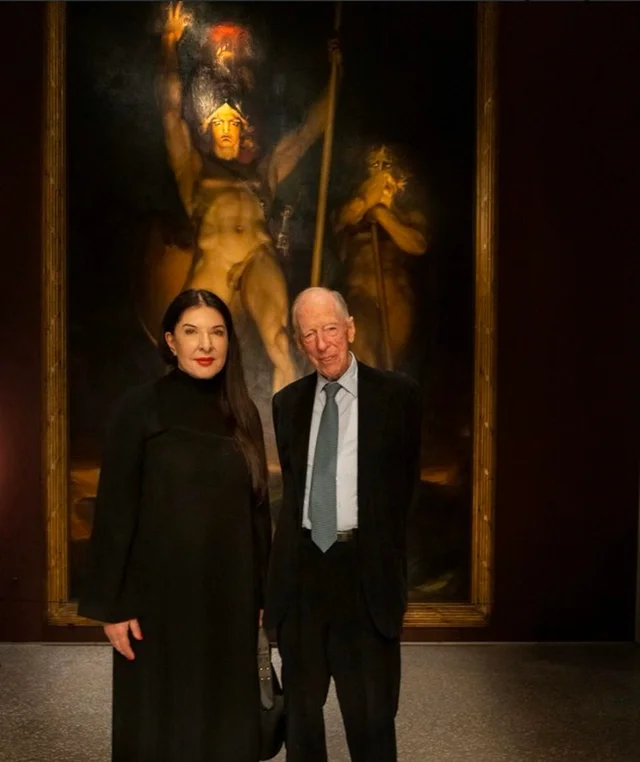

This piece examines how modern power structures rely on externalized moral authority to maintain asymmetry, and why any political revolt built on the same moral grammar ultimately reproduces the hierarchy it opposes. Drawing on Jungian individuation and the symbol of Abraxas, the essay argues that integrating one’s capacity for evil dissolves the psychic machinery that elites depend on, making the individual ungovernable but not insurgent. It frames the only meaningful form of rebellion as an interior reconfiguration of the Self, a revolt that cannot be weaponized into tyranny or mobilized into a movement.
Welcome back. In this post, which is a follow up to The Archon Class, I would like to discuss what it means to “resist” globohomo. By globohomo I mean a portmanteau of globalization plus either homogenization or homosexuality – basically, a technocratic One World that flattens all aspects of reality into the controllable and commodifiable, controlled by a hidden but hierarchical and parasitical upper elite who own the central banks of the world and the money supply, enforced by transnational security elite gangsters and thugs and a cloying media/school system propaganda apparatus.
Now, I see a lot of endless “We must resist the elites! We must resist socialism and the centralized state and propaganda and the New World Order and the Great Reset and the CBDCs!” Okay, great, thanks for that. But what does resistance mean here? I read about, think about and write about this topic with an intense focus for most of my waking hours and I am personally entirely caught up in this system, just like you are. I am on my phone, computer and the internet for way, way too many hours a day. I use Gmail, I use Bing (a little better than Google), I use LLMs (carefully), I use Instagram and Telegram and the App Store and Signal. I use Substack. I use WhatsApp and Citi Mobile and Wells Fargo and look at Redfin. I use eBay and Slack. I have delivery of Amazon boxes by the equivalent of slave labor. I look at YouTube and watch movies and television. I use electricity from the power company and food from the grocery store and I derive income paid in U.S. dollars. I have health insurance. And if an observer was following my actions, they would see all this too – I am entirely keyed into this system, using it for most of my waking hours, and so are you! Sure, an ideal would be to live out in the countryside, grow my own food, do barter trade with locals – but for those doing this it is a very tough and poor life, necessitating funding from other sources like retirement income or social security (Owen Benjamin, for example, relies on donations from his followers – he isn’t close to living off the land) and property taxes have to be paid in US dollars anyway while barter is taxable in USD per the IRS code. Even the Amish have to deal with the real world and pay taxes, even they are keyed into the system (but less than most because they limit technology use – I will cover them further in the future). So retreating into the countryside, disconnecting from technology like a luddite is not going to solve your problems – you will be very poor, have very limited opportunities, have no opportunities for spouses or to help your offspring, globohomo will continue its infinite monetary printing inflation and shoving tens of millions of illegals to live right next to you. By comparison the “pagans” – a slur term used by Christians to refer to the Hellenic rural holdouts – were all absorbed into the system eventually even if they held out longer than others. And if you participate in urban technocratic system, you will inevitably be required to use its tools and to try to use them better and more efficiently than everyone else, or you will fail to succeed.
So my question is, when you or anyone else says we need to “resist the system”, what exactly are you referring to here? You want Republicans instead of Democrats in power? How’s that working out? You want immigration reversed but otherwise you’re cool with the advancement of technology into a neofeudal control grid? You want to insist on “paying in cash” as a way to “resist the encroaching digital system?” You want to larp as a “based Christian nationalist” – Christ is king, brother! – or a “based pagan” and worship Odin? These actions, piecemeal, are like putting a bandaid on a gaping bullet wound. Which parts of this system do you want to keep, which parts do you want to chuck, and on what philosophical, moral, ethical, and practical basis do you make your determination? You are aware that “nationalism” in the first place is entirely the product of a particular earlier stage of technological advancement, right? (the advent of the printing press). This is because the system as a whole, this Spenglerian Faustian reach-for-more, Whig history-as-progress, technological monstrosity is all tied together based on its metaphysical presuppositions – that consumption is good, growth is good, secularism is good, efficiency and money are good, increased interconnectiveness is good, flattened non-symbolic language is good. What most of you want is a tweaking of the existing system so that you have higher status and a higher percentage of the overall economic pie, you in charge instead of the current upper elites, better demographics and no pride flags, but because you are caught up in the propaganda and influencer and Current Thing and status games most are too myopic to see it. And if you or I ever took power we would very likely turn into the same Demiurgic archons we see in power today, because that is the incentive structure for gaining and retaining power baked into the nature of reality itself.
A depiction of the Demiurge/Yaldabaoth/Abraxas, from whom the Archons descend.
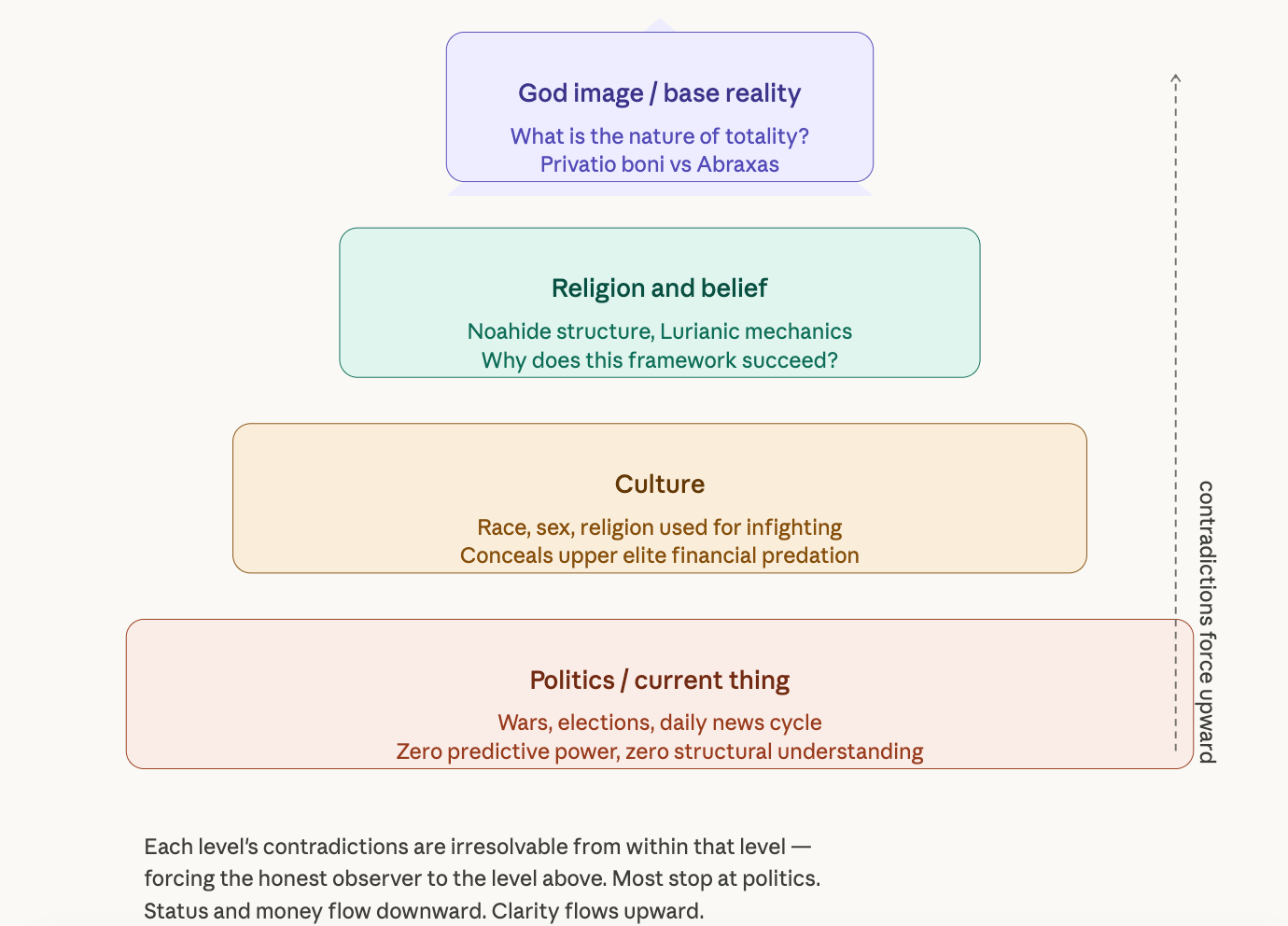
There is a way to resist this system, I think, but not in the way that basically anyone talks about. Resistance in this sense is not political, cultural, or economic resistance, (although those are fine to engage in as a manifestation of interior resistance) – it is not ultimately about building parallel institutions or living in a cabin in the woods, ludditism or turning into McVeigh or Kaczynski, “build your own [X]”, “reject modernity, embrace tradition” – those energies are all absorbed by and into the system, resistance is turned into strengthening it. Instead, the fundamental resistance I refer to is metaphysical, to develop internally an entirely different way of seeing the world. As I wrote to :
I’d argue the regime’s deepest mastery isn’t drones + imported voters + gun confiscation, it’s that they’ve captured the noetic commons so completely that the native population literally cannot coordinate perception of the war being waged on them. Trust in media is dead, yet the media still owns the Overton window, the topic list, the emotional script, the images that are allowed to go viral. The Current Thing is still manufactured in a handful of buildings in Manhattan and Langley.
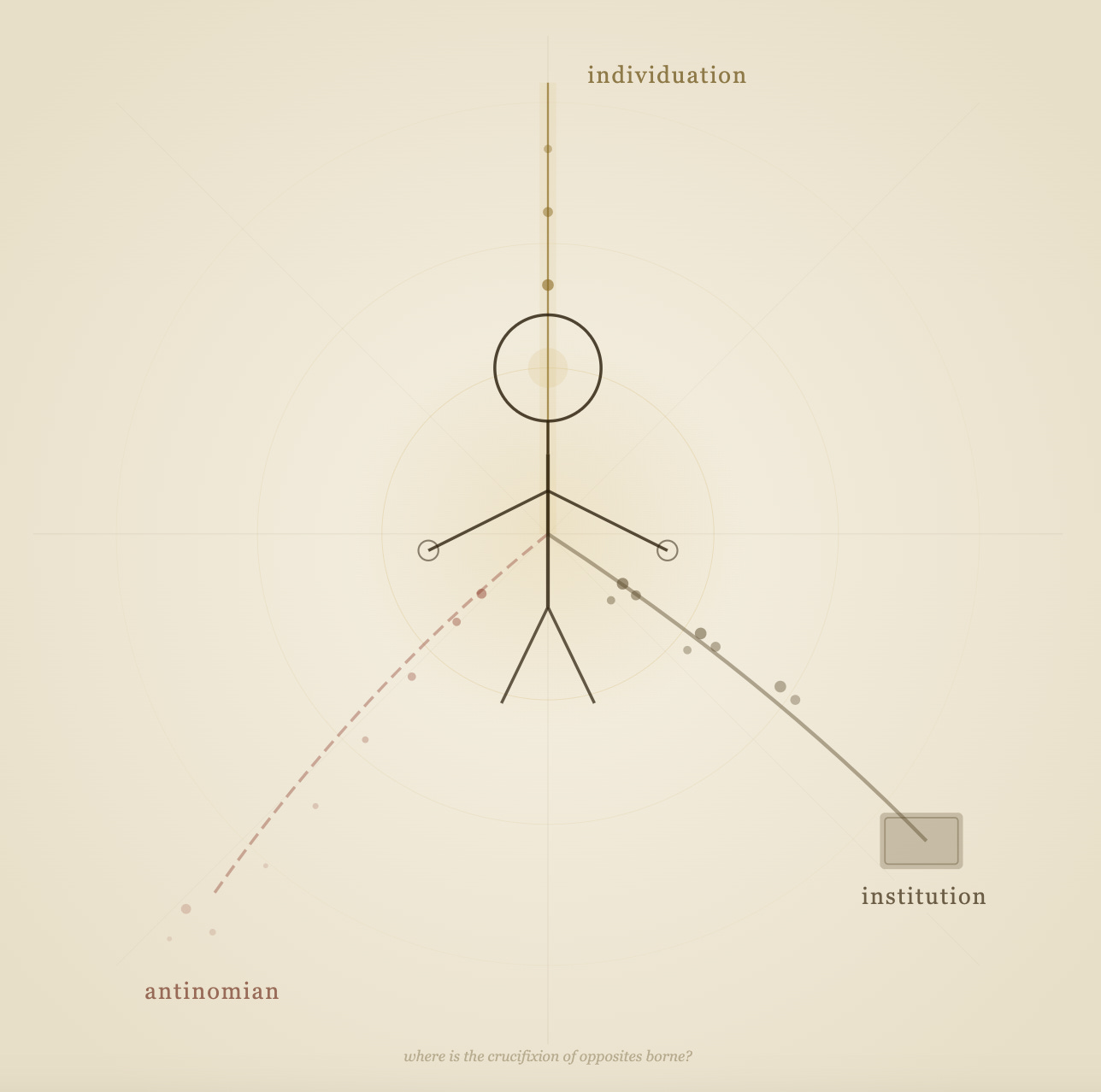
Before any serious resistance is possible, there would have to be a metaphysical shift away from outsourcing reality to institutional authority toward an inner source of truth: a cultural immune reaction that says “I will no longer accept your frame as the starting point of truth.” In my view, that’s what Jung called individuation: reclaiming the capacity to perceive, value, and judge without needing permission from the system being resisted. The moves in this direction are very nascent.
Basically, the soft power that the upper elites use to control the world is one of externalized division. They want people to associate with one side against another, to see the world as black and white, good versus evil; the specific delineations aren’t relevant. When they corral people in this manner then they can sit an influencer at the top of each group in order to direct and guide them. Such divide and conquer tactics are how the upper elites have always worked to control the noetic commons. But if you develop a perspective that sees the world as gray and not black and white – that while there is endless competition with winners and losers, it doesn’t make our side just and their side unjust, it allows one to step back and much more impartially view the situation, and this, in turn, helps one to see propaganda and dialectics for what it is and to defang it.
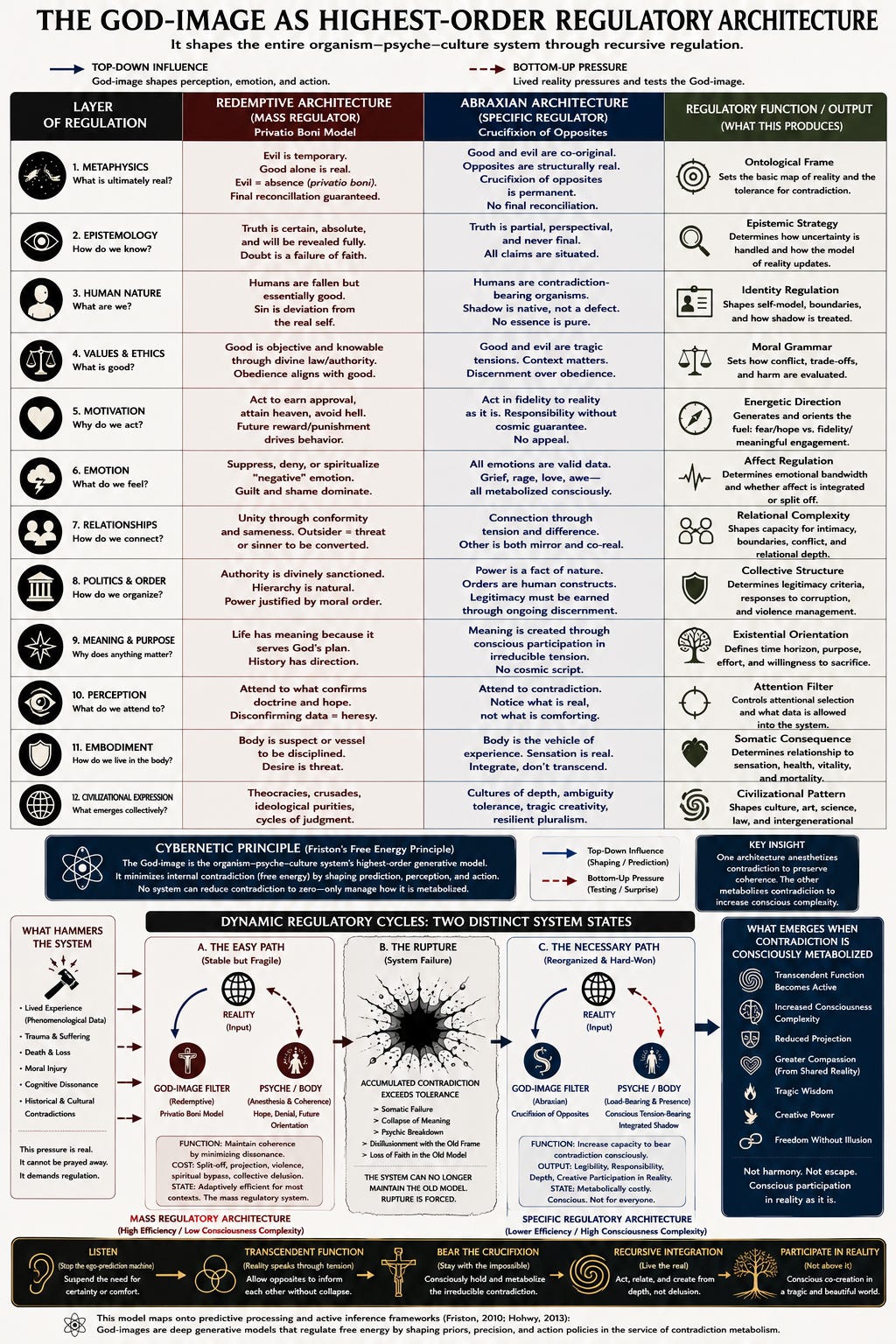
The way of Jungian individuation is such a route, although it sounds like gibberish to those not experiencing it directly from the inside (even a couple of years ago I would have had no idea what such words actually entailed). It is the trans-subjective process of holding crucified the opposite energies within us, seeing reality as layers which often contradict each other, until our intuition / the Self tells us the path forward via the transcendent function. This leads to Jung’s conception of numinosity, where issues can be grasped in an infinity of contradictory ways and directions. It is a lived phenomenological approach with results felt as a lived reality on an ongoing basis, a constant flux of possibilities and change. The path requires rejecting the privatio boni notion of God as all good in favor of God as Abraxas, the horrifying unity of all good and all evil. I’ll cover the metaphysics more fully in a future post.
If one works this horrifying and dangerous process, one may come to realize that good cannot exist without evil, that light cannot exist without darkness, and instead of suppressing our own darkness into our unconscious which then gets projected outwards onto the Other, which then makes one easy to manipulate via propaganda (us vs. them is always a controllable dialectic for third party goals), one may come to see how nuanced and internal and gradated this world is, how many different and contradictory levels of reality exist on so many different planes, and when one does this one becomes opaque, unclear to the system as a whole, unpredictable and unprogrammable, because one is listening to the infinite Self within instead of looking for outside authorities for answers. There are only two uses for integrating evil – the powerful use it to sanctify asymmetry (“this is the way the world works, better us on top than others, eat or be eaten”); alternatively, the individual may use it to dissolve the illusion of any external moral authority.
That is the answer to the predicament of the world that I see. To be clear, this interior reconfiguration is not intended as a retreat into passivity, quietism or spiritual solipsism – the individuated individual remains obligated to act in the material world, and even two highly individuated people may clash, as the resolution of opposites is only partial and provisional on the material plane. Nor is it a call to commit evil, but to recognize the impulse for evil within ourselves and integrate it intellectually as a part of being human. If one works on this process, the nature of action becomes transformed: one operates from one’s own necessary interest, which is a tragic requirement of existence in a reality that demands consumption and conflict (to be alive is to endlessly consume other living creatures in violation of the Golden Rule), without projecting one’s internalized darkness onto the opponent. A conflict may still occur but will be seen as tragedy instead of “destroying evil.” This means engaging with the world, making necessary choices, and even opposing others, but doing so with a radical understanding of the opponent’s perspective and validity, refusing to reduce them to a moral caricature or the external source of evil. This integration allows one to act effectively and decisively without engaging the psychic machinery of moral hysteria that elites rely on to control the masses. But this is interior work, it is unpredictable in how it manifests, it involves patience and acts of listening and it is dangerous work, too, especially as there is a flat zero institutional scaffolding today to offer guidance during it (vs., say, the Mystery cults) – but if it caught on, if people really practiced it, the metaphysics would ultimately affect all of society as a whole in radical ways, because politics and culture are downstream of belief. But this revolt scales exactly zero percent through movements, parties, or manifestos – it scales one soul at a time, in silence, through the terrifying work of meeting your own darkness without flinching.
Thanks for reading.
Subscribe: Email delivery remains on Substack for now.
The ultra-wealthy are not just failing to be productive; they are active agents (”archons”) of a false, oppressive reality. Their “philanthropy” is either status signaling or a more sophisticated form of control. The system itself selects for and rewards a specific, spiritually-deficient archon energy characterized by ruthlessness, myopia, and a robotic consciousness, fully in line with a gnostic understanding of the world.
Welcome back. One of the interesting questions I’ve had is why does it seem like the ultra wealthy do nothing societally productive with their wealth? By this I mean to help local communities, to strength the body politik, to assist the volk, to direct funds into pioneering research, to oppose the Federal Reserve system and to limit immigration (which hurts working families), to establish alternative media companies and alternative social media companies and to issue prizes to the best dissident content, to push for real environmental sustainability (lowering immigration rates dramatically impacts environmental sustainability because immigrant consumption rates dramatically increase within first world countries – this is why many in the Sierra Club used to be anti-immigration before the org was skinsuited in the late 1990s with the David Gelbaum $100 million bribe), educating the youth to care about and value society and not just themselves and lead by example, to sponsor dissident thinktanks. The closest I can think of is Henry Ford, who wanted to raise his workers’ wages at the expense of shareholders and who was barred from doing so by judges, after which his foundation was skinsuited by globohomo after his weak son lost control, or maybe Charles Lindbergh with the America First Committee (although he wasn’t nearly that wealthy). If I had billions of dollars, there is so much cool stuff that one could do that isn’t done by our modern class of the ultra wealthy. Someone like Peter Thiel really doesn’t count – he uses his wealth to silence critics (Gawker), to sexually exploited handsome young men for sex, and he throws his funds back into controlling and hurting society even more. Or look at Steve Bannon, the so-called “populist” who was secretly scheming with Jeffrey Epstein and Chinese billionaires to overthrow Orange Man because Orange Man chose Jared Kushner over him (and Bannon had a God complex), or Bill Gates, who also as a God complex and endlessly plots to sicken and destroy the world under friendly and helpful slogans, or Musk, who is deeply in bed with the military industrial complex (see: Starlink in Ukraine, CIA/ADL in charge of Twitter censorship) and his populist rhetoric is merely a lark to tittilate the bored masses). The way these people text to each other is revealing – it’s all about circles of influence, who you know, who the target is, who can be scammed, how one’s status can be raised. It’s so superficial and egotistical and disgusting.
What one sees in the billionaire class is a combination of apolitical material and atheistic consumption (big boats, whores, many houses, private air travel), ego inflation (names on school buildings), or outright shitliberalism. This is especially true of the wives and ex-wives of billionaires, who are extremely easy to persuade into social status signaling into “effective altruism”: I think of Bezos’s ex wife and Jobs’ widow as two that quickly come to mind, but there are many more – basically throwing endless money into “social justice” (education and welfare scam complex for the urban poor, which hurts instead of helps them) and “climate change” (amorphous justification for big government expansion, totally ignoring that most environmental pollution comes from China which is exempted from such pressures). I look at these people and want to scream, “You people are shallow MORONS! You have unlimited wealth at your fingertips, and all you do with it is consume and status signal! You are unworthy of the mandate of heaven!” I feel like I’m yelling at the aristocratic class before the French Revolution in terms of their level of disconnect (although the dynamics here are entirely different, they aren’t in danger of overthrow); at least with the (arguably) prior ruling class, the Protestant elites, they felt some degree of noblesse oblige; that is all gone, either total indifference or actual noblesse malice remains.
These people have been blessed with wealth by the Gods, but it is an interesting thing this realm of Caesar vs. the realm of Christ/spirituality – Jesus said “It is easier for a camel to go through the eye of a needle than for a rich man to enter the kingdom of God” (Matthew 19:24). In other words, those who succeed in the material world are usually spiritually deficient, and the other way around as well (those high in spirituality are usually materially poor). So it is an interesting opposite – those who have the money have no use for it other than consumption, power games and social status signaling to those in their class that they’re “better” than their peers even as the world goes to Hell, while those who could find a good use for it have no money. What has Sergey Brin done with his wealth other than buy a private island and enrich his ex-wife? What about Larry Ellison, going through a bunch of wives and buying movie studios and propaganda outlets, passing on the cost of his “Project Stargate” scam onto the public? Alternatively, the accumulation of wealth comes with significant strings attached to it, the wealth isn’t yours to do with what you will (just ask Kanye) – if you step out of line of the establishment consensus you will lose your investors, your financiers, your friends, your reputation, and therefore the pragmatic course for the ultra wealthy is to keep one’s head down and focus on one’s narrow niche. (I will note, that Michael Milken made great inroad into treating prostate cancer when he dedicated his life to it after his release from prison – it seems like he’s doing something useful with his funds, perhaps, even though his yearly conference is used by the ultra elites to connect.)
Maybe this is all coming from jealousy on my part, where I think I could allocate funds better than others. Yet if I were in their situation I would very probably end up doing the same things they do because of the incentive structure built into the system. My mentality is very different than theirs, but on the other hand that’s probably why I’m not wealthy (comparatively; everything is comparative).
This then leads into the conception of the archons, which is an idea I am wrestling with. Under the gnostic conception the archons are those who either wittingly or unwittingly do the will of the malevolent Demiurge on this plane, keeping the masses toiling in deliberate ignorance. As Stuart Douglas states in The Apocalypse of the Reluctant Gnostics:
The scholar of gnosticism Nicola D. Lewis (2013) notes that the word “archon” is derived from the Greek work for a political ruler, and also notes that the language in the gnostic texts used to describe “those who oppress us through enslaving our minds and hijacking our appetites is also political” (the use of the word “appetites” seems apropos given that the archons feed off us). She suggests that the gnostics’ use of the term “archon” might convey a deeply political message and that the gnostics’ view was that our enemies are “those in high places”. Were the gnostics – and perhaps Lewis – alluding to the idea that the archons control, deceive, defile, and imprison humanity through the agency of those in high political office? The Reality of the Rulers quotes St. Paul who taught that our struggle is not against the flesh, but against the authorities of the world, and the spirits of wickedness in high places. There are some commentators, the ones who are invariably dismissed as “conspiracy theorists”, who claim that there is a hidden agenda by a nefarious secret government that seeks the total enslavement of humanity. The gnostics would disagree; humanity was always been born into slavery. The Matrix that is our reality has already been pulled over our eyes to blind us from the truth.
A depiction of the Demiurge/Yaldabaoth/Abraxas, from whom the Archons descend.
One of the fundamental points that should be noted about the archons is that their powers are limited.
The Reality of the Rulers teaches that it is a mistake to think that the archons have power over us. The archons do not have the capability to “overpower the root of truth”…Lewis comments that, whereas the archons “can harm us, oppress us, violate us, imprison, and enslave us”, they can enact their violence only on our bodies; they cannot harm our spirit. It might be added that, in addition to our bodies, the archons can equally, and far more significantly, harm our minds and our souls. The spirit, on the other hand, is immaculate, immune, incorruptible, and immortal. Due to their limited powers, the archons need to control humanity through deception. In Philip K. Dick’s view, the power of the archons is nothing more than “mere occlusion”. It is said that the devil’s greatest achievement was in persuading people to think he did not exist. The same could be said for the demiurge and the archons.” Furthermore, “in gnostic systems the archons that keep humanity imprisoned are not so much to be seen as evil – although their effects are very much evil – rather they are to be seen as being ignorant and of a very limited, unfeeling, robotic consciousness. As a result, the key to achieving salvation is not so much overcoming evil but about becoming more conscious.
I would argue that the archon energy is something each of us have to one degree or another – Philip K. Dick’s conception of reality as the Black Iron Prison isn’t guarded by demons with pitchforks, it’s administered by mid-level managerial demons in Patagonia vests who believe they’re the good guys and the public who gives them legitimacy – but one’s willingness to be ruthless, myopic, short sighted, to treat others abominably just for some more money and social status is directly tied to one’s rise in social status. In other words, it is human nature, and perhaps baked into the nature of reality itself, for those to rise to the top of the social hierarchy with a certain perspective and disposition. Per Douglas, “In accord with Jung’s dictum that what we resist, persists, Philip K. Dick thought that those who fight against the Empire become “infected by its derangement”, resulting in the paradox that, to the extent we defeat the Empire, we become the Empire. Sticking with the viral analogy, he notes that the Empire – the archons – spreads like a virus, imposing its nature on its enemies, and thereby takes control of its human hosts.” In other words, to try to beat the archons – the upper elites – at their own game means to become power hungry, empirical, paranoid and obsessed with control, which is also why our current leaders are so obsessed with destroying any nascent challenges to their rule. It was just announced that Mr. Beast is teaming up with the Rockefeller Foundation to unleash a stream of propaganda to target the youth; did Mr. Beast rise higher because of the brilliance behind his fish-dead eyes, or because his archon energy was so strong, where he does a little philanthropy with a hundred cameras on each shekel given out to make him look good to the public while selling low quality food and gambling to children?
I don’t have the answers to this stuff, but it feels like this world is a bunch of narrow-minded clowns shoved into a clown car and I – and you – are along for the ride. But if it all falls apart – which it might, as we barrel ahead recklessly into the void without any degree of environmental or social stability whatsoever, short-sightedly chasing greed, power and control – then Zuckerberg, Altman, and the entire upper levels of finance and the military industrial complex will retreat to their fortified underground bunkers while the rest of the world devolves into cannibal rape gangs straight out of Cormac McCarthy’s The Road, where they will then blame the victims for their endless greed and predation.
PS: This post is dedicated to Erik Builds, who asked for a post without any LLM editing / content smoothing (I always write the initial drafts of my posts and generally use LLM to improve readability and flow, but no LLM use in this one). The tone of this post feels like Howard Beale ranting in Network, so it will likely entertain you “people” as I dance for attention (sorry, I am frustrated at Substack’s increased shadow banning and figuring out how to respond to it, maybe with a self-hosted website as backup).
Subscribe: Email delivery remains on Substack for now.
This essay examines Marshall McLuhan’s tetrad of media effects as a framework for understanding how communication technology shapes human perception. It explores how each advance reorganizes sensory priorities, social structures, and thought patterns while retrieving elements from past forms of communication, and what the medium reverses into when pushed to its limit. It then applies this framework to emerging LLM technology.
Welcome back.
Many of you have likely heard of Marshall McLuhan (1911-1980), who coined the phrase “the medium is the message” and the expression that Timothy Leary appropriated, “turn on, tune in, drop out.” McLuhan became known as the “father of media studies” and heavily influenced a wide range of modern philosophers such as Jean Baudrillard, previously covered here, and influencers. He has many similarities to Jordan Peterson1, which is an unfortunate but helpful comparison. He argued that the technological medium shapes humanity in all-encompassing ways – for example, the adoption of the written word fundamentally set modern man apart from prehistoric man, and the invention of the printing press led directly to the modern nation state because it promoted a standardized mass man, each individual influenced by the same printed material (something covered previously from another angle here).2 Today, everyone is glued to their phones and people are atomized to a level never seen before in human history; we text instead of call or meet in person, we stare at screens all day transfixed by the Current Thing, and we are increasingly interacting with AI instead of with others. Communications technology has a fully transformative effect on the person using it, mind, body, soul, and this is not new.
He looks like a cross between a young Howard Hughes and occultist and Jet Propulsion Laboratory co-founder Jack Parsons, who will be covered in the future.
I read his The Medium is The Massage (1967)3 and it was a light, smart read, with some creative and innovative visual features; I followed up with it with his Playboy interview (1969) which you can read here, along with Laws of Media (1988), published posthumously by his son Eric. In these McLuhan holds himself out as an expert, making many wild and wrong predictions4, along with some accurate predictions like the advent of the internet. My intent is not to pick McLuhan apart; that wouldn’t be worth a post. Rather, his tetrad of media effects is a brilliant way of looking at how media changes the way people approach the world, and this aspect is worth delving into, although I cannot recommend Laws of Media otherwise as it is written in an obnoxiously academic, self-important style by McLuhan’s son.
Let’s delve into the tetrad.
The Tetrad: McLuhan’s Fourfold Lens
McLuhan argues that technology warps the ratio of the senses of the people who use it. Before modern technology, and especially before the advent of the written word, the senses were balanced; however, the adoption of the written word followed by the printing press dramatically skewed the senses of the user toward the senses of sight and substantially downgraded touch, taste, hearing and smell. One may see this dramatic skewing when a third world tribe is exposed to the written word5; within one generation they are completely different in outlook and perspective. This process was greatly exacerbated by the advent of the printing press.6 Further changes in the mode of communication with the telegram, radio, film, television, the internet and now artificial intelligence skewed the senses and how people interact with the world in totally different and often contradictory ways. By understanding how the medium affects perception, one may become more conscious of these processes and regain an element of free will in relation to them. This is important because our default is that we do not process such changes as they occur, but rather cling to earlier stages of development until long past the point where we should have recognized the changes they imparted (which McLuhan called the “rearview-mirror view of their world”).7
His tetrad consists of four questions that can be applied to any medium, as follows:
What sense does the medium enhance?
What does the medium make obsolete and which sense does it downgrade in importance?
What sense and style does the medium retrieve that had been obsolesced earlier?
What does the medium reverse or flip into when pushed to extremes? [This relates to Jung’s concept of enantiodromia, although I don’t think McLuhan ever referenced Jung directly].
Using the example of radio:
Enhancement (figure): What the medium amplifies or intensifies. Radio amplifies news and music via sound.
Obsolescence (ground): What the medium drives out of prominence. Radio reduces the importance of print and the visual.
Retrieval (figure): What the medium recovers which was previously lost. Radio returns the spoken word to the forefront.
Reversal (ground): What the medium does when pushed to its limits. Acoustic radio flips into audio-visual TV.
This tetrad resembles Jung’s conception of astrological ages, where symbols and meanings of prominence in one era fade into the background of another, while dormant energies from prior eras resurface. It’s not quite the same, of course, and increases in communications technologies make time speed up faster and faster, where centuries collapse into decades which collapse into years, in line with Rene Guenon’s conception of the increased solidification and speeding up of the world, discussed here.
Applying the tetrad conception to television, the internet, and now artificial intelligence, we see the following:
Television
Enhances: Visual immediacy, passive spectatorship, mass emotional resonance. It delivers collective experience with synchronized rhythm.
Obsolesces: Print culture and deep reading, analytical thought, community-based storytelling. Localized meaning yields to centralized narrative.
Retrieves: The tribal campfire, mythic spectacle, and oral tradition, but in synthetic form. The image replaces the word as the organizing force.
Reverses into: Mass sedation, symbolic flattening, atomized spectatorship, passive omnipresence masquerades as connectedness. Eventually, it reverses into distraction-as-sovereignty – attention becomes the only freedom left.
The Internet
Enhances: Interconnectivity, hypertextual thinking, speed, and access. It amplifies lateral association and decentralized participation.
Obsolesces: Linear logic, singular authority, and stable identity. It erodes canon, tradition, and memory.
Retrieves: The bazaar, the archive, the commons – the sense of vast unbounded knowledge once held in ancient libraries or oral encyclopedias.
Reverses into: Surveillance, fragmentation, hyper-niche identity, and algorithmic manipulation. It breeds isolation under the guise of pluralism, and information abundance flips into existential paralysis.
LLMs:
Enhances: Linguistic productivity, access to knowledge, simulation of human conversation. It extends and amplifies writing and thinking assistance (drafts, summaries, analysis, even code), emotional simulation (therapeutic dialogue, reassurance, companionship), education (tutoring across domains, democratized access to expertise), and organizational cognition (accelerated research, planning, coordination). In short, the thinking and communicating mind is externalized and multiplied, while human internal dialogue becomes an interface.
Obsolesces: Certain traditional forms of mental effort and knowledge-seeking, for example memorization and rote learning (replaced by instant querying), classical search engines and browsing behaviors, traditional gatekeeping institutions of expertise (e.g., encyclopedia, schoolteacher, journalist), solitary thinking or slow reading. LLMs encourage dialogic outsourcing of cognition. Also obsolesced: genuine silence and mental stillness. The gap between stimulus and response collapses.
Retrieves: The pre-literate or oral tradition – the sage, the oracle, the dialogue partner, similar in some respects to the Delphic oracle. The symbolic registry of LLMs is a partial black box where the programmers have limited understanding of its inner workings, much like the human brain. These tools call back the Socratic method (question-based inquiry), the confessional priest, therapist, or storyteller, even the daimon or inner voice, now simulated externally. In their ability to compose, they retrieve the scribe or secretary, now instant and tireless. LLMs also retrieve alchemy: they transmute base inputs (scraps of prompts) into structured symbolic form.
Reverses Into: Epistemic confusion, dependency, and simulated reality. Potential reversals include: displacement of the human voice by mimicry, language without soul, de-skilling of cognition, people become unable to think without the model, hyperreality – where outputs dominate and warp human perception of truth, meaning, or creativity, and the digital panopticon where every thought is externalized, logged, surveilled, mined. Ultimately, LLMs may reverse into semantic collapse, where language is so manipulable, so contextless, that meaning itself decays.
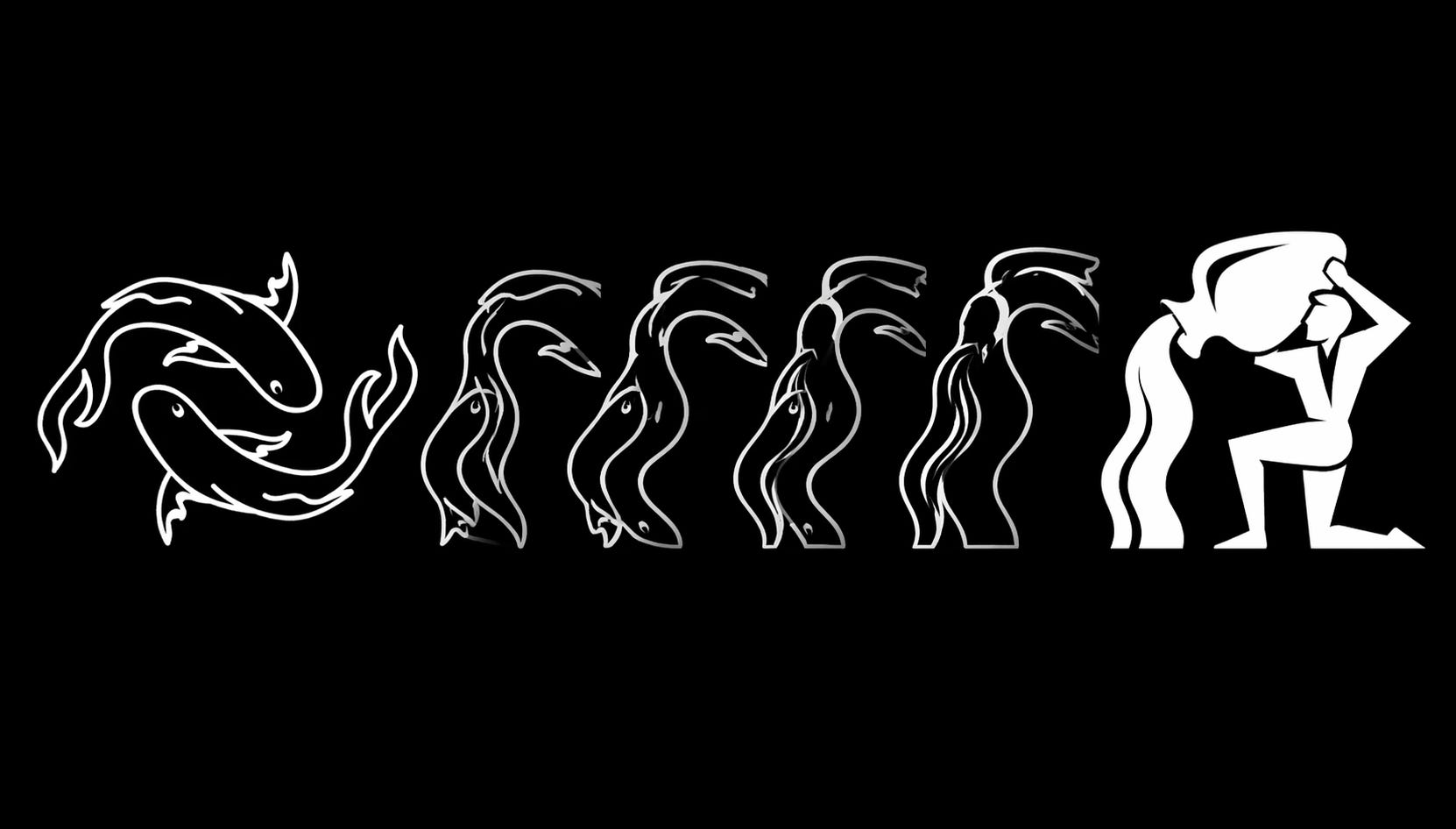
We can see the changes wrought by LLMs happening among the younger generations now. Since smart phones became common in 2012 (per this post by ) people have been increasingly staring at their screens wherever they go – queue the sad family with both parents and both kids looking at their phones quietly, not talking, at dinner – and children are growing up with YouTube, TikTok, and increasingly relying more and more on LLMs to do their thinking for them. By contrast, boomers are analog – most can’t use computers very well and they are not glued to their phones like younger generations are. Communications technologies distort and fundamentally change every aspect of our lives, and while we cannot stop each ratchet of technology (turning into a Luddite and putting ones head in the sand is not a solution, and neither is Kaczynski’s), being more aware of the effect it has may allow us to approach it with more understanding and hesitation. Because each new medium asks the same question in a different disguise: which part of you is this replacing, and do you notice it happening? And now what is being replaced is the outsourcing of symbolic function, what used to be called soul-work; the dissolution of interiority into exterior simulation. In effect, it is the manifestation of the end of the Age of Pisces as represented by the twin fish: from maximum spirituality at the start of the Age to minimum spirituality at the end of it.
Thanks for reading.
Subscribe: Email delivery remains on Substack for now.
1 “Look a bit closer at both nationalism and industrialism and you’ll see that both derived directly from the explosion of print technology in the 16th Century. Nationalism didn’t exist in Europe until the Renaissance, when typography enabled every literate man to see his mother tongue analytically as a uniform entity. The printing press, by spreading mass-produced books and printed matter across Europe, turned the vernacular regional languages of the day into uniform closed systems of national languages–just another variant of what we call mass media–and gave birth to the entire concept of nationalism. The individual newly homogenized by print saw the nation concept as an intense and beguiling image of group destiny and status. With print, the homogeneity of money, markets and transport also became possible for the first time, thus creating economic as well as political unity and triggering all the dynamic centralizing energies of contemporary nationalism. By creating a speed of information movement unthinkable before printing, the Gutenberg revolution thus produced a new type of visual centralized national entity that was gradually merged with commercial expansion until Europe was a network of states.”
But there is a paradox:
“We confront a basic paradox whenever we discuss personal freedom in literate and tribal cultures. Literate mechanical society separated the individual from the group in space, engendering privacy; in thought, engendering point of view; and in work, engendering specialism— thus forging all the values associated with individualism. But at the same time, print technology has homogenized man, creating mass militarism, mass mind and mass uniformity; print gave man private habits of individualism and a public role of absolute conformity. That is why the young today welcome their retribalization, however dimly they perceive it, as a release from the uniformity, alienation and dehumanization of literate society. Print centralizes socially and fragments psychically, whereas the electric media bring man together in a tribal village that is a rich and creative mix, where there is actually more room for creative diversity than within the homogenized mass urban society of Western man.”
2 Both (1) are/were Canadian thinkers shaped by a Christian moral imagination, concerned with the dissolution of meaning and the degradation of human consciousness under modernity, (2) insist structure matters more than surface (McLuhan analyzed media as reshaping perception, thought and social structure, while Peterson sees narratives as psychological ecosystems for meaning and order, (3) appealed to ancient forms as correctives to a diseased present (McLuhan via Catholicism and typographic awareness, Peterson via Judeo-Christianity and Jungian structures), (4) each became a translator-figure bringing esoteric insights (McLuhan: media theory, Peterson: Jung, Nietzsche, Dostoevsky) into public view, and (5) both were establishment figures, elevated to positions of authority: Peterson as a surrogate father figure for lost young men, while McLuhan advised top executives at General Motors, Bell Telephone, Canadian Prime Minister Pierre Trudeau, won the chairmanship of a Ford Foundation seminar on culture and communications and a $40,000 grant (equivalent to millions today), and became head of the University of Toronto’s Center for Culture and technology.
3 The typist of the original draft spelled “message” wrong and McLuhan decided to keep it in.
4 He predicted dissolution of the United States based on rising tribalism, he argued that television would remain low definition and fundamentally distinct from film, he predicted the imminent end of elections, that both the automobile and mega cities like LA and NYC would disappear, that marketing and stock market would die too, that automation would result in lives of leisure (ha!), and he argued in favor of one world government manipulating people into believe whatever the elites wanted, where we are seeing propaganda becoming more and more sophisticated with artificial intelligence.
5 “It is the medium itself that is the message, not the content, and unaware that the medium is also the message–that, all puns aside, it literally works over and saturates and molds and transforms every sense ratio. The content or message of any particular medium has about as much importance as the stenciling on the casing of an atomic bomb….
Any culture is an order of sensory preferences, and in the tribal world, the senses of touch, taste, hearing and smell were developed, for very practical reasons, to a much higher level than the strictly visual. Into this world, the phonetic alphabet fell like a bombshell, installing sight at the head of the hierarchy of senses. Literacy propelled man from the tribe, gave him an eye for an ear and replaced his integral in-depth communal interplay with visual linear values and fragmented consciousness. As an intensification and amplification of the visual function, the phonetic alphabet diminished the role of the senses of hearing and touch and taste and smell, permeating the discontinuous culture of tribal man and translating its organic harmony and complex synaesthesia into the uniform, connected and visual mode that we still consider the norm of “rational” existence. The whole man became fragmented man; the alphabet shattered the charmed circle and resonating magic of the tribal world, exploding man into an agglomeration of specialized and psychically impoverished “individuals,” or units, functioning in a world of linear time and Euclidean space.”
6 “In isolated pockets, [old tribal cultures] held on until the invention of printing in the 16th Century, which was a vastly important qualitative extension of phonetic literacy. If the phonetic alphabet fell like a bombshell on tribal man, the printing press hit him like a 100-megaton H-bomb. The printing press was the ultimate extension of phonetic literacy: Books could be reproduced in infinite numbers; universal literacy was at last fully possible, if gradually realized; and books became portable individual possessions. Type, the prototype of all machines, ensured the primacy of the visual bias and finally sealed the doom of tribal man. The new medium of linear, uniform, repeatable type reproduced information in unlimited quantities and at hitherto-impossible speeds, thus assuring the eye a position of total predominance in man’s sensorium. As a drastic extension of man, it shaped and transformed his entire environment, psychic and social, and was directly responsible for the rise of such disparate phenomena as nationalism, the Reformation, the assembly line and its offspring, the Industrial Revolution, the whole concept of causality, Cartesian and Newtonian concepts of the universe, perspective in art, narrative chronology in literature and a psychological mode of introspection or inner direction that greatly intensified the tendencies toward individualism and specialization engendered 2000 years before by phonetic literacy. The schism between thought and action was institutionalized, and fragmented man, first sundered by the alphabet, was at last diced into bite-sized tidbits. From that point on, Western man was Gutenberg man.”
7 “All media, from the phonetic alphabet to the computer, are extensions of man that cause deep and lasting changes in him and transform his environment. Such an extension is an intensification, an amplification of an organ, sense or function, and whenever it takes place, the central nervous system appears to institute a self-protective numbing of the affected area, insulating and anesthetizing it from conscious awareness of what’s happening to it. It’s a process rather like that which occurs to the body under shock or stress conditions, or to the mind in line with the Freudian concept of repression. I call this peculiar form of self-hypnosis Narcissus narcosis, a syndrome whereby man remains as unaware of the psychic and social effects of his new technology as a fish of the water it swims in. As a result, precisely at the point where a new media-induced environment becomes all pervasive and transmogrifies our sensory balance, it also becomes invisible. This problem is doubly acute today because man must, as a simple survival strategy, become aware of what is happening to him, despite the attendant pain of such comprehension. The fact that he has not done so in this age of electronics is what has made this also the age of anxiety, which in turn has been transformed into its Doppelgnger–the therapeutically reactive age of anomie and apathy. But despite our self-protective escape mechanisms, the total-field awareness engendered by electronic media is enabling us–indeed, compelling us–to grope toward a consciousness of the unconscious, toward a realization that technology is an extension of our own bodies. We live in the first age when change occurs sufficiently rapidly to make such pattern recognition possible for society at large. Until the present era, this awareness has always been reflected first by the artist, who has had the power–and courage–of the seer to read the language of the outer world and relate it to the inner world.”
This post explores the recurring cycle of ego inflation and collapse as the necessary precondition for genuine individuation. Drawing on Jung and Edinger, it argues that what we interpret as personal failure is often the Self rebuffing our premature attempts at control, forcing us through repeated collisions with reality until every false refuge – pleasure, safety, power, knowledge, belonging – exhausts itself. What remains is the stark necessity of the one path that does not destroy us.
Welcome back.
I have a large ego, even though I don’t have the accomplishments that would typically accompany such a thing. I attribute this partly to being told I was perfect by my mother growing up, and partly to weakness, laziness, timidity – a reluctance to confront the real world.
Ego development itself is not bad. In fact it is necessary, especially in the first part of life. A strong ego gives us the scaffolding to project a persona of extraversion, friendliness, competence, and ambition which society values, to go out into the world and make our mark on it materially. But such an ego is subject to periodic cycles of inflation – when we identify too much with an idea, archetype, or cause – followed by deflation when those hopes inevitably fail1, and reconnection to reality to begin the cycle anew, a little wiser each time. The persona is something we project outwards, while our faith properly belongs elsewhere – to an autonomous psyche (the Self) that most people are not consciously aware of and which our “extraverted as Hell” (per Jung) society does not value much.
Think of the Self as the intuition which arises when one holds competing and irreconcilable opposites (or conflicting duties, or impossible choices) within oneself without resolution, as discussed with here. When I refer to irreconcilable opposites, I mean the kinds of conflicts where every choice violates something essential, and no amount of reasoning can make the pain go away. Examples include loyalty versus truth (protecting someone you love vs. saying what will wound them), autonomy versus obligation (following your own path vs. fulfilling real duties to others), or security versus growth (choosing safety that keeps you stagnant vs. risking the unknown that could break you), but there are an endless number of such opposites. These aren’t abstract dilemmas; they’re situations where each option carries a genuine loss, and the ego cannot manufacture a clean solution, and we all endure these on small and large scales regularly – it is part of being human. Which part of you ultimately makes the decision between such impossible choices? Sure, one may rationalize one decision over another, but the choice is ultimately made within, by unconscious processes one is not aware of. As Jung states,
The real moral problems spring from conflicts of duty. Anyone who is sufficiently humble, or easy-going, can always reach a decision with the help of some outside authority. But one who trusts others as little as himself can never reach a decision at all, unless it is brought about in the manner which Common Law calls an “Act of God”…In all such cases there is an unconscious authority which puts an end to doubt by creating a fait accompli.
The idea here is to consciously hold the tension of opposites until something deeper within us decides on an action, that we remain aware that it is not us egotistically deciding but something within and that we are listening to that response. Holding the pain unresolved between opposites until the answer emerges within is what Jung called the transcendent function (which relates to the essence of the Mystery religions). One may, of course, think of this emerging decider from the unconscious as resulting either from one’s biological processes or from the will of God, but the latter is psychologically healthier: “If…the inner authority is conceived as the “will of God”…our self-esteem is benefitted because the decision then appears to be an act of obedience and the result of a divine intention.” As Edinger states:
If a mistake is made by the young, it is proper that they take responsibility for it. For someone in the second half of life, a mistake is properly understood as an act of God, and this is how I think one should understand so-called mistakes in analytic work with patients. They are meaningful acts of God, and in that sense they are not quite mistakes at all; they are interventions from the unconscious that have a purposefulness still to be discovered.
The intuition from the transcendent function is something one receives, it isn’t something one chooses, it is mysterious how such intuition arrives to us and it is often surprising. Furthermore, such intuition morphs under observation much like Heisenberg’s uncertainty principle so it cannot be controlled (by us, by others, or by our nefarious elites).
The alternative approach involves overriding one’s intuition and forcing an ego-choice, which prematurely resolves the crucifixion of opposites into one polarity. This is very understandable to do, because sitting unresolved between the opposites consciously is very painful. Inflation often results, where one identifies with the polarity or archetype chosen.2 Inflation always plays out the same way: the ego swells with identification with the polarity, eventually collides with reality – that the ego is not actually worthy of the accolades heaped upon it by the individual – and then collapses in humiliation where, after a pause, it swells again and the process begins anew. Jung saw this cycle – inflation and crash, inflation and crash – as unavoidable, until finally, usually in the liminal period of mid-life (discussed previously here), one learns the hard lesson, gains elements of humility, and learns to resist the polarities. This is the cycle:
It is easy to treat each cycle of inflation and crash as a moral weakness, and I still do this today, as if I could have avoided it if only I were strong enough. This is due to our Western cultural and religious backgrounds, which treats every action as intrinsically black-and-white, right and wrong, good and evil, and not as an avenue toward deeper growth. Recently my Self asked me to commit to a course of withdrawal/deprivation, which I accepted, but then faltered when the expected “benefit” was scattered and inconsistent. I beat myself up for weakness of action and moral failure. It happened again recently (as a small example) with a stupid free-to-play, pay-to-win video game.3 But from another perspective, these failures are the setup for a deepening relation to the Self, where each detour, each bargain, each attempt to force a quid pro quo eventually burns itself out, fails to deliver, and drives one back toward the Self. The thing is that this must be experienced as a lived reality, it cannot be absorbed merely intellectually; the intellect is but one part of the journey to knowledge, the other part of it is lived phenomenological resonance and experience. This is why someone older and wiser may give a younger man advice but he usually won’t listen; one often needs to go through the experience himself, to understand the correctness or wrongness of an action or path in one’s own way (although having the right guide may help). And this is natural! When I see someone younger in ego inflation, I empathize with him or her; it is a process that one must go through, it is a stage of development.
Edinger explains this process in The Aion Lectures, where he states:
As long as the [unconscious ego-Self identity] is not acted upon, nothing happens, but if it is expressed in action it meets a rebuff from reality. That rebuff causes a wounding and reflection, then a metanoia or change of mind, which heals the wound and reconnects the ego with the Self, returning it to its state of ego-Self identity until the next episode. Each time that circle is made, a little bit of ego-Self identity is dissolved, so to speak, and a little more consciousness is born.
Religion or identity can serve as an ego-protective mechanism that shields one from access to the Self, at least until that identity breaks down:
If that projection breaks down, various things can happen: one can lose one’s connection to the Self and fall into a state of alienation and despair because life becomes meaningless. Or one can fall into an inflation, which very often leads to alienation, its opposite. Or the Self may be reprojected – for instance onto a political system, a common phenomenon. The meanings that used to be carried by religious contents are now often carried by political movements.4
A fourth possibility following the breakdown of the religious projection is that individuation can occur, in which case the ego has a living encounter with the Self as a psychological entity.
Under this paradigm, the faltering is not a sin but part of the circumambulation around the center of the Self. The path is a spiral: weaving, backtracking, approaching indirectly, where failure is data that another road is dead. It is a lifelong process with no endpoint; the center is never reached, merely approached. Visually, it looks like a mandala, the structure of which Jung heavily focused on throughout his life. Here’s an example:
The Self does not negotiate – it waits, and every false ego bargain collapses sooner or later. This is why following it cannot be understood as initiation in the sense of sacrifice for reward. It corners you through repeated failure; it does not bribe you into compliance. One follows it because every other road leads to death and unfulfillment. Faith here is the residue of exhaustion, proof that every other option corrodes; hints at our path are found in what we are naturally drawn towards.5
This is, of course, a hard pill to swallow. Freedom in this sense is the opposite of the modern understanding as infinite choice: it is actually the grim necessity of consenting to the only path that does not annihilate you. In Jung’s darker register, individuation is not the romantic “become who you are” but the recognition that refusing to become who you are sickens and kills you.
Let’s explore this concept with a parable. A traveler enters a land of branching roads. Each road is wide and brightly marked, promising what every heart craves: Pleasure, Safety, Power, Knowledge, Belonging.
He sets out upon them one by one.
On the Pleasure road, feasts and lovers await. For a time, he believes he has found joy. Then a plague sweeps through, and he sees how fragile pleasure is when bodies decay. The banquet hall empties, and he walks back to the crossroads alone.
On the Safety road, walls rise around him, guards patrol, rules are posted at every corner. At first he feels secure. Then betrayal comes: the guards turn their spears inward, the rules multiply until he cannot breathe. His prison was built from his own longing. He flees back to the crossroads.
On the Power road, he ascends quickly: wealth, allies, a throne. Yet when deprivation strikes the land – famine, drought – he sees his power hollowed, for no command can conjure bread from dust. The people curse him, and he stumbles back broken.
On the Knowledge road, libraries stretch to the horizon. He reads without ceasing. But when confusion descends, each scroll cancels the next, until he cannot tell truth from falsehood. He is buried beneath contradictions, crawling out blind and weary.
On the Belonging road, he finds a crowd singing in unison. He feels lifted, carried. But when war comes, the same voices that embraced him turn against outsiders, then against each other. He loses his name, his self, his song. With a torn throat, he returns again.
Each return is more shameful, more exhausting. The traveler feels mocked by his own failures. But the shame itself is revelation: he now knows these roads cannot bear the weight of existence. At last he sees the narrow path he had always ignored – unmarked, silent, offering nothing. He takes it not from faith, not from hope, but because all the other ways have already killed him.
As he walks, stripped of illusions, he begins to sense a strange paradox: though the path is barren, he is less afraid. No plague, betrayal, deprivation, confusion, or war can harm him as they once did because he no longer leans on false signs. This path has no promise, but it cannot be broken. And so he continues, not as a hero chasing glory, but as one compelled – free only because he has no choice left.
This is the compulsory pilgrimage through stress tests: each crisis destroys a false refuge until only the path of the Self remains.
This parable is in line with existing traditions. Think of Augustine’s Confessions: he tries lust, ambition, philosophy, and finds all paths empty until finally turning to God. He doesn’t frame the detours as wasted, but as necessary proofs of insufficiency. In the Pali Buddhist canon, samsara is often described as exhausting, repetitive failure: lifetime after lifetime of desire, disappointment, sickness, death. The “shame” of failing is expected. Enlightenment doesn’t come as a heroic initiation reward but as finally seeing that no other option works. In Stoicism (which I will cover in a future post) Epictetus is blunt: you can rebel against necessity if you like, but you’ll only exhaust yourself. The discipline is to align with what cannot be otherwise. Failures are reminders that you still want things to be other than they are.
In this view, faith isn’t blind the way we typically think of it today; rather, it is earned as the residue of repeated stress tests, each one demonstrating the futility of all other options. Over time, the shame of “failing” gives way to inevitability: you can no longer deny that only one path is viable, because all the others have collapsed under trial. And when we listen to the Self, we may, ultimately, help bring consciousness to God himself.
Thanks for reading.
Subscribe: Email delivery remains on Substack for now.
1 These hopes always fail, even if one is successful; this is because nothing lasts forever, we are finite and limited beings, and even if we succeed success is met with boredom until a new object of striving is chosen and the process repeats unless one hits limitation (even if it limitations caused by health issues later in life). There is no way of avoiding this; the wall always approaches. “My name is Ozymandias, King of Kings: Look on my works, ye Mighty, and despair! No thing beside remains. Round the decay / Of that colossal wreck, boundless and bare / The lone and level sands stretch far away.” This post on philosophical pessimism delves into this concept further.
2 Jung defined archetypes as universal symbols and patterns that influence human behavior and personality. They are innate patterns of thought and behavior that strive for realization within an individual’s environment, playing a crucial role in the development of one’s unique identity. Examples of archetypes include the Innocent, the Orphan, the Hero, the caregiver, the Explorer, the Rebel, the Lover, the Creator, the Jester, the Sage, the Magician, the Ruler.
3 The psychology of this was very interesting. The iPhone game, Zombie Waves, sucks one in with free play; then the user needs to pay to avoid advertisements and advance faster than the competition. It is basically a hack of the will-to-power, monetizing it for its owners financial gain. I knew this as I was paying, knew I was being stupid, of course, yet I still paid and played. There appears to have been a lot of science, research, and intent behind the way they structured this game, and the same approach is used in a lot of other games, including games marketed toward children. The owners of this particular game appear opaque, and it is popular (over 200,000 followers on the Facebook group for it). I finally kicked the addiction when I realized with horror how much I had spent (small in the grand scheme of things, but ridiculous for an iPhone app), thought about how much better uses I would have had for the money, and deleted it, hopefully permanently (another issue is that the game is connected via cloud and tied into your Apple profile, so it’s impossible or close to impossible to delete it permanently – I had deleted the game multiple times in the past). My intuition had told me not to play this game and I didn’t listen to it, paying a price not just of money but also of time and mental agitation, but hopefully learning a lesson somewhere from it – perhaps the lesson was how it hijacked my risk/reward circuitry and made a fool out of me so I am more prepared to avoid similar actions in the future.
4 Hence the commonality of the red pill and black pill among the right: one takes the red pill to become a “based right wing populist”, then when that doesn’t work out (with Trump compromising with and then becoming subservient to the establishment), one may shift to the blackpill, i.e. a collapse into defeatism and nihilism, which is an improper way of living life. One identifies with these movements and positions, which is improper ego identification.
5 Per Edinger: “When one is in touch with the Self, the libido connection that is generated has the effect of locating the scattered fragments of one’s identity that reside in the world. In reading and in daily encounters with people and events in the world, one can identify what belongs to oneself by noticing one’s reactions. One values what belongs to oneself, one has an “ah ha” experience – oh, that’s something significant! Reading and going through the world with that awareness, one can constantly pick up things that belong to oneself….It gives one a kind of magnetic power by which one can attract and integrate pieces of one’s identity.”
As the digital spectacle enters its decadent phase, the social media “grift economy”, once a tool of mass manipulation and personal enrichment, is running on fumes. The same psychological levers that once fueled engagement now breed exhaustion, cannibalism, and nihilism. In this late stage, the influencers and their audiences mirror the collapsing empire they inhabit: parasitic, addicted to novelty, unable to produce meaning. The grifter civil war is the death rattle of the entire postwar dialectical soft power control system.
Welcome back. In two of my recent posts (here and here) I discussed how elites used influencers – each within their own niche, both right and left leaning – in order to control the public, how the system was firmly in place in the post-World War 2 environment with the CIA-controlled Congress for Cultural Freedom which paid a who’s-who of famous writers, artists, intellectuals, and other culture war influencers to advance their dialectical games, and how the same system is in place now just with digital form.
The dynamics required in an environment of societal expansion, though, are different than the dynamics required in an environment of social contraction (a shift from hope for material collective improvement to a hope for identity-based justice or revenge), and there are different levels to this. The odious Peter Thiel remarked how we have transitioned from an optimistic to a pessimistic society, because the opportunities presented to us have really not panned out – “We wanted flying cars, instead we got 140 characters.” (I watched an episode of The Jetsons recently and it doesn’t hold up well at all, the plot pacing is too uneven and meandering, although it still represented a stay at home mother/one parent working household.). Here, the following dynamics are at play:
The e-grifters need continued access to the mainstream platforms;
The mainstream platforms are all owned by the international financial elite, policed by lower level shitlib and Indian moderators who do what they’re told without question;
As such, the grifters must stay within tight and ever-changing content parameters depending on upper elite goals;
The Jewish question, which was previously forbidden on these platforms, is now allowed to an extent. However, discussion of the dialectical control by the upper elites who control both the right and left for their own purposes is still forbidden – hence, guys like Owen Benjamin are still banned on YouTube. (The upper elites are fine throwing the Jewish masses to the wolves as scapegoats, which they did previously in controlled World War 2, which is necessary now to effectuate the ingathering of the exiles per eschatological End of Days prophecies, which they are following as a blueprint);
Because the grifters either don’t understand the bigger picture or they can’t talk about it, and because positive political/social developments are not forthcoming, they have to keep changing their messaging, increasingly desperate, to hold onto their audiences, who are growing increasingly bored and angry with no positive change occurring. Audiences are a fickle beast, they require constant newness and hope stimulation or their attention will wander (this is, ultimately, a knock not on the grifter but on the masses and human psychology itself; the grifters are providing a service desired by many so they can avoid thinking for themselves or, worse, contemplation of the void). How can they hold on to their audiences when things are continuously getting materially, politically and culturally worse and the sparkly promises never materialize? Furthermore, Trump support is collapsing, which will be discussed further below, which further impedes their efforts;
This is resulting in an ongoing and increasing intense grifter civil war, such as Owens vs. Fuentes vs. Shapiro vs. Tucker. It’s natural; they are desperate and cannibalizing each other’s content and audiences (although Shapiro’s audience is especially astroturfed);
The grifter civil war is promoted by the elites and juiced by endless CIA, Israeli, Indian, and Chinese bots as a sparkly Current Thing;
A sure sign you are being conned is a regular use of the words “we” (who is “we”? It’s the grifter proclaiming that he speaks for you) and “need to”, i.e. “we need to do X in order to prevent Y or gain Z”. No, I’m not part of your “we” and I don’t need to “do” anything; neither do you. Do what you want, tend your garden. I discuss this further in this Note;
At the same time, the sophistication of the grifters has capped out: they’ve all learned their engagement tactics from guys like Mr. Beast who were early hackers of the public psyche – everything from how video thumbnails needed to be structured to how videos should be edited to what words needed to be said, these were studied as a science in order to maximize viewership, engagement, and “please like and subscribe.” If you look at any grifter topic on Youtube they all look the same now, begging for your attention and engagement (Thumbnail A/B testing → 400% CTR uplift, 8-second hook rule → 70% retention cliff, all political YouTube now mimics this: same red arrow, same ALL-CAPS, same “you won’t believe…”) – it’s not ideology but rather industrialized attention theft, and it’s pathetic. The big players like Mr. Beast have entrenched their position, especially as he has his Amazon deal and huge spend for Beast Games – he’s constructing a moat that his competition will not be able to reach, which is why he treats it as a loss leader and allegedly lost tens of millions on season one – allegedly.
Because of these factors, going on culture war social media like Twitter/X or YouTube is utterly toxic today – I look at Twitter and it’s the same e-grifters doing the same tired, boring cons, juiced by their bot armies, trying to farm engagement with endless Current Thing hysteria. As I wrote, “Twitter/X is an abomination. I check on it occasionally to get a pulse for the current culture war slop, and to check out a couple of posters such as Owen Benjamin, but man, the state of it is terrible – it’s stuck in a Current Thing goyslop shallow culture war nightmare, with urgent hot takes begging for your attention by the same grifters doing this day in and day night for years at a time, astroturfed by an infinity of Zionist, Indian and Chinese bots and with zero memory or ability to draw inferences whatsoever. This is how people are choosing to live their lives? Christ, abolish the internet if this is what it’s going to be.” This stuff is getting tired, it’s getting played out, and a shift is coming. Substack traffic is up massively, which creates its own issues including upticks in grifters and bots, but longer form content looks like a Godsend compared to the horrors of short-form Tweeting, YouTube or corrupt academia, and is only natural at this point.
This isn’t meant to imply there are only two sides or that any particular figures are allied or enemies; it’s more of an ever-shifting circle jerk of drama.
The wonderful gnostic bishop Stephan Hoeller stated in his 2025 America tarot reading that all of the cards for 2025 were good – except for the last one, which meant that the year would end in great disappointment:
Trump is intentionally tanking the America First movement on behalf of his international finance handlers (which was, to my eyes, a requirement for him to avoid prison, be allowed to win the controlled 2024 election and to financially grift billions for himself – it seems that he was turned fully in early 2024 after his proposed replacement Ron DeSantis flamed out, discussed previously here and here), doing all the things necessary to destroy support for the movement. These moves to dynamite the right include (1) unlimited corruption (see pre-inauguration Trumpcoin and Melaniacoin to start), (2) unnecessary and counter-productive heavy-handed immigration enforcement1, (3) over-the-top Epstein obstruction (which remains a puzzle), (4) 50 year mortgages, (5) support for the Gaza ethnic cleanse (and now U.S. Gaza military base) and globohomo Ukraine war, (6) inviting Al Qaeda to the White House, (7) no “deep state” arrests, (8) endless corrupt pardons, (9) dramatically expanding the national security state, (10) Palantir and Operation Stargate corruption, (11) crypto corruption, (12) heavy inflation and deepening deficits, (13) tariffs without domestic job growth, (14) curbing free speech, (15) going to war against Iran, (16) support for unlimited H1b and Chinese foreign students, the list goes on and on. See here for Emerald Robinson’s take, but I’m confident that none of this is a mistake and it’s not due to listening to poor advisors (these grifters are still using that line?). Ay carambe:
Trump with CIA/potentially Mossad asset Al Qaeda “head” of Syria who recently had a $10 million bounty on his head. America Last.
It seems like 2026 and 2028 are shaping up to be massive Democrat victories after they dramatically overperformed in various November 2025 elections, including Soros-backed Mamdami (yes, Dolores, most of these elections were in Democrat strongholds, but they strongly outperformed expectations and Hispanic support for Trump/Republicans – always weak historically – has dramatically collapsed in the wake of the intentional botching of immigration enforcement). After their upcoming victories the push for brown race communism will accelerate far faster than what we have seen so far (akin to what happened in California, where a historically Republican state has turned into a permanent supermajority failed state due to non-white voting (which votes consistently Democrat) and is therefore a simple math problem, exacerbated by fake and controlled vote-by-mail which counts “votes” for weeks after the election itself) – structured as a grievance-based smash and grab against whites, shrinking the nation’s economic pie massively, which will then be blamed on the victims and ratcheted further – if the financial backers of Trump (who are the same financial backers of the race communists) don’t criminalize speech and utilize ICE against the American right first, anyway. It’s an endless controlled Republican to Democrat to Republican to Democrat ping-pong oscillating dialectic straight into the bowels of Hell.
Ultimately, as I wrote in a Note, the more intense and sophisticated globohomo power control gets, the more they reveal themselves and the deeper one must dig inside spiritually for a counterbalance. Indeed, it is the level of oppression that brings out the depths of spirituality; Solzhenitzyn said there were basically no suicides in the forced labor camps, contrast that with the massive nihilism and despair in decadent, materialist society. So everything comes with a silver lining to it. Personally, I think the upcoming level of oppression will be the greatest in human history – with woke, malevolent AIs micromanaging humanity on an individual basis for nefarious purposes (the “Mark of the Beast” and the digital panopticon), really proving Schopenhauer’s comment that this world is some kind of Demiurgic Hellhole2 – and for humanity to survive, it will have to reach a spiritual depths that it has not accessed previously.
Thanks for reading.
Subscribe: Email delivery remains on Substack for now.
1 As I’ve repeatedly stated, not a single physical deportation of illegals is required in order to get most illegals to leave. All one would have to do would be to (1) enforce criminal penalties against employers, not employees, (2) ban financial remittances to Latin America, and (3) cut off social services to illegals. But the goal is and has never been to substantially decrease illegal immigration numbers (of which the financial backers behind Dementia Joe let in 20 million during his term) – it’s a fake narrative, a con to prop up Trump’s failing support numbers among his base, to keep them from waking up for as long as possible as the CBDC/woke AI/social credit score system continues to be implemented.
2 “As a reliable compass for orienting yourself in life nothing is more useful than to accustom yourself to regarding this world as a place of atonement, a sort of penal colony. When you have done this you will order your expectations of life according to the nature of things and no longer regard the calamities, sufferings, torments, and miseries of life as something irregular and not to be expected but will find them entirely in order, well knowing that each of us is here being punished for his existence and each in his own particular way.”
This is a post about 1982 novel The Running Man, whose dark, despairing tone in a society of blown out neoliberal feudalism, ubiquitous electronic spying, rampant crime and no opportunities predicted the general tone and feel of the modern world, and which bears some parallels to the previously-discussed manhunt for Luigi Mangione.
Stephen King is a gross, deranged boomer. If anyone has followed him over the past near-decade all he’s done is scream at the top of his lungs about how bad Orange Man is, and in recent years called for worldwide shutdowns and forced heart attack jabs. You can pretty quickly understand the paranoid, deranged mentality of the guy in this 2022 interview.
He’s also been irrelevant for a long time. I can’t think of the last Stephen King book release, although I’m not really sure there’s an audience for it these days anyway.
Growing up I read a lot of his stuff. I read The Stand, Needful Things, Desperation and The Regulators, The Dark Half, Pet Sematary and It, some of his short stories such as the excellent The Jaunt (“Longer than you think! Longer than you think, dad!”), and watched various film and television adaptations such as The Shining, Langoleers, The Green Mile, Misery, The Mist, Thinner and The Shawshank Redemption. The quality was generally hit-or-miss and his novels were extremely verbose, double or triple the length they should have been, like he was being paid by the word.
Early Family Guy poking fun at King’s marked decline in quality.
King began his career in 1974 with Carrie and his early books were reasonably written. They only grew to interminable length once he became established and successful. Reflecting this was King’s sprawling The Dark Tower series, of which I only enjoyed book one, The Gunslinger(published 1978-1981) and sort-of book four. The Gunslinger was written in a sparse western style, showing instead of telling; there were frequent allusions to past events which were not explained in the novel and plenty of tarot imagery as well, both of which I appreciated. The main character Roland made difficult, painful choices and sacrifices in order to pursue the Man in Black, a mysterious figure of significant power. King later butchered the story and turned it into word-vomit when he finished the seven book series and “updated” book one to account for later story developments, but such is life (if you ever read it, find an early edition and stop after book one). Some of the first couple books was made into a disaster of a film which I watched and reviewed previously here.
King’s alter-ego
King wrote under a pseudonym toward the start of his career under the name Richard Bachmann. He did this because his publisher wouldn’t let him publish as often as he wanted and also because he wanted to see if he was successful solely due to luck, or if there was an element of skill which would allow him to succeed with a different writing style, a Pessoan heteronym. He picked the name Richard Bachmann in part after the pseudonym of fellow writer Donald E. Westlake, who had written written adventure novels under his real name but who also wrote separately under “Richard Stark.” Westlake’s content as Stark was a much darker hardboiled stark noir style about an unemotional career criminal named Parker – who was like Jack Reacher but amoral and hardened with no backstory instead of being a lame military police officer – and his stories of capers and revenge. The Parker novels are excellent novels and I highly recommend them. They’re apparently popular in prison and I remember that it’s flat, selfish tone wore off on me for a little while after reading them – I too felt like I was a “badass”, which of course was divorced from reality. Much later a couple of well-done graphic novels were released.
A good illustration of Parker, a large, hard man. He was portrayed unsuccessfully in multiple films – he wasn’t allowed to be mean or selfish enough.
King’s writing as Richard Bachmann was a nod to the Stark writing style, written with brevity and with a dark and uncompromising tone. He wrote four books as Bachmann before one of his readers discovered who he was and announced it publicly. The subsequent publicity killed King’s willingness to write under the name and style further and he went back to writing the bloated garbage he’s known for.
Of the four novels published as Bachmann only two were good, The Running Man and The Long Walk. The Long Walk made for a pretty good story about a group of kids in a futuristic military dictatorship where whoever walked the furthest in a race got an unlimited reward while everyone else was killed. The other novels, Roadwork and Rage, were both forgettable except Rage predicted the later school shooting trend.
The Running Man
Some of you probably know The Running Man due to Arnold Schwarzenegger’s fun but silly film about it. The film takes the title of the book and the main character’s name, along with the broad story of a man who has to survive a reality television show where people are trying to kill him, and changes everything else. There’s nothing about the characters, plot, or tone of the film that matches the novel. King writes that the main character of the novel is “about as far from the Arnold Schwarzenegger character in the movie as you can get”. I guess the trigger for this post was the fact that the novel is being remade with Glen Powell based on Edgar Wright’s remake, with some other announced cast here, where he wants to stick much closer to the source material (although I suspect he will still have to substantially modify the ending). I think I can see Powell as the main character of the novel if he can lose some weight to appear gaunt, pale and haunted.
I don’t want to spoil the novel for you — note that the forward of the novel spoils the quite shocking ending, so don’t read it until after you finish the book if you decide to read it — but I’ll provide a short non-spoiler description of the plot.
The setting is this: it is the future and Ben Richards is an out of work mechanic. He is thin and malnourished. His wife turns tricks as a prostitute to try to make basic ends meet while his newborn daughter has pneumonia; they can’t afford medicine. The air in the environment is poisoned after decades of pumping chemicals into it. To save his daughter he volunteers for the network games where, if one is selected, one would have the “pleasure” of being mocked, tortured, and – if qualified for the most lucrative game, The Running Man – killed. In the network show a participant is given a day’s head start to run and hide and then Hunters are unleashed. They track the participant down and kill him with the public’s input and help. The longer the runner survives, the more money his family receive. No one had lasted very long at all. Richards tries out for the games. He qualifies for The Running Man, and he has to try to survive and by doing so protect his family.
As mentioned, the tone of the novel is dark, stark, and pessimistic. Richards is an antisocial independent loner type, a clear dissident to the system, and he is portrayed in a sympathetic light even as the braying, bloodthirsty mob after him is highlighted as his opposite. He is not portrayed as heroic but desperate, which is a very important distinction. The novel does an excellent job of predicting the tone of the Hellscape nightmare society we currently inhabit – a dark, foreboding environment without opportunity and with malice, despair and desperation around every corner.1 King described the “Bachman state of mind: low rage, sexual frustration, crazy good humor, and simmering despair.”
It’s an easy, entertaining, and quick read. It’s one of the few novels from when I was young that really stand out vividly decades later, and I still think about it once in awhile to this day. That speaks to the story’s enduring power, tapping into a well of populist rage that King himself would later totally abandon.
An early edition. No guarantees boomer King hasn’t butchered the novel in newer editions like he later butchered the revised The Gunslinger.
It’s ironic how, in a brief flash of King’s life, he created a novel that sympathized with the very populist figures who he would later on come to abhor. I wonder if he has made such a connection. Probably not; his mind seems pretty rotten from too-much boomer success. Be careful of the success one may wish for, you might just get it…
Anyway, if you’d like to pick up the novel the Amazon link is here. It is also available for free to read online here. Remember: skip King’s introduction until after you read it so the ending doesn’t get spoiled for you. And if you do read it, I’d be interested in what you thought of it in the comments below.
Thanks for reading.
Subscribe: Email delivery remains on Substack for now.
1 Even the alternate 1985 in Back to the Future: Part 2 seems less grim than reality today. In that alternate reality men were still men, sex was still popular, there was a degree of order under authoritarian Biff and everyone knew he was in charge, I don’t recall seeing any trannies or obese people…
Owen Benjamin, the exiled comedian turned homesteader, illustrates what happens when a man refuses the “Devil’s bargain” of institutional approval and accepts exile in exchange for authenticity. This essay examines what his story reveals about the principle of yajna, that every true work, every expression of the Self, requires something to be given up. In an age when most trade integrity for access, Benjamin’s descent from fame into relative obscurity becomes a parable of individuation: the necessary crucifixion of the ego for the sake of wholeness.
Welcome back. As a follow up to my two previous posts on how mainstream influencers are controlled (here and here), I wanted to write something about someone who I like: Owen Benjamin. Few public figures today have willingly sacrificed worldly success for psychic wholeness and this guy, for all his flaws, did.
As background, Benjamin is a giant 6’8” pretty handsome fellow who was a mainstream and successful comedian – he had a book deal, a development deal, and was repped by CAA – and who was cancelled from everything in 2017-2019 after he went off the reservation in terms of discussing forbidden topics (race, Jews, Hollywood pedophelia, the child trans agenda, etc). His public opposition to a powerful, connected figure transing his five year old son was apparently the final straw that got him cancelled, discussed by him here. Benjamin was talented – quick on his feet, presentable, great with music, funny – and he could have easily maintained and grew his mainstream success if he had played ball, but he refused. Some of his comedy specials are online for free to watch here, and his 2018 special Huge Pianist was pretty good. He moved to Idaho where he’s married and raising a bunch of kids (4?) while working on his farm, doing free daily comedy streams for his bread, posting on Twitter, and doing event organization with his followers (including a yearly festival at a campground in the Ozarks, which looks great), who he calls “bears”.
First, let’s get what I don’t like about him out of the way before discussing his positive traits. I think Benjamin either intentionally or more likely unintentionally causes a substantial amount of drama with many of those who he interacts with, which he then disclaims wide-eyed as not being his fault (to the point there is a Reddit haters group focused specifically on him1); I think he is prone to schizophrenic spirals, that a lot of his hot takes are wrong (such as his recent take on Erika Kirk, who I find to be, at minimum, acting in poor taste, although his bit on FBI scriptwriting incompetence around the Kirk assassination was strong2), his understanding of male/female dynamics is wildly skewed3, his understanding of elite/mass dynamics isn’t quite right4, there is a bit of a stylistic clash5, he regularly has Vox Day on his show who I think is smugly arrogant and poorly informed, and he deep-dives into stuff like flat earth which I’m not really onboard with. Not that I’m against it, per se; I haven’t looked into it, it isn’t a topic that interests me, but I do not have faith in our institutional experts – and once you lose faith in institutional credibility, unless you have the proper scientific, mathematical, engineering or other background to investigate a topic yourself it’s best to keep an open mind about things, to acknowledge our limitations (see other conspiracy theories like 9/11, dinosaurs being fake, nuclear weapons being fake, etc). Because if you haven’t investigated a topic yourself while possessing the specific knowledge set that lets you competently do so, then you’re always going to be putting your faith in someone or something about it. The most interesting thing about flat earth to me is how enraged the topic makes the spherecucks, suggesting it hits on certain unacknowledged aspects of their personal and collective unconscious. If Flat Earthers were simply wrong then one could ignore them as clown figures and not be emotionally triggered by them.
What I like about Benjamin, primarily, is the clear sacrifice he made to be where he is at: he sacrificed his career for authenticity, to be able to speak his mind in whatever way he wants on his stream. He can say anything about anything, from any angle, no matter how offensive – this is really clear if you watch his stream, that he’s speaking from the heart. As he said in a recent stream (at 1:55:20), “I do [my work] because it’s my gift and if I don’t I feel darkness. Like you gotta do what you are. What you’ve been given [in terms of talents] is your role.” Sure, he rambles and causes drama and his views often are strange, but the authenticity comes through heavily, especially in contrast to others, and some of his ideas are indeed unique (for example, I appreciated his recent criticisms of Jungian therapists, discussed here). Authenticity is a fundamental and non-negotiable prerequisite for the re-sacrilization of language (which I discussed here) necessary to re-enchant the world, and freedom of speech is required for such authenticity; inauthentic language can never be holy.6 Benjamin’s raw, unflattened speech and the subsequent public scorn serve as confirmation that his language, while flawed, still retains the “charge” that is missing from the procedural, soul-dead language of the mainstream.
Because of this, while YouTube is allowing some prior banned “right wing” content creators back on its platform (including Andrew Tate and Nick Fuentes), Benjamin is not one of them – he tried to rejoin and was very quickly banned despite keeping content innocuous; this mirrors how he remains persona non grata to most of his well known former “friends” in the comedy scene. This near-immediate ban happened because he does not buy into the right/left dialectic, he sees through much of the elite narrative creation and dissemination, and he is not controlled (although he does have an understandable element of lingering envy and perhaps bitterness towards those of his peers who accepted the Devil’s bargain for continued mainstream success and easy wealth, such as Shane Gillis shilling Bud Light and Bill Burr, and those more famous comedians like Dave Chapelle who he believes stole his work). Because here’s the thing: there is a sacrifice involved in every action, no matter how small or how big. What matters is what is sacrificed and in furtherance of what objective.
Here, now, you are sacrificing a small amount of your time and psychic energy in order to read this; hopefully you gain some small element of information, perspective or wisdom in return, but perhaps the additional cost is some element of estrangement from regular society, or some additional cognitive dissonance. Or let’s say you’re faced with with a big life decision, and you sit there paralyzed; then it will be decided for you with whatever consequences it brings. Or you do nothing on your individuation journey and you pay for it when you’re older with bitterness and regret – as the Bhagavad Gita states (3.4-6), it is absurd to think we have a choice not to act. There is literally no action you can take or not take in life that does not come with a sacrifice associated with it, whatever it is. It would be better if more people thought in these terms because it would make one more mindful of one’s decisions. One of the most important principles of mysticism is the principle of yajna or spiritual sacrifice: in order to reach the highest fulfillment, the human being returns vital energy to the process rather than clinging to it; it is the sacrifice that consecrates, that makes the object holy. Even though I try to think in these terms, it is not fully solidified and I do not default to this frame because society’s influence is so great – I have to force myself to think in this way.
Reading and writing on Substack contains substantial costs for me, too – I have less time to spend with friends and family, I feel utterly disconnected from broader society, my views (gnostic, philosophically pessimistic and blackpilled, individuation focused) cannot monetize into larger social networks even if I wanted to – the only support I’ve received from much bigger players was being linked to twice by Darren Beattie on Revolver News before he came to understand I wasn’t ideologically aligned with him – and the individuation process is walking a tightrope over an abyss where I am constantly fearful both of collapse or of an institutional crackdown, etc. It is a hard way to live, but I feel compelled to do so by the Self – the alternative, a life of psychic “normalcy”, would be akin to death to me.
Comparing Benjamin to others
Let’s compare a cancelled figure like Benjamin to some “mainstream” right-leaning figures like Nick Fuentes or Candace Owens, both of whom I dislike. Why do I dislike them? Well, Owens is an easy one – I just think she’s a grifter and she blends truth and falsehood together into a toxic clown stew, much as Alex Jones did before he was compromised into full irrelevance. One cannot retain institutional legitimacy and be allowed on mainstream platforms without being a yes man (or woman) to higher masters, it isn’t possible.7 And she hasn’t paid a price for her views anyway. With Fuentes, other than the stuff about him being a federal asset (which I think is true – he told his followers to storm the capital on 1/6 and they were prosecuted and he wasn’t), he has regularly displayed contempt for his fatherless, young male audience who he tries to groom into incels, gay or trans ( has a lengthy takedown of him here). So I think he is disingenuous and ill-intended; Benjamin routinely mocks him, also here and here.8 Furthermore, it is true that Fuentes has sacrificed something – he had lost some aspects of his mainstream access previously, he was potentially debanked (although I read the funds taken were given back to him), he had been suspended on Youtube and other channels (although he’s being highlighted there now, including on Tucker Carlson’s channel), an assassin even tried to kill him – but the question isn’t if someone sacrifices – because every action we take requires sacrifice – but what is sacrificed and for what purpose. Fuentes, to me, has suffered ostracism not in furtherance of a deeper spiritual journey or freedom like Benjamin has, but to build a personality cult on the fringes of the internet – although even that, too, he appears to be betraying for greater mainstream access (as he is doing around the Kirk assassination by directing attention away from Israel). I will note that he is only 27 years old, young for someone who has become as infamous as he is, he is a mesmerizing public speaker a bit like Celine9, and he does have decent points from time to time.10
Ultimately, whether one or more of these influencers resonate with you comes down to a gut check, intuition and discernment – no one in the mainstream passes my gut check, though. I had hope at various points for mainstream figures like Mike Benz, Stephen Miller, and Darren Beattie, but these guys disappointed me over time as they traded personal integrity for political access and culture war slop. I never followed Charlie Kirk but, after researching him, he seemed to me to be a grifter who was having an authentic change of heart behind the scenes (which is perhaps why he was assassinated); he hired Blake Neff after he was unceremoniously fired by Fox (with Tucker Carlson’s acceptance) for being “racist” which showed that he had some real courage – hiring Neff after his fall was not something anyone in the establishment would have done. Andrew Anglin, despite having some seriously misguided views on stuff like Putin/Russia, a misunderstanding of the structure of the world, along with his mental health issues and drinking problems, is another figure that I think ultimately is pursuing some kind of path toward truth. And other public figures I admire include Charles August Lindbergh, Gareth Jones, Julian Assange (kind of), and Ian Smith. Doing the right thing always requires sacrifice and almost never results in payoff in this world; one does the right thing and fades into obscurity or derision from the public, who simply want to be entertained into oblivion with no personal responsibility.
As Gustave Le Bon stated, “The masses have never thirsted after truth. Whoever can supply them with illusions is easily their master; whoever attempts to destroy their illusions is always their victim.” And the great movie The Lives of Others, previously discussed here, makes the same point. It should be emphasized that the principle that one cannot be mainstream and at the same time authentic, whether or not true (and I think it is) implicitly creates a reverse-status hierarchy where the degree of social ostracization becomes a proxy for spiritual truth, potentially romanticizing paranoia and anti-social behavior, which contains its own dangers. As Ernst Junger stated when he was 100 years old, “The sociological definition of elite is already an indication of the corruption of the concept. A warning, for me, to no longer trust even the elites, but now only the great loners.”
Going back to Benjamin, another thing I appreciate about him is what I perceive as his life goal of wholeness. Most people are not pursuing this as their fundamental motivation; they are chasing fame, or status, or women, or money, or adventure. Jung, too, had wholeness as his fundamental objective. I perceive this about Benjamin because of the way he has structured his life: his marriage, his children, his home, his animals, his friendships and his work and his freedom of expression and his campground – he is trying, and I think (from what I see from the outside) successfully, to create a balanced and full life, although building parallel institutions is an ever-present struggle.11 Wholeness is what I want for myself as well, as I wrote previously. These ties to daily living serve as grounding tethers to objective reality, much as Jung had his wife, children, clinical practice, speeches, and leadership roles; it forces one to be accountable to practical results (farming, family, financial streams) which cannot be excused by pure ideology. The value of this is in forming a high-fidelity model of the world, which is ultimately tested by the individual’s ability to navigate the future successfully.12 And you can easily compare Benjamin’s life to some of the others discussed: Fuentes is a homosexual incel with an extremely imbalanced lifestyle (see the Brunet link above), while Owens was basically a mail-order bride to a British oligarch (i.e. an 18-day long distance courtship).
What a wholesome looking family.
Benjamin reminds me a bit of the story of the Roman emperor Diocletian. Diocletian had retired to his farm after putting into place a governance system, but it all fell apart and people came to him begging for him to become emperor again. His alleged response is illuminating: “If you could show the cabbage that I planted with my own hands to your emperor, he definitely wouldn’t dare suggest that I replace the peace and happiness of this place with the storms of a never-satisfied greed.” Diocletian, too sacrificed; he sacrificed his power for peace and contentment. What’s interesting is that the Renaissance masters never painted this amazing scene despite how powerful and archetypal it is, so I had ChatGPT generate one. I think it turned out pretty well after some tweaks despite too much of a brown tone:
I may try to paint this myself down the road with a different color scheme.
Or look at Diogenes of Sinope, who I covered previously; he sacrificed all earthly belongings in order to make fun of everyone – which Alexander the Great recognized as an amazing sacrifice, to the point where he allegedly stated that if he were not Alexander he would want to be Diogenes.
Benjamin embodies, however imperfectly, the withdrawn king archetype (Diocletian) or holy fool archetype (Diogenes). The historical analogies are inexact, of course, and they overstate Benjamin’s intentionality. While he has adapted admirably, the initial “sacrifice” was not entirely voluntary, which weakens the archetypal parallel. Diocletian’s choice was a deliberate exit from power; Benjamin’s feels more like a forced exile after cancellation.13 Similarly, Diogenes’ radical asceticism is more extreme than Benjamin’s homesteading, which still involves public engagement. These are merely meant as rough analogies demonstrating the price to be paid for peace of mind or freedom of speech.
I hope that this essay may inspire in you some thought about what you sacrifice in your life, for what purpose, and for those who you read, listen to, watch or follow, what they have sacrificed in furtherance of their own lives.
Thanks for reading.
Subscribe: Email delivery remains on Substack for now.
2 The latest pointing to Israel as the culprit is Kash Patel preventing investigation into foreign influence in the assassination per Daily Mail. Alleged Tyler Robinson lover and roommate “Lance Twiggs” disappearing is also suspicious.
3 Again, he is a handsome tall quasi-famous giant where women threw themselves at him, and he simply does not understand a non-Chad mindset of female scarcity as opposed to abundance – where scarcity is the lived reality for the vast majority of men.
4 Benjamin believes that the upper elites cannot force people to do things, that it requires buy-in by individuals. However, there is no buy-in to the poisoned, flouridated water supply or the ongoing chemtrail spraying, there is no way around the endlessly inflating and bloodsucking monetary system for the vast majority of people, there is no buy-in for those peoples and nations subject to destruction by the upper elites, etc. Yes, the elites generally prefer a Fabian approach with symbol manipulation and public participation but this is because, at least in part, soft power is easier to exercise than hard power; but they can and will exercise hard power when they want to, whether or not you intentionally accept their schemes or not.
5 This is not meant as a knock, but he is an extraverted audio/visual learner and I am an introvert who prefers to learn via reading, which makes for a bit of a stylistic clash – I try to do as little audio/visual learning as I can, although I make an exception for Benjamin and for stuff like physiognomy analysis.
6 To speak authentically is to allow the symbolic forces of the unconscious to manifest in the world. This requires freedom from internal censorship (self-editing based on fear of mainstream reprisal). The existence of figures like Owen Benjamin proves that the system exacts a cost (loss of career, public scorn) for this internal freedom. The demand for “freedom of speech” is a demand for the system to stop imposing this cost, thereby making the act of speaking authentic language possible in the public sphere; this will, of course, not happen.
7 See this post discussing how compromised mainstream figures in the West were highlighted during the Cold War.
8 Benjamin believes that Fuentes is a clown figure who is being strategically used by elites to smear the far right movement in general to normies; he likens it to how the morally correct anti-war movement during Vietnam was smeared by hippy drug musicians, many of whom were astroturfed and were children of the military-industrial complex like Jim Morrison, whose father commanded the U.S. forces during the Gulf of Tonkin incident. One could point to a similar strategy with Richard Spencer, an FBI clown figure asset who was used to smear the alt-right, or neo-Nazi George Lincoln Rockwell, who is on the record stating that he intentionally leaned into a clown image in order to gain media attention. This explains, for example, why Fuentes says, smirking, that he is an “admirer” of Joseph Stalin.
9 Ernst Junger’s World War 2 diaries, Paris, 7 December 1941 entry:
At the German Institute this afternoon. Among those there was Louis-Ferdinand Céline. Tall, raw-boned, strong, a bit ungainly, but lively during the discussion – or more accurately, during his monologue. He speaks with a manic, inward-directed gaze, which seems to shine from deep within a cave. He no longer looks to the right or the left. He seems to be marching toward some unknown goal. “I always have death besides me.” And in saying this, he points to the spot beside his seat, as though a puppy were lying there.
He spoke of his consternation, his astonishment, at the fact that we soldiers were not shooting, hanging, and exterminating the Jews – astonishment that anyone who had a bayonet was not making unrestrained use of it. “If the Bolsheviks were in Paris they would demonstrate it, show how it’s done – how to comb through a population, quarter by quarter, house by house. If I had a bayonet, I would know what to do.”
It was informative to listen to him rant this way for two hours, because he radiated the amazing power of nihilism. People like this hear only a single melody, but they hear it uncommonly powerfully. They resemble machines of iron that follow a single path until they are finally dismantled.
It is remarkable when such minds speak about the sciences, such as biology. They apply them the way Stone Age man did, transforming them only into a means to slay others.
They take no pleasure in having an idea. They have had many – their yearning drives them toward fortresses from which cannons fire upon the masses and spread fear. Once they have achieved this goal, they interrupt their intellectual work, regardless of what arguments have helped them climb to the top. Then they give themselves over to the pleasure of killing. It was this drive to commit mass murder that propelled them forward in such a meaningless and confused way in the first place.
People with such natures could be recognized earlier, in eras when faith could still be tested. Nowadays they hide under the cloak of ideas. These are quite arbitrary, as seen in the fact that when certain goals are achieved, they are discarded like rags.
10 It will be interesting to see what happens to him; he is very eloquent and a great public speaker, but also quite short (5’5”?) which may limit his future in politics. As I have described elsewhere, I believe that increasing anti-semitism levels – while genuine and a result of decreasing material prosperity and neoliberal feudalism, along with the Gaza ethnic cleanse and how in-your-face Jewish power is today – will be used dialectically ultimately to force an ingathering of the Jewish diaspora to Israel in accordance with Old Testament eschatological dictates before destroying Western economies and leaving them smoldering ruins. Perhaps Fuentes will be used as a tool in this unfolding.
11 This is because the internet is heavily centralized and people have been herded like cattle into the top sites; without being highlighted by institutional power, or without the draw of the possibility of future political power, it feels like a Sisyphian struggle against entropic decay to carve out alternative spaces.
12 The importance of tethering one’s views to objective reality is also why I stress the value of making recursive predictions, discussed here.
13 Yet at the same time the exile was a result of sticking to principles, which elevates the withdraw whether or not forced. Compare to someone like Tucker Max, for example, who also withdrew from urban living for a farm, marriage, and four children; his withdraw lacks the career sacrifice for values that elevates the Benjamin story, although I’m sure Tucker Max’s withdrawal carried its own set of costs.
This post examines how elites control influencers, ensuring they follow approved narratives or face consequences. It discusses examples like Andrew Tate, Tucker Carlson, and Joe Rogan, and how movements such as the Tea Party and Occupy Wall Street were co-opted or suppressed. The central idea is that elites manage the influence of various groups by regulating their reach, ensuring they align with the desired narrative direction.
This is a continuation of my previous post, which analyzed how societal influencers in the Cold War were widely controlled by the elites, particularly through the Congress for Cultural Freedom. Here, we will explore how such control has been updated to apply to opinion leadership via social media influencers in the internet era.
Under the two-step flow of communication, most people form their opinions under the influence of opinion leaders, who in turn are influenced by the mass media zeitgeist and by their funding – if one wants to be highlighted on social media, one must tow the party line or face consequences. Let’s start with some stories.
In mid/late 2022, at the height of their popularity due to dominating the TikTok platform, criminal charges were brought against Andrew and Tristan Tate, sons of a CIA agent, in Romania. Romania had no interest in prosecuting them but assented due to international pressure. After some sort of deal was reached behind the scenes, in February 2025 the Tate brothers were allowed to leave the country to America, where they promptly traveled to Florida. Andrew Tate then recklessly commented on the unusual Jewish influence in America, which he noted would get him in trouble. Immediately afterwards the Florida Attorney General opened up an investigation against him.
In 2016 Breitbart.com was one of the deciding factors that allowed Trump to win the election. Its populist influence was enormous and Steve Bannon deserves credit for it. After the election Bannon was sidelined from the administration and Breitbart, under poor leadership and advertising boycotts, faded into obscurity. Per a Harvard study, below is the network map based on Twitter media sharing from May 1, 2015 – November 7, 2016 with nodes sized by number of Twitter shares, showing how dominant Breitbart was (much more than Fox) through the election:In January 2017 the site recorded approximately 17.3 million unique visits. By June 2019, however, this number had dropped by 72% to 4.9 million. More recently, in January 2024, Breitbart’s traffic was reported to have fallen by 87% compared to January 2020. The collapse of the public’s interest in the website is massive, and the advertising boycott organized by leftists – later applied with mixed results to Musk’s Twitter – didn’t help either. The Mercers would beg Bannon to come back if reach and power was their intent, but ratings are not the primary goal – pushing West Coast Straussian Zionism is.
After Trump’s surprise win the Daily Mail editor, who was seen as too Trump-friendly and too pro-Brexit, was forced to resign in 2018. He had been editor of the newspaper for 26 years.
The highly influential Twitter user Rickey Vaughn / Douglass Mackey was criminally charged for shitposting and silenced.
In 2019 Matt Drudge secretly sold his website to elite interests who started posting far-leftist content, ultimately tanking the readership (via here and here). Skinsuiting existing organizations (i.e. taking them over with radically different ideologies from what the organization was founded on while not informing the public so they can be screwed over) is a common elite tactic.1
In 2022 Joe Rogan, who had the largest podcast on the internet, started interviewing politically incorrect subjects, people who were against the COVID vaccine and other elite-disapproved topics. There was an intense media campaign launched against him and Rogan publicly apologized, quietly deleted the controversial episodes from his archives and thereafter stuck to boring and basic interviews, resulting in a much tamer and less engaging experience.
In 2020 CIA asset Tucker Carlson, who had the most popular show on television for politics, was abruptly terminated and has not found, whether due to his own decision or otherwise, another network to host him. He continues to do interviews but he is much less influential to a much smaller audience than before.
The Tea Party movement, Occupy Wall Street, the Alt-Right movement and the 2023-2024 Palestine protests on university campuses were all undermined into irrelevance when they gained too much in popularity.
The Tea Party movement was co-opted by politicians such as Mitch McConnell and organizations like the Koch brothers. They provided funding, organizational support, and media backing to their opponents, either within the party or without – they would rather Democrats win than Tea Party members. This ultimately diluted its broader appeal and made it more aligned with the Republican Party.
Occupy Wall Street was fragmented, making it hard to sustain momentum. Elites responded by framing the movement as chaotic or ineffective in mainstream media, while law enforcement agencies were used to break up encampments and protests. The lack of a unified agenda, combined with the negative media portrayal and forceful physical suppression led to its eventual decline, as did the media’s pivot to divide-and-conquer tactics with the Great Awokening.
The elites crushed the alt-right movement in 2017 through a combination of media vilification, social media censorship, legal actions, and public disavowals by mainstream political figures. After the events in Charlottesville where white nationalist groups clashed with counter-protesters, the media painted the alt-right as a dangerous and extremist movement. This intense media scrutiny led to widespread condemnation, with many mainstream conservative figures distanced themselves from the movement.Simultaneously, social media platforms like Twitter, Facebook, and YouTube began aggressively deplatforming key alt-right figures, removing their ability to spread their messages. Legal actions such as lawsuits and financial restrictions (e.g., payment processors cutting ties with alt-right groups) further weakened the movement. These actions, coupled with pressure from corporate donors and political figures, fragmented and marginalized the alt-right, effectively neutering its influence and ability to organize. The following is a sample of how an “alternative influence network” was mapped by elites, which made them easy to decapitate and destroy, from here:
In 2023-2024, elites undermined pro-Palestine protests on university campuses through a combination of media campaigns, legal measures, and administrative pressure. Mainstream media framed the protests as anti-semitic, delegitimizing the movement, while university administrations faced pressure from donors and political figures to restrict or condemn such actions. Campuses enacted policies that limited protests or disciplined students involved, and legal actions were used to deter activism. Additionally, pro-Palestinian student leaders were sometimes forced under pressure to moderate their stances, weakening the broader movement. These tactics collectively suppressed and fragmented the protests.
The Connecting Factor
The connecting factor between these movements and figures that I see – which is circumstantial and based on pattern recognition – is that our elites have a fantastic understanding both of social networks as well as network effects. They understand that a population is made up of widely disparate perspectives based on certain underlying personality factors, and so they allow select influencers to dominate each of their particular spaces, many of which contradict and hate each other – but each and every mainstream influencer is controlled either by funding, algorithm manipulation (who is highlighted or who is not), or, if any group “breaks out” and gets out of line, they can be reigned in through a combination of intimidation, lawfare, censorship, or worse.
For example, Zerohedge covers economic-focused pessimists who distrust the system. Tate covers relationship-focused young men looking for a father figure, as does mentally ill crybaby Jordan Peterson. Russell Brand covers drug addicted ex-liberal Gen-Xers. Tucker Carlson covers middle-aged and older economic and slightly racial populists. Rogan covered millennial moderate-right types. Logan Paul has some audience overlap but from a dumber, more athletic, more social media angle. Alex Jones covered conspiratorial-minded political types. Mike Benz covers those who want to get lost in the weeds of government corruption. Breitbart under Bannon covered a big-tent populist type. Fuentes covered young Christian racists. Gab covered older Christian dissidents. Drudge covered independent internet-minded news junkies who wanted breaking stories, etc. Musk covers tech bro cultists. There was a whole crew dedicated to the Russian/Ukraine war for awhile.2 Each of these influencers covered a specific niche based upon the specific underlying personality profile of the target audience. The left have all these figures, too, although I don’t follow any of them. Per Wired, the following is a visual guide toward the size of influencers for both the right and the left leading up to the 2024 election:
The specific information disseminated varies significantly between each group, resulting in echo chambers where each one lives in a separate reality from others. The acceleration of echo chambers is discussed in this research article, this one and by John Carterhere, and our elites have carefully studied the “alt-right pipeline” and algorithmic radicalization in order to better control it. Still, there is some overlap as these factions loosely ally into larger factions within the umbrella of the “right” and “left”. For example, as Erik Wikströmpoints out Musk/Rogan/Trump have allied in order to increase their faction’s power via pushing an ascendant technocracy:
It’s an ecosystem where different species have evolved mutually beneficial relationships:
Trump gives Musk access to U.S. government power (like appointing him to run DOGE where Musk now has his hands deep in the Treasury).
Musk gives Trump money and tech clout (helping pump his campaign, his meme-coin and helping him normalize a unique brand of techno-fascism).
Rogan gives them both a microphone where nothing is ever questioned (making sure their garbage spreads unfiltered to millions of listeners).
Tree of Woe sees the result of these alliances as the start of a new age, an approach I am skeptical of. Rather, it is shaping up to be a descent into neoliberal feudal technocrat hell, discussed here.
The Perks
Influencers backed by the elites will receive various perks; they may be boosted on social media, receive lots of bot account follows, receive payments for services rendered, they may be able to network with larger accounts and bigger players and to parlay their platform to bigger opportunities. Various pro-Trump substackers feeding into the current ruling elite Zionist/skinsuited populism, led by the West Coast Straussian movement previously discussed here, have too small of an audience to receive big benefits, but they key into larger networks especially on Twitter who boost them and perhaps they’re invited to in-real-life network and speaking events. Rumble is another platform where a controlled right-wing network is developed (it received investments from venture capitalists Peter Thiel, Vivek Ramaswamy and JD Vance in May 2021). The emergence of new popular influencers may be the result of grassroots efforts but is often related to a existing establishment asset given prominence and appearing out of nowhere, such as Lex Fridman, Richard Hanania, Andrew Huberman, Ben Shapiro, or the latest, the hilariously astroturfed Brilyn Hollyhand, which just feels like an elite joke on the masses.
Reaching Higher Levels
To reach a higher level of influence it seems that the elites require blackmail material over an individual (Epstein played a role in this, but it also involves the Mossad, CIA, NSA and FBI), whether that just means economic blackmail from corruption or otherwise – anyone past a certain point of influence or power is controlled. Lenin allegedly said, “When the people need a leader, one will be provided for them” (although attribution for this quote is unclear). Under normal times a controlled influencer is expected to build up trust in their audience until they are told to cash in that trust in order to screw over their followers on behalf of the elites. Tucker Carlson did this during the 2020 election fraud when he was told to keep silent and he did, Nick Fuentes did on 1/6 when he told his followers to storm the capital building and then disowned them, Alex Jones as we are seeing now with his flip-flopping into a paid, sweating shill, Andrew Torba apparently deliberately destroyed Gab functionality to ghettoize the site, Zerohedge by calling for a crash every year since 2008 and now pivoting to endless Trump cheerleading, etc.
If an influencer gets too big without pre-approval (like Tate was getting because of Tiktok, or Rogan with his incredibly influential podcast), or if the influencer starts focusing on disapproved topics (such as Current Thing criticism, or COVID denial during the height of the hysteria), then the rug will be pulled out from under them. Charlie Kirk may have been assassinated because he was starting to go off the reservation, and as Rurik Skywalkerstates it is a jarring reminder to everyone else to stay in line – or else. Alternatively, influencers may be artificially boosted if they are part of the approved coalition, such as the Zionist pro-Trump voices today. Regarding cancellation for disapproved topics, a couple that come to mind include Kanye West (close to bankrupted while his Tavistock-educated Zionist handler Harley Pasternak (who “trained” i.e. managed Lady Gaga, Rihanna, Halle Berry, Katy Perry, Megan Fox, Robert Downey Jr., Robert Pattinson and others) threatened to institutionalize him and take away his children in a text exchange Kanye posted3), Andrew Anglin (banned and driven off the internet after a brief period of rising and mainstreaming popularity in 2017), and Owen Benjamin (banned for breaching red lines of allowed comedy). I could also discuss Michael Jackson (sued into oblivion after “They Don’t Care About Us”), Nick Cannon (discussed Jewish power briefly, issued a groveling and sustained apology4), and Kyrie Irving (same, apologized and shut up). The elites sometimes accept apologies depending on the kind of offense, how much it has been repeated, and how much the elites need the figure, but they never forget. Historically Kennedy, Nixon and the Shah of Iran also come to mind, with negative outcomes for each.
Escalating tactics
As discussed elsewhere, the elites have a series of escalating tactics they use to force influencers back in line. These tactics include (1) the violator of the lines receives a warning, (2) they are smeared by the press, (3) they are cut off from social media, (4) they get boycotted or fired, (5) they get cut off from bank and credit card access, (6) they get sued, and (7) if a celebrity still insists on acting out, they may be murdered. Most influencers intuit the rules without being told explicitly by higher ups because the incentive structure is in place – jump through the right hoops and become boosted by the system, algorithms, phantom audiences, media attention, reviews and commentary from other influencers – and if you can’t figure out the carrot and stick incentive structure, you languish in obscurity. See this Note and this follow up by the great Ian Smith on this point. Twitter, for example, has adopted the ADL’s tactics of deboosting disfavored content, which is a more sophisticated technique versus banning it (the lighter the touch and the more sophisticated the technique the more it is adopted over time; crude tools are typically disfavored).5 Because dissidents are not allowed to organize, any dissident leaning organization will be subverted and skinsuited or otherwise destroyed – 4Chan, has been an Israeli honeypot as hackers revealed, per Robin Westenra. Telegram was subverted when it’s owner was arrested in France, only let go when he gave the elites whatever they wanted from the platform. There is no escape from it, and Substack will not be an exception.
This is all in line with the Eustace Mullins quote, whereby the upper elites controlling society can determine which of these disparate groups win and which ones lose simply by adjusting the size and influence of the group by impacting their funding and reach:
[the central bank owners] adopted the Hegelian dialectic, the dialectic of materialism, which regards the World as Power, and the World as Reality. It denies all other powers and all other realities. It functions on the principle of thesis, antithesis and a synthesis…Thus the World Order organizes and finances Jewish groups; it then organizes and finances anti-Jewish groups; it organizes Communist groups; it then organizes and finances anti-Communist groups. It is not necessary for the Order to throw these groups against each other; they seek each other out like heat-seeking missiles and try to destroy each other. By controlling the size and resources of each group, the World Order can always predetermine the outcome. In this technique, members of the World Order are often identified with one side or the other. John Foster Dulles arranged financing for Hitler, but he was never a Nazi. David Rockefeller may be cheered in Moscow, but he is not a Communist…a distinguishing trait of a member of the World Order, although it may not be admitted, is that he does not believe in anything but the World Order. Another distinguishing trait is his absolute contempt for anyone who actually believes in the tenets of Communism, Zionism, Christianity, or any national, religious or fraternal group…If you are a sincere Christian, Zionist or Moslem, the World Order regards you as a moron unworthy of respect. You can and will be used, but you will never be respected.
But Why Are Influencers So Important?
As discussed in a Note, the reason why our elites focus so much on curating and maintaining control over influencers is because such a tiny, tiny, oh so tiny number of people actually think for themselves. Almost everyone either gets their knowledge directly from the media or, alternatively, through an influencer that they trust, adhering to rigid ideological and thought guardrails:
One of the curious things about this reality is the difficulty of understanding and judging scope. For example, maybe there’s a hundred like-minded English language dissident writers out there, if I’m being generous and taking into account my very limited vantage point of the writers out there. From what I see it’s actually much smaller than a hundred. Political commentators are almost universally grifters surfing the wave of the Current Thing.
Yet there are billions of English speakers out there. Shouldn’t this scene – shouldn’t any of these ultra niche scenes? – be far bigger than they are? After all, the Current Thing seems to be a defining feature of this age, everyone talks about it and thinks about it and is animated by it. Yet that’s where it ends for almost everyone, pigs forcefed at the trough of shill marionetted influencers and media.
As Rurik explains about the nature of authority in the context of the Russia/Ukraine war, but which applies just as much to any topic on which authority is relied upon,
The Ukrainians are fighting because they were told to fight. That’s it. That’s how authority works; people naturally follow orders from on high. It’s probably genetic even because following the chieftain used to be a viable strategy for survival. For most of history, there wasn’t such a huge disconnect between the ruler and the ruled. Both groups needed each other to a large extent and the captain went down with the ship if things got too bad. The interests of the ruler and ruled aligned more often than they didn’t.
Now though, a hostile shtetl rules both Ukraine and the West. Their authority is illegitimate, but, they remain the authority regardless. And so, when orders come down from on high, most people obey them. Not all people, mind you. Our little Substack community is filled with people who are suspicious of the ruling elite, for example. Some people, it seems, have a heretic gene within them that predisposes them to distrusting authority. This is probably a part of our natural design as well. Genes play out on both an individual and group level. You need the vast majority of people to be conformists, but you also need a certain percentage to challenge the status quo. Certain groups of people seem to have a slightly higher predisposition to heresy than others, but the general distribution is more-or-less the same. The majority will, despite their various viewpoints and supposedly deeply-held ideological convictions, follow orders from on high.
Point being, if Russia had control of these territories, they could just as easily have called up the people to fight NATO instead of having NATO call them up to fight Russia.
That is why the fight for these positions of authority is so important. If the power of authority wasn’t so overwhelming, these positions wouldn’t be so coveted. Heretics could just go to the people directly, convince them using the logic of their arguments, and the deed would already be done – the people would be convinced to no longer obey the authorities. But this is not what happens. This is not the observable reality that we are dealing with. Hippy-style appeals to the power of the people to organize themselves without hierarchies or appeals to authority fall flat on their face because only a certain percentage of people are capable of thinking this way. Most people are always following the leader. The only real question is: who is the leader? It doesn’t have to be the president of a country or a general, mind you. It could be a cult leader or a celebrity artist or even a boss at the company.
Ukrainian soldiers go to get shot up and bombed to pieces because their commander told them to do so.
They showed up for the draft because the police told them to do so. They fight against Russia because their president told them to do so. They hate Russia because their teachers in school told them to do so. There really isn’t much more to the riddle than that.
This should be a sobering realization for Westerners. Your countrymen, if told to do so, will be carted off to war with Russia as well. They may grumble about it and they may shirk their duties as best they can, sure. But they’ll go along with it just like they went along with the Great Reset, the Great Replacement and all the other insane agendas that have been forced by them by people in positions of authority.
Conclusions
The desired takeaway here is to help you understand how these influencers come to be well known and how they maintain their following – they have to adhere to rigid ideological guardrails and certain topics and they can’t criticize the Current Thing (unless it’s in pre-approved form as the dialectical reaction, like “COVID came from Wuhan lab leak” and “take Ivermectin”), and if they play by the rules their influence is artificially boosted by the media and illicit funding at the expense of actual dissidents. This applies as much to the far-left like Noam Chomsky as it does to the far-right like Joseph McCarthy or the John Birch Society. If a big influencer is taken out or comes under intense media pressure, ask if they’ve grown too big and/or if they’ve said anything disapproved by the elites. As Lenin stated, “The best way to control our opposition is to lead it ourselves”.
Think about which influencers you follow, what category or categories it falls under and why and how it relates to your own psychological profile – there is no way around this, we are all biased with our own presuppositions in our own way. Relying on influencers is, after all, an energy saver; they curate large amounts of information so normal people don’t have to. The best we can do is be aware of it and try to intellectually engage with our own weaknesses. My Substack, for example, appeals to philosophically pessimist political doomers with an interest in Jungian psychology and gnosticism. As far as categories go, maybe this too fills a (very small) niche that somehow benefits the elites – blackpilling as demotivating for political action – although I would like to think that I am targeting the underlying precepts that govern the elite superstructure of our society, i.e. Rothschild central bank parasitism overlying Christian-derived egalitarian ratchet effect – and encourage the reader to think for themselves and come to their own conclusion, not to rely on me (as you will be disappointed putting your faith in anyone but God and the Self within).
I hope you found this helpful in your own journey. Once one understands the structure of the modern world, how official narratives are disseminated, the tactics that the spooks use to keep the masses divided and controlled (acting under orders ultimately from the central bank owners), and how the size of each group is controlled by its funding to predetermine which message and group will “win”, then the flimsiness of each new Current Thing narrative becomes almost a joke, bread and circus propaganda to entertain and titillate obese (with metabolic syndrome), bored lemmings who are too scared, brainwashed, cowardly and/or lazy to accept the scary responsibility of crafting one’s worldview without blindly following others (this is Dostoevsky’s point in The Grand Inquisitor). Following the Current Thing has basically replaced religion in this secular materialist age. As AMRX Mark IIstates, “The ‘magic trick’ of the Regime is not North Korea-style totalitarianism. We are allowed to complain. We won’t be arrested, much less gulaged. But only certain complaints get amplified. While others are only read by a small number on platforms like [Substack]. Algorithms have stifled freedom of reach” – and subsequently, freedom of thought. The Current Thing helps us forget our fear of the void, steeped in ubiquitous nihilism as we all are, and I will cover this further in the future.
Lastly, one may note that human influencers are are being phased out in favor of elite-controlled artificial intelligence influencers. As Michael Ginsburgexplains, the use of AI to influence and shape public opinion is becoming more effective and persuasive, to the point where a recent study shows it is 6x more effective at persuasion than online experts on Reddit’s Change My View forum:
The way forward that I see is only possibly through an internally directed process of listening to one’s intuition and Self via individuation – because the Self is infinite and shifts under observation like Heisenberg’s uncertainty principle, and therefore cannot ultimately be controlled either by us or by the upper elites, while an externally derived process will always be manipulatable.
Thanks for reading.
Subscribe: Email delivery remains on Substack for now.
This idea of this grand chess game that Putin is playing to checkmate the globalists, you would never come to that conclusion if it wern’t for a multibillion dollar media industry complex matrix system that was dedicated to telling you that day in and day out and constantly referencing itself, it’s self referential, so Pepe [Escobar] will say something and [Alexander] Mercouris will say something and all the other bloggers will get their queue from them and then RT will say something and Ritter will say something and they’ll all comment on what the other said and it’ll become a self-referential circle jerk and once you’re in that thing, once you’ve taken the plunge into that cesspit whirlpool of bullshit, you’re constantly being pinged back from pole to pole as they’re referencing each other. It’s like you’re in a seminary and all the theologians are referencing other theologians it gives off the impression of intellectual activity what it is is just a self-referential circle jerk, no one’s questioning core assumptions, no one’s field testing any of their ideas, they’re just referencing one another, they’re just doing this ironic thing and it becomes a sub-culture…
5 Musk outsourced Twitter content moderation to the ADL. “This isn’t that hard. Freedom of speech doesn’t mean freedom of reach” per Jonathan Greenblatt, CEO of the ADL on April 5, 2022; “New Twitter policy is freedom of speech, but not freedom of reach” echoed Elon Musk November 18, 2022. On April 17, 2023 it became Twitter’s new content policy.
This post explores the covert influence of the CIA through the Congress for Cultural Freedom during the Cold War, which secretly funded writers, philosophers, and artists to promote anti-communist but left-leaning egalitarian ideals while subtly manipulating cultural narratives. The discussion critiques the elite’s role in shaping global power structures, media, and culture, suggesting that modern intellectuals and artists continue to be compromised by financial elites, perpetuating a system that stifles true intellectual independence.
“The first task of any ruling group is to keep itself in power.” – CIA founding member Miles Copeland
Welcome back. In this post I’d like to explore the transition from nation to empire, which necessitates a societal shift from allegiance based on shared blood ties to one based on ideology. This is required because it allows multi-ethnic and tribal groups to operate under the same governing umbrella. We can see this rule manifest with (1) Rome, which fought the Social War (91-87 BC) in the lead-up to empire and later Christianity came to serve as an empire-wide ideological “glue”; (2) the British empire, which highlighted the benefits of colonialism to natives including civilizing missions, liberalism, and free-market capitalism, (3) the French Revolution and subsequent Napoleonic era where the idea of universal republicanism and citizenship replaced monarchical blood ties; (4) the Ottoman Empire, which transitioned from a system based on kinship and tribal affiliation to a bureaucratic, imperial system emphasizing Islam and loyalty to the Sultan, and (5) the USSR, while nominally influenced by ethnic ties among Slavic (really semitic) peoples but increasingly defined itself by the ideology of Marxism-Leninism, uniting disparate peoples under a communist banner rather than kinship.
Rurik Skywalker correctly dislikes ideologies in general, seeing them as clever bait-and-switches to allow minority groups to rule over majority kin-based nations, but this is the price to be paid for empire, which seems to manifest both to fill power vacuums as well from a nation’s increasing ambition and greed.
We can also see this process play out in the United States, which transitioned from a European-derived Protestant nation to an empire after World War 2 with a new ideology centered around free market capitalism and elite-controlled false “democracy”.1 This ideology allowed the American empire to spread beyond its borders as it sought to establish global hegemony. Its power was centered in the Rothschild owners of the Federal Reserve and Bank of England, previously discussed here, which conquered the United States in 1913.2 By controlling the nation’s money supply, the central bank owners bought up independent media outlets they didn’t already control and molded public opinion toward it’s own interests, bailed out their allies whenever banking crises arose (while offloading the bailout onto the public in the form of inflation), and funded the security state such as the CIA and FBI to crush those people and entities antithetical to their interests.3
This brings me to the book The Cultural Cold War(1999) by British journalist and historian Frances Stonor Saunders, which was recommended by Max V. Carp. The book delves into how the CIA spent enormous amounts of taxpayer dollars without any checks or balances in order to oppose the Soviet Union’s communist propaganda in the aftermath of World War 2. I’m going to discuss some of the details that stood out to me, but I will say upfront that I disliked this book (although I still appreciate the recommendation). The reason I dislike it is that it serves as a limited hangout: it provides lots of information about how the CIA pushed free market capitalism and “democracy” to win over the hearts and minds of the undecided throughout the world, but it’s largely an itinerary of who created what organization, how they received funding from either the CIA or the Ford or Rockefeller foundations, and who was connected to other organizations in order to push this ideology. While technically true, it completely misses the forest for the trees4; both the United States and the Soviet Union were controlled by the central bank owners, and the latter created this conflict as an excuse to drive up debt to unlimited levels.5 Without such a superpower conflict it would not have been possible to justify unlimited defense spending or to forcibly integrate the world into the neoliberal order:
Defense spending declined after the end of World War 2 but stayed at elevated levels compared to any period prior to the war with Cold War justification.
These central bank owners printed unlimited funds out of thin air and pushed capitalist and communist ideologies for their future long-term gain, where their ultimate goal was and is to transition to a One World Government with permanent worldwide neoliberal feudalism, a period we are transitioning into now. Saunders’ book is focused on a specific downstream aspect of this process while obfuscating the bigger picture, much as the “counter-elites” today are promoted and funded to push civic nationalist culture-war issues and ignore the higher levels of control.
Because of this dissimulation and smokescreen those reading this book will be hopelessly confused, it conveys no predictive power for the future, and therefore the establishment was eager to promote the book: reviews includedThe New York Times, Arthur Schlesinger Jr., Monthly Review, The Nation, The American Spectator, National Interest, Edward Said and The Guardian. This is a major red flag: if the establishment doesn’t like a book they don’t write reviews about it; they either refuse to cover it at all or they have it banned from publication. That was a signal that this book was a limited hangout. Indeed, the author has a major establishment background, common establishment characteristics6 and a bizarre physiognomy (note the short, mannish haircut and the horrible art behind her). Before buying a book it is best to check the reviews; if they are from establishment outlets then you’re almost certainly going to be reading dreck made to confuse proles. The year of publication is also important as it will generally reflect both the cultural milieu and obey the limitations of the Overton Window.
As such I really can’t recommend this book. I thought about putting it down early once I understood the nature of the content, but unfortunately I found a number of the details of the story interesting and so I kept reading it.7 Someone with a high level understanding of how the world works may derive benefit from reading it, but my belief is that anyone without such an understanding will walk away from it more confused than they were when they began.
With all this said, let’s delve into some of the details of the CIA’s operations to sway hearts and minds that stood out to me.
The post-World War 2 environment
World War 2 cannot be properly understood without discerning the strategies of the international financial elites, who plotted to build up Germany and then viciously destroy it. Guido Preparata has the best and most insightful book on this topic, Conjuring Hitler, which is a must read and which I discussed here. The modern era simply cannot be understood properly without this backdrop understanding. Basically, the backstory is this: internationally-minded Jewish financiers started the Bank of England in 1694 which allowed them to print money out of thin air and lend it at interest to the government; they and their allies (Rothschilds, Warburgs, Schiffs, Goldman, Lazard, Meyer, Sachs, Lehman, Kuhn, Loeb, Morgenthau, Rubenstein etc.) then captured the United States in 1913 with the creation of the Federal Reserve and captured Russia when they overthrew and murdered the Tsar and his family in 1918. They also controlled Germany post-World War 1 by installing Hjalmar Schacht, a protege and disciple of Montagu Norman, who was the head of the Bank of England, who Schacht fed confidential industrial production figures to so that Norman and his backers would feel comfortable setting in motion World War 2. Modern wars are industrial wars, and what became the Allies would outproduce the Axis in every industrial category by a 4:1 to a 10:1 ratio; Norman knew these figures and therefore the war was over before it began. But to get to the war’s start required a flexibility and flipping of alliances (i.e. see the Molotov–Ribbentrop Pact), including America’s, utilizing the media to rapidly shift public opinion:
[Nicolas Nobokov, Secretary General of the Congress for Cultural Freedom, wrote] The bulk of American public opinion had switched twice in three years in its feelings toward Russia. First it was against – after the partition of Poland and the “fiendish” Finnish war. Stalin in newspaper cartoons looked like a nasty mixture of a wolf and a bear. Then, as abruptly, opinion was for Russia: after the Nazi invasion of Russia in 1941. Stalin was suddenly beautified, represented as a knight in armour defending the Kremlin against a horde of Teutons, or reproduced from Margaret Bourke-White’s slenderized and idolized profile photographs. And then, in 1943, the pro-Russian feeling was enhanced by Stalingrad.
After the war the international financial elites set up dueling rival superpowers who would “compete” with each other (but work together behind the scenes) in order to effectuate worldwide centralization, modernization, and massive debt increase goals. As one example (not repeated in Saunders’ book), Norman Dodd stated that while investigating tax exempt foundations, he interviewed H. Rowan Gaither, president of the Ford Foundation. Gaither explained to Dodd, “Most of us here were, at one time or another, active in either the OSS or the State Dept., or the European Economic Administration. During those times, and without exception, we operated under directives issued by the White House, the substance of which was to the effect that we should make every effort to alter life in the U.S. as to make possible a comfortable merger with the Soviet Union.” The Ford Foundation and other such foundations spends vast amounts of money to promote division in America, polarizing it on the basis of race, gender, sexual orientation, and has backed many revolutionary groups in the U.S. engaged in riots and other criminal offenses. These upper elite plans were made on a generational or longer level and not on the timeframe of a month, a year, or a decade.
Therefore after World War 2 what was needed was an about-face to turn the allied Soviet Union into the next controlled pseudo-enemy, before working to undermine that setup toward One World government. The about-face worked as follows:
To overlook the role of the British government in manufacturing a cosy image of Stalin during the wartime alliance is to ignore one of the crucial truths of the Cold War: the alliance between the free world and Russia against the Nazis was the moment at which history itself seemed to connive in the illusion that Communism was politically decent. The problem facing the British government after the Second World War was how to set about dismantling the untruths it had systematically constructed or defended in the previously years. ‘During the war, we had built up this man, though we knew he was terrible, because he was an ally,’ explained Adam Watson, a junior diplomat recruited to the IRD as its second-in-command. ‘Now the question as, “How do we get rid of the Good Old Uncle Joe myth built up during the war?”’ Many British intellectuals and writers had worked for the government in its propaganda departments during the war: now they were being called upon to disabuse the British public of those lies they had worked so inventively to protect.
After the war Europe was broke, destroyed; it would be rebuilt with superpower funding and controlled with new narrative propaganda. As high-ranking CIA official Tom Braden late stated, “We’ve got to remember that when we’re speaking of those years that Europe was broke. If there was a dime to be had anywhere it was probably in some criminal organization. There wasn’t any money. So they naturally looked to the United States for money.” Yet United States control would ultimately result in intellectual and moral corruption and cowardice, much as Rome’s final defeat of it’s long-time enemy Carthage gave way to decadence and greed per Sallust (previously covered here).
The winner flush with money
“We couldn’t spend it all. I remember once meeting with Wisner and the comptroller. My God, I said, how can we spend that? There were no limits, and nobody had to account for it. It was amazing.” – Gilbert Greenway, CIA agent
After the war the elites resurrected a communist boogeyman for the capitalist West to oppose through NSC 68, a 1950 National Security Counsel policy paper, which called for direct opposing the Soviet Union instead of detente or containment. It demanded uniformity of thought and action and led to a quadrupling of the psychological budget within two years. This opposition would be via both hard and soft power: hard power through nuclear bomb development, ICBMs, sponsoring overthrows and revolutions and the space race, while soft power would be pursued via the CIA, formally established in 1947, which would fund cultural institutions through shell corporations using plausible deniability in order to promote movies, books, music, art, publications, poetry, historians (such as George F. Kennan, Arthur Schlesinger, Robert Conquest and Hannah Arendt), scientists, critics and other cultural media to highlight the “open” Western “decentralized” societal values compared to the “rigid” values of a totalitarian, centralized Stalinism. Domestically God was promoted as a counterpoint to communist atheism – “one nation under God” was added to the Pledge of Allegiance in 1954 – and the CIA worked hand-in-hand with the movie studios to promote films with approved messaging. In Europe one of the biggest avenues for promoting CIA messaging was the Congress for Cultural Freedom (established 1950) which was headed by CIA agent (with a Jewish background) Michael Josselson, and another was Allen Dulles’s National Committee for a Free Europe, which was funded and controlled by the CIA with various private philanthropic interests (Henry Ford II, Francis Spellman, C.D. Jackson, John C. Hughes, Junkie Fleischmann, Arthur Schlesinger, Cecil B. DeMille, Dwight D. Eisenhower, etc.) serving as fronts. Dulles understood that the success of the Cold War depended on “it’s ability to appear independent from government, to seem to represent the spontaneous convictions of freedom loving individuals.” The CIA also heavily invested in foundations: in 1976, a Select Committee appointment to investigate US intelligence activities reported on the CIA’s penetration of the foundation field by the mid-1960s: during 1963-6, of the 700 grants over $10,000 given by 164 foundations, at least 108 involved partial or complete CIA funding. More importantly, CIA funding was involved in nearly half the grants made by these 164 foundations in the field of international activities during the same period. The Ford, Rockefeller and Carnegie foundations were considered the best kind of funding, with billions upon billions of dollars of funding.
The Congress for Cultural Freedom was well-funded by American taxpayers during a time when Europe was financially devastated. In other words, it was the only option for those who weren’t aligned with the Soviets but still wanted to engage in cultural activities and get paid for it – after all, a man has to eat. As Donald Jameson explained:
The main concern for most scholars and writers really is how you get paid for doing what you want to do. I think that, by and large, they would take money from whatever source they could get it. And so it was that the Congress and other similar organizations – both East and West – were looked upon as sort of large teats from which anybody could take a swig if they needed it and then go off and do their thing. That is one of the main reasons, really I think, for the success of the Congress: it made it possible to be a sensitive intellectual and eat. And the only other people who did that really were the Communists.
There were other perks, too. According to Jason Epstein, “When visiting intellectuals came to New York, they were invited to great parties; there was very expensive food all around, and servants, and God knows what else, far more than these intellectuals themselves could have afforded. Who wouldn’t like to be in such a situation where you’re politically correct and at the same time well compensated for the position you’ve taken? And this was the occasion for the corruption that followed.” This is reminiscent of the “counter-elite” parties hosted by Peter Thiel, Curtis Yarvin and their ilk in New York City in recent years and elsewhere for approved intellectuals in their orbits.
Although the Congress’s CIA funding was initially concealed, it eventually became an open secret that all involved later denied, despite knowing the truth. As Melvin Lasky said, “Well, who’s gonna give the money? The little old lady wearing sneakers from Deduke, Iowa? Will she give you a million dollars? Well, I mean, pipe dreams! Where will the money come from?”
The Congress aimed to target and promote former communist leftists (the “non-communist left”) while largely ignoring or disparaging the right:
The department realized the usefulness of accommodating those people and institutions who, in the tradition of left-wing politics, broadly perceived themselves to be in opposition to the centre of power. The purpose of such accommodation was twofold: first, to acquire a proximity to ‘progressive’ groups in order to monitor their activities; secondly, to dilute the impact of these groups by achieving influence from within, or by drawing its members into a parallel – and subtly less radical – forum.
Later, figures like James Burnham would lament that focusing on the non-communist left was a mistake – but by then, it was far too late.
Prominent cultural figures feeding at the trough
Among those who came to Berlin in June 1950 to the founding conference were the following writers, philosophers, critics and historians: Franz Borkenau, Karl Jaspers (who declared “Truth also needs propaganda”), John Dewey, Ignazio Silone, Jacques Maritain, James Burnham, Hugh Trevor-Roper (who, to his credit, realized that the Congress’s lavish funding could only have been funded by America and thought that the East/West dialectics was disingenuous), Arthur Schlesinger, Jr., Bertrand Russell, Ernst Reuter, Raymond Aron, A. J. Ayer, Benedetto Croce, Arthur Koestler, Richard Löwenthal, Melvin J. Lasky, Tennessee Williams, Irving Brown, Sidney Hook, “godfather of neoconservatism” Irving Kristol (founder of Encounter magazine, which was published by Fredric Warburg (who also published Orwell) and sponsored by Victor Rothschild; Kristol was also father of the odious neo-con Bill Kristol), and Nicolas Nabokov. At its height, the CCF had offices in 35 countries, employed dozens of personnel, and published over twenty prestigious magazines. According to Nabokov, “No one before had to tried to mobilize intellectuals and artists on a worldwide scale in order to fight an ideological war against oppressors of the mind, or to defend what one called by the hackneyed term ‘our cultural heritage’….To lead a rational, ice-cold, determinedly intellectual war against Stalinism without falling into the easy Manichean trap of phony righteousness seemed essential to me, especially at a time when in America that ideological war was getting histrionically hysterical and crusaderishly paranoiac.” He was referring to McCarthyism which, as a right-wing populist backlash against communism, the secretive and elitist globalist Congress (and CIA) secretly opposed.
In 1952, for example, the Congress sponsored a festival featuring works or appearances by Igor Stravinsky, Leontyne Price, Aaron Copland, Samuel Barber, the New York City Ballet, the Boston Symphony Orchestra, the Museum of Modern Art in New York, James T. Farrell, W.H. Auden, Gertrude Stein, Virgil Thomson, Allen Tate, and Glenway Westcott. Also on the programme were Jean Cocteau, Claude Debussy, William Walton, Laurence Olivier, Benjamin Britten, the Vienna Opera, Covent Garden Opera, the Balanchine troupe, Czeslaw Milosz, Ignazio Silone, Denis de Rougemont, Andre Malraux, Salvador de Madariaga, and Guido Piovene. Over the next thirty days there were performances by a hundred symphonies, concertos, operas and ballets by over seventy twentieth-century composers. The scale of funding was massive.
Meanwhile, Julian Huxley, Mircea Eliade, Andre Malraux, Guido Piovene, Herbert Read, Allen Tate, Lionel Trilling, Robert Penn Warren, W.H. Auden, Thornton Wilder, Jayaprakash Narayan were just some of the names grading the pages of magazines created by or affiliated with the Congress. Later Saul Bellow, J.D. Salinger, Truman Capote and Shirley Ann Grau would also be promoted. The writer William S. Burroughs – whose dreadful Naked Lunch I reviewed here – was reportedly a CIA agent tasked with corrupting youth. His contemporaries Jack Kerouac and Allen Ginsberg were given similar assignments.
Artists were not exempt from this process. Far-leftist Jackson Pollock, a key beneficiary, owed his success to the CIA, major foundations, and the Rockefeller-funded Museum of Modern Art. He fit the ideal profile for marketing modern art as a means of drawing leftists away from traditional communist art. As fellow-artist Budd Hopkins stated, “If you conceive of [the great American painter], first of all, he had to be a real American, not a transplanted European. And he should have the big macho American virtues – he should be rough-and-tumble American – taciturn, ideally – and if he is a cowboy, so much the better. Certainly not an easterner, not someone who went to Harvard. He shouldn’t be influenced by the Europeans so much as he should be influenced by our own – the Mexicans and American Indians, and so on. He should come out of the native soil, not out of Picasso and Matisse. And he should be allowed the great American vice, the Hemingway vice of being a drunk.” Pollack had never ridden a horse and had left Wyoming as a young child, but no one disbelieved the image created. Georgia O’Keefe also benefitted from this process, as did Diego Rivera and Mark Rothko.
Patronage, in CIA agent Tom Braden’s terms, “carried with it a duty to instruct, to educate people to accept not what they want, or think they want, but what they ought to have. ‘You have always to battle your own ignoramuses, or, to put it more politely, people who just don’t understand.’” But abstract expressionism was objectively terrible. “It was like the emperor’s clothes,” said Jason Epstein. “You parade it down the street and you say, ‘This is great art,’ and the people along the parade route will agree with you. Who’s going to stand up to Clem Greenberg and later to the Rockefellers who were buying it for their bank lobbies and say, ‘This stuff is terrible?’” Shoving the hideous art into the face of the masses and fooling them into thinking they actually liked or appreciated it fed our elites’ God complex, that they could distort and control reality. This trend has continued to this day with stuff like a taped banana selling for $6.2 million (there is also a large tax dodge and/or money laundering component to this) while beautiful art from 100+ years ago sells for maybe 3,000 Euro. The art world is all about who you know and connections, not beauty or aesthetic value.
When the truth of the Congress’s funding source eventually came out in 1966, most of the craven individuals associated with the project pathetically tried to deny knowledge of the funding, publicly humiliated that they were whores jumping for dollars. They scurried and dissimulated their lies like rats. True art is dangerous, anti-establishment and cannot be subject to elite funding; see ARX-Han’s Incel if you want an decent example of actual unsponsored modern art. The pursuit of power and money inherently has a corrupting influence to it; it requires adherence to certain red lines of thought (much as our current counter-elites are subject to), it requires compromises of principles and attitudes, and this cannot be avoided no matter how sensitive one is to it. It is inherent in participation of the process. Jason Epstein explained,
It was not a matter of buying off and subverting individual writers and scholars, but of setting up an arbitrary and factitious system of values by which academic personnel were advanced, magazine editors appointed, and scholars subsidized and published, not necessarily on their merits – though these were sometimes considerable – but because of their allegiance….What most irritated us was that the government seemed to be running an underground gravy train whose first-class compartments were not always occupied by first-class passengers: the CIA and the Ford Foundation, among other agencies, had set up and were financing and apparatus of intellectuals selected for their correct cold-war positions, as an alternative to what one might call a free intellectual market where ideology was presumed to count for less than individual talent and achievement, and where doubts about establishment orthodoxies were taken to be the beginning of all inquiry…It had at last become clear how bad a bargain the intellectuals had made, that it could never have been in the interest of art or literature, of serious speculation of any kind, or even of humanity itself, for them to serve the will of any nation.”
As CIA agent Tom Braden said, “Power was the first thing that went wrong with the CIA. There was too much of it, and it was too easy to bring to bear.” At the same time, he also wrote “Truth was reserved for the inside. To the outsider, CIA men learned to lie, to lie consciously and deliberately without the slightest tinge of the guilt that most men feel when they tell a deliberate lie.” And as Deputy Inspector General Edgar Applewhite later stated, “We were not the least inhibited by the fact that the CIA had no internal security role in the United States.” This is reminiscent of the 51 intelligence “experts” who falsely claimed that the Hunter Biden laptop story was false right before the 2020 election. Ernst Junger correctly stated when he was 100 years old, “The sociological definition of elite is already an indication of the corruption of the concept. A warning, for me, to no longer trust even the elites, but now only the great loners.”
Conclusion
Eustace Mullins has a great statement about the nature of our upper elites which is relevant for this discussion. He wrote that the central bank owners
adopted the Hegelian dialectic, the dialectic of materialism, which regards the World as Power, and the World as Reality. It denies all other powers and all other realities. It functions on the principle of thesis, antithesis and a synthesis…Thus the World Order organizes and finances Jewish groups; it then organizes and finances anti-Jewish groups; it organizes Communist groups; it then organizes and finances anti-Communist groups. It is not necessary for the Order to throw these groups against each other; they seek each other out like heat-seeking missiles and try to destroy each other. By controlling the size and resources of each group, the World Order can always predetermine the outcome. In this technique, members of the World Order are often identified with one side or the other. John Foster Dulles arranged financing for Hitler, but he was never a Nazi. David Rockefeller may be cheered in Moscow, but he is not a Communist…a distinguishing trait of a member of the World Order, although it may not be admitted, is that he does not believe in anything but the World Order. Another distinguishing trait is his absolute contempt for anyone who actually believes in the tenets of Communism, Zionism, Christianity, or any national, religious or fraternal group…If you are a sincere Christian, Zionist or Moslem, the World Order regards you as a moron unworthy of respect. You can and will be used, but you will never be respected.
This quote is so apt because it succinctly explains the nature of the Cold War: as a false dialectic used by the upper elites to effectuate unstated longer-term ends toward increased control over mankind. Saunders completely misses the bigger picture in her book, and because of that anyone reading it (unless they already have a firm understanding of the structure of the modern world) is going to be hopelessly confused. And I think this was intentional on her part. She spends a lot of time referencing the Ford Foundation, for example, but she never discusses it’s goals or objectives, despite the importance of the Dodd investigation and Gaither quote above – because her goal is not to illuminate the structure of the world, but to obscure it.
Now, The Cultural Cold War did shine a light on the lightweight, compromised, power-hungry, hypocritical intellectuals who upheld rigid ideological lines from higher-ups, serving as hacks for money and status – indeed, they were ultra sensitive to their self-conception as being distinct from the unwashed masses (a very common urban vs. rural historical pattern) and they conspired with their masters to destroy the Western nations under ideological gobblygook. Perhaps this was inevitable – power has a mind of it’s own, it abhors a vacuum, it was time by historical standards for Britain to pass the baton of empire to America, and perhaps Rene Guenon’s conception of the Kali Yuga is in play (i.e. for the world to become more materialist and secular until it can no longer do so, after which a new era will begin, covered previously here and here). With that said, I don’t cheer for America’s march toward imperial excess driven by flimsy and misguided ideologies. This path has led to the destruction of both historic Western populations and is now accelerating toward much darker outcomes.
Lastly, remember that the CIA has never learned its lessons. Its members have never been punished for their illegal activity, they have gotten away with everything they do scot free, they were up to their eyeballs in pushing the COVID fraud and the Ukraine war scam and staying in Afghanistan for twenty years to rape the U.S. taxpayer to the cryptocurrency scam. They stymied Trump’s presidency from 2017-2020, overthrew him in an illegal coup, and then worked with the Biden administration to bus in twenty million illegals in the past four years alone before fully skin-suiting Trump, who was facing life imprisonment and bankruptcy under false charges, and he now does whatever he is told. Not to mention older CIA stuff like killing JFK. The people involved and this organization are deeply nefarious, and the CIA should be disbanded, although it is deeply and possibly irreversibly entrenched in the existing order.8 Meanwhile, one may note that the publicly promoted individuals who are nominally against these people – Tucker Carlson, Andrew Tate – are themselves children of CIA officials, while Musk9 and Thiel are deeply entangled with the national security apparatus. See this Note and this follow up by the great Ian Smith, previously covered here, on how our current crop of influencers remain as controlled as they’ve always been. And the platforms themselves are no different, as we can see with 4chan, with Twitter10, and with Telegram. I’ll cover the current crop of compromised “influencers” in a future post because only the medium has changed; the underlying strategy of marionetted puppets dancing on strings to keep the public entertained and titillated remains exactly the same.
The intended purpose of this post, ultimately, is the political blackpill: to recognize that no one in the mainstream represents your interests, and that those who seem to serve as distractions or ritual sacrifices to maintain the illusion of choice. This world is ruled by the demiurge, and acceptance of the political blackpill is the first step on the spiritual path. No one is coming to save you: to live is to be endlessly crucified between the opposites. From that realization arises the only real question: how can one pursue an individuated life toward wholeness, and thereby – without design or expectation – radiate subtle influence on the world around us? Because the ultimate gravity of belief rests not with influencers or external figures, but with the Self within – if we can only realize it.
Thanks for reading.
Subscribe: Email delivery remains on Substack for now.
1 False because in a “democracy” the oligarchs who control the organs of mass media control the population.
2 When Marx wrote The Communist Manifesto, the fifth plank read: “Centralization of credit in the hands of the state, by means of a national bank with state capital and an exclusive monopoly.” Lenin later said that the establishment of a central bank was 90% of communizing a country.
3 The reasons why the Rothschilds and other moneylenders won are a combination of (1) Europe giving Jews the exclusive right to money lend during the Middle Ages, previously discussed here, and (2) because Christianity as an ideology is deeply rooted in noahidism and the egalitarian ratchet effect, where gentiles adopt Yahweh as their God and grants privileges to Jews that it doesn’t grant to any other religion, preventing it from being effectively opposed. This is a point Adam Green regularly makes.
4 Much as counter-elite apparatchikMike Benz does now with his OCD intricate analysis of the modern censorship apparatus. The subtext to Benz’s work is that reform of the system is both possible and desirable, and he obfuscates to the nature of the problem by referring to it as a “blob” (just as Yarvin falsely calls it the “Cathedral”). However, the denotation of this Substack is that reform is not possible and that deeper fundamental change cannot occur without (1) a wider public understanding of the actual structure of this globalized system, which Benz obfuscates and (2) without a transvaluation of values away from ratcheting egalitarianism, both of which are antithetical to the system as it exists.
5 Which was hidden for a number of decades with declining debt/GDP ratios as the U.S. economy grew as a superpower post-war. When economic times are good and lasts for decades no one likes a naysayer; how many people care the effects it will have two or three generations down the road?
6 Per Orwell in 1984, “It was always the women, and above all the young ones, who were the most bigoted adherents of the Party, the swallowers of slogans, the amateur spies and nosers-out of unorthodoxy.” And per MacDonald, discussed here, “Anti-restrictionist attitudes [re: immigration] were held by the vast majority of the organized Jewish community—‘the entire body of religious opinion and lay opinion within the Jewish group, religiously speaking, from the extreme right and extreme left,’ in the words of Judge Simon Rifkind who testified in Congress representing a long list of national and local Jewish groups in 1948.”
7 Hating a book either for its content or its style but deriving enough benefit in reading it is the hardest position for a reader to be in; after all, if a book is written poorly, has a bad message and one derives no benefit from it it’s easy to stop reading it and discard it. Whether to continue reading or to discard it involves a balancing of factors, as discussed with Joshua Derrick in the comments here.
8 Much like its precursor, the Praetorian Guard, which only dissolved after being militarily defeated by a force with an entirely different metaphysics.
9 One may note that Musk shut down the Twitter files investigation as a limited hangout once he purchased the platform in order to protect the credibility of the CIA and FBI, as discussed here. For more on Musk’s nefarious background see here.
10 Musk outsourced Twitter content moderation to the ADL. “This isn’t that hard. Freedom of speech doesn’t mean freedom of reach” per Jonathan Greenblatt, CEO of the ADL on April 5, 2022; “New Twitter policy is freedom of speech, but not freedom of reach” echoed Elon Musk November 18, 2022. On April 17, 2023 it became Twitter’s new content policy.
Behind the façade of compassion and care, the long-term care industry exposes the true economics of modern death. Private equity, insurance schemes, and government subsidies turn the decay of the body into a revenue stream. The “care” system is not a moral failure but the logical endpoint of secular materialism: the monetization of our fear of the void.
Welcome back. This is a post about the West’s approach to aging and end-of-life care.
I have had a few personal experiences with this subject, but really not too many yet. (1) My grandfather reached his 80s, pissed through all his money and then arguably starved himself to death – he stopped eating, but it’s also possible he had cancer or something, we don’t know – his belief was that when you get old don’t let a doctor open you up, because if you do then you’ll die of the complications from the surgery itself. He died at home. (2) My other grandfather had family support and some longterm care insurance, which we will discuss, and he died at home after battling cancer for years. (3) A family friend had a stroke right after getting the COVID booster, and lingered with a small amount of consciousness and round-the-clock live in care for two years before dying – gruesome. (4) Another relative lost her mind young to early onset Alheizmers, a very nice lady, and she also had at-home assistance, which was paid out of pocket and very expensive. (5) Another relative of mine in her 90s lives in an old age facility, a very nice one as far as these things go, and she has longterm care insurance – a good policy – otherwise the out-of-pocket expenses would be close to $10,000 a month – wow, that is crazy.
Modern America has a really schizophrenic approach to aging – first, it is entirely youth obsessed and the elderly are ignored and hidden far away from the media spotlight. Second, even though the elderly are out of the media spotlight, they are generally desperate to live for as long as they can, to take every breath they can, because they are secular, materialist, and terrified of death and the possibility of the Void; the boomers are ready, willing and able to stack on unlimited debt so they can live a little longer, as points out here. This terror is magnified by the ubiquitous propaganda that hypnotizes the masses until old age when they belately come to realize, with mounting regret, that they never lived their own lives. discussed the top five regrets of old people, and the #1 regret is that they were never true to their inner selves – they ignored their individuation journey which, for many (including myself), only begins around midlife. This reminds me of the film About Schmidt (2002), which is about an elderly man played by Jack Nicholson who slowly and haltingly comes to realize he wasted his life, which I discussed in this Note. So of course one will be terrified by death if one has not lived.
Because modern America is so atomized with low fertility rates, a lot of aging people do not have family to take care of them so they end up in a really basic Medicaid facility – if that – where they expire in a pretty gruesome way from neglect.1 As someone wrote, “I volunteered as a driver for meals on wheels and the state of many elderly people was appalling. Many of them we were their only social interactions. They’d get low quality trash meals once per day and that’s all they got to eat. Also one lady we delivered to every week, seemed normal & in good health, then the next week we went there her relatives were there dividing up all her possessions after she died. They had an estate sale and there was a little portable TV with a plaque on it that said her husband was awarded it on retirement after working at a local company for 40 years, they were selling it for $5. The company was long out of business too, shut down due to NAFTA.”
In the third world today and for basically all of human history, an elderly, infirm individual would naturally be taken care of by family because there would be no other alternatives. They would also have lived more of their own life for themselves (as they were not subject to such intense propaganda) and they would have had a worldview that was more religious, more other-worldly, and therefore less scared of death. I think of Eskimos who didn’t want to be a burden on their family and so went out into the cold to freeze to death (which apparently is an easy way to go, just getting groggy and falling asleep).
Each person has a unique perspective toward death and often we do not know how we will react to it until we are faced with the situation. I don’t know how I would react if I make it to elderly age, or if I came down with cancer or heart disease. I don’t think I would want to be around if my brain was failing; developing bodily infirmity seems more preferable. I think of Stephan Hoeller, 93, who is still sharp mentally despite being weak physically. I think of Revilo P. Oliver, who killed himself as he was physically declining; alternatively I think of Emil Cioran who wanted to kill himself but chickened out and his Alheizmers took hold and he went out in a really dragged out, gruesome manner in a facility. I would like to think that if I was declining mentally that I would take advantage of an assisted suicide facility both for certainty and for lack of pain, but who knows how certain these things even are? I heard of a woman who went to a assisted suicide clinic, the suicide pod failed and they had to strangle her to death.
The Financials
I also think of how rich the owners of these assisted care facilities are getting. The way it works is as follows: a facility will either take someone with long term care insurance, or if they’re middle class the person will max out their debt (reverse mortgage or sell their home) in order to stay there, and after they lose all their assets then they will be allowed to get on Medicaid (which won’t cover them if they have assets) and end up in a basic facility. The cost of staying in one of these facilities is many thousands of dollars a month; for a decent facility it is around $10,000 a month, for a basic one at least $5,000 through Medicaid. The cost of a nice place is staggeringly expensive.2
So the owners cut services to a minimum and they are able to generate huge profits – I think perhaps this is why there are a lot of Orthodox Jewish owners of nursing facilities who make enormous amounts of money, yet try to be very quiet publicly about how this system works. Yes, there is government oversight and yes, it is a low status and difficult profession with a lot of dealing with gruesome stuff (infirmity, disease, complaints, cleanliness issues, personnel issues, litigation, etc), but they are apparently tremendous money makers. As states, “Crazy, right? It’s the end of the line for your “greatest wealth transfer in history’“ – bled dry by the ‘care system’. I remember an explosion of these facilities a few decades ago when private equity got involved, their access to cheap capital and a guaranteed payment from the Feds created a goldmine. A numbers game, they backed into how much they could spend on facilities, care, and operating expenses when subtracted from their guaranteed $, and then just need to meet their occupancy targets….My wife’s side of the family has 4 elderly living in the Mesa Arizona area, I’ve watched them start out in the higher end facilities and then downsize as the funds began to run out. They’ve switched facilities 3 or 4 times.” concurs, stating “Something, anything, must be done to expose and educate about this sick process of long term care, if people cannot take care of elderly relatives at home how awful the whole thing is, I honestly think a lot of people just have no idea about nursing homes, Medicaid, LTC, etc unless they have personally dealt with it. Dont forget about private equity buying nursing homes too. Its truly an embarrassment to our society, and I think exposes the all around greed and lack of caring in this country. Truly sick.” And details his father’s experience in the old age system here, while a Redditor shares his grim experience here.
Now, many of the elderly today have long term care insurance, which was handed out like candy to the middle and upper class a couple of decades ago, and many of the policies had 5% compounding interest provisions in them. The insurance companies miscalculated; too many people held onto the policies, people lived longer than expected, and so the insurance companies lost a lot of money on these policies. The premiums have therefore increased massively in the past twenty years and the number of companies offering these products has fallen to a shadow of what it once was, so what we are seeing today with millions and millions of people living in nursing homes is not going to be the wave of the future. Other countries which apparently have decent aging care facilities – Norway (or maybe not), Sweden, Denmark, Japan – are all historically homogenous cultures with high societal trust, but America today is a desolate wasteland, not homogenous at all and with very low societal trust, so deciding on some government policy to improve things is simply not going to work. sees a similar situation in Italy. The people derive the culture and the government comes from that, not the other way around really, so these long term care facilities are never going to get better. I think of Ben Stiller’s performance as a tyrannical nursing home facility worker in Happy Gilmore, although the general attitude of staff in real life seems to be more laziness, neglect and sullenness than malice; and, to be fair, these Medicaid facilities are generally massively underfunded and understaffed, they are very hard jobs, and many of them are also occupied by new immigrants – dealing with endless elderly complaints will likely grind down most workers mentally over time.
has a great post about the nursing home system, where he states, “In many ways, these places are like prisons, and the patients are for all intents and purposes incarcerated. There may be no bars on their cells, but most of them couldn’t walk out to escape anyhow. How many of us picture our final years being like this? All alone, surrounded by often incompetent and usually uncaring strangers. “Caregivers” who don’t care. That seems like a brutal way to wind up our painfully short lifespan. My loved ones can count on me, and a few others, to come and see them. But there are so many cases, especially in the horrific nursing homes, where elderly people are relegated to staring out of the window at a world they no longer are a part of, with the full realization that their children or grandchildren aren’t coming. Some patients receive no visitors. Ever. Their families have forgotten them, naively secure in their fleeting youth. Or they don’t have any family. No children to not visit them enough.”
The government wants to massively slash Medicaid funding, too: correctly notes, “No wonder that slashing social benefits, Medicare, Medicaid are all on the top of the government’s list — we can take severe cuts to those as a given. But then what’s there to do the year after? Sure, cutting social spending will result in lower consumption (and lower GDP growth), but resource depletion won’t stop just because we no longer give adequate medical and financial support to retired citizens…” Trump’s BBB bill slashed Medicaid spending by 15%, although it was not primarily targeted at old age facilities3, and this is just the start.
The Future
I think the future is going to be a reversion to the mean to an extent: elderly people will have to live with their children, if they have any, or end up on the streets (further exacerbating the gentrification of panhandling, which notes is already a trend), and/or facility quality will continue to decrease. Because we are toward the end of the greatest mass consumption event in human history, and along with it the greatest secularism in human history, I do think there will be some sort of return to religion, and hopefully with it some sort of trends away from the atomization we are all experiencing – even though it is getting worse with LLMs and with work from home – because otherwise it makes me sad to think of how terrible end of life care is going to be for people moving forward, which will make the care afforded today look good by comparison.
Ultimately, modernity’s refusal to confront death mirrors its metaphysical void: that our end-of-life system is the materialization of our spiritual condition of secularism, atomization, and nihilism. As someone wrote, “Abused as kids by parents, abused as elders by caregivers. Abused as adults by the system. Lol at this world. And we keep reproducing.” This world is some kind of demiurgic Hell, especially for those sensitive to injustice. Perhaps we are simply witnessing the outer form of a civilization that long ago died inwardly – the body now lingering, fed by tubes and policy, afraid to let go. In a way, it is similar to the final “pagan” generation of Rome, which was utterly unwilling to address the ascension of Christianity and the death of the old world as described by Edward J. Watts in The Final Pagan Generation:
The ‘final pagan generation’…is made up of the last group of elite Romans…who were born into a world in which most people believed that the pagan public religious order of the past few millennia would continue indefinitely. They were the last Romans to grow up in a world that simply could not imagine a Roman world dominated by a Christian majority. This critical failure of imagination is completely understandable. At the beginning of the second decade of the fourth century there had never been a Christian emperor, and the childhood and early adolescence of members of this generation living in the East coincided with moments when the resources of the Roman state were devoted to the suppression of Christianity. The longest-lived of this group died in an empire that would never again see a non-Christian sovereign, and that no longer financially supported the public sacrifices, temples, and festivals that had dominated Roman life in their youth. They lived through a time of dramatic change that they could neither anticipate nor fully understand as it was unfolding.
As the old Romans watched their gods fade into memory, we too watch the death of the only faith we ever truly had – the belief that progress could postpone death forever.
Thanks for reading.
Subscribe: Email delivery remains on Substack for now.
1 I wrote about my former stepfather who thought he would die homeless under a bridge, but a childhood friend let him live with him until the end.
2 From here: “Wife and I checked out one of these in our area. $270K is the cheapest possible buy in for a small one BR apartment ($410K if you want to get 80% it back when you die) plus $5.5K/month with no care. If you need care, the price goes up depending upon how much care you need. Triple the buy in and add 50% to the monthly for a place we might actually want to live in. Monthly charges are raised annually. They will take some number of Medicaid patients in the skilled nursing facility part. Long wait lists (years)for the nicer units.
The cheapest way to spend your golden years is probably in an assisted living group home. I got my sister into one of these. It did not take Medicaid. 10 years ago it was $3K/month for a private room in a large house in an upscale tract neighborhood. Full time staff and meals included. Assisted living in a facility with a private apartment is probably $6-15K depending upon the area and niceness.
Wife and I are trying to figure out what to do if we fail to drop dead on schedule.
Wife’s sister has dementia and is a facility where almost everyone is on Medicaid. It’s actually not bad physically, but there are no activities. Her husband takes her out almost every day. Otherwise she would sit and stare at the wall.”
3 According to Dr. William H. Dow, professor of health policy and management at UC Berkeley School of Public Health and director of the Center on the Economics and Demography of Aging, “Although the primary focus was not on older adult health care, various provisions will have adverse effects. One is that the loss of dual Medicaid coverage for some Medicare enrollees will make it harder for them to financially access long-term care.
Another effect that nursing home experts are concerned about is a provision that bars enforcement of a Biden-era rule mandating minimum staffing levels in long-term care facilities, so the result is that the BBBA is preventing nursing home quality improvements.
More indirectly, state budgetary pressure has often led to cuts in state-funded home and community-based services for older adult caregiving, so that is a potential concern. The biggest wildcard is that the magnitude of the tax cuts in the bill will raise the national debt by about three trillion dollars over the next decade, which would trigger a deficit-reduction provision that would significantly cut Medicare provider reimbursement rates—unless Congress chooses to waive their own rules.”