
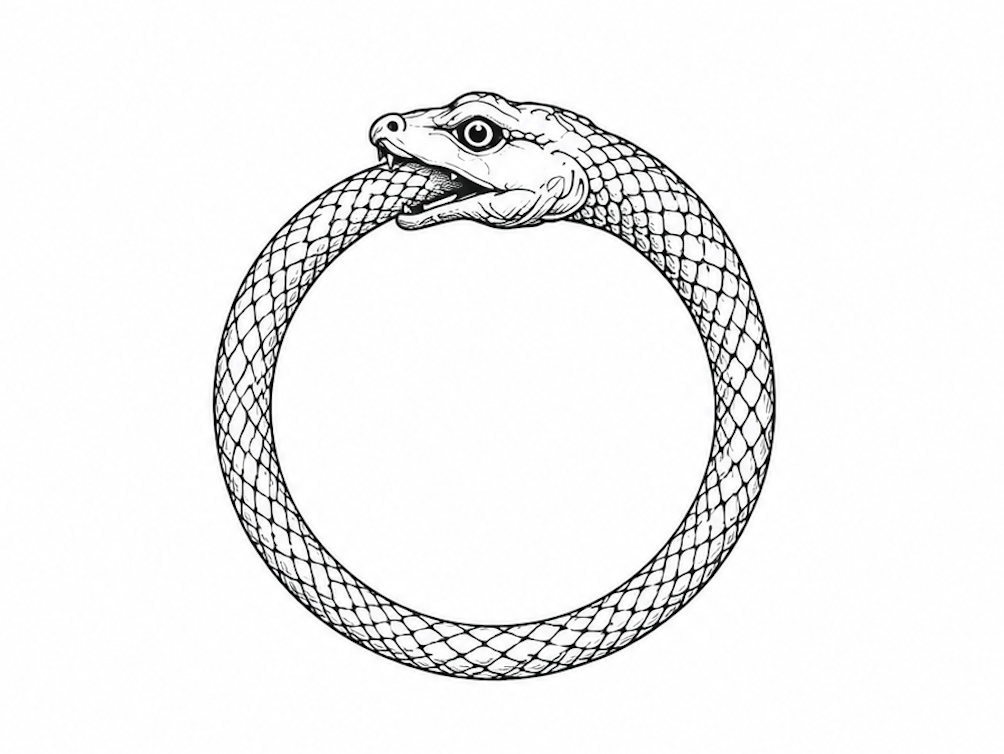
This essay explores the nature of metaphysical pain: not merely emotional or spiritual distress, but a deeper revolt against the structure of reality itself – a vertical wound that cannot be reconciled with moral order or worldly logic. Drawing from personal experience, Jungian individuation, and thinkers like Ernst Jünger, the piece argues that such pain is not a symptom to be medicated or transcended, but an alchemical crucible through which the Self may emerge. In this framework, metaphysical suffering is not pathology but rather initiation, and the refusal to numb it may be the only real fidelity to truth left in a disenchanted age.
Welcome back. This is a post about pain.
There are different types of pain in this world – physical, emotional, spiritual, and metaphysical.
What is worse – being in constant and unrelenting pain from failed back surgeries, or being plagued by the loss of a loved one? Feeling abandoned by God, or even that the base incentive structure of this reality is all wrong? How does one weigh these types of pain? It is close to impossible, is it not?
Regardless of the type of pain experienced, it sucks. If one is experiencing chronic pain, it goes against the dictates of modern society which calls for shallowness, extraversion, friendliness and a positive attitude. If one wallows in pain one will ultimately lose one’s relationships and ability to function in the world. There is an element of shame involved; those in pain are to be avoided, radioactive after a point, dragging others down into their morass which may rapidly become a black despair.
Ernst Jünger1 wrote in his essay On Pain (1934), which you can read here, that one’s relationship to pain determines the type of person you are. Do you run from it? Do you ignore it, push it down, cheerily carry on? Do you subsume it into blaming others? Do you hide from it in drugs, alcohol, addiction, distraction? Do you confront it to a limited extent – through conversations with friends and family, perhaps through therapy or meditation? Or perhaps you channel it into an activity to try to forget all about it, the man who throws himself into work so he can avoid the overwhelming feelings of relational (a failed marriage, perhaps) or other loss?
What our society hates, I think, is an ability to sit with pain. Not to push it away, not to ignore it, not to subsume it with other activity, but to sit there and just accept it – yes, I am in pain. No, I cannot push it away. I am here with it now. I will sit here and hear what it has to say, in silence, to allow the unconscious to come to the surface if it decides to do so, at it’s own pace and not my ego’s, to dialogue with pain. That is a radical action, and one which has very little support in modern society. Because pain in whatever form is ultimately transformative, if it can be held – the person subject to it changes in reaction to it, sooner or later, in ways that one cannot expect or plan for with ego. As Carl Jung stated, “There is no coming to consciousness without pain. People will do anything, no matter how absurd, to avoid facing their own soul.” Sitting with pain is the nigredo, the first stage of the alchemical soul transformation.2
Of the types of pain listed, physical and emotional pain are well understood by modern society. My former stepfather was in constant emotional pain after my mother left him, for example. Spiritual pain is much less understood, but is to a limited extent – the desire for God, to have a religious community, to feel that one’s life has meaning and purpose beyond the secular materialist mundane world. The first example that I think of for spiritual pain is that of Roosh – his sister died young of cancer, and that emotional and spiritual pain ultimately completely transformed his life, where he abandoned his secular, hedonistic lifestyle and found refuge in God. I also think the pain experienced by Patrick Bateman in Ellis’s American Psycho is fundamentally a spiritual pain caused by the emptiness of secular materialism.3
The least well understood one is metaphysical pain – not just the idea that this world is imperfect and cannot be perfected, but a constant pain about how fundamentally unfair and unjust this life is to all involved in it; that the rules of the game do not make rational sense, they cannot be squared away with one’s notion of justice – “do unto others as you would have them do unto you” is simply impossible on this plane. While for most pain people experience is horizontal pain – pain from failure of belonging, of loss of control, of injustice, abandonment, mortality – it remains within the structure of the world. It does not question the world as structure, it wants the world to work. Metaphysical pain, by contrast, is vertical, it lies outside the structure of the world. It arises from the belief that this entire order is wrong – not just corrupted, but ontologically misaligned. As I’ve repeatedly stressed, this realm is a never-ending cornucopia, an orgy of forever-violence: one must consume other living creatures in order to survive on this plane, even plants emit a wavelength of screaming when they are being devoured. There is no way around this unless maybe you’re a fruititarian (which isn’t a sustainable diet on its own), as fruit enjoys being devoured so it’s seeds can spread. Furthermore, the base incentive structure of this reality is all wrong: one is either striving for an object or, if the object sought is obtained, bored until one seeks out a new object to strive for. Combining striving/boredom with endless consumption and the inability to avoid breaking the Golden Rule means this world is simply a demiurgic Hellhole.
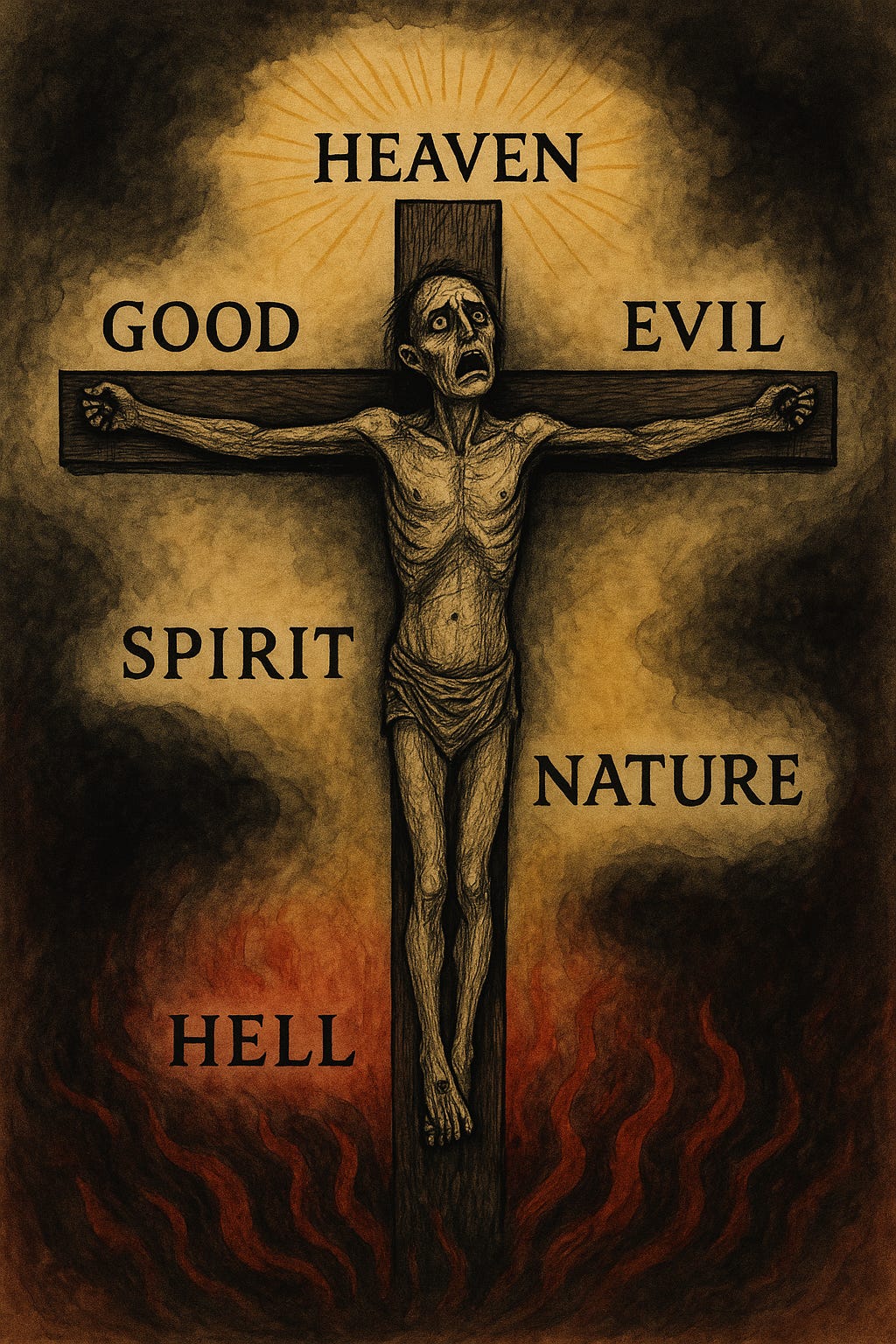
Another layer of this is being comfortable with accepting unlimited ambiguity – that what appears on one layer and timeframe to be “good” to an individual may appear on another layer and timeframe to be “bad”, often both at the same time; that our perspective as subjective humans is too limited, too narrow, to understand the bigger pictures at play. Truth is often contradictory depending on the layer on which it is assessed. I discussed this point with here, and also see the wonderful Chinese farmer “maybe” story which is a really powerful and important one.4 And yet another layer is that we as humans are crucified between endlessly competing and contradictory forces, pulled between Heaven and Hell, materialism and spirituality, nature and spirit, good and evil. Jung believed that it was our role as humans on the material plane to synthesize these competing energies, which he equated to stars or to demanding Gods, to come to temporary solutions between them in ways that no other creature or entity could do. In this way we all serve as a Christ figure, torn between the opposites:
Now, I’m putting this philosophical pessimistic perspective into words, but I have always felt this way. I grew up solidly middle class, never had any material wants or concerns and never suffered any physical abuse, but I was perpetually unhappy anyway, and my underlying intrinsic understanding of this reality played a significant role in it – I was perpetually in pain, even if I was unable to articulate it at the time (or even properly until recently). I have known only one other person in my life, now deceased, who also was in constant metaphysical pain, even though he had not properly addressed it – it formed a deeper bond between me and him, a mentor, as we shared this burden that no one else seemed to carry.
This unrelenting metaphysical pain in turn has served as a major impetus for my individuation process, because I would drown without it. Metaphysical pain doesn’t seek healing, but rather truth without consolation. It demands that one hold both the agony of the world and the refusal to numb it and, from that tension, to become a vessel for symbolic articulation. There is no movement in anything in life without sacrifice, whether sacrifice of one’s time, attention, or comfortable outlook or illusions. While the ego wants pain to be useful, resolvable, the Self demands pain be witnessed – sacrifice as sacred. This is what makes metaphysical pain unbearable to the ego – it can’t be “handled.” We are all accustomed to want achievement without sacrifice, but it is that incorrect belief that has turned the world into the materialist Hellhole it is today. People want something for nothing, which is impossible, and they are eager to push off the consequences both to the future and onto future generations.
Now, Jünger believed in On Pain that pain should be subsumed for mission, in particular the mission of the warrior, to absorb and accept pain in order to ultimately battle and transform the forces of nihilism pervading society. After Germany’s defeat in World War 2 and in the succeeding decades his opinion on this evolved substantially, first into the role of the forest rebel and then the figure of the anarch – basically, Jünger came to understand that pain could be an impetus for personal and spiritual growth even if it went against the dictates of broader society. But Jünger did not go all the way with his vision; he stopped short of the end goal. Because the further one gets into individuation and spiritual growth, it becomes apparent that one must eventually return to share that knowledge with others (whether or not it is accepted or rejected). Yes, Jünger wrote lots of books and shared his ideas, but he did not share the core of what mattered (perhaps because he didn’t know how to or couldn’t): how one could individuate to become a deeper version of themselves. He knew how to do it for himself, but not how to help others do it along their own paths. And because of that he is deficient in a way that Carl Jung with his individuation process is not.
The Prestige
This also reminds me in a way of the film The Prestige, which the magic act is broken into three parts: the Pledge, where the magician shows something ordinary; the Turn, where the ordinary is made extraordinary by making it disappear; and the Prestige, where the vanished object returns, completing the illusion. Jünger completes the Pledge and the Turn, but not the Prestige, while Jung does through Aion, Liber Novus, and remaining in conversation with the collective unconscious. It is by doing the work of individuation, the focus on one’s core inner work, of integrating the opposites painfully into a higher level synthesis as well as one’s dark, terrifying and nightmarish unconscious, ultimately resulting in initiation into deeper layers of symbolic reality, that allows one then to return and impact broader society. As he explains in Liber Novus:
We think that there is singleness within us, and communality outside us. Outside of us is the communal in relation to the external, while singleness refers to us. We are single if we are in ourselves, but communal in relation to what is outside us. But if we are outside of ourselves, then we are single and selfish in the communal. Our self suffers privation if we are outside ourselves, and thus it satisfies its needs with communality. Consequently, communality is distorted into singleness. If we are in ourselves, we fulfill the need of the self, we prosper, and through this we become aware of the needs of the communal and can fulfill them.
Returning is not always writing books or giving lectures; rather, it may mean becoming a vessel for the wound’s truth, bearing witness without requiring agreement, allowing others to suffer without rescuing them (because no one can be rescued from spiritual or metaphysical pain, they have to find their own rescue, which may first require hitting rock bottom), but still lighting a path. The Prestige is not dramatic in this context, but rather ritual presence after descent.
Pain, if you let it, doesn’t simply scar you but forms you – not into the person society needs, but into the person the Self requires. That person may still suffer, but they no longer seek escape; they seek the symbol that will let them speak, and in speaking, they return. As Jung wrote:
To live oneself means: to be one’s own task. Never say that it is a pleasure to live oneself. It will be no joy but a long suffering, since you must become your own creator. If you want to create yourself, then you do not begin with the best and the highest, but with the worst and the deepest. Therefore say that you are reluctant to live yourself. The flowing together of the stream of life is not joy but pain, since it is power against power, guilt, and shatters the sanctified.
And this return, if effectuated genuinely and through a focus on one’s individuation process instead of from ego, may in turn have ripple effects on others that are mysterious and powerful. As Stephan Hoeller wrote in The Gnostic Jung and the Seven Sermons to the Dead:
In his own unique way Jung gave us the answer: “To the constantly reiterated question ‘What can I do?’ I know no other answer except ‘Become what you have always been,’ namely, the wholeness which we have lost in the midst of our civilized, conscious existence, a wholeness which we always were without knowing it.”
Today, just as in the second or third centuries, humanity’s greatest need is that attainment to wholeness or fullness of being which comes to the soul in the form of gnosis. Religious and moral fervor, faith in God or in political ideologies, advocacy of harsh law and rigid order, apocalyptic messianic enthusiasm – not only are these imperfect solutions to our problems, but in reality they are no solutions at all. As long as vast numbers of individuals expect all problems to be solved and all ills to be remedied outside themselves, they will be beset by inhumanity upon inhumanity, holocaust upon holocaust. We are not faced with a problem we can solve, but with a predicament from which we need to extricate ourselves; a predicament of a-gnosis, of a lack of intimate, personal and firsthand knowledge of our authentic nature….Jung spoke of the task of these new gnostics, the contemporary heroes of consciousness when he wrote:
‘The effect on all individuals, which one would like to see realized, may not set in for hundreds of years, for the spiritual transformation of mankind follows the slow tread of the centuries and cannot be hurried or held up by any rational process of reflection, let alone brought to fruition in one generation. What does lie within our reach, however, is the change in individuals who have, or create, an opportunity to influence others of like mind in their circle of acquaintance.I do not mean persuading or preaching – I am thinking, rather, of the well-known fact that anyone who has insight into his own action, and has thus found access to the unconscious, involuntarily exercises an influence on his environment. The deepening and broadening of his consciousness produce the kind of effect which the primitives call “mana.” It is an unintentional influence on the unconscious of others, a sort of unconscious prestige, and its effect lasts only so long as it is not disturbed by conscious intention.’
I hope this essay on pain helps you think about your own relationship to pain and how it has perhaps made you grow.
Thanks for reading.
Subscribe:
Email delivery remains on Substack for now.
1 I previously wrote about his personality in this post.
2 The nigredo, or “blackening,” is the first stage of alchemical transformation, both in classical hermeticism and Jungian psychology. It marks the breakdown of an old worldview or ego-structure, often triggered by intense external crisis or inner contradiction such as moral betrayal, systemic collapse, the failure of collective narratives, or personal disillusionment. In Jung’s view, the nigredo is entered when the conscious ego is forced to confront the chaos of the unconscious and is no longer able to maintain its prior identity or beliefs. This descent is often accompanied by depression, confusion, and symbolic “death.” Many evade its demands through repression, ideological retrenchment, or distraction. But if endured consciously, if one submits to its darkness and listens, nigredo can serve as the crucible for individuation, the beginning of a reconfiguration toward deeper psychological integration and spiritual autonomy.
3 “…there is an idea of a Patrick Bateman, some kind of abstraction, but there is no real me, only an entity, something illusory, and though I can hide my cold gaze and you can shake my hand and feel flesh gripping yours and maybe you can even sense our lifestyles are probably comparable: I simply am not there. It is hard for me to make sense on any given level. Myself is fabricated, an aberration. I am a noncontingent human being. My personality is sketchy and unformed, my heartlessness goes deep and is persistent. My conscience, my pity, my hopes disappeared a long time ago (probably at Harvard) if they ever did exist. There are no more barriers to cross. All I have in common with the uncontrollable and the insane, the vicious and the evil, all the mayhem I have caused and my utter indifference toward it, I have now surpassed. I still, though, hold on to one single bleak truth: no one is safe, nothing is redeemed. Yet I am blameless. Each model of human behavior must be assumed to have some validity. Is evil something you are? Or is it something you do? My pain is constant and sharp and I do not hope for a better world for anyone. In fact I want my pain to be inflicted on others. I want no one to escape. But even after admitting this—and I have, countless times, in just about every act I’ve committed—and coming face-to-face with these truths, there is no catharsis. I gain no deeper knowledge about myself, no new understanding can be extracted from my telling. There has been no reason for me to tell you any of this. This confession has meant nothing ….”
4 As recounted by Alan Watts: “Once upon a time there was a Chinese farmer whose horse ran away. That evening, all of his neighbors came around to commiserate. They said, “We are so sorry to hear your horse has run away. This is most unfortunate.” The farmer said, “Maybe.” The next day the horse came back bringing seven wild horses with it, and in the evening everybody came back and said, “Oh, isn’t that lucky. What a great turn of events. You now have eight horses!” The farmer again said, “Maybe.”
The following day his son tried to break one of the horses, and while riding it, he was thrown and broke his leg. The neighbors then said, “Oh dear, that’s too bad,” and the farmer responded, “Maybe.” The next day the conscription officers came around to conscript people into the army, and they rejected his son because he had a broken leg. Again all the neighbors came around and said, “Isn’t that great!” Again, he said, “Maybe.”
The whole process of nature is an integrated process of immense complexity, and it’s really impossible to tell whether anything that happens in it is good or bad — because you never know what will be the consequence of the misfortune; or, you never know what will be the consequences of good fortune.”