

This is a post about 1982 novel The Running Man, whose dark, despairing tone in a society of blown out neoliberal feudalism, ubiquitous electronic spying, rampant crime and no opportunities predicted the general tone and feel of the modern world, and which bears some parallels to the previously-discussed manhunt for Luigi Mangione.
Stephen King is a gross, deranged boomer. If anyone has followed him over the past near-decade all he’s done is scream at the top of his lungs about how bad Orange Man is, and in recent years called for worldwide shutdowns and forced heart attack jabs. You can pretty quickly understand the paranoid, deranged mentality of the guy in this 2022 interview.
He’s also been irrelevant for a long time. I can’t think of the last Stephen King book release, although I’m not really sure there’s an audience for it these days anyway.
Growing up I read a lot of his stuff. I read The Stand, Needful Things, Desperation and The Regulators, The Dark Half, Pet Sematary and It, some of his short stories such as the excellent The Jaunt (“Longer than you think! Longer than you think, dad!”), and watched various film and television adaptations such as The Shining, Langoleers, The Green Mile, Misery, The Mist, Thinner and The Shawshank Redemption. The quality was generally hit-or-miss and his novels were extremely verbose, double or triple the length they should have been, like he was being paid by the word.
https://www.youtube-nocookie.com/embed/5IFGJPDKtZc?rel=0&autoplay=0&showinfo=0&enablejsapi=0
Early Family Guy poking fun at King’s marked decline in quality.
King began his career in 1974 with Carrie and his early books were reasonably written. They only grew to interminable length once he became established and successful. Reflecting this was King’s sprawling The Dark Tower series, of which I only enjoyed book one, The Gunslinger (published 1978-1981) and sort-of book four. The Gunslinger was written in a sparse western style, showing instead of telling; there were frequent allusions to past events which were not explained in the novel and plenty of tarot imagery as well, both of which I appreciated. The main character Roland made difficult, painful choices and sacrifices in order to pursue the Man in Black, a mysterious figure of significant power. King later butchered the story and turned it into word-vomit when he finished the seven book series and “updated” book one to account for later story developments, but such is life (if you ever read it, find an early edition and stop after book one). Some of the first couple books was made into a disaster of a film which I watched and reviewed previously here.
King’s alter-ego
King wrote under a pseudonym toward the start of his career under the name Richard Bachmann. He did this because his publisher wouldn’t let him publish as often as he wanted and also because he wanted to see if he was successful solely due to luck, or if there was an element of skill which would allow him to succeed with a different writing style, a Pessoan heteronym. He picked the name Richard Bachmann in part after the pseudonym of fellow writer Donald E. Westlake, who had written written adventure novels under his real name but who also wrote separately under “Richard Stark.” Westlake’s content as Stark was a much darker hardboiled stark noir style about an unemotional career criminal named Parker – who was like Jack Reacher but amoral and hardened with no backstory instead of being a lame military police officer – and his stories of capers and revenge. The Parker novels are excellent novels and I highly recommend them. They’re apparently popular in prison and I remember that it’s flat, selfish tone wore off on me for a little while after reading them – I too felt like I was a “badass”, which of course was divorced from reality. Much later a couple of well-done graphic novels were released.
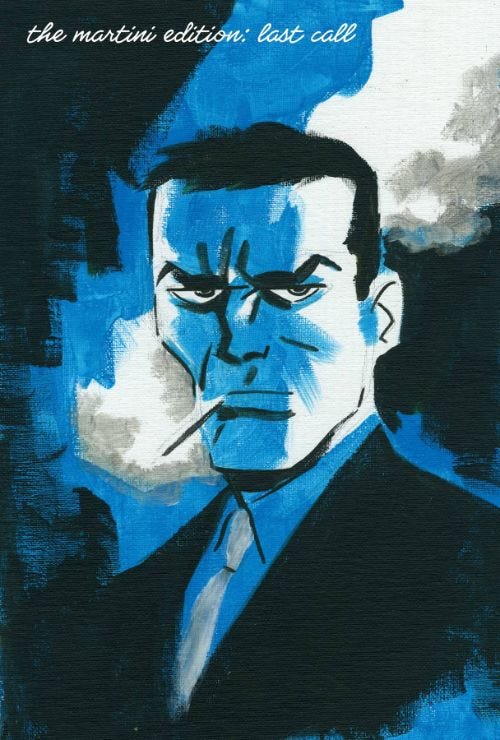
King’s writing as Richard Bachmann was a nod to the Stark writing style, written with brevity and with a dark and uncompromising tone. He wrote four books as Bachmann before one of his readers discovered who he was and announced it publicly. The subsequent publicity killed King’s willingness to write under the name and style further and he went back to writing the bloated garbage he’s known for.
Of the four novels published as Bachmann only two were good, The Running Man and The Long Walk. The Long Walk made for a pretty good story about a group of kids in a futuristic military dictatorship where whoever walked the furthest in a race got an unlimited reward while everyone else was killed. The other novels, Roadwork and Rage, were both forgettable except Rage predicted the later school shooting trend.
The Running Man
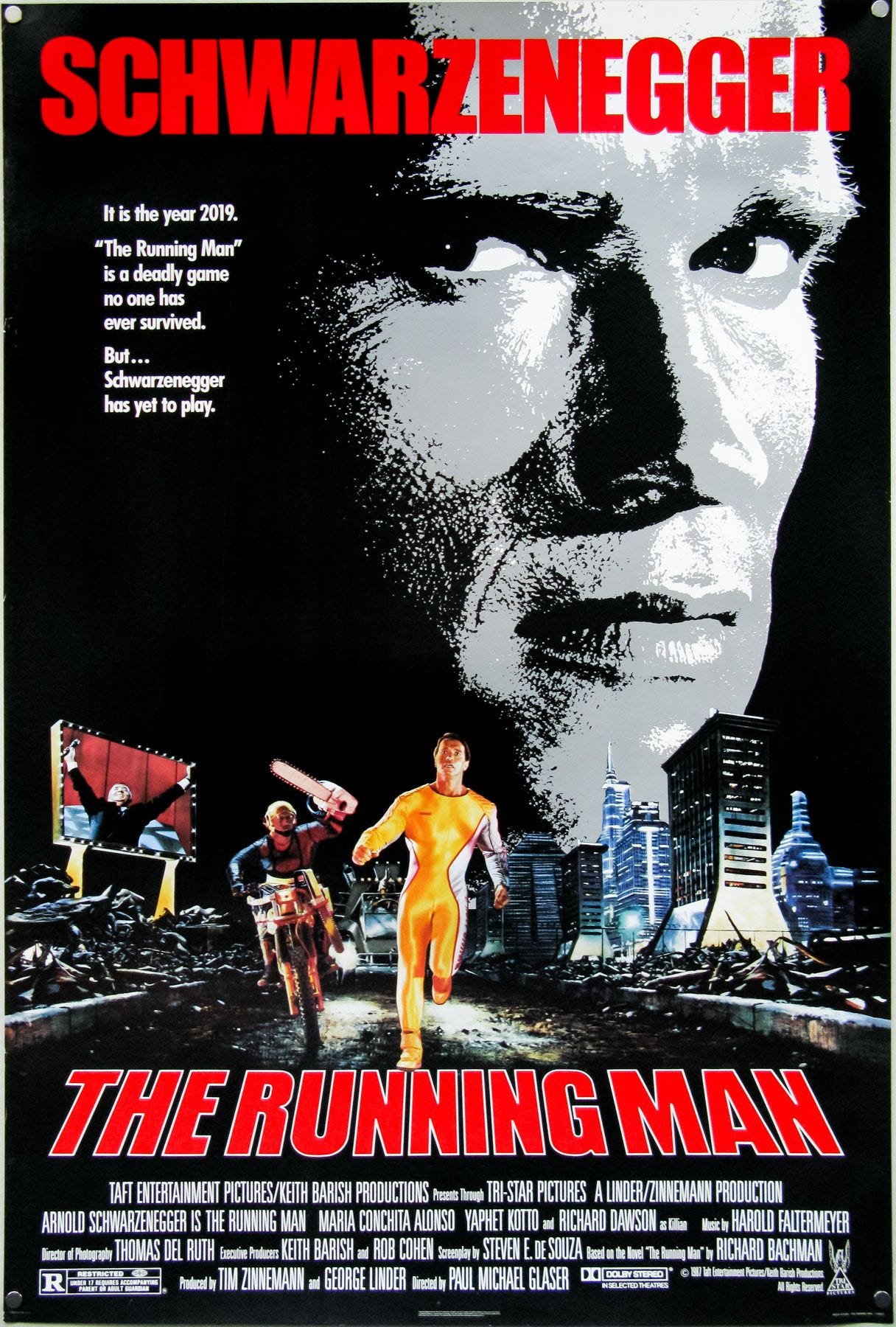
Some of you probably know The Running Man due to Arnold Schwarzenegger’s fun but silly film about it. The film takes the title of the book and the main character’s name, along with the broad story of a man who has to survive a reality television show where people are trying to kill him, and changes everything else. There’s nothing about the characters, plot, or tone of the film that matches the novel. King writes that the main character of the novel is “about as far from the Arnold Schwarzenegger character in the movie as you can get”. I guess the trigger for this post was the fact that the novel is being remade with Glen Powell based on Edgar Wright’s remake, with some other announced cast here, where he wants to stick much closer to the source material (although I suspect he will still have to substantially modify the ending). I think I can see Powell as the main character of the novel if he can lose some weight to appear gaunt, pale and haunted.
I don’t want to spoil the novel for you — note that the forward of the novel spoils the quite shocking ending, so don’t read it until after you finish the book if you decide to read it — but I’ll provide a short non-spoiler description of the plot.
The setting is this: it is the future and Ben Richards is an out of work mechanic. He is thin and malnourished. His wife turns tricks as a prostitute to try to make basic ends meet while his newborn daughter has pneumonia; they can’t afford medicine. The air in the environment is poisoned after decades of pumping chemicals into it. To save his daughter he volunteers for the network games where, if one is selected, one would have the “pleasure” of being mocked, tortured, and – if qualified for the most lucrative game, The Running Man – killed. In the network show a participant is given a day’s head start to run and hide and then Hunters are unleashed. They track the participant down and kill him with the public’s input and help. The longer the runner survives, the more money his family receive. No one had lasted very long at all. Richards tries out for the games. He qualifies for The Running Man, and he has to try to survive and by doing so protect his family.
As mentioned, the tone of the novel is dark, stark, and pessimistic. Richards is an antisocial independent loner type, a clear dissident to the system, and he is portrayed in a sympathetic light even as the braying, bloodthirsty mob after him is highlighted as his opposite. He is not portrayed as heroic but desperate, which is a very important distinction. The novel does an excellent job of predicting the tone of the Hellscape nightmare society we currently inhabit – a dark, foreboding environment without opportunity and with malice, despair and desperation around every corner.1 King described the “Bachman state of mind: low rage, sexual frustration, crazy good humor, and simmering despair.”
It’s an easy, entertaining, and quick read. It’s one of the few novels from when I was young that really stand out vividly decades later, and I still think about it once in awhile to this day. That speaks to the story’s enduring power, tapping into a well of populist rage that King himself would later totally abandon.
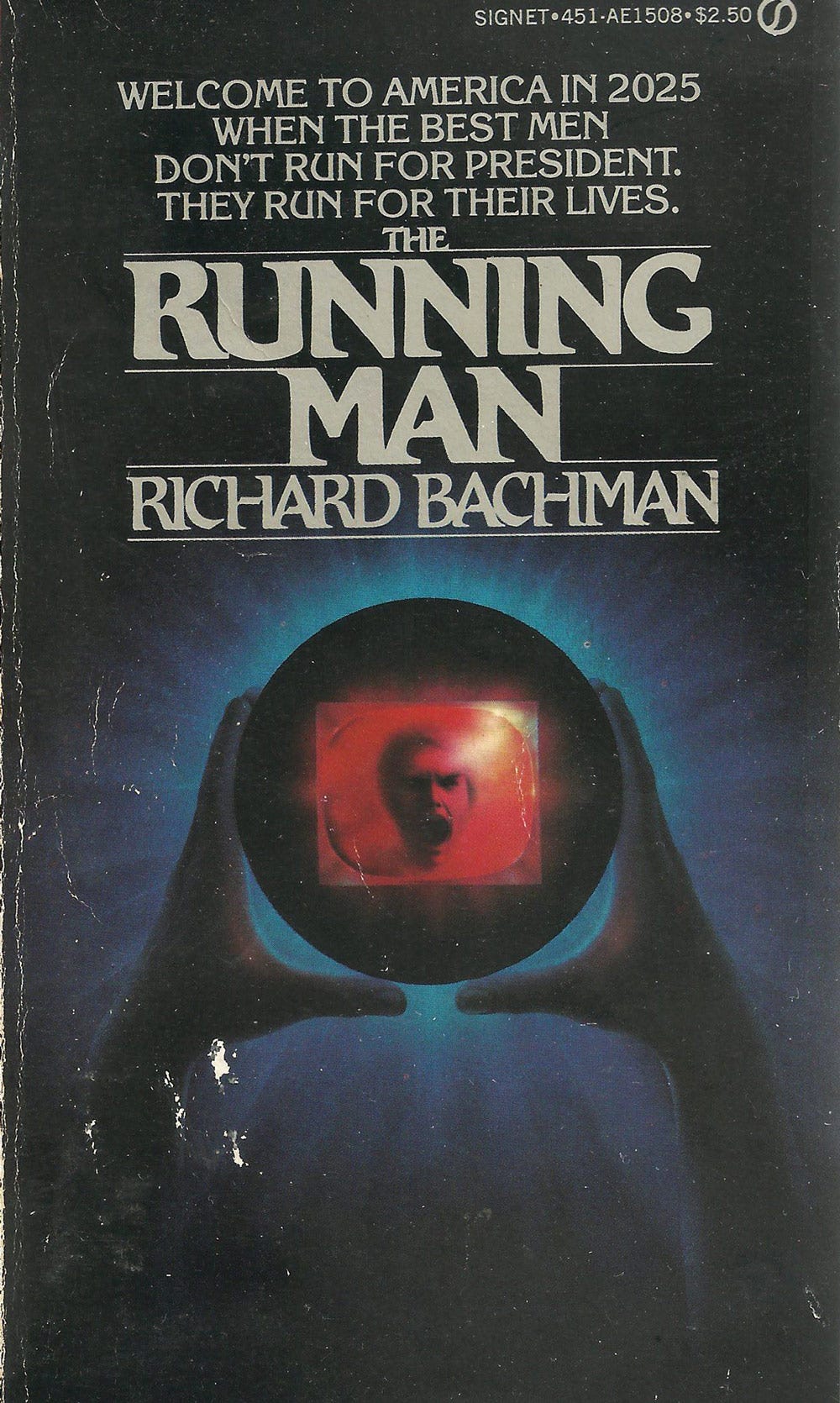
It’s ironic how, in a brief flash of King’s life, he created a novel that sympathized with the very populist figures who he would later on come to abhor. I wonder if he has made such a connection. Probably not; his mind seems pretty rotten from too-much boomer success. Be careful of the success one may wish for, you might just get it…
Anyway, if you’d like to pick up the novel the Amazon link is here. It is also available for free to read online here. Remember: skip King’s introduction until after you read it so the ending doesn’t get spoiled for you. And if you do read it, I’d be interested in what you thought of it in the comments below.
Thanks for reading.
Subscribe:
Email delivery remains on Substack for now.
1 Even the alternate 1985 in Back to the Future: Part 2 seems less grim than reality today. In that alternate reality men were still men, sex was still popular, there was a degree of order under authoritarian Biff and everyone knew he was in charge, I don’t recall seeing any trannies or obese people…