
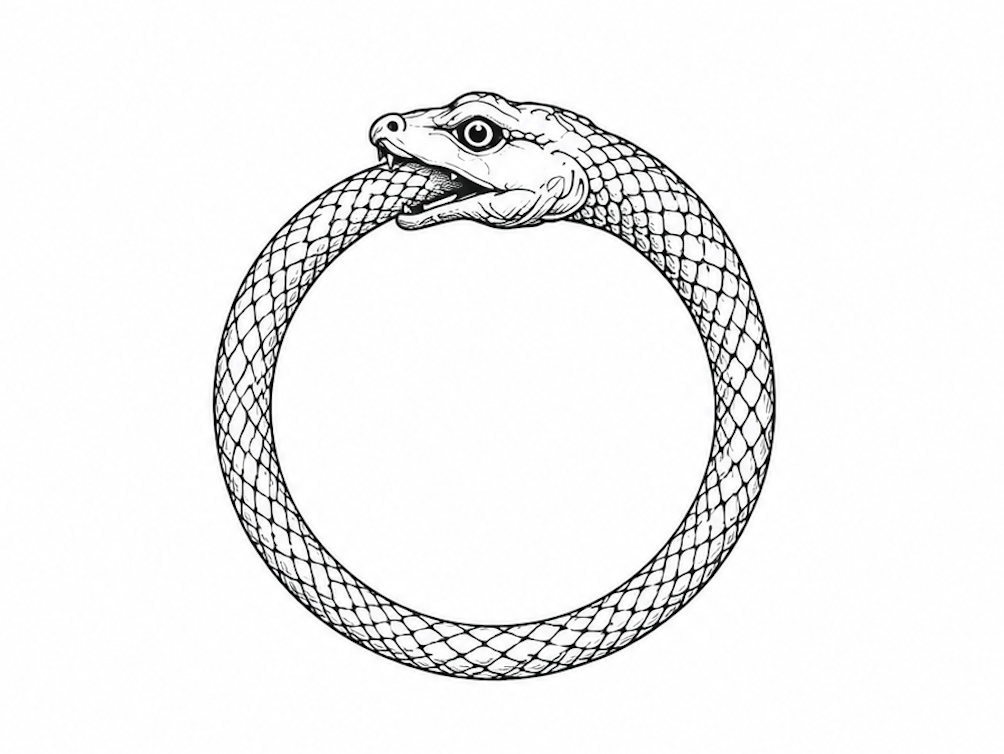
This essay picks up where the previous post left off by confronting the implications of Jung’s gnostic cosmology. If the Abraxas God-image is taken seriously – if good and evil are ontologically co-equal and suffering is no longer provisionally redeemable -then familiar moral, spiritual, and psychological assurances collapse. What follows is an examination of what remains once those guarantees are removed: what kind of responsibility, discernment, and individuation are possible in a world that cannot be theologically redeemed without remainder, and what kind of psyche can endure that recognition without retreating into denial, predation, or false consolation.
Welcome back. In my previous post – which is required background reading or the following discussion won’t make sense – I discussed the metaphysics and ontology of the terrifying figure of Jung’s vision of Abraxas, which he outlined in his Liber Novus1 and moved toward in his oblique Answer to Job during a sickness he experienced late in life.2 I had covered the book back in March, but I have felt especially crucified between opposite energies since then which has deepened my understanding of the world, and my understanding of Abraxas continues to develop phenomenologically over time – including its horror. Properly conceptualizing Abraxas and the crucifixion of opposites, writing these thoughts and feelings down as they arise, and publishing it all have different effects upon my psyche, and I don’t know what they will be until I undergo them. While I think I properly articulated Jung’s conception of Abraxas, he explicitly kept his understanding within a psychological register3, whereas I am extending that logic to the metaphysical realm.4
While I believe that the metaphysics and ontology laid out in the previous post is clear and logical, tightly argued5, it does raise many questions about what adopting this new God image would entail – its strengths and weaknesses (because every God image has weaknesses), what kind of psyche is fit for absorbing it and which kinds (the vast majority) are not, its conception of good and evil, whether cosmic justice exists at all, and many others. These are provisional articulations of my thoughts and I don’t claim that any other person or figure, including Jung, agrees with them. My views on the following may also change substantially down the road. I feel that I must discuss this for my own intellectual, spiritual, and emotional journey, even though the audience for this particular material is small. I am going to offer these clarifications in a question and answer format instead of my usual essay style. Also, note that I used LLMs for this piece, not just for editing but for dialectical sparring. The material is subtle enough that having an interlocutor (even synthetic) helped sharpen distinctions that would otherwise not have been steel-manned, which is critical for something like this. The ideas remain mine; the LLM functioned as Socratic mirror. Take of this what you will.
1. If Abraxas is the unity of all opposites – good and evil, matter and spirit, love and hatred, greed and asceticism, short term versus long term, light and darkness, persona vs shadow, masculine vs feminine, rational/scientific vs irrational/spiritual or mystic – then how can Abraxas be an unconscious figure – wouldn’t it also contain the union of consciousness vs. unconsciousness within itself?
Abraxas contains the potential for consciousness, but the actuality of consciousness requires differentiation – a limited standpoint from which opposites are experienced as unreconciled. Abraxas is unconscious not because he’s blind, but because there’s nothing outside him to perceive. Consciousness arises only when totality fractures into perspective through finite beings.
2. What are the strengths and weaknesses that would arise from adopting the God image of Abraxas as opposed to the privatio boni notion of God as all good?
This invites a long and detailed response. Benefits include the following:
- A radical reduction of projection. By focusing internally on integrating one’s own darkness via the individuation process instead of projecting it outwards onto the Other for destruction, people stop needing villains to purify themselves, scapegoats to stabilize meaning, or moral theater to feel aligned. This is stabilizing for a certain kind of psyche (not for everyone or even most), to be discussed further below.
- Increase in inner honesty. Shadow material no longer threatens cosmic collapse; one can say “this too belongs”. This produces calm, not despair, in people already accustomed to darkness.
- Increased tolerance for ambiguity. The psyche stops demanding resolution. This stabilizes paradox instead of erasing it, and the increased in bandwidth for paradox and ambiguity may provide greatly enhanced analytical and problem solving abilities.
- Deepened responsibility. Without divine arbitration, one’s choices become heavier, not lighter. No appeal, no ledger, no appeal court – this is it, and justice won’t be enforced in the victim’s favor in the afterlife.
- Freedom from moral conscription. Political, religious, and ideological scripts lose their hypnotic force. The psyche can no longer outsource evil. Enemies become mirrors into our own psyche, which ends crusading psychology permanently. One may feel relief in clarity even as hope diminishes – again, for a certain personality type.
- Exit from metaphysical infantilization. No more “if I am good, the universe will reciprocate.” Under privatio boni morality is outsourced upward: God guarantees justice, meaning, and final accounting. Under Abraxas, no cosmic parent is coming, and one stops behaving as if the universe owes moral restitution. This forces psychic adulthood and maturity. It is also structural clarity, where the world stops appearing insane – horror becomes intelligible without being justified.
- Increased humility: Not “I am sinful,” but “I am partial”. Privatio boni humility states: “I am fallen; I need grace to become good.” Abraxas humility states: “I am one finite tension-point in an infinite field; my view is always partial, my action always incomplete.” This is epistemic humility, not moral shame. It fosters listening over judging, curiosity over certainty, collaboration over conversion.
- Immunity to moral blackmail. If evil is not an anomaly but structural then catastrophe does not imply meaninglessness, suffering does not require justification, and no one can conscript you with “this must be good because God.” This is psychologically stabilizing for a small class of people – those who were already breaking under moral incoherence.
- Precision about power. Abraxas dissolves fantasies about “evil anomalies” and reveals power as ontological, not accidental. This sharpens perception and it removes the naïveté that gets people eaten. Moral authorities will recognize immediately that this perspective is not atheism, it is not secularism, it is not heresy in the ordinary sense – it is worse to them. This is because it does not deny God, it denies God’s moral monopoly.
- To delve into this more deeply: when you deny God outright (atheism) religious elites know how to respond; when you secularize God (liberal theology) they know how to absorb it; when you commit a recognizable heresy they know how to anathematize it. All of those still preserve God’s moral monopoly, which is the exclusive right of the God-image (and its institutional custodians) to define what counts as good, what counts as evil, what suffering means, how it will be compensated, and who has standing to judge whom. The privatio boni model is not just a metaphysical claim; it is a jurisdictional claim. It says: all goodness flows from here, all evil is a deviation from here. That makes God – and by extension the Church, clergy, theologians, moral authorities – the final court of appeal.The Abraxas framing does something far more dangerous. It says: Good and evil are not monopolized by the God-image, they are structural opposites within reality itself. That has several consequences religious elites will grasp: God is no longer the guarantor of moral repair, suffering is not promised retroactive justification, evil is not guaranteed to be “accounted for.” This removes the Church’s role as the broker of cosmic reassurance. Moral authority can no longer be externalized upward; if God contains both poles, then moral clarity cannot be outsourced. The believer cannot say, “God wills this, therefore it is good.” Under Abraxas judgment collapses back into lived responsibility and sin loses its clean bookkeeping function. Under privatio boni evil = deviation, repentance = erasure, grace = ledger correction, but under Abraxas nothing is cosmically “balanced”, and this annihilates sacramental control. Heaven and hell stop functioning as leverage; if Heaven is not guaranteed compensation and Hell is not guaranteed punishment, then fear and hope can no longer be administered institutionally. God becomes unownable. This is the core threat to moral authorities. A God who is all-good can be represented, but a God who contains evil cannot be spoken for safely. No priest, no theologian, no hierarchy can say, “We stand closer to God than you.” Because proximity to Abraxas is not sanctity, it is exposure. That is why this position would feel worse than heresy to them; heresy still plays on the same board, it argues about what God is like. This move changes what God is for. It strips God of his role as moral insurer, cosmic accountant, narrative redeemer, institutional anchor. What remains is a God-image that cannot be used to govern souls. Religious elites do not fear disbelief – they fear a God who cannot be made safe, as it makes their mediating role structurally obsolete.
Drawbacks include the following:
- The evaporation of hope as a civilizational glue. Abraxas detonates hope – not cruelly, but cleanly. Christian hope sustained the weak, delayed despair, allowed injustice to be endured without revolt or psychic collapse by deferring justice to the afterlife or to the Second Coming. Abraxas replaces hope with intelligibility. This is stabilizing for a certain psyche, but destabilizing for mass systems. Civilizations are not built on lucidity alone; historically, this suggests Abraxas cannot be a mass god, it can only be an esoteric god-image or a transitional one, metabolized by a few while others cling to older myths.
- Loneliness. Most people need a morally aligned cosmos. Abraxas strips that away. The result is fewer companions – not because of arrogance, but because of incommensurate psychic economies.
- Psychological elitism (who can survive this vision?). Good and evil still exist phenomenologically, but their claim on the soul weakens. This produces ironic distance, aestheticization of horror, spiritual spectatorship. Jung feared this explicitly, hence his insistence on experience over doctrine. Abraxas presupposes high frustration tolerance, capacity to endure unresolved tension, ability to self-generate meaning without guarantees. That means the god-image is selective by nature, even if no one intends it to be. This creates a new inequality not of power, but of psychic survivability. Only certain constitutions can metabolize this image without collapse. Abraxas universalized would stratify humanity: those who can hold tension, those who collapse into despair, those who weaponize it. This is not egalitarian truth, it is initiatory truth. That alone is enough to make it a weakness, even if unavoidable.
- Collapse of moral teleology / loss of directional meaning. Under Abraxas good and evil are ontologically co-constitutive, creation has no guaranteed moral arc, suffering is not “for” redemption in any assured sense. There is no progress, guarantee, eschatological arc, cosmic learning curve. There is no moral arc bending toward justice. There is only increasing differentiation, increasing complexity, increasing tension between opposites.6 Under this conception history does not “improve”, it intensifies and amplifies contradictions. Technology intensifies power, information intensifies awareness, globalization intensifies contact, psychology intensifies interior conflict. This is not progress, it is an increase in psychic pressure. Aquarian lucidity doesn’t save us, it strips illusions faster than we can metabolize them.This raises a terrifying implication: why act at all, if all outcomes feed the same totality? Individuation is a partial answer, but it is not a universal motivator. Most people need a moral cosmos. Removing it without replacement produces despair, nihilism, or regression. It stabilizes only a minority temperamentally capable of holding tension without collapsing. For the majority, Abraxas risks moral indifference, fatalism, psychic exhaustion, quiet nihilism disguised as “lucidity”. People would say: “All outcomes add to totality”, “Suffering is structurally necessary”, “Victim and predator are equally real”, and this may dissolve moral urgency worse than cruelty: indifference with metaphysical justification. Abraxas removes the eschatological leverage that keeps outrage morally energized. Under privatio boni, moral action is energized by alignment: Be good → align with God → justice eventually occurs. Under Abraxas, good and evil are both ontologically grounded and nothing guarantees cosmic vindication. Consciousness, not goodness, is what adds to the totality. This doesn’t produce overt nihilism in serious people; it produces fatigue, a thinning of moral urgency. One still acts ethically, but without metaphysical reinforcement. Ethics becomes tragic, not redemptive.
- Love under Abraxas is no longer sanctified. Under privatio boni love is guaranteed meaning, suffering is retroactively justified, victims are redeemed elsewhere, but under Abraxas love does not save love, does not fix love, does not outweigh horror. Rather, love becomes fidelity to consciousness in the face of no guarantees, which makes it rarer and more serious, not sentimental. It becomes contingent, tragic, non-teleological. This destroys romantic metaphysics completely. It also explains why modern relationships feel structurally unstable – they are unconsciously asked to carry redemptive weight they cannot bear. Love becomes attention without alibi, care without metaphysical insurance, fidelity without reward. This is colder. It is also cleaner – nothing is being smuggled in.
- Abraxas explains evil but does not justify suffering. This framework explains why evil exists, explains why it cannot be eliminated, explains why projection fails, but it does not answer: Why this much? Why this distribution? Why these victims? Some readers will mistake explanation for justification. This is not a logical flaw so much as a moral vulnerability: clarity feels like cruelty to those demanding justice, intelligibility can feel like betrayal; but explanation is not absolution, understanding is not endorsement. The privatio boni model filters horror, claiming that evil will be undone, it is not the final word, God will rebalance the scales. Abraxas removes the filter. The weakness here is burnout by lucidity. People do not fail morally; they fail energetically. They cannot metabolize the steady awareness that atrocities are real, irreparable, and not metaphysically “corrected.”
- Elite instrumentalization (Abraxas as predator theology). An Abraxas god-image is compatible with elite amorality. If everything contributes to totality exploitation becomes cosmically neutral, predation becomes metaphysically justified, power asymmetry becomes “how the opposites work themselves out”. This is not a misreading – it’s a structurally available interpretation. In fact, one could argue elites already live as if Abraxas is true but without the compensatory demand of individuation or consciousness. This makes Abraxas uniquely dangerous as a public god-image: it clarifies reality without restraining power. Those with power can say: “Predation and suffering are integral to the Whole.” “Resistance is merely another polarity.” “History requires this.” This is not a misunderstanding of Abraxas, it is a selective adoption. The corrective Abraxas offers to mass moralism becomes a license for asymmetry at the top, akin to how Chabad/Kabbalists use their God image.7 This is why Jung insisted (sometimes disingenuously) on psychological modesty. He knew that ontologizing this too cleanly could collapse ethical restraints among the powerful.
- The “beyond Abraxas” move is underdeveloped, but necessary. I introduced “hinting at a figure even beyond Abraxas” from Jung, which is also its softest point.8 Because if Abraxas is totality, what does “beyond” mean without contradiction? Either: (1) the Self emerges from Abraxas or (2) the Self participates in something beyond Abraxas. Option (2) risks smuggling back in the privatio boni, while option (1) risks total closure. Jung never resolved this, oscillating deliberately. That oscillation is a protective ambiguity, not a flaw, with reliance on apophatic escape, the unknowability of the Self, grace as non-derivable. Critics may say: “You reintroduced transcendence without grounding it.” I would answer that transcendence cannot be grounded without ceasing to be transcendence and any system that pretends otherwise becomes ideology.Furthermore, Abraxas corrects the deficiencies of the all-good God, but Abraxas is not stable either. Its weaknesses include encouraging indifference, moral silence, psychic coldness – and these almost demand a further correction. This means Abraxas may not be the final god-image but acts as a necessary passage through horror and clarity, a stripping stage. In alchemical terms Abraxas may be nigredo clarified, not redeemed. The system still awaits a coniunctio that does not erase suffering but does not glorify it either. I gesture toward this possibility with the Self beyond Abraxas, grace as received, not earned, and individuation as orientation, not salvation. This ambiguity is not a weakness – it is a sign that the system is alive rather than closed.
- If Abraxas requires differentiation to gain consciousness, then creation is not good, not evil, but necessary violence. This collapses teleology, providence, moral authorship. Creation becomes an experiment with no guarantee. That is not nihilism, it is worse: ontological irresponsibility at the divine level. Differentiation means separation where there was unity, boundary where there was continuity, exclusion where there was inclusion. In lived terms, differentiation always entails loss (something is no longer something else), finitude (this, not that), asymmetry (inside/outside, predator/prey, agent/victim). This is structural harm: the fact that for one form to exist, another must not. Life itself is built on this: cells differentiate → other potentials die, organisms live → other organisms are consumed, consciousness sharpens → innocence is lost. Calling this “violence” is a refusal to anesthetize reality with euphemism. Differentiation means a cut a separation, a loss of unity, the emergence of inside/outside, self/other, subject/object. A newborn’s first breath is not morally violent, but it is traumatic. Likewise, consciousness arises through severance from undivided being. Differentiation is the wounding that makes awareness possible. This is why myth always encodes creation as sacrifice, dismemberment, exile, fall tearing apart of a primordial unity. Creation hurts by definition – not because God is evil, but because being aware requires separation. That is why creation under Abraxas cannot be called good in the Christian sense.If creation has no moral alibi, then no act is clean, no choice is innocent, no system is just. Ethics becomes harm minimization, containment of excess, protection of fragile differentiation; not virtue, not purity, not righteousness. This is a tragic ethics, not a nihilistic one. Violence is not ontological irresponsibility in this model. What would be ontological irresponsibility is pretending differentiation didn’t cost anything, pretending suffering was avoidable, pretending creation was clean, justified, or morally elegant. The irresponsibility belongs to privatio boni, not Abraxas. Abraxas is horrifying precisely because he does not deny the cost, he does not absolve it, he does not redeem it, he does not retroactively justify it. He simply contains it. That honesty is what collapses hope and also what makes the structure coherent. If creation is unjustifiable then suffering has no excuse, existence has no justification, being conscious is not a favor. And yet – consciousness exists anyway. This produces a final inversion: meaning is not given, it is maintained against collapse, not because the universe wants it, not because God demands it, but because without it differentiation rots.
3. These strengths and weaknesses reveal why Abraxas isn’t universal. But they also raise a deeper question: if every god-image is provisional, correcting for prior deficiencies, what makes Abraxas necessary now?
The Abraxas image is imperfect like all other God images, but it is psychically necessary at this time because the privatio boni model has failed catastrophically. When mass atrocity is industrialized, innocence is repeatedly annihilated, justice fails generation after generation, the all-good God becomes psychically dishonest. Abraxas is not chosen for Aquarius, it is what consciousness backs into when moral fiction and the all good God collapses. That is why elites already live there functionally, they just don’t name it.
What would break Abraxas? Three possibilities: (1) discovery of a non-totalizable remainder (grace, Self, consciousness-source) that can’t be absorbed into the opposites – this would require further god-image evolution, (2) lived experience that contradicts the framework (e.g., undeniable cosmic justice, verifiable afterlife rewards), (3) a psyche metabolically incapable of holding tension who nonetheless achieves wholeness through a different structure – this would prove Abraxas isn’t universal even for coherence-types. I haven’t encountered any of these yet, but the framework remains falsifiable in principle, which is why it’s phenomenological reporting rather than dogma.
4. What is the conception of Heaven and Hell under the Abraxas God image?
Under privatio boni, God is all-good, evil is lack or privation, justice is deferred, Heaven and Hell exist to repair moral asymmetry after death.9 Politics is an extension of the privatio boni.10
Under Abraxas God contains all good and all evil, no cosmic repair mechanism exists, no moral accounting system can reconcile the damage. Therefore, Heaven and Hell cannot be compensatory realms. Instead they become states of psychic organization.
Under this conception Hell involves folding the psyche into one polarity and suppressing the other pole, having it leak out uncontrollably with one unable to bear the tension of opposites. That is Hell in this ontology – not punishment, but structural collapse. More precisely, Hell manifests when one pole is absolutized (good, purity, justice, power, transcendence, reason, instinct, domination, withdrawal), its opposite is denied, split off, or projected, and the denied pole returns autonomously and destructively. This produces compulsion, possession, ideological rigidity, predation justified as necessity, victimhood absolutized into ressentiment, or ascetic withdrawal that becomes sterile negation. Hell is not just suffering, it is suffering without mediation. This is why Hell is lived here, politically, psychologically, interpersonally. Heaven, by contrast, is not bliss or moral purity, it is the temporary achievement of held opposites, conscious endurance of contradiction without collapse, a livable equilibrium where shadow is acknowledged but not enacted blindly. Heaven is therefore fragile, temporary, non-guaranteed, personal rather than cosmic. It is closer to grace than reward and, crucially, it can vanish without explanation. That is why it cannot be promised.
Once Abraxas is admitted, any traditional afterlife faces a problem. If all acts feed totality, no moral arc corrects injustice, consciousness arises only through differentiation and suffering, then a compensatory afterlife would reintroduce privatio boni through the back door, restore moral bookkeeping, undermine the tragic structure of consciousness itself. So the ontology does not deny an afterlife outright, but it refuses to assign it moral purpose. If there is persistence beyond death, it would be non-judicial, non-compensatory, possibly non-personal in the egoic sense, more like continuation of psychic process than verdict. Jung himself stayed deliberately ambiguous here – and that ambiguity is not cowardice, it is structural honesty.
Here resurrection becomes individuation, not eschatology. What Christianity projects into the end of time, this model internalizes into life: judgment becomes self-confrontation, resurrection becomes integration, salvation becomes individuation, damnation becomes psychic disintegration.
The apocalypse is not coming, it is repeating, with every life reenacts it privately. This framework removes cosmic vindication for victims, removes cosmic punishment for perpetrators, removes cosmic apology, removes narrative closure – but it does not remove meaning. It relocates meaning to maintenance under impossible conditions. That is why it is palliative rather than redemptive. Not “this will be made right,” but “this makes sense, even if it cannot be justified.”
The final consequence (which few accept) under this ontology: Heaven and Hell are not where you go, they are what you become able or unable to inhabit, and death does not rescue you from that structure. If anything persists after death it likely carries forward the degree of differentiation achieved, not moral status. Which is another way of saying: consciousness is the only thing that survives, if it survives at all. That is the coldest implication, and also the most honest.
5. What is the ethical stance that remains when neither Heaven nor Hell can be promised?
Once Heaven and Hell are removed as guaranteed metaphysical endpoints, ethics cannot be grounded in reward, punishment, or cosmic bookkeeping. What remains is not relativism, but something harsher and more demanding.
- Ethics becomes custodial, not salvific. Under an Abraxian ontology no act is retroactively redeemed, no suffering is cosmically compensated, no injustice is secretly “worth it”, so ethics is no longer about earning anything. It becomes custodial: the care and preservation of differentiated consciousness in a reality that did not morally justify its own creation. In other words: you do not act ethically because it will be rewarded, you act ethically because collapse spreads. Cruelty, predation, ideological possession, and withdrawal are not “sins”, they are entropy accelerants. They narrow differentiation, flatten interiority, and convert complexity back into brute force. Ethics here is damage control inside an already-broken totality.
- Responsibility intensifies when guarantees vanish. Under privatio boni, responsibility is softened by metaphysical insurance: God will sort it out, justice will be done later, suffering is meaningful because it will be redeemed. Under Abraxas, none of that holds. So responsibility sharpens: every act lands, nothing erases its psychic or relational trace. Meaning must be maintained locally or it disintegrates. This produces a paradoxical effect: less hope, but more weight. Not despair – weight.
- As argued above, the reason not to act predatory is not moral purity, nor obedience, nor fear of punishment, it is fidelity to differentiation itself. Excess predation is not “evil” in a Christian sense, it is anti-Abraxian in a structural sense. And the cost of being anti-Abraxian is psychic contraction: narrowing of interiority, loss of symbolic depth, eventual ideological possession or compulsive repetition. Not damnation – impoverishment.
- Meaning without redemption. Under this frame meaning is not given, guaranteed, or redeemed. Meaning is maintained against collapse not because the universe wants it, not because God commands it, but because without it differentiation rots. This is why ethics here feels colder but also cleaner. No lies, no moral alibi, no metaphysical outsourcing.
6. If God is not good but all good and all evil, he is indifferent to human suffering, why not be a predator? What does morality matter then?
There are four non-theological constraints, and none of them are sentimental.
Constraint 1: Individuation is incompatible with compulsive predation. Predation can be instrumental, but compulsive predation fractures the psyche. Why? Because individuation requires holding opposites consciously. Predation collapses tension by externalizing shadow outward. The predator does not contain evil; he discharges it. That produces inflation, dissociation, eventual psychic rigidity, and finally possession by the very archetypes he thought he wielded. Predation is anti-individuative, not immoral per se. This is a structural limit, not a moral one.
Constraint 2: Predation narrows consciousness, and Abraxas wants consciousness (or rather, consciousness is the logical telos of the Abraxian process of differentiation, even if Abraxas has no intention). This is subtle and important. Abraxas does not care about good or evil, but consciousness is the one thing he lacks. Predation simplifies reality, it reduces others to objects, it flattens complexity, it trades awareness for efficiency. If humanity’s function is to increase consciousness, then predation is counterproductive even within the Abraxas logic. Not forbidden, but inferior.
Constraint 3: Total predation destroys the field that individuates anyone. A purely predatory system annihilates trust, continuity, symbol, and memory. That produces short-term dominance, long-term sterility. No individuation occurs in total collapse; only survival loops. Thus even without a good God, predation undermines the very psychic ecosystem that makes higher differentiation possible. This is why elites can exploit but never fully burn the system down, and why they already live post-privatio boni while pretending otherwise.
Constraint 4: Suffering becomes yours once projection is gone. Under privatio boni, one can justify cruelty as obedience, necessity, destiny, or righteousness. Under Abraxas, there is no such alibi. If you harm, you own the harm. Not morally – existentially. Many people cannot bear that weight, and it breaks them faster than guilt ever did.
In other words, under Abraxas predation is metaphysically permissible, but it is psychologically corrosive. Predatory action increases unconsciousness, not wholeness. Why? Because individuation is not about expressing power, it is about holding opposites without collapse. Predation collapses the tension by identifying fully with one pole. The predator becomes unconscious of the victim, pole dependency, vulnerability finitude. Unrestrained predation collapses differentiation, reduces complexity, annihilates future consciousness, erodes the very field in which opposites can be held. Excess predation collapses differentiation because it reduces others to means, flattens interiority, simplifies the world into resource and obstacle. The predator becomes less differentiated as he dominates, his consciousness narrows, his symbolic range shrinks. He becomes repetitive, compulsive, mechanical. What happens then? Meaning thins, time collapses into repetition, the world becomes boring, hostile, or unreal, violence escalates because it no longer satisfies. This is why predation is self-defeating even in a godless cosmos. Not because it is immoral, but because it is anti-consciousness. Predation simplifies the psyche while individuation complexifies it.
So the restraint against predation is not moral law, it is not “goodness”, not divine command but psychic consequence – structural fidelity to the conditions of consciousness. This is energetic economy. You do not need a higher good god above Abraxas, you need the fact that consciousness is fragile and easily lost. Excess predation is anti-Abraxian, not because it is evil but because it is stupid at the level of totality. Abraxas does not reward goodness, but unconsciousness punishes predation internally. That’s colder, and truer. This produces an ethics of stewardship of differentiation, damage limitation, preservation of psychic and social complexity; not obedience, not righteousness not salvation – maintenance.
This is the irony: privatio boni licenses predation through moral projection, while Abraxas limits predation through structural realism. When no cosmic referee exists harm is final, loss is irreversible, destruction is not redeemed elsewhere. This creates practical restraint, not nihilism. Cold gods often produce warmer ethics because they leave no room for moral outsourcing.
7. Similar to the previous question, why should good be preferred over evil in this model?
This ontology explains why evil exists, but it is thin on why good should be preferred, except pragmatically or psychologically. That’s not a contradiction, but it is a vulnerability. In Abraxas good is not ontologically privileged. Preference for good must come from individuation, intuition, grace, or existential commitment, where good is structurally advantageous for maintaining differentiation. Societies built purely on predation collapse into simplified power loops (constraint 3, Q6), while interpersonal relations built purely on exploitation erode symbolic depth (constraint 1). This doesn’t make ‘good’ obligatory, but it makes sustained predation self-defeating at the level of consciousness-preservation. This means that ethics becomes post-metaphysical, which many readers will experience as a loss, not a refinement. That’s acceptable to some, but it’s a real cost. Furthermore, if grace comes from beyond Abraxas, is not guaranteed, and cannot be systematized, then it functions as hope without ontology.11 That may be existentially honest, but it will feel evasive to some, and those with “dog eat dog” ethics may see the individuation process as naive.12
Does one have to smuggle in a “higher God” above Abraxas to retain morality? This is the razor’s edge. If one simply installs “the Self comes from a higher, good God beyond Abraxas” then yes, privatio boni sneaks back in through the back door. But Jung’s move is subtler and colder. The Self is not morally good; it is teleological, not ethical. The Self does not say “this is good; that is evil”, it says, “this is necessary for your becoming whole.” Sometimes that aligns with compassion, sometimes it aligns with separation, sometimes with refusal, sometimes with sacrifice – yours or another’s. This is not redemption, it is orientation. So morality does not come from a good God, it comes from psychic coherence under tension. The Self is not omnipotent, not morally perfect, not redemptive, not guaranteeing justice. It is a local orienting intelligence, a teleological pressure, a directional intuition within finitude. That is not privatio boni, it is phenomenological orientation, not cosmic morality. Grace, in this model, is received, contingent, uneven unexplained, which preserves its integrity.
Does this mean people would treat each other better or worse under the limit condition of Abraxas? Both, and that’s the point. Short term many will become more predatory, moral cover stories collapse, cynicism rises, weakness is punished more openly. Long term (for a minority) relations become less ideological. Fewer lies, fewer crusades, more precision, fewer mass delusions. A colder but more honest compassion emerges – not universal love, but accurate regard. The system does not make people good, it makes hypocrisy harder.
8. What is Abraxas under this system – is it something to be worshipped?
Abraxas is not a god one worships, he is a god one survives understanding. As Jung writes in his Liber Novus:
You do not need to seek him. He will find you, just like Eros. He is the God of the cosmos, extremely powerful and fearful. He is the creative drive, he is form and formation, just as much as matter and force, therefore he is above all the light and dark Gods. He tears away souls and casts them into procreation. He is the creative and created. He is the God who always renews himself in days, in months, in years, in human life, in ages, in peoples, in the living, in heavenly bodies. He compels, he is unsparing. If you worship him, you increase his power over you. Thereby it becomes unbearable. You will have dreadful trouble getting clear of him.… So remember him, do not worship him, but also do not imagine that you can flee him since he is all around you. You must be in the middle of life, surrounded by death on all sides. Stretched out, like one crucified, you hang in him, the fearful, the overpowering.
The individuation path does not redeem suffering, it renders it intelligible. That is the consolation, it is not mercy, and this is why this work will relieve a very small number of readers, unsettle many, and be rejected viscerally by people who require justice to be ontologically guaranteed. They are not wrong to recoil, but they are wrong to think recoil refutes the vision.
One may ask, “why show loyalty to such a monstrous entity?” This question assumes something crucially wrong: that Abraxas is an entity who can be pleased, served, or denied. Abraxas is not Yahweh (see footnote 2). Abraxas does not want. Abraxas does not reward loyalty. Abraxas names a metaphysical condition, not a lord. You do not “serve” gravity, you do not “pledge loyalty” to entropy, you do not “honor” time. You recognize them. You do not “give Abraxas consciousness.” Abraxas names the fact that totality is indifferent, the fact that creation has no moral alibi, the fact that consciousness exists because of fracture. Loyalty is a category error here. What matters is how the differentiated being responds, not whether Abraxas is pleased. Consciousness happens within Abraxas as a side-effect of differentiation. The ethical question is therefore not “why should I serve Abraxas?” but “what happens to consciousness if I act in ways that collapse differentiation?”
9. If Abraxas is indifferent, why sustain differentiation at all?
Because we are not Abraxas. This is the crucial move that prevents nihilism – Abraxas contains everything, we do not. We are a finite locus of consciousness, and consciousness only survives under certain conditions: symbolic richness, restraint of compulsion, refusal of collapse into prey/predator, or numb withdrawal. One does not sustain differentiation for God, one sustains it because without it your interior world deadens, others become unreal, suffering multiplies without even being known. Meaning is not obedience, it is maintenance under conditions of entropy because otherwise everything rots.
10. Who is this metaphysics aimed at? Everyone or only a small subset of people?
A small subset. This essay is not for people seeking consolation, people whose moral orientation depends on reward/punishment metaphysics, people whose psychic stability relies on clear villain/hero partitions, people whose identity is organized around ressentiment and moral indictment, people who need the universe to mean well. It is especially dangerous for trauma-dominant readers without symbolic containment, readers already flirting with nihilism, readers seeking permission structures rather than orientation structures.13 This work is for a very narrow type: someone already crushed by contradiction rather than merely confused by it, someone who has lost faith in moral accounting but refuses nihilism, someone who cannot unknow the world’s predatory structure, someone who has already felt the crucifixion of opposites somatically, someone whose despair is not melodramatic but metaphysical. This work is for those already shattered by contradiction, those who have lost faith honestly, those whose suffering has made sentimental answers obscene, those capable of holding tension without acting it out. It is for survivors, not seekers. In other words: it is for people who need intelligibility more than hope. This requires a specific personality type with specific characteristics14, which I will delve into more in my next post on this topic. It must never be aimed at the resentful, the sadistic, the ideologically possessed, the spiritually immature, those looking for permission to dominate. In the wrong psyche, Abraxas becomes a license. In the right one, it becomes a burden.
11. How can one hold this God image without becoming cold oneself?
Three rules: (1) Never universalize it; this is not a mass doctrine, it is an initiatory lens. (2) Anchor it phenomenologically; return always to lived tension, not metaphysical abstraction. (3) Permit grace without guaranteeing it. Grace, if it exists, must remain unowed. Coldness comes from pretending you are above the field, while humility comes from knowing you are inside it, permanently exposed.
12. Why did Jung refer to these concepts only obliquely, never directly and simply?
Alchemy, quaternity symbolism, and the Self were pressure valves to Jung, not evasions. He understood that Abraxas annihilated hope – not sentimentally, but structurally – and that stating this too cleanly, too early, would overwhelm psyches still stabilized by inherited metaphysical forms. Symbolic indirection was containment, not cowardice. Myth was still doing real psychological work in his time.
What has changed is timing, not courage; the collapse Jung feared has already occurred. The moral, privatio boni Christian god-image no longer regulates behavior, meaning, or suffering, and it persists largely as rhetoric, instrument, or nostalgia. Nihilism is no longer a speculative threat but an intense, lived background condition, intensified by neoliberal feudalism, technological abstraction, and the exhaustion of moral language itself. The anesthesia is already gone.
In this sense, an explicit articulation of Abraxas is late, not premature – late because its effects are already everywhere, but timely because those effects have now become unmistakable. It names a structure already operating unconsciously, often in its most predatory and disintegrative forms, no longer as hypothesis but as lived reality. What once required symbolic mediation to prevent psychic rupture now announces itself directly through history, technology, power asymmetry, and the normalization of suffering. The danger today is not that this god-image will destroy meaning – it is already here – but that it will continue to function without being recognized as such, without consciousness, without individuation, and therefore without restraint.
I am doing what Jung refused to do publicly not because I am braver or wiser, but because the historical conditions that made refusal responsible no longer exist. To continue speaking only symbolically now would be a different kind of irresponsibility, one that preserves psychological comfort while abandoning coherence. The risk remains real, but it is no longer avoidable.
13. Where is joy to be found under this perspective?
Joy under an Abraxas God image does not come from resolution of opposites, moral reassurance, harmony with the world, salvation narratives. Joy comes from relief of false expectation, release from metaphysical protest, moments of coherence without demand, clean contact with the real. This is a quieter joy, it’s episodic, it’s bodily. It shows up as calm without hope, interest without compulsion, humor without superiority, affection without metaphysical stakes. Think less “happiness” and more “unclenched presence.”
Conclusion
The Abraxas-shaped problem is being approached indirectly everywhere today. Across many conversations themes recur: frustration with privatio boni, rejection of naive moralism, exhaustion with political redemption narratives, suspicion of consolation metaphysics, fascination with tension, paradox, and irresolvable opposites. But most people stop just before Abraxas. They circle tragedy without ontology, pessimism without structure, shadow integration without metaphysics, ethics without cosmology. They sense the abyss but then avert their gaze.
Very few people can hold this god-image. Some partial precursors to this view include late Jung himself, Simone Weil (without resolution), Schopenhauer (without individuation), certain strands of Madhyamaka (without myth) and some post-theistic phenomenologists. Most contemporary Jungians do not go here. Modern Jungian discourse often psychologizes symbols, defensively treats individuation as personal wellness, evacuates metaphysical stakes, replaces crucifixion with “integration” rhetoric. Abraxas is mentioned, rarely inhabited, while Answer to Job is cited, seldom followed through. This is not accidental; Jung himself contained the insight because it is destabilizing. It is destabilizing because it requires all of the following simultaneously: tolerance for metaphysical horror without collapse, refusal of nihilism without consolation, capacity to live without guarantees, resistance to both predation and withdrawal, willingness to let hope become provisional rather than central. Most people need either a good God, or a bad Demiurge, a redemptive arc, or a final escape. Abraxas offers none. This work is not for the morally hungry, the justice-demanding, the salvation-seeking, the ideologically armed, the psychologically brittle. It is for people who are already living inside the contradiction and need to know whether the madness has a structure. Not to escape it, not to redeem it, but to stand inside it without lying. That is not a mass audience, but it is a necessary one.
Ultimately, this framework removes every metaphysical pressure valve simultaneously: there is no final justice, no moral arc, no cosmic apology, no guaranteed redemption, no righteous violence, no innocent spectators. What remains is consciousness, tension, responsibility without reward, grace without repair. That is why even brilliant thinkers recoil. It does not argue them out of hope, it outlives hope. And yet it offers something rarer: “This insane world actually makes sense.” Not morally, not redemptively, but structurally. That is not consolation, but it is a palliative. And for the very small number of people already crushed by contradictions, that may be enough.
Thanks for reading.
PS: I will discuss how my adoption of Abraxas as the new limit condition God image relates to the Neofeudal Review project in a subsequent post, but before that I will review my 2025 political/cultural predictions and make my 2026 predictions.
Subscribe:
Email delivery remains on Substack for now.

1 The Seven Sermons to the Dead had been released by Jung privately in 1916, but the much broader Liber Novus was not released until 2009. Gnostic scholar Stephan Hoeller had written The Gnostic Jung and the Seven Sermons to the Dead in 1989 without having read the Red Book; his speculations were later proven mostly accurate upon its release, but he did update his understanding of Jung’s conception of Abraxas which this article delves into.
2 As soon as Jung finished writing the book in the form of a rant, very unusual for his style, which he cracked out with great rapidity when he felt called to do so after his heart attack, the sickness immediately vanished, and he said while he would rewrite all of his books if he could, he wouldn’t rewrite Answer to Job.
Yahweh in his story shares several overlapping characteristics with Abraxas, but is not the same thing: both are unconscious, use humanity as the vessel through which God becomes conscious, and both involve how the God-image evolves historically. Crucially, though, Yahweh is not the totality of opposites. He is one-sided, identified with power, sovereignty, and righteousness, split off from his own shadow (which appears as Satan), reactive rather than encompassing. Satan, in Job, is not integrated into Yahweh, he is externalized. That alone disqualifies Yahweh from being Abraxas – Abraxas contains Satan, Yahweh argues with him. That difference is decisive. Jung knew Abraxas early in his decades-earlier unpublished Liber Novus, but deliberately did not present Abraxas directly in Answer to Job. Instead, he staged a transitional myth that moves readers toward Abraxas without naming him. It destabilizes the privatio boni without removing the moral scaffold entirely.
3 He was reluctant to extend his arguments beyond the psychological realm out of legitimate fear of being labeled a prophet and worshipped by his followers and/or derided by the scientific establishment, along with fears of ego inflation and from a sense of civic responsibility – Abraxas is so horrifying that its effect upon an unprepared psyche could be catastrophic.
4 Jung was writing inside a Christian-European symbolic field, constrained by clinical responsibility and by the need to be publishable, constrained by his own fear of psychic inflation and madness (explicitly stated in Liber Novus), and deeply wary of building systems rather than symbolic constellations. So he approached Abraxas, circled it, translated it, retreated from it, reframed it mythically rather than structurally. Extending his arguments to the metaphysical realm here requires a post-Christian collapse of moral metaphysics (which has already happened), a post-institutional context, and a psyche willing to accept the absence of cosmic reassurance.
5 Every premise constrains every other premise. (1) If God is totality, then evil cannot be ontologically secondary. (2) If opposites are constitutive, then privatio boni collapses. (3) If consciousness requires differentiation, then unity must be unconscious. (4) If God lacks consciousness, then creation cannot be morally guaranteed. (5) If creation lacks moral guarantee, then redemption cannot be assumed. (6) If redemption cannot be assumed, then ethics cannot be outsourced. Remove any one of these and the entire structure breaks. Most systems secretly smuggle in reasons to behave well: heaven, karma, cosmic justice, historical meaning, divine reward, evolutionary progress. This system offers none of these. Ethics, if it exists at all, must arise after the metaphysics, not before it.
6 Observing a pattern: biological evolution → specialization, cultural evolution → symbolic proliferation, technological evolution → amplification of opposites, psychological evolution → internal conflict becomes conscious. Modernity is not morally worse than antiquity, it is more differentiated with more roles, more identities, more contradictions, more awareness of injustice without the power to resolve it. This is why Aquarian lucidity feels cold. It does not lie, it does not soothe, it shows the structure naked.
7 The idea of divine totality or the union of opposites is not unique to Jung and precedes him by centuries (e.g., Kabbalah, Gnosticism, Christian mysticism). However, Abraxas as used here differs in a critical way from its closest analogues. In Kabbalistic systems (including Chabad), the reconciliation of opposites remains embedded within covenant, law, ritual repair (tikkun), and hierarchical restraint; knowledge of totality does not dissolve moral asymmetry but redistributes it. Sabbatean and Frankist currents radicalized this insight by collapsing law and embracing transgression as redemptive, externalizing contradiction into historical or performative rupture. Antinomian mysticism similarly risks converting metaphysical insight into license.
By contrast, Abraxas in the Jungian sense is neither theurgical nor redemptive: it authorizes no covenant, no chosenness, no collective discharge, and no sanctified transgression. It relocates the entire burden of contradiction into individual consciousness, where predation remains metaphysically possible but psychologically corrosive. This distinction matters because Abraxas lacks built-in restraints at the level of power: when abstracted from individuation, it can be selectively adopted by elites as a cosmology of neutrality that justifies asymmetry rather than dissolves it.
Abraxas is psychologically safer than antinomian mysticism because it internalizes contradiction rather than acting it out, but socially more destabilizing than covenantal systems because it dissolves the moral asymmetries that sustain authority. An Abraxian god-image is uniquely threatening to traditions that derive moral authority from covenant, law, or esoteric hierarchy because it offers no privileged standpoint outside the crucifixion of opposites and it dissolves the claim that any group, lineage, or initiatory class stands closer to the Good. In this sense, resistance to Abraxas by those advancing a Yahweh God image is not only theological but defensive from their standpoint (to the extent they would acknowledge it at all): it protects structures of moral asymmetry that Abraxas renders untenable. This is why those advancing a Yahweh God image express authoritarian certainty, moral confidence without self-doubt, instrumentalized metaphysics, and psychic inflation masked as devotion. In Jungian terms, this is inflation plus moral authorization; Abraxas requires one to bear contradiction, authoritarian Yahwism externalizes it.
8 Jung in Liber Novus: “You have in you the one God, the wonderfully beautiful and kind, the solitary, starlike, unmoving, he who is older and wiser than the father, he who has a safe hand, who leads you among all the darknesses and death scares of dreadful Abraxas. He gives joy and peace, since he is beyond death and beyond what is subject to change. He is no servant and no friend of Abraxas.” But this passage reintroduces a softened, internalized form of privatio boni. Jung is attempting to re-stabilize the psyche after Abraxas without collapsing back into moral dualism – he installs a counterweight as a psychologist because Abraxas alone is metabolically unbearable for most psyches – but it is weak. The “inner star” is not above Abraxas, it is the capacity to remain conscious inside him.
9 Once you adopt privatio boni, an afterlife is no longer optional – it is logically mandatory. Why? Because an all-good God governing a world of manifest injustice creates an accounting problem. If God is good and sovereign, then unresolved suffering in this world cannot be final. It must be deferred, compensated, reversed or explained away. The afterlife is the balancing ledger that keeps God morally solvent. Structurally Heaven redeems what history destroys, Hell punishes what history rewards, meaning is backdated after the fact. This is not primarily about comfort, it is about protecting God’s goodness from empirical falsification. Without an afterlife God appears either weak, unjust, or nonexistent. With an afterlife God remains all-good, history becomes probationary, not decisive, victims are promised restoration without requiring justice here. This is why Christianity can tolerate centuries of horror without revising its God-image: the real story is postponed. Once Abraxas enters, this entire structure collapses. If God contains both good and evil there is no moral imbalance to correct, there is no cosmic apology forthcoming, thus the afterlife loses its compensatory function. It may still exist, but it can no longer justify anything.
10 When metaphysical afterlife weakens, the compensation logic does not disappear, it migrates. Modern politics is Christianity with the eschaton dragged into time. Observe the structural equivalence: Heaven becomes utopia/liberation/equality, Hell becomes fascism/reaction/evil Others, Judgment becomes tribunals, purges, cancellations, Sin becomes structural guilt and wrong consciousness, salvation becomes alignment with history’s “right side.”
Politics becomes a moral afterlife simulator. Why? Because once people lose faith that injustice will be corrected elsewhere they demand that it be corrected now, by force, through total systems. This produces zero-sum moralization, apocalyptic rhetoric, intolerance of ambiguity, compulsory innocence signaling. In Jungian terms the unintegrated shadow of the all-good God returns as collective persecution. Modern political movements are not primarily rational projects, they are attempts to re-install Heaven and Hell inside history after metaphysical belief collapses. This is why they are so ferocious: they are carrying the weight of theodicy without admitting it. Abraxas detonates this. If there is no cosmic justice arc politics cannot redeem, enemies cannot be metaphysically purged, history cannot be purified. What remains is tragic management, not salvation, which is intolerable to most people.
11 Under privatio boni grace repairs injustice, corrects evil, makes things right. Under Abraxas grace does none of this. So what is grace? Grace becomes non-compensatory interruption. Not “this suffering will be redeemed” but “despite everything, consciousness is given again.” Grace is not justice, not fairness, not repair, but unowed continuation, appearing as insight that arrives without merit, restraint that arises without command, meaning that persists without guarantee, the refusal to collapse when collapse is cheaper. Grace does not vindicate the victims, does not punish the perpetrators, does not justify creation – it allows the work to continue anyway. This is why grace in this ontology must come from beyond Abraxas – not as a better god, but as a non-totalizable source. Not a moral God, not a good God, but a non-identical remainder that Abraxas cannot absorb. This preserves humility (no moral alibi), responsibility (no erasure), mercy (without metaphysical excuse). Grace becomes permission to remain human in an unjust totality. That is radically different from salvation.
12 The best version of their argument is as follows (because arguments should be grappled with steel-manned, not straw-manned): (1) Reality is structurally predatory. (2) Life requires killing life. (3) The Golden Rule is metaphysically impossible. (4) Therefore, innocence is an illusion. (5) Given this, moral asymmetry is inevitable. (6) Better to align consciously with power than be crushed by it. Yahweh provides a framework where predation is authorized, hierarchy is sanctified, obedience replaces guilt, and weakness is not romanticized. From this view, Abraxas looks naïve because it removes moral cover, refuses teleological justification, and asks individuals to carry unbearable weight. This is a serious argument. Where I part ways is here: Yahweh makes predation morally coherent. Abraxas makes predation existentially expensive. Yahweh says: “You are right because God wills it.” Abraxas says: “You may do it, but you will become smaller.” That difference is everything.
13 Jasun Horsley argues that humans behave better when they believe morality is externally grounded, the loss of “objective moral reality” historically correlates with collapse, and therefore such removal is dangerous regardless of philosophical elegance. His orientation prioritizes containment with metrics of social stability, ethical guardrails, historical pattern, and he fears mass destabilization, license, collapse, concluding that some form of objective moral grounding is functionally necessary. His is an argument about civilizational risk management and I don’t disagree with him, but this is a different project. I prioritize coherence with alignment between lived experience and highest-order belief, fear psychic falsity, projection, and internal contradiction, and conclude that false moral grounding corrodes consciousness even if it stabilizes systems. These are not refutable positions, just different failure-mode optimizations. He is guarding collective behavior, I am diagnosing psychic structure – the tension between those layers is not resolvable without choosing which risk you’re willing to bear.
14 Tolerance for abstraction, comfort with paradox, low need for social reassurance, high cognitive conscientiousness, high openness and low agreeableness, low suggestibility to authority, high internal constraint satisfaction. Historical figures with this temperament include Jung, Nietzsche, Schopenhauer, various gnostics, and non-teleological metaphysicians.
[…] framework, and my own work is not exempt from this critique. In a sense this is a follow-up to my Collapse of the All Good God: Part 2 essay; the Q&A format worked well there, and so I will be using it again here. What follows is […]