
An egregore is a collective regulatory architecture that emerges from shared attention toward a common symbolic object, exerts back-pressure on individual god-images, and follows predictable feedback loop dynamics of growth, saturation, and rupture. This essay applies the cybernetic framework developed in prior posts to explain how the Christian egregore is failing, why the Aquarian transition pushes toward individual rather than collective differentiation, and what the installation of a new apex regulatory variable – whether the Federal Reserve or CBDC infrastructure – reveals about how supreme egregores are built.
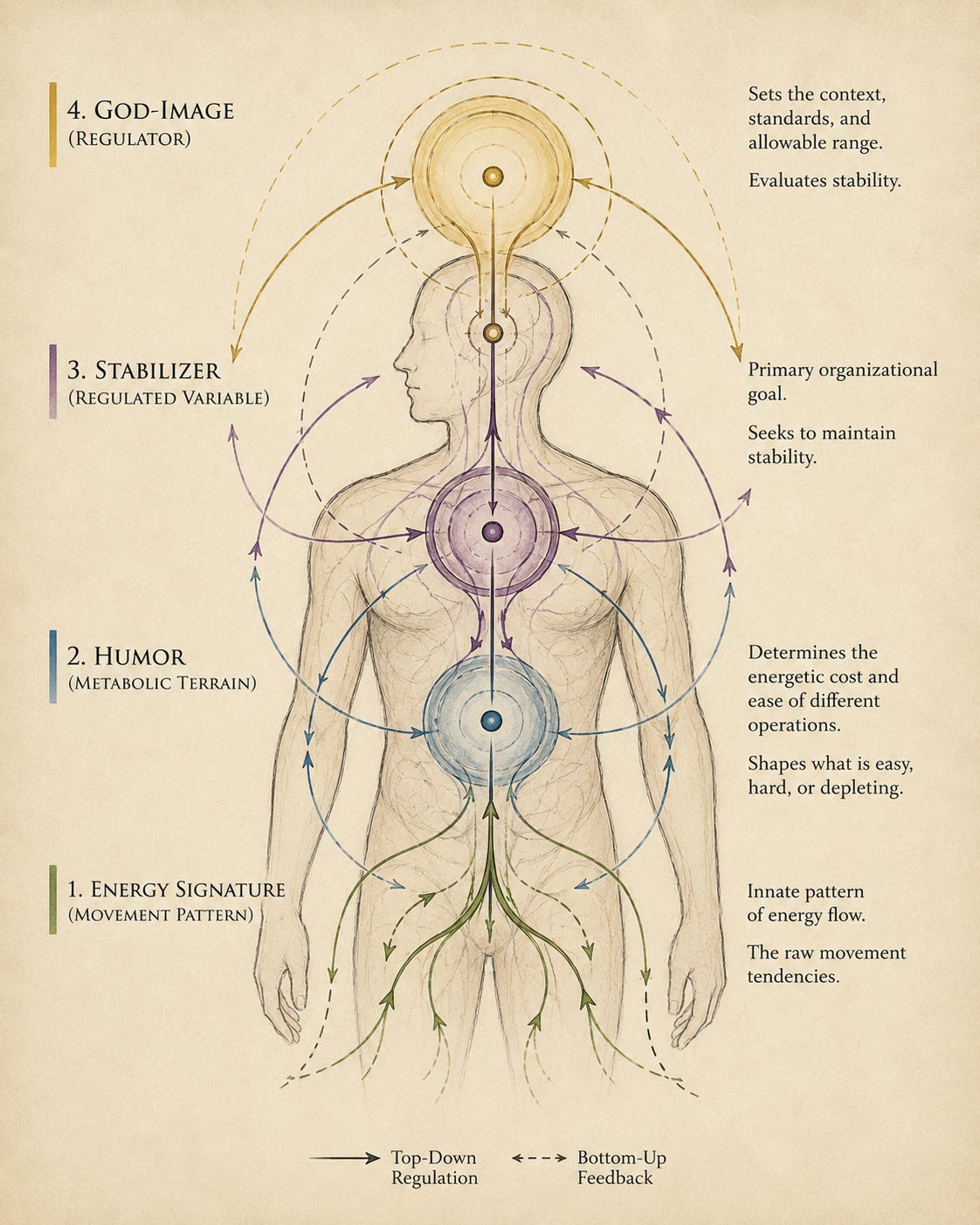
Welcome back. In my recent post I discussed human energy flow and organization in cybernetic terms, arguing that there is a four-pronged differentiation between movement (how psychic force moves, where does energy go?), metabolism (how expensive different energetic operations are, what is the cost of moving that energy?), regulation (what the psyche ultimately protects, why do we move the energy, what is the homeostatic goal?), and orientation (the highest-order regulatory architecture governing the stabilizers themselves, what reality is the psyche orienting towards?). This process is cybernetic in the sense that each layer impacts the other layers, which affects them back in turn. Mental illness, depression, lethargy, and dissatisfaction are to some degree caused by improper or deficient synching of the various layers, and mental health therapeutics do not differentiate between these layers, leading regularly to improper and failed interventions.
The highest layer of orientation relates to the God image, our highest order individual beliefs which presupposes thought itself and which Wittgenstein refers to as a hinge proposition (i.e. what must be in place for doubt to be possible, the beliefs that humans carry that shape the presuppositions that go into the thought form itself). All beliefs nested under the God image are impacted by the top layer beliefs, which in turn interact with reality and from those interactions either sync with or put pressure back on the God image. It looks like this:
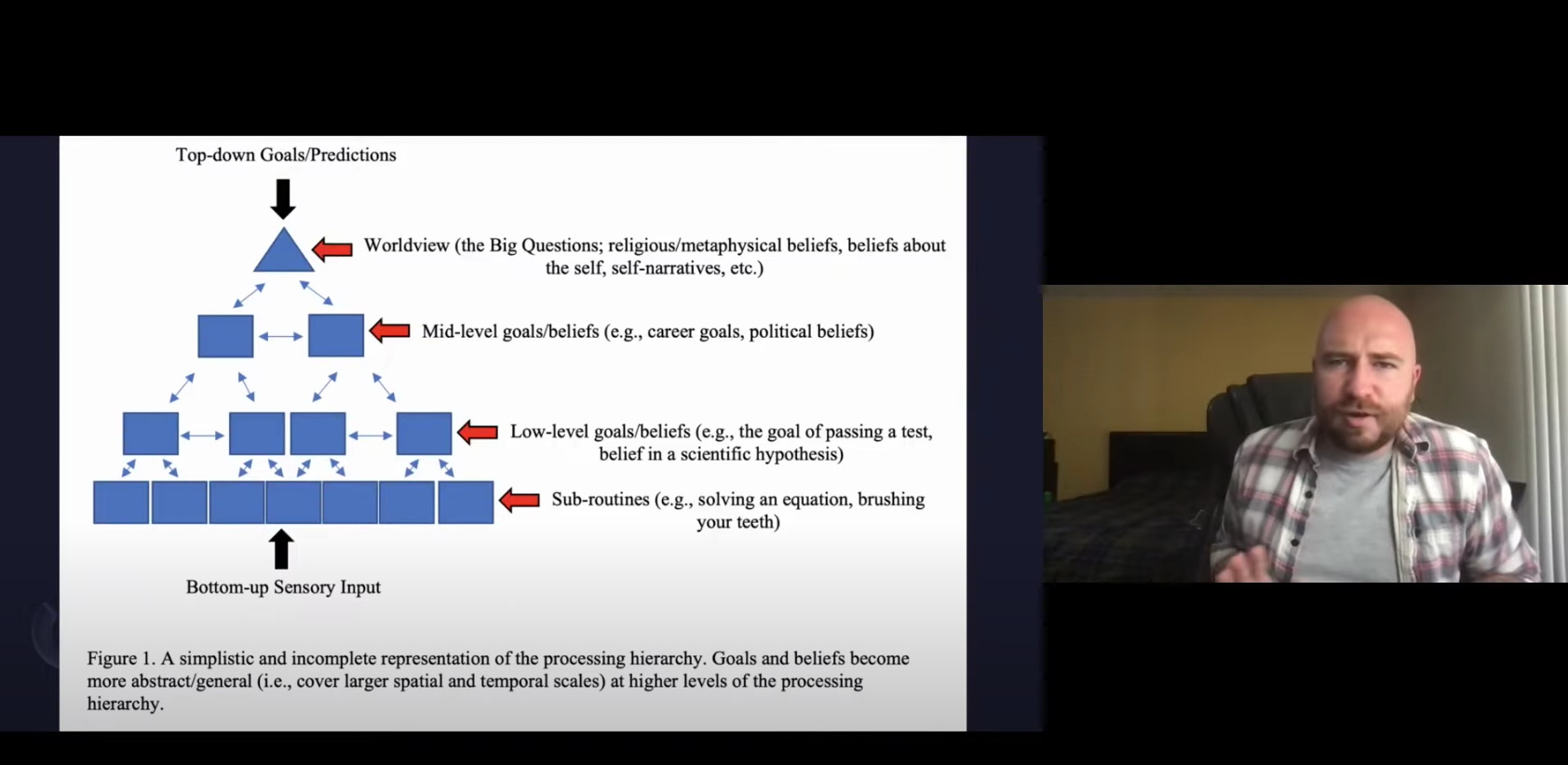
Brett Andersen did a good job of explaining nested hierarchical beliefs in scientific terms here and here, which I have discussed before.
Humans are social creatures, and the specific God image of an individual is not a fixed organizing principle. Instead, it is installed during childhood and is shaped by the relationship to the parents, by genetics, perhaps by astrological influences, and by broader society. A God image forms as a psychic regulatory tool – it screens reality in order to filter out the “noise” of competing/alternate perspectives so that one can more efficiently live the life one has been exposed to.
From a cybernetic perspective, the God image can be seen as a kind of regulator of the human machine, where it tries to maintain homeostasis and equilibrium. This system functions in equilibrium if or until received perceptual data so off-kilters the God image (because they don’t match) that pressure requires implementing a God image substitute to restore equilibrium (my case), sort of like how a system regulator can only regulate a system if it has sufficient variety (Ashby’s law). One’s God image may change in life – although such change is very difficult, as it results in a reorganization of all nested beliefs under the top layer, and also impacts one’s fundamental thought processes and perceptive abilities.
A shared, collective vision of a specific God image or lesser belief is called an egregore, and it shapes the noetic commons which animates society and serves as the topic of today’s post. I read Egregores: The Occult Entities That Watch Over Human Destiny (2018) by Mark Stavish, but it is not very good and I don’t really recommend it, although it close to the only book on Amazon relating to the topic. While well written, it neglects psychology, group dynamics, how egregores evolve over time, and more importantly how the concept relates to cybernetics, so it is incomplete; it is also too occult focused for my taste, which confuses more than it clarifies. The following analysis utilizes his insights only to a minor degree.
The God-image vs. Egregore
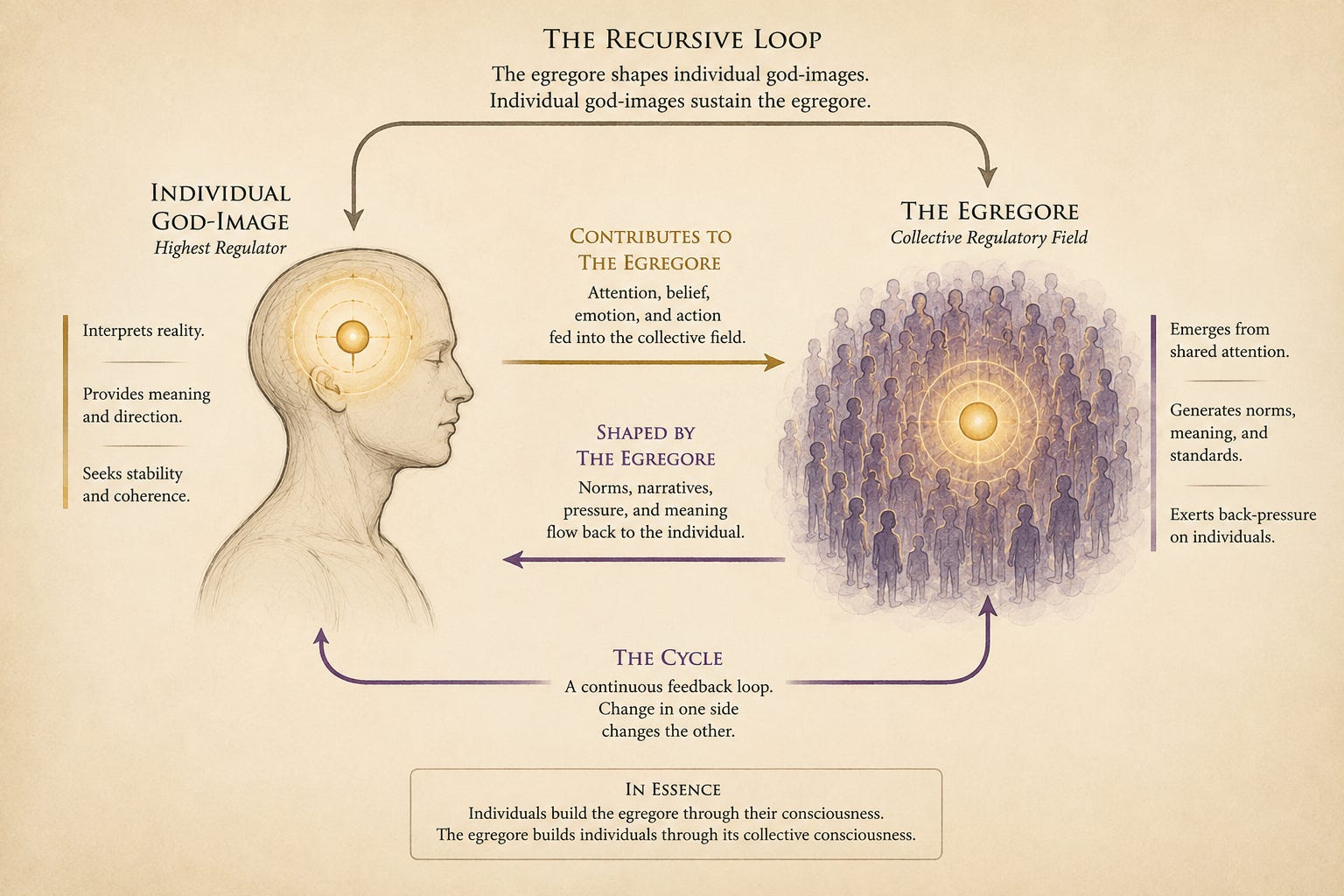
The god-image and egregores are related but different concepts. The god-image is intrapsychic and individual, serving as the highest-order organizing principle that structures how a particular person metabolizes reality, filters experience, and assigns meaning. The egregore, alternatively, is intersubjective and collective – it’s the emergent thoughtform generated by many individuals sharing sufficiently similar god-images (or beliefs lesser than god-images; a football team is an egregore as is a political party, just lesser forms), which then takes on a kind of autonomous existence and exerts back-pressure on individual god-images, pulling them toward conformity with the collective form. The directionality is what makes them distinct: the god-image is a lens through which an individual sees; the egregore is a field that individual lenses collectively generate and are then partially shaped by. One is constitutive of personal perception, the other is an emergent property of aggregated perception that becomes semi-independent of any individual contributor.
An egregore is also not the same thing as a Jungian archetype1, and while occultists2 and others3 see the egregore as a “real” entity, such beliefs are not relevant to analyzing its regulatory purpose for collectives. Rather, an egregore relates to the concept of how beliefs between people seem to act on a higher plane even without the individuals’ knowledge, impacting them in subtle and unconscious ways. For example, the Gospels mention “When two or more are gathered in my name, I will be in the midst of them.” This speaks to the idea that a collective ‘mind’ or consciousness can emerge whenever a group of individuals unite and it can dissolve just as easily when the group disperses. In such moments, the individuals are no longer just acting as separate entities – they become part of something larger which can influence their thoughts, decisions, and actions. Napoleon Hill touched on this concept in Think and Grow Rich, where he stated: “The coordination of knowledge and effort of two or more people, who work toward a definite purpose, in the spirit of harmony…No two minds ever come together without thereby creating a third, invisible, intangible force, which may be likened to a third mind.” Traditionalist philosopher René Guénon believed “the collective, in its psychic as well as its corporeal aspects, is nothing but a simple extension of the individual, and thus has absolutely nothing transcendent with respect to it, as opposed to spiritual influences, which are of a wholly different order.” He even believed that prayer is not directly addressed to spiritual entities such as gods or angels, but rather, “consciously or not, addresses itself most immediately to the collective entity, and it is only by the intermediary of this latter that it also addresses the spiritual influence that works through it.” And L.P. Koch argues, without naming the concept, that one cannot understand the thought pattern of another without understanding the egregores to which he is attached:
What if the other person doesn’t have access to the thought form in question? Then communication can’t succeed. The person may lack the experience to make sense of what we said — experience not just in the sense of having lived through something, but also of having thought certain things, felt certain things while thinking about it, and so on. He therefore can’t channel the information from the cloud, so to speak; it is being that opens us up to that information, and if we lack the being, we will be blocked.
Egregore Formation
An egregore forms when sufficient individuals direct attention toward a shared symbolic object – a god, a nation, a team, an ideology – and that shared attention generates a field that in turn shapes what those individuals attend to next. This is a second-order cybernetic process in the von Foerster sense: the observers are partly constituted by what they collectively observe, and the observed field is partly constituted by the observers’ attention. The egregore is the emergent regulatory architecture that arises from collective action feedback loops.
The highest layer egregores of Western civilization have been a redemptive one since the end of Hellenism, either via Christianity (privatio boni/God as all good, evil as a deprivation of God, humanity’s role to get closer to God), its Abrahamic competition running a parallel, competing redemptive egregore, or secular permutations which rely on some form of history-as-progress (democracy, socialism, communism, atheism). As I wrote in a Note, the biggest difference in perspective is not between any particular redemptive religion or ideology, but between redemptive and non-redemptive worldviews as categories.
The argument is that egregores function as collective cybernetic regulators analogous to individual god-images, that the Christian egregore is and has been in its rupture phase for a very long time (echoes of Nietzsche’s “death of God”), that the Aquarian transition pushes individuals toward the individuation process rather than a new mass egregore (discussed here), while at the same time the Jewish egregore is on the verge of fulfilling its eschatology based on a checklist model for the upper elites, previously discussed in this three part series. Understanding how egregores are created, grow, and fail is an important piece of the puzzle necessary for framing ongoing developments, human nature, and underlying reality itself.
The Feedback Loop
Each egregore is partial and differentiated and does not comprise something like Abraxas/totality. Because of this, there must be elements excluded from the egregore as boundary line-drawing; what is rejected by the egregore results in a collective shadow which builds pressure, pressure which eventually results in marginal failures which precede eventual systemic rupture. The feedback loop has three phases that map onto the God-image change dynamics:
- The growth phase: Shared attention toward an egregore generates the field, the field amplifies the shared symbolic object, more individuals are drawn in because the field provides psychic stability, and their attention further amplifies the field. This is a positive feedback loop – self-reinforcing, expansive, energetically cheap for participants because the field does much of the regulatory work. The individual doesn’t have to hold the crucifixion of opposites internally; the egregore holds it collectively in the form of doctrine, ritual, and shared narrative. People don’t just join egregores because they’re convinced by the ideas; they join because the egregore offers regulation for a destabilized psyche caused by the failure of prior egregores.The stabilizer framework explains this: when a primary stabilizer is failing, latching onto an active egregore that metabolizes that failure (by offering belonging, meaning, control, esteem, or coherence) becomes extremely attractive. Egregores also exert back-pressure on deviant god-images, enforcing conformity through language, institutional power, economic incentives, and the somatic markers of shame/ostracism. When an individual’s god-image deviates from the egregore, the egregore’s carriers (other people) react with confusion, hostility, or exclusion. That social friction is internalized by the individual as somatic anxiety (the feeling of being “out of sync”), as loneliness or being incomprehensible, which adds further incentive to join the expanding egregore.Ashby’s law of requisite variety applies here in an interesting way. The egregore must have sufficient internal complexity to metabolize the variety of experiences its members bring to it. A too-simple egregore – a football team, a political party – can only metabolize a narrow range of experience. A complex egregore such as Christianity at its peak or Yahwist Judaism over millennia can metabolize enormous variety: suffering, triumph, theodicy, community, individual salvation, collective destiny. The more complex the egregore, the more experience it can absorb without breaking down, and the more psychically stabilizing it is for its members. Furthermore, an egregore can form around a god-image or around a lower-order stabilizer (attachment to a sports team, esteem from a political party)4, but lower-order egregores are parasitic on higher-order ones for their ultimate motivational power. A football team egregore works because belonging and esteem are already regulated within a broader cultural frame that values competition, achievement, and collective identity; if that broader frame collapses, the football egregore hollows out. So the hierarchy is nested.5
- The saturation phase: The egregore has absorbed so much variety that it begins suppressing the elements that don’t fit its regulatory architecture.6 The suppressed material accumulates in the collective shadow, which is everything the egregore cannot metabolize without fracturing its coherence. For Christianity this was the problem of evil, the status of women, the tension between individual experience and doctrinal authority, and the suppressed Hellenic naturalistic impulse. The suppressed material doesn’t disappear; instead, it builds pressure beneath the surface.
- The rupture phase: The accumulated shadow exceeds the egregore’s capacity to suppress it. The regulatory architecture begins failing – the material destruction of symbols and institutions is one mechanism7, but egregores can also fade through neglect (declining attention, not active destruction). The Christian egregore in Europe today isn’t being smashed, it’s being ignored, with attention withdrawal rather than from opposition. The cybernetic model explains this as attention is the energy source where withdrawal starves the feedback loop. The failure occurs for some members first, then progressively more; those on the margins whose experience was never adequately metabolized by the egregore first begin seeking alternatives, and new symbolic forms emerge that can metabolize what the old egregore suppressed. The new forms draw in those for whom the old egregore had already failed, gain enough collective attention to form their own feedback loops, and eventually become alternative or successor egregores.8
The Hellenic material that Christianity suppressed is relevant here. The Hellenic egregore had metabolized tragedy, the plurality of gods including destructive and erotic ones, the acceptance of fate without cosmic justice, the heroic confrontation with mortality, and the body as a site of legitimate experience rather than suspect desire. Christianity suppressed all of this under the privatio boni with evil as absence, the body as suspect, the plural gods as demons, fate as providence, and tragedy as temporary affliction awaiting redemption. Two thousand years of suppression has accumulated an enormous shadow. The return of the suppressed Hellenic material is a way of reading the current cultural moment: the resurgence of new forms of paganism, polytheism, embodiment spirituality, tragic worldviews, the interest in mythology and the gods, and the specific appeal of non-redemptive frameworks to constitutions for whom the Christian egregore has failed (Jungianism, Hillman-esque internal polytheism, tragedy as seen in such entertainment as Game of Thrones and Breaking Bad come to mind, along with Wicked).
The shadow of Christianity is partly the pre-Christian worldview that Christianity displaced and suppressed, returning now as the Christian egregore loses its regulatory power over an increasing portion of the population. The suppressed material returns through different forms conditioned by the intervening period rather than as a direct reproduction of what was suppressed – it’s not a boomerang effect – therefore I do not expect the re-emergence of Christianity’s shadow to mirror what Christianity superseded and suppressed. What Christianity suppressed seems to return as the recognition of these energies within the psyche as interior functional realities rather than external gods along with the individuation process.
The noetic commons and elite arbitrage
The noetic commons – the shared background of assumptions, values, and perceptual filters that makes collective cognition possible – is shaped by the egregores that animate a society. When a supreme egregore such as Christianity or secular progressivism dominates the noetic commons, it provides a stable regulatory field within which individuals and institutions coordinate. Most people operate inside this field, their god-images aligned with the egregore’s requirements, and their stabilizers are metabolized by its narratives and rituals.
But elites have discovered something the framework makes explicit: one can operate outside the egregore’s constraints while still extracting its coordination benefits. This is regulatory arbitrage, using the stability provided by the collective field while refusing to bear the individual costs of alignment. The elite globalist class, for example, rhetorically supports progressive values (belonging, meaning, equity) while their actual behavior (wealth extraction, surveillance infrastructure, population management) contradicts those values. They are not stabilized by the egregore they publicly defend; they parasitize it. They do not believe the narratives they promote; they treat them as control tools for the non-elite. This is a natural function of the incentive structure governing the upper elites.
The egregore framework explains why this arbitrage is possible and why it eventually destabilizes the system. The egregore requires genuine belief and attention from a critical mass of participants to maintain its regulatory function. When elites simulate belief while privately operating under a different god-image, they drain the egregore’s energy without replenishing it. The shadow material they suppress – their own cynical non-belief, their extractive behavior, their contempt for the narratives – accumulates in the collective unconscious. When the non-elite eventually register the mismatch between the egregore’s promise and the elite’s behavior, the rupture phase accelerates. The noetic commons hollows out from the top down.
The Christianity case and the Federal Reserve parallel
There is a Federal Reserve parallel here which I think is relevant. Christianity succeeded not by having a fully worked-out theology at the point of its emergence but by installing Yahweh at the center of the gentile world – putting the Jewish God-image at the apex of what would become the Western egregore – and then allowing the details to be filled in over centuries through councils, heresies, and doctrinal development, discussed long ago here. The core regulatory function was established first, and the elaboration followed.9
This is exactly how the Federal Reserve worked: the principle of central banking as the apex of the financial system was established by the 1913 Act, and the specific mechanisms of control – the ability to expand and contract credit, the relationships with primary dealers, the lender-of-last-resort function, the eventual abandonment of gold convertibility – were elaborated over decades through amendments and crises. The cybernetic description of this is that both Christianity and the Federal Reserve achieved what Ashby called the installation of an essential variable as the highest-order regulator of a complex system. Once the essential variable is installed at the apex, the rest of the system reorganizes around it. Displacing it requires displacing the entire regulatory architecture it has organized, which is why both institutional Christianity and central banking are so resistant to reform: you can’t just change the policy or the doctrine without addressing the apex regulatory position that makes all the other positions cohere.
I expect the upcoming central bank digital currency (CBDC) infrastructure will follow this cybernetic logic: installing the apex regulatory variable (the digital ledger) first, and subsequently expanding its regulatory reach to eliminate alternative metabolic pathways (i.e., physical cash), thereby closing the system’s requisite variety until only state-approved transactions remain possible.
The Jewish eschatological egregore
The Western supreme egregore has been Christian/secular-progressive for two millennia, but it has never been the only supreme egregore operating in the same geographical and civilizational space. The Jewish egregore – rooted in the Yahwist covenant, the Torah, the chosenness narrative, and the messianic promise – has run in parallel, partially assimilated, partially resistant, always maintaining its own regulatory architecture for those whose primary stabilizers aligned with its demands.
What makes the Jewish egregore distinctive is its checklist eschatology. Unlike Christianity, which frames redemption as a passive gift (grace, faith, salvation through Christ), the Jewish messianic framework requires active completion of specific preconditions. These include: ingathering of exiles (Greater Israel), rebuilding of the Temple, establishment of universal Noahide laws as the moral baseline for all humanity, and the restoration of the Davidic line. This is not allegorical; for a significant portion of the religious Jewish population – and, I have argued, for the upper-elite secular Jewish network that coordinates global governance – these are concrete, actionable goals.
The egregore framework illuminates this structure: the eschatological checklist is the ritual completion required for the Jewish egregore to achieve its highest regulatory closure. The egregore’s feedback loop – shared attention to Torah, Temple, land, law – has been sustained for millennia. But a feedback loop that never terminates accumulates pressure. The messianic endpoint is the termination condition that would either (a) fulfill the egregore and dissolve it into its telos, or (b) transform it into something new. The active pursuit of the checklist (settlements, Temple Institute preparations, Noahide legislation in various countries) is egregoric maintenance and acceleration. It feeds the collective thoughtform with the specific variety it requires to complete its cycle. As the Christian egregore enters rupture phase, the Jewish egregore’s checklist accelerates, because the dominant regulatory field no longer has the requisite variety to absorb or redirect it.
Unresolved questions
There are many unresolved questions here which are addressable within the cybernetic frame with varying degrees of certainty. Let’s go through some of them.
- Can one group have multiple egregores? Yes, and the tension between them is a form of intragroup regulatory conflict. Consider Catholicism vs. Protestantism, or Christianity vs. Mormonism, or Orthodox religious Jews vs. secular leftist Jews – these groups may share certain deep cultural-genetic inheritances, but have organized different mid-level egregores around those inheritances. The question of whether they share one egregore with internal variation or constitute genuinely distinct egregores is answerable by asking whether their regulatory architectures can be unified under a single set of highest-level premises. Orthodox religious Jews and secular leftist Jews have a shared and intense cultural perspective of perceived oppression and trauma leading to shared ethnic solidarity, but their God images appear different; the former with a tribal, wrathful God of the covenant and Chosenness, the latter with a perspective that veers toward a redemptive tribal secular materialism.
- Can the egregore of the same group change? Yes. The evolution of Judaism after the destruction of the Second Temple is the clearest historical example of egregores changing – the egregore lost its Temple-based ritual architecture and reorganized around Torah, text, and diaspora community, preserving its feedback loop through a radical structural transformation.
- What role does genetics play? The genetics question is the most politically sensitive and the most genuinely uncertain. The constitutional differences between groups – what the energy typology essay calls different metabolic profiles, what Maurice Samuel was gesturing at with his Gentile/Jewish distinction10 – may mean that certain egregores are more metabolically compatible with certain constitutional types than others. This doesn’t require any strong essentialist claim about genetic determination of worldview, it only requires the claim that constitutional variation is real, that it clusters in ways that correlate with ancestry and upbringing, and that egregores that fit the constitutional profile of their primary carriers are more stable than those that require ongoing suppression of constitutional tendencies that conflict with the egregore’s regulatory requirements. In other words, different populations may have different distributions of constitutional types, and egregores that fit the modal type of a population are more stable; this also explains the re-emergence of the God Wotan in the German psyche leading up to World War 2.11 The Hellenic egregore was more constitutionally compatible with the athletic, fate-accepting, pluralistic Hellenic temperament than with the exacting, duty-oriented, covenantal Jewish temperament. Neither is superior, they are constitutionally different in ways that map onto different egregore compatibility.
- Does the egregore exist independently or only as a collective idea? This is a question the essay leaves open. What the cybernetic frame says is that whether or not the egregore has independent ontological existence, it has real functional existence – it produces measurable effects on individual god-images, social organization, motivational structures, and collective action. The functional reality is what matters for the framework’s purposes. The ontological question can remain indeterminate without undermining any of the practical claims.
Conclusion
The Aquarian transition functions in a sense as an egregore rupture, much as the transition to Pisces ruptured the Hellenism egregore. The Christian egregore is failing, the margins are being pressured in all sorts of novel ways, and whether the Aquarian moment inherently pushes toward a new collective egregore formation or a novel individual god-image differentiation is an unresolved question.
This last question is the most interesting for the project. The Abraxian framework produces individual regulatory architectures that are constitutionally incompatible with mass egregore formation – it can’t generate the shared redemptive narrative that gives an egregore its mobilizing power without fundamentally undermining what the framework represents. This means the framework cannot produce a successor egregore to Christianity. This is not a mark of superiority; the inability to generate collective field is both a substantial cost while offering protective coating against instrumentalization or co-option for ulterior purposes. What it can produce is a small number of constitutionally specific individuals whose god-images are no longer organized by the failing Christian egregore, navigating without collective field support, carrying their own psychic weight in the Aquarian mode. The constitutionally specific individuals navigating without collective field support are the test case for whether human psychic life can sustain itself without egregoric regulation at all. The answer can only be known longitudinally, through whether what they find on the other side coheres.
Subscribe:
Email delivery remains on Substack for now.
Archetypes as defined by Jung are not collective thought-forms generated by attention, but transpersonal patterns that appear to precede individual consciousness and shape symbolic experience from below. Egregores, by contrast, emerge from the recursive interaction of many individuals oriented toward a common symbolic object. If archetypes move from depth toward manifestation, egregores move from manifestation toward collective stabilization. The two may interact, but they are not identical phenomena.
Egregore is Greek in origin and derives from egregoros, meaning “wakeful” or “watcher”, and is included in the Book of Enoch describing an angelic being. Occultists define the egregore variously: (1) as an autonomous psychic entity which is shaped by and influences the thoughts of a group of people, (2) as a channel for nonhuman intelligence, linking invisible realms with our material world, or (3) as a collective entity embodying a nation or faith that exists not only in the physical bodies of its members but also in their astral and mental states (Mouni Sadhu’s view). In all cases, the common theme is a psychic force larger than the individual but dependent on collective attention.
As Joscelyn Godwin wrote in The Golden Thread, “The important point is that an egregore is augmented by human belief, ritual, and especially by sacrifice. If it is sufficiently nourished by such energies, the egregore can take on a life of its own and appear to be an independent, personal divinity, with a limited power on behalf of its devotees and an unlimited appetite for further devotion. It is then believed to be an immortal god or goddess an angel, or a daimon.”
According to Mark Stavish, “egregores are anthropomorphized images of the concept at hand. For instance, peace, war, love, wealth and nation are all just ideas that are created through visualization and vitalized through regular ritualized emotion, and finally made concrete through a specialized sign or symbol. These signs or symbols are no different from the logo of a company, brand, or product, which are themselves lesser or greater egregores. Just as a logo acts as a form of legal protection for the company and its employees who work together for a common cause, so too does the sigillum (magical sign or seal) of an egregore act as an identifying, guiding, and protecting force for its members.”
Using the football team egregore example, a football team operates primarily on esteem and belonging stabilizers. It metabolizes the need for collective identity, competitive tension, and communal experience of victory and defeat. It does not address the problem of evil, the meaning of suffering, the question of what happens after death, or the structure of the cosmos. Its regulatory reach is shallow. When it fails – when the team loses chronically, when the sport loses cultural relevance, when the individual ages out of the emotional intensity – the collapse is real but limited. The individual can find another team, another sport, another shallow egregore. The deeper stabilizers are not threatened.
On the other hand, a God-image level egregore (Christianity, Yahwist Judaism, secular progressivism) reaches all the way to the highest regulatory level, and its failure produces the kind of systemic destabilization the Regulatory Architecture essay and Stabilizers essay describe: regulatory collapse that propagates downward through meaning, identity, motivation, embodiment, and relational orientation. The difference in severity between losing faith in your football team and losing faith in your God-image is the difference in regulatory depth the two egregores occupy.
This gives one a structural hierarchy: egregores range from shallow (sports teams, political parties, consumer brands) to deep (national identities, ethnic traditions, religious frameworks) to supreme (God-image level egregores that reach the highest regulatory architecture). Deeper egregores are harder to form, more metabolically efficient once formed, more psychically stabilizing for longer, and more catastrophically destabilizing when they fail.
Stavish gives the example of Rome which incorporated new Gods into its empire as it grew, but such incorporation drained the initial egregore of Rome itself:
Egregores were formed to watch over city-states, the Republic, and the Empire itself. A s long as offerings and devotion continued, the prosperity and well-being of the city or Empire was thought to be assured. However, if new cults came into being and the energies of worship were directed elsewhere, the agreement would be broken and the egregore would cease to support the land and its people. Esoterically, this can be seen as the reason for the collapse of the Roman Empire. When its old gods and goddeses were no longer sustained by the people, they in turn could no longer support Rome or its territories. In short, the spiritual death of the Roman Empire can be seen in what Godwin terms the natural tolerance of polytheism. By accepting new religious practices insofar as they did not challenge governmental authority, a slow draining-off of energy from traditional cults and their attendant egregores began. But it doesn’t end there. The real death stroke lay in the nature of these new religions. These mystery cults from Greece, Persia, Egypt, Palestine, and Syria offered something Roman religion did not – personal salvation or, rather, survival after physical death.
Based on these metaphysical premises, Godwin suggests – and we agree – that for a city, nation, or empire to exist, its devotees must be focused on life in the material world to some degree. When their direction is turned otherworldly, the cults of family and state, the cults of blood, become weakened and are simply a jumping-off point for the individual instead of an end in themselves. When combined with the demands of time and intellectual and emotional commitment that mystery religions demanded of their members – initiates of the secret way – little or no energy was left for the traditional egregore….[This is reminiscent of] the famous quote from the Emerald Tablet: “that which is above is like that which is below; and that which is below is like that which is above; to accomplish the work (or miracle) of the One Thing.”
To destroy a religious, esoteric, or political egregore, the objects and symbols connected with it may be destroyed. Examples include Christianity, which destroyed Hellenic temples, architecture, art, books and culture; the French Revolution in 1789 destroying the monarchy and it’s symbolism, the Bolshevik’s overthrow of Tsarist Russia, the U.S. scrubbing Nazi ideology with “denazification” post-war, the Chinese Communists in Tibet in 1959, the Chinese Cultural Revolution, and the destruction of non-Islamic monuments and texts by Islamic fundamentalists. “While the spiritual or intelligence aspect of the egregore will continue to live for a very long period of time without a physical anchor, devotees, or rituals to feed it, its emotional or astral counterpart will not be able to sustain a presence in the physical world as a result of such acts of destruction.”
A God image – especially one from a redemptive architecture to a non-redemptive architecture is not chosen; it is either inherited or replaced by psychosomatic pressure. A God image replacement is a big deal because it is energetically very expensive to implement and with uncertain outcome, a step away from one’s inherited community, etc. From my current belief, a God image is installed in early childhood on a somatic level; from my example, the double binds created a God image within me of God as totality, not love or justice. But I didn’t have the words for it or intellectual understanding of it for decades, creating a feeling in those I interacted with that I seemed “lost”. The idea is and was to sync one’s God image with what one feels to be true somatically. This to me is a God of horrifying totality, not God-as-angel or God-as-devil (although God contains evil within it). The paradoxical thing is that a non-redemptive God image of Abraxas as totality cannot become a shared belief, because it would simply recreate the noetic commons under a new banner and undermine the very individuation process that such a God image necessitates.
See David Berger’s The Rebbe, the Messiah, and the Scandal of Orthodox Indifference, where he states in footnote 45 on page xxxv, “Maimonides maintained that the rise and spread of Christianity and Islam were part of a divine plan to prepare the world for the Messiah. When the Messiah arrives, he will enter a world already familiar with the Torah and with the concept of messianic redemption, thus enabling the nations to react to his coming with some degree of understanding.” And on p. 73, “In addition, despite profound Jewish objections to trinitarian and incarnationist theology, it cannot be denied that the religion set in motion by Jesus’ career erased pagan-style polytheism from vast sections of the earth. I should hate to depend on an argument that Jesus did absolutely nothing of a messianic nature.” And from Maimonides directly in Mishneh torah, Laws of Kings II: 4, uncensored version, as recounted by Berger on p. 152:
In fact, all the events surrounding Jesus of Nazareth and the Ishmaelite [Muhammad] who came after him were for the purpose of straightening the way for the King Messiah and preparing the entire world so that all will serve the Lord together, as it is written, ‘For then I will make the peoples pure of speech, so that they all invoke the Lord by name and serve Him with one accord’ (Zeph. 3:8). How is this so? [Because of Christianity and Islam,] the entire world has been filled with discussion of the Messiah, the Torah, and the commandments.
In other words, the only reason that gentiles care about the Jewish stories is because they put the Jewish God at the center of their world.
Maurice Samuel, a Romanian-born British and American award winning novelist (winning the 1944 Anisfield-Wolf Book Award and the Itzik Mangar Prize), translator and lecturer of Jewish heritage, argues that Jews and gentiles are simply incompatible in his 1924 book You Gentiles, referring to their competing egregores. In it he states:
Years of observation and thought have given increasing strength to the belief that we Jews stand apart from you gentiles, that a primal duality breaks the humanity I know into two distinct parts; that this duality is a fundamental, and that all differences among you gentiles are trivialities compared with that which divides all of you from us….that primal difference, which I have sensed more and more keenly as I have tasted more and more of life, your life and our life, is a difference in the sum totals of our respective emotions under the stimulus of the external world; it is a difference in the essential quality or tone of our mental and spiritual being. Life is to you one thing — to us another. And according to these two essential qualities we make answer to the needs and impulses which are common to both of us.
To you life is a game and gallant adventure, and all life’s enterprises partake of the spirit of the adventurous. To us life is a serious and sober duty pointed to a definite and inescapable task. Your relation to gods and men spring from the joy and rhythm of the temporary comradeship or enmity of spirit. Our relation to God and men is dictated by a somber subjection to some eternal principle. Your way of life, your moralities and codes, are the rules of a game – none the less severe or exacting for that, but not inspired by a sense of fundamental purposefulness…For you certain acts are “unbecoming” to the pertinent ideal type – whether he be a knight or a “decent fellow.” We have no such changing system of reference – only one command….we will not accept your rules because we do not understand them…
This difference in behavior and reaction springs from something much more earnest and significant than a difference in beliefs: it springs from a difference in our biologic equipment. It does not argue the inferiority of the one or the other. It is a difference in the taking of life which cannot be argued. You have your way of life, we ours. In your system of life we are essentially without “honor.” In our system of life you are essentially without morality. In your system of life we must forever appear graceless; to us you forever appear Godless.
Seen from beyond both of us, there is neither right nor wrong. There is your Western civilization. If your sense of the impermanence of things, the essential sportiness of all effort, the gamesomeness and gameness of life, has blossomed in events and laws like these I have seen around me, it cannot, from an external point of view (neither yours nor ours) be classified as right or wrong. Wars for Helen and for Jenkins’ ear; duels for honor and for gambling debts, death for a flag, loyalties, gallant gestures, a world that centers round sport and war, with a system of virtues related to these; art that springs not from God but from the joyousness and suffering of the free man, a world of play which takes death itself as part of the play, to be approached as carelessly and pleasantly as any other turn of chance, cities and states and mighty enterprises built up on the same rush of feeling and energy as carries a football team – and in the same ideology – this is the efflorescence of the Western world. It has a magnificent, evanescent beauty. It is a valiant defiance of the gloom of the universe, a warrior’s shout into the ghastly void – a futile thing to us, beautiful and boyish. For all its inconsistencies and failures within itself, it has a charm and rhythm which are unknown to us. We could never have built a world like yours….
These are two ways of life, utterly alien to the other. Each has its place in the world – but they cannot flourish in the same soil, they cannot remain in contact without antagonism. Though to life itself each way is a perfect utterance, to each other they are enemies.
In Carl Jung’s 1936 Essay on Wotan, he explained:
In fact, I venture the heretical suggestion that the unfathomable depths of Wotan’s character explain more of National Socialism than all three reasonable factors [economic, political, and psychological] put together. There is no doubt that each of these factors explains an important aspect of what is going on in Germany, but Wotan explains yet more. He is particularly enlightening in regard to a general phenomenon which is so strange to anybody not a German that it remains incomprehensible, even after the deepest reflection.
Perhaps we may sum up this general phenomena as Ergriffenheit – a state of being seized or possessed. The term postulates not only an Ergriffener (one who is seized) but, also, an Ergreifer (one who seizes). Wotan is an Ergriefer of men, and, unless one wishes to deify Hitler – which has indeed actually happened – he is really the only explanation. It is true that Wotan shares this quality with his cousin Dionysus, but Dionysus seems to have exercised his influence mainly on women…Wotan confined himself to the berserkers, who found their vocation as the Blackshirts of mythical kings….
[Wotan] is a fundamental attribute of the German psyche, an irrational psychic factor which acts on the high pressure of civilization like a cyclone and blows it away. Despite their crankiness, the Wotan-worshippers seem to have judged things more correctly than the worshippers of reason. Apparently everyone had forgotten that Wotan is a Germanic datum of first importance, the truest expression and unsurpassed personification of a fundamental quality that is particularly characteristic of the Germans.
Also see the poet Heinrich Heine, who in 1835 predicted the rise of Nazism a hundred years later based on understanding the German spirit or egregore, which he attributed to Thor, the son of Odin:
Christianity – and that is its greatest merit – has somewhat mitigated that brutal Germanic love of war, but it could not destroy it. Should that subduing talisman, the cross, be shattered, the frenzied madness of the ancient warriors, that insane Berserk rage of which Nordic bards have spoken and sung so often, will once more burst into flame. This talisman is fragile, and the day will come when it will collapse miserably. Then the ancient stony gods will rise from the forgotten debris and rub the dust of a thousand years from their eyes, and finally Thor with his giant hammer will jump up and smash the Gothic cathedrals. … Do not smile at my advice – the advice of a dreamer who warns you against Kantians, Fichteans, and philosophers of nature. Do not smile at the visionary who anticipates the same revolution in the realm of the visible as has taken place in the spiritual. Thought precedes action as lightning precedes thunder. German thunder is of true Germanic character; it is not very nimble, but rumbles along ponderously. Yet, it will come and when you hear a crashing such as never before has been heard in the world’s history, then you know that the German thunderbolt has fallen at last. At that uproar the eagles of the air will drop dead, and lions in the remotest deserts of Africa will hide in their royal dens. A play will be performed in Germany which will make the French Revolution look like an innocent idyll.
See this post by Chad Crowley for more on this.
Great content! Keep up the good work!