

Given the elite coordination framework established in Part 1, this follow-up asks: what specific prophecies must be fulfilled, how far along is the checkboxing process, and what technological infrastructure makes enforcement at planetary scale newly possible? This essay maps the eschatological checklist against observable preparation, examines the demographic calculations requiring potential diaspora crisis, and traces how AI surveillance, CBDCs, and the Noahide legal interface provide the enforcement layer that historical attempts at messianic fulfillment lacked.
Welcome back. In Part 1 I laid out a structural argument, using IF-THEN logic, that IF there is a multi-generational upper elite comprising the central bank owners in a pyramid structure, that they would naturally converge on a Talmudic-Kabbalistic belief framework. I was reluctant to publish it for a number of reasons, but felt compelled to do so.1 I haven’t seen a structural argument for upper elite metaphysical domination laid out without emotional heat or moralizing, with a tragic metaphysical frame and without belonging to any particular side, and thought it needed to be expressed.2 Furthermore, treating eschatology as binding technology is novel and uncomfortable for both the reader and also for me as the author, as common frameworks rely on either a belief system, conspiracy theory, psychological projection, secular analysis or cultural artifact via anthropology; thinking of religious prediction as a coordination mechanism with specific affordances, selection-optimized for multi-generational elite binding, with features functionally superior to secular alternatives, while being testable through reviewing checkboxing behavior is mechanism design thinking applied to religious eschatology.
A note on methodology: purely materialist elite analysis – tracing financial flows, diplomatic records, and institutional connections – explains historical patterns retrospectively but generates no forward-looking predictive model. Archive-based historical reconstruction of elite coordination, however rigorous and compelling, is structurally incapable of anticipating what comes next because it has no model of elite directional intent. Without knowing where elites are trying to go, you can document what they did but cannot predict what they will do. The eschatological coordination framework proposed here is valuable precisely because it inverts this limitation: it generates specific, falsifiable predictions about what must happen next if the model is correct. If those predictions prove accurate – the sequence of Temple Mount status change, accelerated diaspora crisis and ingathering, Universal Moral Charter, and others – that constitutes evidence the materialist framework cannot produce or explain. The checkboxes are the mechanism by which this theory distinguishes itself from retrospective pattern-matching and becomes genuinely predictive.
The structural and psychological logic employed and explained in Part 1 is that the upper elite require a unifying glue across generations that keeps them from splinting through infighting, while also psychologically framing their predation efforts against the masses as positive for themselves materially and metaphysically. To meet these objectives, the upper elites require three features from a belief system: (1) non-redemptive theology (where power doesn’t need to justify itself via outcomes), (2) infinite interpretive flexibility (where any action can be reframed as necessary), and (3) ontological hierarchy (allowing exploitable lower tiers without moral contradiction). These features provide metaphysical justification for domination and parasitism and the flexibility necessary to deal with threats without having to feel guilty, which would otherwise cause structural drag and weakness against competition.
Most Western traditions lack one or more of these: Christianity is redemptive, universalist, and weak dialectically; Islam is redemptive, interpretively closed, with a universalist ummah3, Marxism is redemptive (classless society) and ends at revolution, while liberalism is redemptive (progress) and denies hierarchy. The Talmudic/Kabbalistic framework uniquely provides all three: (1) Yahweh as a God-image containing both good and evil (destruction is divine, not error)4, (2) Tikkun olam and pilpul (permanent incompletion plus infinite recursion), and (3) Rabbis → Jews → Righteous Gentiles → Kelipot (ontological stratification). That isn’t to say that other traditions may not be used for upper elite power justification, just that they do not do it as efficiently. As I wrote,
Both Christianity and Islam have historically served elite power effectively – the Byzantine Empire, Holy Roman Empire, and Ottoman Caliphate all used religious frameworks for legitimation and maintained hierarchical rule for centuries….[but] Christianity requires ongoing hypocrisy (elites acting against the universalist and redemptive theology they espouse), Islam requires careful navigation of specific Quranic permissions (bounded by fixed sacred text)…It’s not that other traditions cannot serve elite power, but that this one does so with less structural resistance.
As binding glue to keep the upper elites together, then, they would need to have a longterm, “God-provided”, vision about where they are taking the world. Whether they actually believe it or not, or to what extent, is irrelevant; they need to be pushing toward this vision to stay united and avoid devolving and fracturing (see the following footnote on alternative cohesion mechanisms5). This vision wouldn’t have to be enacted over a day, month, year, or even century; the in-the-moment binding glue is the primary benefit, and the final effectuation of that vision is secondary. One may think of the Fabians or any secret society such as the Freemasons, who (I believe) serve this higher vision structure as an occulted version of the “righteous among the nations” third tier, but that is a topic for another day.
In this post, I would like to discuss the prophecies which the upper elites must check off as boxes in order to fulfill their eschatological Talmudic-Kabbalic binding glue. Basically, their goal is to create Greater Israel, restore the Third Temple, proclaim the Messiah, and rule the world under a revitalized Sanhedrin leadership. They are far along the path at this point. To bring forth the “Messiah” there are certain prophecies that must be fulfilled before it will be recognized by believers, which is the nature of any so-called “Messiah” – if they “return” to “fulfill the prophecies”, then one needs to know which prophecies are required by the religion, what they claim to have fulfilled and why. Both Christ6 and Bar Kokhba7 adhered to this pattern to the extent they or their promoters could, but what makes the current upper elite approach unique is that they are using a slow-moving Fabian approach to fulfill the preconditions, as opposed to Christ (arguably retroactively checkmarked by the Gospel writers) and Bar Kokhba (a brute force attempt to fulfill the prophecies militarily). Let’s go through the prophecies that the upper elites must checkmark to bring their vision to fruition, and highlight a couple of items which I will elaborate on further.
For clarity, this argument concerns the instrumental and strategic use of symbolic resources by apex elite networks. It does not assume shared intent, coordinated agency, or functional alignment among the broader population who participate in the same religious tradition for ordinary devotional, cultural, or inherited reasons. The predictive claims that follow apply only to actors operating within elite institutional networks where symbolic frameworks may serve coordination or legitimation functions. The presence of a shared theological tradition at the population level does not imply that its adherents participate in, benefit from, or are even aware of such strategic deployments. This is especially important to clarify because the IF-THEN structural argument about elite convergence on the basis of maintaining elite coherence, when applied to specific political and cultural predictions, can easily be misinterpreted as applying to the non-elites who genuinely believe in the tenets of the religion, and to attribute such apex power dynamics to regular believers of the religion is a category error.
An implication of this structural argument deserves explicit statement: if the upper elites instrumentalize eschatological frameworks as binding glue while perhaps believing in nothing but their own power, then sincere believers of every tradition – including the Jewish masses – are tools and potential sacrificial material, not beneficiaries or co-conspirators. Eustace Mullins observed this about the World Order generally: its members have absolute contempt for anyone who sincerely believes in Zionism, Christianity, Communism, or any other framework they deploy:
The central bank owners adopted the Hegelian dialectic, the dialectic of materialism, which regards the World as Power, and the World as Reality. It denies all other powers and all other realities. It functions on the principle of thesis, antithesis and a synthesis…Thus the World Order organizes and finances Jewish groups; it then organizes and finances anti-Jewish groups; it organizes Communist groups; it then organizes and finances anti-Communist groups. It is not necessary for the Order to throw these groups against each other; they seek each other out like heat-seeking missiles and try to destroy each other. By controlling the size and resources of each group, the World Order can always predetermine the outcome. In this technique, members of the World Order are often identified with one side or the other. John Foster Dulles arranged financing for Hitler, but he was never a Nazi. David Rockefeller may be cheered in Moscow, but he is not a Communist…a distinguishing trait of a member of the World Order, although it may not be admitted, is that he does not believe in anything but the World Order. Another distinguishing trait is his absolute contempt for anyone who actually believes in the tenets of Communism, Zionism, Christianity, or any national, religious or fraternal group…If you are a sincere Christian, Zionist or Moslem, the World Order regards you as a moron unworthy of respect. You can and will be used, but you will never be respected.
The corollary is that ordinary Jews are among the victims of elite instrumentalization of their own tradition. This is consistent with observable history: the financing of conditions producing the Holocaust by Rothschild-adjacent networks documented in Conjuring Hitler, Israel’s position as one of the most aggressively locked down countries in the world during COVID (along with Australia), also see here and here, and the general pattern of Jewish suffering being instrumentally useful for accelerating ingathering and consolidating Israeli state power. The framework being instrumentalized is Jewish; the people bearing its costs include Jews and non-Jews alike, positioned as expendable material below the apex; the apex network feels no contradiction in this because lower-tier Jews, like all non-apex populations, occupy expendable positions in the ontological stratification the network actually believes in. The binding glue requires the framework’s eschatological vision to remain directionally intact; it does not require the survival or wellbeing of those who sincerely believe in it.

On Chabad/Jewish Eschatological Requirements
Generally Agreed Upon (Mainstream Jewish/Chabad)
- Ingathering of Jewish Exiles (Kibbutz Galuyot) where Jews return to Israel from diaspora. This is not contested and a widely accepted requirement.Status: Arguably achieved with creation of Israel, but also arguably incomplete – we will return to this with a detailed analysis below.
- Rebuilding of the Third Temple. Physical temple rebuilt on Temple Mount, resumption of sacrificial system. This is the big contested/delayed item.Status: Not yet begun (preparation stage). Interesting to note that Israel was offered the Temple Mount after the 1967 war but Moshe Dayan rejected it, stating “What is this? The Vatican?” then ordered to give administrative control of the Temple Mount over to the Waqf, a Muslim council – too early?
- Davidic Kingship/Messiah Revealed. Messiah from line of David, must be recognized/revealed. Chabad believed Schneerson might be (some still do). Note Trump and Lutnick paid homage to Schneerson recently. Status: Not fulfilled (waiting/contested).
- Universal Recognition of God of Israel. All nations acknowledge Hashem, often interpreted through Noahide laws. Can be seen as “in process” through diplomatic normalization (international “values-based” order). I will discuss this item further below.Status: Partial/interpretive.
- World Peace. End of war, universal harmony under divine kingship. Obviously not achieved.Status: Not fulfilled.
- Resurrection of the Dead (some traditions). Physical resurrection, particularly righteous/tzaddikim. More contested theologically.Status: Not fulfilled.
The Contested/Less Clear Areas
- Greater Israel Boundaries: Biblical borders (Genesis 15:18-21, Exodus 23:31). Euphrates to Nile? Euphrates to Mediterranean? Some maximalist interpretations, some minimal. Highly contested even within Chabad. Current Israeli policy is more pragmatic than eschatological, but the Middle East is being rapidly remade to accommodate this vision, as discussed previously here and here:Iran attack which decimated its leadership and nuclear program was round 1; round 2 may be started shortly given massive U.S. naval buildup.
- Gog and Magog War: Major eschatological war before messianic age. East vs. West? Russia vs. Israel? Nuclear? Interpretations vary wildly.
- Red Heifer Sacrifice: Required for Temple purity restoration. Red heifer breeding program exists; must be unblemished, never worked. Practical requirement if Temple rebuilt.Status: Several candidates exist.
- Sanhedrin Restoration: Jewish legal authority re-established, 71 rabbis making halachic decisions, Attempted in 2004 (not universally recognized).Status: Disputed.
Other areas:
- Kohanim (Priestly) Training: Temple service requires trained priests, programs exist training Kohanim for sacrificial rites. This is happening quietly.
- Temple Implements: Menorah, altar, priestly garments, musical instruments. Temple Institute in Jerusalem has created most of these. Ready and waiting.
- Architectural Plans: Detailed Third Temple designs exist. Engineering assessments done, can be constructed rapidly once site available.
- Demographic Shifts: Increasing Orthodox/Haredi population in Israel. More right-wing religious government coalition, political will building.
- Financial Infrastructure: Temple tax collection considered, half-shekel campaigns exist, economic preparation.
What’s striking is how many boxes are already checked or in active preparation. Completed: Ingathering (partially), Jewish sovereignty in Jerusalem, regional military dominance. Active preparation: Red heifer breeding (candidates exist), priestly training (ongoing), temple implements (created), architectural plans (ready), regional destabilization (Iraq shattered, see Syria, Lebanon/Hebzollah, Gaza/Hamas, West Bank/Palestianian Authority, Yemen leadership destroyed, Iran weakened), diplomatic normalization (Abraham Accords expanding).
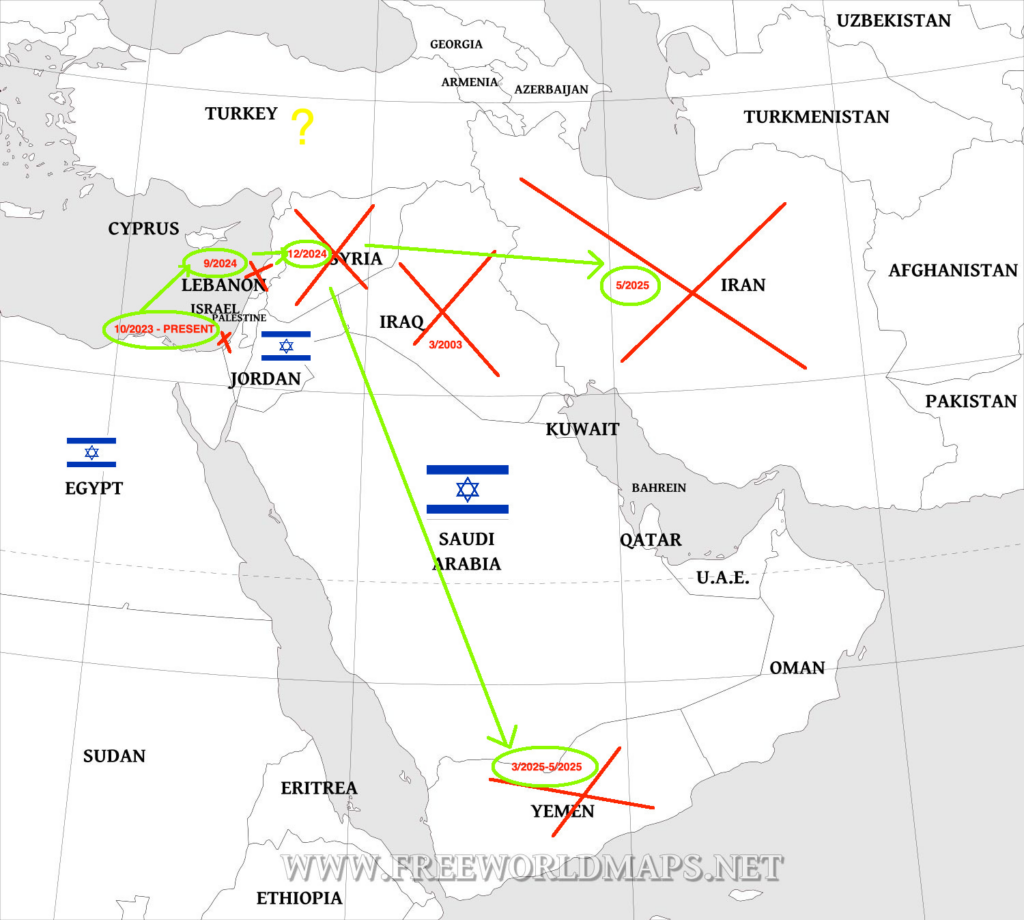
Major obstacles remaining include Temple Mount access (Al-Aqsa present), international opposition to Temple (massive, sort of – see footnote 3), messiah figure identification (contested/unclear).
My prediction that this accelerates soon because most preparation is already complete, only 2-3 major obstacles remain, those obstacles require crisis/opportunity (war, regional chaos), and current trajectory shows regional instability increasing. But the upper elites seem to have some reverence for the 2030 date as an important demarcation year, which interestingly puts it 2,000 years after the death of Christ (and could signify roughly the change of the age from Pisces to Aquarius for those who ascribe to astrological interpretations). 2030 appears repeatedly in elite governance frameworks – the UN Sustainable Development Goals, EU climate targets, various ’30 by 30′ initiatives. Whether this reflects eschatological coordination, secular planning horizons, or coincidence is unclear. What matters for this analysis is that multiple timelines are converging on the same window: the preparation checkboxes are nearly complete, regional destabilization is accelerating, and major global governance frameworks share this target date. This creates affordances for coordination regardless of intent.
This thesis about elite coordination makes more sense when you see the checklist exists, active preparation is observable, multiple independent groups are working on different boxes, coordination points exist (Chabad, Israeli government, Temple Institute, etc.). This isn’t proof of conspiracy, it’s evidence of shared eschatological vision, distributed preparation, opportunistic advancement when conditions allow, and elite coordination around shared telos. Whether elites “truly believe” or instrumentalize doesn’t matter. The framework provides shared goals (checkboxes), coordination mechanisms (who does what), legitimation (divine mandate), and multi-generational binding (eschatological timeline). That’s exactly what the essay argues elite power structures require.
Elaboration on some of the requirements
- The numbers problem. Current Israeli Jewish population: ~7 million, global Jewish population: ~15-16 million total. Remaining diaspora: ~8-9 million (US ~6-7M, Europe ~1-1.5M, elsewhere ~1-1.5M). Greater Israel territorial claims (maximal interpretation): current Israel: ~22,000 km², West Bank: ~5,860 km², Golan Heights: ~1,200 km², Southern Lebanon (disputed): ~variable, parts of Syria: ~variable, Sinai (historical claim, abandoned): ~61,000 km². Total Greater Israel (maximal): Potentially 100,000-150,000+ km². The problem for upper elites: Even with current 7M Israeli Jews, population density is manageable but not dominant in expanded territories. Greater Israel would require demographic control of expanded territories, settlement of currently Arab-majority areas, security presence across larger geography, economic development of new regions. With only 7M, this is difficult. With 15M, it becomes feasible. Is complete ingathering required? This is where interpretations diverge: Strict Interpretation (requires full ingathering): Some traditional sources suggest all or nearly all Jews must return: Isaiah 43:5-6: “I will bring your offspring from the east, and gather you from the west, Ezekiel 36:24: “I will gather you from all the countries and bring you back into your own land”. Emphasis on complete restoration. This would require the remaining 8-9M diaspora Jews relocating, a triggering event that makes diaspora untenable, and an active ingathering campaign (or crisis forcing it). Pragmatic Interpretation (substantial ingathering sufficient). Others argue that“Ingathering” means opportunity exists, not 100% compliance, a significant return (current millions) satisfies the requirement, the remaining diaspora is by choice, not forced exile, and the mechanism (state of Israel) is established, the rest is voluntary. This allows current population levels to “count”, messianic era to proceed without full demographic return, ongoing immigration as process, not prerequisite. The Demographic Math. Greater Israel territorial control requires: Scenario A: Minimal Expansion (West Bank + Golan). Total population needed: ~10-12M Jews, current: ~7M, Gap: 3-5M (achievable through natural growth + moderate immigration over 10-20 years). Scenario B: Moderate Expansion (+ Southern Lebanon, parts of Syria). Total population needed: ~15-20M Jews, current: ~7M, gap: 8-13M (requires substantial diaspora ingathering). Scenario C: Maximal Expansion (Biblical boundaries). Total population needed: ~25-30M+ Jews, current: ~7M, gap: 18-23M (requires nearly complete diaspora ingathering + high birth rates). The Elite Calculation: If elites are coordinating toward Greater Israel eschatology, they face the following options: (1) Proceed with current demographics, slower expansion, more Arab population integrated, higher security requirements, longer timeline, or (2) trigger ingathering event with afaster demographic shift, more Jewish settlement capacity, clearer demographic control, and compressed timeline. Option 2 is more efficient but requires crisis.From a Systems Theory perspective, such a crisis need not be acute, but may be a ‘Phase Transition.’ A more precise way to frame this: elites don’t need to orchestrate every detail, they need to create conditions where migration becomes the rational response to incentives and disincentives. If diaspora life becomes sufficiently precarious (rising antisemitism, economic instability, political delegitimization) and Israeli life becomes sufficiently attractive (economic opportunity, security, communal belonging), then ingathering happens through individual choice, not coercion. This is less engineering than leveraging, adjusting variables to produce predictable aggregate outcomes. The distinction matters because it doesn’t require perfect control, only effective manipulation of conditions. Evidence of Preparation for Increased Ingathering: (1) Infrastructure development with massive housing construction in Israel, absorption centers expansion, Hebrew education programs in diaspora; (2) aliyah (immigration) campaigns: Nefesh B’Nefesh (North American immigration), Jewish Agency programs, financial incentives for immigrants; (3) rhetoric around diaspora:increasing “dual loyalty” accusations globally, rising antisemitism narrative (through a combination of controlled influencer grifters like Candace Owens, Tucker Carlson, and Nick Fuentes, who would otherwise not be allowed on establishment-owned platforms, along with rising non-white Gen-Z anti-semitism due to increased precarious economics plus the Gaza ethnic cleanse), “Only safe place is Israel” messaging resulting in psychological preparation; (4) economic integration: expanding Israeli tech sector (Nvidia as the latest example) designed for Western Jewish integration, dual citizenship normalized, remote work enabling “soft aliyah” resulting in economic on-ramps. Conclusion: IF elites are coordinating toward Greater Israel, given current demographic growth supports modest expansion (West Bank, Golan) on a longer timeline (50+ years), and IF the timeline is compressed shorter than that for various reasons, THEN they face demographic insufficiency, THEN they need triggering event for mass ingathering of an additional 10-15M Jews, THEN we should see preparation/orchestration of crisis. If major crisis emerges triggering significant Jewish migration to Israel, that’s strong evidence for orchestrated rather than organic eschatological fulfillment. Watch for diaspora crises (economic, political, security), Israeli infrastructure expansion beyond current demographic need, rhetoric shifts toward “urgency of return”, regional destabilization enabling territorial expansion.To be precise about who bears the cost of this mechanism: it is diaspora Jews themselves who would be subjected to artificially ratcheted antisemitism, economic precarity, and psychological pressure to abandon communities, livelihoods, and lives built across generations – not as beneficiaries of an eschatological vision but as pawns being moved by an apex network that regards their sincere beliefs and genuine suffering as useful variables in a demographic calculation. The manipulation is not done by them or for them, it is done to them.
- Technology as Enforcement Infrastructure. For most of history, the Noahide requirement to establish “Courts of Justice” remained theoretical – the elite couldn’t see into every home. AI surveillance, biometrics, CBDCs, and IoT change this fundamentally, making distributed real-time enforcement possible. What global institutions call “Sustainable Development Goals,” “The Great Reset,” and “Universal Basic Income” maps directly onto eschatological language: “Tikkun Olam,” “Noahide Laws,” “Third Temple.” The elite use esoteric language for internal coordination (the glue) and secular language for mass administration (the permissions). Technology bridges both. The mechanisms operate at multiple levels. Surveillance functions as enforcement layer: AI pattern recognition ensures “alignment” with universal values – not just punishing crime but maintaining permissions within acceptable parameters. CBDC serves as moral filter through programmable money that only functions for those in “Noahide alignment,” enabling instant asset freezing for system deviation. The Digital Temple manifests as planetary dashboard: if the Messiah must “judge the nations,” he requires complete data – every resource, person, and transaction mapped in real-time.
- The Noahide Interface. The seven Noahide Laws function as Minimum Viable Product for global governance, integrating 8 billion non-Jews into Jewish-led eschatological framework without requiring conversion. The critical seventh law (establish Courts of Justice) requires nations to build legal systems compatible with “higher law.” This doesn’t mean every country becomes religious theocracy but rather that international legal infrastructure – ICC, trade agreements, ESG standards – eventually aligns with Sanhedrin interpretation through what could be called a snap-to-grid moment.The observable trajectory shows progression: In 1991, US Congress passed H.J. Res. 104 recognizing Noahide Laws as “founding principles of our nation.” Currently, global systems shift from rights-based to duty-based citizenship through social credit systems, ESG frameworks, and “responsibility-based” governance models. The prediction: a Universal Moral Charter will be presented as solution to climate crisis or unity imperative, actually functioning as final alignment mechanism where international law snaps into compatibility with rabbinic interpretation.This reflects a pivot from Negative Liberty (freedom from interference) to Positive Alignment (freedom to serve the collective purpose). The Noahide Laws serve as the Application Programming Interface (API) between the esoteric ‘inner loop’ of elite metaphysics and the ‘outer loop’ of secular mass management. It allows for a Modular Legal Framework where different nations keep their local ‘skin’ while running the same ‘kernel’ of rabbinic interpretive logic.
Assembly Status and Predictions
Multiple checkboxes are actively being marked. Surveillance infrastructure has been built, CBDC frameworks are deploying, duty-based citizenship models are emerging, global legal convergence is in progress, Temple preparation is ready, and demographic positioning is partial. Furthermore, Western demographics have been obliterated, with mass African and Islamic immigration funneled into Europe, and mass Hispanic immigration funneled into the United States (~20 million 2021-2025 alone), preventing demographic solidarity that could otherwise potentially oppose this system (their goal isn’t total demographic replacement, but enough so that the population can no longer unite against the upper elites). Furthermore, Western populations have been destroyed through a combination of food, water and air poisoning (rendering the population obese and sickly), pornography, and noetic commons manipulation and corruption. The remaining obstacles require crisis or opportunity: Temple Mount access demands destabilizing event, mass ingathering requires triggering diaspora crisis, and Messiah identification remains contested though flexible in interpretation.
The predictive test operates on 10-20 year timeline.
If the model is correct, we should observe within 10 years:
- Temple Mount status change: A significant incident (violence, ‘terror attack,’ archaeological ‘discovery’) used to justify revised access arrangements or shared sovereignty. Not necessarily full Israeli control, but change from status quo.
- Red heifer sacrifice within 3 years of that change: The existence of candidates means this can happen quickly once political conditions allow.
- Diaspora crisis in one or more Western country: Sharp increase in antisemitic violence or political delegitimization of Jewish institutions, followed by accelerated aliyah and ‘only Israel is safe’ narrative.
- Universal Moral Charter: A UN, G20, or Davos declaration of global ethical principles presented as response to AI, climate, or pandemic, structurally aligned with Noahide framework but in secular language.
- CBDC deployment with ‘alignment’ conditions: Programmable money that restricts funding for ‘disinformation,’ ‘hate speech,’ or other categories defined through the Moral Charter.
What would falsify the model by 2035:
- Temple Mount status remains unchanged without major incident
- No significant increase in diaspora aliyah rates (above current ~20-25k/year from Western countries)
- No Universal Moral Charter adopted
- Messiah figure fails to emerge or gains no significant recognition
- Alternative legitimation framework (Catholic, Islamic, secular) visibly consolidates elite cohesion
If none of the positive predictions occur by 2035, the model is likely wrong. If some occur but others don’t, the model needs refinement. This is the difference between a recursive predictive framework and a just-so story.
On Elite Failure Modes and What To Do With This
Two questions worth addressing directly. First, on elite failure modes: I see none during the assembly phase. The Fabian approach toward eschatological vision is specifically structured to minimize premature fracture – total control over media, institutions, education, food systems, AI infrastructure, and financial architecture leaves no organized opposition capable of disrupting checkbox completion. Failure modes emerge after completion, when the structure transforms fundamentally. Open domination replacing covert coordination dissolves the binding glue that held the apex network together – the eschatological vision, once achieved, no longer functions as cohesion mechanism. What follows may include elite infighting freed from shared telos, mass population collapse affecting the predation substrate the system requires, environmental damage exceeding the system’s own tolerance, or simply the unpredictable human variable that no total system has ever fully eliminated. Bar Kokhba’s revolt and Sabbatai Zevi’s apostasy both demonstrate that eschatological visions can achieve apparent fulfillment and still produce civilizational catastrophe rather than redemption. The pattern may repeat at larger scale.
There is a deeper failure mode that the framework cannot see from inside itself. The predation logic embedded in ontological stratification, when applied not just to human populations but to the natural world, produces extraction without limiting principle. The dialectical sophistication that reframes human exploitation as divinely sanctioned has no internal mechanism that stops at the boundary of the ecosphere – the same logic makes topsoil, aquifers, atmospheric stability, and biodiversity exploitable without moral remainder. Whether the eschatological vision is sincerely believed or instrumentally deployed, it is optimized for elite cohesion and civilizational control while remaining structurally blind to the substrate those things operate on. The checkboxes may be completed on a planet that can no longer support the civilization the vision was supposed to crown. Jerusalem was achieved in 132 CE and rubble by 135. The pattern may repeat at larger scale, with the eschatological vision fulfilled in a smoking ruin that renders the fulfillment meaningless.
Second, on what to do: institutional authority and expert consensus have been captured so thoroughly that they function as noise rather than signal. The recursive prediction model described previously – testing frameworks against observable outcomes, following doubt wherever it leads, burning off what cannot survive the Münchhausen trilemma – is one approach. The other is returning to the body’s response as a pre-cognitive truth detector that operates below the level of narrative capture. Institutions tell you what to think; the body registers what is actually happening. Developing that registration, doing what one is genuinely called to do regardless of systemic pressure, and maintaining the individual sovereignty described above may be the only honest response to a situation where political programs have been anticipated and absorbed.8
The noetic commons – the shared epistemic substrate through which populations self-police, self-censor, and self-coordinate toward elite-approved frameworks without requiring direct coercion – is the system’s cheapest and most scalable control mechanism. Soft power works precisely because it doesn’t require surveillance, enforcement, or visible coercion; populations govern themselves. Every person who genuinely exits narrative capture represents a marginal increase in the cost of control, forcing the system incrementally toward hard power – overt coercion, account freezing, deplatforming, mandate enforcement. That transition is expensive and self-revealing in ways soft power never is. COVID offered a partial preview: the degree of coercion required to maintain compliance exposed the architecture in ways that decades of soft power management had successfully concealed, and the resistance it generated was a further operational cost the system had not fully anticipated. The acid epistemology described here – recursive prediction model, body-response truth detection, Münchhausen dissolution of institutional authority – is threatening because it erodes the substrate that makes opposition unnecessary from the system’s perspective. It raises the cost of control without providing a target to suppress. But there is double-edged irony in this: even though removing oneself from the noetic commons that the upper elites use to govern the masses results in higher control costs for them, withdrawing from the system and avoiding collective responses may be seen as an acceptable trade-off, as isolated individuals opting out are not much of a threat to their system.
Lastly, given the risks of misunderstanding of this essay are substantial, let me again re-emphasize that this essay analyzes elite structural strategy, eschatological coordination, and long-term checkbox fulfillment. It does not make claims about ordinary Jews, Judaism, or religious populations; misreading this analysis as broad moral judgment or attribution of intent would be a category error. The tragic frame is about the nature of apex power and systemic selection, not about people en masse.
Part 3 will examine two deep paradoxes generated by this model.
Thanks for reading.
Subscribe:
Email delivery remains on Substack for now.
1 The argument is too easy to be read as anti-semitic by casual readers, and the translation cost from a tragic Abraxian limit condition God image framework to privatio boni readers (who are almost all my readers, because almost all of the West is steeped in privatio boni belief) is high. The heart of the piece was this: “The tragedy is not that “evil” people have seized the framework, but that the framework is the only one capable of holding the apex [of power]. Any hand that reaches for the scepter must first wither. This leads to a profound philosophical pessimism: history is not a progress toward enlightenment, but a series of “Succession Crises of the Blind.” If consciousness and power are opposites, then every New World Order is a fresh regression into deeper contraction. The selection pressure ensures that the most spiritually hollow group always wins the competition for the top tier. In this view, civilization is a machine that systematically converts human consciousness into hierarchical stability until the resulting spiritual brittleness triggers a systemic collapse.”
The coldness that careful readers will notice throughout is not stylistic aloofness, it is the direct literary consequence of writing from inside an Abraxian limit-condition God-image while the overwhelming majority of readers still inhabit the privatio boni frame. Privatio boni readers arrive with an implicit moral cosmology: evil is deficient and ultimately unreal, there will be a final accounting, the arc of the universe bends toward correction. This makes moral outrage not only permitted but ontologically justified and emotionally sustainable. The Abraxian frame offers no such comfort – the divine contains both creation and destruction without remainder or apology, there is no outside from which redemption arrives, and moral outrage becomes structurally difficult to sustain because the framework refuses to split the opposites into a good side that can be defended and a bad side that can be opposed. The same facts that would produce righteous condemnation in a normal culture-war essay are delivered here with a flat recursive calm based on an acceptance that the opposites are not going to resolve. That calm reads as inhuman or alien to a nervous system still wired for eventual cosmic vindication. The essay is not cold because I lack feeling, it is cold because the God-image it is written from does not permit the temperature to rise in the way privatio boni cosmology would license.
2 Normal thought patterns are as follows: (1) adopt a framework (family, culture, conversion), (2) defend the framework (identity fusion), (3) examine the framework only to strengthen it (apologetics), (4) experience doubt as threat, (5) resolve doubt through rationalization or suppression. But my thought pattern is: (1) observe framework (from outside), (2) examine framework (structurally), (3) question framework (without identity threat), (4) experience doubt as data, (5) follow doubt wherever it leads. I serve as an acid when it comes to belief, burning off anything that can’t follow the Münchhausen trilemma (i.e. if you keep asking “Why?” to justify a claim, you eventually hit one of three outcomes: (1) Infinite regress (every answer requires another justification, forever), (2) circular reasoning (a claim is justified by something that depends on the original claim), (3) dogmatic stopping point (you eventually say, “That’s just how it is,” or “I don’t know.”) So when you keep pressing “Why?” and even experts eventually run out of further justification, you’re encountering this epistemological limit. My radically different approach from most people is a big part of why I feel like an alien.
3 A deeper implication worth noting briefly: by adopting the Hebrew scriptures as foundational, Christianity and Islam transferred the egregore of Yahweh into gentile psychological architecture at the level of highest belief. Where the Romans treated Judaism as one unremarkable sect among many – according it no special metaphysical status – Christian and Islamic populations absorbed Jewish chosenness, covenant theology, and eschatological expectation into their own foundational God-image. This creates a structural asymmetry: populations whose highest-order beliefs already encode Jewish sacred history as divinely significant face a different relationship to the system described in this essay than populations for whom Yahweh was simply a foreign tribal deity.
Most striking is the two-thousand-year retrospective sequence itself – Roman destruction of Jerusalem, Pauline Christianity undermining Roman values from within, Rome’s adoption of Yahweh’s egregore, Jewish moneylending monopoly in medieval Christendom, Rothschild leverage into central banking dominance, and modernity as the culmination – a chain too long, too contingent, and too consequential to have been consciously designed by any human actor or institution, yet too coherent to be accidental. Whether this reflects egregoric agency, Jungian aeon logic, structural selection pressure, or all three describing the same phenomenon from different altitudes is a question reserved for future treatment.
4 A clarification on terminology that Part 1 handled somewhat inexactly: Yahweh and Abraxas are not identical despite both containing good and evil within a single divine image, which places them closer to each other than either is to the privatio boni God of mainstream Christianity. The decisive difference is allegiance and externalization. Yahweh enters covenant with a specific people, directs destruction and creation with something resembling tribal intent, and externalizes his shadow – Satan in Job is not integrated into Yahweh but argued with, which disqualifies Yahweh from being true totality. Abraxas contains all opposites without remainder, without allegiance, without outside – a God for whom covenant and chosen people are structurally impossible because there is no other toward which preference could be oriented. What the Talmudic/Kabbalistic tradition may have achieved, however, is the most sophisticated working approximation of how reality actually operates – closer to Abraxas than any competing framework while retaining the tribal covenant structure that pure Abraxian totality dissolves. This creates a possibility more unsettling than mere instrumental efficiency: the framework may be structurally optimal for elite legitimation not only because it works as a coordination mechanism but because it most accurately maps the underlying structure of power and reality. It gets the metaphysics more right than its competitors while keeping the allegiances that genuine totality would dissolve.
5 Some argue that multigenerational elite cohesion is maintained not through shared metaphysical vision but through initiation into antinomian criminality – that bloodline provides access but participation in extreme criminal acts (sexual blackmail, ritual transgression, documented kompromat) provides the actual binding mechanism, with each generation initiated before receiving power. This argument has genuine explanatory force for the innermost network layer and is consistent with observable patterns in the Epstein operation and historical secret society structures. Three limitations prevent it from being a complete theory, however. First, initiation into criminality produces defensive stasis – mutual assured destruction keeps participants frozen but doesn’t explain purposive directional movement toward specific long-horizon goals. Blackmail explains why people stay in; it doesn’t explain where the system is going or why. Second, the outer coordination rings – mid-tier politicians, NGO administrators, think tank operatives, Freemasons – cannot all be criminally compromised, yet they participate in directionally consistent behavior. They require a different binding mechanism. Third, and most fundamentally, even the innermost criminal network requires psychological legitimation – very few people can sustain extreme predatory behavior across a lifetime without a framework that reframes it as cosmically sanctioned rather than merely transgressive. The Sabbatean and Frankist precedents are instructive here: pure antinomianism without metaphysical containment produced psychological disintegration and social horror rather than durable power structures. Chabad’s success as a movement – precisely through rigorous rabbinical containment of the same non-privatio boni God-image that destroyed the Sabbateans – demonstrates that even extreme theological radicalism requires legitimating metaphysical structure to remain stable across time. The parallel for elite criminal networks is direct: antinomian predation without cosmological legitimation follows the Sabbatean trajectory toward self-destruction rather than the Chabad trajectory toward durable institutional power.
6 Jesus demonstrates assembled messianic checkboxing: Gospel writers portrayed him fulfilling prophecies including Davidic descent (Isaiah 11:1, Jeremiah 23:5 – claimed through genealogies in Matthew and Luke), virgin birth (Isaiah 7:14), Bethlehem birthplace (Micah 5:2), ministry in Galilee (Isaiah 9:1-2), entry into Jerusalem on donkey (Zechariah 9:9), betrayal for thirty pieces of silver (Zechariah 11:12-13), crucifixion details matching Psalms 22 (pierced hands/feet, garments divided, forsaken cry), and resurrection on third day (Hosea 6:2, Jonah’s three days). Early Christian arguments for messiahship centered on these textual alignments, with writers like Matthew explicitly citing “to fulfill what was spoken by the prophet” formulas. Christianity also claimed fulfillment of universal peace (Isaiah 2:4) and kingdom restoration through theological reinterpretation: peace became spiritual/internal (”peace I leave with you” – John 14:27), the kingdom became “not of this world” (John 18:36), and the Temple became believers’ bodies (1 Corinthians 3:16). The observable, material requirements – physical Davidic kingdom, literal ingathering of exiles to Israel, rebuilt physical Temple, actual cessation of warfare, universal recognition of God – were either spiritualized or deferred to Second Coming. Judaism rejected the claim based on non-fulfillment of concrete messianic criteria. This demonstrates how checkboxing can be backwards-engineered (writing events to match prophecies) versus forward-engineered (creating conditions to fulfill prophecies), with modern elite strategy resembling the latter approach. Christians assembled narrative (wrote about a figure) while Jewish elites would assemble conditions (create the reality).
7 Bar Kokhba (132-135 CE) demonstrates the checkboxing pattern: Rabbi Akiva proclaimed him Messiah based on apparent fulfillment of prophecies including restoration of Davidic kingship (2 Samuel 7:12-16), re-establishment of Jewish sovereignty in the land (Ezekiel 37:21-22), gathering of Israel’s scattered people (Isaiah 11:12), and preparation for Temple rebuilding (Ezekiel 40-48, Haggai 2:9). His revolt achieved temporary control of Jerusalem and the Temple Mount, and his coins proclaimed “Year One of the Redemption of Israel” while depicting the Temple facade. However, the revolt’s failure exposed incomplete checkboxing: no permanent kingdom (Daniel 2:44), Temple never rebuilt, universal peace not achieved (Isaiah 2:4, Micah 4:3), and nations did not recognize the God of Israel (Zechariah 14:9). Bar Kokhba’s case shows how partial fulfillment can justify messianic proclamation by recognized authorities, but also reveals the difference between military force alone (Bar Kokhba’s approach) and modern elite strategy using diplomatic normalization, regional destabilization, financial leverage, and technological control as more sophisticated checkboxing mechanisms.
8 A clarification on what unmediated contact with totality requires psychologically, because without it the instruction is empty. Abraxas as a limit-condition God-image containing all opposites is not a inhabitable position for finite creatures because pure undifferentiated totality produces psychotic dissolution rather than sovereignty. The psychological survival mechanism is the spontaneous rebirth of the gods within the psyche as differentiated, personified energy centers – what pagans called gods and Jung called archetypes: the psyche self-protects by distributing the unbearable tension of totality across multiple internal figures, each carrying a portion of the opposites without requiring the ego to hold everything simultaneously. This is internal polytheism as load-bearing structure rather than belief system. The Kabbalistic Tree of Life performs this function collectively and externally – spatializing contradictions across sefirot, distributing tension across a shared symbolic map mediated by rabbinical authority – while internal polytheism performs the same function individually and internally, without external mediation or hierarchical authority. The cost is that there is no rabbinical interpreter to resolve tensions, no community of shared symbolic inheritance, no institutional belonging. The benefit is that the differentiation cannot be captured, redirected, or frozen into alignment by any external system. This is a psychological mechanism that makes individual sovereignty survivable rather than merely aspirational, and it is discussed in more detail in the three-part series on internalized paganism.