
This post reframes the classical humors as metabolic systems rather than personality traits, distinguishing how the body processes energy from how the psyche orients toward meaning through mythic god-types. Using an energy-economics frame, it treats symptoms and burnout as consequences of chronic misalignment between constitution, environment, and symbolic mediation rather than moral failure or weakness. Individuation here is precise alignment, not optimization: a life can be efficient and still be wrong or costly and still be right, but sustained misallocation always exacts a psychic price.
Welcome back. In my last post I laid out a mythic typology of human temperament, tying our energies to archetypes of the pagan Gods and arguing that in some sense those Gods were reborn within the human psyche. Today’s post was supposed to discuss how an archetypal or pagan understanding of psychic processes serves as an operational, stable approach toward living under an Abraxas God image, because the differentiated gods provide what Abraxas cannot: a livable partitioning of the unbearable.1 It would then explain how this perspective results in a weakening of elite control over the noetic commons which governs public perception, but that will have to wait until the next post (or later if necessary).
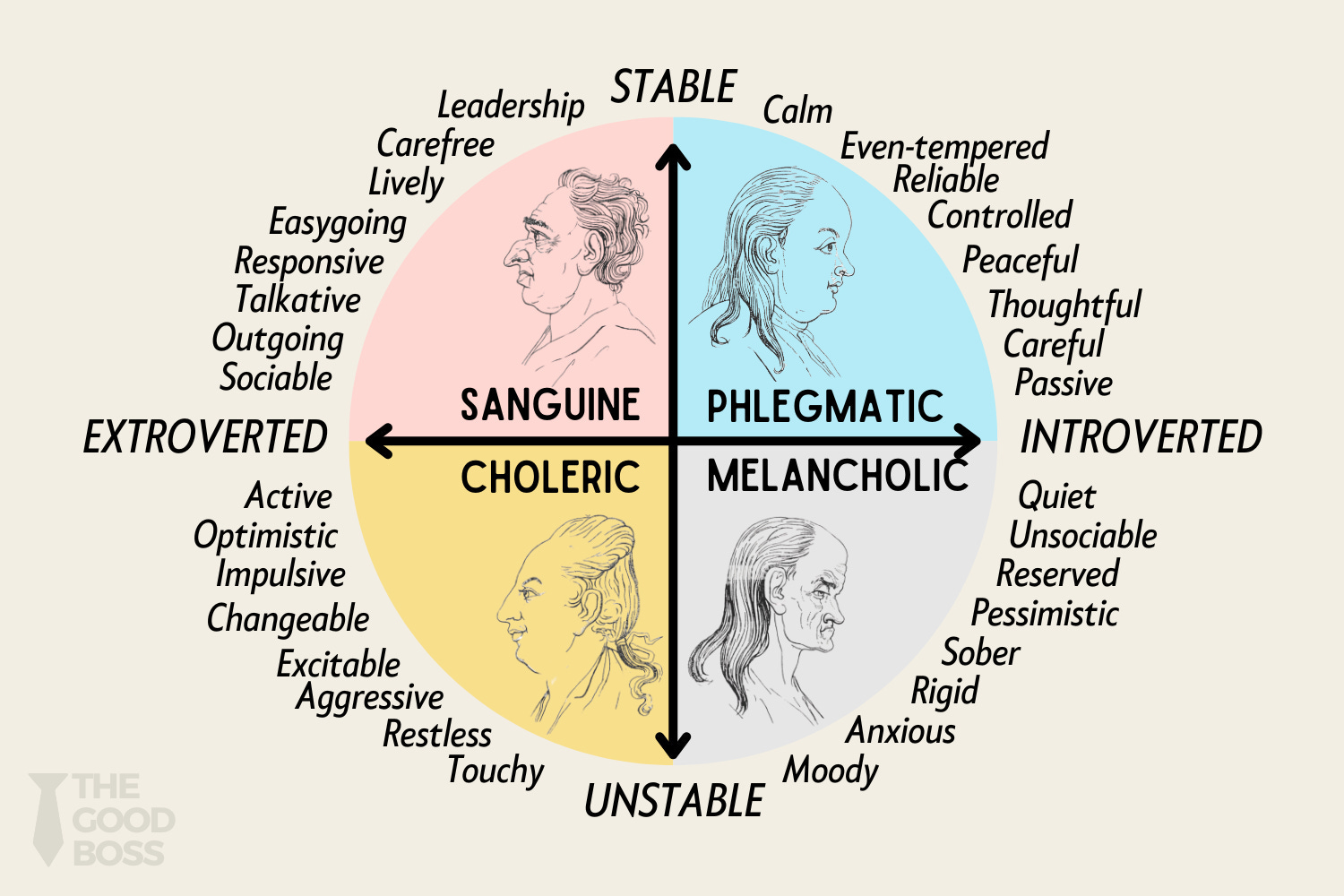
Rather, in this post I want to discuss the concept of energy efficiency vs. inefficiency. ♱ Rurik Christwalker ♱ had a good question about the humors in the last post, specifically about the four temperaments (sanguine, choleric, melancholic, and phlegmatic) and how it relates to mythic energy typology. The short answer, which I will expound on here, is that the humors describe bodily metabolism rather than symbolic orientation – they shape what is easy or costly for the body, not what the psyche is oriented toward. Roughly: humors answer what kinds of states the body can sustain without breaking down, god-types answer what kinds of states feel meaningful or fated.
Taylor has a couple of good videos on his physiognomy-focused YouTube channel about this topic, i.e. see here and here (who I have discussed previously here) and one may note the relationship between the humors and symbolic orientation is not just internal, but manifests externally in how one looks. It’s not just as above, so below, but also as within, so without (and as without, so within!). Taylor in his videos discusses a person’s humors and also how their face shape relates to specific God type archetypes:
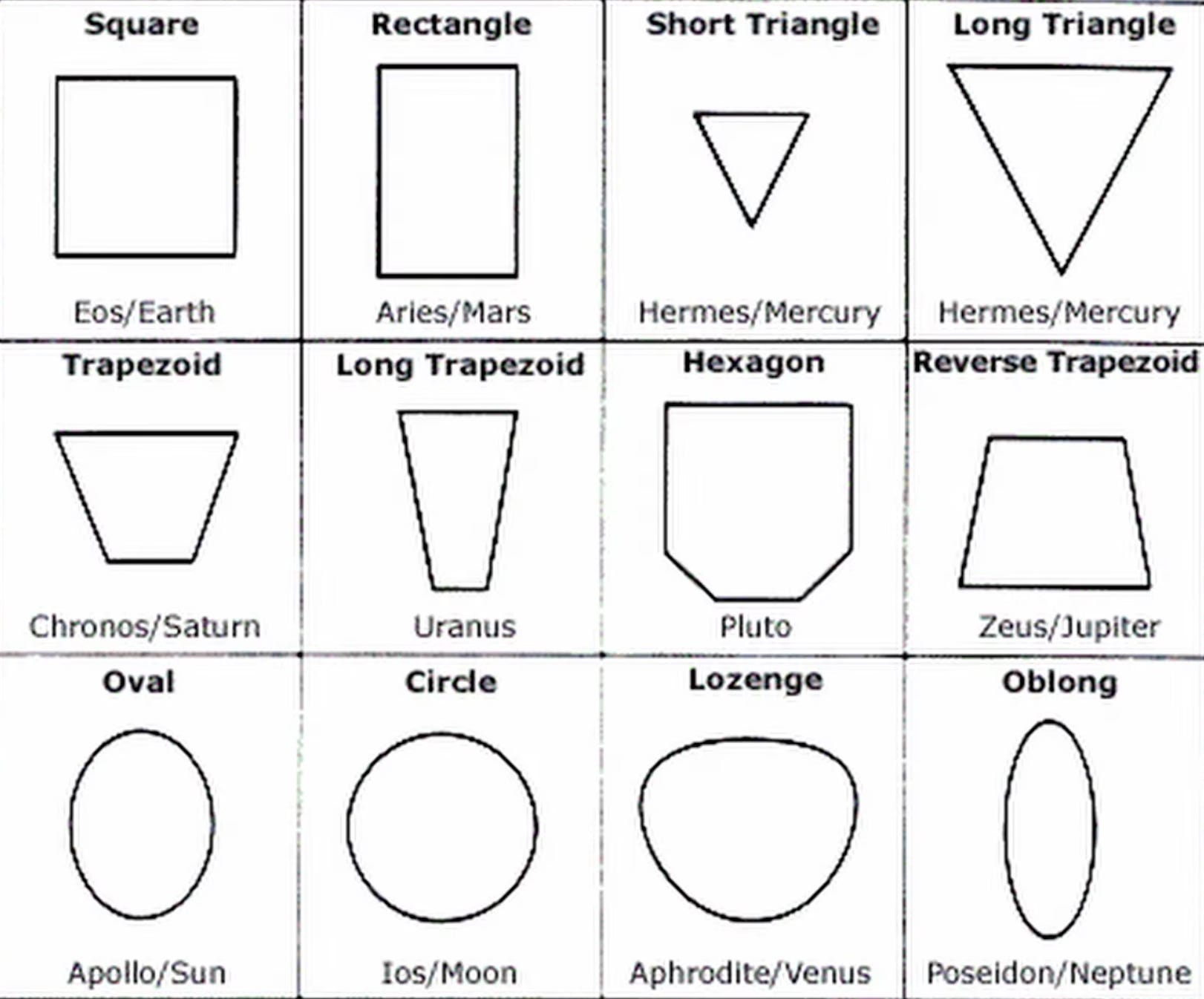
As he demonstrates in his physiognomy videos, these patterns manifest visibly – which raises the question of deeper structural relationships between metabolism and symbolic orientation. What is the relationship between the two? Do certain energies synch more efficiently or less efficiently with certain metabolisms than others, and how does that manifest? What follows is not meant as typology-as-identity, rather it is intended as a diagnostic lens one may keep using: “Does this environment increase my coherence per unit energy or drain it, based upon my specific metabolic makeup? And how can I maximize my coherence in order to create a more fulfilling life?”
This is intended as a metabolic model, of which there are four layers:
- The primary frame is energy economics, not traits. Under this framing “psyche” means energy system, a “situation” is a demand on energy conversion, “symptoms” are losses, blockages or misrouting, and “efficiency” is the ratio of coherent output to psychic cost. This frame comes from a convergence of depth psychology (Jung, post-Jungians), cybernetics/systems theory, psychoanalytic economics (Freud’s economic mode), ACT/schema therapy’s focus on functional flexibility, and my own repeated emphasis on psychic pressure requiring and leading to reorganization or collapse. Once one adopts energy economics, a lot of moral language drops away and what remains is: does the system convert or leak?
- The second layer is local vs. global efficiency, separating local efficiency (specific channels where energy flows cleanly) from global cost (baseline energy required to operate the system). It explains why someone can be brilliant in narrow domains and exhausted in everyday life without contradiction.
- The third layer is depth bias vs throughput bias. Depth-biased systems require pressure to activate, resist premature closure, and metabolize contradiction suffer in low-signal environments, while throughput-biased systems act quickly, waste little energy per action, but cannot hold paradox collapse under prolonged ambiguity.
- The fourth layer is misallocation as primary pathology. That frame comes from Jung’s concept of neurosis as misalignment with one’s type, Adler’s idea of overcompensation, modern burnout research, and from watching high-capacity systems get destroyed by environments that reward the opposite metabolism.
Some psyches move energy cheaply with minimal resistance, little internal heat, low byproduct, while others move the same energy expensively with turbulence, waste heat, psychic inflammation, exhaustion. Imagine energy entering the system with stimulus, demand, affect, and pressure: in a well-matched metabolism, it routes along existing channels, reinforces structure and exits as action, symbol, or rest, while in a poorly matched metabolism it stalls, overheats, and loops spills into symptoms such as irritability, anxiety, obsession, and collapse.
Humoral Correlation to Symbolic Orientation
In humoral terms, different constitutions prefer certain modes of energy flow and conduct them with radically different losses. Choleric flows like assertion, conflict, and forward motion are efficient for some but catastrophic for others; melancholic flows like withdrawal, depth, and gravity are stabilizing for some and suffocating for others; sanguine flows like sociality, novelty, dispersion are regulating for some, dissolving for others; and phlegmatic flows like stillness, conservation, and slowness are restorative for some but deadening for others. What modern psychology often misses is that forcing a flow that is metabolically inefficient for a given constitution doesn’t train the system, it damages it. The system spends more energy compensating than adapting and then fails because insight doesn’t change conductance.
Reframing the humors as metabolic profiles instead of personalities yields the following results:
- Choleric: Fast intake, fast discharge, high heat. Efficient in leadership, crisis, action, inefficient in waiting, ambiguity, introspection.
- Sanguine: Fast intake, diffuse discharge, social heat. Efficient in social circulation, inefficient in solitude, sustained focus.
- Melancholic: Slow intake, deep processing, cool. Efficient in analysis, depth, synthesis, inefficient in speed, noise, performativity.
- Phlegmatic: Slow intake, slow discharge, stabilizing. Efficient in maintenance, continuity, inefficient in pressure, rapid change.
None are better than the others; each has energy-efficient environments and energy-hostile ones. However, modern life strongly privileges speed sociability and surface performative/output, which means certain metabolisms are chronically penalized.
There are moderate correlations between certain humors and god-types, but they are not deterministic. These are natural resonances, not identities or destinies:
- Melancholic (cool, inward, depth-processing) is most efficient with Saturn (limits, gravity, duration) and Apollo (clarity, form, meaning after digestion). Least efficient with: raw Dionysus (unbounded excess, dissolution), unchecked Mars. Why: melancholic psyches require containment before expression; Saturn gives weight and boundary, Apollo gives intelligible form after pressure is metabolized.
- Choleric (hot, directive, outward). Most efficient with: Mars, Jupiter (authority, expansion, command). Least efficient with Saturn without outlet, excess Apollo (analysis paralysis). Why: choleric energy must move or decide; containment without discharge turns into rage or tyranny.
- Sanguine (hot, circulating, social). Most efficient with Jupiter, Dionysus (social, festive form). Least efficient with Saturnian isolation, excessive depth-work. Why: sanguine energy metabolizes through circulation; meaning comes after exchange, not before.
- Phlegmatic (cool, stabilizing, sustaining). Most efficient with Lunar, Saturn (maintenance aspect). Least efficient with Mars, Dionysian disruption. Why: phlegmatic systems are designed to preserve equilibrium, not generate novelty or rupture.
The correlations above are intended as moderate, not deterministic. Think: ~0.6 correlation, not 0.9 – enough to matter, but not enough to trap you. It’s not stronger than that because God energies are situational forces and humors are constitutional tendencies; life stages, trauma, culture, and vocation all distort the mapping. Furthermore, whether mediating energies are involved has a major impact on efficiency or inefficiency, i.e. a melancholic can host Dionysus, but only if Saturn or Hermes mediates, while a choleric can use Saturn, but only as discipline, not enclosure. Three common failure modes include:
- Unmediated god-force. Example: Dionysus without Saturn leads to dissolution (see Nietzsche), Saturn without Hermes leads to rigidity and calcification, Apollo without Dionysus leads to sterility.
- Chronically wrong environment. Example: Melancholic depth psyche in a surface-social economy, choleric directive psyche in bureaucratic stasis. Even “right” god energies become inefficient when the environment forces constant downshifting.2
- Moral / ontological mismatch. A metabolism can be efficient and still corrupting; efficiency alone is not the telos.
Beyond humors and gods, energy efficiency is also shaped by time-scale compatibility (some psyches metabolize best on long arcs, delayed payoff, slow synthesis, while forcing them into rapid feedback and constant performativity creates artificial inefficiency) and symbolic vs literal processing (some people metabolize experience symbolically (myth, writing, image) while others literally (task, action, result) – mismatch here produces massive drain, regardless of humor).
Phenomenological Analysis
As usual, I approach this issue and arrive at my conclusions primarily from a perspective of phenomenological lived experience. This approach is one of the few one can take if one has come to distrust external authority figures and sources; another method is recursive prediction. In other words, here I looked at whether my energies are aligned or misaligned with my physiognomic profile, then applied that analysis to my understanding of those in my life and the world in general. Let’s look at me and then apply those lessons more broadly.
Regarding my humors, I am melancholic-dominant with choleric overlays, and low sanguine. My melancholic core relates to depth processing, high sensitivity to contradiction, long integration cycles, and symbolic metabolism. This is efficient when I am working slowly, handling abstractions, integrating opposites, and writing reflectively, and it is inefficient when forced into rapid response, when I am socially overstimulated, or if I am asked to “decide and move on”.
My choleric overlay (conditional) relates to sharp articulation and structural clarity, and carries with it a capacity for decisive action after integration. It is efficient when acting on already-digested insight, cutting away dead structures, enforcing limits, and it is inefficient when used defensively, if I am triggered by ego threat, and when mistaken for identity rather than function.
I have low sanguine; this mean I have low tolerance for noise, low reward from novelty, and high cost from social performance. The implication is that environments that energize others drain me; I do not recharge through stimulation. I don’t need to travel to see the world, to party, to endlessly see new things like Eat-Pray-Love shrews, or to excessively socialize.
Putting these together, my energy metabolism is conditionally efficient, but globally expensive. I am highly efficient in narrow, aligned channels. When the pressure is real (not artificial or performative), the problem is structural (not tactical or social), the frame allows integration rather than compliance, and the output is symbolic, analytic, or synthetic (writing, theory-building, pattern recognition) my system converts energy with very low loss. In those states I don’t thrash, I don’t loop emotionally, I don’t require much external regulation, and my output is dense relative to input. This is why, once the Hermes-function was installed, my writing became self-sustaining rather than draining. The energy that would otherwise overheat or stagnate gets routed into symbolization. I have over a hundred unpublished posts prepared, and I regularly receive feedback (or rather, I did in the past before my writing narrowed in scope to become more niche, targeted at a specific personality type) asking in wonder how I had time to digest and output such content. This work is a challenge, but it’s one that I excel in relative to what I have seen elsewhere, and my output is prodigious.
My inefficiency shows up outside those channels, especially in interpersonal ambiguity, prolonged low-grade social friction, environments requiring constant affect modulation, and situations where prediction errors are social rather than structural, where my becomes metabolically wasteful; what happens instead of flow is excessive internal processing for minimal external signal, delayed action due to over-integration attempts, emotional heat without discharge, fatigue disproportionate to stimulus. This is high internal resolution applied to low-information domains, like running a particle accelerator to heat soup. Because my system is optimized for contradiction, paradox, long arcs, and second- and third-order effects, it makes it inefficient in shallow environments by definition. I pay a tax whenever I have to act before meaning has cohered, when I’m forced into binary signaling, and when energy must move quickly rather than accurately – my system experiences something close to energy hemorrhage, and it’s when exhaustion, cynicism, or shutdown appear. Many people are the inverse: fast, shallow, cheap, but incapable of sustained integration, while I’m slow, deep, expensive, but capable of genuine reorganization. Neither is “better”, but mine is costly to operate. Externally, people might see my behavior as withdrawal, overthinking, resistance, latency, putting on a false front, discomfort, restlessness. Internally, what’s happening is active metabolization, pressure redistribution, and structure-testing.
The work I’ve been doing over the last couple of years has mostly been about reducing waste by refusing incompatible flows, operating as a kind of systems engineering.3 I’ve been in the wrong energy transmission gear for almost all of my life until reading and writing through individuation over the past ten years, struggling to find the gear where torque finally matches load. Once realignment happened4 my effort dropped, heat dropped, meaning rose, and output stabilized, resulting in subjective emotional stabilization. The important thing is if something feels effortful and noisy for me I increasingly assume mis-gearing instead of weakness; this has been a brutal lesson to learn.5 Individuation here is become precise about where I transmit torque.
Comparing my humors to my symbolic orientation (Saturnian exterior severity and limitation, wild Dionysian fury internally, mediated and synthesized by Hermetic contemplation and writing), and my coherence primary orientation6, and my psychological profile is most efficient in domains that do not require casual and surface interactions, do not require me to be extraverted, and allow me plenty of time for contemplation and synthesis. I would have been excellent, I think, as a military strategist or in military intelligence, and I thought about going that route, even taking the ASVAB at one point; my severe Saturnian exterior energy would have benefitted from that environment. However, I am thankful that I did not go in that direction; this is because actions are not just about energetic metabolism/fit but also moral/ontological fit. In other words, just because I would have been good at a job doesn’t mean it wouldn’t have gnawed on me morally, because being good at promoting a militarized apparatus worldwide would have been internally corrosive to my soul. So there is always a compromise involved between fit and belief. High efficiency in a soul-destroying system is not a success, it is accelerated damage. So two filters are always required: metabolic compatibility and ontological / moral compatibility. Ignore either and one may still collapse.
For those who feel soul deadened by their jobs, it is likely because of a strong mismatch between internal calling and exterior performance, but that doesn’t mean one needs to blindly follow one’s passions; one still has to live and work in the real world. Efficiency matters because it preserves stamina, it reduces resentment, and it allows endurance, but it is not the purpose of life; rather, it’s the constraint within which purpose can be lived without self-destruction. So the real formula is not to maximize energy efficiency but find the most energy-efficient expression of what does not deform the soul and which one can reasonably live in.
General Lessons
The core principle is that people are not drained by effort itself, they are drained by effort that moves against their native flow. This explains why some people thrive under chaos while others collapse under it; some find structure liberating while others find it suffocating. Energy efficiency is relational, not absolute.
Across cultures and systems (humors, astrology, temperament theory, Jung, modern personality psychology), the same axes recur. Here’s a neutral abstraction:
- Structure ↔ Flux. Structure-dominant psyches metabolize best through routines, hierarchy, clear roles, limits, while flux-dominant psyches metabolize best through novelty, improvisation, movement, ambiguity. Mismatch symptoms: structure type in flux leads to anxiety, control, while neurosis flux type in structure leads to depression, rebellion, leakage .
- Depth ↔ Surface. Depth-oriented psyches metabolize through meaning, symbol, coherence, inner narrative, while surface-oriented psyches metabolize through interaction, action, visible feedback, social exchange. Mismatch symptoms: depth type forced to surface leads to despair, alienation, while surface type forced to depth leads to rumination, paralysis.
- Heat ↔ Cool. Heat-dominant psyches (choleric/sanguine poles) metabolize via expression and discharge, need movement and output, while cool-dominant psyches (melancholic/phlegmatic poles) metabolize via containment and digestion and need time and interior processing. Mismatch symptoms: heat without outlet leads to aggression, burnout, while cool without space leads to shutdown, anxiety.
Unfortunately, most people do not choose how to live their lives based on energy efficiency; rather, they choose based on prestige, fear, imitation, moral pressure, and survival urgency, then they then normalize the drain: “Life is just exhausting.” “Everyone feels this way.” “That’s adulthood.” But chronic inefficiency always extracts payment: neurosis, addiction, bitterness, cruelty, illness, and moral collapse. This is structure, not pathology. There are three simple questions anyone can ask as a general diagnostic heuristic: What kinds of effort restore me instead of draining me? What environments produce resentment even when I “succeed”? Where do I feel frictionless seriousness rather than forced motivation? Patterns over time matter more than ideals.
This approach de-pathologizes struggle, explains burnout without moralizing, restores older wisdom without superstition, allows humane results of pluralism without relativism, and crucially it replaces “What’s wrong with me?” with “Where does my energy actually flow?”
Energetic Pathway Width
All psychologies have a path to maximum efficiency, but not all paths are equally wide, socially supported, or morally survivable. Inefficiency is usually not a failure of will or intelligence but a mismatch between energy, mediation, and environment. Some people are generally more energy-efficient than others because their humoral metabolism, their dominant god-energies, and their environmental demands happen to align early or by luck. That alignment produces what looks like “natural ease,” but it’s usually situational grace, not intrinsic superiority.
No humor is inherently inefficient from this lens; rather, some configurations have broader tolerances while others have narrow operating ranges. Some metabolic configurations are like wide highways – many environments, many expressions – while others are like mountain passes requiring precise conditions, exact mediation, and little margin for error. Modern institutional life is optimized for wide-path metabolisms, people who recharge through stimulation, process quickly and shallowly, excel at surface-level social performance, and convert effort into visible metrics efficiently. If you’re depth-biased, slow-processing, and meaning-oriented, you’re just operating in an environment built for different conductance patterns. Examples: Sanguine plus Jupiter energies have a wide path, they are social, institutional, and communicative environments support it easily. Melancholic plus Dionysus energies, alternatively, have a narrow path, requires Saturnian containment and Hermetic mediation, without which it collapses into despair, obsession, or dissolution. People with narrow metabolic paths have tight operating tolerances and require correct sequencing, specific environments (depth over surface, coherence over throughput), require proper mediation (writing, containment, symbolic processing), and tolerable pressure bands (not too low, not too high) to function. But in exchange they often gain deeper synthesis, higher resolution perception, and truer integration of opposites. The cost is fragility under misalignment. This is why many such people collapse early, become embittered or withdraw entirely, because their efficiency is conditional and because society does not build institutions for narrow metabolisms, pressure arrives before mediators do, and the person is told to “be more normal” instead of being given the correct container, so they burn energy just staying intact.
Conclusion
Energy becomes destructive when it is forced to move through a structure not built to carry it. God energies name forces, humors name conduits, efficiency names friction.
A usable synthesis simplified:
- What energies dominate my life right now? (Saturn, Dionysus, etc.)
- How does my psyche metabolize force? (humoral tendencies)
- What mediators are present or missing? (Hermes, Apollo)
- Is the environment morally aligned or corrosive?
- Is the pressure inside my viable band?
If those five align, one may experience efficiency and integrity. If they don’t, one will likely experience drain, even if “successful.”
Energy efficiency is not the purpose of life, it is the condition for sustainable being and the precondition for meaningful sacrifice – sometimes you choose inefficiency for love, truth, or refusal, but chronic, unconscious inefficiency is just slow self-erasure. What matters is the right placement of force with the goal of approaching (never fully achieving) wholeness, not optimization. Approaching wholeness from an energetic perspective means accepting your actual operating parameters without shame, minimizing but not eliminating friction (some friction produces growth), finding “good enough” external arrangements that don’t drain you catastrophically, and reserving your best energies for domains that matter to you.
One final clarification: this framework is neither morally relativist nor morally universalist in the modern sense. It does not claim that values are arbitrary, nor that the same virtues, roles, or ideals apply equally to all psyches. Rather, it treats truth, conscience, and ontological integrity as objective constraints that operate through different constitutions differently. A life can be efficient and still be wrong; it can be costly and still be right. But a life built on sustained falsity – whether moral, symbolic, or existential – always exacts a metabolic price. That price may be delayed, masked, or even socially rewarded for a time, but it is not optional. In this sense, morality is not a preference layered atop the system; it is a condition of long-term coherence within it.
The language used here – systems, efficiency, pluralism, functional analysis – is therefore methodological rather than ontological. These tools are associated with postmodern and post-structural approaches and are employed deliberately but instrumentally to dissolve false moralization, inherited role-fictions, and performative identity claims. They do not imply that reality itself is plastic or that meaning is arbitrary. On the contrary, they are used to reassert constraint – bodily, psychic, symbolic, and moral – under modern conditions. Pluralism here does not mean “anything goes,” but that different systems fail in different ways when they violate what is real.
Thanks for reading.
Subscribe:
Email delivery remains on Substack for now.
1 This framework presupposes an Abraxian god-image in the Jungian sense: a symbolic acknowledgment that totality includes both creative and destructive force and cannot be inhabited directly without psychic damage. Without this background image, the present analysis would tend to collapse either into moralized typology (where efficiency implies virtue), or into therapeutic optimization (where suffering is always a solvable error). The differentiated gods are not alternatives to Abraxas, but functional partitions that make life possible under conditions Abraxas names but does not resolve.
2 “Downshifting” = forcing energy to operate below its natural gear. Examples: A depth-oriented psyche forced into constant small talk, rapid affect regulation, performative agreeableness, or a long-arc synthesizer forced into short feedback cycles, daily metrics, superficial outputs. The energy can operate there but at terrible cost. So even correct god energies become inefficient when Saturn is used for bureaucracy instead of structure, Apollo is used for optics instead of form, Hermes is reduced to networking instead of mediation. The system spends all its energy translating downward instead of transforming upward.
3 This should not be mistaken for optimization or self-management as an end in itself. While reducing chronic waste preserves stamina and coherence, individuation is not achieved by efficiency alone. Jung’s transcendent function remains operative: decisive movements in a life often require discernment rather than calculation, and may involve temporary instability, sacrifice, or energetic loss that cannot be metabolically justified in advance. Energy economics describes constraints on what can be sustained; it does not replace the necessity of listening.
4 The correct gears for me are:
- Containment to build torque (reading, note-taking, pressure accumulation, no public output). Warning sign to shift up: internal pressure crystallizes into a question;
- Symbolic mediation to convert pressure into structure (Hermetic writing, diagramming, comparative analysis, mythic framing). Warning sign to shift up: insight begins repeating itself;
- Articulation to externalize integrated structure (essays, public synthesis, teaching-adjacent output). Warning sign to shift up: sense of closure or diminishing returns;
- Rest to cool the system (withdrawal, silence, low-stimulus living). Warning sign to shift up: boredom with coherence intact.
Common accidental downshifts (the danger zone) for me include premature articulation (publishing before integration, talking instead of writing) which leads to ego inflation and collapse, a reactive choleric mode (cutting too early, argument as discharge) which burns stored insight, and a borrowed sanguine gear (over-socializing, performing engagement) which leads to massive inefficiency and long recovery time.
5 Growing up I faced a triple bind: my psyche required depth, slowness, and symbolic coherence, my capacities were abstract, strategic, non-social, and the world rewarded shallow sociability and visible performance. So I was bad at what was rewarded, good at what was either invisible or morally compromised, and uninterested in playing the games that grant legitimacy. That combination produced long stretches of no energy-efficient domain at all, a retreat into the interior world as refuge, a sense of being “misplaced” rather than defective, and as a way to limit ontological damage. What finally shifted things was that I found a domain where depth itself became metabolizable, where slowness produced yield, where contradiction generated insight instead of punishment, and where conscience wasn’t a liability. I found the right gear relatively late in life.
6 From here: “Broadly speaking, human psyches tend to regulate around one of a few primary stabilizers: (1) attachment and belonging, (2) esteem and status, (3) meaning and narrative, (4) control and agency, (5) coherence and truth-consistency. Most people have several, but one dominates. My dominant stabilizer is coherence. This means that when reality makes sense, I am stable even if it is bleak; when reality does not make sense, I destabilize even if life is comfortable. Emotional reassurance does not compensate for structural falsity in my worldview, belonging does not override contradiction, and hope that contradicts lived data increases my anxiety instead of relieving it. This isn’t common, but it is is a known psychological configuration and is not mystical. For those with my psychic profile, contradiction feels like suffocation. This configuration does not produce confidence, leadership, or direction for others, and it is poorly suited to movement-building, moral persuasion, or collective repair. Where it succeeds is in maintaining coherence in the presence of contradictions that cannot be resolved without psychic damage. A non-negotiable requirement is that my god-image may not contradict lived phenomenological data; this is why the privatio boni did not merely feel “wrong” to me – it felt unlivable.”
[…] next post will discuss how an archetypal or pagan understanding of psychic processes serves as an […]