
One of my favorite quotes by Alexander Solzhenitsyn in The Gulag Archipelago relates to the changing nature of who we are as people over time. The quote is as follows:
If only there were evil people somewhere insidiously committing evil deeds, and it were necessary only to separate them from the rest of us and destroy them. But the line dividing good and evil cuts through the heart of every human being. And who is willing to destroy a piece of his own heart? During the life of any heart this line keeps changing place; sometimes it is squeezed one way by exuberant evil and sometimes it shifts to allow enough space for good to flourish. One and the same human being is, at various ages, under various circumstances, a totally different human being. At times he is close to being a devil, at times to sainthood. But his name doesn’t change, and to that name we ascribe the whole lot, good and evil.
I think of this quote regularly. I’m not the same person I was two or five or ten years ago, let alone decades ago; nor will I be the same person in another five or ten years. Experiences will change me, books and ideas will change me, varying circumstances will change me. Who, then, am I, and who are you? We ascribe the whole lot, good and evil, over a lifetime to the name. Is that appropriate?
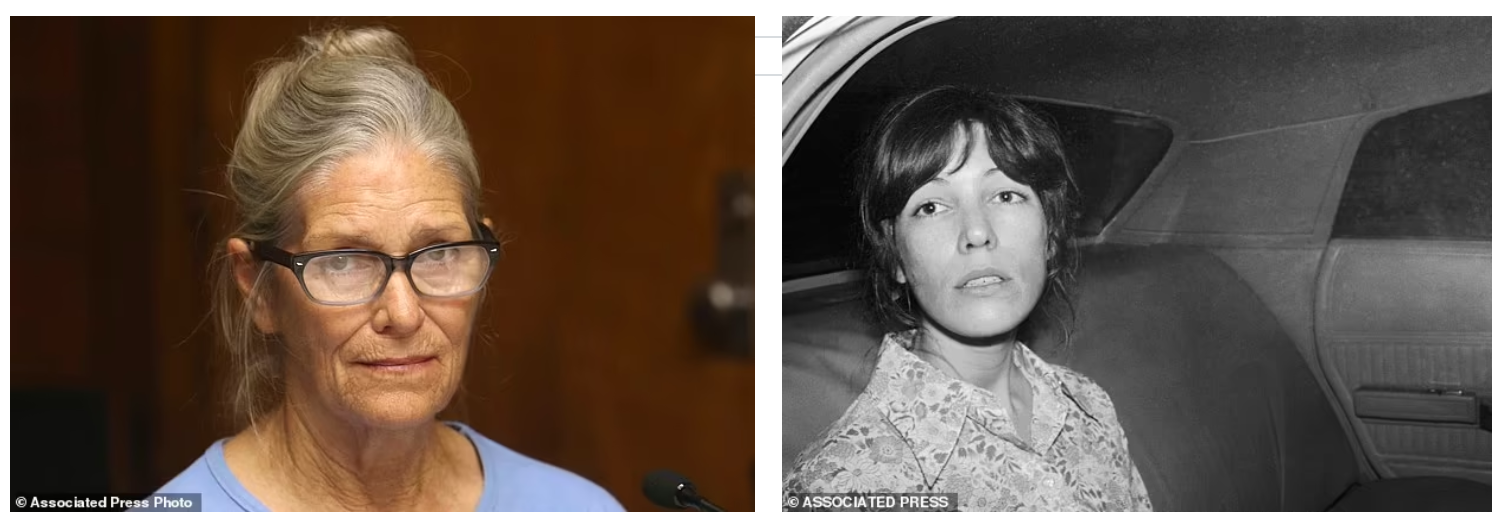
I saw in the news recently that one of Charles Manson’s lackeys is being let out of prison after serving 53 years in prison, to much chagrin by the victim’s families. And I get it, it does a disservice to the families who were robbed of these long decades with the victims; the impact is incalculable. But is this 73-year old woman the same as she was 53 years ago when she was 19? Surely not.
Is the purpose of incarceration to punish or to rehabilitate? If it is to punish, what is the point of issuing a life sentence (especially a life sentence without the possibility of parole) — why not just have flogging, hard-labor for a set period or execution and be done with it? If a crime is so heinous as deserving to deprive the perpetrator of freedom for the rest of their life, shouldn’t execution as punishment be way more widely applied? The cost would certainly be less (if one discounts the unnecessarily extremely expensive execution appeals process). What is the point of a life sentence? If the point is rehabilitation, as it is is many European countries where life sentences means a couple of decades in prison if that, then life sentences without the possibility of parole also make no sense.
Anyway, this was a digression.
If our personalities change over time due to new thoughts, world events, and new experiences, what about personality changes resulting from physical changes? When people get old they become forgetful, get Alheizmers or dementia, can no longer take care of themselves, etc. What can be said about the nature of their soul when they have become entirely different people at that stage in their life due to no fault of their own?
The favorite example I like to use to demonstrate this is the example of Phineas Gage.
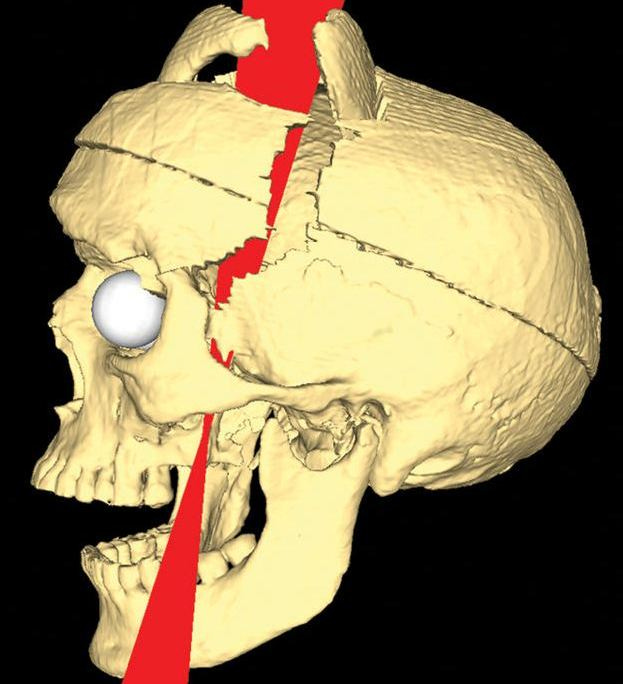
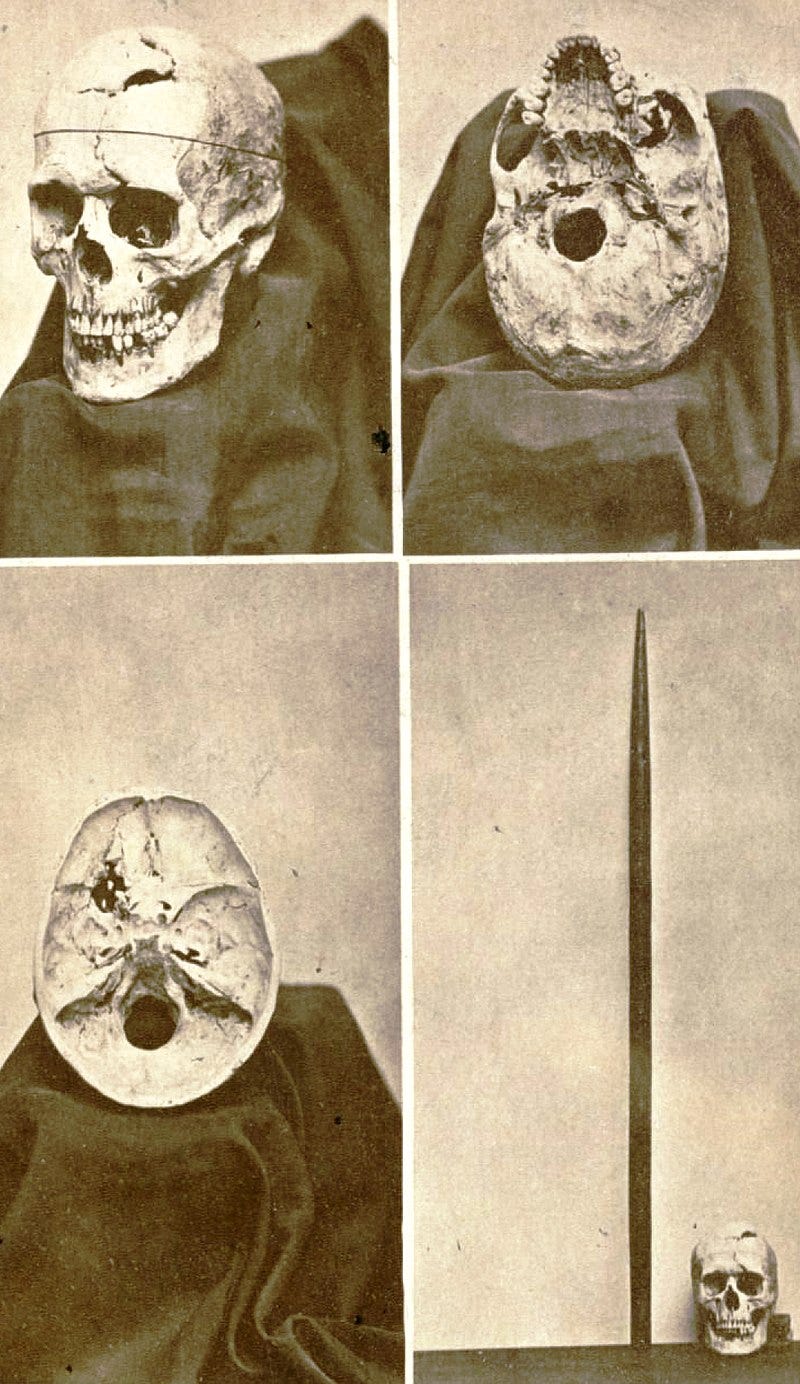
Phineas Gage was a normal man in the 19th century until he suffered a work accident in 1848 and a tamping iron was shoved through his skull with extreme force. He lost an eye but miraculously survived:

After the accident, Gage’s personality completely changed:
Harlow (“virtually our only source of information” on Gage)described the pre-accident Gage as hard-working, responsible, and “a great favorite” with the men in his charge, his employers having regarded him as “the most efficient and capable foreman in their employ”; he also took pains to note that Gage’s memory and general intelligence seemed unimpaired after the accident, outside of the delirium exhibited in the first few days.Nonetheless these same employers, after Gage’s accident, “considered the change in his mind so marked that they could not give him his place again”:
The equilibrium or balance, so to speak, between his intellectual faculties and animal propensities, seems to have been destroyed. He is fitful, irreverent, indulging at times in the grossest profanity (which was not previously his custom), manifesting but little deference for his fellows, impatient of restraint or advice when it conflicts with his desires, at times pertinaciously obstinate, yet capricious and vacillating, devising many plans of future operations, which are no sooner arranged than they are abandoned in turn for others appearing more feasible. A child in his intellectual capacity and manifestations, he has the animal passions of a strong man. Previous to his injury, although untrained in the schools, he possessed a well-balanced mind, and was looked upon by those who knew him as a shrewd, smart business man, very energetic and persistent in executing all his plans of operation. In this regard his mind was radically changed, so decidedly that his friends and acquaintances said he was “no longer Gage.”
What does this example mean toward our understanding of the human soul, of God and of the afterlife? Or what about famous 1950s mass murderer Charles Whitman, whose personality changed leading to his clocktower shooting due to a pecan-sized brain tumor (he knew he was behaving strangely and asked his brain to be examined after death)? There are many such cases. One could also look at electroshock therapy as another (usually less extreme) example of personality change, or horrendous cases of frontal lobotomies as a more extreme example. Also many such cases.
Kaczynski wrote in Industrial Society and Its Future, “There may or may not be an immaterial human soul, but if there is one it clearly is less powerful than the biological mechanisms of human behavior. For if that were not the case then researchers would not be able so easily to manipulate human feelings and behavior with drugs and electrical currents.”
This is the perspective of our materialist overlords, who believe humans are simply programmable meat puppets without a soul (or at least a meaningful one that can resist their dictates) and therefore without any inherent dignity in the eyes of God (who they believe doesn’t exist). Jewish homosexual atheist and advisor to World Economic Forum head-honcho Klaus Schwab Yuval Harari calls humans “useless eaters”. Globohomo has spent a tremendous amount of time and energy learning how these “useless eaters” operate physiologically, especially via endless experiments conducted via the Tavistock Institute and its affiliates.1
If our personality changes as we age, through changing circumstances, drugs, brain tumors or a metal rod shoved through our brains, who exactly are we?
Or what about our species’s personality changes due to humanity’s evolution based on natural selection pressures? What effect does that have on our souls? Or what does artificial selection to breed any species to emphasize or de-emphasize certain personality traits have to say about the soul?
Schopehauer believed that everything came down to the will: a blind, unconscious, aimless striving devoid of knowledge, outside of space and time, and free of all multiplicity. Such a will animated everything living. Nietzsche thought as Shopenhauer did but believed the will not to be aimless, but rather a will to power, and that, like Heraclitus, there were not solid states of anything but merely time-dependent processes playing out; everything was a process of becoming, of change, and nothing was static other than the process of change itself.
There’s even the astrological perspective that our character and dispositions are determined by our natal chart (position of the planets at birth) and progressed chart (how the planets move over time based on the natal chart). The West scoffs at astrology as a pseudo-science (and the vague birth-month horoscopes in newspapers are indeed trash), yet ancient civilizations that had no contact similarly cast horoscopes predicting personality and life events. Should we be so quick to dismiss something that was essentially universally accepted across the world until the modern era? And if the position of the planets determines or influences a person’s personality and evolution of that personality, what would that say about the nature of the soul, free will or of Heaven or Hell?
Regardless, most humans feel as though we possess souls; I know I feel as though there is something more than mere physical reality. Does that mean we do have souls, or perhaps it was an evolutionary advantage to feel so in order to feel less scared of death and to take more risks?
Brett Anderson argues that consciousness (which people generally think of as necessary to possess a soul) is an entirely bodily phenomenon, not subject to mind-body dualism, and that consciousness is a way to transmit information efficiently throughout the brain via self-organized criticality which arises from the interaction of competing brain processes. He believes this theory ties together Global Workspace Theory and Integration Information Theory, where consciousness is defined as the difference between the sum of the brain and its constituent parts. Under his theory it seems like he would deny the existence of a soul, or rather, deny that any knowledge of the soul from within material reality, if any, is possible.
Some people hedge their bets. One of the smartest men in history, John von Neumann, was terrified of death. He was basically an agnostic all his life yet received a deathbed conversion because of Pascal’s wager:
He invited a Catholic priest, Father Anselm Strittmatter, O.S.B., to visit him for consultation. Von Neumann reportedly said, “So long as there is the possibility of eternal damnation for nonbelievers it is more logical to be a believer at the end,” referring to Pascal’s wager. He had earlier confided to his mother, “There probably has to be a God. Many things are easier to explain if there is than if there isn’t.” Father Strittmatter administered the last rites to him. Some of von Neumann’s friends, such as Abraham Pais and Oskar Morgenstern, said they had always believed him to be “completely agnostic”. Of this deathbed conversion, Morgenstern told Heims, “He was of course completely agnostic all his life, and then he suddenly turned Catholic—it doesn’t agree with anything whatsoever in his attitude, outlook and thinking when he was healthy.” Father Strittmatter recalled that even after his conversion, von Neumann did not receive much peace or comfort from it, as he still remained terrified of death.
I obviously don’t have an answer to these questions (although I’ve discussed some of the difficulties with the common perspectives on religion here), and if you have any insight or perspective you’d like to share I’d be interested in hearing it. I’ve heard of various near-death experiences, many of which are quite similar with seeing approaching light, loved ones, etc, as well as astral projections and deathbed experiences where those dying see their dead relatives which perhaps gives them elements of peace, but how does one separate these experiences out from biochemical mega-dopamine releases from the body as death approaches? How does one know what is scientific biochemical reactions and what, if anything, is something more?

It would be great to firmly believe that this world isn’t it, that some aspect of us lives on to be reunited with loved ones in an environment without pain, without suffering, for all eternity. There is such a peace of mind that derives from that belief system, and it is part of Christianity’s enduring appeal. Who wants to grow old and decrepit, lose our facilities and face the black void of eternal nothingness, everyone we loved from prior generations simply gone forever with no meaning or purpose behind it, poof? Who wants to live in a purely materialist universe where globohomo summons a giant woke artificial intelligence, extracts all the world’s natural resources, kills all the animals of the world, gallops toward white genocide, rules over with an iron fist the masses of “programmable useless eaters” for exploitation in locked-down, force-vaccinated “15-minute smart cities”, and leaves a giant dead husk of a planet behind? This is why, in the face of an unrelenting, increasingly atheistic materialist horror animated by what appears to be the Demiurge, there must be a return to religious belief in whatever form it takes. As this materialist horror continues to manifest and intensify, a countervailing religiousness will grow in its shadow because worsening conditions will become too difficult to bear otherwise. Whether this is simply a coping mechanism I don’t know. The horrors of material reality may serve to highlight the materialist/spiritual dualism at the heart of reality and as emphasized by the gnostics much as, per Richard Tarnas in The Passion of the Western Mind, each era in history has served as a springboard for advancement and pushback in the next.
Ultimately, the concept of an all loving God that actively cares about us and that brings us back into His embrace upon death is a powerful belief that isn’t so easily replaced by science or materialism, which can explain how but not why. Indeed, this gross materialist Machine metaphysically uses the traditions and beliefs of humans as fuel for its continued propagation, which is why there has been such a collapse into the nihilism as prophesized by Nietzsche with the “Death of God”. At least to me, the counter to pure materialism can be summed up by the song that best approximates the feeling of a loving God, George Strait’s “Love without End, Amen”:
George H.W. Bush, an evil globohomo type who spent his life screwing over the vast majority within America, was a big fan of this song and he seemed to really love his family and children. People are complicated and strange.
Subscribe:
Email delivery remains on Substack for now.
1 The Tavistock Institute, heavily funded by the foundations to the tune of billions per year, developed the mass brain-washing techniques which have been widely used on the American public by modifying individual behavior through topical psychology. Tavistock’s pioneer work in behavioral science along Freudian lines of “controlling” humans established it as the world center of foundation ideology. Its network extends from the University of Sussex to the U.S. through the Stanford Research Institute, Esalen, MIT, Hudson Institute, Heritage Foundation, Center of Strategic and International Studies at Georgetown, where State Dept. personnel are trained, US Air Force Intelligence, and the Rand and Mitre corporations, along with the personnel of the foundations. Tavistock originated the mass civilian bombing raids carried out by Roosevelt and Churchill (who was so corrupt that he had to be continuously bailed out by his benefactors) against Germany as a clinical experiment in mass terror, keeping records of the results as they watched the “guinea pigs” reacting under “controlled laboratory conditions.” They were also responsible for the “experiment” in compulsory racial integration, the use of drug experiments (see MKUltra), and placing German foster children with pedophiles. The goal of their research is to break down the psychological strength of the individual and render him helpless to oppose Rothschild central bank owners. Any technique which helps to break down the family unit and family inculcated principles of religion, honor, patriotism and sexual behavior is used by Tavistock as weapons of crowd control. Ten major institutions are under Tavistock’s direct control with 400 subsidiaries and 3,000 other groups and think tanks which originate many types of programs to increase establishment control, per Eustace Mullins in “The World Order: Our Secret Rulers”, 285-288.