
This is a disturbing post. Read on if you dare.
This is a continuation of and branching off from a prior post, The sad skinsuiting of the environmental movement, Part 1 and Part 2. In that post I noted how the environmental movement was taken over by the political left and then skin-suited for ulterior goals even as humanity rapidly consumes the world’s natural resources – an unsustainable trainwreck which will have devastating consequences down the road for all of us. That isn’t to say ranchers and loggers and other right-leaning people don’t care about sustainability, but from a political standpoint the environmental movement is still considered “leftist” as seen through organizations such as Greenpeace, the World Wildlife Fund and the Sierra Club.1 Images that come to mind are hippies tying themselves to trees to stop logging and PETA protesters showing their tits. It’s a stupid dichotomy and stupid branding and I reject it.2
I want to focus on a specific aspect of environmentalism in this post: the horrors of the industrialized food production system. In Part 2 of the above I had written in part:
“The industrialized food system is a complete horror show. The animals that aren’t at risk of going extinct are those that humans raise for consumption such as cows, pigs and chickens….[The scale of slaughter is mind-boggling]…But their lives are horrifically bad in the modern industrialized meat production system which breeds for economic efficiency; short, brutish lives, and in the dark and in pain, yanked from their mother’s embrace either at birth or close to birth.”
Now, I eat meat. Especially red meat. A lot of it, almost daily. I love the taste and I love the way it makes me feel. I ate a carnivore diet for awhile and it put me into amazing shape. You can see a guy like Dr. Shawn Baker and all he eats is unprocessed or low processed red meat and he looks incredible and has broken all sorts of rowing world records on this diet.
You are what you eat, and Baker looks like a giant steak now.
In fact, an all-meat or close to all-meat diet is a clean cure for the obesity impacting most Americans today given most of our food supply is poisoned with seed oils and endless strange chemicals throughout the food supply. Click the above link if you want to read a post about the obesity crisis, but it’s not pretty:
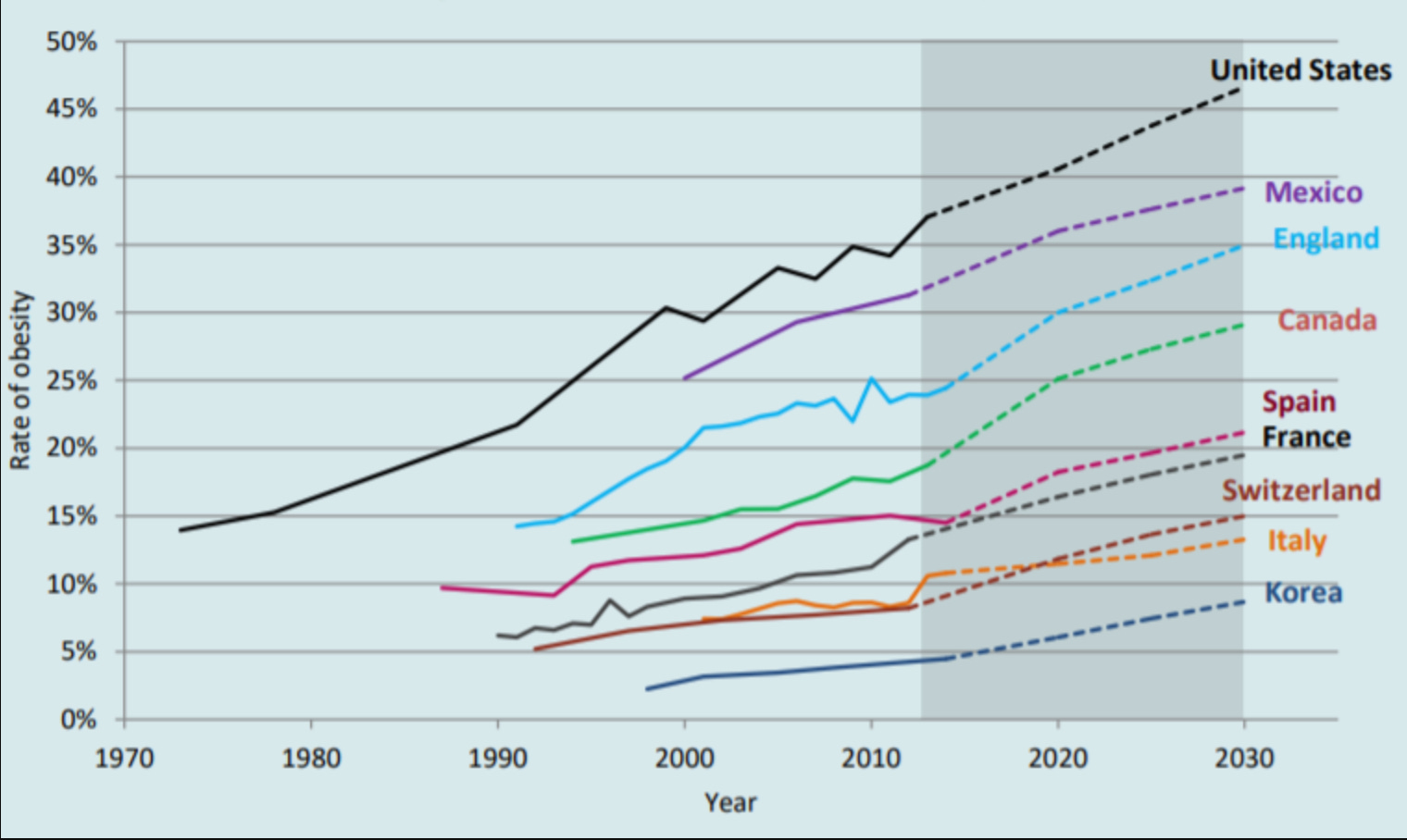
Alt-light scion Joe Rogan went on an all-meat diet for a month and raved about it. Or consider wonderful biologist and exercise coach P.D. Mangan, whose motto is “sun, steak, steel” and he looks like this in his 60s:
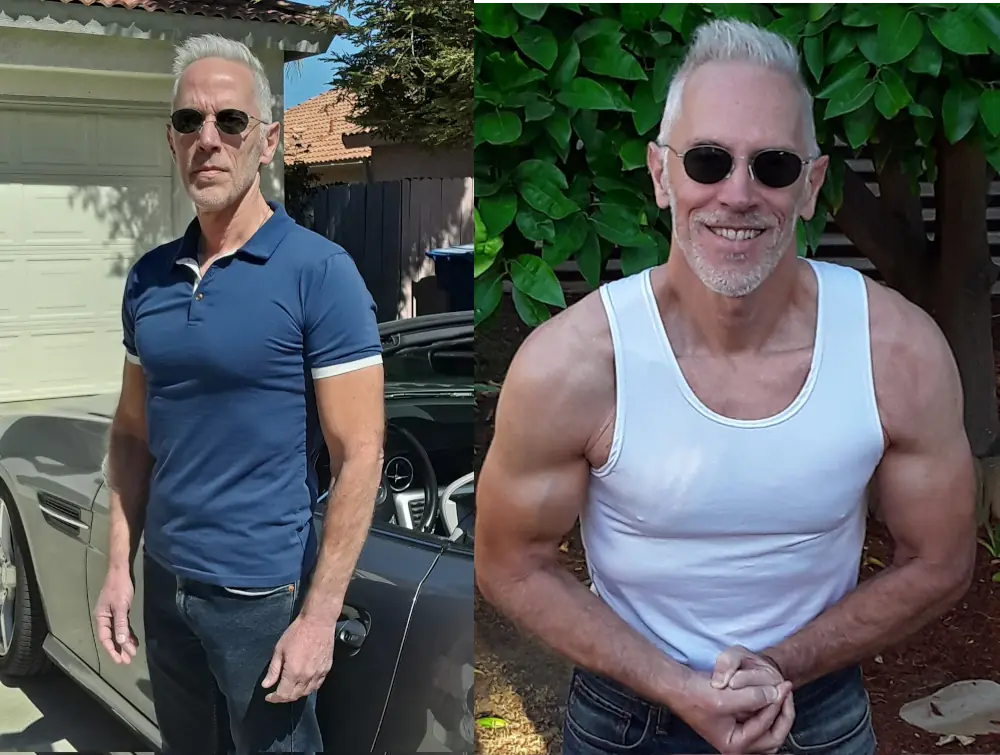
The results are clear from a carnivore diet: it works. Prior to the neolithic agriculture revolution 10,000 years ago humans were hunter gatherers and ate a mostly meat diet along with fruits and nuts. That’s what our bodies are adapted for, although we are gradually changing genetically over time to account for a sedentary agricultural lifestyle. If you eat carnivore many of the ailments of modern living may either be positively impacted or disappear, as attested to at Baker’s website here. 107 pages of success stories. And it’s healthy, too: consider that Hong Kong has the highest life expectancy on the planet and the highest rate of red meat consumption, while India, which has a very low rate of red meat consumption (only among its Muslims), has a much lower life expectancy and rapidly rising rates of obesity. Official science’s stance on meat consumption, especially red meat consumption (low or unprocessed) is a lie.
We can get cheap meat, as much of it as we want. It is plentiful and ubiquitous and cheap, cheap, cheap on a historical basis, even after accounting for recent food inflation. But life in many respects is about moderation. After the agricultural revolution humans ate meat uncommonly, and before that the human population was tiny in comparison to other species and to the world at large; our impact was less.
How often do we ask about the process that goes into that cheap food production? We are all vaguely aware that there is an industrialized meat production system, but the truth of it is really ugly and most of us would prefer the convenience of eating it, and eating it cheap, than thinking about the process behind things.
Well, here are some numbers:
Land animals only (USDA 2020 slaughter + imports – exports + pre-slaughter deaths):
- Every year: 8,533,141,000
- Every day: 23,378,000
- Every hour: 974,100
- Every minute: 16,234
- Every second: 271
Inclusive of land and aquatic animals:
- Every year: 55,429,141,000
- Every day: 151,888,000
- Every hour: 6,328,000
- Every minute: 105,480
- Every second: 1,758
Here is more information on the numbers. The scale of it seems almost beyond comprehension. These animals are mostly kept in small, cramped, dark, conditions; they are injected with hormones to grow faster and with antiobiotics and vaccines to prevent disease from spreading in such poor conditions. They are killed as soon as they are of sufficient size. Chickens, for example, are bred to have as large of breasts as possible to the point they cannot walk. Male chicklets are usually killed shortly after birth as a standard process:
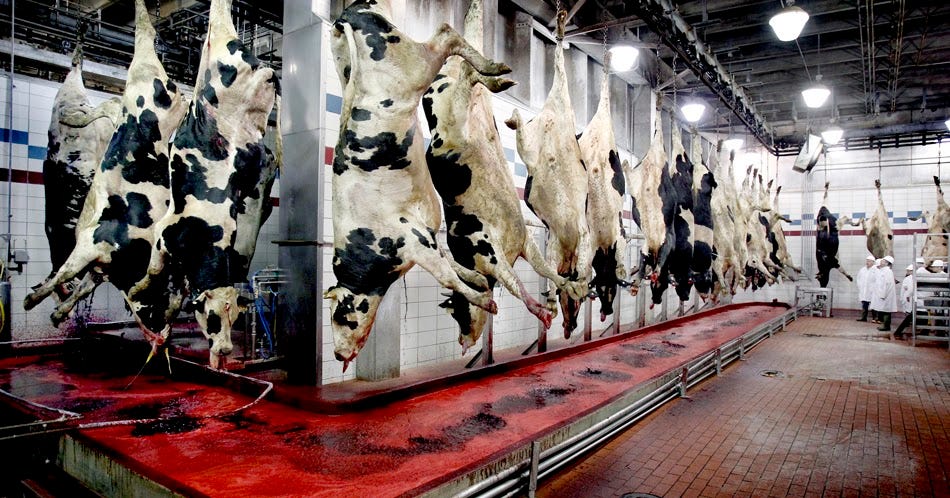
Even the milk we enjoy comes from cows being kept impregnated with their baby cows taken from them immediately after birth. Cows only lactate in the period after birth, which can be extended with painful techniques.
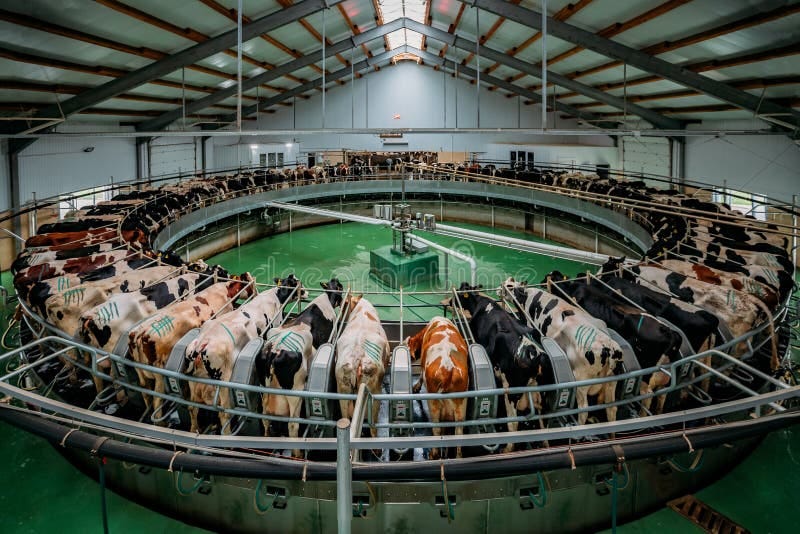
How can one claim this planet is anything but a horror show nightmare based on this? (As a side note, note that the proclaimed worst group in history, the Nazis, wanted to ban this kind of industrialized meat slaughter).
Sometimes I get a flippant “Why should I care?” to the above when discussing this issue. I judge those who give that response – it shows a deep and unfathomable hole in their hearts – but the answer is simple and it’s strange that it has to be elaborated on. If one doesn’t believe that this world is simply here for human pleasure, that everything else is simply a tool to manipulate for our enjoyment (a disgusting myopic anthropocentrism), if we believe that animals possess some kind of consciousness and soul, that we are all connected in this universe and not disconnected from it as part of our “divine reason”, if we believe that we should treat others as we wish to be treated, the Golden Rule affirmed throughout history and by religion, then we have a duty to at least be mindful of the things that we consume and work to create less pain and darkness in this system (a correct biocentrism).
Of course nature itself is brutal. You can go on Youtube and watch plenty of videos of animals eating each other alive. One that particularly sticks out in my mind is of a Komodo dragon slowly eating a paralyzed in fear deer while filming tourists watched:
There’s a rhythm and a flow to what happens in nature, though. It can be terrible to watch but it’s the natural order of things regardless of our feelings. This industrialized meat production system though is something else, a reflection of the same Machine, the same mechanization process that has lowered humanity to widgits. Do you think our globohomo overlords do not consider the masses of humanity itself in the same manner, that they must be either used or discarded? If we treat animals in this manner, without any dignity or concern, why would that process not extend eventually to the rest of us?
There’s not an easy solution to the industrial food production system as this time because the human population size is too large. How else would you feed 8+ billion people? It is what it is at this time, it’s not going away — but it’s both unsustainable based on the rate of natural resource consumption (see the links at the top) and deeply immoral. The system is set up to consume and exploit everything it can and then eventually collapse once natural inputs run out, leaving a blown out smothering ruin in its wake. And ultimately consumers choose lower prices over higher quality with regularity – it’s so easy to point the finger elsewhere, but would you rather buy the $5 “regular” chicken breasts or the $9.99 cage free, free range chicken breasts? If the labeling was even real, and who really knows?
So let’s sum this up. There is a natural dilemma to meat eating: our bodies are tuned to it because of millions of years of evolution as hunter gatherers, we can survive and be healthy and have long lives on exclusive meat diets, yet the system that produces cheap meat is utterly immoral and horrific. One can ameliorate the moral implications to a degree by eating grass fed, open pasture animals, but that’s just only to a degree. It would be better to have a connection to the food we eat, i.e. to raise our own animals for consumption on a farm, but very few do this today. This is not a left-right issue but an anthropocentric vs biocentric model of the world. This also speaks to the incentive structure of reality: any alive creature basically only survives by eating other alive things (even plants are alive and feel pain). If it was morally wrong to eat meat, why would God create such a system where our bodies respond so well to it? The incentive structures for this reality are wrong, they clash with the Golden Rule. This feeds back into the whole Demiurgic argument, in my opinion…
This doesn’t mean I’m going to stop eating meat, even a lot of meat, although maybe my views will change down the road. I try to be conscious of what I’m consuming, though, I try to buy grass-fed and pasture-raised meat3, and I try to think of whatever animal I’m eating and say “thank you” before every meal when I consume it. It’s not a perfect solution, vegetarianism or veganism is certainly more ethical, although apparently enormous numbers of animals – billions a year – are killed to keep them from consuming non-meat products as well.
Ultimately a shift from this mechanized anthropocentric model to a biocentric model is needed with a shift from a focus on quantity/egalitarianism to a focus on quality/inegalitarianism (to a degree), in line with Rene Guenon’s prediction that the reign of quantity would eventually give in to a new paradigm. Globohomo’s preferred solution – keep the anthropocentrism but expand it to only the central bank owners and their lackeys as the most important creatures on the planet, not humanity as a whole – where the masses get lab grown meat (heavily processed and unhealthy, literally growing tumors, and injected with mRNA cancer causing “vaccines”) and bugs while the top class continues to get real meat – is a terrible vision for the future.
I’ll do a future post on rates of animal and plant extinction and the destruction of planetary biodiversity. It’s all pointing in a very ugly neo-Malthusian direction.
Thanks for reading.
Subscribe:
Email delivery remains on Substack for now.
1 Another one that came to mind was the anti-whaling direct action organization Sea Shepherd which had split from Greenpeace over tactics. However, in research for this article I came across Paul Watson, its founder, who had originally split from the Sierra Club over the issue of immigration. Watson was correct in that a strict anti-immigration stance is absolutely necessary for the environmental movement because immigration into first world countries dramatically increases the consumption patterns of those immigrants. Indeed, the open borders policies of so-called environmental organizations shows how empty and skin-suited such organizations are. Watson later split from Sea Shepherd after it became skin-suited too (what mainstream organization has not?). He recently created a new organization named after himself because “the reason I called it that is because it’s pretty hard for anyone to infiltrate and take over an organisation that included my name.” Watson seems worthy of further study. This brings to mind the recent skin-suiting of Project Veritas where the usual suspects ousted James O’Keafe, the founder, before shutting the company down who went on to create a new organization in his own name.
2 Or see Junger in The Details of Time, 52: “I tend to think that [the Greens are] on the right path: perhaps like Faust’s famulus, who wanted to know everything but had not yet put his knowledge in order. This could certainly happen if first-rate personalities emerged from those circles. In any case, there is something that you have been able to note and that I dwell on in my book The Worker: namely, that pure economy is not enough. We are therefore sent from economy to ecology. That’s a first step, but of course it’s not the last. Nevertheless, I insist that it’s a step in the right direction.”
3 Even those these labels are often misrepresentative. I know the head of a local grocery store and he claims that these food quality labels – especially the “organic” label – are often thrown on to get higher prices but do not have underlying differences otherwise. The best way is if you know your local rancher so you can verify yourself where the meat is coming from, but those in major cities do not have that opportunity.