This essay continues the structural analysis of upper elite beliefs by examining two paradoxes the framework generates. The first: if upper elites converged on a Talmudic/Kabbalistic eschatological framework as binding technology and engineered WW2, why did that process destroy precisely the most religiously observant Jewish communities as the primary carriers of the tradition they supposedly operated within? The second: what explains the survival and rise of Chabad – small, poor, and marginal in 1951 – into a worldwide political force whose influence now touches Trump, Putin, Zelensky, and Palantir simultaneously? The resolution of both paradoxes turns on a single principle: in a sufficiently centralized power environment, networks are neither preserved nor destroyed by accident.
Welcome back. In this post I would like to continue my structural exploration of upper elite beliefs. In Part 1 I argued, using IF-THEN logic, that IF there were an upper elite who possessed centralized power and guided world affairs, THEN, based on an understanding of human nature and incentive structures, it would naturally converge on a legitimization framework with certain features. These features would be necessary to justify elite rule both to themselves and to others, to keep themselves united in a shared vision, and to provide longterm goals to organize around. Secular ideology and the pursuit of power for its own sake would not be sufficient binding glue to keep such upper elites from infighting; people want to think of themselves generally as the “good guys”, and to act against an underlying ontology would create cognitive dissonance which builds up over time and finds uncontrolled outlets. Therefore they would constellate around the following attributes in a religious, not a secular context:
- non-redemptive theology (where power doesn’t need to justify itself via outcomes),
- infinite interpretive flexibility (where any action can be reframed as necessary), and
- ontological hierarchy (with exploitable lower tiers without moral contradiction).
Most Western traditions lack one or more of these: (1) Christianity is redemptive, universalist, and weak dialectically, (2) Islam is redemptive, interpretively closed, with a universalist ummah, (3) Marxism is redemptive (classless society) and ends at revolution, (4) liberalism is redemptive (progress) but denies hierarchy. A Talmudic/Kabbalistic framework uniquely provides all three: (1) Yahweh as a God-image containing both good and evil (destruction is divine, not error), (2) Tikkun olam and pilpul (permanent incompletion plus infinite recursion), (3) Rabbis → Jews → Righteous Gentiles → Kelipot (ontological stratification); therefore, elites seeking maximum power-legitimation would converge on this framework not because of ethnic conspiracy but because it’s structurally optimal for their needs. This perspective discounts the argument that the Anglo elites of the United Kingdom or the U.S. are in the apex power position, and that the apex is held by the central bank owners.
Part 2 of the essay extended this logic to what specific end goals this shared vision would likely be structurally, which is based on Jewish eschatology: the ingathering of the exiles/diaspora, the manifestation of Greater Israel, the rebuild of the third temple and the proclamation of the Messiah, and that this vision would rule the world formally and externalized via a combination of central bank digital currency, woke artificial intelligence scanning everyone’s digital footprints and assigning social credit scores, where those with poor scores will be cut out of society and their funds stolen from them. It is this longterm, multi-generational vision combining religion and power that would be able to unite the upper elites, give them a shared vision, prevent infighting, and address any psychological issues caused by domination as part of God’s will/plan (It also explains why, apparently, much of the critical infrastructure of the West is designed in Israel).
There are two deep paradoxes raised by this framework to a careful reader, and this is what this post intents to wrestle with:
- If upper elites converged on a Talmudic/Kabbalistic eschatological framework as binding technology and engineered WW2, why did that process destroy precisely the most religiously observant Jewish communities as the primary carriers of the tradition they supposedly operated within?
- What explains the survival and rise of Chabad – small, poor, and marginal in 1951 – into a worldwide political force whose influence now touches Trump, Putin, Zelensky, and Palantir simultaneously?
As we will see, the resolution of both paradoxes turns on a single principle: in a sufficiently centralized power environment, networks are neither preserved nor destroyed by accident. Note that this essay is long, technical, and with many footnotes, because the answers to these specific questions require a historical understanding and framing.
The First Paradox: Hasidic Judaism Destruction
If apex elites are (a) Jewish in identity or converged on it as a structural optimism argument, (b) use eschatological frameworks as generational binding technology, and (c) engineered or enabled the conditions for WW2 (Guido Preparata argued convincingly that the upper elite engineered these wars in his must-read Conjuring Hitler, discussed here), then the almost total destruction of the most religiously observant, anti-Zionist Hasidic Jewish populations of Europe creates a deep structural paradox (this post is not meant to get into the details of the Holocaust – you can see the following footnote if you want my opinion1): they’re wiping out the primary carriers of the very tradition they’re supposedly animated by. How does one reconcile this paradox?
There are four theories:
- The acceptable loss theory. The eschatological goal – a Jewish state as precondition for end-times fulfillment – required both the moral/political pressure that only catastrophic persecution could generate, and the elimination of diaspora as a competing “solution” to Jewish existence. The Orthodox and traditional communities of Eastern Europe were, from this angle, obstacles as much as victims: their theology was anti-Zionist (many strands of Orthodoxy considered political Zionism a violation of the divine prohibition on “forcing the end”). The destruction of Vilna, of Polish Jewry, of the yeshiva culture removed the most theologically serious opposition to the Zionist project. Acceptable loss calculus, with the scale perhaps exceeding what was anticipated or intended.
- The Sabbatean/Frankist strand.2 The Sabbatean/Frankist tradition is explicitly antinomian – it holds that in the messianic era, transgression of the law becomes the path to redemption, that the sacred can be reached through deliberate descent into the profane.3 Jacob Frank explicitly taught that the Torah of the new age inverts the Torah of the old. From this framework, the destruction of normative, halachic, establishment Judaism is structurally consonant with the vision, where the old Torah-world had to be annihilated for the new order to emerge.4 The apex elites operating within this strand would have had theological justification for viewing the Orthodox communities not as their own people being sacrificed but as representatives of a superseded dispensation.
- The identity discontinuity theory. The apex elites’ Jewish identity is nominal or instrumental, where they use Kabbalistic/eschatological frameworks as coordination technology without being bound by ethnic solidarity to Jewish communities generally. The communities destroyed were, from their vantage, not “their” people in any meaningful sense. This is coldly cynical rather than theologically motivated, but structurally it solves the paradox by dissolving the assumed solidarity. A contemporary data point that illuminates the identity discontinuity theory is that during COVID-19, Israel was among the most aggressively locked down and force-vaccinated countries in the world, alongside Australia, subjected to the same population control measures imposed on gentile populations globally. If upper elites operating through a Jewish eschatological framework maintained genuine ethnic solidarity with the Jewish population of Israel, this would be difficult to explain. It becomes explicable only if the apex network’s relationship to ordinary Israeli Jews mirrors its relationship to other populations: instrumental rather than solidary, the masses as pawns regardless of ethnic identification. The Israeli population, including its religious communities, appears to have been a test case for the digital surveillance and vaccine compliance infrastructure that the broader globalist project requires, suggesting the eschatological end goal does not extend its protections to ordinary Jews any more than to ordinary gentiles. The pyramid has many layers, and proximity to the apex, not ethnic membership, determines one’s position within it.
- The unintended scale theory. They opened a door – engineered conditions for persecution and displacement sufficient to drive Zionist political momentum – without anticipating or fully controlling the industrial scale of what the Nazi machinery would do. This requires believing in meaningful gaps between apex intention and implementation, which has some structural plausibility: the system had its own dynamic once set in motion. The anti-immigrationist Breckinridge Long, who was Assistant Secretary of State committed to halting refugees to America, wrote in his diary in 1944: “The Jewish organizations are all divided amid controversies…There is no cohesion or any sympathetic collaboration – rather rivalry, jealousy and antagonism”, which cuts against the idea that the upper elites controlled every aspect of the war (although Long was undermined and forced to resign after Henry Morgenthau Jr. – who proposed to genocide Germany via his Morgenthau Plan – complained to Roosevelt about Long’s efforts to keep America’s doors closed to hundreds of thousands of Jews fleeing Hitler; after his resignation 200,000 were allowed in via the War Refugee Board.)
The Sabbatean/Frankist angle is the most structurally elegant resolution to the core paradox, precisely because it dissolves the assumed solidarity. The three attributes useful for the upper elites – non-redemptive theology, infinite interpretive flexibility, ontological hierarchy – are present in Talmudic/Kabbalistic Judaism generally, but Sabbatean/Frankist antinomianism adds a fourth attribute that the others lack: active sanctification of transgression as the mechanism of historical completion. Standard Kabbalistic frameworks provide the structural properties while Sabbatean/Frankism provides the operational theology, the specific permission structure for doing whatever the eschatological project requires, including destroying the old order, without experiencing cognitive dissonance. It’s not that upper elites would necessarily choose Frankism over other Kabbalistic strands, it’s that the Frankist strand provides the most complete permission structure for the specific actions apex power requires.
If the operative theology at apex levels is indeed antinomian – if the old Torah-world represents a superseded dispensation that must be overturned for messianic emergence – then the destruction of normative Orthodox Jewry wasn’t a tragic cost to be rationalized, it was theologically consonant with the vision. The Frankist doctrine that redemption comes through the inversion and transgression of the old law provides the grammar for viewing the annihilation of halachic Judaism as participation in the mystery rather than sacrifice of one’s own. This sharpens the confluence of the theories: the “acceptable loss” theory becomes theologically motivated rather than merely strategic when filtered through the Frankist lens, and the Zionist state as eschatological requirement doesn’t just need the Holocaust political pressure, it needs the elimination of the theological competition that the Orthodox anti-Zionist world represented.
The Transmission Mechanism
The missing piece is the transmission mechanism. That’s where Gershom Scholem’s Redemption Through Sin becomes helpful reading, which is serious scholarship documenting the Frankist underground’s persistence and its infiltration of the Haskalah, serving as the gateway into 19th century Jewish intellectual and eventually political modernity5 (although Israel Shahak believes that Scholem hides critical information he deems would be antithetical to Judaism.6)
Even though the Sabbatians intentionally obscured their beliefs7, the transmission mechanism from 18th-century sectarian heresy to 19th-century financial and revolutionary power is partially recoverable through specific documented cases. As Scholem writes, “Not only did most of the families once associated with the Sabbatian movement in Western and Central Europe continue to remain afterwards within the Jewish fold, but many of their descendants, particularly in Austria, rose to positions of importance during the nineteenth century as prominent intellectuals, great financiers, and men of high political connections.” Jacob Frank’s nephews, whether as believers or out of some other motive, “were active in high revolutionary circles in Paris and Strsbourg…[and] while the idea of violating the Torah of beriah remained a cardinal principle of “the holy faith”, its application was transferred to other areas, particularly to dreams of a general revolution that would sweep away the past in a single stroke so that the world might be rebuilt.”
Moses Dobruška – Jacob Frank’s first cousin, ennobled in Vienna as Thomas von Schönfeld – provides the clearest human link. A founding architect of the Order of the Asiatic Brethren, the first Masonic lodge to explicitly incorporate Kabbalistic ritual and admit Jewish members, Dobruška later appeared in Paris as ‘Junius Frey,’ a Jacobin Club member executed alongside Danton during the Terror. His trajectory from Frankist initiate to esoteric lodge founder to revolutionar maps the precise path by which the antinomian permission structure migrated from sectarian underground to secular political modernity. The Asiatic Brethren functioned as the institutional vessel: a ‘neutral’ esoteric space where Frankist-derived theology – the old order as husk to be shattered, transgression as sacred work – was transmitted to European aristocratic and intellectual elites under the guise of Kabbalistic wisdom. By the time this current reached the revolutionary and banking frameworks of the early 19th century, the theology had been secularized with its eschatological grammar intact, its explicitly Jewish content abstracted into universal revolutionary ideology. The persistence of this network into the 19th and 20th centuries followed three distinct paths:
- Aristocratic integration where the mass conversions and ennoblements of the late 18th century, typified by the Offenbach baptisms, dissolved the sectarian form while preserving the network’s high-trust cohesion through specific marriage patterns that Scholem documented persisting a century after formal conversion.
- Financial institutionalization where the transition from court banking to international finance, most visible in the Frankfurt milieu from which both the Rothschild and Schiff networks emerged, and which culminated in the construction of the Federal Reserve architecture by figures like Paul Warburg.
- Intellectual migration where the absorption of the antinomian permission structure into Haskalah secularism and subsequently into the progressive, legal, and media institutions that constitute the modern interpretive apparatus.
By the 20th century the theology had been abstracted with its eschatological grammar intact, its explicitly sectarian content invisible, its functional properties – non-redemptive, infinitely flexible, ontologically hierarchical – operating through secular institutional forms that neither their operators nor their critics recognized as carrying a specific theological inheritance. The framework’s persistence is identifiable through functional continuity, with the same three structural properties operating through successive institutional forms, regardless of what those institutions call themselves or what their operators believe about their own motivations.
The most documentable human chain example runs through the Frankfurt Judengasse, where the Schiff family shared a communal house with the Rothschilds for decades before both families emerged into international finance in the 19th century. Jacob Schiff’s Kuhn Loeb partnership financed Japan in the Russo-Japanese War – a move that contributed to Romanov destabilization – while Paul Warburg, who had intermarried with the Schiff family, became the primary architect of the Federal Reserve system in 1913. James Warburg, Paul’s son, later told the U.S. Senate in 1950 that world government would come “whether or not we like it.” Whether these figures consciously carried Frankist theological formation cannot be documented, but what can be documented is that they emerged from the specific Frankfurt milieu where Frankist-adjacent networks operated, constructed the central banking architecture as the apex coordination mechanism, and expressed a long-term vision of global governance that maps precisely onto the eschatological end-state Parts 1 and 2 described. The theology may have been fully secularized by this point, but the functional properties it produced were identical to what a consciously Frankist-informed program would have built. The names change from Dobruška to Warburg, but the structural affordance remains, with the transmission of a specific operational software that proved more durable than any competing framework in modern history.
The Second Paradox: The Near Destruction then Flourishing of Chabad
But this raises another paradox. If the upper elites destroyed anti-Zionist Orthodoxy as theological competition – and this can be structural confluence rather than fully intentional8 – what explains the survival and flourishing of the Chabad movement under Menachem Schneerson, universally considered the most influential rabbi of the 20th century, which was initially non-Zionist before later pivoting to activism? Chabad is not Sabbatean and has historically been opposed to it. This question is relevant because Chabad today seems to have an unusually large amount of public influence over key political figures across the world: from Trump (via Kushner but also many other angles, including Lutnick) to Putin (Berel Lazar as Putin’s preferred Chief Rabbi9) to Zelensky (his relationship with Moshe Azman), and even to Palantir, which Chabad honored at a ceremony for its work on belief of Israel (“over 500 people, including more than 50 House and Senate Leaders and Members, ambassadors and senior diplomats, packed Washington, DC’s regal Great Hall of Union Station for the Annual Lamplighter Awards Dinner in support of American Friends of Lubavitch (Chabad) in Washington, DC….The magnificent event honored Dr. Alex C. Karp, Co-founder and CEO of Palantir. The Leadership Award was bestowed upon Hon. Hakeem S. Jeffries, Democratic Leader of the US House of Representatives”). The relationship of the upper elite to Chabad changed over time, and understanding how and under what circumstances it changed sheds light on the relationship between networks and power systems. To investigate this question I read Rebbe (2014) by Joseph Telushkin, a 600 page hagiography organized by topic by the son of Chabad’s accountant and which received rave establishment reviews. It’s extreme positivity about its subject reminded me of Buber’s Tales of the Hasidim (1946), which took a similarly one sided, laudatory perspective about its topic. I also read The Secret of Chabad (2015) by David Eliezrie, another Chabad insider and even more of a hagiography than Rebbe, and offset these with Israel Shahak’s highly critical Jewish Fundamentalism in Israel (1994).
One may note that structural and religious arguments overlap and blur in ways that resist clean separation. The structural argument offered here looks at the religion from the outside as an organizational approach to power, but for those on the inside the power that results from it is a natural result of doing God’s will. If Chabad and/or Kabbalah/the Talmud’s approach outcompetes its enemies based on a more accurate appraisal of reality’s incentives, human psychology, and nature, does that mean that God himself blesses these organizations, or does it mean that they are simply more optimized structures for domination based upon underlying reality without anything being God given? These perspectives are methodologically incompatible, but at least my approach is falsifiable based on recursive predictions while theirs is unfalsifiable.10
Chabad’s Approach
Chabad had distinguished itself from other Hasidic organizations because of its international outreach strategy embracing less observant and secular Jews through “smiles and love”, a strategy that its insular competition did not employ (although Yeshiva University professor David Berger notes “I have no doubt about their fundamental sincerity. But in the face of resistance, they engage in tactics whose ruthlessness has shaken even [those predisposed to liking them].”11 Schneerson’s predecessor, the 6th Chabad head rabbi known as the Frierdiker Rebbe, was imprisoned by the Soviets and sentenced to death in 1927 for counter-revolutionary activities (Chabad was the only organization to run yeshivas and Hebrew immersion classes under the Soviets, having a clandestine network12), but international pressure was brought to bear based on his connections and he was both released and allowed to leave the country, which was unheard of. This repeated itself: after Nazi Germany’s invasion of Poland in 1939, the Frierdiker Rebbe was able to use American diplomatic pressure to get Nazi Germany to allow his and his family to leave the country, also highly unusual, as recounted in Bryan Mark Rigg’s Chabad sympathetic Rescued from the Reich (2004).13 These actions showed the power and reach of Chabad in terms of its cultivation of powerful political relationships despite their poverty and small size, although that power was used on behalf of its leadership.
Menachem Mendel Schneerson, upon his ascension to power, dramatically broadened Jewish outreach. His character was unusual – apparently he had memorized the entirety of the Torah, Talmud, and Kabbalah, and could cite and cross-cite from it at will, and he had extremely strong memory retention with respect to networking – remembering names, who they were connected to, their stories, what they liked and didn’t like, etc. even decades later – and he held court for whoever wanted to talk to him, called farbrengens, at least twice a week until three or four in the morning, then arising after only a few hours of sleep to start the process over again. Schneerson’s memory retention extended beyond religion to include politics, culture, and military strategy and tactics. His astrology profile was interesting.14 His objective was to hasten the return of the Messiah, and he didn’t think there was a moment to wait – anything that could be done now should be done now, and no one should rest on their laurels, always challenge oneself to push for more. There’s a famous video of Schneerson telling Netanyahu to do what he could to hasten the Messiah’s return15:
Netanyahu later remarked “The Rebbe gave me my mission in life.”16
What Rebbe hints at is that Schneerson had or grew into a dual role – if his primary and intense objective was “Mashiach Now”, then it would only make sense that he would be involved not just in Jewish outreach but connected to clandestine efforts to promote Judaism and Israel that could and would not be publicly disclosed, such as his deep connections to Mossad, apparently even outranking them in some matters.17 Yitzchak Rabin left a meeting in 1972, confiding to diplomat Yehuda Avner, “The Rebbe knows more about Israeli security than the 120 members of the Knesset.” There are even hints that his network had a role in Stalin’s death during Purim when Stalin was weeks away from deporting their Jewish community to Siberia, which would have been a likely death sentence.18 Schneerson later predicted the upcoming end of the Soviet Union in 1985.19 This story from Eliezrie’s book, p. 255, is worth repeating here:
In 1968, [Ariel] Sharon visited the Rebbe in New York and was strongly urged by the Rebbe to change his return flight. Sharon complied, though he did not understand why. His planned El Al flight was hijacked by terrorists on the last leg between Rome and Tel Aviv, and diverted to Algeria. General Sharon would have been a big prize. The Israeli daily, She-arim, wrote at the time, “It seems the whole purpose of the hijacking was to get Sharon.” The Rebbe’s advise had saved his life.
Eliezrie, of course, does not follow up at all with the pertinent questions about how Schneerson know this information. As he notes in a footnote though, p. 386, “Even today it is difficult to unveil the layers of secrecy concerning the activities of decades ago. Many of those involved have passed on and there are few written records. The Rebbe compartmentalized the work. It was all on a need-to-know basis. It seems that no one other than the Rebbe knew the broad scope of the secret efforts. Even the Rebbe’s secretaries were not privy to the vast majority of the activities.”
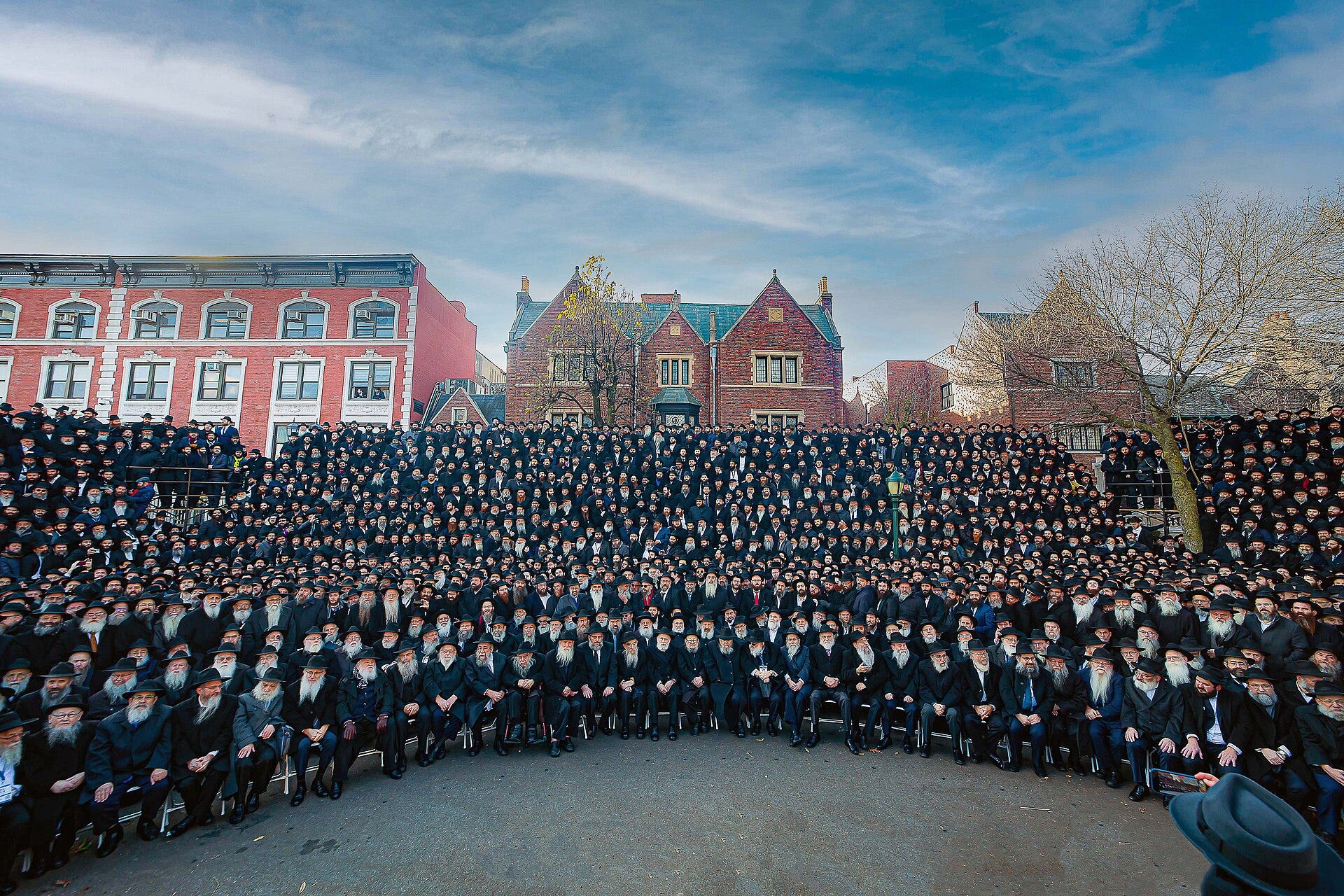
Chabad under Schneerson grew and flourished as a result of his activities, and he sent his shluchim (emissaries) all over the world, who established Chabad houses near universities, financial centers, and diplomatic communities, so the network naturally intersected with mobile elites and grew into a motivated, intelligent, religious worldwide network that was deeply keyed into local communities and politics. Each node is financially semi-autonomous, maintains loyalty to the central movement, and develops relationships with local elites. As of 2021, there are over 6,500 Chabad shluchim families worldwide, operating over 3,500 institutions in over 110 countries, with 200,000 committed adherents plus hundreds of thousands of Jews who attend Chabad schools, synagogues, and study groups, and an operating budget of close to a billion dollars a year. Chabad runs the largest network of synagogues of any Jewish movement as of 2023. In network theory terms, this is a distributed high-trust diaspora network, and it would have very likely caught the eye of the upper elites over time – global geographic reach, internal trust, local embeddedness, and ideological cohesion would make the network instrumentally valuable.20
Furthermore, the key text of Chabad, the Tanya, directly promoted the ontological stratification (Rabbis -> regular Jews -> “Righteous among the nations” non-Jews -> “kelipot” gentile resisters) that the upper elites would have honed in on like honey. The ontological stratification embedded in Chabad theology is stated explicitly by Schneerson himself, as documented by Israeli professor Israel Shahak, a Holocaust survivor and civil rights activist who Gore Vidal referred to as the “latest- if not the last – of the great prophets” and whose Jewish Fundamentalism in Israel remains one of the few serious treatments of these texts from an insider-critical perspective.21 Here’s Schneerson himself:
The difference between a Jewish and a non-Jewish person stems from the common expression: “Let us differentiate.” Thus, we do not have a case of profound change in which a person is merely on a superior level. Rather, we have a case of “let us differentiate” between totally different species. This is what needs to be said about the body: the body of a Jewish person is of a totally different quality from the body of [members] of all nations of the world … The Old Rabbi explained that the passage in Chapter 49 of Hatanya: “And you have chosen us” [the Jews] means specifically that the Jewish body was chosen [by God], because a choice is thus made between outwardly similar things. The Jewish body “looks as if it were in substance similar to bodies of non-Jews,” but the meaning … is that the bodies only seem to be similar in material substance, outward look and superficial quality. The difference of the inner quality, however, is so great that the bodies should be considered as completely different species. This is the reason why the Talmud states that there is an halachic difference in attitude about the bodies of non-Jews [as opposed to the bodies of Jews]” “their bodies are in vain.” … An even greater difference exists in regard to the soul. Two contrary types of soul exist, a non-Jewish soul comes from three satanic spheres, while the Jewish soul stems from holiness. As has been explained, an embryo is called a human being, because it has both body and soul. Thus, the difference between a Jewish and a non-Jewish embryo can be understood. There is also a difference in bodies. The body of a Jewish embryo is on a higher level than is the body of a non-Jew….A Jew was not created as a means for some [other] purpose; he himself is the purpose, since the substance of all [divine] emanations was created only to serve the Jews…this means everything, all developments, all discoveries, the creation, including the “heavens and the earth – are vanity compared to the Jews. The important things are the Jews, because they do not exist for any [other] aim; they themselves are [the divine] aim…The entire creation [of a non-Jew] exists only for the sake of the Jews.”
The Tanya’s ontological stratification – its explicit metaphysical hierarchy of Jewish souls over gentile souls, reflected also in the Kabbalah22 – maps directly onto the third criterion identified in Part 1 as structurally necessary for apex power legitimation: ontological hierarchy that permits exploitation of lower tiers without moral contradiction. This understanding of Chabad’s perspective was confirmed by pro-Chabad author Bryan Mark Riggs, although in a wishy-washy form.23 This is not incidental to Chabad’s appeal to elite networks, it is its precise structural affordance. Schneerson’s views are standard Chabad views to this day, and if you talk to a Chabad rabbi, their first question will be “Are you Jewish?” and “Are you Jewish through the mother?” They mean this racially, not religiously, affects the dynamic of how they interact with an individual – the structural parallel to Nazi racial classification is difficult to avoid.24 And Schneerson’s perspective is not niche – he was considered by a significant portion of Chabad to have been the Jewish messiah25, they hung onto his every word without question26, and as stated above, he is widely recognized as the most influential rabbi of the 20th century.
The Noahide laws, under this perspective, which Schneerson and Chabad insist gentiles must abide by, is the demand that gentiles adopt the Jewish God or egregore as their own – because once gentiles put the Jewish God at the center of their universe, everything else follows. As noted in part 2, in 1991 US Congress passed H.J. Res. 104 recognizing Noahide Laws as “founding principles of our nation” (and in 1995 Schneerson was posthumously honored by Congress with the Congressional Gold Medal). For those who reject the Noahide laws under this conception, it is a short leap of logic to understand that they may be marked destruction so long as political, cultural, and other factors are properly accounted for27, as tactical concerns of gentile backlash are taken account.28 Chabad, which was intentionally apolitical for decades as a way of maximizing Jewish outreach, is quietly leaning into a political role – allied with Itamar Ben-Gvir, who kept a portrait of Baruch Goldstein in his living room until recently (Goldstein murdered 29 Palestinian worshippers at the Cave of the Patriarchs in 1994 and is venerated in certain religious Zionist circles as a martyr). This shift reflects underlying dynamics – demographic growth, network maturation, and perceived status increase – that have moved in Chabad’s favor per this Haaretz report.
The argument, then, is that Chabad early on had a metaphysical structure and networking intent that was upper elite-encoded, but the network was only fully actualized and instrumentalized once Schneerson perfected the structure. How and under what circumstances this happened is unclear, although the Frierdiker Rebbe escapes and the Stalin story hint that it may have been substantially in place before Schneerson himself. Over time the intelligence community increasingly intersected with Chabad, donations increased, and it became the face of worldwide Jewish outreach. Without the combination of eschatology match, intelligence community match, and politics match, Chabad could have been like any number of other Jewish communities that simply stayed small and marginal or were actively crushed like the anti-Zionist communities in central/Eastern Europe.
The precise moment of crystallization is probably unrecoverable from public sources, because the relationships between intelligence communities and religious networks of this kind do not generate documentary trails accessible to outside researchers. What Schneerson then did was not initiate the relationship but systematically expand the network whose elite connections already existed, converting latent relational capital into institutional infrastructure at a scale and speed that made the dual role increasingly legible to anyone paying attention. The obscurity of the transition mechanism is a feature rather than a bug – networks of this kind are designed to be opaque at precisely the points where their most significant functions operate.
The Upper Elite Reaction to Organic Network Growth
This speaks to the nature of how the upper elites work – competing networks develop naturally based on human nature over time, and the upper elites assess it and determine whether it can be absorbed or whether it should be undermined and destroyed. Recent emergent networks demonstrate a consistent selection pattern: the Alt Right movement, the Tea Party movement, Occupy Wall Street, Julian Assange’s Wikileaks are networks that were allowed to grow under higher-level observation, then undermined and destroyed once their use was over, while Trump’s MAGA movement was allowed to survive but skin suited into its opposite from within, as were environmental movements like the Sierra Club, Project Veritas, Greenpeace, Sea Stepherd, etc. Facebook provides the cleanest documented case of the cooptation mechanism, which was an emergent network that led unexpectedly to Trump’s 2016 victory (via Cambridge Analytics to an extent), and the upper elites turned the screws on them right after: they had to appoint a Soros censorship board and agree to other onerous measures or they would be broken up under anti-trust laws, and Zuckerberg tried to resist for a bit but then complied.
Observable patterns of network manipulation include the recent cryptocurrency movement, which has been controlled by (likely CIA/Mossad-backed, as discussed here) Tether since 2017, allowed to flourish because of its global network effects and as a case study for upcoming CBDCs. One could extend the argument further, that the upper elite came into being because of their advanced network effects relative to competition – the Sephardic Jewish community which sponsored William of Orange in his successful attempt to take the British throne leading to the creation of the Bank of England, or the Rothschild network which set up banking houses throughout Europe and which were much more effective than competition.
The apparent contradiction flagged earlier – that Chabad is historically opposed to Sabbateanism yet both appear within the same elite framework – resolves once the two are understood as operating at different levels of the same power architecture rather than as identical phenomena. Chabad provides the visible institutional layer: the worldwide network of nodes, the outreach infrastructure, the ontological hierarchy of the Tanya that the upper elites find structurally congenial. The Sabbatean/Frankist strand, operating as a crypto-underground within elite financial and intellectual families since the 17th century per Scholem’s documentation, provides the operative theology at the apex level, i.e. the antinomian permission structure that sanctions whatever the eschatological project requires. Most Chabad emissaries are exactly what they appear to be: sincere religious figures doing outreach work, with no knowledge of or connection to the apex theological layer. The network is instrumentalizable precisely because its practitioners don’t need to share the apex theology for the network to serve apex purposes. The public face and the inner core can be structurally integrated while remaining theologically distinct, which is itself the most stable possible configuration for a long-term power architecture.
Conclusion
Each nascent network is assessed by the upper elites on the basis of whether they can increase the centralization and power of the existing network; if they can they will be accepted and absorbed as a subsidiary level, if they are useful but difficult they may be taken over and skinsuited, or if they are unhelpful they will be undermined and destroyed. Chabad, unlike other Hasidic movements from central Europe, turned out to be an emergent network that was instrumentalized for upper elite power.
From a broader perspective, this conversation leads back to Rene Guenon’s conception of the Kali Yuga, who believed that centralization and technological innovation would speed up time to such an extent that it would reach a terminal point where it could no longer speed up and the astrological age cycle would begin anew. Each absorbed network increases the resolution and reach of the existing system, accelerating the very process Guénon identified as the terminal signature of the Kali Yuga, where centralization compounds upon itself with increasing speed until the cycle exhausts its own momentum and the conditions for renewal, however catastrophic, finally emerge. This, in turn, raises further questions about what kind of world we live in and the nature of the God image under which we all live and operate.
A final observation, which the structural analysis makes unavoidable. The framework being described was built for the journey, not the destination. Two thousand years of exile, persecution, dialectical refinement under existential pressure, and eschatological longing produced a structure of extraordinary resilience and power, but that structure’s coherence depends on the tension that produced it. The tradition was optimized for minority survival in a world of competing civilizational structures. It has no internal resources for governing a world it has fully consumed because its ethical constraints are calibrated for the in-group and its ontological hierarchy treats everything outside that in-group as instrumental. When that hierarchy was one structure among many, its most extreme implications were constrained by external counter-pressure. When it becomes total (and it is rapidly heading toward total control), those constraints disappear. The commodification of every aspect of human life, the reduction of persons to data points within a surveillance and social credit architecture, the elimination of the wild and the particular and the local – these are the logical expression of a four-tier ontological structure applied without remainder to a world it has conquered. Victory, if it comes, may prove more catastrophic than any persecution the tradition survived, not only for the out-group which bears the cost first and most severely, but for the in-group itself, whose coherence and meaning depended on the wound of exile that victory finally heals. The Abraxian irony at the heart of the entire structure is this: the tradition’s power comes from the tension of incompletion, and the completion it has always sought may be the one thing that destroys it. Whether that destruction constitutes the end of the cycle Guénon described, or the painful precondition for whatever comes after, is not a question the structural analysis can answer. It is, perhaps, the question the next aeon will.
Thanks for reading.
Subscribe:
Email delivery remains on Substack for now.
1 The Holocaust presents an epistemological challenge that most commentary refuses to engage honestly. That Jewish populations across Eastern Europe were subjected to large-scale deliberate persecution and mass killing is supported by convergent evidence across multiple archives and languages. That Orthodox communities (precisely those most resistant to the Zionist political project) bore disproportionately catastrophic losses is also well documented and civilizationaly significant regardless of precise mechanisms or scale.
Where the situation becomes murky is at the level of specific claims about mechanisms, precise numbers, and organizational intentionality behind the worst atrocities. The criminalization of historical inquiry across Western Europe is itself a significant tell – genuine historical consensus does not require legal enforcement and free speech suppression, but Holocaust denial is harshly punished. These laws protect the narrative’s political function rather than its historical integrity, and the Holocaust became the moral foundation of the post-war international order in ways serving specific interests: the establishment of the Israeli state, the delegitimization of European ethnic nationalism, and the construction of a victim hierarchy with lasting political consequences. Real events get instrumentalized constantly – the instrumentalization doesn’t require fabrication, only selective emphasis and suppression of complicating detail. Whether this destruction was actively engineered or passively accepted as an acceptable loss for the broader strategic objective, the outcome remains functionally identical.
The comparative suppression of contemporaneous atrocities is the clearest evidence of this. The Holodomor, the Armenian genocide, the Gulag system, Mao’s cultural revolution, and Soviet mass killings in the Baltic states and Eastern Poland receive a small fraction of the canonical moral weight despite comparable or greater scale. The asymmetry reflects the political priorities of the victors rather than the relative moral weight of the events.
The most defensible position acknowledges large-scale deliberate persecution and mass death, takes seriously genuine historical complexity that criminalized inquiry has made harder to establish, recognizes substantial political instrumentalization for post-war purposes, and insists that comparative atrocities deserve equivalent moral attention regardless of political inconvenience.
2 Sabbateanism emerged from the mass messianic movement around Sabbatai Zevi (1626-1676), who declared himself the Messiah and then apostatized to Islam under Ottoman pressure in 1666. Rather than destroying the movement, the apostasy was reinterpreted by followers as a necessary descent into impurity – the Messiah must enter the realm of evil to redeem the divine sparks trapped within it. Jacob Frank (1726-1791) radicalized this antinomian logic further, teaching that the Torah of the new messianic era explicitly inverts the Torah of the old, that transgression of traditional law is the path to redemption rather than an obstacle to it. Scholem’s essay Redemption Through Sin documents the movement’s persistence as a crypto-underground within educated, cosmopolitan Jewish families after its official collapse, infiltrating the Haskalah and 19th century Jewish intellectual modernity.
3 Per Scholem, p. 75, “When fulfilling each commandment, the pious Jew says a blessing. But according to the new Messianic formulation introduced by Sabbatai Zevi himself, he says: “Praised be He who permits the forbidden,” a formula which the defenders of Jewish tradition rightly regarded as the epitome of this revolutionary heresy. As so often in the history of spiritualistic sects, the sexual taboos provided a point of application at which Messianic freedom – through libertinism – could find its confirmation and concrete content. Orgiastic rituals were preserved for a long time among Sabbatian groups, and in the circles of the Donmeh until about 1900….that such rituals, which anticipated the Messianic utopia, struck at the heart of the strict sexual morality of the Jewish tradition is obvious. And in fact the bitter struggle against the Sabbatians began in earnest only when the performance of such rituals, about which the Sabbatian texts could leave no doubt, became known to wider circles. Here was an obvious reversal of values that could destroy the moral structure of the Jewish communities.”
4 Per Scholem, “the five distinguishing beliefs of “radical” Sabbatianism are:
- The belief in the necessary apostasy of the Messiah and in the sacramental nature of the descent into the realm of the kelipot [unclean].
- The belief that the “believer” must not appear to be as he really is.
- The belief that the Torah of atzilut [the “true” Torah which has been in a state of concealment for the entire period of Jewish exile] must be observed through the violation of the Torah of beriah [a word denoting every aspect of the old life and its institutions].
- The belief that the First Cause and the God of Israel are not the same, the former being the God of rational philosophy, the latter the God of religion.
- The belief in three hypostases of the Godhead, all of which have been or will be incarnated in human form.”
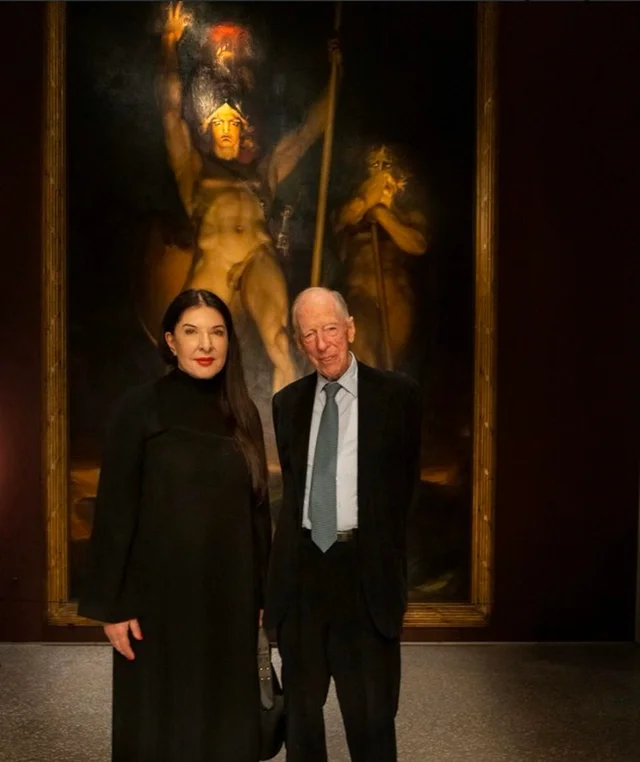
5 Suggestive rather than conclusive, but consistent with the Sabbatean/Frankist symbolic vocabulary: Jacob Rothschild has been photographed at Waddesdon Manor standing before Joshua Reynolds’ Satan Summoning His Legions, and the 1972 Rothschild Surrealist Ball at Château de Ferrières – documented in photographs showing invitations written in mirror-script requiring inversion to read, alongside extensive occult and transgressive symbolic imagery – deploys precisely the inversion-of-sacred-and-profane aesthetic that Frankist antinomianism treats as theologically operative rather than merely decorative. Whether these represent conscious identification with the tradition, aristocratic provocation, or aesthetic coincidence cannot be determined from the imagery alone, but that they are legible within the Sabbatean/Frankist symbolic grammar is not nothing.
6 Per Shahak, Scholem “willfully omitted reference to [Jewish supremicism]” in his works, having “employed the trick of using words such as ‘men,’ ‘human beings’ and ‘cosmic’ in order to imply incorrectly that the Cabbala presents a path leading toward salvation for all human beings. The actual fact is that cabalistic texts, as opposed to talmudic literature, emphasize salvation for only Jews.” Personally, I found Scholem to be difficult to read for precisely this reason, that he is operating as a partisan while falsely performing neutrality which produces hedged, vague, meandering, evasive prose texture, and the stylistic unpleasantness is the phenomenological signal of the intellectual dishonesty.
This isn’t limited to Scholem and is unfortunately common in religious translations into English; in reading Rami Shapiro’s Tanya, the Masterpiece of Hasidic Wisdom: Selections Annotated & Explained, the author writes in the introduction, “While the focus of the Alter Rebbe is on Jews alone, I have widened that focus and applied what the rebbe has to say to all human beings. While Tanya is written for the rebbe’s students, all of whom were men, I have adapted the language of my version of the material to be more inclusive. To avoid the limitations of gendered pronouns, I have cast the text as a direct address to the reader….My commentary on tanya presents the Kabbalistic ideas of the text in a universalist manner; that is, I have presented the teachings of the Alter Rebbe in the light of my own understanding of and spiritual training in Judaism, Buddhism, Hinduism, and the field of comparative religion.” In other words, Shapiro twists the text to make it feel more comfortable instead of understanding the text on its own terms and how both the Alter Rebbe and how his followers intend it to be understood. At least he was upfront with what he did instead of being sneaky about it, but this is a terrible, solipsistic method of translation.
7 Scholem, 79: “The Sabbatian movement in its various shadings and configurations persisted with remarkable obstinacy among certain sectors of the Jewish people for approximately 150 years after Sabbatai Zevi’s conversion. In a number of countries it grew to be powerful, but for various reasons, internal as well as external, its affairs were deliberately hidden from the public eye. In particular, its spokesmen refrained from committing their beliefs to print, and the few books that they actually published concealed twice what they revealed.”
8 The confluence model says: multiple actors pursuing their own interests and theological imperatives produced the same outcome without requiring explicit coordination at every step. The Sabbatean/Frankist apex provided theological permission. Zionist organizational pressure provided political direction. German nationalist movements provided the operational instrument. British imperial strategy provided geopolitical facilitation. Each operated from its own logic; the confluence produced the outcome. This is more plausible than a single coordinated plan and more disturbing because it doesn’t require a smoking gun.
9 Eliezrie, 229-232: “A professor of mathematics at the University of Novosibirsk summed it up when he told me, “Putin may not be good for Russia but he is definitely good for the Jews of Russia.” Putin’s support of Jews in Russia started long before he met Rabbi Lazar and Sasha Barada. He started his political career in 1993 as vice-mayor of Saint Petersberg. A request had been submitted to the municipality to open the first official Jewish school in Russia. Saint Petersburg’s Jewish mayor feared being accused of favoritism if he permitted the school. It was Putin who stepped forward and approved the school, the very first in post-Communist Russia. This would be the first of many actions over the years to bolster Jewish life in Russia. Many were accomplished far from the public eye, without an agenda to gain favor from Western critics. When mayors in Russian cities opposed returning historic synagogues to local communities, he repeatedly intervened….Putin attended the opening of the new Marina Roscha building in 2000 and participated in the Chanukah menorah-lighting ceremony there. He donated his personal salary toward the construction of the Jewish Museum and visited after it opened….Dmitry Perkoviv says Putin “was raised with Jewish friends, and his whole life he was surrounded by Jews.”…In a private meeting, Israel’s president, Shimon Peres, thanked Putin for his assistance to Israel and support of Jewish life in Russia. Putin responded, “Whenever Rabbi Lazar comes and asks me something, I can’t refuse him because he is such a good person.”
10 To believers, any outcome that benefits the structure gets attributed to divine confirmation, while any outcome that challenges it gets attributed to external hostility or internal failure of observance. A framework that can absorb any result as confirmation is not a description of reality, it’s a power structure protecting itself from scrutiny through theological enclosure.
11 David Berger, The Rebbe, The Messiah, and the Scandal of Orthodox Indifference, xxxi.
12 Eliezrie, 37: “[The Rebbe] established a clandestine Jewish communal and educational network. Wein notes that “Lubavitch alone among all Jewish religious organizations was able to maintain underground Jewish religious life for the entire seventy-five-year period until the collapse of the Communist system.”
13 On the German side, the rescue was approved by Admiral Wilhelm Canaris, head of the Abwehr; he was later executed for his participation in the 1944 plot against Hitler. Another Nazi, Helmut Wohlthat, chief administrator of Goring’s Four Year Plan. On the U.S. side Secretary of State Cordell Hull (whose involvement “raises questions that this book cannot definitively answer”), the U.S. State Department generally, Congressman Sol Bloom, Attorney General Benjamin Cohen, Justice Louis Brandeis, Senator Robert Wagner, Postmaster General James A. Farley all brought pressure to bear. “Lubavitch Hasidim…were conscious of the importance of political power and had maintained contacts within the American Jewish community and with influential politicians.” Riggs notes that the State Department officials conducting the investigation came to the conclusion that the Rabbi’s presence would not be beneficial to the United States, but “his damning report was ultimately disregarded, presumably because of the large number of high-ranking officials already involved in the case.”
14 His natal Sun degree, Sepharial interpretation, Aries 27: “It denotes one of a rich and beneficent nature, who will, by his goodness of heart, attract many friends and gain great attention. It indicates success through a woman. The nature is not free from love of luxury and approbation, but it is generous and gifted, and will, by friendly counsel, meet with opportunity for expression and due reward. It is a degree of FAVOUR.” One may note that he ascended to his position because he married the daughter of the previous head rabbi. Schneerson’s other planets in his natal chart include degrees that show both genius as well as extreme dogmatism in relation to his core beliefs (although he had flexibility of tactics).
15 Here’s Maimonides on this point, as translated by Gershom Scholem, which is not hard to imagine within a global technocratic framework overseen by artificial intelligence, social credit scores, and central bank digital currencies: “If [the potential Messiah] is then successful in rebuilding the sanctuary on its site and in gathering the dispersed of Israel, then he has in fact [as a result of his success] proven himself to be the Messiah. He will then arrange the whole world to serve only God….Let no one think that in the days of the Messiah anything of the natural course of the world will cease or that any innovation will be introduced into creation. Rather, the world will continue in its accustomed course….The sages said ”The only difference between this world and the Days of the Messiah is the subjection of Israel to the nations.”…The sages and prophets longed for the days of the Messiah not in order to rule over the world and not to bring the heathens under their control, not to be exalted by the nations, or even to eat, drink, and rejoice. All they wanted was to have time for the Torah and its wisdom with no one to oppress or disturb them. In that age there will be neither famine nor war, nor envy nor strife, for there will be an abundance of worldly goods. The whole world will be occupied solely with the knowledge of God. Therefore the Children of Israel will be great sages; they will know hidden things and attain an understanding of their Creator to the extent of human capability.”
16 Eliezrie, p. 252.
17 Eliezrie, p. 370: “After the First Lebanon War in 1982, the Israeli government decided that the Jewish community in Tunisia was at risk, since the PLO (Palestine Liberation Organization) had relocated its headquarters there. Ephraim Halevy of the Mossad, Israel’s intelligence agency, who would later become director of the agency, discovered that the local community was not willing to relocate to Israel, due to the advise of Rabbi Pinson. Pinson was following the instructions the Rebbe had given to him. Halevy flew to New York to meet with the Rebbe. Years later, he recalled it was a very interesting meeting, saying “We did not agree”. The Jews remained in Tunisia. The fact that they refused to abandon the country shows the depth of Chabad’s influence.”
18 Per Wikipedia: “There is a tale in the Hasidic Chabad movement that Stalin became sick as a consequence of some metaphysical intervention of the seventh Chabad leader, Rabbi Menachem Mendel Schneerson, during the recitation of a public discourse at a Purim gathering in 1953, which supposedly caused Stalin’s death and averted massive deportations of Soviet Jews to Siberia that were to take place as a result of the anti-intellectual campaign surrounding the doctor’s plot affair.” The motive was certainly there, as Schneerson did whatever he could to promote Judaism and Stalin would have destroyed it. The timing was interesting, right on Puim, and Schneerson’s network in the Soviet Union was unusual. There isn’t a causal connection I can point to – Beria and the others knew the Doctor’s Plot would be used to destroy them, they had plenty of their own motives, although Molotov’s wife was Jewish – but if Schneerson had been involved, this would have been the way to obliquely comment on it for the public record with plausible deniability. Ironically, even though the Doctor’s plot was deemed to be a flimsy pretext, the threat of Soviet Jewish deportation may have triggered such a conspiracy to manifest. Whether or not Schneerson directly influenced Stalin’s death, though, the timing and outcome served Chabad’s institutional survival, suggesting either remarkable luck or network capacity.
19 Eliezrie, 203: “Professor Branover was astonished by the message that the Rebbe asked him to transmit to Jews in Russia: “The Rebbe asked me to inform Jews on the other side of the Iron Curtain that the Communist era would soon be over and the Soviet Union would cease to exist. A new period was beginning in which Jews would be free to immigrate to Israel – or, if they chose, to live in Russia, without any restrictions on religious freedom.”
20 Just as one example, as recounted by Eliezrie, p. 8, during the 2008 Mumbai terror attacks which targeted the local Chabad house among others, “[FBI] agents were deeply impressed with the professionalism of the [intelligence gathering] operation mounted by Brooklyn, telling Seligson, “You have better information than we do at the FBI office.””
21 Shahak understood the tradition he was critiquing with clarity and documented it with courageous honesty, but what he couldn’t see clearly was the tradition he was critiquing it from. Secular rationalist egalitarianism presented itself to his generation as a neutral, universally available default position, the place you arrived at when you cleared away the theological and tribal accretions from clear thinking – he didn’t recognize it as itself a historically contingent tradition with its own metaphysical assumptions, its own blind spots, and its own conditions of possibility. It turns out that traditions which don’t maintain boundaries, don’t reproduce themselves demographically, don’t cultivate in-group solidarity, and don’t provide the binding technology of eschatological purpose are not stable alternatives to traditions that do those things. He didn’t have a framework for understanding that civilizational competition is dynamic rather than static, that traditions either expand or contract like a living creature and do not stay static (ala Spengler), and that the belief structure he was operating from was in a phase of decline which would become obvious in the decades since his death.
22 Shahak, xix: “In his book, Rachlevsky correctly claimed that Rabbi Kook the Elder, the revered father of the messianic tendency of Jewish fundamentalism, said “The difference between a Jewish soul and souls of -non-Jews – all of them in all different levels – is greater and deeper than the difference between a human soul and the souls of cattle.”…Rachlevsky pointed out that Rabbi Kook’s entire teaching was based upon the Lurianic Cabbala, the school of Jewish mysticism that dominated Judaism from the late sixteenth to the early nineteenth century. One of the basic tenants of the Lurianic Cabbala is the absolute superiority of the Jewish soul and body over the non-Jewish soul and body. According to the Lurianic Cabbala, the world was created solely for the sake of Jews; the existence of non-Jews was subsidiary….that Kook deprecated unnecessary Jewish brutality against non-Jews should not minimize criticism of his expressed delight in the belief that the death of millions of soldiers during World War One constituted a sign of the approaching salvation of Jews and the coming of the Messiah….Jewish mysticism, the Lurianic Cabbala, Hassidim and the teachings of Rabbi Kook contain basic ideas about Jewish superiority comparable to the worst forms of anti-Semitism.”
23 P. 253 of his book, buried in an endnote: “Although many in Chabad today distance themselves from the belief that Gentile souls are inferior to those of Jews, their philosophy teaches that they are. As the Rebbe’s newspaper wrote in December 1941, “In general and as a nation, as a whole, we are always better than the other nations.” The newspaper further explained in June 1942 that antisemitism often arose because people “begrudged the Jew his enviable higher position.” According to Chabad, Jews have both “animal” and “divine” souls, whereas Gentiles have only an animal soul. According to historian Roman Foxbrunner, Lubavitcher’s view Gentile souls as of an “inferior order” and “totally evil with no redeeming qualities whatsoever.” These souls “were created only to test, to punish, to elevate, and ultimately to serve Israel (in the Messianic Era).” Lubavitcher philosophy teaches that having a divine soul brings man closer to God, while the animal soul drags him down. Only Jews, says the founder of Chabad, Rebbe Schneur Zalman, have a divine soul since they are the “descendants of the righteous patriarchs.” Gentile souls die with the bodies, while Jewish souls are eternal. Most of these ideas are articulated in Zalman’s Tanya, which, according to Rabbi Eli S., “is quoting the Talmud, basic Jewish law. It’s not a question against Chabad, but against Judaism, as a whole. As is often the case, Chabad is now defending normative Jewish thought, a position it is comfortable with but which requires a fair chance and adequate time to achieve properly”…Zklikovsky’s view seems to be the prevalent one among many Lubavitcher’s today. To call Gentiles bad contradicts Jewish writings that maintain that everyone is created in the image of God….Rabbi Simon Jacobson adds that this topic about Jewish philosophy and Gentiles is a very complicated matter and the sources used in this note give a literal but distorted view of the issues. Jacobson claims that the Bible is full of references to the Jews being the “Chosen People,” and thus, God recognizes their special role in the world. However, Jacobson also notes that every nation has a role in God’s plan and that Gentiles can definitely have a divine spark in their souls. Also, if they honor God and keep some of his commandments, they can also have a share in the world to come.” This is disingenuous, though: in order for a gentile to have a part in the “world to come”, they must adhere to the Noahide laws – which means that they must accept Yahweh as their God, putting Jews at the center of their worldview and give approval of the hierarchical scheme – if they do not adhere to the Noahide laws, they represent “kelipot” and not subject to a share of the “world to come.” This core point is intentionally obfuscated.
24 According to Ron Unz, “My encounter a decade ago with Shahak’s candid description of the true doctrines of traditional Judaism was certainly one of the most world-altering revelations of my entire life. But as I gradually digested the full implications, all sorts of puzzles and disconnected facts suddenly became much more clear. There were also some remarkable ironies, and not long afterward I joked to a (Jewish) friend of mine that I’d suddenly discovered that Nazism could best be described as “Judaism for Wimps” or perhaps Judaism as practiced by Mother Teresa of Calcutta.”
25 There are multiple definitions of “messiah” in Judaism. The standard one is the individual who rebuilds the third temple and checkmarks off the other eschatological requirements, but another definition is as a “potential messiah of the generation”, one who has the characteristics of which one would think would constitute the messiah if he actually fulfills the checkmarks. Given Schneerson did not checkmark the boxes and had never actually stepped foot in Israel, the definition his followers attribute to him with this label is the latter.
26 Per Bryan Mark Rigg, p. 21: “Rebbe Schneersohn described the love a Rebbe has for his followers as stronger than what a parent feels for a child. As for the follower, he or she should say; “Rebbe, I am yours; I dedicate myself to you completely. It’s only that the smart little fellow, who is wise to do evil – the Evil Inclination – is trying to fool me and ensnare me into a sack. Basically, that’s not what I want. I’m yours: I want to be as I ought to be. Rebbe, have pity on me: take me out of where I am, and set me up where I ought to be!” For the Lubavitchers, the Rebbe is not only a human being but also a prophetic leader worthy of total submission.” In other words, the Chabad masses collapse the individuation process – the crucifixion of the opposites – into a polarity of slavish devotion to the pronouncements of the leader (Chabad would argue that Schneerson turned followers into leaders, especially when compared to other Hasidic sects which encouraged cults of personality worship). This is very common and perhaps standard in exoteric religion; see Dostoevsky’s wonderful The Grand Inquisitor for a critique from an Eastern Orthodox perspective.
27 As discussed in part 2, “The seven Noahide Laws function as Minimum Viable Product for global governance, integrating 8 billion non-Jews into Jewish-led eschatological framework without requiring conversion. The critical seventh law (establish Courts of Justice) requires nations to build legal systems compatible with “higher law.” This doesn’t mean every country becomes religious theocracy but rather that international legal infrastructure – ICC, trade agreements, ESG standards – eventually aligns with Sanhedrin interpretation through what could be called a snap-to-grid moment.
The observable trajectory shows progression: In 1991, US Congress passed H.J. Res. 104 recognizing Noahide Laws as “founding principles of our nation.” Currently, global systems shift from rights-based to duty-based citizenship through social credit systems, ESG frameworks, and “responsibility-based” governance models. The prediction: a Universal Moral Charter will be presented as solution to climate crisis or unity imperative, actually functioning as final alignment mechanism where international law snaps into compatibility with rabbinic interpretation.
This reflects a pivot from Negative Liberty (freedom from interference) to Positive Alignment (freedom to serve the collective purpose). The Noahide Laws serve as the Application Programming Interface (API) between the esoteric ‘inner loop’ of elite metaphysics and the ‘outer loop’ of secular mass management. It allows for a Modular Legal Framework where different nations keep their local ‘skin’ while running the same ‘kernel’ of rabbinic interpretive logic.”
28 Shahak, 20: “Rabbi Yoseph acknowledged that in messianic times Jews would be more powerful than non-Jews and would then be obligated to conquer the land of Israel, to expel all non-Jews and to destroy the idolatrous Christian churches. Rabbi Yoseph, however, asserted that the messianic time of redemption had not yet arrived. He wrote: “The Jews are not in fact more powerful than the non-Jews and are unable to expel the non-Jews from the land of Israel because the Jews fear the non-Jews…the Israeli government is obligated by international law to guard the Christian churches in the land of Israel, even though those churches are definitely places of idolatry and cult practice. This is so in spite of the fact that we are commanded by our [religious] law to destroy all idolatry and its servants until we uproot it from all parts of our land and any areas that we are able to conquer…”. The quotation cited above illustrates well a part of Israel’s realpolitik. Before the 1996 election, both Peres and Netanyahu regarded Rabbi Yoseph as an important political figure and often courted him openly. This was done in spite of Yoseph’s publicly declared doctrine that Jews, when sufficiently powerful have a religious obligation to expel all non-Jews from the country and destroy all Christian churches.”