

Most people who lose their faith lose it intellectually – they argue themselves out of it, find the theodicies unconvincing, decide the evidence doesn’t support the conclusion. Varlam Shalamov lost his differently. The gulag simply burned it away, the way extreme cold burns off sensation through exposure, gradually and then completely, until nothing remained, not even the question. This is a post about his Kolyma Tales, and about what it looks like when a human being writes seriously and carefully from that position.
Welcome back. This is a post about Varlam Shalamov’s mostly autobiographical Kolyma Tales (published in the West in individual stories 1970-1976, compiled later).
Very few of you have likely heard of Shalamov, especially native English speakers. He published tales about the Soviet gulag, but unlike Solzhenitsyn, he remains virtually unknown. Solzhenitsyn wanted to write The Gulag Archipelago with Shalamov as co-author, but the latter refused; Solzhenitsyn had recognized both Shalamov’s talents and that Shalamov had had a much more brutal experience in the gulag system than he had, spending about 17 years in the camps (arrested in 1937, released 1951, rearrested briefly). Solzhenitsyn wasn’t in the most brutal camps; his research camp was relatively mild, and he was placed in a fairly cushiony location due to his mathematical and other talents. Solzhenitsyn writes: “Shalamov’s experience in the camps was longer and more bitter than my own, and I respectfully confess that to him and not me was it given to touch those depths of bestiality and despair toward which life in the camps dragged us all.” Shalamov’s tales are short, recounted without emotion, and consistently end in a flat horror; the good are doomed, the “evil” prosper, there is no final accounting, no redemption, this is it, this is reality, accept it or don’t, but no punches are pulled.
I’ve read the three volume Gulag Archipelago twice now, once a decade or more ago and another time a couple years ago, and it was okay (but a grind of a read, I had to force myself to finish it), truthful in its way, but it was instrumentalized by the West as a moral crusade against the Soviet system, playing into the dialectics of the upper elites (as I see it). This is why Solzhenitsyn was honored by being allowed to give a Harvard commencement speech. Shalamov criticized Solzhenitsyn for playing into this narrative drama, but, to the latter’s credit, the exposure of the gulag system did need to happen and he did explore a taboo subject with his 200 Years Together, which was heavily smeared by Western media due its controversial handling of Jewish-Russian relations and which remained unpublished in English until very recently. Shalamov’s work remained censored in the Soviet Union until after perestroika, that’s how damaging the material was (much like Gareth Jones’ covering of the Holodomor was intensely suppressed, discussed previously here). Solzhenitsyn’s narrative could be instrumentalized; Shalamov’s cannot. One offers a moral drama with recognizable roles; the other offers only this happened, and then this, and then they died. That’s harder to build a crusade around.
The Core Disagreement
The core disagreement between Solzhenitsyn and Shalamov was about the nature of suffering. Solzhenitsyn believed that suffering had a redemptive factor, that it purified and ennobled the soul, or that at least it could. He famously wrote:
And how we burned in the camps later, thinking: What would things have been like if every Security operative, when he went out at night to make an arrest, had been uncertain whether he would return alive and had to say good-bye to his family? Or if, during periods of mass arrests, as for example in Leningrad, when they arrested a quarter of the entire city, people had not simply sat there in their lairs, paling with terror at every bang of the downstairs door and at every step on the staircase, but had understood they had nothing left to lose and had boldly set up in the downstairs hall an ambush of half a dozen people with axes, hammers, pokers, or whatever else was at hand?… The Organs would very quickly have suffered a shortage of officers and transport and, notwithstanding all of Stalin’s thirst, the cursed machine would have ground to a halt! If…if…We didn’t love freedom enough. And even more – we had no awareness of the real situation…. We purely and simply deserved everything that happened afterward.
The is a standard theodicy: evil happens because the good aren’t good enough (the other common theodicy is “it’s all part of God’s plan”). Shalamov, alternatively, believed that prison could be ennobling where one sits inside a prison cell all day long, but not past a certain point within the gulag system where physical exertion and not incarceration is what is required of inmates. When the body is slowly starved to death in temperatures reaching -70 degrees with little food or lodging or comforts, all of the human emotions fade away except the last remaining emotion – spite. There are no friendships that form in such conditions, emotions burn off, God burns off, nothing ennobling is possible from it, there is nothing left except the total destruction of the human being – suffering as ennobling is a laughable fiction, and for Solzhenitsyn to push it meant to Shalamov that he was compromised. What’s remarkable is that this destruction was not experienced by Shalamov as loss in any conventional sense – there was no grief for the absent God, no existential crisis, no dark night of the soul as spiritual literature understands it. Those are the experiences of someone who still has enough metaphysical warmth left to feel the cold, but Shalamov was past that. The burning off of God was simply one more thing the cold took, alongside friendship, pride, and the ability to button one’s pants.
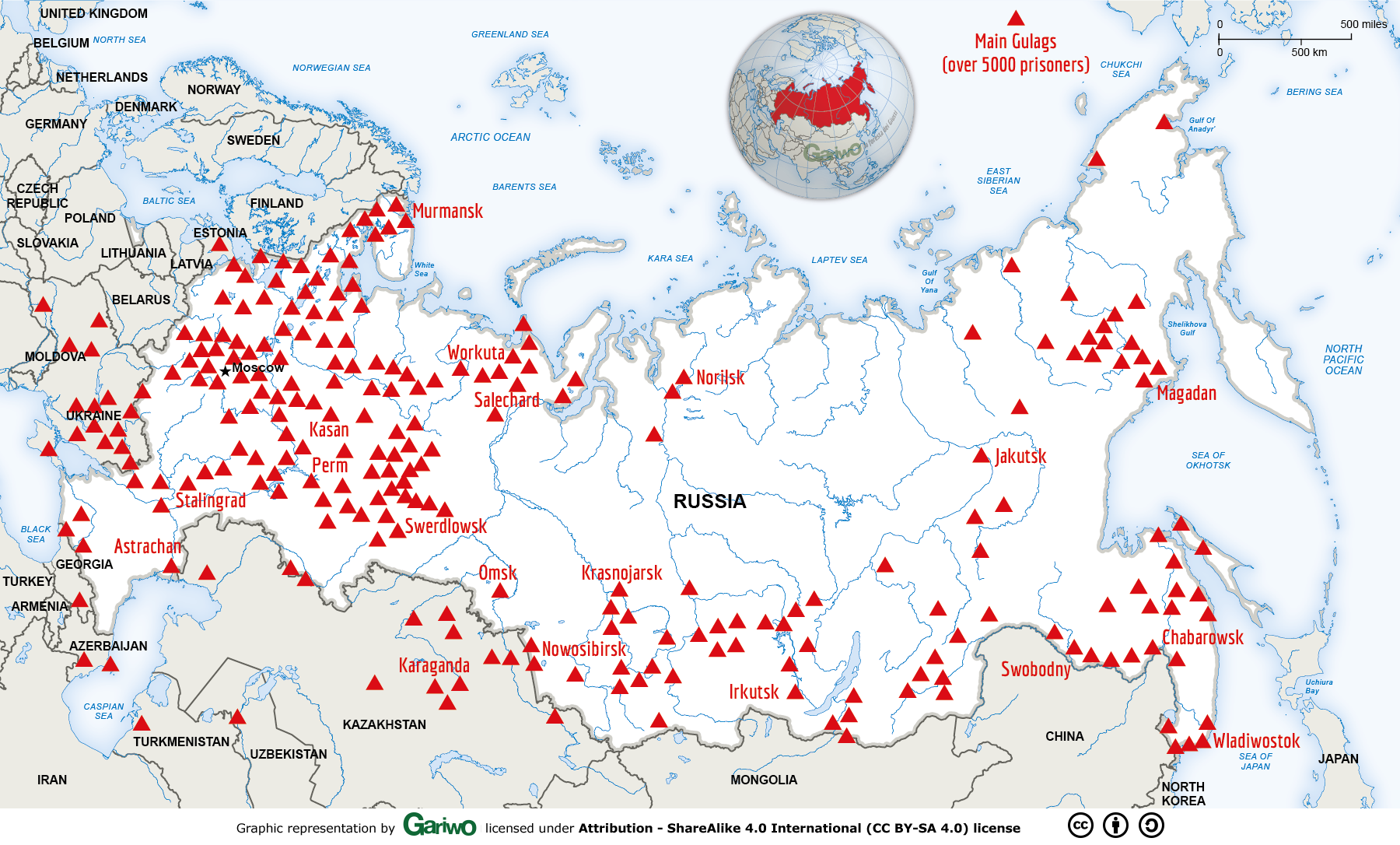
Shalamov himself was placed into far east Siberia, where estimates of half a million to a million or more people died in his region alone – the Soviet authorities shipped people there to work in the gold mines, were underfed, had very limited clothing, were predated upon by the criminal element (which were given far more privileges than the “political prisoners” and who stole the political’s food, clothing, packages from home, etc). The political prisoners were almost all convicted on pretexts; the mines required a certain number of prisoners to do slave labor, the prisoners died or became incapacitated at certain rates, therefore more arrests were needed – it didn’t matter the reason – in order to keep the mines operational. The politicals arrested were forced to sign confessions; the Soviet organs did not release people post-arrest – you signed whatever they told you to or you were tortured until you did, or they could escalate and haul your family in too. Shalamov refused to be a stoolie in the gulag, he refused to take on overseer responsibilities which perhaps could have saved his life because it would have required him to oppress the common prisoners, and he almost starved to death; he was saved at the last minute by someone in the local hospital who, at great personal risk, placed him as a hospital orderly. The greatest danger was not the lack of food but a combination of being overworked and of the extreme cold – if you didn’t eat much but you did not have to expend massive calories by working in -60 degree temperature mining for gold, your odds of survival drastically increased. Here’s a passage from the foreword about this:
He had been held in a virtual death camp, where – at nearly six feet tall – his weight and dropped to 90 pounds. With the new sentence he was transferred to a prison hospital and managed to regain his weight. Gold mining once more emaciated him, and he was returned to the hospital. After that he was sent to a logging camp where the convicts were simply not fed if they did not fulfill their work norms. Captured during an escape attempt, he was dispatched to a penal zone where, if they could not work, prisoners were thrown off a mountain or tied to a horse and dragged their deaths. Chance came to his aid when group of Italian prisoners were delivered to the site, replacing the Soviet conflicts. It was at that point that a physician took an interest in him and managed to have him assigned to paramedical courses – a second fortunate twist of fate that literally saved his life.
Many millions died in the forced labor slave camps through execution, famine, forced labor, and neglect (used both to forcibly industrialize the backwards Soviet Union and as a way of silencing and murdering potential competitive elements), although estimates vary wildly, but it is mostly forgotten about in the West and pales dramatically in the media and academia’s treatment to Nazi Germany. In 1990 Soviet general and historian Dmitry Volkogonov gave an estimate of the total number of repressed persons (those imprisoned and/or murdered): 22.5 million, but non-Soviet historian estimates run higher. Regarding Kolyma itself, there is a 1949 estimate by the Polish historian Kazimierz Zaomorski of 3 million exiled there, not more than 500,000 of whom supposedly survive. Robert Conquest estimated 3 million died in Kolyma. One may note that a million German POWs in Soviet captivity died, and Russian soldiers who had been captured by the Germans were treated as criminals to be sent to the far East to die (central Europe living conditions were so far ahead of the Soviets that authorities thought that, if the truth came out, that it would dramatically hurt morale in the Soviet Union; furthermore, soldiers tended to develop a degree of courage that the Soviet leaders wanted to grind down and destroy post-war). This is why so many captured Soviet soldiers, who knew they were doomed if they returned home, volunteered for the Vlasov brigade – a brigade of the doomed, where victory of either side would have meant death.
The God Image
When one sees what humanity devolves to at this level, the notion of an “all good” privatio boni God – which Solzhenitsyn retained, believing that people were being punished for their or society’s sins – becomes a farce. If one were to attempt a metaphysical reconstruction after such a collapse, it would have to account for both good and evil as co-present without moral reconciliation. Shalamov does not construct an alternative theology, he does not articulate a counter-metaphysics like Abraxas; what he demonstrates is the collapse of the privatio boni model under extreme conditions. He refused metaphysics and overarching narratives entirely, which is why his stories are fragmented; he tells little vignettes of men suffering, then being destroyed and dying, and that was it – there were no lessons to be had, no cosmic lessons learned. Suffering and then death, no redemption arc, and the victims forgotten – how do you sit with that from within the privatio boni?
So why did he write, then? It seems like he wrote both as a calling and as a remembrance to the dead, perhaps a bit like Mizushima in The Burmese Harp, reviewed here. And Shalamov refused to moralize to his audience, unlike Solzhentisyn. Per the foreward:
Chekhov, a writer who respected the rights of the reader in the artistic process, consciously avoided drawing conclusions for his audience. Tolstoy, on the other hand (like Solzhenitsyn later), constantly lectures the reader [based on underlying privatio boni metaphysics].” The British Slavish Geoffrey Hocking wrote, “Where Solzhenitsyn writes with anger, sarcasm, and bitterness, Shalamov adopts a studiedly dry and neutral tone….Where Solzhenitsyn is fiercely moralistic and preaches redemption through suffering, Shalamov contents himself with cool aphorisms and asserts that real suffering, such as Kolyma imposed on its inmates, can only demoralize and break the spirit.
This is the difference between writing from a privatio boni standpoint and an Abraxian one; if God (if he exists) is a combination of good and evil, then moralizing about the horrors of the world loses its metaphysical bite – one can still oppose it, but the “heat” is gone. But Abraxas is still a metaphysical position – it still posits something, a god beyond good and evil, a cosmic principle that contains both. Shalamov doesn’t even have that. His is a third position that has no real name: not atheism, which is still a stance taken in relation to a question, not a dark or dual god, simply the silence that remains after the question itself has been destroyed. The privatio boni framework didn’t get replaced or inverted – it got incinerated, along with everything else, in -60 degree temperatures in a Siberian gold mine. What’s eerie about his prose is that it retains the form of moral seriousness – precision, witness, memory – while being completely evacuated of the metaphysical foundation that would normally justify why any of it matters. He cares, rigorously, about things in a universe where caring has lost its cosmic warrant. For Shalamov, the act of writing is a biological reflex, a stubborn persistence of the nervous system that outlasts the soul itself, not a route toward healing. He witnesses because he is a recording instrument that hasn’t been broken yet. It is the “spite” he mentions transformed into prose: a refusal to let the void have the last word, even if the void is all there is.
The Look
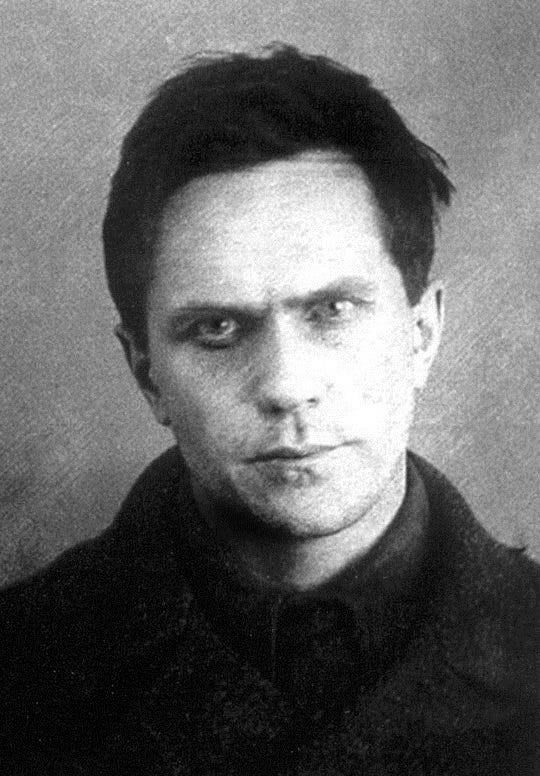
Take a look at his physiognomy, look at the piercing stare:
This reminds me of a meme’d Russian World War 2 soldier before-and-after four years apart which shows a hopeful young man in the pre-war photo, and a blown out husk of a human being, shell shocked, totally destroyed and haunted with the thousand yard stare in the second:
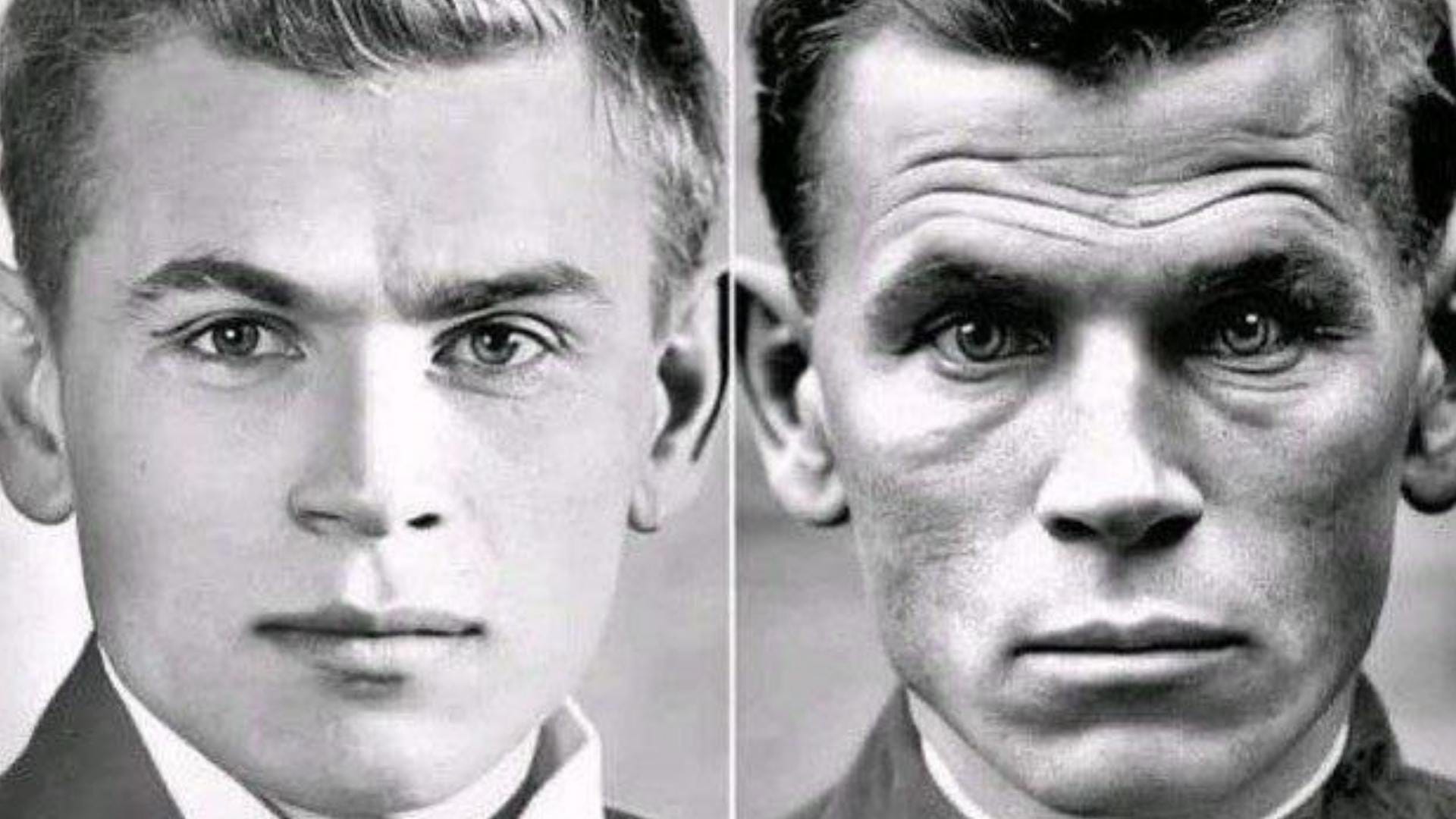
Shalamov wasn’t blown out and destroyed mentally, though; the look he gives to me is that of a man who has stepped back from regular reality to the position of an observer, and what he has seen is so horrifying that it has fundamentally changed his understanding of what this reality is. The look says: I have seen what there is, and I will not look away, and I will not console you or myself. He is level headed, inward focusing, beyond cynical – it is a very powerful look because it’s strength is both of this world (having seen all the horrors) and not of it (having lost attachment to things most of humanity takes for granted). The gaze is unadorned, it does not seek sympathy, it does not perform endurance, it does not moralize. I don’t see that kind of stare from Solzhenitsyn.
We tend to treat the metaphysical impulse – the need for meaning, the intuition of the sacred, the sense that existence has a structure – as the most foundational thing about human consciousness, the bedrock beneath everything else. But it turns out that metaphysics is downstream of the body: downstream of calories, warmth, sleep, not being worked to death in -60 degree temperatures. Remove those conditions long enough and the meaning-making apparatus switches off, which means it was never foundational. It was always contingent on the body remaining within a survivable range. This is vertiginous because it means the feeling of metaphysical certainty – the conviction that God exists, that existence is meaningful, or even that it isn’t – may tell you less about reality than it tells you about your physical conditions. The mystic in his warm cell and the gulag prisoner are not accessing different truths, they are operating under different temperatures.1
If God exists independently of the human apparatus for sensing him, then Shalamov’s experience says nothing about whether God is real, only that the receiver can be destroyed. But it does refute the idea that extreme suffering opens rather than closes that receiver, that it is spiritually productive, that God communicates through it. Shalamov is the empirical counterexample to that entire tradition. Past a certain threshold, suffering doesn’t deepen the spiritual sense, it destroys it permanently. Which means either God goes silent past that threshold, or the communication model was always wrong, or there is no communicator. Shalamov doesn’t choose between those options, he simply writes from the place where the signal stopped.
Conclusion
Shalamov eventually survived the gulag system and his work was smuggled into the West; however, he stayed within the Soviet Union and was forced to denounce his own work publicly, which his supporters in the West found correctly to be distasteful, even though he kept writing the same stuff after his denouncement. His health was destroyed by the gulag and he spent his later years in a writer’s nursing home, and he was going to be sent to a psychiatric ward (a common tactic against dissidents) when he fell ill and died, the end, no redemptive arc – except in the sense, perhaps, that a few people write about him to this day, like in this post. He survived the gulag, he recanted under pressure, he died in obscurity, but the stories remain. They offer no redemption.
This total evacuation of the metaphysical is what made the Soviet system so effective compared to what came before. The ruthlessness Shalamov witnessed was the logical endpoint of a world that had abandoned the ‘wishy-washy’ metaphysical constraints of the tsarist monarchy. Where the Romanovs were still tethered to a fading sense of divine accountability – a tether that ultimately made them weak in the face of absolute Darwinian struggle – the Soviet Organs operated in the very vacuum Shalamov describes. They operated on the premise that the soul was a fiction that could be worked, starved, and frozen out of existence, manifesting naturally in the gulag.
Like in The Lives of Others, one may choose to do the right thing for its own sake, but in this realm there is a direct and inverse correlation between spirituality and power – the more power you have, the less spiritual you will generally be, and to hold the apex of political power one must have no morality and to do whatever it takes to retain that power without compunction – because if you don’t then you will be outcompeted by those who will (which is why the Romanovs were ousted from power; they were not ruthless or creative enough2).
Kolyma Tales is a good read and I recommend it. Here’s the Amazon link, but better if you buy it from somewhere else if you choose to read it. Here are some of my favorite passages:
Cold, hunger and sleeplessness rendered any friendship impossible, and Dugaev – despite his youth – understood the falseness of the belief that friendship could be tempered by misery and tragedy. For friendship to be friendship, its foundation had to be laid before living conditions reached that last border beyond which no human emotion was left to a man – only mistrust, rage, and lies….Dugaev sat down on the ground. He was already exhausted enough to be totally indifferent to any change in his fate….he had been exhausted and hungry for a long time and that he did not know how to steal. The ability to steal was a primary virtue here, whatever it involved, from taking the bread of a fellow-inmate to claiming bonuses of thousands of rubles for fictitious, non-existent accomplishments.
All human emotions – love, friendship, envy, concern for one’s fellow man, compassion, longing for fame, honesty – had left us with the flesh that had melted from our bodies during their long fasts….We’d all learned meekness and had forgotten how to be surprised. We had no pride, vanity, or ambition, and jealousy and passion seemed as alien to us as Mars, and trivial in addition. It was much more important to learn to button your pants in the frost. Grown men cried if they weren’t able to do that. We understood that death was no worse than life, and we feared neither. We were overwhelmed by indifference. We knew that it was in our power to end this life the very next day and now and again we made that decision, but each time life’s trivia would interfere with our plans….We realized that life, even the worst life, consists of an alternation of joys and sorrows, successes and failures, and there was no need to fear the failures more than the successes. We were disciplined and obedient to our superiors. We understood that truth and falsehood were sisters and that there were thousands of truths in the world…We considered ourselves virtual saints, since we had redeemed all our sins by our years in camp. We had learned to understand people, to foresee their actions and fathom them. We had learned – and this was the most important thing – that our knowledge of people did not provide us with anything useful in life. What did it matter if I understood, felt, foresaw the actions of another person? I was powerless to change my own attitude toward him, and I couldn’t denounce a fellow convict, no matter what he did. I refused to seek the job of foreman, which provided. A chance to remain alive, for the worst thing in camp was the forcing of one’s own or anyone else’s will on another person who was a convict just like oneself….Our inability to use certain types of ‘weapons’ weakened us in comparison with certain of our neighbors who shared Berts with us. We learned to be satisfied with little things and rejoice at small successes.
Friendship is not born in conditions of need or trouble. Literary fairy tales tell of ‘difficult’ conditions which are an essential element in forming any friendship, but such conditions are simply not difficult enough. If tragedy and need brought people together and gave birth to their friendship, then the need was not extreme and the tragedy not great. Tragedy is not deep and sharp if it can be shared with friends. Only real need can determine one’s spiritual and physical strength and set the limits of one’s physical endurance and moral courage….A human being survives by his ability to forget. Memory is always ready to blot out the bad and retain only the good…We had all been permanently poisoned by the north, and we knew it.
The intellectual convict is crushed by the camp. Everything he valued is ground into the dust while civilization and culture drop from him within weeks. The method of persuasion in a quarrel is the first or a stick. The way to induce someone to do something is by means of a rifle butt, a punch in the teeth.
The intellectual becomes a coward, and his own brain provides a ‘justification’ of his own actions. He can persuade himself of anything, attach himself to either side in a quarrel. The intellectual sees in the criminal world ‘teachers of life’, fighters for the ‘people’s rights’. A blow can transform an intellectual into the obedient servant of a petty crook. Physical force becomes moral force.
The camp had dried up my brain, and I could not, I just could not squeeze another word from it. I was not up to the job – and not because the gap between my will and Kolyma was too great, not because my brain was weak and exhausted, but because in those folds of my brain where ecstatic adjectives were stored, there was nothing but hatred. Just think of poor Dostoevsky writing anguished, tearful, humiliating letters to his unmoved superiors throughout the ten years he spent as a soldier after leaving the House of the Dead. Dostoevsky even wrote poems to the czarina. There was no Kolyma in the House of the Dead.
My favorite story was Condensed Milk. In this story the main character is enticed by a man named Shestakov, who has a fairly cushy position, toward an escape attempt; the main character sees through the act immediately, because there is no real plan in place. Shestakov must be in trouble with the authorities and he promised other people’s hides to get out of his trouble. The main character goes along with the sham initially so long as Shestakov provides him with some condensed milk; Shestakov provides it to him, the main character consumes the condensed milk, then immediately backs out of the plot.
‘You know, I said, carefully licking the spoon, ‘I changed my mind. Go without me.’ Shestakov comprehended immediately and left without saying a word to me. It was, of course, a weak, worthless act of vengeance just like all my feelings. But what else could I do? Warn the others? I didn’t know them. But they needed a warning. Shestakov managed to convince five people. They made their escape the next week; two were killed at Black Springs and the other three stood trial a month later. Shestakov’s case was considered separately ‘because of production considerations.’ He was taken away, and I met him again at a different mine six months later. He wasn’t given any extra sentence for the escape attempt; the authorities played the game honestly with him even though they could have acted quite differently. He was working in the prospecting group, was shaved and well fed, and his checked socks were in one piece. He didn’t say hallo to me, but there was really no reason for him to act that way. I mean, after all, two cans of condensed milk aren’t such a big deal.
Thanks for reading.
Subscribe:
Email delivery remains on Substack for now.
1 It also brings to mind Phinneas Gage, a worker where a metal pole went through his brain and fundamentally altered his personality, making him highly aggressive, an entirely different person, discussed previously here. Who are we if physical trauma results in radical personality change? Who are we if we fall to dementia or old age and become a shell of ourselves? What is there to survive death, what unchanging inner core?
2 What was required was total ruthlessness without compunction against their enemies, not wishy-washiness, along with a heavy focus on technological innovation – it was Lenin who stated that the monarchy’s last chance was through Stolypin’s reforms, discussed previously here. Stolypin was considered a butcher by his detractors, smeared in the anti-tsarist media, but his law-and-order measures were a thousanth of the brutality inflicted by the Soviet regime. Eastern Orthodoxy and the monarchy ultimately lacked the underlying metaphysics required for domination, technological innovation, and sophisticated dialectics – they never had a chance.