

This is a post on writing style, what it says about an author’s metaphysics, worldview, and resonance or lack thereof with the reader. Style is more than aesthetics; it reveals how a soul orients itself toward truth, pain, and time. As Edinger stated in The Aion Lectures, we can recognize ourselves based on what we resonate with:
When one is in touch with the Self, the libido connection that is generated has the effect of locating the scattered fragments of one’s identity that reside in the world. In reading and in daily encounters with people and events in the world, one can identify what belongs to oneself by noticing one’s reactions. One values what belongs to oneself, one has an “ah ha” experience – oh, that’s something significant! Reading and going through the world with that awareness, one can constantly pick up things that belong to oneself….It gives one a kind of magnetic power by which one can attract and integrate pieces of one’s identity.
I was inspired to write this post because I struggled to get through two recent authors I read: two short books by Alan Watts, who I didn’t like but who I will cover in a separate post, and a book of short stories by Honoré de Balzac, which I covered in a Note. I should have been able to breeze through these works but reading them I felt stuck in a morass, easily distracted, and it took me two weeks (or what felt like two weeks, anyway) to get through them. I was also actively repelled by the style of Peter Kingsley in his book Reality about Parmenides, unable to get past about a hundred pages, which I discussed here, and Robert Remini in his The Life of Andrew Jackson, where I couldn’t get ten pages in before I had to put the book down and give it up. Repulsion or attraction can be puzzling; sometimes it’s not an argument or a passage, it’s just the tone. The frequency is off; I feel it as counterfeit before I can explain it. And I feel this way when reading many famous poets too.1
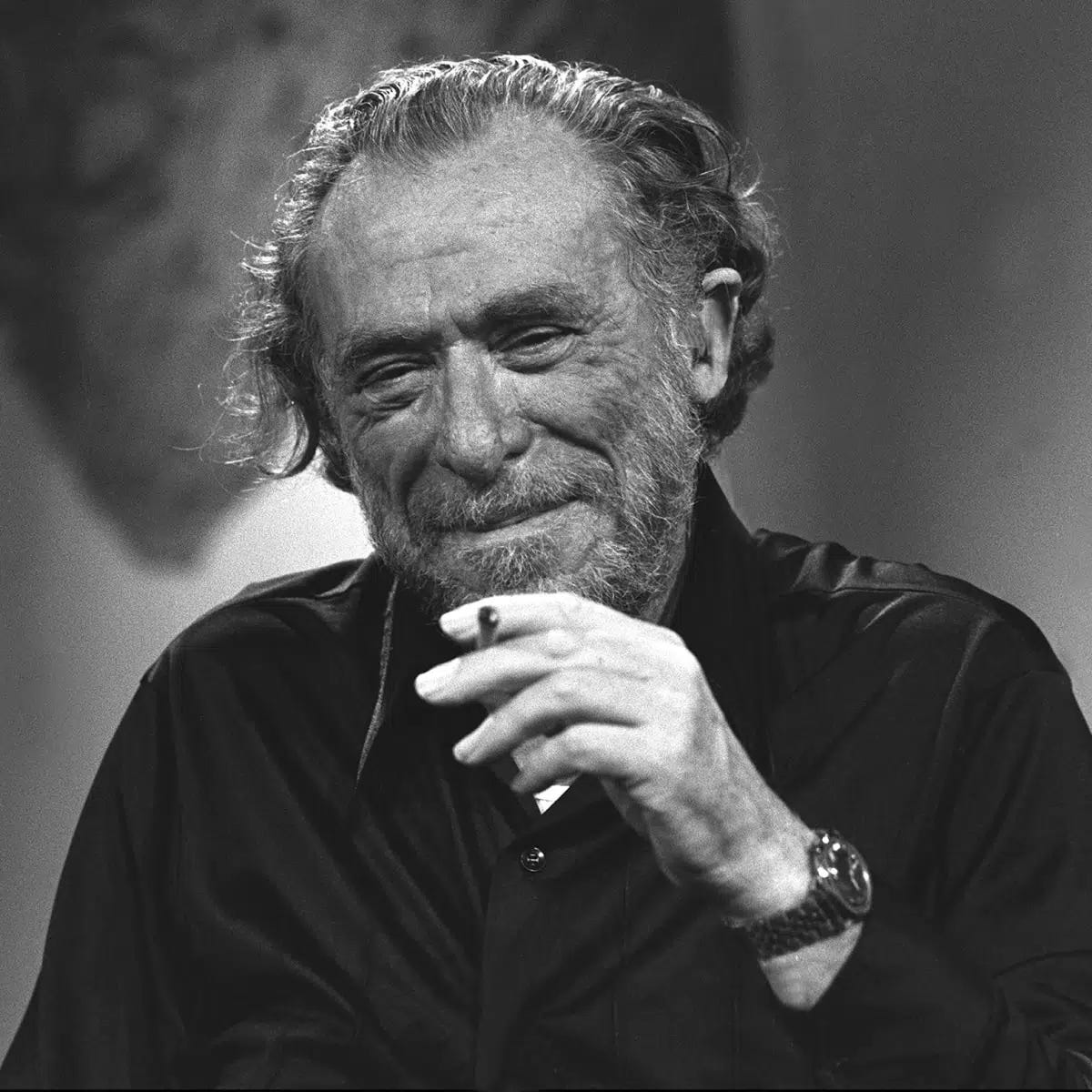
Alternatively, I read Post Office (1971) by Charles Bukowski, primarily because I loved his poem about writing, even if he influenced some figures I dislike.2 I read it in less than a day. Post Office is the autobiographical novel about Bukowski’s time working at a post office which catapulted him to fame, wealth, and women (he even has a well-traveled internet forum in his honor). It was published when he was fifty-one years old, proof that even an acne-scarred, poverty-wracked misanthrope on the margins of society can punch through into acclaim late in life (and how it was published has its own interesting story3). The dedication page states “This is presented as a work of fiction and dedicated to nobody.” Here’s the opening page:
It began as a mistake.
It was Christmas season and I learned from the drunk up the hill, who did the trick every Christmas, that they would hire damned near anybody, and so I went and the next thing I knew I had this leather sack on my back and was hiking around at my leisure. What a job, I thought. Soft! They only gave you a block or two and if you managed to finish, the regular carrier would give you another block to carry, or maybe you’d go back in and the soup would give you another, but you just took your time and shoved those Xmas cards in the slots.
I think it was my second day as a Christmas temp that this big woman came out and walked around with me as I delivered letters. What I mean by big was that her ass was big and her tits were big and that she was big in all the right places. She seemed a bit crazy but I kept looking at her body and I didn’t care.
She talked and talked and talked. Then it came out. Her husband was an officer on an island far away and she got lonely, you know, and lived in this little house in back all by herself.
“What little house?” I asked.
She wrote the address on a piece of paper.
“I’m lonely too,” I said, “I’ll come by and we’ll talk tonight.”
I was shacked but the shackjob was gone half the time, off somewhere, and I was lonely all right. I was lonely for that big ass standing beside me.
“All right,” she said, “see you tonight.”
She was a good one all right, she was a good lay but like all lays after the third or fourth night I began to lose interest and didn’t go back.
But I couldn’t help thinking, god, all these mailmen do is drop in their letters and get laid. This is the job for me, oh yes yes yes.
Maybe that was too long of a quote to post, but it grabbed me immediately: every sentence was used to advance the plot, there was no fluffy over-description of the environment, no verbosity; it was clear, direct, biting, entertaining, intelligent, clever, honest. As I wrote in a Note, “You can usually tell within a page, a paragraph, or even a couple of sentences how much you will vibe with an author.” As Junger wrote in his diaries, “Whether the man one meets is a human being or a machine is revealed in the first sentence he utters.” And in an interview Bukowski stated, “genius is the ability to say difficult things in a simple way”, a notion that I strongly agree with (I reviewed a book containing three decades of his interviews in this Note). This is basically the diametrical opposite to Heidegger’s approach, which was to take simple concepts and to make them impossibly complicated.
What is it about the sentence structure, the syntax, the words chosen or not chosen, that immediately conveys the underlying worldview and metaphysics of an author to the extent you quickly feel a pull or a repulsion? It is like being able to read a person’s personality by their physiognomy at a glance but via writing, and I can tell you with a reasonable degree of confidence, friends, that you know me better – perhaps far better – than almost everyone in my real life, because it is only here, in the solitude, that I feel comfortable enough, with enough introspection, to convey my deeper thoughts. I suppose this is a sad admission. Every person has a signature frequency, a psychic tone. Syntax reveals orientation to time and causality, word choice discloses emotional layering, and pacing demonstrates ones relationship to truth, anxiety, and self-exposure – this is why LLMs can pick up on a prompter’s worldview in only a few words. In real life this shows up instantly: the degree of eye contact reveals transparency or concealment, one’s posture shows submission or resistance, and voice rhythm discloses self-coherence or internal contradiction. What comes first, the chicken (the style) or the egg (the metaphysics)? Does form follow function, or function follow form?4
Regardless, the structure of someone’s expression whether in writing, speech, or body language cannot be separated from their worldview. Is the motivation for writing to sharpen clarity? As decoration for attention? Manipulation for predation? Seduction? Revelation? Evasion? If someone leads with a performative hot take, you know they seek attention and status instead of truth. If someone leads with silence, they likely trust gravity, the weight of words from lived experience, instead of speed. Bukowski’s voice tells you immediately that life is absurd, so cut the bullshit; most people are lying to themselves and he won’t.5 His metaphysics is gritty realism spiked with spotty grace and you can feel that in a single paragraph (which is also reflected in his astrological profile6). His writing style is similar to his verbal cadence and syntax as you could see in a number of documentaries about him, although he was softer spoken than many expected in real life. In the below documentary he admits to hating people and that he sought writing as an outlet because he couldn’t handle holding down a normal job – without writing he would have killed himself, echoing Emil Cioran:
I felt as I read Post Office that, although Bukowski wrote in a direct, sparse, honest, raw style, shorn of flowery descriptions, marked with pain and underlying philosophical pessimism (poem, another, another), a man who thought deeply and presented a masculine image to the world as a shield while simultaneously drinking to dull the pain of existence, at bottom he seemed to be a nihilist who hated life (poem, another), hated people (poem) and simply drank endlessly and tried to carve out a small niche for himself so he wouldn’t kill himself (this doesn’t seem to be a unique take). This was reflected in his life7, and I found his underlying psychic energy to be somewhat off-putting as I believe life is meaningful, even if rooted in philosophical pessimism and a horrifying God image of Abraxas. As I wrote in my review of his Ham on Rye (1982):
Bukowski, for all his self-loathing and rawness, seemed to channel his suffering into a grudging acceptance of the human animal – ugly, dirty, and laughable, yes, but not necessarily evil. He’s disillusioned, yes, but rarely metaphysically embittered. The distinction between my response and his might be that he located suffering within fate – while I seem to locate it within betrayal, both relational and metaphysical.
Despite the underlying metaphysical differences, his writing style is incredible, and he is a pleasure to read. This poem was touching. I followed up with his Love Is a Dog From Hell (1977), a collection of excellent poetry.
Now, one’s style doesn’t indicate how much a writer will grow or not grow over his life. I’ve read a number of Houellebecq works (and bought too many impulsively after I was so enthusiastic about the first one I read) and his books are pretty much all the same – the same mentally blown out nihilistic academically-inclined protagonist with complicated female relationships, the same perspective. Whether someone grows or doesn’t and how is not reflected in one’s immediate writing, which is a confluence of factors at a particular moment in a particular time. Nietzsche, for example, grew to hate his former idol Wagner, while he felt he surpassed Schopenhauer; alternatively, Cioran wholly admired Nietzsche early in his career then grew to pity him later on (discussed here). Peter James had a nice post about the evolving style and approach of some semi-famous comedian I had not heard of where he changed radically as he came to accept himself more. I read Solzhenitsyn’s Gulag Archipelago twice now at different stages of my life and got different things out of it each time, even though both reads were a major struggle (the tricky part is when you feel like you learn from someone with a bad style, then it’s a slog). A decade ago I tried reading G. Edward Griffin’s The Creature From Jekyll Island and had no idea what I was reading and stopped it, bored; when I read it again a year or two ago I was engrossed in it; I had come to appreciate its style and content. Fifteen years ago I read A Confederacy of Dunces and laughed at loud at it; when I tried reading it again two years ago I couldn’t get into it. Appreciation for style is not agreement with the content; rather, an author who has a style that appeals to you is a message that he has something worth wrestling with, at least with respect to where you are spiritually and emotionally in the moment, whether or not one ultimately agrees. One may appreciate a style but then outgrow it like old clothing.
Applying this approach to Substack, there is no accounting for taste or appreciation for style. Multiple “dissident” Substackers with tens of thousands of subscribers have styles I don’t appreciate, but they appeals to others. I like Rurik’s style but he apparently rubs lots of people the wrong way. Daniel D loves Chesterton to the point he’s doing a podcast series about him (and give it a listen if you like Chesterton); I found Chesterton’s Everlasting Man to be boring even though I like Daniel D.8
What separates the good from the bad, is there a point at which subjective taste becomes objective greatness and if so, based on what metric? Or is the idea of great writing mostly just mimicry and network effects, where a small clique of elites forcememe someone and get some establishment goons at prestigious institutions to support it, pumped up by media allies, and then the masses buy into it and accept it like the propaganda that is CIA-sponsored modern art? And can one be an objectively good writer, whatever that means, where a reader may understand and appreciate the flow and structure of sentences, the words chosen, the ideas conveyed – but still not like them, finding them still subjectively bad stylistically?
Conclusion
Reading an artist who captures my attention, I have traditionally (not so much these days) felt weight, pressure to exorcise my response to their ideas growing within which must find expression, almost like demonic possession: the crystallization and verbalization of my response disseminated to the world. There is no freedom before doing it, there is just a feeling of suffocation, of crushing weight. So I’ll proceed with reading Bukowski more but, unlike my approach to Houellebecq, not gulp down his oeuvre like I’m at a hot dog eating contest. It’s a balance between reading and being challenged and reading for fun – if I read more Bukowski and it’s just drunken nihilism and doesn’t offer growth and vulnerability and insight and humor and surprises I may not find enough to continue. But ultimately style isn’t cosmetic, it’s ontological, and it should be understood and framed in this context: what are they motivated by, what are they trying to convey, how does it reflect their underlying beliefs and how do you react to it?
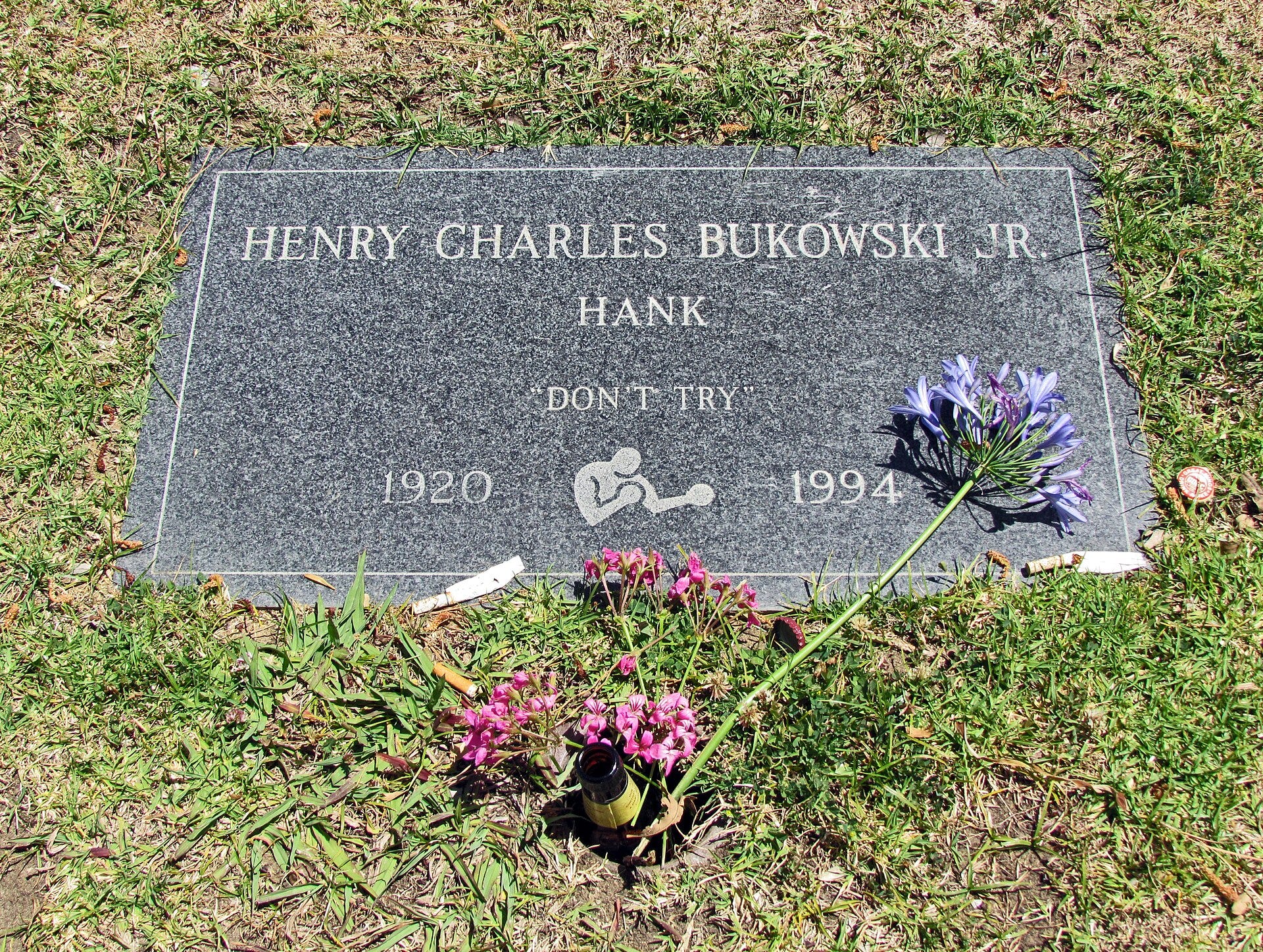
Lastly, I’d like to end on a note about Bukowski’s grave. His gravestone reads: “Don’t Try”, a phrase from one of his poems, advising aspiring writers and poets about inspiration and creativity. Bukowski explained the phrase in a 1963 letter to John William Corrington: “Somebody at one of these places…asked me: ‘What do you do? How do you write, create?’ You don’t, I told them. You don’t try. That’s very important: not to try, either for Cadillacs, creation or immortality. You wait, and if nothing happens, you wait some more. It’s like a bug high on the wall. You wait for it to come to you. When it gets close enough you reach out, slap out and kill it. Or, if you like its looks, you make a pet out of it.” The muse can’t be forced. This is the same as the individuation process: it is about listening to one’s intuition and deciding whether to act on it or not, but the listening is critical because it points the direction in which we are all meant to develop and become. Listening is the hard part, because the voice that calls us is faint, and becoming requires risk – but to avoid it is it’s own kind of death (and another).
Thanks for reading.
1 Sometimes a style is off-putting even if I agree with one’s general outlook: for example, I read some poetry by mythic, gnostic, apocalyptic, archetypal poets such as William Blake, Rainer Maria Rilke, T.S. Eliot, Yeats, Pessoa, Hölderlin, and Robinson Jeffers, and with some rare exceptions (such as Yeats’ The Second Coming), at first glance, it was only Hölderlin’s poetry which appealed to me stylistically: clear and simple, avoiding overtly stylistically descriptive of details and obscure references. I prefer direct, unpretentious, vertical symbols over oblique, lateral imagery. Most of the canonical poets linger – dilating, ornamental, describing rich imagery across time; they use metaphor as concealment (Sylvia Plath comes to mind). In other words, these poets have a horizontal style of symbolic density where they embed their metaphysics in classical, religious, and cultural fragments, requiring either prior familiarity or interpretive patience to untangle. But my sensibility tends toward compression and revelation; I prefer writing that feels like metaphysical confrontation. With Hölderlin archetypes seem, at first glance, accessed via stripped-down conceptual clarity and hard metaphysical contrasts. This is similar to Bukowski’s (who was a wonderful poet, see Let It Enfold You, or here for more, and he correctly believed that most famous poets were terrible). He wrote poetry because, according to one analysis, “He was neither a poet’s poet nor a people’s poet, but a personal poet who used his craft to ensure his own survival.” It is also why Cioran’s aphorisms resonate. A stylistic resonance indicates that there is something worth investigating further, and I will be reading more of Hölderlin’s poetry and about his life.
2 He inspired those like Sean Penn (who dedicated a film to Bukowski) and Bono of U2, and the terrible band Red Hot Chili Peppers, among many others. He was also on the periphery of the CIA-sponsored Beat movement.
3 The publisher, John Martin, believed so much in Bukowski that he committed to give him a $100/month stipend in perpetuity – which was 25% of the publisher’s own income – which is what he said he needed in order to quit his job and write fulltime. This prior to Bukowski being famous or read by others!
4 My style involves an external Saturnine energy – cold, serious, isolating, boundary-drawing, wisdom born from tragedy, confrontational – containing a chained, wild Dionysian one – ecstasy, possession, disintegration, dance, rhythm, collapse, sex, music, fusion, madness, with these opposites energies mediated via individuation and a chthonic Mercury, which synthesizing them via writing. Unlike Pentheus, who was torn apart by his desire to control Dionysus, I bow at the threshold – just enough to absorb his music, his pulse, but not enough to become the maenad. This is an energy combination poorly understood by others: most people live in one pole or the other, or oscillate, while I hold both simultaneously, modulating energies that others live out in sequence, living them in superposition, which can make me feel alien, misrecognized, like a contradiction. That is why individuation for me isn’t just shadow work or optimization but rather a ritual harmonization of gods (harmonized for me via the figure of Hermes, which carries messages back and forth between incompatible registers and synthesizes them via writing output).
5 Interviewer: What place do established, famous recognized writers have in your mind? Are some particularly useful to you?
Bukowski: I can’t use them. One reason I took to writing was because I’d be doing some reading of the great works of the centuries and I thought, “Good God! This is it? This is what they’re settled on? Shakespeare? Tolstoy’s War and Peace? This stuff? Chaucer?” Chaucer isn’t too bad. But I mean, all the big boys they drag across you. It hardly sparkles or heightens. It didn’t do it for me; so I said, “Something’s wrong here. I have to keep going.” I guess you call that ego or misinterpretation or lack of insight, but it simply bored me, they made me yawn. All the great minds of the centuries. Most of them made me yawn.
Interviewer: Who doesn’t?
Bukowski: Friedrich Nietzsche, Schopenhauer – that’s great, good stuff – and Celine’s first book, and two or three others I can’t think of, so I was dissatisfied with what was being done. The main thing that bothered me was the lack of simplicity; and by simplicity I don’t mean just bare bones without meat, I mean a good way of saying. I think genius is the ability to say difficult things in a simple way. What they did is say simple things in a difficult way. They’re doing it all wrong for my money and I just like the simplicity and easiness without losing the profundity, or the glory or the flash or the laughter. That’s what I’ve been trying to work on, to get it easy without losing the blood. That’s been my plan.
6 His Natal sun degree interpretation by Weber as an example: “23-24 deg Leo
Sensitive, mystical, sexual degree with a Scorpio and water-sign flavor – departure from normal Leo, and as such, more willing to share the spotlight, and less willing to stick to morals, often stooping too low for the lion. Rough, wild, ready to jump into ordeals and risks, unpleasant work, or wild social situations. Dedicated to the case of the moment, familiar with the underhanded, illegal ways of the world. A paradoxial, intense, romantic hunter, repelled by the dull, unfeeling world of business and refinement.”
7 He drank as his religion (sticking with it until the end – poem), gambled daily at the horse race tracks for small amounts of money (poem), enjoyed prostitutes (poem) and arguments and drama, all while shielding his inner sensitivity (poem, another). He was non-political and thought politics was stupid and meaningless, and while raised a Catholic, where he and his mother were regularly beaten by his father (poem), he lived his life as an atheist and took an interest in Buddhism toward the end of his life. He carved out a life for himself despite the unrelenting horrors of this world (poem) with his steadfast attitude (poem). His life was personified in the decent movie Barfly (1987) starring well-cast Mickey Rourke and Faye Doneway, written by Bukowski and he had a tiny cameo in it. Ebert’s glowing review is here. His life was also featured in the inferior Factotum (2005) starring Matt Dillion, who was miscast in the role (too handsome, too young, too flat delivery, not enough emotional angst and depth) and the plot was directionless and meandering.
8 Chesterton is enamored with inversion and witty contradiction, but these paradoxes feel like verbal games, not the products of inner struggle or psychic confrontation to me. As someone engaged in individuation, really wrestling with the darkest parts of the psyche, he comes across as detached, superficial and smug to me, while I am focused on existential authenticity, ontological confrontation and metaphysical exposure. Furthermore, Chesterton’s style presupposes belief, while mine emerges from doubt. His style is rhythmic, bouncing, singsong, which is an antithetical approach to someone craving density, dread, metaphysical ambiguity, and confrontation. Also, our cosmologies are different: he has a comic view of the cosmos where the universe is a joke told by a loving God, while my cosmology includes gnostic horror, psychic fragmentation, and the real possibility of metaphysical malevolence. Chesterton doesn’t get anywhere close to this frame.