
Category: Neoliberal Feudalism

  • Introduction: Part 2

    Continued from Part 1…

    This section looks at how people think, how perspectives differ on a generational level, and the ethical theories that will be used for the rest of this essay.

    WHAT IS THE NATURE OF PEOPLE’S INNER EXPERIENCES?

    Before criticizing the masses for failing to investigate and organize societal trends in their own minds, let’s first ask if the masses have frequent inner thoughts.  The concept is strange, but the answer may be less than one would expect according to a 2007 University of Nevada Department of Psychology study on college students.  Per the study, regarding the frequency of common phenomena of inner experience (inner speech, inner seeing (aka images), unsymbolized thinking, feeling, and sensory awareness), the frequency of common phenomena of inner experience is low, with 13-30% of participants not experiencing a specific form of inner experience during the study at all:
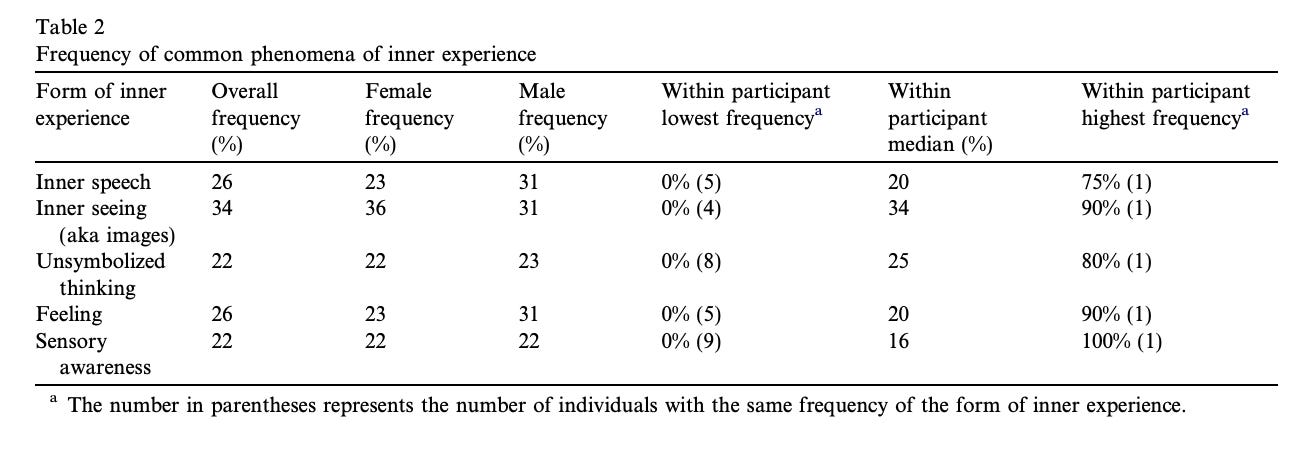
    If this study is accurate, many people may lack specific types of inner experience, and the overall frequency of some types of inner experience may be surprisingly low. Perhaps the low frequency of inner speech (17% not experiencing it at all, and the overall frequency being 26%) explains the nature of extraverts, or why many women verbalize what they feel to those around them as a running commentary. Regarding unsymbolized thinking, defined as “thinking a particular, definite thought without the awareness of that thought’s being conveyed in words, images, or any other symbols”, the overall frequency was only 22% with 30% of participants not experiencing it at all. A lack of frequent unsymbolized thinking may explain why so many people live paycheck-to-paycheck with no ability to plan for expenses.  The premium for car insurance isn’t an event that’s planned for, it’s just something that happens; if a person has the money great, if not they’ll deal with it when the bill comes in.  It’s why people living on food stamps eat steak, buy expensive hardbacks and then run out of money before the month ends.  The idea that the person will need to eat at the end of the month just like they did last month doesn’t cross their minds.

    If this explanation for the general population’s behavior is accurate, the ramifications are disquieting.  If many individuals do not experience specific types of thinking at all (such as unsymbolized thinking), what would that say about the nature of democracy (one person one vote) or about standardized education? What would that say about the Western outlook, which believes that everyone is inherently equal except societal racism/ sexism/other -isms and -phobias holding people back?


    THE CALCIFICATION OF ONE’S WORLDVIEW WITH AGE

    Not only do many people seem to lack frequent unsymbolized thoughts, but most people’s beliefs calcifies as they age: they become no longer open to new ideas, perspectives or experiences which could stimulate changes in younger people’s belief system.  Science shows that aging individuals adopt and rigidify the beliefs they learned as children or adolescents while society evolves and changes with the next generation.  An example of this is J.K. Rowling’s transsexual position: she grew up in an era when being pro-homosexuality was taboo but hip and exciting but transsexualism was off-bounds; society moved on to make transsexualism the taboo but hip and exciting thing, leaving her behind. Or consider Matt Stone and Trey Parker of South Park fame, whose 90’s libertarian irreverence locked into place, unable to adjust to changing circumstances and they’ve been irrelevant for well over a decade.

    This happens in every generation.1 People’s worldview become less sophisticated and more about instinctive reaction to base nature and emotional feelings as they age, and it’s happened with the boomer generation in charge of America today.  For transparency, the following criticism is not meant to absolve younger generations of their culpability about the state of society (and they are also criticized toward the end of this section), but merely to describe how rigid mental calcification affects society. 

    The boomers were a generation where, growing up, they were coddled by the “Greatest Generation” and experienced no external challenges.  Times were good and post-World War 2 America was on the ascendency.  The boomers took advantage of this time of plenty and prosperity and adopted a superficial bootstrap mentality (“You can make it on your own, just work harder!”), a blind belief in formal education (“Just go to college, then you’ll get a great job!”), an extreme belief in “individual rights” and casual drug use and sex (“Peace and love, brother!”), a declining religiousness and a singular focus on making money at the expense of society.   College was cheap, health care was cheap, housing was cheap, raising children was cheap, opportunities were unlimited, and interest rates were decreasing for an uninterrupted 40 years starting in the 1980s which in turn increased asset prices in an almost straight line (as there is a direct inverse correlation between asset values and interest rates):

    Declining interest rates for 40 years.
    Leading to 40 years of S&P price appreciation.

    The mentality created from growing up in idle times of prosperity created the seeds of decadence and decay which would later manifest.  The boomer’s fixed worldview of prosperity resulted in a selfish, entitled, self-absorbed, naively idealistic, short-sighted generation, and they decided to drastically increase government spending so they could enjoy life and retirement at the expense of future generations. As Carl Schmitt argues, when times are good nobody likes a pessimistic naysayer.2  Sticking with this bootstrap mentality, white boomer parents cast out their children at eighteen with no financial support in stark contrast to the Jewish, Indian, Asian and Muslim American populations who continued to support their children indefinitely and which therefore gave them a massive leg up on historic white Christian Americans.  

    These selfish boomers are the people who lead the nation now, a country swimming in debt, illegal immigration, degeneracy, tense racial relations and a host of other seemingly unsolvable problems, and their objective seems to be to kick the can down the road until they die off then let others deal with it — “oh well, it won’t be my problem anymore, it’s yours”.  Some cultural signs of a stagnant, decaying society include endless forgettable movie reboots and Marvel movies (“capeshit”), dull music with auto-tuned beats and no memorable hits in a decade, politically correct video games, replacing statues with woke versions, and awful, decadent architecture and art3 (such as “Piss Christ”).4

    The San Francisco Federal building, an example of modern architecture.
    Compare to any number of examples of older architecture. Which would a neutral observer say is superior?

    Bruce Gibney makes a similar argument in his book “A Generation of Sociopaths”.  He argues: 

    “[In 1978] the gross debt-to-GDP ratio was about 35 percent. It’s roughly 103 percent now — and it keeps rising. The boomers inherited a rich, dynamic country and have gradually bankrupted it. They habitually cut their own taxes and borrow money without any concern for future burdens. They’ve spent virtually all our money and assets on themselves and in the process have left a financial disaster for their children. We used to have the finest infrastructure in the world. The American Society of Civil Engineers thinks there’s something like a $4 trillion deficit in infrastructure in deferred maintenance. It’s crumbling, and the boomers have allowed it to crumble. Our public education system has steadily degraded as well, forcing middle-class students to bury themselves in debt in order to get a college education….[the boomers instituted] a massive push for privatized gain and socialized risk for big banks and financial institutions. This has really been the dominant boomer economic theory, and it’s poisoned what’s left of our public institutions…. 

    I think the major factor is that the boomers grew up in a time of uninterrupted prosperity. And so they simply took it for granted. They assumed the economy would just grow three percent a year forever and that wages would go up every year and that there would always be a good job for everyone who wanted it. This was a fantasy and the result of a spoiled generation assuming things would be easy and that no sacrifices would have to be made in order to preserve prosperity for future generations.  On an abstract level, I think the worst thing they’ve done is destroy a sense of social solidarity, a sense of commitment to fellow citizens. That ethos is gone and it’s been replaced by a cult of individualism. It’s hard to overstate how damaging this is. On a concrete level, their policies of under-investment and debt accumulation have made it very hard to deal with our most serious challenges going forward.”

    Good times inevitably carry the seeds of its ultimate demise within it, bringing to mind a G. Michael Hopf quote: “Hard times create strong men. Strong men create good times. Good times create weak men. And, weak men create hard times.”  The boomer “good times” mentality rapidly brought about “weak men” in the Millennial and Generation Z generations, whose stuck-in-perpetual-adolescence mentality is also having disastrous effects.

    Boomers booming away the nation’s future, swapping unlimited debt for immediate consumption.

    MILLENNIAL AND YOUNGER GENERATIONS ARE STUCK IN PERPETUAL ADOLESCENCE

    Millennials and Generation Z are stuck in a sort of perpetual adolescence deep into their 30s and 40s.  The reasons for this are many and include a combination of poor real-world experience and ubiquitous college degrees, having entitled boomer parents unable to impart life lessons with genuine wisdom, incessant media propaganda encouraging pleasure seeking and short-term planning, an over-the-top political correctness preventing practical thinking, weak personality traits (such as being spoiled, entitled, lazy, sensitive, and feminine), a lack of considered perspective which could have been learned from history, philosophy or religion; a failure to procreate (“having kids is hard, I’d rather just enjoy life”), a lack of skills necessary to repair and maintain complicated societal infrastructure, being significantly more homosexual and transsexual than prior generations which have historically been associated with decadence; utilizing smartphones as a crutch while avoiding interacting with the analog world, ever-shrinking work opportunities because America is a “service based economy” (i.e. domestic manufacturing jobs shipped to China so you can buy cheap plastic at Walmart, leaving most people with paper-shuffling, low value-add jobs5) and vastly increased education and housing costs.  While significantly more formally educated than prior generations, it’s unclear what the Millennials and Generation Z have actually gained from such education, and it may have actually been detrimental – the well established correlation between more schooling and having fewer children has held strong.  

    If American standards of living are rapidly declining while decadence is skyrocketing, how can these younger generations even begin to think about reforming the system when they are stuck in a mental haze of perpetual adolescence?  One blogger discusses this point in detail:

    I am one of the oldest millennials. Something terrifying is happening to us. We are dying while we are still children….

    The oldest of us are rapidly closing in on 40. We are the least married, least fecund generation in history. Really, only 30% of people under 40 are married! Big-brained thinkers blame economic conditions, largely because big-brained thinkers go through years of training to ensure they don’t see what is right in front of their faces….

    My entire life, the only message I got from school, or church, college, and the media was that every decision I made, from what degree to pursue, to where I lived, to whether to marry, was with the goal of having a maximally pleasurable life. True, as someone raised in a conservative church, I was warned against fornication and substance abuse, but these were framed in terms of interfering with the good life. In the 1990s, there was no difference between Christians and non-Christians in that general outlook. Both Christian and non-Christians were equally horrified at the notion that a bright young woman might not end up “maximizing her potential,” which meant putting 40 hours a week into a cubicle. Both warned her against getting married too young, because marriage could cut short a promising career. Evangelicals, for their part, indulged in a pious fiction that the unmarried 25-year-olds in the church were all virgins, but still, everyone agreed that the proper way to treat the world is as your playground. 

    Any kind of social responsibility or context to our choice-making was completely absent from what our boomer elders told us. What is the social purpose of marriage? Conservative boomers couldn’t say. They appealed to “tradition” without understanding why it existed, to a Biblical literalism that was as mindless as it was quaint, in a world where their own self-indulgent concept of marriage had led to record-smashing divorce rates in the 1970s and 80s, and my generation growing up with every weekend alternating between parents. The boomer had already set up the foundation of marriage as an exercise in self-indulgence; gay marriage came as the consequence. If marriage has a social purpose, to channel and direct human sexuality in a way that promotes social cohesion and provides for a man’s progeny, then gay marriage is nonsense….

    It’s sad to watch my generation collapse into nihilism and fear as our bodies begin the process of dying. The men become bugmen, living to consume, filling shelf after shelf with toys their adult brains can’t find amusement in, because they know of nothing else to do. The women are in a panic, desperately trying to hold onto their evaporating youth, trying to prove to themselves that a woman can be just as sexy and alluring at 35 as she could at 23. There’s a lot of rage at the Boomers, but it’s aimless and uninformed….

    Boomers have a perpetual teenage mentality that their parents never understood, and they raised us to be the eternal teenagers they didn’t get to be. When you’re 17, the idea of just buying cool stuff, having consequence-free sex, and binge-consuming media for the rest of your life sounds fantastic. You do not understand that when you are 40, you will not want that any more. There are tons of guys my age and younger who wear Star Wars T-shirts, collect Marvel [toys], and have gotten vasectomies, and they have no idea why they’re so miserable. There are women my age who just broke up with another live-in boyfriend of three years and have no children. So here we are, and we’re falling apart. 

    Our parents instilled in us a totalizing selfishness that they never got to indulge, assuring us that marriage and family “would just come” when “the time is right.” As far as they were concerned, that’s just what happens. Except it “just happened” to them because of all the social capital of previous generations that was still there for them, which they razed to the ground. Now my generation is absolutely miserable because we’re reaching that age where your brain shifts modes from “consume and copulate” to “prepare your offspring for adulthood,” and we don’t understand that’s what is actually happening. Women of my generation have been told their entire lives that loneliness is a psychological disorder, that children are parasites, and that exhausting yourself for 40 hours a week at work is the meaning of life. It turns out that continuing to live as though you were a teenager does not in fact bequeath eternal youth. “Age is just a number” is the most insidious of all Boomer proverbs. 

    For my generation, there is not really a path back out. All the social institutions of this country have been detonated in the quest for money and self, or via the hysterical condemnation of every kind of organic social relation as “sexist” or “racist.” In the cities, nobody knows anybody. Professional associations and social clubs are borderline nonexistent. Nobody knows or cares about anyone, and nobody knows how to start. It’s so sick and twisted that my generation uses the word “community” to refer to people who buy the same consumer products, like going to see a movie means you’re part of the “Star Wars community.” Even churches have been consolidated into massive theme parks where anonymous masses of people go to be entertained; centuries-old congregations have shuttered as the people moved to the megaplex. Brain-dead “conservative” pundits can only worry our declining birth rate in terms of funding entitlements or GDP; hardly anyone will come right out and say a society with low fertility is fundamentally sick and disordered. 

    Millennials need to accept that the values inculcated in us were a load of horse crap. I don’t see that happening, as we’re mostly are upset that we can’t live the idyllic lives of self-indulgence the Boomers promised us. Even suggesting that divorce should be harder, marriage should be younger, and women were built to be mothers, not office drones, causes the average Millennial to dissolve into hysterical outrage. We’re the generation that thinks having a country is racist and the most important thing about space exploration is making sure hijab-clad Muslims are a part of it. So we’re probably not going to snap out of it. We’ll be buried in Batman coffins, surrounded by our Xbox games. Maybe whoever buries us will finally discard the morality of the Boomers.

    The perfect image of the millennial generation.

    What a nightmare.


    THE CHOICE OF VALUES

    We’ve established that the gulf between what most people want and what they receive from society is a wide chasm, amplified by unthinking thought patterns and generational attitudes poorly adapted to the modern world.  But by what standard are we to judge these trends?  

    There are three main ethical theories that attempt to justify moral rules and principles: deontological ethics, virtue ethics and consequentialism.  Briefly stated:

    • Deontological ethics focus on the rightness or wrongness of actions from a duty, rule or obligation based perspective (such as religious believers whose actions derive from the requirements of the religion without focusing on the real-world consequences, for they believe they will be judged by God in the afterlife).
    • Virtue ethics focus on the development of the individual’s character and understanding of the virtues that make up good character. This theory holds that a good and moral person will naturally act in the right way, and that this is the best way to determine right and wrong. Virtue ethics places importance on understanding the virtues, such as courage, justice, and wisdom, that make up a good character.
    • Consequentialism focuses on means-end testing to maximize the value(s) chosen by the person conducting the analysis.  These values can either be hedonistic utilitarianism (trying to maximize overall wellbeing of society) or preference utilitarianism (emphasizing certain subjective values and seeking objectives which maximize those values; for example, a desire for mankind to advance technologically, or a desire for humanity to get close to Promethean perfection, or a desire to protect/preserve nature, etc).  Under utilitarianism, objective truths about our material​ universe do exist but objective values​ do not exist for human beings due to our imperfect minds. The closest we can get is to listen to our intuition, the voice of morality inside ourselves about which values are most important and then seek to achieve them.

    Having a discussion about the state of society without settling on the ethical method being employed results in people arguing past each other, making it harder to achieve agreement.

    Because most of the provided analysis is descriptive about the nature of society as opposed to prescriptive, the hope is that this essay may appeal to those under any of these ethical theories. The method employed attempts to formulate a descriptive framework for human nature and society judged by its predictive value, derived recursively under a time-consuming trial and error process. It attempts to discern the perennial laws governing material reality and human nature until it’s explanatory power synchs up as closely with current and future events as possible.

    After extensive analysis there will be some moral judgments applied, primarily based on the Golden Rule (“do unto others as you would have them do unto you”). There will also be an interpretation offered of where Western society’s core values originate that may upset those with a deontological outlook.


    ONE MUST UNDERSTAND THE PRESENT IN ORDER TO UNDERSTAND THE PAST

    How does one even begin to develop a predictive framework to analyze human nature and society?  Carl Sagan famously said, “You have to know the past to understand the present.”  It’s a nice quote and certainly true in some respects, but Sagan got the cause and effect mostly backwards.  It is difficult understand the past until you understand the present; to discern in real time, by observing the people you know in your own life how they choose what to believe, who they listen to and who they ignore, and why; seeing the ways news propagates and how narratives evolve, and whether they are believed or not and why; what people are taught in school and what is left out of their education, with various strains of thought forbidden; and the various assumptions, incentives and demands people receive that impacts their work, their mating choices, their lives. As Orwell wrote in 1984, “Those who control the present control the past, and those who control the past control the future.”

    How can one attempt to properly understand the past, whether and to what extent historical narratives are true, what information is being conveyed by who and for what purpose, without first developing the discernment necessary to separate fact from fiction in the present?  It is exceedingly difficult.  With careful observance one may learn how false stories are generated today; how these stories are pushed by authority figures to further their own power and control; how these narratives are taught to the masses via media, entertainment and schooling, who absorb these official dogmas and uncritically teach it to their own children, who then perpetuate the cycle.  A judicious individual can take these lessons on propaganda and misinformation and then apply them to what we know of history.

    If one focuses on the present, observes and comes to understand people’s motivations and then applies those lessons to the past, a more accurate understanding of the world can be ascertained.  This is where we turn to next.


    1 See Edward J. Watts, The Final Pagan Generation, 7: “The work of scholars such as Glen Elder has shown that, in the modern world, social and economic conditions experienced during childhood.  People who grew up at different times and under different conditions often do not understand the same event in the same way because their life experiences have conditioned them to react to certain stimuli and ignore others. Their different worldviews are not shaped by any one dramatic day. They instead reflect the slow process of learning to live in the world in which they were born. We know intuitively that older and younger people now share neither the same concerns nor the same reactions to events, but we often forget that this generation gap existed in antiquity as well. Obscuring or ignoring generational differences, then, prevents us from seeing shape people’s behaviors for the rest of their lives, the full implication of historical events.”

    2 “Without wanting to decide the question of the nature of man one may say in general that as long as man is well off or willing to put up with things, he prefers the illusion of an undisturbed calm and does not endure pessimists. The political adversaries of a clear political theory will, therefore, easily refute political phenomena and truths in the name of some autonomous discipline as amoral, uneconomical, unscientific and above all else declare this- a devilry worthy of being combated.” ― Carl Schmitt, The Concept of the Political 

    3 The Turner Prize exemplifies the decline.  Joseph William Mallard Turner was a British landscape artist who made beautiful, romantic paintings.  A prize was made in his honor, which degenerated into the worst of filth.  Per Robert Conquest in Reflections on a Ravaged Century, p. 210: “It is already some years since the Tate gave the Turner Prize to half a mother cow with half a calf, cut horizontally, in a glass case. (A friend phoned the Tate to tell them that the supposed mother was in fact a heifer – and a good sign was that the unfortunate Tate people laughed heartily.). And all this defended by the typically mind-scrubbed ex-financier in charge, Lord Palumbo, on the grounds that Turner, too, was rejected in his time…Later Turner Prizes, some less “transgressive” than others, show a similar taste – the latest being smeared with elephant dung.”

    4 But this trend is nothing new.  “We can assert with some confidence that our own period is one of decline; that the standards of culture are lower than they were fifty years ago; and that the evidences of this decline are visible in every department of human activity. I see no reason why the decay of culture should not proceed much further, and why we may not even anticipate a period, of some duration, of which it is possible to say that it will have no culture” – T. S. Eliot, 1948

    5 Most office workers only “work” a couple of hours a day, staring at their iPhone for sports and politics updates the rest of it.  As an example of this, Elon Musk fired 80% of Twitter employees with no discernible loss in site quality.  But the whole economy is like this and has been like this for a very long time.  As Henry Adams wrote in 1910, “The whole fabric of society will go to wrack if we really lay hands of reform on our rotten institutions.”  Then he added, “From top to bottom the whole system is a fraud, all of us know it, laborers and capitalists alike, and all of us are consenting parties to it.”

  • Introduction: Part 1

    Continued from the Preface…

    This section looks at the bourgeoisie, secular, materialist aspirations of the Western masses and concludes that their lifestyles have been eroded massively over the past decades.

    WHAT DO MOST PEOPLE WANT IN LIFE?

    The general outline is the same everywhere.  Most people, regardless of background, want to get married and have a family.  They want to have a fulfilling career and make a positive impact on those around them.  They want to own a home in a safe area with a sense of community.  They want to have health insurance. They want a legacy they can pass onto their children, both morally and financially.  They want to be able to send their kids to good, safe, clean schools and afford college that will prepare them for life.  They want time for their hobbies, whether it is fishing, hiking, travel, reading, sports, etc.  They would love to have the option of a one-working-spouse household.  They want to feel like they are part of a community of like-minded people, with similar backgrounds and similar beliefs, and that their input matters and they are appreciated.  They want to feel and be healthy.  They want to be able to retire one day.  They want to have trustworthy experts who can answer questions and offer guidance in their lives.  They want to feel like their interests are being properly represented in government.  They want some connection to God.  

    Most people especially want to feel that they are improving their situation in life, that their status – i.e. their standing in their communities, the amount of money they make and the impact they have – increases over time with the efforts they put in.  To increase one’s status makes one happy; it increases one’s mating prospects and treatment by society while to decrease one’s status makes one feel depressed, that they are going in a bad direction.  People inevitably take for granted their current status; they compare themselves to people on the “next rung up”, not those on rungs below them or far above them.  See the Dunbar number where humans naturally maintain a maximum of ~150 relationships.  

    As a corollary, most people want to avoid ideas and influences which society perceives as low status. Being a recipient of “wrong-think” increases the odds of losing social status – of alienating friends and acquaintances, of risking one’s job and standing in their community – which could cause that person a great deal of emotional and psychological pain. 

    Because status is relative, there is a never-ending, zero-sum struggle against others regardless of society’s overall quality of life – there will always be a similar mate pool and social hierarchy to compete for.  This is Nietzsche’s will to power, where in Beyond Good and Evil he states, “Even the body within which individuals treat each other as equals … will have to be an incarnate will to power, it will strive to grow, spread, seize, become predominant – not from any morality or immorality but because it is living and because life simply is will to power.” 


    COMPARED TO WHAT PEOPLE WANT, WHAT DO WE ACTUALLY HAVE IN SOCIETY TODAY?

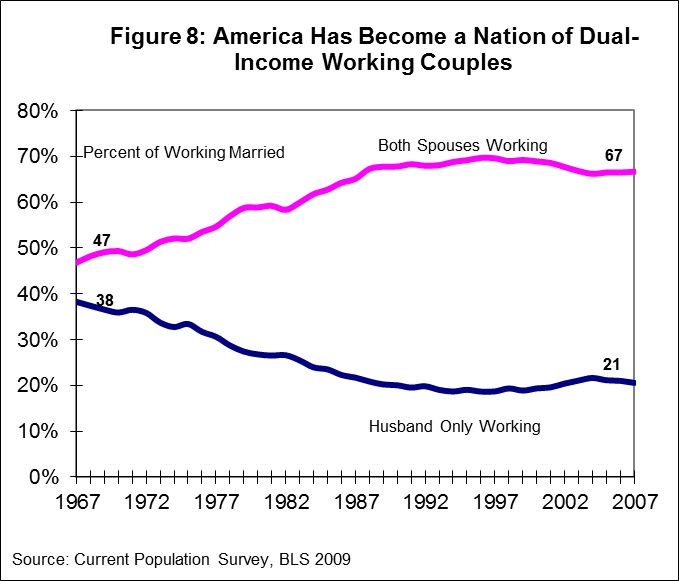
    Today sixty percent of Americans live paycheck-to-paycheck with significant amounts of credit card, student loan debt, and mortgage loans and car loans (if they’re lucky enough to own a house and car).  According to Social Security statistics, in 2018 33% of Americans earned less than $20,000 per year, 46% less than $30,000, 58% less than $40,000 and 67% less than $50,000.  Two working parent households are required in order to try to pay basic expenses.  Per a UBS report 44% of consumers don’t make enough to cover their bills.  

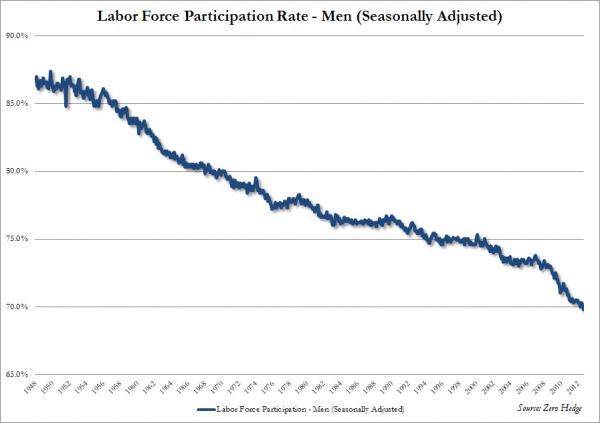
    The labor force participation rate for men declined from 87% in 1948 to 69% in 2012.  Rates of housing and family formation have fallen enormously,  divorce rates have skyrocketed (with pair-bond-challenged women initiating 80% of divorces given legal outcomes substantially favoring them) while children from shattered homes have much worse average life outcomes. People go to work in unstable 9-5 job with no pension and little if any retirement benefits and then lie down on the couch and watch Netflix and porn (or perform on OnlyFans) until bed.  To the extent most people can retire it is only via social security, Medicare and Medicaid, systems that are bankrupt Ponzi schemes, and then when they get too old their children put them into old age homes where they gracelessly expire, neglected and covered in bed sores.

    It’s worse for younger people.  Most Millennials have been priced out of home ownership and they both have children later in life and have smaller families than prior generations.  If they attended college they graduated with an average of $25-30,000 student loan debt and then had difficulty finding jobs because degree inflation has made college degrees useless (which in turn is causing an increasing number of youth to forego college entirely). The education system revolves around teaching the young to hate their past and genders, encouraging young boys to become girls and for young girls to become boys. Society is highly feminized with masculine behaviors banned — pranks (forbidden), childhood fights (forbidden), bullying antisocial elements (forbidden), and endless litigation tying the hands of educators.  

    On the social front everyone is atomized and social networks are shattered.  People have few close friendships.  Parents and grown children live halfway across the country from each other and see each other a couple times a year.  There are no communities; except for a couple of religious outliers (religious Muslims, religious Jews and the Amish; Catholic fertility rates are basically at replacement and declining and Mormon fertility rates are also declining) all others have are gutted.  The right of free association has been banned in America for decades; see Supreme Court cases Shelley v. Kraemer (1948), Heart of Atlanta Motel, Inc. v. United States (1964), Katzenbach v. McClung (1964), and Daniel v. Paul (1969).  The southern border is wide open and many millions of illegals stream into the country each year with the approval of the US government, driving down wages, dividing communities and providing votes from a swelling underclass for the establishment. 

    Social atomization.

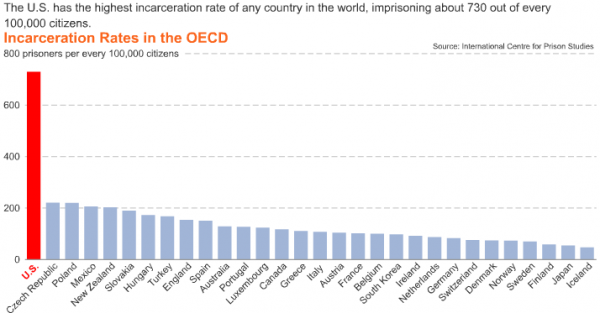
    Crime rates are massive and underreported, then manipulated further downwards.  Even with these tactics the U.S. incarceration rate is by far the highest in the world.  Trash and broken roads litter the streets as aggressive, drug addicted panhandlers lie down next to multi-million dollar high-rises.  Neighbors distrust each other and the government spies on everything you do or read online. Citizens who defend themselves against violent criminals go to prison or lose their rights while arrested violent criminals are immediately released on their own recognizance without bail (a term called “anarcho-tyranny”).  Speak your mind about these things and you will be banned from social media, lose your job, frivolously sued (causing stress and legal bills even if you eventually win) and in various western countries now such as the U.K. face imprisonment for having the temerity to share those beliefs publicly.1 

    Extreme poverty next to extreme wealth.

    Strange chemicals in the water supply are ubiquitous, especially estrogen and SSRIs; most restaurant food is drenched in dangerous industrialized seed oils; micro-plastics have leached into everything including significant amounts in the human body, testosterone levels have dropped dramatically in a generation and obesity rates have skyrocketed.  Average IQs have dropped by an astonishing 14 points over the past 100 years.  5G cell towers, which may have unknown long-term ill effects on health are everywhere and help the government spy on its population. People are glued to their smartphones which have simultaneously destroyed attention spans, atomized people from in-person interactions and, despite the unlimited amount of information online, people are less intelligent than ever. 

    The gulf between rich and poor widens year after year.  The top 1% now own 32.1% of the nation’s wealth, the top 0.1% own 22% of the country’s wealth and the top 0.01% own 11% of the country’s wealth.  The value of the dollar has been inflated away into nothing, having lost 99% of its value in 100 years.  The national debt stands at $31+ trillion with at least $11 trillion dollars printed out of thin air in 2020-2021 alone: $6 trillion of treasuries and mortgage bonds purchased and $5 trillion in CARES Act funds.  

    Dollar purchasing power is down 99% since the enactment of the Federal Reserve in 1913

    Belief in God is at an all-time low and depression is at an all-time high.  The majority white population is demonized via relentless media and entertainment propaganda, racially discriminatory employment and education practices, while the most deviant elements of society are actively promoted (i.e. homosexuality and transsexualism).  There is a marked lack of representation for white Americans in society and government.  For example, despite making up 2% of the population almost the entirety of Biden’s cabinet is either Jewish, married with Jewish spouses (Kamala), or their children have Jewish spouses (all of Biden’s children). Obama, despite being elected on a “hope and change” platform, had his entire cabinet chosen by global bank Citigroup. Social media companies, cracking down on freedom of speech, are run by recently arrived H1B Indian immigrants with no respect for the American Bill of Rights or Constitution (to preempt a common counter-argument, while they are officially non-governmental corporations, the government tells them who to ban and censor). Whites are dramatically underrepresented in college admissions.  Due to these and other discriminatory policies the white percentage of the American population has dropped from 90% to 60% in 50 years.  There are similar but not as extreme trends in Canada, the United Kingdom, France, Germany, and the rest of western Europe.  It is a slow rolling but historically breathtakingly fast white, western civilizational suicide. Those who point any of this out are called racist and sexist, de-personed and made to feel like an outcast.

    Meanwhile the US military industrial complex gets involved in endless wars for the purpose of fleecing the public with obscenely overpriced military hardware and a bottomless hole of graft, while projecting coercive hard power with ~800 military bases in over 70 countries. It is unclear who is in charge; it’s not the president (Joe Biden has dementia and regularly flubs reading simple cue cards, and Trump battled the entrenched bureaucracy for four years to no effect) and it’s not any one specific governmental agency, so who is it?  Many foreign governments view the United States as “agreement incapable” because there is no one clearly in charge, and even recently signed agreements are tossed out and ignored.   

    The Pentagon has never passed an audit.

    Whatever the case may be, the officials pushing these policies have stripped American citizens of their rights, dignities, and quality of life while enriching and empowering a small number of corporations and individuals who financially benefit.  The combined effects of these policies is akin to a kind of Hell on Earth.  These officials then export these policies worldwide to force a handover of every country’s sovereignty to globalized elites for exploitation.  They do this by riling up a country’s underclass (whether it be women, ethnic minorities, or homosexuals) via deceptively “do-gooder” NGOs or otherwise overthrowing their rulers directly.  This process is defined as “globohomo”, i.e. the combination of globalization plus homogenization, or alternatively the combination of globalization plus homosexuality.   

    A mural of Afghan “pro-democracy” protesters using an image of George Floyd in U.S. occupied Afghanistan; an example of global homogenization of American culture.
    U.S. military bases enforce globohomo hard power.  It’s commitment to global hegemony was reaffirmed in a 2023 Senate vote 86-9 to maintain 2001’s “War on Terror” authorization.

    All of these issues are consistently getting worse.  Is there no limit to this depravity and degradation?  The gulf between what people want and what they get from government has not been greater in living memory.


    HOW DO PEOPLE RESPOND WHEN YOU TALK TO THEM ABOUT THESE ISSUES?

    Based on a lot of anecdotal observation if you bring up these issues with most people and solicit feedback, it appear they become hesitant, unsure of how to respond.  They seem to search in their heads for canned media lines they can repeat but come up short.  Their ability to independently ponder, assess and organize political, social, and economic trends affecting their lives seems to be weak. Food prices are skyrocketing?  Housing prices are increasing?  Education and health care are unaffordable?  How can one explain these things?  Blame a nebulous “inflation”?  Blame “Russia and Putin”?  Blame “right wing religious fanatics” for opposing… abortion?  Blame the “economic damage” caused by COVID, or by COVID vaccine deniers?  Blame congressional “dysfunction”?  Blame “political divisiveness”?  Blame Trump’s “unpresidential demeanor” and “racism” (“Orange Man Bad”)?  None of these explanations feel to normal people to be quite satisfactory, so it seems that they try not to think about it, are silent and either try to busy themselves with their personal lives, distractions like sports/television, or otherwise numb themselves with drugs and alcohol.  Cast adrift in a stormy sea; waiting for a sign of calm to magically return.

    To independently think about societal trends and link them requires a certain skillset: interest in politics, the ability to make inferences between seemingly disconnected issues; the ability to form hypothesis about common causes; the willingness to observe events and see if results fit into the hypothesis and if not to adjust one’s worldview until they become more predictable; the ability to reason independently of authority figures; the willingness to be comfortable with doubt/uncertainty for long periods of time; the ability to resist group pressure.  It requires basically being autistic, anti-authoritative and politics focused, something most people are not.

    In the next section we will look at how people think, how perspectives differ on a generational level, and the ethical theories that will be used for the rest of this essay.

    Continue for Part 2…


    1 “Political correctness is communist propaganda writ small. In my study of communist societies, I came to the conclusion that the purpose of communist propaganda was not to persuade or convince, not to inform, but to humiliate; and therefore, the less it corresponded to reality the better. When people are forced to remain silent when they are being told the most obvious lies, or even worse when they are forced to repeat the lies themselves, they lose once and for all their sense of probity. To assent to obvious lies is in some small way to become evil oneself. One’s standing to resist anything is thus eroded, and even destroyed. A society of emasculated liars is easy to control. I think if you examine political correctness, it has the same effect and is intended to.” – Theodore Dalrymple

  • Preface

    “The prolonged absence of any free exchange of information within a country opens up a gulf of incomprehension between whole groups of the population, between millions and millions.  We simply cease to be a single people, for we speak, indeed, different languages.”
     – Alexander Solzhnetizyn, The Gulag Archipelago

    “Give me the liberty to know, to utter, and to argue freely according to conscience, above all liberties.” – John Milton

    “Again, the devil took him up on an exceedingly high mountain, and showed him all the kingdoms of the world and their glory. And he said to him, “All these things I will give you if you will fall down and worship me.” – Matthew 4:8-9

    This world has a sickness to it.  Bad people prosper and good people suffer.  The basic incentive structures of reality is predatory and malevolent: all life survives by consuming other life; even something as simple as a plant is alive and struggles for survival.  Reproductive fitness favors those who dominate others via cunning and strength, stealing resources using force or trickery.  This can take many forms, but in the modern era it typically involves elites utilizing psychological manipulation via media, government, or education.  As Donald Hoffman argues in The Case Against Reality: Why Evolution Hid the Truth From Our Eyes, humans are evolved to maximize their reproductive chances which has little to do with the pursuit of truth; indeed, focusing on truth lowers these chances.  Or as Thomas Ligotti concludes in The Conspiracy Against the Human Race, “If truth is what you seek, then the examined life will only take you on a long ride to the limits of solitude and leave you by the side of the road with your truth and nothing else.”  Lasciate ogne speranza, voi ch’intrate.

    undefined
    Gustave Doré‘s engravings illustrated the Divine Comedy (1861–1868). Here, Dante is lost at the start of Canto I of the Inferno.

    The harshness of reality is difficult for most people to accept; a cold, dark, uncaring universe is depressing and may result in suicidal ideation or becoming a sociopath to take advantage of the weak.  Exoteric religion serves as a mollifying force to keep people sedated and compliant, but it also creates the conditions necessary for the “social contract” allowing people to interact without brutal winner-take-all warfare.

    Those sensitive to the fundamental nature of reality have it harder than normal people who outsource their critical thinking facilities to society, formal education, sports, entertainment and the media; removing the burden of independent thought understandably makes it easier to get through life. These regular people, derided in dark corners of the internet as “non playable characters” (“NPC”, a video game term) think in narrowly proscribed, rigid lines as dictated by society. Outsourcing their critical thinking turns them effectively into a form of cattle, ripe for exploitation.  A minority feel a pull to understand the world and experience cognitive dissonance regarding society’s rules and norms and, for those thinking more deeply, about the suffering nature of reality itself. Labeled “dissidents”, these free thinkers are unusual, rare, and set apart from the masses of gray, unthinking NPCs that populate the world.

    As Oswald Spengler argues in The Decline of the West: “A thinker is a person whose part it is to symbolize time according to his vision and understanding.  He has no choice; he thinks as he has to think.  Truth in the long run is to him the picture of the world which was born at his birth.  It is that which he does not invent but rather discovers within himself.  It is himself over again: his being expressed in words; the meaning of his personality formed into a doctrine which so far as concerns his life is unalterable, because truth and his life are identical.”  For these few, the pursuit is truth is something serving as an objective in and of itself, whether due to ideals, impulse, belief in God or otherwise, without expectation of material or status rewards.

    This essay is a tribute to such free thinkers.  It hopes to serve as a primer for younger dissidents who retain a degree of establishment indoctrination as a jump-start toward their future growth. It also attempts to provide an informational compendium for dissidents who are more advanced in their political journeys but who have holes in their knowledge about the structure of the modern world.  The dissident space is fractured; each blogger, tweeter or author focuses on one aspect of the lies society pushes on us, but no one thus far has tied it together into a cohesive structure using political syncretism.  Because one’s political typology is fixed like one’s physiognomy, this essay is not geared toward NPCs, sociopathic globalists or corporatists, who would either not understand or appreciate the arguments made herein.  It is specifically directed at dissidents.  

    This essay also serves as a critique of those who have been fooled throughout history (and continue to be fooled) by falling victim to the elite’s propaganda against their own interests, and it also criticizes society’s sociopathic rulers who hide in the shadows, issuing secret orders behind the curtain without the public’s knowledge or consent.  Per J.R.R. Tolkein, “The true equation is ‘democracy’ equals government by world financiers. The main mark of modern governments is that we do not know who governs, de facto any more than de jure. We see the politician and not his backer; still less the backer of the backer; or what is most important of all, the banker of the backer.  Enthroned above all, in a manner without parallel in all past, is the veiled prophet of finance, swaying all men living by a sort of magic, and delivering oracles in a language not understood of the people.”

    This cabal of criminal financiers has adopted a dialectic of materialism which views the World as Power and the World as Reality, and they deny all other powers and all other realities.  According to Eustace Mullins, these people have “absolute contempt for anyone who actually believes in the tenets of…any national, religious or fraternal group…If you are a sincere Christian, Zionist or Moslem, the World Order regards you as a moron unworthy of respect.  You can and will be used, but you will never be respected.”  These are the cunning predators who capitalize on society’s trust for profit and control; motivated not by a sense of noblesse oblige which nominated elites of the past, but by noblesse malice – a desire to punish and destroy society – they lack a clear understanding of the consequences of their actions, potentially leading toward ruin of all mankind if current trends continue.

    With that said, events are bringing these malevolent figures into the sunlight as never before.  It is the hope that their reveal from behind the curtain may unite dissident groups and the masses of the world with a common goal, joined in a vision of a better future for humanity.

    Some of the following discussion about how the world works is uncomfortable, but it is not intended to be ultimately demoralizing.  The presented framework should be judged by its predictive value for future events and how well it illuminates current and past events, based on an attempt to understand the perennial laws that govern material reality and human nature. Meaningful change is only possible in a directed way once a problem is properly understood.   Perhaps even the aggressive, predatory nature of the universe can ultimately be transcended by a humanity which better understands itself and the laws governing the world around it; from there hopefully a more just and Godly world may follow.

    Thanks for engaging on this journey.

    Continue with Introduction: Part 1…

  • Table of Contents


    On the Nature and Crafting of Belief in the Elite’s Struggle for Power and Control

    Section 0: “Preface”, available here

    Section 1, “Introduction”, describes what most people want in life and the disconnect between their hopes/dreams and what they receive.  Part 1 and Part 2

    Section 2, “The Dissemination of Information in Technological Society”, looks at how information is created and disseminated and why people choose to believe it. Part 1 , Part 2 , Part 3

    Section 3, “Dissonance to Information Control in Technological Society”, explores the rise of cognitive dissonance to establishment propaganda and what types of people are more likely to experience it and why. Part 1 , Part 2 , Part 3 , Part 4 , Part 5 , Part 6

    Section 4, “Goals, Motivations and Strategies of the Owners of Modern Society”, argues that a handful of families own the central banks of the world and control society via unlimited fiat monetary printing.  It offers a historical and psychological framework for their behavior and investigates their objectives. Part 1 , Part 2 , Part 3

    Section 5, “Deeper Societal Trends Predating the Central Banks”, analyzes the modern and historical relationships between Judaism, Christianity, and Hellenism and contrasts their values and beliefs, and explores how civilizational values are retained from millennia-old conflicts. Part 1 , Part 2

    Section 6, “Suggestions and Takeaways”, looks at currently perceived alternatives to our globalized system and offers various conclusions. Part 1 , Part 2

    Appendix A provides a brief history of central-bank initiated wars.

    Appendix B addresses a caveat to the willpower behind the central bank system by discussing the rise of a perpetuating capitalist matrix.

  • On the Nature and Crafting of Belief in the Elite’s Struggle for Power and Control

    Hello, and welcome.  This Substack contains a chapter-by-chapter essay entitled “On the Nature and Crafting of Belief in the Elite’s Struggle for Power and Control.” 

    The central thesis, stretched among six sections containing well over 1,000 hyperlinked citations and footnotes, is that (1) the private owners of the world’s central banks are attempting to aggregate all wealth in their own hands and turn the world’s population into dirt-poor serfs, or worse; and (2) a hyper-focus on achieving equality dating back to trends from thousands of years ago is resulting in a frightful “leveling down” of anything and anyone superior, flattening the world to the lowest common denominator.  A world where this energy predominates is a world of gray dreariness, no laughter, no excitement, a world of Death, and it is being pursued with the glee and sanctimony of the righteous pursuing a Holy War against their insufficiently equality-focused enemies.  

    This process is only warming up with much worse to come, and if these trends continue it will likely result in the complete destruction of western civilization and possibly of humanity itself. 

    Various bloggers, tweeters and authors address one or multiple aspects of the problems plaguing modern society, but no one thus far has tied it together into a cohesive structure using political syncretism. This is one such attempt.  The expected future is going to be so terrible for the vast majority of the world’s population that I felt a moral obligation to say something even though it will likely have little effect.

    Please start at the Table of Contents for the structure of the essay.  Posts are meant to be read in chronological order, but the core sections are Section 4, “Goals, Motivations and Strategies of the Owners of Modern Society” and Section 5, “Deeper Societal Trends Predating the Central Banks” if you decide to skip ahead.  Sections 1-3 deal with the nature of propaganda, why people believe it and how the technological surveillance state propagates it.

    This essay is a living one and may be updated with revised arguments and new links from time to time.  Arguments should be steel-manned, not straw-manned, so feel free to offer any criticism within and I will give an honest look at it.  This will remain free, as the point is not to monetize it but get it out into public square.  I don’t want to be a globohomo slave subject to ever-decreasing quality of life and don’t think you do either.

    That being said, there are no political prescriptions offered herein other than the contention that central banks should be publicly owned.  The primary thrust of the essay is an attempt to frame a different way of thinking and looking at the world for the reader.  

    Ultimately politics is downstream from belief, and only a Nietzschian transvaluation of values can lead to meaningful change.

    I’d like to thank those that provided feedback on the initial draft and those that I have debated with over the years.  This has been an effort which has taken an extended amount of time to write with a lifetime of politically-focused learning and research behind it.  It is dedicated to those few free-thinking, independent dissidents who are victims of the masses of NPC-herd creatures (who are in turn animated by false establishment messaging); and it is also dedicated to those who are too young to decide their own future before society targets them.

    – Neoliberal Feudalism

    Thomas Cole’s The Course of Empire, fourth painting