
Category: Neoliberal Feudalism

  • Inceldom as the apex of nihilism

    This is a post about inceldom, specifically in the context of the eponymous novel by ARX-Han which you can find here. First I’ll discuss my reluctance to read and possibly review a novel about inceldom (which, to be clear, ARX-Hax had not asked for this review), then my reasons for doing so anyway. Then I will cover the plot of the novel with some select quotes so you can see the quality of the writing, which is high, then review its strengths and weaknesses as I see them. I try to avoid spoilers below but there is one or two things I point out that may be construed as such.

    Cool cover art

    This isn’t a topic that I was very excited to revisit for a couple of reasons. First, I am not in a dating phase of my life and the struggles and lessons learned (in part) I’ve tried to impart in various posts about dating and male/female dynamics herehere and here. Why revisit the topic of dating from new perspectives when it doesn’t speak to my current experiences and when I felt pretty comfortable with the conclusions I have drawn? Second, I am increasingly doing a deep-dive into aspects of the esoteric tradition and inceldom is truly the apex of nihilism, and life is hard enough without wallowing in it. My hope is to find a worldview that works for me to re-enchant the world so the weight of material existence and globohomo control is not so heavy. My time is limited so focusing on a novel about incels is perhaps not the best use of it. Third, the topic felt outdated; not in the sense that incels don’t take up a major portion of the (mostly male) public in globohomo Hellworld 2024, but rather that they’ve semi-disappeared from the public light, walling themselves off on Reddit (r/foreveralone) or forums such as incels.islooksmax.org, or plenty of others (it can actually be hard to join these communities; they moderate new users and screen out all but the most dedicated). The last incel terror attack I can think of was Alek Minassian in 2018 and, of course, the “Supreme Gentleman” Elliot Rogers in 2014; perhaps there have been more recent ones, but really not many and I think it signals that the copycat wave of such rage/spite induced attacks has dwindled.

    Okay, so there were plenty of reasons to not read the book. But I ultimately picked it up anyway; why? Well, first ARX’s Substack writing is solid. I especially liked his posts detailing how difficult it is for an independent writer to develop reader interest; i.e. the skillset of marketing is a completely different skillset from that of writing, something that other wonderful writers like Guido Giacomo Preparata have also struggled with. And it’s not just a completely different skillset but one entirely stacked against the independent writer. You can see ARX’s two posts on this topic here where he offers two examples of indie writers who have achieved some degree of public recognition, Delicious Tacos and Mike Ma, and here where he argues that mainstream publishers spend money haphazardly without knowing what will be successful or not, and that they chase high status trends as much as profits (or more so). Writing about low status men from a neutral or empathetic perspective is declasse so such topics get no funding or support. Thus, even though my audience here is limited I wanted to read it in a show of solidarity and, if it was any good, to write a post about it and maybe it might interest a couple people to read it. Tiny little indie writers should support each other if they offer interesting and thought provoking work, should we not?

    Second, I like to stagger my reading — I can’t read multiple books on the same topic or from a similar perspective, I like to go heavy-light-heavy-light on topics and style, and while most of what interests me is non-fiction, increasingly fiction has a place as well (such as Goethe’s Faust). Incel hit from a different and fictional angle versus most of the other stuff I’ve been reading, which is a plus. Third, perhaps there was still something for me to learn here — one can think they know a topic well but can still be surprised and learn new things; it’s the mark of a foolish man to think one knows everything there is to know about an issue. And lastly: I think it is important to read writers who write not for fame or fortune or attention, which is most, but because they feel compelled to write as a way of almost exorcising a Demon: the act of writing relieves the burden and the torment of carrying around the heaviness of a subjectively important idea. This is something Brett Andersen has experienced (you can see his Substack or check out his Youtube) and something that ARX has felt as well. It was philosopher Emil Cioran who stated,

    “In my opinion, a book should be written without thinking of others. You shouldn’t write for anyone, only for yourself….Everything I’ve written, I wrote to escape a sense of oppression, suffocation.  It wasn’t from inspiration, as they say.  It was a sort of getting free, to be able to breathe.” He also stressed the importance of writing in accordance with temperament: “A writer mustn’t know things in depth.  If he speaks of something, he shouldn’t know everything about it, only the things that go with his temperament.  He should not be objective.  One can go into depth with a subject, but in a certain direction, not trying to cover the whole thing.  For a writer the university is death.”

    Ernst Junger agreed with this, writing in his World War 2 journals, p. 96:

    [Special insights] come from authentic intuition, which itself exists outside of time. This truck me in regards to On the Marble Cliffs, which was triggered by a dream in a single night. But after the flash of intuition, it can take me an entire year to work it out. That’s why I often jokingly say to my wife, “Pray to heaven that I don’t get an idea!” Because then you become the slave of your own idea, and that’s the worst kind of slavery. If a work has to attain a certain rank, it goes back to that initial flash of intuition; then the implementation either succeeds or fails, but in any case, it demands quite a long time.

    Okay, so I picked up the book and read it. What was it actually about and how was it?


    The novel

    Incel tells the first-person story of a twenty-two year old graduate student named “anon” who has never had sex and who plans to kill himself if he doesn’t get laid by his twenty-third birthday. His values are rooted deeply in the nihilism of the modern West, as Han explained here:

    And so—the modern incel—“the quintessential subject of modernity,” is a young man who has searched for meaning but found it absent. If he is alive right now, he has lived through a late-USSR style collapse in nearly every possible dimension of meaning: religion (killed by science), state (killed by oligarchical financialization), community (killed by industrial capitalism), art (killed by homogenization), family (killed by the preceding three) and lastly, love (killed by inceldom).

    Wealth does not count as a sufficient source of meaning.

    In modernity, the only ritual of masculinity that remains for the young man is to have sex. In effect, it is the main remaining prerequisite for a successful transition into adulthood (reproduction is no longer required). If he is unable to achieve this, there is essentially nothing left that is socially prescribed for him apart from wealth accumulation. This dynamic exists against a background of intense atomization and loneliness that is already a feature of our urban societies.

    Because the story is told through the first-person, there are elements introduced where anon’s narrative is unreliable and it later comes to haunt him on a number of occasions. His graduate studies are in evolutionary psychology and he autistically approaches every interaction with women like he’s playing a video game and not like he’s dealing with a human being. Input the right combination of statements and expressions, achieve the desired output of sex. He iterates and evolves his approaches, hitting on women everywhere he goes while still striking out and experiencing a lot of anger and frustration:

    While studying her face over the course of this conversation, I also note the flash of discomfort that periodically darts across her eyes, mapping these movements onto a preset understanding. Even with the comparative disadvantage of my minimal intergender experience, it’s plainly evidence that the girl probably senses something wrong contained within the central parameters of my psyche. She is, of course, entirely correct in her analysis: not only is loneliness a profoundly aversive stimulus to members of the female race, it’s a defect that seems to produce a sort of audiovisual field that continuously dissipates from the pores of your skin. The paradox is that this acts like a positive feedback cycle – the repulsion exerted by this field of force is omnipresent and omnidirectional, further entrenching your own automization by amplifying the strength of your isolation. I try my best to mask this but do not always succeed. In order to connect with human beings, you must bury your pain so deeply that it becomes imperceptible to others. To face the world, you must show only strength.

    And another:

    I decide that Jason’s philosophy is indeed an accurate depiction of reality; if ever you find yourself deeply wanting someone, it means that you’ll never be desired in return. After thinking over his advice from the previous night, I’ve concluded that the cause of this dynamic is an extremely simple one. The strength of your desire is proportionate to your discrepancy in mate value: the higher her value relative to yours, the less likely the girl is to reciprocate your interest. A couple of hours after meeting Zoe I’m still crushing on her big time, and her silence contains the message of negation. It’s the amorphous, distributed intelligence of the universe and its hidden streams of causation, which, sensing your weakness, cohere into a singular negative intentionality that astrally projects a Big Black Cock into the domain of your daydreams, stalking you through the corridors of non-Euclidean space until it finds and slaps you across the cheek with a relentless, turgid velocity that terminates in your absolute submission to the void.

    His tone reminded me to an extent of the bitterly truthful Red Pill Comics such as this one (others can be seen here):

    Anon’s outlets including a few close friends, boxing, endless amounts of pornography and browsing depressive Reddit sites to hear other people wallow in their misery. Here’s an excerpt on this last part after a woman anon really likes ghosts him:

    What I most like about the internet – well, what everyone likes about the internet, I suppose – is knowing that you are not alone in your suffering. Insofar as the anonymity of a forum displays the hidden qualia of otherwise atomized individuals in a centralized pool, its value lies in its honest ability to capture the media primate’s daily existence on this orbiting hellscape. Only when you peel away the flesh of a man’s face can you directly examine the contents of his consciousness, opening an unobstructed channel past the myriad filters of social calibration that constrain the public exhibition of his existential distress. Mental states are like resonant frequencies: they seek coherence and amplification from like-minded peers. Thus, the cure for loneliness is to plug into the lives of others; through the reciprocal interface of voyeurism and exhibitionism, you can relegate yourself to a single node among a collection of otherwise isolated individuals. This amounts to a networked vampirism – a sucking of energy from the lost, disaffected souls who spend days immortalizing their grievances onto the marks of a digital ledger. Perhaps the enlightened primate understands that transcendence emerges from the descent into the void, not the ascent into Valhalla.

    If you stare at the screen long enough, you can hear the sound of their screaming.

    In aggregate, they coagulate into a very particular feeling: the feeling of being in a place called hell. Yes, the internet is hell, and the reason it is hell is because we are in hell. On the internet you are always in the center of the pentagram, the focal point in a vast perimeter of interconnected souls screaming in unremitting torment, the primary conductor of a grand chorus reifying the subjective centrality of your own misery over and above the world’s. There is no part of you that does not enjoy being among the suffering of others. The best thing about hell is that it contains other people.

    This is strong writing.


    Strengths and weaknesses

    As mentioned, the writing in the book is superb throughout. The words grabbed me and I felt compelled to read it through. With many books I read as long as I am deriving value from it; even if the writing is poor and is a slog to get through I will power through it so long as the benefits of the accruing knowledge outweigh the pain of getting through it (The Gulag Archipelago was one such painful exercise). Samuel Chapman makes a similar point hereIncel was a pleasure to read and I could tell that a lot of thought and effort went into it.

    One of the strengths of the novel is that it combines accurate, grim facts about the nature of dating and of reality itself with the subjectivity of an unreliable first person narrative, kind of like Fight Club which is referenced once or twice (indeed, it seemed at one point that his best friend and opposite in many ways might have been a similar Tyler Durden-esque figure). The mark of a strong narrative is that is can be and is multiple things at once, like a prism refracting light depending on the angle of the viewer watching it. The fact that a loser who can’t get laid uses those facts as a shield to protect his fragile ego so he doesn’t kill himself doesn’t mean that those facts or studies are useless or that he necessarily interpreted them wrongly; rather, it highlights one of Han’s core points (correctly) that ultimately intellectualism should not detract from having a lived experience of connection with other humans organically, a point also stressed heavily by Goethe in Faust.

    ARX set the novel in 2012 which is probably appropriate because that was when the incel community was really having an underground impact – but this also means perhaps that the timing of the release of the novel is off. For example, Neil Strauss released a couple books on game when the game movement was at the edge of mainstream society; he parlayed that into success. If he had released those books today they would not have done nearly as well because that “moment” is over.
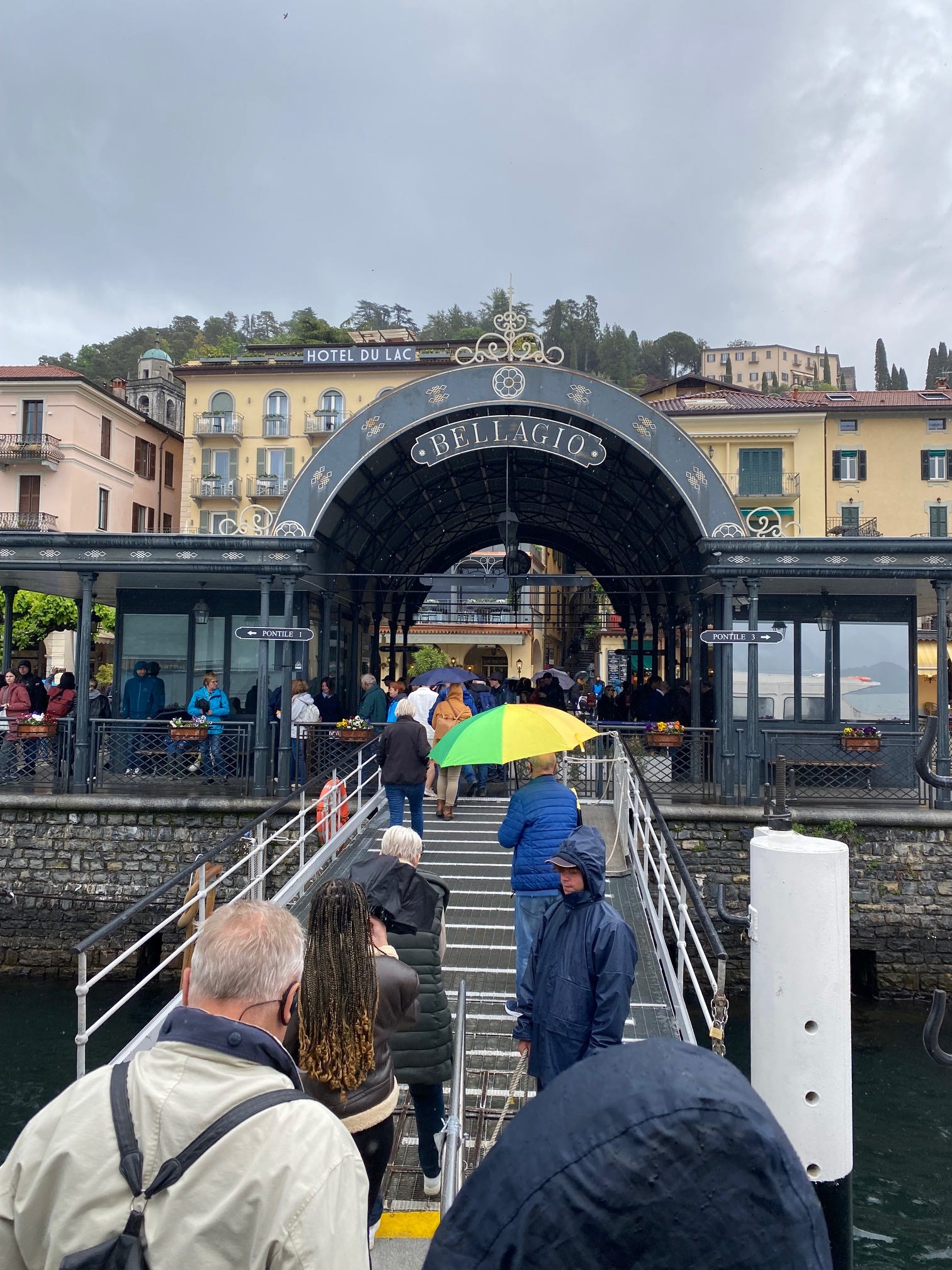
    Regardless of timing, ARX gets many of the details of the difficulties in dating in the modern era correctly if one isn’t Chad. To share a piece of my own story, I had a lot of trouble dating in a similar fashion as anon due to a combination of autism, being an outsider to the mainstream zeitgeist, having a pessimist outlook and possessing high levels of disagreeability. I ultimately had success in dating when I decided to treat it like a second job and arranged for 3-5 dates a week, striking out way more than I succeeded but over time iterated a process that increasingly worked for me. I only found a long-term partner when I had that success and was starting to enjoy it; the relationship just kind of crept up on me naturally. Strange how that works. But that didn’t solve all my problems; the residue from not being successful with women during my formative years will always be there, lurking as a danger toward misogyny, much as anon will never have average or normal feelings on this topic.

    On this note, I think ARX does a good job in writing anon from at least a partially sympathetic perspective. We all change and evolve over time; are you the same person you were five or ten or twenty years ago? To what extent would you have things in common with that person? And also what does our changes in personality say about the nature of the soul? It is important to have empathy for who we once were even if one has evolved past it: Ernst Junger makes this point in his later interviews, basically how he didn’t identify with his gung-ho nationalist self from the 1920s anymore but he understood and empathized with where he was coming from. He never apologized for who he used to be.

    Han made the main character anon twenty-two years old and white, but his intellectual knowledge both seemed greater than a twenty-two year old and he seemed very Asian to me, or at least half-Asian (ARX has stated that he himself is a Chinese-American). Perhaps ARX intended the novel to be aimed at deradicalizing white incels specifically but from that perspective I don’t think he nailed the tone of that ethnic group. Rather, anon seemed to at least be a hapa (half Asian half white) — and it seems that hapa males with white fathers and Asian mothers mentally struggle a great deal in Western society compared to other groups (this dynamic does not really apply to hapa males with white mothers and Asian fathers, but those are much rarer). Furthermore, I don’t think anon’s parents were mentioned at all – his sister features prominently, but it’s interesting why the parents would have been left out along with other family members (unless there was something I missed). It was also curious the lack of anon having or trying to find male role models; usually desperate young men flailing around in a choking sea of nihilism reach out and try to find someone, usually an older male, to guide them where possible…this is where the silly Andrew Tate and Jordan Peterson phenomenons came from (but after the time set in the novel). Clean your room!

    Lastly, with respect to Han’s stated intent of deradicalization1: it’s a tricky subject, isn’t it? Nietzsche believed that truth required a synthesis of opposites and I think that’s accurate: while political radicalization combined with inceldom is a difficult path for a man to follow, it doesn’t mean that their criticisms about the nature of society are illegitimate – with respect to female entitlement and obesity, divorce laws favoring women, the difficulty of financially supporting a family or buying a home, etc. (and women, please don’t think that I believe men are innocents in this process; there’s a large amount of obesity, entitlement, and laziness with men as well). See this video which Elon Musk agreed with highlighting this point. I think on this basis that the book’s afterward is a bit too on-the-nose explaining its themes, perhaps ultimately detracting from the power of the novel – it should stand on its own terms – although I personally found it interesting to see ARX’s motivations regardless.


    Conclusion

    Writing talent, even high writing talent, is no guarantee of success in this world. Talent in anything, actually, is no guarantee of success. I was listening to the wonderful song Hallelujah recently and I looked up its history. Leonard Cohen released a terrible version that no one listened to, then years later John Cale released a wonderful/my favorite version which also got no attention. You can hear it here:

    Then years later Jeff Buckley released a new version and that too received no attention until Buckley died in a freak drowning accident. After that Buckley’s version and then Cale’s version became popular and then it spawned a huge number of covers as well as the song being featured prominently in a huge number of stupid globohomo television shows and films. Why did it take so long for the song to become popular? Would it have ever achieved popularity and fame without this very specific series of events? How many other wonderful songs are out there that didn’t have a lucky break like this?

    This also brings to mind famous musicians playing on a street corner as an experiment and getting routinely ignored. Can the public recognize talent unless certified “experts” tell them that something received official approval?

    Such is the nature of everything. One counter is that the harder one works the luckier one becomes. So ARX, congratulations on writing an interesting and very readable novel which raises a lot of interesting issues. Congratulations on ending the novel on a true, authentic beat instead of something artificial and saccharine. I hope you have luck with marketing and promotion even if the road to getting more people to read it is a circuitous one, and even if marketing efforts such as on Twitter is an uphill battle.

    This era of ubiquitous nihilism is really a choking one, and any efforts to push past it will certainly not be coming from within the mainstream. It’s guys who have no connections writing from pure passion that will have to be the change if it ever comes; they are the only ones who can really speak truth to power, and it is that dangerous act where true art is made. So ARX-Han, thank you for following your passion.

    If this review piqued your interest, you can find the novel here.

    Thank you for reading.

    Subscribe:
    Email delivery remains on Substack for now.


    1 Although ARX stated in a podcast that the deradicalization framing is ultimately wrong and it’s more about identifying an aspect of society’s spiritual malaise in order to grapple with it directly.

  • How globohomo skinsuited the Catholic Church

    This post investigates why and how globohomo skinsuited the Catholic Church, begun in earnest in the aftermath of World War 2 and finalized with the widespread allegations of priest sexual abuse in 2002. Prior entries on religion include the origination and evolution of Christianity, the history of the Eastern Orthodox Churchthe relationship between the central bank owners and the Jewish people, and an analysis of different religions in the context of group fertility rates. Islam will be covered in a future post.

    “The Church’s maw’s remarkably capacious, Gobbles up whole realms, everything precious / Nor once suffers qualms, not even belches; The Church alone is able to digest / Goods illegitimately possessed.” – Mephisto in Faust: Part One, Scene: Out Walking

    As Nietzsche explained in his first treatise in “On the Genealogy of Morality” and as discussed previously on this Substack, Christianity originally arose as a way to rile up the masses of poor, women, and slaves to smash the hated, powerful Roman Empire by inverting its core values. To the Roman elites what was “good” was what separated them from the masses i.e. strength, immediacy of purpose, nobility, victory, while “bad” was anything that made the elites like the masses. Meanwhile Christians believed in a system of good/evil where what was “good” were the traditionally “bad” Roman values, i.e. weakness, humility, blind belief, meekness, subservience, equality, pity, guilt, suffering and self-hatred, and what was “evil” was the traditionally Roman “good” values. An inversion of society from top to bottom.

    Christianity caught on like wildfire, but its inherent pacifism and egalitarianism was not a viable route toward empire building or power acquisition. The Catholic Church evolved to solve this problem by outcompeting and destroying its competition (Hellenic, Arian, gnostic) and putting rigid hierarchical guardrails in place around its core egalitarian energies.

    This strategy succeeded and ultimately reached a kind of egalitarian/inegalitarian balance, lasting for about 1,000 years until the adoption of Aristotelian logic by Aquinas. The adoption of rationalist empiricism gradually gnawed away at the belief system of the Church and led/devolved to Protestantism, secularism, modern-day shitliberalism and the hollowing out of the Church itself.

    Perhaps this is ultimately why we have Pope “Francis” Bergoglio continuing this trend and now blessing same sex marriage, building on earlier Vatican documents, while calling for a “paradigm shift” in theology for the world of today:

    This post will focus on the actions and belief of the current Pope and the history of what led to his election. After all, he was elected by a majority of the College of Cardinals so his views represent the dominant outlook of most Catholic Cardinals and therefore the Church itself. There are many indications that this far-leftist faction remains in power while few or no indicators to the contrary.
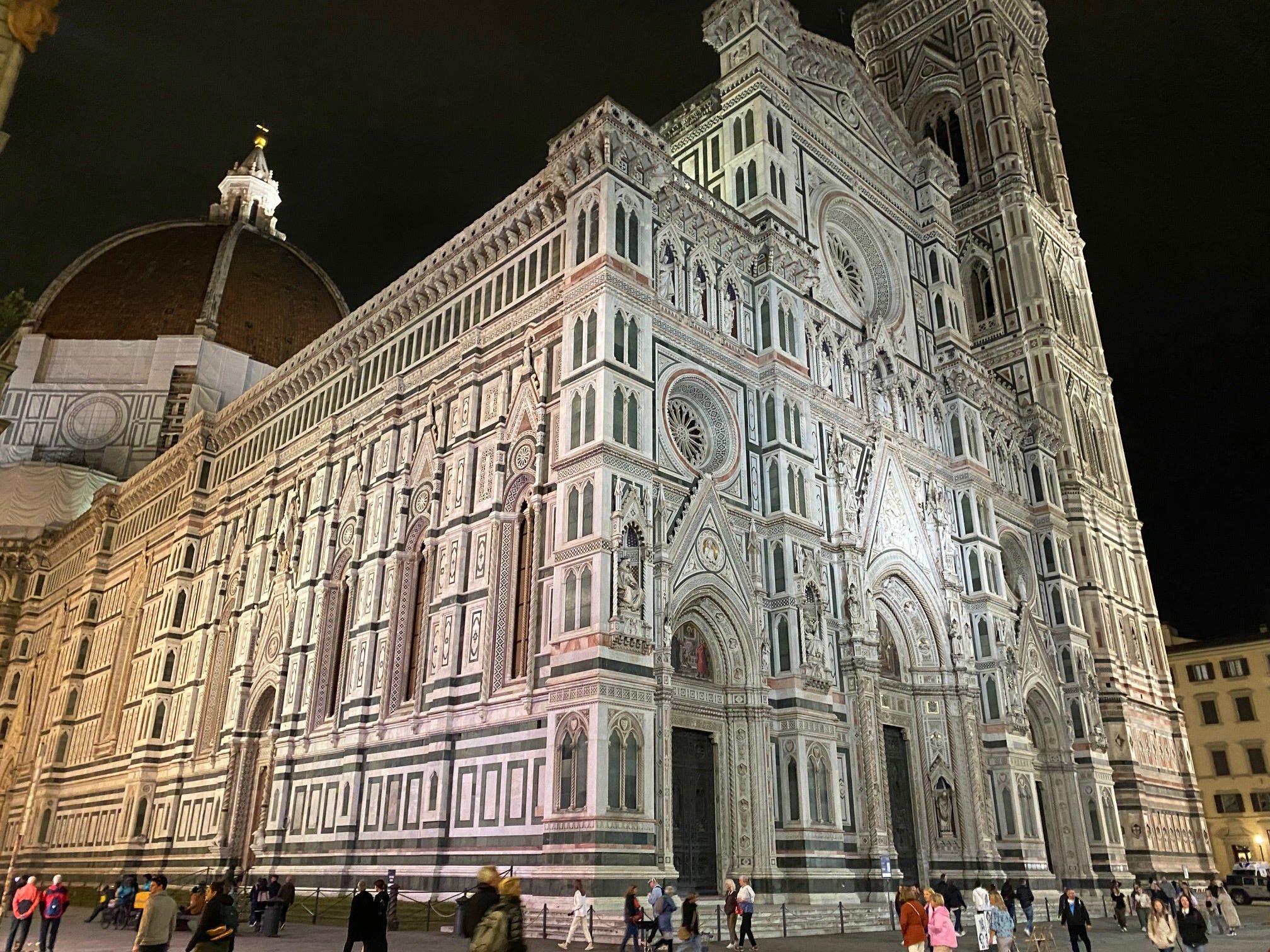

    Some of the Pope’ recent actions

    In 2020 Francis blessed the Council for Inclusive Capitalism, a group led by Lynn Forester de Rothschild that represents $2.1 trillion in market cap and 200 million employees.  The Group is pushing environmental, social and governance (ESG) practices in business that seek to bankrupt small and midsize businesses and consolidate control among big business in the name of environmental sustainability.

    He also called for the West to accept endless hordes of non-integrating illegals:

    In 2019 Francis donated funds to illegal immigrants ($500,000 for a quoted 75,000 migrants, or $6.66 per migrant curiously) and he even has crosses removed from events so that Muslim migrants won’t be upset. All while he washes and kisses their feet:

    Wow, this is really a leader worth following

    The Catholic Church along with various Jewish, Lutheran and other religious organizations have been up to their eyeballs in assisting the CIA/State Department to import ~20 million illegal immigrants in the past 3.5 years alone; see here and here.

    Meanwhile, the Pope purged non-globohomo Cardinals like Cardinal Burke in November 2023, stripped him of his salary and kicked him out of his apartment after he criticized the Pope’s pro-homosexual stance. In the same month he dismissed Bishop Joseph Strickland for the same reason, and also because he refusal to implement Vatican directives to restrict the use of the old-style Latin Mass. During COVID he removed a Bishop who was anti-COVID mandate and also publicly argued that getting force-vaccinated was a “moral obligation”. He also removed conservative Cardinal Robert Sarah as head of the Vatican’s office for liturgy.

    These developments should be understood in the context of Catholicism’s doctrines of papal infallibility and papal supremacy, where when the Pope speaks ex cathedra he is preserved from the possibility of error on doctrine. But these recent moves by the Pope are mere manifestations of his long-held radicalism. In 2013 he assured atheists that you don’t have to believe in God to go to Heaven. In 2017 he quietly reduced sanctions against pedophile priests.


    The state of the Church

    According to the wonderful Archbishop Vigano, the Pope is a globohomo shill and there exists a deep Church pushing “heresy, sodomy, and corruption.”  He states:

    “There is a very strict relationship between the doctrinal crisis of the Church and the immorality of the clergy, that scandalously reaches up to the highest levels of the hierarchy. But it is also apparent that this crisis is being used by the ultra-progressive wing not only to impose a false morality together with a false doctrine, but also to irremediably discredit the Holy Church and the Papacy before the faithful and the world, through the action of its own leaders.”  Viganò added that a “gay lobby” has “infiltrated into the Church and that is literally terrified that good pastors will shed light on the influence that it exercises in the Secretariat of State, in the Congregations of the Roman Curia, in the Dioceses, and over the entire Church…[Pope] Bergoglio has surrounded himself with compromised and blackmailed personalities, whom he has no qualms about getting rid of as soon as they risk compromising him in his media image.” Viganò said that “these three elements – heresy, sodomy, and corruption – are so recurrent that they are almost a trademark of the deep state and of the deep church.”

    The question becomes: how exactly did globohomo skinsuit the Catholic Church? When did it happen and why? For the answer we turn to Guido Giacomo Preparata, whose brilliant work “Conjuring Hitler” I previously covered and which turned the common understanding of the causes of World War 2 on its head (another good review is here). In his 2023 book “Empire & Church” he traces the behind-the-scenes battle between the Church and globohomo in the aftermath of World War 2 and how the latter came to dominate the former. Poetically written, the book is at an advanced level and requires a developed understanding of the structure of the modern world (i.e. as a slave colony to the central bank owners) before it can really be appreciated.


    The Church as a corporation

    Agreeing with the point made at the start of this post, Preparata believes that the Catholic Church was crafted to stem the radical egalitarianism at the heart of Christianity. It became a temporal rival to Empire but in doing so it lost the original message of Christ:

    At an even deeper level, for the Ghibellines [i.e. those supporting the supremacy of state over Church], the ultimate insidiousness of Catholicism lies in its anarchistic core. It is thus to hide her occult nature, that, purportedly, the Church has traditionally resorted to presenting a facade of “mediocrity, compromise, ritualistic aestheticism, and prudence,” which has enabled her to develop a formidable capacity for adaptation and absorption within a highly hierarchized yet externally impersonal structure. “The preaching of Christ,” Evola contends, “was never aimed at constituting a new form of associative life or even a new religion. Such a preaching was at heart anarchistic, anti-social, defeatist, and subversively hostile to any rational order of things.” Therefore, in order to retrain its insubordinate animus, and to begin to fashion itself as a viable organization, Catholicism has had to “incorporate the popular customs of the pagan world, to round off the more extreme and anti-political facets of its primitive complexion, and to avoid with colorless circumspection the logical conclusions of Protestantism [on the irrefragable impossibility of free-will] and mystical delirium.” In the final analysis, the secret recipe of Christianity’s success is its exclusive, quasi-monopolistic rapport with the “mass of cosmopolitan desperadoes.”

    Thus, from the moment it structured and militarized itself in hierarchical form, not only did Christianity betray its hallowed principle of peaceful equality but it also became ipso facto a rival of the Empire; as such, since there can only be one source of power, [to the Ghibellines] the Church must be either supplanted, defeated, and hollowed out, or at the very least subordinated, subjected and absorbed.”

    The Church focused on the accumulation of material power and came to be run as a business, concerned with expanding and defending its domain and profits. This resulted in its centuries-long dance with secular leaders with push-pull scheming behind the scenes by both parties. “Empire & Church” was titled such because they need each other: an empire needs the Church for its moral and spiritual legitimacy, while the Church needs the Empire to defend its interests by force:

    From the (primordial) standpoint of the ruled, the rulers have always had to radiate the confidence of (1) awesome warriors who (2) had the favor of the gods. Both requisites – sword and (devotional) creed – had to be satisfied. The technicalities surrounding the classic propositions of the “principle of authority” and “legitimacy” (who is entitled to rule?) stem from this condition. As eventually did [those] torrents of treaties on the divine right of kings and emperors, the temporal prerogatives of popes, – and later on, when modern bureaucracies emerged, – on “natural rights,” the sovereignty of “The People,” democratic rule, etc.”

    We will see this push-pull between secular and religious forces in the lead-up both to World War 1 and 2 after which the game changed completely, catching the Church totally off guard.


    World War 1 and its aftermath

    In the lead-up to World War 1 the Habsburg Empire of Austria-Hungary remained unshakably loyal to Rome, providing it, along with France, the Netherlands and Bavaria most of the Church’s funds. In 1882 Italy, Germany and Austria joined in the Triple Alliance which, if it flourished, could have created a “Catholic space” not unlike the area once covered by the Holy Roman Empire. But the Italians were bribed by the British – despite Benedict XV’s pleadings to the contrary – and switched sides in an act of Free-Masonic infamy. Tethered to the Allies, Italy helped ”win” the war but at the cost of 650,000 dead and financial collapse. Via Versailles Austria was dismembered which virtually annihilated the Church’s supply of vicarious secular might. Benedict XV called World War 1 “the suicide of Europe.”

    undefined
    Eugenio Pacelli at the Imperial Headquarters with the peace proposal of Benedict XV to Emperor Wilhelm II

    Because Austria was destroyed the weakened Church felt forced to negotiate with Italian Fascism (1931) and Nazism (1937) in the hopes of resuming their pre-war expansion plans. The Concordat with Nazism contained secret clauses hinting at an eventual spiritual conquering by Catholicism of the Slavic world.

    Despite the Concordat, the Nazis and the Catholics had sharp differences in their ideologies and approaches and, feeling their authority challenged, the Nazis unleashed a PR blitzkreig that would later be so effectively copied by globohomo:

    [The Nazis] started, first, by exposing with fanfare, and very efficaciously, several (sensationally grotesque) cases of financial fraud and embezzlement that featured pious little nuns laden with cash, concealed under their robes, restlessly shuttling like mules between Italy and Germany; and subsequently – after the break-down of a patched-up truce in 1936 – the offensive was sustained by hitting the Church hardest where she was most ignominiously weakest: sex….Pioneering the tactic that the U.S. Neoconservatives via the Boston Globe would have adopted in January 2002 to discredit publicly and thus silence the Church in the ru-up to the War on Terror, Goebbels and his Ministry of Propaganda [unleashed] packs of reporters tasked with the failsafe assignment of unearthing from Catholicism’s clerical underground lurid stories of homosexuality, molestations, pedophilia, and sacristies and seminaries turned into bordellos. Shamefully exposed, and searingly blasted by Goebbel’s inquisitorial vituperations (“the horrifying rot” of “these monsters!…”), the Holy See, humiliated anew, retreated and capitulated by agreeing to the dissolution of all Catholic Youth Organizations in Germany. There followed the pacification of 1937-1938.

    While the Church was engaged with German and Italian politics, though, it also engaged with the financial overlords of the West:

    Starting in the mid-1920s, the invested patrimony of the Vatican would expand into a veritable financial empire which extended from the European portfolios of Italy, France, Belgium, Germany, Hungary, Britain and Switzerland to faraway stakes in Latin America, and whose key terminus was in Wall Street – or, rather, in the investment banking trust of the J.P. Morgan Company, to be specific.

    The Church’s financial holding company was purportedly created in two stages: from 1929 to 1933, following the Lateran Accords, and from 1939 to 1945, on the lucrative coattails of World War 2. Counseled by the financiers of the Morgan Bank, the Holy See gained access, e.g. to the trust of Anaconda Copper and to Iraq’s oil wells. These and a plethora of other ventures ended up being so fabulously remunerative for Rome that “Pius XI would confer upon both Jack and Tom Lamont [of J.P. Morgan Company] the Grand Cross of Saint Gregory the Great.” The alarcity that the House of Morgan also displayed in helping Mussolini stabilize the Lira in 1926 and in doing good business with Fascism in general (with Washington’s blessing, quite naturally) was very much linked to this USA-Vatican entente.

    The Vatican had, as part of this deal, given custody of a considerable amount of Vatican gold shipped from Europe to the managing offices of the Federal Reserve Bank. It was therefore engaging with both sides of the emerging power centers.


    World War 2

    When Germany marched into Poland in 1939 Pope Pius XII did not condemn the invasion and, when told of the upcoming Operation Barbarossa, the Pope was said to have received the news with satisfaction. He looked forward to converting the East to Catholicism per the secret clause of its Concordat with Germany.

    But not even four months later the Vatican was informed by trusted sources at the highest level that the Axis powers had already irredeemably lost the war (the source Preparata cites is Lacroix-Riz, Le Vatican, pp. 515, 516, 527, 532). Barbarossa had not destroyed Russia whose manufacturing factories had been moved before the war beyond the Urals, and the outgunned and out-produced Germans were already losing critical manpower and supplies. It was over long before the public understood: in modern wars those with the greatest industrial production wins, and the Allies outproduced and outgunned the Axis by anywhere from a 3:1 to a 10:1 margin.

    undefined
    German advances from June to August 1941

    When it finally dawned on the Church what was happening it hurriedly pivoted to lend Washington its hand, including re-awakening the Mafia to assist logistically in the landing of U.S. troops in Sicily in 1943. If the Church had not played both sides in the lead-up to World War 2, if it had put all its eggs in the Axis basket, developments very well could have ended up destroying the Church post-war. But due to this moderate level of foresightedness it would live to fight another day — for awhile.


    The gradual skinsuiting

    After the war, given both the Soviet Union and the West were controlled by the same central bank owners and the Axis had become hollowed-out vassal states, the Catholic Church remained the only significant entity that retained a degree of autonomy worldwide. But globohomo was not willing to accept any rivals for power: after all, Empire thrives in a nucleus of Church and Sword, and globohomo lacked the moral and spiritual legitimacy provided by the Church. It wanted to acquire it like a real estate deal, a real estate deal for a billion souls. A frontal attack was not needed; rather, a slow drawn-out process would be much more effective:

    The rulers tolerate [“patriotic”] Catholics as a temporary and necessary evil, reasoning that the stage has not yet arrived at which one can utterly wipe out religion, and that it is better to deal with accommodating bigots than with refractory ones….The masses in highly industrialized countries like England, the United States or France are largely de-Christianized. Technology, and the way of life it produces, undermines Christianity far more effectively than do violent measures [i.e. by raising man, not as a “child of God’,” but as a purely social creature]. The core of the problem is to avoid galvanizing the forces of Christianity by some careless misstep. It would be an unforgivable carelessness, for example, to close the churches suddenly and prohibit all religious practice. Instead, one should try to split the Church in two. Part of the clergy must be compromised as reactionaries and “foreign agents” – a rather easy task, given the utterly conservative mentality of many priests. The other part must be bound to the State as closely as the Orthodox Church is in Russia, so that it becomes a tool of the government. A completely submissive Church – one that may on occasion collaborate with the security police – loses authority in the eyes of the pious. Such a Church can be preserved for decades, until the moment when it dies a natural death due to a lack of adherents.

    This slow process has played out under the Second Vatican Council and then under the tutelage of John Paul II and his successors.

    undefined
    Paul VI presiding over the introductory ingress at the Second Vatican Council

    This in turn led to the Sedevacantism movement, but it is very small: tens of thousands or perhaps a couple hundred thousand of Catholics amidst 1.36 billion worldwide.

    Today the Vatican has become wholly subdued to the globohomo techno-structure:

    (a) The bulk of Vatican funding is American; (b) the bulk of “progressive” Catholics have become entirely subservient to the business ethos of the Liberal mainstream, which finances its parishes and schools – schools that are, by and large, posh, unaffordable establishments catering almost exclusively to the ultra-rich; (c) U.S. Catholic reactionaries have, since 9/11, rallied with ferocious exhilaration to the Neocons’ patriotic and war-mongering promise of a never-ending hyper-modern crusade against Islam(ism); and (d) Catholic “anarchists” – Evola’s, Maurras’s, and pretty much everybody else’s nemesis – who were very few to begin with, can be said to have been successfully relegated to the appendices of esoteric codices amid unicorns and faeries.

    Globohomo also successfully reused Goebbel’s propaganda strategy to smear the Church with its pedophile sex crimes in 2002. The pressure and leverage from this attack was ultimately used to make their deviant, degenerate candidate the Pope:

    Eventually, with the added leverage of the pedophile scandals in the 2000s, the last resistances were broken and…a faction of the Curia allegedly conspired to hand over (i.e. to sell) the “Catholic box” wholesale to Washington in exchange for the guarantee that their tenure – presently as subaltern chief officers of what was then bound to become Anglo-America’s affiliated bureau of Catholic Affairs – be confirmed.

    This came to pass in the Spring of 2013 with the abdication of Joseph Ratzinger (Benedict XVI) in favor of America’s long-standing candidate, Jorge Mario Bergoglio (Francis I).

    Thenceforth, I consider the match to be over: de fact, in the last two decades or so, for matters of geo-politics…the Catholic Church has mostly served as a sounding board for the Washington consensus. These last events…have merely punctuated what appears to be a foregone demise: as said, hyper-modernity is certainly not in functional need of a Catholic Church: the Anglo-American Commonwealth, whose facial traits over the years have been approximating ever more crisply those of Orwell’s Big Brother, has given the world ample proof that it can perform, solo, all duties, sacred and profane alike. It is the “New Vatican.”

    Yes, the Church has not yet fully bought into abortion rights, gender theory, or the abolition of the family, but as seen under Pope Bergoglio the Church is making regular inroads against its own positions on these issues. Meanwhile the Church (and Christianity in general) is rapidly losing followers throughout the West. The continued hollowing out of the Church by its globohomo cretins has all indications of continuing apace with very little pushback.

    With the Church skinsuited, this is the hierarchy of power in the modern world:

    Ultimately, this world is controlled by the Demiurge; see Matthew 4:8-9 where Satan offered Jesus control over the nations of the world and while Jesus said no, he did not dispute that Satan had the power to do so. Those hoping for a materialist solution to the fallen nature of this world are going to be – as they always have been – sorely disappointed. There are no major institutions left within the United States or worldwide that have not experienced this hollowing out process and rot, and any attempts to change this situation have been rapidly dismantled and destroyed.

    This is why a turn inward to understanding the structure of the modern world (via the privately owned central bank scam, the egalitarian ratchet effect and the real history of World War 2) and a focus on individual spiritual growth is needed at this time.

    Thanks for reading.

    Subscribe:
    Email delivery remains on Substack for now.

  • Technology as the accelerator of time

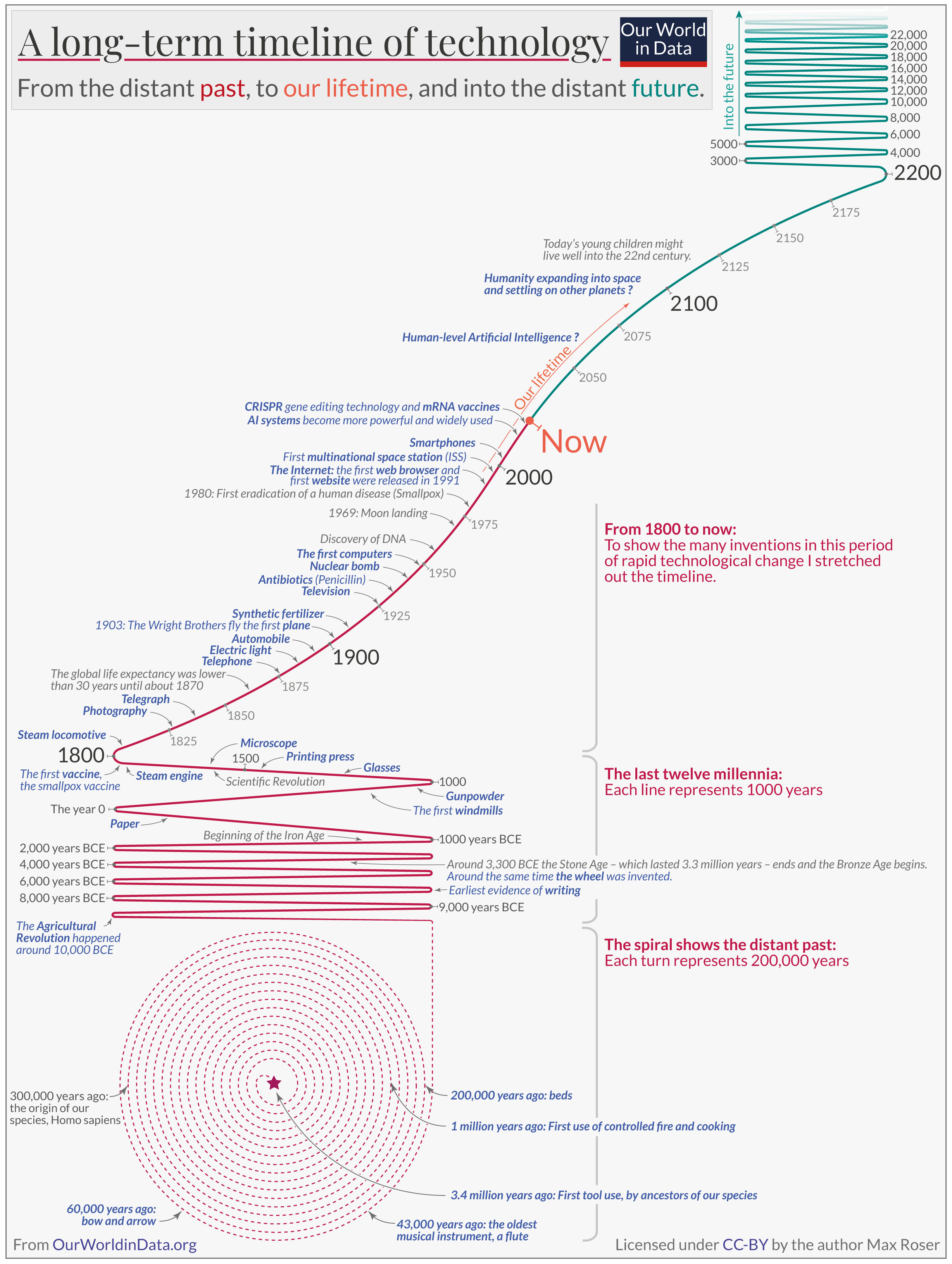
    This is a post about the accelerating nature of time and the increasing “solidification” of the world where reality becomes more material and less spiritual at an ever-increasing rate.

    Time as we experience it is not a static thing. Depending on our circumstances and perspective it can feel long (put your hand on a hot stove and it will feel like forever) or short (watch an exciting sports match, play video games, have fun with friends). The nature of time also changes as we age; for a three year old a five minute time-out can feel like eternity, while in adulthood whole years go by in a blur.

    One under-discussed aspect of time is how technology accelerates it.

    Take the smartphone or computer. If you have a salaried wagecuck job or your own business, you are expected to respond to texts, emails or calls at any hour of the day including weekends. The “job” transitioned sometime in the past twenty years from a 9-5 to 24/7. Even if you don’t have such a job, the smartphone is a constant temptation to pull you out of whatever you are doing in the real world to engage in the virtual world. By serving as an attack on our down-time, on the empty space between events where silence and boredom develops (which is the fertile ground where imagination is born), it serves as an attack on time itself: life blurs together and every day feels the same and you blink, waking up 50 years later with your life over.

    Shutterstock
    Life passing by staring at screens

    This is a nightmare many of us are barreling towards, including myself, and we seem almost powerless to resist it no matter how hard we try.

    This brings to mind a Kenny Chesney song:

    This post by The Obsolete Man makes a similar point: we are frenetically speeding into the void.

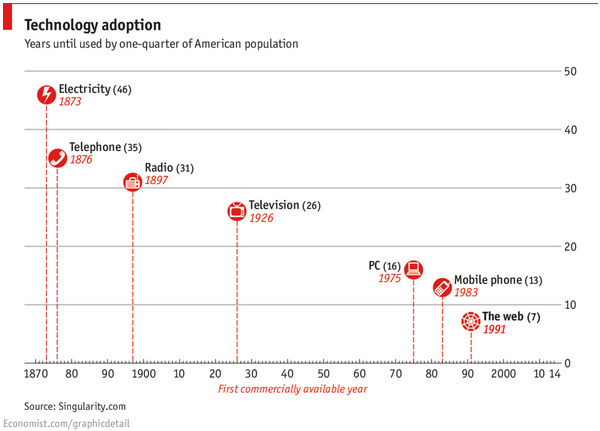
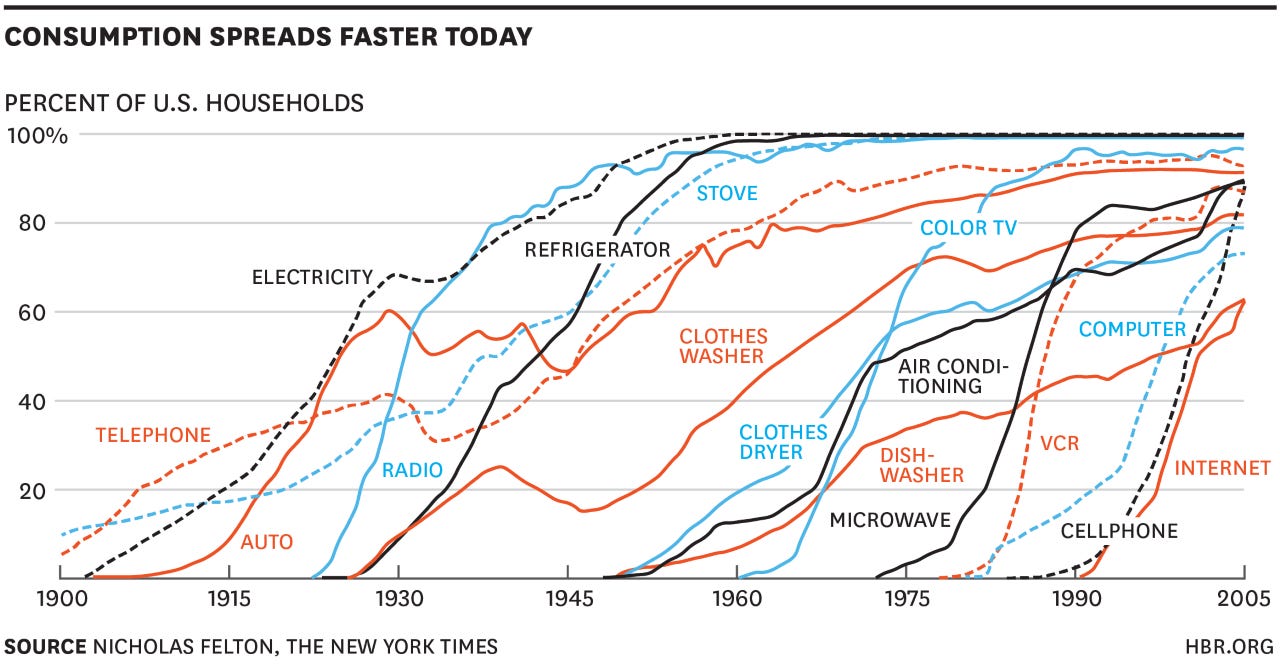
    It didn’t always use to be this way. Before the smart phone and the internet life was slower. There was downtime between events; one was not expected to be tethered to work outside of office hours. Each successive iteration of communications technology sped up human communications and altered the flow of time itself: from carrier pigeons to the Pony Express to the telegraph to payphones to landlines to faxes to the internet to non-smart phones to smart phones. When communication was limited to mail and ideas by book, when the family lived in small agricultural communities instead of the hustle-and-bustle of urban living, time itself was slower, and it was even slower before the neolithic agricultural revolution 10,000 years ago.

    Consider travel as another example – the world shrank and accelerated as humanity brought forth the automobile, the train, the airplane, leading to a claustrophobic lack of breathing space. The horizons of the unknown shrank; the sense of adventure died. Poet Charles Upton argues that the agitation caused by technology annihilates spacial dimension:

    “When we are in a state of deep calm, space is more real than time; when we are agitated, time becomes more real than space. And it shouldn’t be too hard to see how faster modes of travel, and especially the electronic media, which disturb and agitate consciousness, also annihilate space; cyberspace, in particular, is the annihilation of all spacial dimension. In these latter days, nothing has a stable form. Everything moves faster and faster, until all form – including the Human Form itself – becomes a shapeless blur.”

    Paradoxically, even as our lifespans have grown in the modern era our life experiences have shortened. Did a thirty-year-old hunter gatherer have more life experiences than a sixty-year old modern man who spends his waking life staring at glowing screens, with two weeks off a year for “vacation”?

    Of course it is impossible to really separate mankind from technology (defined as the creative impulses we experience to make processes more efficient). In a fundamental ways man is technology. Use a rock to split open a coconut is technology. Use fire to cook food is technology. One can’t separate man from his impulse to innovate; that’s a part of what makes us human. It’s just that technological innovation and therefore the change in the perception of time has parabolically sped up.1


    The process of solidification

    It’s not just time that has sped up as technology advances. There is an increasing intensity toward “solidification” by which the material world increasingly becomes more real and the spiritual world is increasingly disconnected from life. Traditionalist philosopher (not to be confused with conservative) Rene Guenon discussed this in his The Reign of Quantity & the Sign of the Times, which is a very challenging read due to its dense and pedantic style and its reliance upon prior works, including by Aristotle, Neoplatonism and Scholasticism. You can see a summary of the book here if you like.

    Guenon was a French-Egyptian intellectual who studied occultism and Hinduism before converting to Islam and practicing Sufism in Cairo until his death. He has been influential in both Islamic and far-right circles, although his name is not widely known.2

    A strange and lopsided physiognomy, suggesting both knowledge of mysteries and eccentricity. He looks a bit like Doctor Strange.

    Guenon argued that this process – the speeding up of time, the solidification of the world and the disconnection of esoteric connection to the Divine – is all part of what the Hindus consider to be a cosmological cycle, and that we are approaching the end of a particular age – the final age, the Kali Yuga, before the cycle restarts.3 He assigned the following length of time to each age4:

    • Krita Yuga or Satya Yuga (Golden Age): 4, corresponding to 25,920 years.
    • Treta Yuga (Silver Age): 3, (19,440 years).
    • Dvapara Yuga (Bronze Age): 2, (12,960 years).
    • Kali Yuga (Iron Age): 1, (6,480 years).

    Each age is a a “fall” from the previous one, per Upton,

    As the cycle progresses, or rather descends, the very nature of time and space changes. In earlier ages, space dominates; the forms of things are more important, more real, than the changes they undergo; time is ‘relatively eternal’. As the cycle moves on, however, time begins to take over, melting down space and the forms within it until everything is an accelerating flow of change.

    The cycle has a 4:3:2:1 configuration where each Age is shorter than the prior one.

    In the Kali Yuga humanity descends from a focus on quality and connection to the Divine down to crass materialism, a focus on quantity disconnected from anything greater. It has devolved into mere consumption.

    “[Guenon] explains that we have reduced work to something merely quantitative. Ancient craftsmen saw themselves as involved in something of cosmic significance. Someone who made a table for example, wasn’t trying to merely satisfy an industrial purpose of assembling four legs to a tabletop by pressing levers on a machine. The traditional table maker was rather participating in the communion of the family that would eat at this table. This communion of the family would itself fit in the communion of village, which would ultimately fit in the communion of the whole world. The table maker wanted to make it beautiful with that cosmic purpose in mind. Art and craft were one.”

    The industrialization process dehumanizes workers, making them mere unthinking automaton in an assembly line. Even the corporate focus on providing “experiences” to its customers to ensure repeat business is but a form of standardizing quantity. Ektropius argues that materialism offers a better consensus mechanism than religion which is why it has caught on so strongly.

    In other words, this intensifying, ratcheting cycle crushes the quality out of everything (bringing to mind the egalitarian ratchet effect), forcing materiality down to the lowest common denominator in order to turn everything into quantifiable widgets including humanity itself. During this descent the process intensifies and time speeds up faster and faster until it hits a hard limit: it can eventually speed up no more, and therefore the energies suddenly reverse themselves, a cosmic cataclysm that changes the look of heavens and earth occurs and a new cycle begins. As Upton explains:

    Time, the “devourer” ends by devouring itself. At the end of time, Time will be changed into space again. […] This ultimate timeless point is simultaneously the end of the cycle of manifestation and the beginning of the next.[…] Before this ultimate transformation, in the latter days of the present cycle certain final developments must take place. Since quantity has particularly to do with matter, the Reign of quantity must also be the reign of materialism. The age of miracles ceases, the world becomes less permeable to the influences of the higher planes of reality; the very belief in such planes, as well as in the eternal and transcendent God, becomes harder to maintain.

    The very heaviness of materialism, however, ultimately results in a sort of ‘brittleness’. The cosmic environment, heaving lost much of the flexibility which allowed it to be moved by the Divine Spirit, begins to crack, like an old tree that can no longer bend to the wind, and ends up being uprooted in the storm. But these cracks in the cosmic environment, in the ‘Great Wall’ separating the material world from the realm of subtle energies, first happen in the ‘downward’ rather than the ‘upward direction, letting in a flood of infra-psychic’ forces, either neutral or actively demonic….[We can all feel these Demonic, dark energies growing, can we not?]

    However depressing this may sound, the truth is that such developments are entirely lawful given the lateness of the hour. The lowest possibilities of manifestation must also have their day in the course of the cycle; fortunately, since they are inherently unstable, being based not upon Truth but solely upon power, that day will be short. ‘There needs to be evil,’ said Jesus, ‘but woe to him through whom evil comes.’ And there are certain spiritual possibilities of the highest order which could never be realized except in the face of this most demonic of challenges to the integrity of the human spirit.

    This last point is one that Solzhenitsyn dwelled on at length in The Gulag Archipelago: the horrors of the Gulag led to spiritual heights that would have been unobtainable in a less oppressive environment. And Evola states in Revolt Against the Modern World, p. 432 – the end of the cycle “is not even perceived as a sense of capitulation”, to the point that the “final collapse may not even have the characteristics of a tragedy”. This hints at the source of some on the far right’s accelerationism position…

    I like this framing because it puts even deranged, frothing-at-the-mouth “secular” and viciously anti-white shitlibs in a frame where one may (reluctantly) accept it, perhaps: they too have their role in the cosmic game to end the cycle and start the next.

    Guenon believed that humanity was close to the end of the Kali Yuga; you can see how he calculated this in 1931 here, but he arguably put the end of the cycle at either 2,000 AD or 2,030-2,031 AD although he refused to give an exact date (correctly, as everyone who’s made such a prediction has been wrong so far). Hindus believe that the end of the Kali Yuga is brought about by the return of Vishnu in the form of Kalki, the avenger. This seems similar to the Christian eschatology of the End of Days and the Messiah ushering in a new “Golden Age”, and even Nazi Savitri Devi urgently wished for the return of Kalki.5 But note Cioran had nothing but scorn for this perspective.6

    In an interview with Ernst Junger at 90 years old, as recounted in Julien Hervier’s “The Details of Time”, Junger stated7:

    For the moment, we are going through an era of transition, of chiaroscuro, in which sharply defined phenomena are few and far between. The ancient values no longer obtain, and the new ones have not yet been imposed. It is a world in the shade.

    You can observe a ubiquitous ambivalence of opinions. Some people maintain one thing, others the exact opposite: the two sides cancel each other out, even on the highest level…Let us hope that the transitional period is ending…

    For the prophets: once we have crossed all the deserts, something new will eventually transpire. In all great visions, like those in the Edda, in the visions of divinity, the titans revolt against the gods, and the gods initially lose; but in the end, they return….In the hymns of the good era, [there] were still Christians who lived their faith in the full metaphysical sense of the word. That mentality is extremely rare today. People are cut off from transcendence, transcendence is vanishing. But if someone somehow still preserves this relationship to transcendence, he is “ultimately” safe from fear. He can have the feeling of participation, he can tell himself that horrible things are happening, but that behind them a great light is dawning.” (134)

    The-destruction-of-Sodom-and-Gomorrah-painting-by-John-Martin-1852-scaled
    John Martin, “The Destruction of Sodom and Gomorrah”, 1852

    What is to be done?

    Guenon believed that the best path through this process for an individual was initiation into an existing formal religion, performing consistent practice within it, while being open to intellectual, metaphysical intuition as discussed here. As Guenon explains:

    “[…] initiation is essentially the transmission of a spiritual influence, a transmission that can only take place through a regular, traditional organization, so that one cannot speak of initiation outside of an affiliation with an organization of this kind. We have explained that ‘regularity’ must be understood to exclude all pseudo-initiatic organizations [such as the theosophists and the New Age movement], which, regardless of pretention and outward appearance, in no way possess any spiritual influence and thus are incapable of transmitting anything.”

    But his approach seemed to only partially work for him. As Jean-Philippe Marceau writes:

    In fact, Guénon himself became increasingly paranoid and deranged throughout his life. For example, he came to see himself as the victim of repeated magical anti-traditionalist attacks and accordingly chose to avoid contacts with Westerners. You can even find a lot of anecdotal evidence of people becoming insane after diving too deep into his work. One way to see it is that Guénon indeed tries to fly too high. He relentlessly demolishes our modern, ordinary epistemology, but he doesn’t manage to replace it with something viable before going crazy. He spends his time analyzing perennial religious patterns in different traditions, studying the signs of our times, but he can’t really connect it down to his own life. He disconnects his head from his own body. And even his very devout involvement in Sufism, a mystical branch of Islam, did not suffice to keep him grounded.

    Guenon’s approach, then, disconnected him both from humanity and to an extent from life itself.

    Instead of such extreme action, it’s my hope that one takes away from this post an understanding of the connection between time and technology use, and that if we hope to live longer via our experiences then we should be more mindful of limiting our use of technology. It’s also to note that increases in materialism and technology seem to decrease our connection to God, and to take note of the possibility of cycles where it may become “darkest before the dawn” – in other words, we may have to see the full blossoming of evil in its worst form before it can then be effectively opposed (but hopefully this is not the case): right now, at this moment, we are seeing its increasing intensification and manifestation blossoming in grotesque and shocking ways such as the transsexualism push (especially targeted to children), the increase in debt by a trillion dollars every hundred days, extreme and increasing censorship, completely open borders and funding/supporting endless foreign wars. Perhaps with this understanding we may better steel ourselves mentally and spiritually for what may be worse things to come. Or as Junger wrote in the quote above, “if someone somehow still preserves this relationship to transcendence, he is “ultimately” safe from fear.”

    Thanks for reading.

    Subscribe:
    Email delivery remains on Substack for now.


    1 One may theorize this is due to the ongoing genetic changes brought about by the neolithic agricultural revolution 10,000 years ago which supercharged creativity and innovation.

    2 He is most widely known for The Crisis of the Modern World about the falsehoods of so-called “democracy”, wonderfully discussed by A Forest Rebel+ here.

    3 Indeed, seeing history as cyclical as others such as Oswald Spengler believed is antithetical to the Whig history-as-progress model which permeates the West. The question is one of timeframe and scope. As Junger explained in The Details of Time, 63: “If we believe, or accept the hypothesis, that a cyclical order exists, this hypothesis goes beyond the notion of progress. Progress is linear, while cyclical movements return to their starting points. One could therefore say that a kind of panic recurs once every thousand years. Around the year 1,000, people feared the end of the world. This is again the case today, when the omens are technological, while in earlier times they were religious: people are afraid of the atomic bomb. For my part, I don’t believe in any great danger.” But Guenon believed the cycles were much longer than 1,000 years.

    4 Hindus believe each age lasts between hundreds of thousands to millions of years, but Guenon thought that the additional zeroes were added on so that they wouldn’t be used by the unenlightened to make false predictions. As such, he removed the extra zeroes from his calculations.

    5 Devi initially considered Hitler to be the return of Kalki, but following his disastrous defeat she modified her position to considering him only the precursor to his return. She elucidates her concept of “Men in Time,” “Men above Time,” and “Men against Time” using the lives of Genghis Khan, Akhnaton, and Hitler respectively, in her book The Lightning and the Sun which I didn’t think was written well. Hitler is used to illustrate a “Man against Time” who seeks to fight historical decay of the Hindu cycle. Hitler had himself leaned into type of comparison, styling himself after the figure in the painting The Wild Chase a dark, grim and somewhat unnerving portrait that depicts the Germanic god Wotan, the highest of the Germanic Gods, completed in 1889, the same year Hitler was born:

    6 See Cioran, A Short History of Decay, 75: “What a preposterous notion, to draw circles in hell, to make the intensity of the flames vary in its compartments, to hierarchize its torments!… You can champion some idea or other, have a place or crawl—from the moment your actions and your thoughts serve a form of real or imagined city you are its idolators and its captives. The timidest employee and the wildest anarchist, if they take a different interest here, live as its function: they are both citizens internally, though the one prefers his slippers and the other his bomb. The “circles” of the earthly city, like those of the one underground, imprison beings in a damned community, and drag them in the same procession of sufferings, in which to look for nuances would be a waste of time. The man who acquiesces in human affairs—in any form, revolutionary or conservative—consumes himself in a pitiable delectation: he commingles his nobilities and his vulgarities in the confusion of Becoming….

    To the dissenter, within or outside the city, reluctant to intervene in the course of great events or small, all modalities of life in common seem equally contemptible. History can offer him only the pale interest of renewed disappointments and anticipated artifices. The man who has lived among men and still lies in wait for a single unexpected event—such a man has understood nothing and never will. He is ripe for the City: everything must be given him, every office and every honor. So it is with all men—which explains the longevity of this sublunary hell.”

    7 Also see Ernst Junger’s connective work “At the Wall of Time” (unfortunately untranslated into English as of yet, although ormulus has started), which is discussed along with a Guenon, Spengler, Evola and Herodotus connection here.

  • An overview of dissident right Substack authors

    John Carter had a great comment in a post awhile back describing the wide range of views on the dissident right. He wrote: “Religiously, the right embraces an incredible variety of creeds. Tradcaths, Orthobros, prots of every description from high church Lutheran to low church Baptist, Odinists, Neo-Hellenists, Buddhists, Hindus, Muslims, Nietzschean vitalists, gnostics, New Agers, druids, and atheists are all found in varying degrees of abundance. Ideologically, you have neoreactionaries, traditionalists, foundationalists, Nietzschean vitalists, civic nationalists, ethno-nationalists, MAGA America Firsters, populists, fascists, national socialists, 4th Political Theory Duginists, paleo-conservatives, classical liberals, post-liberals, libertarians, anarcho-capitalists, Catholic integralists, monarchists, masculinists, and (what I think is) the most recent addition, Landian effective accelerationists.”

    What a large number of beliefs under the umbrella of the “dissident” label! Indeed, as Cioran argues it is in the twilight of belief in the existing paradigm that a plethora of new possibilities arise.1 Could these viewpoints be organized in a way that simplifies and clarifies? Is there an essence that can be honed in on (other than the common factor of low agreeability on the Big 5 personality test)? I think, perhaps, the answer is yes. The hope is that by organizing these views into something simpler that it will provide insight on some fundamental fault lines as well as to offer new writers for you to read depending on your reading style.

    With that said, these views can be organized into two disparate values that can be expressed in chart form: (1) whether the dissident is philosophically optimistic or pessimistic and (2) on what level the writer posts at. Let’s explain what I mean:

    1. Philosophical optimistic or pessimism is in relation to how a person views the world. Dissidents of all stripes believe there is a lot wrong with the world, indeed, that’s what makes them dissidents; can these wrongs be made right, can the world be perfected or, if not perfected, made much better than it is today? Dissident optimists believe the answer is yes even if their prescription is wildly different — from this approach both neo-Nazis, Z-anoners, the populist right and Christian nationalists are philosophical optimists because they believe that a change in values, beliefs, war outcomes or politics of the masses or at least the elite can or would result in a better world. Philosophical pessimists, on the other hand, see material reality as fundamentally flawed, and therefore salvation must be pursued in spiritual avenues without expectation for material betterment in this world (although that doesn’t necessarily stop one from trying).
    2. On what level the writer generally posts at. Posters may sometimes make posts on different levels, but this is a generalization of where they usually write. There are three levels of posting: on the level of politics, on the level of culture and on the level of belief/metaphysics. There is a saying “politics is downstream of culture which is downstream of belief.” It is an issue of scope; metaphysics incorporates culture and politics but the same isn’t true in the other direction. Focusing on lower levels may eventually give rise to a focus on higher ones.

    As a preface to the below chart, please note (1) these are crude approximations (both in terms of placement and in terms of the graphics themselves; I’m not a visual artist), (2) there is no moral judgment attached to any specific placement, and (3) apologies if you were either included or not included, depending on your preference. Also, (4) while I’ve heard of all of the below Substackers, inclusion does not mean I necessarily read them or if I do that I read them often; rather, their inclusion is meant to highlight the diversity among dissidents in accordance with this grouping (thanks to John Carter for his feedback). With that said, here is the chart:

    Some commonalities can be drawn from this chart:

    1. You’re not going to find a gnostic as a philosophical optimist or a Christian nationalist as a philosophical pessimist, for example. There are certain identities that require one to have a certain mindset for those beliefs.
    2. You’re also not going to generally find pessimists writing mainly on the level of politics because it’s too grim to write regularly “the dissident right is likely to continue to lose” without attaching metaphysical meaning to it.
    3. There is no author placed at the extreme end of pessimism (including myself), because there is intrinsic hope involved in posting: the hope that spreading dissident ideals can have a positive effect in some capacity even if the extent is unknown. Indeed, the pessimists must hold out hope somehow no matter how remote or silly the odds because hope is required to make life worth living.
    4. The optimists have the opposite issue: dealing with unmet or dashed hopes and expectations. Is it difficult to live in a world as a dissident where one’s hopes and dreams are regularly disappointed as globohomo continues its unrelenting march forward? How is this dealt with – with an update of worldview? A stubborn doubling down or burying one’s head in the sand? A pushing out of the expected Judgment Day? It is interesting to see.
    5. There is often an underlying tension between the optimists and pessimists. To the optimists the pessimists are holding back the expected changes with unnecessary negativity; they are souring the mood and hurting the energy. To the pessimists the optimists have insufficient understanding of the base setup of reality or history which gives insufficient cause for such optimism; they are seen as naive.
    6. Generally speaking, the lower the level of discourse the more popular it will be and the more followers one will have (i.e. political discussions are much more popular than metaphysical discussions). There are fewer political Substackers represented on the chart not because there are fewer such Substackers (there aren’t) but rather because I am less acquainted with them.
    7. In the same vein, optimistic posters are much more popular generally than pessimistic posters.

    The referenced Substacks are as follow (left to right):

    Pessimists:

    Edward Slavsquat: Edward Slavsquat

    Rurik Skywalker: The Slavland Chronicles

    Daniel D: A Ghost in the Machine

    Theodore Atkinson: The Last Sage

    Jasun Horsley: Children of Job

    Rod Drehar: Rod Dreher’s Diary

    Niccolo Soldo: Fisted by Foucault

    The Good Citizen: The Good Citizen

    Tree of Woe: Contemplations of the Tree of Woe

    The Z Man: The Dissident Writer

    Optimists:

    L.P. Koch: LucTalks

    Eugyppius: Eugyppius: A Plague Chronicle

    William Hunter Duncan: Born on the Fourth of July

    Librarian of Calaeno: The Librarian of Celaeno

    Yuri Bezmenov: How to Subvert Subversion

    John Carter: Postcards from Barsoom

    Grant Smith: H2F Man

    Morgoth: Morgoth’s Review

    Morghorak: Morgthorak the Undead

    Brett Andersen: Intimations of a New Worldview

    Kulak: Anarchonomicon

    Sanfedisti: Position and Decision

    Karl Kaemers: Taboo Truth

    (Kruptos): Seeking the Hidden Thing

    el gato malo: bad cattitude

    Robert Malone: Who is Robert Malone

    Simplicius: Simplicius’s Garden of Knowledge

    Curtis Yarvin: Gray Mirror

    Hopefully this post offers a bit of a new way of categorizing dissidents and perhaps both offers you insight on the types of readers you like to read and maybe points you in new directions on who to check out.

    Thanks for reading.

    Subscribe:
    Email delivery remains on Substack for now.


    1 The following is an optimistic perspective about the state of society (the pessimist version is that the egalitarian ratchet effect continues undisturbed): “Is there a pleasure more subtly ambiguous than to watch the ruin of a myth? What dilapidation of hearts in order to beget it, what excesses of intolerance in order to make it respected, what terror for those who do not assent to it, and what expense of hopes for those who watch it . . . expire! Intelligence flourishes only in the ages when beliefs wither, when their articles and their precepts slacken, when their rules collapse. Every period’s ending is the mind’s paradise, for the mind regains its play and its whims only within an organism in utter dissolution. The man who has the misfortune to belong to a period of creation and fecundity suffers its limitations and its ruts; slave of a unilateral vision, he is enclosed within a limited horizon. The most fertile moments in history were at the same time the most airless; they prevailed like a fatality, a blessing for the naive mind, mortal to an amateur of intellectual space. Freedom has scope only among the disabused and sterile epigones, among the intellects of belated epochs, epochs whose style is coming apart and is no longer inspired except by a certain ironic indulgence.

    To belong to a church uncertain of its god—after once imposing that god by fire and sword—should be the ideal of every detached mind. When a myth languishes and turns diaphanous, and the institution which sustains it turns clement and tolerant, problems acquire a pleasant elasticity. The weak point of a faith, the diminished degree of its vigor set up a tender void in men’s souls and render them receptive, though without permitting them to be blind, yet, to the superstitions which lie in wait for the future they darken already. The mind is soothed only by those agonies of history which precede the insanity of every dawn…”

    – E.M. Cioran, A Short History of Decay, 80

  • Ernst Jünger: The man with no hands

    This is a post about one of the most unique and complicated authors of the 20th century, Ernst Jünger. The power of his writing comes not so much from his insights but from the unusual internal conflicts that he embodied, which in turn stimulates deeper thinking on behalf of the reader. Reading Jünger is difficult but rewarding and will further your spiritual development if you decide to engage with him.

    “Some people had dirty hands, some had clean hands, but Jünger had no hands.” – Jean Cocteau

    “When I studied the documents, I was often astonished by [Hitler’s] intransigence in minor differences (to put it diplomatically), for example, in the dispute over the heads of a handful of innocent people. We will never grasp this if we cannot see through his desire to destroy the nomos [law, customs], which guides him infallibly. This can be expressed impartially: He wants to create a new standard.” – Jünger on Hitler

    I recently read the recent English translation of Ernst Jünger’s 1941-1945 war journals, and for once (ha) I am at a loss of words. There are so many ideas highlighted within his contradictory writing, but the core themes relate to stoicism, faith, the importance of individualism and staying true to one’s values. The hope is that by delving into Jünger’s worldview it will shine light onto our own development and journeys. Perhaps it may also highlight ways for us to resist globohomo’s dictates even if we outwardly abide by them, at least to an extent, much as Jünger remained unconquered within even as he externally complied to an extent with the existing mileau.

    Jünger has an interesting but strange physiognomy, something unusual, almost daintish and mercurial about the eyes and mouth

    Jünger’s background

    For background, Jünger was a highly celebrated World War 1 German war hero and author who volunteered early to fight. He treated war as an adventure. Most famous for his Storm of Steel novel which glorified war for its own sake, he was wounded fourteen times in battle, including five bullet wounds and became the youngest recipient of Germany’s highest military honor, the Pour le Mérite at 22 years oldAwarded it by Ludendorrf, per Jünger, the ancient general warned him “‘it is dangerous for one so young to be decorated with the highest honour.’ Back then I considered it pedantic, but today I know that it was right.”

    Jünger as a young man. Around his neck is the Pour le Mérite, the highest military honor of the German Empire.

    Jünger started what became an illustrious writing career which gave him unusual access to hobnob with influential authors, poets, artists, politicians and other intellectuals across the political spectrum. He served in a cushy military role in World War 2 even though his antipathies to the Nazi regime were public knowledge: he warned Germany would lose against Russia in his prescient 1939 allegory On the Marble Cliffs1 and publicly refused Nazi entreaties to become their ally. He was within the circle of aristocrats that conspired against Hitler in the July 20 plot and served as an inspiration by writing The Peace but declined to participate, and closely survived being executed. “Nothing happens to Jünger,” Hitler apparently said.

    Surviving the war, he wielded much influence in the fifty years he lived beyond it. The older Jünger lost his taste for battle’s glittering accoutrements when World War 2 turned into a war of de-personalized butchery: “I am overcome by a loathing for the uniforms, the epaulettes, the medals, the weapons, all the glamour I have loved so much. Ancient chivalry is dead; wars are waged by technicians.”  Yet after the Allies won he refused to undergo denazification, remaining firmly against democracy, and he despised the liberals who had given themselves over “completely to the destruction of the old guard and the undermining of order”. Still, over the decades he became highly decorated by the liberal order for his literature and scientific achievements.

    Most of Jünger’s post-World War 2 work touched on man’s relationship to technology and the struggle to retain individualism in light of mass social conformity and technology pressures (see his novel The Glass Bees). But because Jünger’s aristocratic, anti-democracy, mystical perspective was so inaccessible to western audiences, only eleven of Jünger’s fifty-nine works have been translated into English. This is unfortunate and hopefully will be remedied in the future.2


    Junger’s contradictions

    Jünger’s wartime journals – four of the six translated into English in this edition3 – were not what I was expecting. I was expecting a narrative like his adventurous, war-loving Storm of Steel, but instead the journals have a mystical, contemplative feeling reflective of Jünger’s advancing age (he was approaching 50). They focus on dream interpretation, astrology, his growing beetle collection and the various famous figures he socialized with after the conquest of France where he was stationed in an administrative capacity. There is little political or military discussion in the first half of the book and not a large amount thereafter. Despite the unmet expectations, the surrealism and strangeness of the esoteric writing draws one in – there is a feeling that the significant time demanded will be rewarded, and it is.

    Reflecting on his journals, it is not so much of what Jünger wrote which was profound but rather the astonishment at how so many contradictions could be held within the body and soul of one man. Compounding the issue of understanding is that his character was forged in a time and environment with very different values compared to the ubiquitous egalitarianism of today. As Jünger writes,

    When viewed politically, man is almost always a mixtum compositum [hodge-podge]. Time and place exert huge demands upon him.

    In this sense, when seen from the ancestral and feudal perspective, I am a Guelph, whereas my concept of the state is Prussian. At the same time, I belong to the German nation and my education makes me a European, not to say a citizen of the world. In periods of conflict like this one, the internal gears seem to grind against each other, and it is hard for an observer to tell how the hands are set. Were we to be granted the good fortune to be guided by higher powers, these gears would turn in harmony. Then our sacrifices would make sense.

    It is Jünger’s commitment to listening to his own voice and not being internally swayed by the crowd, as well as his personality contradictions that stimulates deep thought on the part of the reader. By observing how he navigated his inconsistencies perhaps we can further our understanding of our own.

    Jünger seemed to feel the following conflicting impulses:

    • A deep aristocratic feeling which made him disdain the middle class and populismeven as he extended his sympathies to the lower class. This feeling grew as he aged and likely played a role in his disdain for Nazism, a movement he had initially quasi-embraced.4 He called The Myth of the 20th Century by Rosenberg “the dullest collection of hastily copied platitudes imaginable.”
      • “In my dealings with people, I have noticed that I do not speak much to the middle sort, whether of intelligence or character. My contact with very simple as well as highly developed natures, however, presents no difficulty. I seem to resemble a pianist playing only the keys at the extreme ends of the keyboard and just having to make do without the rest. It’s either peasants and fishermen or people of the highest quality. The rest of my social dealings consist of arduous attention to the mundane – rummaging through my pockets looking for change. I often get the feeling that I am moving within a world for which I am not adequately equipped.”
    • A strain of honor and chivalry where he felt more horror at Germany’s breaches of these values than he felt at similar or more extreme tactics used by its enemies. Jünger strangely seemed to feel more horror felt at Germany’s use of collective punishment, including its targeting of the Jews5, versus the Allied bombing of Dresden which killed 200,000 Germans. It’s possible some of this influence had to do with Jünger’s mistress who he considered leaving his wife for, Sophie Ravoux, a German-Jewish doctor.
      • “It is appalling how blind even young people have become to the suffering of the vulnerable; they have simply lost any feeling for it. They have become too weak for the chivalrous life. They have even lost the simple decency that prevents us from injuring the weak. The opposite is true: they take pride in it….I never allow myself to forget that I am surrounded by sufferers. That is more important than any fame achieved through military or intellectual exploits, or the employ applause of youth, whose taste is erratic.”
      • “Two young officers from the tank corps sitting by the window; one of them stands out by virtue of his fine features, yet for the last hour they have been talking about murders. One of them and his comrades wanted to do away with a civilian suspected of spying by throwing him into a lake. The other man expressed the opinion that after every time one of our troops is murdered, fifty Frenchmen should be lined up against the wall: “That will put a stop to it.”I ask myself how this cannibalistic attitude, this utter malice, this lack of empathy for other beings could have spread so quickly, and how we can explain this rapid and general degeneration. It is quite possible that such lads are untouched by any shred of Christian morality. Yet one should still be able to expect them to have a feeling in their blood for chivalric life and the military code, or even for ancient Germanic decency and sense of right. In principle they aren’t that bad, and during their short lives, they are willing to make sacrifices worthy of our admiration. We can only wish that the words “above reproach” might be added to their unassailable motto, “without fear.” The second has value only in conjunction with the first.”
    • A keen Christian sensibility with a strong belief in the afterlifewhile seemingly believing in the existence of other Godly powers and energies. He wrote, for example, “The ancient gods still stand before us with their magical presence, perhaps even in competition,” intending it literally. Still, he read both the Old and New testaments front-to-back twice in the four years covered in the diaries which offered him peace of mind. His Christian sensibility likely played a significant role in both his philo-semitism and his understated anti-racism beliefs.
      • “What can one advise a man, especially a simple man, to do in order to extricate himself from the conformity that is constantly being produced by technology? Only prayer. Here even the lowest human being has a vantage point that makes him part of the whole and not just a cog in the machinery…In situations that can cause the cleverest of us to fail and the bravest of us to look for avenues of escape, we occasionally see someone who quietly recognizes the right thing to do and does good. You can be sure that is a man who prays.”
    • A scientific eye for detail balanced against feelings of mysticism. The former is seen in entomology research (multiple types of beetles were eventually named after him), while the latter is reflected in his belief in strange omens, premonitions and prophecy, his dabbling in astrology and the occult, seeing synchronicity everywhere, and his fascination with dream interpretations. Dreams to Jünger represented the connection between the temporal and the spiritual worlds; it is where we communicate with the dead and with our innermost self. As World War 2 dragged on and the sense of German hopelessness grew, the line between dream and reality increasingly blurred.
    • A friend to those across the political spectrum from the left and far-left (Bertolt Brecht, Ernst Toller, the anarchist Erich Muhsam, the National Bolshevisk Ernst Niekischto the right and far-right (Gottfried Benn, Ernst von Salomon, Arnold Bronnen, Carl Schmitt) so long as they did not possess middle class sensibilities. He met with prominent figures like Picasso and Braque in their studios and debated their art in fluent French, pondered the meaning of dreams with Jean Cocteau, along with science, poetry, the military and politics. “Some people had dirty hands, some had clean hands, but Jünger had no hands” wrote Cocteau as he blended in, chameleon-like, with whoever he was with.
    • Despite his wide circle of friendships, Jünger possessed an emotional aloofness, detachment and arrogance (a “statue of ice” in the words of one acquaintance) which separated him from them all. The Gestapo had described him at his period in Paris as “an impenetrable, highly suspect individual” and even his wife felt his emotional coldness. Jünger wrote, “The fact that I love the most elusive, and probably also the best, in them – that may be the source of the coldness they perceive in me.” And he refers to the hyper-acute sense of observation “with which I am cursed, the way others have an especially keen sense of smell. I detect the shady moves that are endemic to humans are too clearly.”6
    • His focus was on a level above politics, focusing on the spiritual. His politics, to the limited extent he shared them, were aristocratic and anti-democracy, but he displayed little of the brilliance when Guido Preparata described the strategies employed by the British and American financial powers for world domination in “Conjuring Hitler”.7 Jünger’s thoughts were elsewhere. Even in his “On the Marble Cliffs”, easily seen as a parable for a German invasion of Russia and its subsequent defeat, he attempted to dismiss at the level of political analysis:“I would also like to add, even though I think an author should respect the rule of never talking about his books, that in the case of Marble Cliffs the political effect was secondary for me. Some friends have reproached me for downplaying this effect, which for many was the most important one. However, I prefer to draw attention to the fact that in that case I placed myself on another level. After all, it is clear that if mine had become a political stance, I might have found companions and followers, but I would have fallen at the same level as Hitler. I was his opponent, but not a political opponent. I was simply in another dimension.
    • Jünger served in the German armed forces in World War 2 despite his ideological misgivings. He referred to Hitler throughout his journal as Kniébolo, meaning roughly “kneel to the Devil”, even though Hitler refused to let harm come to him after publishing On the Marble Cliffs8 or even after the July 20 plot. As a man who favored martial values Hitler had a great respect for Jünger’s World War 1 service and writings. Jünger wrote of Hitler, “I sometimes have the impression that the world spirit has chosen him in a subtle way. There are secrets here that other tribes will never comprehend.”
    • A warrior with an inborn love of dangerous adventure who eagerly put his life in harm’s way early on without ideological motivation, expecting to die very young, and yet who lived to 102 years old (converting to Catholicism shortly before his death). Writing at the age of 65, “I have now reached the biblical age of three score and ten – a rather strange feeling for a man who, in his youth, had never hoped to see his 30th year. Even after my 23rd birthday in 1918, I would gladly have signed a Faustian pact with the Devil: “Give me just 30 years of life, guaranteed, then let it all be ended.”” He truly had luck on his side when it came to his friendships and his health. And his mind stayed sharp up until the end, learning and absorbing new information even as others far younger developed rigid thoughts and habits. He wrote, “In order to grow old, we have to stay young.” However, his oldest son Ernstel followed in his footsteps but died very young, killed in early 1945 in Italy.9 The most touching part of the diaries is about the loss of his son. You can read the details by Junger Translation Project here.
    • Jünger’s relationship with death was complicated and strange. He had a sense that this life is simply a tryout for values brought with us in the afterlife. While many people mouth these platitudes in the modern era, Jünger believed it. Echoing Diogenes of Sinope, he wrote “What is left of us from this life if we do not accumulate worth that can be exchanged for gold at the tollgate of death’s realm, to be exchanged for eternity?”10
    • Although a man of bold action early in his life, by World War 2 he had become a man of external passivity. With respect to his circle’s plot against Hitler, Jünger argued that historical precedents showed that assassinations of leaders led to greater tyranny, and he was worried that if it was successful it would lead to a new Stab-in-the-Back legend. Jünger merely offered moral support and narrowly avoided being targeted by retribution after the July 20 plot failed. Ultimately he was merely dismissed from the army.
      • “The individual of historical importance has his own aura, his superior necessity, a power that repels [assassination]. Napoleon’s statement applies here: As long as he was under the spell of his mission, no power on earth could bring him down, whereas after he had fulfilled his mandate, a speck of dust would suffice.”
    • Despite the conservative milieu of the time and his aristocratic, warrior background, Jünger experimented with drugs in order to access different planes of existence. He was one of the first to try LSD; he met with LSD inventor Albert Hofmann and they took it together several times, and he experimented with cocaine, ether and hashish. He later wrote a book about it.
    • After the war Jünger was targeted as a Nazi, although the label didn’t really stick. His leftist friends such as German playwright Joseph Breitbach vouched for him, stating that he had saved others when the risk to himself was at an acceptable level, he had never joined the Nazi party, the Gestapo had searched his home multiple times and he predicted they would lose in his On the Marble Cliffs. Still, Jünger refused to undergo denazification. Decades later he became quasi-lauded by the globohomo establishment for his books, while some on the far right considered him a traitorAccording to Aris Roussinos,Just as he did with Hitler’s regime, Jünger lived and died a dissident against the liberal regime that replaced it, outwardly conforming but never submitting. He despised democracy just as he despised the gullible and easily-swayed demos who had brought Hitler to power. And he despised the liberals who had given themselves over “completely to the destruction of the old guard and the undermining of order”, setting in train the nightmares of the 20th century, just as he despised the “young conservatives who first support the demos because they sense its new elemental power, and then fall into the traces and are dragged to their deaths.”

    Tying the character puzzle together

    It is hard to combine these contradictory elements into a unity, but the core seems to me what Jünger later described in his 1977 Eumeswil novel as an “anarch”: participating in life as required by society to the extent necessary for survival, while retaining an internal independence of mind and spirit that cannot be controlled by outside influences. One gets the sense reading his work that he marched to the beat of his own moral compass, and at least internally had a rich inner world others could never reach. There are no historical figures akin to Jünger; he is in a class of his own.11 As much as he studied the characteristics of beetles with his entomology hobby, his real character study was that of other humans who he viewed as a kind of alien watching their behavior and motivations from the outside. He writes of his impulse to observe the war’s characters “as if these were creatures like fish in a coral reef or insects on a meadow”.  I too feel like a perpetual outsider to all groups, watching human behavior in a similar fashion.

    The unique combinations and contradictions in Jünger’s personality manages to zigzag around a reader’s preconceived, built-up defenses to consider new ideas with an open perspective. It is in a way like Nietzsche’s perspective who felt that only by addressing contradictions could one hope to reach a synthesis where the truth might lie. According to Ayn Rand’s Atlas Society,

    Nietzsche’s concept of knowledge did not only allow for contradictions. It required them. Only total, comprehensive knowledge, which incorporated opposite opinions, was true knowledge for him. Thus, it was possible for him to write for and against Judaism, for and against Christianity, for and against racism. The National Socialists could interpret his writings any way they wished and manipulate them for their ends because of Nietzsche’s explicit rejection of reason and logic.”

    Jünger’s contradictions were less explicit than Nietzsche’s, of course. He engaged in some unstated emotional process that manifested in ambiguous phrases and turns of expression which themselves contained the competing ideas.


    Jünger’s natal sun sign and degree

    In light of Jünger’s astrological inclinations and in furtherance of my own interest in astrological degree interpretation, the below is his natal chart Sun sign degree as interpreted by Carelli12:

    8-9 deg Aries

    The native has such faith in himself as to border on heedlessness, but will be assisted in danger by that cool-bloodedness which usually is the mark of true courage. Too proud to serve, he can fulfill himself as a leader or a cultist of the free arts; he is hardly a bearable subordinate, as his lack of modesty will let his inborn pride drift into conceit, haughtiness and misplaced touchiness.

    Yet his never-falling, positive sense of reality always will lead him back to the right path if vanity has led him astray, and will enable him to show it to anyone willing to follow him.

    Luckier than he deserves, he has a noble sense of friendship, which he feels strongly. He is on the other hand a dangerous foe.

    All human activities based on the written or spoken word—political and forensic rhetoric, philosophy, writing-are congenial to him. He speaks well, even too well, and is bent on listening to himself rather than to others.

    All of this is quite accurate. I think I may start presenting natal sun degrees in more figures I cover in future posts, along with my rules to cover a person’s physiognomy.


    The weakness of Jünger’s conservatism

    The problem of Jünger’s conservatism is that in a clash between technological “progress” and the human spirit the former always wins out against the latter in this world. “I harbored the suspicion that this world is modeled on the perfidious prototype of the charnel house [i.e. place of death]”, echoing gnostic thought. The gulf between modern views and the esoteric, mystical, aristocratic and honor-based views he expresses throughout his journals is monumental, a colossal void which grows even wider as time goes on. This is because the egalitarian ratchet effect increasingly pushes down anything that is superior to the lowest common denominator, and as part of that effect the history of the white Christian west is gradually eroded and destroyed. On January 17, 2024 Germany even removed his monument to the 200,000 German civilian dead at Dresden, firebombed in a monumental war crime for no military benefit, ironically protested against by the Russians. I wonder what Jünger would think of the current era with gay marriage, transsexualism, mass-censorship and increasing leftist totalitarianism and elite-enforced third world mass-migration into Europe and North America. He died in 1998 before this stuff really intensified.

    According to Julius Evola, “Jünger…should be numbered among those individuals who first subscribed to ‘Conservative Revolutionary’ ideas but were later, in a way, traumatized by the National Socialist experience, to the point of being led to embrace the kind of sluggishly liberal and humanistic ideas which conformed to the dominant attempt ‘to democratically reform’ their country; individuals who have proven incapable of distinguishing the positive side of past ideas from the negative, and of remaining true to the former. Alas, this incapability to discern is, in a way, typical of contemporary Germany (the land of the ‘economic miracle’).” 

    At one (and only one) point in his journals Jünger noted that Hitler was attempting to transvalue the egalitarian, Christian values of the West back into Roman aristocratic, Darwinian will-to-power values, reflecting historian Tom Holland’s comments on the topic, explaining why his actions were so brutal:

    “The situation could be described as a paradox: the warrior caste certainly wants to support war but in its archaic form. Nowadays it is waged by technicians. This is an area that includes the attacks of the new rulers against the ancient concept of military honor and the remnants of chivalry. When I studied the documents, I was often astonished by Kniebolo’s intransigence in minor differences (to put it diplomatically), for example, in the dispute over the heads of a handful of innocent people. We will never grasp this if we cannot see through his desire to destroy the nomos [law, customs], which guides him infallibly. This can be expressed impartially: He wants to create a new standard. And because there is so much about this new Reich that is medieval, it involves a steep decline.”

    The transformation of society’s core values cannot be accomplished easily; there are huge numbers of people welded to the existing values and they will react with maximum resistance at any attempted to transvalue them. Hitler’s attempted solution was to murder those who resisted his imposition of the new aristocratic, hierarchical warrior values, and the shocking example those murders would set would serve to impose and solidify those new values onto the population. One might expect that once those new values were firmly accepted by the population that the extreme level of brutality would have been drastically reduced and even seen in a positive light, but who knows. As Holland states in the above link, “It is the incomplete revolutions which are remembered; the fate of those whose triumph [such as Christianity] is to be taken for granted.”

    Regardless, while I have argued that a transvaluation of values away from pure egalitarianism is critical for humanity’s survival, I would like to see a balance between egalitarianism and inegalitarianism, not a total value inversion to the other polarity. Whatever specific form that might take is hard to know at this time.


    Concluding thoughts

    Thomas Friese, who translated Jünger’s “The Adventurous Heart”, had an interview where spoke about the core of Jünger’s difficult, disjointed writing style. To Friese, Jünger’s style was intentionally selected to help the reader learn to think for himself:

    Thomas Friese: The main difficulty is following his often seemingly disjointed trains of thought. Naturally they are not disjointed, merely connected at a hidden level. To borrow his own description, they are like archipelagos, which form organic wholes, though it is not immediately apparent how the islands above the surface (the sentences) are connected. The reader, and even more the translator, must make the leaps themselves—this makes it more interesting, more involving. A related challenge with Jünger is maintaining his deliberate ambiguities or multiple meanings, without also giving them away, making them easier for the reader to understand than he intended. Jünger wants his readers to think for themselves. The same applies to the underwater connections between the islands—the translation should not try to explain the meaning; that is the reader’s task….

    But although there is much in his thought that academia could engage with and society benefit from, its main audience is the individual; it seeks not to improve the world in general, which Jünger saw as a vanity, but to help the individual discover and develop himself—and thereby gain a position to help others do the same for themselves.

    I think Jünger has succeeded at this in his war journals. It forces the reader to pay attention and to draw one’s own connections and conclusions. The world would be a better place with more free thinkers, and regardless of one’s politics this book could play a small role in encouraging its spread.

    Thanks for reading.

    Subscribe:
    Email delivery remains on Substack for now.


    1 Fairly reviewed in the New Yorker, not a publication known for that quality, here, and in the Paris Review here.

    2 Per Thomas Friese: “I’m glad you put the question in a current context—because there are two Jüngers that can be spoken of, even if the second grew out of the first, its developmental prerequisite. The second, the mature author, is the “current” Jünger, the man who gradually evolved into an anarch, starting more or less with this book, after leaving behind early experiments in the world of action and politics. I find the first interesting only to the degree that it helps explain the second. Let’s not forget: his first phase covered from 22 to about 42 years of age, 9 works or so—the second from 42 to 102, with 47 or 48 works! By the way, only 11 of these 59 works have ever been translated into English—not the case for French, Italian, or Spanish, which are more or less complete. Odd, no?

    3 Various excerpts of the last journal can be found online; for example, here are the entries pertaining to Hitler and Mussolini’s deaths.

    4 This passage by Guido Giacomo Preparata in his “Empire and State” offers interesting insight into Junger’s early philosophy:

    Junger’s point of departure in the 1920s is the standard Fascist one, namely the languorous yearning for the ancient “chivalry” and its knights, all creatures of a heroic and magical world, which are found to be deplorably deprived of breathing room in the atmosphere of mobilized masses and “technique”. Very much bound to the mystique of “Blood and Soil,” Junger was, clearly, enamored of his national cradle. And having passionately fought in the Great War, he was also keenly aware of and profoundly perturbed by the unrelenting siege the Universalist spirit had been laying to his homeland.

    For young pro-Fascist nationalists like him, “the supranational power,” – i.e. Jewry, Free-Masonry, High-Finance, and the “Church’s pursuit of power for the mere sake of power, which is customarily referred to as Jesuitism” – had coalesced into a conspiratorial nebula organically hostile to the aboriginal “will to fashion a community through blood-ties,” which is nationhood. “Nations,” wrote Junger, “are cores of organic bonds of a higher substance; an internationalist aggregation, on the other hand, is merely an instrumental abstraction which is concocted, behind the scenes, by an American brain.”

    To him, when the time for settling scores would have come and native blood would have been given thereby occasion “to speak,” the unreal constructs of these “internationalist” conceptualizations would have collapsed like houses of cards. Interestingly, seeming to fear her most, young Junger stung the Church with relish (he would convert to Catholicism two years before his death, at the age of 101), and, again, like Borgese and Evola, wished her ill with yet another Neoconservative/Ghibelline curse.

    5 Junger’s journals mention on multiple occasions the intentional extermination of the Jews, first via mass shooting and then via gas chambers, told to him by high ranking German officials and dutifully written down. Just two examples, one the December 31, 1942 entry: “On that note General Muller told about the monstrous atrocities perpetrated by the Security Service after entering Kiev. Trains were again mentioned that carried Jews into poison gas tunnels. Those are rumors, and I note them as such, but extermination is certainly occurring on a large scale.” And October 16, 1943 entry: “At the same time, new deported Jews pour in from the occupied countries. To dispose of these people, crematoria have been built not too far from the ghettoes. They take the victims there in vehicles that are supposed to be an invention of Chief Nihilist Heydrich. The exhaust fumes are piped into the interior so that they become death chambers.”

    6 Or see: “I have to reach a plane from which I can view things the way a doctor examines patients, as if these were creatures like fish in a coral reef or insects on a meadow. It’s especially obvious that these things apply to the lower ranks. My disgust still betrays weakness and too great an identification with the [Darwinian struggle for existence]. We have to see through the logic of violence and beware of euphemism in the style of Millet or Renan. We also have to guard against the disgraceful role of those citizens who moralize about people who have made terrible bargains while looking down from the safety of their own roofs. Anyone not swallowed up by the conflict should thank God, but that does not give him license to judge.”

    7 Although Jünger does have one piercing throwaway comment, June 8 1944: “It seems that money has the subtlest feelers and when bankers assess the situation, they do so more meticulously and with greater precision than generals.”

    8 Also from here:

    As for Hitler, that’s how it was. It was not a week after On the Marble Cliffs came out in the bookshops that the Reichsleiter of Hanover, a certain Bouhler, complained in Berlin that he thought the book incited a conspiracy. Hitler, who was an admirer of my World War I diaries, ruled that they should leave me alone. On more than one occasion he had made signs of friendship and expressed interest in me. But I did not let myself be flattered by those offers. It would have been too easy to exploit them for personal gain. It would not have taken much to do as Goering did.

    9 Although the details are murky; he may have been murdered by the Nazis as revenge against Jünger for his spiritual support of the July 20 plot.

    10 And, facing the prospect of death at the intense Allied aerial bombardments in 1945 he wrote, “We are approaching the innermost vortex of the maelstorm, almost certain death…my baggage, my treasures, I shall have to leave behind without regret. After all, they are valuable only to the extent that they have an intrinsic connection to the other side.”

    11 Indeed, becoming an “anarch” is difficult to emulate. There is a quote which I am paraphrasing which comes to mind: “change a person’s actions and the mind will follow.” Somewhat akin to Upton Sinclair’s, “It is difficult to get a man to understand something, when his salary depends on him not understanding it!” People want to see themselves as morally correct; if they are forced to behave contrary to their beliefs, their beliefs will eventually “update” themselves to correspond to their actions. Jünger was in a unique situation: hailed as a war hero and literary figure, he was allowed to exist in a space where he did not have to violate his internal beliefs. This is hardly a solution for many. Still…

    12 The Sun sign forms the core of a person’s personality, but note that a full astrological chart interpretation, both natal and progressed, is much more complicated. The Carelli degrees along with other astrological degree interpretations can be seen here.

  • The horrors of the industrialized food production system

    This is a disturbing post. Read on if you dare.

    This is a continuation of and branching off from a prior post, The sad skinsuiting of the environmental movement, Part 1 and Part 2. In that post I noted how the environmental movement was taken over by the political left and then skin-suited for ulterior goals even as humanity rapidly consumes the world’s natural resources – an unsustainable trainwreck which will have devastating consequences down the road for all of us. That isn’t to say ranchers and loggers and other right-leaning people don’t care about sustainability, but from a political standpoint the environmental movement is still considered “leftist” as seen through organizations such as Greenpeace, the World Wildlife Fund and the Sierra Club.1 Images that come to mind are hippies tying themselves to trees to stop logging and PETA protesters showing their tits. It’s a stupid dichotomy and stupid branding and I reject it.2

    I want to focus on a specific aspect of environmentalism in this post: the horrors of the industrialized food production system. In Part 2 of the above I had written in part:

    “The industrialized food system is a complete horror show. The animals that aren’t at risk of going extinct are those that humans raise for consumption such as cows, pigs and chickens….[The scale of slaughter is mind-boggling]…But their lives are horrifically bad in the modern industrialized meat production system which breeds for economic efficiency; short, brutish lives, and in the dark and in pain, yanked from their mother’s embrace either at birth or close to birth.”

    Now, I eat meat. Especially red meat. A lot of it, almost daily. I love the taste and I love the way it makes me feel. I ate a carnivore diet for awhile and it put me into amazing shape. You can see a guy like Dr. Shawn Baker and all he eats is unprocessed or low processed red meat and he looks incredible and has broken all sorts of rowing world records on this diet.

    You are what you eat, and Baker looks like a giant steak now.

    In fact, an all-meat or close to all-meat diet is a clean cure for the obesity impacting most Americans today given most of our food supply is poisoned with seed oils and endless strange chemicals throughout the food supply. Click the above link if you want to read a post about the obesity crisis, but it’s not pretty:

    Alt-light scion Joe Rogan went on an all-meat diet for a month and raved about it. Or consider wonderful biologist and exercise coach P.D. Mangan, whose motto is “sun, steak, steel” and he looks like this in his 60s:

    The results are clear from a carnivore diet: it works. Prior to the neolithic agriculture revolution 10,000 years ago humans were hunter gatherers and ate a mostly meat diet along with fruits and nuts. That’s what our bodies are adapted for, although we are gradually changing genetically over time to account for a sedentary agricultural lifestyle. If you eat carnivore many of the ailments of modern living may either be positively impacted or disappear, as attested to at Baker’s website here107 pages of success stories. And it’s healthy, too: consider that Hong Kong has the highest life expectancy on the planet and the highest rate of red meat consumption, while India, which has a very low rate of red meat consumption (only among its Muslims), has a much lower life expectancy and rapidly rising rates of obesity. Official science’s stance on meat consumption, especially red meat consumption (low or unprocessed) is a lie.

    We can get cheap meat, as much of it as we want. It is plentiful and ubiquitous and cheap, cheap, cheap on a historical basis, even after accounting for recent food inflation. But life in many respects is about moderation. After the agricultural revolution humans ate meat uncommonly, and before that the human population was tiny in comparison to other species and to the world at large; our impact was less.

    How often do we ask about the process that goes into that cheap food production? We are all vaguely aware that there is an industrialized meat production system, but the truth of it is really ugly and most of us would prefer the convenience of eating it, and eating it cheap, than thinking about the process behind things.

    Well, here are some numbers:

    Land animals only (USDA 2020 slaughter + imports – exports + pre-slaughter deaths):

    • Every year: 8,533,141,000
    • Every day: 23,378,000
    • Every hour: 974,100
    • Every minute: 16,234
    • Every second: 271

    Inclusive of land and aquatic animals:

    • Every year: 55,429,141,000
    • Every day: 151,888,000
    • Every hour: 6,328,000
    • Every minute: 105,480
    • Every second: 1,758

    Here is more information on the numbers. The scale of it seems almost beyond comprehension. These animals are mostly kept in small, cramped, dark, conditions; they are injected with hormones to grow faster and with antiobiotics and vaccines to prevent disease from spreading in such poor conditions. They are killed as soon as they are of sufficient size. Chickens, for example, are bred to have as large of breasts as possible to the point they cannot walk. Male chicklets are usually killed shortly after birth as a standard process:

    Even the milk we enjoy comes from cows being kept impregnated with their baby cows taken from them immediately after birth. Cows only lactate in the period after birth, which can be extended with painful techniques.

    How can one claim this planet is anything but a horror show nightmare based on this? (As a side note, note that the proclaimed worst group in history, the Nazis, wanted to ban this kind of industrialized meat slaughter).

    Sometimes I get a flippant “Why should I care?” to the above when discussing this issue. I judge those who give that response – it shows a deep and unfathomable hole in their hearts – but the answer is simple and it’s strange that it has to be elaborated on. If one doesn’t believe that this world is simply here for human pleasure, that everything else is simply a tool to manipulate for our enjoyment (a disgusting myopic anthropocentrism), if we believe that animals possess some kind of consciousness and soul, that we are all connected in this universe and not disconnected from it as part of our “divine reason”, if we believe that we should treat others as we wish to be treated, the Golden Rule affirmed throughout history and by religion, then we have a duty to at least be mindful of the things that we consume and work to create less pain and darkness in this system (a correct biocentrism).

    Of course nature itself is brutal. You can go on Youtube and watch plenty of videos of animals eating each other alive. One that particularly sticks out in my mind is of a Komodo dragon slowly eating a paralyzed in fear deer while filming tourists watched:

    There’s a rhythm and a flow to what happens in nature, though. It can be terrible to watch but it’s the natural order of things regardless of our feelings. This industrialized meat production system though is something else, a reflection of the same Machine, the same mechanization process that has lowered humanity to widgits. Do you think our globohomo overlords do not consider the masses of humanity itself in the same manner, that they must be either used or discarded? If we treat animals in this manner, without any dignity or concern, why would that process not extend eventually to the rest of us?

    There’s not an easy solution to the industrial food production system as this time because the human population size is too large. How else would you feed 8+ billion people? It is what it is at this time, it’s not going away — but it’s both unsustainable based on the rate of natural resource consumption (see the links at the top) and deeply immoral. The system is set up to consume and exploit everything it can and then eventually collapse once natural inputs run out, leaving a blown out smothering ruin in its wake. And ultimately consumers choose lower prices over higher quality with regularity – it’s so easy to point the finger elsewhere, but would you rather buy the $5 “regular” chicken breasts or the $9.99 cage free, free range chicken breasts? If the labeling was even real, and who really knows?

    Chick-Fil-A’s regular advertising is a morbid “joke” about which animals to kill in the industrial meat production system. I hate it.

    So let’s sum this up. There is a natural dilemma to meat eating: our bodies are tuned to it because of millions of years of evolution as hunter gatherers, we can survive and be healthy and have long lives on exclusive meat diets, yet the system that produces cheap meat is utterly immoral and horrific. One can ameliorate the moral implications to a degree by eating grass fed, open pasture animals, but that’s just only to a degree. It would be better to have a connection to the food we eat, i.e. to raise our own animals for consumption on a farm, but very few do this today. This is not a left-right issue but an anthropocentric vs biocentric model of the world. This also speaks to the incentive structure of reality: any alive creature basically only survives by eating other alive things (even plants are alive and feel pain). If it was morally wrong to eat meat, why would God create such a system where our bodies respond so well to it? The incentive structures for this reality are wrong, they clash with the Golden Rule. This feeds back into the whole Demiurgic argument, in my opinion…

    This doesn’t mean I’m going to stop eating meat, even a lot of meat, although maybe my views will change down the road. I try to be conscious of what I’m consuming, though, I try to buy grass-fed and pasture-raised meat3, and I try to think of whatever animal I’m eating and say “thank you” before every meal when I consume it. It’s not a perfect solution, vegetarianism or veganism is certainly more ethical, although apparently enormous numbers of animals – billions a year – are killed to keep them from consuming non-meat products as well.

    Ultimately a shift from this mechanized anthropocentric model to a biocentric model is needed with a shift from a focus on quantity/egalitarianism to a focus on quality/inegalitarianism (to a degree), in line with Rene Guenon’s prediction that the reign of quantity would eventually give in to a new paradigm. Globohomo’s preferred solution – keep the anthropocentrism but expand it to only the central bank owners and their lackeys as the most important creatures on the planet, not humanity as a whole – where the masses get lab grown meat (heavily processed and unhealthy, literally growing tumors, and injected with mRNA cancer causing “vaccines”) and bugs while the top class continues to get real meat – is a terrible vision for the future.

    I’ll do a future post on rates of animal and plant extinction and the destruction of planetary biodiversity. It’s all pointing in a very ugly neo-Malthusian direction.

    Thanks for reading.

    Subscribe:
    Email delivery remains on Substack for now.


    1 Another one that came to mind was the anti-whaling direct action organization Sea Shepherd which had split from Greenpeace over tactics. However, in research for this article I came across Paul Watson, its founder, who had originally split from the Sierra Club over the issue of immigration. Watson was correct in that a strict anti-immigration stance is absolutely necessary for the environmental movement because immigration into first world countries dramatically increases the consumption patterns of those immigrants. Indeed, the open borders policies of so-called environmental organizations shows how empty and skin-suited such organizations are. Watson later split from Sea Shepherd after it became skin-suited too (what mainstream organization has not?). He recently created a new organization named after himself because “the reason I called it that is because it’s pretty hard for anyone to infiltrate and take over an organisation that included my name.” Watson seems worthy of further study. This brings to mind the recent skin-suiting of Project Veritas where the usual suspects ousted James O’Keafe, the founder, before shutting the company down who went on to create a new organization in his own name.

    2 Or see Junger in The Details of Time, 52: “I tend to think that [the Greens are] on the right path: perhaps like Faust’s famulus, who wanted to know everything but had not yet put his knowledge in order. This could certainly happen if first-rate personalities emerged from those circles. In any case, there is something that you have been able to note and that I dwell on in my book The Worker: namely, that pure economy is not enough. We are therefore sent from economy to ecology. That’s a first step, but of course it’s not the last. Nevertheless, I insist that it’s a step in the right direction.”

    3 Even those these labels are often misrepresentative. I know the head of a local grocery store and he claims that these food quality labels – especially the “organic” label – are often thrown on to get higher prices but do not have underlying differences otherwise. The best way is if you know your local rancher so you can verify yourself where the meat is coming from, but those in major cities do not have that opportunity.

  • Globohomo likely ordered Dementia Joe out: who’s the replacement?

    This is a politics post about the Democrat nominee if Joe Biden drops out.

    I generally try to avoid political posts because such posts have short shelf-lives and because political developments are subject to higher-level cultural, religious and metaphysical forces which are much more interesting and convey a much wider perspective to the reader to assist them in their own journeys. Politics is all sound and fury, and the public responds to the so-called “facts” that are spoon fed to them as Guido Preparata so astutely points out in “Phantasmagoria, 11:

    My viewpoint is fundamentally alien from [the classically Cartesian] pseudo-dichotomous game of perception, which in the final analysis, still plays itself out entirely in the discursive arena designed and fastidiously controlled by the screenwriters of Washington’s propaganda ministries […] a fundamental truth of (today’s) politics [is that] unless we ourselves are protagonists at the highest level of the event in question, there is no way of knowing anything at all about what is truly unfolding, except for the superficial and spectacular layer of sound and fury, which is in any case conveyed by TV screens and (journalistic) hearsay. So “they” write the story (in the media and books) and “we,” for our part, are relegated to commenting. But the comment, whatever it may be, ends up being nugatory for our “reflections” are wholly conditioned and constrained by the “facts” – the “reality” – which the self-proclaimed “actors of history” see fit to throw at us.

    To being “relegated to commenting” on spoon-fed “facts” is in effect playing into their rigged game. Regardless, it is occasionally fun to delve into this lower, dumber political level just to mix things up while still keeping our eye on the higher realities. For background, I previously argued that Trump was a better pick than Ron “Meatball” DeSantis before DeSantis’s complete implosion when he was still running neck-and-neck with Trump. So let’s do another political post here.


    Biden has arguably been ordered to withdraw

    The New York Times, the official outlet of globohomo along with the Washington Post, has arguably ordered Joe Biden to withdraw from running for re-election by promoting a nasty hit-piece against his cognitive capacity. The below link is clickable:

    Also see the Daily Mail article here for some colorful analysis. To add insult to injury Biden’s handlers then brought him out without giving him drugs for a night-time press conference (when dementia patients are in a worse condition), and told the controlled press to unleash lots of attacks on his mental condition and record and publish the results. Hillary Clinton, David Alexrod and others then piled on.

    Globohomo wants Biden out because he is polling poorly against Trump, an average of Trump +1.9 according to RealClearPolitics:

    Meanwhile fake polls show a Democrat “other than Biden” beating Trump by 6 points.

    Biden is trying to respond with weak, transparent political games to sway the public such as trying to blame Republicans for the wide open border during his term where something like 20 million illegals were let in. However, it was his cabinet appointees like Alejandro Mayorkas who opened the border and ideologically-aligned organizations like the CIA and affiliates (including religious groups, both Jewish, Protestant and Catholic) who carried out the logistics of shipping in these hordes from Latin America and settling them across the country, housing them in hotels and giving them access both to public services and funding. This is globohomo’s strategy playing out of what they accomplished in California by turning it into a one party state but nationally: at least 60% of these illegals if not much more will vote Democrat, therefore shipping in tens of millions of them will eventually ensure a permanent Democrat one party state. It’s simple math. Because Republicans are the Orwellian Outer Party that follows whatever globohomo dictates, led by turtle-man Mitch McConnell, they have encouraged and facilitated this process. That’s why Ronna McDaniel, the niece of RINO Mitt Romney has been chair of the RNC since 2017 — her goal like her uncle’s is to destroy the populist white right-wing base.

    He looks like he has no jaw at all and he’s increasingly cross-eyed. This is terrible physiognomy.

    Now, Dementia Joe has suffered from cognitive decline well before 2020, although it’s recently gotten worse. He survived the 2020 debates with a powerful cocktail of drugs, a hidden earpiece telling him what to say along with a media assist and bottom-level public expectations, supercharged by a heavily rigged election, primarily from mass mail-in balloting from the COVID scam. Because of Biden’s growing cognitive decline it’s an open question whether his handlers will let him debate Trump this time around – there’s no agreed upon debate yet. Maybe they’ll take the “high road” and say they won’t let him “debate an insurrectionist” or whatever. Or maybe he’ll miraculously pull off a 2020-tier performance with a similar assist.

    It’s possible they always intended Biden to be a one term president. Between raising interest rates by 5% under his watch and completely opening the borders, encouraging a major war in Ukraine and a host of other horrors, they likely calculated that his actions would be unpopular and they would throw him under the bus as he got too old, discarded like a piece of trash.


    How much does who is president matter?

    From a wider perspective, regardless of who is president there are fundamental structural issues in America that won’t be solved by Trump or by anyone else. No one can fix the $2+ trillion dollar deficit sitting on top of a $33+ trillion dollar national debt which only increases parabolically no matter which party or who is president:

    It’s more like $33-35 trillion now under Biden. Yeah man, you’re sure going to vote yourself out of this one.

    That’s not to say the president has no power; he does have some, specifically in international relations deciding which wars to start or end (which is why Congress is trying to tie Trump’s hands preemptively from ending Ukraine support), which treaties to sign or not sign, as well as whether to enforce existing laws or not. The laws for immigration are all already on the books, it’s just that Mayorkas, the Jewish front man for Cass Sunstein who has directed Biden’s open borders policies from behind the scenes and who previously came up with globohomo’s cognitive infiltration strategy of their enemies, refuses to enforce them:

    An extremely evil guy. Married to Samantha Power.

    Because the president has some power, globohomo was so furious at Trump’s 2016 win that they recklessly revealed themselves to the public to stop him. First they ordered the media to scream about him nonstop for four years, then they ordered the courts to twist the law into a sick facsimile of itself as a way to paralyze Orange Man, then they coordinated a worldwide shutdown under the guise of “COVID” in order to institute permanent vote-by-mail (in addition to other objectives). They accomplished their goal: Trump’s presidency was basically a failure. What did he “achieve” other than tax cuts for the ultra rich, letting huge numbers of criminals out of prison, abandoning his base and moving the embassy to Jerusalem? Even the Afghanistan withdrawal happened under Dementia Joe after globohomo stymied his attempt. I guess Trump kept us out of a war in Syria, although he did bomb them. But the cost to globohomo was letting the cat out of the bag that it existed — until then it was able to hide in the shadows and remain a “conspiracy theory” that relatively few believed. That’s a big cost: they now have to increasingly rely on hard power for control, and hard power is much more expensive and much less efficient than soft power.


    Why doesn’t Biden retire gracefully?

    Back to Dementia Joe. The reason for the New York Times hitpiece as well as special counsel Robert K. Hur’s report highlighting Biden’s ill health is they want him gone before the election, but he or his handlers (likely his fake “Doctor” wife) are resisting this and don’t want him to withdraw. Globohomo doesn’t want to remove him by focusing on his corruption, of which they have unlimited evidence of (indeed, politicians are not allowed to reach this level of power unless globohomo has nasty blackmail against them, just like Barack Obama1; for one example, Obama basically admitted publicly he is homosexual, with his 1982 love letters being released in 2023 stating, “I make love to men daily, but in the imagination”; also see here — Trump was the exception, ultra clean, which is part of why they hate him so much). Hitting Biden on corruption is too close to home because Biden was only doing what everyone else in the uniparty is and was doing, including and especially in Ukraine. If they try to take him out on this basis who’s to say that this argument won’t be turned on others? Too tricky, too uncomfortable. Better to blame it on his health.

    It’s all fun and games when you’re in the uniparty. Here their wives celebrated the life of globohomo shill John McCain and here Trump wasn’t invited to it.

    Note society’s increasing focus on reading unstated motives into official statements. In other words, what is published in the official papers of record is nonsense, and anyone who takes it at face value today is a retard. The establishment has lost its legitimacy. The Soviet people used to do the same thing when they read Pravda: no one took it at face value and the question became which party behind the scenes was trying to benefit from any particular piece of information? That’s where we are at now.


    Who do they want?

    Biden was chosen as a compromise candidate in 2020. He represented the race-obsessed anti-white Obama wing of the Democrat party; as Obama’s VP he would continue to represent this wing’s interests and this wing was ascendant, stronger than the competing corrupt Clinton/Wall Street clique. In the Democrat Party the party decides who will be the candidate and the primary elections are simply show for the masses; this is why Biden came in a distant fourth place in the early 2020 primaries until his competition suddenly dropped out (they were ordered to). This is also why Bernie fell on his sword in numerous cycles when he was polling well and he ended up with multiple expensive vacation homes. The Republican party doesn’t have anywhere near a deathgrip over the primary process as the Democrats do, although they try, which is why they were unable to prevent Trump’s ascendancy in 2015/2016 (aided by the mass media and by Hillary/Bill Clinton who saw him correctly as a clown buffoon who they hoped would simply blow up the Republican party, which almost happened but they were too clever by half).

    At this stage it’s not entirely clear who globohomo wants to replace Biden with. It likely won’t be Kamala because, despite her checking off the correct race and gender boxes, she is incredibly unpopular even within her own party.

    There seem to be only two figures who have situated themselves to take up the mantle at the Democrat convention: “Big Mike” Michelle Obama or “Gruesome Newsom” Gavin Newsom (I love the Big Mike label because it is such a funny representation of modern clown world, but Newsom’s maybe could use some work). Good Citizen thinks the choice will be Big Mike.

    Note the changing odds on RealClearPolitics where both Big Mike and Gruesome are rising and Dementia Joe is falling:

    See some earlier articles setting the stage for Big Mike’s entrance here and here. She/he also stated in 2017 she has expressed no interest in ever running for president, stated in 2021 she is nearing retirement and Barack has publicly guaranteed she would never run. Not that this means anything to these liars. Anyway the first Democrat primaries are this month, so if they are going to make their move they will do it perhaps at the DNC or shortly thereafter.

    There are a number of reasons why globohomo could favor a Big Mike ascendency:

    1. Black and “female”, checks those intersectional boxes. Makes it harder to attack her. Theoretically breaks the glass barrier that Hillary tried with “I’m with her” for first “female” president.
    2. Major chip on her shoulder due to knowing her advancement was from AA. Her senior thesis was apparently an unreadable abomination and she admitted to suffering from “Imposter Syndrome” at Princeton. Her hatred of whites is seen as a plus.
    3. Extremely masculine physiognomy to the point there have been swirling rumors, in half jest, that she is a transsexual. Also see here. She is linebacker size. Her children look like Obama’s close friends Anita Blanchard and Martin Nesbitt. Given the way globohomo loves to scam the public in as extreme ways as possible for their own God complex, this could make sense as well.
    4. Blackmail is not an issue given Barack and Michael went from basically penniless to buying eight figure mansions after leaving office. They are controlled top to bottom.
    5. The Obama’s have no scruples, spying on the Trump administration and their political enemies in the Spygate scandal that makes Watergate look like a walk in the park.
    6. Michael “coincidentally” watched the Notre Dame cathedral fire while drinking wine along the Seine:
    7. She is extremely popular among liberal women, almost cult-like.
    8. She would allow the continuation of the team behind Obama to continue their work without any interruption.

    My gut says the rise of Big Mike would be a good strategy and that it would be easier to pivot and generate excitement by NPC shitlibs, especially shitlib women, than to push a half-dead dementia patient across the finish line with excessive fraud.

    The other alternative is Gruesome Newsom whose physiognomy is strongly reminiscent of Patrick Bateman’s. The guy has no scruples, he will say anything, do anything without any compunctions – he helped obliterate California’s future without blinking an eye and he would do the same thing to America in a heartbeat if he thought he could personally benefit from it. The upside for globohomo regarding Newsom is he is a gaslighting bully and those kind of antics may be seen as useful. He recently and transparently vetoed some ultra-far leftist bills to try to bolster his national reputation. It’s also why globohomo hosted him in a debate against Meatball.

    They’re basically the same person

    Alex Jones predicts the nominee will be either Big Mike or Gruesome Newsom:

    Alex Jones called Biden’s withdrawal seven months ago. See the above clip if you also want to watch Biden admit he crapped his pants on live television.

    While globohomo can do whatever they like in elections – between permanent vote by mail, endless printed ballots, fraudulent Dominion voting machines, a shitlib Democrat tsar within the post office, a fully compliant media and judiciary, tens of millions of illegals, etc. – they generally prefer to keep the election within a couple of percentage points because the further a blowout is in favor of Trump the harder it is to rig. Maybe they’ll ultimately keep Dementia Joe if his handlers put up enough of a fight, maybe they won’t. Maybe they’ll even “let” Trump win and then crash the economy around him. Or they could imprison him and install cheating slut Nimrata Randwata. Democracy is dead and we are ruled by a parasitical global oligarchical central bank financial squid intent on crushing the world and turning everyone into slaves.

    Let’s finish this post with a couple of Petrina Ryan-Kleid paintings found hanging in Jeffrey Epstein’s mansion:

    Petrina Ryan-Kleid, Parsing Bill (2012). Image via the New York Academy of Arts.
    Petrina Ryan-Kleid, Parsing Bill (2012). Owned by Jeffrey Epstein.
    “War Games” featuring George W. Bush as a child with paper planes next to destroyed Jenga towers

    Thanks for reading.

    Subscribe:
    Email delivery remains on Substack for now.


    1 Obama has an Islamic background with a CIA affiliated communist father and a deranged shitlib and possibly prostitute mother with white grandparents who raised him, who he later threw under the bus, with major holes within his official history and is very likely a CIA asset like his father. Who knows how and under what circumstances his good looking chef died in ten feet of water while paddle-boarding outside Obama’s home; tying up of a loose (gay) end?

  • The Ukrainian stalemate: Intentionally planned for ulterior objectives

    This is a sour post about how my May 2023 post about the Russia/Ukraine war is shaping up as predicted.

    In that post, I argued that both Ukraine and Russia are controlled by the world central bank owners. They are using the intentionally stalemated war to achieve ulterior objectives from Russia’s proclaimed intentions of conquest or “de-Nazification” or from Ukraine’s stated intent to expel Russia from the Donbass and Crimea. Read the post if you want to understand the why and how of the argument with the underlying links, but the ulterior objectives of the war include the following:

    1. to shift from the 20-year Forever War of Afghanistan while seamlessly continuing globohomo’s military-industrial complex grift (i.e. its not coincidental that the Ukraine war began only six months after the end of Afghanistan). This is why the NATO Secretary General is warning this will be a “decades-long confrontation.” Assange had eloquently explained this purpose in this 30 second clip,
    2. to shift away from a flailing COVID narrative without allowing the public to introspect and get angry about it,
    3. to provide a “Russia’s at fault” for the West’s soaring inflation (caused by the Federal Reserve printing $11+ trillion dollars during COVID and giving most of it to themselves),
    4. disrupting Ukrainian grain production and causing food prices worldwide to soar which will increase food export profits and decrease worldwide fertility rates,
    5. using the endless U.S. “foreign aid” to Ukraine as a funneling mechanism where most of that “foreign aid” ends up back in the pockets of U.S. politicians and connected allies,
    6. to prevent Nordstream 2 from going online in order to prevent any further German/Russian economic integration, which is the #1 goal of the U.K./U.S. pursuant to Mackinder’s thesis,
    7. to churn endless white Christian deaths on both sides, “emptying” Ukraine and to a lesser extent Russia of military age fighting men in order to remake Ukraine as the world’s first globohomo Great Reset state,
    8. to ban the Russian Othodox Church and split and weaken Orthodoxy permanently, and
    9. (possibly) to betray the Russian globohomo supporters in charge of Russia and move in for the kill to shatter Russia and break it up permanently.

    Since the May post these objectives continue to be fulfilled and the so-called “war” continues on in a controlled “stalemated” form. Unfortunately lots of young men continue to die and heroic Igor Strelkov, the Russian dissident who argued that the Russian authorities were intentionally sabotaging the war effort, was finally arrested and sentenced to four years in prison for nothing (he had previously stated that if he was arrested that was the signal that the Russian authorities were preparing a stab-in-the-back surrender of the war1) and Putin’s henchmen assassinated Prigozhin and the Wagner top leadership in August. The Z symbolism has been buried and the Kremlin has been changing and shrinking its war objectives through its propaganda outlets.

    This is why you end up with recent interviews like Putin’s trolling of midwit CIA asset Tucker Carlson with obtuse legal hedging and historical minutia with a smirk on his face. The interview cannot be properly understood except with the understanding that Putin is a globohomo lackey – indeed, he owes his entire rise and career to them – and his objective is to crush Russian populism on behalf both of his corrupt oligarchical allies and their central bank owning handlers. He is laughing at Tucker and laughing at you in the interview. Put that perspective as an overlay on the conversation and Putin’s brushoff makes sense. Rurik Skywalker delves into this a bit here and more here. It’s a good Rorschach test – if a writer takes this interview at face value he doesn’t understand the subtext.

    “In order to understand the current conflict here’s a detailed history lesson on the year 1650….”

    Meanwhile in Ukraine the population is being decimated through emigration, collapsed fertility rates and huge numbers of war deaths:

    Keep in mind that Ukraine’s population has decreased 30% since it gained independence in 1991.

    After banning all opposition parties, the latest news is that puppet homosexual Jewish actor Zelensky and his globohomo masters are drafting 500,000 more young men to die in the meat grinder. As part of the coercion to force compliance Ukrainian officials will steal the funds out of bank accounts of anyone who resists the death-draft. This is very likely foreshadowing how globohomo will approach dissidents in the West in the not so distant future; remember that Trudeau tried to steal the bank accounts of Canadian truckers protesting the COVID measures before his masters quickly pulled him back — it was not yet time. And Brazil also stole the bank accounts of protesters upset about their steal of the election from Bolsonaro.

    It seems like the strategy of emptying out Ukraine for all of the above reasons is going quite well. We may soon see a cleared out nation ready for New Khazaria, a destroyed country for Blackrock to “build back better”, a continuation of globohomo’s endless money laundering operation as well a testing ground for novel tactics such as mass bank account theft, CBDCs, and 15 minute smart cities that they will later implement within the West. This is shaping up to be a second Holodomor.


    Ukraine as cursed

    Ukraine has always had a troubled history, serving as a weak border between the East and the West. I previously covered how Gareth Jones let the world know about the ongoing 1932-1933 Holodomor where the Soviet Union under orders of the Rothschild central bank orders, carried out by its untouchable Maxim Litvinov, deliberately murdered millions of independent small farmer “kulaks”. Keep in mind that it was not “evil Russia” that did this to Ukraine but rather the same central bank owning cabal that controls both sides of the conflict today.

    Here’s Ernst Junger on how the Ukraine is perpetually cursed:

    “I continue to study people on the street, which again reinforces my impression of the Orient [Rostov] as a place of disenchantment. The eye has to grow accustomed to the most unpleasant sights imaginable – there is no oasis, no respite. Technology is the only thing that functions in good order: the railroads, the cars, the airplanes, loudspeakers, and naturally everything belonging to the world of weaponry. Otherwise, there is a complete absence of everything organic, of nourishment, clothing, warmth, light. This is even more pronounced for the higher aspects of life – for joy, happiness, and cheer, and for any benevolent power of art. And all this on some of the richest soil on the globe.

    The story of the Tower of Babel always seems to repeat itself. In this place, however, we do not find it under construction, but rather in the stage after its collapse and the confusion of languages. These rational constructs always contain the seeds of their own destruction. They have an icy chill that attracts fire the way iron attracts lightning.” (November 23 1942)

    Perhaps this grim diagnosis only afflicted Ukraine after the Soviets took over. Pyotr Stolypin had the answer that had eluded others, i.e. promoting free enterprise to encourage the creation of a middle class via peasant initiative. The Soviets viciously destroyed it. This was one of Hitler’s refrains as well – that lebensraum was necessary because Ukrainian land, among the richest in the world, was highly under-utilized.

    Anyway, few people want to hear this blackpilled take about how the central bank owners simply own the world with no real resistance (not since World War 2, anyway, which was also controlled). You get authors like Simplicius with his 27,000 followers telling retards for 2+ years how Russia is on the verge of enormous success, delving with breathtaking excitement and a magnifying glass over war and political minutia, and the masses who hate Ukraine or the West simply eat it up (“Based Putin is going to teach the West a lesson and stand up to globohomo! Yeah!”) with no memory of prior predictions made and no accountability. Meanwhile Rurik Skywalker slaves away with much fewer followers because his message is not a Q-anon lite (“Z-anon”) version of “sit back and watch guys, it’s all going to turn out alright – you’re in for some real entertainment as the Good Guys win!” We also see corrupt hacks like Dmitry Medvedev jumping up and down and threatening global nuclear war so the masses keep paying attention. That’s what people want to hear.

    The past two+ years continue to demonstrate that very few people are waking up to the real objectives of this war, meaning it can be continued for much longer (i.e. globohomo scams continue until enough people wake up to it, then they nimbly pivot to the next one). People lack the perspective necessary to understand how the world works, which takes time, patience, and wanting to update one’s worldview in light of new facts. I’d rather discuss what I perceive as reality with a much smaller subset of people than feed into this empty hopium. As Guido Preparata argues in Phantasmagoria, 11:

    My viewpoint is fundamentally alien from [the classically Cartesian] pseudo-dichotomous game of perception, which in the final analysis, still plays itself out entirely in the discursive arena designed and fastidiously controlled by the screenwriters of Washington’s propaganda ministries […] a fundamental truth of (today’s) politics [is that] unless we ourselves are protagonists at the highest level of the event in question, there is no way of knowing anything at all about what is truly unfolding, except for the superficial and spectacular layer of sound and fury, which is in any case conveyed by TV screens and (journalistic) hearsay. So “they” write the story (in the media and books) and “we,” for our part, are relegated to commenting. But the comment, whatever it may be, ends up being nugatory for our “reflections” are wholly conditioned and constrained by the “facts” – the “reality” – which the self-proclaimed “actors of history” see fit to throw at us.

    In other word, narratives are rolled out to the public according to the dictates of our rulers and we are “relegated to commenting.” This is why it is so important to step back and look at the structure of modern society, because without such a perspective the so-called “facts” as they are fed to us cannot be put into the proper context or meaning. Real societal or political change is not possible until a sizable minority of people come to understand how the world is structured, which is comprised of a grifting privately owned worldwide central bank cabal superimposed over a cult of egalitarianism, possibly with a malevolent Demiurge directing the process. The cabal structure is represented as follows, hat tip Yet Another Tommy from here:

    How can one hope to change what they don’t even understand? The change required currently is in the metaphysical space, not the political space, which will duly follow if the former is fixed. Politics is downstream of culture which is downstream of belief.

    Thanks for reading.

    Subscribe:
    Email delivery remains on Substack for now.


    1 Surrender in this context is in the meaning of Minsk 1 and 2; i.e. a pause to rearm for a mid-term future conflict which Russia will also deliberately lose.

  • The wagecuck as the antithesis of both FIRE and NEET

    This post is an offshoot of “The era of empty, secular mass consumption is over”, discussing the fundamental difference between slaves and free men in the modern world.

    Wagecuck = the act of working a dead-end job with little or no opportunity for ever exiting the rat race.

    I basically never go on Twitter/X because I consider it a cesspool, pushing short soundbytes in order for the author to receive micro-dopamine hits from an assorted coterie of nerds and losers many of whom are trying to do the same thing. The whole place reeks of desperation, a cry of “Listen to me! I have interesting things to say!” even though it’s a complete waste of time. That isn’t to say Substack doesn’t have an element of that too, but the focus on long-form content and a Subscription instead of advertising model does away with the worst of it, I think. Anyway, I checked out John Carter’s Twitter in a moment of weakness and while the micro-takes still hurt my brain, there was something that caught my eye (images below are clickable):

    Now, I don’t like Matt Walsh; he works for Ben Shapiro, and as we’ve seen from Shapiro’s leaked contracts he muzzles his employees with extremely onerous provisions that silence their ability to actually state their minds, plus Walsh is engaged in exactly the stupid culture war stuff which is without question destined to lose. But I also don’t like to feud with others as it’s a waste of time.

    But these Tweets highlight a point I’ve made regularly: slavery never ended, instead it expanded from a direct, formalized slave-whipping model to an indirect financial-control model that expanded to almost all of humanity and sucked up all of their free time. The Rothschilds and their allies put this system in place via the privately owned central bank system, while simultaneously filling the masses’s heads with nonsense about how everyone is free under “democracy”. Even the average commute to work both ways is an hour/day. If you have two hours a day that you can direct to your own interests and the weekends are spent on the chores that fell behind during the week, are you your own master? How is your position any different from that from a slave except the lack of physical whipping?

    This is the essence of neoliberal feudalism.

    It’s actually much worse now than in prior feudalism, because under feudalism if you were a landlocked serf you would work sunrise to dusk during harvesting season, and you would be in danger of being called up for military duty, but generally speaking you would have vast months of downtime where your time was your own and you could read, hunt, focus on your hobbies, the community etc. During that time your time was your own and you had much greater freedoms that you have today. This is part of the reason why architecture of this period was so beautiful; local artisans had lots of time to devote to their craft.

    Today, there is really only two ways to escape the rat race: either ascend it via passive income or drop out from it entirely. Because only from escaping the rat race can a person really be free; if you are not in charge of your time you are a slave.

    In the former, you grind away within the rat race hoping to make enough money and investments so that the passive income from the investments eventually exceed your expenses, plus allowances for inflation and reinvestment. This is the financial independence and retiring early (FIRE) community. There are ways of doing this both for the rich and less rich by adjusting the expenses one lives on but the basic idea is the same. If you have enough “passive income” (I hate that term, as it never really is passive) coming in, you then have time to focus on your hobbies or whatever else you want to do. Although, to be fair, people are so zombified today by unrelenting propaganda that I don’t think most people would know what to do with themselves in retirement other than play Canasta and listen to “It’s Five O’Clock Somewhere”. Their creative spirit has been completely crushed.

    A great game teaching the principle of escaping the rat-race through “passive” income is Cashflow the game by the Rich Dad/Poor Dad author (stupidly high pricing; you can find it cheaper used on Ebay. There’s also a free electronic version here). You start out as a wagecuck and have to work until you have enough investments until you can escape the rat race. Play it if you havn’t; it’s fun and very educational, much more so than Monopoly.

    Unfortunately most people have dead-end jobs which makes FIRE difficult or impossible even with limited spending. Home ownership rates are at an all-time low, retirement savings for most is minimal, people have huge amounts of credit card and other debt and even for those families who aren’t divorced, tax rates are choking and both husband and wife need to work to barely scrape by (and they rarely see their children). Social security is a bankrupt zombie and who knows when it will collapse.

    The other way out is via the NEET community (Not in Employment, Education, or Training) – just drop out of society, live at home with the parents (and/or get on disability and Section 8), don’t get married or have kids, and waste one’s life away on (usually empty) hobbies.

    CDN media
    A waste of a NEET life

    I would argue that the distinction between being in the rat race or being out of it is the fundamental distinction in society today economically. Bill Gates, Jeff Bezos, a retired guy watching his wealth with $5 million and a NEET are all more similar to each other than to a wagecuck – even if the wagecuck makes $5 million a year, as unless one is careful one’s expenses generally rise with one’s income – in the sense they are in charge of their time, even if the reach of their options may be different. What does Gates or Bezos have in terms of their daily living over a retired guy with $5 million? More homes, private planes, sex slaves (Bezos’s old plastic surgery’s fiance is gross and proves that money isn’t everything)? Everyone has internet access, computers, electricity, refrigerators, television, shopping at the same grocery stores, most have AC and heating, etc. The difference between the rich and poor in this age is far less than in past ages…

    The sad thing is technology was not supposed to evolve in this manner. Technology was supposed to free up our free time and allow us the ability to pursue our interests. After all, fewer and fewer people are needed in agriculture or industrial production to produce the same or higher output than in generations past:

    However, a combination of unlimited open borders and infinite Federal Reserved printed loldollars causing vast inflation sucks up the wealth created by technology. AI is not going to change this paradigm; globohomo will just let in even more illegal immigrants and print even more money, as Peter St Onge explains eloquently here.

    The other aspect is that the amount of money needed to escape the rat race becomes higher and higher over time, the number of people who can afford to escape the rat race lessens and lessens, and more and more people are cast into the Thunderdome over time filled with crime and homelessness, even for those who carefully watch their expenses. Our overlords want everyone but themselves working as slaves; after all, if everyone middle class or above has more or less comparable lifestyles if they’re not working, how do our elites get to virtue signal their superiority? The gap between rich and poor must grow until the differences between the elites and everyone else is obvious to all. And people feel this on a subconscious level, absorbed via osmosis; the sense of desperation is growing, everyone is chasing ridiculous Ponzi schemes like cryptocurrency in the hopes of winning, lottery-like, the escape from the rat race.

    So what’s the point of all this? Like most of my posts, it’s about reframing ideas about society and living. Live beneath your means and try to escape the rat race. Expect things to become harder. Try to make time in your life for your hobbies. Acknowledge that if you are beholden to a 9/5 you are a slave just as most everyone is. It sucks to be a slave but that is base reality. Giving up like NEETs is a rational choice for many but feels wrong; life is struggle and giving up does a disservice to your millions of years of ancestors. Don’t be the one to break the chain of existence. Very few people frame things in this manner, but many more should. Changing things starts with a baseline of accepting reality for what it is. From there change becomes possible.

    Thanks for reading.

    Subscribe:
    Email delivery remains on Substack for now.

  • Aphorisms and anecdotes of Diogenes of Sinope

    This is a light and whimsical post about one of ancient Greece’s most interesting characters, Diogenes of Sinope (412/404 BC – 323 BC), who listened to his inner voice despite hardship and public pressure. His decision to live ascetically and shamelessly free from social constraints continues to have lasting appeal.

    An aphorism is a concise, terse, or laconic expression of a general truth or principle.

    Diogenes of Sinope was one of the founders of Cynicism, a school of ancient Greek philosophy, and his life, ideas and expressions continue to have lasting appeal.

    Statue of Diogenes in Sinop, Turkey, looking for an honest man

    He is most famous for his encounter with Alexander the Great when Alexander visited Corinth in 336 BC. According to Plutarch, the story is as follows:

    Now a great assembly of the Greeks was held at the Isthmus, where a vote was passed to make an expedition against Persia with Alexander, and he was proclaimed their leader. Thereupon many statesmen and philosophers came to him with their congratulations, and he expected that Diogenes of Sinope also, who was tallying in Corinth, would do likewise. But since that philosopher took not the slightest notice of Alexander, and continued to enjoy his leisure in the suburb Craneion, Alexander went in person to see him; and he found him lying in the sun. Diogenes raised himself up a little when he saw so many persons coming toward him, and fixed his eyes upon Alexander. And when that monarch addressed him with greetings, and asked if he wanted anything, “yes,” said Diogenes, “stand a little out of my sun.” It is said that Alexander was so struck by this, and admired so much the haughtiness and grandeur of the man who had nothing but scorn for him, that he said to his followers, who were laughing and jesting about the philosopher as they went away, “But verily, if I were not Alexander, I would be Diogenes.”

    What a story! Here you have a man who had no possessions at all, living on the streets as a dog and begging for his food as a homeless man, and the most glorious man alive, whose name and actions would echo for eternity, comes to him and asks him what he wants, and he says – get out of my way! What power of thinking, of composure, of self-assuredness, to have nothing, to need nothing, to retain your wits regardless of the vicissitudes of fate. It reminds me of Rudyard Kipling’s wonderful poem “If”: “…If you can talk with crowds and keep your virtue, Or walk with Kings—nor lose the common touch, If neither foes nor loving friends can hurt you, If all men count with you, but none too much; If you can fill the unforgiving minute With sixty seconds’ worth of distance run, Yours is the Earth and everything that’s in it, And—which is more—you’ll be a Man, my son!”

    Per Ecclesiastes 3:20, “All go to one place; all were formed of the dust, and all will return to dust.” All of the world’s honors, riches, glory ultimately mean nothing as we all return to the same source; the adventures we go on, the conflicts and struggles we endure are mere trifles in the grand scheme of things, and it takes a man of wisdom like Diogenes to think for himself and not give credence to such silly things.

    undefined
    Alexander und Diogenes by Lovis Corinth, 1894

    The book “Diogenes of Sinope – Life and Legend” contains every extant reference to the man. These references are from the following authors: Aelian, Aesop, Aulus Gellius, Apuleius, Athenaeus, Augustine, Basil of Caesarea, Clement, Cicero, Dio Chrysostom, Diogenes Laertius, Epictetus, Greek Anthology, Julian, Lucian, Marcus Aurelius, Origen, Philostratus, Plutarch, Seneca, Socrates Scholasticus, Strabo, Tertullian. The book was interesting to read; some writers resonated more than others. For example Dio Chrysostom was longwinded and boring despite having the most coverage.

    Here’s a brief background of Diogenes before letting some of the best aphorisms speak for themselves. He was the son of the mintmaster of Sinope. He started working in the mint but was caught debasing the currency and so he fled into exile. While fleeing, the boat he was on was captured by pirates and he was sold as a slave. He eventually secured his freedom and became more or less a homeless bum (or “dog”) which was a philosophical choice, and he insulted or praised those who passed by him as he begged for basic sustenance without regarding for wealth or privilege.

    undefined
    Diogenes Sitting in His Tub by Jean-Léon Gérôme (1860)

    He was a fairly prolific author and also wrote tragedies, none of which survive. He was a contemporary both of Plato and of Alexander the Great. He lived to an old age and developed a large following as one of the founders of Cynicism. The Stoics, Cynics, Epicureans, and Skeptics practiced a philosophy focusing on an individual’s approach to life rather than on the structure of the state, philosophies which become more relevant as we enter a time with major reductions in material consumption.

    To be clear, I am not endorsing Diogenes’s actions or ascetic-like philosophy except to the extent they shine a light on the absurdity of mankind. It is the mark of wisdom that one can understand and appreciate a style of thinking without accepting or rejecting it; to hold in one’s mind competing ideas and ideals gives rise to the complexification process at the heart of life.

    The below are the aphorisms and anecdotes that stood out to me. They are organized alphabetically by author, not chronologically.

    Aelian, Varia Historia III.29:

    • Diogenes the Sinopian used to say of himself that he fulfilled and suffered the imprecations in the Tragedy, being a Vagabond, destitute of a house, deprived of his country, a Begger, ill clothed, having his livelihood only from day to day: And yet he was more pleased with this condition, then Alexander with the command of the whole World, when having conquered the Indians he returned to Babylon.

    Aelian, Varia Historia X.11:

    • Diogenes had a pain in his shoulder by some hurt, as I conceive, or from some other cause: and seeming to be much troubled, one that was present being vexed at him, derided him, saying, “Why then do you not die, Diogenes, and free yourself from ills? He answered, “It was fit that those persons who knew what was to be done and said in life (of which he professed himself one) should live. Wherefore for you (he said) who know neither what is fit to be said or done, it is convenient to die; but me, who know these things, it behoveth to live.”

    Aelian, Varia Historia XIV:

    • It is reported that Plato used to say of Diogenes, “This man is Socrates mad.”

    Aesop:

    • A bald man insulted Diogenes the Cynic and Diogenes replied, “Far be it from me to make insults! But I do want to compliment your hair for having abandoned such a worthless head.”

    Diogenes Laertius, Book 6:

    • Menippus in his “Sale of Diogenes” tells how, when he was captured [by the pirates] and put up for sale, he was asked what he could do. He replied, “Govern men.” And he told the crier to give notice in case anybody wanted to purchase a master for himself. Having been forbidden to sit down, “It makes no difference,” said he, “for in whatever position fishes lie, they still find purchasers.” And he said he marveled that before we buy a jar or dish we try whether it rings true, but if it is a man are content merely to look at him. To Xeniades who purchased him he said, “You must obey me, although I am a slave; for, if a physician or a steersman were in slavery, he would be obeyed.” Eubulus in his book entitled The Sale of Diogenes tells us that this was how he trained the sons of Xeniades.
    • He lit a lamp in broad daylight and said, as he went about, “I am looking for an [honest] man.”Diogenes Searching for an Honest Man, attributed to J. H. W. Tischbein (c. 1780)
    • One day he got a thorough drenching where he stood, and, when the bystanders pitied him, Plato said if they really pitied him, they should move away, alluding to his vanity.
    • When Lysias the druggist asked him if he believed in the gods, “How can I help believing in them,” said he, “when I see a god-forsaken wretch like you?”
    • Dionythe the Stoic says that after Chaeronea he was seized and dragged off to Philip, and being asked who he was, replied, “A spy upon your insatiable greed.” For this he was admired and set free.
    • Being short of money, he told his friends that he applied to them not for alms, but for repayment of his dues.
    • When a youth effeminately attired put a question to him, he declined to answer unless he pulled up his robe and showed whether he was man or woman.
    • Rhetoricians and all who talked for reputation he used to call “thrice human,” meaning thereby “thrice wretched.” (Make note, Substack authors…)
    • When someone reproached him with his exile, his reply was, “Nay, it was through that, you miserable fellow, that I came to be a philosopher.” Again, when someone reminded him that the people of Sinope had sentenced him to exile, “And I them,” said he, “to home-staying.”
    • Being reproached one day for having falsified the currency, he said, “That was the time when I was such as you are now; but such as I am now, you will never be.”
    • He once begged alms of a statue, and, when asked why he did so, replied, “To get practice in being refused.” In asking alms – as he did at first by reason of his poverty – he used this form: “If you have already given to anyone else, give to me also; if not, begin with me.”
    • To the question what is wretched in life he replied, “An old man destitute.”
    • Being asked what creature’s bite is the worst, he said, “Of those that are wild a sycophant’s; of those that are tame a flatterer’s.”
    • Being asked whether he had maid or boy to wait on him, he said “No.” “If you should die, then, who will cary you out to burial?” “Whoever wants the house,” he replied.
    • Being asked what was the right time to marry, Diogenes replied, “For a young man not yet: for an old man never at all.”
    • To the question what wine he found pleasant to drink, he replied, “That for which other people pay.”
    • When he was advised to go in pursuit of his runaway slave, he replied, “It would be absurd, if Manes can live without Diogenes, but Diogenes cannot get on without Manes.”
    • Some authors affirm that the following also belongs to him: that Plato saw him washing lettuces, came up to him and quietly said to him, “had you paid court to Dionysius, you wouldn’t now be washing lettuces,” and that he with equal calmness made answer, “If you had washed lettuces, you wouldn’t have paid court to Dionysius.”
    • When someone said, “Most people laugh at you,” his reply was, “And so very likely do the asses at them; but as they don’t care for the asses, so neither do I care for them.”
    • Alexander once came and stood opposite him and said, “I am Alexander the great king.” “And I,” said he, “am Diogenes the Cynic.” Being asked what he had done to be called a hound, he said, “I fawn on those who give me anything, I yelp at those who refuse, and I set my teeth in rascals.”
    • On being asked what he had gained from philosophy, he replied, “This at least, if nothing else – to be prepared for every fortune.”
    • To the man who said to him, “you don’t know anything, although you are a philosopher,” he replied, “Even if I am but a pretender to wisdom that in itself is philosophy.”
    • When someone brought a child to him [for tutoring] and declared him to be highly gifted and of excellent character, “What need then,” said he, “has he of me?”
    • Seeing a young man behaving effeminately, “Are you not ashamed,” he said, “that your own intention about yourself should be worse than nature’s: for nature made you a man, but you are forcing yourself to play the woman.”
    • To one who protested that he was ill adapted for the study of philosophy, he said, “Why then do you live, if you do not care to live well?”
    • Being asked what was the most beautiful thing in the world, he replied, “Freedom of speech.”
    • He would ridicule good birth and fame and all such distinctions, calling them showy ornaments of vice.
    • Diogenes is said to have been nearly ninety years old when he died. Regarding his death there are several different accounts. One is that he was seized with colic after eating an octopus raw and so met his end. Another is that he died voluntarily by holding his breath….Over his grave they set up a pillar and a dog in Parian marble upon it. Subsequently his fellow-citizens honoured him with bronze statues, on which these verses were inscribed: Time makes even bronze grow old, but they glory, Diogenes, all eternity will never destroy. Since thou alone didst point out to mortals the lesson of self-sufficingness and the easiest path of life.” But some say that when dying he left instructions that they should throw him out unburied, that every wild beast might feed on him, or thrust him into a ditch and sprinkle a little dust over him.
    • [Cynics] also hold that we should live frugally, eating food for nourishment only and wearing a single garment. Wealth and fame and high birth they despise. Some at all events are vegetarians and drink cold water only and are content with any kind of shelter or tubs, like Diogenes, who used to say that it was the privilege of the gods to need nothing and of god-like men to want but little.

    Epictetus, Discourses 4.1:

    • Diogenes was free. How came he by this? Not because he was of free parents (he was not), but because he was free himself, had cast away all the weakness that might give slavery a hold on him, and so no one could approach or lay hold on him to enslave him. Everything he had he was ready to let go, it was loosely attached to him. If you had laid hold on his property, he would have let it go rather than have followed you for it; if you seized his leg, he would have let that go; if his whole poor body, he would have let his whole body go; and the same with kinsfolk, friends, and country. For he knew whence he had them and from whom, and on what conditions he received them. His true ancestors, the gods, and his his true Country he would never have deserted, nor have suffered another to yield them more obedience or attention, nor would another have died for his Country more cheerfully. For he never sought to get the reputation of acting for the universe, but he remembered that everything that comes to pass has its source there and is done for that true Country’s sake and is entrusted to us by Him that governs it. Wherefore look what he says and writes himself: ‘Therefore, Diogenes,’ he says, ‘you have power to converse as you will with the king of the Persians and with Archidamus, king of the Lacedaemonians.’ Was it because he was the son of free parents? When all the men of Athens and Lacedaemon and Corinth were unable to converse with them as they wished, and feared and flattered them instead, was it because they were the sons of slaves? ’Why have I the power to do it then?’ he says. ‘Because I count my poor body not my own because I need nothing, because law and nothing else is all in all to me.’ These were the things which left him free.

    Greek anthology anonymous

    • Diogenes the Cynic, on his arrival in Hades, after his wise old age was finished, laughed when he saw [king] Croesus. Spreading his cloak on the ground near the king, who once drew great store of gold from the river, he said: “Now, too, I take up more room than you; for all I had I have brought with me, but you, Croesus, have nothing.”

    Julian, Oration 6

    • Then let him who wishes to be a Cynic, earnest and sincere, first take himself in hand like Diogenes and Crates, and expel from his own soul and from every part of it all passions and desires, and entrust all his affairs to reason and intelligence and steer his course by them. For this in my opinion was the sum and substance of the philosophy of Diogenes.

    Lucian, The Way to Write History 3

    • Such sights and sounds, my Philo, brought into my head that old anecdote about the Sinopian. A report that Philip was marching on the town had thrown all Corinth into a bustle; one was furbishing his arms, another wheeling stones, a third patching the wall, a fourth strengthening a battlement, every one making himself useful somehow or other. Diogenes having nothing to do – of course no one thought of giving him a job – was moved by the sight to gird up his philosopher’s cloak and began rolling his tub-dwelling energetically up and down the Craneum; an acquaintance asked, and got, the explanation: “I do not want to be thought the only idler in such a busy multitude; I am rolling my tub to be like the rest.”

    Plutarch, How a man may receive advantage and profit from his enemies

    • There are others who, as Diogenes and Crates did, have made banishment from their native country and loss of all their goods a means to pass out of a troublesome world into the quiet and serene state of philosophy and mental contemplation.
    • And here may be inserted that wise and facetious answer of Diogenes to one that asked him how he might be revenged of his enemy: The only way, says he, to gall and fret him effectually is for yourself to appear a good and honest man. The common people are generally envious and vexed in their minds, as oft as they see the cattle of those they have no kindness for, their dogs, or their horses, in a thriving condition; they sigh, fret, set their teeth, and show all the tokens of a malicious temper, when they behold their fields well tilled, or their gardens adorned and beset with flowers. If these things make them so restless and uneasy, what dost thou think they would do, what a torment would it be to them, if thou shouldst demonstrate thyself in the face of the world to be in all thy carriage a man of impartial justice, a sound understanding, unblamable integrity, of a ready and eloquent speech, sincere and upright in all your dealings, sober and temperate in all that you eat or drink.

    Hopefully you found some of these anecdotes and aphorisms about this silly, sarcastic homeless fellow, living in a completely different age with quite different societal values, whose name and deeds we know about 2,300 years later as interesting as I did.

    Thanks for reading.

    Subscribe:
    Email delivery remains on Substack for now.