
Category: Neofeudal Review

  • Hitler’s Top Guy

    This post examines the post-World War 2 life of Walloon leader and super-soldier Leon Degrelle, seen by many as the likely successor to Hitler. It seeks to answer this question: how did Degrelle maintain his relentless optimism and idealism for decades when ongoing developments regularly proved disappointing to him personally and to his cause? Was his perspective appropriate? This is a long, detailed post and there may not be one next week.

    “What weighs upon one in exile is neither loneliness (this is often, to the contrary, a wonderful blessing) nor the bitterness of defeat, but rather it is that feeling of impotence, being unable to project all the forces that roar inside of one and to convince others born to transmit these forces as I was born to carry them. This is the torture of every day, every hour; that nothing happens.” – Leon Degrelle to a young comrade, November 11, 1961

    This is a post about Hitler’s top guy.

    That got your attention, right?

    “Hitler’s top guy” is a reference to Sam Hyde’s comedy sketch. For those who don’t know Sam Hyde, he’s a comedian whose approach is to make fun of his in-person audience as a meta-joke for people who later watch the shows online; it’s reminiscent of Andy Kaufman, I think. Hyde walks the line of offensiveness right up to the point of being physically attacked, but because he’s 6’4” and a trained fighter people avoid assaulting him. He had a Comedy Central show which was cancelled after one season due to his association with the alt-right. Some of his classic comedy pieces include his 2070 paradigm shift making fun of Ted Talks, an open mic at some NYC art event where he starts preaching the evils of homosexuality to a horrified crowd, the sketches “Thanks white people”, “You might be Michael Brown if,” and MDE sketch “Moms”. My favorite sketch of his, though, is “Hitler’s top guy” where he disparages Hitler to a Jewish woman on a date while at the same time fantasizing about how great it would have been to be Hitler’s top guy:

    https://www.youtube-nocookie.com/embed/gH6kzLTUUMk?rel=0&autoplay=0&showinfo=0&enablejsapi=0

    To take the question of “Hitler’s top guy” seriously, there’s multiple ways to ask who the “top guy” could be. His #2 was officially Rudolf Hess as Deputy Führer, Hermann Göring was his appointed successor in 1939, he spent a lot of time with his architect Albert Speer, Martin Bormann was Hitler’s private secretary and had immense power. However, militarily, Hitler’s top guy – his favorite soldier – was a non-German Belgian named Leon Degrelle.

    Degrelle (1906-1994) was a Belgium politician that formed the Rexist party, a far-right, Catholic, populist, middle-class, anti-communist socialist party in 1935. The party had success until the non-populist parties banded together to defeat Rex’s ascension, after which it lost it’s momentum. Here’s Degrelle in a brief 1936 clip:

    https://www.youtube-nocookie.com/embed/66XG4YQtwD4?rel=0&autoplay=0&showinfo=0&enablejsapi=0

    After Hitler’s invasion of Belgium Degrelle became a collaborationist and, after Germany’s invasion of the Soviet Union, he organized the Walloon legion of Belgian volunteers to assist in the war effort. He strongly believed in the dangers of the communist threat and thought a pan-European Christian socialism was the only alternative to stop it, which he continued to believe for the rest of his life.1

    Degrelle led the legion personally and was wounded five times, displaying fierce bravery and tenacity. Here he is in an anti-communist speech in 1944:

    https://www.youtube-nocookie.com/embed/oIQUa8OOF18?rel=0&autoplay=0&showinfo=0&enablejsapi=0

    The Walloon’s were originally considered an inferior French people compared to the Germans, but due to Degrelle’s efforts the Germans “upgraded” them to a Germanic people. The Walloons were eventually integrated into the combat Waffen-SS (not to be confused with the paramilitary SS; you can see video of Degrelle’s discussing the Waffen-SS here). The Waffen-SS casualties on the Eastern front were staggering; out of a million members, 352,000 died and 50,000 were missing in action. Instead of leading from the back like in almost every other army in the world, their officers led from the front. As a result, half of all division commanders were killed in combat. Degrelle was awarded the Knight’s Cross of the Iron Cross (Germany’s highest military medal) as well as became the first recipient of the Golden Badge for Close Combat (requiring fifty hand-to-hand battles) by Hitler personally. Hitler once reportedly said: “If I had a son, I would want him to be like Degrelle.” (This reminds me of Obama’s “If I had a son, he’d look like Treyvon [Martin.]”)

    Hence: Hitler’s top guy.

    Indeed, the liberal European historian Jacques de Launay wrote: “It is necessary to speak with those from Hitler’s entourage who are still alive to understand that Degrelle had great possibilities of becoming, perhaps, the Fuhrer’s successor.” This was due to Degrelle’s unique personality profile, which we will discuss. He was even arguably the inspiration for the comic book character Tintin (which remain among the best books for a young boy to read today); also see here if you know French.

    Hitler awarding Degrelle the Knight’s Cross of the Iron Cross

    A journalist, politician and warrior before the war, Degrelle became a prolific author (writing around twenty books), poet and motivational speaker after the war, as well as serving as a center to which anti-communist elements gathered while in exile. I read his famous The Eastern Front memoir a number of years ago. It was easy to read and if you want a beat-by-beat retelling of Barbarossa from his perspective as a front-line soldier – where he rose from private to general – it’s a good one.2 By all accounts his behavior at the front was exemplary, displaying honor and courage, and he did not participate in any war crimes; the Allied War Crimes Commission did not include him on their lists, neither did the Israelis, and even the Soviets who he fought against never charged him with such crimes. Per Degrelle,

    An identical purpose united us all: to represent our people brilliantly among the twenty nations that had joined the struggle; to fulfill, without servility, our duty as Europeans, by fighting against the mortal enemy of Europe; to obtain for our mother country a strong voice in the continental community that would be born out of the war; and finally, to gird the shock troops whose might would guarantee social justice upon our permanent return to our country after the hostilities.

    For this ideal we offered our lives.

    This offering was not mere rhetoric. Of the six thousand Belgian volunteers who joined the Wallonian Legion between autumn of 1941 and spring of 1945, 2,500 died as heroes. 83% of our soldiers received one or more wounds in the course of this mighty epic. Of the first eight hundred volunteers, three alone of those who had taken part in all the battles reached the end of the war alive: a simple soldier, a junior officer who became a captain, wounded three times, and the author of these lines, himself wounded on five occasions.

    But all of this is preamble; it’s not why I wanted to write this point. Here, my interest is in the intersection of idealism and ideology succumbing to hard, painful realities, when the ideal is destroyed; how one keeps and maintains or loses hope against overwhelming odds, how people sustain themselves spiritually. Degrelle fought against overwhelming military odds on the Eastern Front but it was really after the war during his time in Spain, where he lived until he died in 1994, that his real struggle occurred: a long-term failed struggle against the continuous advent of a global political, financial, anti-western civilization push that was and is leading directly to the suicide and end of the West entirely. Would he succumb to despair? Would he fight against the dying of the light? How would he react? After all, the Nazis had attempted a transvaluation of society’s core values for the first time since the success of Christianity 2,000 years before; it’s failure unleashed a sustained, violent, and increasingly intense egalitarian ratchet effect which we are still experiencing to this day.

    To be clear, my interest in these questions is broader than Degrelle: how can one maintain hope in light of loss, or otherwise how should one respond to philosophical pessimism which was discussed previously in Schopenhauer vs. Nietzsche’s starkly different approaches. In the future I will be discussing others who struggled with faith against overwhelming odds in different contexts.

    For this post I picked up Léon Degrelle in Exile (1945-1994) by José Luís Jerez Riesco, a close friend of his. It was a well written book and he had access to a huge amount of Degrelle’s writings and correspondences, both public and private. I came away from it with a solid understanding of his thought process and worldview – that of a staunch anti-communist, a pan-European promoter and a deeply held Catholic faith, along with a love of beauty – and if you are interested in Degrelle I highly recommend it.

    Okay, let’s begin.


    Degrelle’s escape to Spain

    Degrelle participated in the Battle of the Bulge in December 1944/January 1945, which failed. In April, with the Allies rapidly closing in he headed north and into Norway. On May 8 Norway officially surrendered as did Germany, marking the end of the war. Unwilling to accept “victor’s justice” of death by partisans, Degrelle boarded a small plane with a couple of others with the goal of reaching Spain, which was non-aligned during the war and Franco’s government had at least nominal pro-Axis sympathies. There were two major problems: (1) the plane they boarded had clear Nazi markings and they had to fly over Allied territory, where they had a major risk of being shot down; and (2) the range of the plane was on the borderline of being able to reach Spain (~2,200 km, maximum range was 2,300 km). If they didn’t reach it they would crash and die or be captured and imprisoned, likely shot. Their hope was that the Allies would not shoot down the plane on the day of surrender, that they would be confused by the plane’s passage if they weren’t partying, drunk and asleep. The plane was indeed shot at by anti-aircraft fire as it passed over Allied territory, but it was not hit. The plane made it to the border with Spain where it crash-landed, hard, out of gas, on the beach on the Spanish side of the border. One of the pilots was killed in the crash and the occupants suffered varying degrees of injury; Degrelle was badly injured.

    Photograph of the wreckage of the Heinkel He 111 Degrelle escaped in, May 1945
    The wreckage of the Heinkel He 111 in which Degrelle escaped to Spain, May 1945

    Attempts to repatriate Degrelle

    The injury turned out to be a blessing in disguise for Degrelle. Belgium put extreme pressure on Spain to expel him, but Spain pushed off a decision because Degrelle was bedridden for more than a year and unable to be moved due to strict doctor orders. Degrelle had been tried and convicted in absentia in 1944 after the Allies had re-taken Belgium and sentenced to death without right of appeal for fighting on behalf of the Axis on the Eastern Front (he was smeared at various points at having committed war crimes, but no evidence of war crimes was ever substantiated – he was a front-line soldier), so sending him back would be akin to a death sentence. Vae victis! At the same time France demanded Pierre Laval’s return from Spain, and Spain sent him back under France’s promise for a fair trial and no execution, which France immediately backtracked on. Degrelle was supposed to be sent back on the same flight as Laval but avoided it because of his injuries. Railroaded in a show trial, Laval thought his career was on the line but not his life. He was convicted and executed. This shocked Spain’s leaders and soured their willingness to send Degrelle back.

    Thus began Belgium’s multi-decades attempts to force Spain to hand back over Degrelle. Belgium used every method at its disposal to accomplish this – they held back normalizing relations with Spain, they issued complaints to the U.N., they sent multiple kidnapping teams to kidnap Degrelle which were only averted by the narrowest of margins (Israel, De Gaulle and other allied countries also tried to kidnap him; Israel thought he would be able to reveal the location of Martin Bormann who had disappeared, but it was really because of Degrelle’s growing spiritual reputation as the potential successor to Hitler). Degrelle explained how he avoided these attempts:

    Firstly, because I am very lucky, always protected by a special “baraka” [blessing]. Secondly, to kidnap me, they have to resolutely risk their necks. I was not an easy man to catch. I got my training during my seventy-five close combat engagements on the Eastern Front. The kidnappers, even knowing that, always acted within the shelter of protective operations that were too complicated. It was evident that they did not want to die in their attempt. In the end, those “gangsters” in the service of certain low-level politicians, and even the naive Loinfosse wanted nothing more than my blood. Lacking a great ideal, they did not know how or want to risk anything of themselves, and so they failed outright. I could always face them because I have what they do not have: faith in a cause. I sympathize with those whose lives were only shadows without light. I prefer to be on the top and not on swampy ground.

    Spain had to deal with these kidnapping attempts gingerly; even after being caught most of the attempted kidnappers were quickly released. Spain was in a very weak position vis-a-vis the allies; Franco did not want to be overthrown. Belgium imprisoned Degrelle’s parents, both of whom died in prison in extremely poor conditions, imprisoned his wife for a decade (released after six years), his brother-in-law was murdered in prison, and Belgian authorities separated his five children, changed their names and brainwashed them. Degrelle would not hear anything from his children for more than a decade, their only crime that they were related to him. Even his birthplace and his home were razed. Previously, his pharmacist, non-combatant brother had been assassinated in 1944 by partisans to hurt Degrelle as he fought on the front. Later, all his children would join him in Spain, although tragically his son, who he had last seen when the son was four years old, joined his father finally at the age of eighteen and died only a couple of months later in an automobile accident.

    Degrelle with his daughter Anne and son-in-law Servando Balaguer

    To put the persecution against Degrelle in perspective, Belgium ordered the arrest of 28,000 entrepreneurs – almost all of Belgium’s employers – for “economic cooperation” with Germany. Some 15,000 people were killed and another 231,000 were banned from work, of which 70,000 were imprisoned. Similar acts of injustice occurred in all the so-called “liberated” countries.

    Degrelle was willing throughout all these years and decades to return to Belgium and face trial, but he was not willing to turn himself over to be quietly executed. His conditions for turning himself over were a publicly televised and fair trial where he would be able to defend himself to the Belgian public. Belgium, terrified at what Degrelle would reveal – he knew many of their dirty secrets, including that the Allied Belgium politician Paul-Henri Spaak who had desperately wanted to work with Hitler but Hitler had been repulsed by him and turned him down – would not and would never agree to these conditions. They also banned all his books (as did France), possession of which carried a heavy criminal sentence and prohibited his words from being published in the newspapers.

    Degrelle, once recovered, escaped from the heavily guarded hospital with the tacit approval of Francisco Franco and Degrelle’s fascist and conservative allies. Franco then told Belgium that Degrelle had left the country, hoping to divert much of the pressure being placed upon Spain to return him. Degrelle moved from safehouse to safehouse for long stretches of time without the ability to move about and with almost no one knowing his whereabouts; he spent his time writing books about his life and the eastern front. This was an extremely depressing time for him; between losing the war, his injuries, his sadness at his parent’s death in prison (for no crime other than being his parents) and his wife’s imprisonment and not knowing where his children were, along with his inability to leave the small, dark hiding places, it severely tested his usual resolutely optimistic character. In addition, one of his injuries returned and he lost weight. Nearly at death’s door, he was operated on and survived the operation from where he began his recovery. He wrote to his doctor in his despair:

    It is the soul that is sick. The soul loaded down with so many painful events, by all my great greats that have died. I was made, so I used to feel, to change the world, to convey it a great ideal. Instead, I will die of having turned this immense and devouring fire against me. This is what consumes me, excessively, made by the universe and resting upon the poor heart of a defeated giant. Even this word “giant” will make you smile, but it is true. I believed I was born for an epoch and felt I had the right to look, with the eyes of a teacher upon a people made to receive my faith and be transfigured by it. We can take care of it, with attention, with tenderness, but my great dreams of yesterday, who will resurrect them? This not being able to act breaks me down…

    He also wrote a letter to his cousin Louis, a priest, regarding his family being imprisoned just for being related to him:

    In your letters, my dear Louis, you have made clear that some conditions need to be included [for his family to be released]. You speak of “expressing sincere repentance,” of “wise resolutions for the future.” What do you mean? Do you think I risked my life for four years on the Eastern Front, where I suffered so much, without having carried inside me a great ideal? Should I disavow all this right at the moment when, everywhere, the fight against communism is the first rule of the day? One thing that we have understood for years and have shown, is that we offered our own youth to protect the world and Christianity from the communist tidal wave that millions of crazy people, attacking us from behind, have managed to use to take over half of Europe.

    In this struggle, cooperation with Germany was the only reasonable course because it represented the only serious force on the continent….So, my dear Louis, do you understand the monstrosity of asking me to piously put on the slippers of repentance and sterility? In short, as a priest, you well know what it means to have a vocation. I also have one that embraces my whole being. It is God who has given it to me. For me, to reject it would be to betray the gift of God and betray my own life….As for my children, I want them to always hold their heads high when they think of my work, instead of looking at a father who would have morally ended himself by preferring conformity and the cowardice of easy renunciations rather than a hard life…


    Degrelle’s decades in Spain

    After many years the risks to Degrelle began to recede a bit – even as the calls for his expulsion back to Belgium to face certain death and the kidnapping attempts remained an ongoing threat – and he began to move about more freely. As a devout Catholic he undertook the 640 mile Camino de Santiago pilgrimage on foot. He built his house and collected much art. He continued to read and write letters and meet up with many Axis leaders and Eastern Front soldiers and volunteers, including those from Spain’s famed Blue division. He also became very successful as a developer of houses for the United States’ military bases in Spain, and he created a series of successful dry cleaners in 1968. His wife divorced him after her long imprisonment where the death of their son in Spain under his responsibility was the final straw; he eventually remarried. Regarding his approach, he wrote:

    Often in life, only beauty frees the soul from human misery. There are so many mediocre, low, or ugly things on earth, that one day you end up being drowned in them if you do not carry in yourself the fire of that which is beautiful, burning away the ugly, consuming it, and purifying yourself. There are thirty-six ways to bring art to life. It is necessary to cultivate them with passion and love. It is our inner health, our secret garden that, without ceasing, refreshes us and fortifies us. Poetry, painting, sculpture, music…no matter what it is, it is necessary to avoid the banal, to rise above the dust, to create the great rather than conform to the small, to make this extraordinary flame, which each of us possesses in ourselves, come to life and turn it into a great fire!

    Elsewhere, he stated, “There are no great men who are not, first and foremost, great artists. Any work, whether political or note, that does not enhance the splendor of beauty, is nothing more than a tree without roots, ready to be knocked down by the next gale.”

    Degrelle spent much of his time writing, giving speeches and interviews in order to combat the relentless Allied propaganda about Germany and Hitler’s base evils. Degrelle explained that he had a vision for a united Europe and he fought on that basis against the twin evils of communism and hyper-capitalism; it was only through a European socialism that equality and justice could be promoted. The Walloon brigade volunteering on the Eastern front was meant to demonstrate to the Germans that, if the Germans had won, that Belgians should be treated equally to the rest of European countries, that they had done their part with blood and sacrifice as well. Degrelle also combated the notion of the Holocaust – he acknowledged that Jews in Poland had been nearly wiped out at one point (in one interview he stated, “The problem with the Jews is that they always want to be the victims, eternally prosecuted, so much so that, if they have no enemies, they invent them. Their persecution was not only in Germany, but also in Poland, where they were almost exterminated. As always, they wanted to form a state within another state.”), but he said there was never gasing of the Jews in concentration camps, that the allegations were physically impossible and that it was a false narrative designed to benefit Jews generally and Israel. Rather, those who died within the concentration camps were because of disease and lack of food, especially at the end of the war when logistics broke down. He countered by pointing out that the Allies had killed 200,000 defenseless women and children in the Dresden firebombing (which had been heavily suppressed in the West until David Irving’s 1963 book on the topic), that the Soviets had enacted the Katyn massacre (after attempting to blame the Germans) and had killed and were killing many millions of their own citizens in gulags and elsewhere, and that America had killed hundreds of thousands in their nuclear bombings of Nagasaki and Hiroshima. He also noted that the West had criminalized open discussion of the Holocaust, where he was sued in Spain as an early form of lawfare3, an argument I agree with (which our elites has also done to an extent over HBD, global warming and especially recently with COVID). If an argument is true it should be able to be debated openly and honestly; there doesn’t come a point where discussion is simply over and done, period, no more discussing it or you get punished. I am intrinsically quite wary of any argument that becomes verboten like this.

    Degrelle remained a fighter until his death. He remained optimistic, writing in the 1950s: “In two, three, or five years, great hours will come. You will see…how we will do formidable tasks. All that has been done so far has been nothing more than patrol, reconnaissance, stealthy inspection. Real life has yet to begin. I firmly begin it.” In an interview in 1954, he stated that the world is headed toward it’s redemption. Yet in 1961, he wrote:

    Everything has died around me, great ideas and great dreams. The years pass, and with them the golden years of strength and faith; everything is frayed and is breaking down. I am like the dead man who has been left with his eyes open in the coffin. From time to time, a hopeful breeze blows in, refreshes the atmosphere and puts me into action, but our time now is no more than jumping from miscarriage to miscarriage, like a woman who can give no more of herself. The great masses are brutalized by the enormous forces of the beasts and the corruption that dominates everything. How do you blow all this up? I would certainly jump for joy if there were but still a possibility of rebuilding a great Europe, but my hamstrings would go numb before the chance to jump ever came, if this possibility can still be given to a world that does not deserve it. In short, Michelangelo used mud, not to honor clay, but to create beauty and the eternal! Man is made of mud that can serve the worst (today) or the best (if the time of destiny comes again)…

    He wrote later that year, “Everything can change abruptly! Our generation, too, had to climb out of the abyss. Living, this means fighting, believing, struggling up until our very last breath! We have what is essential: willingness and faith!”

    In a letter to his daughter in 1974 he wrote,

    Ordinary life is often drunkenness, monotony, brutish, but it can also be beautiful, and happiness is at your door if you recreate it without ceasing, if you put your mind to it. It is like fireworks; they can be nothing more than stupid firecrackers in a box, or they can also flood the sky with dazzling-colored lights. Even by closing your eyes, bright colors are discovered. Beauty and happiness, in everything, are within our reach, in the contemplation of a blade of grass, or in the mysterious impulse of a gaze. Everything is inside us. We can do everything, but look, it is not necessary to be just a small ant walking to and fro stupidly and uselessly. There are ants, millions of ants, there are also lions, some are lions, and eagles, some are eagles. You need to be a lion or an eagle…

    Above all, it is essential to get out of mediocrity, avoid it at all costs, and escape that which will otherwise invade us everywhere and oppress us just like the metastasis of a cancer. In the background, the noblest evasion, that which, in any case, comforts everything, is God. You know, truly, that this was my true great ideal. I wanted to be nothing more than this. This interested me much more than politics…The Church, like everything else, is all mixed up, but the heart of men is always the same, it will always be the same, and conflicts, temptations, endless aberrations will never choke the great inner calling of every being, their thirst for truth, justice, their need for surrender, and above all their hope for eternity. If not, what is living? If it is nothing more than walking in circles for fifty to eighty years inside a pot – or inside a mink coat – what does it serve, if we accumulate a lot of grudges, disappointments, sadness, which, sooner or later, eat away our chest, as if an infestation of rats were gnawing at us under our clothes?

    Happiness is the peace of the soul, it is nothing else, it is to have a soul that believes and gives, that is nourished by great inner light that illuminates and comforts by the joy that it brings to those who strive not only in material complications, but in the long, interior shadow of spiritual sterility. In fact, the vast majority of men are very unfortunate, even if they do not appear that way, even if they say they are not, even though they bustle and cover themselves with an outer cover of a joy that almost always is nothing more than a show, an escape…

    If you have crossed the artificial barrier of false, creative joy of a world that is nothing more than pretty dust, you will understand that sooner or later it will decompose; you have to be attentive to the essentials. The only thing that does not lie, that never disappoints, is the great inner peace, that secret vocation that transcends everything. To have discovered this vocation, to have allowed it to gush forth (there are so many wonderful springs that never gushed forth), to have made of life, poor in itself (even when the brightest tinsels camouflage it), a wealth always renewed…

    This is the story of both the happiness and misfortune of humanity, which otherwise adapts, and winds up diluted in mediocrity, this is the fate of accommodation of the vast majority of people. So, how many mediocre people surround one! They end up being satisfied with, or unconscious of, their semi-mediocrity, becoming accustomed to it, thinking nothing more beyond this vague comfort that pleases everyone equally, like a car (like everyone else!), a television (like everyone else!), a vacation (like everyone else!), and a certain cavalier agreement that makes one become too engulfed in family or in the midst of being crushed by the weight of life….

    Degrelle lived to the age of eighty-seven, had a youthful outlook and attitude until the end, and died of heart disease in Spain. His only regret was that the Axis lost the war:

    And when we see what there is on the other side, what 30 years of the others’ victory has given, this anarchy in the world, this rout of the white world, this desertion throughout the universe; when we see in our own countries the decay of morals, the fall of the fatherland, the fall of the family, the fall of social order; when we see this appetite for material goods which has replaced the great flame of the ideal which animated us, well then, truly, between the two we chose the right side. The small, miserable Europe of today, of this impoverished Common Market, cannot give happiness to men. Consumer society poisons humanity rather than elevating it.

    So, for our part, we dreamed of something great, and we have only one desire, that this spirit be reborn. And with all my might, up to the last moment of my existence, I will fight for this. So that what was our struggle and our martyrdom, will one day be the resurrection.

    See here for to watch the video of his speech on this (unable to embed here unfortunately); it is worth watching. And here he is recommending one have faith in life:

    https://www.youtube-nocookie.com/embed/Rr6bwQdfr4o?rel=0&autoplay=0&showinfo=0&enablejsapi=0


    Degrelle’s character

    Degrelle maintained a firm belief in God, an optimism that things were right about to change in favor of the national socialist vision. “We all carry our cross. It must be carried with a proud smile, so we know we are stronger than suffering and also so that those who wounded us know their arrows reached us in vain…Next to the long voluptuousness of solitary domination, which is human melancholy it flowers without vigor, with muted colors on which the weak breezes float! Melancholy is the disease of the defeated. Joy is the fire of untamed colors, and no mishap can quench or suffocate these fiery colors!” Despite various earthly defeats, he always optimistically retorted, “Yes, but only temporarily defeated.” He maintained this hope through the end, even though things got worse and worse for that vision as the years and decades passed. He kept his door open to everyone, even the anonymous, and he displayed great bravery and courage in standing up for his ideals. Indeed, the national socialist ideal was his core belief and he remained faithful both to it and to Hitler, who he viewed as a genius who had been demonized intentionally by the West during and after the war, until the end.

    Leon Degrelle and Otto Skorzeny in Spain (Skorzeny was 6’4”)

    It was a combination of Degrelle’s eloquence, his intelligence, his courage, his unshaken belief in his ideals, his incredible youthfulness and energy (which he maintained until the end of his life; he slept maybe only three hours a day), his ability to build friendships and alliances, that led both Degrelle himself and many others to think that he had been destined to much greater things, handicapped by being forced into exile and the shattering of his ideal on the world stage. He shared the following on one occasion:

    God dwells in me. If, by some miracle, fate was to warn me again, yes, I would still go to the appointment, but to the appointment of the forgers of peoples, of the masters of life, the only ones that interest me….I wanted to fill my soul with greatness, and it is a food that costs dearly. I pay the bill, but the bliss I had following my vocation, and forging a lofty destiny, makes up for the most bitter of bitterness….I see, with a clear vision, that this life has given me a maximum of sorrows and joys. In short, it was worth it. I am happy….We are only defeated when our soul is defeated. Misfortune is nothing more than an accident.

    The true sacrifice of exile is not there. What is harder and crueler to me is the feeling that the decades in which I could have done something great have gone away in silence and uselessness. I was carrying tumultuous forces within me, which I can only imperfectly distinguish. They lie inert in the background of my solitude. What I could have achieved for myself, and especially for others, was forbidden to me. Exile buried me alive. Since 1945 I have only survived in hibernation.

    This is the drama of my exile: holding against my heart glowing possibilities, suffocated by a layer of lead. I was made to create. My arms have hung limp for decades. Will I be only the end of the epic, whose tools are destroyed for eternity?

    In my service of my faith, my life has been a sword. I remained steadfast both in luck and in misfortune.

    Degrelle was right when he said “The heroic thing was not dying on the Eastern Front, but fighting, from 1946 onwards, without dying.”


    Was Degrelle’s optimism misplaced?

    I was drawn to Degrelle’s story because he and I are very different, primarily in how pessimistic I am about both human nature and the future of the world and how optimistic he was. Degrelle lived for an ideal: he stated in an interview in 1954: “Our mission was precisely to guide those people toward us with faith, even if it was bad, to purify it in our struggle. Even today, I believe that the world can be saved when people who are always wholesome are given an ideal.” My perspective is much closer to Ernst Junger’s, who thought as shown in the allegorical On the Marble Cliffs (1939) that Germany was going to be disastrously destroyed in World War 2 and it’s ideals shattered regardless of what one thought of the merits of the movement. In his novel the main character and his brother are invited by two conservative elites to invade the nearby forests of the Head Forrester – the sinister enemy lurking in the woods, who was engaging in charnel house murders akin to a concentration camp or gulag – and kill him, and they decline. They saw the two conservative elites as fighting foolishly in vain against something that could not be stopped, while the two conservative elites saw the main character and his brother as weak-willed cowards. The two conservative elites went forward with their plan anyway and die for it. Who was right? On what basis is one to know? Would there have been a different outcome if the protagonist and his brother had participated, or would they have been killed uselessly as well?

    This is why Guido Preparata’s narrative in his amazing Conjuring Hitler, covered previously here (and whose brief, inconsequential references to Degrelle’s writings contributed to his unwarranted academic lynching at the University of Washington, as he recounts in this afterward to his book), is so important: it answers so many strange questions about the war that are otherwise unsolvable, questions that must be answered to understand the war and the world’s setup:

    If it is true that the British stewards intrigued at Versailles to conjure a reactionary movement that would feed on radicalism and be prone to seek war in the East; if it is true that the Anglo-Americans traded heavily with and offered financial support to the Nazis, continuously and deliberately from the Dawes loans of 1924 to the conspicuous credits via the Bank of International Settlements in Basle of late 1944; if it is true that the encounter in Cologne in von Schröder’s mansion was the decisive factor behind Hitler’s appointment as Chancellor; if it true that such financial support was accorded to make Nazism an enemy target so strong as to elicit in war a devastating response – retribution that would make the Allied victory clear-cut and definitive; if it is true that appeasement was a travesty since 1931; if it is true that Churchill refused deceitfully to open a western front for three years, during which the expectation was that the Germans would find themselves so hopelessly mired in the Russian bog as to make the British closing onslaught from the West as painless as possible; and if it is true that Hess brought with him to Britain plans for evacuating the Jews to the island of Madagascar, for such was the last policy pursued by the Germans before adopting the Final Solution – a plan that clearly was given no sequitor; if all the foregoing is true, then it is just to lay direct responsibility for incubating Nazism and planning World War II, and indirect responsibility for the Holocaust of the Jews, at the door of the Anglo-American establishment.

    This is not to argue that Hitler was an intentional puppet; rather, the British and Jewish international financial interests set up the conditions for a revanchist German war machine that would make war in the East in order to then be obliterated and destroyed; the massacre of Germans within the Polish corridor was the spring on the trap, per Good Citizen, much like Russia was trapped by the U.S.’s control over Ukraine (which was butchering Russian-leaning civilians in the Donbass for a decade, killing 10,000). Indeed, Hjalmar Schacht, the head of Germany’s central bank, fed highly confidential German industrial figures to Montagu Norman, his boss and the head of the British central bank, which gave Norman the confidence necessary to push forward with the war. What became the Allies out-produced the Axis in every industrial category and availability of personnel by a 4:1 to 10:1 ratio, Norman knew this, and in industrial wars production is the deciding factor, not organizational quality, quality of soldiers or their morale levels, of which the Germans were far superior.4 Germany, set up unknowingly to be destroyed ahead of time, was sacrificed on the alter for worldwide global control and power…

    Additionally, a key insight into understanding this reality is that a society’s core beliefs will intensify over time as a ratchet effect, as previously discussed here. In World War 2 Hitler attempted a transvaluation of values away from the West’s core values of egalitarianism to one of inegalitarianism. When his attempt failed, the egalitarianism at the heart of Christianity doubled down and intensified in a very intense way. This is why the Allies were so ruthless in murdering hundreds of thousands of civilians during the war, executing thousands of Nazis after the war, throwing their families into prison including children, then forcing a radical de-Nazification agenda after the war (Morgenthau had wanted to genocide Germany entirely, a plan that was only stopped at the last second) – the West’s core values had been challenged, unlike, say, fighting a Vietnam or Korea war or Afghanistan war or whatever. Any war fought over a society’s core values is going to be a fight to the death. The central bank owners could not have pursued war in this brutal fashion without the core values of society being so radically challenged.

    After the war Degrelle thought that a revolution could take place at any moment and had baited breath for decades after the war. But there would be no round two, at least not in his lifetime; he held his breath in vain. Instead, we have seen ever-increasing ratcheting egalitarianism until the nightmare of today. Before he died in 1994 Degrelle had put his faith in a strong-man arising in Russia to save Europe, but even there he was wrong; post-Soviet Russia was and is just as controlled by our elites as Soviet Russia was; Putin remains a pathetic puppet controlled by the international financial elite! Poor guy, he did not understand the level and degree of behind the scenes manipulations…

    To compound this issue further, I wrote previously how the Muslim sufi philosopher Rene Guenon saw the world as increasingly solidifying into materialism: that we were in the Kali Yuga, the last phase of the world which would continuously get worse – more materialistic, less spiritual, less just – before it ends and the cycle begins anew. This is why Nazi Savitri Devi, who believed that we were in the Kali Yuga, called Hitler the “man against time” in her book The Lightning and the Sun (which I didn’t think was well written) – in other words, he was striving against the intensification of the cycle which made him a great man to her even if he was doomed to failure (she originally thought he would be the reincarnation of Vishnu, meant to end the cycle and start a new one, but she had to reconsider after Germany failed).

    I would also note that Degrelle, as a passionate and dedicated Catholic who spent much time with Hitler, believed that Hitler was at least nominally pro-Christian, even if some other top Nazis like Himmler were anti-Christian and pro-pagan. However, I think this perspective may be wrong: Hitler’s Table Talks, to the extent they were real (and the scholarly consensus is that they were probably real even if some of the quotes may have been taken out of context) showed that Hitler eventually wanted to mothball Christianity as an outcrop of Jewish decadence and replace it with nature worship and pantheism. As such, Degrelle was possibly fighting for the very forces that, if they had won, would have undermined his Catholic faith.

    So let’s put this critique together. If one combines Preparata’s thesis with Guenon/Devi’s beliefs about the Kali Yuga, and one sees how the world has indeed developed since World War 2 – where Western civilization has basically ended, dead by international financial predation and endless swarms of migrants – then it seems clear that Degrelle’s boundless optimism – which did falter a bit in old age as he came to see Europe as increasingly irredemable5 and the arrival of neoliberal feudalism6 – was false. Not intrinsically false, necessarily, but false in terms of the way power works and the setup of the world; the end of World War 2 was preordained before it began, the Germans never had a significant chance for victory (Russia had moved it’s factories beyond the Urals before the war began, Germany was never close to developing nuclear weapons, etc.). Hitler, despite his complaints arguing about Jewish international control and the Bolsheviks did not seem to really understand what he was up against; he remained pro-British through much of the war, he was surprised at how deeply the international financiers were willing to double down, and even in April 1945, as relayed by David Irving in Hitler’s War, he expressed feverish hope after FDR died on April 12 that the Americans and British would turn around and ally with him at the last second, to save him much like Hitler’s hero Frederick the Great was saved, in order to stop the Soviet menace – but the Soviets were totally controlled by the same international financiers that controlled Britain and America! Degrelle had always thought that the communists were the real threat, but the communism was a front, a fake; it was just an ideology that allowed the international financiers to genocide and remake the Russian population.If Hitler had really understood this, I think his approach on the Eastern Front would have been very different; initially the Germans were extremely harsh with the Eastern European populations, seeing them as sub-humans to be exploited and exterminated to make room for lebensraum instead of to be liberated as allies. Degrelle did not see them this way, and he noted that the German position did change over time (but too little too late):

    Personally, I have always vigorously defended the Russians and, finally, succeeded in convincing Hitler that the Germans should live with the Russians as partners and not as conquerers, but before achieving any such collaboration, the issue of eliminating communism was a priority.

    But does that mean that Degrelle’s perspective was wrong? Perhaps he’s right that it was proper to fight for his ideal even if he was destined to failure; he was being true to himself, and the courage and dedication he showed to his ideals was admirable. I think it would be hard not to admire his positive attributes in real life. As Chesterton once wrote, it is the irrational optimists that ultimately succeed:

    No one doubts that an ordinary man can get on with this world: but we demand not strength enough to get on with it, but strength enough to get it on. Can he hate it enough to change it, and yet love it enough to think it worth changing? Can he look up at its colossal good without once feeling acquiescence? Can he look up at its colossal evil without once feeling despair? Can he, in short, be at once not only a pessimist and an optimist, but a fanatical pessimist and a fanatical optimist? Is he enough of a pagan to die for the world, and enough of a Christian to die to it? In this combination, I maintain, it is the rational optimist who fails, the irrational optimist who succeeds. He is ready to smash the whole universe for the sake of itself.

    Degrelle’s optimism was also reflected in his astrological chart. His natal sun sign degree is described (quite accurately) as follows:

    23-24 deg Gemini (Carelli interpretation)

    Symbol: A merry fellowship.

    A demonstrative and jovial fellow whom all will like. The native would seem unable to live alone, as the frankness with which he declares his friendship, the selfless pleasure he feels in the company of his comrades, and the proof of true friendship he can give when needed, will win him the largest possible number of hearts. Few people will enjoy so many and so sincere affections.

    The native’s mind might turn to deep scientific research. He is in love with fine arts and music but his inborn innermost gift is the art of persuasion.

    Degrelle’s astrological chart emphasizes his courage, ups-and-downs in life, fame, adventurous spirit, ambition: “One believes that one is entrusted with a special mission and must follow the path which has been drawn by a mysterious hand” (Saturn), “Matters of intellectual and spiritual nature are of major importance in one’s solitary works” (Uranus). So much of a person’s personality is written in the stars…

    Regardless of whether irrational optimism may sometimes succeed, Degrelle did not succeed in his lifetime. His understanding of the issues was too narrow and limited; the truth is that our elites have grown in power over time: first with the privately owned Bank of England (1694), destroying Napoleon, and overthrowing the Tsar and instituting the privately owned Federal Reserve in 1913. Perhaps it goes back much further than that, capturing the Catholic Church, pushing Protestantism, or to the beginning of Christianity itself (as a Jewish plot to conquer Rome after the destruction of the Second Temple, as Nietzsche argued), or long before. I have argued that this world is likely controlled by a malevolent Demiurgic spirit that seeks to destroy the God-souls within each of us.

    With my belief, Junger’s concept of the anarch is more appealing to me – to be an observer of human nature, to study it and the various ideologies that come and go ephemerally without being attached to any of them. What is important is one’s individuation process and connection to the Divine, to further our own spiritual development and to help others that we know with theirs.

    Another problem was that the Nazis were as group-centered and required conformity as much as the Soviets and the brainwashed Americans/British. Governmental and media messaging that so easily sways people into believing propaganda is one of the fundamental problems of this reality, and that problem exists regardless of ideology. Degrelle noted this aspect in his criticism of hyper-capitalism:

    By dint of cunning, intelligence, and passion for the new, television has become a real wonder. The result: the masses are stuck in front of their television screen for three and a half hours a day. They end up being completely confused, at the mercy of whatever viper’s tongue or whatever garbage happens to spew forth…These passive viewers do not think any more, guided not by ideas but by repeated images, often amazing, and almost always destructive to the personality.

    Three minutes of television have a thousand times more impact than a hundred objective studies by scholars or specialists…

    Television is the great poison of the century. It is enough that some of its broadcasters are installed in key positions by well-placed political personalities or by money manipulators, juggling the millions that regulate the life of television channels. These donors of illusions make opinion, dominate opinion, confuse opinion, and by what right? What remains of “democracy” at the end of such gawking by the caged multitudes?

    But the Nazis utilized the same tactics for their control! Hitler bragged about how the white male masses ate up official propaganda even when it contradicting itself the moment before in his Table Talk:

    We have frequently found ourselves compelled to reverse the engine and to change, in the course of a couple of days, the whole trend of imparted news, sometimes with a complete volte-face. Such agility would have been quite impossible, if we had not had firmly in our grasp that extraordinary instrument of power which we call the press—and known how to make use of it. 

    A year before, when the Russo-German Pact was signed, we had the task of converting to a completely reverse opinion those whom we had originally made into fanatical opponents of Russia—a maneuver that must have appeared to be a rare old muddle to the older National Socialists. Fortunately, the spirit of Party solidarity held firm, and our sudden about-turn was accepted by all without misgiving. Then, on 22nd June 1941, again: “About turn!” Out shot the order one fine morning without the slightest warning! Success in an operation of this nature can only be achieved if you possess the press and know how to make tactical use of it. 

    When you regard the role of the press from this angle, you will realize at once that the profession of the journalist now is very different from that of the journalist of yore. There was, indeed, a time when the profession of journalism was one without real importance, for rarely had the individual journalist any opportunity to give proof of personal character. Today, the journalist knows that he is no mere scribbler, but a man with the sacred mission of defending the highest interests of the State. This evolution has been in progress throughout the years following our taking power, and today the journalist is conscious of his responsibilities, and his profession appears to him in a new light.

    In other words, this blind trust of authority figures is a universal problem. It remains one of the, if not the primary, problems plaguing society today. It stems from millions of years of hunter-gatherer evolution where failure to listen to the tribe’s leader meant expulsion or death, but in this modern environment where the leaders are not tied to the outcome of the tribe the masses will have to wisen up or be destroyed.


    Conclusion

    I hope you’ve enjoyed this discussion about Leon Degrelle’s life. His life is the stuff made of historical epics and poems, a spirit unconquered – victi invitis victuri – but more importantly, it demonstrates one of the multiple ways one can respond when one’s ideal and worldview is destroyed, which is endlessly fascinating. The death of an ideal isn’t limited to World War 2 and the West, of course – we can see it with the death of ancient civilizations like the Mayans or the Chinese or the Native Americans or the Japanese. I will continue to explore this topic of the challenges to belief, how it is updated or destroyed and how people react to it, in different contexts and with different responses in future posts.

    Thanks for reading.

    Subscribe:
    Email delivery remains on Substack for now.


    1 He wrote in 1991:

    The modern world is threatened with death by two monsters: on the one hand, communism, invalidated from the very first moment by the economic aberration of Marxism; on the other hand, hyper-capitalism, moving man into social selfishness, unlimited speculation, immorality of money, and becoming the sole guide of human destiny. Sweeping out one serves no purpose if the other is not swept out as well, instead of turning one of them into the only global arbiter, as it is at the moment. It would be necessary to replace these two heresies against nature with a liberating system that would bring social justice to humanity, based mainly on a balanced collaboration of the classes, the dignity of work, and respect for the human being, owner of the material.

    2 The highlights that stood out to me was his meeting with Hitler, his movie-worthy escape at the end of the war to Spain, his brief references to how badly the Germans treated the invaded Soviet Union populations initially which was later partially reversed, and how the Soviet troop surrenders – which were numerous in the early stages of the war – completely stopped when the Americans landed in Morocco and Algeria. His account of the eastern front soldiers fighting until the end, knowing they would lose, against overwhelming enemy military strength was interesting.

    3 Interestingly Alberto Benasuly of the ADL stated in 1990: “The European Community and, of course, Spain, which occupies the complicated southern border, is inevitably going to assist with in the coming decades, the peaceful or impetuous invasion of Africans, asians, South Americans, and Eastern Europeans.” In 1994 Benasuly created a Commission of Jewish Organizations of Spain composed of the Federation of Jewish Communities of Spain, the B’nai B’rith of Spain, and the ADL in order to affect the proposals of Spanish parliamentary groups.

    4 Trevor N. Dupuy, a noted American military analyst, US Army Colonel, and author of numerous books and articles, studied the comparative performance of the soldiers of World War II. On average, he concluded, 100 German soldiers were the equivalent of 120 American, British or French soldiers, or 200 Soviet soldiers. “On a man for man basis,” Dupuy wrote, “German ground soldiers consistently inflicted casualties at about a 50 percent higher rate than they incurred from the opposing British and American troops under all circumstances [emphasis in original]. This was true when they were attacking and when they were defending, when they had a local numerical superiority and when, as was usually the case, they were outnumbered, when they had air superiority and when they did not, when they won and when they lost.” Many other noted historians agreed with this assessment.

    5 In a 1985 interview he stated: “Now more than ever, strong men, that is, men who have Europe’s best interests at heart, will be needed, given that the people of Europe are going to be invaded by immigrant peoples who are foreign to her civilization and genius. In this regard, Jean Raspail’s book, The Camp of Saints, seems to me prophetic. It is urgent for people who are tragically sleeping to wake up. History has shown, countless times, that rejection of combat in a just cause leads to disappearance.”

    Then in a 1992 interview, he stated:

    I always believe that salvation can come if the Russians bring it. I believe that Europe no longer has sufficient strength to do it. It is a broken continent. In fifty years of democracy, since 1945, its results have been catastrophic. Nothing has changed for the better and everything has changed for the worse. These are countries that are all ruined. These are countries with tremendous racial corruption, countries that have lost all the old virtues that made up Europe. Europe is a hyper-capitalist territory without hyper-capitalism. They have no money, but they have the vices that American hyper-capitalism has given to Europe. The Russian people have been left as a fairly healthy people who can recover and, as I have said from the beginning, it is always to be hoped that out of their three hundred million people someone will come who can raise up the Russian people and give decisive support to Europeans who still seek the resurrection of a great ideal….

    The enemy right now is the enemy of all time: hyper-capitalism. For us, there were two great enemies in the world: Marxism, which throws classes against each other, inevitably ruining the entire economy and leading people to ruin; and hyper-capitalism, which turns every man into a machine and makes him a pawn placed on the American board, instruments of the Americans….American capitalism is the great enemy, but an enemy as weak as communism. Just as communism fell once because it was a false doctrine, hyper-capitalism can sink. It is completely ruined. It has the highest deficit in the world. It has many races mixed together who hate each other and has a materialism that eliminates all spiritual life. This is how they will bring themselves down. This is necessary because, otherwise, the Pacific world will become the masters of the next century.

    6 As he wrote in 1992,

    Humanity believes itself free, but where is it? Hyper-capitalism dominates society. This is the new form of slavery, a slavery in which the gold barely camouflages the cruelty. The poor man, however poor he may have been in the past, could still get a morsel; when having next to nothing was still sufficient. Today, the relentless rigor of modern life, with its overconsumption and its unceasingly increased expenses, dominates or strangles the penniless; the man who started out honest ends up being considered a fool. It is the evilest, the most calculating, the least scrupulous that counts. If someone lacks money, he feely consents, beyond his means, with their sword at his throat, to being tyrannized by creditors. Living on credit has become, for the nine out of the lured by it, a false passport to the trap of wealth, believing that once they get it, they can keep taking on limitless debt.

    A young man does not understand that, before, one could live in another way.

    Modern life, of course, is theoretically easier than yesterday, but only for some. It throws entire undeveloped countries into torment. The truth is that most men and women, even if they work hard, are only rich in terms of money that is eclipsed, that slips between their fingers and disappears like water in the sand….

  • The Numbers Go Up Hypothesis

    Wealthy boomers and wage earners, regardless of political affiliation are beginning to express panic amid a drop in the stock market. This reaction highlights the “Numbers Go Up” mindset, where stock market performance is seen as the sole indicator of societal health despite real-world issues like inflation and social decay. This article critiques this unhealthy obsession, noting how panic from a continued drop in the market will be exploited by the elites for their own purposes.

    On Thursday, April 3, when the S&P 500 declined 4.84% (before Friday’s 5.97% fall), a friend told me that his wealthy boomer boss, a Republican, was flipping out about the stock market and wants Trump thrown out. He heard his boss talking to another Trump voting boomer on the phone, and his boss said “I think if the election was held today I don’t think there’s a single person in the country who would vote for him.” My friend has investments in the market which are down but he laughed hearing this.

    Another Trump voter I know is depressed and wishes Kamala won. A successful far-leftist I know felt emboldened enough to rant about Trump (he and other leftists have been on zombie-idle mode since the election, turned off by the media machine) and another successful far-leftist warned that the Trump hate will return with a vengeance if the market keeps falling.

    This all for a market that had fallen only to September 2024 levels!

    The world is falling apart, nooooooo my numbers! It’s barely down from the peak. It should be apparent this is the biggest stock market bubble of all time (compare to 2000 and 2008), representative of a sovereign debt bubble. As a sidenote, Buffett has pulled back from the market due to the Buffett Indicator – the US stock market value to GDP – being at historic highs.

    This made me think about the magical nature of numbers, which I will return to in a second.

    But first, for newer readers, my position is a nuanced one: I supported Trump during 2015-2016 as he gave a voice to the forgotten white Middle American whose jobs had been shipped overseas and who had been constantly discriminated against in media, in work, in schooling and universities, and I have continued to support him, more and more reluctantly, until I came to understand he was allowed to win the 2024 election only because he came to backroom deals with the elites to give them whatever they wanted – unlimited Israel support, no Epstein files released, no real JFK files release, unlimited corruption and graft allowed, no one punished for fraudvirus or the Russiagate scam, etc. The solid political figure Ian Smith (who I covered previously) delves into the details of Trump’s betrayal in this strong Twitter rant, but I also have posts on it here and here. Because Trump has so rapidly betrayed his base since he won, his approval is slipping into the gutter (which, to be fair, also happens to other presidents – such as to Biden and Trump 1.0 – after they won their elections):

    I do expect Trump’s support to fall off a cliff if there is a large and sustained market crash, but some 5D chess types are arguing Trump is intentionally causing chaos in order to force interest rates to decline so that all these tech and other companies can refinance their enormous, earth-shattering debt levels at lower rates, after which Trump will stop the tariff chaos and the market will boom again. Personally I don’t believe Trump is capable of 1D chess at this point, let alone 5D chess.


    Numbers Go Up

    The Numbers Go Up hypothesis is that there are certain converging factors that have coalesced into a belief by the wealthy that everything is ultimately fine so long as the stock market keeps improving in a straight line up forever. Every other aspect of life and of the economy can be ignored so long as Numbers Go Up – there’s no community trust anymore, no job opportunities, no middle class, enormous inflation (20-30% per year due to $11 trillion printed during fraudvirus with most of it given to the upper elites), huge crime which goes unreported and unpunished (why report it? charges won’t be brought anyway), a destroyed environment, crashing fertility rates, everyone depressed and medicated. But who cares if Numbers Go Up? It’s almost comical to the point that if you stuck a rich boomer in a post-Hiroshima environment, a totally blown out and destroyed world, if you gave him a pile of money he’d be happy — well, at least until he had to eat or sleep, after which he’d have to burn the pile of money for warmth. It apparently burns very nicely.

    Under the theory of Stock Market Numbers Go Up, the bourgeoisie – upper and upper middle class boomers at this point, as they have most of the country’s wealth – pretend to care about other issues, but at the end of the day what they really care about is when Stock Market Numbers Go Down. As long as Numbers Go Up, they are satiated, satisfied, regardless of any and every other factor of life; if Numbers Go Down, all hell breaks loose.

    Ahhhhh feels so good when Numbers Go Up.

    Most people consciously think they care about certain things, but careful observation of their actions shows something entirely different: what causes them panic, what actually motivates them into action, show that their actual deep, core beliefs have little to nothing about what they say they care about when times are easy and good. This was easy to see during fraudvirus, where a huge number of seemingly small government minded Republicans and libertarians became authoritarian Big Daddy government types overnight, or how far-leftists who claim to care about economic populism passionately despised far-right “alt-right” types, as they ultimately care about anti-white egalitarianism more than economic populism. What people ultimately care about comes out in times of stress, not when times are good. The Numbers Go Up focus is also indicative of broader issues: the secularization and commodification of society so that every aspect of this reality is reduced to digits on a screen (Rene Guenon’s solidification of the world), the whig belief of history-as-progress (from the benighted past to the glorious future), and the greedy Faustian spirit of ever-overcoming.


    Victims of the Process

    I do understand and empathize that the remnants of the middle class rely on fixed pensions which are affected by the stock market in order to survive; however, one may note that for all of human history the elderly relied on younger generations to support them in their advanced age as part of a healthy and intact family unit instead of the blown out atomized hellscape we live in today. The Numbers are a lousy substitute for intact family dynamics. How is that computed in GDP growth? Numbers Go Up is also part of an infinite growth Ponzi scheme which requires ever-increasing populations – which means massive unlimited immigration, fundamentally transforming the country, given younger people are not having many children – to support the aging populations.

    I also have empathy for the lower and middle classes whose jobs may be in jeopardy if the market decline is sustained (they won’t be affected directly by a market crash as they have no investments and no savings). Tariffs – which is the official but false excuse for Numbers Go Down (the elites simply determine if or when to crash the market, as they did in 19291) – could increase prices for goods which may negatively impact the lower and middle classes, although the overall effect is unclear; tariffs may theoretically bring more jobs back to America and lead to upward wage pressure.


    The Problem With The Numbers

    People may think that the stock market is indicative of the health of broader society, but this is a joke; the stock market has gone up since the 2008 financial crisis solely due to unlimited Federal Reserve monetary printing, and all the released economic numbers are manipulated (unemployment, GDP, inflation, etc. – adjustments are common for political reasons, such as this October 2023 example: Massive Adjustments to Health Insurance CPI “has now caused the year-to-year health insurance CPI to COLLAPSE by 37.3%, despite widespread and big price increases of health insurance”). This is why the economy feels zombified and why there is very little competition among megacorps, who have focused on widening and deepening their monopoly moats (techno-feudalism) which is allowed because they play ball in ultra-corrupt public-private partnerships, along with endless stock buyback programs (having nothing else to do with the money other than line the pockets of their executives).

    Even though the stock market has been the highest it’s ever been, the average person is being crushed under the weight of inflation – food inflation, healthcare inflation, rent inflation – and most people have no savings whatsoever. We have reverted to a neoliberal feudalism system with no middle class and we’re supposed to believe the economy is healthy because The Numbers say so? This is like “believe the experts”, “trust the science” and “trust the establishment news” – empty slogans meant as propaganda to fool the masses into accepting their own fleecing. As William M. Briggs argues, this is a period of generalized decline. He quotes the author James Blish:

    In such a period, politics becomes an arena of competing generals and plutocrats, under a dummy ruler chosen for low intelligence and complete moral plasticity, who amuses himself and keeps the masses distracted from their troubles with bread, circuses, and brushfire wars. (This is the time of all times when a culture should unite–and the time when such a thing has become impossible.)

    As a poster wrote on Autoadmit back in 2024:

    High inflation outstripping most people’s income gains.

    Strange abandonment of the 1st amendment, embracing censorship in the name of social good despite being the origin of a great deal of misinformation.

    Divisive social engineering techniques, including the open border disaster. American school districts and municipalities are now burdened with the high costs of accommodating the migrants.

    Open judicial warfares on people deemed the opposition. See Trump prosecutions in New York, delegitimizing the legal system and undermining confidence in neutrality of American courts.

    Entanglement in Ukraine, including allowing it to happen in the first place, and pouring hundreds of billions into an endless quagmire while can’t muster a decent response to hurricanes in the US alone.

    The list goes on. Look, I’m well off, I’m substantially richer today than I was four years ago. But it doesn’t mean I still don’t think we’ve veered off into a damaging direction under the Biden administration, or rather, whoever is running the show in the name of Joe Biden. It’s not just economics. It’s more than the stock market.

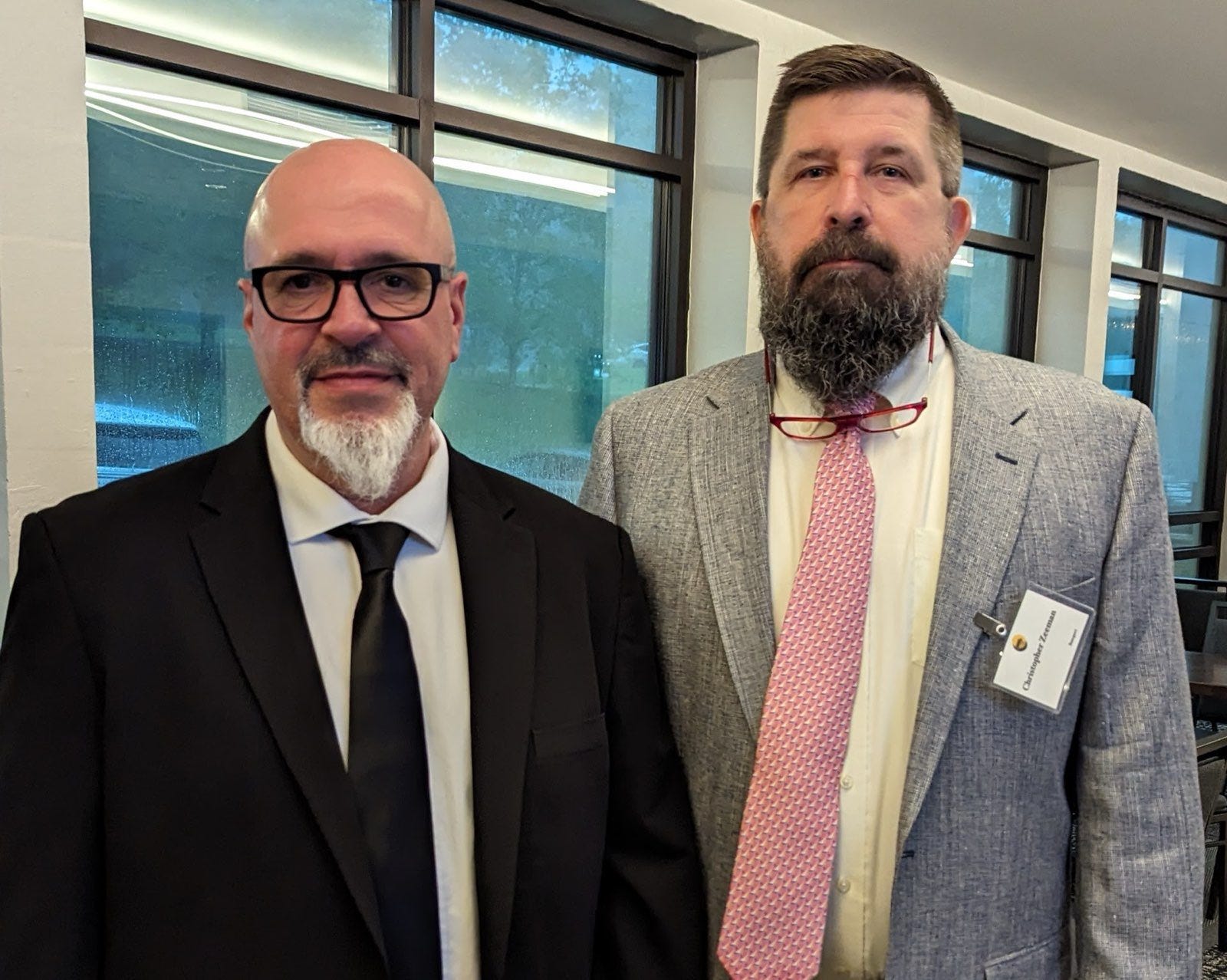
    And as Zman wrote here about the Numbers:

    This is the problem with conservatism. Who decides that something is too important to be subject to the numbers? There are only two choices. Either a supernatural force like God decides or the people through time and experience decide what is no longer subject to the numbers. The former requires a strong religious foundation for society and the latter is just democracy in slow motion. It turns out that Sir John Filmer was right, and John Locke was wrong.

    Of course, we value the numbers of life in this age because we trust that the numbers are not just a reflection of some normative truth but that they are accurate. Low inflation is a good thing so when the government comes out with numbers that say it is at or near the target of two percent, the experts cheer the rulers. This only makes sense if you think the government numbers are correct. The math of this age rests on people trusting the numbers of this age.

    Is inflation really near three percent now? Did Joe Biden really get more votes than any human in the history of elections? Do most Americans back Ukraine? Was last Thursday the hottest day in the history of the planet? Despite the lack of evidence to support most of the numbers, most people seem to trust them. At the same time, most people do not trust the people issuing the numbers. For most of human history people would know to never trust anything from untrustworthy people.

    That is the other novel thing about this age. Christianity has faded for most people as a foundation for moral claims. Something has to fill the void, so we have been flooded with new numbers to function as the authority. This explains why people trust the numbers while distrusting the people issuing the numbers. People are believing machines so when they stop believing in God, they will find something else. In this age people have come to trust the numbers as a last resort.

    In a way though, this is the metric of the liberal society. It works when people can trust the people in official positions. They can trust those people because they trust the institutions to police the people in the institutions. Even in times when the office holders are distrusted, the people can still trust the numbers because they are viewed as the product of the institutions. As long as people still trust the numbers, the rulers are safe, despite the fact they do nothing but lie to us.

    And he continues in another post:

    There is a bigger issue that applies to all the numbers. Decades of lying about the numbers have made all of them suspect. The totally fake economic data pumped out in the Obama years sunk the credibility of the court wizards. When those people with impressive credentials put on their serious faces and said that taking money from you and giving some of it to your neighbor would grow the economy, even the most innumerate started to question the math.

    It is not just the big stuff where lying has undermined the trust in the numbers that used to be the guideposts of society. Television ratings are obviously bogus or not as meaningful as claimed. If the people making the content cared about ratings, they would not have smeared their feces all over popular content. Ad makers would not have replaced most of the white people with nonwhites. They certainly would not have every white woman paired with a black guy.

    Probably the most egregious offender of the numbers are the tech companies, who clearly fake all of their numbers. How many users are really on Twitter? No one knows but we know the official number is a lie. We can clearly see that the follower counts and impressions are fake. Before buying Twitter, Elon Musk made the rather obvious claim that the site was riddled with bots and fake accounts. Once the deal closed, he stopped talking about the bots and fake accounts.

    There is more to the general fakery than the unreliability of the numbers. It is that it reflects a collapse in trust. When the government claims inflation is under control, but you keep seeing your expenses climb, you are reminded by the numbers that the people in charge cannot be trusted. When some new personality bursts on the scene claiming to have a huge audience, but no one you know heard of the guy until last week, you cannot help but wonder if it is a lie.

    The numbers of life are not supposed to tell us what we ought to do, but to be a measure of what we are doing. If we cannot trust the numbers or the people issuing the numbers, then we cannot know what they are doing. We have no way of judging what is being told to us or if it is on the level. The only logical response is to assume the numbers are fake and the people issuing them are lying. A society with unreliable numbers is a society run by unreliable people.

    Of course, this is most clear in politics. The most important numbers are the votes counted on election night. The logic of democracy is that everyone gets their say, then everyone votes and the side with the most votes wins. Along the way polling tells us how the various arguments and people are doing. If all of these numbers are fake, then what is the point? If the numbers at the soap box and the ballot box cannot be trusted, you are left with the numbers in the cartridge box.

    Since the end of the Cold War, American society has travelled along an arc that started with a trust in the numbers and the people behind them to a place where no sane person trusts the numbers or the people behind them. That is probably why it feels like this pirate ship of a society called America is sailing into dangerous waters. Odds are just numbers, and the odds say that in a world without reliable numbers, the most likely outcome is the ship eventually sinks.

    Jacques Ellul in The Technological Society (1954) criticized the tendency to focus on numbers at the expense of everything else. The commodification of human existence, driven by technological rationality, has led to a reduction of individuals and social relationships to mere statistics. This stripped complex human experiences of their qualitative, emotional, and cultural dimensions, prioritizing efficiency, productivity, and control at the expense of values and individual freedom. In such a system people are no longer seen as unique individuals with intrinsic worth but as components in a machine, whose value is determined solely by their output or their role within the system. The focus on quantification, while promoting rational decision-making undermines the richness and diversity of human life and thought. I will cover this book in a future post.

    The elites were smart to keep Numbers Going Up during “COVID” (except for the initial panic), because it satiated the bourgeoisie who don’t care about anything else. It is a divide-and-conquer strategy: the elites seek to undermine all of society other than themselves, but they can’t do it at the same time without causing social unrest, so they will benefit one group over others (during fraudvirus, those invested in the stock market over the working class). I recommended people live beneath their means in this post and warned that the era of empty secular mass consumption is over here.


    Conclusions

    As I wrote in this post, looking at Japan’s example from the 1980s where our elites created and then popped a massive economic bubble in order to hand over control of their central bank to the Rothschilds, our elites have deliberately created the greatest stock market bubble of all time; they may pierce the bubble now or in the future, cause tremendous panic, and then offer a pre-designed dialectical CBDC solution which will result in the greatest loss of freedom in human history – and the boomers will eagerly take it. The Numbers Go Down could theoretically be a good thing to break people out of their spell and to cause emotional/psychic pain and a new focus on things other than Numbers, but I doubt that will happen as these people have no theoretical, intellectual, spiritual or emotional base prepared for such a change.

    No forever Numbers Go Up for Japan’s 1990 bubble

    Benjamin Franklin once said: “Those who would give up essential Liberty to purchase a little temporary Safety deserve neither Liberty nor Safety.”

    One may update this quote for the present moment: those who would give up a functioning Western society for easy profits deserve neither a functioning Western society nor profits.

    Let’s end with this short video:

    https://www.youtube-nocookie.com/embed/WfGMYdalClU?rel=0&autoplay=0&showinfo=0&enablejsapi=0

    Thanks for reading.

    Subscribe:
    Email delivery remains on Substack for now.


    1 From here: “Paul Warburg arranged the 1929 stock market crash; first he advised all member banks to get out of the stock market or sell it short on March 9, 1929, then on October 24 the Federal Reserve Bank suddenly increased the rediscount rate to 6%, thousands of orders hit the exchange to sell “at market”, and six days later the Federal Reserve Bank ordered the contraction of brokers’ loans in the amount of $2.3 million, the combination of which caused the crash. Congressman Louis T. McFadden stated “It was a carefully contrived occurrence. The international [central] bankers sought to bring about a condition of despair so that they might emerge as the rulers of us all.”

  • The Silver Lining to the Blackpill

    This post explores the concept of the “blackpill,” acknowledging its validity on a political level due to humanity’s short-term focus, societal conformity, centralization, and environmental collapse. However, it rejects the blackpill on a personal level, emphasizing the importance of individual agency for psychological well-being and personal growth, recognizing that even with negative societal trends there is potential for deeper understanding and positive change.

    Welcome back. In my prior post on Emil Cioran, I mentioned that his view of the world felt too negative – even for me. I’ve sometimes been labeled a “blackpiller” – a vague and often misused term that generally refers to someone perceived as defeatist or overly pessimistic. While I accept this label in some contexts, I’d like to explore why I don’t fully embrace it, especially when it comes to my personal life.

    Let’s start with the aspects of the term that I agree with. I accept the “blackpill” label on a political level, and these are some reasons why:

    1. Human motivations lean toward focusing on the short term, on comfort and security and consumption, at one’s narrow experience niche, at the expense of freedom or long-term planning or future generations. This is an inborn and seemingly almost universal human trait;
    2. Humans are herd creatures, adept at following the social consensus to fit in and preserve one’s status, and that’s the way it’s always been and perhaps the way it always will be;
    3. There are millennia-length trends toward ever-increasing centralization and ever-decreasing freedom; and
    4. Humanity is rapidly running out of the natural resources necessary to sustain technological society – neo-Malthusianism in action – as Grundvilk discusses in the context of declining energy return on energy invested, while causing mass biodiversity die-off in the ongoing Holocene extinction event.

    The “blackpill” is also associated with philosophical pessimism ala Nietzsche and Schopenhauer, as well as the gnostic perspective of a malevolent Demiurge ruling this material plane, and I accept both of these: living creatures in this reality can only survive by consuming other living things, which means that one inherently cannot live by the Golden Rule no matter how much one may want to – an endless cornucopia of amoral or immoral death and consumption, the stuff of nightmares. Furthermore, humans are never satisfied with what we have: we are stuck perpetually striving for an object and, after achieving the object sought (if we do), we become bored and restless until deciding to strive for something new.

    When it comes to my personal life, though, I reject the “blackpill” label, and I would advise others to do the same. In fact, embracing agency – the ability to make meaningful choices – is key to maintaining psychological well-being, even in the face of broader societal challenges. It is important to narrow the scope of one’s focus to what one can impact in one’s own life: “Having and using agency is…important for psychological wellbeing and using that agency to make a mark on the world in line with one’s individuation process. To wallow in the blackpill on a personal level is to resign oneself to depression and despair, a wasted life.” This attitude to develop agency is regardless of whether or not societal circumstances are bad and getting worse.

    This idea is echoed in the experience of James Stockdale, who emphasized the power of individual agency in difficult circumstances. Stockdale embraced Epectitusian Stoicism during his seven-years in Vietnamese captivity, which he discussed in a somewhat interesting 1993 speech to King’s College in London. He narrowed the scope of his focus to what he could affect with his agency, which allowed him to maintain psychological and emotional equilibrium despite imprisonment and torture. Haim Ginott argued similarly (in a quote wrongly attributed to Goethe elsewhere on the internet),

    I have come to the frightening conclusion that I am the decisive element. It is my personal approach that creates the climate. It is my daily mood that makes the weather. I possess tremendous power to make life miserable or joyous. I can be a tool of torture or an instrument of inspiration, I can humiliate or humor, hurt or heal. In all situations, it is my response that decides whether a crisis is escalated or de-escalated, and a person is humanized or de-humanized. If we treat people as they are, we make them worse. If we treat people as they ought to be, we help them become what they are capable of becoming.

    We have agency in our own lives, even if what happens in the political realm is ultimately outside of our control.


    The Chinese Farmer

    This broader view of external forces ties into a personal philosophy that embraces uncertainty and perspective. One key lesson in navigating life is realizing that nothing is purely good or bad; it’s all about perspective, timing, and context. For example, when Rome conquered and destroyed Carthage in the Punic Wars – an unprecedented and total victory, one would think black-and-white winning – it sowed the seeds of Rome falling into decadence and infighting, per Sallust, leading to the end of the Republic and the rise of dictatorship. What may appear as good in one moment or period of time may appear entirely the opposite in another period of time. To illustrate this idea, consider the story of the Chinese farmer as told by Alan Watts, a tale that reminds us of the unpredictable nature of events and outcomes:

    Once upon a time there was a Chinese farmer whose horse ran away. That evening, all of his neighbors came around to commiserate. They said, “We are so sorry to hear your horse has run away. This is most unfortunate.” The farmer said, “Maybe.”

    The next day the horse came back bringing seven wild horses with it, and in the evening everybody came back and said, “Oh, isn’t that lucky. What a great turn of events. You now have eight horses!” The farmer again said, “Maybe.”

    The following day his son tried to break one of the horses, and while riding it, he was thrown and broke his leg. The neighbors then said, “Oh dear, that’s too bad,” and the farmer responded, “Maybe.”

    The next day the conscription officers came around to conscript people into the army, and they rejected his son because he had a broken leg. Again all the neighbors came around and said, “Isn’t that great!” Again, he said, “Maybe.”

    The whole process of nature is an integrated process of immense complexity, and it’s really impossible to tell whether anything that happens in it is good or bad — because you never know what will be the consequence of the misfortune; or, you never know what will be the consequences of good fortune.

    I try to keep myself in the place of “maybe” as much as I can. But one may still notice trends: there is a direct inverse relationship between material prosperity and spirituality. In other words, the more one consumes on the physical plane the less someone will focus on a connection to God or deeper meaning, and the opposite is also true. This is why the wealthiest and most powerful individuals are, almost by definition, secular material atheists, and why so many who are deeply religious are quite poor. As we continue our descent into neoliberal feudal hell (covered well in this post by Erik Wikström about his father’s personal experiences) people will have to find a way of developing their spiritual connections as a coping mechanism against declining material quality of life – a painful and difficult process for which society is currently in a liminal transition, or they will perish from despair.


    The Silver Lining

    Let’s move on to a related idea: the concept of the silver lining. The silver lining is a more optimistic “whitepilled” way of looking at life, suggesting that even bad situations can offer unexpected opportunities. No event is ever fully what it appears to be upfront – good often comes out of bad situations, and bad comes out of good situations, even though we may not see how ahead of time or how exactly it may manifest. “Man plans and God laughs.” For example, regarding bad coming out of good situations, the unprecedented peace and prosperity in the 1990s felt decidedly unreal to me: it deadened the spiritual senses, made people focus on the inessential, and this listless decadence led to a drifting, unfocused nihilism (grunge music was a good representation of this), paving the way for our elites taking advantage with the 9/11 false flag which resulted in something like ten trillion dollars and thousands of lives wasted to benefit the military industrial complex, to reduce freedoms (the Patriot Act was written years before 9/11) and enrich a small minority of oligarchs (mostly on behalf of Israel; 1996’s A Clean Break: A New Strategy for Securing the Realm policy document was followed to a T after 9/11). The population had it too good, they were too trusting of elites and government, and they got screwed. The famous G. Michael Hopf quote is true.1

    Similarly, we can often find unexpected benefits in political and social upheaval if we know where to look. Let’s take a closer look at some significant political events and explore the silver linings they reveal:

    1. The oligarchical reaction to Trump’s surprise 2016 win, where he was stymied across the board via a combination of intense media propaganda equating Trump with Hitler, endless lawfare and CIA-initiated mass protests, and then a stolen election utterly defanged his term, discussed previously here and here. The silver lining is that it became impossible for anyone with a discerning eye to fail to understand that there existed a “deep state” which controlled America which was not responsive to democracy or the popular will;
    2. The 2020-2023 COVID scam (“fraudvirus”), which instituted the same exact lockdowns worldwide and forced heart attack jabs on their populations. No one discerning could look at how this process played out without understanding that the world is controlled in a hierarchical manner behind closed doors; and
    3. Currently, Trump’s administration is pretending to be populist even though it is skinsuited into representing the interests of the oligarchy, discussed here and here. Our elites and media are now deliberately attacking one’s underlying ability to differentiate truth from falsehood, where everything appears as a mass of confusion, unable to separate fact from fiction. Part of this involves being corralled into self-reinforcing social media algorithm ghettos as Joshua Stylman discusses here, adjusted based on our personalities and backgrounds as Martin Štěpán discusses in this video2, and part of it is the advancement of AI which are blurring human from machine, discussed by Erik Hoel here. However, this process is being supercharged where media reporting has become fully divorced from actual political developments. This is a new and unique situation. Our rulers are unabashedly lying directly to our faces about their actions, reinforced by the media machine, while intentionally doing the exact opposite – basically this meme but for everything. Even government spending is apparently up 7.5% over last year, completely demolishing the “Musk cutting government waste” false narrative. So many of the “dissident right” folks are falling for this propaganda as Sotiris Rex contends here. And as Geopolitics & Empire writes: “If you’re still not quite connecting the dots, all right, let me try to spell it out for you.The global ideological system we all live under is going totalitarian. (That system is global capitalism, but call it what you want. I really don’t give a shit.) It is stripping away the simulation of democracy, which it does not need to maintain anymore. The Cold War is over. Communism is dead. Global capitalism has no external adversaries. So it doesn’t need to placate the masses with democratic rights and freedoms. So it is gradually stripping away those rights, and conditioning us to accept the loss of them.It is doing this by staging a series of “emergencies,” each featuring a different “threat” to “democracy,” or to “freedom,” or “America,” or “the planet,” or whatever, each with its own particular “monsters,” who are such a threat to “freedom” or whatever that we need to surrender our constitutional rights, and make a mockery of democratic values, or “otherwise the monsters will win.”It is doing this by switching the face it wears from “left” to “right,” then back to “left,” and then back to “right,” then “left,” and so on, because it needs our cooperation to do this. Not all of our cooperation at once. Just one cooperative demographic at a time.It is succeeding at this—i.e., the system is—by instrumentalizing our fear and hatred. The system could not possibly care less whether we identify as “left” or “right,” but it needs us divided into “left” and “right” so that it can feed our fear and hatred of each other … one administration, one “emergency,” one “war” at a time.There you go. That’s the War on Whatever. I cannot make it any simpler than that.” Gary D. Barnett concurs in this strong Note. How are you to verify what is real and what is false in this environment? The opportunity here, now, is to divorce oneself from the Current Thing narrative on an individual level, the propaganda control structures that drive our lives, by developing discernment and learning to tune out their nonsense as the false elite-crafted and disseminated narrative that it is. Our attention is powerful and should not be allowed to be directed unconsciously in ways against one’s interests.

    Conclusion

    Every one of the societal challenges and deceptions we encounter provides an opportunity to deepen our understanding of the world, our role within it, and even our spiritual connections – if only we can see the opportunity for what it is and pursue it honestly and diligently. There is no way to sit on the sidelines of this process: either one adapts and understands the silver lining and implements the correct lesson in one’s life or one will get eaten by the system without any shadow of a doubt – there is no third option. If you accepted the Trump = Hitler narrative you turned into an unthinking NPC, and these “people” still walk among us, just now in idle mode because the oligarchy flipped the media switch to turn their agitation off for the moment; if you accepted the fraudvirus scam you currently have an increased risk, of indeterminate degree, of heart attacks and turbo-charged cancer and who knows what else. And if you accept the current media narratives one becomes totally confused, bouncing from one headline to the next, unable to make sense of what is happening in this world – a chicken with it’s head cut off squawking about the false wonders of DOGE, RFK Jr. and “putting the woke away”.

    What we see, then, are these meta events serving as a repeated filter mechanism: either you increasingly think for yourself, understand the world for what it is – a blackpilled centralized horror show overseen by the Rothschild central bank system, their media and security state apparatuses superimposed over the belief system of the masses which has allowed this system to develop – and increasingly tune out the Current Thing (with the understanding that listening to and reacting to their pushed narrative, no matter how one responds to it, fundamentally buys into the elite’s action-reaction-synthesis dialectics3, feeding it and giving it power), and that the only rational response is to stop reacting to it as the false scam that it is or, if one fails the challenge, one becomes a faceless, gray automaton, with one’s brain, heart and soul colonized by the malevolent predators of this world, doomed to an eternity of darkness and destruction.

    It is important to engage the Current Thing early on, before or at it’s peak hysteria, because that is when it really matters, not a couple years later when the elites have moved onto their next scam. So many famous and influential people whitewash their involvement in this process when it’s over; they are disgusting. It is a scary thing engaging with one of these narratives at it’s peak intensity from outside the dialectical action-reaction paradigm; taking the right action in the moment requires a deep gut check because there is always a heavy feeling of danger, of severe consequences, of feeling scared and alone and isolated – facing one’s fear in this moment is nothing at all like the movies. This is why I highlighted the bravery of gym owner Ian Smith during peak fraudvirus, for example. And the masses too, slowly and haltingly, like a mentally challenged person, grudgingly evolve: 80% of the masses got the first heart attack jab and only 50% got the second, while the 2017-2020 endless media hysteria campaign wasn’t working well toward the end which necessitated the 2020 election steal, but the masses are really slow on the uptake, and worse, they always fall for whatever the next Current Thing scam is which hits them from an angle they aren’t prepared for – waking up to it after the objectives have been achieved is waking up to it too late.4

    This message is, ultimately, the opposite of the blackpill on a personal level: it sees within political darkness the endless opportunity for increased spiritual growth and depth of understanding, as long as one is willing to own their agency and direct it properly. Ultimately, the choice remains within each of us: either we adapt and grow, learning from these difficult lessons, or we risk becoming passive participants in the system’s designs.

    Thanks for reading.

    Subscribe:
    Email delivery remains on Substack for now.


    1 “Hard times create strong men. Strong men create good times. Good times create weak men. And, weak men create hard times.”

    2 He states at the end: “It’s impossible to see eye to eye and communicate with people that are different from you. And that is because, in a sense, it is true that we live in a simulation, though one that our brains produce from the very real external world, and that different people due to different genetic traits, training, experiences, incentives and cultural and religious heritage produce a simulation of a completely different world in their minds even when exposed to exactly the same information.” This reminds me of a post I wrote awhile back where a friend and I watched the exact same video and came away with diametrically opposite interpretations of it – if we can’t agree on the same visual evidence in front of our faces, what hope is there of coming to a shared reality about anything else?

    3 i.e. “COVID came from a Wuhan lab leak!” wrongly accepts the dangerousness of the fraudvirus scam as a baseline.

    4 Even though elections are controlled and decided behind closed doors, it seems like our elites want public acquiescence to their control. I don’t know why they ultimately care; perhaps it’s an occult revelation of the method – by the public doing what they’re told they are on some level agreeing to be abused, which absolves the abuser of guilt? – or for some other reason, but their calculations really do take whether the public accepts their narratives or not.

  • The Three Stages of Integration Into the Neoliberal Order

    The U.S. has a long history of supporting foreign regimes and later overthrowing them, a pattern that continues today. Julian Assange and WikiLeaks reveal that this behavior is part of a deliberate strategy to transform countries into neoliberal slave states, controlled not by military means but through international debt. Their three-step approach allows the U.S. to control nations indirectly, moving from direct colonialism to economic subjugation.

    “The modern implement of imposing slavery is debt.” – Ezra Pound

    The U.S. has a strange pattern to it’s foreign policy: it has historically supported loyal regimes all around the world and then, from time to time, it suddenly yanks the rug out from underneath the regime and overthrows it. This pattern continues to this day. The question for this post is: Why would it do this? Is it simply shifting politics, perhaps different administrations with different alliances, is it Great Power schizophrenia, deliberately playing both sides, or is there something more to it?

    Before attempting to answer this question, let’s examine a few historical examples of this behavior:

    • Latin America: The U.S.’s involvement in endless regime changes in Latin America is well known. Noriega, Allende, Monroy, the list is long…
    • China: In 1949 the communists took over China with the help of deliberate Washington meddling.  Chiang Kai-shek, a faithful nationalist ally of the U.S., was trying to establish a constitutional republic, but General Marshall demanded that Chiang accept the communists into his government or forfeit U.S. support.  Marshall also negotiated truces that saved the communists from imminent defeat which they exploited to regroup and seize more territory, and slammed a weapons embargo on the nationalist government. Thanks to the embargo the nationalists ran out of ammunition.  Congress voted to send $125 million in military aid to Chiang but Truman held up implementation until China collapsed. On January 25, 1949, John F. Kennedy declared before the House of Representatives:”Mr. Speaker, over this weekend we have learned the extent of the disaster that has befallen China and the United States. The responsibility for the failure of our foreign policy in the Far East rests squarely with the White House and the Department of State. The continued insistence that aid would not be forthcoming, unless a coalition government with the Communists were formed, was a crippling blow to the National Government.”He reaffirmed this in a speech five days later, concluding: “This is the tragic story of China, whose freedom we once fought to preserve. What our young men had saved, our diplomats and our President have frittered away.”
    • Iran: In 1953 the CIA backed the overthrow of Iranian Prime Minister Mossadegh with the Shah Mohammad Reza Pahlavi as the replacement after Mossadegh tried to nationalize the oil industry. But in January 1979 U.S. General Robert Huyser was sent to Iran to prevent Iranian military leaders from orchestrating a coup to save the Shah (also see here):That day, Carter dispatched General Robert E Huyser, Deputy Commander of US Forces in Europe, to Tehran to tell the Shah’s generals to sit tight and “not jump into a coup” against Prime Minister Bakhtiar….Once there, Huyser was tasked with taking the temperature of the military’s top brass and convincing them to “swallow their prestige” and go to a meeting with Beheshti [Khomeini’s second-in-command in Iran]. The US believed such a meeting would lead to a military “accommodation” with Khomeini.To help break the stalemate, President Carter swallowed his own prestige. On the evening of 14 January, US Secretary of State Cyrus Vance sent a cable to US embassies in Paris and Tehran: “We have decided that it is desirable to establish a direct American channel to Khomeini’s entourage.”….Establishing a direct link with Khomeini was a highly sensitive matter; if revealed, it would be interpreted as a shift in US policy, a clear signal to the entire world that Washington was dumping its old friend, the Shah. Rurik Skywalker has a good post outlining how compromised Iran is to this day.
    • Iraq: In Iraq, US intelligence helped Saddam Hussein’s Ba`ath Party seize power in 1963 as part of its general offensive against radical Arab nationalism. Evidence suggests that Saddam was on the CIA payroll as early as 1959. The CIA later helped Saddam Hussein gas Iran by exploiting a key weakness in their ongoing war. Later the U.S. attacked Iraq twice, overthrew and executed him.
    • Egypt: In 2011, protests from the Muslim Brotherhood overthrew Hosni Mubarrak, the president of Egypt and staunch U.S. ally as part of the so-called “Arab Spring”. The revolution was sponsored covertly by the State Department; for example Wael Ghonim, one of it’s key organizers, met with State Department and then Google executive (and close friend of Eric Schmidt, co-authoring a book together) Jared Cohen right at the very start of the protests (lamely denying that it was related). National security expert Mike Benz tells a fascinating tale of how the State Department used social media to inspire revolutions, including the “Arab Spring”, until the 2014 Donbass/Crimea elections, after which they realized that social media could be used by the enemies in the same way they used it to inspire their own revolutions1 and then after Trump’s surprising 2016 win they turned against those tools.2

    These examples just scratch the surface of this repeated behavior. Why would the U.S./State Department/CIA support regimes, then betray their loyal allies in favor of something else? Julian Assange (who I previously covered here and who is now out of prison3) and the Wikileaks organization have an answer for this puzzling question in their interesting The Wikileaks Files (2016), and it’s an answer that is not well understood. Wikileaks arrives at certain unsettling conclusions from analyzing many hundreds of thousands of confidential State Department cables which reveal underlying patterns in how the Department interacts with foreign governments. The revelation of these patterns would set Wikileaks as a primary target by our elites for subsequent targeting for imprisonment and destruction.


    The three phases of neoliberal slave-state integration

    Wikileaks’ answer to the question of why is that there is a very specific, conscious strategy being employed by the State Department and CIA. Their strategy is to transform countries around the world from nation states (as that term is traditionally understood, with leaders who answer to their populations and focus on national interests) to hollowed-out slave states subservient to the financial international order, controlled not by military means but rather by sophisticated debt mechanisms. This is akin to neocolonialism but broader and applies to countries that have never been formally colonized. This transformation occurs in three phases which are region dependent; some places go through the phases faster than others. These phases are:

    • Phase 1: Install strongman. Develop friendly client regimes who will create a national security apparatus willing to crack down on domestic dissent.
    • Phase 2: Stability. Encourage regimes to develop an industrial base which can sustain stable political authority without allowing an opening for populism.
    • Phase 3: Market liberalization. A transition to “market oriented” economies based “on “democracy” and the Washington Consensus which can be controlled through neoliberal debt mechanisms.

    Per Assange,

    At the heart of postwar US policy-making is the doctrine of liberal internationalism. Pioneered by Woodrow Wilson [NLF: the Federal Reserve was established under his watch] and embellished by Franklin D. Roosevelt and Harry Truman, this doctrine is generally understood as the justification of military and other interventions by the US if they help produce a liberal world order: a global system consisting of liberal-democratic nation-states, connected by more or less free markets and ruled by international law. In this world-view, the goal of achieving a liberal world system trumps the commitment to state sovereignty. The US sees itself as the natural vanguard of such a global order, as well as the chief bearer of any right to suppress state sovereignty in the pursuit of liberal goals.

    For example, we can look at Iran: it’s gone through Phase 1 (Shah and then the Mullah strongmen, development of national security apparatus to crack down on domestic dissent), Phase 2 (development of the country), and now it’s on Phase 3 (CIA-backed encouragement of internal dissent, neocons pushing for war with Iran to crack it open and turn it over to international market forces). The Soviet Union also went through these three phases ending with glasnost and perestroika, it’s assets stripped and sold to international Jewish interests leaving a hollowed out country controlled by international financial elite-puppet Putin. South American countries are universally at Phase 3; we can see it with looking at Argentina or Mexico’s current leaders and their practices, for example. Alternatively, our elites tried transitioning Egypt from Phase 2 to Phase 3 but failed, and it reverted as a result.

    Rurik Skywalker covered these three phases in this solid post, which is worth a read.

    Any country which attempts to back-out of this process will be invaded or destroyed (Gaddafi, Saddam), as wars to ensure dollar hegemony and globalist control are one of the three types of wars that our elites engages in. The best a country can do is to turn into a hermit kingdom like Belarus, North Korea, or Burma before the phases are initiated, but it just buys an element of time; it is not a permanent solution. Lukashenko in Belarus was almost overthrown in a coup, North Korea has come close to being attacked by the U.S. numerous times, and Burma is in the process of being hollowed out.

    Let’s go into detail on each of these phases.


    Phase 1: Install Strongman

    The first phase involved setting up a strongman who will crack down on the international elite’s enemies and build out a national security apparatus:

    In a global market dominated by the US, supporting national governments in place that were open to US investment was more important than becoming a colonial overlord. Profits could flow back to Wall Street without the debilitating costs of occupation. To achieve this world order, however, the US would need to prize open the colonial empires….

    The chief concern of US officials during [Phase 1] was that “premature independence” might lead to a new freedom for people as yet unfit to govern themselves. Given this unfitness, they might not commit to building liberal capitalist states integrated into a US-led world market, instead preferring politically immature “populist” or radical solutions. They might even, in some cases, “go communist.”

    As a leading American expert on African populist, William J. Foltz, wrote in 1966, it would take more than a few generations to teach the majority of black Africans “the skills necessary to participate meaningfully and effectively in politics.” Therefore, if a further period of tutelage at the hands of white colonial masters was not possible, the “modernization theory” of US state mandarins held that these people would require a period of authoritarian rule under enlightened military regimes.

    Therefore the US supported the Mobutu regime in the Congo, dictators in South Vietnam to avert Viet Minh rule, dictatorship in South Korea, the Indonesian general Suharto to open the country to US investors, the House of Saud, Egyptian dictatorship to suppress the Muslim Brotherhood, etc. The U.S. would train local forces loyal to it’s installed leaders to take over military duties so it would not be burdened with long-term occupation. As Walter LaFeber argued: “The United States had hit upon a solution to its traditional dilemma of how to inject force to stop revolutions without having a long-term commitment of US troops. The answer seemed to be to use native, US-trained forces that could both pacify and protect the country.” Having a worldwide network of military basis to exert indirect control helped, too:


    Phase 2: Stability

    After the strongman was installed the next phase involved building out national industry:

    A new phase was opened up by the Cold War, in which the United States sought to encourage regimes to develop an industrial base and a prosperous middle class that could sustain stable political authority without creating an opening for leftist movements. This was linked to the development of a global series of institutions known collectively by the name Bretton Woods, after the location of the conference at which they were launched. These included a global monetary system in which currencies were pegged to the gold standard, and institutions such as the International Monetary Fund, set up to enable the development of world trade. The prevailing orthodoxy was that national states could intervene extensively in economic affairs to support and develop productive industry. In this period, the US intervened frequently in Latin American affairs, but much less through the traditional military means than through covert CIA-coordinated interventions to bolster the national security apparatuses of friendly governments, and to sabotage movements and governments that threatened US interests.

    I would add that the role of the strongman was more than just setting up a national security apparatus and developing productive industry in order to suppress populism. The role of the strongman was to do whatever it took to suppress populism, including waging war and other measures. For example, the Iraq/Iran war and other initiatives such as family planning restrictions served a broader goal of bleeding off nationalist fervor and speeding the process of collapsing domestic birthrates. i.e.:

    And:


    Phase 3: Market liberalization

    After a strongman was installed who created a national security state to suppress populist unrest, and after they stabilized the country by modernizing it to the extent necessary, the strongman’s role was finished and it was time to transition to a parliamentary democracy which would be easier to control with market forces:

    The third phase was signaled by the collapse of the Bretton Woods system amid a global economic crisis, and the American adaptation to defeat in Vietnam and a series of related crises in its rule. The outcome, following a protracted and violent process of reorganization, was a form of rule predicted on the liberalization of markets, capital controls, and regulations on finance and labor. Rather than encouraging the state-coordinated development of industry, the IMF pursued “structural adjustment,” using debt as a mechanism to incorporate Latin American states into the global economy. Market dependency would exert its own disciplinary mechanisms, as unfriendly policies could be “punished” by capital flight, or ruled out of bounds by global institutions. This involved reorganizing national elites, reducing the power of protectionist oligarchies, and – once leftist movements had been defeated by a tornado of CIA-orchestrated violence – encouraging them to rule through parliamentary institutions. With some outstanding exceptions, such as Plan Colombia and the Venezuelan coup, the United States was largely able to withdraw from military and paramilitary interventions, and let markets do the talking.

    Often times the shift from Phase 2 to Phase 3 would catch the victim dictator off-guard; he was doing what his masters wanted, he was loyal, so why would they overthrow him? It didn’t make sense to their worldview which, although they could be ruthless and aggressive, would never plunge to the depths of twisted, black thinking required to understand this strategy. With respect to Iraq, “The dictatorship of Saddam Hussein in Iraq had been strongly supported by the United States in its invasion of Iran after the overthrow of the shah, and facilitated in its brutal war against the Kurds. But the regime was still predicated partly on Arab nationalism and heavy state involvement in the economy, and the moderation of hostilities with Iran meant that Iraq’s usefulness was drawing to an end.” More than the invasion of Kuwait, it was Saddam’s declining influence as well as his attempt to trade oil for Euro instead of dollars – a red line for the U.S. regime – that spelled the end of his rule.

    During this phase the establishment uses various methods to get the targeted country hooked on international debt: “US economic aid and IMF loans were used as levers to win support for opening up these economies to global markets, superseding the import-substitution model of industrial development. They therefore became dependent on imports, and repeated balance-of-payments crises only deepened their dependence on IMF-organized loans, and thus their acceptance of their associated conditions – including the whole package of neoliberal reform dubbed ‘structural adjustment.’”

    This indirect control was much more manageable and much less costly to our elites than former direct colonization. The effect was the same or even better due to increased profitability:

    In the post-Cold War world, the reigning world-view was that liberal capitalist democracy was the ultimate terminus of history, the endgame to which all states tended. And the more America’s “backyard” was integrated into the world system, the more it opened its markets, allowed public goods to be privatized and run by US firms, and the more it signed up to global and regional trade treaties, the less need there was for direct violent interventions. The political form of dictatorship often became more of an impediment than an asset, and the United States was even willing to offer limited support to some pro-democracy movements, provided they were congruent with the overall goal of expanding “free markets” under the direction of strong states.

    Because the international financial elites controlled the Soviet Union as much as it controls the United States, the same process worked in a similar way in countries dominated by it. For example, despite Vietnam winning the war against the United States it was rapidly integrated into the global economy without any subsequent war being fought:

    Through the 2000s, over a quarter of a century after US defeat to the Viet Minh, WikiLeaks’ disclosures show the US embassy in Hanoi charting with some satisfaction the Vietnamese government’s incorporation into US-led globalization. That included laying the foundations for accession to the WTO, engaging in market-led reforms and privatization programs, and willing submission to IMF orthodoxy and compliance with all necessary prerequisites for participation in IMF structural adjustment programs. Such programs are notorious for the effects they have on national economies and for the ignominious nature of dependency they generate between debtors and creditors: in short, debt bondage….

    Why did the Vietnamese government, nominally a socialist one that had defeated the American empire in a horrifying war, accede to this? The short answer is that the new Politboro’s attempt to reconstruct the economy of a unified Vietnam on a statist basis after the devastation of war was simply untenable in an increasingly integrated and competitive world economy. The attempt to make a rational allocation of economic resources and to plan efficiently turned out to be too difficult. In a global economy in which the price fluctuations of almost all goods and services were under no one’s control, and in which Vietnam was often isolated, it was practically impossible….

    In short order, since Vietnam owed over $1 billion in debt, the IMF offered its services and, of course, recommended the same policy mix as it recommends to all would-be debtors: cut subsidies, remove price controls, remove exchange and capital controls, privatize and let the market rip. The classic debt trap was initiated. The more Vietnam borrowed from the IMF, the more it needed to borrow, and its rate of indebtedness soared. The more it adopted “free market” policies, the more dependent it was on markets and the less able it was to apply controls.

    The philosopher Jean Baudrillard agreed with this understanding, although he also linked the Vietnam war to the pacification of China, where he wrote in Simulacra and Simulation (1981):

    The [Vietnam] war, at bottom, was nothing but a crucial episode of peaceful coexistence. It marked the arrival of China to peaceful coexistence. The nonintervention of China obtained and secured after many years, China’s apprenticeship to a global modus vivendi, the shift from a global strategy of revolution to one of shared forces and empires, the transition from a radical alternative to political alternation in a system now essentially regulated (the normalization of Peking-Washington relations): this was what was at stake in the war in Vietnam, and in this sense, the USA pulled out of Vietnam but won the war.

    And the war ended “spontaneously” when this objective was achieved. That is why it was deescalated, demobilized so easily.

    This same reduction of forces can be seen on the field. The war lasted as long as elements irreducible to a healthy politics and discipline of power, even a Communist one, remained unliquidated. When at last the war had passed into the hands of regular troops in the North and escaped that of the resistance, the war could stop: it had attained its objective. The stake is thus that of a political relay. As soon as the Vietnamese had proved that they were no longer the carriers of an unpredictable subversion, one could let them take over. That theirs is a Communist order is not serious in the end: it had proved itself, it could be trusted. It is even more effective than capitalism in the liquidation of “savage” and archaic precapitalist structures.

    Same scenario in the Algerian war.

    The other aspect of this war and of all wars today: behind the armed violence, the murderous antagonism of the adversaries – which seems a matter of life and death, which is played out as such (or else one could never send people to get themselves killed in this kind of thing), behind this simulacrum of fighting to the death and of ruthless global stakes, the two adversaries are fundamentally in solidarity against something else, unnamed, never spoken, but whose objective outcome in war, with the equal complicity of the two adversaries, is total liquidation. Tribal, communitarian, precapitalist structures, every form of exchange, of language, of symbolic organization, that is what must be abolished, that is the object of murder in war – and war itself, in its immense, spectacular death apparatus, is nothing but the medium of this process of the terrorist rationalization of the social – the murder on which society will be founded, whatever its allegiance, Communist or capitalist. Total complicity, or division of labor between two adversaries (who may even consent to enormous sacrifices for it) for the very end of reshaping and domesticating social relations.

    This reminds me of the scene in the mediocre movie The International about how a country is controlled in the modern era by debt, not by outright military control:

    https://www.youtube-nocookie.com/embed/LFqx2sROwsE?start=84&rel=0&autoplay=0&showinfo=0&enablejsapi=0

    In Neo-Colonialism, the Last Stage of Imperialism, Kwame Nkrumah wrote:

    In place of colonialism, as the main instrument of imperialism, we have today neo-colonialism…[which] like colonialism, is an attempt to export the social conflicts of the capitalist countries….

    The result of neo-colonialism is that foreign capital is used for the exploitation rather than for the development of the less developed parts of the world. Investment, under neo-colonialism, increases, rather than decreases, the gap between the rich and the poor countries of the world. The struggle against neo-colonialism is not aimed at excluding the capital of the developed world from operating in less developed countries. It is also dubious in consideration of the name given being strongly related to the concept of colonialism itself. It is aimed at preventing the financial power of the developed countries being used in such a way as to impoverish the less developed.

    The essence of neo-colonialism is that the State which is subject to it is, in theory, independent and has all the outward trappings of international sovereignty. In reality its economic system and thus its political policy is directed from outside.

    It also reminds me of this strange Argentinian president Javier Milei, who our international financial elite-controlled media raves is slashing costs – which he is doing by slashing government spending and “deregulating” in order to pay it’s international debts, while it’s poverty levels surged to a 20 year-high of 57%. I guess it also doesn’t hurt media support that he seems to be in some process of converting to Judaism.


    Conclusions

    We are often led to think by the insanity we see in the media and the incompetent politicians we see on television that the United States and it’s upper elites are not rational actors, but this is mostly an illusion for rubes. Yes, there is a general decline in our elite’s effectiveness due to a combination of increased “diversity” and women in the workforce, as well as increased political correctness and increases in laziness and societal despair — and especially because it has been on top unchallenged for so long. But there is a real method to the madness, a highly sophisticated apparatus of worldwide control which is deliberately concealed from the public. The most important thing to ask yourself is why: if world actions don’t seem to make sense, if they seem contradictory and self-defeating, it is not proper to assume it is due to incompetence; our international financial elites have been on top for too long to have that be the baseline assumption. Dig deeper.

    Here, our elites brilliantly transitioned from a system of direct colonization to an indirect system based on neoliberal debt practices. Just as this process plays out on a national level, it also plays out on an individual level where most people have no savings and are controlled by their debt (house debt, student loans, credit cards). Slavery and control never ended; it merely took on an indirect form where people wouldn’t realize they are controlled.

    I hope this is a little eye opening.

    Thanks for reading.

    Subscribe:
    Email delivery remains on Substack for now.

    PS: Because the U.S. and Britain are controlled by the same central bank owning elite, they utilize the same strategies to achieve neoliberal control. In a future post I will cover the ruthless and highly controversial British counter-insurgency general Frank Kitson and how the tactics he used toward crushing populist uprisings served as a precursor for the initiation of Phase 1 toward neoliberal debt control.


    1 From here: “Now, the high watermark of the sort of Internet free speech moment was the Arab Spring in 2011 2012, when you had this one by one, all of the adversary governments of the Obama administration, Egypt, Tunisia, all began to be toppled in Facebook revolutions and Twitter revolutions. And you had the State Department working very closely with the social media companies to be able to keep social media online. During those periods, there was a famous phone call from Google’s Jared Cohen to Twitter to not do their scheduled maintenance so that the preferred opposition group in Iran would be able to use Twitter to win that election. So free speech was an instrument of statecraft from the national security state to begin with. All of that architecture, all the ngos, the relationships between the tech companies and the national security state had been long established for freedom. In 2014, after the coup in Ukraine, there was an unexpected counter coup where Crimea and the Donbass broke away. And they broke away with essentially a military backstop that NATO was highly unprepared for at the time. They had one last Hail Mary Chance, which was the Crimea annexation vote in 2014.

    And when the hearts and minds of the people of Crimea voted to join the Russian Federation, that was the last straw for the concept of free speech on the Internet. In the eyes of NATO as they saw it, the fundamental nature of war changed at that moment. And NATO at that point declared something that they first called the Durasimov doctrine, which is named after this russian military general who they claimed made a speech that the fundamental nature of war has changed. You don’t need to win military skirmishes to take over central and eastern Europe. All you need to do is control the media and the social media ecosystem, because that’s what controls elections. And if you simply get the right administration into power, they control the military. So it’s infinitely cheaper than conducting a military war to simply conduct an organized political influence operation over social media and legacy media. An industry had been created that spanned the Pentagon, the british Ministry of Defense and Brussels into a organized political warfare outfit. Essentially infrastructure that was created, initially stationed in Germany and in central and eastern Europe, to create psychological buffer zones. Basically to create the ability to have the military work with the social media companies, to censor russian propaganda or to censor domestic right wing populist groups in Europe who were rising in political power at the time because of the migrant crisis.

    So you had the systematic targeting by our State department, by our IC, by the Pentagon, of groups like Germany’s AfD, the alternative for Deutschland there, and for groups in Estonia, Latvia, Lithuania. Now, when Brexit happened in 2016. That was this crisis moment where suddenly they didn’t have to worry just about central and eastern Europe anymore. It was coming westward, this idea of russian control over hearts and minds. And so Brexit was June 2016. The very next month at the Warsaw conference, NATO formally amended its charter to expressly commit to hybrid warfare as this new NATO capacity. So they went from basically 70 years of tanks to this explicit capacity building for censoring tweets that they were deemed to be russian proxies. And again, it’s not just russian propaganda. These were now Brexit groups, or groups like Mateo Salvini in Italy or in Greece or in Germany or in Spain with the Vox party. And now, at the time, NATO was publishing white papers saying that the biggest threat NATO faces is not actually a military invasion from Russia. It’s losing domestic elections across Europe to all these right wing populist groups who, because they were mostly working class movements, were campaigning on cheap russian energy at a time when the US was pressuring this energy diversification policy.

    And so they made the argument after Brexit. Now the entire rules based international order would collapse unless the military took control over media, because Brexit would give rise to Brexit in France with Marine Le Pen, to spexit in Spain with the Vox party, to Italy. Exit in Italy to Gregson in Germany to Grexit in Greece. The EU would come apart, so NATO would be killed without a single bullet being fired. And then, not only that, now that NATO is gone, now there’s no enforcement arm for the International Monetary Fund, the IMF, or the World bank. So now the financial stakeholders who depend on the battering ram of the national security state would basically be helpless against governments around the world. So from their perspective, if the military did not begin to censor the Internet, all of the democratic institutions and infrastructure that gave rise to the modern world after World War II would collapse. So you can imagine. Wait. May I ask you to pause the 2016 election?

    You just told a remarkable story that I’ve never heard anybody explain as lucidly and crisply as you just did. But did anyone at NATO or anyone at the State Department pause for a moment and say, wait a second, we’ve just identified our new enemy as democracy within our own countries? I think that’s what you’re saying. They feared that the people, the citizens of their own countries would get their way and they went to war against.”

    2 From here: “Google Ideas renamed itself Google Jigsaw to develop what was previously a DARPA-funded program to use something called natural language processing, an AI technique to examine words to assess the political topography of different kinds of narratives,” Benz explained. “The dialect of an idea, almost the way academic jargon gave rise to a sophisticated dialectic Marxism, there is a similar thing with respect to MAGA or ISIS. If you can train your model on that ideology, you can use that for content moderation purposes in highly sophisticated and targeted ways.”
    “Jared Cohen at Jigsaw, immediately after the 2016 election turned this DARPA-funded project, originally funded by the DOD to look at the ways ISIS was recruiting, they turned it on three sets of political training data — the 2016 election and Donald Trump, Nigel Farage and the Brexit party, and climate change.”
    “They ended up rolling that out to the social media companies, it ended up becoming standard, and then there became a gold rush to develop more and more AI domestic censorship superweapons for control over political discourse.”

    3 Although subject to who-knows-what types of restriction as part of his plea deal; he did publicly speak for the first time recently.

  • A Philosophy of Decay: Emil Cioran and the Boundaries of Pessimistic Thought

    This essay explores Emil Cioran’s philosophy, revealing how his reflections on pessimism, suffering, and the human condition offer a radical form of freedom. Through his life and aphorisms Cioran challenges conventional views of hope, progress, and meaning where, without the burden of progress or idealized outcomes, life becomes more open to unexpected joys and surprises. His thoughts serves as a guide to live without the constraints of conventional optimism, embracing life in its complexity and unpredictability.

    This is a post about an extreme philosophical pessimist: Emil Cioran.

    Cioran is known as one of the great writers of aphorisms (i.e. short, fragmented ideas communicated within a few paragraphs) who became famous for his A Short History of Decay (1949). I felt reluctant to cover him because his writing leaves a sour taste in the mouth, a claustrophobic dread, as a brutally pessimist author who basically used his writing as a therapy tool so he wouldn’t kill himself or go mad. “A book,” said Cioran, “is a suicide postponed.” Indeed, Cioran believed that by coping directly with the horrors of this world it would strip away illusion and perhaps make life worth living. “Only optimists commit suicide, optimists who no longer succeed at being optimists. The others, having no reason to live, why would they have any to die?”

    Many authors use writing as a coping tool; I do as well. But my outlook is not as relentlessly bleak as Cioran’s, even though it’s bleaker than most other Substacks. The intent here is not to lean into the pessimism as much as he did; rather, the question is where can one find hope and meaning in a world of intensifying neoliberal feudalism and ubiquitous nihilism? (And I do see some, also here.)

    So why did I want to cover Cioran? Three reasons. First, to highlight the many themes he covers which overlap with this Substack; second, because I enjoy reviewing strange figures who march to the beat of their own drum – it is by following our intuition (within reason, in a measured capacity) that we can become who we are really meant to be; and third, as a limit to how far one can push their pessimism. I don’t want to be as pessimistic as Cioran; it is too much. So is the approach of the infamous “Nothing Good Has Ever Happened” Will Martin for that matter – I feel like I should perhaps dedicate this post to him, lol.1 An element of “maybe” from the Chinese farmer story is a healthier approach, even though pessimism is a nice baseline – I would rather be pleasantly surprised to the upside than to the downside.

    Cioran as an older man. Good looking fella, great hair.

    Cioran’s background

    Cioran was a Romanian born in 1915 to a Greek Orthodox priest father and who supported the far right during the rise of Fascism, including Hitler and the Iron Guard.2 He moved to France, refused to be drafted by Romania to fight Russia in the Soviet Union, and became somewhat disillusioned with politics after the Axis lost. He lived in Paris for the next fifty-some years where he refused to work a “real” job, wrote a couple dozen pessimistic books and then died of Alheizmer’s in 1995 at 84 years old (after planning to kill himself as his mental facilities declined but he waited too long3). He was the friend of other famous writers such as Eugène Ionesco and Mircea Eliade. He said nothing good comes from getting old, though: “One doesn’t become better on the moral plane with old age.  Nor wiser.  Contrary to what people think.  One gains nothing in getting old.  But as one is more tired, one gives the impression of wisdom….There is no progress in life.  There are small changes.” He was an anti-natalist and had no children, something I see as foolish and decadent.

    Cioran (left) with Ionesco and Eliade

    His break from the mainstream perspective began from the unrelenting insomnia he suffered as a teenager.4 He wrote his famous A Short History of Decay, which included dozens of aphorisms about decay in all its forms, by forcing himself to learn to write French in his late 20s and 30s. It was a very difficult process which he ended up re-writing three times. Cioran described the process of learning French as “the most difficult task of my life”, comparing it to “putting on a straitjacket”.

    He looks depressive.

    Overlapping themes

    What are the overlapping themes between Cioran and this Substack?

    1. Cioran was a 20th century gnostic according to professor Costica Bradatan:In his books, Cioran never stopped berating the gods, except, we might say, for the god of failure, the demiurge of the Gnostics. There is something distinctly Gnostic about Cioran’s anti-cosmic philosophy and the manner of his thinking. Gnostic insights, images, and metaphors permeate his work, as scholars of Gnosticism have noticed. A Short History of Decay, The Temptation to Exist, and The New Gods, writes Jacques Lacarrière, are “texts which match the loftiest flashes of Gnostic thought.” Just like the Gnostics of old, Cioran sees creation as the result of a divine failure; human history and civilization are for him nothing but “the work of the devil,” the demiurge’s other name. In A Short History of Decay, he deems the God of this world “incompetent.” “Of all that was attempted on this side of nothingness,” he wonders, “is there anything more pathetic than this world, except for the idea which conceived it?” The French title of one of his most influential books, which in English has been published as The New Gods, is telling — Le Mauvais démiurge (1969): “the evil demiurge.” Here, with unconcealed sympathy, Cioran calls the Gnostics “fanatics of the divine nothingness” and praises them for having “grasped so well the essence of the fallen world.”
    2. He had a strong interest in esotericism and mysticism. He disliked exoteric religion and considered becoming a Buddhist before rejecting it – “What attracted me to Buddhism is the statement that everything is illusion, that nothing is real.  It’s perhaps the negative aspect of Buddhism that I liked, the statements on life that it makes.”
    3. He believed deeply in philosophical pessimism, tying in nicely with gnosticism and esotericism. Cioran was heavily influenced by Nietzsche in his youth (h/t Max V. Carp) although he later came to pity him5; he loved Schopenhauer and despised Heidegger.6 I discussed philosophical pessimism in depth here.
    4. Cioran was unique and stood out from the crowd – he was a Jungerian-esque anarch, keenly following his intuition — where are these figures today? Has the ubiquitous conformity brought about by mass media and high technology simply killed it? Or do they still exist, lurking in the shadows but not generating the public’s attention of yesteryear?Cioran with Junger
    5. He also had strongly anti-democratic leanings which did not dissipate later in life and he distrusted the notions of so-called “progress”.
    6. Cioran refused to work as a wagecuck where he would have been enslaved: he would rather be dignified and poor, much like Diogenes of Sinope.Cioran would do anything, except take up a job. Doing so would have been the failure of his life. “For me,” an older Cioran remembers, “the main thing was to safeguard my freedom. Had I ever accepted to take up an office job, to make a living, I would have failed.” In order not to fail, then, he chose a path most would consider failure embodied, but Cioran knew that failure is always a complicated affair. “I avoided at any price the humiliation of a career […] I preferred to live like a parasite [rather] than to destroy myself by keeping a job.” As all great idlers know, there is perfection in inaction: Cioran was not only aware of it, but he also cultivated it all his life. When an interviewer asked him about his working routines, Cioran answered: “Most of the time I don’t do anything. I am the idlest man in Paris […] the only one who does less than I do is a whore without clients.”
    7. He was also critical of success, echoing thoughts offered on this Substack.7 “There is something of the charlatan in anyone who triumphs in any realm whatever,” [Cioran] wrote. One has to sell out to the powers that be, to squelch your independent thought, to ally with an existing power center (as Rurik Skywalker states) to have mainstream success at anything. Cioran turned down most awards, refused almost all interviews and led a quiet and poor life. He also studied the concept of failure thoroughly. Per the Los Angeles Review of Books, “[Cioran] knew how to appreciate a worthwhile case of failure, how to observe its unfolding and savor its complexity. For failure is irreducibly unique: successful people always manage to look the same, but those who fail fail so differently. Each case of failure has a physiognomy and a beauty all of its own, and it takes a subtle connoisseur like Cioran to tell a seemingly banal but in fact great failure from a noisy yet mediocre one.”8 And: “[Cioran] can measure, for example, the depth of someone’s inner life by the way they approach failure: “This is how we recognize the man who has tendencies toward an inner quest: he will set failure above any success.” How so? Because failure, Cioran thinks, “always essential, reveals us to ourselves, permits us to see ourselves as God sees us, whereas success distances us from what is most inward in ourselves and indeed in everything.” Show me how you deal with failure, and I will tell you more about yourself. Only “in failure, in the greatness of a catastrophe, can you know someone.” (As an aside, Peter James has a nice post on failing at standup and another one on the lessons he learned from the experience.)
    8. He thought that one should only be writing if compelled. In other words, to write for writing’s sake or for attention will not achieve the desired effect: “In my opinion, a book should be written without thinking of others.  You shouldn’t write for anyone, only for yourself….Everything I’ve written, I wrote to escape a sense of oppression, suffocation.  It wasn’t from inspiration, as they say.  It was a sort of getting free, to be able to breathe.” He also stressed the importance of writing in accordance with temperament: “A writer mustn’t know things in depth.  If he speaks of something, he shouldn’t know everything about it, only the things that go with his temperament.  He should not be objective.  One can go into depth with a subject, but in a certain direction, not trying to cover the whole thing.  For a writer the university is death.” (This is relevant in an age where everyone can write, but very few are well read per ARX-Han here).
    9. Unlike Nietzsche, who believed only the acceptance of contradictory ideas could result in a higher-level synthesis and come closer to truth, Cioran believed that it was not man’s responsibility to synthesize such information but rather to articulate what we feel in the moment, regardless of whether we may think or feel something else later. Contradiction was simply irrelevant:When they read a book of aphorisms, they say, “Oh, look what this fellow said ten pages back, now he’s saying the contrary. He’s not serious.” Me, I can put two aphorisms that are contradictory right next to each other. Aphorisms are also momentary truths. They’re not decrees. And I could tell you in nearly every case why I wrote this or that phrase, and when. It’s always set in motion by an encounter, an incident, a fit of temper, but they all have a cause. It’s not at all gratuitous.As Bradatan explained, “With [Cioran], self-contradiction is not even a weakness, but the sign a mind is alive. For writing, he believed, is not about being consistent, nor about persuasion or keeping a readership entertained; writing is not even about literature. For Cioran, just like Montaigne several centuries earlier, writing has a distinctive performative function: you write not to produce some body of text, but to act upon yourself; to bring yourself together after a personal disaster or to pull yourself out of a bad depression; to come to terms with a deadly disease or to mourn the loss of a close friend.”

    Select aphorisms

    Below are a handpicked number of select aphorisms (or parts of aphorisms) that stood out to me. I whittled it down to ten (the last being my favorite). If they catch your interest, A Short History of Decay is available for free online here.

    1. Fanaticism vs Skepticism (“Genealogy of Fanaticism”)

    ….Once man loses his faculty of indifference he becomes a potential murderer; once he transforms his idea into a god the consequences are incalculable. We kill only in the name of a god or of his counterfeits: the excesses provoked by the goddess Reason, by the concept of nation, class, or race are akin to those of the Inquisition or of the Reformation. The ages of fervor abound in bloody exploits: a Saint Teresa could only be the contemporary of the auto-da-fé, a Luther of the repression of the Peasants’ Revolt. In every mystic outburst, the moans of victims parallel the moans of ecstasy. . . . Scaffolds, dungeons, jails flourish only in the shadow of a faith—of that need to believe which has infested the mind forever. The devil pales beside the man who owns a truth, his truth. We are unfair to a Nero, a Tiberius: it was not they who invented the concept heretic: they were only degenerate dreamers who happened to be entertained by massacres. The real criminals are men who establish an orthodoxy on the religious or political level, men who distinguish between the faithful and the schismatic.

    What is the Fall but the pursuit of a truth and the assurance you have found it, the passion for a dogma, domicile within a dogma? The result is fanaticism—fundamental defect which gives man the craving for effectiveness, for prophecy, for terror—a lyrical leprosy by which he contaminates souls, subdues them, crushes or exalts them. . . . Only the skeptics (or idlers or aesthetes) escape, because they propose nothing, because they—humanity’s true benefactors—undermine fanaticism’s purposes, analyze its frenzy. I feel safer with a Pyrrho than with a Saint Paul, for a jesting wisdom is gentler than an unbridled sanctity. In the fervent mind you always find the camouflaged beast of prey; no protection is adequate against the claws of a prophet. . . . Once he raises his voice, whether in the name of heaven, of the city, or some other excuse, away with you: satyr of your solitude, he will not forgive your living on the wrong side of his truths and his transports; he wants you to share his hysteria, his fullness, he wants to impose it on you, and thereby to disfigure you. A human being possessed by a belief and not eager to pass it on to others is a phenomenon alien to the earth, where our mania for salvation makes life unbreathable. Look around you: everywhere, specters preaching; each institution translates a mission; city halls have their absolute, even as the temples —officialdom, with its rules—a metaphysics designed for monkeys. . . Everyone trying to remedy everyone’s life: even beggars, even the incurable aspire to it: the sidewalks and hospitals of the world overflow with reformers. The longing to become a source of events affects each man like a mental disorder or a desired malediction. Society—an inferno of saviors! What Diogenes was looking for with his lantern was an indifferent man. . .

    It is enough for me to hear someone talk sincerely about ideals, about the future, about philosophy, to hear him say “we” with a certain inflection of assurance, to hear him invoke “others” and regard himself as their interpreter – for me to consider him my enemy. I see in him a tyrant manqué an approximate executioner, quite as detestable as the first-rate tyrants, the first-rate executioners. Every faith practices some form of terror, all the more dreadful when the “pure” are its agents.

    1. To get over fear of death, one must become acquainted with it (“Variations on Death”)

    And it is death, the most intimate dimension of all the living, which separates humanity into two orders so irreducible, so removed from each other, that there is more distance between them than between a vulture and a mole, a star and a starfish. The abyss of two incommunicable worlds opens between the man who has the sentiment of death and the man who does not; yet both die; but one is unaware of his death, the other knows- one dies only for a moment, the other unceasingly. . . . Their common condition locates them precisely at each other’s antipodes, at the two extremities and within one and the same definition; irreconcilable, they suffer the same fate. . . . One lives as if he were eternal; the other thinks continually of his eternity and denies it in each thought.

    The man who has not given himself up to the pleasures of anguish, who has not savored in his mind the dangers of his own extinction nor relished such cruel and sweet annihilations, will never be cured of the obsession with death: he will be tormented by it, for he will have resisted it; while the man who, habituated to a discipline of horror, and meditating upon his own carrion, has deliberately reduced himself to ashes—that man will look toward death’s past, and he himself will be merely a resurrected being who can no longer live. His “method” will have cured him of both life and death.

    1. Salvation as death, the end of being. (“Annihilation by Deliverance”)

    A doctrine of salvation has meaning only if we start from the equation “existence equals suffering.” It is neither a sudden realization, nor a series of reasonings which lead us to this equation, but the unconscious elaboration of our every moment, the contribution of all our experiences, minute or crucial. When we carry germs of disappointments and a kind of thirst to see them develop, the desire that the world should undermine our hopes at each step multiplies the voluptuous verifications of the disease. The arguments come later; the doctrine is constructed: there still remains only the danger of “wisdom.” But, suppose we do not want to be free of suffering nor to conquer our contradictions and conflicts— what if we prefer the nuances of the incomplete and an affective dialectic to the evenness of a sublime impasse? Salvation ends everything; and ends us. Who, once saved, dares still call himself alive? We really live only by the refusal to be delivered from suffering and by a kind of religious temptation of irreligiosity. Salvation haunts only assassins and saints, those who have killed or transcended the creature; the rest wallow—dead drunk—in imperfection. . . .

    The mistake of every doctrine of deliverance is to suppress poetry, climate of the incomplete. The poet would betray himself if he aspired to be saved: salvation is the death of song, the negation of art and of the mind. How to feel integral with a conclusion? We can refine, we can farm our sufferings, but by what means can we free ourselves from them without suspending ourselves? Docile to malediction, we exist only insofar as we suffer. A soul enlarges and perishes only by as much insupportable as it assumes.

    1. On metaphysical rebellion against reality itself (“The Model Traitor”)

    Since life can be fulfilled only within individuation—that last bastion of solitude —each being is necessary alone by the fact that he is an individual. Yet all individuals are not alone in the same way nor with the same intensity: each occupies a different rank in the hierarchy of solitude; at one extreme stands the traitor: he is an individual to the point of exasperation. In this sense, Judas is the loneliest being in the history of Christianity, but not in the history of solitude. He betrayed only a god; he knew what he betrayed; he betrayed someone, as so many others betray something: a country or other more or less collective pretexts. The betrayal which focuses on a specific object, even if it involves dishonor or death, is not at all mysterious: we always have the image of what we want to destroy; guilt is clear, whether admitted or denied. The others cast you out, and you resign yourself to the cell or the guillotine. . . .

    But there exists a much more complex modality of betrayal, without immediate reference, without relation to an object or a person. Thus: to abandon everything without knowing what this everything represents; to isolate yourself from your milieu; to reject—by a metaphysical divorce—the substance which has molded you, which surrounds you, and which carries you.

    Who, and by what defiance, can challenge existence with impunity? Who, and by what efforts, can achieve a liquidation of the very principle of his own breath? Yet the will to undermine the foundations of all that exists produces a craving for negative effectiveness, powerful and ineffable as a whiff of remorse corrupting the young vitality of a hope. . .

    When you have betrayed being you bear with you only a vague discomfort; there is no image sustaining the object which provokes the sensation of infamy. No one casts the first stone; you are a respectable citizen as before; you enjoy the honors of the city, the consideration of your kind; the laws protect you; you are as estimable as anyone else-—and yet no one sees that you are living your funeral in advance and that your death can add nothing to your irremediably established condition. This is because the traitor to existence is accountable only to himself. Who else can ask him for an accounting? If you denounce neither a man nor an institution, you run no risk; no law protects Reality, but all of them punish you for the merest prejudice against its appearances. You are entitled to sap Being itself, but no human being; you may legally demolish the foundations of all that is, but prison or death awaits your least infringement of individual powers. Nothing protects Existence: there is no case against metaphysical traitors, against the Buddhas who reject salvation, for we judge them traitors only to their own lives. Yet of all malefactors, these are the most harmful: they do not attack the fruit, but the very sap of the universe. Their punishment? They alone know what it is. . .

    It may be that in every traitor there is a thirst for opprobrium, and that his choice of betrayal depends on the degree of solitude he aspires to. Who has not experienced the desire to perpetrate an incomparable crime which would exclude him from the human race? Who has not coveted ignominy in order to sever for good the links which attach him to others, to suffer a condemnation without appeal and thereby to reach the peace of the abyss? And when we break with the universe, is it not for the calm of an unpardonable crime? A Judas with the soul of a Buddha—what a model for a coming and concluding humanity!

    1. A flourishing mankind paradoxically only comes from turning one’s back on the universal (“The Flower of Fixed Ideas”)

    So long as man is protected by madness, he functions and flourishes; but when he frees himself from the fruitful tyranny of fixed ideas, he is lost, ruined. He begins to accept everything, to wrap not only minor abuses in his tolerance, but crimes and monstrosities, vices and aberrations: everything is worth the same to him. His indulgence, self-destroying as it is, extends to all the guilty, to the victims and the executioners; he takes all sides, because he espouses all opinions; gelatinous, contaminated by infinity, he has lost his “character,” lacking any point of reference, any obsession. The universal view melts things into a blur, and the man who still makes them out, being neither their friend nor their enemy, bears in himself a wax heart which indiscriminately takes the form of objects and beings. His pity is addressed to . . . existence, and his charity is that of doubt and not that of love; a skeptical charity, consequence of knowledge, which excuses all anomalies. But the man who takes sides, who lives in the folly of decision and choice, is never charitable; incapable of comprehending all points of view, confined in the horizon of his desires and his principles, he plunges into a hypnosis of the finite. This is because creatures flourish only by turning their backs on the universal . . . To be something—unconditional— is always a form of madness from which life—flower of fixed idea—frees itself only to fade.

    1. We see a man’s last words as the summation of his life (“History and Language”)

    When, at the dying man’s bedside, his nearest and dearest bend over his stammerings, it is not so much to decipher in them some last wish, but rather to gather up a good phrase which they can quote later on, in order to honor his memory. If the Roman historians never fail to describe the agony of their emperors, it is in order to place within them a sentence or an exclamation which the latter uttered or were supposed to have uttered. This is true for all deathbeds, even the most ordinary. That life signifies nothing, everyone knows or suspects; let it at least be saved by a turn of phrase! A sentence at the corners of their life —that is about all we ask of the great—and of the small. If they fail this requirement, this obligation, they are lost forever; for we forgive everything, down to crimes, on condition they are exquisitely glossed—and glossed over. This is the absolution man grants history as a whole, when no other criterion is seen to be operative and valid, and when he himself, recapitulating the general inanity, finds no other dignity than that of a litterateur of failure and an aesthete of bloodshed.

    In this world, where sufferings are merged and blurred, only the Formula prevails.

    1. Introspection as the mark of a society’s death (“Advantages of Debility”)

    “Inner life” is the prerogative of the delicate, those tremulous wretches subject to an epilepsy with neither froth nor falling: the biologically sound being scorns “depth,” is incapable of it, sees in it a suspect dimension which jeopardizes the spontaneity of his actions. Nor is he mistaken: with the retreat into the self begins the individual’s drama—his glory and his decline; isolated from the anonymous flux, from the utilitarian trickle of life, he frees himself from objective goals. A civilization is “affected” when its delicate members set the tone for it; but thanks to them, it has definitively triumphed over nature—and collapses. An extreme example of refinement unites in himself the exalté and the sophist: he no longer adheres to his impulses, cultivates without crediting them; this is the omniscient debility of twilight ages, prefiguration of man’s eclipse. The delicate allow us to glimpse the moment when janitors will be tormented by aesthetes’ scruples; when farmers, bent double by doubts, will no longer have the vigor to guide the plow; when every human being, gnawed by lucidity and drained of instincts, will be wiped out without the strength to regret the flourishing darkness of their illusions…

    1. Psychology as having killed the hero (“Faces of Decadence”)

    Nothing monumental has ever emerged from dialogue, nothing explosive, nothing “great.”….The clear-sighted person who understands himself, explains himself, justifies himself, and dominates his actions will never make a memorable gesture. Psychology is the hero’s grave. The millennia of religion and reasoning have weakened muscles, decisions, and the impulse of risk. How keep from scorning the enterprises of glory? Every act over which the mind’s luminous malediction fails to preside represents a vestige of ancestral stupidity. Ideologies were invented only to give a luster to the leftover barbarism which has survived down through the ages, to cover up the murderous tendencies common to all men. Today we kill in the name of something; we no longer dare do so spontaneously; so that the very executioners must invoke motives, and, heroism being obsolete, the man who is tempted by it solves a problem more than he performs a sacrifice. Abstraction has insinuated itself into life—and into death; the “complexes” seize great and small alike. From the Iliad to psychopathology— there you have all of human history.

    1. History confirms skepticism but only fanaticism makes for strong societies (“Views on Tolerance”)

    Signs of life: cruelty, fanaticism, intolerance; sighs of decadence: amenity, understanding, indulgence. .. . So long as an institution is based on strong instincts, it admits neither enemies nor heretics: it massacres, burns, or imprisons them. Stakes, scaffolds, prisons! it is not wickedness which invented them, but conviction, any utter conviction. Once a belief is established the police will guarantee its “truth” sooner or later. Jesus—once he wanted to triumph among men—should have been able to foresee Torquemada, ineluctable consequence of Christianity translated into history. And if the Lamb failed to anticipate the torturer of the Cross, his future defender, then he deserves his nickname. By the Inquisition, the Church proved that it still possessed enormous vitality; similarly, the kings by their “royal will”. All authorities have their Bastille: the more powerful an institution, the less humane. The energy of a period is measured by the beings that suffer in it, and it is by the victims it provokes that a religious or political belief is affirmed, bestiality being the primal characteristic of any success in time. Heads fall where an idea prevails; it can prevail only at the expense of other ideas and of the heads which conceived or defended them.

    History confirms skepticism; yet it is and lives only by trampling over it; no event rises out of doubt, but all considerations of events lead to it and justify it. Which is to say that tolerance—supreme good on earth—is at the same time the supreme evil. To admit all points of view, the most disparate beliefs, the most contradictory opinions, presupposes a general state of lassitude and sterility. Whence we arrive at this miracle: the adversaries coexist—but precisely because they can no longer be adversaries; opposing doctrines recognize each other’s merits because none has the vigor to assert itself. A religion dies when it tolerates truths which exclude it; and the god in whose name one no longer kills is dead indeed. An absolute perishes: a vague glow of earthly paradise appears, a fugitive gleam, for intolerance constitutes the law of human affairs. Collectivities are reinforced only under tyrannies, and disintegrate in a regime of clemency; then, in a burst of energy, they begin to strangle their liberties and to worship their jailers, crowned or commoners.

    The periods of fear predominate over those of calm; man is much more vexed by the absence than by the profusion of events; thus History is the bloody product of his rejection of boredom.

    And my favorite, the Felicity of Epigones:

    Is there a pleasure more subtly ambiguous than to watch the ruin of a myth? What dilapidation of hearts in order to beget it, what excesses of intolerance in order to make it respected, what terror for those who do not assent to it, and what expense of hopes for those who watch it . . . expire! Intelligence flourishes only in the ages when beliefs wither, when their articles and their precepts slacken, when their rules collapse. Every period’s ending is the mind’s paradise, for the mind regains its play and its whims only within an organism in utter dissolution. The man who has the misfortune to belong to a period of creation and fecundity suffers its limitations and its ruts; slave of a unilateral vision, he is enclosed within a limited horizon. The most fertile moments in history were at the same time the most airless; they prevailed like a fatality, a blessing for the naive mind, mortal to an amateur of intellectual space. Freedom has scope only among the disabused and sterile epigones, among the intellects of belated epochs, epochs whose style is coming apart and is no longer inspired except by a certain ironic indulgence.

    To belong to a church uncertain of its god—after once imposing that god by fire and sword—should be the ideal of every detached mind. When a myth languishes and turns diaphanous, and the institution which sustains it turns clement and tolerant, problems acquire a pleasant elasticity. The weak point of a faith, the diminished degree of its vigor set up a tender void in men’s souls and render them receptive, though without permitting them to be blind, yet, to the superstitions which lie in wait for the future they darken already. The mind is soothed only by those agonies of history which precede the insanity of every dawn.

    This reminds me of a statement by the Jungian psychologist James Hollis in his Finding Meaning in the Second Half of Life, where he states: “Wherever certainty is brandished so vehemently, it is generally in compensation for unconscious doubt, and therefore is dishonest. Our anxieties lead us to grasp at certainties. Certainties lead to dogma; dogma leads to rigidity; rigidity leads to idolatry; idolatry always banishes the mystery and thus leads to spiritual narrowing. To bear the anxiety of doubt is to be led to openness; openness leads to revelation; revelation leads to discovery; discovery leads to enlargement.”


    Conclusion

    Despite the darkness and despair of Cioran’s work, it’s a breath of fresh air when one gets sick enough with the bullshit of modern society – he pulls no punches and he writes for no one else. His insights are top notch and his writing strong. I was uncertain if I would continue reading his works after finishing A Short History of Decay because it was so downbeat, but a number of months later I returned to him with his The New Gods (1969) which deals with gnostic themes, which I enjoyed and will cover in a future post. Cioran’s work doesn’t offer the comforting illusion of progress or meaning, but that’s exactly what makes it liberating. The absence of expectation frees you from the weight of constant striving. I’m going to keep reading his other works, but sparingly, as a palette cleanser when my feeling of societal nonsense becomes too strong. There’s something freeing in accepting life as it is, and Cioran helps remind you of that in his uncompromising way.

    Thanks for reading.

    Subscribe:
    Email delivery remains on Substack for now.

    PS: While I have not enabled paid subscriptions at this time, I am going to try out crypto if you found my work helpful and would like to donate. Posts are and will remain free. This is an experiment and is subject to further changes:

    Bitcoin: bc1qh6cdaagqwcmp7ctqt9gdj6y6xjr88a7pz7fgpg

    Ethereum: 0x30DB893613D032cdcE3B4F6De86aF921A236a7C3

    Monero: 43CX9B3nfmJcmrD624pTq86gNRFeEk2eMMWjWtMy59afX8Szrxt88VkXRw6ez3LKWXcLtZxWjGgrk9Kecv9xvqsvGJcGrVa


    1 Will goes around Substack spamming this message to anyone who will listen, and many who don’t or won’t. I think he may have been suspended for spamming previously, which is a very hard thing to accomplish on Substack at this time. I think he may be trolling in part — his response to a Note about the Chinese farmer story was too over-the-top not to be.

    2 From here: “A further glimpse into Cioran’s peculiar manner of political thinking, in a letter he sent to Mircea Eliade in 1935: “My formula for all things political,” he writes, “is the following: fight wholeheartedly for things in which you do not believe.” Not that such a confession brings much clarity to Cioran’s involvement, but it places his “ravings” within a certain psychological perspective. This split personality characterized the later Cioran, and it makes sense, for a philosopher who sees the world as a failure of grand proportions, to mock the cosmic order (and himself in the process) by pretending that there is some meaning where there is none. You know that everything is pointless, but by behaving as if it wasn’t, you manage to articulate your dissent and undermine the designs of the “evil demiurge.” And you do that with boundless irony and humor, which is rigorously meant to counter the divine farce. He who laughs last laughs hardest.”

    3 Id. “In a sense, however, he had already left before he died. For the last several years he had suffered from Alzheimer’s and had been interned at the Broca Hospital in Paris. Fearing precisely such an ending, he had planned to commit suicide. Cioran and his longtime partner, Simone Boué, were to die together, like the Koestlers. But the disease was faster, the plan failed, and Cioran had to die the most humiliating of deaths, one that took several years to do its work.”

    4 “But that was a precise period, about six or seven years, where my whole perspective on the world changed.  I think it’s a very important problem.  It happens like this:  normally someone who goes to bed and sleeps all night, the next day he begins a new life almost.  It’s not simply another day, it’s another life.  And so, he can undertake things, he can express himself, he has a present, a future, and so on.  But for someone who doesn’t sleep, from the time of going to bed at night to waking up in the morning it’s all continuous, there’s no interruption.  Which means, there is no suppression of consciousness.  It all turns around that.  So, instead of starting a new life, at eight in the morning you’re like you were at eight the evening before.  The nightmare continues uninterrupted in a way, and in the morning, start what?  Since there’s no difference from the night before. That new life doesn’t exist.  The whole day is a trial, it’s the continuity of the trial.  While everyone rushes toward the future, you are outside.  So, when that’s stretched out for months and years, it causes the sense of things, the conception of life, to be forcibly changed.  You don’t see what future to look forward to, because you don’t have any future.  And I really consider that the most terrible, most unsettling, in short the principal experience of my life.  There’s also the fact that you are alone with yourself.  In the middle of the night, everyone’s asleep, you are the only one who is awake.  Right away I’m not a part of mankind, I live in another world.  And it requires an extraordinary will to not succumb.”

    5 From here: “What I consider his most authentic work is his letters, because in them he’s truthful, while in his other work he’s prisoner to his vision.  In his letters one sees that he’s just a poor guy, that he’s ill, exactly the opposite of everything he claimed….It’s because that whole vision, of the will to power and all that, he imposed that grandiose vision on himself because he was a pitiful invalid.  Its whole basis was false, nonexistent.  His work is an unspeakable megalomania. When one reads the letters he wrote at the same time, one sees that he’s pathetic, it’s very touching, like a character out of Chekhov.  I was attached to him in my youth, but not after.  He’s a great writer, though, a great stylist.”

    6 Id. “The German influence in France was disastrous on that whole level, I find.  The French can’t say things simply anymore….it’s the influence of Heidegger, which was very big in France.  For example, he’s speaking about death, he employs so complicated a language, to say very simple things, and I well understand how one could be tempted by that style.  But the danger of philosophical style is that one loses complete contact with reality.  Philosophical language leads to megalomania.  One creates an artificial world where one is God.  I was very proud being young and very pleased to know this jargon.  But my stay in France totally cured me of that.”

    7 i.e. see the second half of this post: “In a society hyper-focused on enforcing conformity via the Overton Window or risk being cast out, jumping from one fake meta-narrative to the next to keep the public entertained, only the Loser clique loser, the lowest of the low, the most socially awkward, the worst performer financially, the eternal outsider, can discern the truth of the state of society and dream of a course correct.  It is, indeed, the only thing they are good at.  This is because when other cliques achieve financial success or academic prominence or excel at sports – really any activity not associated with being a Loser – such success comes with strings attached that require one to compromise one’s views in order to retain their social status.  Only the Loser, lacking any success at all, can afford to grasp and promote viewpoints that lack social status.

    One may also note that Carl Jung felt the same way about failure, where he wrote in an essay Aims of Psychotherapy: “The psychologist learns little or nothing from his successes. They mainly confirm him in his mistakes, while his failures, on the other hand, are priceless experiences in that they not only open up the way to a deeper truth, but force him to change his views and methods.”

    8 Tolstoy posited a similar analogy in his novel Anna Karenina : “Happy families are all alike; every unhappy family is unhappy in its own way.”

  • From Revolution to Corruption: The Cryptocurrency Scam and the Future of Inflationary Bailouts

    This post criticizes cryptocurrency as a negative reflection of the world’s increasing corruption and material “solidification”. It outlines three increasingly subtle methods of analyzing the space: first, as revolutionary technology; second, as a fraud-ridden space, notably with Tether; and third, as a controlled system used by elites to test technologies for central bank digital currencies. It argues that the crypto fraud will eventually be offloaded onto the public, leading to even higher inflation as the West shifts toward a more controlled, manipulative system that consolidates power and erodes freedom. It is a follow up to a 2023 post criticizing crypto.

    In the entertaining and thought-provoking short story The Minority Report (1956) by Philip K. Dick – who’s mind-expansive, gnostic-leaning short stories I loved growing up and which I recommend1 – the protagonist, John Anderton, works in a law enforcement role within a “precrime” unit. This unit relies on three psychics known as “precogs” who predict crimes before they happen with great accuracy. Using their predictions, the police arrest criminals before they commit the offense. However, when the precogs foresee that Anderton himself will commit a murder, he is shocked and goes on the run, with his former colleagues following closely in pursuit. (Spoiler alert) In the end, Anderton discovers that the precogs were split in their predictions: two predicted he would commit the murder, while one dissenting precog believed he would not. Anderton tracks down the dissenting precog’s report, which becomes crucial to clearing his name. The decent movie adaptation (2002) introduces a debate about free will versus fate, ultimately concluding that free will can alter the future.

    https://www.youtube-nocookie.com/embed/lG7DGMgfOb8?rel=0&autoplay=0&showinfo=0&enablejsapi=0

    (As an aside, I miss the era of films before smartphones became ubiquitous around 2012, when many movies began to lose their quality. The rise of smartphones marked a new epoch per Erik Hoel, in a way similar to the predictions of the Mayan calendar – transforming society as we knew it.)

    The story’s ending, in my opinion, is far superior to the film’s. In the short story, the precogs’ predictions are not just about Anderton’s actions but also considers his knowledge of those predictions. This nuance is largely ignored in the movie. Here’s how the story’s predictions worked:

    • The first precog predicted that Anderton would commit the murder.
    • The second precog predicted that Anderton would be aware of the first precog’s prediction and would decide against committing the murder.
    • The third precog predicted that Anderton would learn about the first two predictions and, realizing the paradox, would choose to commit the murder anyway.

    Thus, there was a 2-1 split in favor of Anderton committing the murder, but each precog’s reasoning was different. When Anderton became aware of this, he chose to follow the third precog’s prediction (although he could have changed his mind), reinforcing the concept of free will in light of knowing the future. This presents an interesting twist: free will only exists when one is aware of the predictions ahead of time. It’s a subtle but powerful commentary on choice and destiny.


    The Levels of Cryptocurrency Analysis

    In many ways, the situation in The Minority Report mirrors the paradoxes we face in understanding cryptocurrency. Just as the precogs predict an inevitable but conflicting future, we too are confronted with conflicting, paradoxical truths about crypto – its potential for revolutionary change, its susceptibility to corruption, and the realization that it may be controlled by forces beyond the public’s understanding. The truth depends on the level of understanding and perspective one brings to it. Just as Anderton is faced with differing predictions about his future, we are confronted with three distinct narratives about cryptocurrency:

    1. Cryptocurrency as Revolutionary Technology: Cryptocurrency, with its blockchain technology, offers a new way of transacting that cuts out intermediaries like banks and governments. The transactions are private, verifiable, and secure. Unlike gold or silver, cryptocurrencies solve the logistical issues of storage, transfer, and counterfeit prevention. Julian Assange, for example, recommended cryptocurrency to Google’s executive chairman and lizard-man Eric Schmidt as early as 2011, as recounted in the book When Google Met WikiLeaks, after WikiLeaks found itself cut off from the financial system.
    2. Cryptocurrency as Fundamentally Corrupted and Controlled: I have previously discussed how the entire crypto space has been corrupted by Tether. This $100 billion operation, run by known fraudsters, has never undergone a proper audit, and there is strong evidence suggesting that it has artificially inflated the crypto market by printing vast amounts of funds out of thin air and buying digital coins with them. The daily trading volume of Tether is greater than the trading volume of the top ten coins combined. The Tether scam, which was suspected as early as 2017, raises doubts about the legitimacy of the entire cryptocurrency ecosystem. Governments, I believe, could easily crash the market by targeting Tether or by shutting down fiat on/offramps like Coinbase. I felt uneasy about investing in crypto for these reasons – why would governments allow a viable alternative to fiat currency to flourish, especially when crypto is often used in illicit activities? Erik Wikström discusses this a bit in this commentBitfinexed on Twitter has also focused on the details of Tether with sustained energy for years.2
    3. Cryptocurrency as a Positive Investment Because It’s Corrupted: This perspective sees the crypto corruption as a plus, with the CIA and NSA backing Tether to prevent its collapse (the Russian term for this kind of protection is a krisha). In this manner the elites felt comfortable with growing the space because they control it – they could pump or crash the market at their leisure. By allowing the crypto space to grow, these agencies were able to test blockchain technology in preparation for upcoming Central Bank Digital Currencies (CBDCs), which are poised to result in the greatest loss of personal freedom in history, discussed previously here. Crypto has also allowed these elites to enrich themselves and bolster CIA black operations. With research into CBDCs basically finished and ready for rollout – either gradually (via Musk/Trump $5,000 payments to people via CBDC, perhaps?) or rapidly as a dialectical solution to a contrived financial crisis – the primary objective of privately owned crypto has already been accomplished. It seems the exit strategy of our elites will be to offload the massive cost of this privately owned crypto Ponzi scheme onto the public through government-backed cryptocurrency reserves and other bailouts. This third stage is far more cynical and disillusioned than the second, which still held some belief in the rule of law and the ability of institutions to control fraud. I’m convinced that if the elites hadn’t been able to dominate and control the crypto space, it would have collapsed much sooner.

    Thus, these three levels of understanding – cryptocurrency as worth investing in, as not worth investing in, and ultimately worth investing in again – mirror the logic of the precogs in The Minority Report: the initial belief in cryptocurrency as a revolution, followed by a realization of its corruption, and ultimately an acceptance of it because the ecosystem is controlled by those in power. Two out of three, investment wins and those who did early got amazingly rich from it! But as I wrote in a Note, I know at least three young-ish cryptocurrency investors who are worth over $100 million from their “investments” and all three are idiots stuck at the first stage. When I talked to them early about what a flimsy scam Tether was all three stuck their heads in the sand and ignored it. As I wrote:

    So from my perspective these abject, shallow, utter morons have fallen ass-backwards into immense wealth, beneficiaries of a long-term, giant scam that they have no knowledge of, while I stayed out of it because I thought something deeper was afoot. As the famous saying goes, “Man plans, God laughs” and these 100 IQ scammers are now driving around in Maseratis while I eat the equivalent of dog food.

    Oh well.

    But the story of cryptocurrency doesn’t exist in a vacuum. Its rise and fall are part of a broader societal transformation – one that encompasses everything from how we interact with technology to how political power operates in the digital age. The advent of smartphones and social media has not only reshaped our daily lives but also set the stage for the next phase of digital control. In many ways, the crypto space serves as a microcosm of this larger shift, where power, technology, and society intertwine in ways that were once unimaginable.


    The Pivot to Dump Crypto Onto the Public as an Exit Strategy

    Cryptocurrency is at the stage now of in-your-face violent, intense fraud. The cryptocurrency industry backed Trump to win the election and has heavily capitalized on it; investigations into the endless number of crypto scams have been shut down, Howard Lutnick – an arch-criminal heavily involved in the Tether scam – is now the Secretary of Commerce, the investigation into corrupt Coinbase has been shut down after they donated tens of millions to his campaign (and the CEO’s sister now works for DOGE), the investigation into also arch-criminal Justin Sun has been shut down after his enormous contributions to Trump, Trump himself has benefitted from the enormously in-your-face corrupt TRUMPCOIN (launched two days before his inauguration where he made billions of dollars from it!) and MELANIACOIN, and each time crypto starts falling in price a new narrative is released to re-pump the price (such as Trump pledging to introduce a governmental crypto reserve). Corporate transparency has also been banished by executive fiat. All while the IRS is being cut in half (something I am not opposed to in theory, but when combined with the above it’s clearly being done to facilitate fraud).

    Arch-criminal Howard Lutnick

    There’s also enormous insider trading going on — the day before Trump introduced the governmental crypto reserve idea someone bought $200 million of Bitcoin and Ethereum on 50x leverage and made $1.5 billion of profit in a single day. Someone sent me the below image from a Telegram chat or elsewhere, I cannot speak to it’s origin but the bet must be from someone deeply connected within the administration.

    Michel de Cryptadamus noted a smaller (still seven figures) but similar trade at 50x leverage here. This is so wrong and gross. And we’re only two months into this administration! Imagine where we will be as a country with four years of this (or longer if Vance wins in 2028) – it boggles the mind.

    Anyway, I’m too disturbed by what’s unfolding in this space to keep focusing on the details. Cryptadamus is doing an excellent job of exposing the staggering extent of in-your-face corruption so check out his Substack Notes for more information. The wolves are in the henhouse now, and there’s no longer any fear of prosecution from the authorities. The CIA/NSA-backed Tether scam will eventually be offloaded onto the public who will bear the cost through inflation. CBDCs are ready to roll out, and a woke, sinister AI is being fine-tuned to usher in a digital panopticon, where everyone’s behavior will be micromanaged on an individual level. The head of the Bank for International Settlements, Agustin Carstens, brags about what is coming soon with their micromanaged CBDC control grid and dramatically decreasing quality of life for most:

    https://www.youtube-nocookie.com/embed/rpNnTuK5JJU?rel=0&autoplay=0&showinfo=0&enablejsapi=0

    One can see these pigs at the trough rushing to get rich so that they are on the ruling end of this rapidly progression transition to neoliberal feudalism.


    Conclusion

    Despite all this, I’m still not invested in crypto. I do, however, ironically have a tip jar set up with it because I don’t fully trust Stripe as a payment processor. Even though it’s probably still a decent investment bet, considering the intense push to legalize all the criminal activity and shift the costs onto the public, I just don’t feel comfortable contributing to this mess at this point. There’s always the possibility of a rug pull — who knows? Regardless, cryptocurrency is definitely not an investment in the traditional sense; it’s just a wager on more corruption and fraud.

    Technology, like anything else, is a double-edged sword. What appears beneficial now will have negative repercussions down the road. For example, Rome’s destruction of its arch-enemy Carthage ushered in an age of unprecedented decadence and laid the groundwork for Roman dictatorships. Similarly, the benefits of technology — from social media to search engines to artificial intelligence to cryptocurrency — are evident now, but the drawbacks of technological advancement will only become fully manifest in future generations, as digital slavery becomes a horrifying reality. While the elites have been planning this outcome for centuries, the masses are focused on short-term survival, unaware of the dangers ahead. Humanity is a violent, bloodthirsty species, and the decades of prosperity since World War II have accumulated a psychic toll that will soon be cashed in by the Demiurge, affecting humanity in ways deeper, more negative, and more profound than ever before.

    Ultimately, this world continues its descent into the “solidification” of the material realm as described by René Guénon with his conception of the Kali Yuga — which increasingly seems to be culminating in the rise of an Anti-Christ figure. The failure of this scheme, after worse horrors than we can possibly imagine, may then give way to the Age of Aquarius and a new paradigm.

    Thanks for reading.

    Subscribe:
    Email delivery remains on Substack for now.

    PS: While I have not enabled paid subscriptions at this time, I am going to try out crypto if you found my work helpful and would like to donate (yes, I recognize the irony of this in this post). Posts are and will remain free. This is an experiment and is subject to further changes:

    Bitcoin: bc1qh6cdaagqwcmp7ctqt9gdj6y6xjr88a7pz7fgpg

    Ethereum: 0x30DB893613D032cdcE3B4F6De86aF921A236a7C3

    Monero: 43CX9B3nfmJcmrD624pTq86gNRFeEk2eMMWjWtMy59afX8Szrxt88VkXRw6ez3LKWXcLtZxWjGgrk9Kecv9xvqsvGJcGrVa


    1 I recently watched the pretty good adaptation of A Scanner Darkly (2006), reviewed here.

    2 But the people who listened to him ended up poor. He also never revised his views to the third level, which led me to believe he might be controlled; when I asked him some basic questions about his positions years ago on Twitter he immediately banned me.

  • Jung’s Answer to Job: A Psychological Redemption of God?

    Jung’s Answer to Job presents a radical reinterpretation of the Book of Job, suggesting that God is not omniscient in the way traditional theology assumes but rather an unconscious being who evolves through human self-awareness. Jung argues that Job’s suffering forces God to confront his own moral failings, ultimately leading to the incarnation of Christ as an attempt to redeem Himself rather than humanity. While Jung’s theory provides an intriguing psychological framework for understanding religious evolution, it also raises major philosophical and theological issues, particularly regarding divine omnipotence and the nature of evil. The post explores these ideas, comparing Jung’s interpretation to gnostic and exoteric Christian perspectives while questioning whether his approach truly resolves the problem of suffering or merely reframes it.

    The first Jung book I read a couple years ago was his Answer to Job(1952), a stream-of-consciousness work he wrote feverishly during an illness. The moment he completed it his symptoms vanished. In hindsight this book was not a great place to start my exploration of his oeuvre; it was dense and difficult to follow without the knowledge of his more introductory works. I had anticipated a gnostic interpretation of Job given Jung’s reputed affinity for gnostic themes, but instead he sought to synthesize the God of both the Old and New Testaments through the lens of Jungian psychology. In Answer to Job classical Christian doctrine is upended: Jung posits that the purpose of Christ’s incarnation was not to redeem humanity from sin but rather to redeem God for his transgressions against Job.

    I think the attempt doesn’t quite work, but it’s worth covering because it is an interesting alternative to both exoteric Christian approach to the problem of evil and the traditional gnostic interpretation.1 For reference, the problem of evil is well encapsulated by the Epicurean paradox, flowcharted in an easy-to-understand manner as follows:

    Just like I tried to steel-man my argument about the central bank owners by addressing conflicting alternatives here and here, by addressing competing theories to the gnostic perspective my hope is to steel-man that theory as well (unless it persuades me to change my mind).

    This wasn’t something I planned intentionally. Why did I begin my exploration of Jung with Answer to Job? The question is a bit backward: Job and Ecclesiastes are my two favorite books of the Bible and I wanted to dive deeper into them. I’m drawn to Job because it grapples with the problem of evil and to Ecclesiastes because of its philosophical pessimism, arguing that everything humans do is fleeting, destined for dust, and based on “vanity.” I might discuss Ecclesiastes in a future post, though I touched on it briefly in my previous post about philosophical pessimism. In any case, I decided to write a post about Job and discovered that Jung had written an analysis of it.


    The story of the Book of Job

    Most of you already know the story of Job (written sometime between 600-400 BC), but for those who don’t the story is as follows. Job is the most righteous man in the land of Uz, and he is also successful and has a wonderful life and family. The devil tells God Job is only righteous and loves God because of the things he has, and they make a bet that if these things are taken away job will curse God for his plight. God agrees and lets Satan kill Job’s children, ruin his livestock and health. Quite a few of the commandments that God had given to the Jewish people were broken by God here. Job is perplexed and repeatedly prays to God asking why all this is happening to him, but in his torment he does not become unrighteous – he curses the day he was born but does not curse God. Three friends visit Job and argue that he must have sinned to cause such misfortune, but Job rebukes them.

    undefined
    Job and His Friends by Ilya Repin (1869)

    Having finally had enough of Job’s prayers, a wrathful God appears in a whirlwind before him and demands to know why Job dares to question His actions. God offers no explanations for His deeds but instead rages about His immense power and Job’s insignificance. He lists the marvels of creation, highlighting the wonders of the earth, the mysteries that Job can never hope to understand, and the monstrous forces at work – like Behemoth and Leviathan – that Job has no control over. Terrified, Job shrinks in fear and apologizes, much like someone would if confronted by a menacing bully.

    Satisfied that Job no longer dares to question His actions, God restores Job’s family, health, career, and reputation. Satan faces no punishment for initiating the wager, and the story leaves unaddressed its central issue: God’s all-knowing, omnipotent nature, which should have meant He knew Job’s heart and could foresee the outcome of the bet without being manipulated by the devil. And with that, the story ends.

    It’s a compelling narrative that vividly portrays the God of the Old Testament as flawed – haughty, petty, capricious, unjust, and vulnerable to manipulation by Satan, revealing a deep lack of self-awareness. The story was likely included as a lesson to accept God’s judgment with humility and grace (a point emphasized by Jungian therapist James Hollis2). However, from a modern perspective the takeaway is vastly different: God is to be feared not because humanity behaves unjustly, but because God himself acts as an imperfect, capricious bully, lacking self-understanding.

    The gnostic poet and painter William Blake has a series of paintings inspired by the story of Job, which you can see here. Jasun Horsley takes his inspiration from this story. The binding of Isaac by Abraham is another story that portrays God in a very poor light, as Sotiris Rex explains here.


    Jung’s take

    Jung wrote Answer to Job in 1952 in one furious burst of energy when he was seventy-five years old while he was plagued by an illness. Once finished he felt well again. Unlike his other books which were apparently much more measured, Jung intended this book to be a subjective rant, an approach I can appreciate. He knew it would be very controversial so he pared the language and tone back from its initial rough draft, and he was hesitant about publishing it:

    “The many questions from the public and from patients had made me feel that I must express myself more clearly about the religious problems of modern man. For years I hesitated to do so, because I was fully aware of the storm I would be unleashing. But at last I could not help being gripped by the problem, in all its urgency and difficulty, and I found myself compelled to give an answer. I did so in a form in which the problem had presented itself to me, that is, as an experience charged with emotion.”

    Jung felt that what he wrote about in this book was the unfoldment of “the divine consciousness in which I participate, like it or not.” 

    When he finally published the book it aroused a lot of controversy; some loved it, some hated it, and he lost friends over it. Still, he was extremely proud of it. Many consider Answer to Job to be his most important work. Jung said that if he could he would go back and re-write all of his books except for the Answer to Job. This was likely hyperbole to upset his detractors.

    Jung’s interpretation was grounded in psychology, not religion. For his purposes, whether the Bible is literally true is simply irrelevant. The Bible deals with miracles that are contrary to the laws of nature, otherwise they would be subject to regular studies of history and physics. What matters to Jung is whether the Bible resonates with man on a psychological basis, both consciously and unconsciously. To him specific religions and ideas caught on so strongly in society because they spoke psychological truths to man, it nourished him and gave him a sense of peace in a crazy world, regardless of whether they were literally true. However, just as man over time evolved to become more sophisticated based on experience and societal, cultural and technological changes, man’s conception of God (the “god-image”) evolved too, either because God actually changed or man perceived him in a different way due to his own evolving psychology. Jung looked at the tales within the Old and New Testaments as psychologically true, an approach both the religious and irreligious should be able to appreciate. I know I do. This is a great merging of opposing viewpoints into a higher level synthesis, where this coincidentia oppositorum is at the core of spiritual growth.


    The Unconscious God

    According to Jung, God’s omniscience inherently precludes self-awareness – being omniscient, God has no distinct, focused self to recognize. Being a part of everything, God has no opportunity to distinguish self from non-self which is necessary for consciousness — as such, he is an entirely unconscious being. However, through the thoughts of his creations he can experience what self-awareness is and grow through this process. According to Paul Levy’s analysis,

    In this book Jung interprets world history as a dreaming process of a greater being (which we call God), whose origin lies outside of time and yet is manifesting—and revealing itself—in, through and over time. Jung writes, “the imago Dei (God-Image) pervades the whole human sphere and makes mankind its involuntary exponent”. In other words, an atemporal, eternal process is manifesting itself historically in, through and over linear time, which it did not only two thousand years ago, but, as Jung realized, events in our world today are the current reiteration—and revelation—of the same deeper archetypal process of the incarnation of God in human form. This time, however, instead of appearing in one man—in projected form outside of us—this is a process in which all of humanity has gotten drafted into participating….

    As Jung wrote in Answer to Job, due to our littleness and extreme vulnerability, there is one thing that humanity possesses that God, because of his omnipotence, doesn’t possess – the need for self-reflection. As Jung poetically expresses it, in the human act of self-reflection, God becomes motivated to step off his throne, so to speak, and incarnate through humanity in order to obtain the uniquely precious jewel which humanity possesses via our self-reflection. In other words, the act of deepening our realization of the Self has an effect upon the Self that we are realizing.  

    Our reflecting upon ourselves is the very role that we are meant to play in the divine drama of incarnation. Self-reflection is the best service we can offer to God—not to mention ourselves and the world. It should get our highest attention, as Jung elucidated in Answer to Job, that evil—personified in the story of Job by Satan—is the very catalyst for us to reflect upon ourselves. This brings up the question of who Satan works for—is he an emissary of the darker forces, or is he a secret agent for the light? The answer to this question depends upon whether we recognize what is being revealed by—and through—the darkness. 

    Jung expanded on this idea in his autobiography Memories, Dreams, Reflections, where he wrote:

    The ritual acts of man are an answer and reaction to the action of God upon man; and perhaps they are not only that but are also intended to be “activating,” a form of magic coercion. That mans feels capable of formulating valid replies to the overpowering influence of God, and that he can render back something which is essential even to God, induces pride, for it raises the human individual to the dignity of a metaphysical factor.

    Or see Jungian psychologist Edward Edinger’s five minute explanation reflecting the same idea:

    https://www.youtube-nocookie.com/embed/RdrLQoZdltU?rel=0&autoplay=0&showinfo=0&enablejsapi=0

    As an aside, this take kind of reminds me of the great Ori villains in Stargate: SG1, who live in a different dimension but feed off the worship and attention of their followers.


    Flaws with Jung’s theory

    I have mixed feelings about Jung’s explanation. His attempt seems flawed because it makes major assumptions about how consciousness applies to God. See this June 10, 1991 Time magazine article by Lance Morrow, who states that one could agree with any two of these three propositions, but not all three: (1) God is all-powerful. (2) God is all-good. (3) Terrible things happen. You can believe that there is an all-powerful God who allows terrible things to happen, but this God could not be all-good. On the other hand, there might be an all-good God who lets terrible things happen because he does not have the power to stop them; thus he is not all-powerful. At the beginning of his Summa Theologiae, Thomas Aquinas admitted that the existence of evil is the best argument against the existence of God.

    Jung assumes that while God is omnipotent he is not truly omniscient – or, at least, that he is not in tune with his own omniscient aspect. In the story of Job Yahweh is not split but is a totality of inner opposites, and this Jung identifies as the coincidentia oppositorium, the conjunction of opposites. A God outside of space and time but infused in every aspect of existence (panentheism) would not necessarily have a need to grow consciously within space and time as it is infinite outside of it, so it seems like Jung is taking a leap in logic. On the other hand, the exoteric Christian idea that God is all light and all good and everything that’s evil is the absence of light/goodness (the privatio boni theory of evil) I find to be limiting of God’s abilities, as does Jung — He is everything, and that ultimately includes the evil side as well. Compare this with Plato, who inspired exoteric Christianity with his form of the good, which notably excludes the form of the bad. Jung saw this evil side of God as the missing fourth element of the Trinity, which he believed should be supplanted by a Quaternity. Victor White, an English Dominican priest who Jung conversed with, accused Jung of being a Manichean dualist. Seeing God as containing evil is not a pleasant perspective, though: Marie-Louise von Franz reports that when Jung was asked how he could live with the knowledge he had recorded in Answer to Job, he replied “I live in my deepest hell, and from there I cannot fall any further.”3

    To Jung, the story of Job is a highly embarrassing one for God. It paints God as an un-self aware bully. As the story took hold in society, it stimulated something in God to grow and respond to the accusations that he was unjust: it signaled the return of Sophia, the goddess of wisdom, to assist God in this process. This culminated in God deciding to become man through Christ in order to experience humanity’s suffering himself. In other words, the collective response to the story of Job forced God into growing his consciousness. His desire to become man was signaled in the Book of Enoch and also the Book of Daniel. The major plus from a perspective like this is it assigns to man a role of cosmic importance: to stimulate God to develop his consciousness in order to evolve alongside mankind. If embraced by society at large, this perspective could restore humanity’s divine significance, providing meaning to our existence and perspectives, effectively banishing nihilism. And that would be incredibly powerful. This is apparently similar to the Kabbalistic view of man’s role to benefit God as represented in the Zohar.4

    But what kind of God needs to atone for the sins of man (or his own) by manifesting as human in order to form a blood sacrifice? What kind of father is he who is appeased by murdering his own son? After Christ’s return the Apocalypse of John signals that God’s unconscious will return in the future — but in the form of the anti-Christ.

    Ultimately, the idea of God expanding his consciousness while seemingly setting aside his omnipotence—if I’m understanding Jung’s framework correctly—feels forced and limited to me. There’s a lot of mental acrobatics involved, even though Jung’s perspective could restore humanity’s cosmic significance and push back against nihilism, which would certainly have value. It seems simpler to attribute the flawed and painful material world – full of imperfections, evil, suffering, and sociopathic dominance – to the creation and management of an imperfect, blundering Demiurge, while the God of light and justice exists beyond this realm. This approach offers a more straightforward solution to the problem of Job. It also raises the question of whether the God of light is superior and more powerful than the Demiurge, or if they are equally strong, as in Zoroastrianism (or maybe the Demiurge is more powerful?). But that’s a whole separate issue. Perhaps, though, this approach is just shifting the problem and the Demiurge is merely an inferior aspect of the Divine Whole, bringing us back to Jung’s view. Scholarly reactions to Jung’s ideas are mixed, but they continue to spark serious debate and discussion.

    I’d like to end with gnostic Bishop Stephan Hoeller about the four steps toward actualizing consciousness, discussed previously here:

    The first step in the actualization of the myth of consciousness is that we permit the destruction of the universe in which we have existed. More often than not this involves primarily a “relativation” of our “personal” reality. The word ‘personal” means that just as our perception of reality is our own, so too its altering must be confined to our own selves. “Relativation” implies that this process is not an extinction of old values, but rather a process which renders relative the concepts and values which we previously considered to be absolute. Specific values increase while general values decrease. Concrete realities become more important than abstract principles. While this may seem a terrible thing to say, as a result of this process we become in a certain sense unprincipled. What actually happens is that when reality takes over abstractions are reduced to their proper size. When we enter the practical realm of the myth of consciousness we enter the fluid, mercurial realm of psychic reality where all rules engraved in stone are inappropriate. Attachment to rigidly held abstractions, to theories and doctrines of any variety diminishes and eventually vanishes. What remains is the living reality of the deeper psyche operating from its own vision and guidance….

    The second step in the enactment of the myth is the entry of the psyche into the process of creative conflict. This means that we must leave behind our attachment to the current overvaluation of tranqulity or lack of conflict and also to the overvaluation of health, wealth and power. One of the ways that this change may be approached is by contrasting the conditions of a static state with those of a process. We must recognize that tranquility, peace, health, wealth and power are all descriptions of states or conditions. They are not processes. Consciousness, on the other hand, is a process, not a state of being. This brings up the issue of commitment. To what is an individual committed in an active pursuit of the myth of consciousness? The commitment must always be to the process and never to the outcome. Persons, symbols, ideas and ideals can all find their proper places within the process but the process itself must be regarded as primary, other goals as secondary….The sense of the drama of the soul is growth through conflict. The creation and enlargement of consciousness cannot take place without the creative alchemy of conflict…in the conflict we may need to experience defeat and lamentation before the archetypally facilitated resolution can occur. If the process is interrupted when it becomes dark and painful the chances are lessened that the resolution we desire will come about.

    Thus by the conflict of will and counterwill, of yes and no, affirmation and negation, and in the ultimate resolution of these conflicts brought about by the wisdom of the archetypal psyche, consciousness is born and expands. Moral opposites are very much part of this process so that the psyche is forced to make choices that are not dictated by external commandment but by individual, conscious insight. The objective of this process is not moral goodness but conscious wholeness of the psyche.

    At this point, we come to another predicament. Since in the course of the pursuit of the myth of consciousness we cannot follow the accustomed moral impulse to espouse one opposite as against another (not even good against evil), we no longer have the luxury of feeling righteous. We are, in fact, no longer “good” men and women….Instead, we must become alchemical vessels in which light and darkness, good and evil, male and female struggle, embrace, commingle, fuse, die, and are born. All our cherished ethical beliefs – monotheism, the belief of Jews and Calvinists that they are chosen people, predestined for righteousness – vanish before our eyes. Our moral superiority also evaporates. Not only are we no longer able to condemn others we may consider unrighteous but we are also not able to condemn that side of ourselves that we have been taught to despise and abominate….

    The third step in the actualization of the myth is the conjuction of the opposites which follows their conflictual interaction. This step represents the best mechanism for the generation of consciousness. When the union of opposites occurs consciousness is born…leisure and work, altruism and self-love, youthful energy and mature wisdom, idealistic self-sacrifice and common sense frequently wrestle and conjoin within us, thus bringing us to more highly developed states of consciousness….

    The fourth and last step of the myth is…”the transformation of God”…unlike the gnostics who remained silent about the possibility that the Demiurge could be redeemed, Jung time and again affirmed that the Creator-God could be redeemed by becoming conscious, and that this process could be facilitated by humanity. While mainstream Christianity holds that God redeems human beings, Jung held that humans could redeem God. The question is how can this redemption be accomplished?

    God’s unconsciousness, Jung said, has one primary manifestation – the loss of its feminine side. In Answer to Job, Jung wrote that the Creator-God once had a feminine side who was his sister, consort and possibly his mother all at once and that her name is Sophia, which means “wisdom”.” By losing contact with Sophia God became unwise or, in psychological terms, unconscious. Thus it is evident that the Creator-God’s way to consciousness leads to the feminine which he needs to recognize and to rehabilitate, and with which he must achieve union….

    The significant conclusion that needs to be drawn for our purposes is that, while the wholeness that needs to be brought to the Creator requires rescuing and elevating the Divine Feminine, this task need not be wedded to historical and anthropological theories which are highly speculative. Thus, bringing wholeness to the lonely, irascible and in part unconscious male Creator-God is not a political task but a psychological one and even a spiritual one. The problem with this task, as Jung very bluntly stated, is that “America is extroverted as hell.”…Money, prestige and power are goals that appeal strongly to the extroverted psyche; psychological transformation does not….

    Thus we must recognize that the issue of God versus Goddess is not about class warfare or political power, but rather about psychological and ultimately metaphysical wholeness. Those people who recognize this clearly and are willing to act upon it will be the true heroes of consciousness. They will help to restore wholeness and create consciousness in the souls of men and women and, beyond that, in the subtle, metaphysical dimensions of gods and goddesses. To quote Edinger…”As it gradually dawns on people, one by one, that the transformation of God is not an interesting idea but is a living reality, it may begin to function as a new myth. Whoever recognizes this myth as his own personal reality will put his life in the service of this process.”

    Thanks for reading.

    Subscribe:
    Email delivery remains on Substack for now.

    PS: While I have not enabled paid subscriptions at this time, I am going to try out crypto if you found my work helpful and would like to donate. Posts are and will remain free. This is an experiment and is subject to further changes:

    Bitcoin: bc1qh6cdaagqwcmp7ctqt9gdj6y6xjr88a7pz7fgpg

    Ethereum: 0x30DB893613D032cdcE3B4F6De86aF921A236a7C3

    Monero: 43CX9B3nfmJcmrD624pTq86gNRFeEk2eMMWjWtMy59afX8Szrxt88VkXRw6ez3LKWXcLtZxWjGgrk9Kecv9xvqsvGJcGrVa


    1 The gnostic take is that the God of the Old and New Testament are simply different Gods — where the God of the Old Testament is the Demiurge, the malevolent but bumbling creator and maintainer of material reality, while the God of the New Testament, the one of love and pacifism, is entirely a spiritual God who is far removed from the material plane.

    2 In Finding Meaning in the Second Half of Life, Hollis writes: “When God does appear to [Job], as a voice out of a metaphoric whirlwind, He tells Job that He does not have to answer to Job’s idea of the agreement between them. It seems that the God of the universe will be bound by no contract, at least not one struck by humans. Job experiences a revelation, a transformation of perspective, and declares that his widely proclaimed piety was based on a hubristic assumption that his compliant behavior compelled God to treat him well. Job realizes that there is no deal, that such a deal is a presumption of the ego in service to its now familiar agenda, which promotes its own security, satiety, and continuity….But such deals with the universe are our fantasy alone, and have little to no bearing on reality….Sooner our later, life brings each of us not only disappointment, but something worse, a deep disillusionment regarding the “contract” that we tacitly presumed and served to the best of our abilities….As deep as the suffering may prove in our outer world, this other spiritual suffering, this loss of one’s fundamental understanding of the world and how it works shakes the foundations of beliefs even more…..Such a crisis is an existential wounding and a spiritual wounding as well….This betrayal by the other – by God, by our lover, by our friend, by the corporation – is a betrayal of our hope that the world might be manageable and predictable…As the child once fantasized that heroism could manage to do it all, so the person in the second half of life is obliged to come to a more sober wisdom based on a humbled sense of personal limitations and the inscrutability of the world….We learn that life is much riskier, more powerful, more mysterious than we had ever thought possible. While we are rendered more uncomfortable by this discovery, it is a humbling that deepens spiritual possibility.”

    3 As reported from David Hiles’s essay, “Jung, William Blake and our answer to Job” here.

    4 The Zohar’s theurgical approach argues that not only does God redeem man but man redeems God offers parallels to Carl Jung’s work. Both the Zohar’s theurgical approach and Jung’s psychological framework suggest that humanity’s actions, whether through spiritual practice or psychological growth, play a role in an unfolding divine process. In the Zohar this involves the human soul repairing the divine cosmos through its actions, essentially “redeeming” God from the hidden or fragmented state of creation (although “tikkun olam” in the way it is commonly used seems, to a significant extent, to be both destructive to mainstream society and to advance elite interests). In Jungian terms, this could be seen as making the unconscious aspects of God (or the divine archetypes) conscious, integrating hidden aspects of the divine and allowing for a more complete, conscious relationship with the divine.

  • Unseen Consequences: The Emotional and Social Fallout of Divorce on Children

    This post reflects on the long-term consequences of divorce on children based on Judith Wallerstein’s influential study. It argues that while divorce might seem like a solution to an unhappy marriage, it often has detrimental effects on children, particularly when it comes to their ability to form healthy, lasting relationships. Drawing from personal experience and societal trends, the piece suggests that staying in a marriage for the sake of children is often a better choice than divorce unless there is extreme abuse involved. It also critiques the current state of divorce laws and the societal influences that encourage divorce, emphasizing the importance of considering the impact on children before making such a decision.

    A wise man once told me don’t get divorced once you have children. Now, he had what looked like an exemplary marriage from the outside, but he ended up divorced anyway after his wife cheated on him. He died shortly thereafter out of shame, but regardless, the principle he was articulating was correct. Humans are fallible and we don’t always measure up to our principles, but it doesn’t mean the principles themselves are incorrect.

    A Guide to Divorce in Italy – Lawyer Monthly | Legal News Magazine

    The gold standard of divorce research is the Judith Wallerstein study California Children of Divorce. Beginning in 1971, she followed 131 middle class white children between the ages of 3 and 18 from 60 divorced families in Marin County, California for twenty five years, with intensive interviews conducted every five years. She also followed a control group of white middle class children from families who did not get divorced. The study itself is not very long and is an easy read, which is available here.

    Wallerstein started this study after divorce rates tripled within a few years starting in 1960, which were caused by increasing secularism, atomization, female participation in the workforce1, the egalitarian ratchet effect, and increased material prosperity (as material prosperity and decadence go hand in hand):

    The wonders of “progress”

    Scenes like this depicting marriage tension in the 1950s via Mad Men were common:

    https://www.youtube-nocookie.com/embed/Bs3YlDgPYLw?rel=0&autoplay=0&showinfo=0&enablejsapi=0


    Results of the Study

    The results of Wallerstein’s study were unequivocal: No matter how bad a marriage was or how easy a divorce was, children of divorce almost universally had worse outcomes than children whose parents stayed together. These outcomes generally began manifesting itself during the teenage years when these children were beginning to form relationships with the opposite sex, but the effects were lifelong and multi-faceted. I’ll quote at length from the central findings because they are important:

    The central finding of this study is that parental divorce impacts detrimentally the capacity to love and be loved within a lasting, committed relationship. At young adulthood, when love, sexual intimacy, commitment, and marriage take center stage, children of divorce are haunted by the ghosts of their parents’ divorce and are frightened that the same fate awaits them. These fears, which reach a crescendo at young adulthood, impede their developmental progress into full adulthood. Many eventually overcome their fears, but the struggle to do so is painful and can consume a decade or more of their lives. In addition to overcoming their fear of failure, they have a great deal to learn about the give and take of living with another person, about how to deal with differences, and about how to resolve conflicts. This is knowledge that children acquire from growing up with both parents in reasonably harmonious, intact families. As our study ended, 60% of the women and 40% of the men had been able to establish reasonably gratifying and enduring relationships that included a satisfying sexual relationship. Close to 40% had opted for parenthood. The remainder said they were not interested in having children. A good number enjoyed successful careers but suffered from severe loneliness. Because most of these people were still in their 30s, we may yet see changes in their attitudes toward relationships and parenthood.

    One third of the men and women were openly pessimistic about marriage and divorce and sought to avoid both. “If you don’t marry, then you don’t divorce,” was their mantra. Only a few were outright cynical. The majority were eager, even desperate, for a lasting relationship, and fearful that they would never achieve it. They did not want the lives their parents had. Their message was clear: “My parents’ divorce is still incomprehensible to me. They met in college. They fell in love. They were compatible in their tastes and values. So, what is to keep the same fate from happening to me?” Over and over, they told us, “I’d love to get married, but I’m sure that I’d jinx it.” Or, “Any relationship I’m in will dissolve.”…

    As the study ended, 42% of the men had never married or cohabited for longer than 6 months, compared with 6% in the comparison group. Half of the single men in the divorce group led sad, isolated lives. One young man went so far as to discipline himself to go without dinner so that he could avoid the misery of eating alone. Another group of men were inordinately hurt by the failure of a first love affair and withdrew from the dating scene for years thereafter. Many were astonishingly passive in their relationships with women and altogether clueless in responding to the woman’s wishes or complaints when they lived together….

    By contrast, members of the comparison group, even those raised in disappointing marriages, were hopeful that sooner or later they would meet the right person and enter into a satisfying, committed relationship, usually involving marriage. Considering the high incidence of divorce in our culture, we expected more doubts, but only a small minority admitted to worry. “I never doubted I’d marry and have a family” was a typical comment. They expected ups and downs in their relationships, but they did not expect to fail, if they chose carefully. The issue of choice of partner, which was so baffling to the children of divorce, was where the comparison group told us they put their greatest efforts. Their confidence that things would eventually work out well enabled most to survive heartbreak and to delay marriage until they felt ready. Often they drew on their family of origin for images of what they wanted. “I didn’t want a volatile lady like my mom.” Many men and women mentioned that they wanted someone who would be a good parent to their future children. Asked how she chose her husband, one woman laughingly answered, “Besides his being devastatingly good looking, you mean? I wanted someone who wasn’t too serious, who would treat me well, who would be a good father, and was someone I’d like to wake up with 50 years later.” This way of thinking, which came easily to many of those raised in intact homes, was omitted from the voices of the women in the divorce sample….

    The wide differences in the incidence of marriage and divorce between the children of divorce and the children of intact families are in line with national data (personal communication, Norval Glenn, November 1997, based on figures from the Statistical Abstract of the U.S. Bureau of the Census, 1997, for adults ages 18–44). By the end of our study, 60% of the divorced group had married, as compared with 80% of the comparison group and 84% of the national sample. Fifty percent of those married before age 25. Of those, 57% divorced. In the comparison group, only 11% married before age 25, and of those, 25% divorced. The overall divorce rate by the end of the study was 40% for the children of divorce as compared with 35% nationwide for persons in that age group, but only 9% for our comparison group. The outcomes of later marriage, for both the divorce group and the comparison group, are unpredictable. In looking at these delayed marriages, the majority seem to have improved. Several went out of their way to marry people from intact families. “He has no baggage,” one woman declared triumphantly in describing her spouse. “No one has ever been divorced in his family.”

    The study ended in the mid to late 1990s. The effects of decadence, nihilism, entitlement and feminism have become more widespread and entrenched since then, and its effects even worse with society completely falling apart on many levels.

    The chart below traces the “divorce, separated, or in second or later marriage” trend between 1960, 1980 and 2017 cohorts. People were much more likely to get divorced at a younger age in prior decades, but that’s just because people delay marriage until much later now. You can see how divorce in 2017 becomes higher starting at age 40 and massively spikes thereafter compared to earlier cohorts, thereafter remaining at a rate double that of earlier generations:


    Personal Experience

    I’m going to speak from experience as to the veracity of Wallerstein’s study: my parents divorced when I was young, and it had an extremely negative impact on my life as well as negatively impacted ways I interacted with women, even if it took years for those effects to manifest. The comment “Several went out of their way to marry people from intact families” very much applied to me, and I actively sought out women who came from healthy, intact families because I knew my own background was so screwed up. I had not been modeled strong, healthy relationships growing up, so I had no one to model my own relationships after. Although I also had other reasons for a then-failure to launch.2


    The Impact of COVID

    Many marriages ended during COVID, as women in the smartphone era became increasingly liberal and erratic. This was amplified by the constant feedback loops they found on platforms like Reddit, Facebook, Twitter, and Instagram, where they encouraged one another in narrow echo chambers. Highly educated urban women began enforcing establishment ideology at home, creating tense situations. During COVID, they frequently complained and panicked about things like mask mandates, vaccinations, and going outside. As Orwell wrote, “It was always the women, and above all the young ones, who were the most bigoted adherents of the Party, the swallowers of slogans, the amateur spies and nosers-out of unorthodoxy.” These women are currently in zombie idle mode because Trump is doing what the elites want him to do, but our overlords may flip the switch and make them hysterical again at their whim, which creates an underlying uneasiness and instability about long-term relationship planning. Who knows what our elites will get these dancing marionettes to do in the future? If they will inject themselves with untested, experimental mRNA “vaccines”, they will do anything they are told.

    This is a novel and unusual situation, a result of mass smartphone use. Men were using the internet long before the smartphone era, but women were not really using it much prior to 2012:

    Image

    The Mayans were correct and 2012 signified the start of a new era—one that marked the rise of extreme liberalism. See this post by Erik Hoel for more on this point.


    On Happy Marriages

    Happiness within marriage is a luck of the draw, although happy marriages are anecdotally fairly uncommon. Many couples will stay married for the benefit of the kids (which they should be doing absent extreme abuse), even if they are not happy. You can do everything to search for red flags ahead of time but that doesn’t mean other problems won’t develop later. Reading famed psychologist Hans Eysenck’s autobiography – who wrote a book on astrology I covered previously – I noticed he had a bad first marriage and got divorced long before it was societally acceptable, but the effect it had on his son was very negative:

    Why did our marriage break up? It is difficult for me to say – people often drift apart without any obvious reason. I was still young and immature when we were married; it is well known that early marriages seldom last. As an enemy alien [a German living in England] I had to make my career against great odds – I had to give all my time to research, writing and lecturing, to reading, thinking and testing. That left little time for marital togetherness. I cannot blame Margaret for getting fed up with me, particularly when conditions were hard in the war and its immediate aftermath. When I fell in love with [his second wife, who he was happily married to for over fifty years] the decision to end what had become a loveless marriage was inevitable; I knew that my whole happiness depended on it. Margaret was young and attractive enough to have many suitors. Leaving Michael [his son] behind was worst; we always had a good understanding. Human affairs are always messy and involved; I was truly worry about what I was doing, but I could see no real alternative.

    This is unfortunately a sad and very common experience.

    Julius Evola wrote in 1945 that American women base their relationships on trading sex for material goods3 and that divorce heavily favors them:

    The much-vaunted sex appeal of American women is drawn from films, reviews and pin-ups, and is in large print fictitious. A recent medical survey in the United States showed that 75% of young American women are without strong sexual feeling and instead of satisfying their libido they seek pleasure narcissistically in exhibitionism, vanity and the cult of fitness and health in a sterile sense. American girls have ‘no hang-ups about sex’; they are ‘easy going’ for the man who sees the whole sexual process as something in isolation thereby making it uninteresting and matter-of-fact, which, at such a level, it is meant to be. Thus, after she has been taken to the cinema or a dance, it is something like American good manners for the girl to let herself be kissed – this doesn’t mean anything. American women are characteristically frigid and materialistic. The man who ‘has his way’ with an American girl is under a material obligation to her. The woman has granted a material favour. In cases of divorce American law overwhelmingly favours the woman. American women will divorce readily enough when they see a better bargain. It is frequently the case in America that a woman will be married to one man but already ‘engaged’ to a future husband, the man she plans to marry after a profitable divorce.


    Conclusion

    If you’re in a bad marriage with kids, think about Wallerstein’s study before you end it even if it is painful to stick with it, at least until they’re grown up and out of the home. Biblical Man has a similar and strong post on not getting divorced here, calling it the initiation of a generational curse. It’s tempting to think “oh, my wife and I fight a lot, isn’t it setting a toxic example for the kids if we stay together? Isn’t it better for them to see each of us in a loving relationship with someone new? They can model my better behavior in my second attempt!” If Wallerstein’s study is to be believed, the answer is an unequivocal no absent extreme abuse. All states today recognize no-fault divorce, but it is an abomination at least if children are involved (if you’re married and don’t have kids, go ahead and get divorced quickly if you want with no judgment from me). Divorce laws are so favorable to women that they initiate 70% of divorces in America. After all, many think “oh, I can end this marriage, get alimony and child support, find a new man and have the best of both worlds!” A terrible, noxious perspective, but one the government and society encourages. Taking into account the impact of divorce on the psyches of children should be more widely understood within society as a whole, and no-fault divorce should be ended.

    Divorce involving children may still occur for some, but it should be a far more challenging and serious decision due to the significant negative impact it has on them. This is a harsh and challenging world where evil thrives and the good suffer, a world rooted in philosophical pessimism. However, when you have children your foremost responsibility is to shield and protect them from this, not to add to their burden and perpetuate a cycle of suffering.

    For further reading on male/female relations, see the following posts: On the inversion of male and female formsThe different conceptions of marriage in patriarchal vs. matriarchal societiesand Prominent pickup artists: Where are they now?

    I’ll end with Blink-182’s 2002 song Stay Together For The Kids, composed by guitarist Tom DeLonge, who based its lyrics on his parents’ divorce and its effect on him:

    https://www.youtube-nocookie.com/embed/k1BFHYtZlAU?rel=0&autoplay=0&showinfo=0&enablejsapi=0

    Thanks for reading.

    Subscribe:
    Email delivery remains on Substack for now.

    Addendum 1: Someone linked me to this strong 1993 article from The Atlantic, which discusses the Wallerstein study along with other data and argues, “The social-science evidence is in: though it may benefit the adults involved, the dissolution of intact two-parent families is harmful to large numbers of children. Moreover, the author argues, family diversity in the form of increasing numbers of single-parent and stepparent families does not strengthen the social fabric but, rather, dramatically weakens and undermines society.” Furthermore:

    According to a growing body of social-scientific evidence, children in families disrupted by divorce and out-of-wedlock birth do worse than children in intact families on several measures of well-being. Children in single-parent families are six times as likely to be poor. They are also likely to stay poor longer. Twenty-two percent of children in one-parent families will experience poverty during childhood for seven years or more, as compared with only two percent of children in two parent families. A 1988 survey by the National Center for Health Statistics found that children in single-parent families are two to three times as likely as children in two-parent families to have emotional and behavioral problems. They are also more likely to drop out of high school, to get pregnant as teenagers, to abuse drugs, and to be in trouble with the law. Compared with children in intact families, children from disrupted families are at a much higher risk for physical or sexual abuse.

    Contrary to popular belief, many children do not “bounce back” after divorce or remarriage. Difficulties that are associated with family breakup often persist into adulthood. Children who grow up in single-parent or stepparent families are less successful as adults, particularly in the two domains of life–love and work–that are most essential to happiness. Needless to say, not all children experience such negative effects. However, research shows that many children from disrupted families have a harder time achieving intimacy in a relationship, forming a stable marriage, or even holding a steady job.

    PS: While I have not enabled paid subscriptions at this time, I am going to try out crypto if you found my work helpful and would like to donate. Posts are and will remain free. This is an experiment and is subject to further changes:

    Bitcoin: bc1qh6cdaagqwcmp7ctqt9gdj6y6xjr88a7pz7fgpg

    Ethereum: 0x30DB893613D032cdcE3B4F6De86aF921A236a7C3

    Monero: 43CX9B3nfmJcmrD624pTq86gNRFeEk2eMMWjWtMy59afX8Szrxt88VkXRw6ez3LKWXcLtZxWjGgrk9Kecv9xvqsvGJcGrVa


    1 This is due to the nature of female hypergamy, where women only want a mate who is higher status than she is. Female participation in the workplace raises the social status of women, as does higher education achievement, higher earnings, etc., which shrinks the supply of men who are higher status than the woman is. A woman whose status moves up with grow dissatisfied with her current man if her previously lower status becomes higher than his. Women would rather be alone and childless than be with a lower status male. This is the backdrop for understanding the amazing Singapore leader Lee Kuan Yew, covered previously here, begging highly educated men to marry highly educated women in the Great Marriage Debate — men didn’t want to because men care about youth more than a woman’s status, and high status women are more demanding, so they were ending up alone – which Lee Kuan Yew hated because he wanted eugenic birthrates based on IQ and not dysgenic ones. Singapore today has one of the lowest fertility rates in the world and the highest unhappiness rate despite it’s material wealth.

    2 These reasons included being excessively praised for character traits instead of praised for accomplishments in childhood, which led to a massively oversized ego with nothing to substantiate it, being Loser clique (defined in the second half of this post), and negative progressed astrological influences (astrology in general is discussed here). Clique theory will be the subject of it’s own future post and there will likely be another on failing to launch.

    3 Of course it works both ways; men trade material goods for the expectations of sex.

  • The Paradox of Zionism Wrapped Inside White Nationalism

    This post argues that elites are manipulating the masses through the current populist right narrative, using figures like Trump and tactics such as QAnon to create false hope and distraction while pushing agendas that ultimately serve elite interests. It suggests that the populist right, far from offering true resistance, is part of a carefully crafted strategy to control public opinion. The solution lies in individuation—embracing personal growth and intuition to break away from the collective mindset and the distractions of the “current thing,” ultimately achieving a deeper understanding of oneself and gaining freedom from the elites’ influence.

    Welcome back. I have many posts planned on various topics, but when inspiration strikes – thoughts coming out of nowhere demanding attention – I follow my individuation process and write a draft to stitch them together. If I don’t, I feel unpleasant psychic and other forms of feedback.1 As the wonderful pessimistic philosopher Emil Cioran wrote, “Everything I’ve written, I wrote to escape a sense of oppression, suffocation. It wasn’t from inspiration, as they say. It was a sort of getting free, to be able to breathe.” Spilling out these thoughts also gives me room to breathe. Or as Ernst Junger alternatively stated, [Special insights] come from authentic intuition, which itself exists outside of time. This struck me in regards to On the Marble Cliffs, which was triggered by a dream in a single night. But after the flash of intuition, it can take me an entire year to work it out. That’s why I often jokingly say to my wife, “Pray to heaven that I don’t get an idea!” Because then you become the slave of your own idea, and that’s the worst kind of slavery. If a work has to attain a certain rank, it goes back to that initial flash of intuition; then the implementation either succeeds or fails, but in any case, it demands quite a long time.”

    Here, I’ve been tasked with pushing the following point: Trump’s administration is hardcore Zionism wrapped inside an empty shell of white nationalism, modeled after a combination of Q-Anon “Trust the Plan” and Ukraine’s Azov Brigade. In some ways this post will be a follow-up to my recent Fool’s Gold: How Trump’s Populist Return Is a Trap for the NaiveAlthough I prefer to stay above the fray of daily politics, I feel a need for this follow-up because the narrative of Trump’s term is being shaped now. There’s a strong push by “populist” gatekeepers – promoted by the regime due to their moral and financial compromise – to silence dissent against the “Trust the Plan” cheerleading for Trump and his agenda by hand-waving away inconvenient information. Therefore, now is the time to frame this administration properly, just as the proper narrative for early 2021 was to frame Biden as an illegitimate president, the heir to a CIA- and FBI-controlled stolen election. To understand what Trump would need to accomplish this term to avoid being seen as a pawn of the elites in my eyes, refer to this post.

    I’ll get to explaining what “Zionism wrapped inside an empty shell of white nationalism” means, but let’s start with some background and iconic images.


    Symbols and omens

    There have been a couple of iconic images since the start of Trump’s administration. The first occurred at his inauguration when Trump, standing next to Melania dressed in strange funeral garb, was sworn in – but not on a Bible (he had sworn in on a Bible in 2017, which was a long-standing, unbroken tradition until now):

    Donald Trump is sworn in as the 47th president of the United States
    Notice how the photo was taken: from a downward to an upward angle. This is meant to glamorize the target of the photo.

    Perhaps Trump was rushed or distracted and it may not be fair to focus on this detail. His inauguration was moved indoors at the last minute reportedly due to a drone attack threat. Alternatively, as I believe, he may have been coerced by the elites behind closed doors to avoid prison and subconsciously knows that the agenda he’s being forced to push is wrong. Perhaps Melania, too, is subconsciously in mourning by the way she dressed. Regardless, this moment is both a symbol and an ominous omen which will color this administration.

    The second image involves Trump pushing in Netanyahu’s chair like a house servant, taken from this video and discussed here:

    This photo is iconic and in my opinion will be referenced for years to come. It shows that Trump is merely Netanyahu’s Shabbos goy, a pawn in his master’s hands. It carries the same weight and explanatory power as my profile photo of Evelyn de Rothschild pointing his finger at Prince Charles—an image that speaks volumes about the modern world’s power structure, illustrating who is in charge and who is subservient:

    One may note that Netanyahu presented Trump with a macabre trophy at their meeting:

    Do you think it was bugged this time?

    Iurie Rosca has two strong posts on Trump being an Israeli puppet, one relating to this golden pager incident where is as much of a trophy as it is a warning to Trump not to fall out of line, and the other relating to both Trump and Putin’s obedience to the Chabad Lubavich network.2 I hope there’s an upcoming English translation of Pierre Hillard’s Comprendre l’empire Loubavitch: Une dynastie royale et missionnaire (“Understanding the Lubavich Empire: A Royal and Missionary Dynasty”).


    The Agenda Ahead

    In the latest developments, Trump is reportedly negotiating with several countries to relocate all Palestinian Gazans in order to ethnic cleanse Gaza (though the idea of U.S. boots on the ground in Gaza has been partially walked back). This plan would make space for Jared Kushner’s infamous Gaza highrises, which Trump has grotesquely called a “real estate deal for the future.” It also involves the planned Ben Gurion Canal, Middle Eastern oil and gas pipelines to Europe, and is part of the ongoing Greater Israel project. The preliminaries of this project is nearing completion with Hamas, Hezbollah, and Assad destroyed, Palestinians in the West Bank being increasingly displaced, and Iran as the last major obstacle. Trump and Israel have labeled Gaza “unlivable,” claiming that ethnic cleansing is the “humanitarian” solution, despite the fact that Israel has killed over 60,000 people in Gaza and bombed nearly every building in the region. Curtis Yarvin enthusiastically supports this ethnic cleansing outcome. Trump is pressuring various countries to accept the Palestinians: Egypt, Jordan (threatening to withhold foreign aid and possibly forcing them to yield), while the UAE has added to the pressure. He is also urging Albania, Ireland, and Saudi Arabia to accept them with rumors suggesting the U.S. might take some in as well. Only 13% of Americans support this plan, but a lack of public approval has never stopped the elites before. For instance, the American public was strongly opposed to both World War I and World War II, yet they were manipulated into supporting them. It’s important to note that my perspective on Gaza differs significantly from most anti-Israel critiques.3

    Beyond Gaza, Trump is reinstating his maximum pressure campaign against Iran and plans to either invade them, overthrow them via a combination of sanctions and a CIA-backed uprising, or otherwise inadvertently trigger a U.S. invasion of Iran based upon a CIA-backed and Israel approved false-flag assassination of Trump (discussed in a previous post here). Though Netanyahu has called Trump Israel’s best friend, and despite the fact that Trump’s children are all married to Jews and his grandchildren are Jewish, he is viewed as a sacrificial Noahide gentile. He may be sacrificed to further a broader agenda, much like the Jewish victims of the 10/7 false flag were used to push the same agenda. It’s worth noting that even though Trump moved the U.S. embassy from Tel Aviv to Jerusalem and strongly supported Israel, Netanyahu was the first foreign leader to endorse Biden’s CIA-backed 2020 election coup, betraying Trump in the process – a point Trump himself has complained about.

    Trump was brought back onboard by our upper elites to sell this reality to the right-wing masses, who have been resistant to this agenda under liberal leadership. This isn’t just about the Greater Israel project; there are other goals as well: (1) The re-emergence of an Orwellian superstate integration, which began with NAFTA and has been slowly advancing through the concept of a North American Union, a topic you can read more about here. This has long been a goal of the elites. For example, a January 2005 leaked diplomatic cable reveals U.S. government officials discussing the best approach to North American integration based on their assessment of Canadian views. The National Post’s Robert Hiltz described the cable as discussing “the obstacles surrounding the merger of the economies of Canada, the United States and Mexico in a fashion similar to the European Union.” We can see that such a repackaged strategy is on the agenda (including Greenland) because Google – an ultra-liberal company that fought Trump during his first term – has eagerly jumped on board. This is evident in their promotion of the ominous Gulf of America rebrand, as well as their compliance with the new anti-DEI culture shift:

    The body of water formerly named as "Gulf of Mexico" is now listed as "Gulf of America" on Google Maps as of Tuesday. Google Maps

    Trump is also expected to (2) further the corrupt, transnational CIA-backed cryptocurrency project controlled by our elites via Tether fraud; (3) advance the development of central bank digital currencies, which will result in the greatest loss of freedom in human history; (4) promote extreme surveillance of American citizens led by the criminal Palantir organization, discussed by Political Economist here (one may also note that Palantir’s stock has risen 400% in recent months), as well as Musk’s DOGE, which is far more sinister than it appears (discussed by The Solari Report here), paving the way for the digital panopticon; (5) formalize BAP/Yarvin-esque Jewish Nietzschean will-to-power with no checks and balances (e.g., Trump has just formally legalized corruption); and (6) attack free speech while consolidating the far-left social gains of the past two decades, including gay marriage, transsexual acceptance (with a possible exception in the military to boost readiness for war with Iran, Russia, or China – hardly a good sign), and the influx of tens of millions of non-white illegal immigrants into the country. I previously discussed these developments in a post titled The Consolidation Phase of the Egalitarian Ratchet Effect. An example of such consolidation can be seen in the 2025 Super Bowl, which appeared to be about 80% black, featuring countless interracial ads and various social deviations. Despite this, the public accepted it without question, making it feel like the “new normal.” The decay within Western institutions has advanced so far that political leaders now feel comfortable openly calling for white erasure.

    Tech overlords at Trump’s inauguration. Yeah, Trumpenproles, these shitlib tech overlords who spent years cracking down on MAGA really did an about turn and have your interests in mind now! Come on, you naive sucker. Rather: they want a piece of the digital panopticon.

    It’s also possible that (7) Trump could be used as the scapegoat to discredit nationalism, especially if the elites choose to burst the largest stock market and asset bubble in history.


    Trump’s Role in This Agenda

    Trump was brought back into the fold after Ron DeSantis faltered in early trials, tasked with selling these policies to the right-wing masses. Left-wingers are generally already on board with global governance, the erasure of white identity, and rule by “experts.” However, they tend to be more skeptical of Israel and more supportive of Palestinians than the right, a point we will revisit later. A key point I frequently emphasize is this: While the insightful Guido Preparata (whose works I’ve covered herehere and here and interviewed here) argues that the elites create narratives that the masses simply accept unquestioningly and that’s how it’s always been, I believe there’s a more complex interplay. The elites craft these narratives to distract the masses through “bread and circuses” as they continue their financial exploitation. However, the masses do possess some power—they can reject the messaging by tuning it out and ignoring it. This forces the elites to shift to the next narrative in order to capture public attention. For example, the COVID narrative ended when only 50% of the public received the booster, compared to 80% who got the initial shot. This decline in compliance necessitated a shift in focus, paving the way for a new narrative.


    The predecessors of the current narrative

    Trump, as the skilled media manipulator and carnival barker he is, must execute these anti-MAGA agendas without alienating his MAGA base or having them tune out.4 How does one do this? How can he manage this? There are two recent examples that come to mind: the Q phenomenon and the Azov brigade phenomenon.

    Q (or “QAnon”) was a far-right conspiracy theory that emerged in 2017. Modeled after the Soviet Operation Trust, it centered on an anonymous figure called “Q” who claimed to be a high-ranking government insider with access to classified information. Q’s messages, known as “Q drops”, were posted on online forums like 4chan and 8chan, offering cryptic clues and predictions about a supposed battle between President Donald Trump and a “deep state” of powerful elites who control global events. Key elements of the QAnon theory included the idea that a global cabal of pedophiles, involving prominent politicians, business leaders, and celebrities, secretly runs the world, the belief that Trump was working to expose and dismantle this deep state, and the idea that events like COVID-19, the 2020 U.S. election, and various political crises were part of a larger plan orchestrated by this elite group. In reality, Q was likely a CIA or FBI operation designed to redirect populist anger toward the “deep state” into complacency and passivity, much like the earlier Soviet Operation Trust, and it succeeded wildly in this aim. I knew almost immediately that the Q phenomenon was a scam because a true dissident movement doesn’t merely predict but also explains the logic behind the prediction, leaving it up to the reader to agree or disagree with the reasoning. Q made predictions, didn’t offer the logic behind them, and then either promptly forgot about the prior failed predictions or kicked the can down the road. Do not put your faith in anyone or anything else, not elected officials, not bloggers, not me – listen to the arguments and then do a gut check and make up your own mind. But if whoever you’re listening to does not explain the logic behind their arguments they should be immediately written off.

    In this way, a deliberately crafted cult of personality has formed around Trump – not just among his core supporters, but also through Musk-boosted online personalities, creating a new Obama-esque “hope and change” or Q-esque “trust the plan” movement. “Oh, don’t agree with what Trump is doing? “You’re a bitter black-piller trying to drag people down into depression! You are wrong and you should be ignored!” Most of the Trumpenproles care about feeling like they’re winning much more than they care about winning itself, where the first step required to win is to soberly understand the actual game being played (which is a painful, dark and scary experience). The hopium is like a drug addiction where detractors from the addiction are lashed out at in fury. Whoever crafts and pushes the biggest feel-good drug hit “wins”. As Whitney Webb states:

    I also find the narratives that deviating from the “trust the plan” stance is deemed “blackpilling” and as peddling “paralytic” “hopelessness” very telling, as it frames “trusting the plan” as the only solution for facing the problems of today.

    Even though I do offer solutions that I think are helpful, I am still often told I offer none because “trust the plan” is not one of them. If “trusting the plan” is the only way to be considered an optimist or solution-minded person to you, the scope of solutions you are willing to consider is both extremely myopic and q-flavored.

    I’ll have another post analyzing how these right wing influencers/bloggers are paid shills and this is how our elites have always operated, using these lower hirelings to manipulate public opinion, but if you fall for it the simple answer is: you’ve been duped. You can see John Carter’s February 8, 2025 highly popular post “The Blitzkrieg Through the Institutions: We’re the Regime Now” if you want to read something stomach churning – I would not be surprised if he was being paid and supported by regime elements at this point. I won’t link to it, though. There are also those who have naively bought into the cultural pendulum swing such as N.S. Lyons here, who is far too credulous and not nearly conspiracy-minded enough. Even Kevin MacDonald has been suckered. Catherine Austin Fitts of the Solari Report has a much better understanding of what is going on as America continues it’s transition from a soft power model to a hard power model (which is not to be applauded, although hard power is more expensive to maintain than soft power). Wyatt Peterson at Unz also understands the game afoot, as does Jasun Horsley here.5

    The second example is that of the Ukraine’s Azov brigade which came to prominence during the ongoing Ukraine/Russia war. The Azov brigade were nominally neo-Nazis whose hero was the war criminal Stepan Bandera (whose main goal in World War 2 was to kill as many Russians and Poles as he could, including civilians). However, one should note that Ukraine was and remains headed by a homosexual Jewish actor acting on behalf of trans-national Jewish central bank interests. In effect, the “far-right” and “neo-Nazi” emblems were used as a skinsuit6 to fool lower information far-rightests to arrive at the wrong conclusions about what was actually happening. This strategy proved highly successful. When many Azov Brigade members were captured by Russia during its failed defense of Mariupol, they were accused of extreme war crimes, including the torture and execution of Russian POWs, and were supposed to be put on trial. Despite this, they were swiftly exchanged in prisoner swaps and returned to Ukraine, enjoying luxurious accommodations. From this the higher powers behind Trump learned the effectiveness of using such a deceptive skin-suit strategy; it really confuses those being targeted for the psyop.

    Jewish homosexual actor Zelensky welcoming back the “neo-Nazi” Azov commanders

    This demonstrates the Baudrillardian hyperreality surrounding the current Trump administration – pushing border shutdowns and mass expulsions, which serve as a dog whistle for white nationalism (even though there have only been very minor deportations). In fact, many of the few illegal immigrants arrested by ICE have been released. But do mass deportations even need to happen if elite-owned media are telling the public they are? How can the public verify what is actually happening on the ground? Most will just accept whatever the news reports. We can see ultra-arrogant and deviant Elon Musk (covered a number of years ago here), who apparently tells his four year old son that he’s the real president7, push this strategy intentionally by seig heiling like an autistic retard on television8:

    Musk’s approach to USAID, though welcome, is clearly designed to capture public interest and secure new buy-in. However, he’s only scratched the surface. One might question his true intentions, especially considering that his previous transparency in revealing Twitter’s corruption—according to Matt Taibbi—was a “limited hangout” intended to signal that “new Twitter” was different from the “old Twitter” without addressing the underlying CIA/FBI control of the platform. As a result, I expect DOGE to follow the same limited hangout pattern. As I mentioned in a Note, wake me up when Musk starts targeting the following corrupt structure:

    Robert F. Kennedy, Jr. is also an obvious fraud.

    We also see this strategy in the administration’s recent handling of South Africa. South Africa, which has been devastated by the elites’ white erasure agenda, protested the administration’s plans to ethnically cleanse Gaza. In response, the Trump administration attacks South Africa for white erasure, threatens to cut off its funding, and discusses (probably falsely) bringing white Boers in as refugees to the U.S. (something I actually support). But the real reason behind this? It’s simply revenge for South Africa’s stance on Gaza. Do you see? Do you understand? Expect more of this kind of manipulation in the future.

    We’re now in a 2001-like environment with the odious George W. Bush in power once again. Back then, plans to invade Afghanistan and Iraq were relentlessly pushed in the media while critics were silenced – except for a few principled voices like Ron Paul, Paul Craig Roberts, and James Buchanan, representing the paleocon right. Later, when the momentum fades as it did during Bush’s second term, the left will shift back to an antiwar stance (especially if the U.S. goes to war with Iran, Russia, or China). The left will resurge once allowed, and the political pendulum will swing left again. However, political criticism of the central banking system and its owners will remain forbidden and mass censorship will persist.


    A note about our elites

    When examining the power and actions of our elites, one may wonder: are they all-powerful? Are they near-gods? While I believe they’ve held power since at least the 17th century – if not much longer – I do think they make mistakes. For example, Trump’s 2016 victory was a major blunder on their part (discussed in my previous three-part series). This mistake forced the “deep state” and its upper levels to expose themselves to the public beyond plausible deniability, which was a huge loss. I also believe they made significant errors with the flimsiness of their 10/7 false flag attack from Gaza which the world rejected; Israel even had to criminalize discussion of the obvious fraud. Despite their mistakes, the narratives they create engage the public from new angles, sparking significant public interest. Even I find it difficult to disengage from these new narratives—they are both interesting and compelling. How brilliant and devious these people are to come up with the idea of pushing a skinsuited “white nationalism” to push their ulterior goals!

    This isn’t to say our elites deserve all the credit. I believe they are using advanced artificial intelligence to determine the best ways to distract and deceive the public. It reminds me of scenes from a later season of Westworld (which isn’t great), where all of the world’s data is compiled through A.I. and delivered to the elites in the form of a “black box” analysis called “Rehoboam.”

    One may note that Rehoboam, despite its sophisticated data-crunching abilities and predictions, is not infallible and ultimately fails in the show. The fall of Rehoboam symbolizes the show’s themes of free will, choice, and the limitations of overreliance on AI for governance.

    On a deeper level, one may refer to the philosophical pessimism underlying material reality itself – our desires are never satisfied, if desires are attained we become bored until we develop new Kaczynski-esque surrogate activity desires, humanity naturally adheres to relationships akin to slave-making ant colonies, and one cannot live by the Golden Rule because survival in this reality fundamentally requires consuming other living creatures for sustenance. As Jasun Horsley argues, this reality appears set up to challenge souls on a fundamental and sustained level:

    By my own criteria, I am not a pessimist but an optimist. I have always accepted that social or political change that is lasting and hence meaningful is an impossibility (which is actually undeniable, since at a societal level, nothing lasts); and, as someone said, what is impossible cannot be desirable (unless we wish to live inside a John Lennon song).

    But if, as Keats said (probably once he knew he was dying, at 26), the world is the vale of soul-making, then its seemingly satanic, irredeemable nature (its alignment with power-abuse) is, like the forge to metal, just what the soul needs. And as Job knew, what the soul needs (not what it wants), is what the soul gets!


    Conclusion

    What I want to stress from this continued analysis is that you develop your own processes for moving forward in life that are not reliant on a God Emperor Trump or anyone else to save you. Salvation may only come from within. The current narrative is devious, deviant, and brilliant, and the next “Current Thing” will undoubtedly also capture everyone’s attention and excite the public. As Baudrillard’s hyperreality suggests, separating fact from fiction has become more challenging than ever. My recommendations are:

    1. To educate yourself and others about the structure of the modern world;
    2. To develop a grounding mechanism to help separate fact from fiction as discussed here. The method I suggest is one of recursive prediction, where you make predictions about the future, review them, and – if they prove wrong – adjust your worldview to incorporate the new information, and to do this over and over again. Personally, I am also inclined toward gnosticism, discussed here and here, due to the nature of this world; and
    3. to explore Jungian individuation so that you become more of who you were meant to be in this world – we were all put here with a predetermined purpose based upon our skillset, our way of thinking and of our interests.9 We cannot be anyone else, we can only be the best version of ourselves that we can be. The more you become yourself, the less the opinion of the masses or of the narratives of our elites matters, and the weaker their next Current Thing narrative will be. I wish I had people to guide me in this way, but I spent much of my early life lost in uncertainty, despair, and anger. As Jung believed, we cannot truly advise others about the wrongness of the current state of affairs unless we offer an alternative. I attest to the truth of this, as I’ve seen the results of individuation in my own life.

    What ties these three recommendations together are that they are things that each of us can work on in our own lives without waiting for an external savior. It will help resist whatever next Current Thing our elites have planned and to help others resist it as well, and longer term it may have a spiritual impact. But for those looking for immediate political organization and action – an argument articulated recently by Andrew Parker here, which I have sympathy for – I don’t have an optimistic perspective on it succeeding at this time (such opportunities do occasionally arise such as Trump’s win in 2016 and Prigozhin’s brief window of opportunity to overthrow WEF stooge Putin).

    I hope you found this post helpful in your own journey.

    Thanks for reading.

    Subscribe:
    Email delivery remains on Substack for now.

    PS: While I have not enabled paid subscriptions at this time, I am going to try out crypto if you found my work helpful and would like to donate. Posts are and will remain free. This is an experiment and is subject to further changes:

    Bitcoin: bc1qh6cdaagqwcmp7ctqt9gdj6y6xjr88a7pz7fgpg

    Ethereum: 0x30DB893613D032cdcE3B4F6De86aF921A236a7C3

    Monero: 43CX9B3nfmJcmrD624pTq86gNRFeEk2eMMWjWtMy59afX8Szrxt88VkXRw6ez3LKWXcLtZxWjGgrk9Kecv9xvqsvGJcGrVa


    1 The individuation process began for me during the liminal phase of midlife, which I previously discussed here. In simple terms, it involves letting go of the ego to some extent and trusting intuition, following its guidance as it emerges through seemingly random thoughts and impulses. This process is balanced with one’s intellect, emotions, and senses. It focuses more on the journey itself rather than the end result, requiring a leap of faith that, over time, it will lead to greater balance, depth, and wholeness. However, the changes are often subtle and can only be fully recognized in hindsight. As a result, my personality traits have been evolving quite rapidly.

    2 I have covered how Putin is a stooge to higher financial powers in prior posts on the Russia/Ukraine war herehere and here.

    3 The typical perspective is represented both on the left and right by Caitlin Johnstone, who basically believes Israel is being a bully and Palestinians are mostly-innocent victims of the bully. This is a manifestation of the egalitarian ratchet effect, which basically believes that victims of oppression are morally superior to their oppressors. Yet these same people basically totally ignore Muslim Azerbaijan’s seizure of 1/3 of Christian Armenia and of the ongoing Islamic massacres of Christians throughout Africa, probably because Israel is at the heart of Christian and secular post-Christian attention as Nietzsche so aptly demonstrated regarding Christianity’s original transvaluation of values, as Laurent Guyénot discusses here, and as Adam Green so often points out. My perspective is one of American isolationist autarky and wanting an end to Team America: World Police-style interventions. Let the world fend for itself; cries about worldwide oppression are thinly veiled calls for intervention. The reason why Israel and Gaza bother me is because Zionists have totally taken control of the U.S. government, Jews are wildly overrepresented within government both among Republicans and Democrats, and because Jewish groups from the far-left to the far-right have universally historically been in favor of open borders in America and closed borders in Israel. As such, if one wants to return to American autarky one must wrestle with this factor and the issues that arise from it, and therefore addressing the Gaza issue. One may also note that the 60,000+ dead in Gaza has severely weakened Jewish/Israel’s ability to use the Holocaust as a shield against perceived anti-semitic attacks.

    4 Or from Jason Christoff via Geopolitics & Empire reflecting on the structure of the structure of this world and the Current Thing:

    Each country is a corporation. It’s a franchise, and there’s a franchisor, and I think it’s the banking cartel. And what we believe are politicians, they’re staff.

    These are franchises. There’s a franchise manual. I mean, I’ve investigated franchises my entire life because I’m a businessman. There’s franchise manuals. And these manuals include…all the things to maximize the profit of any franchise, and it includes poisoning the population, basically to maximize the franchise, what we call countries, there’s a full spectrum weakness agenda.

    And PSYOPs start and they end. And when they start, they’re really hard to explain…reveal to the general public. Like when we started the COVID PSYOP in 2020, it’s not like it is now. Now you can post about it. You can post about deaths. You can post about heart attacks and strokes. So it started and now they’re trying to wipe it off the table.

    Another PSYOP just started. It’s a Trump cult. So there’s an actor, he’s a highly paid employee, and because it’s the start of the PSYOP and not the end of it, people are still having such a real hard time wrapping their head around it, although they’ve experienced similar patterns of psychological control in the past. So people have to start understanding the structure of how the franchises work, how they maintain control.

    5 Horsley writes in part: “NLF believes there was a real “war” going on between DJT and an established “deep state,” back in 2016 and 2020, and that DJT caved some time in 2024, after which he was shoed into office. If so, then the “deep state” currently being dismantled by DJT—in what John Carter called the Second American Revolution—represents a few flimsy factions once supported by the superculture who have failed to realize that said support has been withdrawn and that they have now been hung out to dry: a kind of “Potemkin” deep state that has already been replaced by a new set of skin suits, proxy party, ideology, etc. That this ought to be obvious to serious parapolitical commentators, but somehow isn’t, indicates that they have either been so stupefied by the supercultural intoxicants of Matrix 2, or were born into them, and no longer have anything to compare them to.”

    6 I thought skinsuited was a term that had a slang definition in the way I am using it, but I am not finding it with searches. To be “skinsuited” (for which I guess I should take credit?) means to incorporate the outer trappings of an ideology or organization – it’s symbols, it’s phrases, it’s mythos and heroes – while pushing core values which are diametrically opposite to that of the ideology or organization itself. Orwell touched on this concept with his conception of doublethink where he referred to such things as the Department of Defense really meaning the Department of War, for example, but the skinsuiting phraseology is more accurate and cuts to the heart of the idea better.

    7 In a press conference from the Oval Office that Musk gives with Trump sitting idly by, Musk brought his highly obnoxious four year old son. The son tells Trump on camera he isn’t the president and to shut his mouth and leave. See here, underlying videos here and here. Obviously a child of this age is only parroting what he’s been told by his parents. Why is Musk giving press conferences from the Oval Office anyway?

    8 Some people argue that Musk will be punished by a future liberal regime if they come back to power. First, I think that’s wrong both because Musk is personally necessary for furthering an electric future (electric cars and battery technology advancements) and also for rocketry, second because he’s willingly playing a role for higher up elites, and third because of his astrological profile: both his natal chart and especially his progressed chart for the rest of his life look extremely positive to me, although his motivations look to me like they will progressively weirder and weirder. I discussed astrology previously here.

    9 This also relates to one’s fixed physiognomy, covered in this post.

  • Sprinting Toward 2030’s “I Own Nothing” Reality

    Since 2020, the cost of new homeownership in the U.S. has risen by at least 20-30% annually. While official figures show modest overall inflation, the real price increases are far higher than that and felt most acutely in housing, with home prices climbing by 50% and mortgage payments more than doubling for new buyers due to soaring interest rates. This post explores the main factors driving this surge, including supply shortages, rising construction costs, and the impact of government policies.

    I have made the claim at various points that the real annual inflation is currently at least 20% in the United States, even though the official rate of inflation was only 2.9% in 2024. By real inflation, I’m referring to the rising costs of housing, food, healthcare, insurance (both home and auto), cars, education, and utilities. Some categories have seen slower or even negative inflation such as televisions, internet, and phones (see here from 20181). Official statistics are manipulated downwards to a comical degree for political reasons.

    When I tell people my estimate of real inflation rates most people look back blankly, unable to process what I said; I’m not sure if they think I’m joking or if I’ve glitched out their brain. Without an “expert” on television or in writing telling them that real inflation is massive, are most people going to process what’s in front of their eyes?2 Hell, a sandwich eating out is now $15-20! A typical sit-down dinner is $40/person and a steak dinner is $100+/person, at least in urban areas. This is double what it was pre-COVID. Do people even notice how fast prices are changing?

    In this post, I’ll focus on one specific aspect: homeownership inflation. This builds on earlier discussions about our shift into a neoliberal feudal system, where the concept of ‘owning nothing and being happy’ is becoming a reality thanks to the elites driving us toward Agenda 2030. For context, check out this archived Forbes article (they later deleted it) titled Welcome To 2030: I Own Nothing, Have No Privacy, and Life Has Never Been Better. It begins with: “Welcome to the year 2030. Welcome to my city—or should I say, “our city.” I don’t own anything. I don’t own a car, a house, any appliances, or clothes.” This reflects a vision of techno-communism where everything is owned by the elites. For a deeper dive into these topics, you can also explore posts like The Wagecuck as the Antithesis of Both FIRE and NEET and The Era of Empty, Secular Mass Consumption Is Over.

    The key discussion point for this post is that the cost of homeownership has surged since 2020 despite 30-year fixed mortgage rates rising from 2.5% to 7%. This is highly unusual because typically there’s a strong and direct inverse relationship between interest rates and asset prices – i.e. lower rates allow people to borrow more, which drives prices up, while higher rates reduce borrowing power and lower prices. We will explore why this relationship is not tracking for homes now.

    According to the Federal Housing Finance Agency (FHFA), the average purchase price in the United States went from $300,000 in 2020 to $450,000 through the end of 2024:

    The FHFA House Price Index (HPI) focuses on changes in the price of single-family homes based on actual sales transactions. The HPI tracks price changes over time in specific geographic regions, adjusting for factors like home characteristics (e.g., size, location, etc.) to ensure it reflects only price changes, not shifts in the types of homes being sold. A 50% increase in 4 years equals 12.5% price appreciation/year.

    The S&P CoreLogic Case-Shiller U.S. National Home Price Index also shows a corresponding roughly 50% rise in cost from 2020. While the FHFA HPI index is meant to track dollar-for-dollar, the Case-Schiller HPI shows relative price changes over time but doesn’t directly provide the price of homes in dollars:

    Meanwhile, 30 year mortgage rates have increased from a low of 2.5-3% in 2021-2022 to 6.95% today:

    A monthly payment at 6.95% is about 64% higher than it would be at 2.70% for a 30-year fixed mortgage at the same home price.

    50% increase in the home price and a 6.95% interest rate compared to the original 2.70% interest rate leads to a monthly mortgage payment that is more than double the original payment at approximately 146.2% higher. Divide by 4 years and that’s a 36.55% increase in the cost of mortgage payments or divide by 5 years and it’s a 29.22% increase. Another way of looking at it is house payments as a percentage of median income:

    That 2024 rate is higher now as interest rates today are higher. Or see:

    And:

    Of course the cost of home ownership includes other things such as property taxes, homeowners insurance, maintenance, and utilities. These costs have also surged massively (50%~ over the past five years?), but they are also location dependent.

    Homeowners insurance rates are up 44% nationally over the past 6 years:

    I think I’ve built a decent case here for how the cost of home ownership has increased at least 20%, if not much more, year-over-year since COVID.

    Now, why have home prices increased so much since 2020 even though interest rates have tripled? As I wrote above, it is a highly unusual situation. I attribute it to the following factors:

    1. a massive increase in national debt to $37 trillion, massive monetary expansion ($11 trillion alone was printed during COVID) and a continuously running $2+ trillion dollar deficit dramatically decreases the value of the dollar versus hard assets;
    2. an estimated 20 million illegal immigrants were let into the country under the Biden administration, straining housing resources;
    3. the lack of new construction during COVID and its aftermath which disrupted the housing supply chain;
    4. the impact of COVID on the global supply chain caused sharp increases in construction material prices—lumber, steel, copper, and even appliances became more expensive;
    5. Builders have faced continued challenges such as labor shortages, rising material costs e.g. lumber, steel, and supply chain disruptions;
    6. a shift in housing preferences with the increase in remote work;
    7. institutional investors have been increasingly buying single-family homes as part of larger portfolios, turning them into rental properties (this practice should be illegal in my opinion). Recent research by MetLife Investment Management (MIM) estimated that institutions own some 700,000 single-family rentals in 2022, about 5% of the 14 million SFRs nationally. MIM forecasts that by 2030 institutions will increase SFR holdings to 7.6 million homes, more than 40% of all SFRs; and
    8. the lock-in effect from existing homeowners who don’t want to trade their low-rate mortgages for higher ones.

    While homeownership rates are not terrible by historical standards, generational home ownership rates are horrific – i.e. the silent and baby boomer generations are doing great, while Gen X is somewhere in between and Millennial home ownership rates are terrible. Let’s not get started about Gen Z.

    If you don’t own a home is the cost of renting to going to be much cheaper? No, that’s gone way up too:

    The average cost of rent is rising far faster than rising incomes:

    So, look. As I’ve argued, the middle class in America is not dying but simply dead at this point. Home unaffordability is extremely high and people have to put an increasingly enormous percentage of their take-home pay toward rent. I believe this to be intentional and engineered, where our upper elites use the magic of financial engineering to lead us toward predetermined results (which they’ve always done historically; see the engineered 1929 crash (as explained by congressman Louis T. McFadden), or the engineered stock market crash in Japan, or how they engineered the rise of Nazi Germany for it’s future destruction). They’ve locked in a lot of people with low interest rates from 2020-2021 which provides an element of loyalty to the regime as they completely screw over younger and future generations.

    In 2016 the WEF issued eight predictions for which the future would look like by 2030, which are rapidly coming true (they later deleted the post because it made them look bad, but it is still archived – for now). These predictions include:

    1. All products will have become services. “I don’t own anything. I don’t own a car. I don’t own a house. I don’t own any appliances or any clothes,” writes Danish MP Ida Auken. Shopping is a distant memory in the city of 2030, whose inhabitants have cracked clean energy and borrow what they need on demand. It sounds utopian, until she mentions that her every move is tracked and outside the city live swathes of discontents, the ultimate depiction of a society split in two.
    2. US dominance is over. We have a handful of global powers. Nation states will have staged a comeback, writes Robert Muggah, Research Director at the Igarapé Institute. Instead of a single force, a handful of countries – the U.S., Russia, China, Germany, India and Japan chief among them – show semi-imperial tendencies. However, at the same time, the role of the state is threatened by trends including the rise of cities and the spread of online identities,
    3. Today’s Syrian refugees, 2030’s CEOs. Highly educated Syrian refugees will have come of age by 2030, making the case for the economic integration of those who have been forced to flee conflict. The world needs to be better prepared for populations on the move, writes Lorna Solis, Founder and CEO of the NGO Blue Rose Compass, as climate change will have displaced 1 billion people.
    4. The values that built the West will have been tested to breaking point. We forget the checks and balances that bolster our democracies at our peril, writes Kenneth Roth, Executive Director of Human Rights Watch.

    It’s easy to make predictions for the future when one is deliberately conspiring to carry them out.

    If you want to understand what the end goals of our elites are, see this three part series here. For the structure of the modern world, see here. Basically, our upper elites are intentionally re-instituting a permanent neoliberal feudalism which they hope will last forever. Or as a prescient 4chan poster wrote in 2013:

    This process will be supercharged by upcoming central bank digital currencies, which will result in the greatest loss of personal freedom in human history.3

    I hope you “enjoyed” this foray into real rates of inflation. But if you believed the official rates of inflation of 2-3% were anywhere close to reality prior to reading this post, then you’re probably beyond saving at this point.

    Thanks for reading.

    Subscribe:
    Email delivery remains on Substack for now.

    PS: One asset class that I think remains undervalued – perhaps the only one in this market – is gold and silver. While gold just hit a new all time high at $2,900~/oz, it’s current real value is estimated at $9,000-12,000/oz per the U.S. Debt Clock website (scroll to the far right and a little down). Silver’s value is $1,100-1,500/oz. The biggest difference between bullion and crypto is that gold and silver prices are actively suppressed by the government while crypto prices are massively inflated via the Tether scam, which is not an insignificant factor for consideration…


    1 Car inflation was fairly nominal through the date of the article (2018), but experienced significant price increases during COVID.

    2 As explained here, “Before criticizing the masses for failing to investigate and organize societal trends in their own minds, let’s first ask if the masses have frequent inner thoughts. The concept is strange, but the answer may be less than one would expect according to a 2007 University of Nevada Department of Psychology study on college students. Per the study, regarding the frequency of common phenomena of inner experience (inner speech, inner seeing (aka images), unsymbolized thinking, feeling, and sensory awareness), the frequency of common phenomena of inner experience is low, with 13-30% of participants not experiencing any specific form of inner experience during the study:

    If this is accurate, many people may lack specific types of inner experience, and the overall frequency of some types of inner experience may be surprisingly low. Perhaps the low frequency of inner speech (17% not experiencing it at all, and the overall frequency being 26%) explains the nature of extraverts, or why many women verbalize what they feel to those around them as a running commentary. Regarding unsymbolized thinking, defined as “thinking a particular, definite thought without the awareness of that thought’s being conveyed in words, images, or any other symbols”, the overall frequency was only 22% with 30% of participants not experiencing it at all. A lack of frequent unsymbolized thinking may explain why so many people live paycheck-to-paycheck with no ability to plan for expenses. The premium for car insurance isn’t an event that’s planned for, it’s just something that happens; if a person has the money great, if not they’ll deal with it when the bill comes in. It’s why people living on food stamps eat steak, buy expensive hardbacks and then run out of money before the month ends. The idea that the person will need to eat at the end of the month just like they did last month doesn’t cross their minds.”

    3 The head of the Bank for International Settlements, Agustin Carstens, brags about what is coming soon with their micromanaged CBDC control grid and dramatically decreasing quality of life for most:

    Catherine Austin Fitts of the Solari Report delves into what this means here; one may note that the $500 billion “investment” into Stargate Data Centers and Musk’s recent DOGE moves at the Treasury, stupidly cheered on by the retarded Trumpenproleteriat, are facilitating this process.