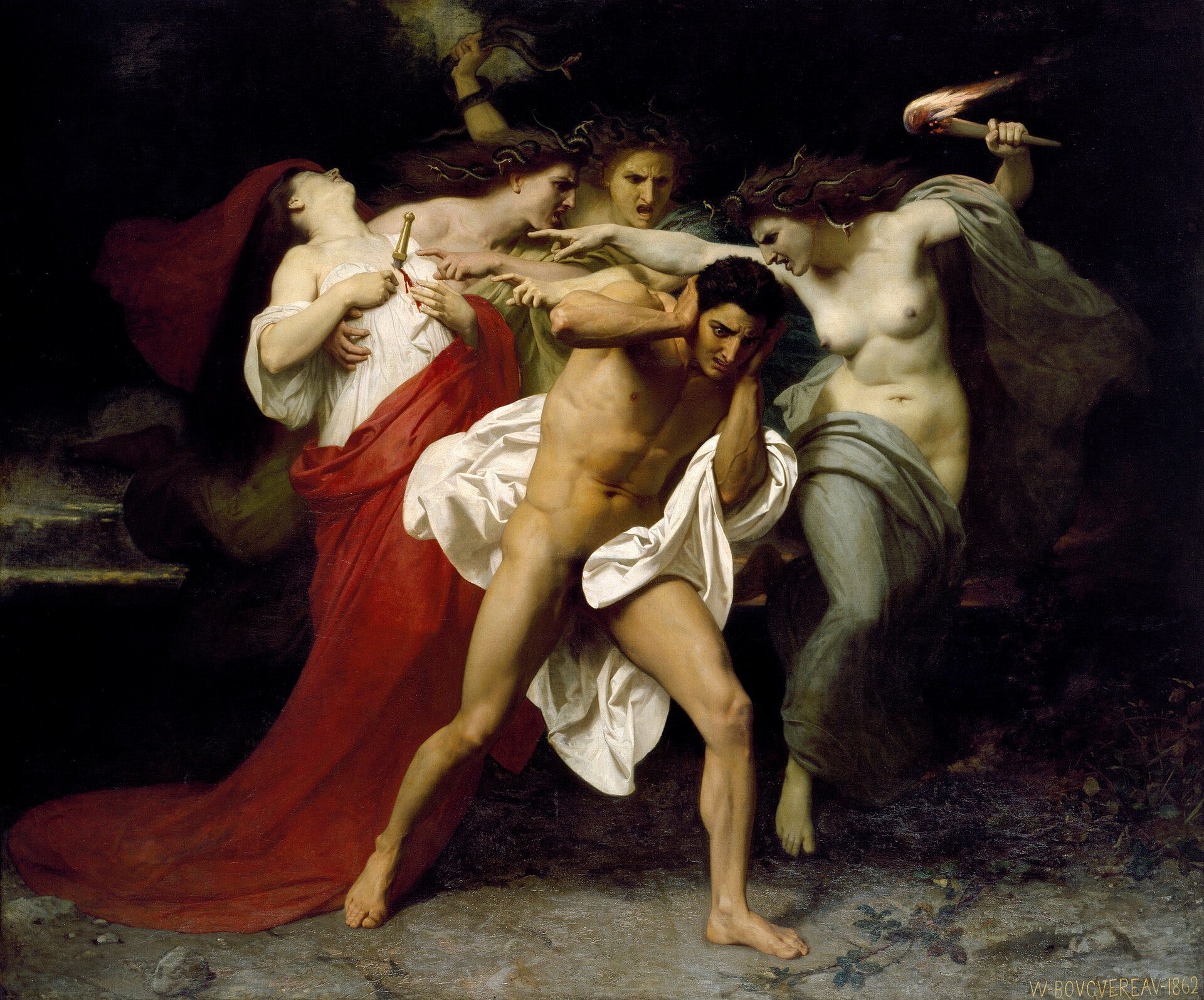
This essay uses Euripides’ The Bacchae as a lens through which to examine Nietzsche’s framing of Apollonian-Dionysian duality. While Nietzsche treats this opposition as an aesthetic and cultural dynamic, The Bacchae shows what happens when a finite human order encounters a force it cannot contain.
Welcome back. This essay continues discussion of Greek tragedy from my last post, which was niche and somewhat inaccessible for those who have not already read the plays. I knew it would be a less popular post, but it had to be done as part of my ongoing review of historical resonances to my own non-redemptive, tragic framework. This one may be more accessible, as it only discusses Euripides’s play The Bacchae1, which was his second to last and most famous play, written after the age of seventy while in exile from Athens for unclear reasons.2 I will offer a brief summary for those who have not yet read it, and then offer my interpretation. For context, Euripides lived from 480-406 BC; of the other great tragedians Aeschylus was from the prior generation, while Euripides was a contemporary of Sophocles. Plato overlapped but came later at 428/423-348/347 BC.
I was drawn to The Bacchae because of its resonance to my own experiences, and it is quite unlike any of Euripides’ other plays or other Greek tragedies; here its protagonist is the God Dionysus himself, and his presence confronts people with something their ordinary categories of rationality and control cannot contain.
I. The Story
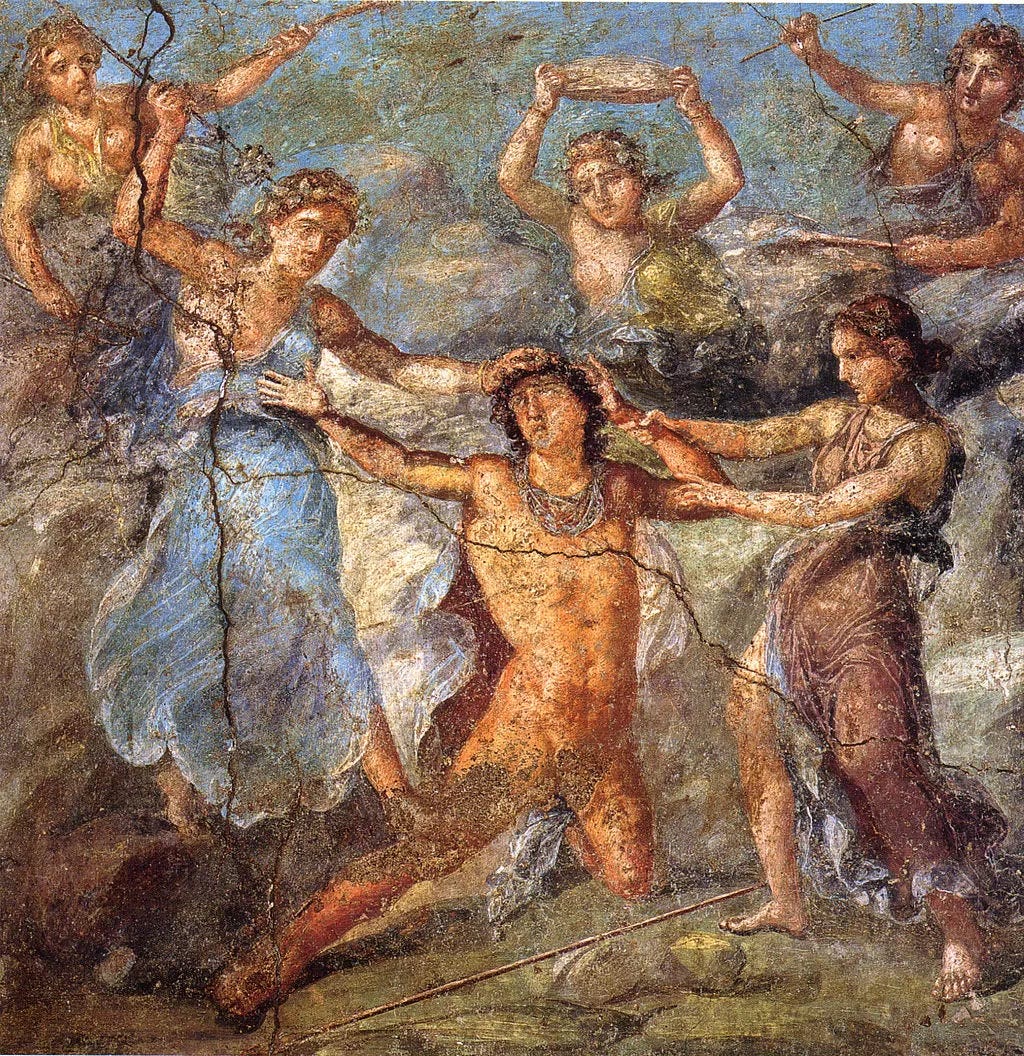
Briefly, Dionysus is the God of intoxication, of dissolution, of dance, of alcohol, of frenzy, of music and ritual and the night. He comes to Thebes in human form to spread his religion, and he entices women to go out at night, get drunk, party, allegedly fornicate, and to rise to such a frenzy that they attack villages and eat animals alive in a possessed state. The King of Thebes is a young man named Pentheus, who sees this man claiming to be a God come into his land, causing chaos and promoting loose morality (although the herdsman reports the maenads chaste, sleeping apart from men), and he sees him as a threat to law and order. He arrests Dionysus and his followers and throws them in prison; the biblical conversation between Christ and Pontius Pilate mirrors their conversation3 (and the myth of infant Dionysus being torn to pieces and devoured rhymes with Christian communion4). They escape from prison by miraculous means. For disrespecting Dionysus King Pentheus is driven insane, and his possessed mother Agaue and other Dionysian worshippers murder him and tear him limb from limb. Agave then carries her son’s head, believing it’s a lion’s, and slowly is made to see what she holds. This is anagnorisis – the recognition of ones limited position within a divine order, which in this case arrives too late – as discussed in the prior essay. She and her father Cadmus are then cursed by Dionysus, to be sent into exile and suffer additional calamities. This is the fate of those who acknowledge the God but refuse to recognize his essence – that he must be respected and acknowledged, and cannot be contained. Cadmus: “Have mercy on us, Dionysus. We have sinned.” Dionysus: “You know too late. You did not know me when you should.” Chorus: “Gods manifest themselves in many forms, bring many matters to surprising ends; the things we thought would happen do not happen; the unexpected God makes possible: and that is what has happened here today.” Exeunt.
The play can be read as a warning about what happens when a rational order encounters forces that exceed the categories of its understanding. Pentheus encounters something his conception of reality cannot accommodate, and his attempt to force that encounter back into his existing categories becomes catastrophic. The Bacchae is a dark joke on the Athenian enlightenment, where Euripides effectively argues that their rationality will not save them (or you); it will get one torn apart by one’s own mother. The blind seer Teiresias provides the striking counterexample, recognizing Dionysus without attempting to reduce him to categories of ordinary rational judgment, and he fades out of the play untouched after the first act.
II. Nietzsche’s Argument
I discussed Nietzsche’s The Birth of Tragedy (1872) in the last post, and I am generally reluctant to re-engage him much (except for his Genealogy of Morality, which formed a core part of some of my earlier cultural arguments about the egalitarianism underlying modern society) for a number of reasons.5 The work itself is immature and weak – rambling, disjointed, resulting in a later self-criticism6, and it offers no sustained analysis of any tragedies despite holding itself out as a typology of such tragedies. Still, it retains a historical impact because of its exhortative style7 and because of the fascinating duality it introduces.8
In Birth Nietzsche attacks Euripides for leaning into rationality and corrupting the traditional Greek tragedy structure, which he saw as a balance between the Dionysian and the Apollonian (i.e. reality as disordered and undifferentiated by forms/unity versus reality as ordered and differentiated by forms, i.e. an aesthetic polarity). Michael Tanner summarizes Nietzsche’s argument:
What happened was that the third of the three Greek tragedians killed [tragedy] by the production of works in which, though few have realized it, knowledge (Wissenschaft) was preferred to wisdom (Weisheit). This is signalized in Euripides’ plays (for he is the villain) by the comparative insignificance of the chorus, and the multiplication of individual characters who think that they can resolve their conflicts by argument, or as Nietzsche puts it, dialectic. As soon as one puts one’s faith in reason and reasoning, as opposed to intuition mediated through music, one has forfeited the possibility of genuine knowledge, which must always be tragic.
There is something real here; Euripides tends to reduce the Gods in his plays to explanatory features of human impulses. As G. Devereux argues in The Psychotherapy Scene in Euripides’ Bacchae, this involved innovations in psychotherapy which “is the natural consequence of the basic outlook of a poet who…systematically substituted psychological explanations of human motivation for traditionally supernatural ones.” The fates continue to exist in Euripides’ plays but the metaphysics is sometimes hidden behind argument and dialectic. However, the Greek academic E.R. Dodds sees Euripides as fundamentally irrational in his approach.9
III. The Exception
Regardless, The Bacchae is a striking exception to Euripides’ alleged approach, which turns rationalism on its head. Nietzsche makes only two brief references to it in his book, weakly hand-waving the play away as a late mea-culpa by Euripides for his earlier rationalism10, because The Bacchae has little to do with aesthetic structure, and the Apollo vs. Dionysus dynamic is inapplicable to it. Nietzsche likely did not engage with the play out of necessity: he sees Dionysus as an intoxicating creative principle, a sort of raw material organizing into tragedy; he can be theorized, incorporated, and made productive – he can be used when combined with Apollo to create art. But Euripides’ Dionysus cannot be balanced and is not a principle of art; he brings catastrophe when human beings mistake their ability to categorize reality for an ability to contain it. He ruins those who try to contain him, and he cannot be made safe through recognition, though refusal to recognize him is disastrous.
Here, the opposition is between an established human order and something that exceeds the categories through which that order understands itself. Pentheus represents an intelligible form of governance: he perceives an apparent threat, assesses its consequences, and attempts to restore order. As the ruler of the land he perceives things in terms of threat/risk profiles. Dionysus appears as a madman pressuring his followers into debauchery and anarchy, undermining law and order for his own benefit. Of course Pentheus would have him arrested as an example so chaos would not spread. But Pentheus is wrong in this case, because Dionysus happens to actually be a God – instead of being a madman, he is a God incarnate. And to not honor the God, to disrespect him, is to risk having the wrath of the Gods descend on one and one’s family and nation, and that’s what happens here. He is wrong because the world he is trying to regulate is not the world he believes it to be.
There is a cybernetic way of describing this problem. W. Ross Ashby’s principle of requisite variety holds that a controller can regulate a field of disturbances only to the extent that its own repertoire of possible responses is sufficiently varied to meet them, while Conant’s good-regulator theorem states that a regulator must contain a model of what it regulates. Pentheus confronts something for which his regulatory architecture has no adequate response because Dionysus falls outside the variety of the world his model recognizes. Dionysus therefore represents unaccounted-for variety: what a finite system has excluded from its model of reality and therefore cannot successfully regulate when it returns; what is repressed accumulates as pressure at the boundary of the model until it returns as something the model can no longer contain.
This tragedy, then, refuses Nietzsche’s schema. Dionysus appears as an untamable, uncontrollable force instead of an aesthetic, creative intoxication, even Pentheus resists Nietzsche’s framing (he represents Saturn (law, structure, repression) instead of Apollo (form, dream, individuation)), and the tragedy is theological, ontological. Its central conflict raises a question: what happens when the structure of reality is not what they believed it to be? As translator Nicholas Rudall notes in his introduction:
The Bacchae is a play rich in themes, and one of its most disturbing is the inadequacy of rational human government in the face of the ecstatic Irrationality of Dionysus….The play is about the inadequacy of human response to the incomprehensible. It is about the necessity of submission and the futility of resistance to divine power….We want to know who is right. We assume that right will be the provenance of the god. But the punishments he inflicts…have little to do with what is “right.” When it comes to human fate the truth lies in the awfulness and majesty of the divine, not in an inappropriate desire for a just balance.
This pervading sense of human impotence in the face of a cruel and inevitable tide of events must have mirrored the mood of Athens as its world collapsed. The Bacchae is, in the end, a document of human folly. Dionysus lacks mercy. And to assume that human wisdom and human rationality are forces that can resist him is a monumental mistake. Pentheus has been a good, competent, and thoughtful king…but Pentheus’s reason cannot comprehend the insignificance of man and the majesty of god….[the play] is at once a celebration of the power of the irrational and a cry for the need for human submission to it….
The original Greek is often archaic, certainly elevated in its diction. I have attempted to suggest a biblical tone as our modern equivalent….[This is in reference in part] in the figure of Dionysus, son of god and mortal woman, the god who was killed and born again, whose blood was wine, who made miracles on earth, and who demanded that all mankind believe in him.
It would be comforting to read this as a simple message to honor the god and be spared, but the play refuses this interpretation. Cadmus honors Dionysus and is exiled and turned into a serpent anyway, Pentheus fails by the standards of a good king, and Dionysus never says he failed by any measure of justice. Teiresias is spared but the play never says why. Nothing in your conduct guarantees what happens to you, and the reader who takes “respect your limits” as the lesson has done to the play what Pentheus did to the stranger: reduced it to a rule that can be managed.
IV. What is Dionysus’s Purpose?
If Dionysian energy cannot be contained, what use is he? I think good response inverts the question: what becomes possible when one stops demanding that there be a use? Dionysian dissolution can expose the inadequacy of an existing orientation without providing an orientation that should replace it. Such dissolution may clear the ground, but it does not guarantee that anything new will emerge, nor does it specify what should replace what has been destroyed.
Pentheus is not a fool. He has a model of threat, a procedure for response, and an army to enforce it, and most of what we depend on has the same shape. Our strategies work well within the variety they were built for, but none of them tells us what it has left out; from a psychological perspective what is ignored accumulates in the suppressed shadow, lurking, and it will eventually manifest itself in surprising and uncontrollable ways. The Bacchae suggests that the leftover doesn’t announce itself in advance, that there is no reliable way to prepare for its return, and that being a careful person won’t exempt us. The point, then, is to recognize that the structures by which one has organized reality may themselves be partial and contingent. The Greeks did not have the vocabulary of Abraxas, individuation, or somatic incoherence, but their tragedies dramatize the capriciousness of the gods, the permanent tension of irreconcilable opposites, the moments of recognition that destroy and reorder, and the bearing of weight without redemption, and so I see resonances with my own perspective in them.
V. Conclusion
Nietzsche framed the Dionysian as an aesthetic principle, a creative intoxication that could be balanced with Apollonian form, but The Bacchae reveals a metaphysical force that dissolves order and punishes the failure to recognize it; it dramatizes the return of variety which a finite system excluded from its own model. This is the wisdom of The Bacchae; the god who cannot be contained is the god who must be recognized, but recognition does not save you from the possibility of dissolution. Its tragic lesson is that no finite ordering of reality should mistake its own categories for reality itself.
Note: You can sign up to receive email notifications of new posts here.
I read both the Philip Vellacott translation and the Nicholas Rudall translation, and liked them equally.
Although he was a critic of the never-ending war with Sparta, which Athens would eventually lose.
Pentheus: How comes it that you bring these rituals to Hellas?
Dionysus: Dionysus, son of Zeus, himself instructed me.
Pentheus: Is there a Lydian Zeus, then, who begets new gods?
Dionysus: I speak of Zeus who wedded Semele here in Thebes.
Pentheus: Did he possess you in a dream, or visibly?
Dionysus: Yes, face to face; he gave these mysteries to me.
Pentheus: These mysteries you speak of: what form do they take?
Dionysus: To the uninitiated that must not be told.
Pentheus: And those who worship – what advantage do they gain?
Dionysus: It is not for you to learn; yet it is worth knowing.
Pentheus: You bait your answer well, to arouse my eagerness…
Do you perform these mysteries by night or day?
Dionysus: Chiefly by night. Darkness promotes religious awe.
Pentheus: For women darkness is deceptive and impure.
Dionysus: Impurity can be pursued by daylight too.
Pentheus: You must be punished for your foul and slippery tongue.
Dionysus: And you for blindness and impiety to the god….
Pentheus: I’ll lock you up in prison and keep you there.
Dionysus: The god Himself, whenever I desire, will set me free…
Pentheus: Where is [Dionysus], then? Not visible to my eyes.
Dionysus: Beside me. You, being a blasphemer, see nothing.
Pentheus [to the guards]: Get hold of him; he’s mocking me and the whole city.
Dionysus [to the guards]: Don’t bind me, I warn you. [to Pentheus] I am sane, and you are mad.
Pentheus: My word overrules yours. [to the guards] I tell you, bind him fast.
Dionysus: You know not what you are saying, what you do, nor who you are.
Dodds, p. 277: “Late Greek writers explained the (Greek term) as they did the dancing, and as some would explain the Christian communion: it was merely a commemorative rite, in memory of the day when the infant Dionysus was himself torn to pieces and devoured. But the practice seems to rest in fact on a very simple piece of savage logic. The homoeopathic effects of a flesh diet are known all over the world. If you want to be lion-hearted, you must eat lion; if you want to be subtle, you must eat snake; those who eat chickens and hares will be cowards, those who eat pork will get little piggy eyes. By parity of reasoning, if you want to be like god you must eat god (or at any rate something which is [Greek term]). And you must eat him quick and raw, before the blood has oozed from him: only so can you add his life to yours, for “the blood is the life.” God is not always there to be eaten, nor indeed would it be safe to eat him at common times and without due preparation for the reception of the sacrament.”
Nietzsche may have responded to the philosophical pessimism he correctly diagnosed (as discussed here) by doubling down on his ego rather than accepting the tragic implications of the collapse he perceived. Jung makes a related criticism in his autobiography, that Nietzsche recognized the death of the Christian God-image but did not recognize the inflation involved in attempting to take up the vacant position himself, transforming the problem into a project of self-overcoming and value-creation. Whether this contributed to Nietzsche’s eventual collapse is impossible to establish from the evidence available. Regardless, I quickly became aware of the danger of reading Nietzsche: having already had a very large ego, I found his rhetoric ego-inflationary, because it turns encounters with the limits of inherited meaning into occasions for imagining that the exceptional individual could overcome those limits through force of will. My own reorientation under the Abraxas God image has made me more cautious about that response, and I can slowly and more carefully now read Nietzsche’s confrontation with nihilism without automatically converting it into an invitation to make the ego sovereign.
Nietzsche in his Attempt at a Self-Criticism: “To say it once again: today I find it an impossible book – badly written, clumsy and embarrassing, its images frenzied and confused, sentimental, in some places saccharine-sweet to the point of effeminacy, uneven in pace, lacking in any desire for logical purity, so sure of its convictions that it is above any need for proof, and even suspicious of the propriety of proof, a book for initiates, ‘music’ for those who have been baptized in the name of music and who are related from the first by their common and rare experiences of art, a shibboleth for first cousins in artibus – an arrogant and fanatical book that wished from the start to exclude the profanum vulgus of the ‘educated’ even more than the ‘people’…”
A style I don’t appreciate. Discussed in this Note, but many do love this style such as the Bronze Age Pervert, who adopted an exhortative style to keep the masses interested and entertained while containing underlying esoteric hidden knowledge, much like his influence Leo Strauss, discussed here.
I tried following it up with Camille Paglia’s Sexual Personae (1991), which applies Nietzsche’s framework to contemporary culture, but it was terrible as discussed in this Note.
See, E.R. Dodds, The Greeks and the Irrational, p. 187: “To judge from extant pieces, what chiefly preoccupied Euripides in his later work was not so much the importance of reason in man as the wider doubt whether any rational purpose could be seen in the ordering of human life and the governance of the world. That trend culminates in the Bacchae, whose religious content is, as a recent critic has said, the recognition of a “Beyond” which is outside our moral categories and inaccessible to our reason. I do not maintain that a consistent philosophy of life can be extracted from the plays (nor should we demand this of a dramatist writing in an age of doubt). But if we must attach a label, I still think that the world “irrationalist,” which I once suggested, fits Euripides better than any other.”
See Robert Baldick’s Euripides: The Bacchae and Other Plays, 31: “The Bacchae is – among other things – a demonstration that the consequences of refusing ‘worship’ in this sense to Dionysus are disastrous, since such refusal is a denial of undeniable fact; it is a ‘condemnation’, if you will, of intolerance, violence, and cruelty, all of which are generated when humanity tries to deny either of the two sides of its nature. Thus there is no place for the view once held by a number of scholars, that the play was the poet’s ‘recantation’ – that after a lifetime of intellectualism and disbelief Euripides repented and wrote this play to express and encourage reverence for the gods, by showing the fate of those who oppose them. The question of ‘believing in’ Dionysus was irrelevant.”