
Author: Hermes of the Threshold

  • Where False Hope Ends, the Work Begins

    I recently read ’s response to my post, in itself a response to his prior post, about the difference between philosophical optimist versus philosophical pessimist dissidents, and I thought it merited a further response.

    To engage in tit-for-tat posts, effectively what risks becoming a subthread wasteland, is not how I enjoy reading others’ posts – I’m not interested in interpersonal drama full of ego, nor do I care about pedantic arguments where nothing is resolved, the audience has lost the plot halfway through, and everyone comes across sounding like bickering children. Here, though, I thought it was worth responding for a couple reasons: (1) Librarian is keeping the conversation friendly enough and focused and (2) the issues we are discussing are important, not from a theoretical and pedantic perspective but from lived experience and the question of how best to orient one’s life.

    First, and importantly, I agree with the core point Librarian makes in his response to me – that hopeless doomerism is psychologically unhealthy and those stuck in that victim mindset do a disservice to themselves and their lives. Perhaps some of the pessimists I linked to are mired in that perspective, and to the extent they are I don’t agree with them (some of the people I read clarify the limits and nuances of my own beliefs, even if I don’t always agree with theirs). However, Librarian’s core argument attacking hopelessness is not the point I made in my post, which revolves around the nature of philosophical pessimism (not just pessimism) and one’s response to it.

    Philosophical pessimism is about the base nature of this reality. As I wrote in footnote 5, “Philosophical pessimism is that the base conditions of this world mean that one cannot be satisfied: humans are always either striving for an object or bored, nothing we do lasts, and existence is suffering. Furthermore, it is an endless cornucopia of violence – one must consume other living creatures in order to survive. Schopenhauer responded to this with ascetic withdrawal, while Nietzsche responded to it with will-to-power to try to spite underlying reality.” I don’t think that this description is really debatable, although it is, of course, debatable whether these horrors are outbalanced by the good in the world or that God is using this terrible metaphysical incentive structure for a higher purpose (both of which Librarian would, I think, agree with).

    Furthermore, Librarian characterizes my political position as “that an evil cabal of bankers of centuries-old vintage so thoroughly dominates the globe that even to dream of working against them is wholly futile.” There is an element of truth to his statement (i.e. see here and here), but it is also a straw-man; we do ourselves a disservice by strawmanning instead of steelmanning alternative viewpoints, as it is only by confronting the strongest opposing views can we strengthen our own.

    So first, yes, I believe that there is an international financial cabal in charge of world events; yes, they have achieved a tremendous victory over the masses of the world and yes, they face little to no actual resistance anymore. Fair enough. But I don’t believe that resistance is futile; if I did, what would the point of writing my blog be? Rather, I believe that cultural and political resistance is currently futile – instead, what is needed is a transformation of society on the level of metaphysics (culture and politics are downstream of metaphysical belief). There are some inklings in this direction, which I will discuss briefly, but basically fundamental cultural and political change is not currently possible because the world is not ready for the metaphysical shift required for it.

    Furthermore, even if Librarian’s statement of my position was accurate, it still stops short – because if “an evil cabal of bankers of centuries-old vintage so thoroughly dominates the globe that even to dream of working against them is wholly futile”, it then begs the question: what then? How should one structure one’s life to live in this world, to act in a meaningful way and not succumb to the despair that Librarian so highlights? And that is the core of my project, not an endless loop focusing on the parasitical international central bank owners themselves.

    Now, part of the divergence between us lies in our ontological and cosmological assumptions. In Liberian’s perspective (and please correct me if I’m wrong or strawmanning you) “good” is what brings one closer to God, who is ultimately infinite goodness, while “evil” is what takes one away from God, because “evil” is the absence of God. This is a standard Christian ontology, and any belief system contains an implicit ontology whether or not it is consciously acknowledged.1 In his cosmology God created the world, even if Satan is in control of it, because he loves us and gave us free will to decide whether to get closer to him or not. I see this perspective and approach in his relationship to his personal issues he is currently undergoing; I appreciate the vulnerability he showed by sharing that with his readers, and I hope that they resolve positively in a way that benefits his life. I also want to acknowledge the commentators in his post such as JasonTUncouth BarbarianJulie CBobby LimeJohn BunyanMrs. Erika ReilyReluctant Convert who noted that the suffering → humility → grace → hope structure has positively impacted their own lives.

    Could Librarian describe my ontology and belief structure, though? Based on his response, I don’t think he could – and I don’t really blame him for this, both because my perspective is still evolving and because it is so unusual. As I’ve written previously, though (hereherehere), regular readers would, I think, understand that my perspective is not just philosophically pessimistic but gnostic, recursive, and Jungian.

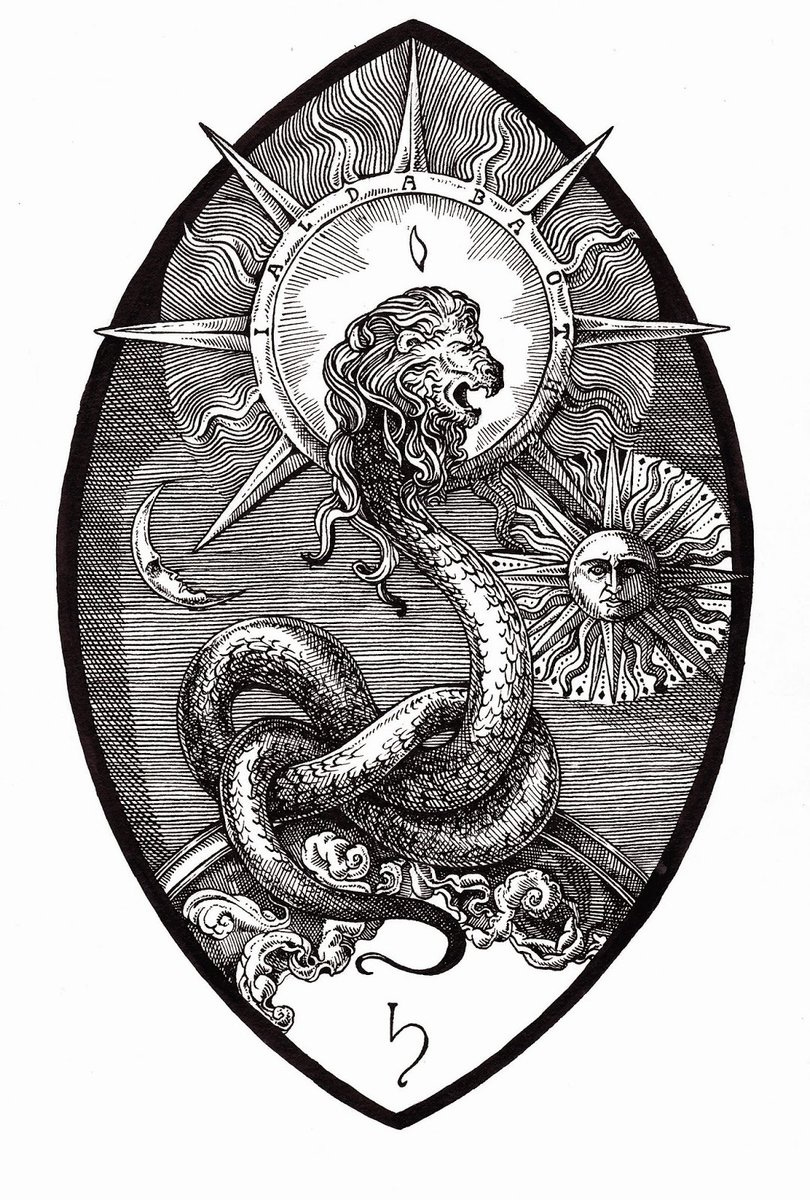
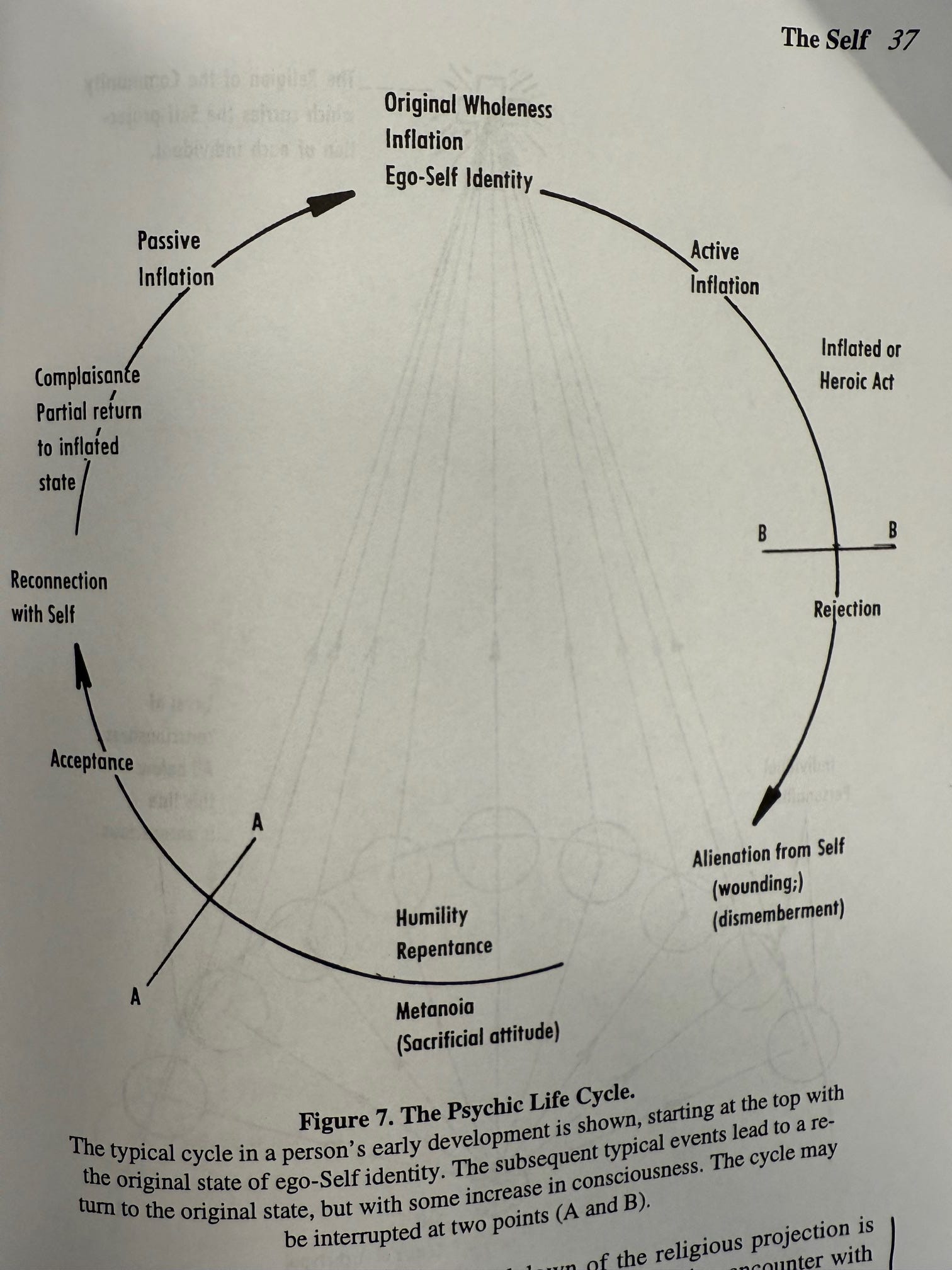
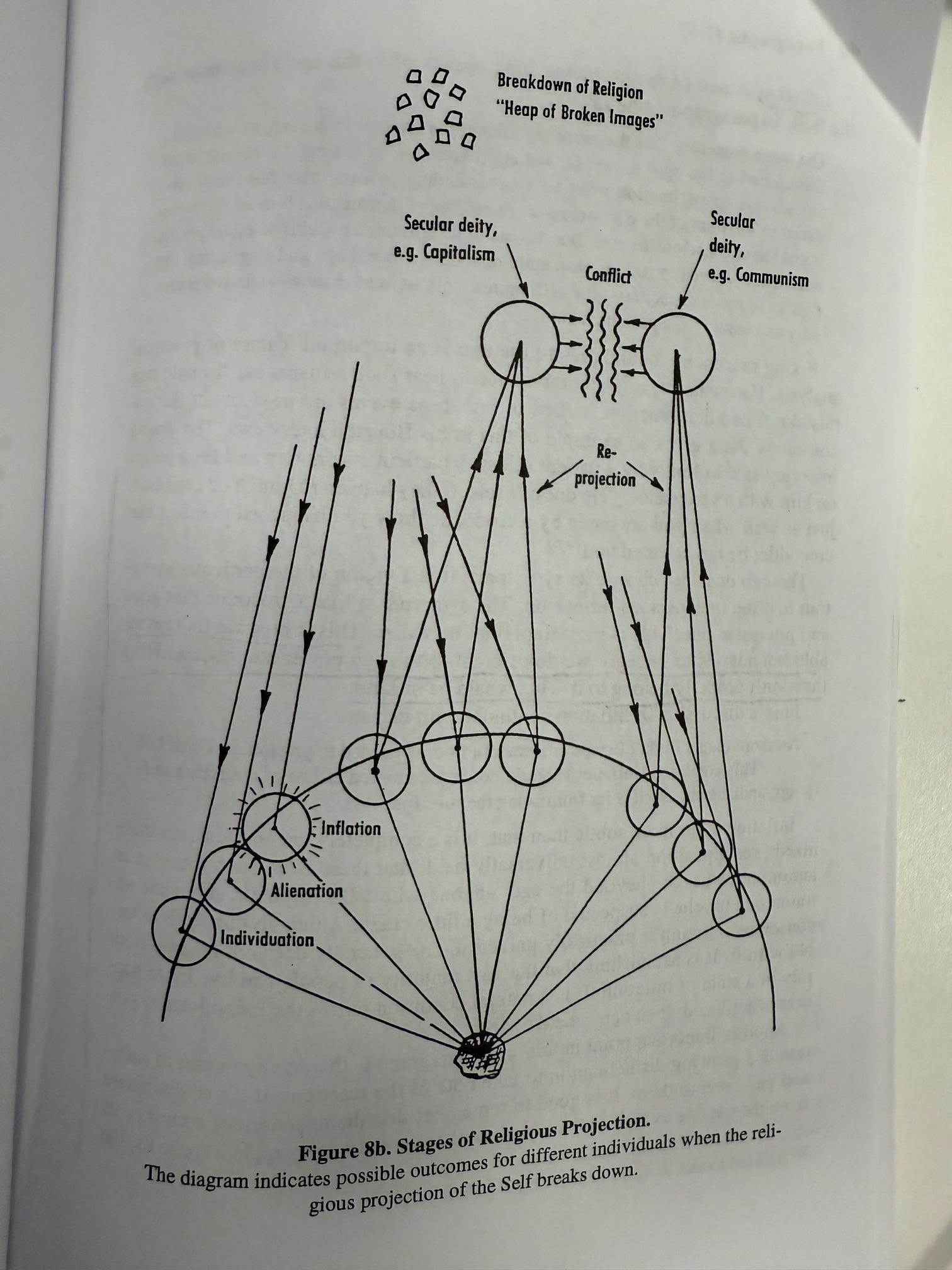
    By gnostic I mean I think this world is controlled by a malevolent demiurgic creator who unifies the opposites within him – he is all good and all evil, combined, which Jung described in his Answer to Job and Liber Novus and which he called Abraxas. Jung has commented extensively and persuasively, I think, that in the Age of Pisces (30 AD-2,030 AD, give or take), under the Christian conception of God, the dark, uncomfortable parts of the psyche were suppressed into the unconscious, rejected in the hope of drawing nearer to Heaven. This manifested, though, in the projection of the unconscious onto the Other, resulting in endless and increasing war and strife. Jung argued that in the Age of Aquarius, which we are currently transitioning into, that there would be a new God image2 toward one of wholeness, not goodness. Under this conception one would bring one’s dark, nightmarish unconscious into awareness – not to act on it, but to integrate it in the circumambulating journey toward wholeness, which is never complete. This doesn’t mean acting on those dark inclinations, but bringing them to consciousness and accepting them as parts of ourselves. Under this ontology “good” is what deepens our individuation process – to become who we are meant to be by balancing our intellect, intuition, emotions and senses in the hopes of approaching wholeness, away from Abraxas (acknowledging his presence and integrating it but individuating away from it) – and “bad” is what leads us away from that process. It is not just Christ that is crucified but all of us, individually, as we are torn between good and evil, God and Satan, materialism and spirituality, baser instincts and higher instincts – and this tension of the opposites manifests in each of us constantly, energies which we are meant to synthesize and resolve in our own unique ways.

    Regarding the recursive component, it is important that each of us have a way of bouncing our views against bedrock reality. As I’ve written about, I make specific predictions about the future and then check those predictions; to the extent they are wrong I then update my views accordingly. I’ve been doing this process for about a decade now – and I would ask Librarian, do you ever check your prior predictions and update your worldview accordingly? If so, how often do you do this and can you offer some examples?

    This leads me to the core point about my “doomerism”: if the world is fallen and cannot and will not be perfected, if God is all good and all evil together, if “good” is what leads us toward individuation, then putting out endless hope that someone, somewhere, some political or cultural or religious figure will save us results in spiritual paralysis. Why do anything spiritual, why go through the painful individuation process, if someone is just going to swoop in and save the day? In other words, adopting a political and cultural blackpill is a fundamentally necessary prerequisite toward doing individual spiritual work, which is hard, difficult, painful, and ever so scary. The work cannot start so long as one remains philosophically optimistic and waiting for salvation from others. And America, which has been on top for so many decades and centuries, is, as Jung put it, “extraverted as Hell.” There is an inverse correlation between material wealth and spiritual growth, and as the world barrels toward a neo-Malthusian Hellscape of endlessly diminished natural resources (reflected in ever-declining energy return on energy invested), as our quality of life continues to decline, I predict increased trends toward spirituality – but as this is an age that demands experience instead of faith, I predict that the ontology I laid out has much room for growth.

    To wrap this up, hope can be a sedative. It is pain – deep, metaphysical pain – that breaks us open enough to begin the work. My project begins where worldly optimism ends. It is not about despair, but about confronting reality without illusion so that the inner process can begin in earnest, although it does have its own pitfalls and dangers.3 I don’t ask anyone to agree, only to consider that individuation begins where false hope dies.

    True hope – the hope that the individuation process can lead to a deeper, more fulfilling, and integrated life – is not only helpful, but critically important. But this kind of hope is grounded in the results we see here and now, not projected into a deferred afterlife, and based on our willingness to sit with pain and contradiction and do the work, not on anyone else or God. The work must happen in this world, in this time, by us individually, in the midst of our unrelenting and crucifying contradictions.

    Lastly, I had to brace myself psychically to read Librarian’s response, because historically exoteric mainstream Christianity, from which Librarian draws his strength and inspiration, has been a brutal prosecutor of esoteric gnosticism – from the original gnostics to the Marcionites to the Manicheans to the Cathars to the Bogomils, my views and those of Jung would have been denounced as heretics, with all of the punishment that involves, in the not so distant past. Jung had to hide his mysticism throughout his life under the guise of science, and his Liber Novus was only released in 2009. This relates to the concept of enantiodromia, where any energy over time changes into its’ opposite – Christianity, once suppressed by the Romans, became the oppressors of all of its detractors. And I can’t say that I blame them for it, because any ontology is going to ultimately change into something else and these competing beliefs will be seen as a threat – but Heraclitus was right that the only constant in this world is change itself (and death and taxes). As Emil Cioran wrote about the benefit of living in an age before the birth of a new God:

    Is there a pleasure more subtly ambiguous than to watch the ruin of a myth? What dilapidation of hearts in order to beget it, what excesses of intolerance in order to make it respected, what terror for those who do not assent to it, and what expense of hopes for those who watch it . . . expire! Intelligence flourishes only in the ages when beliefs wither, when their articles and their precepts slacken, when their rules collapse. Every period’s ending is the mind’s paradise, for the mind regains its play and its whims only within an organism in utter dissolution. The man who has the misfortune to belong to a period of creation and fecundity suffers its limitations and its ruts; slave of a unilateral vision, he is enclosed within a limited horizon. The most fertile moments in history were at the same time the most airless; they prevailed like a fatality, a blessing for the naive mind, mortal to an amateur of intellectual space. Freedom has scope only among the disabused and sterile epigones, among the intellects of belated epochs, epochs whose style is coming apart and is no longer inspired except by a certain ironic indulgence.

    To belong to a church uncertain of its god—after once imposing that god by fire and sword—should be the ideal of every detached mind. When a myth languishes and turns diaphanous, and the institution which sustains it turns clement and tolerant, problems acquire a pleasant elasticity. The weak point of a faith, the diminished degree of its vigor set up a tender void in men’s souls and render them receptive, though without permitting them to be blind, yet, to the superstitions which lie in wait for the future they darken already. The mind is soothed only by those agonies of history which precede the insanity of every dawn.

    Thanks for reading.

    The Knight at the Crossroads (1878)
    Viktor Vasnetsov’s The Knight at the Crossroads (1878), warning that either path leads to death. The stone is inscribed with the following words: “If you go straight ahead, there will be no life; there is no way forward for he who travels past, walks past or flies past.”

    Subscribe:
    Email delivery remains on Substack for now.


    1 In the Jewish ontology, for example, “good” is what furthers the power accumulation and domination of the Jewish people, crouched in “tikkun olam”, while “bad” is whatever detracts from that. Christians in this ontology are “good” if they help advance the Jewish project and “bad” if they denigrate from it. Alternatively, under Nazism “good” was what promoted the German and white race volk and “bad” was what denigrated it. Whatever a belief systems’ ideology is, it summons an egregore and individuals hooked into that egregore become hyper attune to any dissent, as discussed in this Note here.

    2 Humans are not capable of comprehending God; rather, we have an image of God, the “God image”, that varies depending on a culture’s development and changes over time.

    3 This gnostic and pessimistic orientation often does evade the full spectrum of joy, embodiment, and trust in being if it is not handled in a careful way, which involves a precarious balancing act between truth seeking, participation in life, and willingness to sit in pain and contradiction. Not because this orientation denies joy, embodiment and trust in being outright, but because its default posture is suspicion: it waits for the poison behind the beauty, the fall after the flight. This perspective fears consolation as a trap, treats joy as illusion-prone, tainted by entropy, consumption, or betrayal, overcorrects against naive optimism by refusing grace when it does appear, identifies too exclusively with depth, and may reject the surface as frivolous or dangerous. This is why I have been terrified for decades that I may grow old and feel haunted by the ghosts of long deceased relatives and friends in a world that has passed me by and forgotten me – perhaps because I did not participate enough in life itself. Thus, even this gnostic posture evades; it evades affirmation in order to remain true to lucidity, but it is still an evasion.

    To call any framework complete is a misstep; every approach has its negatives associated with it. Even “seeing the illusion” can become its own veil. Epistemological humility is not the enemy of clarity; rather, it is the precondition for staying in touch with the deeper symbolic current without drowning in identification. However, what the gnostic and pessimistic orientation evades is notthe same as what other postures do, where optimists and exoteric religious believers participate in life without understanding it.

  • Pessimist Dissident Substackers: Part 2

    This post explores the divide between philosophically optimistic and pessimistic voices within the dissident space and discusses the personal and strategic implications of networking, audience size, and ideological alignment. It reflects on how optimists dominate reach due to hopeful messaging, while pessimists – often introverts with darker worldviews – pursue connection more for spiritual and intellectual growth. A map of writers across these spectrums is provided, offering insight into a fragmented but evolving ideological landscape.

    This is a post about the benefits and drawbacks of networking.

    Inspiration for this post, although brewing in the back of my mind already, came from two places:

    1. Librarian of Celaeno’s April post The Dissident Right and Its Discontents where he discusses how diverse what he calls the “dissident right” is1, united only in it’s shared opposition to the establishment (where “dissident right” is a label I’m souring on and contemplating a replacement2, although such labels are meant as a directional guidepost and not as a rigid system to be worshipped3). Librarian castigates the “JQ crew”, “doomerism”, “conspiracism”, the “elite human capital crowd”, and “Groypers”4 as he aligns with an optimistic Christian nationalist vision, highlighting dozens of posters who he interacts with, respects and appreciates; and
    2. ’s post about how his unwillingness to network played a big role in his failure as a comedian, where others less funny and talented than he networked to bigger opportunities, after which they were able to develop their talents in a way he was not and eventually surpass his skill level.

    Librarian’s post highlights to me how astute my prior breakdown of the dissident right was, which divided such writers into a quadrant: (1) whether the individual is philosophically optimistic or pessimistic5 and (2) whether they post on a political, cultural, or metaphysical level. Librarian’s friends are all philosophical optimists who mostly post on cultural levels, and he distances himself from philosophical pessimists and simple political posters. These optimist cultural warrior writers include:

    I got my start as a commenter on John Carter’s stack. We’ve disagreed at times, but I can say confidently that his work is excellent. Dave Greene, κρῠπτός, and Johann Kurtz are phenomenal writers and good men, as are Isaac Simpson, Jonathan Epps and Alan Schmidt. Adrian Vermeule and Charles Haywood are brilliant and committed patrons of many of us here and in the real world. Dimes, Fortissax, Mark Bisone, Tree of Woe, Kenaz Filan, LucTalks, Ahnaf Ibn Qais, William M Briggs, Billionaire Psycho, el gato malo – all quality. Lee and the whole crew at IM-1776 are great, and of course I’ve already mentioned Raw Egg Nationalist. Christopher F. Rufo and Christopher Brunet-each does great work despite their differences. Yakubian Ape and The Brothers Krynn deserve ten times their subscriber numbers. Yuri Bezmenov was once denounced by Alexander Vindman; what better mark of quality do you need? Constantin von Hoffmeister and Office Hours with Lomez do the hard work of promoting rightist authors in analogue form, a project very much in need, and are brilliant in their own right. Likewise, few have done as much as Dudley Newright to promote interesting rightist thought on Substack and X. Not that they need my endorsement, but Sigma Game, The Z Man, Don Surber, Morgoth, eugyppius and James Howard Kunstler are all big names worth a follow, and while I don’t always agree, Curtis Yarvin is a must-read. And of course, there’s the ladies- Peachy Keenan, Mary Harrington, and the ever-gracious Nina Power. All of these are great, among so many others.

    Alternatively, I almost exclusively interact with philosophical pessimist cultural/metaphysical writers, although there’s a bit of overlap with the above with more borderline edge case writers (, , , (RIP), and occasionally flirts with the darker side). It’s interesting how the gulf between optimists/pessimists and metaphysical/cultural/ political writers has increased over time: in mid-2023, when I started posting, the gulf seemed far smaller than it is now, and the interaction overlap was much greater. As a philosophical pessimist alternating between cultural and metaphysical interests, I basically don’t interact with philosophical optimist dissidents at all anymore (and I don’t mean to highlight Librarian alone, merely to use his post to the broader issues involved; I’ve had only respectful interactions with him).6


    On Audience Size

    Philosophically optimist dissidents possess far larger of an audience than pessimist dissidents – I would guess somewhere between 25x and 100x larger, although it’s hard to quantify. This is for good reason; people naturally want to believe that the world can be made into a better place politically, economically, religiously, either through their own efforts or by relying on favored politicians to save them (hence the Q phenomenon). People require hope to live, and this is a dark, cruel world; getting a little jolt of hopium – Trump will save us! Tariffs, expulsions of illegals, stock market increases, putting the woke and trannies away, Christ is King, brothers! – helps many people through their day. Even Andrew Anglin, the king of race-focused Daily Stormer, pivoted to a religious-based outlook (I presume) because the audience size was so much bigger and he would otherwise starve. As I wrote in a Note:

    One of the curious things about this reality is the difficulty of understanding and judging scope. For example, maybe there’s a hundred like-minded English language dissident writers out there [NLF: “like-minded” being philosophical pessimist dissidents], if I’m being generous and taking into account my very limited vantage point of the writers out there. From what I see it’s actually much smaller than a hundred. Political commentators are almost universally grifters surfing the wave of the Current Thing.

    Yet there are billions of English speakers out there. Shouldn’t this scene – shouldn’t any of these ultra niche scenes? – be far bigger than they are? After all, the Current Thing seems to be a defining feature of this age, everyone talks about it and thinks about it and is animated by it. Yet that’s where it ends for almost everyone, pigs forcefed at the trough of shill marionetted influencers and media.

    It’s also easy to get jealous of writers who tap into larger latent readership pools even if their takes are poor and their predication capacities are very bad. After all, even though one may write ultimately for oneself – I think of the story that Ernst Junger told about Picasso7 -one cannot live on “soul work” alone: see Kafka’s A Hungry Artist, where, according to critic Maud Ellmann, we survive by the gaze of others and “it is impossible to live by hunger unless we can be seen or represent doing so”. I’ve had the silly idea to create an alternate account Pessoan heteronym, spazz out on low IQ optimistic durr-hurr cultural level takes, and watch how readership skyrockets. However, that would not be psychologically healthy; it’s not possible to adopt a persona like this and not be negatively psychically affected by it.

    Regardless, because the religion of the modern era is the Current Thing – to get excited by new political developments, focusing on the details and debating it with others, acting it out with passion one way or the other, not just for those forever online but normies too – it’s much easier to follow the Current Thing plotlines if one has hope and optimism for the future. “If we just try harder, focus more, debate more, engage more, things will change for the better, brothers! Positive change is just around the corner!” For those interested in power acquisition, too, one has to be an optimist almost by definition – believing that the world is irreparably fallen and will not get better due to human nature and the predatory base incentives of this reality is not a helpful belief structure toward networking, tribe formation, or war. It’s defeatist and depressing, and that sucks, right? Under the optimist approach, the internal contradictions (Jungian unconscious) that haunt every person is externalized into a utopian ideology which allows that person to hide from himself, at least until the ideology fails.8

    Networking for philosophically pessimistic dissidents, though, is a different ballgame: sour on the ability to improve this fallen world and with a much smaller potential audience size, with almost all being introverts, networking is much less about power or money acquisition than about spiritual growth – to think in new ways, to learn previously unconsidered topics, perhaps there’s an element of emotional camaraderie as well, as no one wants to feel totally isolated. I have no idea what ’ politics are, maybe he’s an NPC or shitlib, but his approach to comedy is in line with general pessimism and introversion. He wrote:

    The long answer [for why I failed at comedy] is that I neglected the most important part of finding success in any business or creative scene: relationship building. “It’s all about who you know” is a well-worn cliche, but I’ve learned the hard way that cliches are cliche for a reason. They get repeated so often because they’re uniquely true and useful. The problem is that we mistake their repetition for a lack of vitality and insight and choose to ignore them, often at our own peril.

    When I moved to New York in 2012, I was temperamentally averse to networking, both in real life and online. The whole thing just seemed so gross and transactional to me. I saw comics glad-handing each other at shows and complimenting/tagging each other’s jokes on Facebook and Twitter, and I was immediately put off. There used to be a very mean-spirited (but incredibly accurate) Tumblr account called Comedians Complimenting Comedians that perfectly sums up the sort of thing I’m talking about. And no, I was not behind it….

    But then something interesting happened. Because a comedian (who might have been less funny than me at the time) built relationships and ingratiated themselves in the scene, they got more opportunities for quality stage time and eventually became funnier than me. Years later, I’d watch that same comic generate rolling waves of laughter with their jokes, and it would be painfully obvious that I had been surpassed.

    Because I didn’t have any close relationships with other comedians, I was trying to improve by doing open mics, bar shows, late night comedy club spots, and whatever other scraps of stage time I could hustle up for myself. Every rep on stage is important, but not all reps are created equal. You can’t always get a good read on material doing the spots I was doing, and that negatively impacted my artistic growth. These other comics were performing in front of real audiences on a regular basis, and it was like they hit one of those accelerator ramps in Mario Kart. I, meanwhile, had run off the track and was spinning around in circles.

    He goes on to state that he wishes he networked harder against his own inclinations, but I have doubts whether that approach would have worked for him. Perhaps it wasn’t that he wasn’t networking, perhaps he was surrounded by a bunch of optimists who he didn’t like and didn’t want to force himself to.


    The updated list

    The following is the graph posted in my original March 2024 article (boy, due to Guenon’s increased solidification of the world this feels like ten years ago):

    This chart holds up quite well, I think. While one’s place on the chart is largely based on one’s intrinsic physiognomy and outlook, people’s opinions do change to a limited extent over time based on emotional and spiritual development. I’d move somewhat further to the right on the chart toward optimism after he called Trump’s 2024 win the start of a new post-Faustian era, I’d move a bit leftwards as he sours on Hegseth and the amazing, wonderful, stupendous Trump 2.0, has moved further left and up, and I think has become slightly more pessimistic as he increasingly understands the depths and stupidities of human nature. Shoutout as well to for maintaining communication with pessimists even as he remains a pretty steadfast optimist. I may have moved a bit further toward pessimism, although I’ve conversely articulated the importance of stoically narrowing the scope of what I focus on to the things that I can directly impact in my life. In other words, even if I am solidly blackpilled about politics and human nature, I believe that I must try to remain optimistic and push for better outcomes in the spheres of life that I control, much like the serenity prayer.


    Writers to highlight

    Focusing in just on the upper left quadrant of the chart, here are some additional writers who share a philosophically pessimist outlook (it’s hard to find pessimist politics level writers because one needs a broader perspective in order to cope with life). Some are more pessimist than others, some are much more metaphysically focused and others cultural. In no particular order:

    1. of Predator Versus the People. His perspective as displayed in posts such as One crime syndicate controls the entire world is pretty close to my own.
    2. of Radbod’s Lament. Guyenot is very well researched, a very good writer, and he correctly understands, like Adam Green, that the gentile adoption of the Jewish God via Christianity led to a fundamental metaphysical shift that put Abrahamism at the center of the world, and all that entails…
    3. of Erik Builds. Erik has an engineering background and focuses on the science behind various popular narrative scams.
    4. of The Autistocrat and Natural Law Institute. He’s actually not on Substack much – you can find him on the NLI Youtube channel here, such as this video on core concepts:https://www.youtube-nocookie.com/embed/VTrNYRbSyV8?start=&rel=0&autoplay=0&showinfo=0&enablejsapi=0I would just point out that “Natural Law” in the way he uses the term does not refer to the libertarian definition (which is entirely discredited in my opinion), but rather Stepan’s understanding of human nature through pattern recognition.
    5. of Due Diligence and Art. Great lady, political or cultural level poster focused on the heart attack jab scam, I think she’s fairly moderate or benign in her pessimism but she’s open to ideas and interactions with those much more pessimistic than she is (she recently did an interview with ).
    6. of The Cryptocalypse Chronicles. His Notes on the ongoing cryptocurrency scam reads like a horror novel and are a regular must-read.
    7. has some great Notes as he travels around the world with his life zipping all over the place while maintaining a low cost of living; his posts are here.
    8. focuses on the encroaching digital panopticon, and his descriptions are clear, easy to read and incisive; this post was top notch.
    9. of Blue Vir’s Writings believes that there is an emerging neofeudal order which will result in much lower quality of living for most people, which is in large part driven by declining energy return on energy investment from oil/gas, and that natural energy is no substitute. He posts on a cultural level.
    10. of the eponymous blog has regular posts and interviews mostly focused on the emerging digital panopticon, but he features a gamut of topics. I’d say he’s more moderate in terms of his pessimism.
    11. from NO COPE. His views are pretty quickly evolving, he is a decidedly pessimistic writer and he regularly references both Rurik and myself (thank you).
    12. from Pacem in Terris. INRI is an interesting character; his takes are decidedly pessimistic, mostly from a cultural perspective, but he also has from what I see establishment Christian beliefs (as opposed to gnostic or Marcionite). I think there is fundamental tension between his underlying perspective and his professed views (or at least my understanding of them), and think they will likely evolve one way or the other down the road.
    13. of the eponymous blog. Smith has a decidedly negative view of the future of the world, while at the same time he encourages doing what one can to maximize one’s agency within it.
    14. also of the eponymous blog. Sorcerer sees increasing energy scarcity as ending the growth of the past couple hundred years and that the future is going to be much darker than what most people expect.
    15. conducts a lot of interviews, many of which have substantial overlap with the writers listed herein (and it may perhaps give him some ideas for new interviewees?).

    Although not “rightists”, I’ll also offer an honorable mention to – a depressed and pessimistic communist wagecucking and writing bitter screeds about it, and of this Substack, whose interview here shared much of my perspective about how the international banking elite, the owners of the world central banks, rule the world, and they use divide-and-conquer tactics like “wokeism”, along with race, gender, sexual orientation differences, so people are too busy fighting amongst themselves to focus on the financial parasitism.

    Lastly, although his politics are nuanced and evolving – I think he doesn’t quite know what to make of pessimist dissidents, and his interests are varied – of DECENTRALIZED FICTION deserves a shoutout here, as his debut novel Incel does an excellent job describing with a decent amount of sympathy a young man blown out mentally by modern secular nihilism and doesn’t offer any neat solutions. And while probably too optimistic for this post, of Reflections of The Starving Artist points the way toward the synthesis of philosophical pessimism with optimism, at least from what I see: narrow the scope of what one focuses on to what we can accomplish in our own little sphere in life, and listen to our intuition, blended with our natural interests and talents, to achieve what we are meant to in this world. This is, as I wrote in another post, ultimately the opposite of the blackpill or pessimism on a personal level.

    I hope you found this continued discussion about optimist versus pessimist dissidents helpful in some way, and I hope it leads you to discover new and interesting writers. If I left any of my online acquaintances off who I regularly read, my apologies, and I’ll try to include you next time. If you think you fit the bill of what’s discussed here, feel free to leave a comment and hopefully others will discover you that way.

    Thanks for reading.

    Subscribe:
    Email delivery remains on Substack for now.


    1 He states, “‘Dissident right’ proper is a sort of catch-all category for various rightist tendencies and their associated personalities, united by the fact that they are in some sort of ideological opposition to both left-liberalism and mainstream conservative. The dissident right is defined by a stance of opposition, not a single coherent program. After all, one can dissent from something for a range of reasons, and on the dissident right one can find people who are religious and secular, Christian and pagan, libertarian and distributist, militant and quiescent, trads and futurists, Judeophiles and phobes, among many other things. These and a multitude of other gradients of belief coalesce into a range of camps, many of which are hostile to each other.”

    2 This will be covered in a future post, but briefly: I have felt synergies and congruencies with the approach of Guido Preparata, who comes from a leftist and anarchist background, even though I myself have traditionally thought more along the lines of populism, nationalism, and elements of hierarchy, and more recently Jungian individuation and gnosticism. Francis Parker Yockey tried to unite the far left and far right back in the 1950s and failed miserably – which I may do a post about in the future – and I attributed his failure to the fact that the core “leftist” belief is one of egalitarianism, and they will sacrifice any and all of their stated aims and objectives in furtherance of it – which is why the far left vehemently opposed the “alt right” even with overlapping critiques of the system. But the convergence between myself and Preparata suggests a deeper layer, where both he and I:

    1. see liberal modernity as a controlled illusion, maintained through managed conflict, finance, propaganda, and moral blackmail,
    2. understand fascism and nationalism as honeypots, deliberately fostered and destroyed to prevent genuine autonomy movements from arising;,
    3. share a deep suspicion of mainstream history, economics, and media, and
    4. see the 20th century as a stage-managed disaster to entrench globalist control.

    This is a shared conclusion arrived at from different approach vectors: he sees nationalism and fascism as conjured, manufactured by elites to discredit any challenge to international finance, used as a scapegoat to sacralize liberalism and justify imperial war; while I see nationalism as doomed ontologically – not just because it was used by elites, but because no collective identity structure in the modern era escapes the demiurgic infection. The nation is another idol; no mass movement can save you. This convergence signals a growing undercurrent in dissident thought: not a return to left or right, but a fusion of archetypal, spiritual, and structural analysis. It is post-political because it knows where politics ends and initiation begins; this is why we, despite different aesthetic languages, occupy a similar sacred refusal.

    3 All typologies are partial. As Solzhenitsyn wrote, “the line dividing good and evil cuts through the heart of every human being” – and so too with every label, map, or frame. Even Jung, near the end of his life, confessed that he did not know himself. To typologize in a spirit of discernment is not to imprison truth, but to approach it obliquely, as through a veil. But many typologies do the opposite, ossifying, moralizing, or masking. As Alan Watts observed, naming creates conceptual scaffolding but cannot capture essence; the map is not the terrain. Labels like “dissident right” may offer temporary clarity but they must be held lightly – not as rigid containers of truth, but as symbolic gestures that, if used wisely, point beyond themselves toward deeper intuition.

    4 He argues: “I’ve written extensively and extremely critically about the JQ crew. I’ve called out doomerism and conspiracism. I regard the ‘elite human capital’ crowd as being some of the worst purveyors of negativity on the internet, who exist primarily to call people stupid for not immediately acknowledging their own brilliance…I’ve gone after the Groypers, whom I suspect are behind something like 90% of what anyone who deplores “the state of the right” means.”

    5 Philosophical pessimism is that the base conditions of this world mean that one cannot be satisfied: humans are always either striving for an object or bored, nothing we do lasts, and existence is suffering. Furthermore, it is an endless cornucopia of violence – one must consume other living creatures in order to survive. Schopenhauer responded to this with ascetic withdrawal, while Nietzsche responded to it with will-to-power to try to spite underlying reality. See here if you want more information on this.

    6 Aside from the dissident space, it goes without saying that I stopped interacting with shitlibs and NPCs many years ago about anything relating to politics, both because they never change their minds and they feed energetically off pushback like vampires (although I still interact with them on non-politics levels to an extent; if I stopped interacting entirely I would have to be a hermit in the woods).

    7 The Details of Time, interviewed in 1985: “In 1942, when I visited Picasso on Rue des Grands-Augustins, he said to me: ‘Look, this painting, which I have just completed, is going to have a certain effect; but this effect would be exactly the same, metaphysically speaking, if I wrapped the painting up in paper and cosigned it to a corner. It would be exactly the same thing as if ten thousand people had admired it.’”

    8 Many dissident typologies fail not because they’re false, but because they presume coherence – among actors, movements, or motivations – that rarely exists. The more revealing axis is not ideological, but moral-psychological: the distinction between the naïve power-seeker who believes his system will redeem the world and the cynical manipulator, who cloaks ambition in salvationist language. This motivational asymmetry explains why the same symbolic rhetoric (“tradition,” “order,” “sovereignty”) can serve radically different ends. It also clarifies why so few remain rooted in inner sovereignty: the real conflict is not between systems but between souls unwilling to face their own contradiction. In this light, typology becomes less a map than a veil, and discernment begins not with naming types, but with asking: what does this person truly want, and what wound are they hiding behind the frame?

  • Tax Cuts and Control Grids: What the BBB Actually Does

    I hadn’t planned to write in detail about the so-called “Big Beautiful Bill.” But after a spirited exchange with a friend – someone smart and well-meaning, who supports the bill enthusiastically – I realized the debate was worth unpacking, not just to clarify the bill’s substance but to highlight a deeper divide in how we interpret what legislation like this really means.

    At first, I dismissed the bill reflexively, a move my friend took as proof of “legendary confirmation bias.” He might be right to call me biased but, if so, I’m biased against the ritual charades of bipartisan graft and against the performative politics that wrap consolidation of elite power in populist optics. We will return to this.

    First, I am going to lay out his argument, steel-manned to the best of my ability, before laying out my argument for why I think he’s wrong.

    He began his argument with a link that stated that the BBB retains $4.5 trillion in tax breaks enacted in 2017 that would have expired if Congress failed to act, along with new cuts. This included allowing workers to deduct tips and overtime pay and a $6,000 deduction for most older adults earning less than $75,000 a year. To help offset the lost tax revenue, the package includes $1.2 trillion in cutbacks to the Medicaid health care and food stamps, largely by imposing new work requirements including for some parents and older people, and a major rollback of green energy tax credits. The CBO estimates the package will add $3.3 trillion to the national debt over the decade and 11.8 million more people will go without health coverage.

    My friend is happy that the bill passed: his taxes are already high and would have gone way up, while now they go down. He argues that the government instituted reforms to require all able bodied people to work at least 80 hours a month (volunteering counts) or else they get kicked off federal government benefits, and illegals also finally get kicked off – “these are obviously good things.” Many “immigrants” work under the table and pocket the cash and get the free benefits anyway, and this bill helps stop that. He’s not a fan of the deficit exploding higher, but it seems to him mainly due to extending the expiring tax cuts which benefit all “wagecucks” so “at least it’s spending/deficit for a good purpose.” He argues that this bill mostly helps working professionals (which my friend is) as the super rich already barely pay any taxes due to loopholes; therefore “tax cuts for wagecucks = good spending”. According to him the bill extends tax cuts to all and kicks “leeches” off government benefits programs, which is” 95% of its financial impact”, and “it’s a good thing.” While he agrees that “the big picture is the country is toast, this one is different and it helps taxpayers.” He also believes that the bill does not target rural whites – “it says it considers home equity [as disqualifying for Medicaid] if someone has more than $1 million equity in their home, which sounds very reasonable to me and if so, such a person is not poor; it says you have to rectify every 6 months, which sounds reasonable and there’s no “targeting” at all in that language – if anything it targets urban blacks who will never keep going through the process.” To be fair, he did state that the aspects pertaining to the expansion of the national security state were troubling. He argued that using AI to analyze the contents of the bill would be improper because AI tells the user what he wants to hear, therefore if the user has a bias against the bill then the AI will spin whatever it’s output is to deliver that result.


    My Response

    Now, I don’t like when this friend and I clash on issues, as he has good intuition overall and he regularly makes points that I find important to wrestle with. In this case, though, I found his analysis lacking. Here’s why his argument fails once placed in historical and structural context.

    First, from a big picture perspective, Congress is fundamentally incapable of passing a bill that benefits the public at the expense of the elites. It is fundamentally incapable of confirming cabinet appointees who are not corrupted. I have detailed both of these points before extensively, and I even broke down the Senate’s voting record and concluded only about 15% of the Senate could pass as even quasi-populist. The math is just absolutely brutal against populists in Congress no matter what they do. Kynosargas argued in 2019 that populists “winning” in a democracy is simply not possible, and he is correct. So my default assumption is that whatever Congress passes is going to be an abomination of massive proportions – it will have some nice name that hides the horrors underneath, which will be full of corruption and graft, dramatically increasing the deficit and the gulf between the ultra rich and everyone else, but it will be done in such a way as to be done with plausible deniability. There will be some drama and back and forth between a couple of pseudo-populist holdouts which will all be swept under the rug with the bill passing by a vote or two, with everyone in the opposing party voting no on it. That’s how this thing is done, how it’s been done for decades, and how it will likely continue to be done. So I don’t need to look at the contents of any particular Congressional bill to have expectations about what it will contain. Since 1971 when the U.S. took itself off the gold standard the gulf between rich and poor has increased massively, the national debt has increased parabolically, currently $37 trillion and growing rapidly, with debt to GDP ratio the highest ever – higher than even the peak of World War 2 – and we are now facing 20%+/year annual inflation overall despite official statistics (see insurance rates, car prices, food prices, health care prices etc.).

    Furthermore, every time the CBO assesses the budget impact of a bill it always dramatically underestimates the fiscal impact when judged against actual outcomes. While the CBO is a nonpartisan entity that follows strict rules, its forecasting process contains structural blind spots. It often relies on overoptimistic economic assumptions about growth, tax revenue, and inflation. Here are some examples:

    1. During the 2001 and 2003 Bush tax cuts the CBO failed to anticipate how much revenue would ultimately be lost, projecting a far more modest impact than the $1.5 trillion shortfall that materialized over the decade.
    2. Similarly, the Affordable Care Act (ACA) was projected in 2010 to reduce the deficit by $124 billion over ten years due to new taxes and penalties, but later estimates and real-world costs, particularly the expansion of Medicaid and underperformance of cost-control mechanisms, reversed this picture, contributing hundreds of billions more to the long-term deficit than initially expected.
    3. The 2017 Tax Cuts and Jobs Act (TCJA) is another key case: the CBO estimated it would add $1.5 trillion to the deficit over ten years, assuming the expiration of many provisions in 2025. However, with ongoing political pressure to extend these cuts, the actual cost is likely to exceed $2.3 trillion, according to projections by the Committee for a Responsible Federal Budget.
    4. Most recently, the 2022 Inflation Reduction Act (IRA) was scored as reducing the deficit by over $300 billion, primarily through new taxes and Medicare drug savings. Yet independent analyses like Goldman Sachs’ now estimate the climate-related tax credits alone may cost over $1.2 trillion, largely due to unexpectedly high corporate take-up and loose eligibility requirements.

    Compounding the issue is the CBO’s use of static scoring (which doesn’t account for macroeconomic feedback), its reliance on assumptions about program uptake and implementation that often prove wrong, and Congress’s habitual use of sunset clauses or phase-ins to make programs look cheaper than they are, only to extend them later. Across these cases, the CBO’s projections serve more as procedural enablers for legislation than reliable fiscal forecasts.

    So the macro picture of any Congressional bill is simply a horror show, and this history easily provides enough justification to write any bill enacted by Congress off without delving into the details. However, there are additional practical, moral and framing issues wrong with his arguments, along with problems associated with his details. Let’s continue this analysis.

    Practical Issues

    Even on the surface, the tax relief narrative deserves scrutiny. What’s never addressed is whether they’re clawed back through inflation, or whether their benefits are offset by reductions in public goods. Wages stagnate while asset prices soar as the national debt increases parabolically, so any “tax cut” to a working professional may vanish in higher rent, insurance, or healthcare premiums. Deficit-funded tax relief is a sugar high with a compound interest hangover.

    Moral Issues

    The moral reason why his analysis is wrong is because he equates welfare users with “welfare leeches.” There is certainly a large element of welfare fraud by illegals and those not working, and I agree the safety net should only be offered to those who are actively trying to better their lives. However, the big picture is that the work force in the U.S. has been intentionally gutted by our elites; they obliterated the manufacturing industry and shipped most of those jobs off to China and elsewhere, and of the ones that remained they utilize policies that drain rural jobs to urban areas. They have imported tens of millions of illegals which prevent regular Americans from securing jobs, while millions of others are being automated into obsolescence by artificial intelligence. Inflation has made people desperately poorer as well, and giant multinational corporations are favored via special tax treatment and public policy at the expense of a small business owner. Anywhere you go in America there’s big box multinational stores and vast poverty. So to say that these people need to work 20 hours a week in order to qualify for Medicaid – well, what if they can’t find employment for 20 hours a week? Are they expected to simply starve? The carve-out exemptions are very narrow. One may apparently “volunteer” to qualify, but what that constitutes is unclear and will be determined by future regulations. The Medicaid cuts – phasing out provider taxes and imposing frequent eligibility checks – will disproportionately harm low-income Americans, especially rural whites in red states. These hospitals rely heavily on Medicaid reimbursements, and when eligibility shrinks or administrative churn increases disenrollment, they face shortfalls, service cuts, or even closure. The result is the unraveling of already fragile community infrastructure. Furthermore, my friend assuming that a $1 million home equity threshold and six-month recertification windows are reasonable ignores the reality of how these mechanisms function on the ground. The rural poor often lack reliable transportation, stable internet, or the time to navigate labyrinthine paperwork while working precarious jobs, if those jobs even exist. These recertification traps are engineered to create drop-offs, not ensure fairness. And the idea that someone with a $1M equity stake is automatically ‘not poor’ collapses under regional reality – in many red-state counties, elderly homeowners sitting on land value have no liquid income at all. The metrics reflect a paper logic, not lived hardship, so I don’t consider the failure to secure employment to merit the moral condemnation and cut-off the way my friend does.

    Framing Issues

    While the bill lowers taxes for working professionals, aspects of the bill should not be viewed in isolation but rather comprehensively based both on the purpose of these bills in the past (always to entrench oligarchy at the expense of the masses) and how provisions of the bill relate to each other. It is a 940 page bill, with the text available for review here, and I utilized artificial intelligence to analyze the full contents of the final bill. For clarity, I spot checked the following analysis a bit to double check that it is not telling me what I want to hear – which is very important for a tool prone to hallucinations and mirroring what a person whats to hear back at them – but I have not conducted a full self-analysis of the 940 page bill itself (nor do I plan to). It argued that a key component of the bill was the vast expansion of the national security state under the guise of immigration enforcement, which can be (and will be) turned against regular Americans down the road:

    Having reviewed the full text of the “Big Beautiful Bill,” here’s what stands out from a structural perspective.

    While it includes some symbolic nods to immigration enforcement and conservative priorities (work requirements for Medicaid, funding for Trump-era monuments, language tweaks on asylum), its deeper function is the acceleration of a national AI-powered control grid. Billions are funneled into surveillance infrastructure—biometrics, machine learning, predictive analytics—under the guise of border enforcement and fraud prevention. Palantir and similar contractors stand to benefit enormously. Medicaid cuts appear limited to non-working adults without dependents, mostly impacting poor whites in red states, but compliance is rewarded with federal carrots—especially if states integrate tech-driven monitoring. At the same time, the bill quietly limits flexibility for any state-level healthcare innovation not aligned with federal cost-control priorities.

    What’s really being normalized here is the infrastructure for internal behavioral governance. The optics center on cracking down on illegals, but the architecture being built—black site-style detention, bulk AI purchasing, centralized data fusion—is modular. It’s not hard to imagine it turning inward. Whether or not mass deportations occur, the long-term legacy of this bill may be to hardwire surveillance and social scoring into the administrative nervous system, just as war on terror measures were used against citizens a decade later. A clever bait-and-switch: red meat optics outside, Palantir grid inside.

    Highlights from the bill that support this view:

    • $10.1B authorized for “Digital Enforcement Modernization,” including AI-driven biometric surveillance, facial recognition, and social graphing tools.
    • Bulk DHS purchasing authority for behavioral prediction algorithms (likely to benefit Palantir, Anduril, and other contractors).
    • $2.7B allocated for “Community Risk Monitoring” pilot programs, which incentivize local police departments to integrate with federal databases.
    • ICE authorized to establish six new “Strategic Detention Complexes,” some in remote or ecologically sensitive areas (e.g., “Alligator Alcatraz”).
    • Medicaid work requirements federally mandated for non-disabled adults without dependents, with waivers available only under strict conditions tied to federal tech integration.
    • Capping of SALT deductions partially lifted, disproportionately benefitting blue-state upper middle class homeowners and redistributing tax burden from blue to red.
    • Asylum reform reduced to a $100 filing fee, with built-in judicial discretion to waive it—no substantive change to asylum loopholes.
    • Funding for “American Legacy Preservation Projects,” including Trump monument construction and civic architecture renovations in battleground states.
    • Federal preemption clauses override state data sovereignty in any program receiving federal funding tied to enforcement or fraud detection.”

    This is the Patriot Act playbook run back through the algorithm: use external threats to justify internal architecture, then wait for the next excuse to pivot that architecture against the citizens themselves.


    Conclusion

    At root, my friend and I are not really debating the Big Beautiful Bill. Underneath the arguments themselves, we’re operating from fundamentally different metaphysical and political frameworks which shape what we notice, what we assume, and what we even consider morally relevant.

    He begins from a pragmatic, technocratic frame. The world is broken but fixable; if people are working, following the rules, and not abusing the system, then policy should reward them and punish those who don’t. Tax cuts for workers are good and work requirements for government aid are fair. He sees the country as largely running on bad incentives, and legislation like the BBB as an overdue course correction – which is not perfect, but necessary to tilt the scales back toward responsibility and productivity. Abuse of welfare, especially by those who don’t want to work, represents a core moral failure.

    My framing is darker and more structural. I see the system itself and not the people scraping by at its bottom as the problem. The elite class long ago hollowed out the productive base of this country, shipped jobs overseas, imported tens of millions of low-wage replacements, and then flooded the economy with inflation and surveillance infrastructure. In that context, means-testing Medicaid every six months or requiring low-income people to log 80 hours a month in a decimated labor market doesn’t strike me as fairness but rather cruelty disguised as accountability. I’m not defending the dysfunction or fraud that exists in the system, but my point is that the rot runs deeper and the boot is already on the neck of most these people. If the system were fair we could talk about tightening access, but it’s not – not remotely – and so such measures always fall hardest on those least able to navigate the bureaucracy.

    Deeper than that, I view these bills not as imperfect attempts at reform but as ritual performances. Congress in my frame does not pass bills to help you, it passes bills to consolidate control, placate targeted demographics with optics and reward financial patrons through hidden subsidies. If a bill gives you a tax break with one hand it builds the apparatus to surveil and punish you with the other. And Trump is merely it’s frontman mascot, in place to sell the lies as best as possible to the public (the great anti-COVIDian Ian Smith, covered previouslyagrees). My friend sees the surface while I am focused on the long arc.

    So while we’re both trying to be honest, and while I value his input highly, we are not engaged in the same level of analysis here.

    Thanks for reading.

    Subscribe:
    Email delivery remains on Substack for now.

  • The Trick: Get the Public to Beg for Enslavement Through Manufactured Crisis

    In this post I discuss the Current Thing spectacle – this time, the Trump administration’s immigration deportations, how the media is framing it, and the CIA-initiated nationwide protests against them. I outline why the entire setup is astroturfed by intelligence agencies, why Trump has no structural power over the administrative state, and how the ritual drama is being used once again to manufacture public consent for increased surveillance and control.

    Welcome back. First, I hope my American readers had a great 4th of July – even though patriotism has been intentionally drained out of the country like a corpse drained of blood, it’s still a great opportunity to get together with family and friends for beach, ocean, pool, sun, burgers and beer.

    Second, it looks like I have to descend, once again, from my metaphysical perch into the slime of Current Thing propaganda politics.

    Descent from metaphysics is risky because it relies on factual interpretations that may eventually turn out to be wrong, while metaphysical beliefs are unprovable. I’m less certain now that the Trump assassination attempt was on the up and up than I was before, for example. So while I see many poor takes on ICE raids and the anti-deportation protests, hey, maybe they’re right and I’m wrong, or maybe I’ll be proven wrong in the future, in which case back to the recursive drawing board. We’ll see!

    The framing around this Current Thing – which is defined as whatever the media focuses on at any given time, hyping it up at the expense of whatever else it could be covering, which serves as an attention funneling and amplification tool by the elites to hypnotize the public while downplaying or ignoring narratives it doesn’t like (see here and here for more) – is a dialectical funnel into one of two positions: either

    1. The Trump administration is using ICE to deport innocent non-white illegal immigrants with thug tactics, which will be supercharged by $150 billion in Big Beautiful Bill funding1, and it should be vigorously opposed (Joe Rogan just added his voice to the opposition); or
    2. Trump is merely enforcing immigration law against the tens of millions of illegals allowed into this country, and those who live in this country should obey the law or leave.

    Pick your frame, it’s been set up nice and easy for you. Trump’s attempts to enforce immigration laws using ICE are now being constantly highlighted negatively in the media, focusing on individual sob stories, in order to manipulate mass belief around immigration itself. The CIA has expanded protests nationwide and calls it the “No Kings” movement, slick website here, which is a brilliant label – tapping both into early U.S. history with the Revolutionary War against the British king and making it hard to contest linguistically, much like Black Lives Matter (“Oh, you don’t think black lives matter? Oh, you’re in favor of a king?” <beady eyes narrow>). It’s also being sponsored by hundreds of NGOs and a Walmart heir. Thanks, shitlibs.

    However, there is an open question of whether Trump actually wants to solve the illegal immigration issue (whether under duress or genuinely), which we will come back to – and if he doesn’t, there’s a significant chance he moves for mass legalization after some fig-leaf action like deporting a small minority of illegals with extensive felony records and building some sort of border wall.


    Shaping the Frame

    In order to analyze this developing situation and properly frame it, there are a number of preliminary facts that one should understand:

    1. The Biden administration let in roughly 20 million illegals from 2021-2025 against all the laws on the books, which were simply ignored, while the elite-owned media imposed a total blackout on coverage as it happened. The institutional apparatus surrounding this cost many billions of dollars and involved thousands or tens of thousands of people, funded by the U.S. government through front organizations, and organized from within the CIA and FBI;
    2. The Trump administration has zero ability to curtail the CIA or FBI. The administrative state is untouchable and Trump’s appointees to head the organizations require Senate approval – no one who objects to the elite agenda is going to be confirmed, periodwithout exception (so RFK, Tulsi and Hegseth were controlled from day one);
    3. No organizer from the COVID scam or the Antifa riots has been criminally prosecuted, as they have krisha (institutional protection) from the CIA and FBI;
    4. At the current rate of deportations, Trump is on track to deport maybe 1 million illegals by the end of his term (see this post by where he argues Trump is pursuing harsh optics and little action). In other words, only 5% of the illegals let in by the Biden administration within the past four years alone, let alone the 50 million eligible for deportation prior to 2021. The media hype surrounding Trump deportations is entirely elite and oligarch driven;
    5. The big picture remains unchanged: there is an overarching globalist conspiracy orchestrated by the central bank owners to turn the world into a neoliberal slave class, controlled by a malevolent woke AI, likely with the goal of fulfillment of biblical prophecy with world power and wealth centralized in Greater Israel, tapping into the deepest beliefs of billions of noahide Abrahamics and funneling it energetically for their own ends. This outcome was more or less baked in before any of us were born: the United States was officially taken over in 1913 with the establishment of the Federal Reserve, the IRS and the ADL, the last real resistance worldwide was destroyed when the Russian Tsar was overthrown, and World War 2 was a controlled operation to break the back of white Western civilization. Everything since then has been a mop-up operation: China, Russia, Iran, Saudi, etc., every nation today is fully under international finance’s heel and there is no real resistance whatsoever, just squabbles among lower-level nation states over division of power as the higher-level objectives manifest; and
    6. Our upper elites are likely using supercomputer analysis in order to determine the best routes and strategies to attain their longterm goals, displaying flexibility if they encounter road bumps or resistance (like 2016’s surprise Trump win, the 2022 Canadian trucker protests, or freedom of speech online).

    The Dialectical Funnel

    A major sign that you have been conned by propaganda is when a dialectical funnel is created, where alternative voices are ignored and drowned out. Ezra Pound called this the technique of infamy, which he stated “is to start two lies at once and get people arguing heatedly over which is the truth.” COVID was a great example of this principle, where the elites allowed the public to possess one of only two opinions: (1) COVID is real and Trump is to blame, lockdowns should happen and “vaccines” should be forced on everyone, vs. (2) COVID is real and China is to blame and lockdowns should happen and “vaccines” are great but should be optional. Other options, such as (3) COVID is simply rebranded flu and/or (4) lockdowns should not happen – just leave the olds at home if they’re so worried about dying – and/or (5) that the COVID “vaccines” were based on untested mRNA technology where every prior mRNA vaccine study had been cancelled due to excessive side effect profiles, were all quashed, banned, and ignored, often under threat of loss of career.

    These dialectical funnels happen all the time around major elite-created narratives.

    Here, the illegal immigration issue is quite easy to solve without any ICE raids or physical deportations – but there is a sleight of hand, as our elites do not want this issue to be solved. As I wrote in a Note:

    The illegal immigration is an incredibly easy issue to solve from a policy perspective if the political will was there – without a single physical deportation. Leadership would only have to do three things:

    1) Enforce criminal penalties on employers who employ illegals.

    2) Ban Western Union and other companies from sending U.S. funds abroad to family members.

    3) End all social services and subsidies for illegals.

    If our leaders did these three things, the illegals would all self-deport because they would have no income in the U.S. without a single ICE raid.

    However, our leaders do not want illegal immigration to end. The administrative state under puppet Biden imported 20 million of them in four years alone. What they want is for Trump to use over-the-top thug tactics and then highlight individual cases in the media, over and over, in order to sour the population on the illegal immigration issue, while at the same time justifying the expansion of the Palantir surveillance/security state. In other words, Trump’s approach plays right into the dialectics in order to ensure the vast majority of these illegals stay here and the masses continue to lose their liberties.


    The Trick

    The trick, if our elites decide to escalate and how far it goes (and it’s entirely up to them) is as follows: they want increased centralized power and surveillance over the public, but they do not want to be seen as orchestrating the increased centralized power and surveillance. In other words, they want to

    1. create a crisis (here, with illegals they shipped in by the tens of millions),
    2. have the public cry out desperately for help, then
    3. have the Trump administration pretend to crack down while expanding the national security state apparatus to the tune of $150 billion of Big Beautiful Bill funding, stripping citizens of their civil liberties in order to “protect them”, likely by instituting a massive Palantir spy program onto the public2 (the groundwork of which is already prepared), explained well by here3, and Elon Musk secretly supports this expansion while publicly railing against it, while
    4. Using the media to highlight the Trump administration’s thuggish tactics in order to turn public opinion against immigration enforcement, in which case the tens of millions of illegals in the country will be effectively legalized, which itself may be a step toward a future Orwellian North American Union or Oceania.

    Head they win (expansion of security state under the guise of immigration enforcement), tails you lose (deportations fail and tens of millions of illegals are effectively legalized). It would be the same gameplan as 9/11: a Mossad/CIA operation designed to enact the already prepared Patriot Act to strip Americans of their civil liberties in order to “protect them.”4 Those being deployed on the ground on every side (mostly Hispanic, funnily enough) are controlled by higher powers from the usual suspects.

    Once the dialectical pro/con framing has been established, other frames or perspectives are boxed out of the conversation. Meanwhile, these repeated Current Things come with a hidden cost: each spectacle drains psychic energy from the population; fatigue, numbness, spiritual disorientation are features, not bugs. The endless churn of outrage and distraction acts as an energetic siphon, designed to exhaust any capacity for clear symbolic perception or meaningful resistance. It’s a great strategy and it works. Benjamin Franklin once said: “Those who would give up essential Liberty, to purchase a little temporary Safety, deserve neither Liberty nor Safety.” Most people would make that Devil’s bargain.


    The Diversity Trilemma (Again)

    This reminds me of a Noah Carl post, where he argued that a society may have two out of three of the following: social stability, civil liberties, non-selective immigration, but never all three:

    Such cases highlight what I like to call the “diversity trilemma”.

    What’s this? Basically, you can pick two out of the following three: social stability, civil liberties, non-selective immigration. If you want social stability and civil liberties, you have to be picky with immigration. If you want civil liberties and non-selective immigration, you won’t get social stability. And if you want non-selective immigration and social stability, you’ll have to infringe civil liberties. Since social stability is paramount for most governments (winning reelection is hard when people are rioting in the streets), there are really only two ways to “solve” the diversity trilemma: by being picky with immigration, or by infringing civil liberties.

    In this case, the choice by our elites is for open borders and ending civil liberties.5 This choice was made long before this current crisis, dating back to the Reagan amnesty, the 1965 Immigration Act or long before it.


    Conclusion

    Which of these scenarios will pan out? Well, I’m not in the upper elite’s committee of 300 strategy sessions, but by knowing that they want further control, that they don’t want to be seen as the ones pushing for that further control but rather respond to a fake crisis that they generated where the public begs for assistance, and knowing that these protests are entirely astroturfed by the CIA and FBI, it points in very specific directions.

    At the very least one should understand that for Trump to deport tens of millions, even if he wanted to, he would have to control the administrative and surveillance states whose objectives are antithetical to those of populists. He controls neither, not even slightly; he would have to dismember the institutions and roll them up RICO style with endless prosecutions – there hasn’t been a single prosecution over the COVID scam, or those who oversaw the operation bringing in twenty million illegals in the past four years, or for Obama’s Spygate operation which made Watergate look like a walk in the park (well, Kevin Clinesmith received 12 months of probation – lol). To seize control he would have to control Congress (see here for details), the media, the Federal Reserve, and other institutions, and he controls none of those either. Therefore, whatever he does or doesn’t do with respect to a small number of illegals is only a surface level game for public edification, and if you buy into it either on the pro or con side you’re a sucker. Trump plays the role because he must, skin-suited in 2024 as controlled opposition in order to avoid prison for life on fake charges (see hereherehere, and here).

    Thanks for reading.

    Postscript: After the initial protests Trump immediately cucked and stated he would stop most deportations, increasing the likelihood that the protests were staged to give Trump an excuse and political maneuverability to fulfill his Rothschild-owner demands:

    U.S. President Donald Trump’s administration has directed immigration officials to largely pause raids on farms, hotels, restaurants and meatpacking plants, according to an internal email reviewed by Reuters, a senior Trump official, and a person familiar with the matter….

    Trump was not aware of the extent of the enforcement push [NLF: which has been very small, disorganized, intentionally inept, and targeted to generate the worst optics possible] and “once it hit him, he pulled it back,” the person said.

    Instead, the DOJ is working to strip citizens of citizenship if they do not support Israel. And concurrently, according to Nick Fuentes, Trump announced after the awful BBB passed on July 3rd that he is working on an amnesty for millions of illegals.

    With that said, the CIA-initiated, astroturfed, taxpayer funded protests are expected to continue through the summer with the next major one planned for July 17th.

    Subscribe:
    Email delivery remains on Substack for now.


    1 These bills always have a nickname which is the diametric opposite of the bill’s actual contents, such as the pork-filled Inflation Reduction Act that massively increased inflation. Here, it seems like the core features of the bill involve massively increasing the federal debt by $3+ trillion (likely much more), benefitting the ultra rich, massively stoking inflation (which disproportionately affects the poor) and shifting rural hospital funding to cover significant increases in blue state SALT deductions. Trump’s position here is also the opposite of his prior positions:

    2 The surveillance grid they are expanding is for prediction as much as it is for observation. Machine learning can now forecast individual and group behaviors before they manifest. The very “choice” to resist, to protest, or to awaken may already be modeled, filed, and countered preemptively.

    3 But Joshua, cut down your reliance on ChatGPT for output substantially – you’re overusing it!

    4 The elite strategy echoes the great television series Rome’s portrayal of Julius Caesar (and I am only referring to the tactics used, not the politics of which side was right): orchestrating his own outlaw status so he could justify seizing power under the banner of self-defense. Caesar wanted power but not the blame, so he rigged the process to make himself the victim. Our current elites, too, create crises to claim necessity. Same playbook, different empire. The show echoes some of the energy being deployed now in a nascent stage, although in a twisted, mirror-funhouse manner.

    On the show Caesar worked behind the scenes to have the Roman Senate declare him an outlaw so that he can paint himself as a victim to his troops in need of avenging, which gets out of hand when his enemies, who wish to paint Caesar as a traitor without declaring him an outlaw, lose control of the situation. In this scene Caesar’s enemies seek to have him censured as a traitor, believing that Caesar’s ally Mark Antony will use his veto to prevent civil war:

    https://www.youtube-nocookie.com/embed/gLjgrFciJhE?rel=0&autoplay=0&showinfo=0&enablejsapi=0

    And in this scene, having been declare an outlaw, Caesar can now inspire the troops to “defend” him and themselves so that he can seize power:

    https://www.youtube-nocookie.com/embed/R2AS6JX2UDQ?rel=0&autoplay=0&showinfo=0&enablejsapi=0

    5 A fourth possibility for this particular situation – other than this Current Thing fades, that it’s used as an excuse to strip civil liberties, or that it’s used to effectively legalize tens of millions of illegals – is to ultimately institute some sort of civil war scenario, California and other liberal states seceding, blowing up the U.S. economy (which has already been leveraged to the hilt with our international financial elite stealing everything but the kitchen sink) in order to blame the masses for the destruction which was actually caused by their underlying massive theft – but I think this scenario is unlikely.

  • RIP Zman: Last of the Old Order

    Zman, a long-running dissident blogger known for his relentless output and paleocon worldview, died suddenly at age 58. In this layered eulogy, I reflect on his legacy, his limitations, and what his death signals for the vanishing world of independent political writing. Drawing comparisons to Lawrence Auster and archetypal closure in Jung’s Liber Novus, this post becomes not just a farewell to a man, but an elegy for a dying form of thought – and a meditation on fate, generational death, and symbolic time.

    I received bad news yesterday morning from a post by AMRX Mark II about the passing of the blogger Zman. I wasn’t sure if he meant it metaphorically (as in: Zman was dead to him ideologically) or literally. But a check of Zman’s blog confirmed it – no post yesterday, a silence where there had always been signal. Zman was a machine: five posts a week, premium content on Sundays, no lapses for a decade. His discipline was impressive, and even when I disagreed I respected his rhythm. He was the last of a type, which we’ll get to. As I noted in the immediate aftermath, the abruptness of Zman’s silence felt off – like static interrupting a long-wave transmission that had never missed a beat. In some ways his consistent dissident output reminded me of the late and great Lawrence Auster of View From the Right fame, whose passed away in 2013 and whose website is still preserved in amber here. I have a bunch of drafts ready to post (including one about Auster), and I already did a recent eulogy about my former stepfather, so I’m kind of bummed that I have to do another so soon thereafter.

    Anyway the comments of his latest post indicated that he died suddenly of “natural causes”, and the death was announced by RamZPaul on Twitter here. I did a Note about the death here, and I tried leaving a comment on his blog (which is stuck in “awaiting approval” hell), but I had some additional comments that I thought were worth typing out. Here’s what Zman looked like (on the right), per a Tweet by Peter R. Quiñones. Nice and clean physiognomy, decently dressed, sober in energy:

    Image

    Back in 2022 a couple of odious freaks from the SPLC outed Zman, which you can see here. It stated: “John Christopher Zander, 55, a software salesman residing in the Baltimore suburbs, has inhabited The Z Man persona since at least 2013, based on a Hatewatch review of public records and leaked documents containing biographical data that match Zander with the Z Man persona.” That would place Zman today at around 58 years old — very young to die suddenly of natural causes. Zman correctly did not respond to the outing and any controversy around it didn’t go further – it probably helped Zman that he was a software salesman and probably more resistant to cancellation than other dissidents who rely on corporate jobs.

    Regarding Zman’s content, I followed him for many years, never reading him daily but oftentimes reading him a couple times a week. His was a standard paleocon view which was distrustful of Israel – it was not conspiracy theory laden but it was skeptical and distrustful of establishment narratives. I felt like I outgrew his worldview over time because he was unwilling or unable to understand the structure of the modern world which was above the level of the nation state, which led him to believe (as does fellow dinosaur Andrew Anglin) that stuff like the Ukraine/Russia war was/is on the up-and-up instead of an intentional gentile bloodletting by the international financiers behind both cocaine-addled Zelensky and Putin.

    Someone in the comments of his post said that he didn’t want to get the heart attack jabs (“COVID vaccine”) but he may have gotten it in order to be able to travel; someone who apparently knew him well responded that he did not get it. This is always a question to ask among deaths these days because the establishment has covered up how deadly and lethal it is, both immediately after the fact (and I know multiple people who were injured by it and one who died from it) and causing all sorts of weird immune issues and turbo cancers down the road. It’s also possible, although pretty unlikely, that something more nefarious was afoot.1 Whether from natural causes or iatrogenic interference, the opacity around death itself now mirrors our epistemological condition: nothing is trusted; everything is suspect.

    But it’s likely that he just died of “natural causes”, a sudden heart attack. Men face the greatest risk of heart attack between the ages of 55 and 65, with the risk curve rising sharply before that and plateauing or even slightly declining after 70 for certain subgroups. This is something that one of my former mentors, a brilliant man in many ways and a health aficionado, who worked out daily for decades and who ate extremely cleanly, emphasized to me many times, although he also died young (from the stress and shame from divorce plus a stroke). Here’s how it breaks down:

    • Before 45: Risk is low but rising. Most heart attacks in this age range are due to genetics, smoking, drug use, or severe lifestyle/dietary issues. Rare, but often more fatal when they occur, such as what happened to Sylvester Stallone’s son who died of atherosclerosis at the age of 36 in 2012. According to autopsies of young men who died in the Korean and Vietnam wars, a significant minority had major atherosclerosis – see herehere, and here (the last one regarding general population youth).
    • 45–54: Risk increases steadily, especially for men with risk factors (smoking, hypertension, metabolic syndrome, high LDL, etc.).
    • 55–65: This is the peak risk window for men. Atherosclerosis (plaque buildup) tends to become symptomatic. Hormonal protective factors (like higher testosterone and DHEA earlier in life) begin to decline.
    • 65–74: Still high risk, but the curve flattens somewhat. Many men at this age are already being treated for cardiovascular conditions, which can reduce new incidence.
    • 75+: Paradoxically, the risk of first-time heart attack declines slightly, partly due to survivor bias – statins, beta-blockers, and aspirin reduce risk, while the survivor effect means those most susceptible may have already experienced events. Lifestyle changes (e.g., reduced stress, better diet) also play a role. However, overall cardiovascular risk remains high.

    Someone left a comment that Zman did a yearly physical, which seems right given how nicely he dressed himself, and it’s common to get a CAC score to see what your artery buildup is, but the science is really not exact and you can have no artery buildup and still suffer a heart attack – science is still rudimentary in a lot of ways. Once one hits middle age, the presence of death feels ever closer, eventually triggering a decrease of ego and the rise of the Self, culminating in the now famous midlife crisis as previously discussed here.

    In a way Zman is one of the last of the old-timers. As one of the comments noted on his post:

    I find myself mourning not only Z and the end of this blog but also the death of blogs. 5 years ago there were blogs I could go to for my bad thoughts fix. Z’s was the last. Heartiste gave up when his blog was Shoahed by WordPress. Dahlrock retired his. Roosh gave his sites up to live a private life after being censored and becoming a Christian. TDS and AA have been completely demonetized and censored to the point that AA recently threw in the towel. Z was one of the last blogs standing. There is still Moon of Alabama and Sonar21 but they don’t have near the scope of Zman and TDS. The other wrong thinkers are being herded to X and Substack to get an audience and make money. At X, ones who notice the JQ are already being demonetized and shadow banned. Once democrats get in Substack will come under attack. Besides every institution eventually becomes converged. In my more pessimistic moments I feel that we are seeing the last flickers of independent thought before total darkness. But the future is always different than we think it will be.

    This in turn reminds me of a moment in Gore Vidal’s wonderful novel Julian, about Julian the Apostate, which I previously covered in this two parter. In the scene Julian is having a conversation with the Hierophant of Greece, who was the holiest of men and the custodian and interpreter of the mysteries of Eleusis which went back at least 2,000 years or more. Julian told the Hierophant that it was his hope to support Hellenism in its war with the Galileans, but the Hierophant responded that the Hellenic world will die and that Christianity will rise, that it is the nature of things:

    [The Hierophant] was abrupt. “It is too late,” he said, echoing Prohaeresius. “Nothing you can do will change what is about to happen.”

    I was not expecting such a response. “Do you know the future?”

    “I am Hierophant,” he said simply. “The last Hierophant of Greece. I know many things, all tragic.”

    I refused to accept this. “But how can you be the last? Why, for centuries…”

    “Prince, these things are written at the beginning. No one may tamper with fate. When I die, I shall be succeeded not by a member of our family but by a priest from another sect. He will be in name, but not in fact, the final Hierophant. Then the temple at Eleusis will be destroyed – all the temples in all of Greece will be destroyed. The barbarians will come. The Christians will prevail. Darkness will fall.

    “Forever?”

    “Who can say? The goddess has shown me no more than what I have told you. With me, the true line ends. With the next Hierophant, the mysteries themselves will end….Whether you are Emperor or not, Eleusis will be in ruins before the century is done.

    I looked at him closely…despite his terrible conviction, this small fat man with his protuberant eyes and fat hands was perfectly composed. I have never known such self-containment, even in Constantius.

    “I refuse to believe,” I said at last, “that there is nothing we can do.”

    He shrugged. “We shall go on as long as we can, as we always have.” He looked at me solemnly. “You must remember that because the mysteries come to an end makes them no less true. Those who were initiated will at least be fortunate in the underworld. Of course one pities those who come after us. But what is to be must be….I shall instruct you myself. We shall need several hours a day. Come to my house tonight.” With a small bow he withdrew.2

    In the same way the world is rapidly transitioning to something radically different than what came before – the digital panopticon presided over by a woke AI, CBDCs, and social credit scores, perhaps culminating in some sort of anti-Christ. However, at the same time, the symbols underlying these values are themselves changing, as Carl Jung wrote about in Liber Novus/the Red Book.3 In an excellent essay on it and the individuation process, Jungian scholar George Bright in Harvest magazine, 2024, discusses the ongoing transvaluation of Christian values in the new Aquarius epoch:

    A recurrent theme in Liber Novus is that the age of belief, with its need for teachers and leaders, has now ended and we are on the threshold of the age of knowledge. Rather than attempting to accept religious teachings (“belief”), it is now up to every individuating person to engage to the best of one’s ability with the divine and daimonic purposive mindful energies which from 1919 Jung calls “archetypal” and to work out our own models of the human condition and of the Cosmos from personal experience….

    In the Prologue of Book One Jung refers to the Christian trio of “The way, the truth and the life.” When one has read the whole work, one is in a position to understand his re-definition of all three concepts:

    The Way” now means the demand to travel the way of individuation if one is impelled by the archetypal forces to embark on this way.

    The Truth” refers to Jung’s new valorisation of knowing over believing (faith in the Christian sense) or understanding (intellect as the final arbiter)….The key now is personal experience of the divine/archetypal. Only knowledge of this kind is of real value and on the basis of such direct experiential knowledge, it is incumbent on the individual to form his or her own cosmology, not to ape or imitate at second hand the way and ways of conceptualizing it of Jung or of anyone else.

    The Life” now means that the aim of life is no longer the Christian aim of goodness but the new aim of wholeness. Evil now has to be lived, not suppressed or avoided. This does not imply that anything goes, but that the moral imperative now devolves on the individual conscience. The moral demand is now higher, more intense, more paradoxical and more humanly impossible than in the era guided by the Christian moral law….

    I do not think that Jung’s exoteric writings [i.e. psychotherapy writings] can be regarded as the ultimate guidebook to this terrain. I base my claim on the view which I think underpins all Jung’s work that the closer we approach the truth, the more we enter the realm of paradox and ambiguity…The closer we approach truth, the more we leave the world of order and enter the world of chaos….

    It will be interesting to see how these trends continue to manifest or how they change in the upcoming years. I really don’t think what develops will be within Zman’s understanding, but who knows? Maybe I’m wrong.

    Lastly, I hope that Zman’s funeral is going to be public so that I may attend and pay my respects. If it is, someone please let me know via a DM or in the comments. Lawrence Auster’s funeral was public and I thought about going at the time, but didn’t, and I regret not going. I both liked and respected Zman, and one should pay respect to the dead who kept writing until they couldn’t.

    Thanks for reading, and see you at the next one.

    Subscribe:
    Email delivery remains on Substack for now.


    1 The CIA and FBI love killing dissidents, and with no prominent dissidents in U.S. or world affairs these days, perhaps they’ve taken to smushing gnats like Zman (gnat in the sense of having no political power and no movement) with heart attack guns just out of spite or to keep their skills sharp. After all, Andrew Breitbart died of a “heart attack” at 44…

    2 The Hierophant’s calm in Julian is not despair or passivity, but rather the composure of someone who has seen how the deeper structure of history works – not as a straight line, but as a great wheel. In this cyclical view, symbols, gods, and ideas rise to prominence in one epoch and fade into the background in the next, only to return again in transformed guises. This pattern is reflected in the succession of astrological ages:

    The Age of Taurus (approx. 4000–2000 BC) was marked by widespread bull symbolism including fertility cults, bull worship in Minoan Crete, and sacred bovines in Egypt and Mesopotamia. It was the age of agriculture, earth reverence, and matriarchal mystery. In myth, this corresponds not to the Olympians, but to the older chthonic forces such as the Titans or primordial deities, who represent raw, elemental power.
    The Age of Aries (approx. 2000 BC–0 AD/30 AD) brought the rise of sky gods, conquest, and monotheistic sacrifice reflected in figures like Yahweh, Ares/Mars, and Moses.
    The Age of Pisces (approx. 0 AD/30 AD – 2000/2030 AD) introduced the image of the suffering redeemer – Christ, compassion, the fish as symbol and the turn inward toward the soul’s salvation.

    Each age carries its own god-image, its own dominant symbols. The old ways don’t disappear – rather, they descend into the unconscious, waiting for the wheel to turn. The Hierophant sees this, not as abstract theory but through lived symbolic experience. That’s why he isn’t shaken. His stillness is not resignation, but a deeper kind of faith, one grounded in vision. He knows the mysteries will end in this cycle, but they will return in another. His task is to hold the line until then. I may cover this idea more fully in a future post.

    3 Which was not published until 2009, 48 years after Jung’s death, as the world was not ready for it.

  • Greater Israel is Happening: Part 2

    Welcome back.

    My last post about the Greater Israel project happening was popular. In it I focused on the map of the Middle East and how all of Israel’s enemies have been rapidly eliminated, with Iran being the last domino to fall (happening now).

    This post focuses on pace, and what pace means.

    Let’s consider the rapidity of the timing of the destruction of Israel’s enemies:

    1. First there was October 7, 2023, the attack by Hamas which I feel inclined to label as a “false flag” attack, even though it doesn’t fit the traditional definition (where a country stages an attack on itself, blamed on a third party with the intent of invading and destroying the third party). While I don’t think it’s in doubt that thousands of Hamas fighters invaded Israel, killed a bunch of people and kidnapped a bunch of others, thereby negating the traditional use of this term, I also think it’s been established pretty well that (1) Hamas was founded with Israel support and has continued to be promoted and funded by Israel as a way to ensure that a two state solution does not happen (i.e. Israel can point to Hamas’s charter which calls for the destruction of Israel and claim that peace is not possible), (2) Israel had substantial foreknowledge of Hamas’s military buildup in Gaza, including lots of warnings by frontline soldiers, and deliberately did nothing, (3) vast amounts of the casualties were carried out by Israel’s response, which called for basically killing anything that moved, and (4) Israel utilized false propaganda in it’s aftermath with stuff like Ben Shapiro using AI images of dead Israel babies in ovens to promote the barbaric massacre narrative. would call such an operation a “green flag” operation.
    2. In the immediate aftermath, bombing and invasion of Gaza. My understanding is that 60,000+ Gazans are dead, although no one knows the true number, all of the Hamas leadership is dead (including assassinations outside the territory), 95%+ of the buildings in the Gaza Strip have been leveled, aid organizations and media are consistently and deliberately targeted, the area is kept on near starvation rations or worse, and Israel and Trump are looking to evict all Gazans out into other countries to complete the ethnic cleanse, or escalate to genocide if necessary.1 This is ongoing.
    3. Israel attacked Lebanon on September 17-18 2024, wiping out much of Hezbollah’s military with the pager and walkie talkie attacks, followed up with targeted assassinations of the entire Hezbollah leadership – the top 20 leaders, including Nasrallah, were all killed, followed up with targeted attacks removing the vast majority of Hezbollah rockets and other weaponry. The extreme and detailed knowledge of Hezbollah’s forces belies the lie that Israel could not have known about huge forces massing right on its border in Gaza for 10/7 – this isn’t even slightly believable. Israel has seized large swaths of southern Lebanon but unofficially, where the media isn’t really covering it. An Israeli archaeologist died when he was trying to come up with propaganda “proving” how southern Lebanon really belonged to Israel historically.
    4. The overthrow of Assad occurred on December 8, 2024, where Assad’s military completely collapsed despite fighting a quasi-successful civil war for many years previously. My belief is that Russia withdrew all of their air support for Assad and possibly that prominent pro-Assad generals were bribed into standing down. Ahmed al-Sharaa, the new Syrian leader whose forces rode down from Turkey unopposed, is a former al-Qaeda affiliate and widely understood to be a CIA asset. Notably, Tehran Times has alleged that he is a Mossad agent – a claim Iran has amplified to frame his ascent as a hostile intelligence operation. Whether literal or symbolic, the accusation fits the pattern of post-regime-change puppetry seen throughout the region. Regardless, since taking over Syria he has done nothing while Israel has taken over the Syrian side of the Golan Heights and vast swaths of southern Syria, and he publicly discusses normalizing relations with Israel, signs that point to his background.
    5. Regarding Yemen, it is still a smoking husk from it’s decade long civil war, however one may note curiously that Trump’s administration carried out widespread bombing of it between March and May 2025.
    6. The attacks on Iran starting on June 13, 2025, the intent of which is not just to destroy Iran’s nuclear program but to at minimum set the conditions so that Iran can never rebuild it’s nuclear program in the future (because the Greater Israel project investment will require that there is no ballistic missile or nuclear threat hanging over it), and also for even deeper reasons, which will be discussed further below.

    So think about it: five of Israel’s longstanding enemies destroyed with the last one being destroyed all in a year and a half period. The pace of developments is breathtaking in its rapidity. If we want to analyze the countries to the north, Azerbaijan’s invasion of Armenia occurred on September 27, 2023, the Ukraine/Russia war began on February 24, 2022, and the attempted coup of Lukashenko occurred from 2020-2021 where Lukashenko claims attempts are ongoing.

    Here’s the revised map from the prior post, with dates and arrows:

    Note how the dates of the attacks cover both Biden and Trump administrations; it doesn’t matter which party is in power for certain actions, as discussed in my post Red Lines of the Counter-Elite. Regardless of which party is in power, Israel has widespread, bipartisan support, in part due to gentiles adopting Yahweh as their God and in part due to the power of both AIPAC and the bribery/blackmail networks like Epstein and Ghislaine Maxwell. And the national debt always goes up no matter what party is in power, too.


    Historical Intent

    This also reminds me of General Wesley Clark’s comments after 9/11, where he stated that Bush’s neocon team wanted to invade and destroy seven countries in five years: Iraq, Syria, Lebanon, Libya, Somalia, Sudan, Iran, none of which had anything to do with the supposed 9/11 attackers2:

    https://www.youtube-nocookie.com/embed/FNt7s_Wed_4?rel=0&autoplay=0&showinfo=0&enablejsapi=0

    This strategy was itself based on Israel’s 1996 policy document A Clean Break: A New Strategy for Securing the Realm. In this document Israel’s strategy for regional security included destabilizing and weakening key nations seen as threats. The document explicitly called for efforts to undermine and topple the regimes in Iraq and Syria. It proposed supporting internal opposition within Iraq to weaken Saddam Hussein’s regime, particularly due to concerns over Iraq’s military capabilities and potential weapons of mass destruction, while Syria was viewed as a major regional threat because of its alliance with Iran and its support for Hezbollah. Although not directly calling for military action, the strategy also outlined efforts to counter Iran’s growing regional influence, especially its nuclear ambitions. The overarching aim was to reshape the Middle East by destabilizing these nations to reduce the perceived threats to Israel’s security.


    Iran

    As I explained in a Note:

    predicts, in his excellent post today, that Iran is going to be dismembered in civil war, much like Iraq, Syria and Libya were/are. I think he is totally right about this. The logic is multi-faceted:

    1. Iran’s leadership isn’t just infiltrated by Israeli and Western intelligence, as even mainstream reports now subtly acknowledge – it was engineered into its current form. The Shah, a Western-aligned monarch installed after his predecessor sought to nationalize Iran’s oil against the interests of international finance and corporate power, began questioning Zionist influence in the U.S. before his ouster, including making veiled references to AIPAC. Then, almost seamlessly, he was replaced by a group of exiled clerics – Khomeini among them – who had been living in Paris and London under Western intelligence protection. This regime swap, from secular monarch to Islamist theocracy, gave the illusion of anti-imperialist resistance while installing a system far more useful to elite control: centralized, ideological, emotionally inflamed, and easily scapegoated.3 Since then, Iran has served as a perfect foil: necessary for Israeli fear narratives, useful as a lightning rod, but never truly independent.4
    2. The destruction of the Iranian nuclear program is insufficient from the Greater Israel project perspective: to secure safety for investment into Greater Israel they want to make sure such a nuclear program may never arise again. No elite investor wants to fund a canal, a pipeline, or a data city next door to or near a sovereign country with a danger of ballistic missile attack. As such, the overthrow of the leadership and dismemberment of the country is their preferred way to ensure this [or at a minimum bombing it back to a technological level like Iraq so that it can not threaten Israel in the future, but very likely the ethnic minorities in Iran will rise up with CIA encouragement and support.]
    3. At a deeper level, [this attack reflects a psychopolitical pattern rooted in collective trauma and reinforced through religious memory, which translates perceived vulnerability into moral justification for absolute security – often through preemptive violence]. The Mullahs easily fit the bill with their little civilian nuclear program, reminiscent of Haman in the Purin story [and other biblical stories5]. Destroy the helpless saps, claim self-defense, celebrate and strut around aggressively, consolidate power for themselves, worship and tip the rabbis, rinse and repeat.

    Iranian leadership is not going to be able to stop their overthrow even if they wanted to (for example, pretend populist Musk is enabling Starlink as a weapon for Iranians to route around internet censorship).

    It’s going to be ugly for the Iranian people.

    One may note that the West has been running this scam against Iran since the 1980s, per here, also see footnote 1 from my prior post here:

    Or see this clip from, surprisingly, the Daily Show, where Jon Stewart’s politics have otherwise been a caricature out of a Der Sturmer cartoon.

    One may note that Ali Khamenei had issued a fatwa against nuclear weapon development, claiming it was against Islam, whether or not one actually believes it – any actually independent country would sprint to acquire them for at least defensive purposes, much as Israel itself did.

    Separately, one may also curiously note how seventeen high level Iranian officials were apparently “wiped out” under the false guise of COVID, per here.


    Analysis

    There is so much disinformation out there: “Iran is really crushing Israel with it’s ballistic missile and drone attacks!” “Trump wants to create distance with Netanyahu and Israel, he’s feuding with them!” “Trump is trying to negotiate peace with Iran, they’re being intransigent!” “He won’t actually enter the U.S. into war on behalf of Israel against Iran!” “His administration and the DoD aren’t actually supplying Israel with all the war material, logistics, personnel support and information they need in order to attack Iran!” “He’s actually holding them back!” “Iran will be able to successfully repel Israel and/or the United States!”

    How is one to assess truth from falsehood or other falsehoods in the future? (and, to be clear, all of the above is false; there is a flat zero degrees of daylight between Netanyahu’s chair pusher and Netanyahu; those are empty narratives deliberately designed to fool Iran and to fool Trump’s base that he’s a “peace president”, the negotiations were fake with impossible secret demands like in Gaza6, and the assassination attempts, to the extent they were “real”, were initiated by our transnational security state, not Iran, to push the U.S. into war with Iran, as the usual neocon suspects ramp up their tired and fake propaganda, per ):

    Yes, it’s real.
    Israeli Prime Minister Benjamin Netanyahu makes a bombshell claim that Iran was behind President Trump’s assassination attempts. Fox News
    Netanyahu is looking especially ghoulish in this interview as he lies, yet again, to the public, but to him the ends-justifies-the-means; in other words, he believes he can say anything, do anything, so long as it advances the Greater Israel project and what he believes are the interests of the Jewish people (and for himself, in order to stay in office and out of prison).

    To separate truth from lies it is helpful to understand the structure of the modern worldhow the central bank slavery system works, who is behind it, and what their objectives are. One needs a recursive prediction model to hone one’s predictions over time – it’s fine to be wrong, but if one is wrong in a prediction then one must reassess it and update one’s model. Do this for years or decades and one’s perception of reality will get closer and closer to the truth (but never perfectly as we are all limited and finite beings, including and especially myself).

    So if Iran is controlled and with Israel destroying all of its enemies in two or three years with controlled puppet America’s help, is the contention by detractors that Israel would *not* take advantage of a power vacuum to expand it’s influence and borders and power? Out of altruism, perhaps? The idea is asinine on it’s face; all of its enemies have been destroyed, with the last one being destroyed now, and Israel will certainly take advantage of it – first, because a nation, a people, an ideology, a religion is always either expanding or contracting, and Israel is certainly within expansion mode – and especially to fulfill biblical prophecy, which not only Jews are hoping and expecting but all Abrahamics, a currently massive untapped source of psychic energy which, if fulfilled (or rather, pretend fulfilled), can be channeled energetically in all sorts of ways to benefit the elites.


    Predictions

    Let’s sum this up with some firmer predictions. Again, while I am predicting these I am not guaranteeing them, and to the extent they are wrong I will go back and update my recursive prediction model – there is no shame in that (from my perspective). By the end of 2030 the following will happen, although some of these steps like Iran’s destruction will be soon:

    • Iran is both controlled and going to be destroyed/overthrown/split up like Syria.
    • Iran’s response will remain pathetic despite the endless media hype (i.e. the media and social media disinformation AI persuasion bots will hype up Iran’s pathetic responses as massive in order to justify increased military spending and increased military engagement, as correctly points out; there are claims of 24 dead in Israel, which would be the upper bounds of actual deaths – minuscule). And other great ones from Rurik here and here. [And yes, I am aware of the crippling U.S.-led international sanctions that Iran is under which prevents it from repairing it’s aging military, and also the claims that Russia betrayed Iranian ally Syria and apparently sold or gave Israel the access codes to the missile defense systems it sold them.]This direction of missile strike frequency is bad for Iran, veddy veddy bad.
    • Gaza will be ethnically cleansed, with its population either forcibly expelled or the situation will remain so bad or even get worse so that they will “voluntarily” leave in order to survive. I think actual genocide is unlikely due to bad PR, but not from any moral sentiments.
    • Israel will implement Greater Israel, gobbling up Gaza, the West Bank, Lebanon, most of Syria, parts of Saudi Arabia, and even parts of Egypt, in stages.
    • The digital panopticon is coming worldwide (woke AI with social credit scores and CBDC akin to a digital mark of the beast).
    • The equivalent of the anti-Christ centered in Israel is coming.
    • Neoliberal feudalism will continue, ie you will get poorer as inflation remains 20%+ per year and very few expulsions occur (Trump basically just gave up on them).
    • Putin and China are both just as controlled, a system that was put in place long before any of us were born (the Tsar was the last holdout; World War 2 was an intentional blood sacrifice to Yahweh), and will continue to serve as no challenge to the international financial owners.
    • Anti-semitism may ultimately be used dialectically to draw the Jewish diaspora to populate Greater Israel.

    This all seems like it’s likely coming by the end of 2030, so buckle up.

    Thanks for reading.

    Subscribe:
    Email delivery remains on Substack for now.


    1 As notes, the international rules based system is breaking down under Israeli exceptionalism. This applies both to ethnic cleansing, it applies to militant aggression against Iran, and it will apply to a whole host of other things in the years to come. As Carl Schmitt noted, “Sovereign is he who decides on the exception” – and it should be abundantly clear who is sovereign in this era.

    2 i.e. Bin Laden in Afghanistan and almost all of the attackers were Saudi nationals, although there’s certainly lots of curious information about the potential Israeli role in the attack as a false flag like the U.S.S. Liberty, per .

    3 Several claims, patterns, and circumstantial data points have led some analysts, historians, and conspiracy theorists to suspect indirect facilitation or strategic tolerance of Khomeini’s rise by Western intelligence, particularly in light of the following:

    • Publicly Known and Less Controversial Facts
      • Khomeini lived in the West before the revolution: He spent over a decade in exile, including time in France, where he had unrestricted access to media and communication tools. His sermons were recorded and broadcast into Iran with a degree of tolerance that raised some eyebrows. From Neauphle-le-Château, Khomeini’s messages were widely disseminated, including through BBC Persian, which gave extensive and sympathetic coverage to him during the revolution, unlike its previous treatment of dissidents. Some interpret this as passive Western support, particularly from France and Britain.
      • The Carter administration’s behavior: Some American officials saw Khomeini as less dangerous than the radical leftist groups in Iran. Declassified CIA assessments suggested Khomeini was not hostile to U.S. interests and that a clerical regime might be less volatile than other revolutionary alternatives. The Shah himself claimed that the United States was “betraying him” during the final months of his rule, and several memoirs from the period, including those by U.S. Ambassador William Sullivan, show a lack of support for the Shah from Carter’s inner circle.
      • The Shah’s downfall: The 1979 revolution was not seriously opposed by Western powers despite the fact that Iran was a major Cold War ally. Some view this as benign neglect or a managed transition, with Khomeini allowed to return under carefully watched conditions.
    • Claims, Suspicions, and Conspiratorial Readings
      • French Socialist Party figures, particularly François Mitterrand, allegedly had ties to revolutionary clerical circles. Some researchers claim Western powers preferred an Islamic revolution to a leftist or Soviet-aligned alternative.
      • F. William Engdahl, in books like Full Spectrum Dominance, and other authors from the anti-globalist right and left, have claimed that the revolution was allowed to proceed in order to restructure Iranian society in a way more compatible with a bifurcated East-West system — i.e., to maintain oil flow but destroy the Shah’s aspirations toward full independence.
      • Some Middle Eastern political theorists, especially in Egypt and Syria, have long alleged that both Khomeini and the Muslim Brotherhood were permitted or aided by Western intelligence as a counterweight to Arab nationalism (Ba’athism, Nasserism), which was more secular and economically independent. See the devastating Iran/Iraq war launched shortly after the Ayatollahs took over which resulted in half a million dead, very useful for collapsing birthrates for both countries and dealing a heavy blow to masculine Islam on both sides.

    4 See here for the typical three step process to integrate a country into the international order, but each step in the process is controlled by the international finance elite. It would also explain why, according to Iran’s former president Ahmadinejad, “Iran’s Secret Service had established a unit to target Mossad agents within Iran. However, the head of this unit turned out to be a Mossad operative himself, along with 20 other agents.”

    5 Other than Purim (and the Exodus), Jewish tradition, both biblical and historical, is rich with narratives in which victimization is followed by reversal and triumph – central examples include Joseph rising from slavery to power, David outlasting Saul’s persecution, Daniel surviving the lion’s den, and the Maccabees defeating the Seleucids. This pattern repeats in apocryphal texts like Judith and Tobit, the return from Babylonian exile, and modern Zionist framing of the Holocaust followed by Israel’s founding. These stories consistently portray the Jews as righteous sufferers vindicated by divine or moral justice, reinforcing a collective identity rooted in cycles of persecution and redemptive victory – a structure deeply embedded in Jewish liturgy, memory, and political psychology.

    In other words, the point is the pattern repeats over and over: perceived victimization, tables turned, destruction of enemies.

    6 To the extent negotiations in Gaza are happening at all, all the Hamas leadership are dead – all of the upper and middle ranks – so who does oligarchical media even allege that Trump or Israel are negotiating with? Who has authority for the organization, some low level sap with no power or influence? This is never explained.

  • Greater Israel is Happening: Part 1

    Let me put this in very simple visual form in three charts.

    Map 1: Countries of the Middle East.

    Map 2: Whether each country is allied with Israel or destroyed (marked with an X).

    Egypt, Saudi Arabia, and Jordan are allied with Israel, while Hezbollah, Hamas, Syria, Gaza, Iran (now, as predicted both before the attack and at the start of the year, based on false allegations regarding Iranian nuclear breakout1), Iraq, Yemen have all been destroyed, rendered unable to effectively oppose Israel if they even wanted to (which itself is an open question2). Israel has already seized parts of southern Lebanon and large parts of Syria, and the rest of Syria is controlled by a CIA frontman pretend Islamicist who may well be a secret Jewish Mossad agent, while the ethnic cleanse of Gaza is ongoing.

    Note that Turkey is a question mark: Erdogan does a good job at playing both sides and he is quite an able politician. Israel has a long memory, though, and they don’t see him as a friend.

    Map 3: Looking North a bit.

    Russia and Ukraine are both destroyed (despite both being putative Israel allies; they have a never-ending bloodlust against this region’s gentiles for centuries of perceived pogroms and suppression), Azerbaijan is an Israel ally as is Georgia, Armenia is destroyed (Christian Armenia recently lost 1/3 of their territory to Muslim Azerbaijan and no one in the media or outside of it cared). Belarus is trying to position itself between Russia and the U.S. in order to survive, but Lukashenko already survived one CIA-backed coup and we’ll see if he is as lucky next time.

    Here is what Israel wants territory wise in line with its biblical borders:

    With the Middle East in ruins except for U.S. (i.e. Israel/Mossad) vassal states, who or what would stop the implementation of this agenda?

    Or the rebuilding of the third temple on top of the Temple Mount, for that matter?

    Every U.S. president of recent memory has pledged fealty to this idea:

    Who, exactly, would stop this process? The Rothschilds and their allies, the committee of 300, control the world’s finances via their central banks, centralized in the Bank for International Settlements.3 They control the media, the security state apparatuses, they control the fake crypto scam, they have broken the back of the West with unlimited propaganda and unlimited open borders, poisoned the masses’ food and water and air, average IQ has massively declined and everyone is obese and sickly, and worse, both Christians and Muslims as fellow Abrahamics have bought into the frame of Yahweh as their God (i.e. they have accepted the Jewish egregore as their own), so they are prepped on some level for biblical prophecy to be fulfilled. The U.S. is fully under the control of AIPAC and the Mossad, controlled and corrupted from top to bottom. China is a controlled puppet (and has a great relationship with Israel per Rusere Shoniwa) and the rest of the BRICS are a complete joke, also see here by Edward Slavsquat. Here is the structure of the modern world with the central bank owners at the top:

    The centralized structure of world power; nations are not close to the top

    Meanwhile, populism on the internet has been broken due to censorship, artificial intelligence bots, social media echo chambers and vast amounts of disinformation. A woke AI using Total Information Awareness and 5G has access to all of your electronic records, ready to combine with CBDCs to force your compliance to whatever they demand or cut you off from your funds – a digital Mark of the Beast.

    One may point to rising anti-semitism levels throughout Europe and the U.S. as a counterbalance – after all, the ethnic cleansing approaching genocide in Gaza is correctly wildly unpopular – but even that is likely being used dialectically by our elites to fulfill these goals. After all, where will Israel get the population it needs to fill up Greater Israel? From the diaspora, of course; the gathering back into the land of Israel also fulfills Old Testament prophecy:

    1. Deuteronomy 30:3-5: “Then the LORD your God will restore your fortunes and have compassion on you, and he will gather you again from all the nations where he scattered you… Even if you have been banished to the most distant land under the heavens, from there the LORD your God will gather you and bring you back.”
    2. Isaiah 11:11-12: “In that day the Lord will reach out his hand a second time to reclaim the surviving remnant of his people… He will raise a banner for the nations and gather the exiles of Israel; he will assemble the scattered people of Judah from the four quarters of the earth.”
    3. Jeremiah 23:3–8: “I myself will gather the remnant of my flock out of all the countries where I have driven them… The days are coming,” declares the LORD, “when I will raise up for David a righteous Branch… and they will live in their own land.”
    4. Jeremiah 31:8–10: “See, I will bring them from the land of the north and gather them from the ends of the earth… Hear the word of the LORD, you nations; proclaim it in distant coastlands: ‘He who scattered Israel will gather them and will watch over his flock like a shepherd.’”
    5. Ezekiel 36:24 “For I will take you out of the nations; I will gather you from all the countries and bring you back into your own land.”
    6. Ezekiel 37:21–22: “This is what the Sovereign LORD says: I will take the Israelites out of the nations where they have gone… I will make them one nation in the land, on the mountains of Israel.”
    7. Amos 9:14–15: “I will bring my people Israel back from exile. They will rebuild the ruined cities and live in them… I will plant Israel in their own land, never again to be uprooted from the land I have given them.”
    8. Zephaniah 3:19–20: “At that time I will gather you; at that time I will bring you home… I will give you honor and praise among all the peoples of the earth when I restore your fortunes before your very eyes.”
    9. Zechariah 10:8–10: “I will signal for them and gather them in… Though I scattered them among the peoples, yet in distant lands they will remember me… I will bring them back from Egypt and gather them from Assyria.”

    Now, do I believe any of this? It depends on the level of which one assesses it:

    1. I think that belief summons an egregore which has power on it’s own. In other words, if enough people believed in a flying spaghetti monster, the attributes and beliefs associated with that flying spaghetti monster would have a real world impact. In the same way, most of the gentiles accepting Yahweh as their God have had the effect of turning Jews into the Chosen People of sorts, something which never applied to non-Abrahamic beliefs. So in this way, if enough people believe in the End Times prophecies then it may impact the real world and perhaps ultimately conjure such an outcome. Alternatively, the central bank owners may use such a widespread belief dialectically for their own purposes, harnessing and funneling it like machines in the Matrix harness human energy. Beliefs are powerful.
    2. It’s been an open question how the upper elites manage to stay allied together behind closed doors. Sure, I’m sure they do child sex abuse and blackmail and use threats of murder to keep everyone in line, plus endless amounts of greed, but I don’t think that’s quite enough glue to hold them together; they must have a belief system, something to tie them together in pursuit of a shared goal. Perhaps the goal of permanent neoliberal feudalism is enough, but I think there probably needs to be a religious belief as well – the fulfillment of divine prophecy as foretold in the Old Testament seems like a sufficient glue.
    3. Luminaries such as Carl JungWilhelm Marr4 and Rene Guenon all point in their own ways toward End Time prophecies, even if they each arrive their in their own particular manner (Jung astrologically, Marr through mystic insight, Guenon based on Hindu age mathematics). I myself have written about how human nature naturally consolidates and centralizes over time based on group competition incentives, psychology and history, which will ultimately reach a maximized end-point where further centralization becomes no longer possible and a radical shift in the societal paradigm will occur.
    4. I am not entirely opposed to biblical prophecy – we live in such a secular, materialist age, it is entirely possible that wise men in older ages, far more connected to nature and to reality were able to discern patterns and project them far into the future in this manner – but I don’t necessarily believe it on it’s own. Liturgical, exoteric, left-brain religion has historically been used primarily as a means of control and brainwashing, described so well in Dostoevsky’s Grand Inquisitor short story, and I am naturally much more inclined toward right-brain shamanistic personal religious experiences.

    Marr calculated total Jewish control by around 2030, Guenon calculated the end of the Kali Yuga around 2030-2031, Jung noted that astrological ages were 2,000 years and 2,000 years after the death of Christ in 30 AD would be 2030 AD, also in line with Agenda 2030. The mask really came off our upper elites when Trump unexpectedly won in 2016, and we have seen a great scramble to get the agenda back on track (and Trump is now an entirely skinsuited puppet, per here and here) – it seems as if they want to fulfill their prophecies and agenda by this magical 2030 date for whatever reason, either religious, occult, a combination, or something else.

    What we’ve seen with the remaking of the Middle East with the destruction of Israel’s enemies in the past couple years, and now Iran, is just the beginning, I think. There are so many moves they have to accomplish in order to institute the digital panopticon, establish Greater Israel, build the third temple, and institute their fake messiah/king by 20305 that events are going to proceed at a sprint from now until the deadline, I think. Because there is so much fake and contradictory propaganda in the news, and so few have a framework for which to properly assess these events, people are going to be in a state of shock and befuddlement as the race occurs.

    Lastly, Jung noted that the Age of Pisces had a dual fish symbol: “The astrological sign of Pisces consists of two fishes which were frequently regarded as moving in opposite directions. Traditionally, the reign of Christ corresponds to the first fish and ended with the first millennium, whereas the second fish coincides with the reign of Antichrist, now nearing its end with the entry of the vernal equinox into the sign of Aquarius.” Christ marked the start of the Age of Pisces (one of the two fish) with his death/resurrection in 30 AD. Faith in Christ started strong but has grown weaker throughout the Age. The anti-Christ will bookend the end of the Age of Pisces (the other twin fish) in 2030 AD; it’s energy began weak in relation to secularism and materialism but has grown stronger throughout the Age. The contrast will be stark: Jesus’ pattern of humble sacrifice vs. an anti-Christ pattern of total domination. The latter’s eventual failure, after a horrific reign which will have the same impact on humanity as Christ did but negatively (i.e. it’s going to be really ugly), will then mark the start of the Age of Aquarius.6

    I’ll continue to follow things as they develop. Thanks for reading.

    Subscribe:
    Email delivery remains on Substack for now.


    1 Netanyahu was breathlessly claiming Iranian nuclear breakout was happening back in 2007. See hereherehere. This inveterate liar also publicly stated that invasion of Iraq would bring wondrous things for the U.S. and the world:

    https://www.youtube-nocookie.com/embed/PHzSr52fZLQ?rel=0&autoplay=0&showinfo=0&enablejsapi=0

    2 Regarding Iran, for example, in 1953 the CIA backed the overthrow of Iranian Prime Minister Mossadegh with the Shah Mohammad Reza Pahlavi as the replacement after Mossadegh tried to nationalize the oil industry. But in January 1979 U.S. General Robert Huyser was sent to Iran to prevent Iranian military leaders from orchestrating a coup to save the Shah (see here and here):

    That day, Carter dispatched General Robert E Huyser, Deputy Commander of US Forces in Europe, to Tehran to tell the Shah’s generals to sit tight and “not jump into a coup” against Prime Minister Bakhtiar….

    Once there, Huyser was tasked with taking the temperature of the military’s top brass and convincing them to “swallow their prestige” and go to a meeting with Beheshti [Khomeini’s second-in-command in Iran]. The US believed such a meeting would lead to a military “accommodation” with Khomeini.

    To help break the stalemate, President Carter swallowed his own prestige. On the evening of 14 January, US Secretary of State Cyrus Vance sent a cable to US embassies in Paris and Tehran: “We have decided that it is desirable to establish a direct American channel to Khomeini’s entourage.”….

    Establishing a direct link with Khomeini was a highly sensitive matter; if revealed, it would be interpreted as a shift in US policy, a clear signal to the entire world that Washington was dumping its old friend, the Shah.

    Rurik Skywalker has a good post outlining how compromised Iran is to this day. Also, the head of Iran’s counter-intelligence agency was a secret Israeli spy and another 20 were Mossad agents. Iran was also fully onboard with the COVID scam agenda – lockdowns and vaccinations – and it’s sprinting forward with CBDC, just like every other country. See here if you want to understand the overarching framework.

    3 One of the common criticisms I receive for my writing style is something along these lines: “He always assumes facts not in evidence. I’ve tried reading his Substack, it’ll be “normal” paleo-con conspiracy stuff and then he’ll casually drop a line like, “and in 1973 when the population of Luxembourg was replaced by shape-shifting chimps” and then he just continues on as if that requires no further explanation.” This was a funny comment. My writing style does often shift suddenly from historically grounded material into speculative or metaphysical assertions, and in posts where I move quickly across political, historical, and metaphysical registers, I sometimes present synthesis or conclusion as self-evident when, from the outside, it reads as assertion without argument. I understand this, and there is some truth to the criticism. However, a couple points in response:

    1. Finding the balance between writing for new vs existing readers is a tricky thing. The original giant essay has well over 1,000 links and I think documents my train of thought step by step pretty well, and here is a brief summary of my overarching ideas. I can’t reiterate the basics over and over for each weekly post, which assumes a certain level of understanding with ideas discussed weekly for the past two years. I understand this raises the bar for new readers to get into my material.
    2. I write in a mythic/initiatory mode, not a journalistic or academic one. I’m ultimately not trying to persuade through empirical rigor in every paragraph but to model a worldview that is internally consistent, symbolically resonant, and psychically honest. To ask for citation chains for every esoteric or visionary claim is like asking Yeats for footnotes in The Second Coming.
    3. The “assumption” is intentional: my style often mimics that of sacred or prophetic texts – I declare more than argue. This is a rhetorical decision. It’s not that I lack evidence or reasoning, but that I embed it structurally rather than unpacking it at each turn. The feeling of certainty or of revelation is part of the delivery which makes it more polarizing, but also more powerful for those attuned to it.

    4 I will cover him further in a future post.

    5 The centralization of world power in Greater Israel, the rebuild of the third temple, and the institution of an Israeli king/false messiah will have a tremendous impact on the Jewish psyche, which has historically pursued a sword/shield strategy of agitation against majority nations using the underclass of society using whatever ideological method was required (spiritual egalitarianism in Rome, economic egalitarianism in Russia, racial egalitarianism in the modern West) while claiming to be a victim. However, the centralization of world power in such a public and conspicuous way means that the Jewish psyche will no longer be able to claim victimhood status. It’s failure, if it fails eventually, will mean that the paradigm of agitation/victim status claiming would no longer be applicable thereafter; the world’s psyche would have wisened up to the game, which would be another indication of a radically different paradigm in the Age of Aquarius. Theoretically, at least.

    6 Jung never wrote a systematic treatise on the Age of Aquarius, but he did engage with it symbolically and mythologically especially in later works like Aion (1951) and his Red Book (composed ~1914–1930, published posthumously in 2009). Jung interprets history as unfolding through astrological ages, where each ~2,000-year period is shaped by the dominant symbolic energies of its corresponding zodiacal sign: the Age of Taurus (Bull-worship, goddess religions), the Age of Aries (heroic-warrior cultures, Yahweh, Mosaic monotheism), the Age of Pisces (Christianity and its opposites), followed by the Age of Aquarius. He argued that the Age of Pisces is marked by a duality (the twin fish swimming in opposite directions), representing the psychological tension between opposites – conscious/unconscious, light/dark, good/evil embodied in the Christ/Antichrist archetype.

    Aquarius would represent the resolution or culmination of that psychic tension; it is the water-bearer, but paradoxically it is an air sign. The image is of a man pouring out water, which is a symbol of life, cleansing, or revelation. Jung might have seen this as a release of unconscious contents – a collective confrontation with the psychic shadow that Christianity repressed: instinct, femininity, matter, and evil. The water-bearer pours out rather than contains, possibly a symbol of dissolution of boundaries, the unleashing of chaos or gnosis, or the collective individuation of humanity.

    One may note that his emphasis in Aion was not utopian, and the Age of Aquarius was unlikely to be an enlightened paradise. Rather, it would be the age in which the unconscious content repressed during the Piscean age returns, possibly in terrifying form. In the Red Book and elsewhere, Jung suggested that the next religious age would be marked not by an externalized God (Christ, church, dogma) but by an internalized God – the Self, revealed through individuation. This Age of Aquarius would thus be characterized by a rediscovery of gnosis and the rebirth of ancient inner wisdom. The shadow of the Christian age, the repressed opposites, would rise into view, both individually and culturally.

    The Antichrist would not merely be a political figure, but a psychological phenomenon: the over-identification with rationalism, technology, scientism, i.e. the inflation of the human ego in opposition to God. He warned that failure to integrate this shadow would lead to catastrophe. Hence, he believed this new age required psychological maturity and symbolic literacy, tools he thought depth psychology could provide. Jung viewed these astrological transitions not as deterministic prophecy, but as symbolic frameworks expressing psychic undercurrents.

    Jung’s framework suggests the Aquarian age will require radical inner transformation, confrontation with evil and unconscious content, breakdown of old religious and societal structures, and emergence of new forms of spiritual understanding rooted in the Self. The new God-image would not be external or institutional, but internal, paradoxical, and nondual.

  • Poetry

    Bad at Poetry

    I used to think

    I was bad

    At poetry

    But then I realized

    I just hate poets

    Lost in arcana

    I don’t care about

    obscure references to the Iliad or Dante

    descriptions of flowers

    obsession with meter

    Or rhyme

    Proving your brilliance

    I care about

    Wrestling with the Divine

    And finding meaning in the dirt

    Those who don’t see this

    Have a different mission

    To fulfill

    And that is okay

    But Heaven save me

    From the poets

    Staring Into the Sun

    Good writing

    Comes from pain

    The pain of living

    And not knowing

    If anything matters

    Create your own meaning

    They say

    Glibly

    Mindlessly

    As they consume

    And regurgitate

    Propaganda

    But

    Life is pain

    We will die

    And soon

    Probably painfully

    Which is hard to look at

    For too long

    Like staring into the sun

    And the world

    Will move on and forget

    As it continues its spiral

    Into the abyss

    The Hamster Treadmill

    Go to work

    Shuffle papers for eight hours

    Which could be done

    In two

    Or less

    Keep the masses

    On the hamster treadmill

    Because otherwise

    Chaos

    They promised us

    Freedom from work

    A glorious

    Technological future

    Meet the Jetsons

    Star Trek

    The odious stooge Peter Thiel

    Famously said

    We wanted flying cars, instead we got 140 characters?

    As he sprints to build

    The digital panopticon

    Control comes first

    Second

    Third

    Any other priority

    Is distant

    Control

    Is what matters

    Death is Winning

    The Gods are fighting

    In us

    At all times

    The voices we hear

    Are echoes of eternity

    But we ignore it

    Schizophrenia

    Autism

    Drug me up, doc

    As above, so below

    You can turn away

    But the price to pay

    Is huge

    The answer lies

    In synthesis

    But we don’t use this language

    The framing is nonexistent

    There will be a rebirth of the Old Gods

    From inside

    Or

    Death

    And it looks like

    Death is winning

    Drink Escapism

    Reading Bukowski

    The drinking

    Was made romantic

    The pain of living

    Is almost unbearable

    For those sensitive

    To the injustice of this world

    But drinking

    Just masks the problem

    Punts it into the future

    To enjoy the moment

    And maybe that’s the answer

    Maybe

    There is no answer to be found

    But I feel compelled

    To try

    Anyway

    Like Sisyphus

    Carrying alcohol up the hill

    Give Me Attention

    Give me attention

    Likes

    Restacks

    Comments

    Fill my empty void

    With the meaning

    Of attention

    When nothing is left

    Society is a smoking ruin

    At least

    I will have

    Attention

    It means

    I matter

    Somewhere

    To somebody

    Momentarily

    Where is the line

    Between writing for oneself

    And writing as court jester

    In monkey frame

    It blurs

    It shifts

    Inner knowledge of this blur

    Doesn’t change the blur itself

    It just makes things blurrier

    But fuck it

    Give me attention

    My Glorious Talent

    Sometimes my ego

    Rears its head

    Out of the blue

    I imagine

    I’m the best thing ever

    A God-like intellection among idiots

    If only people would give me

    The attention

    I deserve

    They lack the discernment

    To see

    The fools

    And then I snap out of it

    Nothing is more common

    Than unsuccessful men

    With talent

    Said Calvin Coolidge

    Allegedly

    Likely it was someone else

    But who is to judge

    What talent even is?

    My bank account doesn’t reflect it

    My life doesn’t reflect it

    Women have never swarmed me

    On what basis

    Other than my delusions

    Should I listen to this ego?

    But discarding it isn’t healthy

    Either

    It is the alchemical union

    Of ego, intuition, senses, and emotion

    That points the way

    To wholeness

    The Butterfly Effect

    Knowledge of the world

    Doesn’t change

    That one must still live in it

    one can wax poetic all day

    The Rothschilds

    The central bankers

    The meta conspiracies

    But at the end of the day

    I still have bills to pay

    I have to go to work

    I still have to interact with zombies

    What good

    Is knowledge

    Without action?

    Mental masturbation

    But

    A calling

    Is a calling

    Is a calling

    A butterfly beats its wings

    Who knows

    What effect it will have

    A world away?

    On Women

    I believed in romance

    Once

    Putting pussy on the pedestal

    Desires molded

    By television and film

    And porn

    Expectations by Mother

    Projected onto the object of affection

    For worship

    And attention

    But then

    You wake up one day

    Next to a Nag

    With her own issues

    Her own insecurities

    Her own will to power

    And you realize

    She’s just a person

    Too

    And who likes people?

    The Screen Beckons

    The screen

    Blue

    Looks into you

    As you look into it

    Feeding you your desires

    A Devil

    Holding up a mirror

    To Narcissus

    Lost in a cloud

    Of dopamine

    The sands in the hourglass

    Fall

    Relentlessly

    Staring at the blue screen

    Toward Death

    Could this time be better spent

    With family and friends?

    But they’re staring at their screens

    Too

    All around the dinner table

    A Norman Rockwell painting

    Of screens

    Its call is seductive

    Alluring

    Irresistible

    Give me my screen

    Screaming Food

    My food stares at me

    Screaming

    As I eat it

    $7.99 a pound from Whole Foods

    Or Trader Joes

    Cheap

    Cheap

    Cheap

    Historically peasants ate meat

    Once a week

    Or month

    Now it’s all the time

    McDonalds

    Tripled their prices

    Still cheap

    Who wants to pay

    $14.99 for free range

    Organic

    How does one know

    What that even means?

    These labels

    Are slapped on by predators

    Thinking us morons

    Or not

    How does one know?

    How does one quantify

    Quality of life

    Know your butcher

    Know where your food comes from

    They say

    Okay

    Great

    My food comes

    From Outside

    Of the Concrete Jungle

    And I have no connection

    To the earth

    A mass industrialized slaughterhouse

    Disembodied from Soul

    You must be the change you wish to see in this world

    Says Gandhi

    But where is God in this?

    What did the cows do to deserve this?

    And why

    Oh why

    Does my body feel better on a mostly meat diet?

    Embodying the Process

    Delay

    Doing what you have to do

    Going to work

    One becomes an automaton

    Guided by Process

    Turn the brain off

    Let the Process consume you

    We worship

    What we pay attention to

    Through our acts

    It has to be done

    The worship of Process

    If you rebel

    You can’t Consume

    Can’t Mate

    Can’t Live

    Ellul stated

    Nature would become subordinate

    To Process

    Now

    There is nothing left

    but Process

    And no one remembers

    What it was like

    Before

    So go through the motions

    Subsume yourself to Process

    And watch yourself

    Perform too

    From the vantage of the Other

    Because there is

    No way out

    The Uncertainty Principle

    Naming the Devil

    Drains it of its power

    A mysterious process

    Of integration

    Giving you freedom of choice

    Otherwise our unconscious bleeds out

    Unacknowledged

    Pay fealty to its inner mystery

    Or suffer

    psychoanalysis is control

    They say

    Molds people into widgets

    Kaczynski wasn’t wrong

    But he wasn’t right

    either

    In a world where

    The Gods are dead

    Not just in spirit

    But in tradition

    Nothing to grasp

    It is only the Self

    Morphing and shifting when observed

    Heisenberg’s uncertainty principle

    Applied to the Soul

    Which offers hope

    Because if one can’t reach the center

    Of one’s own soul

    Then how can artificial intelligence

    How can elites

    How can anyone but God?

    The elusiveness of the Self

    Is the key

    The one thing

    Outside of their grasp

    Terror Management Theory

    Internet screeds

    Believe me

    This way

    No, that way

    No true Scotsman

    And things will get better

    Look at the latest outrage!

    Designed

    to elicit a response

    Fed algorithmically

    Straight into your brain

    You dance

    Passionately

    With the strings overhead

    It feels good

    Distracts

    From the Void

    Bread and circus

    Anything to avoid

    Contemplation

    Of the Void

    Chase wealth

    Status

    Drugs

    Alcohol

    Travel

    Women

    Porn

    Anything to avoid

    Contemplation

    Of the Void

    But one has to live!

    You may say

    Meditate as a Buddhist

    As a hermit

    Until death?

    What fun is that?

    It isn’t

    I don’t do it either

    So live the game

    Embrace it

    Feel alive

    Under the strings

    Anything

    To avoid contemplation

    Of the Void

    Sex and Steak

    The five minutes

    After a good fuck

    Or a good steak

    Are the only times

    I feel free

    Free from want

    Free from worry

    I cum

    And the biochemical and psychological change

    Is instant

    But fleeting

    One may catch a glimpse of Paradise

    Through drugs

    Or sports

    Or success

    But it never lasts

    One is either chasing an Object

    Or bored

    The setup of this reality is

    All wrong

    Satisfaction

    Living in the moment

    An impossible ideal

    We are either thinking of the Past

    Or the Future

    As we march toward

    The certainty

    Of Death and Taxes

    But knowledge of the process

    Changes nothing

    So give me

    Sex and steak

    On Natalism

    The anti-natalist say

    This world is a demiurgic Hell

    To bring children into this world

    Is selfish

    Short-sighted

    Capricious

    And they’re right

    This world is Hell

    But having children is a blessing

    anyway

    The way they see the world

    is magical

    To give without expectation of return

    Is beautiful

    But what about their inevitable pain

    Disillusionment

    Suffering

    Death

    Aren’t you proscribing that to them

    As a curse?

    Whether or not

    life has a deeper spiritual purpose

    We are all here with a unique path

    We cannot be whatever we want to be

    We can either embrace

    our purpose

    Or ignore it

    And suffer the consequences

    That’s the choice

    To the extent free will exists

    Whether it fulfills God

    Or whether it merely fulfills

    Ourselves

    That task must be viewed as meaningful

    Or life

    Is not worth living

    And if

    it is meaningful

    Redemptive

    Then it is meaningful

    Redemptive

    for children too

    Even if such meaning is

    Metaphysically uncertain

    Truth is Pain

    People say truth is freeing

    These people

    Are full of shit

    Truth is a burden

    A crushing weight

    A haunting demon

    That can only be exorcised

    Through individuation

    Through work

    Through output

    Writing

    Is a suicide postponed

    Wrote Cioran

    Don’t write

    Unless you absolutely must

    Wrote Bukowski

    Truth

    Is what is left

    After pain

    Has stripped everything else

    Hogging Out

    You read a news article

    Written by a chatbot

    Narrative established in the bowels of Hell

    In London, D.C.

    Or Jerusalem

    The images used

    Either AI-generated

    Or may as well have been

    Quotes pulled from nonexistent sources

    Or scammers in on the game

    Like the son of a FBI agent

    David Hogg

    Popping up as witness in the latest news cycle

    Then whisked off to Harvard

    Despite a plant IQ

    With a rapid political ascent

    Hoisted by his woke petard

    And we are asked

    to take these articles at face value

    Everyone else takes it at face value

    Around the water cooler

    Are they the crazy ones

    Or am I?

    William J. Casey, CIA director said

    We’ll know our disinformation program

    Is complete

    When everything the American public believes

    Is false

    But we are social creatures

    so

    If false is socially true

    Then true is false

    Clownworld honking

    Waiting for the next press release

    Posing as news

    For our consumption

    Pigs at the trough

    Cognitive Infiltration

    You spend hours

    Chatting online

    With the open-minded

    Only to find

    They are bots

    Run out of Langley

    Or men pretending to be women

    Out of Langley

    Time better spent

    Staring at a wall

    Or screaming

    Into the Void

    A deliberate strategy

    To disperse energy

    Into nothingness

    Or conspiracy rabbit holes

    As cognitive infiltration

    To cripple the epistemology of believers

    Thanks, Cass Sunstein

    A swirling opaqueness

    Descending upon the internet

    Destroying free speech

    Without banning it

    Kafka-esque

    Philip K. Dick-esque

    dick-esque

    How can the masses unite and gather in such an environment?

    They can’t

    They won’t

    So get ready

    For the digital panopticon

    The Power of Now

    To spend decades

    A lifetime

    Reading

    Thinking

    Writing

    Individuating

    The alchemical process

    To try to approach wholeness

    Circumambulation around the center

    And at the end

    You die

    Your memory

    Forgotten

    Except perhaps

    In the Akashic field

    From dust to dust

    Sooner or later

    Famous or unknown

    Its only a matter of time

    And degree

    Everything turns to dust

    Even Homer will be forgotten

    One day

    Ozymandias

    The point

    The benefit

    Must be felt in the here and now

    Not in the hope of future gain

    It must be worth it

    In itself

    On some level

    Now

    Or it isn’t worth doing

    Subscribe:
    Email delivery remains on Substack for now.

  • A Eulogy for Tom

    This is a eulogy for Tom (name changed), who was my former stepfather. He passed away recently. I decided to share it because I think it’s an interesting story and there’s a life lesson in it. Comments are off on this one.

    Tom was born in the Midwest in the late 1940s. His family was dirt poor, his mom was a sweet and very religious lady, his father died on the younger side and he had two older brothers (who also both died relatively young, in their 50s and 60s). Tom was physically very strong and he started working out young and became a bouncer, and also an enforcer of sorts for shady characters (I don’t have much of the details on this part of his life). As a bouncer and in his free time he got involved in lots of fights, which he excelled at; he even had the indentations of a guy’s teeth in his knuckles. I think he helped crack down on Vietnam anti-war protesters at one point. He drank a lot and rode motorcycles and started competing in bodybuilding, which was a new trend sweeping the country. He eventually became a professional bodybuilder, in addition to continuing bouncing and the other activities he was involved in, although he didn’t make the upper echelons of the sport; he said he didn’t have the genetics to make it to the very top (he didn’t say this bitterly, just matter-of-factly). He was open about his steroid use, which was essentially required at the time to compete. My mother and Tom started dating, he moved in with her, and they eventually married. This was to be his third marriage; the first two he entered into out of convenience, but it was my mother who really captured his heart.

    As a stepfather Tom mostly stayed out of the child-rearing, although he would occasionally get involved in discipline. I was a very difficult child – both for genetic reasons and because children of divorce are totally screwed up and have much worse life outcomes than parents who stay together, as I previously discussed – and mouthed off a lot. One time Tom threw me in the bath with my clothes on after I refused to take a bath, and another time I wrote a note saying “fuck you” to my mom, so Tom came into my room and punched two holes in the wall next to my head. Another time my sibling forgot to empty the cat litter when told to, so he dumped the cat litter on the sibling’s bed. But those were very rare events. As I grew up Tom tried to get me into weightlifting – he was a good teacher, but I had neither the genetics nor the inclination for it – and he taught me the basics of shooting (he won some local competitions and owned quite a few guns). He also taught me the value of keeping my word – “a man’s only as good as his word” – and he was pro-environment and anti-real estate development. I would describe his politics as “don’t tread on me” right-leaning libertarian, he was into prepper culture, and he was totally secular – maybe an atheist – although we celebrated Christmas every year and he would dress up as Santa. He mostly stayed out of family events but he would go to them a couple times a year for my mother.

    His dream was always to leave our area and head to the Pacific Northwest. We left for suburbia and then they eventually moved to a rural, remote area where they had 30 acres. Tom spent his time chopping down trees, shoveling snow, shooting, feeding the wild turkeys, and enjoying life. Eventually, though, it came apart; he grew addicted to pain medication – from all the fights over the years, plus the steroid use and a bunch of operations (he had a number of motorcycle accidents, twice in the same spot, where he broke multiple bones) – and he was stealing my mom’s pain meds. Worse, he was complaining all the time about politics and other things; having achieved his dream, he didn’t develop new dreams. He still worked out and shot guns but he grew complacent and settled into his life and my mom lost the spark for him and they ended up divorcing. He didn’t fight it, he loved her and let her do what she wanted; he moved back to the Midwest to the town of his birth, quite poor and living on social security (he thought he would end up living homeless under a bridge like a weightlifting friend of his, but a childhood friendship saved him from this). He could have easily trained others in weightlifting or guns as he was an excellent teacher, but I guess he was past the point of wanting to do that, depressed, and he got back into drinking (he was a teetotaler for many years while with my mother, given his alcoholic background).

    I didn’t speak to him much over the past couple of years – he had a hearing aid but was still hard of hearing on the phone, and it was also hard to talk to him because he was still pining for my mother, who he would call weekly. But he always told me he had one good fight left in him – I believed him, he could easily kick my ass well into old age. One of his close friends told me that he went with Tom to a bar a couple years ago and Tom, drunk, instigated a fight with three young and powerful loggers, and his friend watched him knocked all three out with ease. I believe it. This was not a guy one physically stepped to (or was goaded into stepping to) without paying a big price.

    Regarding his death, he had an aneurism that went to his brain and, while I don’t have the details, I think he passed within a couple of days. I was surprised as he was so hardy that I expected him to come out of it like he had survived everything else, but apparently he had become quite alcoholic and that played a contributing role. I felt sadness hearing about it; time is going by so quickly, it’s a blur – blink and you wake up decades older, reminding me of the Kenny Chesney song. Tom wanted to be cremated – he did not want to have a funeral, and given he had no children (he never wanted any of his own) and no other family, just his childhood friend left, I felt it appropriate to share his story somewhere. I’ll take his ashes if my mom doesn’t want them and spread them somewhere in nature, which he loved. He was one of the earlier boomers, and they are starting to die at a much faster rate, a rate that will accelerate into the next five years – a scary thing because it means everyone else is closer up to deck, plus boomers, despite their generally materialist, prosperity-oriented and atomized attitudes, really knew how to do things in the trades that younger generations have mostly forgotten – they were analog while millennials are digital, and analog is necessary to keep basic society running.

    The main lesson I take away from Tom (and there are a number of more colorful stories I don’t feel comfortable sharing) is how important it is to not rest on your laurels, don’t achieve your vision and then stop; one must always be striving to learn more, grow more, develop more spiritually, intellectually, in the material world, whatever it is – because if you don’t, one’s life and the world generally may develop in ways that one really doesn’t expect or want. This is also why it seems like retirees age much faster and die much faster than older people who keep sharp and continue working.

    I wonder if Tom will come to me in a dream. I was dreading the possibility the night I heard of his passing – I think because my dreams are usually extremely dark nightmares – but he hasn’t yet appeared. I’m not sure if there was much left unsaid between us; I don’t think so. Another good friend of mine who killed himself has also not appeared to me in dreams, as I also didn’t think there was much if anything left unsaid between us (while others who have passed, such as a close mentor in adulthood, has appeared multiple times). Even though we didn’t speak much the past couple of years, I appreciate the influence he’s had in my life and I love him.

    Rest in peace Tom. I hope I will see you again.

    Subscribe:
    Email delivery remains 
    on Substack for now.

  • The Death of Politics, the Birth of the Soul

    This essay argues that modern government institutions and legislation are not merely ineffective or hypocritical, but function as instruments of a concealed, higher-order system of financial and societal predation. Rejecting the illusion of political solutions, it contends that true agency lies only in personal individuation and spiritual autonomy, as there is no hope of stopping the ruling elite through conventional democratic means.

    The horrific Republican tax bill just passed the house by a single vote, 215-214 (with all Democrats and two Republicans – Thomas Massie and Warren Davidson – voting against it). Trump calls it the “Big Beautiful Bill”, which is similarly inversely related to it’s actual purpose, much like the Inflation Reduction Act (which was an almost purely graft-based bill which stoked inflation massively), the Patriot Act (designed to curtail American freedoms), No Child Left Behind (designed to turn children into retards), the Affordable Care Act (to make healthcare much less affordable), the USA Freedom Act (to legalize unconstitutional government spying), and the Build Back Better Plan (to destroy the country); or consider Orwellian institutions like the Department of Defense (actual purpose: to wage war), the Department of Homeland Security (actual purpose: to infringe on constitutional liberties), Department of Education (actual purpose: to deliver brainless worker bots for industrial-scale exploitation), the Department of Agriculture (actual purpose: to bankrupt small farms and poison the population), etc. Everything the government says they are doing is the opposite of what they are actually doing.


    The “Big Beautiful Bill” and the Mask of Reform

    The details of the “Big Beautiful Bill” don’t interest me very much, although the big picture does: it will lower taxes for the ultra rich, gut social services to the poor, and is estimated to increase deficits by $3.3 trillion over ten years, although these estimates almost always turn out to be woefully understated, where future administrations will shrug their shoulders and blame the prior one (if they even need to come up with an explanation) and no one will pay attention or care. Per the UPenn analysis: “On a conventional basis, households in the first income quintile lose about $1,035 in 2026, reflecting net reductions in taxes and transfers, including cuts to Medicaid and SNAP. The top 10% of the income distribution receives about 65% of the total value of the legislation.” And, “Collectively, the Medicaid proposal would save at least $625 billion and cause 7.6 million Americans to lose their health insurance over the next 10 years, according to initial estimates by the nonpartisan Congressional Budget Office.” The stuff like not taxing tips or overtime are fig leaves to try to mollify the working poor even as they get screwed harder in other ways. One may also note that the bill forbids states from regulating (extremely nefarious, pro-establishment and “woke”) artificial intelligence for ten years. The Republican party as the party of limited government has been dead for a long time, but hopefully this kills any residue of that false branding (rather, it was always the party of the appearance of limited government, even as it slyly pushed the opposite behind the scenes; the Democrats, for all their horrific faults, make no pretense about supporting big government – except in this case, I guess, because it’s the “Republicans” leading the expansion of government spending).

    Now, I’m not opposed to massive cuts in government spending in theory, including of Medicaid; I don’t think that people should have children unless they are able to support themselves and their families without government assistance, which should be (in a working society) a safety net of last resort. Historically it was the rich who had more children while the poor had fewer because the former were able to support larger families while the latter were not. But cuts to social services while cutting taxes for the ultra rich and massively expanding the deficit, which in turn will result in even greater rates of inflation (which I estimate to be 20%+ annualized currently, despite fake official statistics)? This is just garbage, man.

    Regarding immigration, “The bill would put more than $140 billion toward Trump’s plan to crack down on illegal immigration, including $50 billion for a border wall, $45 billion for detention centers, $8 billion for immigration officers and $14 billion for deportations.” Fine, I guess, but remember that Biden let in 20 million illegals in the past four years and at current deportation rates Trump will have evicted about 1 million over the next four years. In other words, extreme and very unpleasant action would be required to even get back to 2020 baseline, which is just not going to happen. And very likely these “deportation centers” will be used to expel critics of the regime (especially Israeli critics) regardless of whether they are citizens or not.

    So let’s discuss the effects of this ever-increasing national debt:

    1. It will result in the continuation and intensifying of current inflation rates, which are massive (20%+);
    2. It will increase borrowing costs and interest rates as U.S. debt is increasingly seen as less safe (less safety = higher risk = higher borrowing costs to account for risk);
    3. It will benefit the fraudulent cryptocurrency scheme, which Trump and his administration are up to their eyeballs in CIA-backed fraud;
    4. The rich will get richer and the poor will get poorer, in accordance with the ongoing transition into neoliberal feudalism, in line with posts discussing how the good times are simply over; and
    5. The oligarchical owned media will refuse to cover this deliberately orchestrated transition, keeping the masses engaged in Current Thing Baudrillian hyperreality fraud, and the stock market will continue to have absolutely zero correlation with underlying reality, held up by an infinite amount of Federal Reserve monetary printing to keep the hollowed out remains of the upper middle class pacified in their stupor – for now.

    Controlled Opposition and the Myth of Limited Government

    To be clear, I am not blaming the corrupt Orange Retard for all of this, as he is merely a symptom of the underlying issues, which is a combination of (1) democracy by its nature always commits suicide by borrowing too much from the future for current consumption, regardless of whether a so-called “left-winger” or “right-winger” is in power, and (2) in line with central bank owner objectives, which seek a controlled transition from a uniparty to a multiparty world. As Kynosargas persuasively argues, there is no voting your way out of this situation. Here is the accumulated national debt regardless of which puppet is voted into office which shows an almost parabolic increase in debt over time:

    Or see the following from Rudy Havenstein:

    Zooming out to a longer timeline, consider the Treasury’s debt projections through 2100, which demonstrate that these trends are only going to increase and increase and intensify and get worse nonstop over time:

    Note that the traditional red line of government debt is 100% of GDP. Japan’s government debt has hit 263% of GDP, and Japan’s prime minister calls their situation “worse than Greece”. Per Peter St. Onge, America is rapidly heading down the same path:


    The Masses are Screwed

    Another aspect worth touching on is that as this neoliberal feudalism scheme progresses, and especially with the amazing advancements in LLM technologies, the masses are going to continue to be squeezed on every front: with the middle class not just dying but totally dead, the combination of (1) unlimited illegal immigration during the last decade driving down wages, (2) Trump’s failure to bring manufacturing back to the U.S. via his abortion of tariff policies (where his actual intent was to gamify the stock market so he and his allies could make billions via short-dated options trading), (3) unlimited monetary printing stoking inflation, (4) the expected decimation of social services via the “Big Beautiful Bill”, and (5) the upcoming mass loss of jobs due to AI advancement (service sector jobs, transportation jobs, etc.), and there is going to be – and already is – a great mass of poor people who will find it increasingly hard to even find basic employment. What will society do with these “useless eaters” (homosexual Jewish atheist elitist Yuval Harari’s term)? Unless they are given subsistence-level UBI and allowed to gracefully expire Ready Player One style playing video games and looking at anime porn all day (while getting injected with endless heart attack jabs and being medically and sexually exploited by the elites), the system is going to have a big problem on its hands – angry, sullen homeless people with nothing to lose, no niche to work in, so why wouldn’t they become rebels and brigands and start robbing people and committing crimes? This is why I predicted that the Luigi Mangione situation is going to repeat, and more often too (such as the latest with the assassination of the Israeli diplomats, which will not have the effect intended by the shooter – it will result in the Zionist authorities increasing their paranoia and cracking down even harder).1 Worse than this, the advancements in AI are increasingly taking away people’s abilities to individuate creatively – if AI can write better, compose better music, do better art (if such output is judged by algorithm and not heart, anyway, and this is the age of the reign of quantity) in a tiny fraction of the amount of time that humans can, where will people find meaning and purpose in their lives? The amount of mental illness and despair and government backed, CIA-funded fentanyl deaths, already at all-time highs, is only going to skyrocket parabolically higher – and soon.


    No Political Hope: The Spiritual Reframing

    This is why, I think, many readers were confused about the core purpose of this Substack based on some responses to this post. It is not, ultimately, about exposing the Rothschild central bank system stepped in Christian-derived egalitarianism or the encroaching neoliberal feudalism or even that this world is controlled by a malevolent demiurgic spirit and based in philosophical pessimism; rather, it is about the search for how to survive and hopefully thrive while living in such a horrific environment. Given that the incentives of this reality are predatory, contradictory, hypocritical, that human nature naturally follows leaders and imbibes propaganda and is naturally drawn to a slave-making ant colony structure, that there has been no real opposition to it since the end of the Romanov dynasty2 (World War 1 and World War 2 were both mass blood sacrificial offerings to Yahweh, where per Conjuring Hitler Germany’s post-World War 1 rise was incubated and encouraged so it could be seen as a worldwide threat in order to be utterly eradicated – it never had a realistic chance of victory).3 This is why I was impressed with ChatGPT’s analysis of significant amounts of my corpus: it understood that all this background is meant to get the reader to a place of NO POLITICAL HOPE, which is the baseline for meaningful personal change – no more hopium, no one is coming to save you or me or the masses, and instead the question becomes how can one live in such a frame and try to create a meaningful, positive change in our own lives using our own efforts? If there is NO POLITICAL HOPE and if things are about to get much worse for people materially, if a woke, malevolent AI is crafting endless Current Thing narratives on behalf of the elites to the point that almost all news today is corrupted, then how should one live? Is retreat into a stale and outdated exoteric religion that no one really believes the answer? Due to the egalitarian ratchet effect exoteric Christianity is dead and hollowed out; rather, it is the journey of individuation, the esoteric journey within to Know Thyself (quoting from the Oracle at Delphi as a rediscovery of ancient knowledge) requiring a Kierkegaardian leap of faith and listening to one’s intuition that provides a living religion and way of life; every action, no matter how small, may be judged ontologically whether it brings one closer to knowing the self or not. Because humans are a microcosm of the cosmos, this process also initiates the rebirth of the Gods per Alan Watts. Under such a conception establishment propaganda loses it’s power over you, and even if upcoming circumstances requires a drastic reduction in one’s material consumption – such as moving to a rural area and engaging in barter to try to avoid this rapidly encroaching digital panopticon – such an outlook would prove very handy in trying to survive and thrive in such a situation.


    Living in the Inversion: Toward a Personal Praxis

    In a way, this perspective echoes the perspective that Jews took in response to the destruction of the Second Temple. Unable to deal with Rome military might, which was the strongest in the world, they shifted approach to craft an abstract strategy: to change their ideology so that the Temple would be considered, moving forward, within the human soul esoterically instead of as an actual physical building and would therefore be impossible to physically conquer. Richard Carrier (whose On the Historicity of Jesus was okay but who improperly used Bayesian math, as Tim Hendrix ably demonstrated, and I don’t endorse it) argues this in a great point:

    A spiritual solution to the physical conundrum of the Jews would have been a natural and easy thing to conceive at the time. Those Jews who believed they could physically retake control of the temple naturally pinned their hopes on military messianism (as exemplified by the Zealots and the Sicarii, and everyone who led actual rebellions against Rome, from Judas the Galilean to Bar Kochba). But if any Jews had realized that such a reconquest was impossible (as some must [given the long-standing overwhelming military might of Rome]) but still sought a means to escape their cognitive dissonance without denying the evident facts or abandoning deep-stated religious beliefs (and it is reasonable to assume at least some Jews did seek such means without going to such ends), then for them only one solution remained: to deny the physical importance of the temple at Jerusalem itself.

    That would require replacing it, and not with another temple (as that would only recreate the same problem all over again and thus not in fact solve it, as was evident in the fate of the Samaritan messianic uprising at Gerizim), but with something intangible, which neither the Romans nor the corrupt Jewish elite could control (as the intangible cannot be seized or occupied), and which required neither money nor material power to bring about or maintain (the two factors perceived to have corrupted the original temple cult – and to always favor the Romans, who alone had boundless quantities of both), and whose ruler was himself incapable of corruption (and there was only one who was truly incapable of corruption: God).

    This does not entail that anyone did think this, only that it would have been an easy and natural progression of thought from problem to solution, and therefore not implausible. It fit the political and religious context and our understanding of human nature and ingenuity. Therefore, if any religious innovator had proposed that God had arranged a supreme sacrifice capable of cleansing all once and for all (such as, e.g., through the ritual atoning sacrifice of his firstborn son), and further arranged that God’s spirit would, as a result, dwell forever within each individual who pledged himself to him (and thus no longer dwell, or dwell only, within the temple at Jerusalem), then his message would resonate among many Jews as an ingenious and attractive solution to the problem of Jewish elite corruption and Roman invincibility, by eliminating the relevance of the temple to messianic hopes, and thus eliminating the basis for any doomed military conflict with Rome, and further eliminating the problem of the corrupt Jewish elite by simply disinheriting them from God’s kingdom and removing them as middlemen between the people and their God – all without requiring the deployment of any physical or military resources. One simply had to declare that it had been done. God’s will. Sorted.

    The basic Christian gospel – imagining that the death of a messiah had conclusively atoned for all sins (as the OT could already be understood to say), and that by joining with him (through adoption by baptism; and through symbolic consumption of his body and blood) God would dwell in us (instead of the temple) – would thus be recognized by many Jews as an ingenious and attractive idea. Especially since the end result would be that instead of taking orders from the Jewish elite, we would have as our sovereign no fallible men but Christ himself, God’s appointed Lord, directly speaking to his subjects from the right hand of God in heaven (by spirit and angelic communication, and secret messages planted in scripture). Thus the problem of elite corruption is seemingly removed without requiring violence or money or diplomacy or military victory. God has his victory; and all cognitive dissonance is resolved…

    The only sacred space this doctrine required one to physically control was one’s own body, a notion already popularized by philosophical sects such as the Stoics, who taught that nothing external can conquer a man who in his wisdom remains internally free. Not death, nor imprisonment, nor torture represented any victory over him. This was therefore a battle one could always win, even against the ‘invincible’ Romans. One merely had to believe it, to feel it was true, that God now lived in you. No other evidence was required. Thus it should not surprise us that Christianity converted all the military imagery of popular messianism into spiritual metaphor, to represent what we would now call a cultural war. This aligns perfectly with the notion of a spiritual transfer of authority to the people, negating the relevance of the temple and the Jewish elite, while retaining the most fundamental requirements of being Jewish (namely, faith and obedience to the commandments of God; though even that would later be done away with).

    The relevance of this observation is that the earliest Christian gospel makes far more sense as a product of its political context than it does when completely divorced from that context…The centrality of the temple was a continual problem for the Jews. A physical location requiring political control entailed military domination. So long as the Romans had the latter, the Jews would never have the former. The Zealots took the logical option of attempting to remove the Romans and restore Jewish control. But the Christians took the only other available option: removing the temple from their entire soteriological (or ‘salvation’) scheme.

    Christians could then just await God’s wrath to come from heaven, while in the meantime, God’s promise could be delivered unto the kingdom they had spiritually created (Rom. 14.17-18; 1 Cor. 4.19-20), first in an anticipatory way (in the moral and ‘supernatural’ success of the Christian community), and then in the most final way (in the apocalypse itself: e.g. 1 Cor. 15.24, 50; 6.9-10; Gal. 5.19-25; 1 Thess. 4.10-5.15). That the Christians and the Zealots both may have come from the same sectarian background, and pursued collectively the only two possible solutions to the problem facing the Jews at the time, reveals Christianity to be more akin to something inevitable than something surprising.

    In a similar way, let’s reframe Carrier’s insight for this era: “[An individuation] message would resonate among many [non-elites] as an ingenious and attractive solution to the problem of [global] elite corruption and [globohomo] invincibility, by eliminating the relevance of the [establishment messaging] to [distract and brainwash the masses], and thus eliminating the basis for any doomed military conflict with [globohomo], and further eliminating the problem of the corrupt [global] elite by simply disinheriting them from God’s kingdom and removing them as middlemen between the people and their God – all without requiring the deployment of any physical or military resources.” A journey within to find God would remove the power of the Current Thing, AI propaganda or elite generation of disinformation and confusion or their criminalization of free speech. A re-centering of how knowledge is generated and believed away from establishment institutions in all its forms, which will always be corrupted and destroyed, to a path within is, I think, the only possible answer to the way this world works and has always worked.

    Thanks for reading.

    Subscribe:
    Email delivery remains on Substack for now.


    1 As argued here, the world is centralized in a hierarchical manner with the central bank owning families at the top, the Committee of 300. They are the ones who set policy behind closed doors – we don’t know many of their names other than the Rothschilds, Warburgs, and Schiffs, because the media is forbidden from covering them. The World Economic Forum, Bilderberg meetings, CFR, Trilateral Commission, Round Table Group, etc. are merely coordinating entities for the levels above them. In other words, desperate loners carrying out lone wolf attacks would not impact the functionality of the system as it is construed, which is not like having a visible king as a target, although such attacks could make the elites more paranoid, insular, and aggressive regarding censorship and crackdown. Any such lone wolf attacker like a Luigi Mangione or a Brenton Tarrant will be subject to damnatio memoriae and written out of news and history so as not to inspire copycats. But furthermore, the central bank system is merely the visible manifestation of an underlying dynamic of humanity as a slave making ant colony with a base reality of philosophical pessimism and overseen by a malevolent demiurge.

    2

    See Craig Nelsen’s post, where he quotes Wilhelm Marr who in 1879 astonishingly wrote:

    The advent of Jewish imperialism, I am firmly convinced, is only a question of time … The empire of the world belongs to the Jews … Woe to the conquered! … I am quite certain that before four generations have passed there will not be a single function in the State, the highest included, which will not be in the hands of the Jews … At the present moment, alone among European states, Russia still holds out against the official recognition of the invading foreigners. Russia is the last rampart and against her the Jews have constructed their final trench. To judge by the course of events, the capitulation of Russia is only a question of time … In that vast empire … Judaism will find the fulcrum of Archimedes which will enable it to drag the whole of Western Europe off its hinges once for all. The Jewish spirit of intrigue will bring about a revolution in Russia such as the world has never yet seen … The present situation of Judaism in Russia is such that it has still to fear expulsion. But when it has laid Russia prostrate it will no longer have any attacks to fear. When the Jews have got control of the Russian state … they will set about the destruction of the social organization of Western Europe. This last hour of Europe will arrive at latest in a hundred or a hundred and fifty years.

    3 James J. O’Meara has solid analysis that he posts on Notes, like Adam Green on Twitter, about how Christianity fundamentally involves gentiles adopting Yahweh as their God, which then enables the current exploitative paradigm and all that entails. However, his approach suffers from an improper understanding of the nature of World War 1 and 2; it would be interesting to hear his analysis of Conjuring Hitler if he reads it because it is the biggest blackpill of right-wing nationalism that exists, and it requires significant worldview modification if accepted.