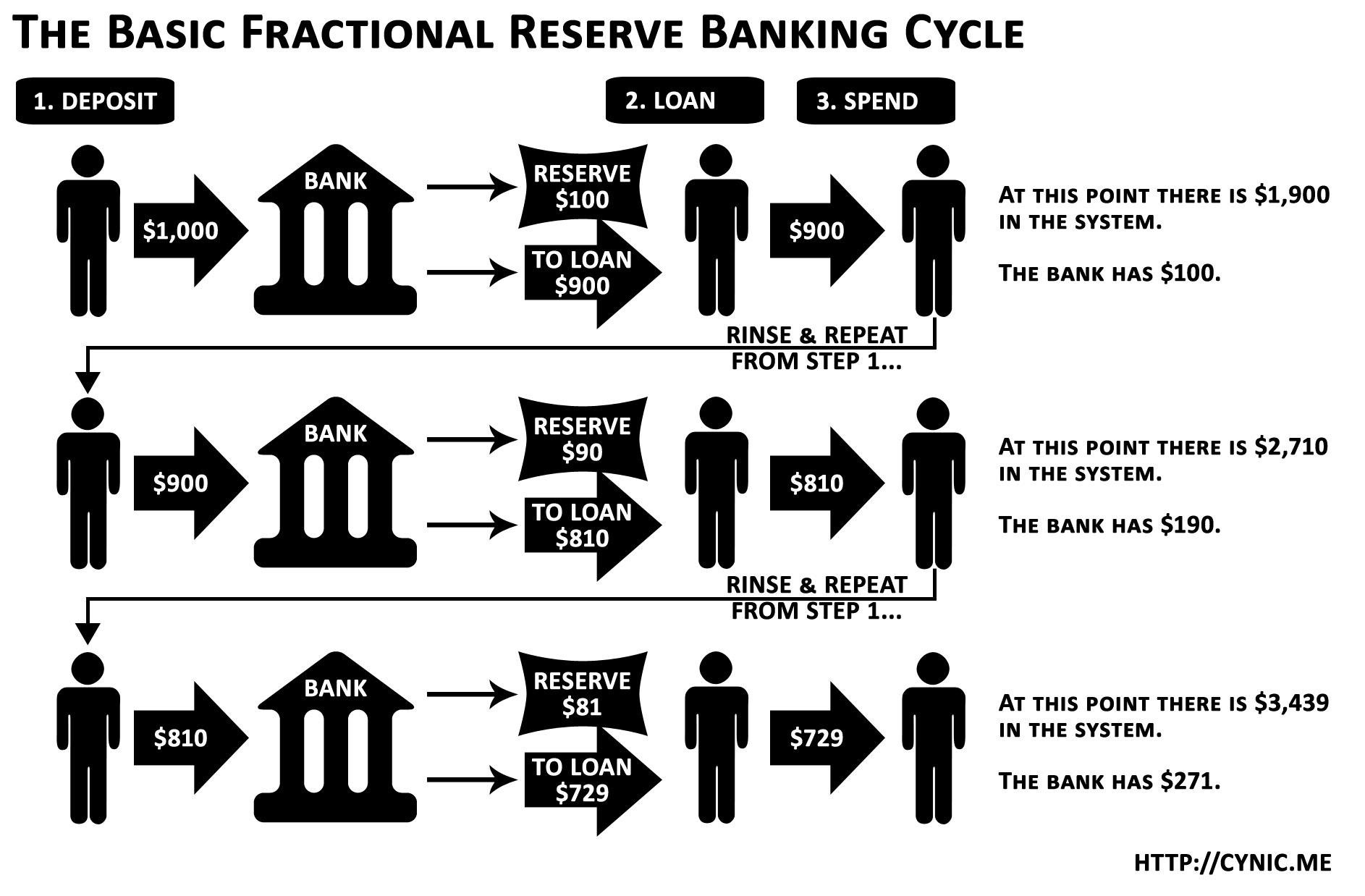
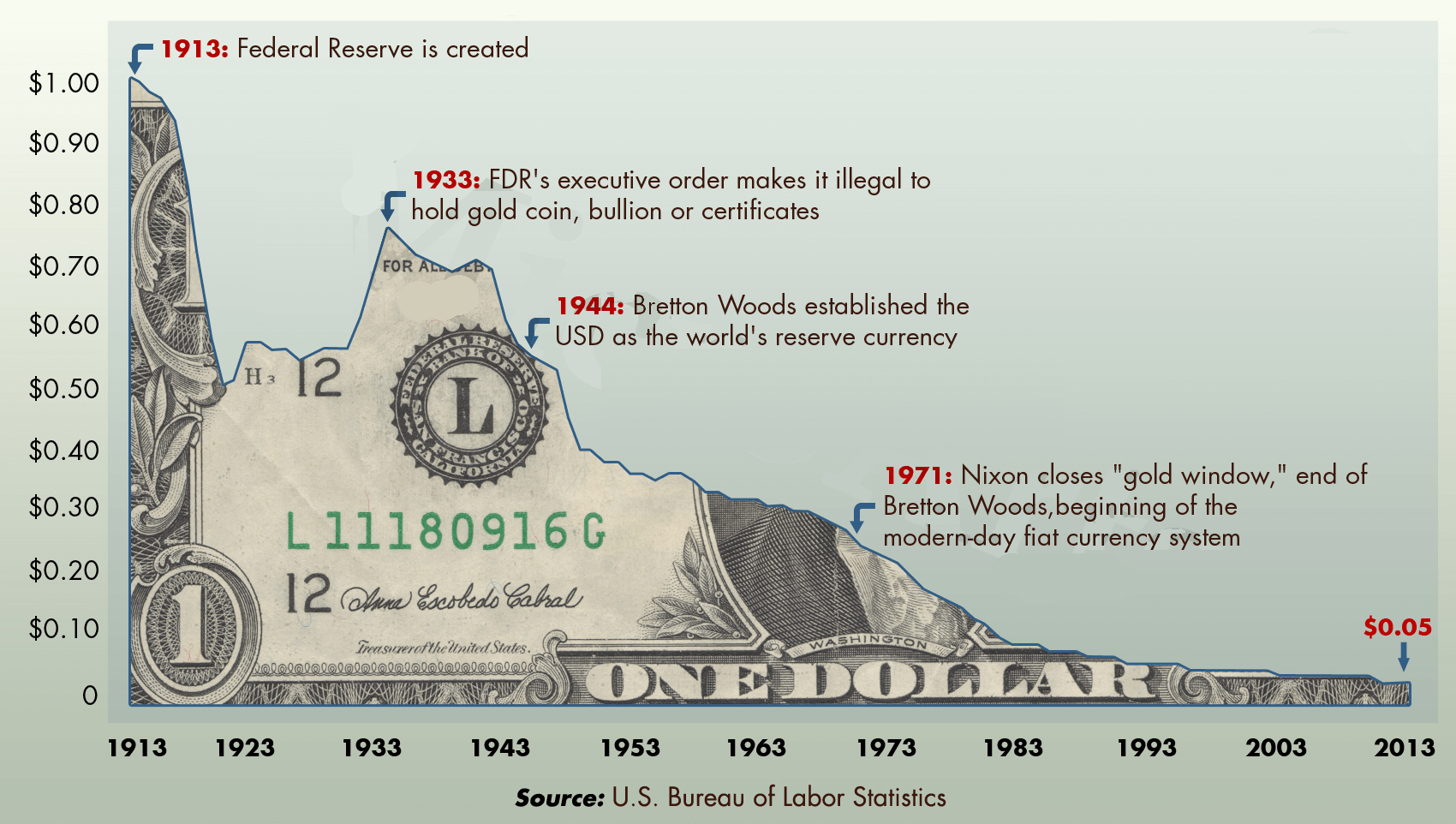
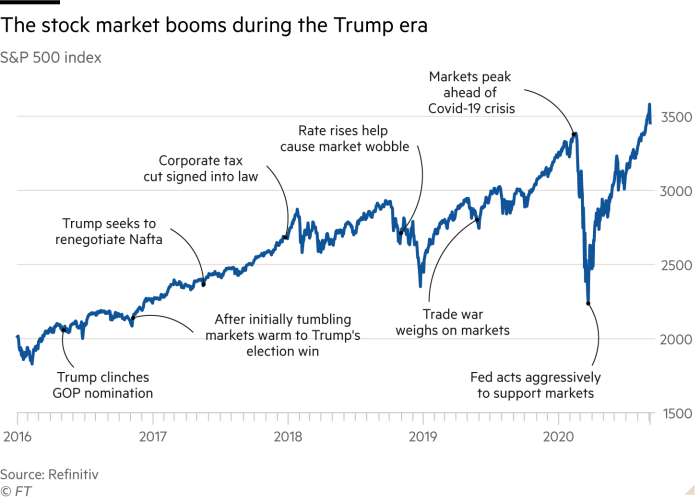
This post argues that stock market bubbles may be created by our upper level elites to then intentionally pop it, generating pain and panic for the public until providing the dialectical “solution” involving increased governmental control. This is especially relevant now with America possessing the greatest stock market bubble of all time.
In my recent post on the Redneck Rebellion I offered four scenarios our upper level elites may use as a pretext for implementing a totalitarian state of emergency to seize whatever civil liberties are left. Such an emergency will led to severe limitations on freedom of speech, programmable CBDCs limiting your consumption, social credit scores based on your internet and phone activity (which is all stored by the NSA and already routinely abused1) and enforced by a woke AI, creating a living Hell for all but our rulers.
These scenarios were as follows:
Crash the economy by deflating the biggest economic bubble in human history until people cry out for assistance, a strategy perfected in Japan;
A false flag hack by “Russians” or “Chinese” as a Cyber Polygon type event, crippling important infrastructure until it is “rebooted” with the radical changes;
World War 3 with Russia, Iran and China, where those who don’t submit will be treated as enemies; or
the Redneck Rebellion.
I covered the Redneck Rebellion in that post; this one will review the first option.
Princes of the Yen
A couple months ago I watched a great independent 2014 documentary recommended by Rurik Skywalker titled Princes of the Yen: The Hidden Power of Central Banks, which is based on the book of the same name by economist and university professor Richard Werner. I had not heard of it before, but it’s on Youtube for free and it’s been viewed an impressive 3.9 million times. The video is here:
The documentary explains how the central bank owners used Japan as its plaything in the aftermath of World War 2. FDR both knew about Pearl Harbor before it happened and manipulated events to bring it about by cutting off Japanese oil supplies; he needed America to be attacked in order to overcome anti-war domestic opposition exemplified by the America First Committee and Charles Lindbergh Jr. If Japan had not attacked, it’s nation would have ground to a halt without oil — a classic Catch-22.
After the war, Japan’s Rothschild-owned central bank, the Bank of Japan, was restructured by the victors. It would take time, patience, and a long-term strategy to incorporate Japan into the One World infrastructure because of its highly reactionary population. Their plan to do so was as follows:
First, keep Japan on a centralized war economy footing but with the production of goods modified for civilian use. The rulers would use window guidance to tell banks which industries to loan to, which companies within those industries to approve and how much money to allocate.
Without the burden of military expenditure, Japan quickly rebounded from the devastation wrought by World War 2 into its “economic miracle”. This was intended so that our elites could use Japan and China as checks on each other in case either tried to get away from their grasp (the “balance of powers” strategy which was also pursued with India/Pakistan, South Korea/China, and Israel/Middle East).
The next stage involved gutting the reactionary Ministry of Finance and transferring the country’s monetary policy to the Rothschild-owned Bank of Japan, which would then become “independent” of political considerations. The Ministry of Finance was powerful with a large bureaucracy, though. How were they to accomplish this maneuver? The strategy pursued was a clever long-term three-step:
create an enormous economic bubble by flooding the real estate and financial sector with endless loans, then
pierce the bubble and create a multi-decade depression by cutting back by 80% or more the amount of loans until the population was sufficiently weakened to
allow for a “restructuring” solution. This was carried out:
Eventually after the multi-decade grind the population grew weary for a solution, any solution, and one was readily provided: the Ministry of Finance was gutted and the Bank of Japan took control in 1998 with its “independence” from political influence (i.e. only Rothschild control) predominating. To add to the humiliation even the name of the Ministry of Finance was changed.
This strategy was also used successfully in the 1997 Asian financial crisis where multiple Asian countries were brought to heel in a similar fashion.
This is a relatively simple, clear, and easy to understand globohomo strategy, yet basically no one understands what was done here or why.
The results
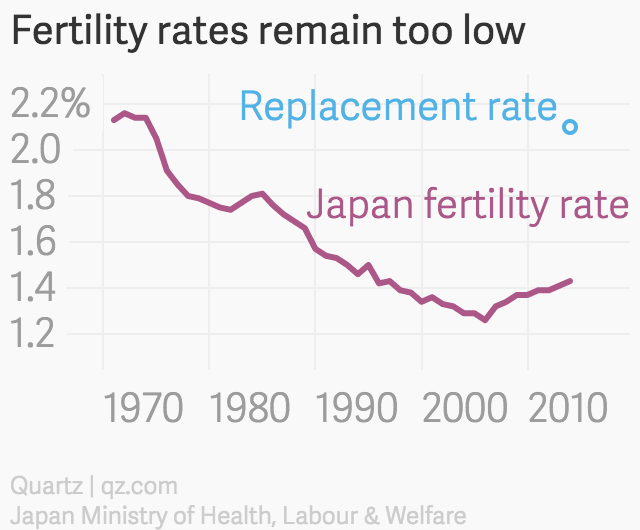
What was the result of our One World leaders militarily occupying the country, creating the conditions for an “independent” central bank while controlling the propaganda outlets of the country? Just like every other so-called “first world” country controlled by the central bank owners, here’s Japan’s fertility rates:
Japan’s fertility rate is half of the replacement rate of 2.1.
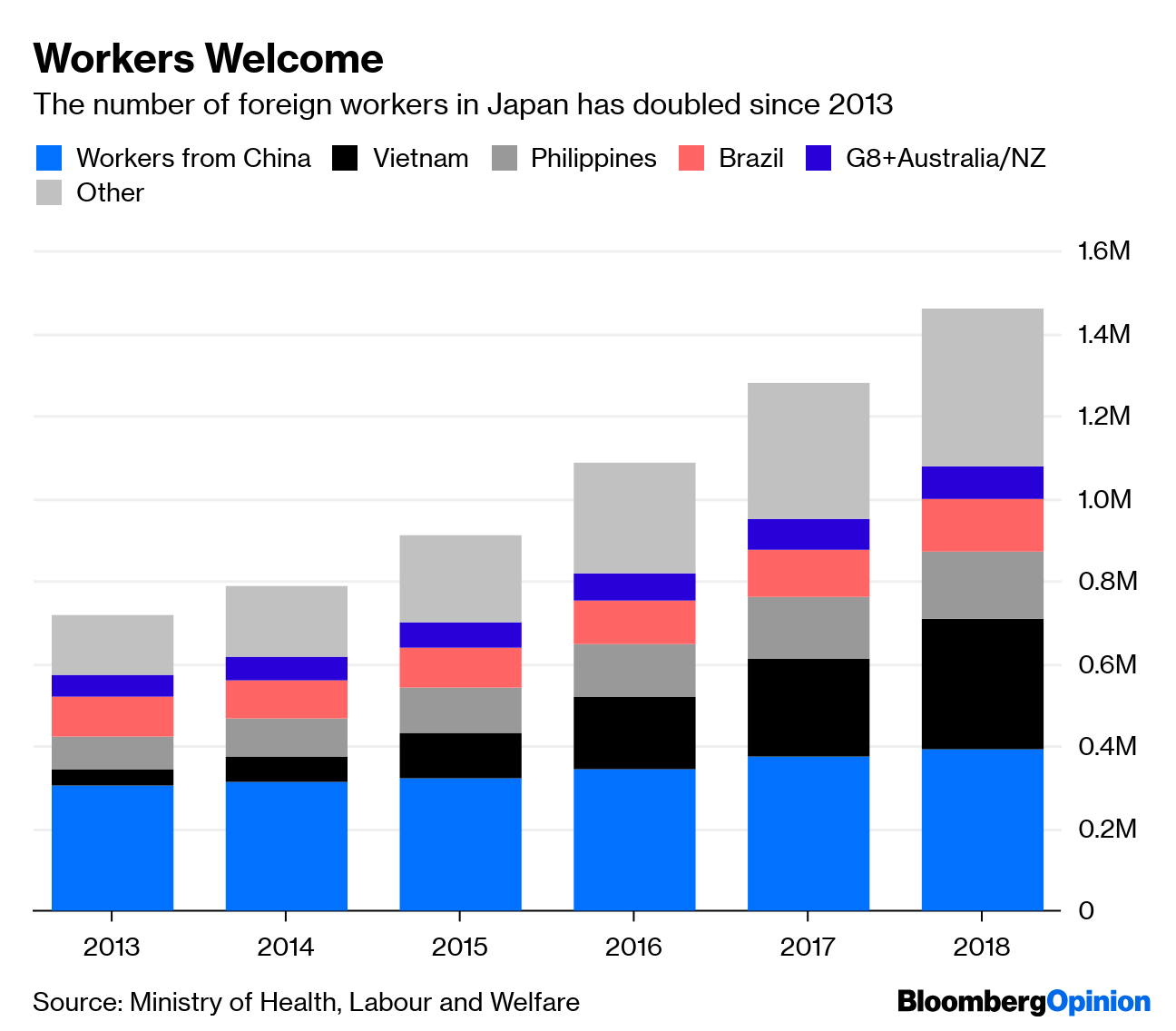
One may note that Japan has historically been rabidly anti-immigration because it has almost no natural resources and has relied almost entirely on its community spirit and bonds for its success. Well, here’s Japan’s immigration rates through 2018:
Is this part of why nationalist Trump-ally Shinzo Abe was assassinated in 2022?
This is how you end up with the below level of humiliation (which is clickable to watch):
This is what a defeated, humiliated, and skin-suited nation looks like.
The United States
Globohomo has multiple tools in its belt to conquer the heart and soul of a nation: it can do so militarily and it can do so financially; it can create bubbles that feel like economic prosperity and create fun and giddiness for many years, and then deflate those bubbles to put pressure on the public to achieve political ends. These strategies can take decades to play out; they are patient and think long term. Once they have established control they attack on the spiritual dimension: make the cost of living too high to afford a house or have children, work the population to death, pummel them with slop propaganda to demoralize them, and then the final step of replacing the native population with foreigners. A long, drawn out genocide so the Rothschild and ally central bank owners can get unfathomably rich, increase their power, and do the service of what arguably appears to be the Demiurge in destroying the world.
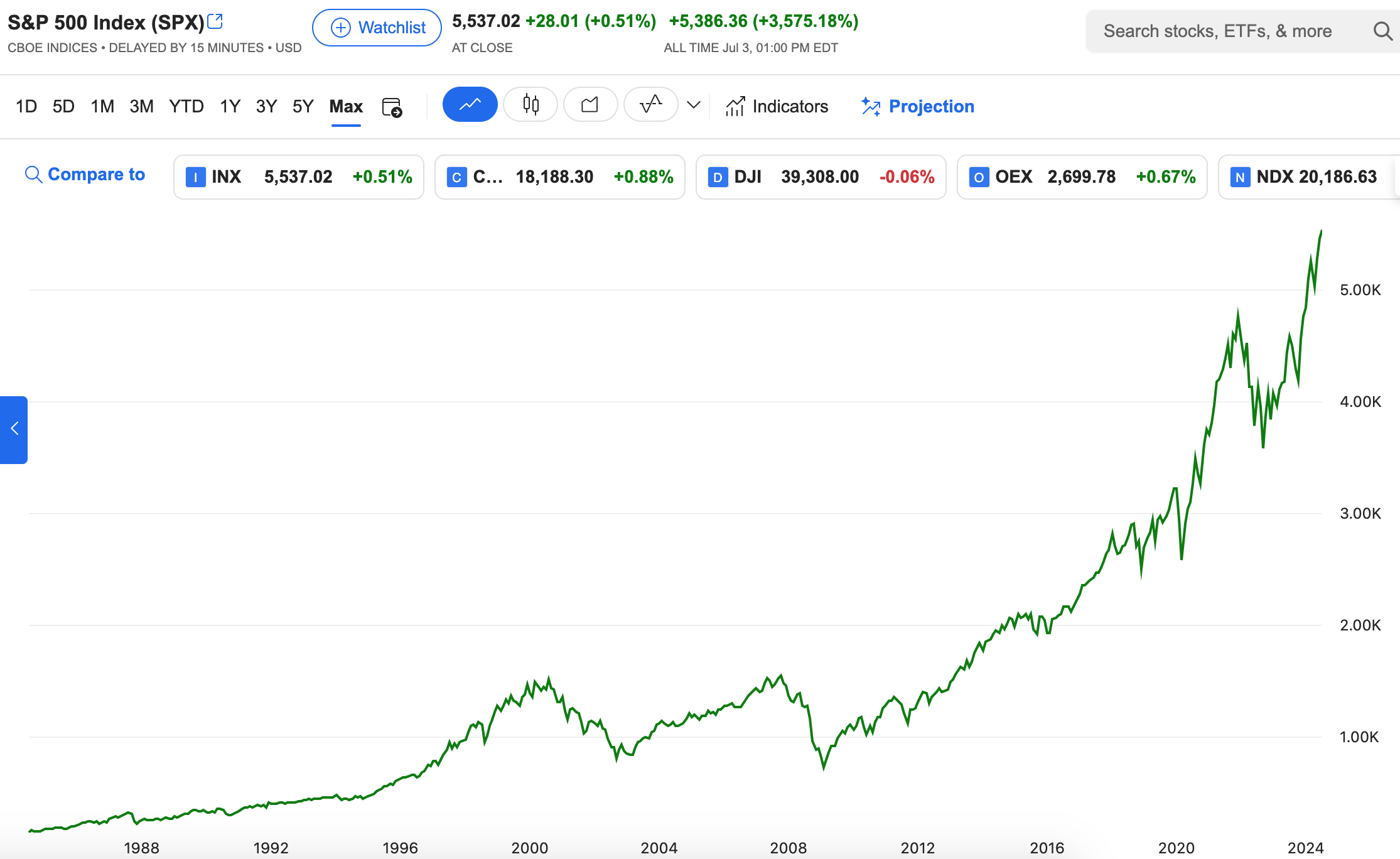
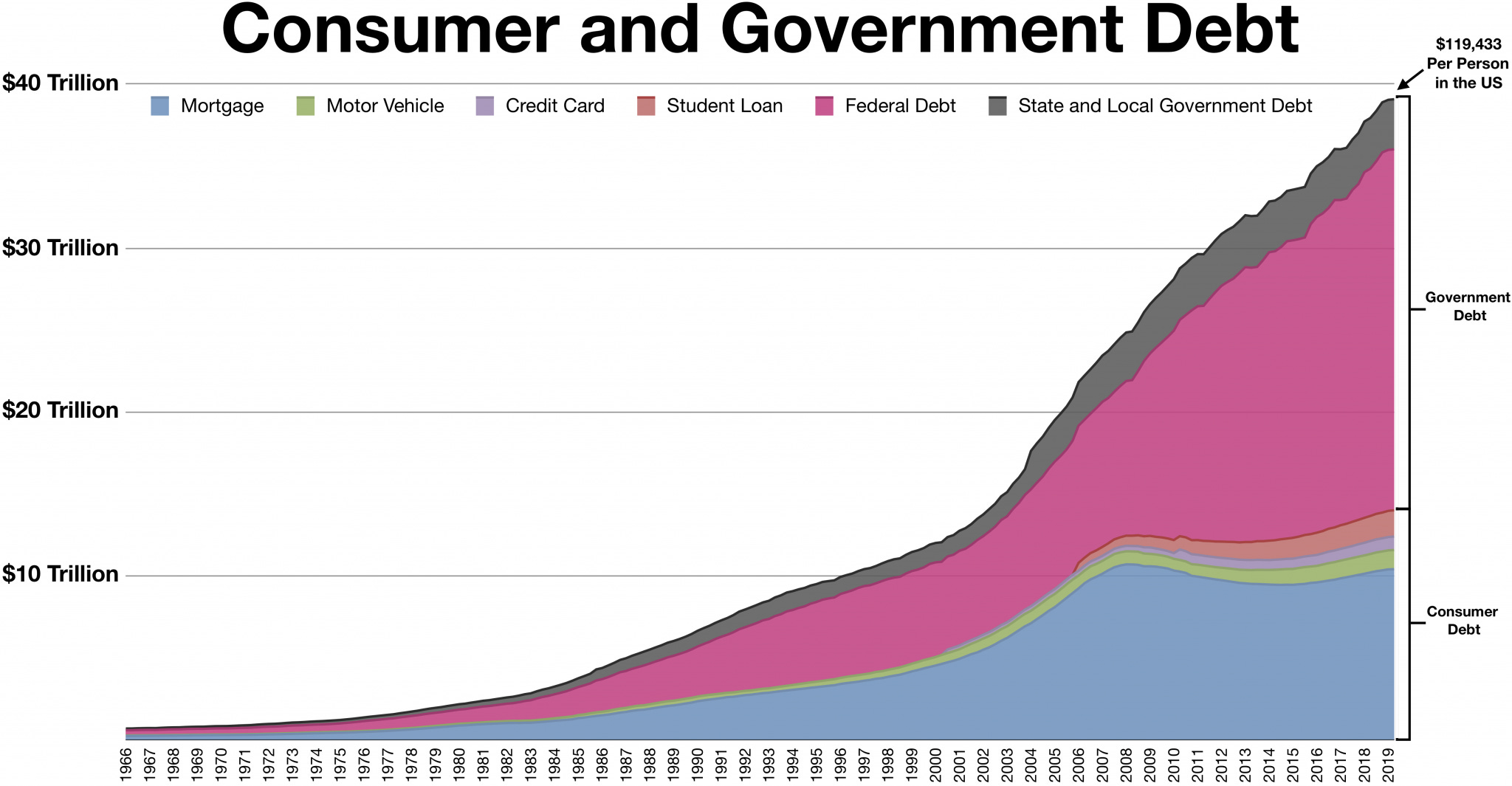
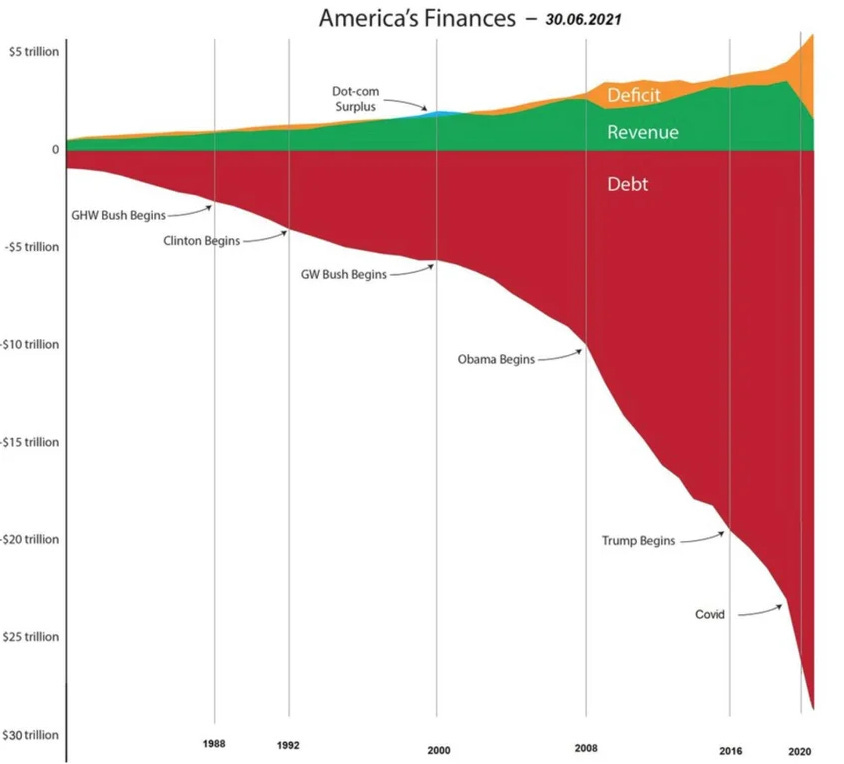
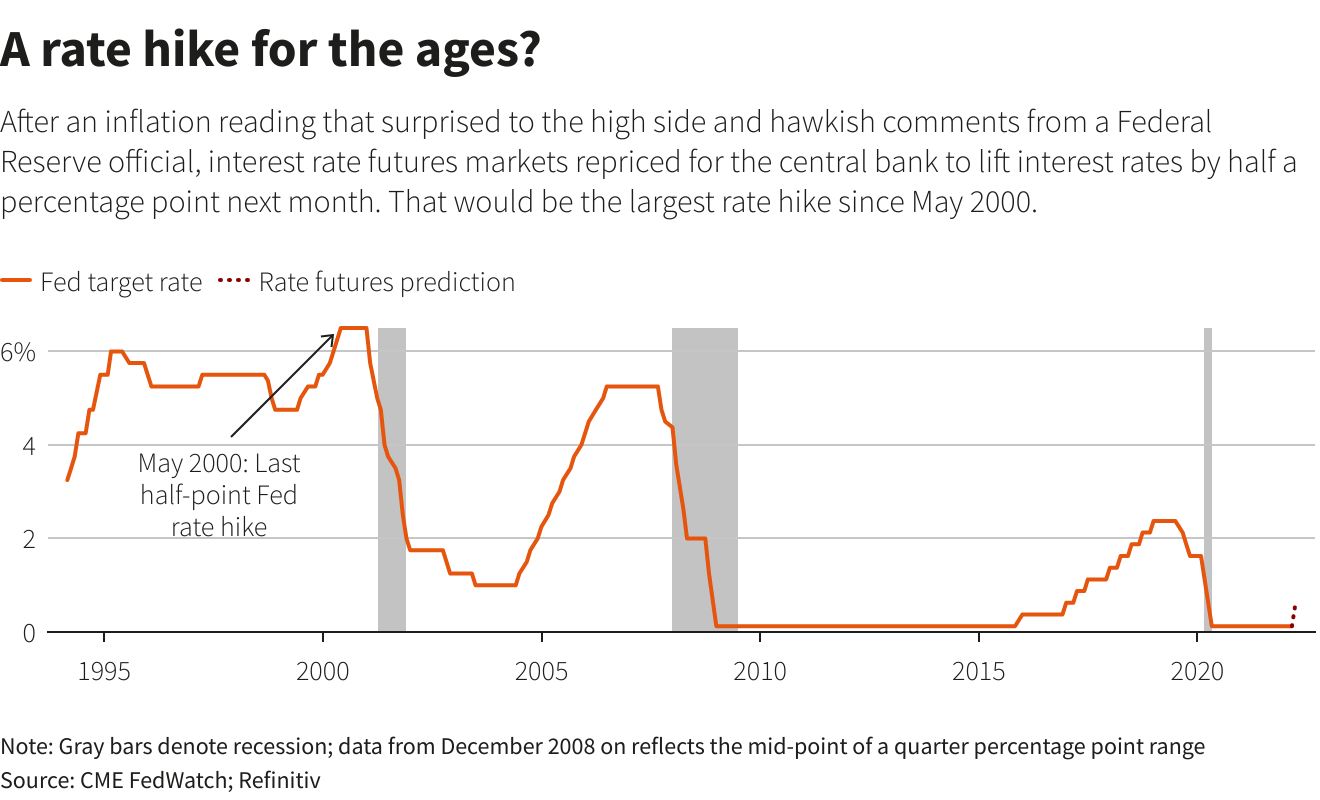
This raises the question: is this globohomo’s strategy here in the United States now, creating an unprecedented artificial bubble in the United States since the 2009 crash (2009-2022) with 0% interest rates in order to then pop the bubble with higher interest rates or a manufactured crisis, bring in an incredible amount of misery in order to facilitate globohomo’s next stage of their plan: the introduction of CBDCs which will reduce humanity to a level worse than that of impoverished serfs?
Note how small the 2000 “Dot Com” bubble and the 2008 financial crisis were against the current Everything (or Sovereign Debt) bubble
Alternatively, perhaps globohomo just prints the stock market to infinity and price non-major stockholders out of life. Our elites prefers to create scenarios that provide them maximum flexibility and optionality where they win from any option. Endless “Numbers Go Up” charts pacify the upper middle class into passivity; they think things must be good as long as their stock market account grows, even though it is only growing due to endless Federal Reserve printed loldollars being shoved into the market (paid for by the public via inflation, disproportionately affecting the lower classes) along with cheap debt, and even though America has descended into a crime-ridden, illegals-everywhere, expensive and filthy blown out Hellhole where only the top 0.0001% benefit. These upper middle class types only panic if the stock market falls. The same argument applies to fake GDP “growth”, as Tree of Woe explains here. There is some strange belief people have in Numbers; it’s hypnotizing and almost occult.
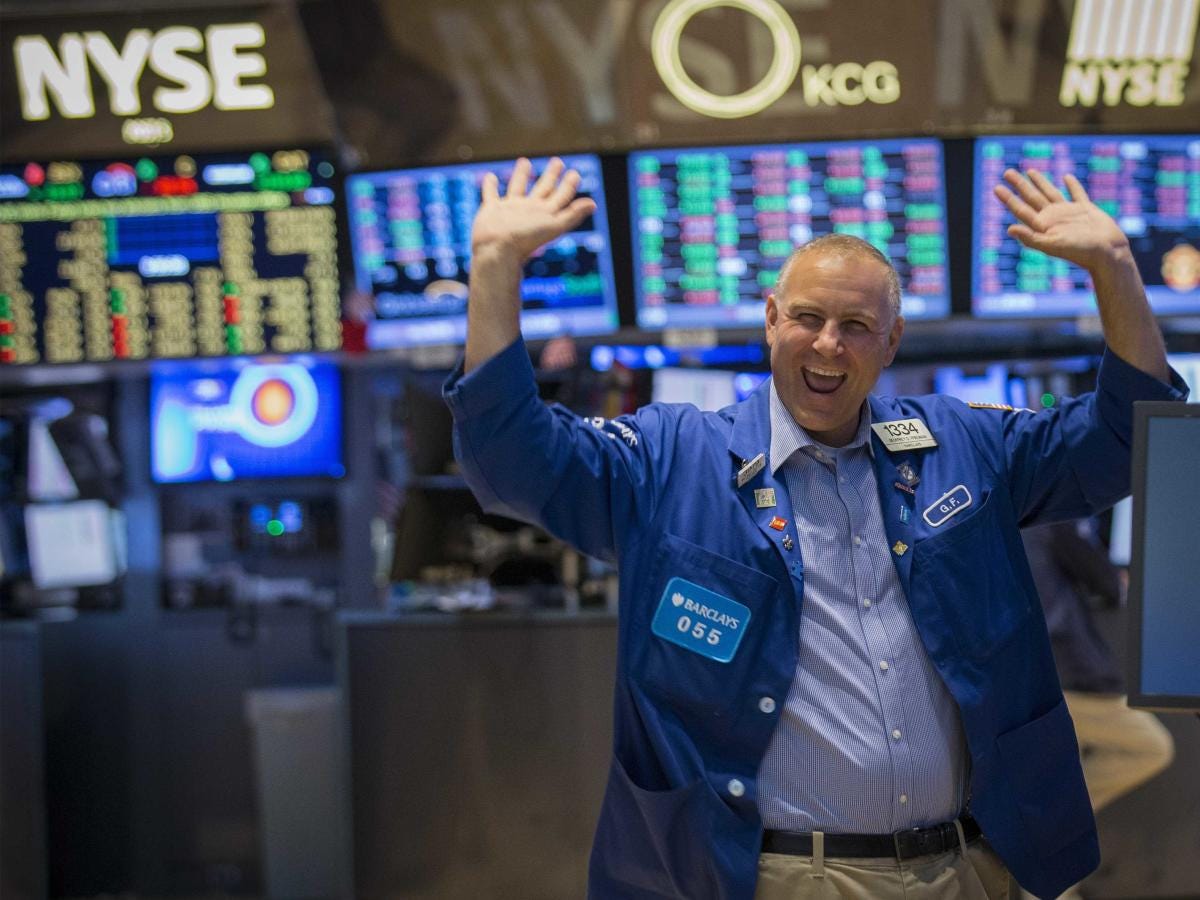
“Yay! OMG Numbers go up!”
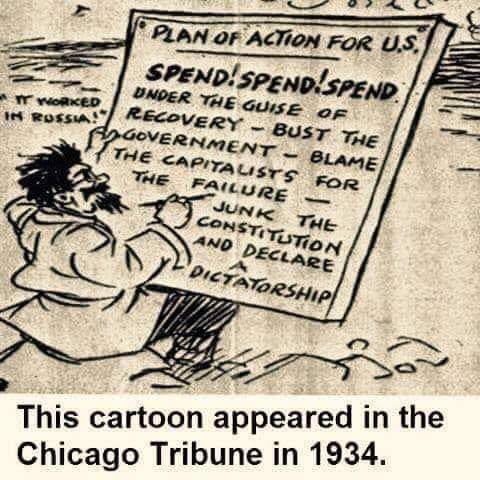
Intentionally creating a bubble to then pop it for political objectives wouldn’t be the first time it’s happened in the United States. The aftermath of the 1929 stock market crash led to FDR’s so-called New Deal which transformed the country into a socialist state. The Supreme Court’s back was broken with the switch in time saved nine. And despite false stories like Bernard Baruch and Joe Kennedy supposedly selling at the peak of the market right before the crash because they saw shoeshine boys pumping stocks, the reality was far more nefarious (as recounted previously here). Paul Warburg arranged the 1929 stock market crash; first he advised all member banks to get out of the stock market or sell it short on March 9, 1929, then on October 24 the Federal Reserve Bank suddenly increased the rediscount rate to 6%, thousands of orders hit the exchange to sell “at market”, and six days later the Federal Reserve Bank ordered the contraction of brokers’ loans in the amount of $2.3 million, the combination of which caused the crash. Congressman Louis T. McFadden stated “It was a carefully contrived occurrence. The international [central] bankers sought to bring about a condition of despair so that they might emerge as the rulers of us all.”
As famously stated by FDR, “In politics, nothing happens by accident. If it happens, you can bet it was planned that way.”
Again, here is the Japan documentary if you want to watch it. It is very educational:
Thanks for reading.
Subscribe: Email delivery remains on Substack for now.
1 A declassified FISA report stated that the FBI ran 3.1 million illegal FISA searches on American citizens in 2017 alone, compared to 7,500 combined searches by the NSA and CIA in the same year. It later came out that the law firm Perkins Coie had its own NSA search terminal set up in its D.C. offices to spy on domestic opposition; it was placed there to provide the perpetrators protection. In 2023 the DOJ Inspector General revealed that more than 10,000 federal employees have access to the NSA database for surveillance inquiries, more than 3.4 million search queries were ran between 12/1/2020 and 11/30/2021, and approximately 30% were outside the rules and regulations that govern warrantless search, showing the pattern of illegal governmental behavior had only expanded. The FBI can now look at your web browsing history, emails, anything you have ever typed on your phone or computer, any audio you have made in the vicinity of your digital devices without a warrant (per Edward Snowden, the NSA picks up all of that data as part of Total Information Awareness). Then they use parallel construction to prosecute. See also the Room 641A controversy, a telecom interception facility operated by AT&T for the NSA as part of its warrantless surveillance program and a facility that is likely copied throughout the country.
I expected this to be a short, fun post about my Italian adventure, but it rapidly scaled into the verbal and visual monstrosity before you, a combined travelogue and political rant. You have about a decade left to enjoy seeing Italians in their native habitat before they become an endangered species. As this is a combined two-parter, there may not be a post next week.
I recently took a trip to Italy for pleasure. It was my first international trip in a long time. This post is going to be a write-up of some of the things I saw and experienced there.
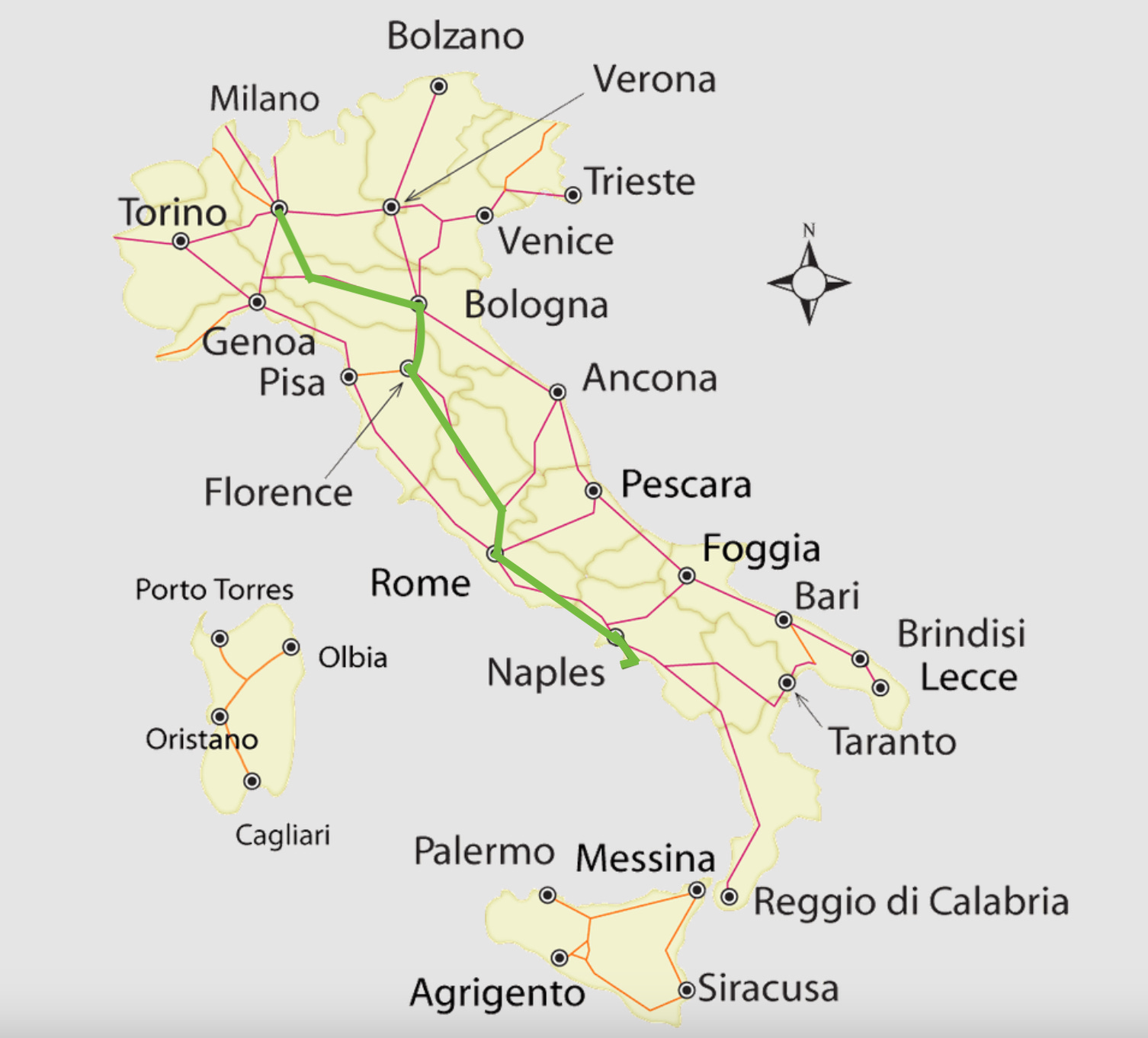
The route involved flying to Milan, a day-trip to Como, a train to Florence for two nights, a train to Rome for three nights, followed by a train to Naples en route to Sorrento with a day-trip at Pompeii, explore the Amalfi coast and fly out of Naples.
The goal was to see as much of Italy as I could within eleven days. Whatever I saw would of course be surface level and superficial, tourist-level and not how locals live, but the hope would be if or when I come back in the future I would have a better idea of the regions that spoke to me, if any, and that I wanted to explore more in-depth.
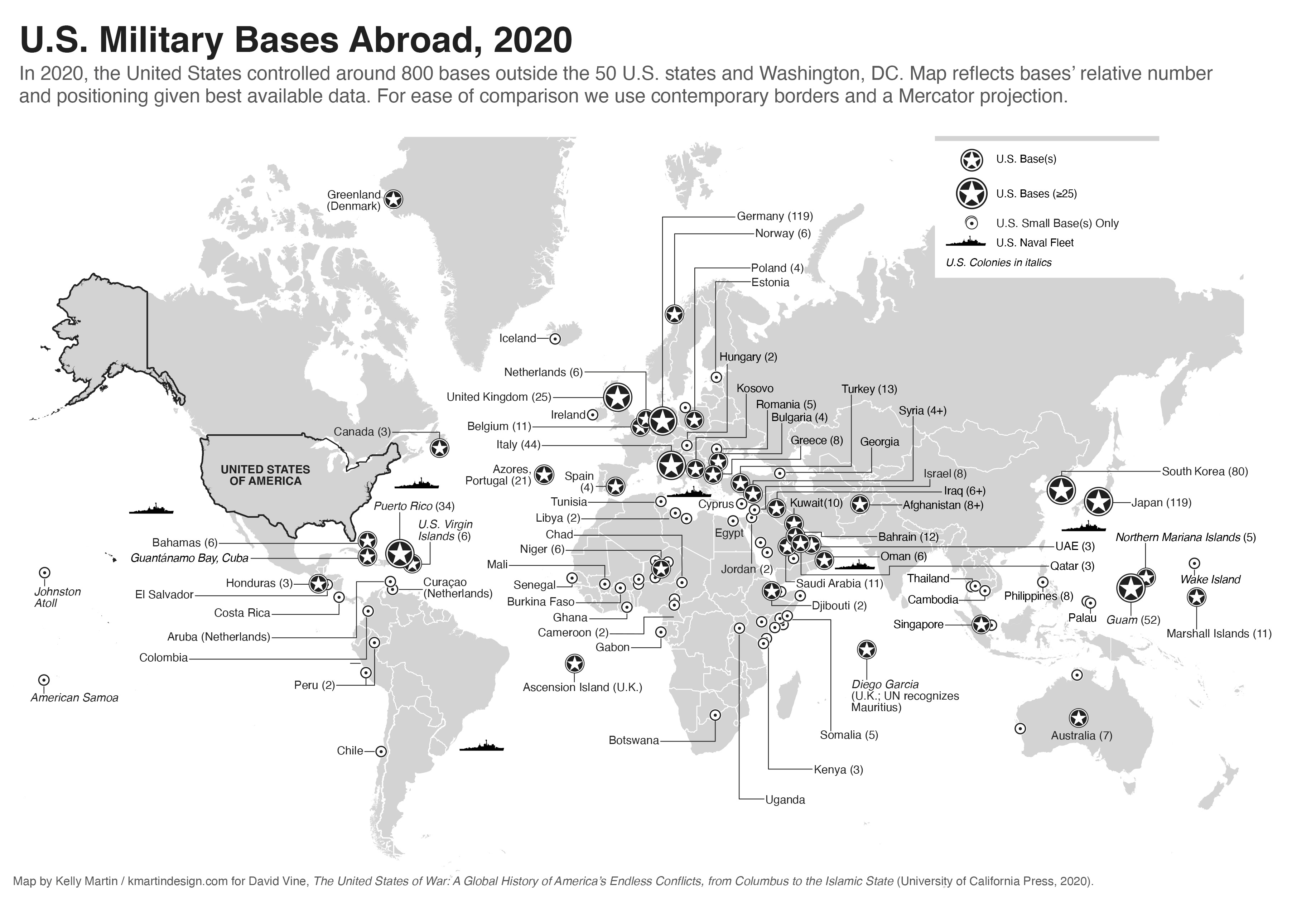
First, why Italy? A couple reasons: one, it has a reputation as a lovely place to travel. It’s known as the home of olive oil, wine, Tuscany, romance, sunsets, history, excellent food, architecture, art, etc. Second, it ties into numerous aspects of this Substack: the transvaluation of Roman values to Christian values, the subsequent wiping out of Hellenism, the ongoing egalitarian ratchet effect, and the continued implementation of the Kalergi plan1 in accordance with globohomo’s demented dictates where huge numbers of non-integrating Muslims and Africans will be imported into Europe so that the population becomes too divided to ever oppose central bank usury. The Europe of today will likely be much darker and much more Islamic within another generation or two; enjoy this version while you still can. Third, I’m interested in obvious aspects of the U.S.’s control within Italy itself — it remains a conquered nation where the U.S. has 44 military bases within the country (compared to 119 in Germany!), and thus very much subject to American soft power (film and television, music, multi-national corporations, etc.).
Second, when to go? The best times of year to go to Italy are in the spring or fall; the summer is uncomfortably hot and humid (this write-up has been in the publishing queue for awhile).
Third, a preamble. I’m not going to cover very much Italian history within; the focus will be more on offering photos, some cultural commentary that stood out to me, along with the usual structure of the modern world and goals of our overlord rants triggered by what I saw. The art of photography is a very different skillset than the art of writing or marketing; instead of pondering and deliberating over framing and word choice, decisions that can be considered for a long time, with photography one has to be QUICK about snapping a shot or the moment is lost. So the skills needed involves swiftly realizing something is worthy of further discussion and then capturing it. Because it took me time to realize this (shoot first, discuss later), I missed out on a few opportunities for good shots early on. I don’t take many international trips, after all. This lesson will be learned for the future.
Let’s begin.
Flight into Heathrow
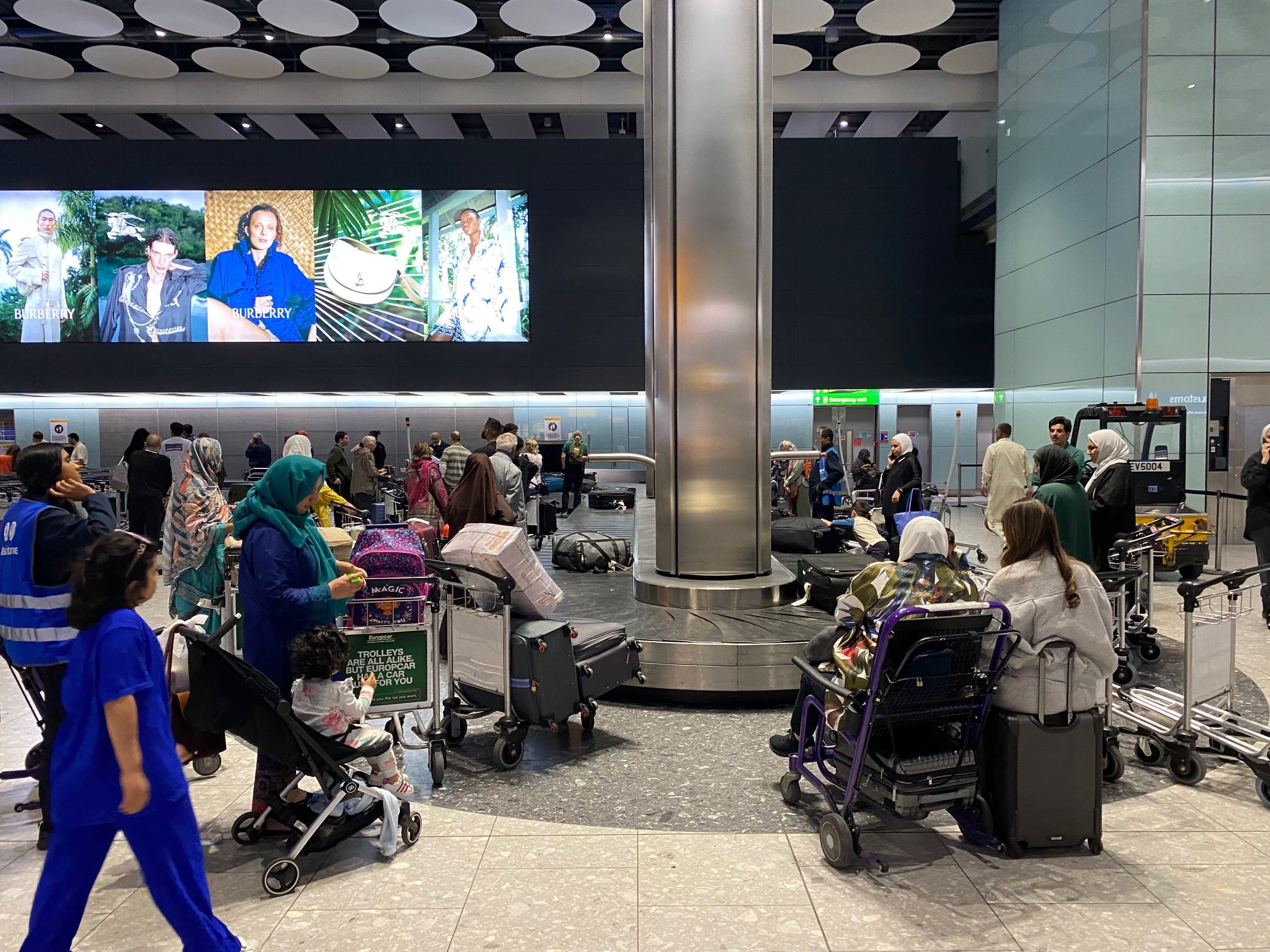
There was a stopover on the way to Milan in Heathrow. London has been called Londonistan for a long time now – it’s officially 15% of the London population as of 2021, but that is of course a lie and the percentage is much larger, especially among the youth. England’s second largest city Birmingham is no better off. Walking through Heathrow felt like I was in Islamabad — roughly 90% of the population was either visibly Islamic, non-white, tattoo’d, obese and ugly, or a combination thereof. Airport exhibitions were plastered throughout the airport displaying only Muslims, blacks, and LGBTQ individuals, preferably disabled or obese in accordance with intersectionalism, with no straight white men anywhere to be seen. This is pushed consciously and cynically on behalf of the central bank owners so the population is too divided on race, gender, sexual orientation grounds to focus on their theft.
The modern representation of Great Britain; a prominent wall displayed with similar photos for new arrivals. The race/gender/sexual orientation focus is the red cape; the central bank owners are the matador. Don’t get fooled by the cape.
The only other posters I saw were for Net Zero propaganda, which is globohomo’s way of lowering first world standard of living to be in accordance with the third world by slashing their energy supply even as China and the rest of the third world dramatically increase their energy consumption. Net Zero is a mere intermediary step before the approach to Total Zero, i.e. wiping out the “useless masses” as WEF-thought-leader Jewish homosexual atheist Yuval Harari casually calls them.2
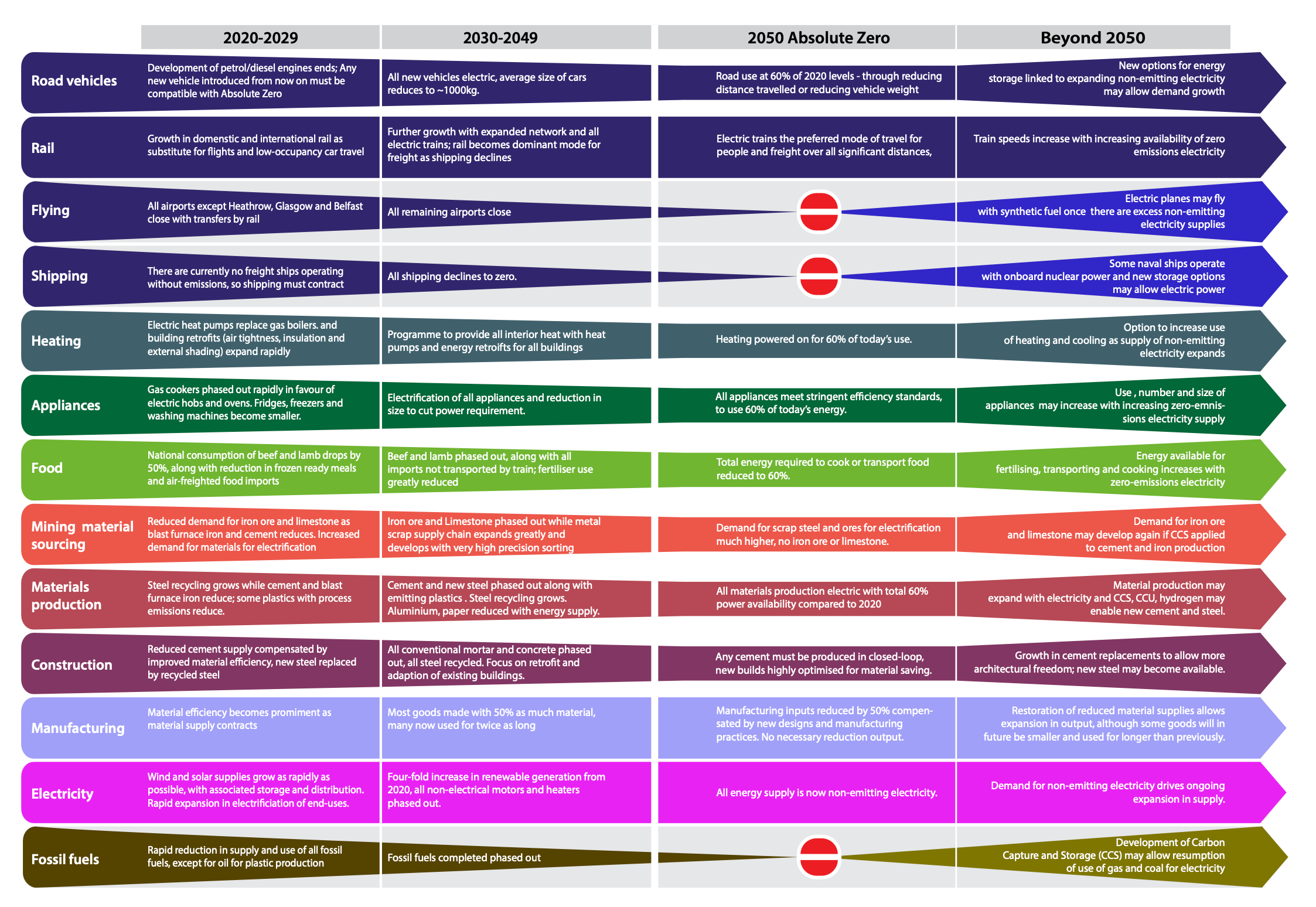
The below is globohomo’s gameplan for the upcoming restrictions on basic living as explained by UKFires, which has a lot of establishment credibility, even attracting a full debate in the House of Lords in February 2020:
The Net Zero zealots have forced the closure of [Britain’s] last remaining fertiliser plant and they also want to close the available routes to import ammonia. Not only that, but no shipping and no aviation will also impede our ability to import food.
The “experts” on the Climate Change Committee want to “release” 11% of our agricultural land by 2035 and up to a quarter by 2050. By “release” they mean turn over to tree-planting or energy crops. One has to ask, without fertiliser or imported food and much less agricultural land, how are we going to feed ourselves?
It is plain to see that we are heading towards economic disaster, social catastrophe and potentially famine.
Anyway, seeing the state of Heathrow was both a shock and depressing but it wasn’t surprising — seeing theory, logic and history become manifest in the real world is always a different experience. It is also a terribly laid out airport; it took almost an hour to get from one terminal to the next with multiple busses and trams having to be taken. The general tenor of the place was akin to the Star Wars cantina.
Is this Heathrow or Islamabad?
I had the chance to explore the surrounding area to Heathrow and the psychic energy was intensely bad — there was and is an active invasion by a hostile non-integrating foreign power taking place where the population nearby was 95%+ Islamic.
To be fair, out of every Western group the British more than anyone else deserve what they get.3 Their rulers were so tied up with being the dominant European power that they were willing to sacrifice literally everything to retain it — their reserve currency status, their superpower status, their empire, colonies, the future of their children and the future of their civilization to retain it, even importing a hostile non-integrating foreign class as necessary to stem any future rise in white populism — selling their souls to the Rothschilds and other central bank owners in the process, as discussed here. I see occasional videos of World War 2 veterans crying that the country of today is not the country they fought for (see this 100 year old crying about America) or John Cleese who poked fun at British society until such society was dead and he laments where it went, and of course consider Enoch Powell’s 1968 rivers of blood speech warning about the catastrophic consequences of illegal immigration, but the crux of the matter is this: most British despite the horrors of World War 1 were willing to fight Germany for control over the European continent because globohomo fed them a bunch of anti-German propaganda and they ate it up, just as the Americans did after the Pearl Harbor false flag.4 The lead-up to World War 1 was conducted in the same manner, as was the earlier transition from feudalism to industrialization furthered by the 1604-1914 Inclosure Acts which herded the British masses into the major cities for exploitation like cattle. A population so willing to let the Rothschilds and their allies buy up the mass media, bribe the politicians and institute the steps leading to war is a population that deserves the civilizational suicide that was being hoisted upon them.
This isn’t to say that I don’t have a lot of empathy and support for Western civilization. I do; it’s perhaps the greatest civilization in the history of the planet in what it’s accomplished, the ideas it’s wrestled with, the freedoms and respect for individual rights its generated. This is why calling attention to its unidentified failures is so important — because basically no one else is doing it that I see, at least not in this way; I’m just a pipsqueak blogger, but these ideas need to somehow enter the zeitgeist somehow.
The point is this: it’s easy to blame politicians and the Rothschilds but the buck ultimately stops at home. Are you currently falling for the Current Thing scam of the Israel/Hamas war or the Ukraine/Russia war just because the media tells you to? Do you have your eye off the totally open southern U.S. border because the media isn’t covering it? Are you aware of the structure of the modern world? If you’re falling for this stuff, what kind of moral authority do you have to think you wouldn’t have fallen for the same kinds of propaganda leading up to World War 1 and World War 2?
Anyway I was eager to leave British soil and I don’t plan to go back if I can help it. The country is doomed and its future belongs to primitive Islam.
Milan
Milan was substantially better than Heathrow; it was hard not to be. Still, it seemed like about 30% of the population at least in the tourist areas and the areas around the train station were non-native Italians, heading toward the future of Heathrow just on a slower pace. Keep in mind that the EU wants to import 75 million more illegal migrants in furtherance of the Kalergi plan and that it prosecuted populist leader Matteo Salvini for preventing illegals from entering the country in 2019. The current Prime Minister, Giorgia Meloni, ran as a populist but immediately did a 180 and opened the borders on behalf of globohomo even further; a truly degenerate and evil woman (dissidents had warned about her WEF ties and compromised background but the media fooled a majority with its false portrayal of her as a populist, as usual).
Some things I noted:
The ground was filthy with lots of gum on it. Italy should have Singapore-type laws regarding gum, it makes everything look grimy and disgusting.
Food portions are smaller and many of the waiters are African and Islamic migrants.
This becomes less of a factor the further one gets away from the rail station areas. Downtown looked almost like one would expect from Milan, which is considered one of the four fashion capital of the world.
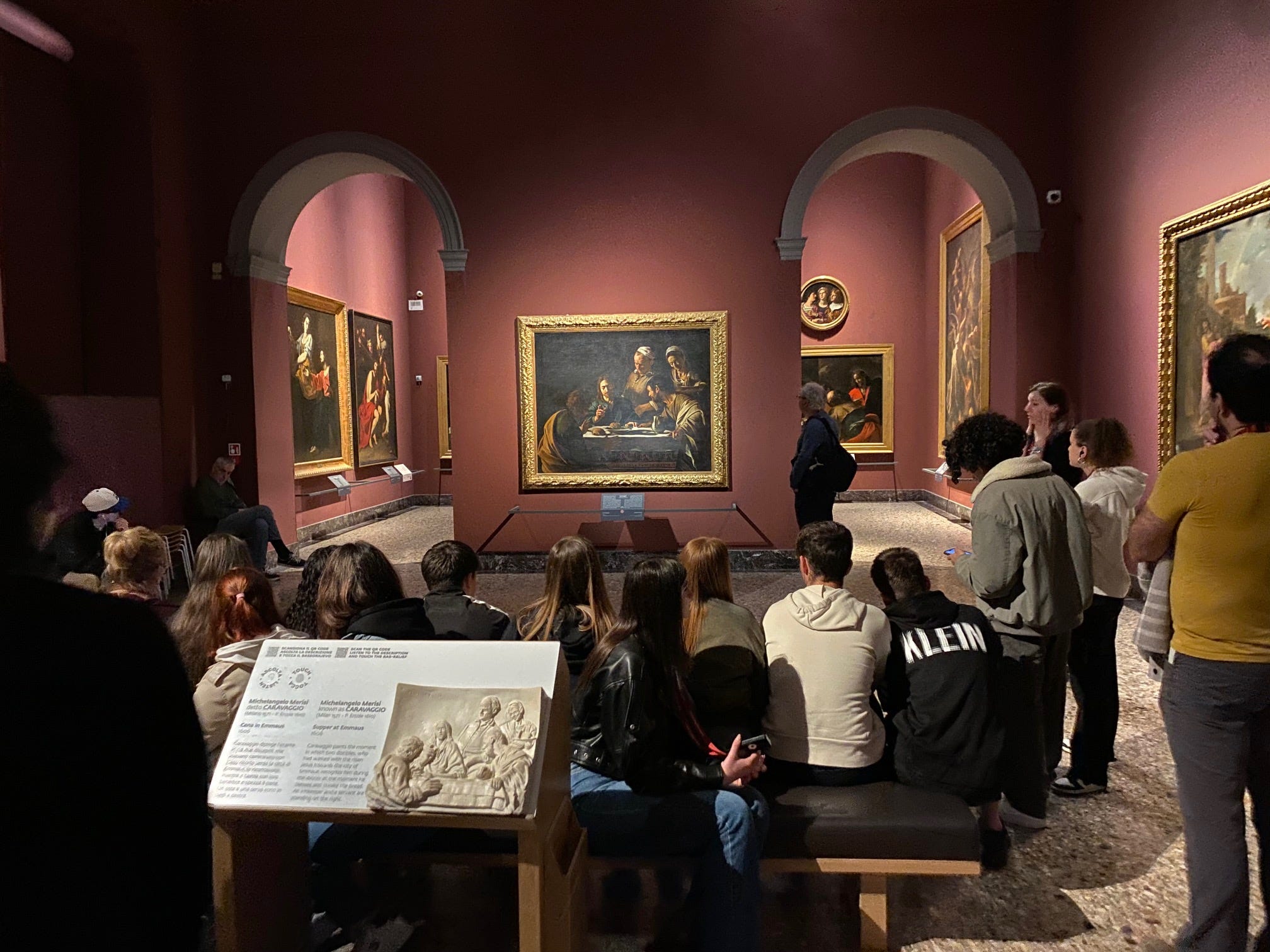
Milan is not known for being a very good city for tourists to visit, but there are interesting things to see regardless. Some of the architecture was really cool such as the Bosco Verticale (Vertical Forest):
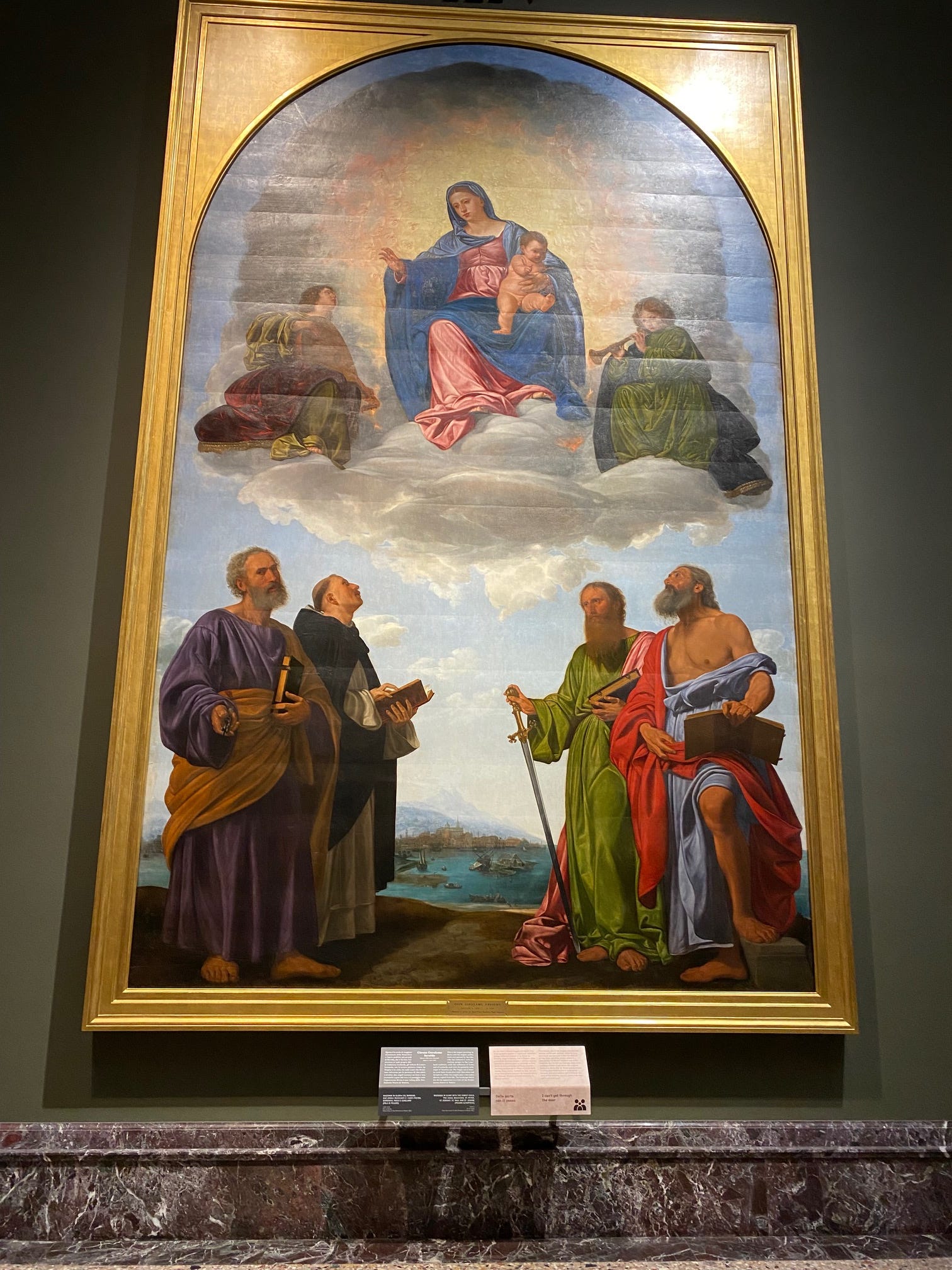
This one by Giovanni Girolamo Savoldo was so large it apparently had to be rolled up to get through the door:
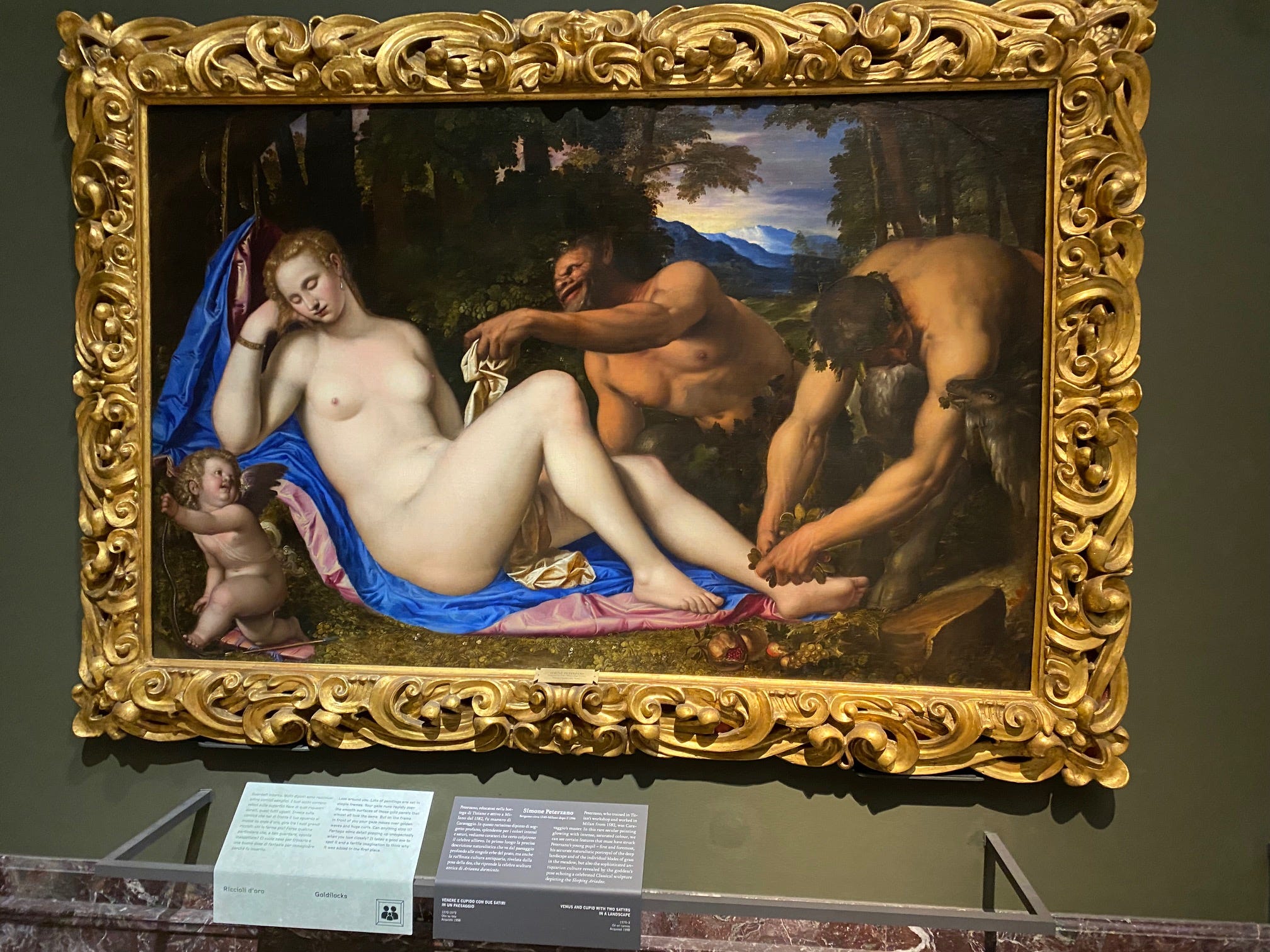
This is the feeling any man gets when trying to initiate sex with a long-term partner:
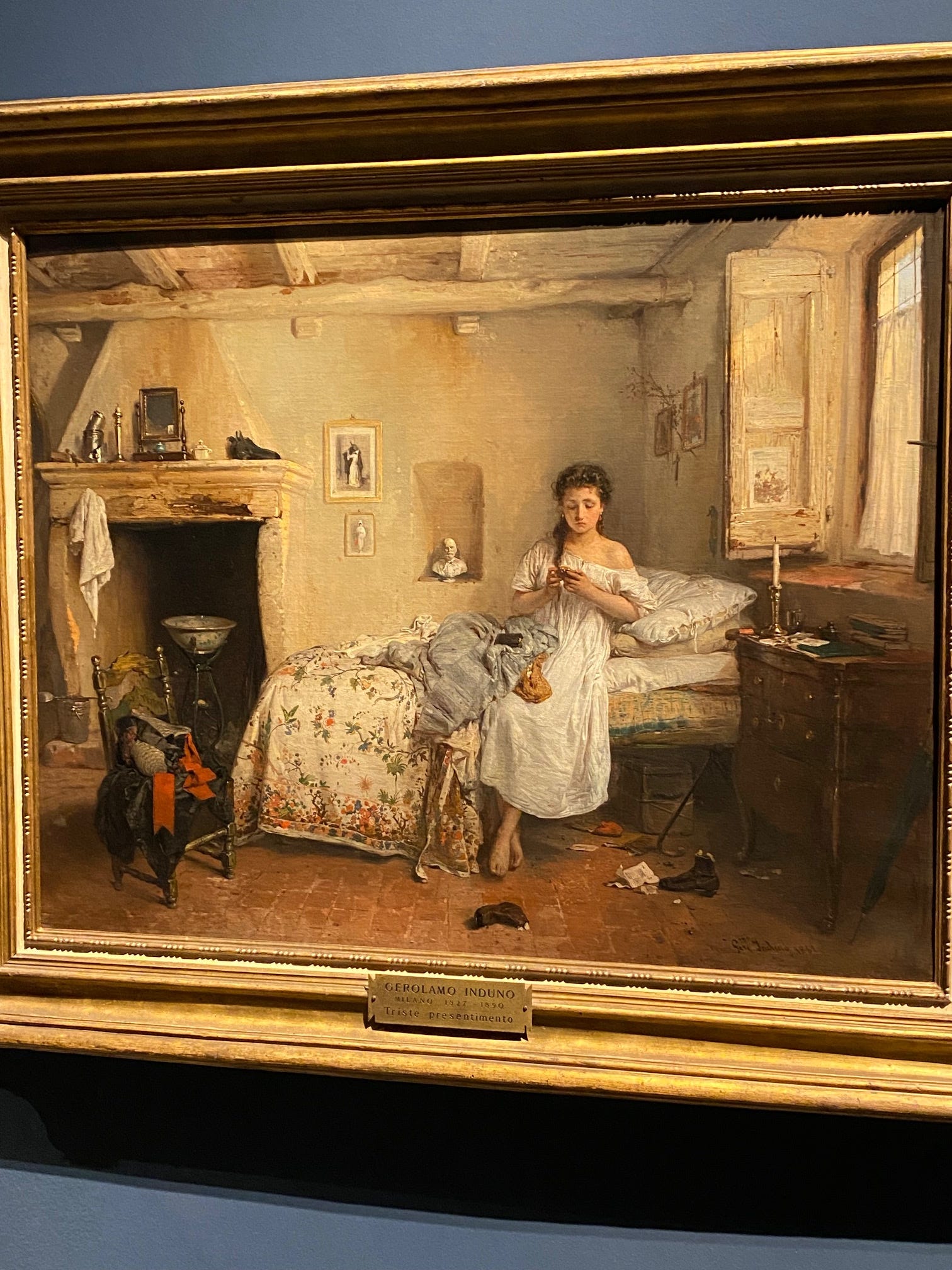
And in the next one this girl is apparently thinking about her love, but it looks like she’s on her iPhone:
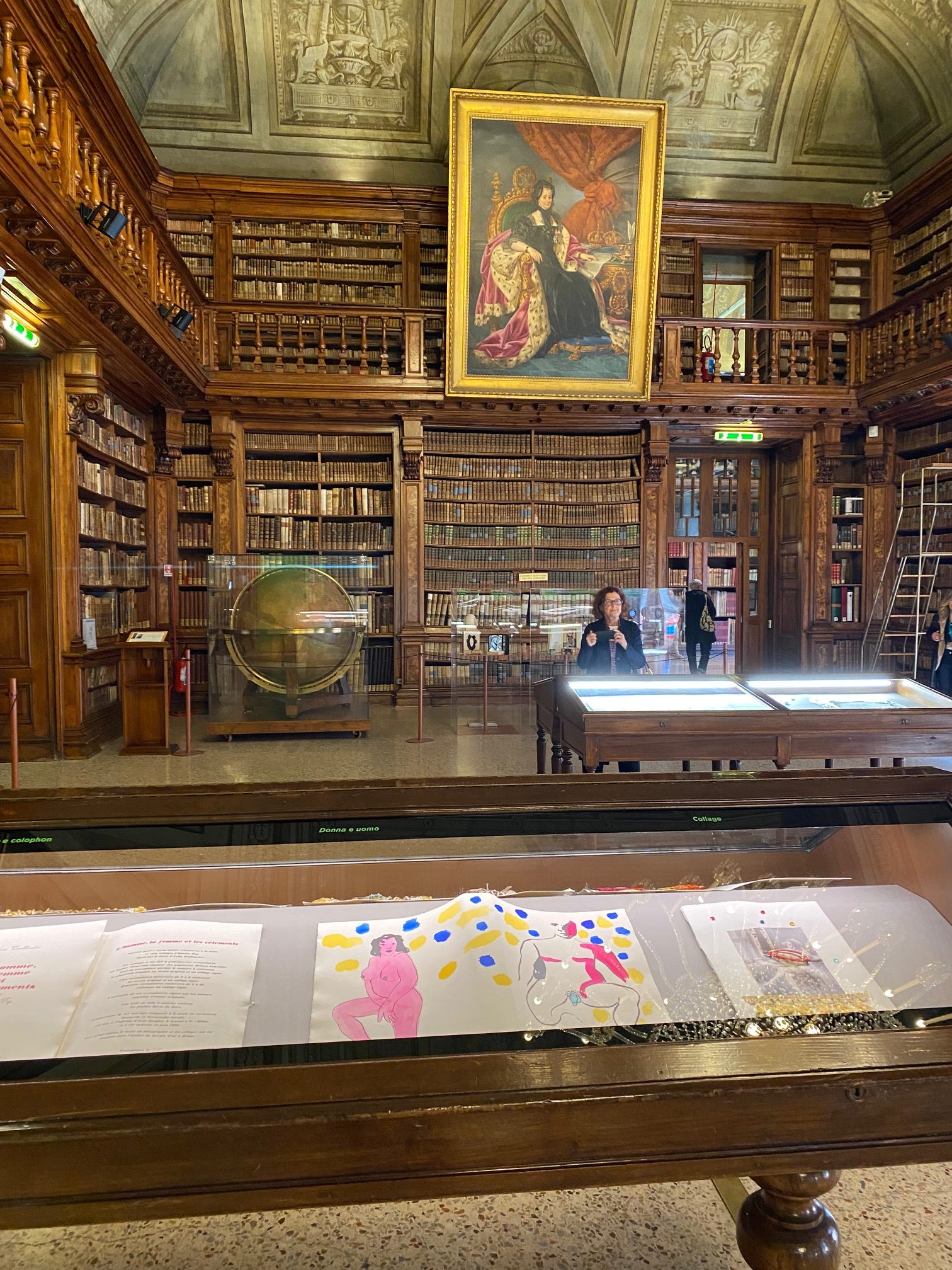
The juxtaposition between traditional art and modern degenerate art in the next photo is kind of striking:
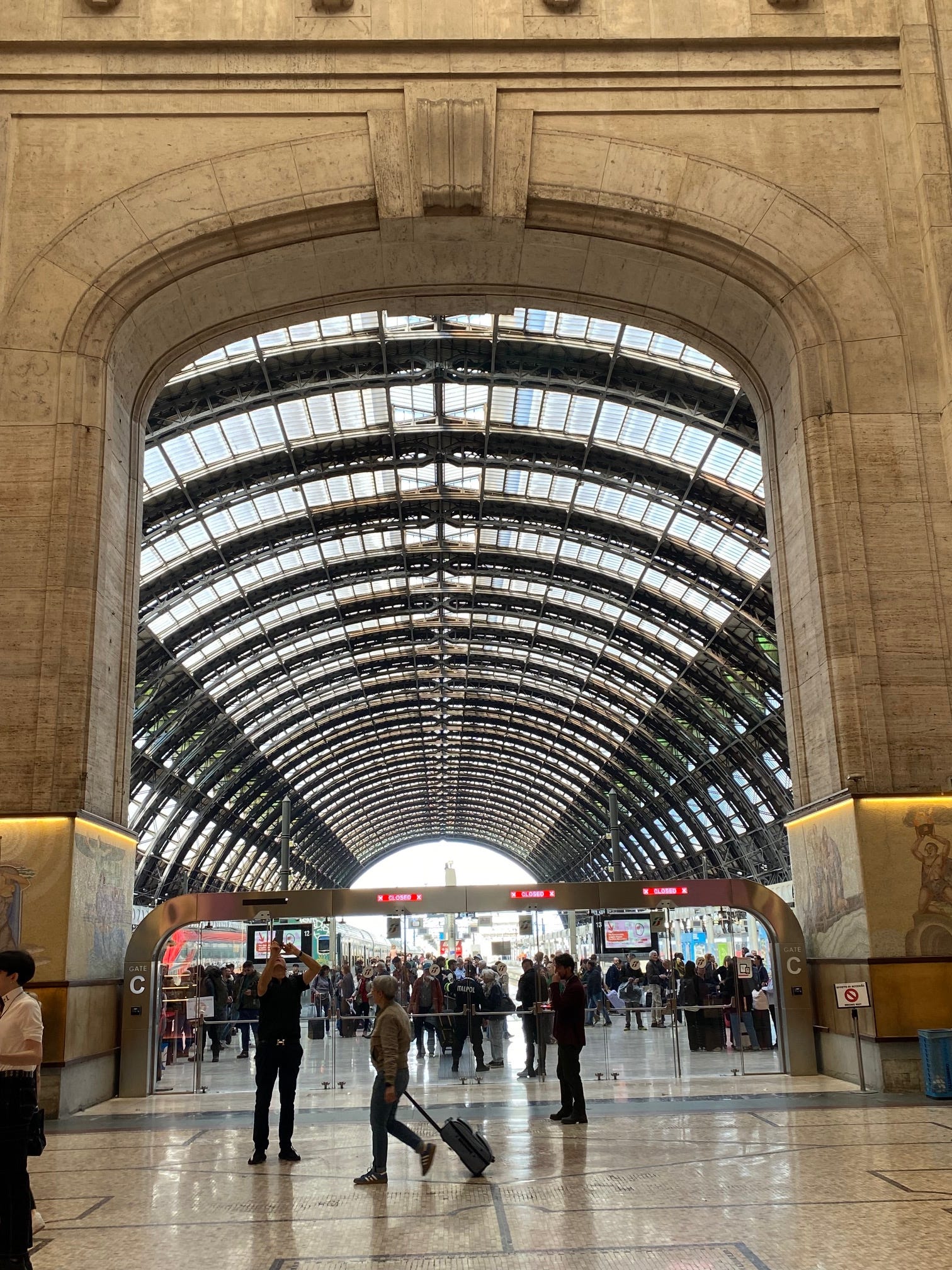
The trains and train stations are awesome throughout Italy; having high quality public transportation is wonderful compared to the mess within the U.S. The trains themselves are large, clean, quiet and comfortable.
The food prices in Milan grocery stores were about 1/3 the cost of what they are in cosmopolitan areas in the U.S. The following prices are in Euros, but the current exchange rate is close to 1:1 at about $1.075 per Euro. These were taken at a local Aldi.
Some additional thoughts:
Prices in restaurants track to tourism; more tourism, higher prices. This applied to McDonalds as well of course (I will admit to grabbing some fries because I was curious what their prices and menu would be) — 3.5 Euro for a soda (lol) but 1.5 Euro for fries. A BigMac meal in Rome would be 11+ Euro, similar to the States.
There is no expectation of tipping in Italy which is refreshing; in the U.S. tipping is always expected at 20% and less than that is considered rude. They even expect tips when ordering from fast food and Starbucks, and they are trained how to make it as awkward as possible for you as they can (they stare at you and don’t say anything or maybe call you by your name).
There are many automated warnings in train stations about pickpockets. It’s apparently a big thing, especially in popular areas. One huckster will engage you or distract you verbally while another picks your pocket; or one will bump into you and try that way. I came across a couple of very aggressive, imposing 6’8” Africans who tried very aggressive sales tactics to solicit change; their English was generally not bad.
The begging situation in Italy is interesting, which I first saw in Milan. In the U.S., at least in major metro areas, there is basically one type of begger: they hold up signs even though most are healthy weight and they’re generally pretty aggressive about coming up to you and shoving the sign in your face. In Italy, though, there appear to be at least three types of beggers: there’s the U.S. kind (which I saw only in Rome), there’s the religious nun kind (raising funds for her Church or nunnery; I gave some change to what looked like a 100 year-old nun, almost totally blind and toothless, outside of the Colisseum), and there’s a prostrating type — a desperate guy who basically lies on his stomach praying, not looking up, appearing sad and desperate, with a cup next to him. I experienced this type in Milan and did a kind of double take; I ended up giving him a couple Euro because the scene kind of moved me, he was subsuming his ego, not bothering the public or even acknowledging them, and just praying that God would provide.
Rooms are tiny, renovated decently in ancient buildings. Unusually tiny elevators.
Note: With the Marriott Bonvoy Boundless Credit Card one can get five free nights at Marriotts worldwide after spending $5,000 within three months of membership. This is a great deal.
Day-trip to Como
In Como the non-natives were about 15% of the population, at least of the tourists; this was surprising as Como is known as a wealthy area and the land of George Clooney. Interestingly Florence and also Rome seemed to be much more oriented toward what I considered to be a traditional tourist element — generally whiter, middle-aged or elderly, middle class or above.
Based on history the trends will be for major cities to become non-white and non-Christian throughout the West and for the rural areas to hang on longer. This phenomenon was experienced in Roman history: the term “pagan” was a Christian slur meaning “rural”; they were the Hellenic rural types who held onto their beliefs much longer than the urban or suburban types. As the West is gradually subsumed to Africans and Muslims I would expect small, rural towns to hold out longer, although globohomo is doing everything they can to target these areas for mass immigration.
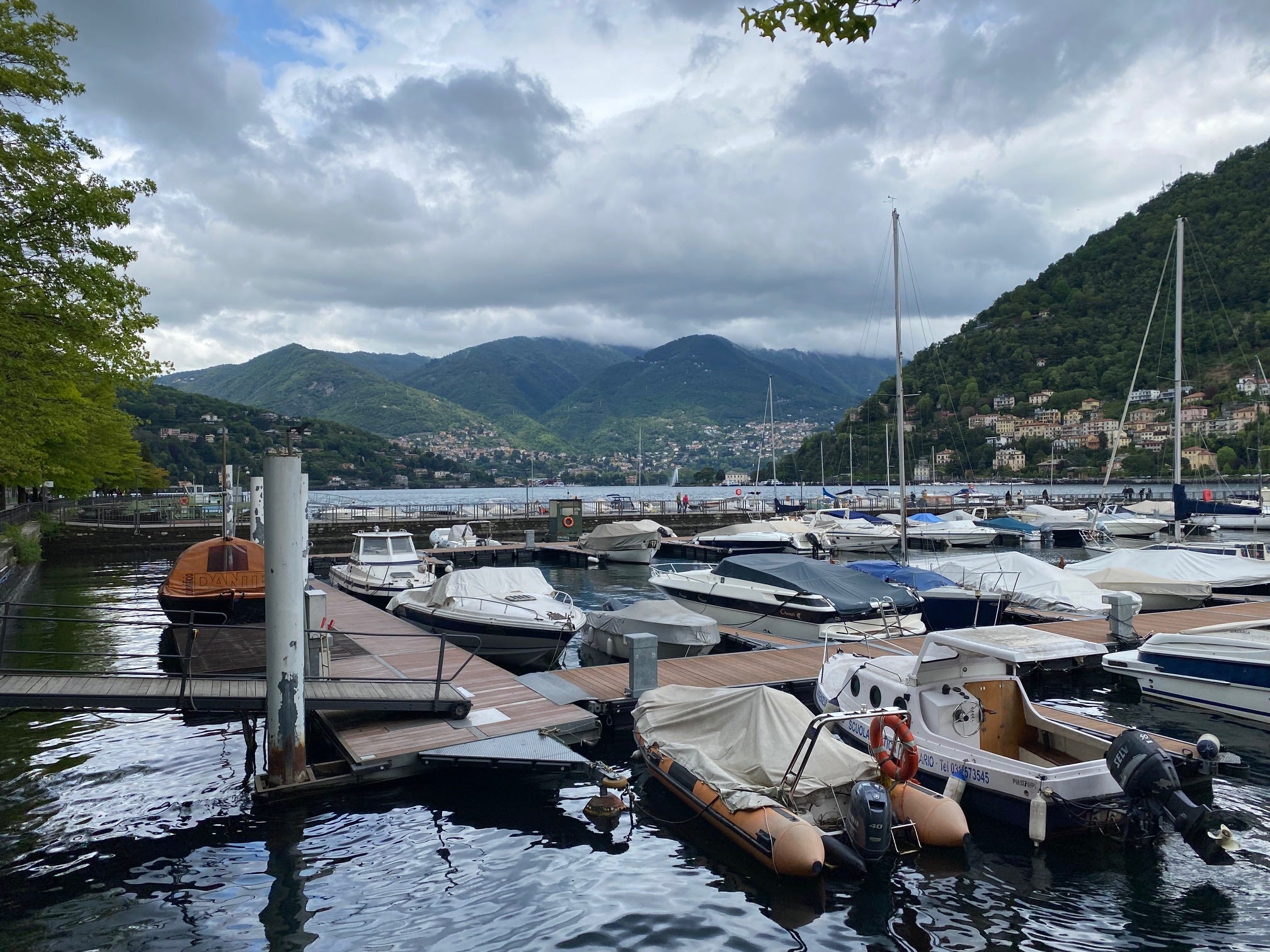
View of Lake Como:
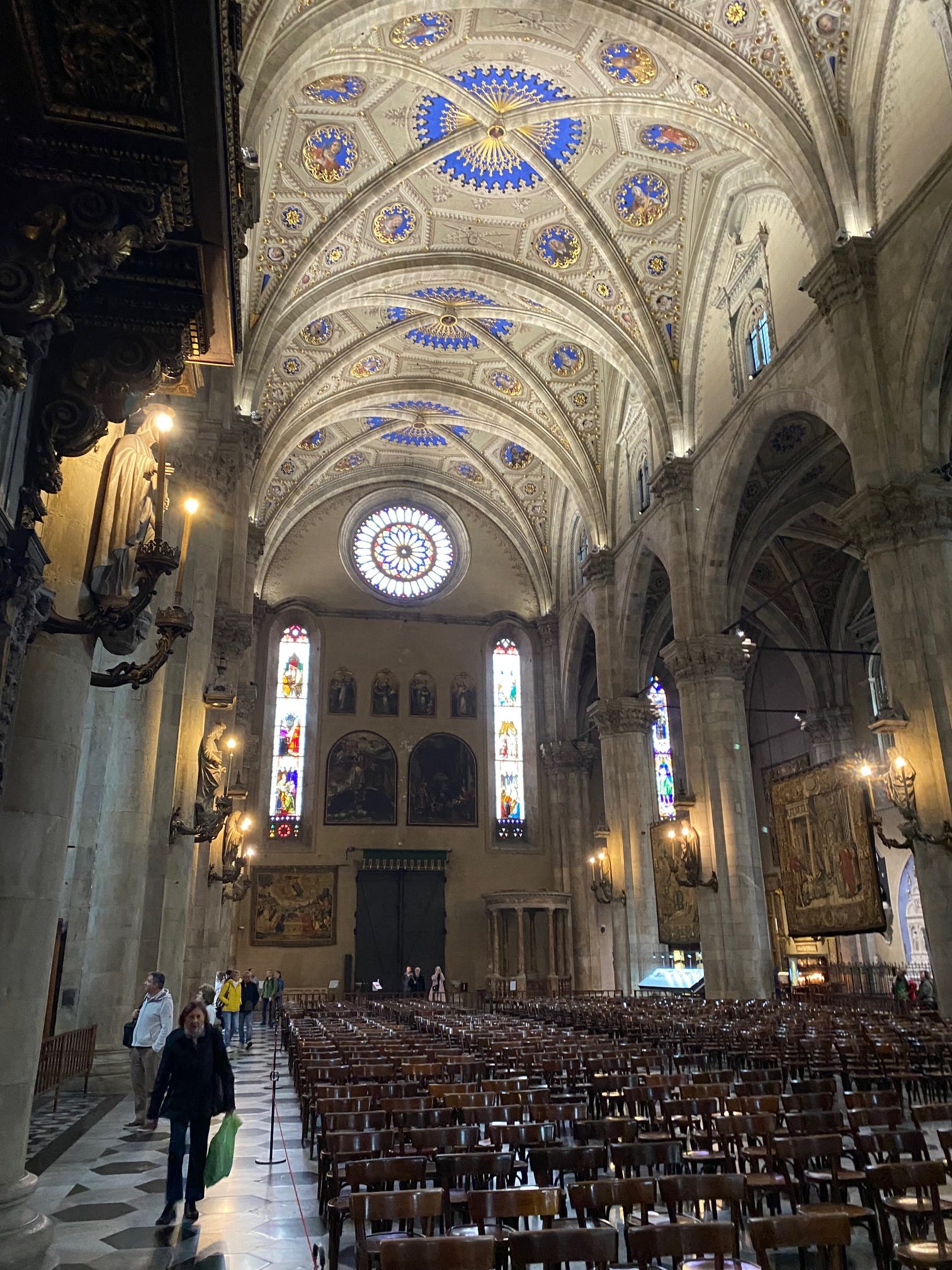
Inside of Como Cathedral, which was empty on a weekday except for tourists:
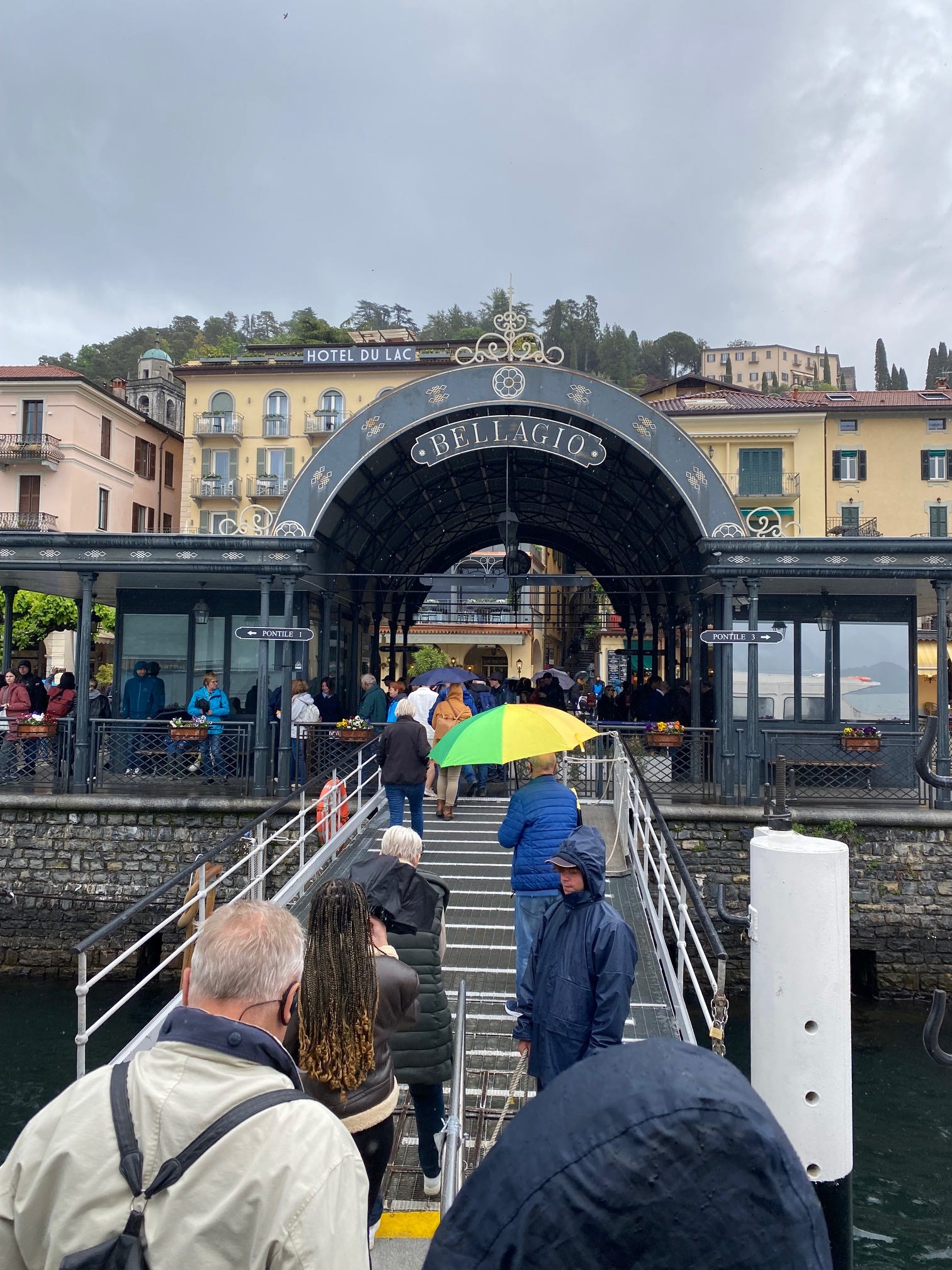
It was raining so I wasn’t able to take any good photos on the boat to the town of Bellagio, a pretty little town which served as inspiration for the Las Vegas Bellagio resort:
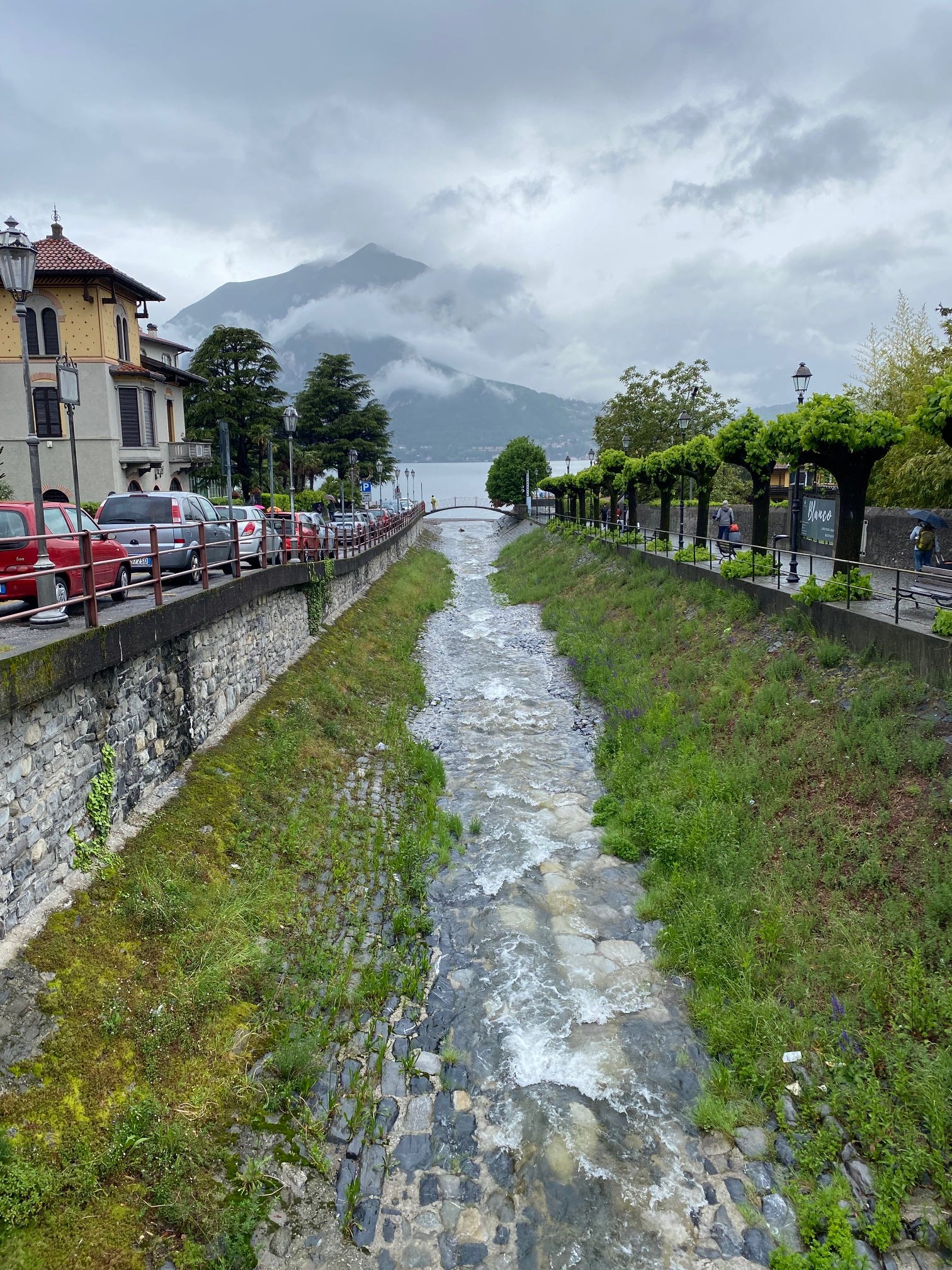
A little stream flowing into the lake from Bellagio. Lake Como is massive:
Some additional thoughts:
There was a significant amount of American culture: music playing in the cities visited, lots of signs and restaurants in English including on the train, and many or most Italians speak English at least to an extent. This was helpful as I am retarded with languages.
Salesmen don’t pressure you in stores which I appreciated. In America you are swarmed by offers of assistance whenever you enter somewhere.
The stupid American zoomer perm has caught on strongly among Italian youth (and of Canadian youth; ahem, Christopher Brunet);
The numbers of tattoos was fairly high but nowhere close to as high as in the U.S.
I did not see much obesity except among foreigners.
The average Italian appears to be a product of much breeding between different groups. They almost look and sound Jewish to me. Their general attitude seems to be lovers by disposition and not fighters; Leon Degrelle thought they were not very good at warfare in his On the Eastern Front, that they were whimsical and lyrical and just wanted to goof off and have fun.
Few kids were seen other than among the Muslims. The high cost of living makes it harder to have them, combined with the nihilism permeating society encouraging anti-natalism and hedonism, along with extreme societal incentives to suppress native population growth (high taxes, censorship, high immigration etc.). If you want to get a sense of what a society looks like that actually encouraged native population growth, look to the example of Gaddafi in Libya.
Not many smokers seen which was surprising. I guess the anti-smoking propaganda which was so pervasive in the U.S. has finally impacted Europeans.
Many stores close for a couple hours after lunchtime, including restaurants, from 2-5pm or so. This is a great European tradition but it seems to be fading.
Florence
I didn’t get to see as much of Florence as I would have liked because I came down with a two-day case of a mild flu (also known as “COVID” or as I like to call it, fraudvirus). But before I came down with it I did get a chance to take a five-hour electric bike tour of the surrounding countryside. The much more popular tour was the scooter tour, which maybe I should have done but the e-bike tour was fun enough.
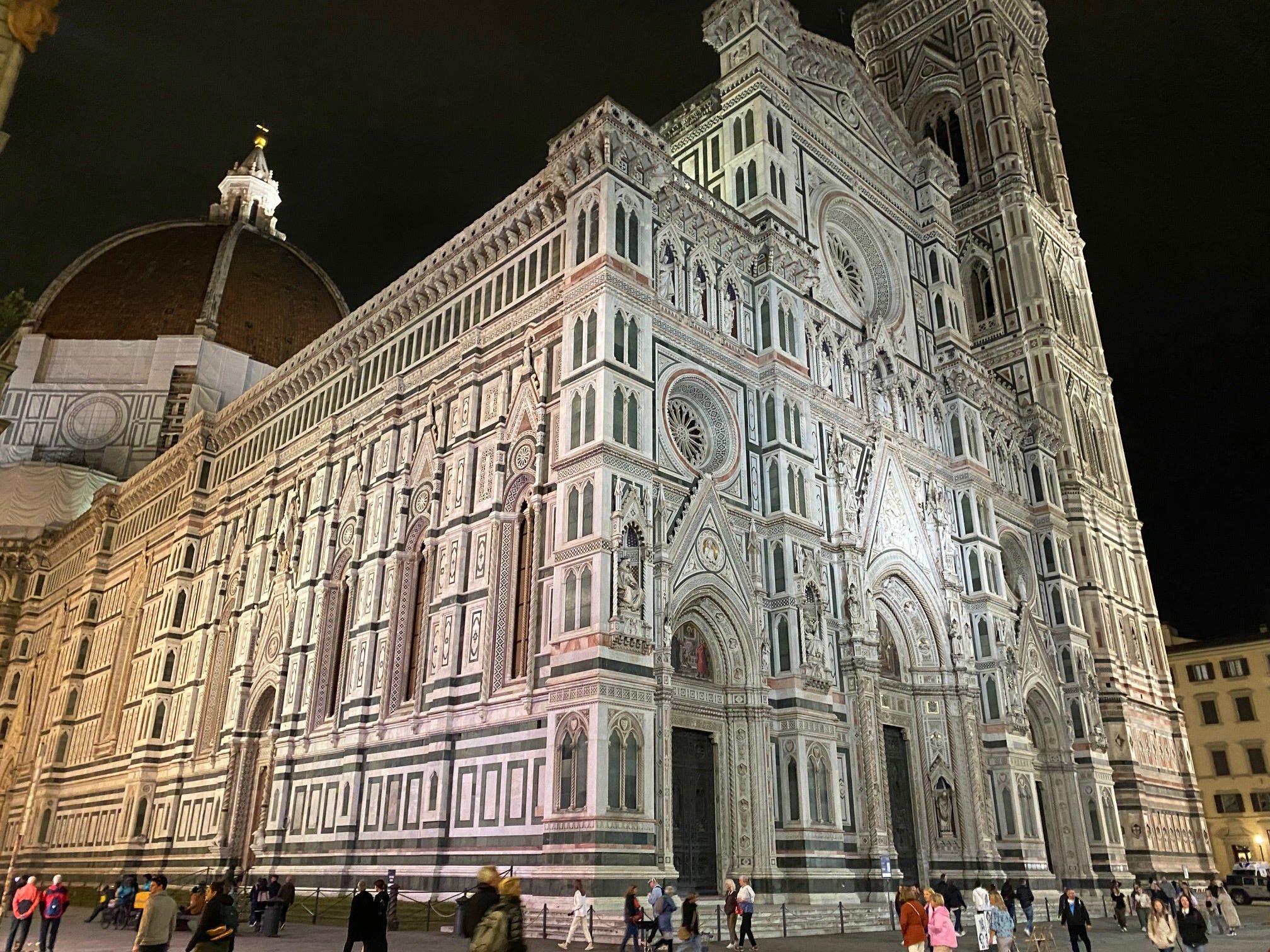
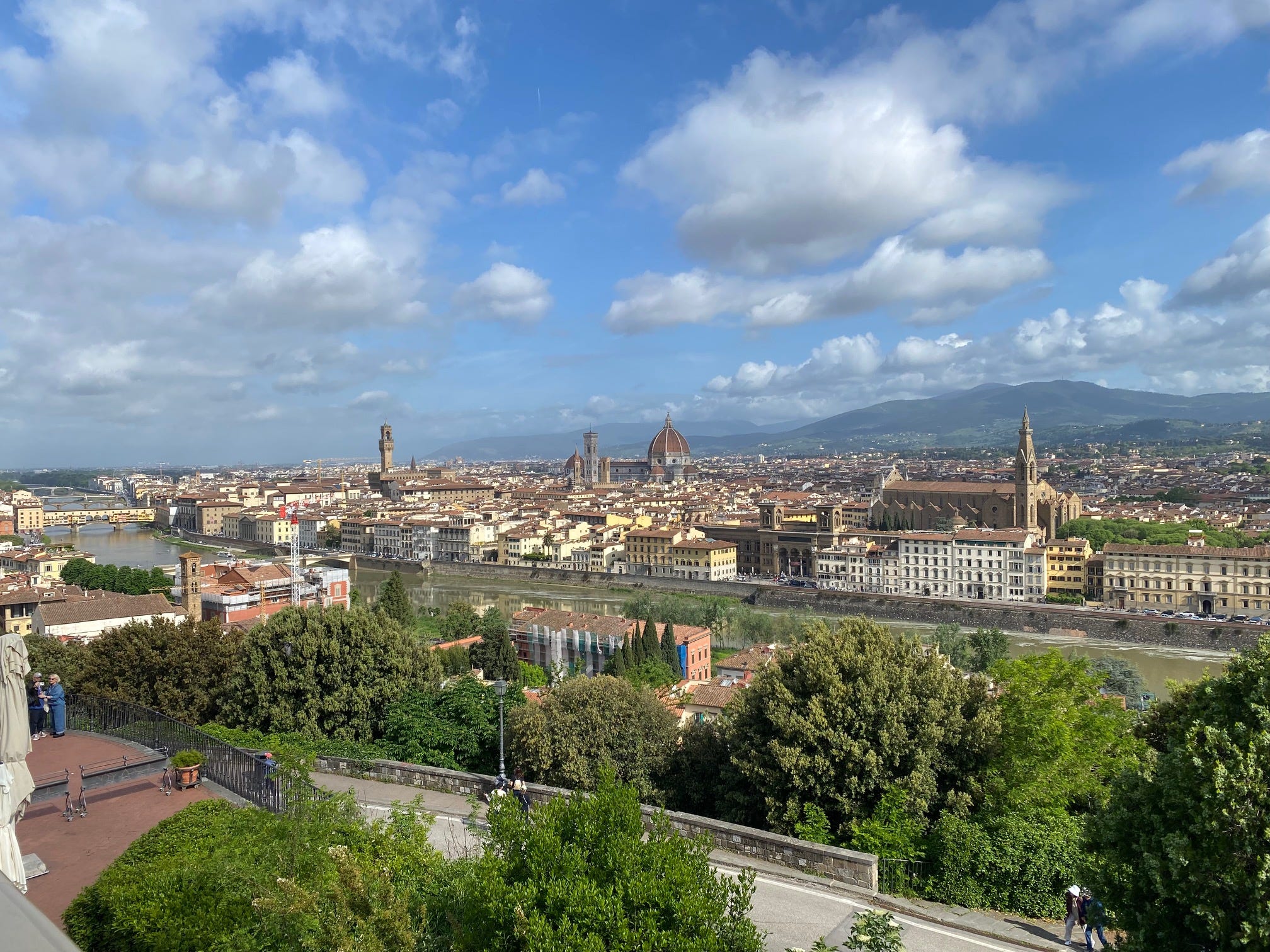
The Florence Cathedral, also known as the Duomo, dominates the city. You can see the size of it based on the below photo. It looks even bigger in person, comically large:
You can see the Ponte Vecchio on the far left and the Duomo in the center.
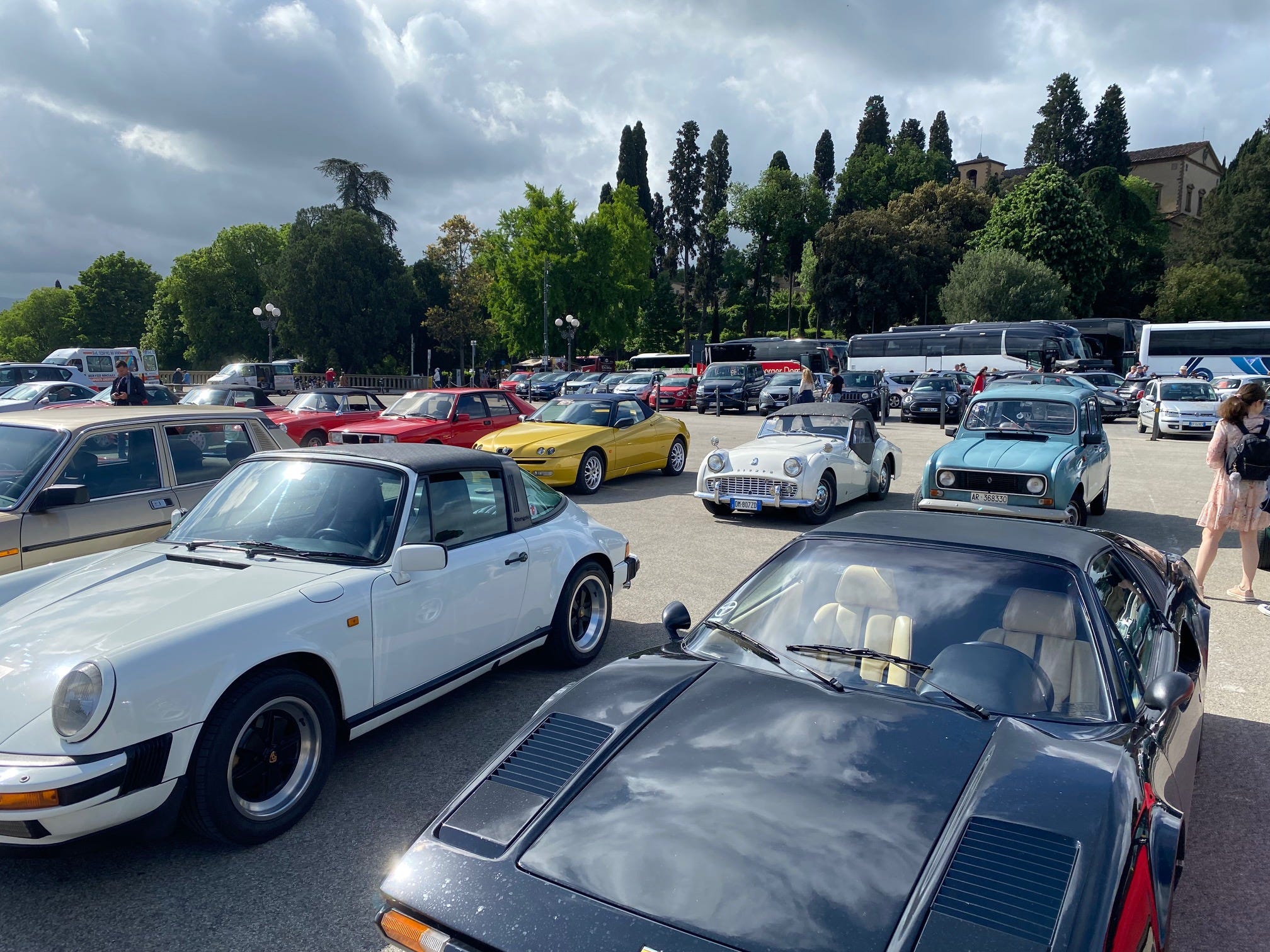
Curiously there was some sort of old car exhibition at the Piazzale Michelangelo:
The e-bike tour stopped off for wine and olive oil tasting and a pasta lunch. I got some information on the economics of local living in Italy from the tour guide. He was middle-aged, from southern Italy, paid $800/month in rent to live in the city, he says the owners of properties (who generally don’t live in town) mostly do AirBnB where they can get about $1,600/month in rent from vacationers and not have to deal with local tenants who struggle to pay rent. As such, the locals are getting pushed further and further out. He said he works all the time and he likes to work outdoors, maybe he makes $100/day not including tips, with tips it’s still not an easy life. I didn’t have the opportunity to ask him about immigration trends. I did ask him about the mafia adulterating olive oil (which I’ve read about elsewhere) but he denied it; I’m not sure if that answer was honest. He said regular biking eventually gave him a bad back, but by switching to e-bikes his back no longer gave him issues (one can’t bring a car into Florence itself so he was used to biking).
Some general comments:
Throughout the trip I tested the theory that Italian/European food ingredients were of such higher quality that they would prevent me from gaining weight if I ate what I wanted (carb heavy), combined with a lot of walking. Nope, I gained weight and felt badly – there goes that theory. Or maybe it used to be true but stopped being true as EU food quality is also going downhill? Regardless, I had to limit carb intake.
There’s no American-style coffee, only “Americano” which is espresso with hot water on the side. Part of the pleasure of coffee is sipping it so I wasn’t really getting my normal coffee fix here. I saw only one Starbucks in Italy which was in the Rome train station, but otherwise the coffee shops are local – a good thing.
Water is served either flat or sparkling, but with no ice and you have to pay 1.5-2.5 euro for it in restaurants.
About 5% of people were wearing face diapers still, mostly older women.
I wanted to buy a blue leather jacket but the one for sale near the Ponte Vecchio was like 900+ euro (probably negotiable), there were a bunch of such stores in Florence but couldn’t find it elsewhere and didn’t have time to figure it out before we left. Bummer. Yeah, there are lots of blue leather jackets for sale online but they look of much cheaper quality and probably different materials used.
Italians can instantaneously tell who is a tourist and who isn’t. This post explains some of the ways how they are able to do so.
Rome
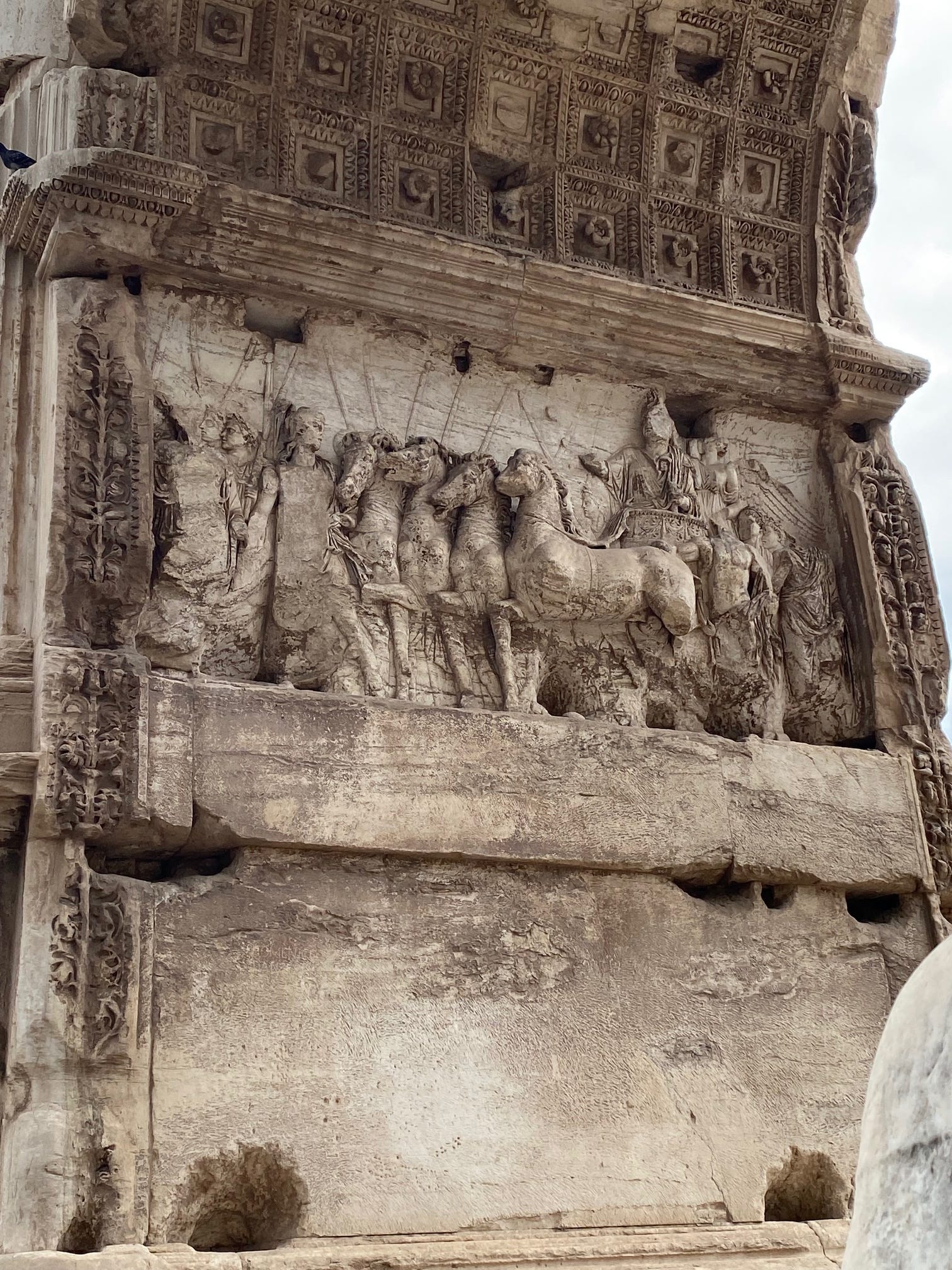
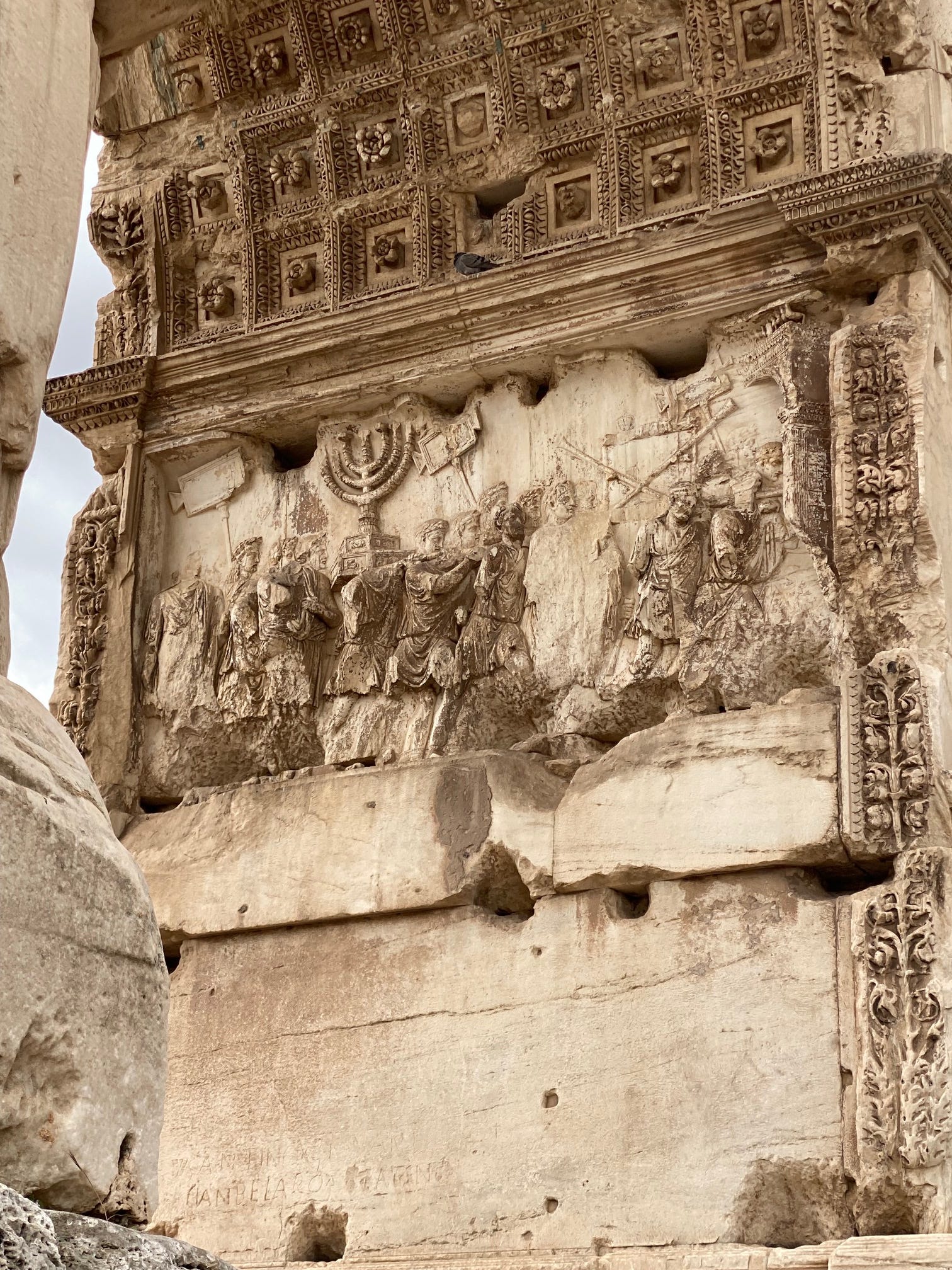
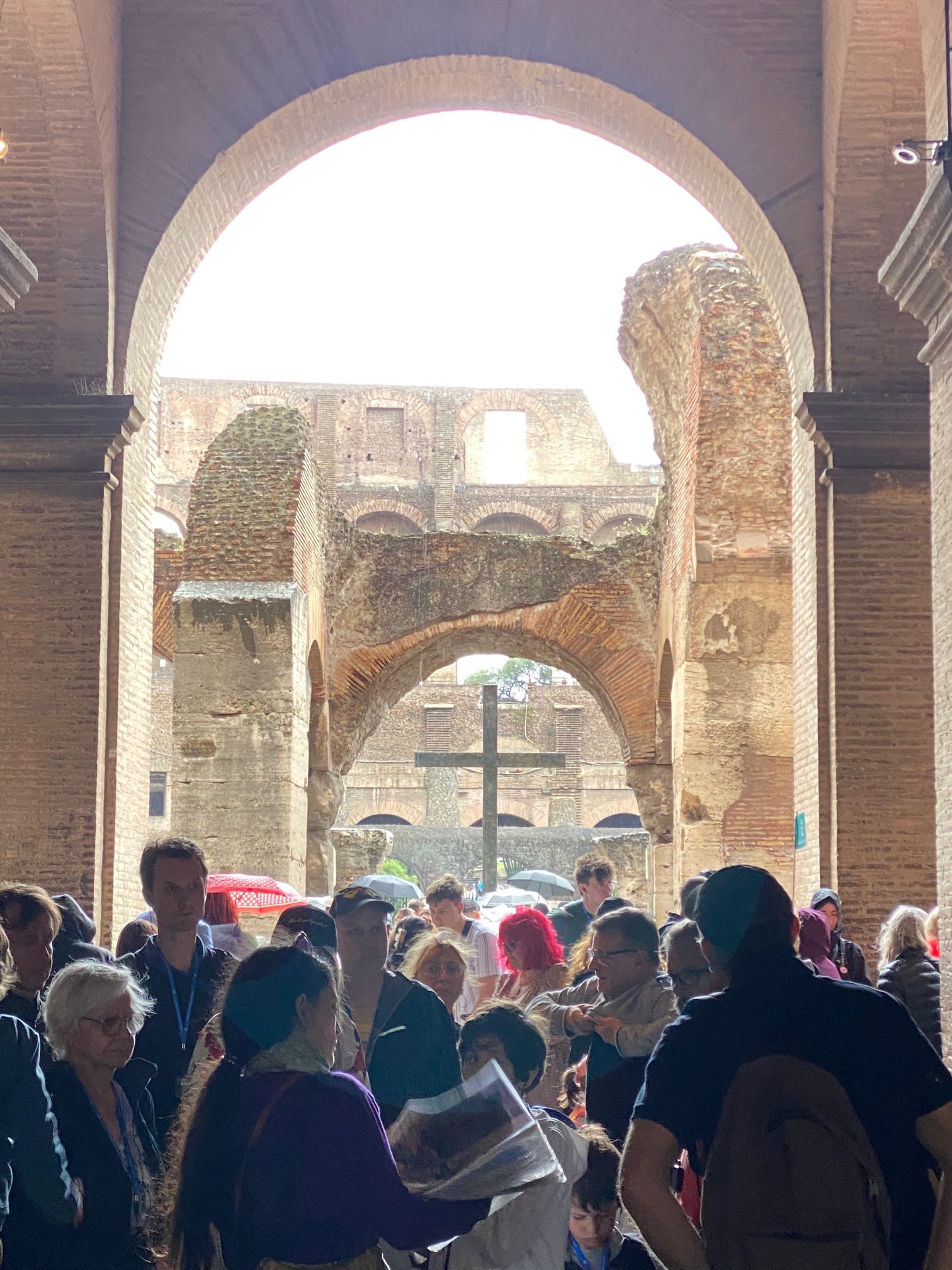
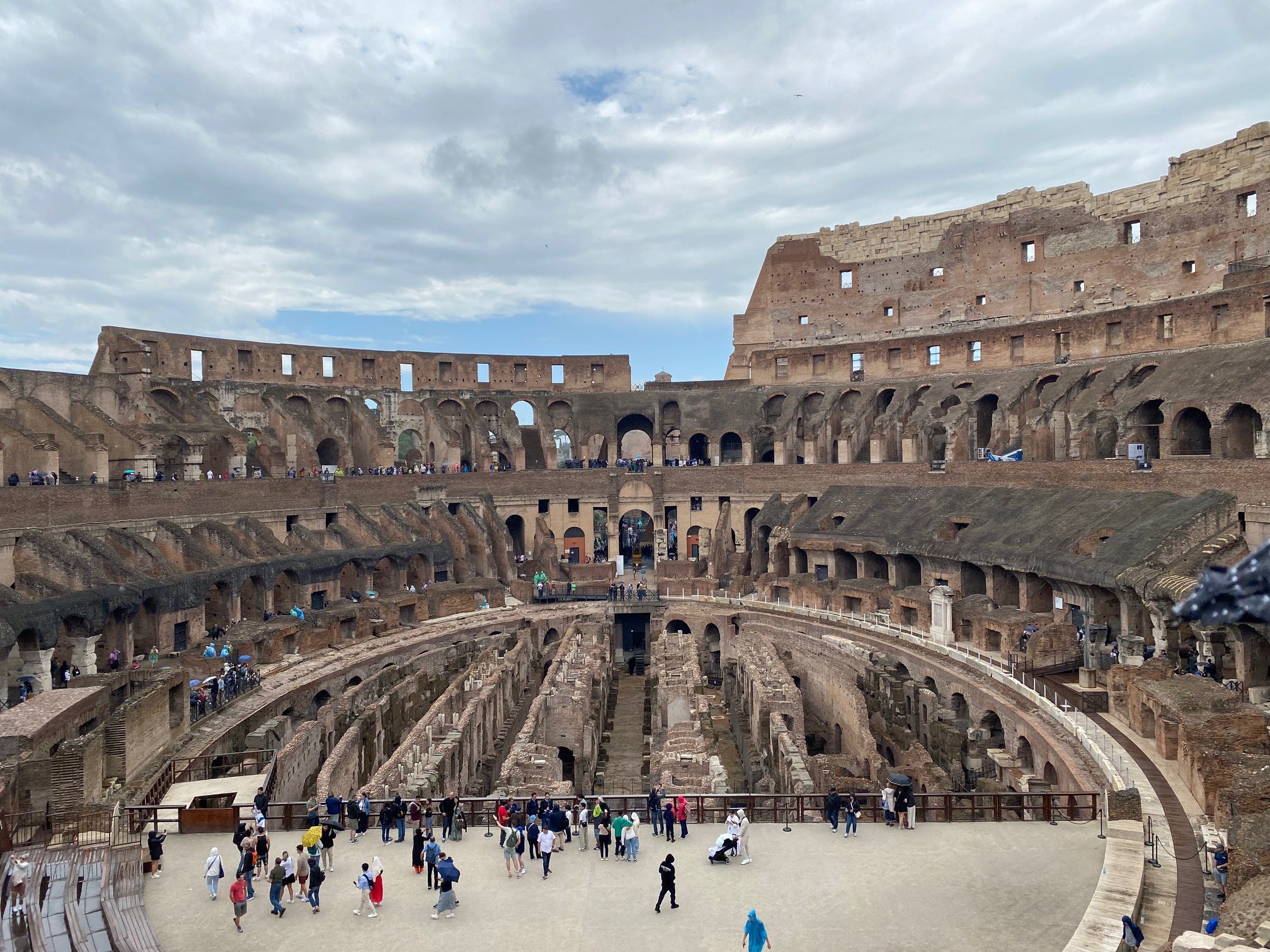
I was supposed to be in Rome for four days but spent two of them in bed with fraudvirus. As such the Vatican tour was cancelled and I didn’t get to see museums or Churches the way I wanted to, nor did I get to visit the ruins of the Praetorian Guard’s facilities at the Castra Praetoria or see the Appian Way. Instead, I had time to see the Colosseum, Forum and surrounding areas (even though it rained part of the time), the Arch of Titus (discussed previously here), the incredible Trevi Fountain, the Pantheon, the Aventine keyhole and the Spanish steps.
Some select photos:
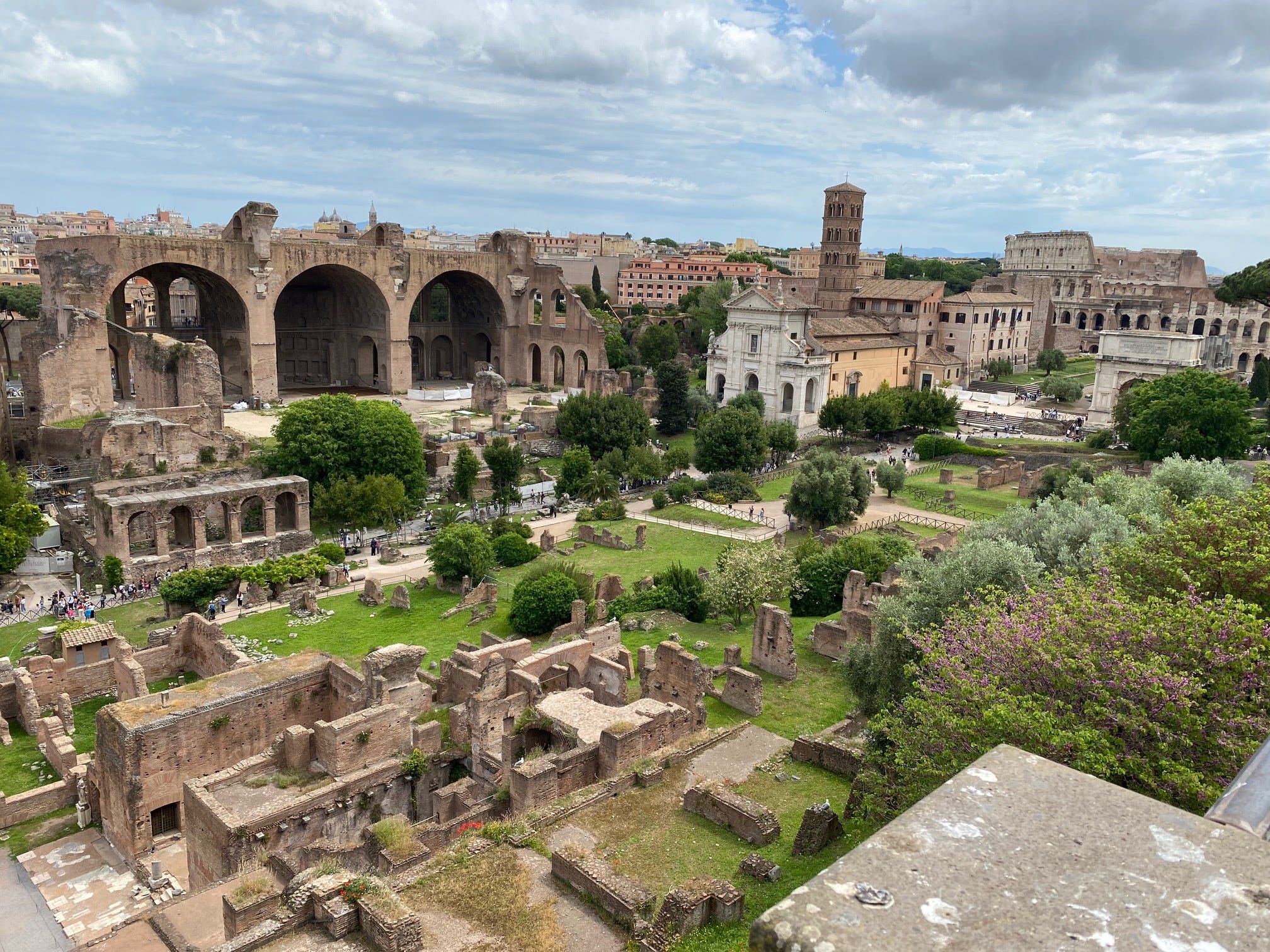
View from the Palatine Hill. I was excited to see this area because it featured heavily in one of the greatest television shows of all time, Rome.
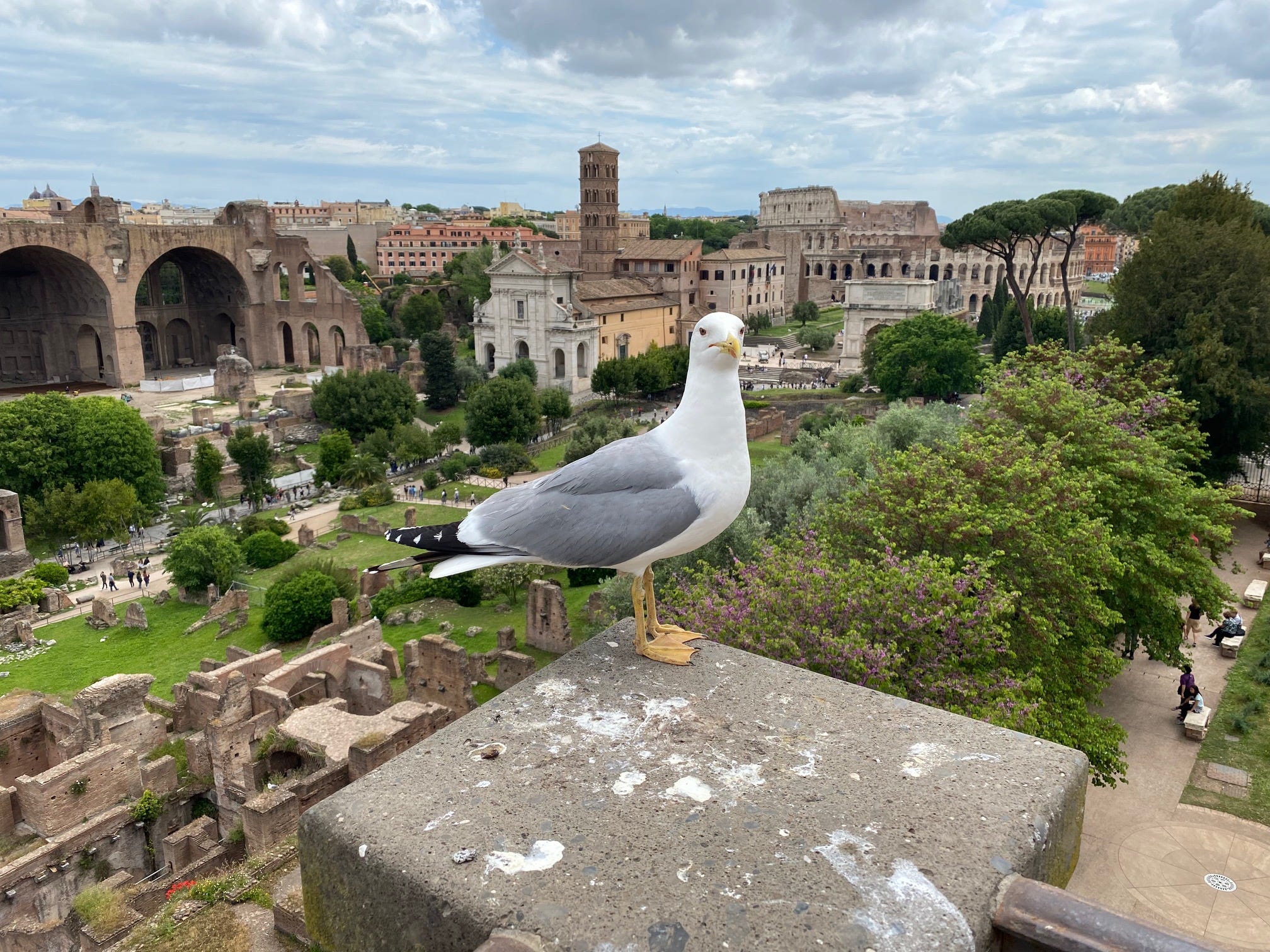
Seagulls are a fairly new species to Rome, originally arriving in 1971. Even though I’ve seen plenty of seagulls in my life for some reason the ones here sounded like meowing cats. I should have recorded them. The one here had absolutely zero fear of humans and I probably could have pet it, I got that close.
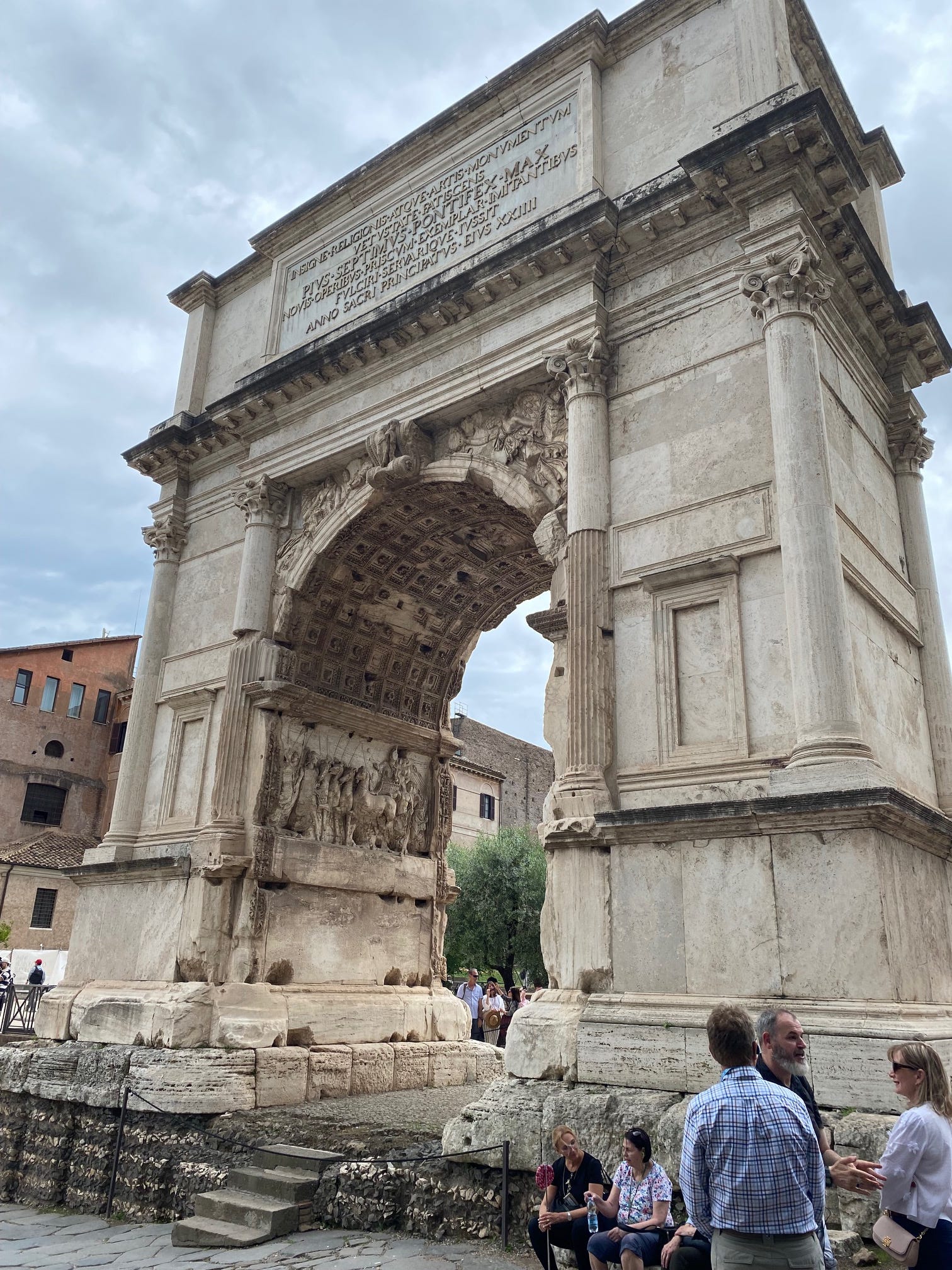
The Arch of Titus.
Note the Romans bringing in the Jewish Menorah as war booty after conquering Jerusalem.
This was one of my favorite photos; the Colosseum of Rome conquered by Christianity.
The farther off section shows the underground complex beneath the Colosseum.
Gas prices of let’s say 1.90 euro per liter. That’s about $7.75 after converting liter to gallon and converting euro to dollar if my math is correct, about double what it is in the States – but I thought it would be higher especially with the obnoxious foreverwar in Ukraine now.
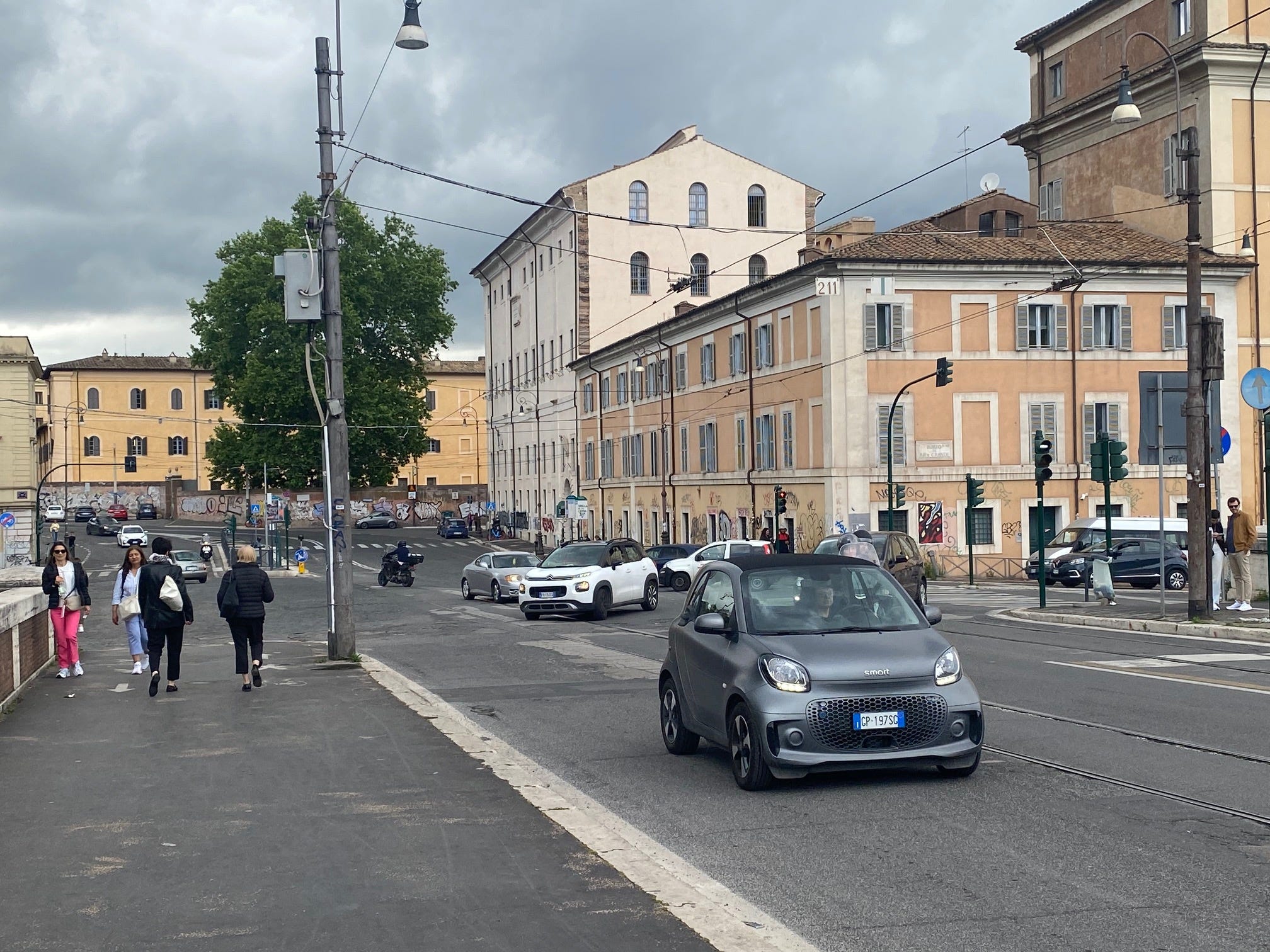
The Italians love their graffiti, you can see it all along the building walls outside of the tourist districts. This is perhaps native to the Italian character; Pompeii had lots of ancient graffiti as well.
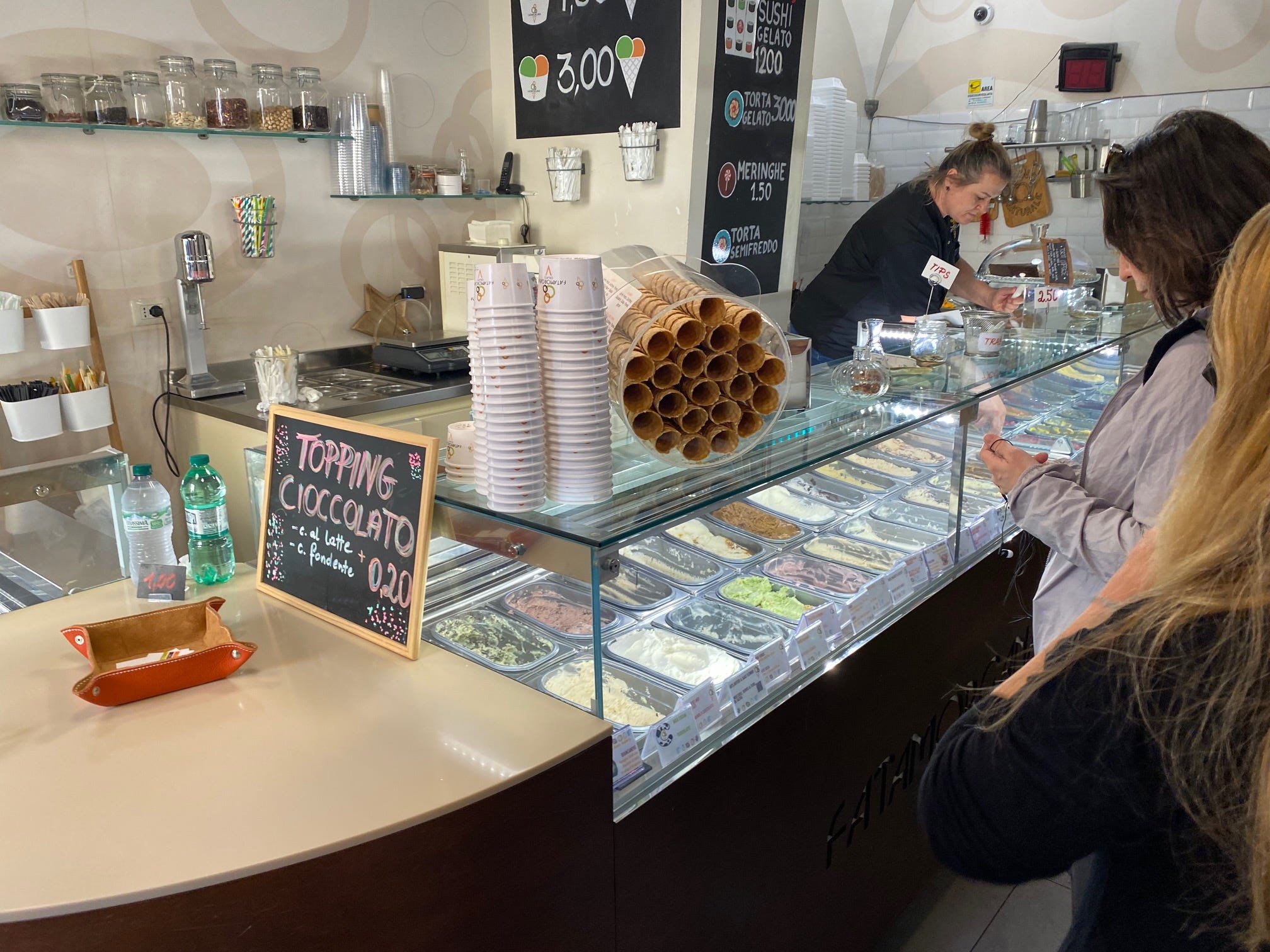
Gelato was everywhere; a national pasttime.
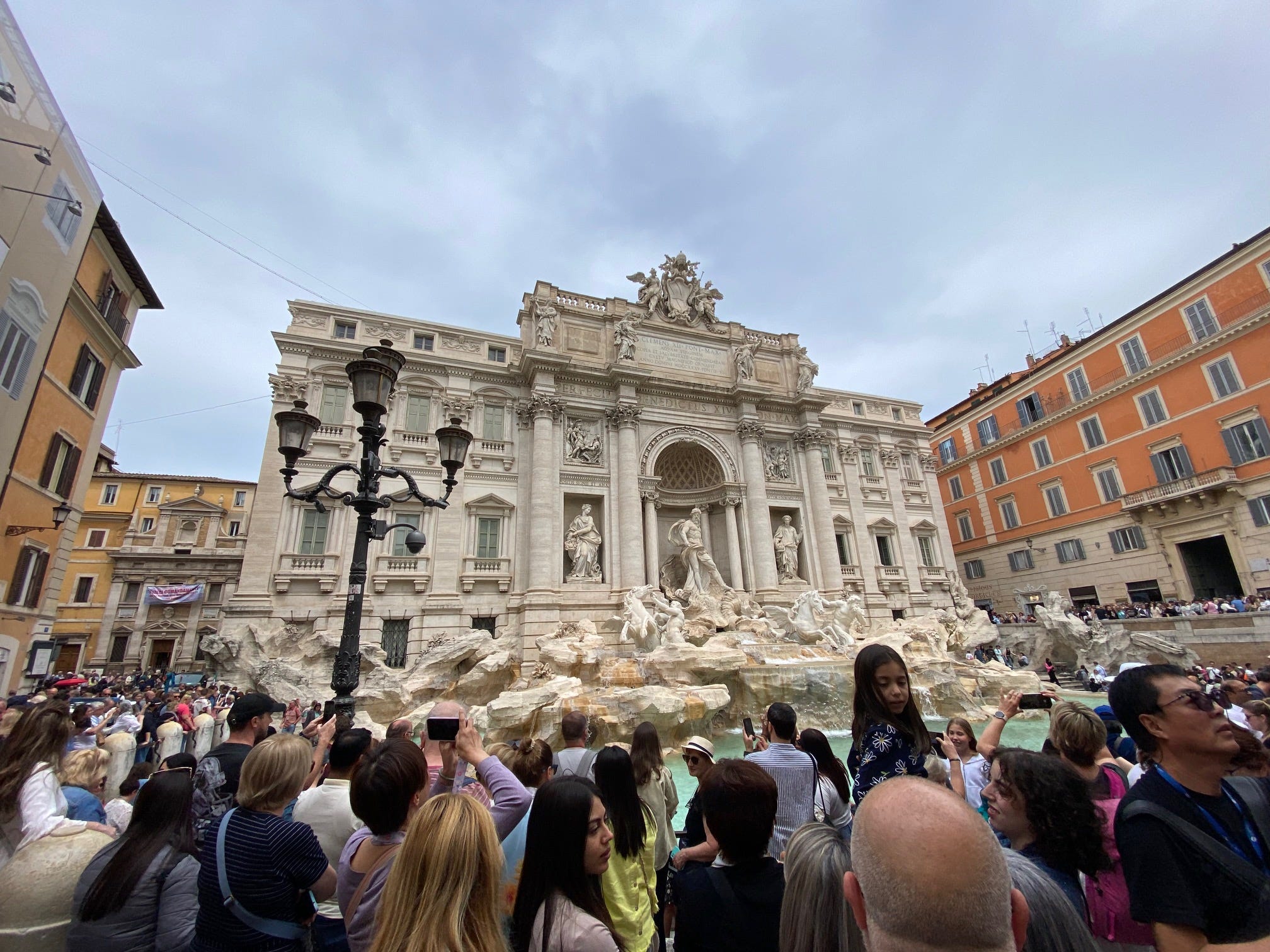
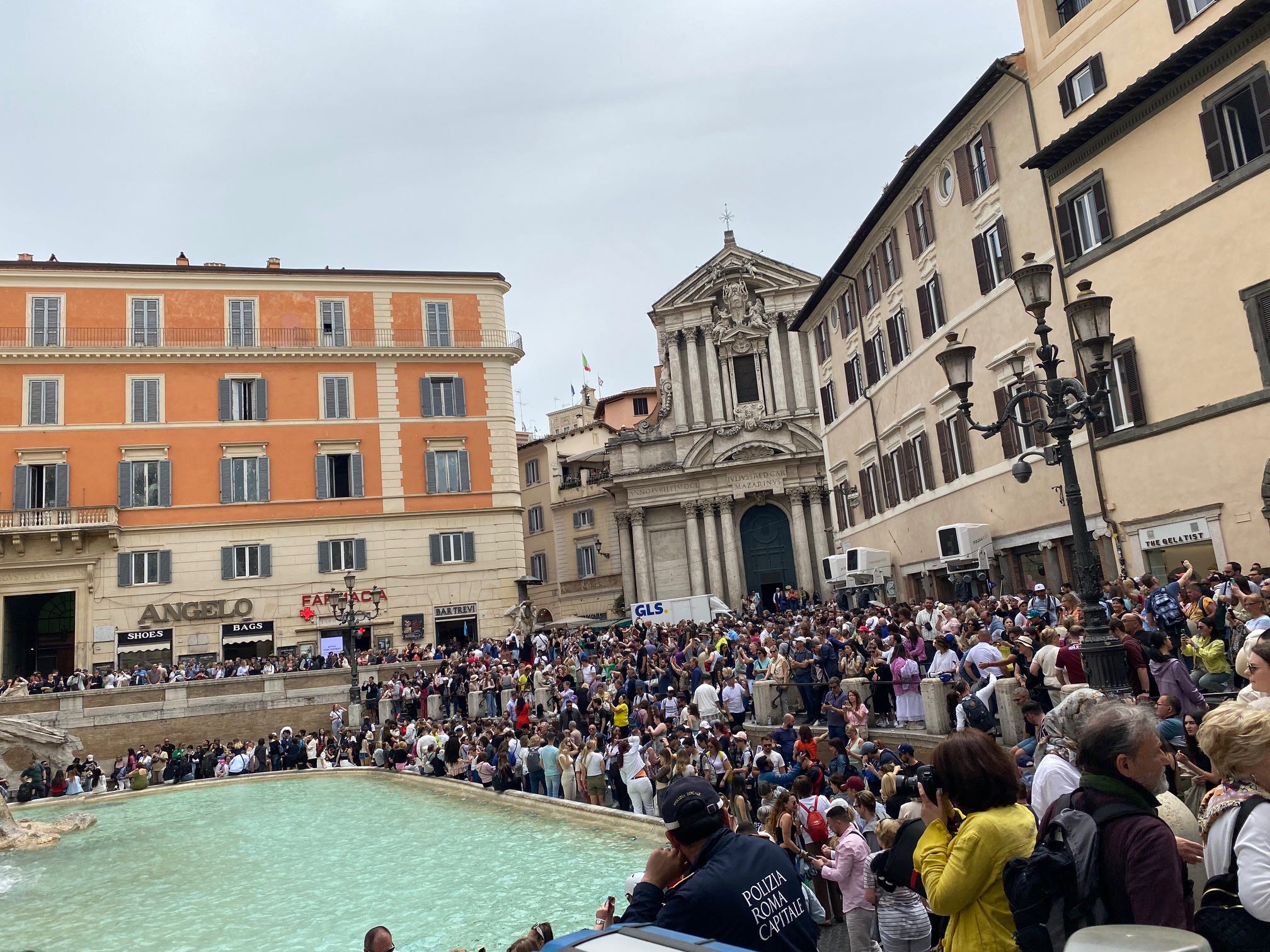
The Trevi fountain.
You can get an idea for the size of the monstrousness of the crowds. It was extreme at the Trevi fountain but bad everywhere.
Some additional comments:
Many places don’t accept cash like when paying to access the park/Colosseum. I didn’t like this as it portends a continued transition to digital currency, which will only be used for control and other diabolical schemes despite its convenience.
The tourist population in Rome was what I expected compared to Milan, Como or to a lesser extent Florence. It was white, middle aged or elderly, and middle class or wealthier. It was much busier everywhere than it was a decade ago, though. But see this post by Pox Populi who comments on the extremely rapid and in-your-face demographic transformation of Rome.
There was a marijuana shop that I saw at one point, which was surprising. Is Europe copying the American legalization trend? (or perhaps it is a separate trend?)
There were lots of teenagers bused in on school tours from all over the country.
There were lots of priests wandering Rome in their garb, as one would expect.
I saw further evidence of American culture: J Lo poster, McDonalds everywhere, lots of billboards and signs in English, English-produced movie advertisements. There was a Five Guys at the metro station.
It’s an interesting question to what extent Italy lives in the past compared to the present. It’s chief economic drivers seem to be tourism, olive oil exportation, leather goods, fashion and cars, and some other strange things. But when one is surrounded by such beautiful, ancient architecture, and your country relies so much on foreign tourists, plus you remain militarily occupied heavily by the United States — it seems quite easy to live in the past. It’s a very different mentality than the American mentality, anyway, I would suspect…
On a similar note, it’s strange to be around so much beautiful architecture from hundreds or thousands of years ago compared to the horrendously ugly modern architecture, none of which is designed to last hundreds of years the way Italy’s ancient architecture was.
Naples/Sorrento/Capri
I took the train to Naples; the area around the train station was the worst place seen in Italy, dirty, homeless, graffiti everywhere, a pervasive sense of danger, surly people and lots of migrants. To get a sense of it see this brief video here. The drivers were among the worst in Italy, significantly more aggressive than New York City drivers. One cab driver came close to running over about a dozen people; it was kind of impressive that a pedestrian wasn’t dead after the ride. He ripped me off on fare as well. I rented a car and Google Maps directed the car through the back country to get to Sorrento. This was a bad call as the roads were very windy and narrow; to get by each other cars would have to push their side car mirrors in.
Sorrento and Amalfi was the first breathing room I felt within Italy. Everything else was too busy, too packed, with tiny rooms even if renovated decently in ancient buildings and tiny elevators. In Sorrento one could actually breathe and have a measure of space.
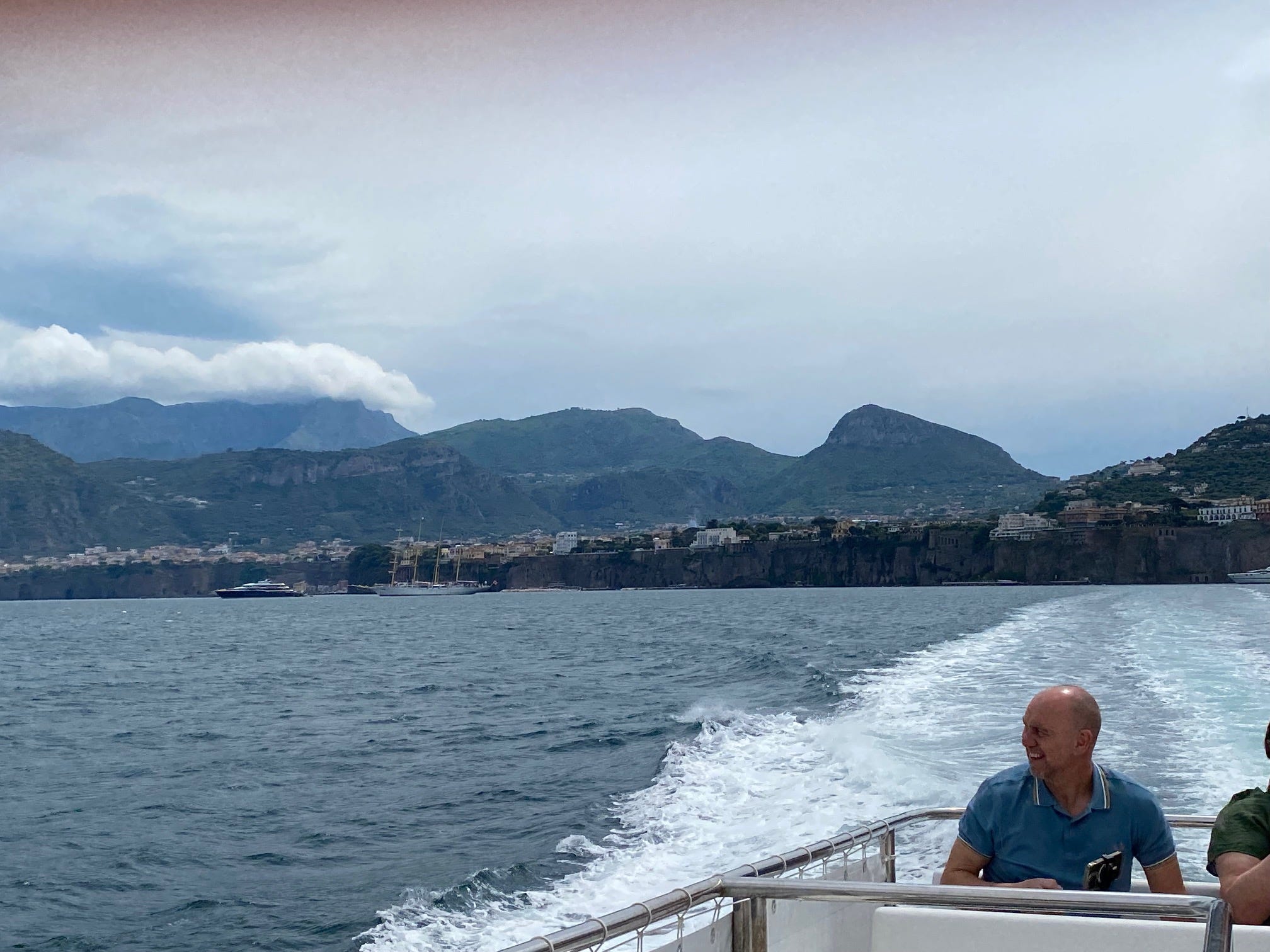
You can see the Amalfi coast in the background. The walls are sheer and well over a hundred feet high. You need to climb winding stairs or pay 1.5~ euro to take an elevator up or down.
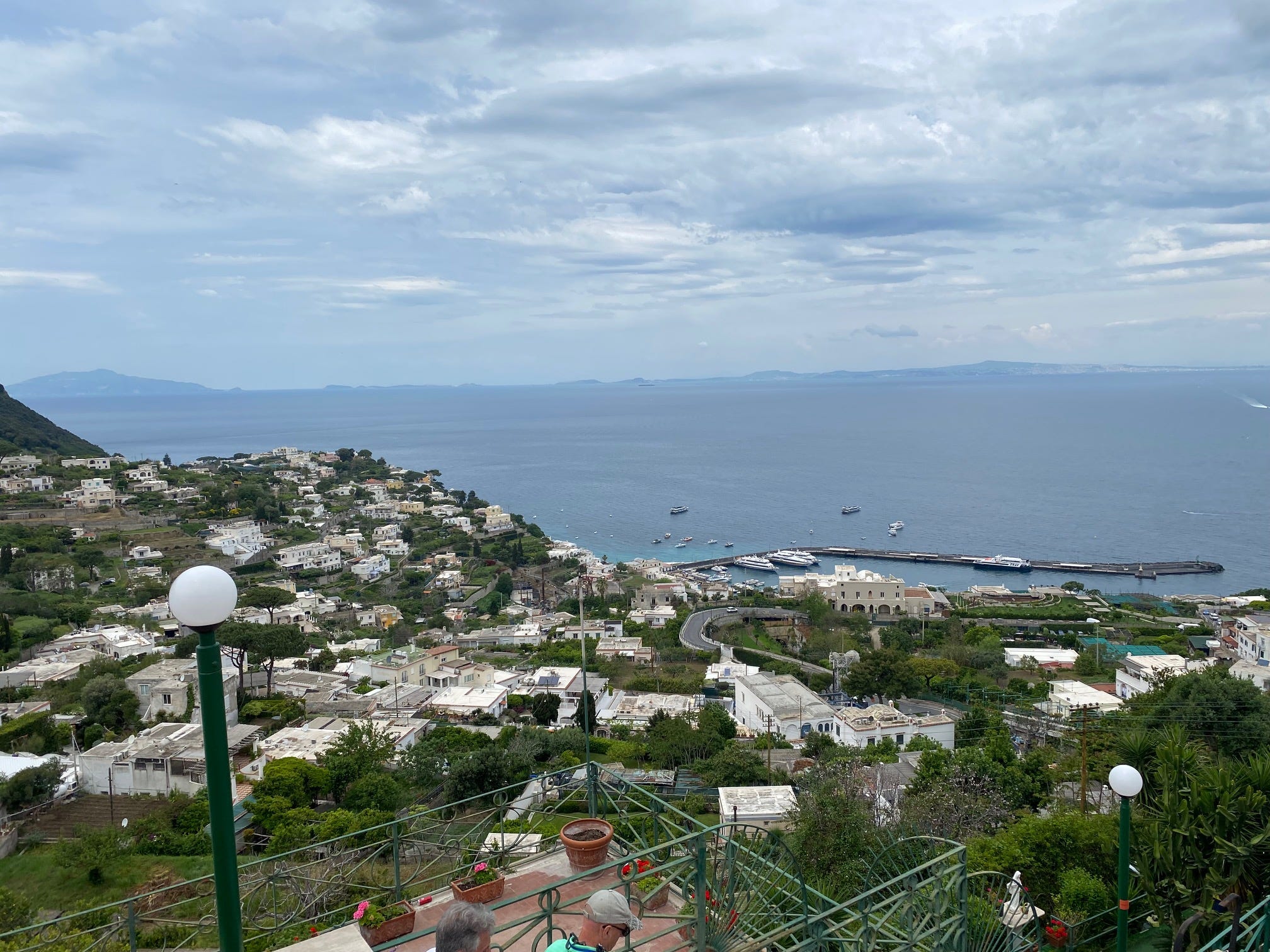
The hills of Capri facing the harbor. I found the hills to be a lot more fun and interesting than the tourist trap immediately around the docks, but the whole area was overly expensive and extremely crowded.
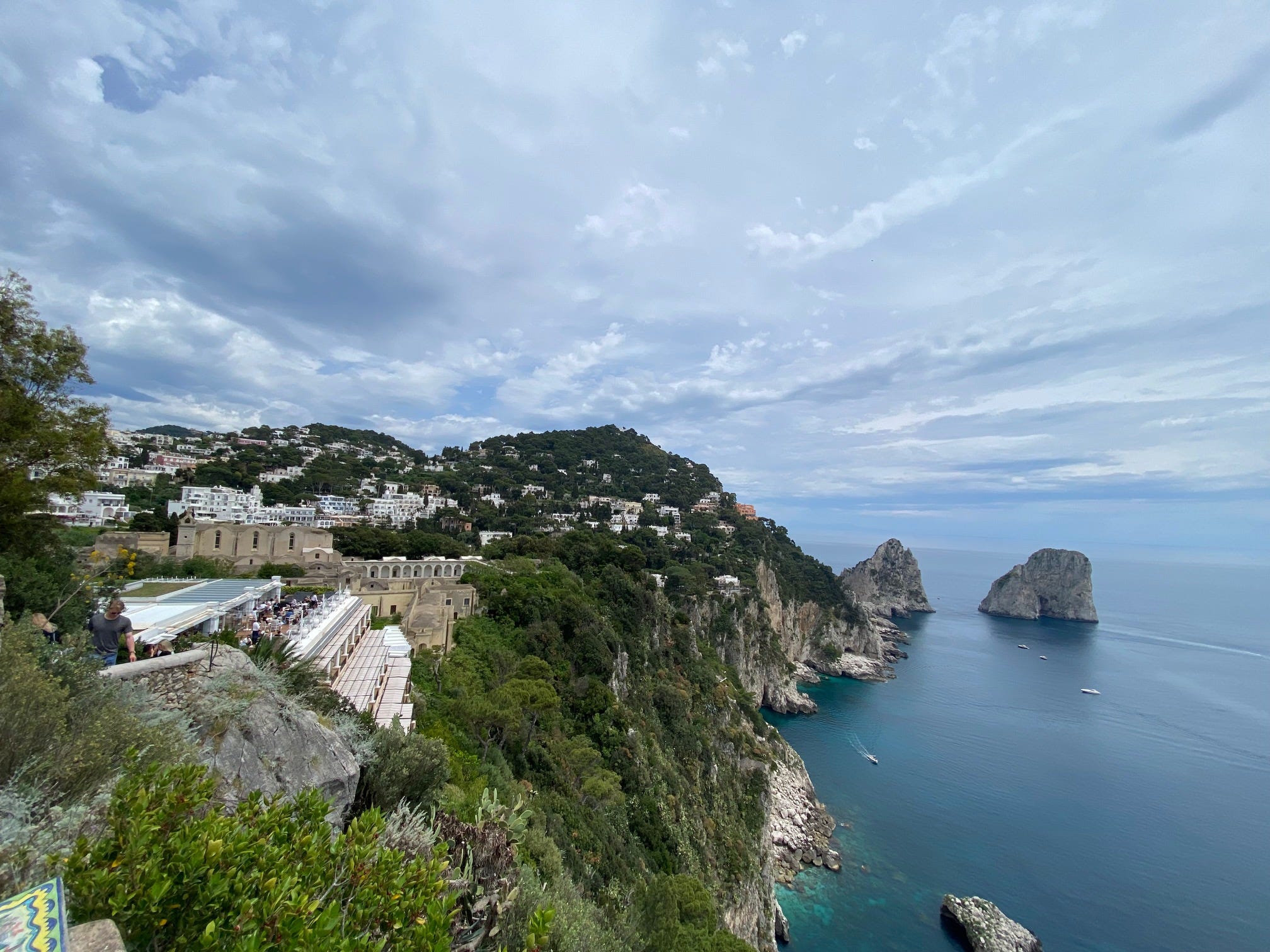
The back of Capri facing away from the harbor. The cliffs are multiple hundreds of feet high.
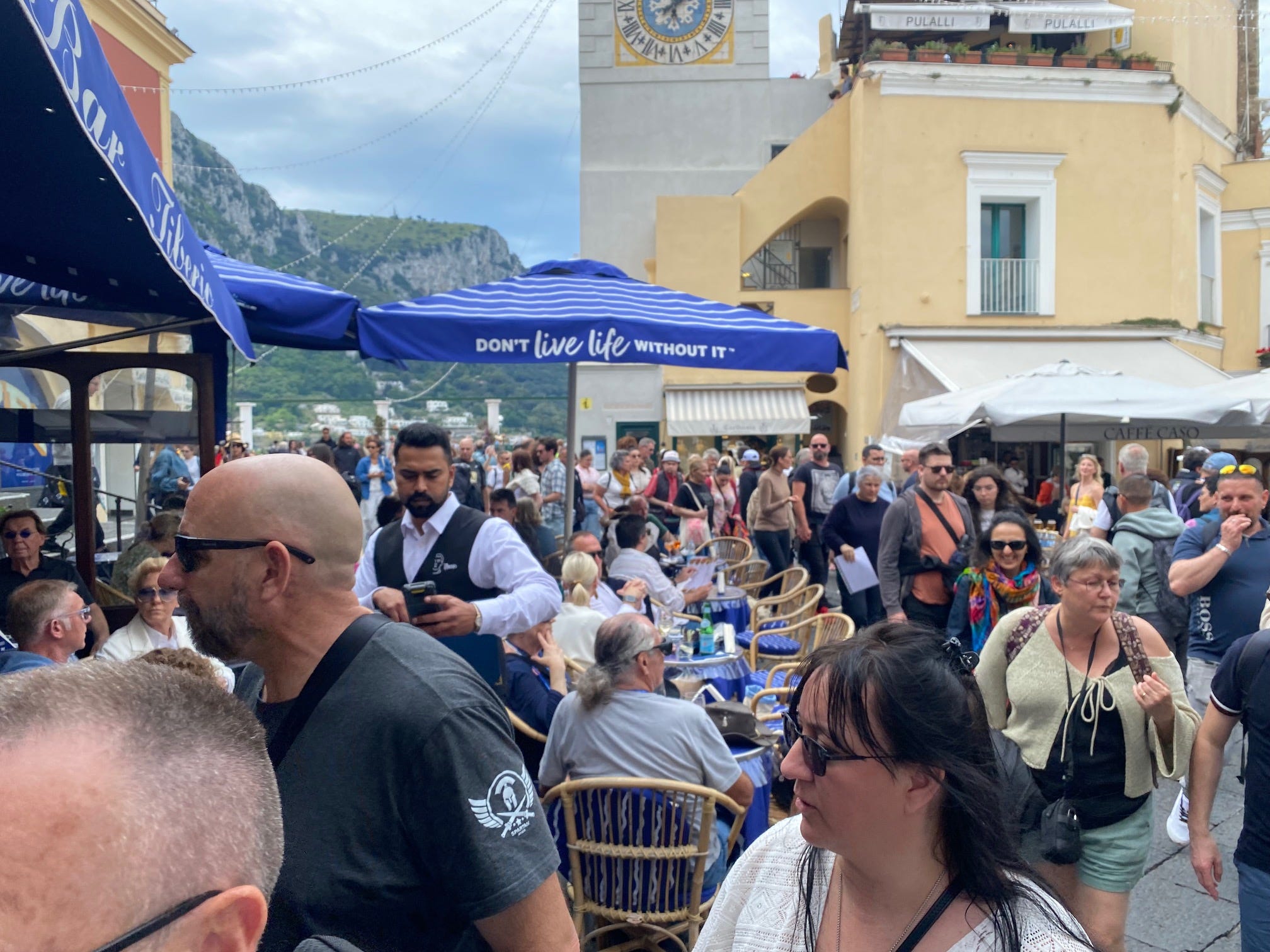
It was a zoo.
Pompeii
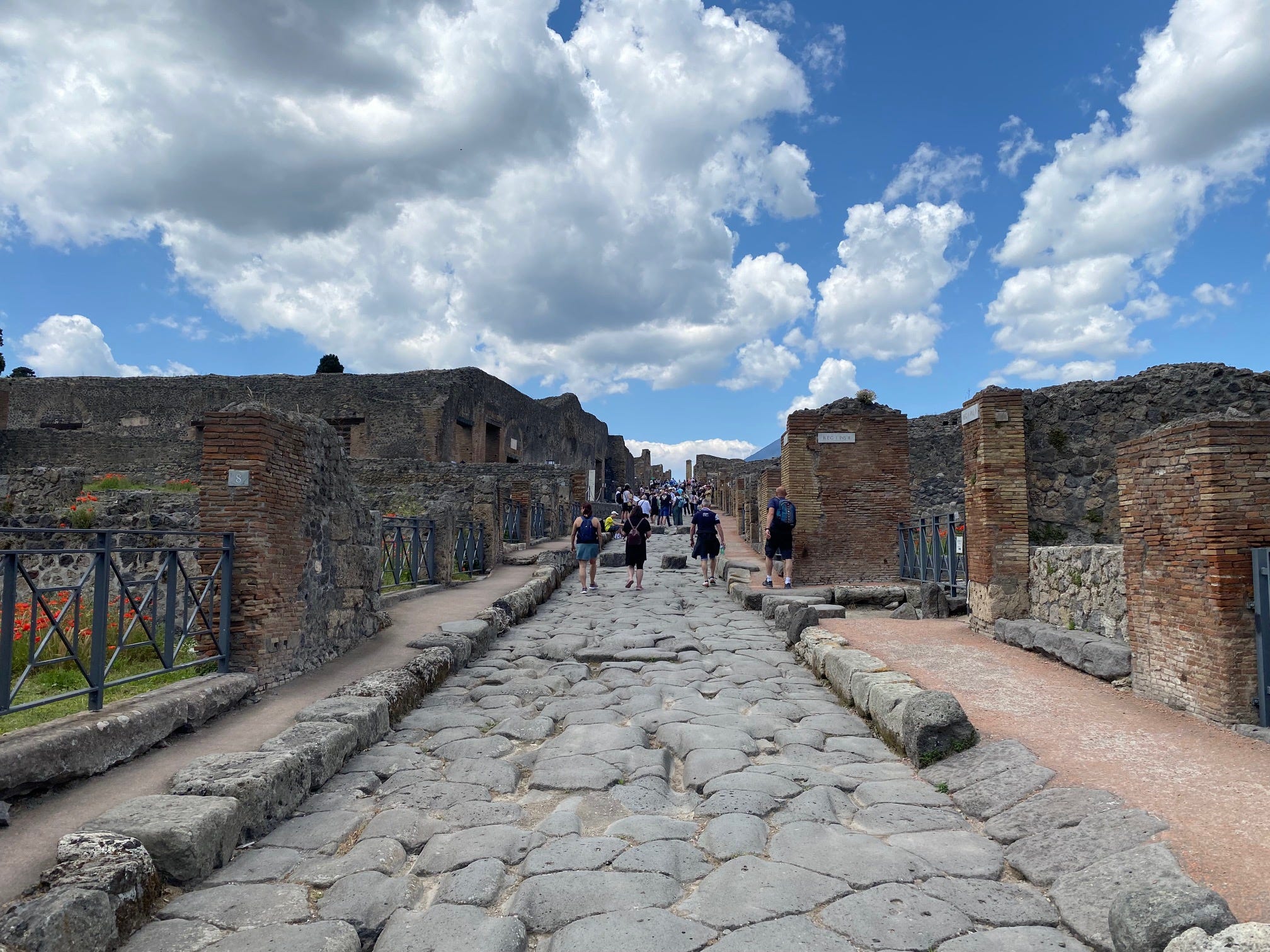
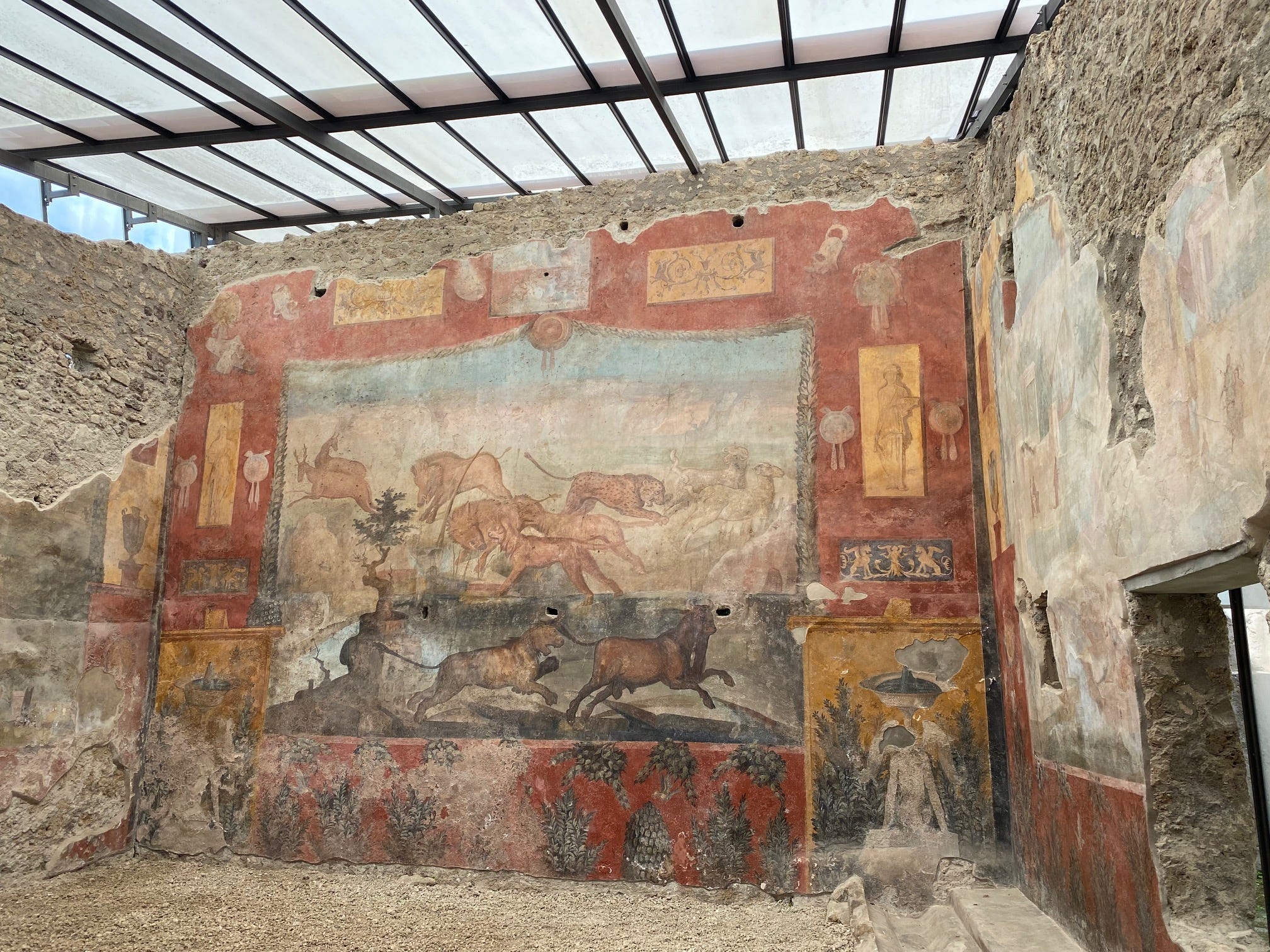
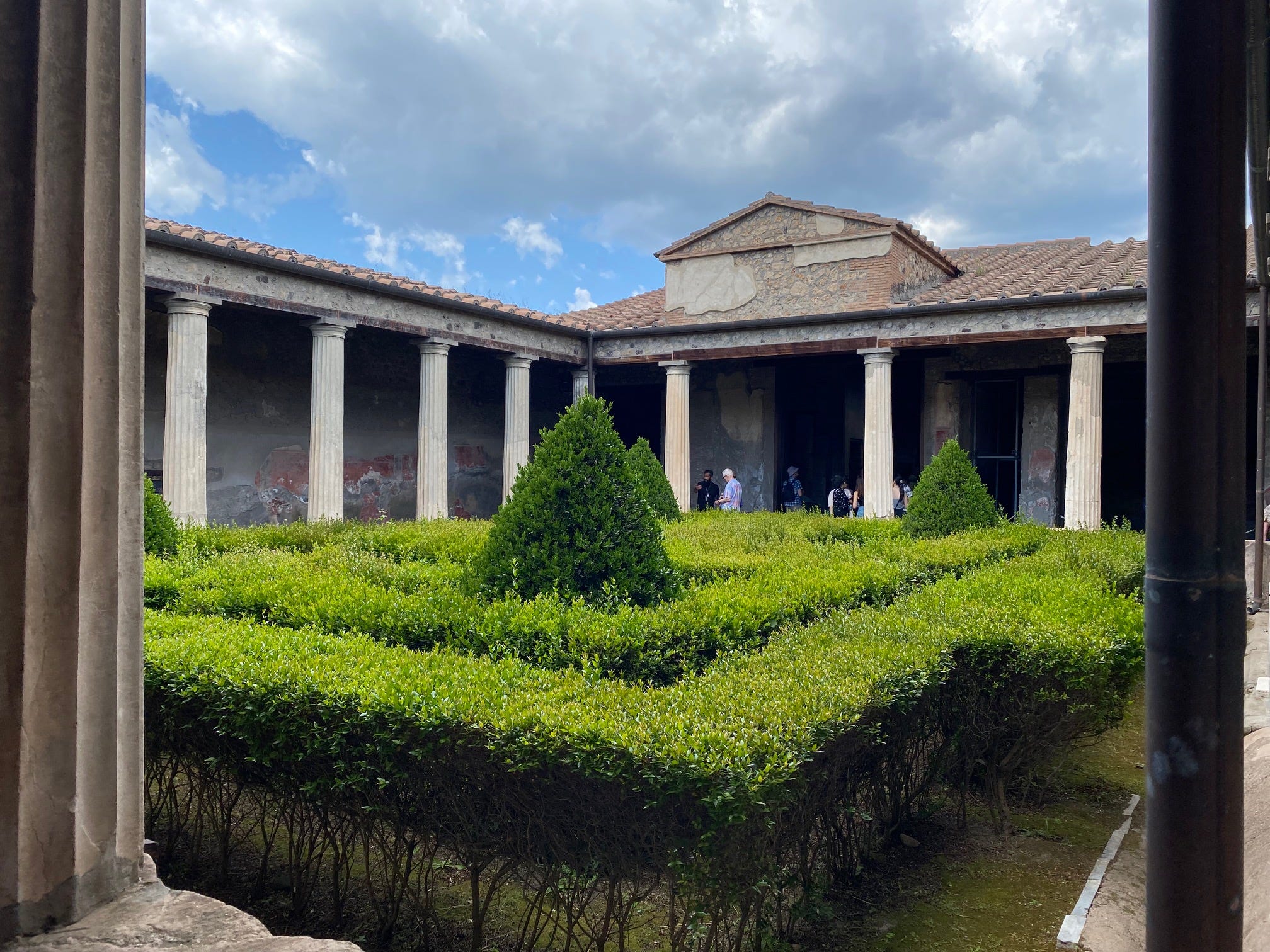
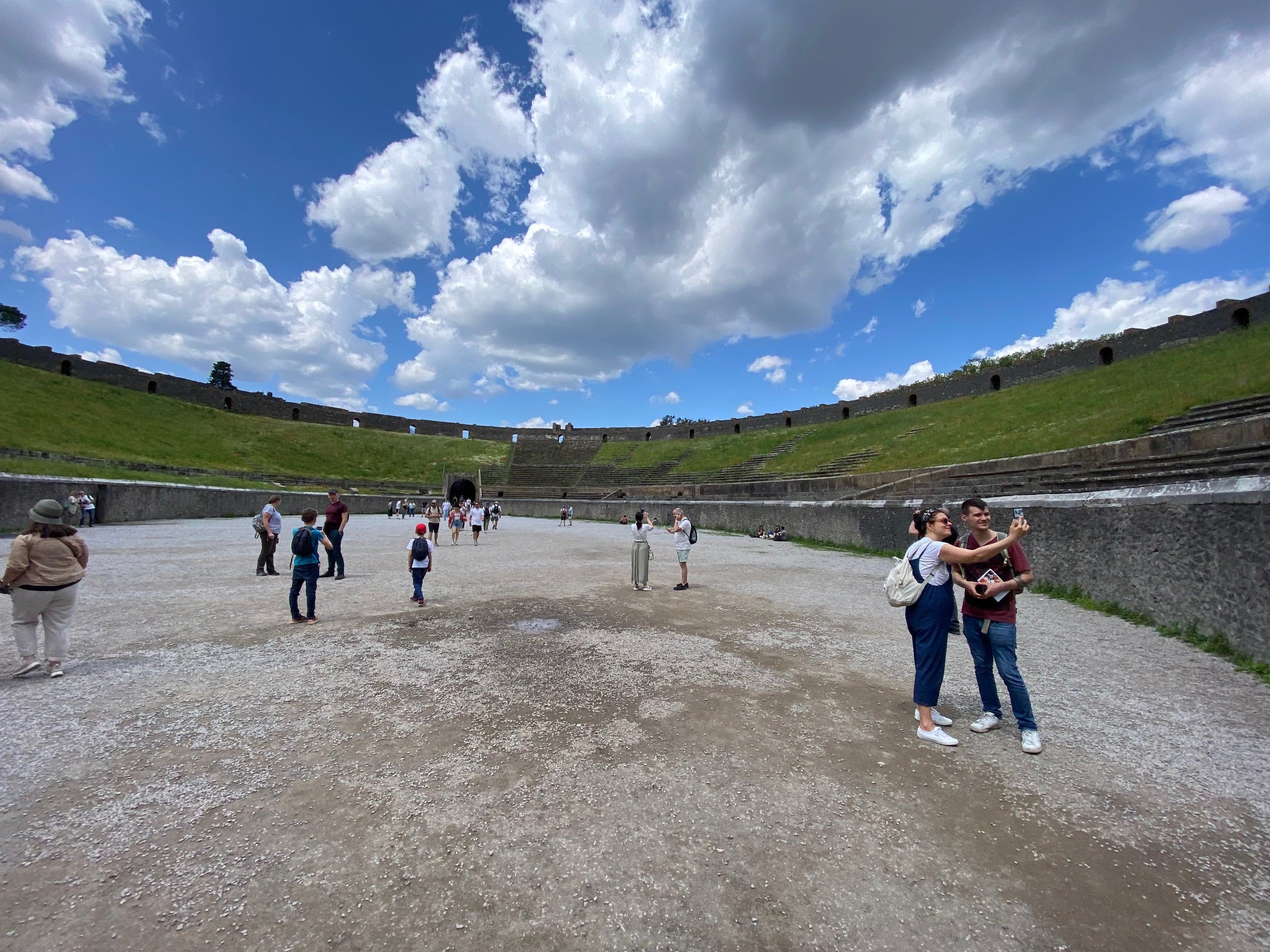
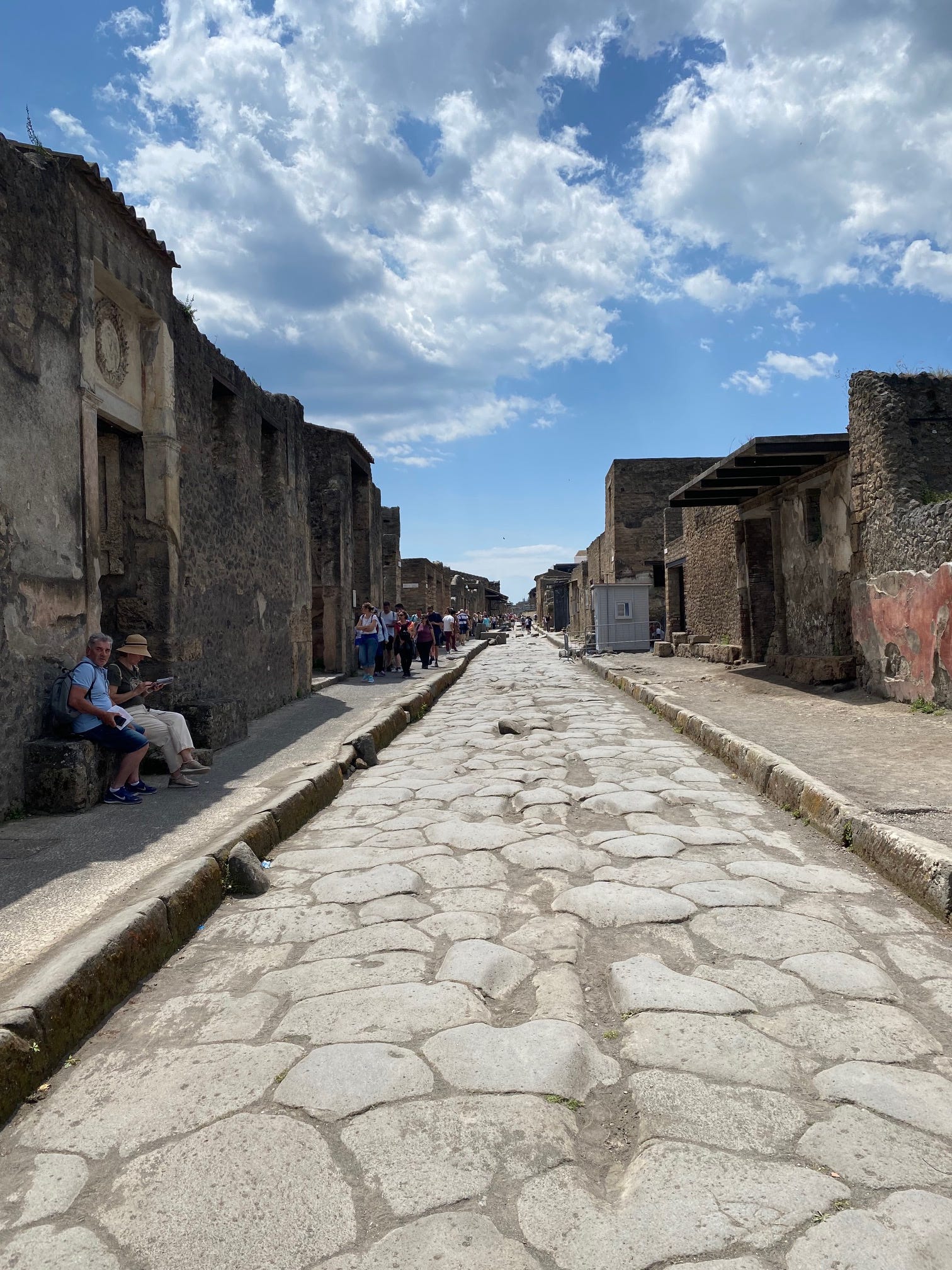
The ruins of Pompeii, which were accidentally rediscovered in the 1700s after Mt. Vesuvius covered the town in volcanic ash in 79 AD, was pretty interesting to behold. The ruins were much larger than I had expected, although I was hoping to see some of the famous graffiti like “Weep, you girls. My penis has given you up. Now it penetrates men’s behinds. Goodbye, wondrous femininity!” Alas, I didn’t see it.
That takes us to the end of this Italian trip. Overall I enjoyed the overview of Italy. My favorite part was the Amalfi coast because the crowds were a bit less and there was a lot more room to breathe. I was bummed coming down with fraudvirus which upset the rhythm of the trip somewhat and I lost two days of sightseeing, and I was disappointed both that the crowds were so large and that the Kalergi plan is in the process of being forced onto Italy. If you have interest in going, go see it before it becomes a dystopian hellhole within the next decade – in this Twitter clip 7,000 African migrants just landed in Lampedusa, Italy in 36 hours.
Thanks for reading.
Postscript: The flight home from Heathrow was cancelled due to maintenance issues (some sort of leak that the maintenance team couldn’t figure out). This kind of thing is going to get much worse moving forward.
Subscribe: Email delivery remains on Substack for now.
1 The founder of the modern EU Richard Kalergi’s publicly stated strategy, where in his book “Practical Idealism” he stated that he “wanted to completely destroy the face of Europe” and that “Europeans are to become Asiatic-Negroid mongrels.” For more details on this see here.
2 Yuval Noah Harari, the spiritual architect of the World Economic Forum and a mentor to Klaus Schwab, claimed that humans are now “hackable animals” and that “the idea of a soul, free will — these are over!” He also said “We just don’t need the vast majority of the population” and he repeated his previous predictions of a “useless class” of “unemployable” humans. In the 21st century, Harari argues, people “are no longer part of the story of the future.” They simply have no role. Humanity 1.0 is being phased out, and only those humans willing to make the transition to Humanity 2.0 and join the all-new species of transhumans will be welcomed in the emerging technocratic society. “Part of what might be going [on] is people realize — and they’re correct in thinking that, ‘The future doesn’t need me. … Maybe if they are nice, they will throw some crumbs my way, like universal basic income.’ “Now, fast forward to the early 21st century when we just don’t need the vast majority of the population,” he continued, “because the future is about developing more and more sophisticated technology, like artificial intelligence and bioengineering.” Harari added that “these technologies increasingly will make redundant…whatever people are still doing which is useful,” and will thus “make it possible to replace the people.” (Harari is a homosexual Israeli atheist.)
3 According to Ernst Junger in his Approaches, aphorism 82, the energy that Dostoyevsky picked up on upon his visit to London in 1862 was that the city was “Baal”:
Dostoeyevsky apparently saw something reassuring in the looser constitution of Paris and something frightening in the order of London. This attests to his penetrating but humane look. He saw Baal enthroned behind the spectacle on the Thames, and it frightened and fascinated him as it had inspired the portrayals of many others before and after him….
The enduring reputation of this God Bel is of a hard and merciless master. The name Babylon, its principal seat, became synonymous with the metropolis as such, especially in its night side. Beyond this, Dostoyevsky also saw something specific: the stamp of puritanism in which enormous deployments of energy were coupled with an unwavering conscience. Hence, it is no coincidence that it was precisely in those puritanical zones that machine technology and its related forms of exploitation brought forth the precedents and model cases for critical reflections on these same phenomena….
In his Paris days, Dostoyevsky was undoubtedly also in Montmartre, but it was not there that Baal appeared to him to reign. He saw an orderly fabric in the Parisian ambience, in London an obscene disorder. We might have suspected the opposite impression, yet it is precisely here that his artistic incorruptibility is demonstrated – the artist whose gaze penetrates through the social veneer, through the varnish on a masterpiece, to its ground.”
4 From here, Henry Stimson, War Secretary and a patriarch of the CFR, wrote in his diary after meeting with FDR: “We face the delicate question of the diplomatic fencing to be done so as to be sure Japan is put into the wrong and makes the first bad move – overt move.” After a subsequent meeting, he recorded: “The question was how we should maneuver them [the Japanese] into the position of firing the first shot…”The Council’s War and Peace Studies Project sent a memorandum to FDR recommending a trade embargo against Japan which he eventually enacted. In Addition, Japan’s assets in America were frozen and the Panama Canal closed to its shipping. FDR knew about the upcoming attack on Pearl Harbor (American military intelligence had cracked the radio code Tokyo used to communicate with its embassies, which suggested an assault would come on Pearl Harbor around December 7; in addition separate warnings were transmitted to high government officials) but no alert was passed on to the commanders in Hawaii. FDR removed the fleet’s Admiral after he protested that it was quite vulnerable to attack, and FDR stripped the island of most of its air defenses shortly before the raid. FDR appointed a commission to investigate what happened, headed by FDR’s friend Supreme Court justice Owen Roberts and other CFR members, absolving FDR of blame. When this whitewash was exposed, FDR suppressed the results, saying public revelation would endanger national security in wartime.
5 Also note how the Italians switched sides in the lead-up to World War 1 which the Pope considered an act of “free-Masonic infamy”, and how Italy at one point considered going to war against Germany prior to World War 2.
This post looks at the likely endpoint of the Trump supporter’s response if the assassination attempt against him had succeeded: a “Redneck Rebellion”, an unleashing of their feelings of hopelessness and displacement of historic Middle America which have been lurking suppressed for years now, and which would have been funneled dialectically by globohomo and then ruthlessly crushed to usher in a new, tyrannical, permanent state of emergency.
“Modern nation-states tend toward weakness. They can only prosper where some legacy is available. When that is consumed, the hunger becomes unbearable, and, like Saturn, they devour their own children.”
– Ernst Junger, the War Journals, August 17, 1944 entry
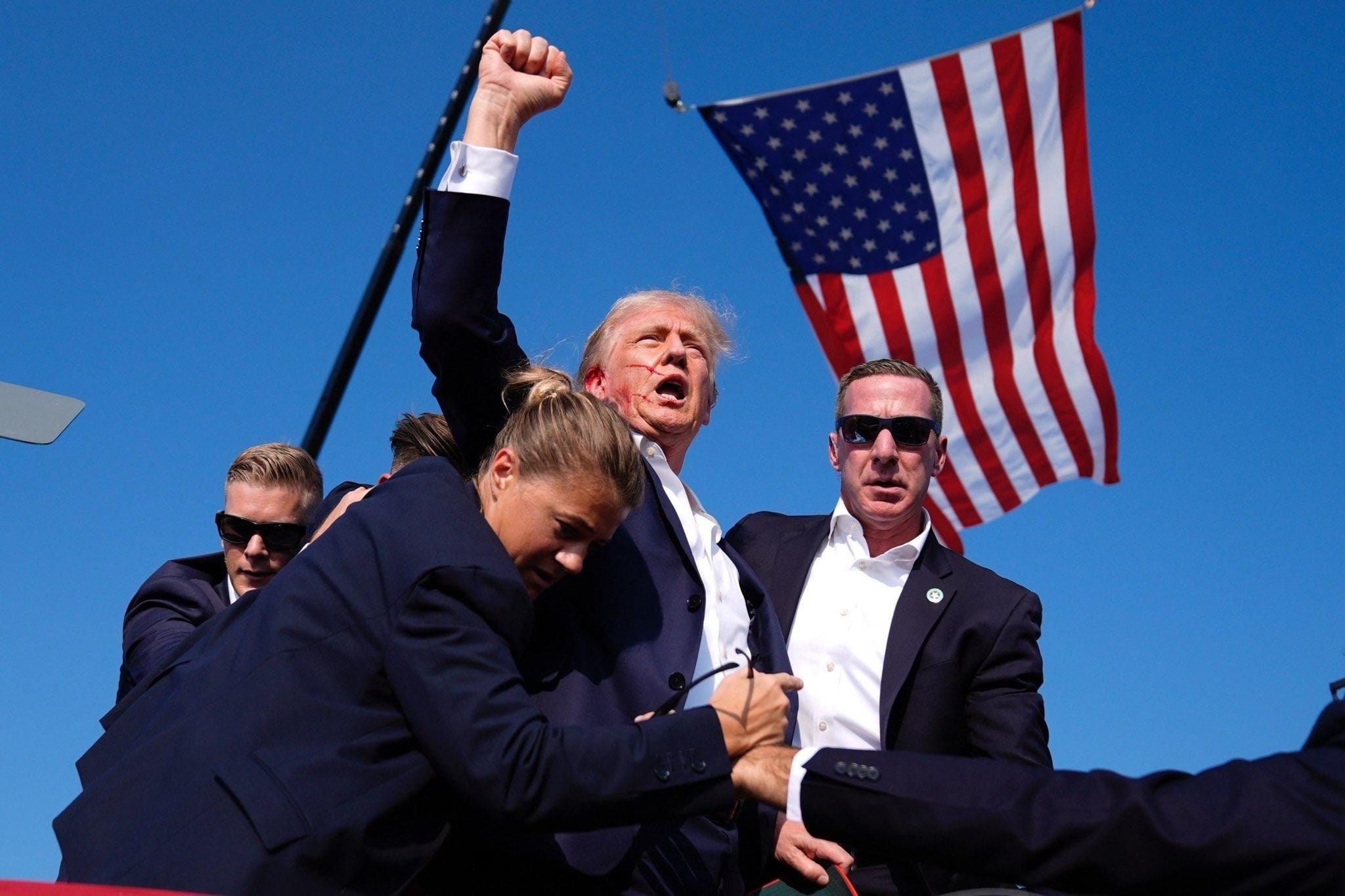
I’ve been meaning to do a post on the potential for the fabled Redneck Rebellion1 for awhile now, which I’ve mentioned in passing in a bunch of prior posts. But the swirling possibilities surrounding it, the uncertainties of form for which it could develop gave me pause; there was too much room for analytical error. So I pushed it off. But with the close call of the Trump assassination attempt, which was timed to generate maximum chaos and anger (Trump had not announced his Vice President at the time and there was no clear successor, he was heavily leading all polling and the JFK-reminiscent attack occurred in front of thousands) the impetus is back.
The basic argument is as follows: whites and Christians are increasingly dispossessed in their own homelands as part of the egalitarian ratchet effect, where society seeks to both raise up non-whites and put the boot on the face of whites in order to “equalize” worldwide outcomes. Whites are excluded from universities, excluded from multi-national corporations and even smaller jobs, they have been reduced from 90% of the U.S. population to 60% within the past sixty years, an extremely fast erasure on a historical timeline. Yet at the same time this population is highly armed and increasingly – but slowly, ever so slowly – becoming racially and class conscious. The built up anger, sense of betrayal, and disillusionment has been growing even before Trump – see the Tea Party and Occupy Wall Street movements, both undermined and destroyed by globohomo – and the rise of the internet, which may be looked back on historically as being as revolutionary as the printing press, means that traditional avenues of establishment narrative propagation do not work like they used to. There is a collapse in the public’s support for institutions and people claim not to trust the media anymore.
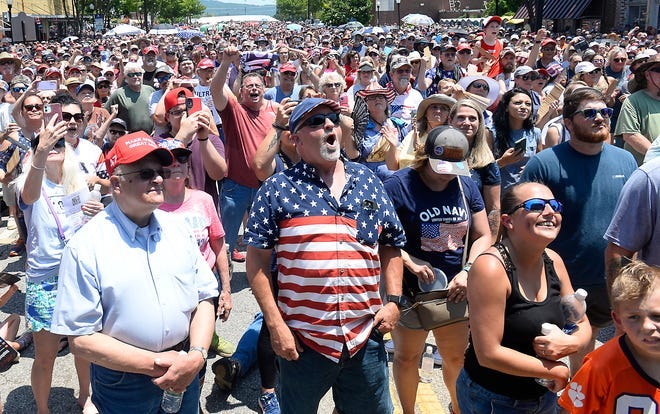
The dispossessed; forgotten and disparaged in their own nation
To offset this, globohomo has imported 20 million Democrat-leaning non-whites in the past four years alone as they seek to repeat what they accomplished in California but nationwide, i.e. a permanent one party state. Even if these illegals do not vote, it does not matter because their mere physical presence is needed for ballot harvesting purposes. According to Sundance,
The Biden administration (DHS) is not “importing democrat voters.” Instead, DHS is importing people, names, that allows the state fraud process to generate ballots. This is an important distinction.
The migrants will not use the ballots. The DNC harvesters will collect them, fill them out (Team Obama), then the Precinct workers will scan them and count them (Team Clyburn). Illegals don’t need to vote. They only need to exist to create a ballot.
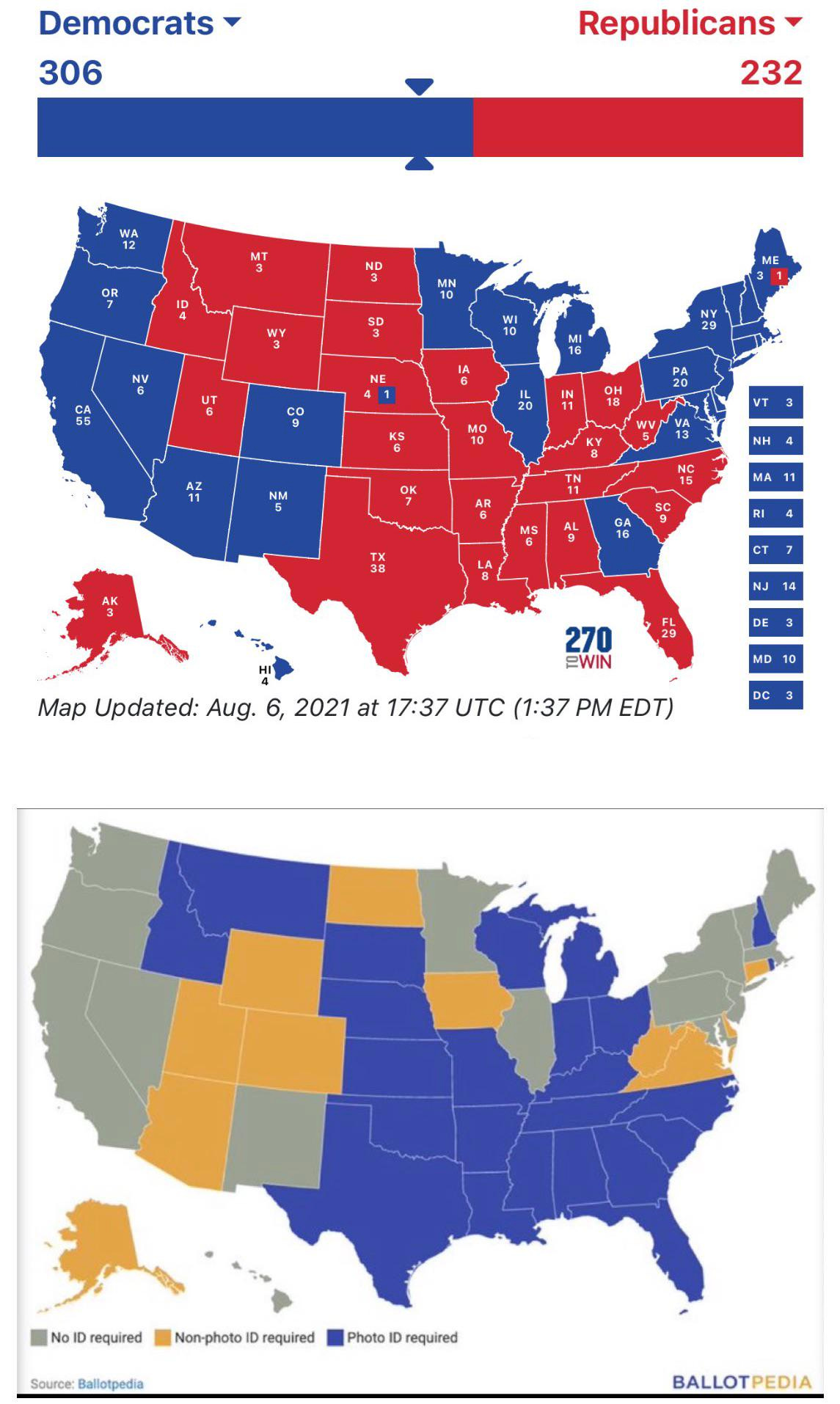
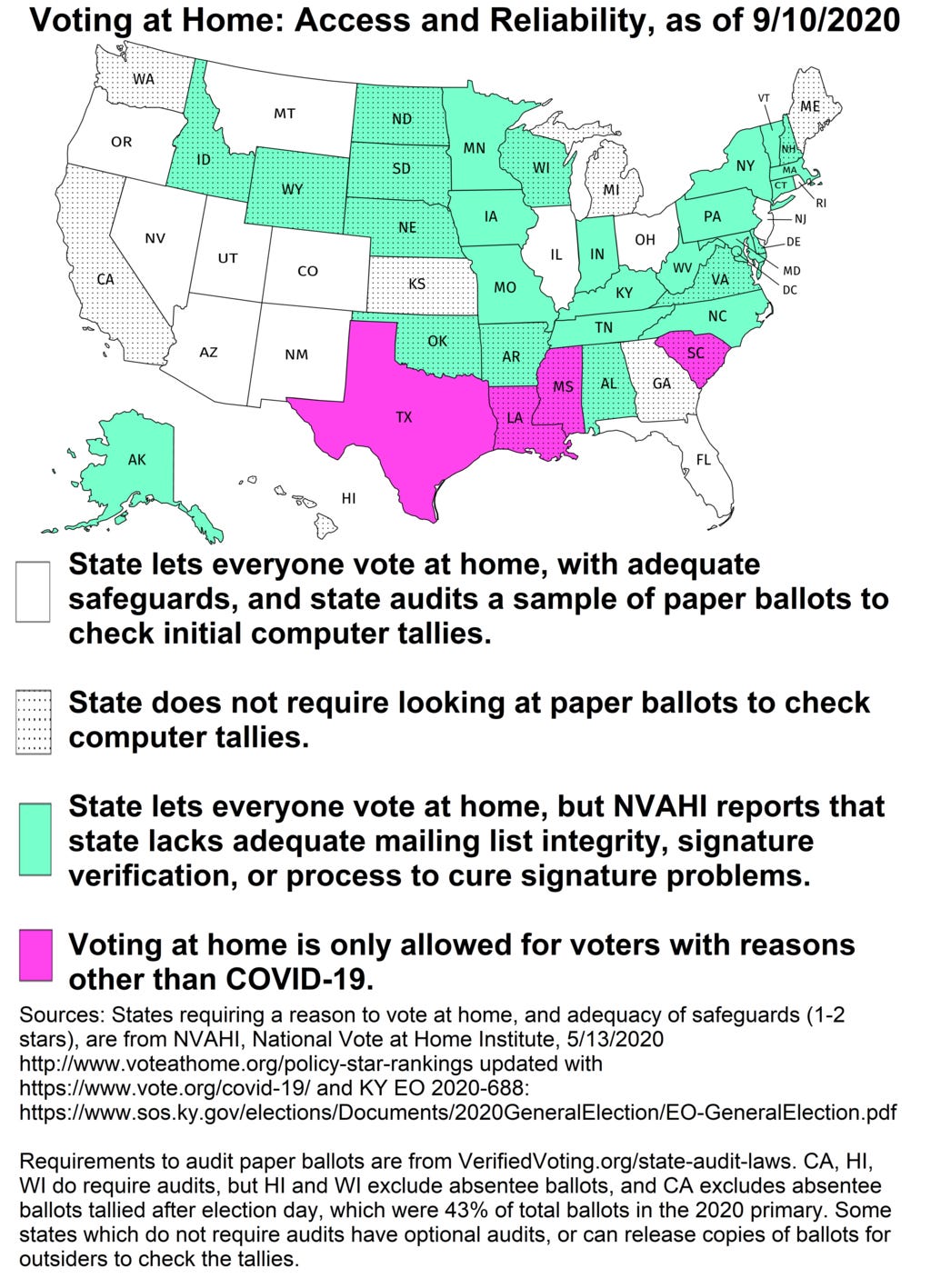
Look at the overlap between whether a state has voter ID laws and whether it votes Democrat or Republican:
They’re also printing tens of trillions of dollars and funneling the vast majority of it back into the hands of the transnational security elite and their allies. 30% of tax revenues now go to paying interest on the national debt alone, which is set to skyrocket in the coming decades:
With community trust in America at an all-time low and the finances unsustainable, what we are seeing feels like some kind of mafia bust-out operation – they’re stealing everything they can as they torch the current system. The trick they want is to cause tremendous confusion and to shift blame away from themselves as poverty and chaos intensifies. That’s the key.
At the same time, we see globohomo moving forward with their long-term plans: CBDC development is finished and ready for deployment per the Atlantic Council. Woke AI has been perfected. Spying on the public has been formally legalized by Congress without a warrant (the legislation to prevent this failed by one vote; globohomo blackmailed and threatened just as many as were necessary). The Supreme Court just ruled 6-3 that the government telling tech companies to censor is constitutional. 5G has been rolled out and it’s primary purpose is not to offer faster internet to consumers but to handle the vast bulk data collection needed for instantaneous spying in order to assign everyone social credit scores – which the WEF has admitted will be finalized by 2030 – and cut anyone out from the system who does not do whatever globohomo tells them to think or act. The programmable CBDCs will be used in conjunction with the woke AI to micro-manage human behavior in what, in my opinion, will have both a depopulation agenda component (especially against whites), a race-mixing component, as well as to eventually separate the masses from the central bank owners as a distinct species. Through this vision globohomo hopes to create a perpetual neo-feudalism that they want to last forever.
Note from this the different time scales that our overlords operate on compared to the masses: the online right thinks in terms of events — days, weeks, months or maybe a couple of years at most — while the timescale of the central bank owners is on the level of decades or centuries, giving the latter an enormous advantage.
Globohomo has all the pieces in place, but they need a triggering event to institute this system. It needs to be a big, historical event, but controlled, and it must give globohomo the narrative impetus for a historically unprecedented tyrannical “protective” state. They can then shift blame for this new horror system away from themselves. It’s the same rationale for why they needed 9/11 to institute the Patriot Act to enlarge government and steal civil liberties, which was drafted long before the actual attack. They have a number of possibilities to do this, as basically all they do is plot against the masses. These include:
Crash the economy by deflating the biggest economic bubble in human history until people cry out for assistance, a strategy perfected in Japan and which I will cover in its own post;
A false flag hack by “Russians” or “Chinese” as a Cyber Polygon type event, crippling important infrastructure until it is “rebooted” with the radical changes;
World War 3 with Russia, Iran and China, where those who don’t submit will be treated as enemies2; or
the Redneck Rebellion.
There are likely more, but those are the four that come to mind that could be sufficient in size to justify an unprecedented security state being implemented. Tree of Woe has a good post on some of these possibilities. And N.S. Lyons has a great if extremely long piece on how globohomo is converging with China to form a totalitarian surveillance state.
Let’s discuss the possibility of the Redneck Rebellion.
The Redneck Rebellion
There has been an undercurrent among some on the far-right itching for an armed rebellion against the globohomo state. Lots of people online hint at it but don’t go over the line from fear of being targeted by feds or accused of fedposting. Their argument goes something like this, to the extent they are willing or able to articulate it:
The government is controlled by those eminently hostile to the interests of the majority population;
Elections have not worked as the country continues shifting to the left and lowering everyone’s quality of life regardless of who is elected;
Trump only became president in 2016 because globohomo was too complacent to rig the election properly, thinking Hillary would cruise to an easy victory like all polling suggested;
Trump was unable to accomplish anything even after he won because a united uniparty combined with extreme media hostility and criminal FBI/CIA/DOJ undermining of the popular will effectively paralyzed his administration;
Elections have not worked given the 2020 election was fraudulently stolen with mass mail-in voting, vote harvesting, electronic voting machine scams, mass illegal immigration and other illegal tactics, with the liberal media providing the criminal perpetrators endless amounts of cover;
Peaceful protests such as January 6 were subverted and co-opted by Ray Epps and other FBI handlers to fulfill globohomo objectives;
White Middle America is radicalizing as a response to its declining quality of life and they lack non-violent avenues to have their grievances addressed; therefore
The only alternative left to dispossessed Middle America is an uprising of some sort, or a right-wing military coup; and
The sooner it happens the better, before illegal immigration swamps the historical American stock permanently.
Their argument continues: America is armed to the teeth and filled with millions of veterans. Military veterans are high testosterone and lean right-wing while cosmopolitan, elitist liberals are low testosterone, limp-wristed, have low rates of gun ownership, and would fold like paper napkins under pressure. Additionally, America runs on a just-in-time distribution system with right-leaning truckers; look at what the Canadian truckers accomplished. Liberals can be starved out in weeks if the truckers join in. After all, the might of the U.S. military couldn’t defeat goat herders in Afghanistan or Iraq, and in the 1970s the U.S. lost badly in Vietnam against a poorly equipped communist enemy. The only way at this point to seize back control, according to their argument, is with an uprising, per Thomas Jefferson’s famous statement, “The tree of liberty must be refreshed from time to time with the blood of patriots and tyrants.”
As much as I understand the argument and the frustration of those watching the complete implosion of America and the west generally, this is a wrong analysis and any Redneck Rebellion is doomed to be viciously crushed by the establishment.
Why?
The first thing to understand about assessing the success of a potential Redneck Rebellion is that whites/the middle class in America have a flat zero institutional support (unless one counts “I’m a nationalist and a globalist. I’m both” Trump when he held the presidency). The Senate and House are both globalist in outlook, the CIA and FBI and DOJ are globalist, the upper branches of the U.S. military are globalist, local police departments have been gutted and have no power, the media is globalist, the judiciary is globalist (including the Supreme Court), the Federal Reserve is globalist as are it’s owners and Wall Street generally, almost or all multi-national corporations have globalist outlooks, etc. A successful objective of the forced untested mRNA heart attack jabs was to purge dissidents from these institutions. Nor do whites in America have any foreign support; maybe Orban in Hungary and some Eastern European leaders like Lukashenko don’t hate whites, but all the leaders in Europe and Asia are globalist and anti-white; that’s why Shinzo Abe was assassinated as he was not playing along.
The second thing to understand is that, as discussed here, the mainstream media can highlight any event into the public’s consciousness or downplay any event to be forgotten by the public, and they can decide how hard or soft to push an issue and when. None of it is organic, all of what they push has a political purpose behind it, and it is a closed-feedback system and echo-chamber that outside facts cannot penetrate. Furthermore, our central banker rulers have bought-and-paid-for politicians queued up to respond to those media created (or downplayed) events in the manner in which they demand. The point of this is that globohomo chooses if or when a redneck rebellion happens by what they choose to highlight or downplay in the media and how their puppet politicians respond to it. There’s been plenty of predictive programming setting it up like the terrible recent Civil War movie. As Ernst Junger stated in his World War 2 journals, May 17, 1944 entry: “The situation calls to mind that of 1939 when people talked about war until it finally came. It’s been like that with the invasion, which perhaps neither of the parties sincerely desires. Yet this is precisely where the stroke of fate will be revealed.” And one may note that World War 2 was similarly set up with a predetermined outcome (as was the U.S. Civil War3).
Here’s the kicker: rebellions/insurrections do not succeed historically without substantial institutional and/or foreign support. The first example that comes to mind is the Spanish civil war, where Franco had both institutional support (the military and the priesthood) and foreign support (Germany) and they still barely won. You can take a highly armed population with broad-based populist support and they will not be able to capitalize on their advantages without the ability to communicate and coordinate (via phones, internet, AM radio, etc.) which would be shut off for them in a rebellion even as globohomo would make extensive use of AI, drone technology, satellite technology, mass media manipulation, etc. But worse is that events like Charlottesville, the endless lawfare against Trump, the COVID shutdowns and forced mRNA heart attack jabs, and January 6 show that even though America broadly (after accounting for vote fraud) supports Trump, that support is pretty shallow — even though white America is being dispossessed most of them are fat, lazy, and have an incredible amount of globohomo propaganda to work through mentally. They are close to useless and globohomo is not very afraid of them. The right has not been allowed to organize themselves for many decades (if they tried the FBI would arrest its leaders and destroy the organization) so they are highly disorganized, de-centralized, and with no readily apparent leadership.
The triggering event
The attempted Trump assassination would have been the perfect excuse to institute the fabled Redneck Rebellion. Trump was cruising to victory against Biden (and is still favored against Kamala), the attempted assassination was in broad daylight during a rally with tens of thousands and the media watching, and there was no prime successor who could take the reins as Trump has not announced his Vice President yet. If the shooter – likely groomed by the FBI – had succeeded it would have set off enormous chaos and tremendous anger, which the intelligence community apparently (and bizarrely) might have tried to parry by claiming Iran was behind it (see footnote 2). The emotional outburst if it had succeeded could easily have resulted in some sort of physical escalation, likely a combination of genuine populist fury and Ray Epps-styled false flags. The important thing would be for the Rebellion to both be hyped up to hysterical levels and be controlled as much as possible. This anger then could be dialectically harnessed much like January 6 was by globohomo in order to then CRUSH the movement. Indeed, the obviousness of the set-up (with the Secret Service basically standing down4) combined with it’s likely intentional mirroring in many respects of the JFK assassination – opening up scabbed-over national trauma – was likely intentional to inspire intense emotional anger on the part of Trump supporters so they would walk into this trap.
The three types of globohomo wars
Most people do not understand that globohomo is willing to do whatever it takes necessary to fulfill their objectives; there is nothing they will not do in order to stay in power, there is no line they will not cross. And while they are not invincible, they are also not wholly incompetent even in this age. People mock America for its military failures, but there are different types of globohomo wars and each type has its own objectives, which do not always include military victory – indeed, preventing victory is the objective of one of these types. I went into it in detail here but the types of wars are as follows:
Forever-wars like Afghanistan, Iraq and Vietnam and the goal is to use the war as an excuse for the military industrial complex and trans-national security state to rape the American taxpayer, not to win the war. People laugh at America as “incompetent” in these wars but that entirely misses the point of them. Julian Assange sums up these types of wars perfectly.
Wars for increased global control. These wars are like the Opium Wars and the Boer Wars, and they are also fought as hard as are necessary for victory. For example, to defeat the Boers, who were a hardy and tenacious enemy, they had to put the Boer women and children in concentration camps and starve them to death. 155,000 women and children were imprisoned in the concentration camps, which was almost 2/3 of the entire Boer population, and 34,000 or 22% of the inmates of the concentration camps died, of whom 27,540 or 81% were under the age of 16. According to Stephen Mitford Goodson, “The bankers achieved their principal aim of obtaining full control of the gold and other mineral resources of South Africa. They had financed the war in the amount of 222 million British pounds and thereby added a further 132 million to Britain’s national debt. For the Rothschilds the Second Anglo-Boer War was a consummate victory.”
Globohomo appears “softer” now overall because they have sophisticated propaganda tools to secure compliance, but if that compliance fails they will assuredly ramp up what they would do as much as necessary. What we can understand, then, is that any globohomo suppression of the Redneck Rebellion would be fought with as much means as necessary to secure their objectives – there is nothing they would not stoop to including mass murder and genocide if that is what it took to further their objectives and maintain control. Then they would use their controlled media apparatus to label themselves the good guys. That’s how it works; first you win, then you justify the victory. They would not fight in any way like they fought in Iraq, Afghanistan, or Vietnam, because the objectives sought here would be entirely different. Basically no one in ultra-wealthy, ultra-complacent, ultra-decadent, ultra-myopic America understands this.
Conclusion
Putting this all together: I think we potentially averted by an inch the initiation of the fabled Redneck Rebellion and it’s subsequent brutal crushing by globohomo to institute a CBDC/woke AI tyrannical slave state Hellhole, which they would blame the Rebellion for everyone’s chaos and declining quality of life (much as 1/6 was hyped up and the underlying stolen election ignored). Perhaps Globohomo will double down.
With Trump surviving with only a flesh wound it will be hard for globohomo to pull off false flag MAGA terrorist attacks, but they still may try. Alex Jones predicted the establishment will murder Biden by a false-flag Trump supporter (which seems less likely now given he is no longer running for re-election) or alternatively poison Trump. Perhaps they just simply steal the election like they did in 2020. Whatever the globohomo media is hyping, though, is an artificial narrative meant to secure official objectives. From a broader perspective, I expect whatever happens will ultimately be negative (in line with my philosophical pessimism) as this world appears controlled by the Demiurge.
Anyway, I have not seen the instigate-Redneck Rebellion-to-crush-it argument made anywhere else (although CJ Hopkins gets a little close here) and I hope this does not come to pass. The more people understand this possibility, the harder it will be for our overlord jackals to pull it off.
Thanks for reading.
Subscribe: Email delivery remains on Substack for now.
1 This is a pejorative; a neutral term would be a mostly-white middle America armed rebellion. The pejorative is being used because the point will be made that such an uprising would have little chance of succeeding based on improper analysis of the nature of the globohomo system, how civil wars are won, and how weak willed America’s citizens are now. “Redneck rebellion” is also a very catchy term.
2 It is looking like the globohomo intelligence community may falsely claim that Crooks was tied into Iranian intelligence. See here and here. This false propaganda would be more successful if Trump had been killed, but the idea would have been to use the attack to start a war in Iran on behalf of Israel while at the same time clamping down on free speech in America to prevent future “foreign-tied lone-wolf shooters.” That would have been win-win-win for them; eliminate Trump, start a new war in Iran, end free speech in America. Russiagate 2.0 but directed against Iran. Regardless, the primary purpose would be to move “the intelligence community killed Trump” argument out of the Overton window, to confuse, muddy the waters and silence those who argued in favor of it, just like it was socially acceptable to discuss the 2020 rigged election until January 6, then it became unacceptable. (For what it’s worth, I don’t think white middle America will fall for another Middle East war no matter how the narrative is structured.)
3 In The Rothschilds, the Financial Rulers of Nations, John Reeves noted that when the family met in London in 1857 for a wedding, Prime Minister of England Benjamin Disraeli declared: “Under this roof are the heads of the family of Rothschild – a name famous in every capital of Europe and every division of the globe. If you like, we shall divide the United States into two parts, one for you, James, and one for you, Lionel. Napoleon will do exactly and all that I shall advise him.” Otto Von Bismark stated in 1867: “The division of the United States into two federations of equal force was decided long before the civil war by the high financial power of Europe. These bankers were afraid that the United States, if they remained in one block and as one nation, would attain economical and financial independence, which would upset their financial domination over the world. The voice of the Rothschilds predominated. They foresaw the tremendous booty if they could substitute two feeble democracies, indebted to the financiers, to the vigorous Republic, confident and self-providing. Therefore they started their emissaries in order to exploit the question of slavery and thus dig an abyss between the two parts of the Republic.” Rothschild family biographer Niall Ferguson notes a “substantial and unexplained gap” in private Rothschild correspondence between 1854-1860. He says all copies of outgoing letters written by the London Rothschilds during this Civil War period “were destroyed at the orders of successive partners”. See here for more.
4 See this video by Matthew Murphy, a retired Green Beret and a level one sniper, trained in assassinations and counter-assassinations who states that the level of so-called incompetence displayed by the Secret Service was not possible based on their rules and regulations and therefore the assassination attempt definitely had insider help.
Apparently Murphy was removed from TikTok for posting it.
The most disturbing feat of propaganda has been the transformation of common sense into fringe conspiracy theory. – Theodore Atkinson
I know I wrote in a Note that my next post would be about the Redneck Rebellion, but there continue to be certain points that feel like they need to be fleshed out as I’m not seeing them elsewhere. I am posting more frequently now not just because the Trump assassination attempt was shocking on its own terms, but because of what globohomo likely planned to do in response to it if it had succeeded. That will likely be my next post. My hope is then that things will calm down and my weekly posting routine can resume, but we’ll see; developments are coming very fast now.
One of the questions being asked about the attempted Trump assassination, such as by Jason Horsley in this extended exchange here, is if 20-year-old Thomas Crooks was part of a broader conspiracy, how was the conspiracy organized?
Now, I have no insider knowledge. The following is speculation based upon curious data points (which should all be looked at skeptically, given the amount of misinformation out there, whether intentional or not) and my own pretty consciously understood biases, discussed in the last post about grounding mechanisms.
Crooks apparently had a “limited” online presence according to authorities. Sundance is correct that this is not really believable; the youth are pretty ubiquitously addicted to technology. Due to Total Information Awareness his internet presence is not wipeable regardless of whatever Crooks did or not do on his own. It would still be in the NSA search database. There are also no recent photos of Crooks that have been released; they’re going off his high school yearbook photo – why? I suspect it would have revealed him as a deranged far leftist Antifa type (one of his classmates said he was a known Trump-hater). According to an article his internet history apparently shows searches for both Trump and Biden rallies; how convenient… You can see Crooks in a video here making some juvenile remarks.
The level of incompetence that the Secret Service displayed is mind-boggling. The Secret Service head Kimberly Cheatle refused to put a counter-sniper team on the roof of the below building which had direct line-of-access sight to Trump and was only 400 feet away; she claimed that it was because the building was “sloped”. The slope of the building was only 10 degrees, if that!The “sloped” buildingThe counter-sniper that eventually killed Crooks after he got off many shots was set up on a much more sloped building:Secret Service basic protocol is to secure all line-of-sight positions that could hit the defended target; according to this video by a Special Forces sniper the level of incompetence displayed here is too great not to be intentional. He posted this on TikTok and apparently was banned by the service after posting it.Now here’s the thing: because the Secret Service failed at a core, basic function of their job, Cheadle had to come up with an explanation, any explanation for the failure. The sloped roof comment is laughably flimsy (even Elon Musk mocked it). But Cheadle would rather have it thought that she and the Secret Service generally were incompetent (which is not totally implausible given she had a DEI goal of 30% of Secret Service agents be women by 2030) versus the attack was an intentional conspiracy, but it’s not working well due to the amount of evidence which is becoming too overwhelming to attribute properly to incompetence.1 Her superiors – the Biden Administration and criminal traitor DHS head Alejandro Mayorkas, who opened the southern border to 20 million illegal Democrat voters in the past four years alone – are backing her and she is not being forced to resign so far (because it is likely she was just following orders).
Crooks apparently wandered the rally for at least an hour before the attack, he was on the roof for half an hour, spotted by the counter-sniper team and tagged multiple times, Crooks used a range-finder to calculate distances to Trump which was observed by the public, he may have brought his own ladder to reach the roof, the crowd outside the rally pointed out his sniper position at least two minutes before the attack, a police officer climbed the ladder and Crooks’ gun was pointed at his head and the officer climbed back down, and apparently the Secret Service had orders not to take out an assassin until the assassin fired first, which is beyond insane. Take one of these facts in isolation and okay, maybe it was incompetence; but add them all up – again, assuming they are accurate – and the picture is very clearly one of intentional malice on the part of the Secret Service.
Apparently – if the below links are accurate – there may have been a large and highly unusual financial short put on Truth Social the day before the attempted assassination. Link 1, 2, 3. If Trump had been successfully assassinated, one would expect Truth Social to immediately implode, as the entire site revolves around access to Trump’s opinions. This reminds me of the shorts placed on airline stocks a day or two before 9/11.
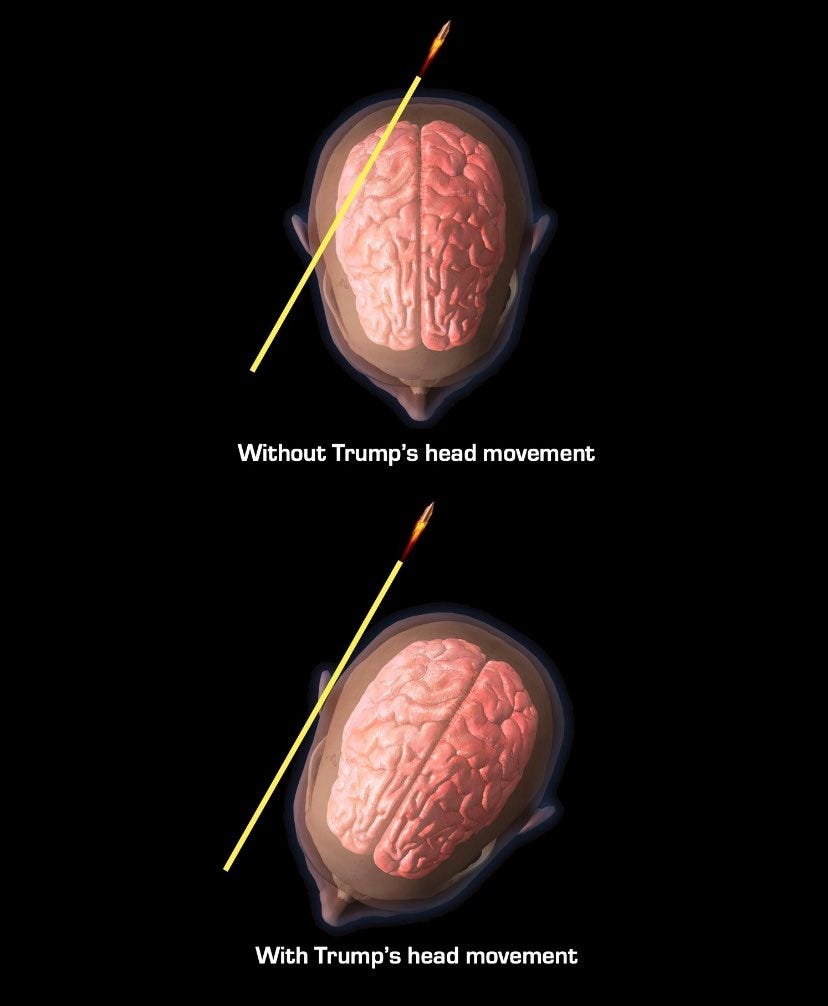
Crooks’ barely missed shot, which has a great visual explanation here, reminds me of the final scene in the wonderful movie Day of the Jackal. The assassin did not anticipate de Gaulle leaning in at the last second:
Okay, so there’s a malicious Secret Service and a 20-year-old attempted assassin. What’s the connection between the two? The Secret Service doesn’t go out and solicit deranged leftist attackers. The likely scenario is that the FBI groomed Crooks from orders-on-high2 and, when certain he would make an attempt, informed the higher-ups who then leaned on the Secret Service to allow the attempt to happen. The motives for this were discussed in the first post on this topic: to create enormous Republican chaos before Trump had announced a Vice President (and there was no clear successor or front-runner to take the helm), as well as possibly to instigate the fabled Redneck Rebellion in order to then brutally crush it to formally usher in a hypercharged surveillance state, which will be discussed in perhaps my next post.
How FBI grooming works
How does the government groom terrorists online work? Well, there’s no online manual, but from studying clues from publicly released information on a lot of these young terrorists the pattern seems to be like this:
The FBI does it on Reddit and a bunch of other places like Discord and Telegram. They strike up friendships with weird loners saying obnoxious stuff. They form parasocial relationships and text with them on Signal or Whatsapp. Then the FBI agent slowly encourages the target to turn violent. The mentality of the FBI agents doing this is not that they are directing terror attacks, but rather they are identifying latent threats before they manifested — they are being proactive instead of reactive — and the proof is that these guys become willing to go along with the incitement to violence, which both allows them to prosecute the target and stop a threat to the community. Of course, very few if any of these loners had the motive, means or opportunity to actually carry out an attack without the active support of the agents themselves. And any organization always feels big pressure to justify their budgets so they can grow in size, so the FBI has an insatiable appetite for so-called “terrorists”…
“I don’t think anyone fully appreciates how demoralizing it is to be sitting across the table from a peace-loving man or woman from a foreign country, insinuating all kinds of baseless BS, attempting to coerce them to spy on their equally peaceful community,” Terry Albury, a disillusioned former FBI agent who was convicted of leaking classified documents, told The New York Times, “but it was also my job.” Read here if you want more details on this process.
After the target commits the terror attack, the FBI conducts an “investigation” into the shooter and attempts to scrub any incriminatory information.
There are numerous examples of this one can point to:
The case of the Liberty City Seven. “The Liberty City Seven case was a mess. It took three trials to convict five of the seven defendants. But it was still proof of concept for the government’s new strategy of using informant-led stings and preemptive prosecutions to root out radicals with violent leanings.”
The case of Eric McDavid, convicted of plotting terrorism but he was really trying to impress a female undercover agent and the FBI withheld exculpatory information.
There’s the infamous FBI agent Ray Epps funneling people into the Capitol on 1/6.
One may also note that these “terror attacks” come in waves – in the late 80s and early 90s the “terrorists” were the rural patriot movement; then it shifted to become Islamic terror after 9/11, where there were dozens of Islamic attacks — then after Trump won in 2016, they almost universally dried up. Did they dry up because Trump was such a scary law-and-order guy that Muslim terrorists were no longer willing to commit attacks? This seems ridiculous; rather, the more obvious explanation is that the FBI which pushed particular types of attacks onto weak-minded, isolated losers changed their priority and focus.
There are likely a lot of others such as the 2023 Nashville school shooting by the tranny (where the FBI covered it up and wouldn’t release the terrorist’s manifesto), and also probably Crooks. They likely groomed him online like they’ve done to quite a few other terrorists then, when he was ready to go, they paved the way in gold for him to get his shots off, then they scrubbed his online presence and whitewashed it. The FBI investigators into the attack are the very same organization that likely MK-ultra’d this kid into being their mentally ill attempted assassin.
Plenty of plausible deniability for the authorities.
This is quite poor physiognomy
Now, to reiterate this is just a theory – a working, plausible theory that ties together the disparate elements of this attempted assassination, but there is no smoking gun for it at this time, nor do I expect there to be one publicly released.
By the way, it was difficult to do research for this post because both Bing and Google are heavily censoring search results. If you Bing images “Thomas Crooks” for example, nothing relevant comes up. They’re only getting better and better at censorship as the AI improves; eventually we will hit a point where globohomo will have total information control and we will not be able to find evidence supporting things we know to be true, or past events.
Lastly, if one accepts that this was a conspiracy, it looks like they very may well try again as a Plan B, possibly using an explosion by “Iran” as “revenge” for the murder of Soleimani in order to both eliminate Trump, push the U.S. into another Middle Eastern war on behalf of Israel, and use it as an excuse to clamp down on free speech on the internet.3
Thanks for reading.
Subscribe: Email delivery remains on Substack for now.
1 Putin, who runs the Russia branch on behalf of the central bank owners, runs incompetence shtick all the time regarding how he keeps getting fooled by his Western “partners”, to great effect. “Oh, I got fooled again, I’ll wake up and do better next time!” He’s really the master at this shtick. Rurik Skywalker covers this all the time at his excellent blog, the only one, along with Edward Slavsquat, to provide English language dissident analysis of what is occurring within Russia itself.
The target of incompetence shtick is preying on Christian notions of forgiveness.
2 Yes, Christopher Wray is a Trump appointee. However, any Trump cabinet appointees had to be approved by a razor-slim margin Republican Senate, and globohomo stooge Mitch McConnell controlled at least a third of the Republicans in the Senate. In other words, the only individuals who could get past Senate confirmation were compromised globalist ideologues. Trump’s hands were tied on this. And the Republican/Democrat distinction has no meaning — James Comey was a registered Republican — what matters is one’s ideological outlook, i.e. oligarchical globalist vs. populist nationalist.
This is a post which investigates how people process information, whether it is by their intuition, their reliance on official expertise or otherwise. It argues that that no one can decide what you should believe for you, that you must rely on your own judgment and expertise – but if you don’t have a feedback mechanism to provide more objective feedback to your approach then it is very easy to become divorced from reality.
In 2008 highly influential arch-liberal Cass Sunstein articulated a strategy called cognitive infiltration in an article titled “Conspiracy Theories” for the Journal of Political Philosophy. In it he made a radical proposal: “Our main policy claim here is that government should engage in cognitive infiltration of the groups that produce conspiracy theories.” He defined “cognitive infiltration” as a program “whereby government agents or their allies (acting either virtually or in real space, and either openly or anonymously) will undermine the crippled epistemology of believers by planting doubts about the theories and stylized facts that circulate within such groups.” See here and here if you want the details on this. Globohomo picked it up and ran with it, and its effects can be seen everywhere today. Cognitive infiltration on social media is heavily boosted via paid agents, “influencers” and bots who push arguments about, for example, the glass dome and the firmament (flat earth arguments) to distract people and lead them into harmless political dead ends.
I think of this cognitive infiltration strategy when I look at the online reaction to the attempted Trump assassination. There were all sorts of theories immediately thrown out: it was a psychological operation and Trump used a squib on his ear or the shooter aimed for his ear; schizophrenic Andrew Anglin has been quasi-pushing this one. Or no one was actually shot. Trump did it to boost his popularity. The FBI/CIA would never use an incompetent to try to assassinate Trump and they never miss their targets when they try to kill them. The deep state wants Trump to win so that he starts World War 3 and whites will join to eagerly fight.
My response was that these lines of argument were untenable for a variety of reasons: the bullets were real given the wounded/dead behind Trump and which missed killing Trump by a fraction of an inch, Trump is too incompetent to employ an expert level assassin for such an attempt even if he wanted to, if one asks cui bono? (who benefits from such an attempt) Trump didn’t need a popularity boost given he was leading Biden by multiple points, among other reasons. Here’s how close the shooter came to killing him:
J. Daniel Sawyer does an excellent detailed forensic deep dive based upon the released video evidence if you really want to get into the weeds of how close this was.
Regarding that iconic photo that was taken (“ohmigod it’s a false flag it looks just like Iwo Jima”), you can see how that photo was taken in this video here.
Michael Dansbury correctly mocks the psyop crowd by summarizing their position on what would have to be Trump’s mentality to institute a false flag here:
“I am four months away from an election in which I am already doing pretty well and even my enemies have to agree that I am a serious challenger. My opponent is clearly infirm and his party are now bitterly divided as to whether he should even stand. I will however ask a gunman to shoot at my head with the infinitesimal chance of hitting my ear, kill an innocent bystander and then in turn have him assassinated. This will lead to a theoretical number of people to vote for me four months from now.”
Librarian of Celaeno, who I have been clashing with more regularly because of our differing perception styles and core values, but hopefully in a constructive and respectful way because I enjoy it – I prefer reasoned criticism than having yes-men because grappling with the pushback is what ultimately strengthens one’s own arguments – and he articulated his disagreement as follows:
Working backwards from cui bono gets you exactly the kind of reasoning you’re talking about here, because you’re assuming an entire chain of actions from an endpoint that could have been radically different under slightly modified conditions.
Donald Trump got shot at- it must have been the Deep State; they serve to benefit, and everyone know they lie.
Donald Trump got shot at- it must have been Trump; he will now get a boost in popularity, and everyone knows he lies.
Donald Trump gets shot- the media was in on it; they all refused to call it an assassination, and everyone knows they lie. They’re working with the deep state.
Donald Trump gets shot- the media is now reporting it as an assassination attempt; they are working with Trump because he’s click worthy.
All of these scenarios are spun from pre-existing assumptions and the facts are shoved in in ways that rationalize them. Letting the evidence lead the way means taking a step back and asking hard questions not only about what happened, but about what I believe.
I agree with the part in bold – except what evidence and facts is Librarian waiting for exactly? The videos have been released and the location of the shooter’s position was known very quickly. Some clarifying information was known later, yes, like the shooter being on the roof for over twenty minutes before he took his shot (!). Perhaps Librarian has made up his mind now, I’m not sure. Perhaps he wants to wait for a corrupt and whitewashing FBI to release official finding who knows when? What qualifies as “letting the evidence leading the way”? I argued instead that one should place emphasis on contemporaneous evidence – video and witness statements primarily – before they get scrubbed from the internet, which has happened regularly over the years to bolster establishment narratives.
I also agree with Librarian that one needs to know and understand one’s own biases and assumptions. One can take ANY piece of evidence, no matter how clear-cut, and people will not agree on it. I went into this on a prior post where a liberal friend (at the time) and I viewed an extremely clear-cut video and walked away with entirely different interpretations of what we watched; this event shook me and I re-evaluated how perception works after this event. And even if one is correct on a particular level of analysis, that doesn’t mean one is correct on other levels of analysis; we are all finite, limited beings and our perceptions are flawed and limited, so it is always good to retain a degree of radical skepticism and doubt even over one’s own opinions.
Christopher Cook had a great post about understanding one’s own biases, where he wrote (quoting at length):
In another sense, however, I am just like everyone else, insofar as my personal predispositions cause me to suspect some things more than others. So let’s look at those predispositions.
First, I do not trust the state. Government is a criminal racket. Even the best-designed systems inevitably devolve into criminal rackets. So I don’t trust much that is said or done by any agent or agency of any government.
Second, I do not trust the state no matter whose hands it is in, but when it comes to the left-right paradigm, I trust the left far, far less.
Leftism is the worst mass ideology ever to ooze forth from the twisted mind of man. It is devious, dangerous, and deadly. Every single time it reaches its fullest bloom, it produces nothing but failure, oppression, and rivers of blood.
Leftists managed to slaughter and starve 150 million people in a single century, and to oppress many millions more in soul-crushing totalitarian mega-states. Leftism really is a “boot stamping on a human face forever.” Denial of that is denial of history.
Of course, non-leftist states have perpetrated their own slaughters—from ancient conquerors to modern colonialism to every other form of barbarism. I oppose them all. But right here, right now, for the last hundred-plus years, leftism is far and away the biggest threat.
The right, properly defined, refers to Anglophone-style conservatives, (non-left) libertarians, and (non-left) anarchists. All of these ideologies share a core classical-liberal provenance in common. As such, they are not generally seeking power for its own sake. They have few objectives. Mostly, they just want to be left alone.
Yes, I know that conservatives have more of a busybody streak than their libertarian cousins. But none of that comes anywhere close to the “Everything in the state, nothing outside the state, nothing against the state” ethos to which every leftist is constantly straining (whether they recognize it consciously or not).
Third, I have very little normalcy bias. I do not assume that things will remain as they are. I do assume that it is only a matter of time before really big, messed-up things happen. (This attitude actually served me well during covid. Yes, the situation was upsetting and even carried some psychological impact, but the lack of surprise made it easier for me to bear.) Thus, I have no difficulty imagining that any one particular event might be the spark of something big.
Fourth, I am not a “conspiracy theorist,” but I am also not not a conspiracy theorist. I am willing to entertain just about any possibility. I am not tyrannized or constrained by Ocham’s Razor or Hanlon’s Razor (I definitely do not believe that either of those is always correct).
Fifth, I am also about as far from mass-formation as you can get. I am generally anti-authority, and I am far less likely to trust mass narratives than most people.
And finally, I am more comfortable than most with the fact that there are a lot of things for which there is no dispositive answer. I am willing to look at a question and consider a range of possible answers without actually setting on one.
For better or worse, that is who I am. And so all of that contributes to any theories I might be more predisposed to consider.
I share many of these same biases; I am naturally anti-groupthink, distrust the motivations of the left, have little normalcy bias and disbelieve official propaganda. But as I’ve written about extensively on this Substack, I also believe that this world is controlled by a small number of central bank owning families who have very specific and very nefarious long-term goals, that they are parasitizing off the masses whose core values are Christian-derived egalitarianism which allowed this financial system to come into place, and that behind this system is the possibility of an extremely malevolent Demiurge whose goal is to prevent the God-souls within each of us from achieving gnosis and ascending beyond the petty flawed materialism of this world. These are my biases, and I will assess new events through this prism unless my prism later updates, which it may.
As attractive as it is to try to adopt simple black-and-white rules for the world about whether something is always or never a psyop or false flag, it doesn’t work that way. As the wonderful and erudite L.P. Koch states,
It amazes me how many on the “real left”, who otherwise see clearly that our democracy is a joke and that we’re ruled by war-profiteering oligarchs, still can’t get out of the “Trump is an evil fascist” talking point, incapable of looking any further, even of just trying on a different angle for a change.
Equally startling is the “everything is a psyop” gang, who live in a world (or rather up their arse) in which all is “staged” and scripted: the mirror-image of leftist subjectivism & schizo-level relativism where nothing really exists except what’s floating in their own heads (the unappetizing float-in-itself).
There are many ways to make people believe 2+2=5.
In other words, while it may be attractive for some to assume either everything or nothing is a psyop1, that’s clearly wrong, and one must use one’s discernment and judgment when approaching any particular issue. Oh no, use one’s own discernment and judgment, how scary! And at the same time retain flexibility to avoid dogma and consciously acknowledge that one may be wrong, that there are multiple levels of truth and we are finite, limited and subjective – oh no, radical uncertainty!
This brings me back to an old favorite quote of mine by Maurice Samuel in his otherwise insane You Gentiles about how one cannot ultimately rely on anyone’s analysis or judgment other than yourself. Certainly don’t rely on mine:
There is no test or guarantee of a man’s wisdom or his reliability beyond what he says about life itself. Life is the touchstone: books must be read and understood in order that we may compare our experience in life with the sincere report of the experience of others. But such a one, who has read all the books extant on history and art, is of no consequence unless they are an indirect commentary on what he feels around him.
Hence, if I have drawn chiefly on experience and contemplation and little on books – which others will discovery without my admission – this does not affect my competency, which must be judged by standards infinitely more difficult of application. Life is not so simple that you can test a man’s nearness to truth by giving him a college examination.
Such examinations are mere games – they have no relation to reality. You may desire some such easy standard by which you can judge whether or not a man is reliable: Does he know much history? Much biology? Much psychology? If not, he is not worth listening to. But it is part of the frivolity of our outlook to reduce life to a set of rules, and thus save ourselves the agony of constant references to first principles. No: standardized knowledge is no guarantee of truth. Put down a simple question – a living question, like this: “Should A. have killed B.?” Ask it of ten fools: five will say “Yes”, five will say “No.” Ask it of ten intelligent men: five will say “Yes,” five will say “No.” Ask it of ten scholars: five will say “Yes,” five will say “No.” The fools will have no reasons for their decisions: the intelligent men will have a few reasons for and as many against; the scholars will have more reasons for and against. But where does the truth lie?
What, then, should be the criterion of a man’s reliability?
There is none. You cannot evade your responsibility thus by entrusting your salvation into the hands of a priest-specialist. A simpleton may bring you salvation and a great philosopher may confound you.
And so to life, as I have seen it working in others and felt it within myself, I refer the truth of what I say. And to books I refer only in so far as they are manifestations of life.
And this leads us into the question: if one is aware of their biases and outlook, exactly how should one assess new information?
Grounding mechanisms
It is important for one to have a grounding mechanism by which one analyzes new information. A grounding mechanism is a way to take in outside feedback and check it against one’s existing beliefs to see if the beliefs are correct or need updating. There are at least two grounding mechanisms, although there are likely others:
the traditional scientific method where independent third parties can try to repeat experiments to judge the veracity of the theory (the scientific method has been corrupted in the modern era, unfortunately, via a focus on “scientific consensus” and perverse funding incentives which corrupt experiment results), and
a focus on recursive prediction, i.e. if one’s worldview predicts certain things in the future and if those things don’t come to pass, then that means that one’s worldview is wrong to a certain extent and should be updated.
A weaker grounding mechanism is to ask cui bono? – who benefits from an action? It is weaker because one can often craft arguments for multiple sides about who benefits, as we see with Librarian’s pushback above.
If you do not have a grounding mechanism for which you can recursively update your beliefs, then you may easily get sucked into and believing unprovable, unfalsifiable theories that will lead you in wrong directions. For example, I generally stay away from ideas like UFOs because there is no way to verify whether the theories being promoted are correct or not.
There is no authority or expert coming to save you on this, not me, not anyone else: you need your own grounding mechanism.
This is also why I knew very quickly that the Q movement was a psyop based on the Soviet’s Operation Trust. Q promised results (with always moving targets) based on innuendo and never explained the logic behind his arguments or predictions. An irreparable red flag. It’s also why Simplicius’s followers are hopeless; he’s been promising Total Russian Victory for 2.5 years now with nothing to show for it yet retains a mass following. Endless hopium is always popular.
A skyscraper’s lightning rod attracting lighting, channeling the energy harmlessly into the ground
One could always just discard a focus on ascertaining truth entirely – no grounding mechanism needed – and go off Carl Schmitt’s friend/enemy distinction. In other words, one could look at the Trump assassination attempt from a dissident perspective and simply argue that the anti-white, pro-globalist FBI and CIA must be behind it because they are middle America’s enemies; therefore doing whatever one can to smear those enemies can only be good. There’s an impulse and an attraction to that, but ultimately that approach is wrong because the right and the left have fundamentally different propagation strategies, and one cannot use the other’s strategies and be effective. The right’s fundamental impulse is one of law and order, transparency and strong and immediate justice; to fall into the left’s impulse of oligarchy, deceit, lies and drawn-out chaos is not an effective strategy, in my opinion.
One may note that this analysis is not meant for the masses who are incapable of independent analysis.2 It is meant for ideological dissidents who are trying to escape from the propaganda that has been force-fed to them all their lives, or perhaps even only a subset of them. Most people (NPCs/hylics) are meant to be led by a strong ruler and without it they can go insane. What we’re seeing from the masses is that they’re losing their trust in the media which has been their de-facto strong ruler and they don’t know what do. A grounding mechanism cannot help them because they cannot think for themselves. If you walk these people through a step-by-step reasoning process they will follow along, maybe nod their head in understanding, then promptly forget everything you told them. This is because it is ultimately about a thought process and not one specific line of argument. I still empathize with the masses, though.
Putting it together
Based on the overwhelming evidence this was simply an extremely close assassination attempt, not a false flag or psyop. It missed by the width of a hair. It is debatable whether the attempted assassin was MK-Ultra groomed by globohomo and then given access to the rooftop, or whether the attempted assassin was simply a mentally ill shitlib who was spurred to action by globohomo’s incessant “Trump = Hitler” propaganda. Multiple nationalist politicians worldwide have recently been murdered (Shinzo Abe), attempted murdered (Bolsonaro), imprisoned (Khan in Pakistan), or face imprisonment (Matteo Salvini) even though globalist politicians have not faced any real serious attempts against their lives and which is another curious data point. It is an open question whether the Secret Service is simply incompetent now due to DEI or whether this opening for the attack was planned in advance, although the evidence points toward the latter. There’s plenty to debate over which will likely never be resolved – especially by the corrupt FBI’s investigation. But the attack did happen and it wasn’t a false flag nor a psyop to boost Trump’s popularity; they wanted him dead.
Lastly, please don’t take this post as a ringing Trump endorsement. I’ve made my feelings about the man known as he is a very flawed individual and no politician is coming to save you. Even if he was a Superman, there are certain structure issues that no one, Trump or anyone else, will be able to fix even if he wins the upcoming election (assuming the election happens): a $32 trillion national debt with a $2 trillion a year deficit, 30% of U.S. tax receipts going toward debt interest payments alone, and 20 million illegal Democrat voters let into the country in just the past 4 years.
In a sense this is all meaningless kayfabe to titilate the public as the country continues to fall off the cliff.
Good entertainment, though. Very exciting.
Thanks for reading.
Subscribe: Email delivery remains on Substack for now.
1 Note that the term psyop is an imprecise one and I don’t like it because it contains two quite different meanings within it: (1) military operations usually aimed at influencing the enemy’s state of mind through noncombative means, (2) government use of a person or phenomenon to influence a population’s opinions and attitudes
2 Most people do not have internal dialogues according to a 2007 University of Nevada Department of Psychology study on college students. Per the study, regarding the frequency of common phenomena of inner experience (inner speech, inner seeing (aka images), unsymbolized thinking, feeling, and sensory awareness), only between 22% to 34% of the individuals studied had frequent internal dialogues:
If this study is accurate, most people may simply be meat robots, lacking thoughts inside their heads, and they react to stimuli as they experience it.
I usually try to stick to a specific writing schedule, with many future posts written weeks or months in advance. However, sometimes there is a political or cultural development which upends those plans. The last two times this happened was my 10/9/2023 concern that the October 7 Hamas attack could lead to a much-expanded regional war (which has not developed so far) and prior to that 8/24/23 commentary on Prigozhin and Wagner’s leadership’s assassination by the Russian deep state by blowing their plane out of the air.
This is a post with some preliminary analysis on the Trump assassination attempt. It is preliminary and future information may come out and contradict this. There are a couple of points to make first though:
I previously argued on July 7, 2023 that the establishment would attempt to imprison and/or murder Trump as a symbol of white middle America, regardless of whether he cucked on policy moving forward. I compared him to what the Bolsheviks did to the Romanov’s.
In Part 3 of my recent history of Trump’s presidency, I backed off this prediction a bit, noting that most of Trump’s criminal trials had been pushed back past the election, that Trump caved on the $95 billion Ukraine aid bill that contained provisions that would trigger automatic impeachment if Trump became president again and tried to withdraw from Ukraine, and that globohomo was taking defensive steps in case Trump did win. In other words, it increasingly looked like Trump had been skin-suited through backroom deals/pressure and, if he won, he would govern like a Jeb Bush or Marco Rubio.
The way people view new events, especially televised events, is always curious to watch. I discussed here how I and a liberal friend back in 2015 viewed a short video and came away with entirely different interpretations, even though whatever information was needed to assess the video was contained within the video itself. What hope is there of agreement on interpretation when what seems like a black and white situation is still disputed?
For less clear-cut videos, ones which require interpretation beyond the corners of the video itself, on what basis should one assess information? One requires a grounding mechanism that ties theory to reality, or else it becomes too easy to believe one’s subjective whims. Traditional grounding mechanisms include (1) the scientific method (which has since been corrupted by scientism) and (2) making predictions about the future, and if they’re wrong one updates in a recursive manner one’s worldview. For specific political events, where there is a lot of conflicting information and one cannot expect truth or veracity from the authorities such as the FBI, DOJ, or media, a good rule of thumb fallback is to ask cui bono? – who benefits?
It is on this basis that I am approaching the Trump assassination attempt today. Because the FBI and DOJ are utterly corrupt I do not expect an honest investigation from them, and not from the media either. The best information to review is video information that is released contemporaneously or close to it with the event, always with the caveat that it could be superseded by subsequently released information. As mentioned, facts are subject to change, but I note the following so far:
An eyewitness reported that he told the police and Secret Service that the shooter was climbing onto the roof and crawling 5-7 minutes before the shooting and they did nothing.
Note the shooter position vs Trump position. The distance is only 125m / 400 feet. That there was not a Secret Service team on this roof is inexcusable.
The counter-sniper teams saw the shooter and let him get off multiple shots before he was killed, which grazed Trump’s ear, killed a bystander behind Trump and seriously wounded another. The video of the counter-sniper team is here. This photo is amazing:
The Trump team had in the past three weeks requested additional security from the Department of Homeland Security which the Biden administration turned down: “A source familiar with Trump’s security detail tells Federalist that the former and future president’s detail has been asking for beefed up protection and resources for weeks, but has been rebuffed time and again by Biden’s DHS.”
Biden recently told donors, “It’s time to put Trump in the bullseye.” Now, this quote may be taken out of context, but the general principle still holds: the media’s demonization of Trump since 2016 has been extremely intense, consistently calling Trump Hitler 2.0. The New Republic just did it recently:
The globohomo media within hours released its talking points, which were to downplay the assassination attempt to the maximum extent possible: Don’t say there was a shooting “targeting Trump”, don’t call it an “assassination attempt”, don’t have “serious” body language or use “color”, don’t say it was “scary” or dramaticize, don’t bring in guests to condemn the attack.
Various liberals on social media initially stated the blood was a squib and/or Trump was targeted with a BB gun. Both were false. They also immediately it was a false flag to improve his popularity, and that no one other than Trump was injured or died (someone right behind Trump died and another was seriously injured).
Deep state actor Elon Musk endorsed Trump right after the shooting.
Here and here are two videos of the assassination attempt. Trump displayed remarkable fortitude when he rose, which you can see in the second video and is quite iconic (after his security detail were very slow in responding; one may note that he had multiple women on his security team, a terrible sign for readiness and competence). Here’s an image of it, which is iconic and will be remembered:
Here’s a photo of the dead shooter (warning: graphic), also see here for less graphic video.
One may note that the shooting distance was 125 meters / 400 feet and it was against a stationary target. This is a very easy shot for someone in a prone position with a tripod, perhaps a scope and in clear weather which even beginner shooters could pretty easily hit. It’s a miracle Trump survived. For comparison, Oswald’s assassination of Kennedy occurred from 265 feet, which was much closer, but was against a moving target. Oswald was documented taking 200-500 yard shots in the USMC against stationary targets.
Analysis
Okay, so let’s put this together. You have a shooter shooting from an outside roof close to where Trump was speaking which should have had Secret Service protection on due to it’s proximity. There is zero excuse for this failure. You had a bystander who warned the police and Secret Service detail 5-7 minutes before the shooting that the shooter was crawling onto the roof and they did nothing. You have counter-snipers who saw the individual but did not engage until after the shooter got off multiple shots. You have the Biden Administration which denied Trump greater protection and Biden said Trump was in the “crosshairs.”
Worse is the political situation. The Democrats can’t collectively decide whether to dump Biden and the polls all show he will lose badly against Trump, and their backup Kamala does not poll much better. There are only a couple months until the election and they cannot easily choose someone other than Kamala. The lawfare against Trump has been pushed back past the election and it’s unclear if the far-leftist judge in New York will be willing to jail the national front-runner for a so-called crime no one understands. Also, Trump has not yet announced his Vice President and there is no backup politician who has the depth and intensity of the support that Trump has.
It is literally a miracle that Trump is not dead now given how close the shooter was.
Some like Librarian of Celaeno suggest we should withhold our judgment until more facts come out and there is an investigation. I pushed back on this, stating yes, we should wait for more facts, but based on a long history of whitewashing that I have no faith in an official investigation to reveal the truth of what’s happened here. Rather, the best evidence is video evidence released contemporaneously with the event, or soon after the event, before it gets scrubbed by censors. I’m a little surprised Librarian is still willing to give the benefit of the doubt to our skinsuited, horrendous institutions even after eight years of in-your-face lies. He also suggests praying for the shooter and his backers, an attitude which is antithetical to my own.
So let’s ask cui bono – who benefits if Trump had been killed? Some really unfortunate people suggested that the intention of the shooter was simply to wound Trump in order to boost his popularity – listen, you get off a shot at 400 feet against a moving target and try to wound the guy’s ear. This might be the most stupid line of argument I’ve heard in a long time. Also, does Trump need a boost in popularity? He’s polling multiple points higher than Biden, who is currently in a political struggle for his life. Trump does not need another boost from an attempted assassination. And even if he did, is there anything to demonstrate Trump has someone on his team who would be willing and able to take a shot against him to merely graze his ear and then keep quiet about it for all eternity, assuming the shooter survives? Trump’s governing incompetence is legendary. The level of schizophrenia needed for this position is remarkably high.
So the shooter cleary intended to kill Trump. Well, why now? Well, it’s before the Republican National Convention and Trump hasn’t announced his Vice President yet. If he was killed it would create huge chaos with no clear front-runner; the Republicans would be in an even worse situation compared to the Democrats. In other words, the motivation for this shooter to be backed by globohomo institutions is extremely strong. Additionally, if Trump was killed despite being the national frontrunner and in such a public way, in front of tens of thousands of people, that could indeed trigger the fabled Redneck Rebellion (either a real one or sponsored by FBI agents like Ray Epps) which would then give globohomo a 1/6 style rationale to brutally crack down on middle America and possibly cancel elections. Now THAT would have been an excellent result for globohomo — and it was missed by an inch or two. Instead, this is a terrible result: a barely wounded Trump with a big upshot in popularity, motivation for revenge, but no triggered redneck rebellion or RNC chaos.
Based on this analysis of who benefits, as well as the information available on the shooting at this time, and it seems likely to me that this shooter, regardless of whatever information comes out about him being a “loner” or “crazy” or whatever, was likely clandestinely supported by the FBI and/or CIA. I was hoping he would be taken alive to be questioned, but unfortunately not even an Oswald scenario for him where we could get a glimpse…
Keep in mind, again, that this is my working theory based on my gut feel and review of available information so far as well as my background understanding of globohomo and is subject to change.
Alex Jones (who is not reliable but still has interesting points every now and then) suggests that globohomo will next try to poison Trump (they also have a readily accessible CIA heart attack gun) and/or kill Biden, possibly by a false-flag Trump supporter.
I hope that Trump views this extremely close call as a wake up call that he can’t negotiate or bargain with globohomo – they want him dead, even if he’s partially skinsuited himself to them – he still symbolizes white middle America and they hate him and want him destroyed. His first term was disappointing the way he bent over backwards to accommodate them, even if certain legal and political realities forced him to. I have also suggested on multiple occasions that Trump needs to pick a Vice President further to the right than he is in order to discourage assassination attempts – Vance, Rubio and the other globohomo guy simply don’t cut it. I suggest Mike Flynn (even though he has some weird beliefs and was possibly compromised in Turkey) or Rand Paul (which I know is a weird and funny pick, but he has the best dissident voting record in the Senate and globohomo both tried to murder him and one of his aides in the past couple years). There are other possibilities – someone suggested to me Erik Prince, the founder of Blackwater, but I havn’t looked into him, or Thomas Massie – but the finalists that have been announced are all mediocre at best. Rubio is a closeted homosexual deep state puppet and Vance was a never-Trumper through the 2016 election and wrote a book which the NYT loved bashing middle America hillbillies. Pass. Vivek is a scam artist. Another hard pass is Tucker Carlson, who is a CIA agent pretending to be a populist and who I covered in the past.
Globohomo very likely has to double down after this; if this very close call shook Trump, he will be more determined to root out their filth and corruption. How they choose to double down at this point is unclear, but there’s only a couple months until the election. Choose well, Donald.
Thanks for reading.
Subscribe: Email delivery remains on Substack for now.
This is a post about how recent events and expected future events means that sitting on the sidelines is no longer possible. It argues that the best strategy against our overlords is one of narrative delegitimization – but if one focuses on unimportant layers of the global control pyramid then one’s efforts will be misdirected at best or play into their hands at worst. I hope my American readers had a Happy 4th of July.
John Carter had a recent post about the nature of fear, both our own and of our overlords. It’s a good post and worth reading, and I agree with much of it. There’s a couple points he makes which deserve elaboration on and some pushback, though, with the hope that it may offer some clarity to readers because these issues are complicated and confusing.
John wrote:
I don’t think anyone’s more terrified right now than Western elites. They know they’ve fumbled the ball, that they’ve lost their footing, and they’re flailing around weightlessly as they try to catch it without faceplanting. None of their plans are really working. None of their usual levers of control are as effective as they used to be; some, such as the media, have almost stopped responding altogether. Their people are turning against them for a dozen different reasons, all of them excellent. Their great economic machine is sluggish, its components grinding together and seizing up. Their enemies abroad are on the march, or mobilizing. It’s all coming for them at once, and they don’t appear to have any idea what to do. You’re seeing that deer in the headlights look a lot now from prime ministers and presidents, and it isn’t always because of dementia. They’re in over their heads. Children, playing a game that became all too real when they weren’t paying attention.
A discussion of fear depends on what level of our elites we are discussing: do the unelected civil service who make up the great Washington D.C. bureaucracy hate and fear Middle America? Of course. Does the media fear the masses over whom they spout their endless lies? Yes. What about our elected politicians? Definitely. But it is important to keep in mind that nation-states are fairly low on the totem pole of the One World hierarchy, which I discussed previously here. As Iain Davis explained,
Agreement on the pillars [of world governance] does not suggest all national governments are of one, single hive mind. It suggests that governments do not control the global governance system. They are subject to it, just like the rest of us. The best they can achieve is “partner” status. And they are not senior partners.
The pillars did not originate with national governments. The pillars were mapped out by public-private globalist think tanks and international organisations that serve the interests of oligarchs.
The pyramid of world control is mapped as follows, although it is the owners of the world central banks at the highest layer:
I believe the higher levels felt fear at Trump’s unexpected 2016 win which explains their over-the-top reaction — it was a major wrench in their long-term plans — although Trump has since been absorbed into the system and our upper-level elites no longer fear him winning in 2024. Nor do they fear a transition from a unipolar to a multi-polar world. Indeed, they gloat about it. Here are a couple examples.
Alex Soros: “The question is, which of these flags will fall first?” and includes the American flag. It sure sounds like an implosion of the country will hurt him!
Here you have the WEF predicting that the world will be multi-polar by 2030 in a since-deleted 2016 article called “8 predictions for the world in 2030”:
A multi-polar world transition must really be a devastating blow to our elites – they’re so scared they’re both predicting it and taking the steps needed to make it happen!
And here you have WEF head Klaus Schwab warn his fellow elites to be prepared for an “angrier world” (because they will be intentionally dynamiting the economy and opening the West’s borders).
So yeah, you can see fear from our lower and mid-level elites, but also rapacious greed; the level of blatant theft occurring now with trillions being publicly stolen feels like a mafia bust-out before the country implodes. Meanwhile the upper level elites look to be firmly in control and a switch from a unipolar to a multi-polar world will result in a tremendous amount of pain for those in America, but not for them. This perspective is important to understand as it is easy to get lost in the endless web of narrative (including alternative narrative) lies and misdirections. If you want to end this system, nothing less than a dismantling of or at least a full nationalization of the world’s central banks, along with corresponding extremely intensive audits, plus an end of fractional reserve banking will suffice, along with the end of globalist entities like the UN, WHO, World Bank, etc. Take your eye off this ball and you’ll end up suckered by unimportant distractions like which controlled party will win the UK or French elections (or see Brexit: what amazing, incredible changes ever came of that? Did it result in decreased immigration to England or greater domestic production?). Kynosargas was right about the lack of impact of elections…
Our overlords are not invincible and the more people who understand the structure of the modern world the weaker they will be.
John also writes:
After all, why do we endure all of this? Why do we practice tolerance? It is certainly not because we value tolerance, as we are endlessly instructed we must, by people whom we despise, and whose false values we repudiate.
We obey because we are afraid of losing what little we have. Our meagre savings. Our 401Ks and RRSPs. Our bullshit email jobs. Our mortgaged houses. Our ten-year-old used Hondas, driven on a lease-to-own basis. We are still just comfortable enough that we fear being uncomfortable, and we fear that open defiance of the regime will lead it to turn its beady eyes upon us – fire us from our jobs, kick us out of school, kick us off of social media, incite our friends and family and professional colleagues to ostracize us, put us on no-fly lists, and freeze our bank accounts….
I do not exempt myself from this judgment. Like most, I keep my head down, within reason, for instance by writing under a pseudonym. And although I do essentially nothing but write, which is to say complain impotently about things on the Internet, still I experience the occasional frisson of paranoia whenever I go through an airport, for example. Will this be the day that I find I’ve been added to a no-fly list? Or the day the knock on the door comes from the police, to deliver charges for violation of some new hate speech statute? Or the day I get doxxed? Or … well, you get the idea.
This brings to mind a quote from Julian Assange, who I covered here. According to Assange, we aren’t able to sit out of this fight. Either we are a participant of history or a victim of it:
I think first it’s necessary to have an understanding that one is either a participant in history or a victim of it, and that there is no other option. It is actually not possible to remove oneself from history, because of the nature of economic…and intellectual interaction. Hence, it is not possible to break oneself off….Because no one wants to be a victim, one must therefore be a participant, and in being a participant, the most important thing to understand is that your behavior affects other people’s behavior, and your courage will inspire actions. On the other hand, a lack of courage will suppress them.
And:
Every time we witness an injustice and do not act, we train our character to be passive in its presence and thereby eventually lose all ability to defend ourselves and those we love. In a modern economy it is impossible to seal oneself off from injustice. If we have brains or courage, then we are blessed and called on not to frit these qualities away, standing agape at the ideas of others, winning pissing contests, improving the efficiencies of the neocorporate state, or immersing ourselves in obscuranta, but rather to prove the vigor of our talents against the strongest opponents of love we can find.
Look. According to public 2017 statements by the WEF (revelation of the method), by 2030 you will have a social credit score assigned to you just like China. They boast: “By 2030, we’ll see, for example, credit scoring expanding into ‘life scoring’. Identity and reputation will be digitised and analysed in minute detail, shaping a future where a personal ‘trust score’ will be the norm, with all the benefits and drawbacks that might bring.” How will a social credit score be implemented? They will have a woke AI scan all of your internet, phone, search, and text records in order to do it. Have a bad score? No loan for you, no credit card for you, no bank account funds for you. Cut out from society with your funds stolen. This is the primary purpose of AI – not ChatGPT or Claude! And it doesn’t take a high level of AI sophistication to do it. They simply needed the right level of infrastructure (5G rollout to absorb massive amounts of data) and political environment to move it forward.
Combining this with the upcoming rolling of programmable CBDCs — which are right around the corner worldwide per the Atlantic Council, either released slowly like the War on Cash or via an acute artificial crisis via a stock market crash, World War 3, or a false-flag like Cyber Polygon — the digital currencies will be programmed to allow you access to your funds only if you are fully up-to-date with dangerous mRNA vaccines and many other requirements. Even then they will limit your consumption: you will only have the privilege of buying meat once a week, or you can only travel more than 15 miles from where you live occasionally. Not to mention you will “own nothing and be happy” as we are seeing with endlessly increasing housing, car and food prices. This is neoliberal feudal hell in action and, if fully implemented, will result in a micro-managed level of control which will be the greatest loss of freedom in human history.
This leads to a couple conclusions:
If one assumes globohomo is going to institute a permanent control grid via social credit scores, CBDCs and patrolled by a woke AI, most people not just writing but also reading dissident Substackers are going to end up cut out of the system sooner or later (i.e. you).
Who wants to live in a worldwide prison? What kind of world is that to leave for future generations? It is extremely dark, evil and depressing if one does not actively oppose it.
As shown by the COVID heart attack jabs unleashed worldwide, there is nowhere to hide and nowhere to run. Either oppose this evil to the extent that you can or be consumed by it.
Now, I can only really speak for myself here. One cannot enter the arena of something one does not understand, and I did not understand the picture of the modern world really until (1) the Trump presidency years revealed the “deep state” beyond a shadow of a doubt and (2) the worldwide unified COVID response revealed the higher layers of One World government beyond a shadow of a doubt. Combined with both of these reveals was, unfortunately, an unbelievable dawning understanding of the NPC mind — a mind that refuses to think for itself and blindly follows authority no matter what (to the point of screaming at the top of their lungs “Orange Man Bad” for four years, accepting ultra-dangerous mRNA vaccines into their own bodies and shutting down the world out of fear). This had to be seen to be believed; it is still insane to me the way most people think.
Sophisticated modern propaganda has hacked and corrupted mankind’s natural inclination to believe authority figures — religious authority figures, technical authority figures, scientific authority figures — to further our elite’s own objectives at the expense of the masses. If there is ever to be amelioration of this situation the masses must ultimately evolve to discard official propaganda in whatever form it takes in favor of one’s own critical thinking skills and self-assessment. No one else will do it for you; but if you do this very difficult but rewarding work you will have an effect on everyone else. Changes to society start from changes to individuals; stop hoping for a political leader to save you.
Of course, it was easier to avoid these now pressing trends prior to the Trump era. Prior to Trump and COVID it was easy to separate the personal from the political; the relative economic prosperity and social stability induced an artificial, shallow mass blindness. It is only in a period of no threats and unprecedented prosperity, to a level never seen before historically, that one could afford to make such a distinction. But these times are over and the personal has become the political again. Reading about how historical conflicts resulted in families torn apart, brother on brother violence like in the U.S. Civil War wasn’t really understandable during modern periods of opulence; it’s becoming more understandable now…
After internalizing these ideas and seeing where our upper level overlords are directing the world, it became impossible to sit on the sidelines: one becomes, as Assange said, either a participant or a victim in this story. If one decides to participate, what would be the best way to oppose globohomo at this time? They control the money supply, they control the media, they control the security apparatus, they control all major institutions not just within the U.S. but worldwide, if there is a Redneck Rebellion they will likely control that too via CIA and FBI plants (see Ray Epps); what they are desperate to control, though, are people’s perceptions. It is far more costly to rule over a population via hard power than using soft power.
The correct attack, then, is an attack of delegitimization. Hence, this little writing hobby. This isn’t to argue that my effect is large or even moderate (it’s aeasy trap to fall into to inflate one’s ego about an enlarged impact one is having), but no matter; I believe this is the best use of my time to combat this nightmare horror show, even though there are dangers involved in doing so.
As Mattias Desmet states:
We must focus our attention on this: The art of good speaking forms the logical remedy for a society sick with that new kind of lie that we call propaganda. We are going through a metaphysical revolution, comparable to the metaphysical revolution that led to the Enlightenment. This revolution essentially boils down to this: a society led by a propagandized mass is replaced by a society led by a group of people connected through sincere speaking.
In a sense, this revolution also transforms the imbalances created by rationalism; it turns them back into relationships. Sincere speaking is resonant speaking – it connects the Soul of man with the outside world; it restores the connection with fellow humans, one’s own body, one’s own drives, society, and nature.
The alternative to opposing this system is to lose the basic autonomy and dignity needed to be human. It would be hell on earth, a worse form of slavery than has ever existed in human history. Everyone has an incentive to vigorously oppose this other than the central bank owners and their top lackeys, so the issue is one of populism vs. upper level elites and their minions, along with the vast NPC hordes who blindly believe whatever they are told, not ultimately one of race, gender, sexual orientation.
It is likely that little will ultimately come of these writings – 20 million illegals have streamed into the U.S. in the past four years alone, the monetary printer is printing $2 trillion+ a year, Trump has been absorbed, woke AI and CBDCs are ready for deployment and almost everyone, while getting angrier at their declining quality of life, remains clueless – but no matter. There is a spiritual component involved. As Ernst Junger wrote, “You may then wonder what the goal of writing is assuming it has a goal. It is the creative instant itself, in which something timeless is produced, something that cannot be wiped out. The universe has affirmed itself in the individual, and that must suffice, whether or not anyone else notices it. In 1942, when I visited Picasso on Rue des Grands-Augustins, he said to me: “Look, this painting, which I have just completed, is going to have a certain effect; but this effect would be exactly the same, metaphysically speaking, if I wrapped the painting up in paper and cosigned it to a corner. It would be exactly the same thing as if ten thousand people had admired it.””
Picasso’s massive Guernica painting about the horrors of indiscriminate bombing during the Spanish Civil War, covered recently by George Bothamley on Substack
I hope you found this post helpful in some manner.
Thanks for reading.
Subscribe: Email delivery remains on Substack for now.
This post looks at the nature of fractional reserve banking, concluding it is fundamentally set up to fail. In order to survive it requires endless bailouts by you, the public, paid for via a combination of increased taxation, debt and inflation.
“[The Rothschild dynasty] had conquered the world more thoroughly, more cunningly, and much more lastingly than all the Caesars before or all the Hitlers after them.” – Frederic Morton, The Rothschilds: A Family Portrait, p. 14
“The issue which has swept down the centuries and which will have to be fought sooner or later is the people versus the banks.” – Lord Acton
G. Edward Griffin’s The Creature from Jekyll Island: A Second Look at the Federal Reserve (“Jekyll Island”) has an interesting history. Originally published in 1994, it swept through the libertarian movement and inspired the “End the Fed” slogans of Ron Paul, who based a chapter in his 2009 book of the same name on it. Jekyll Island was a best-seller at the time and has been continuously updated with new editions, and it almost single-handedly popularized the notion of a cartel conspiracy (at the eponymous island) to establish the Federal Reserve. It is written in clear prose, is well sourced and I highly recommend it, although one may need to reach a certain level of emotional and spiritual development in order to appreciate it.1
Griffin’s Wiki is here, although it’s been so distorted by CIA agents and establishment apparatchiks as to render him into a silly, inconsequential wackjob caricature (and hey, maybe he is in other areas, but Jekyll Island’s sourcing and arguments were strong). Other writers have covered the book such as Frederick R. Smith here and Pepe Lives Matter here.
Sharp, piercing eyes, good physiognomy (although odd mouth in other photos). Looks a little bit like “The Most Interesting Man in the World” from the Dos Equis commercials
The book’s core argument should be familiar to regular readers of this blog: the Rothschilds, Warburgs, Rockefellers and other top financiers banded together in a conspiracy to establish a banking cartel, based on the model of the corrupt Bank of England, that would allow them to print unlimited fiat currency and loan it at interest to the federal government. Griffin traces the first few attempts at forming a national bank:
the Bank of North America and the First Bank of the United States, both of which failed2, spurred on by a bitter rivalry between pro-centralization Federalism led by Alexander Hamilton and de-centralized anti-Federalism led by Thomas Jefferson; and
the Second Bank of the United States, upheld by the Supreme Court in McCulloch v. Maryland which turned the Constitution inside-out3 and which was shuttered in a nail-bitingly close political contest thanks almost entirely to the heroics of Andrew Jackson, who barely avoided assassination and who considered its shuttering to be his greatest accomplishment.4
One thing to keep in mind from this is that Nicholas Biddle, the head of the Second Bank, deliberately crashed the U.S. economy when the Second Bank was threatened in order to blame the country’s instability on Jackson (who was then censured by Congress, the censuring of which was ultimately reversed) — these are the kinds of games these parasitical banking scumbags play. Don’t for a second think that if the Federal Reserve is ever threatened that they wouldn’t crash the economy and blame it on their enemies as well.
After the Second Bank ended the U.S. went on to a long period of economic prosperity.
Nicholas Biddle, anti-American cretin who wanted to enslave mankind
During this struggle Jackson is quoted as having said, “Gentlemen, I have had men watching you for a long time and I am convinced that you have used the funds of the bank to speculate in the breadstuffs of the country. When you won, you divided the profits amongst you, and when you lost, you charged it to the bank. You tell me that if I take the deposits from the bank and annul its charter, I shall ruin ten thousand families. That may be true, gentlemen, but that is your sin! Should I let you go on, you will ruin fifty thousand families, and that would be my sin! You are a den of vipers and thieves. I intend to rout you out, and by the Eternal God, I will rout you out.”5 This quote is quite reminiscent of Jesus’s interaction with the money changers.
A political cartoon depicting Jackson battling the many-headed monster of the Bank.
I’ll cover the Bank War in a future post, but needless to say the country would have been much further on the path toward ruin and much sooner without Jackson’s efforts.
This post isn’t intended do a deep dive into Jekyll which could easily cover a dozen posts, but rather to highlight a core aspect of it: how the fractional reserve system multiplies the money supply and requires endless public bailouts to keep banks from failing. This structure encourages both lending recklessness and endless monetary expansion, as well as perpetual increases of both public and private debt, and the public pays for this primarily through inflation which they don’t understand.
Let’s delve into this.
The fractional reserve banking system
Fractional reserve banking is the basis for the modern monetary system and it started in the 17th century. Under this system the public gives their earnings for safekeeping to a bank, and the bank then turns around and lends most of those funds out to others, leaving minimal reserves in its vaults, called the reserve ratio. These lended funds stay in the bank as new deposits by the lendee (which the bank then lends out again, with the process repeating itself multiple times). This process repeats itself and results in massive monetary creation and expansion even without a national bank printing money. Adair Turner, former chief financial regulator of the United Kingdom, stated that banks “create credit and money ex nihilo – extending a loan to the borrower and simultaneously crediting the borrower’s money account”.
This process continues and repeats from here until the initial $1,000 becomes over $9,000.
The lower the reserve ratio a bank has, the more money they lend out and the higher both the monetary creation and their profits are — but also, the closer to the edge of collapse they become.
Higher reserve requirements, less monetary creation, and the opposite is true as well. See here for more.
A bank run happens if too many of the depositors come to understand the bank does not have sufficient funds on hand for withdrawals, which results in the collapse of the bank. Eventually bank runs under this setup are guaranteed because banks hold themselves out as a prudent, responsible recipient of the public’s wealth while simultaneously recklessly engaging in over-leveraged gambling with those funds. After a bank collapses, the public – which doesn’t understand how this system works – then deposits their funds in the next bank and the process repeats itself. Austrian School economists such as Jesús Huerta de Soto and Murray Rothbard have strongly criticized fractional-reserve banking, calling for it to be outlawed and criminalized.
Fractional-reserve banks always fail under this system because it is fundamentally fraudulent. People would not keep their funds in institutions that they believed were at risk, but all of them are. This has happening with commercial banks throughout American history, using boom-and-bust cycles and reckless bank speculation to maximize private profits (see the so-called panics of 1873, 1884, 1893 and 1907). There is only one way to prevent the collapse: via public bailout. The way to ensure public bailout is with a central bank, which can print funds and shore up the fractional-reserve system and which the public mostly pays for, unwittingly, in the form of inflation. This is why even after being shuttered multiple times the central bank concept always returned, finally assuming its final monstrous form in the Federal Reserve.
The creation of the Federal Reserve
The meeting at Jekyll Island in 1913 took place under the greatest secrecy. The attendees arrived in secret, referred to each other only by their first name or even by code names, and employed only the most trusted servants and personnel. If the public found out about the meeting the cartel they were trying to establish their objective would have been ruined. The attendees included representatives of the greatest wealth on the planet:
Nelson Aldrich, Republican “whip” in the Senate;
Abraham Piatt Andrew, Assistant Secretary of the U.S. Treasury;
Frank Vanderlip, president of the National City Bank of New York, the most powerful bank at the time representing the Rockefellers and the international investment banking house of Kuhn, Loeb & Company;
Henry P. Davison, senior partner of J.P. Morgan;
Benjamin Strong, head of J.P. Morgan’s Bankers Trust Company; and
Paul Warburg, partner in Kuhn, Loeb & Company, a representative of the Rothschild banking dynasty and brother to Max Warburg who was head of the Warburg banking consortium in Germany and the Netherlands.
An article appeared in the New York Times on May 3, 1932 which stated “One-sixth of the total wealth of the world was represented by members of the Jekyll Island Club.” The reference was to the Morgan group, not the Rockefellers or the European financiers (although there is substantial evidence that Morgan was a fake anti-semite who was also funded and controlled by the Rothschilds6); combining them all and one fourth of the world’s wealth would be conservative.
There were a number of problems that this group wanted to address, per Griffin:
How to stop the growing influence of small, rival banks which were proliferating in the South and West and to insure that control over the nation’s financial resources would remain in the hands of those present (by 1913 the number of regional and local banks had grown to 71% holding 57% of the nation’s deposits, a trend that was accelerating);
How to make the money supply more elastic in order to reverse the trend of private capital formation and to recapture the industrial loan market (in other words, to stop companies from funding capital expansion with profits instead of with bank loans7);
How to pool the meager reserves of the nation’s banks into one large reserve so that all banks would be motivated to follow the same loan-to-deposit ratios. This would protect at least some of them from currency drains and bank runs (in other words, in times of crisis the public shifted their funds from banks with low reserve ratios to those with high reserve ratios; if banks all had the same reserve ratios this wouldn’t happen as much); and
Should this lead eventually to the collapse of the whole banking system, then how to shift the losses from the owners of the banks to the taxpayers.
They knew the way to do this would be with a cartel mechanism: a central bank. It would have to be modeled like the Bank of England, which was privately owned and printed money from nothing to loan to the government at interest. Henry P. Davison, who as a Morgan partner, told a Congressional committee in 1912: “I would rather have regulation and control than free competition.” John D. Rockefeller was even blunter: “Competition is a sin.”
But prior central banks had failed and the public was leery of them; how to get around that? Paul Warburg was the genius who the others relied on: he had the most experience with understanding the structure of the Bank of England, and he had keen psychological insights as well. John Kenneth Galbraith explained, “…Warburg has, with some justice, been called the father of the system.” Professor Edwin Seligman, a member of the international banking family of J. & W. Seligman, writes that “…in its fundamental features, the Federal Reserve Act is the work of Mr. Warburg more than any other man in the country.”
If you want to know what one of the prime movers of the 20th century looked like, with powers far in excess of any of the so-called elected leaders across the western world, here you go.
Warburg’s answer was simple: don’t call it a central bank and make it sound like it’s both government controlled and stable, even though it would be neither. Hence “Federal” and “Reserve”, even though the Federal Reserve would be a privately owned central bank with no reserves. Additionally, to hide that it was centralized they would create a system of regional banks that would make the bank appear decentralized, even though the powers of the bank were fully centralized and hidden.8 Furthermore, the bill to be passed would both be written to be as complex as possible9 and to keep much of the controversial provisions vague; the important thing was to get the Federal Reserve passed, and later revisions would clarify the extent of the Fed’s powers when the public was not paying attention. Indeed, there would be 195 future amendments to the Act (so far). Another strategy was that the big banks would pretend to be against the bill in public; this way the masses, who hated the bankers, would be inclined to like it. Various politicians, academics and the media would be paid off to support the bill, extolling its virtues of providing a stability mechanism for existing banks that would protect the consumer; true opponents of the central bank such as wonderful Charles Lindbergh Sr. and the smaller regional bank heads would be ignored and not invited to speak before congress or invited to key events.10 The bill would be jammed through as quickly as possible.
This strategy was as brilliant as it was devious, and it worked. An earlier bill sponsored by Senator Aldrich — who was a known big banking shill — failed, so some of its cosmetic features were changed while the core features remained the same and the new bill, which Aldrich pretended to oppose, emerged triumphantly.
The monstrous system of perpetual debt slavery, endless corruption and infinite inflation had won and the public of both America and the world had lost.
The results
With the public now the backstop for the big banks, the objective for the banks became to be as reckless as possible in order to drive up short term profits and then have the public bail them out using the Federal Reserve (but only the best-connected banks that became labelled “too big to fail”; the less-connected banks, which changed over time, were always ripe for elimination or takeover).11 How the fractional reserve system results in inflation and impoverishment for the masses is too confusing and complicated for the public to understand; they understand direct taxation and may protest about it, but they do not understand inflation so they remain quiet about it.
The Federal Reserve owners also wanted and continue to want to drive up public, private and corporate debt to the maximum extent possible in order to maximize interest payments from the public to the Federal Reserve owners. The best way to do this was and remains via a combination of entitlement spending, wars12, and endless “foreign aid” to underdeveloped nations who had no hope of ever paying the money back (which is fine, as the goal is not to be paid back but to establish a system of perpetually growing interest payments). They want the loan balance to grow in perpetuity so that the interest owed grows more and more until they own everything. Being paid back would mean the interest on their loans stops until they can loan them out again, which is bad. As a result the U.S. national debt has exploded and gone parabolic. It will not have a good end.
Between 1913 and 2013 the dollar has lost 95% of its value via inflation from monetary printing. This served as a hidden tax which disproportionately impacts the poor as a regressive tax:
The Federal Reserve also put Andrew Jackson on their unbacked fiat was a thinly veiled “fuck you” to his legacy, who would have hated everything they represent:
Driving up consumer and government debt by the central bank owners remains entirely intentional. In 2010 interest on the national debt was already consuming 44% of all the revenue collected by personal income taxes, a percent which is much higher today:
Through 2024 the figure is around $35 trillion now
It is a fraud perpetuated on the public who does not understand how the system works.
Griffin’s Prediction
The following is the summary of a “pessimistic scenario” prediction Griffin made in 1994, which by its broad strokes seems pretty accurate as to the future which has and is developing:
A pessimistic scenario of future events includes a banking crisis, followed by a government bailout and the eventual nationalization of all banks. The final cost is staggering and is paid with money created by the Federal Reserve. It is passed on to the public in the form of inflation.
Further inflation is caused by the continual expansion of welfare programs, socialized medicine, entitlement programs, and interest on the national debt. The dollar is finally abandoned as the de facto currency of the world. Trillions of dollars are sent back to the United States by foreign investors to be converted as quickly as possible into tangible assets. That causes even greater inflation than before. So massive is the inflationary pressure that industry and commerce come to a halt. Barter becomes the means of exchange. America takes her place among the depressed nations of South America, Africa, and Asia – mired together in economic equality.
Politicians seize upon the opportunity and offer bold reforms. The reforms are more of exactly what created the problem in the first place: expanded governmental power, new regulatory agencies, and more restrictions on freedom. But this time, the programs begin to take on an international flavor. The American dollar is replaced by a new UN money, and the Federal Reserve System becomes a branch operation of the IMF/World Bank.
Electronic transfers gradually replace cash and checking accounts. This permits UN agencies to monitor the financial activities of every person. A machine-readable ID card is used for that purpose. If an individual is red flagged by any government agency, the card does not clear, and he is cut off from all economic transactions and travel. It is the ultimate control.
Increasing violence in the streets from revolutionary movements and ethnic clashes provide an excuse for martial law. The public is happy to see UN soldiers checking ID cards. The police-state arrives in the name of public safety.
Eventually all private dwellings are taken over by the government as a result of bailing out the home-mortgage industry. Rental property is also taken, as former landlords are unable to pay property taxes. People are allowed to live in these dwellings at reasonable cost, or no cost at all. It gradually becomes clear, however, that the government is now the owner of all homes and apartments. People are living in them only at the pleasure of the government. They can be reassigned at any time.
Wages and prices are controlled. Dissidents are placed into work armies. There are no more autos except for the ruling elite. Public transportation is provided for the masses, and those with limited skills live in government housing within walking distance of their assigned jobs. Men have been reduced to the level of serfs who are subservient to their masters. Their condition of life can only be described as high-tech feudalism.
Conclusion
Interestingly, Jekyll Island remains available to purchase on Amazon, while its later successor and close cousin (in terms of material) A History of Central Banking and the Enslavement of Mankind by former South African central banker Stephen Mitford Goodson is banned (but available for free here). I’m always curious about banned books as it shows an area of wrong-think that the establishment is scared of. Perhaps it is because of the latter’s legitimacy at having worked inside the system, or perhaps it is because Griffin has some significant blind spots regarding his libertarian leanings that ultimately render his positions, like Ron Paul’s (who I will also cover more in a future post) relatively toothless and harmless.13 Goodson was more of a dissident in this respect than Griffin; the latter wanted to end the Federal Reserve and return to gold and silver-backed currency (a romantic ideal) while the former wanted to nationalize the Fed and end the practice of allowing private parties to parasite off lending (because the privately owned Fed prints money and loans it at interest to the U.S. Treasury). Goodson’s approach is more realistic because governments will not limit their lending practices in the long-term unless perhaps forced to by religious dictates such as in Islam, but they could certainly take away the benefits of interest accruing to private parties.
Ultimately, Griffin fails to ask the toughest question of all: what is it about Western civilization that allowed the Rothschilds and their allies and agents to take such advantage over the majority population in the first place? It is not enough to blame greed and speculators because such a nightmarish fractional reserve system, the peak of usury, never evolved in the Islamic world or elsewhere. Yes, most nations historically engaged in currency depreciation and other monetary games, but this is on an entirely different level. How can the core of a problem be solved unless its root causes are understood? The national bank had been killed three times before the Federal Reserve but kept coming back; eventually its horrible proponents would get lucky or skillful enough to pull off the victory, and this is what happened.
My answer to this question is that the egalitarian ratchet effect deriving from Pauline Christianity resulted in Ashkenazi Jews possessing an exclusive money lending role during the Middle Ages which strengthened and evolved14 as Western Christianity fell into nihilism from the Nietzschian Death of God (killed by Aquinas accommodating Aristotelean logic; Orthodoxy was not impacted by this process). Christianity also encouraged a separation of Church and State which ultimately allowed oligarchical power centers, especially financial power centers, to develop. As I have written elsewhere, only a strong monarch, king or dictator has the power to keep oligarchical monopoly formation in check. This was anathema to other religions like Islam, which served as an all-encompassing system with power centered in monarchy and which never allowed oligarchy to develop, which will be discussed in another post.
Thanks for reading.
Subscribe: Email delivery remains on Substack for now.
1 When I tried reading it a decade ago, not understanding enough about how the world worked, my eyes glazed over and I was not able to finish it.
2 The First Bank of the United State’s charter wasn’t renewed on the basis of a single vote, cast by Vice President George Clinton to break the tie.
3 This shows how the Constitution is a piece of paper meant to mollify the masses into complacency; unless power rests in a king, emperor, or dictator who will keep other power centers in line, power will inevitably flow into oligarchy regardless of any safeguards built into the system. It is one or the other; there is no third option.
4 When asked what his greatest accomplishment had been during his two terms as President, Andrew Jackson replied “I killed the Bank.”
5 See The Minds of Men: An American Intelligence Brief by Eric Sanders, AuthorHouse, 2014. pp. 27-28.
6 Griffin, p. 415: “John Moody answers: “The Rothschilds were content to remain a close ally of Morgan rather than a competitor as far as the American field was concerned.” Gabriel Kolko says: “Morgan’s activities in 1895-1896 in selling U.S. gold bonds in Europe were based on his alliance with the House of Rothschild.” Sereno Pratt says: “These houses may, like J.P. Morgan & Company…represent here the great firms and institutions of Europe, just as August Belmont & Company have long represented the Rothschilds.” And George Wheeler writes: “Part of the reality of the day was an ugly resurgence of anti-Semitism…Someone was needed as a cover. Who better than J. Pierpont Morgan, a solid, Protestant exemplar of capitalism able to trace his family back to pre-Revolutionary times?” Morgan also died with a relatively tiny fortune, indicating that he was merely the front-man for much richer and more powerful powers.
7 This is why globohomo later destroyed Michael Milken: the proliferation of junk bonds outside the control of the existing system which allowed corporations to raise funds directly from the public, cutting out intermediaries, threatened their control. After Milken was destroyed the system absorbed the junk bond system and adapted it to their use.
8 Frank Vanderlip said: “The law as enacted provided for twelve banks instead of one…but the intent of the law was to coordinate the twelve through the Federal Reserve Board in Washington, so that in effect they would operate as a central bank.”
9 Antony Sutton writes: “Warburg’s revolutionary plan to get American Society to go to work for Wall Street was astonishingly simple. Even today, …academic theoreticians cover their blackboards with meaningless equations, and the general public struggles in bewildered confusion with inflation and the coming credit collapse, while the quite simple explanation of the problem goes undiscussed and almost entirely uncomprehended. The Federal Reserve System is a legal private monopoly of the money supply operated for the benefit of the few under the guise of protecting and promoting the public interest.”
10 Lindbergh explained: “Ever since the Civil War, Congress has allowed the bankers to completely control financial legislation. The membership of the Finance Committee in the Senate and the Committee on Banking and Currency in the House has been made up of bankers, their agents and attorneys. These committees have controlled the nature of the bills to be reported, the extent of them, and the debates that were to be held in them when they were being considered in the Senate and the House. No one, not on the committee, is recognized…unless someone favorable to the committee has been arranged for.”
11 Congressman Louis T. McFadden repeatedly attacked the Federal Reserve in a series of 1934 speeches, which can be viewed here. He served as Chairman of the United States House Committee on Banking and Currency during the Sixty-sixth through Seventy-first Congresses, or 1920-1931 so he was eminently qualified on this issue. In 1933 he had introduced House Resolution No. 158, which included articles of impeachment for the Secretary of the Treasury, two assistant Secretaries of the Treasury, the Board of Governors of the Federal Reserve, and the officers and directors of its twelve regional banks. McFadden was apparently murdered on behalf of the Federal Reserve owners in 1936.
12 I have discussed the mind of the central bank owners previously, but Griffin has an interesting and apt description of it as well:
They were not necessarily evil in a moral sense. What preoccupied their minds were not questions of right or wrong but of profit and loss. This analytical indifference to human suffering was aptly described by one Rothschild when he said: “When the streets of Paris are running with blood, I buy.” They may have held citizenship in the country of their residence, but patriotism was beyond their comprehension. They were also very bright, if not cunning, and these combined traits made them the role model of the cool pragmatists who dominate the political and financial world of today…. …A study…reveals a personality profile, not just of the Rothschilds, but of that special breed of international financiers whose success typically is built upon certain character traits. Those include cold objectivity, immunity to patriotism, and indifference to the human condition. That profile is the basis for proposing a theoretical strategy, called the Rothschild Formula, which motivates such men to propel governments into war for the profits they yield. This formula most likely has never been consciously phrased as it appears here, but subconscious motivations and personality traits work together to implement it nonetheless. As long as the mechanism of central banking exists, it will be to such men an irresistible temptation to convert debt into perpetual war and war into perpetual debt.”
13 An example is on p. 334, where Griffin states: “If the free market had been left to operate, it is certain that, before long, one or more banks would gain a deserved reputation for honesty and full faith with their depositors. They would become the most popular banks and, therefore, the most prosperous.” This is WRONG! Per Peter Thiel in “From Zero to One”, any corporation seeks to become a monopoly because corporations seek to maximize their profits and free market capitalism drives profits down. Therefore, unless there is an external limiting influence — such as a king or monarch enforcing the free competition — free market capitalism will always devolve to monopoly, every time. If Griffin applied this principle properly, his conclusions would be quite different.
14 These money lenders pursued profit despite extreme negative effects on society; one can’t help but see Jewish extreme antipathy toward the majority Christian population playing a role in this (see the bottom section here).
This is Part 3 of 3 of a series looking back at the campaign and presidency of Donald Trump from a dissident perspective. Part 1 dealt with the Trump 2015-2016 campaign, Part 2 looked at Trump’s presidency, and here we will review COVID and the 2020 election.
Welcome back. To recap Part 2, the establishment decided to break a lot of societal norms in order to render ineffective Trump’s presidency. They successfully accomplished this through intense and sustained media hysteria, forcing social media companies to crack down hard on free speech on the internet, the Crossfire Hurricane and Mueller investigations, utilizing Bill Barr to sweep the underlying criminal FBI and DOJ activities under the rug, followed by a new 2019 Congress with a Democrat House that would impeach Trump twice. The cost that the establishment paid for these efforts was that the coordinated efforts of the “deep state” was revealed to the public as a very real thing, which decreased the legitimacy of the ruling class to the point where they would have to increasingly rely on hard power as opposed to soft power to continue to rule (and hard power is much more expensive than soft power). Was this strategy forced onto the establishment where they lacked alternative options, or could they have co-opted Trump instead and turned him willingly into Jeb 2.0 without severely impacting their credibility? Had they lost their capacity for higher judgment from being unchallenged for so long? The answer is unclear…
Regardless, they went all out and successfully defanged Trump to the point of near-complete toothlessness. Even with this secured, though, they still faced multiple problems heading into 2020 – and they were nervous. The economy was running fairly strong, the intense, sustained media hysteria calling Trump the equivalent of Hitler over and over again was having less and less of an effect, Trump was polling decently and his approval rating was consistently around 45% (not great but not terrible), Trump was now a known commodity and had an incumbency advantage, and it seemed difficult for the FBI and CIA agents typically in charge of the rigging process to get Biden over these hurdles, not to mention the Mueller lawfare effort – fraudulent from the get-go – had nominally failed. Their preferred candidate was already decided on behind closed doors as Joe Biden1 but he was old, unpopular, and had an uncertain degree of dementia. Trump was also becoming a bit more savvy about how the political process worked and he would be able to govern more effectively and therefore perhaps more dangerously if he won a second term. For example, Stephen Miller said that if Trump were reelected the administration would seek to limit asylum, target sanctuary city policies, expand the “travel ban” and cut work visas. Additionally, Trump was increasingly seeking to target the unelected D.C.-based civil service: an executive order from Trump in 2020 re-designated 20,000 civil servants in policy-related positions as “Schedule F” employees, thereby allowing them to be fired with much greater ease (which his administration was unable to do previously given extreme D.C. civil service protections). If he was re-elected he could expand those re-designations substantially which could be a huge threat to the administrative state. There are parallels of Trump to the Gracchi brothers who threatened the wealth and power disparities favoring the ruling elite by giving voice to the anguished plebs.
There were other problems for the establishment: free speech on the internet was increasingly favoring populists not just in America but worldwide — see Bolsonaro in Brazil and Orban in Hungary as examples, or Brexit in Britain, but they couldn’t simply ban such speech due to the First Amendment. The question became how could the establishment regain firm control over the election process again? And to do it not just for one cycle but permanently moving forward? Were there ways of regaining that control while at the same time punishing regime opponents for having the temerity to elect Trump, but to do it in such a way that the punished opponents would not be able to claim the persecution was politically motivated and thereby seek revenge? Tricky, tricky.
Enter COVID.
While Part 1 of this series mixed narrative with facts and Part 2 was detail-oriented, what we will discuss herein is more theoretical and conspiracy-laden, which is necessary as explanatory framing for both COVID and the 2020 election. In other words, the actions taken by the establishment in 2020 are not understandable from a normal perspective and only become rational under an alternative framework. The framework needs to be explained first before we can review what occurred.
The argument will be made that just as the first couple years of Trump’s presidency inadvertently revealed the nature of the deep state to the masses, the global, coordinated nature of the COVID “pandemic”, where almost every country on the planet2 abided by the same required masks, lockdowns, monetary printing, media hysteria and forced COVID vaccinations, would show those discerning enough to see that there was a global order of control above that of the nation state.
The argument made here describes the pyramid-structure organization chart for how the world is actually governed. Basically, the owners of the world central banks, coordinated by the Bank for International Settlements, is at the top of the power structure, followed by the policy makers (WEF, CFR, Club of Rome, etc.), then the policy distributors (UN, IMF, IPCC, World Bank, WHO, global corporations, NGOs), then the policy enforcers (including nation states and scientific authorities), then the policy propagandists (MSM, “fact checkers”, social media influencers, etc.) collectively serving as parasites and enemies of the general public over which it rules. As Iain Davis explains, “[Nation states] are subject to [the global governance system], just like the rest of us. The best they can achieve is “partner” status. And they are not senior partners.” If there wasn’t such a pyramid of control then the worldwide response to COVID would not have been uniform but highly varied and differentiated, but that is not what we saw with the events that transpired.
The objectives
While the establishment hated Trump as a symbol of white middle America’s rejection of the globalist vision, they generally preferred to pursue actions that served multiple goals at once, and unleashing COVID was no different. As FDR famously stated, “In politics, nothing happens by accident. If it happens, you can bet it was planned that way.” Therefore if one action fulfills a check-box list of objectives for the establishment, “you can bet it was planned that way.”
These goals included:
To institute permanent vote-by-mail, which would make manipulating elections moving forward trivial for them;
To institute compliance tests of mask use, social distancing, lockdowns and vaccines where the independently minded, non-compliant would lose their jobs;
To test to see how resistant and freedom-loving populations would be to lockdowns – would they become violent? Would they resist? Would they speak out? The data would be quite important as their long-term agenda progressed;
To target small and medium size businesses which are traditionally more conservative and independent for shutdown while exempting big businesses;
To mass test untested, unproven mRNA vaccines on the population who had little use in a post-scarcity environment, using a range from placebos to lethal doses where the lethal doses would be primarily targeted to middle America Republican-leaning areas;
To set the legal and administrative groundwork for future vaccine passports if there became too much pushback this time around;
To overthrow Trump. He would be in a Catch 22 situation: go along with the over-arching narrative and be destroyed by the permanent vote-by-mail consequences, or resist the narrative and be blamed for the “pandemic”; and
To print $11 trillion dollars, the vast majority which would be funneled back into the hands of the transnational security state, and the inflation caused by it would further the Agenda 2030 goals for lowering quality of life in first world countries and get back on track toward instituting permanent neoliberal feudalism that had been somewhat sidelined by Trump’s surprise election win.
There was also an argument made by Italian professor Fabio Vighi that the Ponzi crony-capitalist system was on the verge of collapse in 2019 and that it desperately needed huge monetary transfusions for survival.
How would Trump deal with this coordinated worldwide plan to change the entire social order? Let’s find out…
The beginning of COVID hysteria
The earliest signs of COVID were sudden internet videos in January 2020 of random Chinese men abruptly collapsing like out of a zombie movie. These videos would later be suppressed almost entirely on the internet and forgotten about because they didn’t fit into what came to become the accepted symptoms of COVID, but they likely led the start of the operation because of shock value. After extensive searching I found a Dailymail article from January 25, 2020 with some of the videos of the “collapses”. Click the link if you want to see it and scroll down a bit for the embedded videos. It’s quite stupid and it may give anyone who still believes in the official narrative of COVID pause for thought.
Here’s also a propaganda video from the South China Morning Post on January 4, 2020 laying the predicate for the future “lab leak theory” seized on by some on the right and which I remain quite suspicious of3:
Due to the rising public concern Trump instituted a nationwide travel ban from China on January 31, 2020 at a time with only a few confirmed cases in the United States. This ban was only for non-U.S. citizens who had been in China within the last 14 days and were not the immediate family member of citizens or/and permanent residents. Liberals did not like the travel ban as they reflexively hated anything Trump did, equating him due to unrelenting media propaganda with Hitler. The day after Trump announced the travel restrictions on China, Biden tweeted that “We are in the midst of a crisis with the coronavirus. We need to lead the way with science — not Donald Trump’s record of hysteria, xenophobia, and fear-mongering. He is the worst possible person to lead our country through a global health emergency.” Pelosi and other top Democrats piled on as well. You can see examples of liberal institutions such as the New York Times pile on as well.
How deadly was the COVID virus? Authorities in February isolated the Diamond Princess cruise ship in February 2020 – i.e. before any lockdowns – where COVID apparently had been discovered and prevented anyone from disembarking. Of the 3,711 people on board the ship at least 705 tested positive for the virus and 7 died, all of whom were more than 70 years old. Left-wing Slate reported this information, although they later tried to hedge to fit in with rising hysteria. To quote:
On the Diamond Princess, seven deaths have occurred among the passengers, constituting a case fatality rate of 0.99 percent. Unlike the data from China and elsewhere, where sorting out why a patient died is extremely difficult, we can assume that these are excess fatalities—they wouldn’t have occurred but for SARS-CoV-2. The most important insight is that all seven fatalities occurred in patients who are more than 70 years old. Not a single Diamond Princess patient under age 70 has died. If the numbers from reports out of China had held, the expected number of deaths in those under 70 should have been around four….
This all suggests that COVID-19 is a relatively benign disease for most young people, and a potentially devastating one for the old and chronically ill, albeit not nearly as risky as reported. Given the low mortality rate among younger patients with coronavirus—zero in children 10 or younger among hundreds of cases in China, and 0.2-0.4 percent in most healthy nongeriatric adults (and this is still before accounting for what is likely to be a high number of undetected asymptomatic cases)—we need to divert our focus away from worrying about preventing systemic spread among healthy people—which is likely either inevitable, or out of our control—and commit most if not all of our resources toward protecting those truly at risk of developing critical illness and even death: everyone over 70, and people who are already at higher risk from this kind of virus.
This still largely comes down to hygiene and isolation. But in particular, we need to focus on the right people and the right places. Nursing homes, not schools. Hospitals, not planes. We need to up the hygienic and isolation ante primarily around the subset of people who can’t simply contract SARS-CoV-2 and ride it out the way healthy people should be able to.
The quarantined Diamond Princess cruise which showed in February 2020 that non-olds were not at risk from dying from COVID
Stanford physician-scientist John Ioannidis warned in March 2020 about the lack of evidence for the dangerousness of COVID, calling it (correctly) a fiasco in the making and that COVID mortality could be less than that of seasonal flu based upon the cruise ship data.
Despite the available February data that COVID was minimally dangerous to non-olds, the WHO intentionally and maliciously estimated in March that worldwide mortality from COVID was 3.4%. By April 2020, about half of the world’s population was under some form of lockdown, with more than 3.9 billion people in more than 90 countries having been asked or ordered to stay at home by their governments.
How did people know about the spread of this new strain of COVID? Enter the “gold standard” of COVID detection, the PCR test. According to Kary Mullis, the creator of the test who coincidentally died right before the start of the so-called “pandemic” in August 2019, “Anyone can test positive for practically anything with a PCR test, if you run it long enough with PCR if you do it well, you can find almost anything in anybody. It doesn’t tell you that you’re sick.” And: “If they could find this virus in you at all, and with the PCR, if you do it well, you can find almost anything in anybody,” Mullis said. “It starts to get you to believe in some kind of Buddhist notion, where everything is contained there and everything in between.” The way it works is as follows: the PCR test uses what is called a “cycle rate” to determine whether someone is infected – the higher the cycle rate is, the more “sensitive” the test is and the higher the odds are that it tests positive for anything. As the WHO stated in May 2020, “the cycle threshold (Ct) needed to detect virus is inversely proportional to the patient’s viral load.” False positives are high at 25x amplification (a study from the Infectious Diseases Society of America, found that at 25 cycles of amplification, 70% of PCR test “positives” are not “cases” since the virus cannot be cultured, it’s dead) , but false positive are extremely high at cycle rates of 40x which many places such as MIT used: “Most tests, like the Broad Institute test used by MIT, use a 40-cycle protocol.”
In other words, whether a person has COVID when tested via the “gold standard” PCR test depends on the amplification rate. Lower the amplification rate, lower the supposed infection rate; raise the amplification rate, raise the supposed infection rate. The wonderful thing about the PCR test and “COVID” is that infection rates could be increased or decreased depending on political necessity by adjusting the cycle rate maximums. Indeed, the CDC lowered the amplification rate maximum right after Biden “won” the 2020 election.
However, it gets worse: the PCR test only tests for the general flu category, not specifically for COVID-19: “it’s only looking for partial viral sequences, not whole genomes, so identifying a single pathogen is next to impossible even if you ignore the other issues…” The CDC itself acknowledged that the PCR test cannot tell the difference between cold/flu and COVID-19: “CDC encourages laboratories to consider adoption of a multiplexed method that can facilitate detection and differentiation of SARS-CoV-2 and influenza viruses.”
Let’s summarize this. The gold standard of COVID testing cannot tell the difference between cold/flu and COVID-19. Infection rates can be increased or decreased pursuant to political necessity depending on amplification rates. Interestingly, the number of simple flu deaths – which typically averages 5,000-50,000 deaths in the U.S. alone each year, with 80,000 dead in 2017 – was zero in 2020. And according to a later suppressed John Hopkins analysis, total mortality in 2020 was flat.
No flu in 2020. A miracle!
Therefore, it is fair to say that the entire COVID pandemic hysteria was a ginned up and fake process by the establishment. Curiously or not so curiously, the so-called pandemic was war-gamed in October 2019 with Event 201, a pandemic simulation event conducted by Johns Hopkins, the World Economic Forum, and the Bill and Melinda Gates Foundation just months before the outbreak of COVID and mirroring the COVID scenario in many respects. A 2010 Rockefeller Foundation document envisioned a worldwide pandemic followed by the creation of a technocratic police state and its details also closely track how COVID-19 has played out.
I’m not going to focus too much on the government response to COVID here – with Anthony Fauci changed his messaging on the so-called “pandemic” every week or two depending on political necessity and who laughed at how easy it was to fool the public4, or how a vast censorship apparatus established quietly after Trump’s 2016 win was utilized to stifle free speech criticizing non-establishment takes on the virus, or how hospitals were paid enormous amounts of money to label deaths as COVID deaths in order to juice societal fear, or the so-called overworked hospital workers were performing elaborate Tiktok dancing videos because hospitals were empty, or the rigidly enforced ubiquitous mask wearing and social distancing, or COVID emergency payments from the government not to work, or a tremendous loss of private-sector jobs, or the closure of small and mid-sized businesses while large businesses remained open, etc. Some of these were points discussed in detail here. Nor am I going to focus on the deadliness of the untested, experimental mRNA vaccines which 81% of the U.S. population got at least one dose and apparently 70% received boosters5, which have killed and maimed a tremendous number of people and which has been deliberately suppressed by the establishment to try to preserve their credibility; these arguments have been made persuasively by others elsewhere. Grant Smith has correctly called it a violation of the Nuremberg code around medical experimentation.
Now, mail ballots — they cheat. Okay? People cheat. Mail ballots are a very dangerous thing for this country, because they’re cheaters. They go and collect them. They’re fraudulent in many cases. You got to vote. And they should have voter ID, by the way. If you want to really do it right, you have voter ID. …
These mailed ballots come in. The mailed ballots are corrupt, in my opinion. And they collect them, and they get people to go in and sign them. And then they — they’re forgeries in many cases. It’s a horrible thing.
A whole slew of mainstream media articles attacked Trump for this, but he was correct. If vote-by-mail did not accord a giant advantage to Democrats – and not just by expanding voter access, but by allowing massive unsupervised ballot stuffing – they would not have pushed so incredibly hard for it. Trump suggested in July postponing the elections as a result but was ignored. In 2022 Democrat operative Marc Elias would gloat that the postal service opened a permanent political division dedicated to the delivery of mail-in voting. Ballot harvesting is also now legal (especially the practice of mailing ballots unsolicited to all registered voters) and recent Republican attempt to “ballot harvest back” is quite stupid because the vast majority of Republicans already vote in person while a huge number of Democrats – low IQ and low time-horizon – don’t vote at all except via this method, and also post office workers may mishandle Republican-voting ballots (so if you vote, go vote in person). “Republicans” are Orwell’s Outer Party and they exist to intentionally lose.
The point is to point out that the commonly understood history surrounding the rise of COVID itself is false, it was entirely a creation of the transnational security state in league with the owners of the media, and it was essentially the launch of the establishment coup against Trump’s presidency that would lead into the 2020 election and create negative reverberations on all national elections moving forward.
The rigged Democrat primaries
As mentioned earlier in the essay, Joe Biden was picked to be the Democrat nominee for 2020 by the DNC behind the scenes as a continuation of Obama’s presidency. He would do whatever he was told. The primaries began in February 2020. He was up against Bernie Sanders, who was sidelined in the 2016 primaries by the DNC using underhanded and duplicitous tactics that angered many left-populists, tactics the DNC hoped to avoid this time around; Elizabeth Warren, who faked her Native American history and was dubbed “Pocahantas” by Trump; 5’5” Michael Bloomberg who ran as a vanity project and threw large sums of money around casually; and Pete Buttigieg, a homosexual CIA agent who hated white, heterosexual Middle America with a passion. Here were the results for the first three states:
While there are strategies to running for president in these primaries, note how Biden curiously came in a distant fourth place in Iowa, fifth place in New Hampshire, and barely second place in Nevada, with leftist-populist Bernie Sanders convincingly winning the states. These are not the results of a popular candidate. The fix was in, though, and the Super Tuesday results overwhelmingly placed him as the front-runner. Sanders, who was willing to play left-populist but was ultimately answerable to the DNC, allowed himself to be bought off with more vacation homes (he owned three homes as of 2019) and he “united the party” and supported Biden. Good boy.
The lead-up to the general election
Trump’s 2020 election strategy was quite different from 2016. In 2016 the media covered him as a clown buffoon figure who was destined to lose and ruin the Republican party so there was lots of attention on his endless, well populated rallies. In 2020 due to COVID he couldn’t hold rallies – which were his greatest strength – and the media would not cover his campaign appearances. His campaign manager Brad Parscale who participated in the 2016 campaign was removed in July and then arrested for being suicidal in September. He downplayed his support for white Middle America and tried hard to bolster his support among black Americans. In general, as opposed to the bombast rebel shooting from the hip in 2016, in 2020 he wanted to appear presidential and safe to attract those who had been turned off by his presentation and style previously.
Because of three years of the media screeching at a 24/7/365 fever-pitch that Trump was the modern equivalent of Hitler, though, he was not a very popular president. In part the perceived strength of the economy (held up by ultra-low rates and unlimited printed Federal Reserve debt) put a floor to his support which never dropped below mid to low 40%. Biden, heavily supported by the media as the “alternative to Trump”, even though he curiously lacked any specifics on how he would govern, started out 2020 polling strongly in the 50%’s. Here’s a chart of relative support throughout 2020 along with key events:
Biden maintained a relatively strong lead in polling which was bolstered by Trump’s impeachment, COVID hysteria, and the FBI/CIA-sponsored antifa riots where they burned down small and mid-sized businesses in large crowds even though the rest of the country was forcibly locked down. However,one may note that it required constant effort to keep Trump’s popularity suppressed, and the betting market odds at times still favored Trump because of the enthusiasm of his base support and there being no enthusiasm for the propped-up “anti-Trump” candidate:
The October surprise of Hunter Biden’s laptop documents containing incriminating evidence of Joe Biden’s corruption such as an email containing “10 [percent of a corrupt business deal] for the big guy [i.e. Biden]” was completely ignored by the media (including by Fox) and hence made very little impact. Fifty-one high level intelligence agents publicly, knowingly and falsely claimed that the laptop was fake.
There were two debates between Trump and Biden which were both forgettable. The expectations for Biden were manipulated by the media to be rock-bottom ahead of time by focusing on his poor mental health so that when he beat those low expectations while hopped on a very powerful but unknown drug cocktail the media proclaimed him the victor of the debates. They’re doing that again now.
The election
Just like for the 2016 election I and millions of other Americans stayed up all night watching the election results in real time, which provided a benefit to such observers as the record was quickly distorted in the “historical record.” Of course, this time the New York Times had learned its lesson and did not offer the wonderful live meter that it had offered in 2016 except to a limited extent for three swing states, where they had Trump winning by a wide degree before the vote count was stopped.
What happened was this: Trump won every bellwether county. The bellwether counties are those that historically predicted who would win the election. From 1980 to 2016, 19 counties voted for the winner of the presidential election every single time. The most impressive of those was Valencia County, New Mexico, which voted for the victor in every presidential election from 1952 to 2016. But in 2020, 18 of these 19 “bellwether counties” voted for Donald Trump. Just one — Clallam County, Washington — voted for Joe Biden. Trump won Florida by 3.5% versus having won it by a razor thin margin in 2016, as an example. He was cruising to victory.
But then deep in the night multiple critical swing states stopped counting results for a period of about four hours. At hearings on 2020 election irregularities in Arizona, Wisconsin, Michigan, Pennsylvania, and Georgia, many GOP poll observers testified about being harassed, blocked, or even removed from the counting facilities, and many witnessed irregular and suspicious activities. There was a claim of a burst water pipe at a ballot processing site in Georgia’s Fulton County, where Republican election observers had to leave the site while Democrat vote counters stayed behind and boarded up the windows – it later turned out that there was no broken water pipe.
After a long delay, votes in these critical states started up again, but the results were entirely different from what came previously. This came to be known as the infamous hockey stick graph:
When Georgia Governor Kemp wavered about investigating voter fraud with signature audits, the car of his daughter’s boyfriend was blown up and the boyfriend killed as a warning to Kemp – he backed down immediately thereafter.
According to this now defunct but wonderful “elections irregularity” website, Biden got nearly 12 million more votes than President Obama did in 2008, yet he had fewer votes than Obama in 70.7% of counties (2,228 out of 3,152). Additionally “Republican House candidates won 27 out of the 27 races that were considered “toss-ups” by the New York Times, and it is extremely rare for an incumbent president to win seats in the house and lose re-election. No presidential incumbent in the past 100 years has increased his vote and lost re-election. No incumbent that has won over 75% of the primary vote (Trump received 94%) has ever lost re-election.” Ben Turner, a fraud analyst also found that there was an average 2-3% shift for Biden in counties that used Dominion electronic voting software. There are more details here. There was also massive irregularities with mail-in voting.
Regardless, Fox News on Rupert Murdoch’s order was the first one to stick the shiv in and declare that the swing state of Arizona was a Biden victory, shifting momentum at a critical time even though it was far too soon to make that call. The furthest right figure allowed on media at the time, CIA asset Tucker Carlson, was ordered not to claim election fraud and he sat there silently and obeyed like a good boy. Fox was still sued into oblivion and coughed up almost a billion dollars to the establishment because a couple of its other media personalities commented on election fraud.
To sum it up: the bellwether counties and the early election results demonstrate that Trump won the 2020 election. The four hour pause to ballot stuff combined with electronic voting manipulation and mail-in ballot fraud turned the tide resulting in the hockey stick on the above chart. This was a successful coup pulled off by the establishment against Trump, utilizing a combination of the FBI, CIA, mainstream media owners, and key personnel within the CDC, Dominion, the post office and various lower-level personnel in critical swing states. Then they sued anyone that pointed it out (not just Fox but many prominent media personalities).
One may also note that Pfizer and its collaborator BioNTech withheld early study results indicating that their COVID-19 vaccine prevented more than 90% of infections until right after the 11/9 election for political reasons. These study results were a blatant lie, of course, and were subsequently repeatedly revised downwards, but such “positive” news would have given Trump a boost if released before the election.6
The aftermath
After the in-your-face election fraud Trump cried foul and arranged an election protest at the capitol on January 6, 2021. After various speeches – including where Trump told the crowd to remain peaceful – deep state agent Mike Pence refused to assist Trump’s efforts, part of the crowd was led to the capitol building where it was opened up by the police and some portion entered (encouraged by FBI agent Ray Epps along with FBI asset and likely homosexual Nick Fuentes (on video here) who has not been charged), toured the capitol and then left with very little property damage. The FBI had prepared a fake pipe bomb plot as a backup to use in case the crowd would not fall into the trap but they did not have to use it.
During the day only one person was killed – Ashli Babbitt, a Trump supporter killed by an officer within the capitol itself. This was a minor loss for the establishment as they hope to have these type of key events consecrated in the blood of at least one of the intended victims (the intended victims being the D.C. establishment itself), which must be an occult practice. They had the media blast for awhile that four or five capitol officers died during 1/6, but it turns out none of them did; the closest they could get was one who died of an unrelated medical issue a day or two later.
Anyway, the crowds disbursed and January 6 was used to impeach Trump a second time (which also failed), and then the establishment slowly and then methodically started arrested January 6 attendees and throwing them into prison with show trials. These efforts have only sped up into 2024 with plans to indict a total of 2,000-2,500 people. Those who participated in Trump’s claims of election fraud have been litigated into oblivion such as Rudy Giuliani, Sidney Powell, Alex Jones and many others. Trump’s voice was silenced on January 7, 2021 on Twitter – the primary method he used to speak to the public without intermediaries – and he remained suspended until he launched Truth Social, a strange social media project headed by Devin Nunes which almost no one uses and likely brings in very little revenue but which is apparently and suspiciously worth billions of dollars on the stock market.7
After the election Time Magazine came out with a gloating victory lap article where various establishment figures bragged about how they “fortified” the election against democracy. The article states: “That’s why the participants want the secret history of the 2020 election told, even though it sounds like a paranoid fever dream–a well-funded cabal of powerful people, ranging across industries and ideologies, working together behind the scenes to influence perceptions, change rules and laws, steer media coverage and control the flow of information. They were not rigging the election; they were fortifying it.” In a real sense the hoopla around January 6 was intended to deflect and obscure the Color Revolution coup which was enacted against America, and it was successful in doing so.
Here’s the thing about power: first you get it, then you use it. That’s how it works. You win and then write the history books portraying yourself as moral and your enemies as evil. The establishment knows how to keep and use power and Trump, who floundered around and wasted – only to a limited extent his own fault given how entrenched his opponents were – his own opportunities. His mentality was too civic nationalist, it was too trusting of existing institutions (he loved reading the New York Times, watching Fox News, and feuding with Mika Brzezinski and Joe Scarborough, for example), it was too set in the past. But this was to some extent to his favor – he was law abiding, where he never took any of the countless opportunities to twist or break the law for short-term advantage which could then really be used to crucify him. He was the opposite of the modern-day Hitler the media portrayed him as at maximum volume endlessly for four years; he was philo-semitic, pro-law and order, and merely wanted to reform institutions as opposed to any radicalism. He even tried to take credit for the horrific COVID vaccines rolled out in 2021 via the insane Operation Warp Speed, which his base constantly boo’d him over in rallies until he stopped talking about it. Because of this dichotomy his “deep state” enemies ultimately revealed themselves from the shadows for all the world to see.
And this reveal has forced the “deep state” to continue to morph from a soft power to a hard power mode of governance. Biden’s presidency is really quite boring in its evil, where his handlers (as he himself is a puppet) started the new forever-war of Ukraine (which may intentionally spiral into World War 3) and snuck a mandatory draft registration into the National Defense Authorization Act, they tried to force-vaccinate experimental, dangerous mRNA vaccines onto the entire U.S. population under threat of job loss while trying to institute permanent vaccine passports, they made the civil service in D.C. essentially impossible to fire, they opened the southern borders and let in roughly 20 million Democrat-leaning future voters as they try to turn the country into a one-party state based on the California model, they solidified permanent fraudulent vote-by mail, his administration continued ramping up spying on and prosecuting their political enemies (including Douglass Mackey for shitposting), they are imprisoning their political opposition (Peter Navarro, Steve Bannon, Paul Manafort) and otherwise trying to bankrupt them via lawfare (Mike Flynn), their allies intentionally inflamed race relations, the online censorship has only gotten worse and worse, they continue to appoint venomous non-white judicial commissars, trillions of funds continued to be printed and wasted which are used to ramp up food and housing inflation while propping up a fraudulent stock market and pushing the country toward “net zero” emissions by 2050. I have no intention to cover this in depth as it really is just a continuation of the globohomo trend toward neoliberal feudalism that has been partaken in by Obama, George W. Bush, Clinton, Bush Sr., and every other modern-era president. As Trump said soon after he took office “I’m a nationalist and a globalist – I’m both.” Being “both” separated him from everyone else in power in the West in the modern era, even though being “both” was always insufficient.
I wrote previously in July 2023 how I expected Trump to ultimately be imprisoned, likely for life from one or multiple trials as revenge for bucking the establishment and also to be smashed as the symbol of white middle class populism.8 His recent conviction for campaign finance violations (I guess? No one knows what he was convicted for) regarding Stormy Daniels was nonsensical and a continuation of the twisting and destruction of the rule of law and, in addition to the threat of imprisonment (not to mention multiple future trials), it may hurt him among some undecided independent voters. There are also unpopular potential abortion restriction measures on the ballots of multiple swing states including Pennsylvania, Arizona and Nevada that will be beneficial to Biden and detrimental to Trump (indeed, the timing of overturning Roe v. Wade right before the 2022 elections was seemingly designed to prevent a red wave). That said, there are also a number of signs that the establishment may allow Trump to win in 2024 and govern as a sick facsimile of himself, a kind of skin-suited Jeb Bush type, or to crash the economy around him9 and blame him and populism for the failure of the existing system. These signs include:
In this manner the establishment is back to its usual pattern of playing both sides so they win regardless of whatever the population chooses. They seem to no longer see Trump as much of a threat, if any; he has been absorbed. Can you see Trump evicting even a significant portion of the twenty million illegals that Biden’s administration has let in over the past four years? I think the answer is a clear no.
The Trump phenomenon showed that the support for civic nationalism and populism is broad-based but also shallow: the American population is fat, lazy, entitled, and completely addicted to its creature comforts. The four years of the establishment illegally stymying Trump, the false COVID narrative and the stolen 2020 election showed that the vast majority of people will put up with whatever the establishment decides. The right is too weak to be a physical threat and the establishment does not seem to care about being seen as lacking legitimacy. So what if it’s more costly to govern under a boots-on-face model instead of soft power? Plenty of regimes have lasted this way for decades or centuries. And with woke AI coming online, CBDCs and social credit scores, dissidents can and will simply be cut out from participating in society much as the Chinese do. Regular steps are being made on this front constantly and quietly, such as the Biden administration announcing that they want to scan your phone using AI. This will continue regardless of who is president.
Ultimately, Trump may have simply come too late. His instincts were in the right place, much like his hero Andrew Jackson, but the intense hostility of the FBI, CIA, DOJ, both houses of Congress, the Judiciary, the Federal Reserve, combined with the declining morals of the general population, a huge national deficit and debt, as well as the globalized structure of the modern world was likely too much of an obstacle for any one man to overcome even if Trump had better political and administrative abilities. He reminds me of Julian the Apostate who I wrote about previously, the last Hellenist emperor who tried to stem the tide of rising Christianity — but he had come too late. Perhaps if Julian had come fifty or a hundred years earlier he very well could have succeeded, but the forces had advanced far past the point of no return. What comes next seems like it will be either intensified Rothschild-fueled neoliberal feudalism and far diminished quality of life for those in the West (perhaps involving a planned regional or global war, perhaps not), or it could be that based on demographic and immigration trends Islam may have the final laugh — unless something radical changes among the general population to bring about a transvaluation of values away from egalitarianism.
A bust of Julian the Apostate
The upcoming 2024 election is ultimately a binary choice: do you choose to vote? If you vote, who will you vote for? Personally, I will likely vote for Trump (unless he substantially cucks out further before the election11), although my expectations will be very low. I understand those who feel embittered and betrayed by his rapid half-hearted globalist turn after using intense populist rhetoric during his 2015-2016 campaign, a sentiment often expressed by Morgthorak the Undead, and his repeated shilling of the ultra-dangerous COVID vaccine which was and is indefensible as aux playing@radio phanærozoic points out. There’s a chance, however small, that Trump holds a grudge over how he was treated since 2016 and that he’s learned something useful from it, and it also still feels like a bit of a protest vote against the system given the ongoing attempts to imprison him. The alternatives – don’t vote, vote for Biden for “acceleration” or RFK for his COVID position (even though he’s otherwise a standard liberal and has no chance of winning) – all seem poor to me. But yes, there’s a very real chance that if he wins that he will govern like Jeb Bush.
Still, in a way Trump’s actions as president were masterful — the deck was stacked against him with an establishment united in its desire to destroy him, and he couldn’t push back effectively against them even if he wanted to because the population was not ready for it; Americans have been quite effectively propagandized based on its history and culture to abhor the idea of a strongman “dictator” or “king”. Sitting there and absorbing endless abuse had its own strange effect, though. People didn’t know about or accept the notion of the “deep state” until deep into his presidency as he got used and abused like a punching bag. A segment of the population is more ready today for radical action, I think, although it is still far from understanding the central bank parasitic structure overlaying the West’s core belief in egalitarianism which is necessary for fundamental change.
As I wrap this up, a few words. Ultimately I believe that narratives are more persuasive than facts, that people prefer to think in terms of good guys and bad guys even though reality contains shades of gray, and I hope I’ve painted a countervailing narrative diametrically at odds with the official story. It is by presenting an alternative morality, not facts, that has the most potential to undermine the establishment’s promotion of neoliberal feudalism. If you can’t beat them in the short-term on the battlefield or in the voting booth, you can at least focus longer-term on undermining their credibility. And keep in mind that just as humanity tried to build the mythical Tower of Babel, it eventually collapsed and resulted in a dispersion of mankind and a confusion of tongues; this one-world government will too eventually collapse sooner or later.
Rider–Waite tarot deck’s The Tower based on the Tower of Babel, symbol of the arrogance and pride of man who desired to rise to compete with the divine and was destroyed by God himself
If you’ve made to the end of this series, thanks for reading. It is through mutual respect, friendship, and a shared vision far outside that of existing power structures and establishment morality where a future has to be forged, and I hope this series made a small contribution toward that endeavor.
See you at the next post, which will likely be in two weeks.
Subscribe: Email delivery remains on Substack for now.
1 He represented the Obama wing and he would eagerly do whatever he was told, lacking internal beliefs while loving graft and weirdly sexualizing very young girls, including his own daughter.
2 Sweden to a small degree, Africa, Belarus and North Korea, basically; so-called Western hating countries such as China, Russia and Iran were fully onboard with the global agenda.
3 It’s unclear whether “COVID-19” as a unique strain of cold/flu has ever been isolated, and given the problems identified in this article about the PCR tests both identifying COVID-19 as well as how easy it was to politically manipulate the numbers of cases depending on the number of cycles used, and also given how the establishment likes to control the dialectic on both sides of a conversation, I am highly suspicious of the so-called “lab leak” theory and lean toward believing “COVID-19” was simply rebranded flu.
4 Trump correctly thought Fauci was intentionally trying to damage his presidency for political reasons; Trump likely planned to fire him if he won the 2020 election, being unable to do so due to political considerations prior to it.
5 This was likely significantly inflated in order to trigger herd instinct compliance. I did not receive any COVID vaccine.
6 Pfizer was granted immunity from liability for releasing an ultra-dangerous and untested “experimental” mRNA poison, but if the news had been released prior to the election it likely would have tipped some undecided voters toward Trump. Pfizer publicly announced that politics wasn’t the reason for the timing of the announcement, that November 9 is just when they had the data available, what a coincidence, which was echoed and boosted by so-called “fact checkers” to the public, but this was an obvious lie.
7 Why didn’t Trump establish an alternate platform before? It was well known how far leftist Twitter was and controlled by FBI and CIA agents. He could have done weekly fireside chats over the radio or television, or moved forward with Lewandowski’s proposed media room operation. He had a lot of options, none pursued at the time. But why did the establishment later let him raise such huge amounts of money? This is a good piece of evidence that he is controlled and perhaps has been controlled for at least a number of years; some like Bacon Commander believes he has been controlled from the start.
8 A Trump imprisonment may be used by the FBI to institute false-flag “right wing terror attacks” in order to then crack down much more heavily on white right wing populism and/or as an excuse to postpone the 2024 elections.
With that said, politics is downstream of culture which is downstream of metaphysical beliefs, and the lower one goes on that scale toward shorter-term politics the harder it becomes to predict specific outcomes. My general 2024 predictions were made at the end of 2023 here.
9 See this post by Peter St Onge about consumers being financially tapped out or here how the New York Fed claims “Americans” expect mortgage rates to rise to 10%, which I read as predictive programming.
10 As we saw with executive orders under Trump, while one may theoretically rescind an executive order with another one the establishment judiciary is eagerly willing to block such rescissions.
11 For example, his short-list of VP candidates is pretty bad, and if he picks a really bad VP that may have some impact on my decision-making process. There are three factors important in a VP: loyalty, ideological commonality and boost to odds of winning. Aside from the no-name recognition guys who I havn’t looked into (Doug Burgum and Byron Donalds), Ben Carson would be loyal but he is not very high IQ and J.D. Vance has some ideological commonality with populists (which is questionable), but the others seem to bring nothing to the table. Personally I think Rand Paul would be the best choice due to his excellent voting record in the Senate; Mike Flynn would also be a good choice.
This is part 2 of 3 of a series looking back at the campaign and presidency of Donald Trump from a dissident perspective. Part 1 dealt with the Trump 2015-2016 campaign, this part will look at Trump’s presidency, and Part 3 will review COVID and the 2020 election.
Welcome back. In Part 1 we examined the history of Trump’s 2015-2016 presidential campaign from its humble beginning through the primaries where, via a combination of Trump’s excellent Twitter and debate skills, his ability to brand his opponents using fun and derogative labels, heavy media attention, sophisticated targeted social media advertisements, along with his ability to nimbly switch campaign managers to cater to the requirements of the moment, he won the nomination and then went on to defeat Hillary Clinton in the general election by razor thin margins against almost insurmountable odds. Very few people thought he would win, although Steve Bannon ridiculously said Trump had 100% chance of winning. Even Trump didn’t think he would win and was shocked and perhaps horrified that he did. It was a true feel-good Rocky Balboa moment, a great David-and-Goliath story, but in Part 2 the “Trump Train” gets derailed – and we will look at why. This section is fairly technical as the maneuvers used against Trump were legalistic, obfuscating, indirect, and with plausible deniability for each act to the maximum extent possible; this is why both James Comey (FBI head), Andy McCabe (acting FBI head after Comey was fired), Bill Priestap (who worked under McCabe), Lisa Page (who conspired with Peter Strzok to overthrow Trump) were all attorneys. So bring your big-boy hat for this part; Part 3 will be easier to read.
Before getting into the details of Trump’s presidency, though, let’s set the stage.
Trump’s shock win created a number of problems for multiple parties. Trump hadn’t thought of the day after the election; his energy and resources went into the campaign and he had insufficient staff prepared to transition to the presidency. Not only that, but the Republicans with government experience were almost all never-Trumpers: to get a sense of it, former president George W. Bush (2000-2008), 2008 Republican nominee John McCain and 2012 Republican nominee Mitt Romney all hated Trump and did not vote for him. Republican Senate leader Mitch McConnell and Republican House leader Paul Ryan both hated Trump. And this feeling extended down to the staff and personnel level. Although Trump’s heart was at least somewhat geared toward populism, there was simply almost no existing bench of populists to draw from who had prior government experience. He was about to enter shark infested waters unarmed and dressed in bright yum-yum yellow shorts, covered in plankton.
Uniparty chums. What mattered to them wasn’t Republican versus Democrats – those were labels for the rubes – but “them” versus “us”
There were different problems for the establishment. Although it had prepared the Steele Dossier as what Peter Strzok would call an “insurance policy” against Trump’s possible win, it was caught flat-footed. The security state had been on top for too long; they had gotten a bit soft and complacent, and given Trump was seen as such a clown figure who was so far behind in the polls they didn’t prepare more for his possible win. There were certain macro plans concealed from the managerial overclass in D.C. that voted overwhelmingly Democrat (90.86% for Hillary and 4.09% for Trump) pertaining to Agenda 2030 and beyond to dramatically lower the quality of life for those living in the West – how would these plans be affected by a bombastic populist in the White House? What if Trump was effective in pursuing his agenda?
Worse than stymying the globalist proactive agenda, though, there were very significant defensive concerns as well: the FBI had been spying on Trump’s entire campaign using the NSA search databases, and before that the spying apparatus had been weaponized by Obama and Eric Holder after Obama’s 2012 election win. The intensity and depth of the spying made Watergate look like a walk in the park. If Trump’s administration somehow managed to prove criminality on this front, it could not only set back the globalist plan but ran an unknown risk of dismantling it entirely. On top of that, as an outsider without blackmail hanging over his head like for every officially approved politician Trump threatened the sinecures of the Washington establishment; the unelected civil service sucked down massive taxpayer funds and benefits while doing very little actually work, and if he managed to figure out the labyrinth D.C. system it could be a threat to their livelihoods.
It was unacceptable. Trump had to be stopped; his agenda, his personnel, his vision. Eradicated. Smart, ambitious people had to become fearful that if they worked with Trump the media would brand them the Devil, their careers would be destroyed and they would run the risk of imprisonment. David Plouffe, Obama’s 2008 campaign manager, summed up the sentiment: “It is not enough to simply beat Trump. He must be destroyed thoroughly. His kind must not rise again.” “His kind” meant non-controlled populists from outside the system. They would do whatever it took: twist and break any law, turn the media’s hysteria up to maximum for years to rile up the general population, especially women and non-whites, and engage in lawfare practices and smears. As political theorist Carl Schmitt famously said, “Sovereign is he who decides on the exception.” A lot of exceptions were about to be made – but, as we will see, at a significant cost (whether intentional or unintentional).
The basics should be mentioned. There are three branches of government which are meant to serve as checks and balances on each other: the Executive branch headed by the President (in charge of the Department of Justice, the FBI and other government departments, along with serving as the Commander in Chief of the Armed Forces), the Legislative branch (Senate and House), and the Judicial branch. Both the Legislative and Judicial branches were utterly hostile to Trump, and as we will see he was unable to gain control over the Executive branch which initiated a slow-moving coup attempt against him through the DOJ and FBI.
There are three intertwined topics discussed herein: (1) the establishment’s attempts to stymie Trump from accomplishing anything (via the counter-intelligence operation, lawfare, and extreme media hysteria); (2) Trump’s attempts at effectuating policy changes, both via executive action and in his interactions with the House and Senate; and (3) Trump’s personnel choices. I considered offering a simple chronological timeline herein, but because of the complexities of the issues separating it by category makes for a better read.
Let’s continue.
The Counter-intelligence operation
The Washington establishment attempted to paralyze the Trump administration from the get-go using a counter-intelligence investigation into Trump himself. These attempts would lead to the appointment of a Special Counsel who would prevent Trump from uncovering prior wrongdoing under the shield of “active investigations” (because if Trump declassified information subject to that investigation it would be branded as obstruction of justice and result in impeachment and criminal charges) and to put him on the defensive so he would waste time and energy, also hurting his ability to fire unelected civil service enemies or to advance his agenda.
The counter-intelligence operation was officially opened on July 31, 2016. The FBI used the Clinton-fundedSteele Dossier (through Fusion GPS intermediary, working ironically with Russians like Igor Danchenko) as a significant part of its basis for opening its counter-intelligence operation against Carter Page, a low level Trump staffer and FBI informant (“operational contact”) in order to “legally” spy on the Trump campaign. Why did it matter that the FBI spied on Page? Because the FBI could legally spy on anyone within two-steps of a counter-intelligence target, i.e. any of Carter Page’s contacts and any of the contacts of his contacts. That meant anyone in the campaign. The Nunes memo in 2018 corroborated these allegations.
Steve Bannon called Devin Nunes, a congressman for 20 years and the chair of the House Intelligence Committee from 2015-2019 until California redistricted his district in revenge (after which he went to go lead Truth Social), Trump’s second-strongest ally in Congress
Additionally intelligence agent Stefan Halper was used to claim on September 19, 2016 that another very low level Trump staffer George Papadopoulos was a Russian spy, enabling the first FISA FBI warrant. James Comey did not inform congressional oversight (the “Gang of Eight”) of this counter-intelligence operation against Trump despite being legally required to do so because of its inherently fraudulent, criminal nature and when called out on it in March 2017 by Elise Stefanik he blamed one of his subordinates, Bill Priestap. You can see how flat footed he is caught with the line of questioning in the first three minutes of this video:
To be clear, this wasn’t the start of FBI spying on Trump or his campaign, which started as soon as he began running. Spying in this context means use of the NSA search databases which suck up all electronic data and which has everyone’s phone, internet, and email records, along with access to your various cameras and microphones via Total Information Awareness. The FBI had access to this database which they routinely abuse, and they even installed a terminal within the D.C. office of Perkins Coie, the law firm Hillary used, to make the process even easier and to create a legal privilege shield. A declassified FISA report stated that the FBI ran 3.1 million illegal FISA searches on American citizens in 2017 alone, compared to 7,500 combined searches by the NSA and CIA in the same year. In 2023 the DOJ Inspector General revealed that more than 10,000 federal employees have access to the NSA database for surveillance inquiries, more than 3.4 million search queries were ran between 12/1/2020 and 11/30/2021, and approximately 30% were outside the rules and regulations that govern warrantless search, showing the pattern of illegal governmental behavior had only expanded – but keep in mind that the epicenter of the criminal activity is the National Security Division within the DOJ and it is exempt from any Inspector General oversight. Anyway, the FBI can as of 2020 look at your web browsing history, emails, anything you have ever typed on your phone or computer and any audio you have made in the vicinity of your digital devices legally without a warrant. Then they use parallel construction to prosecute, i.e. constructing a legal basis not based upon the spying, a strategy used for a long time now. See also the Room 641A controversy, a telecom interception facility operated by AT&T for the NSA as part of its warrantless surveillance program as far back as 2003 and a facility that is likely copied throughout the country. This setup, i.e. legalized ubiquitous spying by the intelligence apparatus combined with woke AI and CBDCs, will eventually form the basis of assigning Chinese-style social credit scores to everyone in the country, cutting out dissidents from the system entirely and stealing their wealth.
Anyway the head of the NSA, Michael Rogers, was aware of the spying on the Trump transition team and went to go meet with them without approval from higher ups on November 17, 2016. He was not part of the Obama-team criminal enterprise and because of this the criminals wanted him removed from his post as reported by the Washington Post the very next day (falsely claiming it was a recommendation from October). It’s likely he informed the transition team that there was an improper FISA warrant focused on a computer server in Trump Tower suspected of links to Russian banks (and which found nothing, but the spying continued), and as a result of informing them the transition team immediately switched out of Trump Tower.
The goal of the FBI running this operation, later dubbed “Spygate”, was to initiate what became the Trump-Russian collusion scam. By claiming Trump was an agent of or working in direct collusion with Russia he would not be able to implement his agenda with that cloud hanging over him, while giving Republican “decepticons” in Congress, led by Mitch McConnell and Paul Ryan, an excuse not to cooperate with him on his agenda.
The leaked texts by FBI agents Peter Strzok and Lisa Page showed the typical elite perspective: “I want to believe the path you threw out for consideration in Andy [McCabe]’s office that there’s no way he gets elected – but I’m afraid we can’t take that risk. It’s like an insurance policy in the unlikely event you die before you’re 40” and, in one particular message when Page asked if Trump would ever become president, Strzok reportedly replied, “No. No he won’t. We’ll stop it.” Strzok was the #2 counter-intelligence officer and he stated “The [Obama] White House is running this”. There was a cover story that Strzok and Page were having an affair to explain their 50,000 text messages over the course of a year – most of which have not been released and were permanently wiped, and most of the limited released texts were redacted – but thatwas likely a lie and their communications were simply about undermining and overthrowing Trump. Both Strzok and Page were married and remained married despite the alleged “cheating”. Lying constantly to the public for ulterior motives was and remains par for the course; why would it be any different here? Strzok and Page were later fired after these text messages came out and Strzok gave incredibly smug and strange Congressional testimony. Look at his movements and physiognomy to get an understanding of this kind of individual:
Trump fired FBI head James Comey, who gave critical support for this operation, on May 9, 2017 acting on the recommendation of Attorney GeneralJeff Sessions and Deputy Attorney GeneralRod Rosenstein for a series of insubordinate actions.1 This wasn’t really a problem for the team acting under Comey as acting FBI Director Andrew McCabe was fully onboard with the agenda of Spygate. Indeed, in some ways it was a good thing as it could be used as the predicate to paralyze Trump’s administration through the appointment of a Special Counsel; with National Security Advisor Mike Flynn out of the way and globalists who replaced him installed in the NSC (discussed in the personnel section below) there were no expected problems from that angle. A Special Counsel had to be appointed by the head of the Department of Justice, though, and Attorney General Jeff Sessions was perceived as a Trump loyalist (52-47 Senate confirmation vote, showing he wasn’t very well liked by the establishment despite decades as a Senator), while his deputy Rod Rosenstein would do what he was told (sworn in on a 94-6 Senate vote, showing his globalist loyalties). It’s curious why Sessions picked Rosenstein as his deputy; perhaps he had to in order to get Senate approval.
Rosenstein has the physiognomy of a haunted, guilty rat
Department of Justice officials came to Sessions and told him that he had a conflict of interest as an early Trump supporter and because of two incidental, forgettable interactions with the Ambassador from Russia which he had forgotten about when asked about it at his confirmation hearing. He was advised to recuse himself from any investigation into Trump by the Department of Justice. Meanwhile another point of leverage was pursued: in March 2017, Senators asked the FBI to conduct a criminal perjury investigation into Sessions based on these two brief, forgettable interactions. Deputy Director Andrew McCabe assigned FBI agents to investigate. (McCabe was later fired for lying under oath with a mountain of evidence about leaking spun narratives damaging to Trump. Because of the sympathy in D.C. for his criminal actions, his firing was later reversed and his legal fees paid for by the government.)
Sessions acquiesced to the demands of the DOJ officials and recused himself from their investigation into Trump’s Russia connections. If he hadn’t have done this the perjury investigation would have been used to force him out; one way or another he would have been made to recuse. Trump was furious, rightly considering this an act of deep betrayal by Sessions; he would never have appointed a man as head of the Department of Justice if he had known he would be so willing to roll over for one’s enemies. Sessions would later lose his attempt to run again for Senate because of his lack of support from the Republican base which turned on him due to his betrayal.
On May 17, 2017 Rod Rosenstein appointed Robert Mueller as Special Counsel to investigate links between the Trump administration and Russia. Mueller was just a figurehead, though, and the same operatives in charge of the counter-intelligence operation against Trump continued their work under Mueller. To a significant extent the process was the punishment as the investigation snared a large number of Trump allies who had to spend extreme amounts of time and money trying to defend themselves.
The investigation would go on until March 2019 when newly appointed Attorney General and establishment lackey William Barr would wrap it up, prepared to move on to the next step of the establishment narrative. This will be discussed further in the personnel section, but keep in mind that any cabinet post must be approved by the Senate and roughly a third of the Republican Senate is directly controlled by arch-globalist Mitch McConnell, while most of the others are milquetoast. Therefore the only confirmable personnel would be disloyal globalists. Barr would prevent sunlight from being cast on undesirable establishment activities, fail to prosecute criminal misdeeds and work to undermine Trump at key opportune moments such as his total unwillingness to investigate 2020 election fraud.
Mueller ultimately found no actionable charges against Trump and he came across as a doddering, forgetful fool in his testimony to Congress, but his objective had been accomplished: to paralyze the Trump administration and run out the clock on the 115th heavily Republican majority Congress – the newly installed 116th Congress had a Democrat House and only a razor-thin Republican Senate – and prevent sunlight being shone on the FBI’s extreme criminal activity by hiding it under the guise of an “active investigation.” Later on in 2022 the FBI would raid Mar-a-lago to get back the physical copies of the documents that proved FBI/DOJ criminality from Trump, which he had held on to but was unable to release due to the “active investigation”, a motive that was never explained to the clueless public.
Note that more than two dozen phones belonging to members of Mueller’s team were wiped clean of data before the Justice Department’s inspector general could review them. Andrew Weismann, a hateful and deranged top prosecutor on Mueller’s team, “accidentally wiped” his cell phone, causing the data to be lost. The cell phone of FBI lawyer Lisa Page was misplaced by the special counsel’s office. When it was eventually obtained by the DOJ inspector general the phone had been restored to its factory settings, wiped of all data. The phone of FBI agent Peter Strzok was also obtained by the inspector general’s office which found “no substantive texts, notes or reminders” on it. The DOJ Inspector General Michael Horowitz would go on to whitewash the illegal Crossfire Hurricane investigation by claiming that their actions were negligent and not based on “political bias or improper motivation influenced”.
The Democrat-controlled House in 2019 ensured that Trump would not be able to pass meaningful legislation and hobbled him with two House initiated impeachment votes. The first one was for looking to investigate Biden’s publicly stated corruption within Ukraine: he bragged about forcing Ukraine to fire its anti-corruption prosecutor or lose $1 billion dollars of aid (“If the prosecutor’s not fired you’re not getting the money [$1 billion]. Well son of a bitch, he got fired, and they put in place someone who was solid at the time.”) Here’s the video:
An investigation into establishment corruption could have put a major dent in their longer-term plans for Ukraine. The country had undergone a color revolution by the CIA in 2014 and the establishment was preparing for a transition away from the 20-year Afghanistan war, which nimbly transitioned into the endless Ukraine/Russia war where many tens or hundreds of billions of U.S. taxpayer dollars are being funneled through Ukraine back into the hands of the transnational security elite. It would have been wholly inappropriate in their eyes to let Trump spoil the upcoming party or to reveal their activities. Many establishment Republicans were in on the charade including Mitt Romney. One may note with curiosity that liberal operative Norm Eisen drafted 10 articles of impeachment for the Democrats a full month before President Trump ever called the Ukraine President in 2018and who personally served as special counsel litigating the Ukraine impeachment.
The second impeachment was for January 6, launched one week before his term expired and which will be discussed further in Part 3.
Utilizing the House and Senate to undermine the populist agenda
As mentioned in Part 1, the expected outcome of the 2016 elections was that the Republicans would control the House and Senate by a decent margin and Hillary would win the presidency. This gridlock would ensure business-as-usual for the uniparty and both the Republicans and Democrats could use the gridlock as an excuse for why they were unable to fulfill their respective agendas. While not a top priority, the establishment preferred to maintain the illusion of a two-party system when doing so would not conflict with larger goals.
Trump’s highly unexpected victory threw a wrench into these plans. The Republicans controlled the House, the Senate, and the Presidency, so they would have no excuse for not passing their stated agenda. This was a problem because they really did not want to pass any portion of Trump’s agenda to re-negotiate trade deals, to close the southern border, to get rid of DACA or to overturn Obamacare. McConnell had played a major role in destroying the Tea Party movement by behind-the-scenes maneuvers such as backing establishment candidates and withholding funds from populist candidates, and there was no way he was going to let populists fulfill their agenda here. He controlled roughly 1/3 of the Republican senators and he would strongly prefer to work with Democrats to undermine Trump. This post analyzed the voting record of the Republican senators and which concluded they were almost universally establishment-oriented and weak. On the House side Paul Ryan despised Trump although he was willing to work with him on certain issues like tax cuts for the ultra rich (Trump endorsed Paul Ryan to try to get into his good graces; Ryan would repay him by doing everything he could to impeach him).
McConnell also refused to change the legislative filibuster requirements to a simple majority instead of requiring 60 votes to overcome it, ignoring Trump’s request here and here to change the rules because otherwise Congress would remain paralyzed. This specific filibuster still stands today – and gridlock is not necessarily a bad thing, requiring a significant majority for major legislation can be good, but anyone with a brain knows it will be removed by Democrats as soon as it is politically expedient. Liberals play for keeps; decepticon Republicans fiddle weakly while Rome burns.
When McCain died the whole political establishment turned out to his funeral: Bush, Obama, Clinton, Cheney, Gore, the whole gamut. Only Trump was excluded as a political outsider. McCain embodied among the worst of globalist values: an endless appetite for war, corruption, graft, and lies.
Congress also passed cosmetic changes to NAFTA despite Trump’s campaign for radical reform, and Trump attempted a weak bit of a trade war with China with some Congressional support and which failed. The Republican controlled Congress was unwilling to pass funds for border security by building the wall, to deal with illegal aliens, or to pass a infrastructure bill – McConnell hated anything to do with American populism and he would ally with the Democrats to prevent it from happening although, as a very seasoned and skillful politician, he made sure to enact his moves behind closed doors. Maintaining institutional credibility in the eyes of the public for the Uniparty remained a priority – although not a top priority – for McConnell.
One accomplishment was that Trump worked with the Senate to appoint three Supreme Court justices. If Hillary had won the Court could have taken an alarming far-leftist turn. Trump’s justice picks were all varying degrees of bad – Gorsuch was okay to a limited extent while Amy Cohen Barrett is a moderate-leftist except on abortion, while Brett Kavanaugh is a crying feminist type reminiscent of a more liberal Jordan Peterson even though the same liberals almost lynched him. The only two “real conservatives” on the bench are Thomas and Alito.
Trump’s personnel choices
Trump’s personnel choices were widely perceived as one of the weakest points of Trump’s administration. His picks were generally geared toward globalists either out of necessity (there were very few populists with government experience and populists were not going to be confirmed for cabinet posts in the McConnell-dominated Senate, at least not after the earliest 2017 picks when Trump arguably had a bit of a mandate), or because he thought dealing with the administrative state would somehow be like hiring and firing employees in business, or out of listening to the wrong people (such as Jared Kushner), or out of laziness and poor administrative ability. He ended up bitterly fighting with many of his personnel as they actively attempted to undermine his agenda, an extremely poor position to be in given his life-and-death battles against the active FBI and DOJ coup attempts and endless, intense media smears.
Let’s discuss Trump’s transition to the presidency and then highlight some of his especially poor personnel decisions. There will be a focus on the National Security Council position because the NSC did not need Senate confirmation; therefore, who Trump picked for that role was entirely up to him and provides helpful insight into his thought process (or lack of one) without requiring a filter of political consideration. Also note that the NSC was the only institution that could have offered a measure of protection against the FBI coup attempt “counterintelligence operation”, which is why they targeted Mike Flynn as a top priority (to be discussed).
Transition to Presidency
Chris Christie, one of Trump’s primary opponents who later endorsed him, was initially put in charge of Trump’s transition team on May 9, 2016; apparently this was a placeholder as almost no one expected Trump to actually win, although Christie treated the job seriously. By October, it was reported the transition team had grown to more than 100 staff, many of whom were policy experts brought on to compensate for a dearth of policy staff employed by the Trump campaign. The election was held on November 8, 2016 and only three days later on November 11 Christie was removed and Trump’s children along with Jared Kushner were named to the transition executive committee. On the same day, Christie’s close associates Richard Bagger and Bill Palatucci were both removed by Trump from the transition team. Globalist Vice President Mike Pence was nominally put in charge of the transition and eventually the truth came out: it was Jared Kushner who had Christie fired because Christie had prosecuted Kushner’s father more than a decade prior. According to Christie:
“If a guy [Kushner’s father] hires a prostitute to seduce his brother-in-law and then videotapes it and then sends the videotape to his sister to attempt to intimidate her from testifying before a grand jury, do I really need any more justification than that?” Christie said in a recent interview with PBS. “I mean, it’s one of the most loathsome, disgusting crimes that I prosecuted when I was US attorney.”
Jared with his father Charles, who “hire[d] a prostitute to seduce his brother-in-law and then videotape[d] it and then sen[t] the videotape to his sister to attempt to intimidate her from testifying before a grand jury”. Amazing.
This was the first inkling that Kushner, a 36 year old nepo-baby who got into Harvard based on a multi-million dollar donation from his father, would for some unknown reason have almost total control over Trump’s decision making process. It was also a sign that Trump did not care much about displaying loyalty to those who had backed him as Christie had done.
On November 10 Trump met with Barack Obama. He looked quite uncomfortable, back hunched:
On November 22 Trump announced there would be no Hillary investigation into her private server despite his campaign pledge to “lock her up”. Senior adviser Kellyanne Conway went on MSNBC’s “Morning Joe” and conceded that with the campaign behind him, Trump isn’t looking to prosecute Clinton. “I think when the president-elect, who’s also the head of your party, tells you before he’s even inaugurated that he doesn’t wish to pursue these charges, it sends a very strong message, tone and content” to the rest of the GOP, she said. “ … I think he’s thinking of many different things as he prepares to become the president of the United States, and things that sound like the campaign are not among them.” Be careful what you say publicly, though: just because Trump decided to “show magnanimity” does not mean that his words would be forgotten. As argues:
Here’s the part many reading this don’t want to hear: Trump did this to himself. You can’t campaign on locking up your enemies and being this great bull in a china shop-type figure, and then let your enemies run your administration instead of locking them up. You also don’t threaten to invalidate an election and encourage your supporters to take drastic action, then do nothing after the action begins. One does not fish in the Rubicon, as they say. Actions have consequences, the bolder (or more foolish) the action, the graver the consequences.
The next day Trump picked never-Trumper and globalist Nikki Haley as Ambassador to the UN. On December 8 Trump picked globalist Andy Puzder as his labor secretary (later withdrawn). On December 17 Trump appointed General Kelly, a noted globalist who was willing to serve under Hillary to head Homeland Security.
Interestingly, outgoing National Security Advisor Susan Rice wrote a memo-to-self on January 20, 2017, the day of Trump’s inauguration, in which she outlined that on January 5, 2017 FBI head James Comey and Deputy Attorney General Sally Yates told Obama, Biden and herself that Trump was subject to an active counter-intelligence operation. They were worried about new National Security Advisor Mike Flynn becoming aware of it, as he would have the operational expertise to understand what was going on and counter it. This was written as a cover-your-ass email in case the effort to overthrow Trump later collapsed. In other words, the efforts to begin the “Trump = Russian collusion” efforts began immediately after the election and with White House approval (to reference again the Peter Strzok text “The [Obama] White House is running this”) – and they had to, for the reasons outlined at the start of this essay. Their behavior was simply too corrupt and criminal to be able to back down; their only choice was further escalation.
Early presidential appointments
Trump was inaugurated on January 20 and was attended by an estimated 300,000-600,000 people. Liberals gloated that Obama commanded much greater crowd sizes, but it’s unclear if the photos showing small crowd size was taken early in the day. Also, given D.C. votes consistently 90%+ Democrat, the fact that a Democrat president would command a larger crowd size than a president that commanded 4% of the local area vote wouldn’t be surprising. Anyway, apparently many of the staff who worked on Trump’s campaign were blocked by a never-Trumper named Johnny DeStefano from attending the inauguration; DeStefano was put in charge of hiring staff in the administration and he either slow-walked or bungled the job, apparently intentionally not hiring campaign staff for positions within the administration (although, to be fair, Bannon (the gold standard for the populist wing) appeared to like him).
On the same day Trump appointed notorious globalist Gary Cohn to be his National Economic Counsel director. James Comey was not fired and remained as head of the FBI. There was no DACA repeal on Trump’s inauguration day despite his campaign promise to do so on day one. Trump had initially kicked off his campaign taking aim at DACA, vowing to “immediately terminate President Obama’s illegal executive order on immigration immediately” in his presidential announcement speech on June 16, 2015, and again during an August 31 rally in Arizona. After a year of expressing intentions to strike a deal that “will make people happy and proud,” a draft of a White House Executive Order terminating the DACA program was leaked on January 25, 2017, the same day Trump said Dreamers shouldn’t be “very worried” because he has “a big heart” in an ABC interview. He would later order an end to DACA in September, which would then get held up by the courts.
On January 22, 2017 globalist, nepotistic Jared Kushner was sworn in as Senior White House advisor, while Mike Flynn was sworn in as the National Security Advisor. Because of Flynn’s experience, knowledge, honesty and integrity, he was the top target of the establishment to take out. The FBI entrapped him claiming they just wanted a meet-and-greet, then claimed that he misled Vice President Mike Pence (who, as a deep state operative, was secretly working in tandem with the FBI) and others about the nature and content of his standard communications with Russian ambassador to the United States Sergey Kislyak. Robin Townly, a Mike Flynn ally and NSC director, was then denied high-level security clearance by the establishment and forced from the NSC; denying security clearances for Trump allies on flimsy pretexts was used to prevent many from assuming important roles. On February 13, 2017, Flynn himself was forced to resign — removing the most important impediment against the launch of the false Russiagate scam that would be used as the “insurance policy” to paralyze Trump’s administration.
Mike Flynn
Here are some other dates in the first few months of Trump’s presidency which offers a feel for his transition from populist rhetoric during the campaign to globalist governing realities. As mentioned, it’s hard to blame Trump entirely for this given the paucity of nationalist populists with experience (but then again, how much does experience ultimately matter versus loyalty to a shared vision?).
Jan 30, 2017: Reports that General Kelly “wins” and prevents anti-immigration hardliner Kris Kobach from being #2 at DHS.
Feb 7: Betsy DeVos, a never Trumper and former supporter of common core, is appointed as Secretary of Education.
Feb 16: Robert Harward, a globalist deep statist, turns down Trump’s request for him to head the NSC.
Feb 20: Trump picks H.R. McMaster, also a globalist deep statist, to head the NSC.
March 14: McMaster tries to fire Ezra Cohen-Watnick from the NSC, who exposed the Susan Rice wiretapping information to Devin Nunes; Kushner blocks it by going directly to Trump.
March 15: Neocon Dina Powell is appointed as Deputy National Security Advisor.
April 5: Trump removes Steve Bannon from his NSC post.
April 6: Bannon calls Jared Kushner, who is rapidly assuming power, a “cuck” and a “globalist”.
April 7: Trump attacks Assad in Syria despite a campaign pledge to have a non-interventionist foreign policy.
April 8: Reports that McMaster wants a 150,000 ground war invasion in Syria.
April 9: KT McFarland, a nationalist and Flynn ally, forced to leave the NSC. Reports that McMaster pushed her out.
April 12: Trump says Bannon is a “guy who works for me” and downplays the roll Bannon played in the election. Reports are Bannon is on the verge of being fired or quitting. He eventually leaves officially in August.
April 14: Trump officially declines to name China a currency manipulator.
April 17: Trump congratulations Erdogan on becoming essentially an Islamist dictator in Turkey.
April 22: Trump tells AP that DACA is here to stay. Pence announces that Trump will honor Obama’s agreement with Australia to take thousands of high risk Muslim “refugees” that Australia had denied asylum.
April 25: Reports that Trump, at pressure of Dina Powell, McMaster and Gary Cohn, will give a massive amount of weapons to Saudi Arabia as well as civilian nuclear reactors.
April 26: Ivanka says publicly that accepting Syrian refugees “has to be part of the discussion, but that’s not going to be enough in and of itself.”
April 28: Trump’s tax plan is released. It increases government deficit an estimated $6-10 trillion over a decade, decreases taxes on the 1% (including hedge fund managers, breaking a campaign promise), and potentially increases taxes on the upper-middle class.
April 28: Trump announces “I’m a nationalist and a globalist. I’m both.”
April 28: News reports that the head of Trump’s media team, Helen Aguirre Ferre, is a notorious and virulent never-Trumper.
April 30: Sebastian Gorka, a former Breitbart reporter and nationalist, is out of the White House; reports that McMaster pushed him out.
May 9: James Comey is fired. Major leaker and Obama holdover/donor David Laufman remains in key position at DOJ.
May 17: Johnny DeStefano, who heads Trump staffing despite never supporting Trump publicly, continues to block pro-Trump political appointees.
May 18: Steve Mnuchin refuses to support the reinstitution of the Glass Steagall Act in his first Senate banking appearance, in effect encouraging banks to take on additional risk and offload that risk onto the public (i.e. privatizing profits and socializing losses).
May 23: Thousands of rejected Australian Muslim refugees begin being screened to be accepted into the U.S.
May 24: Never Trumper Virginia Boney, who has no national security experience, is revealed to be part of NSC; she has support of Lindsay Graham and John McCain.
May 27: Reports that Trump is doubling the number of refugees allowed into the US for fiscal year 2017 from the current rate of 830 per week to 1,500 per week. Brian Hook, who serves under Tillerson at State and is an avowed never-Trumper, is responsible for this.
May 30: Senate majority leader McConnell refuses to use the “nuclear option” to end the fillibuster to pass healthcare reform, tax reform, or anything else.
May 31: Reports that Trump has not ended Obama era catch-and-release policy at the border.
June 1: Time Warner CEO says Trump won’t have impact on proposed AT&T merger.
June 5: Trump supporters Corey Lewandowski and David Bossie will not be joining the administration to help create a media war room despite earlier expectations.
As of June 6, none of the anti-Trump leakers involved have been fired or prosecuted (other than Reality Winner who received security clearance in February and who was not one of the principal leakers). Never Trumper Helen Aguirre Ferre remained at the head of Trump’s media team.
I’m going to end the play-by-play here, but it should be sufficient to demonstrate that even when Trump had total control over certain personnel as he did with NSC selection his picks were schizophrenic and increasingly globalist. Nationalist populists like Steve Bannon were increasingly sidelined and then removed entirely.
Regarding Bannon specifically, he had a giant ego and wanted to take credit for Trump’s achievements, and he also loved stirring the pot of drama and backstabbed the administration out of anger at being sidelined on his way out by talking to establishment leftist author Michael Wolff – in other words, he seemed to be a pretty bad employee. But it’s also clear that the populist agenda was being undermined quite intensely. It’s hard to separate good from bad with him, although there was no one else who cared so passionately about actually fulfilling the agenda that Trump ran on. Look at Bannon’s whiteboard of ideas, this was a creative guy who cared:
While the media was screeching hysterically about Trump and his administration at a level of intensity not seen in modern history, the media was unable to effectively concentrate the public’s attention on more than one or two things at once. Bannon’s plan was to “flood the zone” with a thousand initiatives which potentially could have countered, at least to some extent, the power of the media. Alas, Trump ultimately went in a different direction…
That different direction was Jared Kushner, whose level of control over his father-in-law remains one of the great mysteries of the presidency. It’s possible Kushner was simply Trump’s handler, much like Kanye West’s handler was “celebrity personal trainer”, Tavistock educated, Canadian- governmental-handler Harley Pasternak who threatened to take his children away from him if he didn’t play ball. Alternatively, Trump needed a core constituency of allies and white Christians nationalists were missing from government (even nominally pro-white congressman Steve King was hounded out of office over nothing). Kushner represented the AIPAC element, so where else could he have turned for protection against the bloodthirstiness of the left?
Anyway, Trump ended up feuding with many of his cabinet and other picks. He raged (correctly) at Jeff Sessions’ for his betrayal, he picked H.R. McMaster, a globalist to lead the NSC who offered him no protection against the security state’s coup and who wanted a giant war in Syria; he picked extreme warmongering neocon John Bolton to be his National Security Advisor from 2018-2019, and who later wrote a book blasting Trump; he picked Rex Tillerson to be his Secretary of State and he and Trump got along terribly; he picked Gary Cohn to be his National Economic Counsel director and Cohn illegally stole documents off Trump’s desk and then bragged about it; deep state Mike Pence stuck in the shiv in Trump’s back on January 6 as did Dan Coats, the Director of National Intelligence from 2017-2019 when he affirmed in 2018 the false FBI narrative that Russians had interfered in the U.S. election. I don’t blame this all on Trump — again, there was close to no nationalist populists to choose from with relevant experience, and cabinet picks had to be confirmed by the establishment Senate — but he surely could have done much better than this abysmal track record which made all his other problems much worse.
Trump with neocon warmonger John Bolton, CIA head Gina Haspell (who was understated and stood away from the public eye but sought to undermine Trump however she could) and deep state actor Dan Coates. What a mess. Note Andrew Jackson on the wall, one of the greatest Americans of all time for destroying the Second National Bank.
Thankfully, at least Trump kept hypocritical globalist Mitt Romney away, although he played with Romney by entertaining his plea for a cabinet position at a dinner which was famously captured on camera:
Squirm, Mitty Boy!
Trump executive actions and foreign policy
Trump did have some limited effect through executive actions and on foreign policy. He pulled out of the Paris accords on June 1, 2017 which would handicap America but allow China and other third world countries to pollute essentially at will. The withdraw was complete in 2020 but the Biden Administration re-joined in 2021.
Trump withdrew from the proposed Trans-Pacific Partnership in 2018, although he later flip-flopped and signaled an openness to reconsider it. The Biden administration has not rejoined it as of 2024, meaning the establishment is not now in favor of TPP.
Generally Trump’s instincts were pacifistic. Trump resisted his National Security Advisor Mcmaster’s desire for a 150,000 boots-on-the-ground invasion of Syria. Instead, he opted to bomb some empty Syrian airfields after giving Syria opportunity to evacuate them. He also tried to get North Korea to give up their nuclear weapons, an attempt that Kim Jong Un wisely resisted as it would have set up North Korea for a future CIA-sponsored color revolution.
Trump did initiate the withdrawal from the 20-year Afghanistan war by signing an agreement with the Taliban, although the implementation was delayed so that Biden could claim credit for it in 2021. Julian Assange stated eloquently that the purpose of the Afghanistan war was a “forever war” so that the transnational security elite could graft off the U.S. taxpayer indefinitely:
The U.S. initiated the Russia/Ukraine war a mere six months after the withdrawal from Afghanistan, ensuring the rape of the U.S. taxpayer under the guise of another forever war would continue (Russia initiated the start of the war but that was after the 2014 U.S. CIA color revolution overthrowing the democratically elected president and eight years of heavily arming the Ukrainians who shelled the Donbass constantly, killing over ten thousand people).
Trump pursued an executive order to end Deferred Action for Childhood Arrivals (DACA), an Obama executive order to allow a large number of illegals to stay within America — i.e. Trump merely rescinded an executive order by his predecessor — but a district court judge issued a nationwide injunction to stop the rescission and the Supreme Court affirmed the district court judge in a 5-4 decision on technical grounds in an excellent example of despicable lawfare. Chief Justice Roberts joined with the liberal justices on the decision. Biden reinstated DACA back in 2021.
Trump also tried an executive order on the “Muslim ban”, pushed by Bannon and immigration hardliner Stephen Miller and which decreased the number of refugees from certain Islamic countries into the United States. A single district court judge in the state of Hawaii, personal friends with Obama, issued a nationwide injunction against it and the Supreme Court eventually upheld the ban in a 5-4 decision (this time with weirdo Roberts joining the conservatives).
The Hawaii district court judge and Obama friend Derrick K. Watson who thought he could issue a nationwide injunction against a presidential order
Just before the 2020 elections Trump passed an executive order to gut civil service protections, which was a critically important move given the class consciousness which has arisen among the unelected civil service in Washington D.C. and which is overwhelmingly pro-globalist and anti-populist in outlook. The order was rescinded under Biden.
A note on the media
The media was used throughout Trump’s term as a naked weapon of war against his administration. Any claims to objectivity were completely discarded.
Per the Swiss Policy Research analysis, most western media coverage is provided by one of only three news agencies: the Associated Press, Reuters and Agence France-Presse. Six companiescontrol 90% of U.S. media due to the Telecommunications Act of 1996, and the top shareholders of Time Warner, Comcast, Disney, News Corp are Vanguard, Blackrock and Statestreet, all establishment entities. The structure of the modern world will be discussed in Part 3, but basically all establishment media was turned hard against Trump immediately after his shocking election win in order to imprint the message that Trump was the equivalent of Hitler.
The intensity of the message pushed was unlike anything seen in the modern era until equalled or exceeded by the COVID “pandemic”, which will be discussed in Part 3. The population’s acceptance of this hysteric messaging gave rise to the non-playable character (“NPC”) meme because people who had faith in the media were not able to cope with the level of intense propaganda aimed at them. They glitched out, focused exclusively and intensely on Trump and became the complete opposite of their normal selves. The spigot of intense propaganda relating to Trump was not turned off until the start of COVID when the same people who so passionately hated him (because the media told them to) shifted to worrying about a worldwide “pandemic”.
The way the media worked was as a closed circuit echo chamber. One organization would report some false propaganda and then the next organization would piggyback off of and build off it in an ever-intensifying loop. They would also use the same key words in order to help hypnotize the public. We saw above how Andrew McCabe was the originator of some of these false leaks for which he was later fired.
Here are just two examples among an uncountable number of them:
Additionally, every Trump administration figure was personalized and profiled in depth with every action and statement held aggressively under a microscope, which is a common Saul Alinksi “Rules for Radicals” tactic (who was Obama’s inspiration; Alinski incidentally dedicated his book to Lucifer).
The media also highlighted with intense hysteria the Charlottesville “Unite the Right” rally where attendees clashed with Antifa members. James Fields, who was in his car when far-leftist agitators started hitting it, pushed on the gas to flee for his life, running over an obese woman who may have died from a heart attack. Consecrating the event with blood, Fields was charged with murder and sentenced to life imprisonment.2 The media then demanded that Trump disavow everyone at the rally and crucified Trump for his quasi-unwillingness to do so (as he likely instinctively knew it was a trap). Regardless, the media would hype this event hysterically in order to try to smear Trump as a white nationalist, and there were no subsequent major gatherings of Trump supporters outside of rallies until January 6. Charlottesville, in essence, removed the right’s tentative willingness to try to organize offensively; 1/6 would remove the right’s willingness to try to organize defensively.
Meanwhile, as mentioned in Part 1, the establishment came to understand the threat of unregulated free speech on social media after Trump’s shocking win. They forced Facebook to accept extreme government censorship demands, they had Twitter (where a large number of FBI and CIA agents were embedded as moderators) ban and shadow ban a huge number of influential far-right users, they made 4chan basically unreadable with bots and FBI agents, they banned populist right Subreddits such as /r/TheDonald, they imprisoned Julian Assange and destroyed Wikileaks and many other tactics. These tactics would grow more extreme under Biden.
A note on the economy
With all of Trump’s battles with the establishment, his polling was consistently in the low 40%’s – not good but not catastrophic:
Part of the reason for this was that the stock market did well under his presidency:
Part of the reason for this was Trump consistently hammered the Federal Reserve to lower rates – he even wanted them to go negative (as lower rates equal higher asset values); instead they raised them a bit but not much until 2020:
Trump’s low approval rating was kept above catastrophic levels by low interest rates, a rising stock market and drastically increasing central bank debt and which increased regardless of president or party:
In other words, the core, fundamental problem with American finances continued to get substantially worse under the “small government” Republican party which controlled the House, the Senate, and the Presidency. In a democracy people vote to take from their children’s futures until there is nothing left and if you want to reign in government spending you will be booted from office.
Conclusions
The threat of a populist president united D.C. through class interest to oppose his presidency at every turn. Only a few at the very top knew of the bigger picture plans of the realities of Agenda 2030 and beyond; everyone else was working off either class instinct, media hysteria, or core hatred of white Middle America. Even though Trump was essentially toothless against fighting back against these hyenas, by sticking to the rule-of-law he inadvertently awakened the average person to the existence of the so-called “deep state” and uniparty based off their intense, sustained and over-the-top hostilities when they instituted their Schmittian exceptions in order to do whatever they could to “get” Trump. The existence of the deep state was unfathomable prior to Trump and would have been considered an unhinged conspiracy theory; as a result of his presidency the truth is out in the open. According to Alexandru Constantin, “My dad, a Russian/Romanian who reluctantly followed my mom to the U.S. and who I don’t think was ever happy here, used to explain his distaste for America in these terms, ‘the difference between Eastern European governments and the West is that the Eastern Euros had the decency to be honest that they were corrupt pieces of shit instead of pretending to be good guys fighting for your freedom.’” After Trump, the wool was off the eyes of a substantial portion of Americans and things would never be the same again. And it’s much more costly for a regime to rule via hard power versus via soft power, although many regimes throughout history have ruled via hard power for long periods of time.
This brings us to the end of Part 2. In Part 3, we will look at the so-called COVID pandemic as well as the 2020 election and its aftermath.
Thanks for following.
Subscribe: Email delivery remains on Substack for now.
1 Comey also kept seven CYA memos to himself containing highly classified material in the safe of his house in case he was fired or his illegal activities were eventually prosecuted; after he was fired he illegally leaked portions of those memos to the media. The issue was later dropped as part of Michael Horowitz’s cover-up. “Comey violated FBI policy and the requirements of his FBI Employment Agreement when he chose this path,” Horowitz wrote toothlessly. This memo was relevant to both the ongoing investigation into Flynn and as documentation of a potential attempt to obstruct the Flynn investigation. “Rather than continuing to safeguard such evidence, Comey unilaterally and without authorization disclosed it to all.” Comey argued to Horowitz that he felt the issue was of “incredible importance to the Nation, as a whole” and that he felt leaking the information was “something I [had] to do if I love this country.” But Horowitz responds: “Comey’s own, personal conception of what was necessary was not an appropriate basis for ignoring the policies and agreements governing the use of FBI records, especially given the other lawful and appropriate actions he could have taken to achieve his desired end.”
2 There is something occult about this principle; if an establishment narrative results in at least one death of a member or ally of the establishment then that narrative gains a significant boost in narrative power. We will see how they flailed about hoping to secure such a death on January 6 (discussed in part 3) by lying that multiple security officers died, although ultimately failing when only one died and from an unrelated health issue. Given Ashli Babbitt was a Trump supporter her death did not count for this purpose.